

FMEA in Smartphones: A Fuzzy Approach

Abstract
1. Introduction
2. Smartphones’ Failures—Related Work
3. Failure Mode Effect Analysis (FMEA) and Beyond
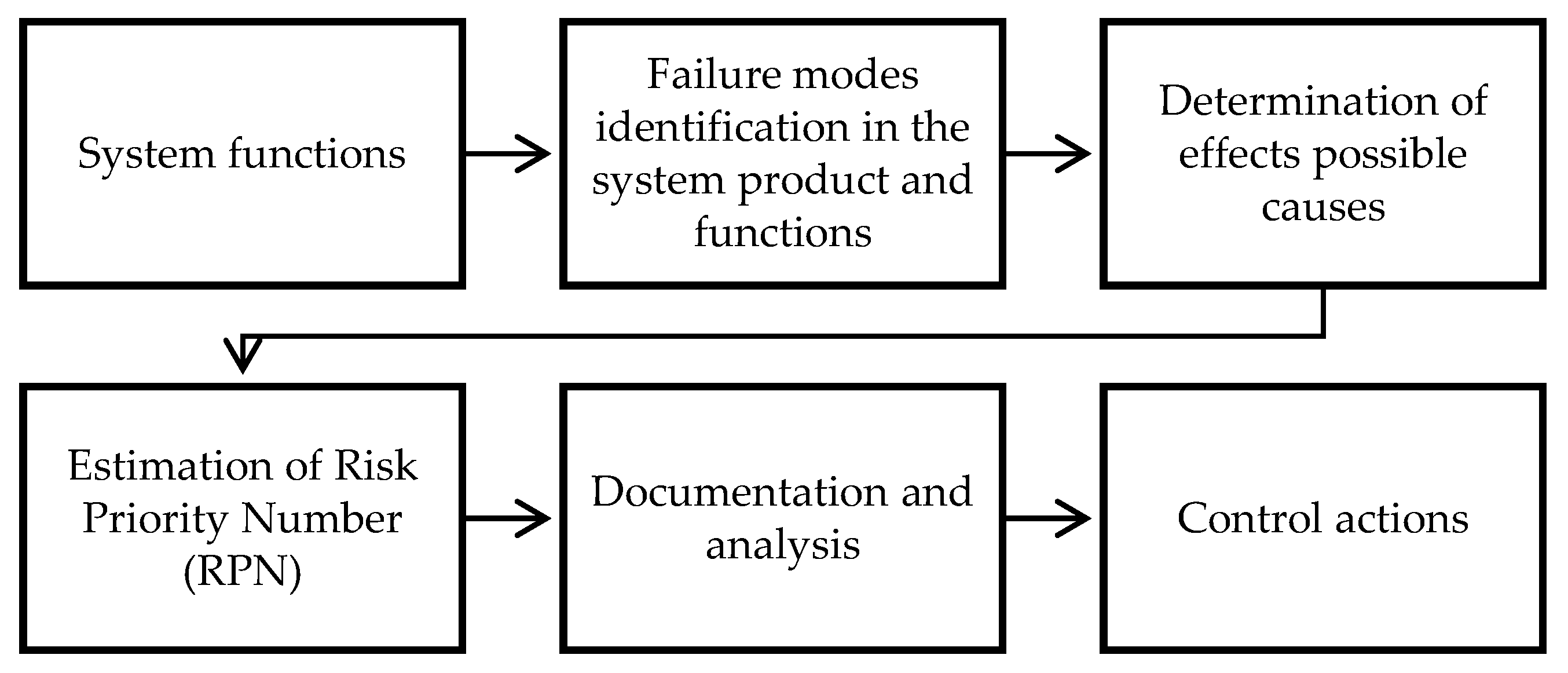
3.1. The Classical FMEA
- The formation of the product concept to check if the customer prospects are taken into consideration.
- The product-defining to check if projects, services, and supplies are appropriate and controlled at the right time.
- The production process to check if documentation primed by engineers is thoroughly carried out.
- The assembly to check whether the process is compatible with documentation.
- The service organization to check whether the product or service satisfies recognized criteria.
3.2. Fuzzy Approach
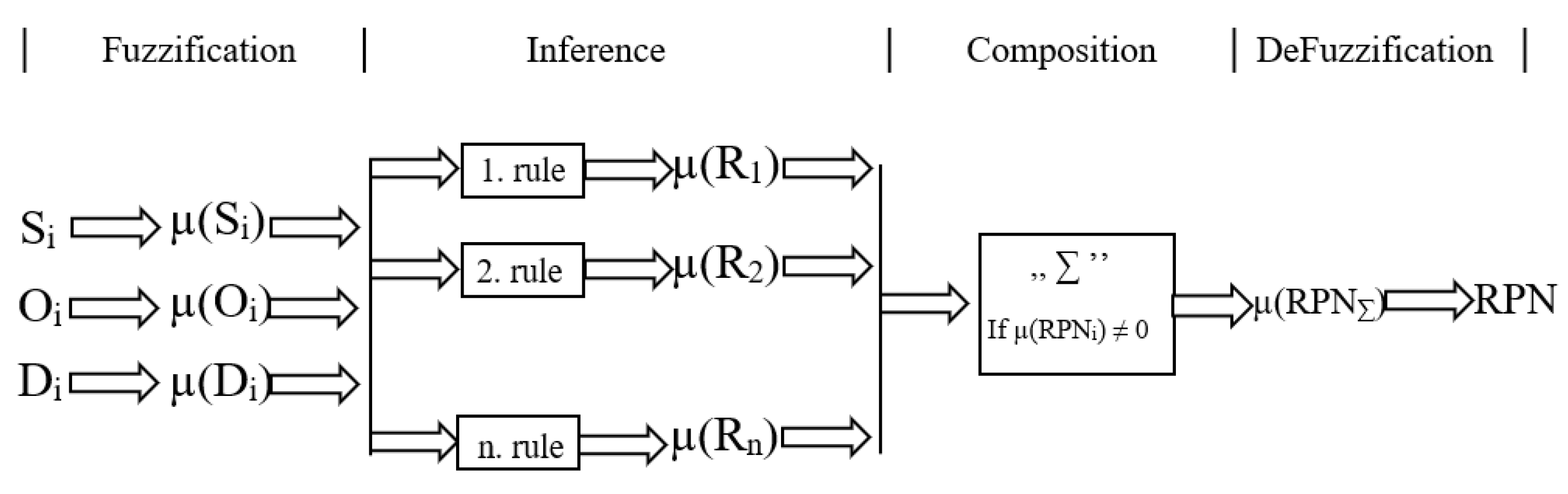
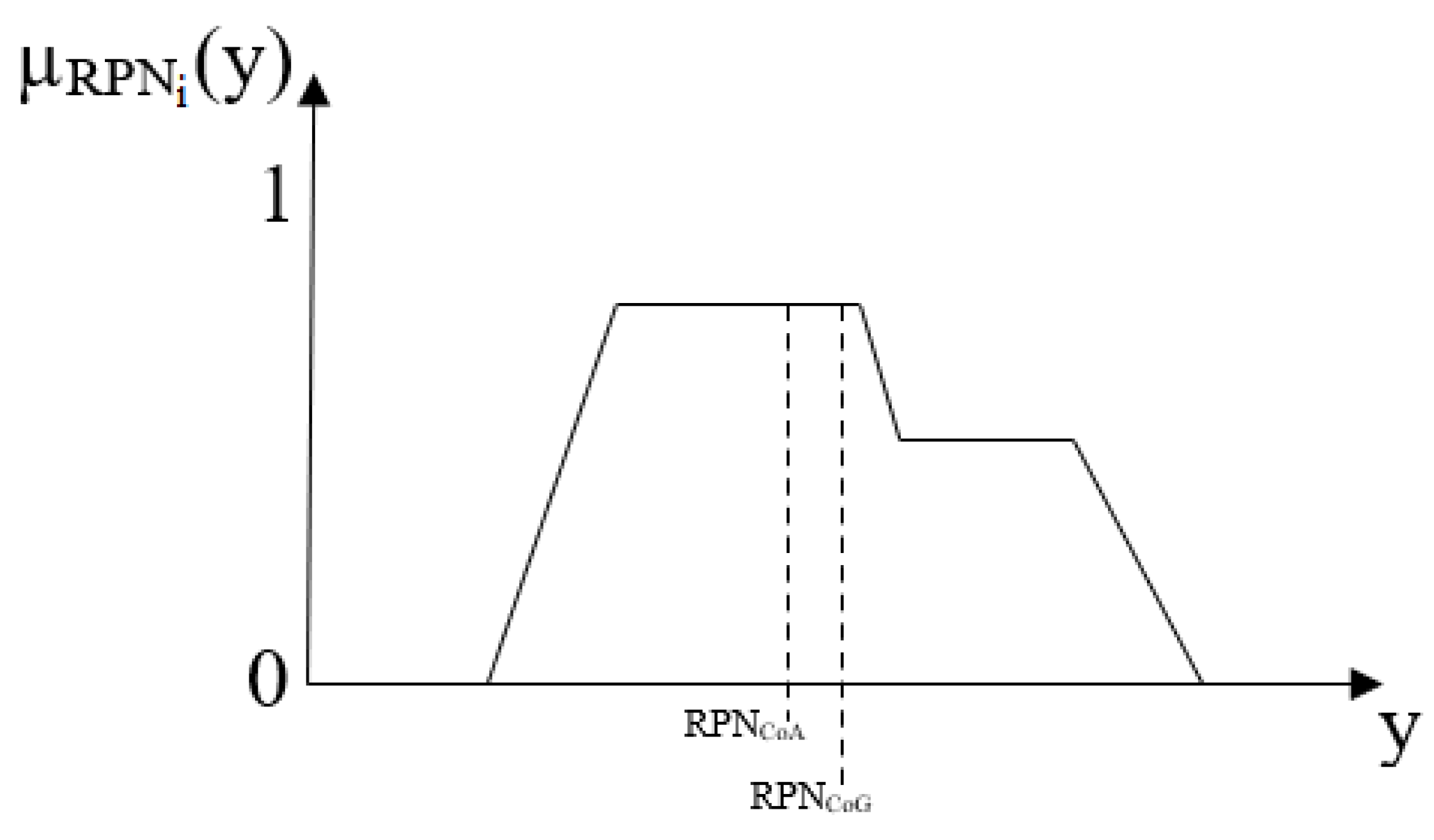
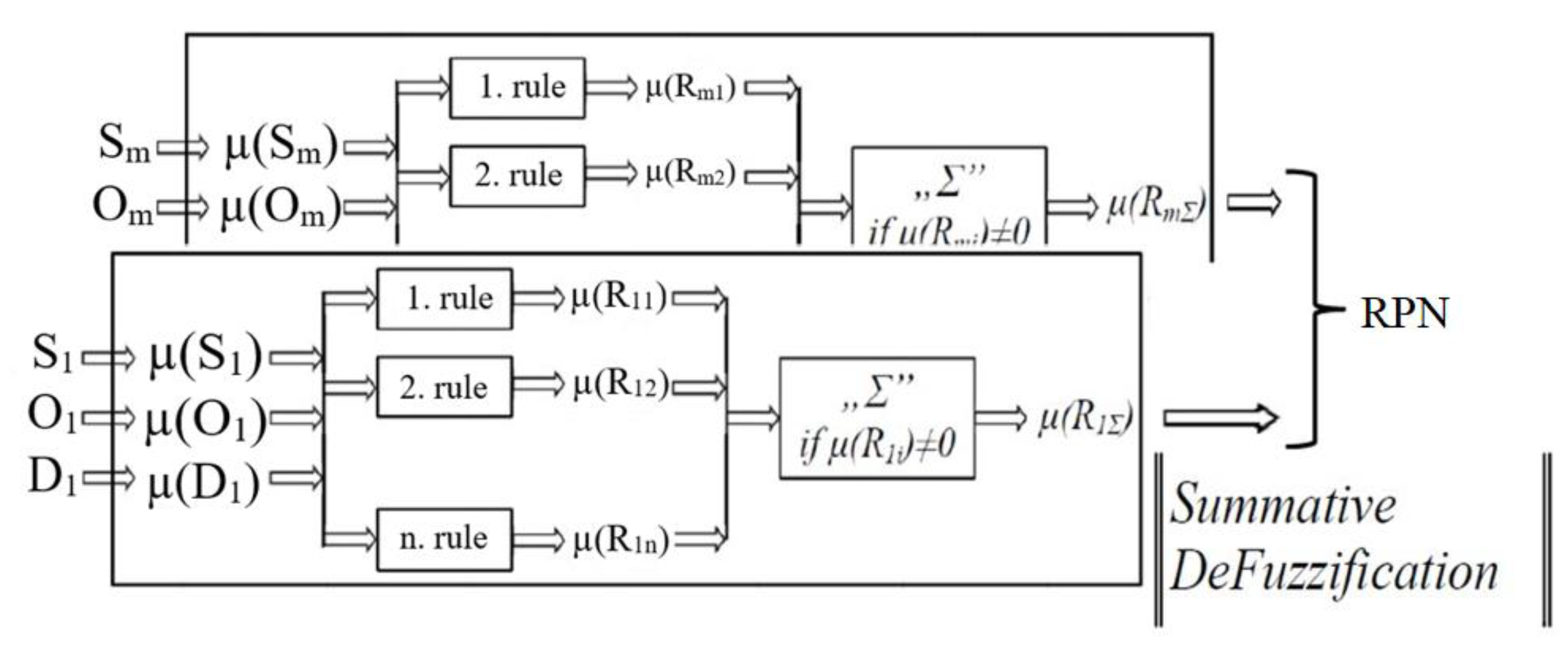
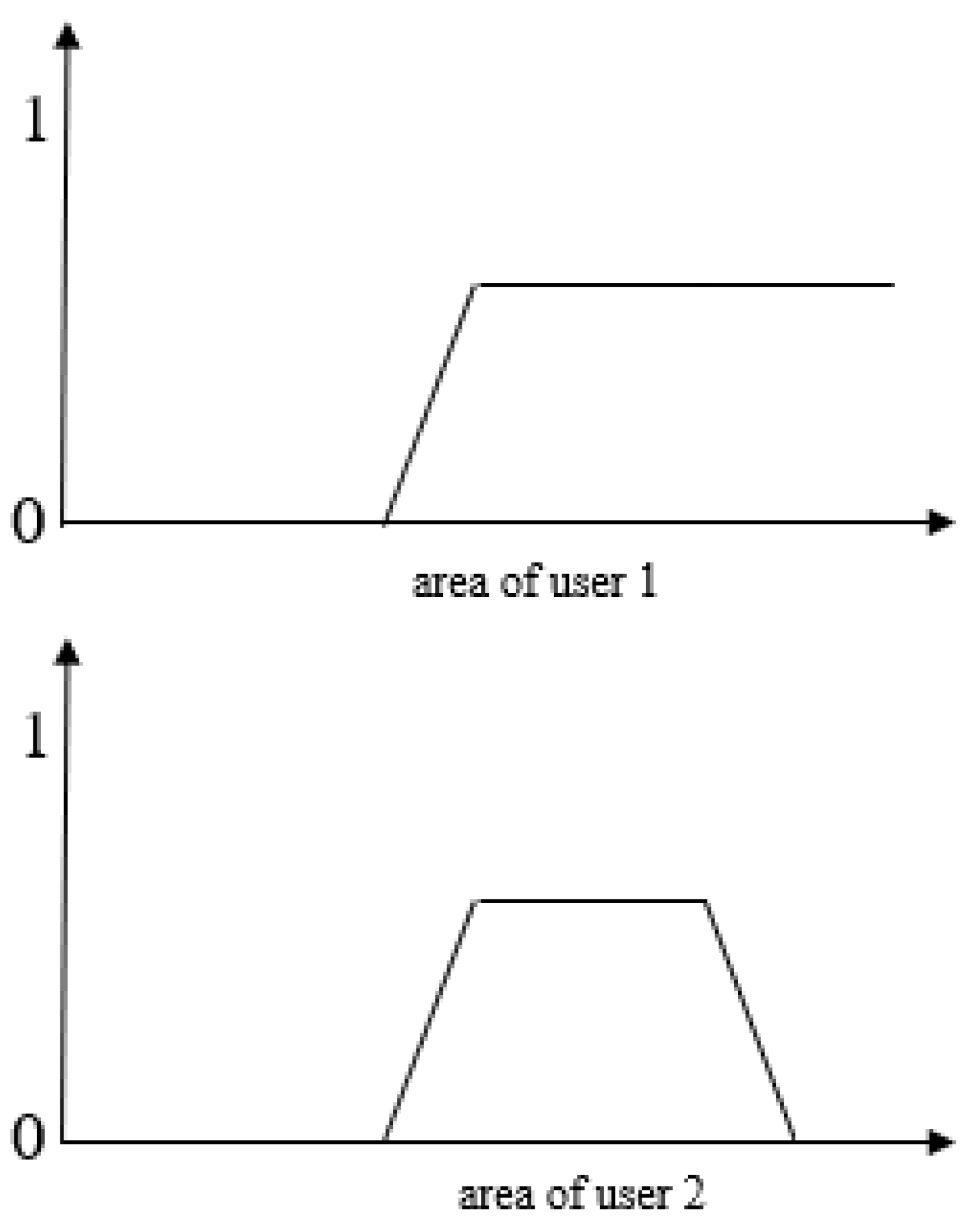
3.3. Fuzzy FMEA with Summative Defuzzification Method
4. The Smartphones’ Case
4.1. FMEA in Smartphones
- Identification of potential failures and effect.The most problematic elements found out in the considered smartphones were:
- Hardware failure modes: touchscreen, battery, device shell, front camera, rear camera, microphones, power buttons, volume control buttons, charger port.
- Software failure modes: freeze, self-shutdown, output failure.
- 2.
- Determining Severity (S)
- 3.
- Estimating Occurrence (O)
- 4.
- Failure Detection
- 5.
- Calculating Risk Priority Number (RPN).The Risk Priority Number (RPN) is calculated based on the explained criteria (Equation (1)). To summarize, it takes into account:
- The severity of the effect on the user and smartphone itself.
- How frequently the problem is likely to occur.
- How easily the problem can be detected.
4.2. FMEA Results
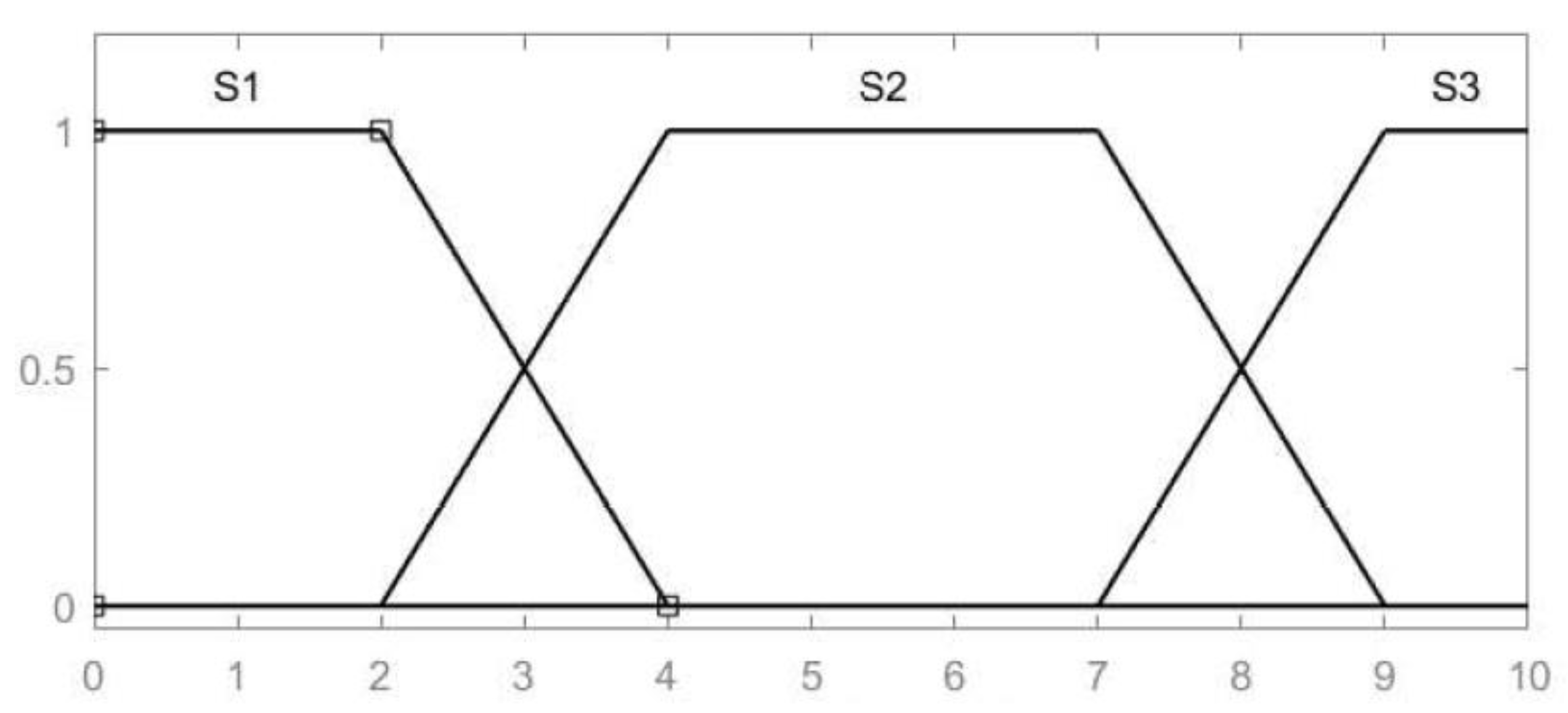
4.3. Fuzzy Rule-Based FMEA in Smartphones
4.4. Comparative Results
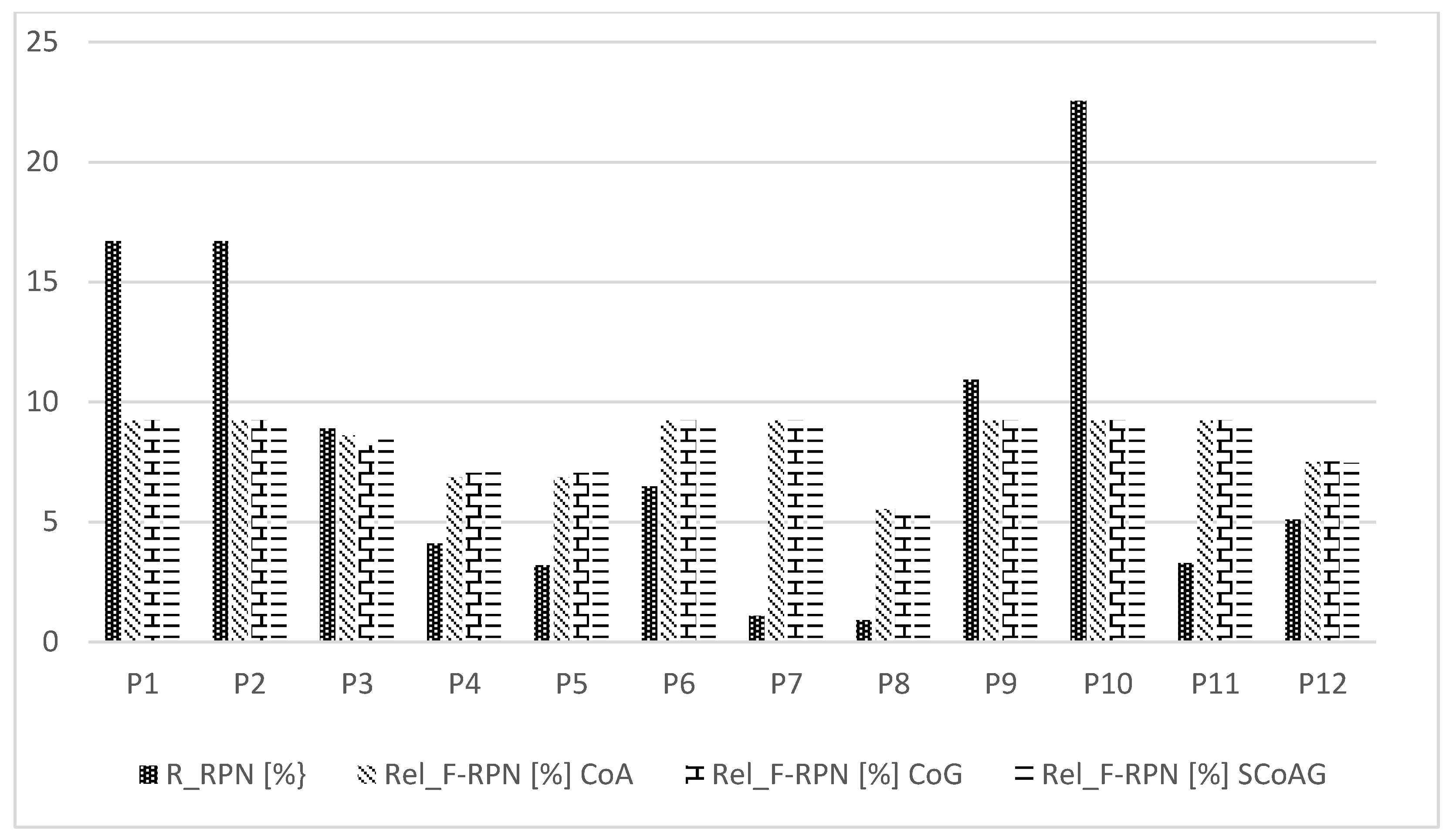
- Failure P10 (freeze) has the highest number in the case of RPN and relative RPN.
- Failure P8 (volume control buttons) has the smallest following P7 (charger port) in the case of RPN and relative RPN.
- Failures P1 (touchscreen), P2 (battery), P3 (device shell), P9 (charger port), and P10 (freeze) have higher values in the case of RPN and relative RPN than F-RPN and relative F-RPN—vice versa in other failure cases.
- Failure P3 gives a close relative RPN result in all cases.
- All the defuzzification methods give close relative F-RPN results.
- It can be observed that P1, P2, P6 (microphones), P7, P9, P10, P11 (self-shutdown), and P12 (output failure) in both CoA and SCoAG gives the same outcome. This situation occurs because this failure is assessed equally by the two different users.
5. Conclusions
Author Contributions
Funding
Institutional Review Board Statement
Informed Consent Statement
Data Availability Statement
Acknowledgments
Conflicts of Interest
References
- Sarwar, M.; Soomro, T. Impact of Smartphone’s on Society. Eur. J. Sci. Res. 2013, 98, 216–226. [Google Scholar]
- Kadena, E. Human error and latent conditions in mobile devices. Reducing risks through FMEA. In Proceedings of the III. International Rating Academy Congress on Applied Sciences, Lviv, Ukraine, 6–7 September 2018; pp. 8–13. [Google Scholar]
- Johnson, K.G.; Khan, M.K. A study into the use of the process failure mode and effects analysis (PFMEA) in the automotive industry in the UK. J. Mater. Process. Technol. 2003, 139, 348–356. [Google Scholar] [CrossRef] [Scilit]
- Dudek-Burlikowska, M.; Szewieczek, D. Quality estimation of sale process with usage of quality methods in chosen company. J. Achiev. Mater. Manuf. Eng. 2007, 20, 531–534. [Google Scholar]
- Dudek-Burlikowska, M. The concept of Total Quality Management and the contemporary entrepreneurship in practice. J. Achiev. Mater. Manuf. Eng. 2015, 37, 236. [Google Scholar]
- Carlson, C.S. Understanding and Applying the Fundamentals of FMEAs. In Proceedings of the 2014 Annual Reliability and Maintainability Symposium (RAMS), Colorado Springs, CO, USA, 27–30 January 2014; p. 12. [Google Scholar]
- Kamble, S.M.; Quazi, T. Shell moulding process using the combination of failure mode effect analysis and ahp approach. Glob. J. Eng. Scs. and Res. Man. 2014, 1, 1–10. [Google Scholar]
- Doshi, J.; Desai, D. Application of failure mode & effect analysis (FMEA) for continuous quality improvement—Multiple case studies in automobile SMEs. Int. J. Qual. Res. 2017, 11, 345–360. [Google Scholar] [CrossRef]
- Keskin, G.A.; Özkan, C. An alternative evaluation of FMEA: Fuzzy ART algorithm. Qual. Reliab. Eng. Int. 2009, 25, 647–661. [Google Scholar] [CrossRef] [Scilit]
- Murakami, S.; Maeda, M. Automobile speed control system using a fuzzy logic controller. In Industrial Applications of Fuzzy Control; Sugeno, M., Ed.; Elsevier Science B.V.: Amsterdam, The Netherlands, 1985. [Google Scholar]
- De Silva, C.W. Applications of fuzzy logic in the control of robotic manipulators. Fuzzy Sets Syst. 1995, 70, 223–234. [Google Scholar] [CrossRef] [Scilit]
- Erfianto, B.; Putrada, A.G. Water Filter Automation System Using Fuzzy Logic Controller. In Proceedings of the 2019 7th International Conference on Information and Communication Technology (ICoICT); 2019; pp. 1–6. [Google Scholar]
- Yasunobu, S.; Miyamoto, S. Automatic train operation system predictive fuzzy control. In Industrial Applications of Fuzzy Control; Sugeno, M., Ed.; North-Holland Publishing: North Holland, The Netherlands, 1985. [Google Scholar]
- Aamir, K.M.; Sarfraz, L.; Ramzan, M.; Bilal, M.; Shafi, J.; Attique, M. A Fuzzy Rule-Based System for Classification of Diabetes. Sensors 2021, 21, 8095. [Google Scholar] [CrossRef] [Scilit] [PubMed]
- Mittal, K.; Jain, A.; Vaisla, K.S.; Castillo, O.; Kacprzyk, J. A comprehensive review on type 2 fuzzy logic applications: Past, present and future. Eng. Appl. Artif. Intell. 2020, 95, 103916. [Google Scholar] [CrossRef] [Scilit]
- Portik, T.; Pokorádi, L. The summarized weighted mean of maxima Defuzzification and its application at the end of the risk assessment process. Acta Polytech. Hung. 2014, 11, 167–180. [Google Scholar] [CrossRef] [Scilit]
- Pokorádi, L.; Szamosi, B. Fuzzy failure modes and effects analysis with summarized center of gravity defuzzification. In Proceedings of the 2015 16th IEEE International Symposium on Computational Intelligence and Informatics (CINTI), Budapest, Hungary, 19–21 November 2015; pp. 147–150. [Google Scholar] [CrossRef] [Scilit]
- Pokorádi, L.; Tóth-laufer, E.; Koçak, S. Fuzzy Failure Modes and Effects Analysis Using Summative Defuzzification Methods. Acta Polytech. Hung. 2020, 18, 111–126. [Google Scholar] [CrossRef] [Scilit]
- Sanfelix, J.; Cordella, M.; Alfieri, F.; European Commission Joint Research Centre. Guidance for the Assessment of Material Efficiency: Application to Smartphones; Publications Office: Luxembourg, 2020. [Google Scholar]
- Duke, C.; Thorun, C.; Dekeulenaer, F.; Svatikova, K.; Smit, T.; Lucica, E.; Kettner, S.; Landzaat, W.; Suter, J.; Rodriguez Diaz, A.; et al. Behavioural Study on Consumers’ Engagement in the Circular Economy: Final Report; CEU: Budapest, Hungary, 2018. [Google Scholar]
- Sanfelix, J.; Cordella, M.; Alfieri, F.; European Commission Joint Research Centre. Analysis and Development of a Scoring System for Repair and Upgrade of Products: Final Report; Publications Office: Luxembourg, 2019. [Google Scholar]
- Prakash, S.; Dehoust, G.; Gsell, M.; Schleicher, T.; Stamminger, R. Influence of the Service Life of Products in Terms of Their Environmental Impact: Establishing an Information Base and Developing Strategies Against “Obsolescence”. 2020. Available online: https://www.umweltbundesamt.de/publikationen/influence-of-the-service-life-of-products-in-terms (accessed on 29 December 2021).
- Watson, D.; Gylling, A.C.; Tojo, N.; Throne-Holst, H.; Bauer, B.; Milios, L. Circular Business Models in the Mobile Phone Industry; Nordic Council of Ministers: Copenhagen, Denmark, 2017; Volume 2017560. [Google Scholar]
- OCU. Los Móviles Acumulan el 51% de las Quejas de Obsolescencia Prematura. 2018. Available online: https://www.ocu.org/consumo-familia/derechos-consumidor/noticias/obsolescencia-prematura (accessed on 29 December 2021).
- Phonerepaircompare. Smartphone Repair—Affordable Repair of iPhone/Smartphone. 2020. Available online: https://www.phonerepaircompare.co.uk/ (accessed on 29 December 2021).
- Stevens, A.; Frick, J.-C. Smartphone Studie. 2020. Available online: https://www.comparis.ch/downloadcenter/smartphone-report-2020 (accessed on 29 December 2021).
- Marques, L.M.C. FMEA—Mobile Phone; University of Ljubljana, Faculty of Computer and Information Science: Slovenia, Ljubljana, 26 May 2010; pp. 1–14. Available online: http://lrss.fri.uni-lj.si/sl/teaching/zzrs/lectures/2010_Marques.pdf (accessed on 29 December 2021).
- Liu, W.; Li, H. Impact Analysis of a cellular phone. In Proceedings of the 4th ANSA and µETA International Conference, Thessaloniki, Greece, 1–3 June 2011. [Google Scholar]
- Tay, R.S.; Chavannes, N.; Futter, P. Failure Modes and Effects Analysis (FMEA) on the RF Performance of Mobile Device Terminals. In Proceedings of the European Conference on Antennas and Propagation: EuCAP 2006, Nice, France, 31 October 2006. [Google Scholar]
- Cinque, M.; Cotroneo, D.; Kalbarczyk, Z.; Iyer, R.K. How Do Mobile Phones Fail? A Failure Data Analysis of Symbian OS Smart Phones. In Proceedings of the 37th Annual IEEE/IFIP International Conference on Dependable Systems and Networks (DSN’07), Edinburgh, Scotland, 25–28 June 2007; pp. 585–594. [Google Scholar]
- Vijayalakshmi, K. Analysis of Android OS Smart Phones Using Failure Mode and Effect Analysis. Int. J. Latest Trends Eng. Technol. 2014, 4, 11–18. [Google Scholar]
- Kadena, E. Assesing risks in mobile devices by using fmea. In Rajnai Zoltán Kiberbiztonság—Cybersecurity 2; Biztonságtudományi Doktori Iskola: Budapest, Hungary, 2019; pp. 184–194. ISBN 978-963-449-185-9. [Google Scholar]
- Mhetre, R.S.; Dhake, R.J. Using Failure Mode Effect Analysis in a Precision Sheet Metal Parts Manufacturing Company. Int. J. Appl. Sci. Eng. Res. 2012, 1, 302–311. [Google Scholar] [CrossRef] [Scilit]
- Bartosz, P.; Dudek-Burlikowska, M.; Roszak, M. The application of the FMEA method in the selected production process of a company. Prod. Eng. Arch. 2018, 18, 35–41. [Google Scholar] [CrossRef] [Scilit]
- Mikulak, R.J.; McDermott, R.; Beauregard, M. The Basics of FMEA, 2nd ed.; CRC Press: Boca Raton, FL, USA, 2011; ISBN 9781563273773. [Google Scholar]
- Stamatis, D.H. Failure Mode and Effect Analysis: FMEA From Theory to Execution, 2nd ed.; ASQ Quality Press: Milwaukee, WI, USA, 2003; ISBN 9780873895989. [Google Scholar]
- Demetgul, M. Washing Machine Using Fuzzy Logic. Autom. Control Intell. Syst. 2014, 2, 27. [Google Scholar] [CrossRef] [Scilit]
- Shamshiden, N.; Koçak, S. Anti-lock Braking System Control Based on Fuzzy Logic Fuzzy logika alapú blokkolásgátló fékrendszer vezérlése. Bánki Közlemények 2021, 4, 1–6. [Google Scholar]
- Varga, T.; Pokorádi, L. Possibilities of Use of Fuzzy Logic in the Quality Planning in the Automotive Industry. In Proceedings of the Mini Conference on Vehicle System Dynamics, Identification and Anomalies, Budapest, Hungary, 8–10 November 2010; pp. 311–318. [Google Scholar]
- Aichholzer, G. The Delphi Method: Eliciting Experts’ Knowledge in Technology Foresight. In Interviewing Experts; Bogner, A., Littig, B., Menz, W., Eds.; Research Methods Series; Palgrave Macmillan: London, UK, 2009; pp. 252–274. [Google Scholar]
- Yousuf, M.I. Using Experts’ Opinions Through Delphi Technique. Pract. Assess. Res. Eval. 2019, 12, 1–8. [Google Scholar] [CrossRef]



| P (Failure) | Failure | Function | Failure Mode | Effects | Causes | Control | Actions |
|---|---|---|---|---|---|---|---|
| HARDWARE | |||||||
| P1 | Touch-screen | Enables the user to interact. It works as an input (using finger or stylus). | Unresponsive: does not get users’ inputs or respond accurately. | Actions are not executable. User dissatisfied. | Hardware fault: user′s behavior; physical damage (e.g., dropped device); frequent touch. Software issue: system and operation issues. | Tests & examinations | More supervision; better material; sensitiveness improvement; quality design of built-in apps improvement. |
| P2 | Battery | Energy and sustainability to the device. | It drains quickly; the device does not hold the charger and cannot charge; overheating. | User dissatisfied; device reboots on its own; explosion risk. | Extreme temperatures; battery type; user negligence. | Tests & examinations | Improving chips more efficient OSs; improving battery quality—replacing the actual ones with more effective ones. |
| P3 | Device shell | Covers/protects the elements inside of the device. | Easily damaged after dropped. | User dissatisfied; device becomes more damaged over time. | User′s negligence; inadequate material quality; design errors from the manufacturing side. | Tests & examinations | More supervision; selecting the appropriate material or improving it. |
| P4 | Front camera | Taking selfies | Not working properly. | User dissatisfied and annoyed. | App problem | Tests & examinations | More supervision; improving default app. |
| P5 | Rear camera | Taking pictures | Not working properly. | User dissatisfied and annoyed. | App problem | Tests & examinations | More supervision; improving default app. |
| P6 | Micro-phones | Transmitting user′s voice to the other person(s);video recording; inputting voice in dictation; used for voice commands, assistants, music recognition apps. | Static sound in audio output; background noises; audio cut offs; distant sound; stop working. | User dissatisfied and annoyed; over time, they can become unfunctional. | Software fault: software bugs, system flaws; corrupted files and apps; configuration issues; accessories (e.g., headphones).ORHardware damage: physical damage of the mic component. | Tests & examinations | More supervision; quality improvements of the components. |
| P7 | Power button | Used to lock the screen; used together with volume control buttons to take screen shot and to switch the device off and on. | Sometimes does not get the user command properly. | User dissatisfied and annoyed; over time, it can be more depreciated. | User′s negligence; quality; manufacturing errors. | Tests & examinations | More supervision; quality improvement. |
| P8 | Volume control buttons | Used to adjust the volume; together with the power button to take screenshot and to switch the device off and on. | Sometimes does not get the user command properly. | User dissatisfied and annoyed; over time, can be more depreciated. | User′s negligence; quality; manufacturing errors. | Tests & examinations | More supervision; quality improvement. |
| P9 | Charger port | Used to charge the device. | Over time can be damaged and the device cannot be charged. | User dissatisfied and annoyed; over time can be more depreciated. | Bad use from the user; hardware can be damaged due to physical or liquid damage. | Tests & examinations | More supervision; quality improvement. |
| SOFTWARE | |||||||
| P10 | Freeze | - | Malfunction | The required function becomes inoperable; inappropriateoutput. | Due to the increase on operations; insufficient memory capacity; less software quality. | Tests & examinations | Selection of proper and reliable software; more supervision |
| P11 | Self-shut-down | - | Sudden or frequent shut down of device. | User dissatisfied and annoyed; not easy to continue the activity. | Poor battery; software issues;Segmentation fault (memory access violation error). | Tests & examinations | Batteries inspections; more supervision. |
| P12 | Output failure | - | No output | User dissatisfied and annoyed. | Hardware problem—due to the touchscreen or software faults. | Tests & examinations | Increased caution; more supervision. |
| P | COMPONENT | S | O | D | RPN |
|---|---|---|---|---|---|
| P1 | Touchscreen | 10 | 6 | 6 | 360 |
| P2 | Battery | 10 | 5 | 5 | 250 |
| P3 | Device shell | 5 | 7 | 4 | 140 |
| P4 | Front camera | 8 | 4 | 3 | 72 |
| P5 | Rear camera | 8 | 3 | 3 | 72 |
| P6 | Microphones | 10 | 1 | 3 | 30 |
| P7 | Power buttons | 9 | 1 | 2 | 18 |
| P8 | Volume control buttons | 7 | 1 | 2 | 14 |
| P9 | Charger port | 10 | 3 | 6 | 180 |
| 10 | Freeze | 9 | 6 | 6 | 324 |
| P11 | Self-shutdown | 9 | 3 | 2 | 54 |
| P12 | Output failure | 8 | 4 | 4 | 128 |
| P | COMPONENT | S | O | D | RPN |
|---|---|---|---|---|---|
| P1 | Touchscreen | 10 | 4 | 5 | 200 |
| P2 | Battery | 10 | 6 | 5 | 300 |
| P3 | Device shell | 5 | 6 | 5 | 150 |
| P4 | Front camera | 7 | 2 | 3 | 42 |
| P5 | Rear camera | 6 | 3 | 2 | 36 |
| P6 | Microphones | 9 | 4 | 6 | 216 |
| P7 | Power buttons | 9 | 1 | 2 | 18 |
| P8 | Volume control buttons | 8 | 1 | 2 | 16 |
| P9 | Charger port | 10 | 3 | 6 | 180 |
| 10 | Freeze | 7 | 5 | 5 | 175 |
| P11 | Self-shutdown | 9 | 3 | 2 | 54 |
| P12 | Output failure | 8 | 3 | 2 | 48 |
| Parameters | Rankings | Functions | |
|---|---|---|---|
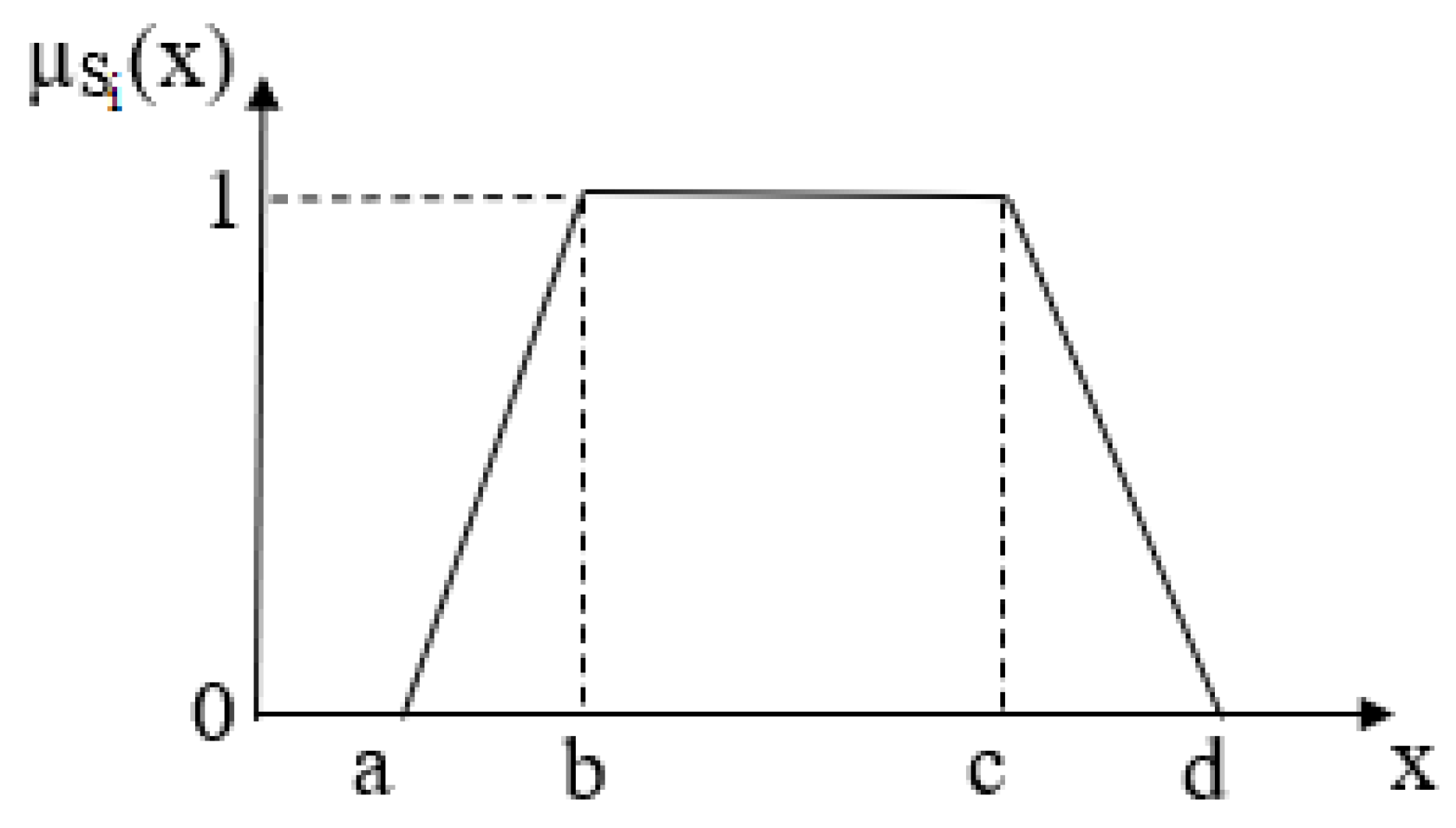
| S | S1 | Low | μLow = ƒ: (0,0,2,4) |
| S2 | Medium | μMed = ƒ: (2,4,7,9) | |
| S3 | High | μH = ƒ: (7,9,10,10) | |
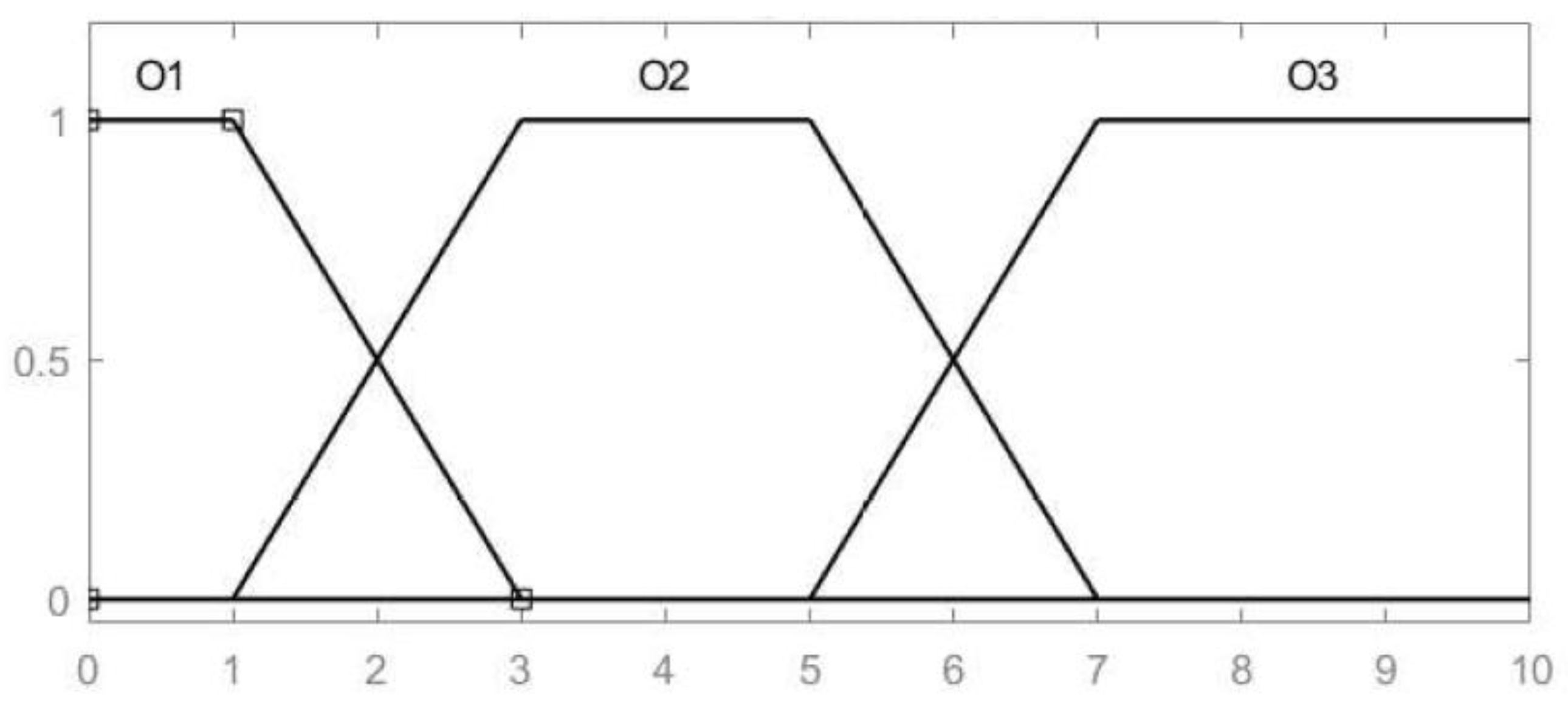
| O | O1 | Improbable | μImp = ƒ: (0,0,1,3) |
| O2 | Occasional | μOcc = ƒ: (1,3,5,7) | |
| O3 | Probable | μPro = ƒ: (5,7,10,10) | |
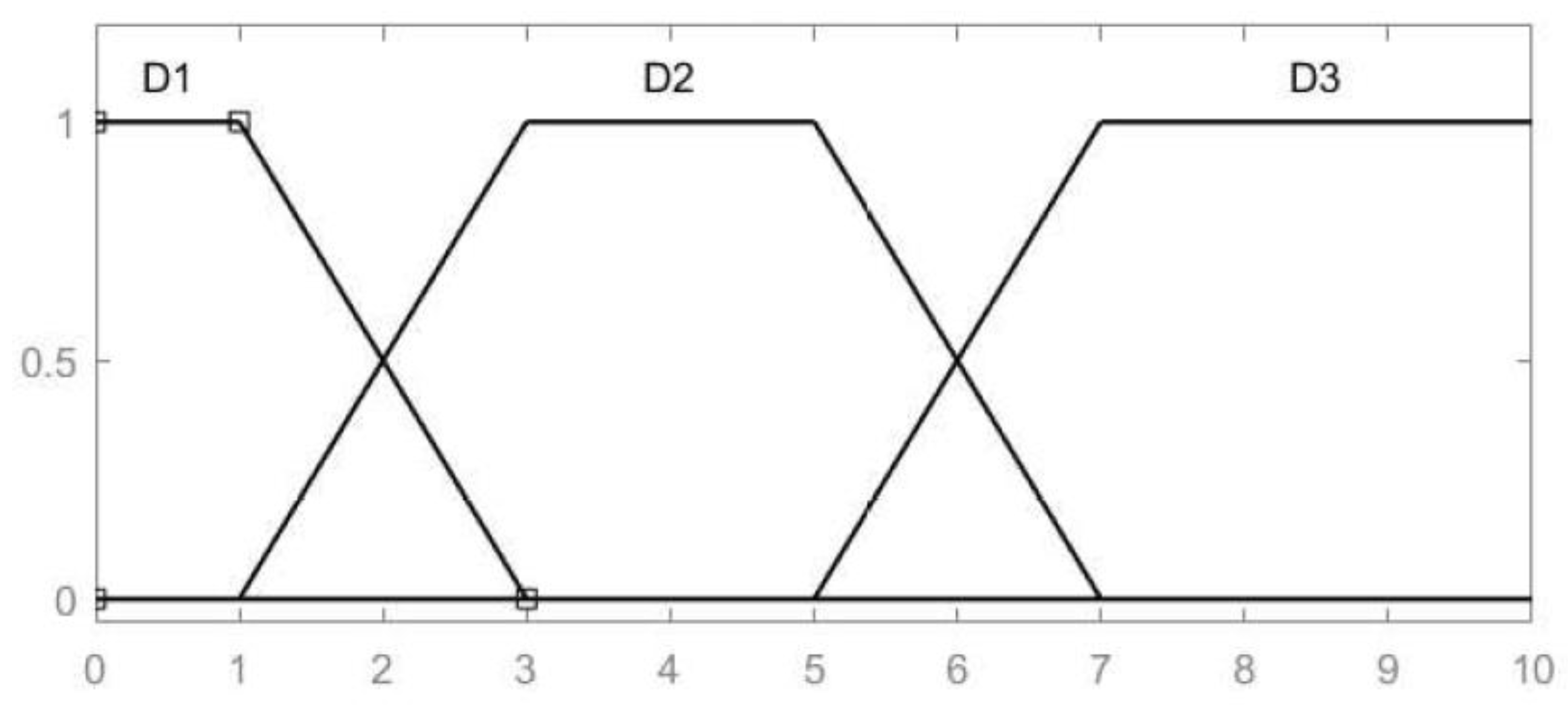
| D | D1 | Detectable Easily | μE = ƒ: (0,0,1,3) |
| D2 | Detectable | μDet = ƒ: (1,3,5,7) | |
| D3 | Detectable with Difficulty | μDif = ƒ: (5,7,10,10) | |
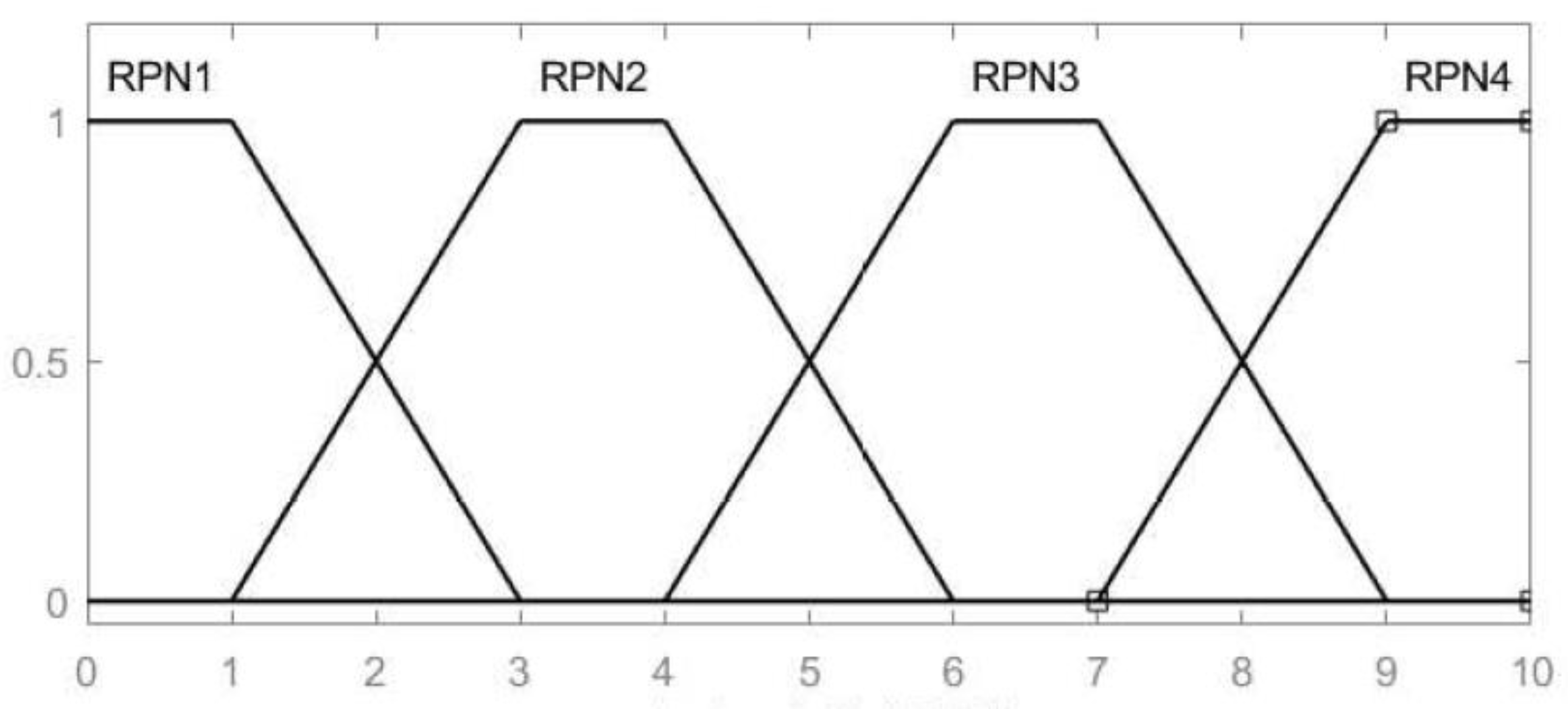
| RPN | R1 | Action is Unnecessary | μUnn = ƒ: (0,0,1,3) |
| R2 | Action is Suggested | μSug = ƒ: (1,3,4,6) | |
| R3 | Action is Needful | μN = ƒ: (4,6,7,9) | |
| R4 | Action is Very Needful | μVN = ƒ: (7,9,10,10) |
| No. | μSi | μOi | μDi | Rule | μRi |
|---|---|---|---|---|---|
| {1} | 0 | 0 | 0 | S1∩O1∩D1⇨R1 | 0 |
| {2} | 0 | 1 | 0 | S1∩O2∩D1⇨R2 | 0 |
| {3} | 0 | 0 | 1 | S1∩O1∩D2⇨R2 | 0 |
| {4} | 0 | 1 | 1 | S1∩O2∩D2⇨R3 | 0 |
| {5} | 0.5 | 0 | 0 | S2∩O1∩D1⇨R2 | 0 |
| {6} | 0.5 | 1 | 0 | S2∩O2∩D1⇨R3 | 0 |
| {7} | 0.5 | 0 | 1 | S2∩O1∩D2⇨R3 | 0 |
| {8} | 0.5 | 1 | 1 | S2∩O2∩D2⇨R3 | 0.5 |
| {9} | 0.5 | 0 | 0 | S3UO3UD3⇨R4 | 0.5 |
| Users | P1 | P2 | P3 | P4 | P5 | P6 | P7 | P8 | P9 | P10 | P11 | P12 | |
|---|---|---|---|---|---|---|---|---|---|---|---|---|---|
| S | User 1 | 10 | 10 | 5 | 8 | 8 | 10 | 9 | 7 | 10 | 9 | 9 | 8 |
| O | 6 | 5 | 7 | 4 | 3 | 1 | 1 | 1 | 3 | 6 | 3 | 4 | |
| D | 6 | 5 | 4 | 3 | 3 | 3 | 2 | 2 | 6 | 6 | 2 | 4 | |
| S | User 2 | 10 | 10 | 5 | 7 | 6 | 9 | 9 | 8 | 10 | 7 | 9 | 8 |
| O | 4 | 6 | 6 | 2 | 3 | 4 | 1 | 1 | 3 | 5 | 3 | 3 | |
| D | 5 | 5 | 5 | 3 | 2 | 6 | 2 | 2 | 6 | 5 | 2 | 2 | |
| S | Average | 10 | 10 | 5 | 7.5 | 7 | 9.5 | 9 | 7.5 | 10 | 9 | 9 | 8 |
| O | 5 | 5.5 | 6.5 | 3 | 3 | 2.5 | 1 | 1 | 3 | 5.5 | 3 | 3.5 | |
| D | 5.5 | 5 | 4.5 | 3 | 2.5 | 4.5 | 2 | 2 | 6 | 7.5 | 2 | 3 |
| Failure | RPN | F-RPN | Relative RPN [%] | Relative F-RPN [%] | ||||
|---|---|---|---|---|---|---|---|---|
| CoA | CoG | SCoAG | CoA | CoG | SCoAG | |||
| P1 | 275 | 9 | 8.94 | 9 | 16.71 | 9.23 | 9.24 | 9.20 |
| P2 | 275 | 9 | 8.94 | 9 | 16.71 | 9.23 | 9.24 | 9.20 |
| P3 | 146.25 | 8.4 | 7.92 | 8.24 | 8.89 | 8.61 | 8.18 | 8.42 |
| P4 | 67.5 | 6.7 | 6.82 | 6.92 | 4.10 | 6.87 | 7.05 | 7.07 |
| P5 | 52.5 | 6.7 | 6.82 | 6.92 | 3.19 | 6.87 | 7.05 | 7.07 |
| P6 | 106.87 | 9 | 8.94 | 9 | 6.49 | 9.23 | 9.24 | 9.20 |
| P7 | 18 | 9 | 8.94 | 9 | 1.09 | 9.23 | 9.24 | 9.20 |
| P8 | 15 | 5.4 | 5.37 | 5.43 | 0.91 | 5.54 | 5.55 | 5.55 |
| P9 | 180 | 9 | 8.94 | 9 | 10.94 | 9.23 | 9.24 | 9.20 |
| P10 | 371.25 | 9 | 8.94 | 9 | 22.56 | 9.23 | 9.24 | 9.20 |
| P11 | 54 | 9 | 8.94 | 9 | 3.28 | 9.23 | 9.24 | 9.20 |
| P12 | 83 | 7.3 | 7.27 | 7.3 | 5.10 | 7.49 | 7.51 | 7.46 |
Publisher’s Note: MDPI stays neutral with regard to jurisdictional claims in published maps and institutional affiliations. |
© 2022 by the authors. Licensee MDPI, Basel, Switzerland. This article is an open access article distributed under the terms and conditions of the Creative Commons Attribution (CC BY) license (https://creativecommons.org/licenses/by/4.0/).
Share and Cite
Kadena, E.; Koçak, S.; Takács-György, K.; Keszthelyi, A. FMEA in Smartphones: A Fuzzy Approach. Mathematics 2022, 10, 513. https://doi.org/10.3390/math10030513
Kadena E, Koçak S, Takács-György K, Keszthelyi A. FMEA in Smartphones: A Fuzzy Approach. Mathematics. 2022; 10(3):513. https://doi.org/10.3390/math10030513
Chicago/Turabian StyleKadena, Esmeralda, Sinan Koçak, Katalin Takács-György, and András Keszthelyi. 2022. "FMEA in Smartphones: A Fuzzy Approach" Mathematics 10, no. 3: 513. https://doi.org/10.3390/math10030513
APA StyleKadena, E., Koçak, S., Takács-György, K., & Keszthelyi, A. (2022). FMEA in Smartphones: A Fuzzy Approach. Mathematics, 10(3), 513. https://doi.org/10.3390/math10030513