

Abstract
This paper investigates the finite-time consensus tracking control problem of uncertain nonlinear multi-agent systems with unknown input saturation and unknown control directions. An adaptive fuzzy finite-time consensus control law is proposed by combining the fuzzy logic system, command filter, and finite-time control theory. Using the fuzzy logic systems, the uncertain nonlinear dynamics are approximated. Considering the command filter and backstepping control technique, the problem of the so-called “explosion of complexity” in the design of virtual control laws and adaptive updating laws is avoided. Meanwhile, the Nussbaum gain function method is applied to handle the unknown control directions and unknown input saturation problems. Based on the finite-time control theory and Lyapunov stability theory, it was found that all signals in the closed-loop system remained semi-global practical finite-time stable, and the tracking error could converge to a sufficiently small neighborhood of the origin in the finite time. In the end, simulation results were provided to verify the validity of the designed control law.
Keywords:
multi-agent systems; finite-time control; fuzzy logic system; unknown control directions; command filter MSC:
93D21; 93D50
1. Introduction
The consensus problem for multi-agent systems has been widely investigated over the past few decades due to its applications in aircraft formation control [1], autonomous unmanned systems [2], wireless sensor networks [3], and other fields. Many remarkable research findings, such as the adaptive cooperative control of nonlinear multi-agent systems [4], adaptive distributed control of non-affine multi-agent systems [5], iterative learning control of nonlinear multi-agent systems [6], distributed optimization control of linear multi-agent systems [7,8], adaptive event-triggered control of multi-agent systems [9,10], and so on, have been extensively reported. It is not difficult to find that in many existing achievements on multi-agent systems, the fuzzy logic system and neural network approach have been successfully applied to approximate the unknown nonlinear dynamics by many researchers; see [11,12,13,14] and references therein. Meanwhile, to obtain the final control law, the backstepping control technique and dynamic surface control technique have been considered by researchers [15,16]. Moreover, in [17,18], an improved command filter control method is addressed, where the compensating signal that does not need to take the derivative of the filtering error is applied, and the so-called “explosion of complexity” problem caused by the traditional backstepping control method is solved. However, it should be noted that in many practical systems, the control directions of these systems may not be known a priori or may be affected by actuator faults. Therefore, it is of more practical significance to consider these cases.
For the issue of control direction, the sign of control gain may not always be known when considering the existence of unmeasurable state variables and unknown uncertainties. Fortunately, the Nussbaum gain function method is presented and is usually used to deal with the unknown control direction, which was first reported in [19]. Subsequently, the method has been widely utilized for the adaptive control problems of kinds of systems under unknown control directions [20,21,22], to name only a few. More recently, the unknown control direction problems for multi-agent systems have been discussed in many references. In [23], the authors studied a class of multi-agent systems with second-order nonlinear dynamics, where the unknown control directions and position constraints are simultaneously considered and the designed position-constrained consensus control law ensured that the consensus errors could converge to zero. In [24,25], high-order nonlinear multi-agent systems with unknown control directions were investigated, where the output-constrained control law and distributed consensus control law have been presented, respectively. Furthermore, the leaderless consensus control for a class of nonlinear multi-agent systems with unknown control directions and strict-feedback form was developed in [26,27], where the designed adaptive control laws ensured that the error surfaces remained bounded and asymptotically converged to zero. However, it should be pointed out that the finite-time control problem was rarely discussed in the above results. Actually, in practical engineering, such as in the chemical reaction process and spacecraft attitude control, it is usually required to achieve stability quickly. Hence, in these cases, finite-time control should be considered. The finite-time control ensures that the tracking errors converge to the desired range within a given settling time. In addition, for the control problem of multi-agent systems with unknown control directions, how to design a finite-time control strategy is a topic worthy of research.
Another issue that needs attention is the faults of control systems, such as input/output saturation, dead-zone, and hysteresis, which are inevitable owing to the influence of external interferences or human factors. Among them, the fault of input saturation exists widely, and many control strategies have been proposed [28,29,30]. In recent years, the consensus control of multi-agent systems with input saturation has attracted the attention of some researchers. Considering the input saturation and unknown leader input, a distributed observer-based output feedback controller for multi-agent systems with multiple leaders was designed in [31]. For a class of singular multi-agent systems with input saturation, the control laws were presented by the authors to solve the semi-global bipartite consensus tracking control problem, where the local information of agents was considered [32]. In [33], an adaptive fuzzy consensus control law for the prescribed performance problem of a type of non-affine stochastic nonlinear multi-agent systems was proposed, where input hysteresis, input saturation, and non-affine nonlinear forms were simultaneously considered. Moreover, in [34,35], the command filter control problem of high-order nonlinear multi-agent systems with input saturation was discussed by the authors, where the problems of bipartite output consensus tracking control and event-triggered adaptive control were solved, respectively. Through the above analysis, it is not difficult to see that the control problems of multi-agent systems with input saturation have been deeply studied. However, it is also easy to see that there are only a few works that have further discussed the coexistence of an unknown control direction and input saturation in the finite-time control problem of multi-agent systems.
Based on the aforementioned discussion, this paper investigates an adaptive fuzzy finite-time consensus control law for nonlinear multi-agent systems with unknown input saturation and unknown control directions. Compared with the existing results, we have the following three main contributions:
(i) A class of nonlinear multi-agent systems is addressed in this paper, where uncertain dynamics, unknown control directions, and unknown input saturation are simultaneously considered, and only the local information of the agents is used. Different from the constant control gains considered in [22,25,27], the control gain considered in this paper is time-varying and the control input of multi-agent systems is subject to saturation constraints.
(ii) An improved command filter is designed, and then an adaptive fuzzy finite-time consensus control law is proposed by using the fuzzy logic system and finite-time control theory. Compared with [16,24,36], in this paper, the derivative of filtering errors generated in recursive design is avoided by introducing filtering compensating signals.
(iii) Based on the Nussbaum gain function method, the problems of unknown control directions and unknown input saturation are effectively solved. It can be seen that the presented control law ensures that all signals in the closed-loop system maintain semi-global practical finite-time stable, and the tracking errors can converge to a sufficiently small neighborhood of the origin in finite time.
The remainder of this paper is arranged as follows. The problem statement and mathematical preliminaries are introduced in Section 2. The design and theoretical analysis of the adaptive finite-time control law is presented in Section 3. Thereafter, Section 4 gives the simulation results, and brief conclusions are shown in Section 5.
2. Problem Statement and Mathematical Preliminaries
In this section, the problem statement and mathematical preliminaries that are used in this paper are provided.
2.1. Problem Statement
Consider a type of uncertain nonlinear multi-agent systems with one leader agent and follower agents. The dynamic model of the agent is given as
where , and are the state vectors; and are the control input and output of the follower agent, respectively; and are known smooth continuous nonlinear function; and , and are unknown smooth nonlinear functions and unknown parameter vectors, respectively; is an unknown time-varying nonlinear function representing the direction of the control input and . Here, the system input suffers from saturation nonlinearity, which is described as
where and are the unknown saturation boundaries, and is the actual control input to be designed. Similar to the method proposed in [36], the piecewise smooth function is introduced to process the saturation function and defined as
Hence, in (2) is expressed as
where is a bounded function and satisfies
Based on the application of the median value theorem [37], there exists a constant , , such that
where and . By selecting , one obtains
Moreover, the graph theory is introduced to represent the relationship of information changes among agents. Let be a directed graph with N nodes, in which is the set of vertices, is the set of edges, and is the weighted adjacency matrix of , respectively. If there is an edge between node and , then and otherwise . The set of neighbors of node is denoted by . The Laplacian matrix of is denoted by , where with . Graph is connected if a path exists between any two vertices.
An extended graph is defined as , which is associated with the leader agent and follower agents. Let the leader adjacency matrix as , and if the follower agent obtains the information of leader agent, then and otherwise .
The control goal is to design an adaptive fuzzy finite-time control law for the system (1), such that: (i) in the presence of unknown control directions and input saturation, all signals of the closed-loop systems are semi-global practical finite-time stable (SGPFS), and (ii) the output of each follower agent can be synchronized to the leader agent’s output .
To achieve the control objective, the following assumptions are given and will be utilized in the subsequent analysis.
Assumption 1.
The directed graph contains a spanning tree and the leader node is the root node.
Assumption 2.
The unknown nonlinear function , in system (1) is bounded. That is, , where and are unknown positive constants.
Remark 1.
Assumption 1 is a basic condition for the directed graph composed of multi-agent systems, which guarantees eigenvalues of have positive real parts [11,38]. That is to say, each follower agent has at least one neighbor. For Assumption 2, it is usually used to solve the problem of an unknown control direction of the system, see [20,23] and references therein. From the perspective of practical engineering, this assumption is reasonable because the control coefficient of the actual control input cannot be infinite in practice.
2.2. Mathematical Preliminaries
To facilitate the design of the consensus control law, we recall several useful preliminaries, including some definitions and lemmas.
Definition 1
[22]. The smooth continuous function is called the Nussbaum gain function if the following properties are held
There are many Nussbaum gain functions such as
, , , , and so on. In the following research, the Nussbaum gain function is chosen as
.
Lemma 1
[25]. Let
and be smooth functions defined on with , and
be an Nussbaum gain function. If the following inequality holds
then
, , and
are bounded on
, where
satisfies
, with
and
being positive constants;
is the positive constant.
Lemma 2
[39]. Consider the nonlinear system , if scalars
,
, and
exist, and a smooth positive definite function
such that
, then the nonlinear system
is SGPFS, and
satisfies
where
,
is the initial value of the system.
Lemma 3
[39]. For any real variables, and , and any positive constants, , , and , the following inequality holds
Lemma 4
[39]. For , , and , the following relation holds
Lemma 5
[4]. For any and , the hyperbolic tangent function satisfies .
2.3. Fuzzy Logic Systems
In the subsequent analysis, some unknown continuous functions will be approximated by the fuzzy logic systems. A fuzzy logic system usually consists of four parts, that is, the fuzzifier, the fuzzy rule base, the fuzzy inference engine, and the defuzzifier [33,40]. The fuzzy rule base is composed of “if-then” rules of the following form.
where and are the fuzzy logic system’s input and output, respectively; is the total number of “if-then” rules; and are fuzzy sets for linguistic variables and , respectively. By utilizing the singleton function, center average defuzzification, and product inference [33], the fuzzy logic system can be formulated as
where .
Let and , then (14) is rewritten as
where , .
Lemma 6
[33]. For any continuous function defined on a compact set and any given positive constant , a fuzzy logic system exists in the form of (15), such that
where
is the ideal parameter vector,
is the approximation accuracy and can be arbitrarily small.
3. Main Results and Stability Analysis
In this section, the adaptive fuzzy finite-time consensus control law is designed for controlling the multi-agent systems (1) based on the fuzzy logic system, command filter, finite-time control theory, and Nussbaum gain function method. The design procedure is divided into steps. At the step for the follower agent , , , the virtual control law is designed, and at the step, the actual control law for the follower agent is proposed.
3.1. Adaptive Fuzzy Finite-Time Consensus Control Law Design
The consensus error and coordinate transformation tracking error are given as
where and , are the output of a second-order command filter (see Lemma 7) with the virtual control law as the input.
Lemma 7
[41]. Consider the following second-order command filter with and as its initial conditions.
For any
, constants
,
, and
exist, such that the difference
is bounded by
.
Defining the compensated tracking error as follows:
where , is the compensating signal to be designed.
Step (): According to (17), (20), and system (1), the derivative of is given as
where
Considering the nonlinear function is unknown, a fuzzy logic system is employed to approximate it, that is,
where , is an approximation error and there exists .
Substituting (24) into (21), yields
According to (18), it is obtained that
According to Lyapunov stability theory, and considering estimation errors , and , the Lyapunov function candidate in this step is designed as
where , and ; , and are positive design constants; , and are the estimate of , and , respectively.
Noting (26), then the derivative of is expressed as
Designing the compensating signal as
Designing the virtual control law as
Designing the adaptive laws , and as
where , , , , , , and are the designed constants, respectively.
Considering (20), substituting (29)–(33) into (28), and considering the Lemma 5, yields
Remark 2.
Observing (18), it is not difficult to see that the differential of needs to be calculated, which will lead to an explosion of complexity. To avoid this phenomenon, the virtual control law is introduced into (26), and the difference can be obtained. Then, through the application of Lemma 7, the analysis process is simplified. The same considerations apply in the following steps.
Step: According to (18), (20), and (1), the derivative of is expressed as
A fuzzy logic system is employed to approximate the unknown nonlinear function , that is,
where is an approximation error and exists.
Considering (18), and substituting (36) into (35), we have
In view of the Lyapunov stability theory, and considering estimation errors and , the Lyapunov function candidate in this step is designed as
where and ; and are positive design constants; and are the estimate of and , respectively.
Thus, the derivative of can be determined by
Designing the compensating signal as
Designing the virtual control law as
Designing the adaptive laws and as
where , , and are the designed constants, respectively.
Substituting (40)–(43) into (39), and considering (20) and Lemma 5, we have,
Step (): It follows from (18), (20) and (1), the derivative of is obtained as
A fuzzy logic system is employed to approximate the unknown nonlinear function , that is,
where is an approximation error and there exists .
Noting (18), substituting (46) into (45) obtains
The Lyapunov function candidate is designed as
where and ; and are positive design constants; and are the estimate of and , respectively.
Similar to Step 1, the derivative of can be determined by
Designing the compensating signal as
Designing the virtual control law as
Designing the adaptive laws and as
where , , and are designed constants, respectively.
According to (20), substituting (50)–(53) into (49), and considering the Lemma 5, we have,
Step: The actual control law will appear in this step, the derivative of is given as
A fuzzy logic system is employed to approximate the unknown nonlinear function , that is,
where is an approximation error and exists.
Substituting (7) and (56) into (55), one obtains
where and .
Noting that
where represents or .
Considering , and Assumption 2, then the following inequalities hold
where and are unknown positive constants.
Similarly, applying the estimation errors and , The Lyapunov function candidate in this step is designed as
where and ; and are the positive design constants; and are the estimates of and , respectively.
Thus, the time derivative of becomes
Designing the compensating signal as
Designing the adaptive laws and as
Considering the control input sign as unknown, the Nussbaum gain function is applied to deal with the unknown control direction. Therefore, the actual control law of the system (1) is designed as
where
where , , , and are designed constants, respectively.
Noting (20), substituting (63)–(68) into (62), and considering the Lemma 5, we have,
3.2. Stability Analysis
Based on the above analysis, the main results can be summarized as follows, in Theorem 1.
Theorem 1.
For the uncertain nonlinear multi-agent systems (1) with unknown input saturation and unknown control directions, under Assumptions 1 and 2, by designing the compensating signals (29), (40), (50), and (63); the virtual control laws (30), (41), and (51); the actual control law (66) with (67) and (68); and together with the adaptive laws (31), (32), (33), (42), (43), (52), (53), (64), and (65), it can be ensured that all signals of the system are SGPFS, and the tracking error can converge to a sufficiently small neighborhood of origin in finite time.
Proof.
Consider the Lyapunov function candidate as
From (34), (44), (54), and (69), the time derivative of can be expressed as
As a result of,
Substituting (72)–(74) into (71), we have,
where,
According to Lemma 3, let , , and , respectively; , , , and , the following results are held,
By using Lemma 4, and substituting (78)–(81) yields
where
Considering Lemma 1, it is found that is bounded and exists, where is a positive constant. Let , and , and based on Lemma 4, we have,
Furthermore, it is implied from Lemma 2 that the function makes the trajectory of the system enter in finite time, which further indicates that the tracking error , , is bounded in finite time, that is,
or,
and the setting time is
where and , is the initial value of .
According to (20), it can be deduced from that the consensus error will be SGPFS, as long as converges in finite time. The following results prove that converges in finite time.
Consider the Lyapunov function candidate as
Considering (29), (40), (50), and (63), the time derivative is given as
According to Lemma 7, it is found that and , , in finite time and the setting time is given as , where and are the positive design constants. Then, we have
Based on Lemma 3, we have,
where , , , are positive constants to be designed.
Substituting (92) and (93) into (91), and using Lemma 4, we can find that
where
Furthermore, it is implied from Lemma 2 that the compensating signal , , is bounded in finite time, that is,
or,
and the setting time is given as
where , and ; is the initial value of .
According to (17), we have
where , , with for .
Considering (87) and (100), and noting , we then obtain
Together with (102) and (103), we have
where expresses the minimum eigenvalue of .
Thereby, we can find the output tracking error satisfies
where . □
Then, by adjusting the design parameters, for , all of the signals in the closed-loop system are SGPFS. The proof is completed. □
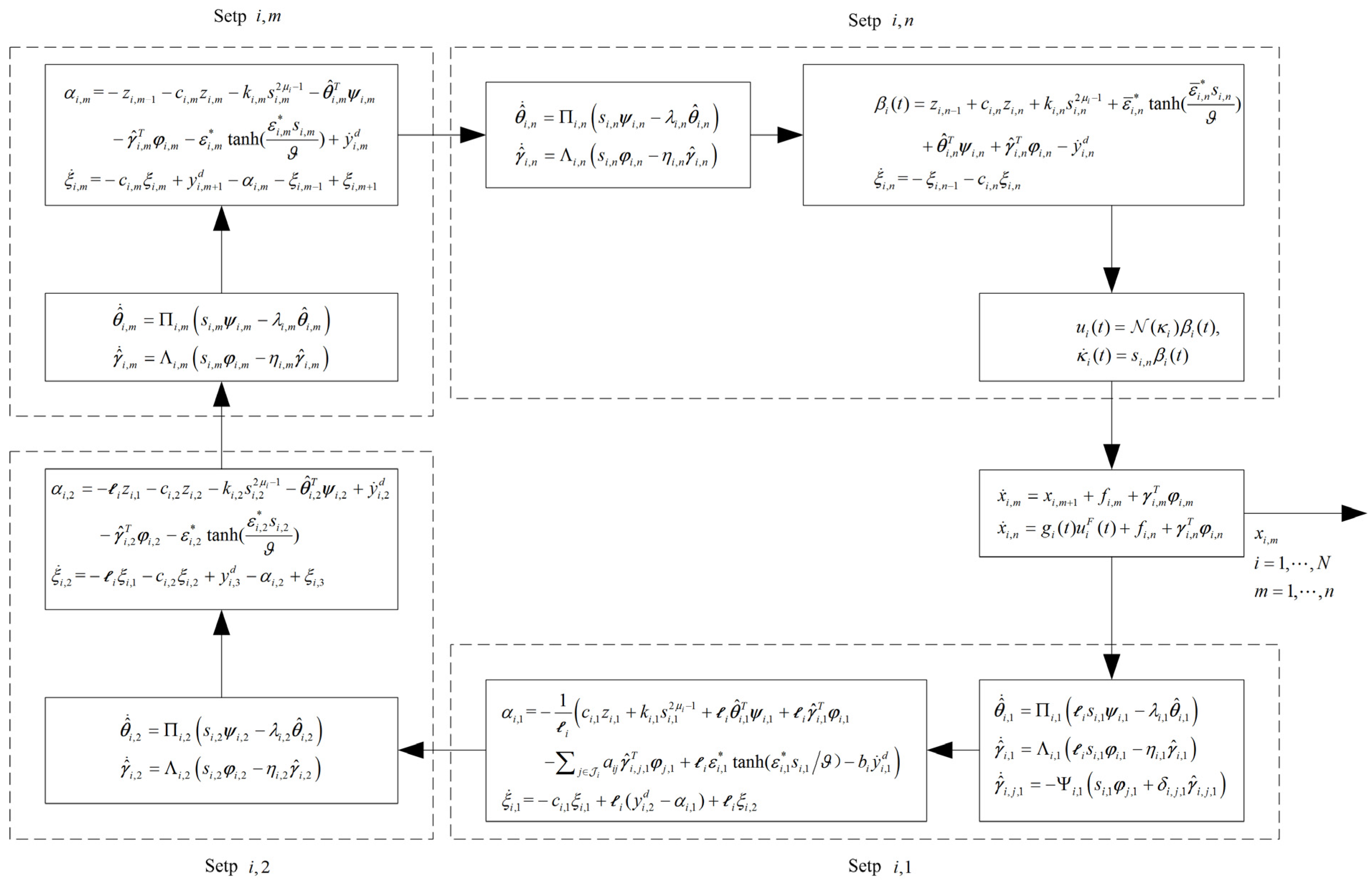
The multi-agent system control block diagram is shown as follows in Figure 1.
Figure 1.
Control block diagram of multi-agent systems.
Remark 3.
Observing (105), we can decrease , , , and or increase , , , and to decrease the values of and ; and we can also increase to increase the value of . Because the values of and are decreased and is increased, the tracking error can be arbitrarily small. However, the selection of these design parameters may cause the control signal to have a large amplitude at the beginning of the simulation. Therefore, when selecting the design parameters, it is necessary to make appropriate tradeoffs between tracking control performance and control signal.
4. Simulation Results
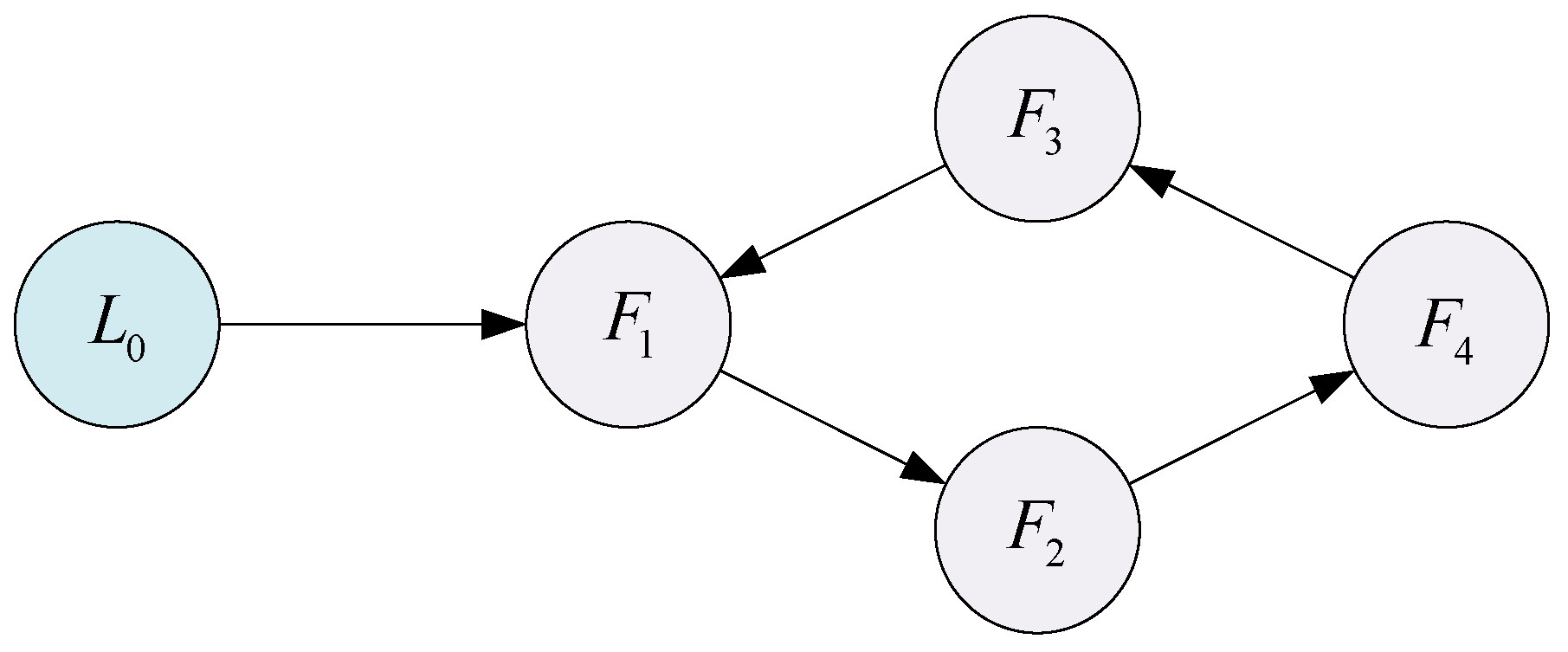
To illustrate the validity of the proposed control law, the nonlinear multi-agent systems considered in this paper are described in (106). The system consists of one leader agent (Labeled ) and four follower agents (Labeled , , , and ), and the directed communication topology graph is shown in Figure 2.
where , , , , , , , , , , , , , , , , , , , , .
Figure 2.
Communication topology graph of multi-agent systems.
The fuzzy logic system is applied to approximate the unknown nonlinear dynamics, and the membership functions are given as follows:
The initial states of the multi-agent systems (106) are set as , , , , and . The initial values of the adaptive laws are given as , , , , , , where . The desired reference trajectory is given as , and the simulation time is set as .
The other design parameters were chosen as , , , , , , , , , , , , , , , , , , , , , , where .
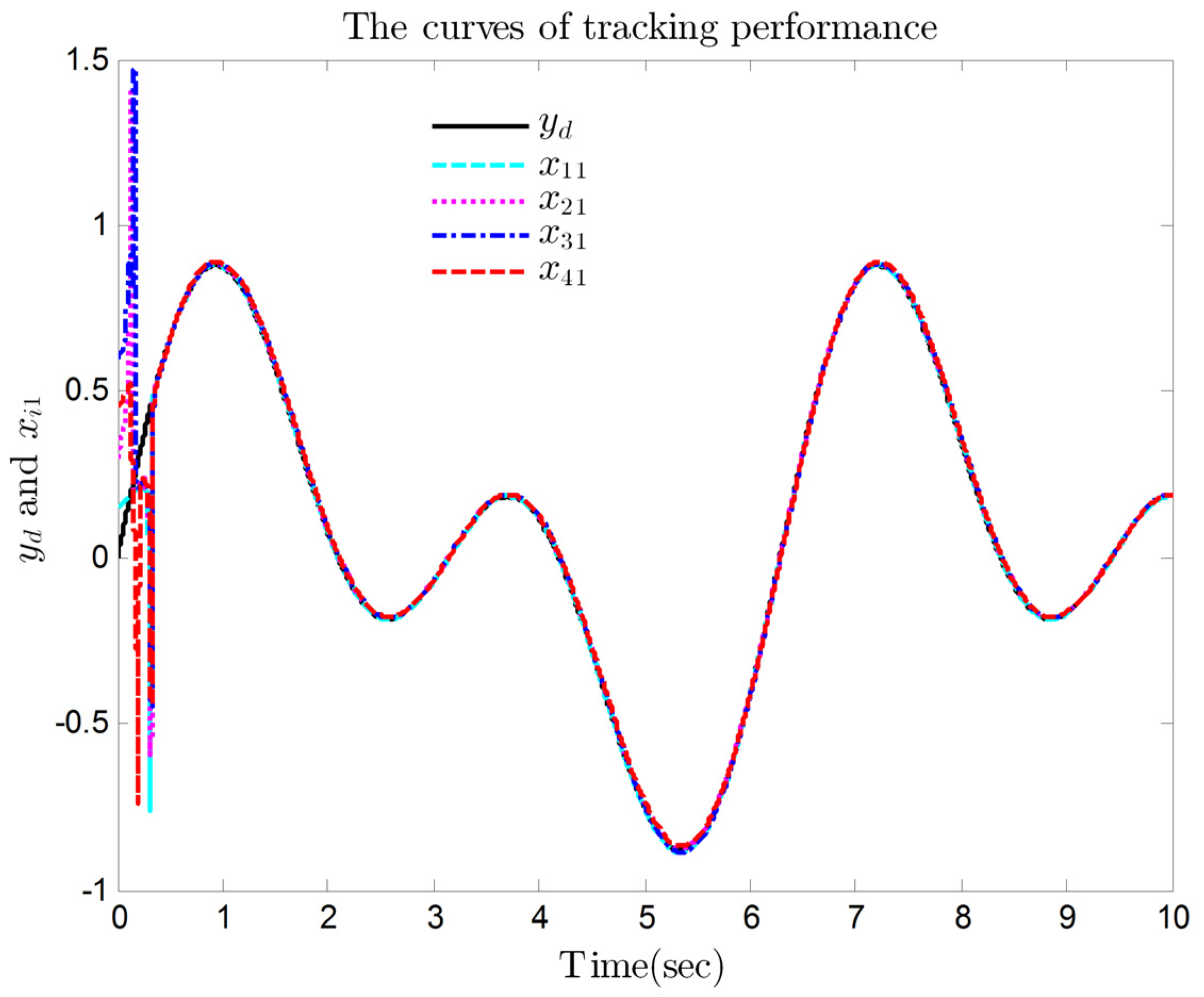
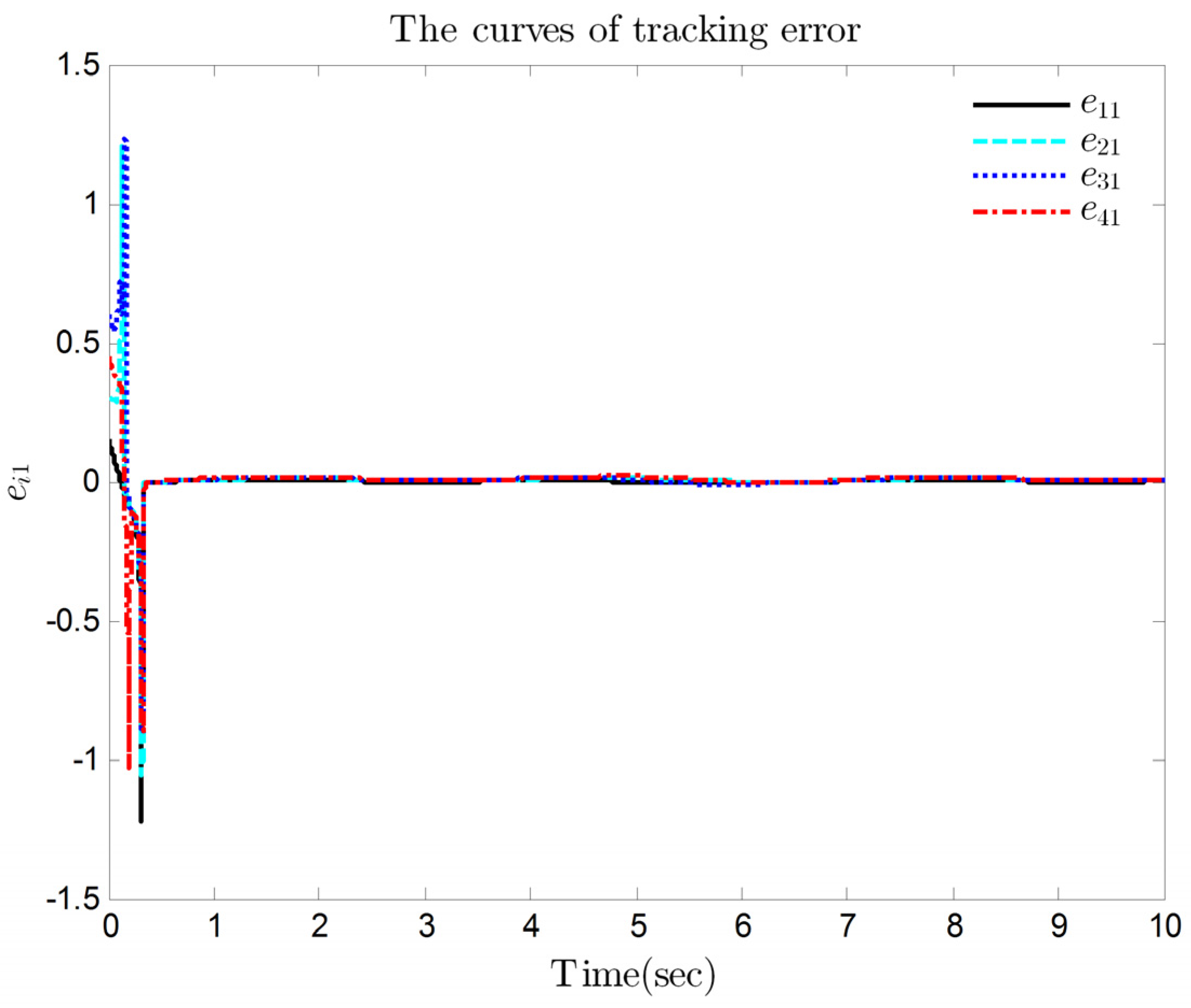
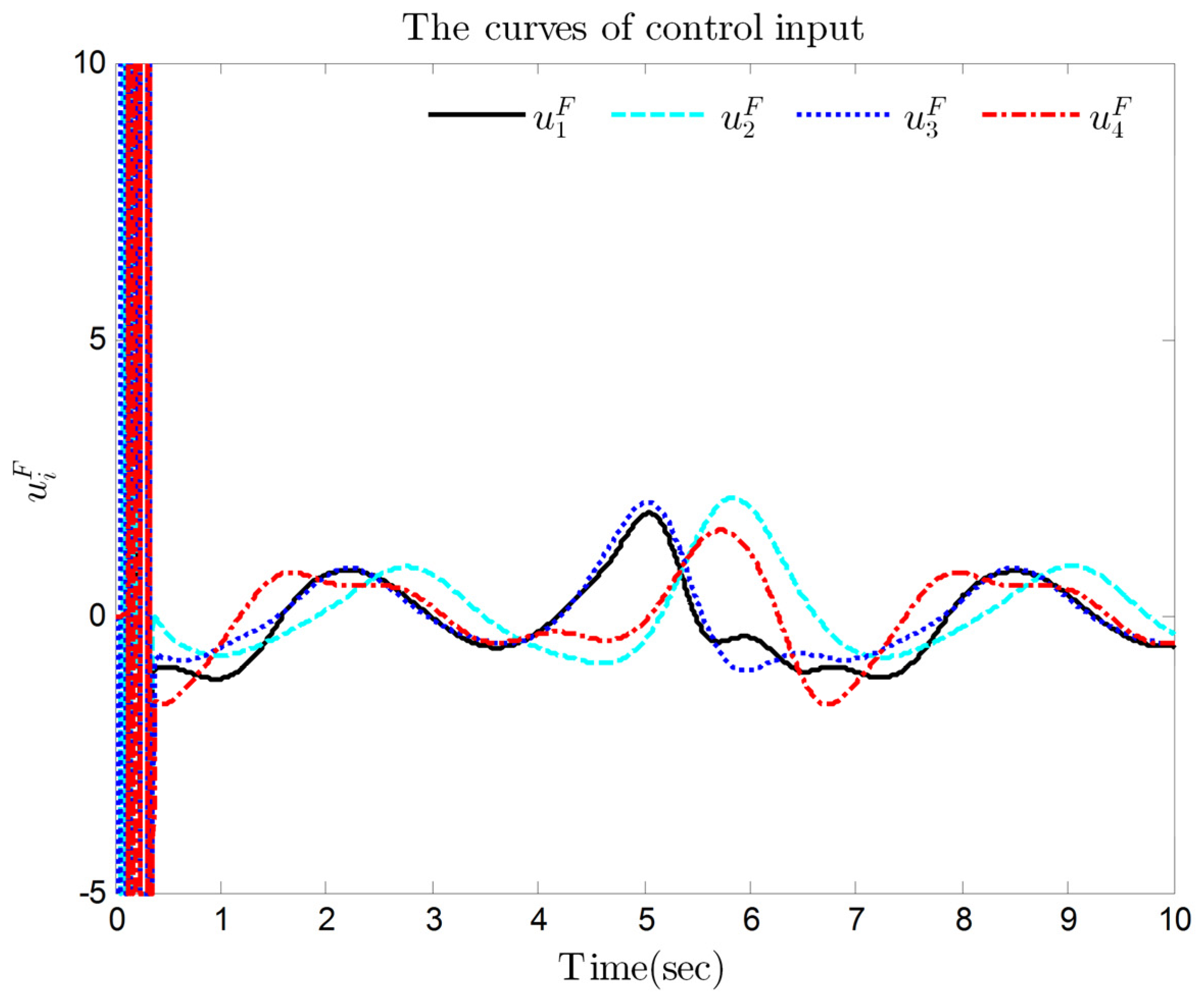
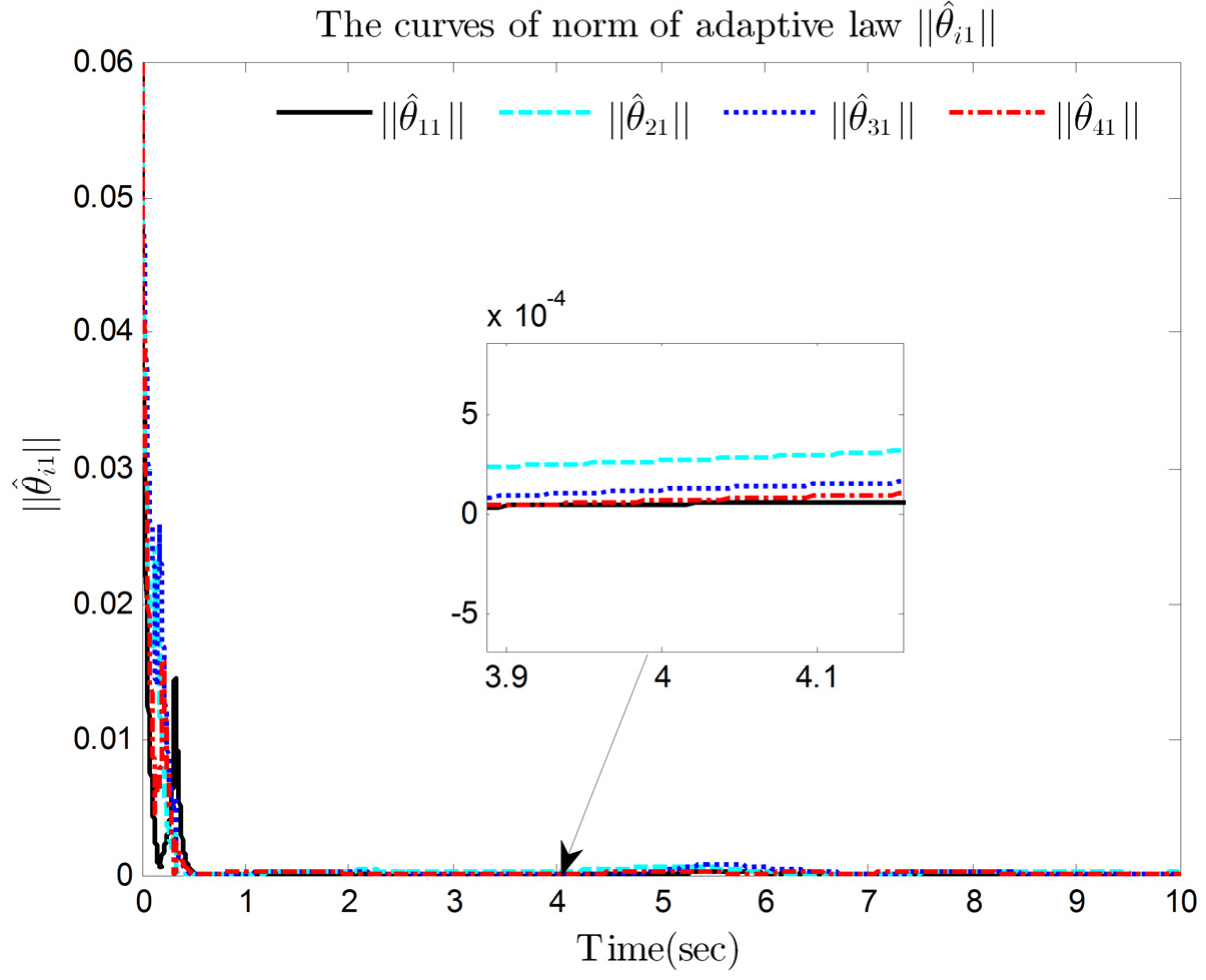
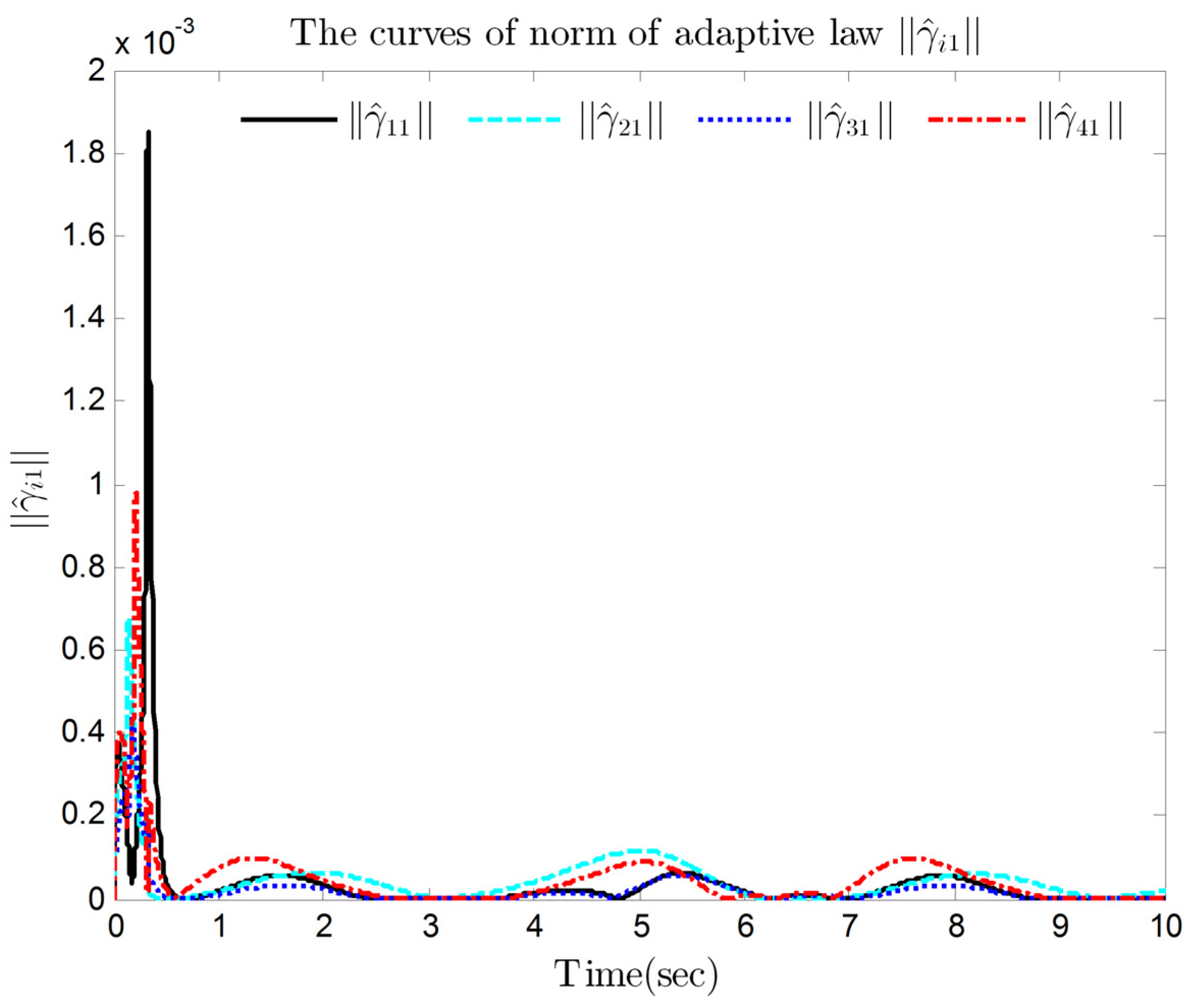
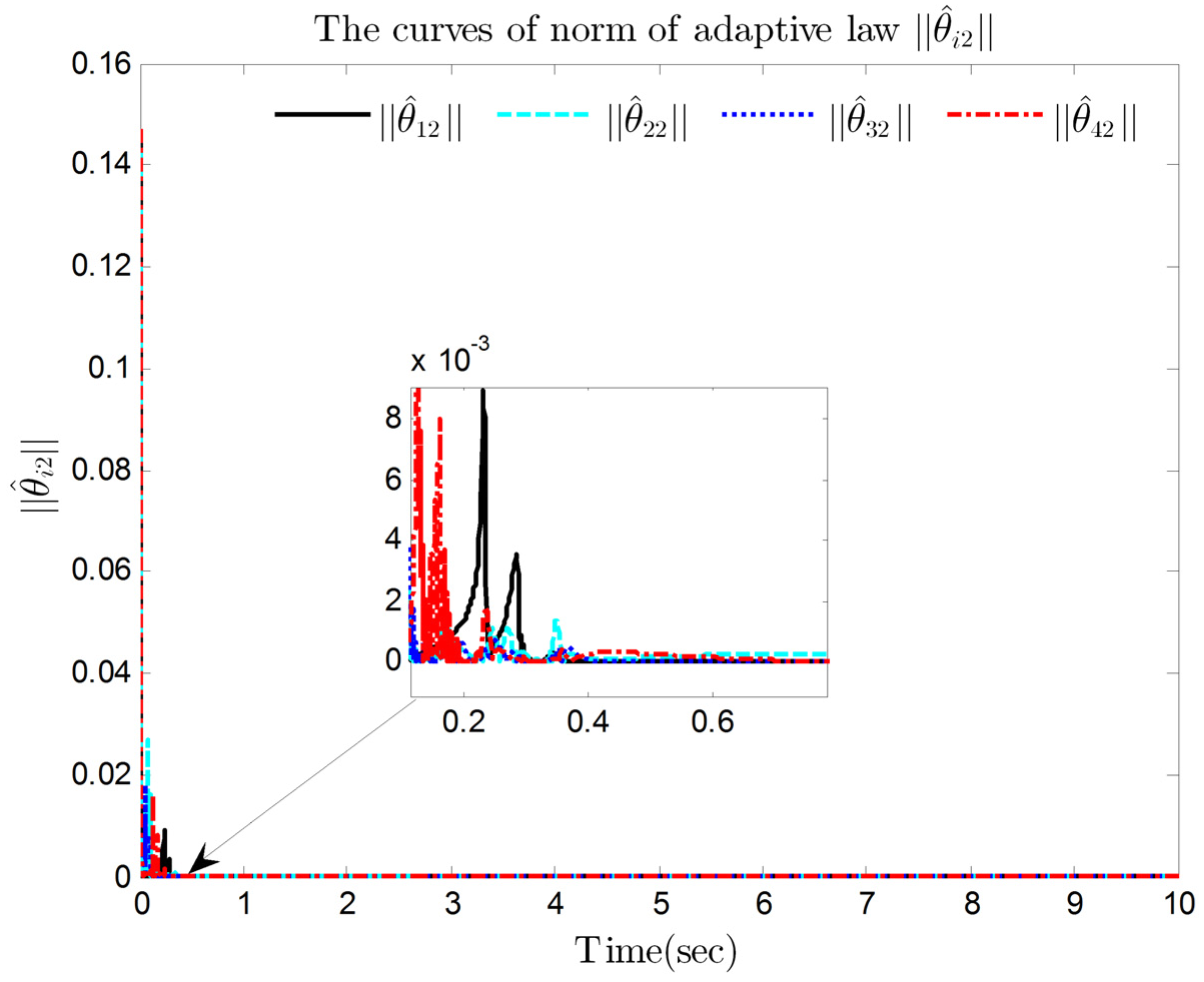
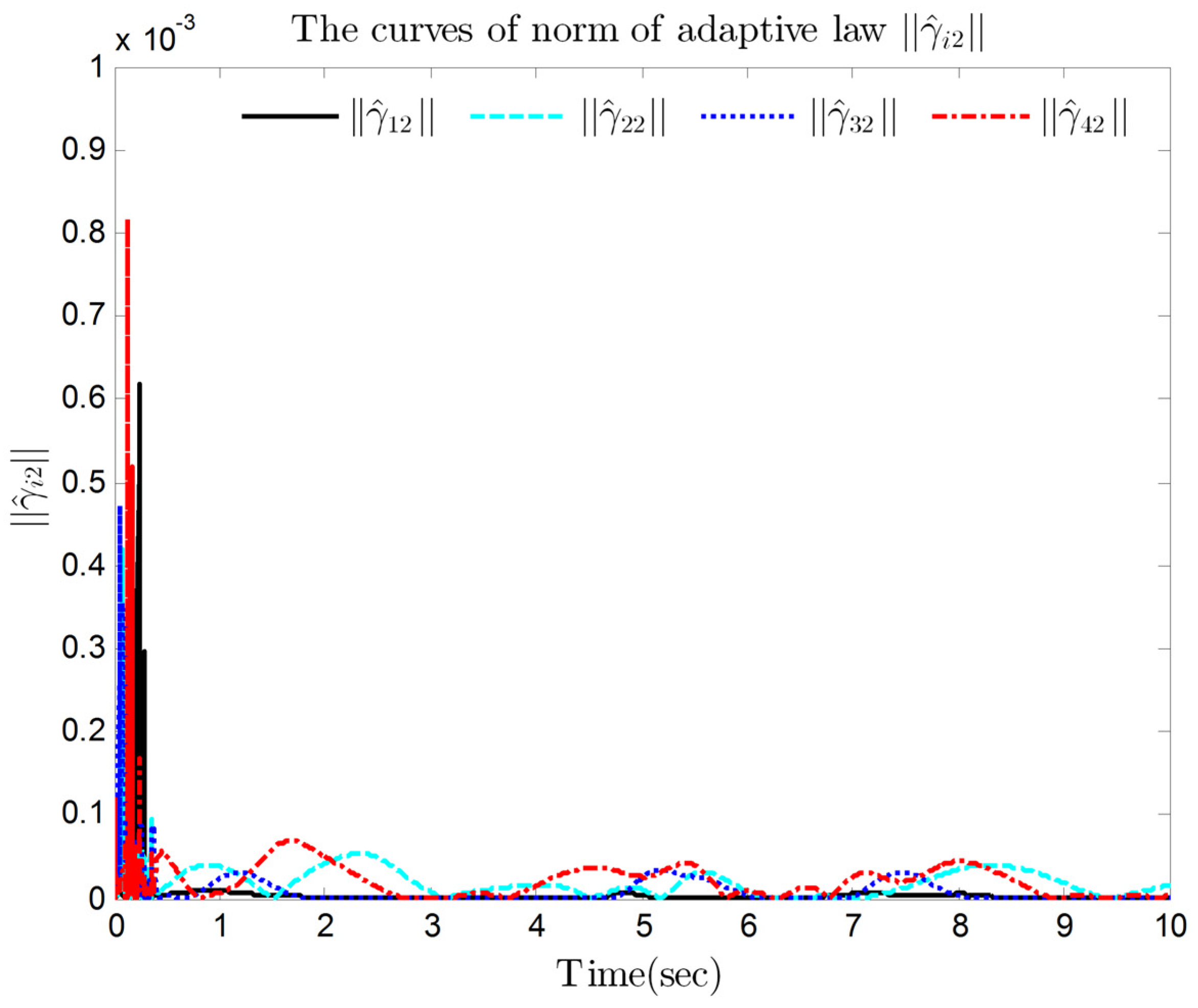
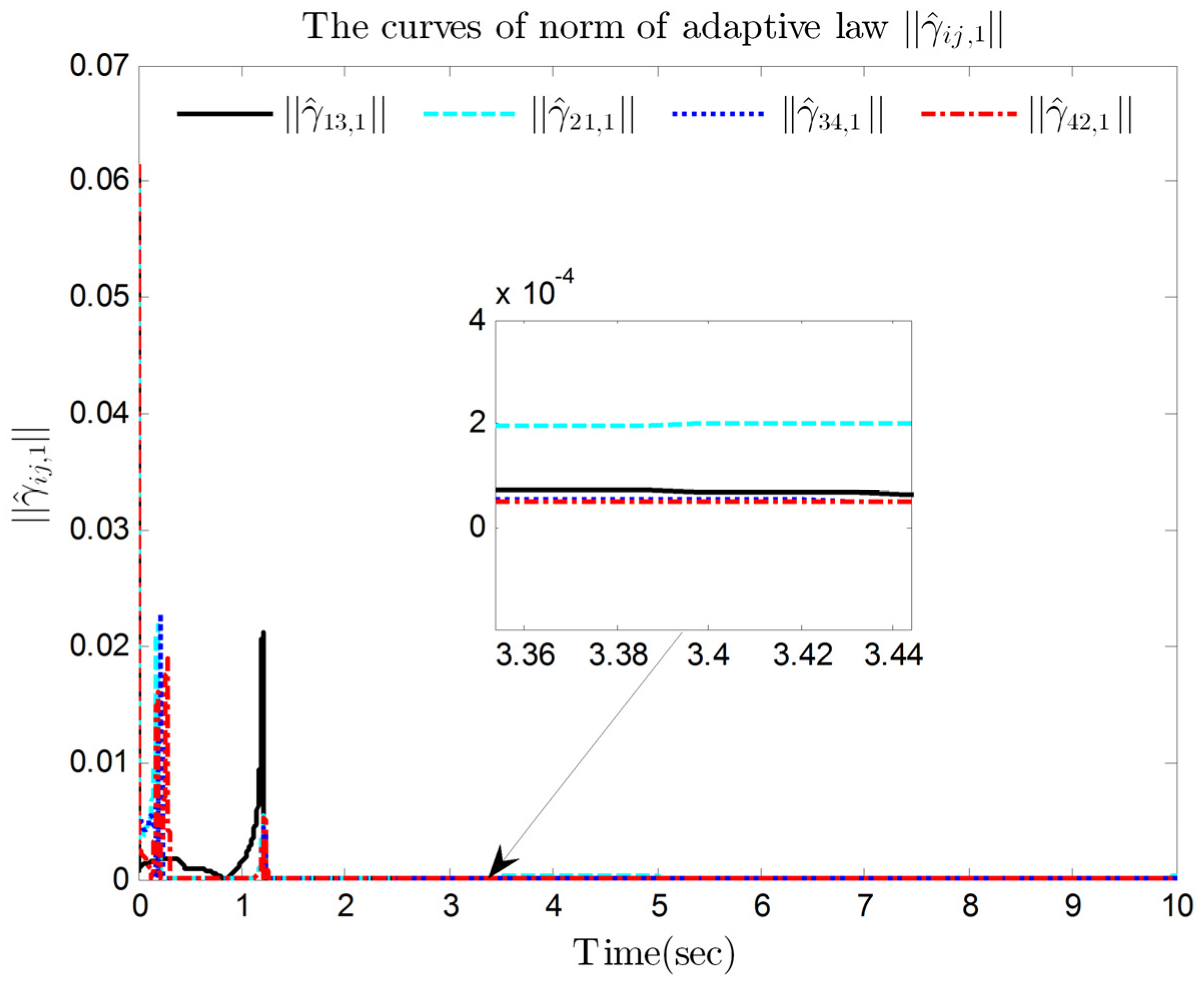
Based on the designed control law and adaptive laws, the simulation results are shown in Figure 3, Figure 4, Figure 5, Figure 6, Figure 7, Figure 8, Figure 9 and Figure 10. The curves of the multi-agent systems outputs and the reference trajectory are shown in Figure 3, and the tracking errors are given in Figure 4. As shown in Figure 3 and Figure 4, this paper showed that multi-agent systems can achieve a good tracking performance under the designed control law, and the tracking errors of four follower agents can converge to a small neighborhood of the origin in a finite time. Furthermore, observing Figure 3 and Figure 4, the multi-agent systems in this paper is subjected to unknown control directions and unknown input saturation, but the finite-time consensus tracking control problem can be solved by using designed control laws and adaptive laws. The curves of the saturated control input are displayed in Figure 5. It is not difficult to see that these control signals are within a limited range. In addition, this paper also presents the curves of the adaptive laws , , , and , as shown in Figure 6, Figure 7, Figure 8, Figure 9 and Figure 10. Similarly, these signals are bounded. This also reflects the effectiveness of the control law designed in this paper from another point of view.
Figure 3.
Trracking results of four follower agents.
Figure 4.
Tracking errors of four follower agents.
Figure 5.
Control input .
Figure 6.
Adaptive laws norm .
Figure 7.
Adaptive laws norm .
Figure 8.
Adaptive laws norm .
Figure 9.
Adaptive laws norm .
Figure 10.
Adaptive laws norm .
5. Conclusions
To solve the finite-time tracking control problem of a class of nonlinear multi-agent systems with unknown input saturation and unknown control directions, a command filter-based adaptive fuzzy finite-time control law has been proposed. The fuzzy logic systems have been applied to approximate each of the unknown nonlinear dynamics in the analysis process. To handle the command filter approximation errors, classes of compensating signals have been constructed in this paper, which effectively avoided the repeated differentiation of nonlinear functions in the recursive design process. Furthermore, considering the existence of unknown control directions and unknown input saturation, the Nussbaum gain function method has been utilized. Then, the effectiveness of the theoretical results is demonstrated through a numerical example. The results show that a good tracking performance can be obtained, and the tracking errors can converge to a sufficiently small neighborhood of the origin in finite time. To make the presented control law more effective, our future works will focus on the full state constraint problem of pure-feedback multi-agent systems with unknown control directions, and a class of observer-based control scheme should also be studied.
Author Contributions
Conceptualization, X.D.; Formal Analysis, X.D., Y.H. and L.W.; Funding Acquisition, X.D., Y.H. and L.W.; Investigation, X.D., Y.H. and L.W.; Methodology, Y.H. and L.W.; Project Administration, Y.H. and L.W.; Resources, X.D. and L.W.; Software, X.D. and Y.H.; Supervision, Y.H.; Validation, X.D.; Visualization, L.W.; Writing–original draft, X.D.; Writing–review and Editing, X.D., Y.H. and L.W. All authors have read and agreed to the published version of the manuscript.
Funding
This work was partially supported by the Natural Science Research of Colleges and Universities of Anhui Province under grant KJ2020A0344 and KJ2020ZD39, the Natural Science Foundation of Anhui Province under grant 2108085MF220, and the Program for the Top Talents of Anhui Polytechnic University.
Institutional Review Board Statement
Not applicable.
Informed Consent Statement
Not applicable.
Data Availability Statement
Not applicable.
Conflicts of Interest
The authors declare no conflict of interest.
Notations
In this paper, represents transposing the vector or matrix ; represents the set of real numbers; and represent the minimum value and the maximum value of variable , respectively; represents a diagonal matrix with as diagonal elements; represents the absolute value of constant ; represents the module of vector ; represents the estimation of and stands for the estimation error; and represent the minimum value and maximum value of , respectively; and represents the smallest eigenvalue of .
References
- Wang, B.; Chen, W.; Zhang, B.; Shi, P.; Zhang, H. A nonlinear observer-based approach to robust cooperative tracking for heterogeneous spacecraft attitude control and formation applications. IEEE Trans. Autom. Control 2022. [CrossRef]
- Li, Y.; Wu, Y.; He, S. Network-based leader-following formation control of second-order autonomous unmanned systems. J. Frankl. Inst. 2021, 358, 757–775. [Google Scholar] [CrossRef]
- Foderaro, G.; Zhu, P.; Wei, H.; Wettergren, T.A.; Ferrari, S. Distributed optimal control of sensor networks for dynamic target tracking. IEEE Trans. Control. Netw. Syst. 2018, 5, 142–153. [Google Scholar] [CrossRef]
- Zhang, P.; Xue, H.; Gao, S.; Zuo, X.; Zhang, J. Adaptive cooperative fault-tolerance tracking control for multi-agent system with hybrid actuator faults and multiple unknown control directions. Expert Syst. Appl. 2022, 197, 116711. [Google Scholar] [CrossRef]
- Chen, G.; Zhao, Y. Distributed adaptive output-feedback tracking control of non-affine multi-agent systems with prescribed performance. J. Frankl. Inst. 2018, 355, 6087–6110. [Google Scholar] [CrossRef]
- Zhang, S.; Chen, J.; Bai, C.; Li, J. Global iterative learning control based on fuzzy systems for nonlinear multi-agent systems with unknown dynamics. Inf. Sci. 2022, 587, 556–571. [Google Scholar] [CrossRef]
- Kaheni, M.; Usai, E.; Franceschelli, M. Resilient constrained optimization in multi-agent systems with improved guarantee on approximation bounds. IEEE Control. Lett. 2022, 6, 2659–2664. [Google Scholar] [CrossRef]
- Wen, G.; Zheng, W.X.; Wan, Y. Distributed robust optimization for networked agent systems with unknown nonlinearities. IEEE Trans. Autom. Control 2022. [Google Scholar] [CrossRef]
- Cao, X.; Zhang, C.; Zhao, D.; Sun, B.; Li, Y. Event-triggered consensus control of continuous-time stochastic multi-agent systems. Automatica 2022, 137, 110022. [Google Scholar] [CrossRef]
- Qian, Y.-Y.; Liu, L.; Feng, G. Distributed event-triggered adaptive control for consensus of linear multi-agent systems with external disturbances. IEEE Trans. Cybern. 2020, 50, 2197–2208. [Google Scholar] [CrossRef]
- Liu, G.; Zhou, Q.; Zhang, Y.; Liang, H. Fuzzy tracking control for nonlinear multi-agent systems with actuator faults and unknown control directions. Fuzzy Sets Syst. 2020, 385, 81–97. [Google Scholar] [CrossRef]
- Shamloo, N.F.; Kalat, A.A.; Chisci, L. Direct Adaptive Fuzzy Control of Nonlinear Descriptor Systems. Int. J. Fuzzy Syst. 2019, 21, 2588–2599. [Google Scholar] [CrossRef]
- Pan, T.-T.; Chang, X.-H.; Liu, Y. Robust Fuzzy Feedback Control for Nonlinear Systems With Input Quantization. IEEE Trans. Fuzzy Syst. 2022, 30, 4905–4914. [Google Scholar] [CrossRef]
- Zheng, S.; Shi, P.; Wang, S.; Shi, Y. Adaptive neural control for a class of nonlinear multiagent systems. IEEE Trans. Neural Netw. Learn. Syst. 2021, 32, 763–776. [Google Scholar] [CrossRef]
- Wang, F.; Gao, Y.; Zhou, C.; Zong, Q. Disturbance observer-based backstepping formation control of multiple quadrotors with asymmetric output error constraints. Appl. Math. Comput. 2022, 415, 126693. [Google Scholar] [CrossRef]
- Wu, W.; Tong, S. Fixed-time adaptive fuzzy containment dynamic surface control for nonlinear multi-agent systems. IEEE Trans. Fuzzy Syst. 2022, 30, 5237–5248. [Google Scholar] [CrossRef]
- Cui, Y.; Liu, X.; Deng, X.; Wen, G. Command-filter-based adaptive finite-time consensus control for nonlinear strict-feedback multi-agent systems with dynamic leader. Inf. Sci. 2021, 565, 17–31. [Google Scholar] [CrossRef]
- Deng, X.; Zhang, X. Adaptive fuzzy tracking control of uncertain nonlinear multi-agent systems with unknown control directions and a dead-zone fault. Mathematics 2022, 10, 2655. [Google Scholar] [CrossRef]
- Nussbaum, R.D. Some remarks on a conjecture in parameter adaptive control. Syst. Control. Lett. 1983, 3, 243–246. [Google Scholar] [CrossRef]
- Kamalamiri, A.; Shahrokhi, M.; Mohit, M. Adaptive finite-time neural control of non-strict feedback systems subject to output constraint, unknown control direction, and input nonlinearities. Inf. Sci. 2020, 520, 271–291. [Google Scholar] [CrossRef]
- Deng, X.; Zhang, C.; Ge, Y. Adaptive neural network dynamic surface control of uncertain strict-feedback nonlinear systems with unknown control direction and unknown actuator fault. J. Frankl. Inst. 2022, 359, 4054–4073. [Google Scholar] [CrossRef]
- Ma, J.; Xu, S.; Ma, Q.; Zhang, Z. Event-triggered adaptive neural network control for nonstrict-feedback nonlinear time-delay systems with unknown control directions. IEEE Trans. Neural Netw. Learn. Syst. 2020, 31, 4196–4205. [Google Scholar] [CrossRef]
- Cai, X.; Wang, C.; Wang, G.; Liang, D. Distributed consensus control for second-order nonlinear multi-agent systems with unknown control directions and position constraints. Neurocomputing 2018, 306, 61–67. [Google Scholar] [CrossRef]
- Fan, B.; Yang, Q.; Jagannathan, S.; Sun, Y. Output-constrained control of nonaffine multiagent systems with partially unknown control directions. IEEE Trans. Autom. Control 2019, 64, 3936–3942. [Google Scholar] [CrossRef]
- Zhang, Z.; Wang, C.; Cai, X. Consensus control of higher-order nonlinear multi-agent systems with unknown control directions. Neurocomputing 2019, 359, 122–129. [Google Scholar] [CrossRef]
- Ao, W.; Huang, J.; Xue, F. Adaptive leaderless consensus control of a class of strict-feedback nonlinear multi-agent systems with unknown control directions: A non-Nussbaum function based approach. J. Frankl. Inst. 2020, 357, 12180–12196. [Google Scholar] [CrossRef]
- Rezaee, H.; Abdollahi, F. Adaptive leaderless consensus control of strict-feedback nonlinear multiagent systems with unknown control directions. IEEE Trans. Syst. Man Cybern. Syst. 2021, 51, 6435–6444. [Google Scholar] [CrossRef]
- Li, Y.; Zhang, J.; Liu, W.; Tong, S. Observer-based adaptive optimized control for stochastic nonlinear systems with input and state constraints. IEEE Trans. Neural Netw. Learn. Syst. 2021, 33, 7791–7805. [Google Scholar] [CrossRef]
- Zhang, W.; Wei, W. Disturbance-observer-based finite-time adaptive fuzzy control for non-triangular switched nonlinear systems with input saturation. Inf. Sci. 2021, 561, 152–167. [Google Scholar] [CrossRef]
- He, C.; Wu, J.; Dai, J.; Zhang, Z. Fixed-time adaptive neural tracking control of output constrained nonlinear pure-feedback system with input saturation. Neurocomputing 2021, 451, 125–137. [Google Scholar] [CrossRef]
- Li, P.; Jabbari, F.; Sun, X.-M. Containment control of multi-agent systems with input saturation and unknown leader inputs. Automatica 2021, 130, 109677. [Google Scholar] [CrossRef]
- Zhu, Z.-H.; Guan, Z.-H.; Hu, B.; Zhang, D.-X.; Cheng, X.-M.; Li, T. Semi-global bipartite consensus tracking of singular multi-agent systems with input saturation. Neurocomputing 2021, 432, 183–193. [Google Scholar] [CrossRef]
- Cheng, W.; Xue, H.; Liang, H.; Wang, W. Prescribed performance adaptive fuzzy control of stochastic nonlinear multi-agent systems with input hysteresis and saturation. Int. J. Fuzzy Syst. 2022, 24, 91–104. [Google Scholar] [CrossRef]
- Zhao, L.; Yu, J.; Lin, C. Command filter based adaptive fuzzy bipartite output consensus tracking of nonlinear coopetition multi-agent systems with input saturation. ISA Trans. 2018, 80, 187–194. [Google Scholar] [CrossRef] [PubMed]
- Hao, R.; Wang, H.; Zheng, W. Dynamic event-triggered adaptive command filtered control for nonlinear multi-agent systems with input saturation and disturbances. ISA Trans. 2022, 130, 104–120. [Google Scholar] [CrossRef]
- Wang, H.; Chen, B.; Liu, X.; Liu, K.; Lin, C. Robust adaptive fuzzy tracking control for pure-feedback stochastic nonlinear systems with input constraints. IEEE Trans. Cybern. 2013, 43, 2093–2104. [Google Scholar] [CrossRef]
- Wang, M.; Liu, X.; Shi, P. Adaptive neural control of pure-feedback nonlinear time-delay systems via dynamic surface technique. IEEE Trans. Syst. Man Cybern. Part B (Cybernetics) 2011, 41, 1681–1692. [Google Scholar] [CrossRef]
- Hu, J.; Feng, G. Distributed tracking control of leader–follower multi-agent systems under noisy measurement. Automatica 2010, 46, 1382–1387. [Google Scholar] [CrossRef]
- Wang, F.; Chen, B.; Liu, X.; Lin, C. Finite-time adaptive fuzzy tracking control design for nonlinear systems. IEEE Trans. Fuzzy Syst. 2018, 26, 1207–1216. [Google Scholar] [CrossRef]
- Deng, X.; Wang, J. Fuzzy-based adaptive dynamic surface control for a type of uncertain nonlinear system with unknown actuator faults. Mathematics 2022, 10, 1624. [Google Scholar] [CrossRef]
- Yu, J.; Shi, P.; Dong, W.; Yu, H. Observer and command-filter-based adaptive fuzzy output feedback control of uncertain nonlinear systems. IEEE Trans. Ind. Electron. 2015, 62, 5962–5970. [Google Scholar] [CrossRef]
Publisher’s Note: MDPI stays neutral with regard to jurisdictional claims in published maps and institutional affiliations. |
© 2022 by the authors. Licensee MDPI, Basel, Switzerland. This article is an open access article distributed under the terms and conditions of the Creative Commons Attribution (CC BY) license (https://creativecommons.org/licenses/by/4.0/).