1. Introduction
There are many challenges against an accurate description of coupled thermomechanical processes [
1,
2,
3,
4]. For example, classical thermoelasticity (CTE) does not correctly describe the attenuation function in a wide frequency range [
5], especially in continuum systems with a molecular structure. Moreover, according to the recent experimental studies [
6,
7], significant deviations from the Fourier law are observed in many materials, such as nanowires, carbon nanotubes, graphene, silicon membranes, etc. As far as dynamics is concerned, experiments, e.g., [
8], demonstrate the simultaneous presence of both positive and negative extrema for stress over time, whereas classical theory is able to predict only one type of extrema (depending on the signs of the parameters). The conventional methods have limitations in effectively handling these challenges. The purpose of this study is to broaden the scope of CTE by overcoming discrepancies with experimentally obtained data.
One of the possible ways to generalize CTE is to consider the fact that the thermomechanical parameters may be functions of frequency. However, if the attenuation of mechanical waves is determined only by the frequency dependence of the parameters, the resulting model will turn out to be essentially nonlinear. Another approach is based on the fractional thermoelasticity, i.e. the heat conduction equation with fractional order differential operators [
9]. An alternative idea [
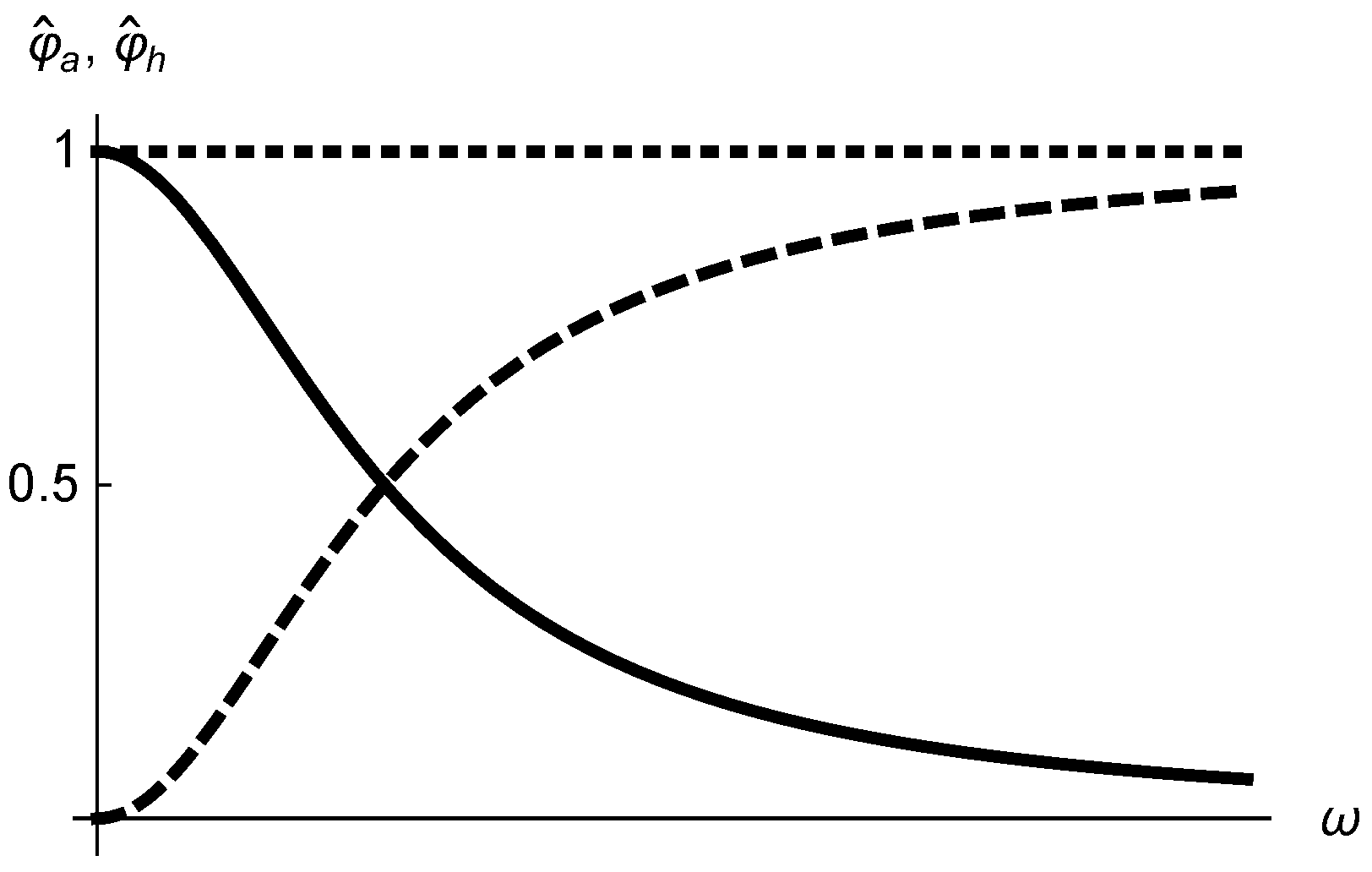
10], further applied in the present work, is to divide the mechanical energy into two components using filter functions. The low-frequency one does not affect the entropy level directly, whereas the high-frequency one is associated with the “heat-like” diffusive energy transfer, causing an entropy increase without a direct contribution to continuum motion.
One more way to correct CTE is to extend constitutive equations. There are two strategies for this: to introduce corrections to (i) Fourier’s law and/or (ii) Duhamel–Neumann law. The majority of theories following the first path (i) result in modified heat equations with a number of new constants that require elaborate and hardly conductible experiments [
3]. Namely, the hyperbolic heat conduction equation (Maxwell–Cattaneo) proved itself to be able to be validated only for a limited number of cases [
11,
12]. For the low-dimensional systems, the approach of discrete thermomechanics [
13] provides robust instrumentation in handling heat transfer beyond Maxwell–Cattaneo and Fourier’s laws.
As far as the second path (ii) is concerned, experimental research for two titanium alloys and two aluminium alloys [
14,
15] has shown that the thermoelastic constant (or coupling parameter, namely
) depends on the sum of principal stresses. In [
14,
16], an explicit model describing the observed experimental effect [
15] is derived based on the fundamental conservation laws for the quasi-static loading. In their next experimental work [
17], the authors reported a weak nonlinearity in stress–temperature dependence. Later, a theoretical research of the elastic buckling of columns was made [
18], incorporating the results obtained in [
16]. This topic keeps being addressed, e.g., in later work [
19], the authors revisit the previous analysis, coming to the same conclusions. In [
20], it is clearly shown that this theory is able to correctly describe the stress dependence of the photoacoustic signal near a hole in aluminum alloy plates.
In the present work, we combined two approaches, namely, we adopted the nonlinear generalized Duhamel–Neumann law, and then we split the stress into mechanical and “heat-like” parts in order to linearize the set of governing equations. Then, we formulated and solved the boundary value dynamical problem for the obtained system of integro-differential equations, employing the method of eigenfunctions. Finally, we compared the temperature and stress fields to those produced by CTE.
2. CTE with a Modified Thermal Expansion Coefficient
In this section, we derived a nonlinear model of thermoelasticity with regard to the stress-dependent thermal expansion coefficient. Following work [
20], let us assume the linear dependence of the thermal coefficient
on the mean stress
:
The coefficient’s
value and sign strongly depend on the effects of various physical nature [
20,
21]. According to the experimental measurements and theoretical predictions [
17], it is estimated as
.
Next, in order to simplify the analysis of the results without loss of generality, let us restrict ourselves to a purely one-dimensional problem. All of the derivations presented below may be repeated for the 3D theory following [
10].
2.1. Equation of Motion
Let us write down the modified Helmholtz free energy density
following [
22]:
Here,
e is the strain,
T is the deviation from the initial temperature
,
K is the bulk modulus,
is the shear modulus,
is the material density, and
is the specific heat capacity at constant volume. Within CTE, the coefficient
B is equal to
, so it is now subject to alteration:
Here, we introduce this addition to thermal expansion coefficient being proportional to strain, not stress. The equivalence of the two definitions will be demonstrated below.
Note that the introduced addition to the thermal expansion coefficient leads to a decrease in the bulk modulus K.
The constitutive Equation (
4) is supplemented by the equation of motion and the definition of strain
therefore, we arrive at
the first governing equation:
Let us return to the literature-based notation of the addition to the thermal expansion coefficient (
1) in order to establish the identity of two approaches.
The generalized Duhamel–Neumann law takes the form
If we restrict ourselves by
, the latter becomes
If we define
the generalized Duhamel–Neumann law (
9) yields to (
4).
2.2. Heat Equation
The energy balance and Fourier’s law have the form
where
U is the specific internal energy,
h is the heat flux, and
is the thermal conductivity coefficient. The balance of the Helmholtz free energy density is written as
where
is the entropy density. In turn, the Helmholtz free energy density is related to the specific internal energy through
Combining the aforesaid, we arrive at the heat equation in the form of
Finally, as the entropy density is given by
the second governing equation yields to
The set of governing equations for CTE with a modified thermal expansion coefficient is given by (
6) and (
16). For small temperature changes, (
16) becomes
The resulting system of governing equations is essentially nonlinear. This means that the linearization procedure wipes out the terms containing the parameter . Thus, in the next section, we consider an alternative approach.
4. Solution to the Extended CTE Boundary Value Problem with a Modified Thermal Expansion Coefficient
Let us consider a boundary value problem for an infinite semi-opaque thermally insulated slab of thickness
. It is irradiated by a short laser pulse hitting its surface
. The interaction of laser irradiation and the slab is modeled by the internal heat sources distributed over the volume. The Lambert–Beer law, also known as the Bouguer law, governs light extinction in a semi-opaque medium:
where
is the intensity of light flux entering the layer, and the extinction coefficient
is determined by the wavelength of the laser and the physical properties of the medium itself. The skin-layer
is much narrower than the width of the slab
l. Thus, the heat sources distributed over the volume are concentrated near the irradiated boundary.
The set of Equation (
27) yields to
where
is the Dirac delta function and
along with homogeneous boundary and initial conditions
In order to obtain the solution, we need to convert the system of partial differential Equation (
30) to an algebraic system using integral transforms. We multiplied the matrix of the system (
30) by the column of eigenfunctions and integrated it over the interval
, performing the so-called finite integral transform with respect to the coordinate. Then, we took the Laplace transform with respect to time. After the respective inverse transforms [
26,
27], we arrived at the formal series
where
and
,
are given by
and
Here,
is the roots of the sixth-order equation
and
is the non-zero roots of the respective third-order equation if
:
We would like to draw the readers’ attention to the fact that the solution to (
36) has three more roots in addition to the CTE solution [
27]. These roots generate auxiliary dispersion curves, driving the wave propagation process. In the next section, we will demonstrate their impact.
5. Discussion
The solution (
33) obtained in the form of a series consists of two parts: the first part includes classical roots
,
, and
in the numerator, which we will refer to as the “classical part”; the second “non-classical part” includes roots
,
, and
, which vanish if we set parameter
and/or choose
and
. The final form of the solution depends on how the amplitudes of the classical and non-classical components of the solution are related to the characteristic times and coordinate scales of each of them. Typical stress, temperature, and displacement fields are analyzed below.
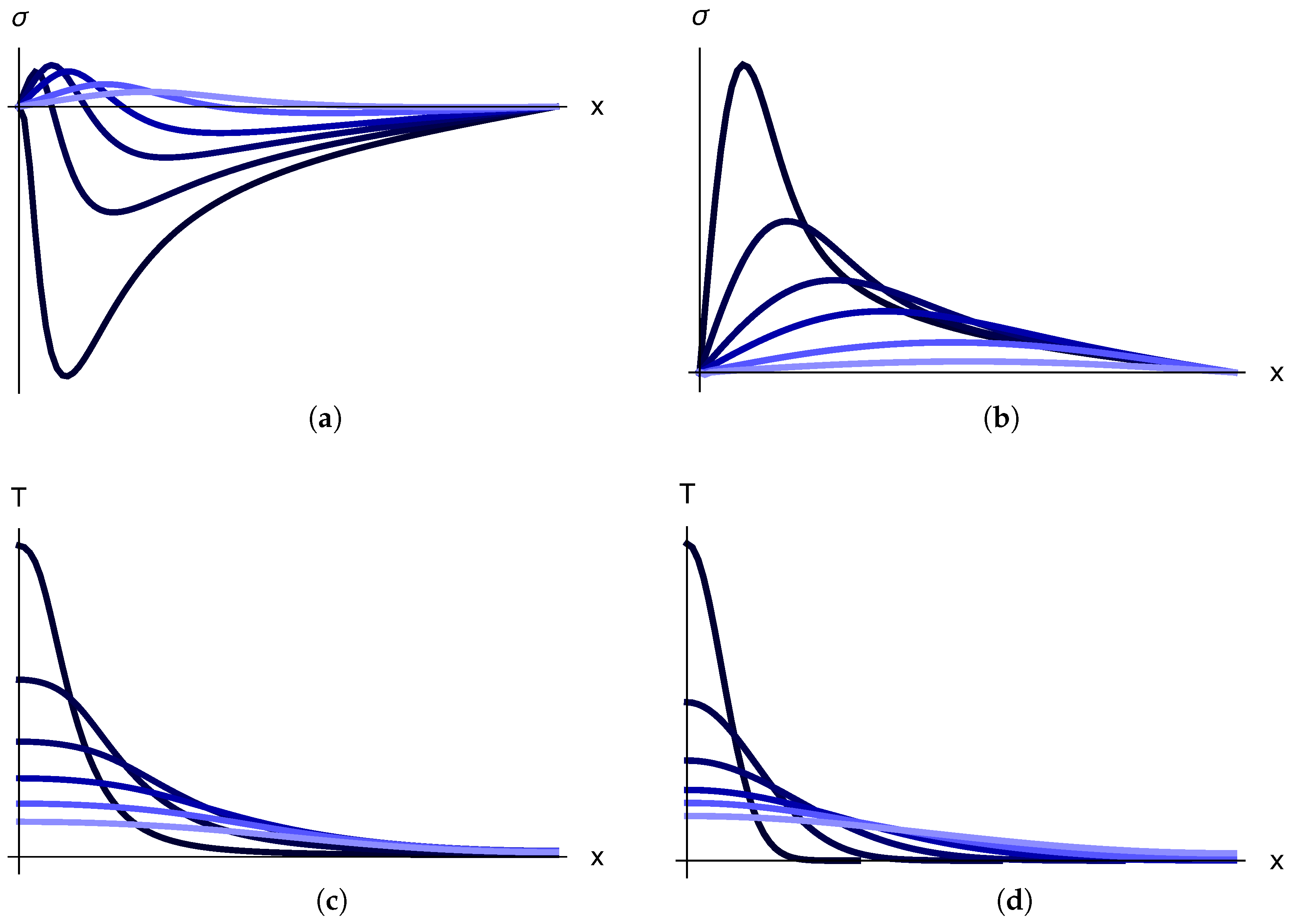
Let us begin with a series of figures that illustrate the evolution of temperature and stress fields, namely,
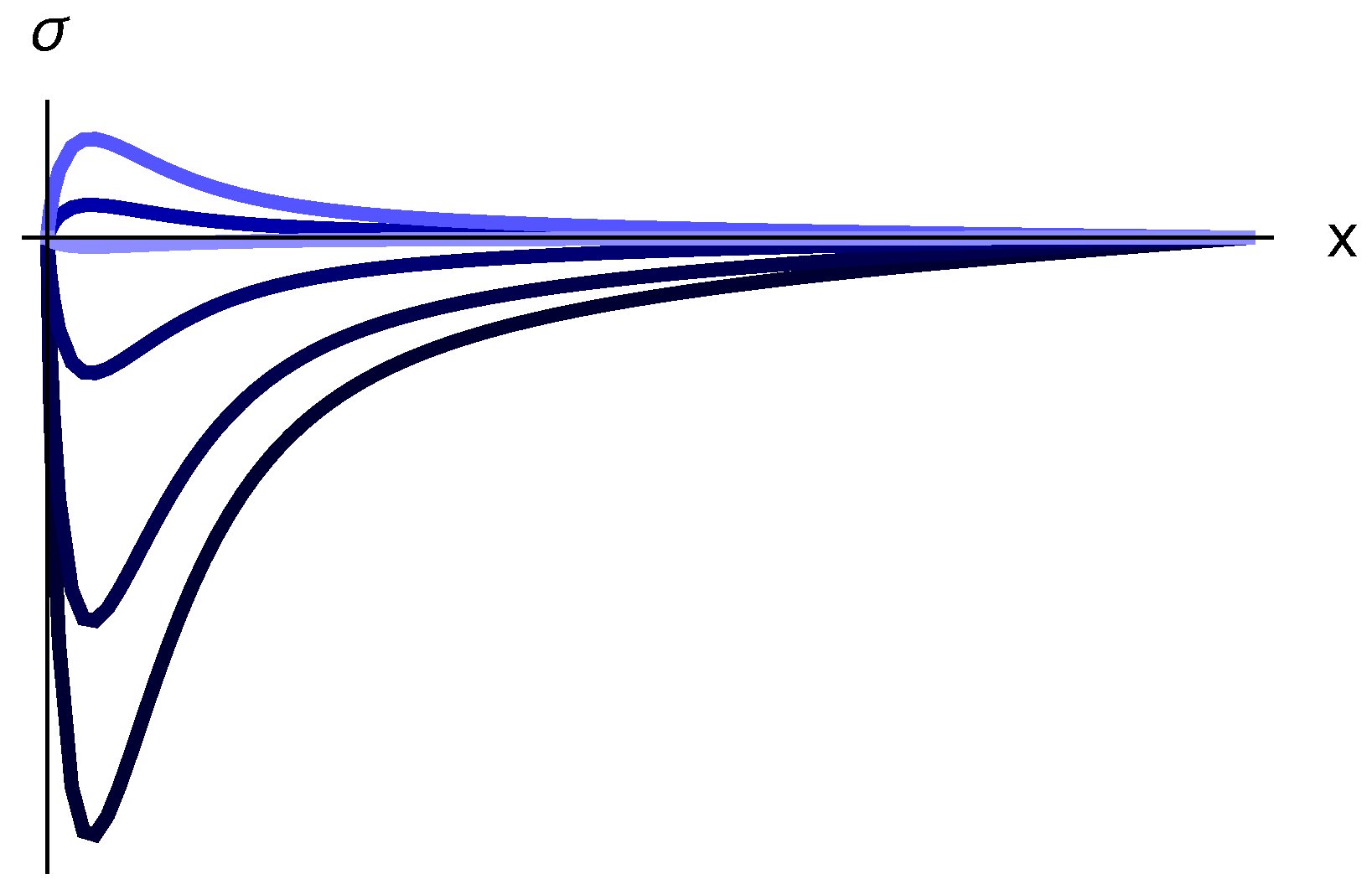
Figure 2 and
Figure 3a,c show the solution (
33), while
Figure 3b,d demonstrate the same boundary value problem treated within CTE.
The component of the solution, corresponding to the “classical” roots (
Figure 2), attenuates rapidly over the time typical for the CTE model. At larger times, this component contributes insignificantly to the amplitude of the slower processes of mechanical waves absorption modeled with the filter function (
20).
The behavior of the solution component, which is determined by the part of the series with non-classical roots, is illustrated in
Figure 3a. This dependence, at certain times, has two extrema and areas in which stress takes both negative and positive values.
Figure 3b shows the stress fields obtained within CTE. There is only one extremum, which can be either positive or negative, depending on the sign of the thermal expansion coefficient
. Thus, unlike the solution (
33), the classical solution cannot change the sign with time or have two extrema.
Figure 3c,d show the time slices for the non-stationary temperature field in the layer of thickness
l, for the extended CTE with a modified thermal expansion coefficient (
33), and for the CTE, respectively. There are no fundamental differences in the temperature plots; however, in CTE, the transition to the equilibrium state takes less time.
A separate analysis of the displacement field was carried out. The solution (
33) was substituted into the equation of dynamics (
5) and integrated twice with respect to time. The respective initial conditions were set as homogeneous.
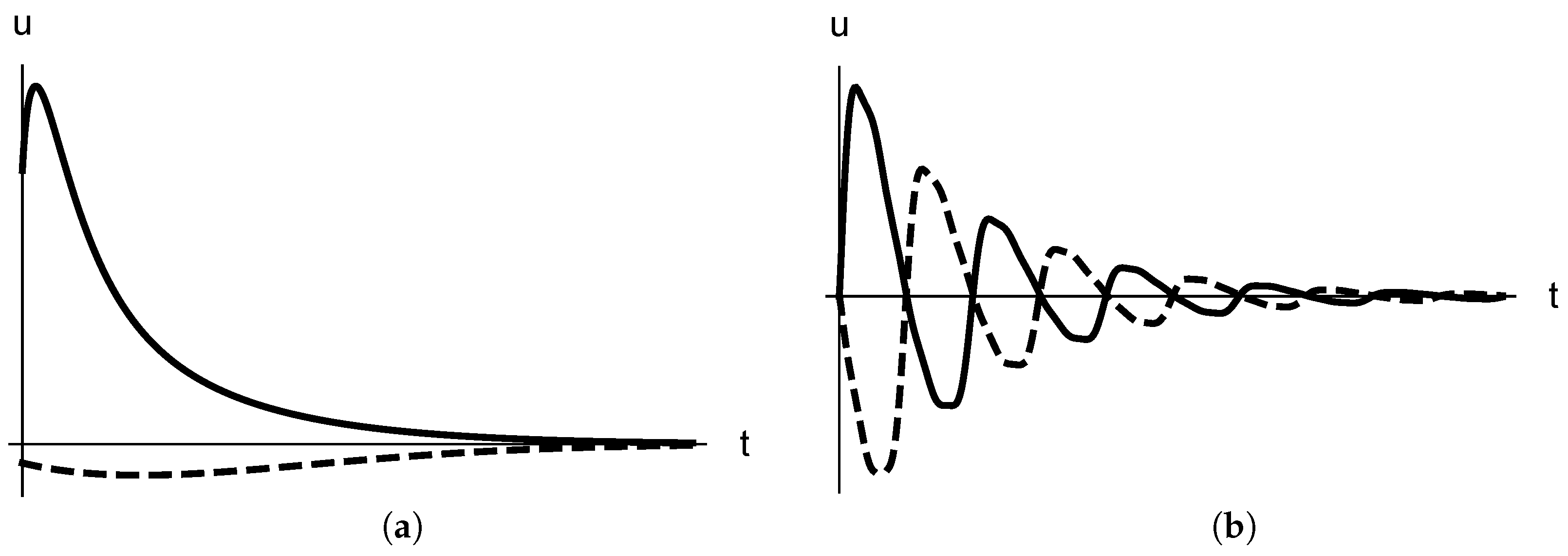
The initial fast expansion of the layer (the “first phase”) is shown in
Figure 4a as a jump associated with the classical thermoelastic effect [
22]. The sample reaches its maximum thickness in the slower second expansion phase, which takes place due to the absorption of mechanical waves modeled by the filter function (
20). Depending on the choice of thermomechanical parameters, each of the phases can contribute more or less significantly to the final displacement of the layer boundaries.
Figure 4b shows the respective results for CTE: an oscillatory process with a relatively high frequency, which is achieved by the small thermal expansion coefficient
, the small layer thickness
l, and the high speed of sound in the medium.
We would like to note that, in classical thermoelasticity (CTE), the acoustic wave consists of only two components: quasi-acoustic and quasi-thermal ones. Their behavior is described by the corresponding branches of the dispersion curves. The laser pulse modeled by the volumetrically distributed heat sources directly generates only the quasi-thermal component of the acoustic wave, whereas the quasi-acoustic component appears due to the coupling effect.
In the extended theory, the acoustic wave turns out to have three components. In the problem considered, the quasi-thermal component is an expansion wave. In view of the absence of mechanical action on the layer in the problem statement, the second, quasi-acoustic component does not make a substantial contribution. The third component becomes noticeable somewhat later, when its amplitude reaches the values comparable to the first component. According to the parameters chosen, this component is a compression wave, thus correcting the first wave component in amplitude (approximately, as it would have been carried out by a nonlinear term), which can be seen in
Figure 3a. One of the possible physical interpretations of these phenomena is a system of two nested sublattices; they have different feedback times and thermal expansion coefficients, so one of them starts expanding with a noticeable lag.
What is more, the greater the parameter , the more prominent the local minimum of stresses becomes in the vicinity of the irradiated boundary. This effect is also due to the third wave process prescribed by the model. Its behavior is governed by the additional curve in the phonon spectrum, which is the subject of further investigation. A separate analysis has shown that the conventional speed of sound is the only asymptotic available in the system.
6. Conclusions
To sum everything up, we proposed a novel approach to the extension of classical thermoelasticity, which incorporated the experimentally observed nonlinearity in the thermal expansion coefficient and remained within the framework of linear models. By tuning the filter function, we can customize the frequency dependence of the attenuation coefficient to satisfy the experimental data. This model can be successfully applied to describe media with a microstructure that undergoes structural changes during the passage of mechanical waves, as well as internal friction. Detailed studies of the associated effects, the phonon spectrum, and the extension to 3D are subjects of further investigation.
Comparing the extended CTE with a modified thermal expansion coefficient to the CTE itself, we conclude that it gives almost no differences in the behavior of the temperature curves, but provides a number of significant alterations in stress fields. Namely, we prove that the model allows us to meet the experiments in which two extrema are simultaneously observed for the stress-over-time-dependence. The similarity between the enhanced theory and CTE is that both models adopt classical Fourier’s law. This means that the heat equation is parabolic in both cases, i.e., the so-called “heat front” is absent in the solution, unless we consider a limiting case (
28).