


Abstract
A set is called a dominating set if for every vertex v in graph G. The domination number is the minimum cardinality of a dominating set of G. The proximity of a vertex v is the average distance from it to all other vertices in graph. The remoteness of a connected graph G is the maximum proximity of all the vertices in graph G. AutoGraphiX Conjecture A.565 gives the sharp upper bound on the difference between the domination number and remoteness. In this paper, we characterize the explicit graphs that attain the upper bound in the above conjecture, and prove the improved AutoGraphiX conjecture.
MSC:
05C69
1. Introduction
We only consider finite, simple and connected graphs in the present paper. Denote by the finite, simple and connected graph, where is the vertex set and is the edge set. The open neighborhood of v is the set , and the closed neighborhood of v is . The degree of a vertex v is the number of edges incident with v in G. The minimum and maximum vertex degree of G are denoted by and , respectively. The distance of two vertices u and v is the length of a shortest path between u and v, denoted by . The eccentricity of a vertex v is defined as . The proximity of a vertex v is the average distance from it to all other vertices in graph. Based on this, the proximity and remoteness of a connected graph G denote the minimum and maximum proximities of vertices in graph G, respectively. Namely,
As we know, the transmission of a vertex is the sum of distances from it to all others in graph. In other words, and can be considered as the minimum and maximum normalized transmission of vertices in graph G, respectively. For more excellent results on proximity and remoteness, the readers please refer to [1,2,3,4,5,6].
The AutoGraphiX (AGX) is an automated system that is mainly used for finding conjectures and extremal graphs for some graph invariant [7]. Aouchiche [8] presented 760 conjectures with regard to 20 graph invariants, and these invariants include proximity and remoteness. Many conjectures on remoteness or proximity were proved. Each one of proximity and remoteness was compared to the diameter, radius, average eccentricity, average distance, independence number and matching number [9,10]. The authors proved lower and upper bounds on the distance spectral radius using proximity and remoteness, and lower bounds on the difference between the largest distance eigenvalue and proximity(remoteness) [11]. The difference, the sum, the ratio and the product of the proximity and the girth were researched [12]. Four AutoGraphiX conjectures on the quotient of proximity and average distance, the quotient of remoteness and girth, the sum of remoteness and maximum degree, the product of proximity and average degree were studied [13]. The upper bound on the difference between the average eccentricity and proximity was determined [14]. The authors established maximal trees and graphs for the difference of average distance and proximity(remoteness), as well as minimal trees for the difference of remoteness and radius [15].
A set is called a dominating set if for every . A classical upper bound on the domination number of G is presented by Ore [16] in 1962, that is . The domination number is the minimum cardinality of a dominating set of G. Although determining the domination number is NP-complete [17], studies on domination number have attracted graph theorists for their applications and interest [18,19]. Recently, we focus on the relationship between the domination number and other graph invariants [20,21,22,23]. And this includes some AGX conjectures on domination number. Furthermore, some other AGX conjectures about domination number have been studied [24,25,26]. In this paper, we will continue to study the following AGX conjecture which is related to the domination number and remoteness.
Denote by the graph of order n obtained from a complete graph by attaching a pendent vertex to each of the b vertices of , where and .
Conjecture 1 (Conjecture A.565)
([8]).
with equality if and only if and . For instance, the equality is attained for the graph .
Based on the Conjecture 1, we will characterize the explicit graphs that satisfy the equation in Conjecture 1, and prove an improved AutoGraphiX conjecture.
2. Results and Discussion
Lemma 1.
If G is a connected graph with vertices and , then and
with equality if and only if G is 4-regular when , and when .
Proof.
It is obvious that since .
Let and . It is well-known that ([27]). Then . If , then . It implies that G is 4-regular, and thus , where v is any vertex of G. Assume that and v is the vertex with , then . Therefore,
To sum up, with equality if and only if G is 4-regular.
Let and . Then , which implies that , the equality holds if and only if . The result follows. □
Lemma 2
([28]). If a graph G has no isolated vertices and , then .
Lemma 3.
Let G be a connected graph of order with . Then
Proof.
Assume that is a vertex with . Since , one has that by Lemma 2. It follows that
Thus and
Therefore
This completes the proof. □
Lemma 4.
Suppose that G is an n-vertex connected graph with . Then
Proof.
It is obvious that . So
The result follows. □
Lemma 5
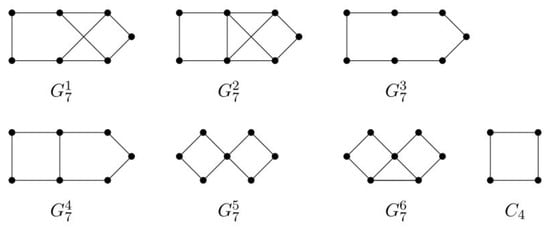
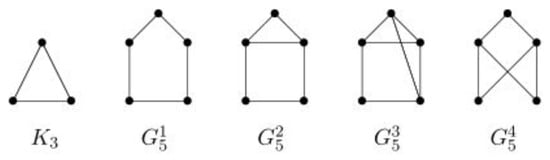
([29,30]). A connected graph G of order n satisfies if and only if , where , , is the set defined in the following.
Let H be any graph with vertex set . Denote by the graph obtained from H by adding new vertices and the edges Define for some connected graph
Figure 1.
Graphs in family .
Figure 2.
Graphs in family .
For any graph H, let be the set of connected graphs, each of which can be formed from by adding a new vertex x and edges joining x to one or more vertices of H. Then define for some graph
Let and y be a vertex of a copy of . Denote by the graph obtained by joining G to with the single edge , where x is the new vertex added in forming G. Then define for some graph
Let be the vertex sequence of a path . For any graph H, let be the set of connected graphs which may be formed from by joining each of u and w to one or more vertices of H. Then define for some graph
For a graph , let be a set of vertices such that no fewer than vertices of X dominate . Let be the set of connected graphs which may be formed from by joining each vertex of U to one or more vertices of H for some set U as defined above and any graph H. Then define for some and some
Definition 1
([23]). Let be the graph obtained from by joining each of u and w to every vertex of , and be the graph obtained from by joining each vertex of to every vertex of .
Denote by the graph of order n obtained from a complete graph by attaching a pendent vertex to each of the b vertices of , where and .
Lemma 6.
If G is a connected graph with order and , then
with equality if and only if is even and is odd and .
Proof.
Since , by Lemma 2.5. Moreover, the order is even for the graphs in and odd for the graphs in by the definition of .
Claim 1.
for , where , , and H is the graph in the definition of . Since
Hence, the claim is true. By the way, and for . In what follows, we prove the lemma in terms of the parity of n.
Case 1.
n is even, that is, .
Let . Then for some connected graph H and by the definition of . Claim 1 implies that for some . If , then
If , then for some . Thus
Moreover,
the equality holds if and only if .
Let . Then . And just by doing a direct calculation, we get that
with the equality if and only if .
Case 2.
n is odd, that is, .
Subcase 2.1.
, where .
When , we get that .
When , one has that for any vertex . Then . It follows that and .
When ,
by direct calculation. Hence, with the equality if and only if .
In all, with the equality if and only if in this case.
Subcase 2.2.
. Then for some connected graph H and by the definition of .
In consideration of , where is the graph obtained from by adding a new vertex x and edges joining x to every vertex of . Assume that . Then Firstly, , by Claim 1. Secondly, for each , we have that
Finnally, for the vertex x appeared in the definition of ,
Since always true for ,
Assume that . Then or for some . Combining with Equation (1), we get that and , respectively. As a result,
In brief, with equality if and only if .
Subcase 2.3.
.
We notice that and a cycle is mentioned in constructing . Let , where and be the neighbors of vertex y in the cycle . It is obvious that is greater than and , by the definition of . Therefore, . Furthermore,
with the equality if and only if And for ,
the equality holds if and only if Considering for , and
we get that
which follows that
Subcase 2.4.
.
By the definition of , one gets that , where . We analyze the proximity of all the vertices in graph G one by one.
For each ,
the equality holds if and only if . For the vertex u of path ,
the equality holds if and only if Analogously, . Moreover,
and the equality holds if and only if , that is, or for each .
Since max and for by Claim 1,
the equality holds if and only if (3), (4) and (5) are tight. Namely , where is defined in Definition 1. Otherwise, or or or for some . It follows that , where i is equal to and l, respectively. As a result,
with equality if and only if .
Subcase 2.5.
.
By the proof of Lemma 3.4 in [23], we derive that , where U is the set in the definition of .
Subcase 2.5.1.
.
In this case, still holds by Claim 1 for , and .
Suppose that and . Similar to the proof of Claim 1, we can obtain that , and thus .
Besides,
with the equality if and only if Furthermore, for each ,
the equality holds if and only if
Combining the inequalities (6) and (7), and using the analysis similar to Subcase 2.4, we get that and
with equality if and only if , where is the graph defined in Definition 1.
Subcase 2.5.2.
.
In this case . For each , let
It is easy to know that and , so
the equality holds if and only if
Let . Then If , then
with equality if and only if . If , then
the equality holds if and only if and s be the vertex with in U.
Let . Then . Since for each , which follows that . Hence,
with the equality if and only if . In view of and , thus
Combine with (8)–(11), we obtain that . And
In conclusion,
with the equality if and only if and by Subcases 2.5.1 and 2.5.2.
Here’s a quick rundown of the above proof. If n is even, then
with equality if and only if is even and by case 1. If n is odd, then with equality if and only if by Subcases 2.2–2.5. And it is worth mentioning that for n is odd and , we get a better bound in Subcase 2.1. Namely, with the equality if and only if . Therefore,
with equality if and only if is odd and This completes the proof. □
3. Conclusions
Many of the AutoGraphiX conjectures were studied, but some of them remained as conjectures. The existing research mainly focus on proving the correct AutoGraphiX conjectures; improving the not-quite correct AutoGraphiX conjectures; disproving the incorrect AutoGraphiX conjectures by counter examples. The aim of this note is to improve the AutoGraphiX conjecture A. 565.
Recall that [16], Lemmas 1, 3, 4 and 6 prove the upper bounds on with , and , respectively. The maximum value of can be obtained immediately by comparing the results in Lemmas 1, 3, 4 and 6. It can not be reached for by Lemmas 4 and 6. But it can be reached for and with , by Lemmas 1, 3 and 6. On this basis, we are obtain Theorem 1 in the following, which implies that Conjecture 1 is not entirely true. In Theorem 1, we are improve the bound for , and recharacterize the extremal graphs that satisfy the equation in Conjecture 1.
Theorem 1.
Let G be a connected graph of order . Then
with equality if and only if 4-regular 6-vertices graph, is even and is odd and .
In this paper, we present the sharp upper bound on the difference between the domination number and remoteness. AutoGraphiX conjectures A.566, A.567, A.568 in [8] give the bounds on the sum, the ratio and the product of the domination number and remoteness, which are still open. It is very meaningful to study the above conjectures. This research method is, in all probability, available in the AutoGraphiX conjectures about the domination number and proximity.
Funding
This research is supported by National Natural Science Foundation of China (No. 11901150), Natural Science Research for Colleges and Universities of Anhui Province (No. KJ2021A0928), Scientific Research Foundation for High-level Talents of Hefei Normal University in 2020 (No. 2020rcjj02), Provincial scientific research platform special project of Hefei Normal University in 2020 (No. 2020PT27).
Data Availability Statement
Not applicable.
Conflicts of Interest
The author declares no conflict of interest.
References
- Aouchiche, M.; Caporossi, G.; Hansen, P. Variable neighborhood search for extremal graphs. 20. Automated comparison of graph invariant. MATCH Commun. Math. Comput. Chem. 2007, 58, 365–384. [Google Scholar]
- Aouchiche, M.; Hansen, P. Nordhaus–Gaddum relations for proximity and remoteness in graphs. Comput. Math. Appl. 2010, 59, 2827–2835. [Google Scholar] [CrossRef]
- Hansen, P.; Mladenović, N.; Brimberg, J.; Pérez, J.A.M. Variable Neighborhood Search. In Handbook of Metaheuristics. International Series in Operations Research and Management Science; Gendreau, M., Potvin, J.Y., Eds.; Springer: Cham, Switzerland, 2019; Volume 272. [Google Scholar] [CrossRef]
- Li, X.; Gao, L.; Pan, Q.; Wan, L.; Chao, K.M. An Effective Hybrid Genetic Algorithm and Variable Neighborhood Search for Integrated Process Planning and Scheduling in a Packaging Machine Workshop. IEEE Trans. Syst. Man Cybern. Syst. 2019, 49, 1933–1945. [Google Scholar] [CrossRef]
- Dankelmann, P.; Jonck, E.; Mafunda, S. Proximity and remoteness in triangle-free and C4-free graphs in terms of order and minimum degree. Discrete Math. 2021, 9, 112513. [Google Scholar] [CrossRef]
- Ai, J.; Gerke, S.; Gutin, G.; Mafunda, S. Proximity and remoteness in directed and undirected graphs. Discrete Math. 2021, 344, 112252. [Google Scholar] [CrossRef]
- Caporossi, G.; Hansen, P. Variable neighborhood search for extremal graphs. I. the AutoGraphiX system. Discrete Math. 2000, 212, 29–44. [Google Scholar] [CrossRef]
- Aouchiche, M. Comparaison Automatisée d’Invariants en Théorie des Graphes. Ph.D. Thesis, École Polytechnique de Montréal, Montréal, QC, Canada, 2006. [Google Scholar]
- Aouchiche, M.; Hansen, P. Proximity and remoteness in graphs: Results and conjectures. Networks 2011, 58, 95–102. [Google Scholar] [CrossRef]
- Wu, B.; Zhang, W. Average distance, radius and remoteness of a graph. Ars Math. Contemp. 2014, 7, 441–452. [Google Scholar] [CrossRef]
- Aouchiche, M.; Hansen, P. Proximity, remoteness and distance eigenvalues of a graph. Discrete Appl. Math. 2016, 213, 17–25. [Google Scholar] [CrossRef]
- Aouchiche, M.; Hansen, P. Proximity, remoteness and girth in graphs. Discrete Appl. Math. 2017, 222, 31–39. [Google Scholar] [CrossRef]
- Hua, H.B.; Das, K.C. Proof of conjectures on remoteness and proximity in graphs. Discrete Appl. Math. 2014, 172, 72–80. [Google Scholar] [CrossRef]
- Ma, B.B.; Wu, B.; Zhang, W.P. Proximity and average eccentricity of a graph. Inform. Process. Lett. 2012, 112, 392–395. [Google Scholar] [CrossRef]
- Sedlara, J. Remoteness, proximity and few other distance invariants in graphs. Filomat 2013, 27, 1425–1435. [Google Scholar] [CrossRef]
- Ore, O. Theory of Graphs; American Mathematical Society Colloquium: Providence, RI, USA, 1962; Volume 38. [Google Scholar]
- Garey, M.R.; Johnson, D.S. Computers and Intractability; W. H. Freeman and Company: New York, NY, USA, 1979. [Google Scholar]
- Haynes, T.W.; Hedetniemi, S.T.; Slater, P.J. Domination in Graphs Advanced Topics; Routledge: New York, NY, USA, 1998. [Google Scholar]
- Haynes, T.W.; Hedetniemi, S.T.; Slater, P.J. Fundamentals of Domination in Graphs; Marcel Dekker: New York, NY, USA, 1998. [Google Scholar]
- Pei, L.D.; Pan, X.F. Extremal values on Zagreb indices of trees with given distance k-domination number. J. Inequal. Appl. 2018, 16, 1–17. [Google Scholar] [CrossRef]
- Pei, L.D.; Pan, X.F. The minimum eccentric distance sum of trees with given distance k-domination number. Discret. Math. Algorithms Appl. 2020, 12, 16. [Google Scholar] [CrossRef]
- Pei, L.D.; Pan, X.F.; Hu, F.T. Some improved inequalities related to Vizing’s conjecture. Inform. Process. Lett. 2018, 135, 85–91. [Google Scholar] [CrossRef]
- Pei, L.D.; Pan, X.F.; Tian, J.; Peng, G.Q. On AutoGraphiX Conjecture Regarding Domination Number and Average Eccentricity. Filomat 2019, 3, 699–710. [Google Scholar] [CrossRef]
- Du, Z.B.; Ilić, A. A proof of the conjecture regarding the sum of domination number and average eccentricity. Discrete Appl. Math. 2016, 201, 105–113. [Google Scholar] [CrossRef]
- Du, Z.B.; Ilić, A. On AGX conjectures regarding average eccentricity. MATCH Commun. Math. Comput. Chem. 2013, 69, 597–609. [Google Scholar]
- Pei, L.D.; Pan, X.F.; Wang, K.; Tian, J. Proofs of the AutoGraphiX conjectures on the domination number, average eccentricity and proximity. Discrete Appl. Math. 2021, 289, 292–301. [Google Scholar] [CrossRef]
- Berge, C. Theory of Graphs and Its Applications; Methuen: London, UK, 1962. [Google Scholar]
- Marcu, D. A new upper bound for the domination number of a graph. Quart. J. Math. Oxf. Ser. 1985, 36, 221–223. [Google Scholar] [CrossRef]
- Xu, B.G.; Cockayne, E.J.; Haynes, T.W.; Hedetniemi, S.T.; Zhou, S.C. Extremal graphs for inequalities involving domination parameters. Discrete Math. 2000, 216, 1–10. [Google Scholar]
- Payan, C.; Xuong, N.H. Domination-balanced graphs. J. Graph Theory 1982, 6, 23–32. [Google Scholar] [CrossRef]
Publisher’s Note: MDPI stays neutral with regard to jurisdictional claims in published maps and institutional affiliations. |
© 2022 by the author. Licensee MDPI, Basel, Switzerland. This article is an open access article distributed under the terms and conditions of the Creative Commons Attribution (CC BY) license (https://creativecommons.org/licenses/by/4.0/).