Abstract
In view of prey’s delayed fear due to predators, delayed predator gestation, and the significance of intra-specific competition between predators when their populations are sufficiently large, a prey–predator population model with a density-dependent functional response is established in a deterministic environment. We research the existence and asymptotic stability of the equilibrium statuses. Then, taking into consideration environmental disturbances, we extend the deterministic model to a stochastic model and research the existence and stationary distributions of stochastic solutions. Finally, we perform some numerical simulations to verify the theoretical results. Numerical examples indicate that fear, delays and environmental disturbance play crucial roles in the system stability of the equilibrium status.
MSC:
60H10; 92D25
1. Introduction
In natural ecosystems, the classical Lotka–Volterra model has been introduced to describe interactions between species [1]. One of the most important species interaction is predation. By incorporating logistic growth for a prey population and the predator population’s functional response (predation connecting the predator–prey interactions), the Lotka–Volterra model was improved to a prey–predator population model. The functional response formulates the feeding rate per predator on the prey population. This is a very key portion for researchers to investigate the kinetics of the model in a more realistic way. Various functional responses have been proposed to formulate realistic behavior among predator and prey species [2,3,4,5]. A Holling-type functional response describes well the predation speed within a regular range. However, in the real world, due to mutual disturbances among predators, an increase in predator population density may indicate a reduction in predation speed. Intra-specific competition within predator populations cannot be ignored when the predator population is significantly large. This is a crucial factor to modify the Holling-type response to a predator-dependent functional response [6,7,8]. By comparing 19 predator–prey systems, the authors of [6] found that when prey is abundant, the Beddington–DeAngelis functional response can preferably describe the predator population’s feeding behaviors.
Functional response formulates the direct feeding of predators, which is easy to find in nature, so a large number of dynamic studies have been performed, and many nice results have been obtained [1,2,3,4,5,6,7,8]. However, in the presence of a mighty predator, the prey species may change its behaviors more powerfully than due to the direct impact of killing, which has been verified by both theoretical studies and empirical data. Experimental facts show that almost all prey population react to the risk of predation with a variety of anti-predation behaviors resulting in a series of physiological changes such as vigilance, foraging and changing habitats. These anti-predation responses may reduce the long-term cost of reproduction and increase the probability of adult survival [9]. For example, an experiment on songbirds was executed in 2011 by the authors of [10]. They observed that the birthrate and offspring survival rate of songbirds were both affected by fear of predators, and the number of their offspring declined by 40%. Incorporating the cost of fear in the birthrate of prey, Wang et al. [11] proposed a prey–predator model and found that a large amount of fear could destabilize the system, accompanied by oscillations. They suggested that the death rate of prey is also influenced by fear of the predator. Further, the findings of Elliot et al. [12] also revealed that the intrinsic growth rate of prey declines in response to fear of the predator, with a reduction from 4.2 to 3.6.
Consequently, in the study of predator–prey dynamics, the fear induced by predators should be incorporated.
In reality, when prey perceives risk from a predator by vocal or chemical cues, they take some time to estimate the risk and decide whether it is necessary to present some anti-predation behavior or not, instead of having an instantaneous response. That is, there is always a time lag for the response of prey to the predation risk [13,14,15]. Actually, delay occurs in almost all biological activities, such as gestation, digestion, maturation and so on. For example, in prey–predator system, the predator’s consumption of prey cannot be instantaneous, and there must be a time delay for this conversion, which is called gestation delay [16]. Many results demonstrate that models with time delay present some rich dynamic behaviors, such as periodic orbits, stability switching, chaos and some bifurcations [17,18]. In view of the complexity of the system, multiple delays often appear in prey–predator systems. The authors of [16] researched a predator–prey system with two time lags of fear and gestation of predator populations. Their results indicated that these two delays jointly brought some crucial influence on the population dynamics.
In addition, predator–prey population systems are exposed to a variety of environmental perturbations, such as drought, disease, flood, earthquake, etc. These environmental components are very important in the study of system dynamics [19,20]. The disturbances can have large influences on the density of populations directly or the parameter values of models indirectly. Therefore, it is necessary to make use of a stochastic system to precisely analyze and predict changes to prey–predator dynamics [21,22]. In stochastic models, not only the mean tendency but also the variance are taken into account. Usually, for fixed initial data, similar results are generated by the deterministic model, but stochastic prediction values are to be given by the stochastic models. In reality, researchers propose many stochastic models to formulate the effects of white noise on prey–predator dynamics [23,24,25].
To the best of our knowledge, an interaction between predator and prey species together with fear in prey, Beddington–DeAngelis functional response, two time delays (delayed fear and delayed gestation) and environmental white noise has never been studied. Hence, we are encouraged to study its kinetics.
For dynamic systems, the existence of a stable equilibrium status is very important for deterministic models, so the main subject of our research is to study the existence and dynamics of the equilibrium status of above predator–prey model and then analyze the potential effects of fear, delay and stochastic parameters theoretically and numerically.
Our study is structured as follows: A deterministic population model with fear of predators and delays is presented, and the existence and global asymptotic stability of its equilibrium status are analyzed in Section 2. Then, the deterministic model is extended to a stochastic environment, and the stationary distribution of its solutions is studied in Section 3. The theoretical results are indicated by numerical examples, and the concrete influences of fear, delays and stochastic environmental disturbances are explored in Section 4. Finally, in Section 5, a summary discussion is given to conclude our research.
2. Deterministic Scenario
2.1. Model Formulation
The popular predator–prey system with Beddington–DeAngelis-type density-dependent functional response is as follows:
Taking the effect of fear of predators into account, the growth rate of prey will be changed. Then, we consider the modified growth rate of prey in the form , which is a monotonic decreasing function about both fear f and species Y, where f is a fear parameter. Consequently, the above model becomes
where X is the prey population and Y is the predator population at time T. All parameter values in this model are positive for biological justification, and their biological meanings see Table 1.
Table 1.
Biological meanings of all parameters.
For the convenience of our analysis in system dynamics, using the transformation as and we can then get the system listed below:
where
Incorporating the time lag of fear of prey induced by the predator and the time lag of the predator’s gestation, we get the delayed version of System (1) as follows:
The initial history functions are
where , , and and denote the fear and gestation delay, respectively; is a Banach space of continuous functions with norm , We assume for any so as to satisfy the biological justification.
2.2. The Positivity and Permanence of Solutions
We begin with a comparison theorem and the definition of permanence.
Lemma 1
([26]). For equation
where and for we then have
Definition 1 (Permanence).
For System (2) with positive initial values , we assume that there exist two positive constants and satisfying and
then, (2) is said to be permanent.
To assure System (2) is reasonable in terms of biological justification, we begin with the proof of positivity and boundedness of the solutions of (2). By integrating both sides of the former equality of (2), we have
Similarly, we deduce that
By the second equation of (2), then
By Lemma 1, then
On the other hand, by use of the first equation of (2), we have
For the above inequality, by the same integrating, we have
That is to say, all solutions of Model (2) are bounded.
Further, from the former equality of Model (2), we get
Then
Using (2) again, then
Thus
We summarize the above analysis that System (2) is permanent.
2.3. Existence of Equilibrium Status
We plan to investigate the existence of a coexisting equilibrium status of (2) in this subsection. Clearly, the equilibrium status of (2) satisfies the following equalities:
By the second equality of (3), the equilibrium point should meet
which is positive under the condition Putting into the first equality, then satisfies the following equality:
Eliminate the denominators; then, we have
where
By verification, if then and . By Descartes’ rule of signs, we conclude that there exists a unique positive solution if the above condition holds. Hence, System (2) has a unique positive equilibrium .
2.4. Global Asymptotic Stability
With respect to the long-time dynamic behavior of , we have the below conclusion:
Theorem 1.
For System (2) with initial data we assume that
Then, the equilibrium status of Model (2) is globally asymptotically stable, i.e., for any solution of (2), we have
Proof.
Define a functional listed below:
Due to the monotonicity of with respect to x, obviously is positive on . Differentiate on variable t along System (2); then
Similarly, define
Function is positive. Differentiating about variable t along (2), we get
Introduce below to eliminate the terms of delay that appeared in the above inequality:
Then
Let ; together with the previous condition, we then have
By functional differential equation theory [18], we conclude that the equilibrium status of (2) is globally asymptotically stable. □
Remark 1.
From the biological point of view, if the population growth rate of prey affected by fear is large, such that , then the prey is persistent. On the other hand, compared to the conversion rate of the prey, if the interspecific competition rate of the predator is not too low, such that , then the predator population is inhibited from increasing excessively and remains persistent.
When both populations hold, then the prey and predator can coexist near the equilibrium state and the system has global stability, which is biologically reasonable.
Theorem 2.
For System (1) with initial data , is globally asymptotically stable provided that .
Proof.
We apply the same techniques presented in Theorem 1 to prove the conclusion. Take
which are the same as before. Compute the derivatives of and with respect to t along System (1); then
and
Let Together with the condition we can derive that
Hence, the result holds. □
Remark 2.
By Theorem 1, it seems that delays have no effect on stability because they are absent from the restricted conditions; while applying the same techniques, Theorem 2 reveals that the assumption guaranteeing the global stability of the equilibrium status is lower than that in Theorem 1 with no delays (). This implies that, in fact, the delays have some important influence on global system stability, as presented by simulations in Section 4.
3. Stochastic Scenario
3.1. Model Formulation
As stated before, predator–prey population systems are often influenced by environmental disturbances. In this section, through consideration of environmental white noise, we extend model (2) to the following stochastic model.
Theoretically, environmental fluctuation may disturb all parameters in Model (2), but the demographic randomness mainly influences the birth velocity of the prey population and the mortality velocity of the predator population [27]. Mathematical researchers often introduce white noise to model environmental perturbations. By the central limit theorem, the error terms of the influenced parameters follow a normal distribution. References [28,29] showed that the stochastic disturbance was related to the difference between existing populations and the equilibrium status. Therefore, perturbing the growth velocity of the prey population and the natural mortality velocity of the predator population, that is, adding a random disturbance coefficient to the original constants:
Using the transformation in Section 2.1 together with the method in [9], we then obtain the following stochastic model:
where and are two Brownian motions that are independent and defined on a complete probability space , and denotes the intensity of white noise.
3.2. Existence and Stochastic Permanence of Model (4)
We investigate the existence of stochastic solutions and stochastic permanence of Model (4) in this subsection. Suppose is a homogeneous Markovian process in described by the stochastic equation:
The diffusion matrix is For Lyapunov functional , we define the Lyapunov operator L of as follows:
Before study of the existence and positiveness of solutions, we give a lemma.
Lemma 2.
Let be a stochastic process satisfying
For System (6), there exists a unique positive solution x(t) with any initial value that is global and is represented by
or
Proof.
First, we verify
is the solution of (6). Let Then is a stochastic process, and
Define . Applying Itô’s formula to results in
Consequently, we have
Next, we illustrate that
is the solution of (6). Let
then is a stochastic process, and
An easy computation gives
Hence, the result holds. □
If the coefficients of (6) are all constants, we can obtain the following corollary.
Corollary 1.
Suppose is a stochastic process satisfying
For System (7), there exists a unique positive solution with any initial value that is global and is represented by
If then
Remark 3.
In [30], there are some errors in the use of Itô’s formula to solve the stochastic equation. For example, by applying Itô’s formula, the authors stated that the solution of the following equation (page 1511, line-4):
is
Easy verification implies that this is wrong. Actually, one can derive from Corollary 1 that the solution to the above equation is
Now, by use of Corollary 1, we discuss the existence and uniqueness of a global positive solution of system (4).
Theorem 3.
For System (4) with initial data there exists a positive solution a.s. that is positive and global.
Proof.
It is not difficult to find that the parameters of Model (4) are local Lipschitz. By use of the theory of existence of stochastic processes, we assert that Model (4) has a unique positive solution on , where denotes the explosion time of solutions. Thus, we only want to prove For this purpose, we apply the comparison method of stochastic systems.
By the positivity of solutions of (4), we get from (4) that
Let be the solution of
where is the super boundness of defined in Theorem 4. Then by use of Corollary 1, the solution of the previous equation is
By comparison theory of stochastic differential equations, we have
From the second equation of (4), then
Let be the solution of
Again, using Corollary 1 gives
Then
On the other hand, from the second equation of (4), we have
Let be the solution of
where is the super boundness of defined in Theorem 4. By use of Corollary 1 again, we have the solution of the previous equation:
Therefore,
Similarly, we have
Let be the solution of
By verification, the formal solution is
By Lemma 2, we have
Summarizing the above conclusions, we obtain
Clearly, the solutions exist for all , so we conclude that the explosion time and the solution is global. □
Theorem 4.
Let be a solution of (4) with initial value Then is stochastically permanent; that is, there are two constants and such that the solution of System (4) satisfies
for any where P is the probability of an event.
Proof.
Define and . Applying Itô’s formula to along System (4), then
Taking the mathematical expectation, then
That is,
Therefore, we have
Note that
Consequently,
Let be a large enough positive number such that , which is a sufficiently small positive constant. Applying Chebyshev’s inequality, we have
Taking the superior limit of both sides of the above inequality leads to
which implies
On the other hand,
By the first conclusion, we have
Let To find the supremum value of , we compute
By the definition of supremum, then
Consequently, as , we have
Let be a large enough positive number such that is a sufficiently small positive constant. Applying Chebyshev’s inequality again, we have
i.e.,
which implies
Applying Itô’s formula to , then
Thus,
Let By the same reasoning, we deduce that the supremum value of is as follows:
Consequently,
Take as before such that is small enough. Applying Chebyshev’s inequality, we have
It is clear that then
This completes the proof. □
Remark 4.
By the second equation of (4), we have The numerical solution is
Thus, approximately, if , which is used in the proof of the stationary distribution.
3.3. Stability in Distribution
For the proof of existence and uniqueness of a stable distribution of (4) that is ergodic, we present a useful lemma.
Lemma 3
([25]). Suppose is a region with a regular boundary. For System (5), if the below conditions hold:
- (1)
- There exists a constant such that .
- (2)
- There exists a non-negative function such that is negative for any
Then the Markovian process is stable in distribution, where the distribution is unique and ergodic; Hence,
for any , where function is integrable about the given measure ψ.
Theorem 5.
Suppose is the unique positive equilibrium status of System (2) such that
Then for system (4) with initial value there exists a unique stationary distribution , and it has an ergodic property.
Proof.
By Theorem 3, we know that the region is invariant for process . By Lemma 3, we only need to find a bounded domain satisfying those conditions. We recall that is the positive equilibrium status of (1) satisfying
Next, we go to construct the required functional. Define as follows:
Obviously, it is positive for all . Differentiating along the solution of (4), we get
Define
Differentiating on variable t gives
Then
Define
Similarly, it is defined positively in . Differentiating along the solution of (4) again, we have
In order to eliminate the delay term, we define
Thus,
Let then
Under the given condition, obviously , which implies that Condition (2) of Lemma 3 holds. On the other hand, it is clear that there exists a such that
for all Hence, Condition (1) of Lemma 3 is also satisfied. Together with the positive invariant property, System (4) therefore has a stable stationary distribution , and it is ergodic. □
If , then System (4) leads to (8) as follows.
For (8), by the same manner, we have the following finding.
Corollary 2.
For (8) with initial value , there is a stationary distribution ψ with an ergodic property provided that and .
If , by use of the ergodic property of , we have the following proposition.
Proposition 1.
Suppose the conditions in Theorem 5 hold. Then
Proof.
By Theorem 4, we know that for all where By the ergodic property, for all we get
By the dominated convergence theorem, we have
Thus,
Taking the limit as leads to
That is to say, and are integrable with respect to the measure . From Thereom 5, we know that the measure has an ergodic property; then
This completes the proof. □
Remark 5.
By Proposition 1, we find that the mean and variance of the stationary distribution can be easily computed. It is clear that the mean
and the covariance matrix of is
where
The mean and variance of are useful for population system.
4. Numerical Analysis
Some numerical examples are given to visualize the globally asymptotically stable equilibrium status, and the important impact of various parameters on system dynamics are to be explored in this section.
First, we validate our theoretical results by numerical examples. Fix a set of parameter values given below:
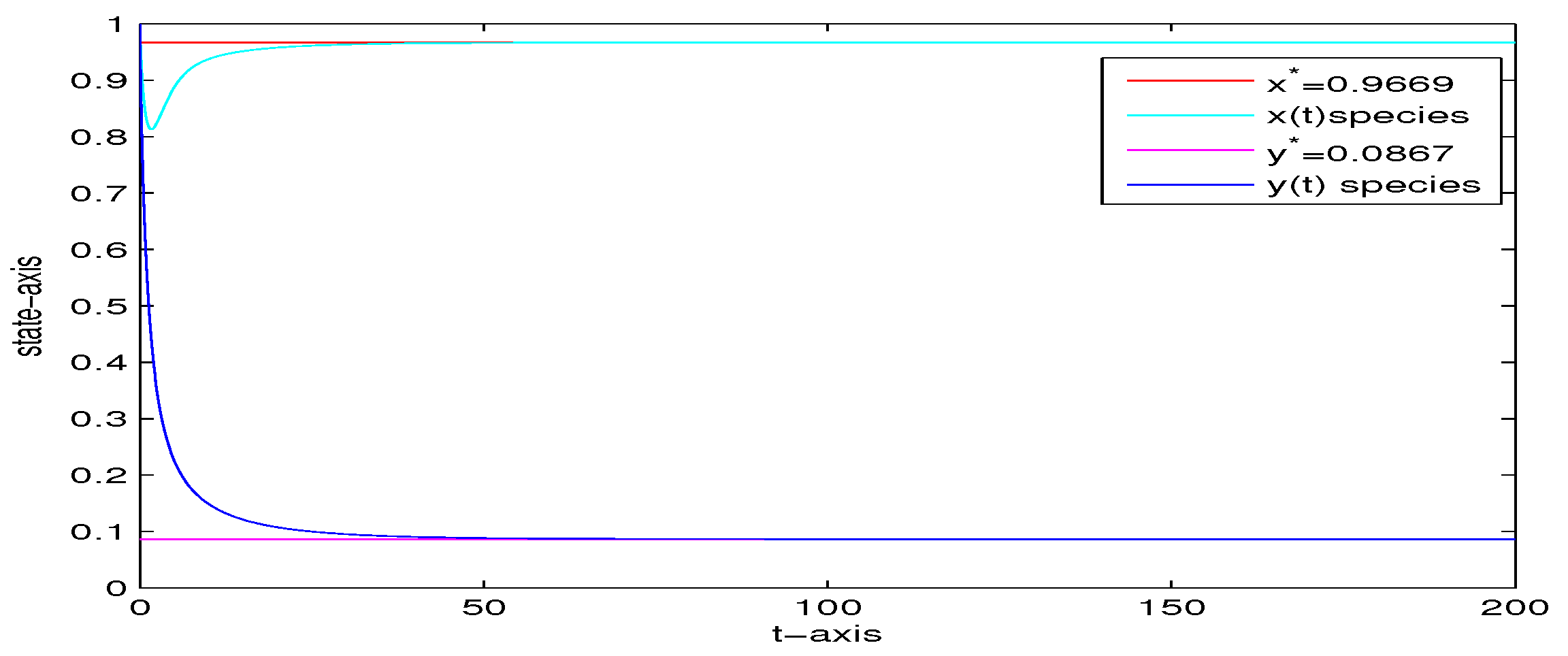
We vary the fear value to see how it affects the equilibrium status. Take , i.e., there is no fear effect on System (2); then, the equilibrium status is . For and , the corresponding equilibrium statuses are and , respectively. That is, if the fear f induced by the predator is large, then both the predator and prey populations are smaller at equilibrium. That means the value of fear from the predator brings some negative influence to the system dynamics (see Figure 1).
Figure 1.
Time-series curves of equilibrium statuses of System (2). The blue line is for the green line is for and the red line is for .
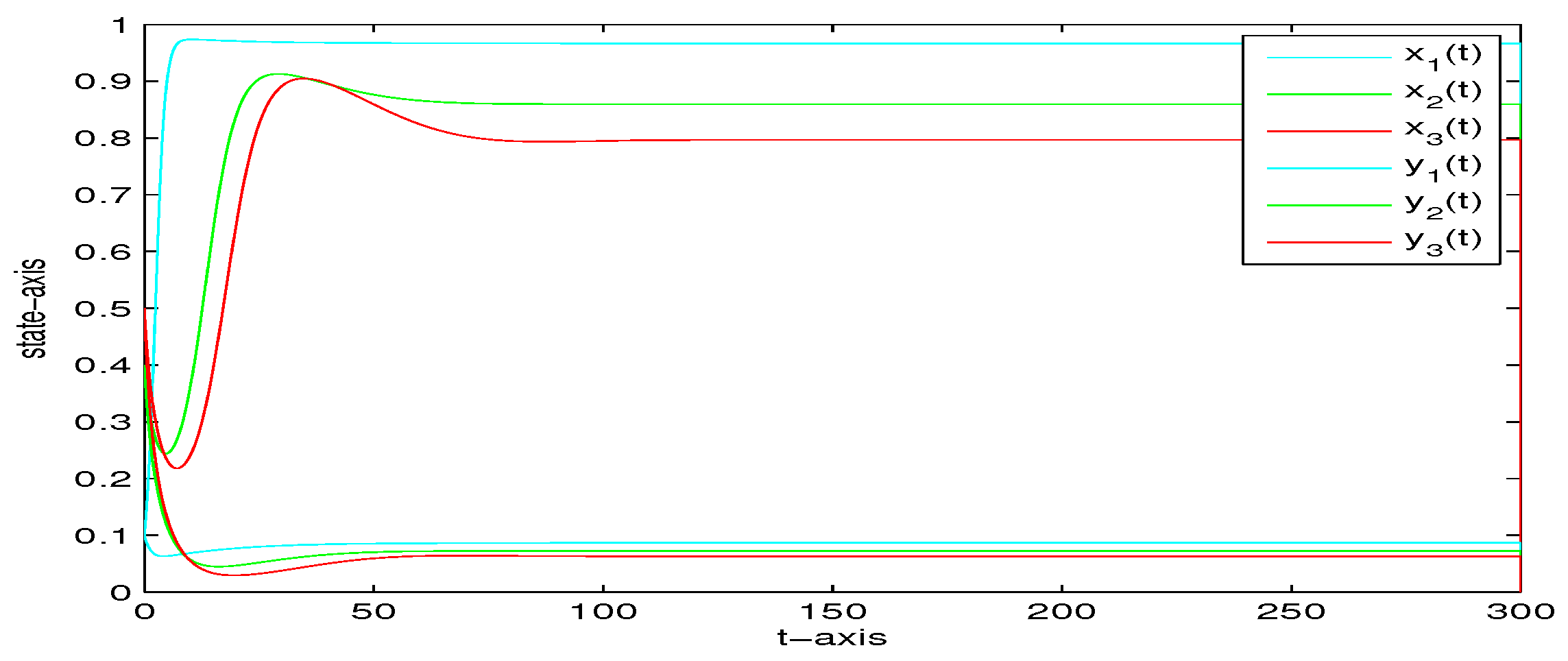
Then, we investigate the global asymptotic stability of equilibrium statuses of and . For the fixed values of parameters in (9) and , we compute the numerical solutions and depict the time-series curves (Figure 2), which are in accordance with our theoretical findings of Theorem 2 because
Figure 2.
The asymptotic stability of of model (2).
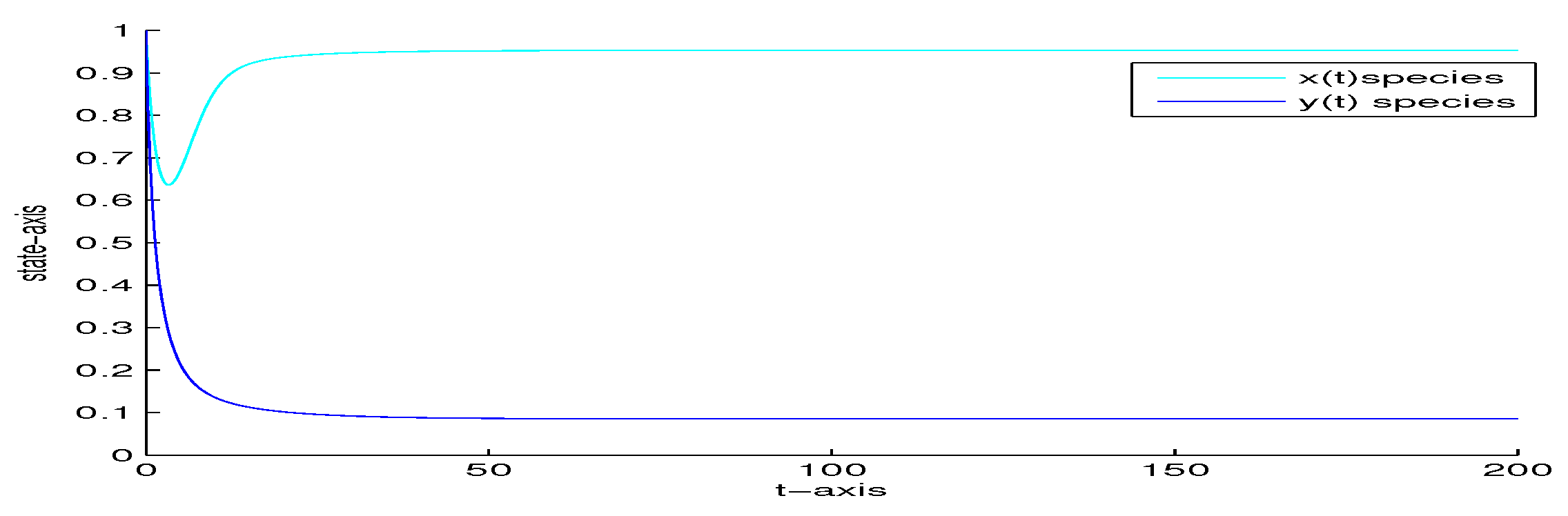
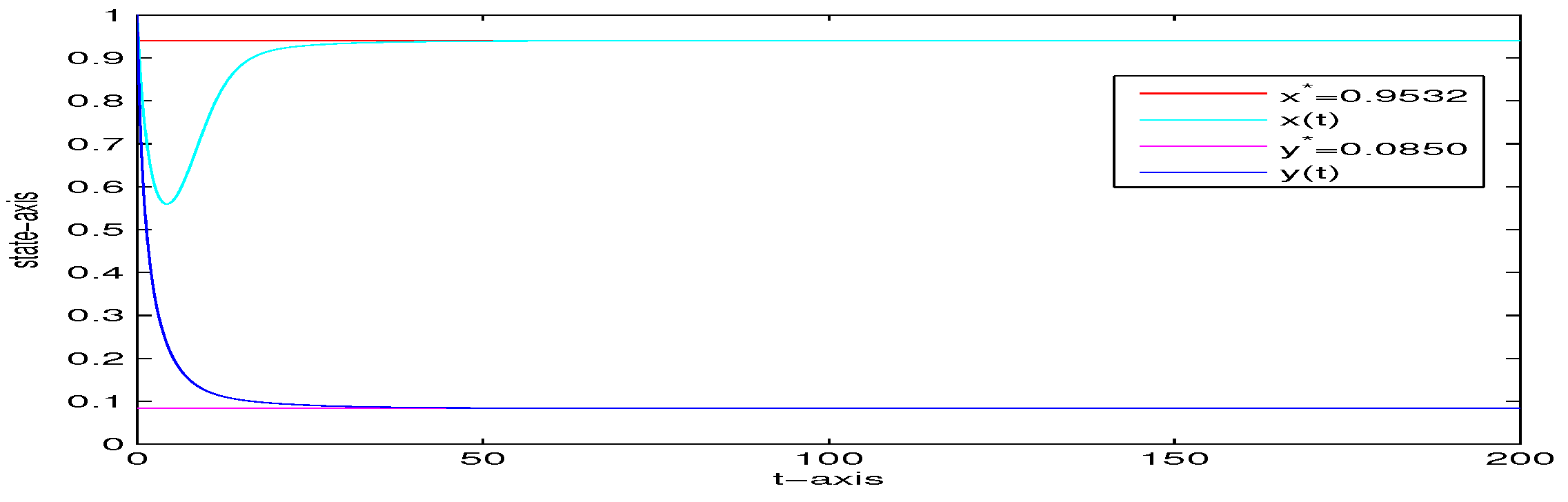
For and , since by use of Theorem 2 again, it should be still globally stable, which is verified by the numerical graph, see Figure 3. If , then the equilibrium status also keeps stable, see Figure 4.
Figure 3.
Global stability of of Model (2).
Figure 4.
Global stability of of Model (2) with .
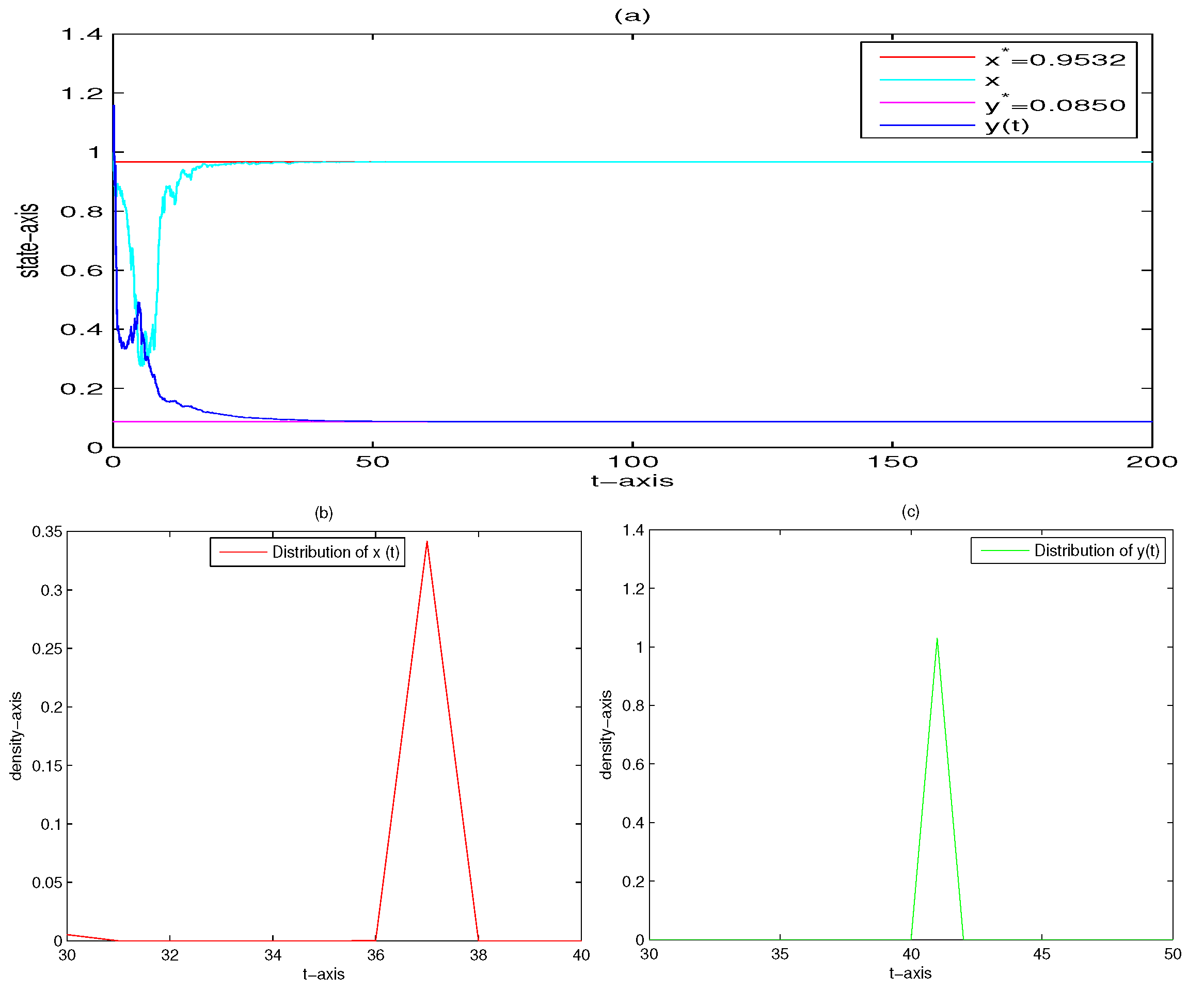
Now, we validate the stochastic results by performing numerical simulations in MATLAB. The stochastic terms are simulated through Milstein’s higher-order method [31]. We take the parameter values as in (9) and and solve the numerical solutions of System (4) (see Figure 5).
Figure 5.
The stationary distribution of (4) with : (a) time-series curves of and ; (b) density distribution of ; and (c) density distribution of .
This reveals that System (4) has a stationary distribution; that is, the equilibrium status remains globally asymptotically stable. We summarize all simulation results in Table 2.
Table 2.
Numerical simulations of (4) with parameters given in (9).
Further, we explore the effects of fear, delays and stochastic parameters on the system dynamics of the equilibrium state of (2) numerically. Set the parameter values of (2) as follows:
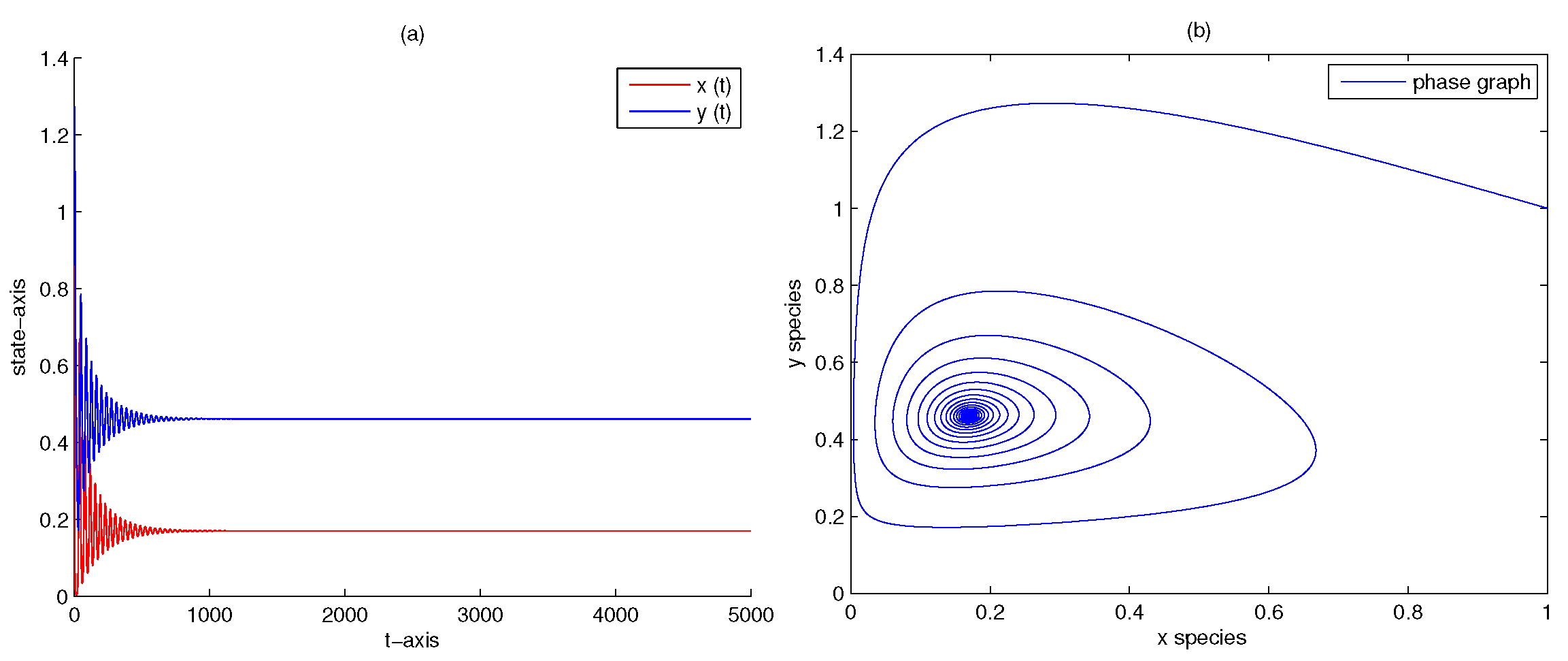
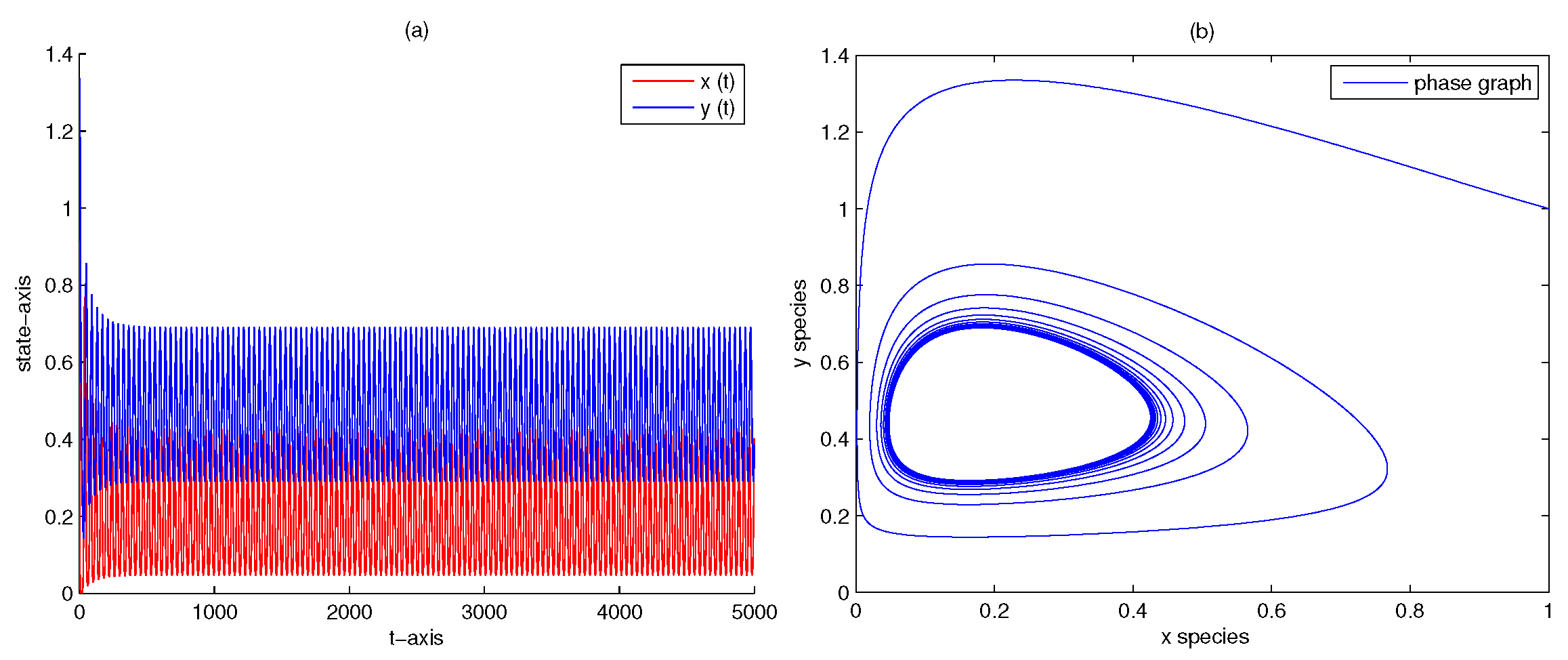
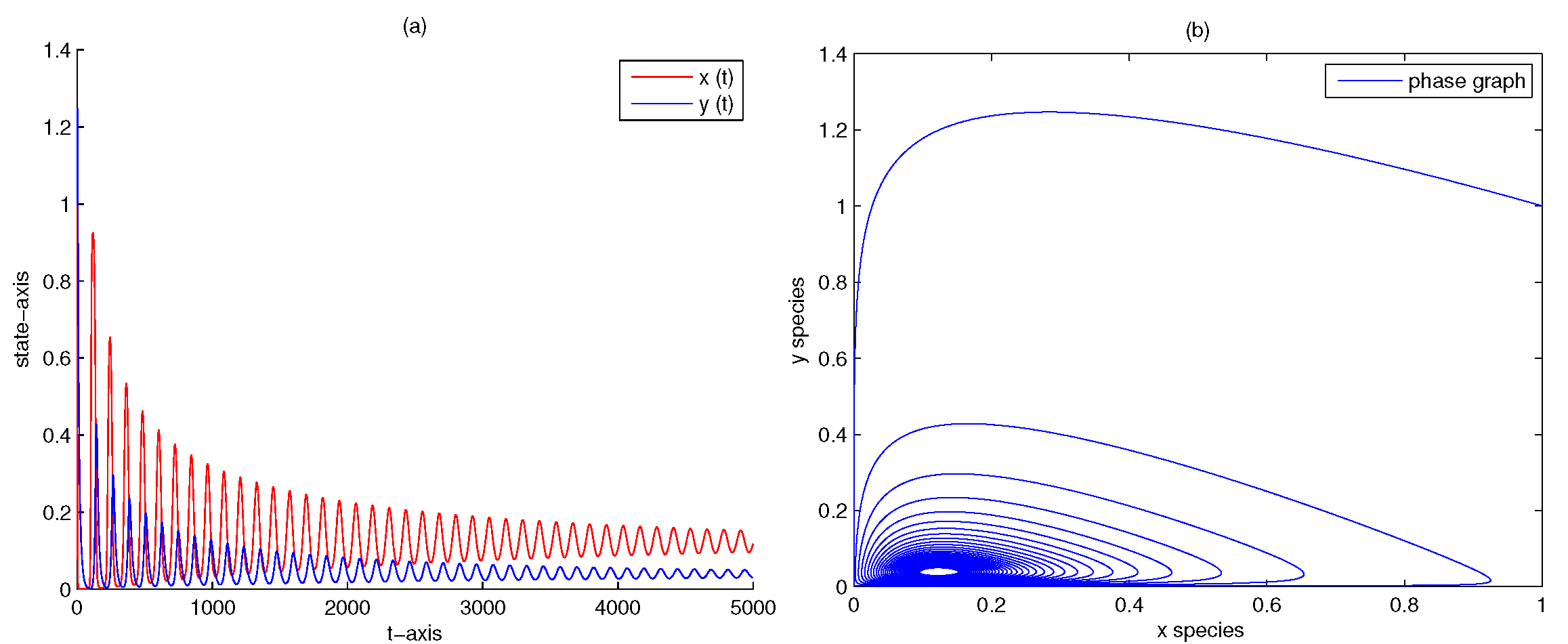
Let then, the equilibrium state of (2) is The numerical curves imply that it remains globally asymptotically stable (see Figure 6). When the fear is large enough, for example , then the equilibrium state is which is unstable (see Figure 7). From a biological point of view, a too high amount of fear can make the prey exhibit such anti-predation responses as foraging, vigilance and even starvation, reducing the population. Certainly, due to the shortage of prey, the predator population also declines, which leads to a coexistence equilibrium state with lower species densities.
Figure 6.
Global stability of of Model (2) with : (a) time-series curves of and and (b) phase diagram.
Figure 7.
Equilibrium status of Model (2) with is numerically unstable: (a) time-series curves of and and (b) phase diagram.
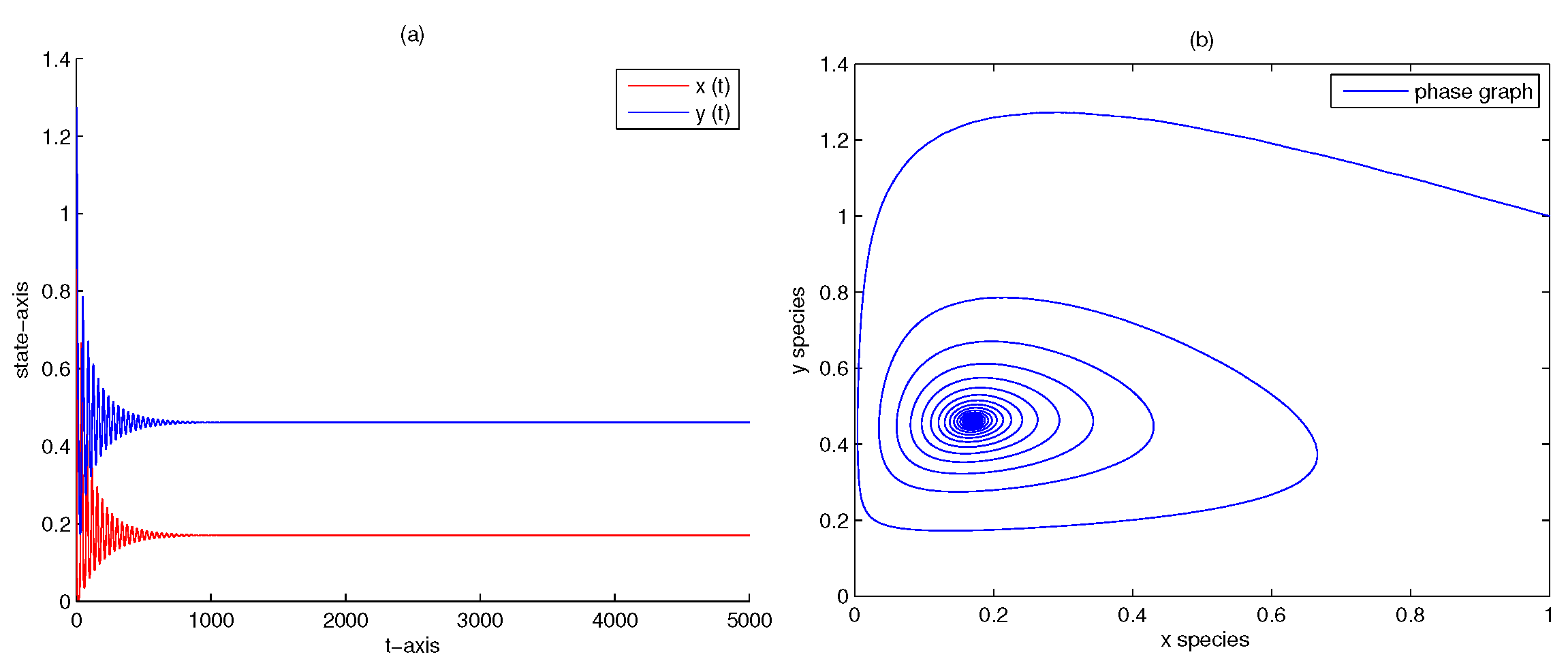
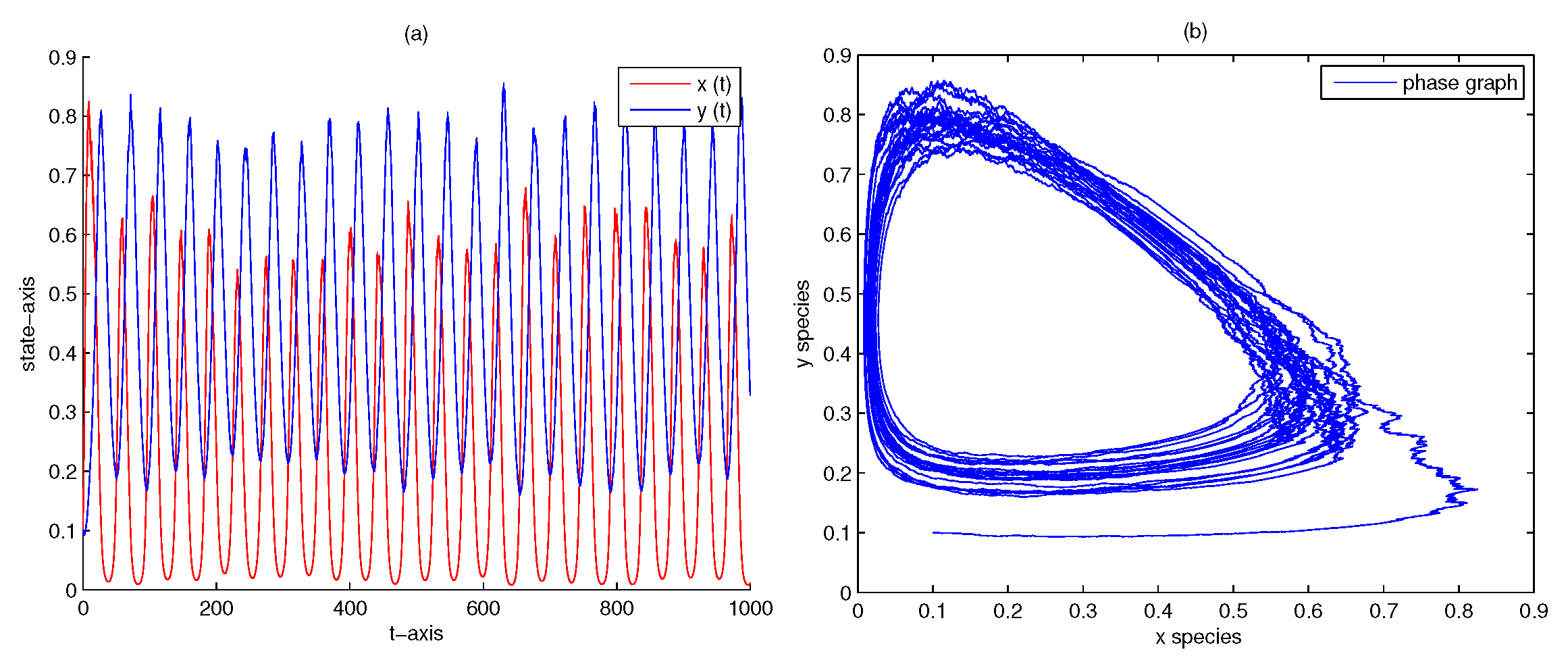
Next, we investigate the influence of time delay and white noise on the system dynamics of . Let and solve (2) numerically; then we get Figure 8, which indicates the stability of fails due to the impact of delays. We alter the values of stochastic parameters to explore the effect of white noise. Let ; Figure 9 shows that a small amount of white noise does not influence the numerical stability of , whereas with greater amounts of white noise, i.e., , the simulation reveals that is unstable (see Figure 10). From a biological angle, if the delay and white noise are relatively small, then their effects can be ignored since this kind of negative role is not enough to affect the long-time behavior of species, but if the effects are large enough, then the biomass will change rapidly in a short period of time so that the negative roles of delay and white noise cannot be offset, which makes the system unstable.
Figure 8.
The equilibrium status of (2) with is numerically unstable: (a) time-series curves of and , (b) is the phase diagram.
Figure 9.
The global stability of of (4) with : (a) time-series curves of and and (b) phase diagram.
Figure 10.
The equilibrium status of (4) with is numerically unstable: (a) time-series curves of and and (b) phase diagram.
We summarize the simulation results in Table 3.
Table 3.
Numerical simulations of (4) with parameters given in (10).
5. Conclusions
For predator–prey systems for which the predator scale is sufficiently large, it is reasonable to use a density-dependent functional response to describe predation, and the fear of prey due to a powerful predator cannot be ignored; hence, we propose a delayed prey–predator model with Beddington–DeAngelis functional response and fear of a predator in a deterministic environment, and then analyze the global asymptotic stability of the equilibrium status of the model with or without time delays. Then, we extend the deterministic model to random environments and get a stochastic model. Applying Lyapunov functional theory, we investigate the distribution stability. Our main results are summarized in Table 4.
Table 4.
Stability conditions of the equilibrium points .
The theoretical results are indicated by above examples (see Figure 1, Figure 2, Figure 3, Figure 4 and Figure 5). The important effects of multiple time lags (delayed fear and delayed gestation), fear of predators and environmental white noise are revealed by simulations (Figure 6, Figure 7, Figure 8, Figure 9 and Figure 10). From Figure 1, we find that the parameter value of fear affects the value of the equilibrium status . In other words, the equilibrium is smaller if the value of fear of the predator is larger. Figure 2, Figure 3, Figure 4 and Figure 5 show the long-time behavior of ; i.e., it is globally stable when the conditions in the main results are satisfied. Figure 6, Figure 7, Figure 8, Figure 9 and Figure 10 reveal that the parameter values have large impacts on the stability of System (5), which can change the dynamics of the equilibrium state from stable to unstable. We deduce that there may be a threshold for every parameter for system stability. In other words, we numerically observe that factors such as fear of prey, time delay of fear, time delay of gestation, and environmental disturbance can greatly influence the stability of the equilibrium status of System (2). In detail, the main contributions of this research are as follows:
- Theorems 1 and 2 show the effects of fear on the global stability of Systems (1) and (2), respectively. Remark 2 reveals the effect of delay on system dynamics.
- Lemma 2 gives the representation of the solution of the stochastic differentialEquation (6). By use of the comparison method together with Lemma 2, the existence of the solution of System (4) is proved, which is distinct from the Lyapunov functional methods applied in some existing research [9,15,32].
- Theorem 3 shows theoretically the effects of environmental white noise and fear on the distribution stability.
In light of our findings, in order to decrease the negative effects of delayed fear and white noise in order to maintain ecological balance, some measures may be undertaken, such as (i) construction of refuge zones to reduce the prey’s fear of predators, (ii) provision of additional food for predators to protect the prey while maintaining the predator population, and (iii) application of some ‘biological control’ strategies such as releasing predators to control prey, and so on.
Some interesting topics deserve further study. Firstly, by simulation examples, some oscillations occur, and there may exist parameter thresholds for stability. Then, it is unknown if the Hopf bifurcations occur at some critical value of fear f or time delay and . Secondly, due to sudden environmental perturbations such natural biological/ecological disasters and sudden changes in weather (hurricanes), which are usually modeled by environmental Lévy noise, it is necessary to introduce Lévy noise to the population model. Thirdly, there is uncertainty created by interactions between different species and shortage of food resources in real-world systems. A review of the literature shows that this uncertainty plays a key role in using mathematical models to predict population dynamics (see, for example [33,34] and references cited therein). Thus, incorporated uncertainty into our model to examine changes in system dynamics is a very interesting topic to be explored. We leave these subjects for future research.
Author Contributions
Y.S. contributed to the conception, model design, analysis, interpretation, drafting of the manuscript, revision and proofreading. W.K. contributed to simulation analysis, interpretation and proofreading. All authors have read and agreed to the published version of the manuscript.
Funding
The paper is supported by the NSF of China (no. 11861027) and partially by the Project of Education Department of Yunnan Province (2022J0807).
Institutional Review Board Statement
Not applicable.
Informed Consent Statement
Not applicable.
Data Availability Statement
Not applicable.
Acknowledgments
The authors are very grateful to the anonymous referees and the editor for their helpful comments and suggestions, which have greatly improved the presentation of this paper.
Conflicts of Interest
The authors declare that they have no competing interest with regards to this paper.
References
- Volterra, V. Fluctuations in the abundance of a species considered mathematically. Nature 1926, 118, 558–560. [Google Scholar] [CrossRef]
- Holling, C.S. The functional response of predator to prey density and its role in mimicry and population regulation. Mem. Entomol. Soc. Can. 1965, 45, 1–60. [Google Scholar] [CrossRef]
- Shao, Y.F.; Li, Y. Dynamical analysis of a stage structured predator-prey system with impulsive diffusion and generic functional response. Appl. Math. Comput. 2013, 220, 472–481. [Google Scholar] [CrossRef]
- Xu, D.S.; Liu, M.; Xu, X.F. Analysis of a stochastic predator-prey system with modified Leslie-Gower and Holling-type IV schemes. Physica A 2020, 537, 122761. [Google Scholar] [CrossRef]
- Roy, J.; Barman, D.; Alam, S. Role of fear in a predator-prey system with ratio-dependent functional response in deterministic and stochastic environment. BioSystems 2020, 197, 104176. [Google Scholar] [CrossRef] [PubMed]
- Skalski, G.T.; Gilliam, J.F. Functional response with predator interference: Viable aiternative to the Holling type II model. Ecology 2001, 82, 3083–3092. [Google Scholar] [CrossRef]
- Beddington, J.R. Mutual interference between parasites of predators and its effect on searching efficiency. J. Anim. Eccol. 1975, 44, 331–341. [Google Scholar] [CrossRef]
- DeAngelis, D.L.; Goldsten, R.A.; Neill, R. A model for trophic interaction. Ecology 1975, 56, 881–892. [Google Scholar] [CrossRef]
- Xia, Y.X.; Yuan, S.L. Survival analysis of a stochastic predator-prey model with prey refuge and fear effect. J. Biol. Dynam. 2020, 14, 871–892. [Google Scholar] [CrossRef]
- Zanette, L.Y.; Allen, A.F.; Clinchy, M. Percieved predation risk reduces the number of spring songbirds produe per year. Science 2011, 334, 1398–1401. [Google Scholar] [CrossRef]
- Wang, X.; Zanette, L.; Zou, X. Modelling the fear effect in predator-prey interactions. J. Math. Biol. 2016, 73, 1179–1204. [Google Scholar] [CrossRef] [PubMed]
- Elliot, K.H.; Betini, G.S.; Norris, D.R. Fear creats an Alleeeffects: Experimental evidence from seasonal populations. Proc. Biol. Sci. 2017, 284, 20170878. [Google Scholar]
- Panday, P.; Samanta, S.; Pal, N.; Chattopadhyay, J. Delay induced multiple stability switch and chaos in a predator-prey model with fear effect. Math. Comput. Simul. 2020, 172, 134–158. [Google Scholar] [CrossRef]
- Sahoo, D.; Samanta, G.P. Comparison between two tritrophic food chain models with multiple delays and anti-predation effect. Int. J. Biomath. 2021, 14, 2150010. [Google Scholar] [CrossRef]
- Shao, Y. Global stability of a delayed predator-prey system with fear and Holling-type II functional response in deterministic and stochastic environments. Math. Comput. Simul. 2022, 200, 65–77. [Google Scholar] [CrossRef]
- Wang, Y.; Zou, X. On a predator-prey system with digestion delay and anti-predation strategy. J. Nonlinear Sci. 2020, 30, 1579–1605. [Google Scholar] [CrossRef]
- Xiao, Y.; Chen, L. Modelling and analysis of a predator-prey model with disease in the prey. Math. Biosci. 2001, 171, 59–82. [Google Scholar] [CrossRef]
- Kuang, Y. Delay Differential Equations with Applications in Population Dynamics; Academic Press: New York, NY, USA, 1993. [Google Scholar]
- Upadhyay, R.K.; Mukhopadhyay, A.; Iyengar, S.R. Influence of environmental noise on the dynamics of a realistic ecological model. Fluct. Noise Lett. 2007, 7, 61–77. [Google Scholar] [CrossRef]
- Liu, M.; Wang, K. Stochastic Lotka-Volterra systems with Lévy noise. J. Math. Anal. Appl. 2014, 410, 750–763. [Google Scholar] [CrossRef]
- Zhao, Y.; Yuan, S. Stability in distribution of a stochastic hybrid competitive Lotka-Volterra model with Lévy jumps. Chaos Solitons Fractals 2016, 85, 98–109. [Google Scholar] [CrossRef]
- Mao, X. Stochastic Differential Equations and Applications; Horwood Publishing: Chichester, UK, 1997. [Google Scholar]
- Liu, M.; Wang, K. Global asymptotic stability of a stochastic Lotka-Volterra model with infinite delays. Commun. Nonlinear Sci. Numer. Simul. 2012, 17, 3115–3123. [Google Scholar] [CrossRef]
- Liu, Q. The effects of time-dependent delays on global stability of stochastic Lotka-Volterra competitive model. Physica A 2015, 420, 108–115. [Google Scholar] [CrossRef]
- Has’minskii, R.Z. Stochastic Stability of Differential Equations; Sijthoff Noordhoff: Alphen annden Rijn, The Netherlands, 1980. [Google Scholar]
- Song, X.Y.; Chen, L.S. Optimal harvesting and stability with stage structure for a two species competitive system. Math. Biosci. 2001, 170, 173–186. [Google Scholar] [CrossRef]
- May, R. Stability in randomly fluctuating deterministic environments. Am. Nat. 1973, 107, 621–650. [Google Scholar] [CrossRef]
- Mao, X.; Yuan, C.; Zou, J. Sttochastic differential delay equations of population dynamics. J. Math. Anal. Appl. 2005, 304, 296–320. [Google Scholar] [CrossRef]
- Huang, Y.; Liu, Q.; Liu, Y.L. Global asymptotic stability of a general stochastic Lotka-Volterra system with delays. Appl. Math. Lett. 2013, 26, 175–178. [Google Scholar] [CrossRef][Green Version]
- Das, A.; Samanta, G.P. Modelling the fear effect in a two-species predator-prey system under the influence of toxic substances. Rend. Circ. Mat. Palermo Ser. 2 2021, 70, 1501–1526. [Google Scholar] [CrossRef]
- Higham, D.J. An aigorithmic introduction to numerical simulations of stochastic differential equations. SIAM Rev. 2001, 43, 525–546. [Google Scholar] [CrossRef]
- Kong, W.L.; Shao, Y. The long time behavior of equilibrium status of a predator-prey system with delayed fear in deterministic and stochastic scenarios. J. Math. 2022, 2022, 3214358. [Google Scholar] [CrossRef]
- Waezizadeha, T.; Mehrpooya, A.; Rezaeizadehc, M.; Yarahmadiand, S. Mathematical models for the effects of hypertension and stress on kidney and their uncertainty. Math. Bios. 2018, 305, 77–95. [Google Scholar] [CrossRef]
- Brehme, M.; Koschmieder, S.; Montazeri, M.; Copland, M.; Oehler, V.G.; Radich, J.P.; Brmmendorf, T.H.; Schuppert, A. Combined population dynamics and entropy modelling supports patient stratification in Chronic cyeloid leukemia. Sci. Rep. 2016, 6, 24057. [Google Scholar] [CrossRef] [PubMed]
Publisher’s Note: MDPI stays neutral with regard to jurisdictional claims in published maps and institutional affiliations. |
© 2022 by the authors. Licensee MDPI, Basel, Switzerland. This article is an open access article distributed under the terms and conditions of the Creative Commons Attribution (CC BY) license (https://creativecommons.org/licenses/by/4.0/).