
Abstract
In this paper, we present a novel variational wavelet inpainting based on the total variation (TV) regularization and the l1-norm fitting term. The goal of this model is to recover incomplete wavelet coefficients in the presence of impulsive noise. By incorporating the Moreau envelope, the proposed model for wavelet inpainting can better handle the non-differentiability of the l1-norm fitting term. A modified primal dual fixed-point algorithm is developed based on the proximity operator to solve the proposed variational model. Moreover, we consider the existence of solution for the proposed model and the convergence analysis of the developed iterative scheme in this paper. Numerical experiments show the desirable performance of our method.
Keywords:
wavelet inpainting; Moreau envelope; proximity operator; fixed point algorithm; impulsive noise MSC:
68U10
1. Introduction
As artificial intelligence technology developed, image inpainting became a key technique in image processing and computer vision [1,2]. The goal of image inpainting was to recover damaged or the missing information, either in the pixel domain or in the transformed domain or in both [3]. It has been extensively linked to other important tasks [4,5,6,7], like text and scratch removal, zooming and high-resolution image reconstruction, and impulsive noise removal, among many others. Up to now, a wide variety of image inpainting methods have been developed in the literature [8,9,10,11,12].
Generally, an image of size is treated as a vector in (with ) by stacking up the columns of the image matrix. Let be the acquired transformed coefficients with the missing ones set to zero and be additive noise introduced in storage or transmission of the coefficients. Denoting by Ω the complete index set of transformed coefficients and as the index set of available ones, the image inpainting problem can be described as
where represents a transform matrix, is a diagonal matrix with if and if . The inpainting problem is to recover from . The pioneering work in this area was proposed by Bertalmio et al. [11]. They have proposed a novel image inpainting model based on the nonlinear partial differential equations (PDE) of third order in image domain. Since then, a wide variety of image inpainting methods have been developed in the literature.
The follow-up studies show that the regularization functional-based method is a class of efficient techniques. In [6], Chan and Shen proposed the total variation (TV) inpainting model. Many methods have considered the curvature information along the isophote to realize the Connectivity Principle, including the curvature driven diffusion (CDD) by Chan and Shen [12] and the Euler elastic energy functional based model by Chan et al. [13]. Fuchs presented a comprehensive review on a class of higher order variational models related to the application in image inpainting [10]. However, these methods were all based on local geometrical information of an image, which were limited to non-texture images. Recently, a class of non-local methods has been extensively applied in image processing fields [14]. Moreover, Arias et al. [15] proposed a general variational framework for non-local image inpainting based on exemplar. Peyre et al. [16] also investigated the non-local TV for various image restoration problems, including the inpainting tasks. All these methods have been considered inpainting in the pixel domain.
In the JPEG2000 image compression standard, images are usually formatted and stored in terms of wavelet coefficients. Due to lossy transmission or communication, some damages to wavelet coefficients may heavily affect the image quality. The damaged regions in pixel domain cannot be well located and the degradation is often inhomogeneous. These prompt the need of recovering the damaged information in the wavelet domain. Chan et al. [3] have addressed this problem as wavelet inpainting, which corresponds to the problem (1) with being an orthogonal wavelet transform. Up to now, wavelet inpainting has received a lot of attentions [17,18,19,20,21,22]. Direct interpolation in the wavelet domain is problematic since high frequency coefficients retained cannot provide enough information for the missing ones. These motivate one to consider features in both the pixel domain and wavelet domain. Motivated by the idea of using TV minimization together with wavelet representation [23,24], Chan et al. [3] proposed the TV wavelet inpainting model. An objective function, which combines TV regularization term in the pixel domain with l2-norm fitting term in wavelet domain, is minimized to reproduce the damaged coefficients; we refer to this model as TVL2 model in this paper. They also have investigated some properties of this model, such as the existence and non-uniqueness of the solutions. Chan and Zhang extended the total variation wavelet inpainting to nonlocal total variation regularization [21]. The textures and local geometry structures are simultaneous when using this nonlocal method. Moreover, other regularization terms were introduced to overcome some drawbacks of the classical TV regularization, such as p-Laplace operator [19].
On the other hand, the fitting term plays an important to the variational model in the image processing. We can integrate the modified fitting term into the variational based wavelet inpainting for a specific purpose. Tai et al. [18] considered the sparsity of wavelet coefficients and proposed to combine TV regularization with l0-norm fitting in wavelet domain. In image restoration, theoretical and empirical analysis shows that the l2-norm fitting is less effective for handling the impulsive noise, while the l1-norm fitting can effectively suppress the outliers occurring in images. Thus, the l1-norm fitting is suitable for impulsive noise removal. Furthermore, it is well-known that the l1-norm for image denoising does not erode the geometrical structures of the image. These observations motivate us to propose the TVL1 wavelet inpainting model, which combines the TV regularization with the l1-norm fitting for the inpainting wavelet coefficients corrupted by impulsive noise. The difficulties are the non-differentiability of both the TV regularization and l1-norm fitting.
Many numerical methods have been proposed to solve the TV-based problems, including time marching scheme, split Bregman/Augmented Lagrangian method and primal-dual method [1,22,25,26]. Recently, Micchelli et al. [27] proposed a fixed-point algorithm based on proximity operator (FP2O) to solve the total variation based denoising model. Inspired by the proximal forward–backward splitting (PFBS) [28] and the FP2O algorithm, Chen et al. [29] have proposed a primal–dual fixed-point algorithm based on proximity operator (PDFP2O) to minimize the sum of the TV regularization and a general differentiable fitting term. Liu et al. proposed a constrained second-order total generalized variational model for image denoising and utilized the primal–dual proximity method to solve it [30]. The non-differentiable fitting term makes it difficult to solve the variational model. Many researchers tackle this problem by introducing additional quadratic terms with some auxiliary variables [31,32]. As is pointed out in [33], this type of method could be included in the framework of Moreau envelope. In this paper, we utilize the Chen et al.’s algorithm and the Moreau envelope to solve the TVL1 wavelet inpainting model approximately and give the convergence analysis of the developed iterative scheme in the framework of the PDFP2O algorithm.
This paper is organized as follows. In Section 2, we present a brief introduction of the Moreau envelope (Section 2.1) and the PDFP2O algorithm (Section 2.2). We present the wavelet inpainting variational model based on the l1-norm in Section 3.1, and its numerical scheme for the proposed model in Section 3.2. We present some numerical results for different kinds of images in Section 4. Finally, this paper is concluded in Section 5.
2. Background
In this section, we briefly review the Moreau envelope (Section 2.1) and the primal–dual fixed-point algorithm based on proximity operator (PDFP2O) (Section 2.2).
2.1. Moreau Envelope
Moreau envelope is used to smooth a non-smooth convex function. Let be the set of all proper lower semi-continuous convex functions , such that the domain of is nonempty. For , we denote its Moreau envelope of index at by
The function is still proper lower semi-continuous on and always differentiable with the gradient by
where is the identity operator from to and is the proximity operator of given by
Moreover, the function is bounded above by and converges pointwise to as (Theorem 1.25 in [34]). The differentiability of Moreau envelope motivates one to smooth a non-smooth function by its Moreau envelope. For some , its proximity operator even has closed form.
For example, with . Let , then the i-th component of is given by
where sgn is the sign function.
2.2. The PDFP2O Algorithm
Let , and is differentiable on with a -Lipschitz continuous gradient for some . Many researchers pay more attention to an efficient algorithmic framework for the following minimization problem:
where is the first-order difference matrix defined as follow. is described as
where is the identity matrix in , is the matrix given by
and the notation denotes the Kronecker product of matrices and . The problem (6) can be solved by the classical proximal forward–backward splitting algorithm, which can be shown by
Thus, the problem (6) is equivalent to solving the fixed-point of operator . Inspired by the FP2O algorithm, Chen et al. [29] proposed a primal–dual fixed-point algorithm based on proximity operator (PDFP2O) as follows:
where the parameters and the variable could be understand as the dual variable of the primal dual formulation related to (6). The PDFP2O algorithm is convergent under some restrictions on the parameters and , which can be shown by Lemma 1 (Theorem in [29]). In this paper, we utilize the PDFP2O algorithm to solve the proposed model approximately.
Lemma 1.
Suppose and where is the largest eigenvalue of . Let be a sequence generated by the iteration (7). Then the sequence converges to the minimizer of the problem (6).
3. The Proposed Model and Its Numerical Scheme
3.1. Wavelet Inpainting Variational Model Based on L1 Norm
Mathematically, image inpainting can be regarded as an ill-posed problem. This kind of problem can be solved by adding the regularization term into the variational model. Chan et al. [3] proposed the wavelet inpainting based on the total variation and the l2-norm (TVL2):
where refers to the total variation of the image, is the l2-norm in , and is a scalar parameter balancing the TV regularization term and the fitting term. plays the role of regularization, incorporating additional a priori knowledge into the problem to convert the ill-poised problem into a well-posed one or select one from the infinitely possible solutions. The fitting term based on l2-norm can be used to penalize inconsistency between the observed image and the estimated image. They perform well on some geometrical information and reduce Gaussian noise and other oscillations (e.g., Gibbs’ phenomenon). The experiments show that the TVL2 model can recover the missing wavelet coefficients, while preserving the geometrical features in pixel domain.
Impulsive noise often occurs in the storage or transmission of the coefficients. It could seriously affect the image quality. Thus, we should pay more attention to the impulsive noise in the processing of wavelet inpainting. The TVL2 model cannot provide desirable reconstruction result, which use the l2-norm fitting term. Many studies pay their attention to the l1-norm fitting term. Thus, it is widely used for impulsive noise removal or deblurring or both due to its distinctive and desirable features such as the contrast and edge preservation, data driven scale selection and multiscale decomposition. This consideration motivates us to propose the following TVL1 model for wavelet inpainting:
where denotes the l1-norm in , is a scalar parameter balancing the TV regularization and the fitting term. Thanks to the properties of the l1-norm fitting term, the TVL1 model can recover a good image from the partial wavelet coefficients corrupted by impulsive noise. The TVL1 model (9) can be reformulated as
where , , and . Due to the non-differentiability of the fitting term in (10), the TVL1 model for wavelet inpainting is not easy to solve. In the next subsection, the Moreau envelope is applied to tackling the non-differentiability of the l1-norm, and then an iterative scheme based on the PDFP2O algorithm is presented, which is used to solve the associated problem.
3.2. Numerical Scheme for the Proposed Model
The main difficulty for the numerical treatment of the proposed model lies in non-differentiability of the fitting term. It is known that when the operator K in (10) is the identity operator in , this model becomes the TVL1 image denoising model. Various efficient numerical approaches have been proposed in the literature. However, all these approaches cannot be directly applied to solving the TVL1 model for wavelet inpainting.
Considering the non-differentiability of the function and the properties of the Moreau envelope, we substitute the function in (10) with its corresponding Moreau envelope. Then the modified TVL1 model is given as
where is a scalar parameter determining how well the Moreau envelope approximates the function (a better approximation with a smaller ). The following proposition shows the existence of a solution to the problem (11).
Proposition 1.
For each , let , , , be defined in (10), then the problem (11) has at least one solution.
Proof of Proposition 1.
By the definition of , we rewrite the problem as
Firstly, we show the existence of a minimizer to the function .
The first and second terms are obviously convex. The Hessian of
is given by
where T is the transpose operator and is the identity matrix in . is a positive semidefinite since is positive semidefinite. Then is convex. It is easy to see that is proper and continuous. We only need to show that it is coercive, i.e., as . We argue by its contrapositive. Let be a sequence such that
We deduce that
and
By Poincaré inequality, there exists a independent of , so that
Moreover, (14) implies that . Since for any , there exists a independent of , so that
Therefore, . This shows the coercivity of . The existence of a minimizer to follows.
Next, we show that if is a minimizer of , then . It directly follows that
By the definition of proximity operator, we know that
which together with the last inequality implies
Hence, .
Finally, we show that if is a minimizer of , then is a minimizer of . Using the definition of the Moreau envelope, we have
By (11), (12), and (15), we can obtain . By contradiction, if is not a minimizer of , then there exists a , such that .
This inequality implies that , which contradicts with the assumption that is a minimizer of . This completes the proof. □
Many numerical methods have been proposed to solve the TV-based energy functional. In the following, we will utilize the PDFP2O algorithm to solve the proposed model (10) approximately. We have given a brief introduction to this algorithm in Section 2.2. Using Proposition 1, we obtain the numerical scheme for the modified model by the chain rule and the iteration scheme (7) as follows:
where is the transpose operator. Using the Formula (3) and the translation property of proximity operator, we have
In (16) and (17), the proximity operator () can be explicitly computed according to the Formula (5). For simplicity of description, we introduce an intermediate variable . By (17) and , the iteration (16) can be changed into the iteration (18). The iterative of algorithm for the modified model (11) is summarized in Algorithm 1.
| Algorithm 1 The numerical scheme for the proposed model |
In the following, we give the convergence analysis of the Algorithm 1 in the framework of the PDFP2O algorithm.
Proposition 2.
Suppose , and , where is the largest eigenvalue of . Then the sequence generated by Algorithm 1 converges to a minimizer of the problem (11).
Proof of Proposition 2.
According to Lemma 1, it suffices to show that the composite function is differentiable and its gradient is -Lipschitz continuous. By the chain rule and the differentiability of , it shows that is -Lipschitz continuous.
In fact, for any , , by Formula (16) we have
where , which is similar for others. The first and third inequalities follow from the fact that both and are bounded linear operators, while the second inequality follows from the fact that is a firmly non-expansive operator [28] if . The last inequality holds due to and , where is the spectral radius of the matrix . This completes the proof. □
Proposition 2 implies that, for a given , we can find a solution (denoted by ) to the modified TVL1 model by Algorithm 1. Since
the solution of the modified model with a small enough is a good approximate solution of the original model.
4. Numerical Results
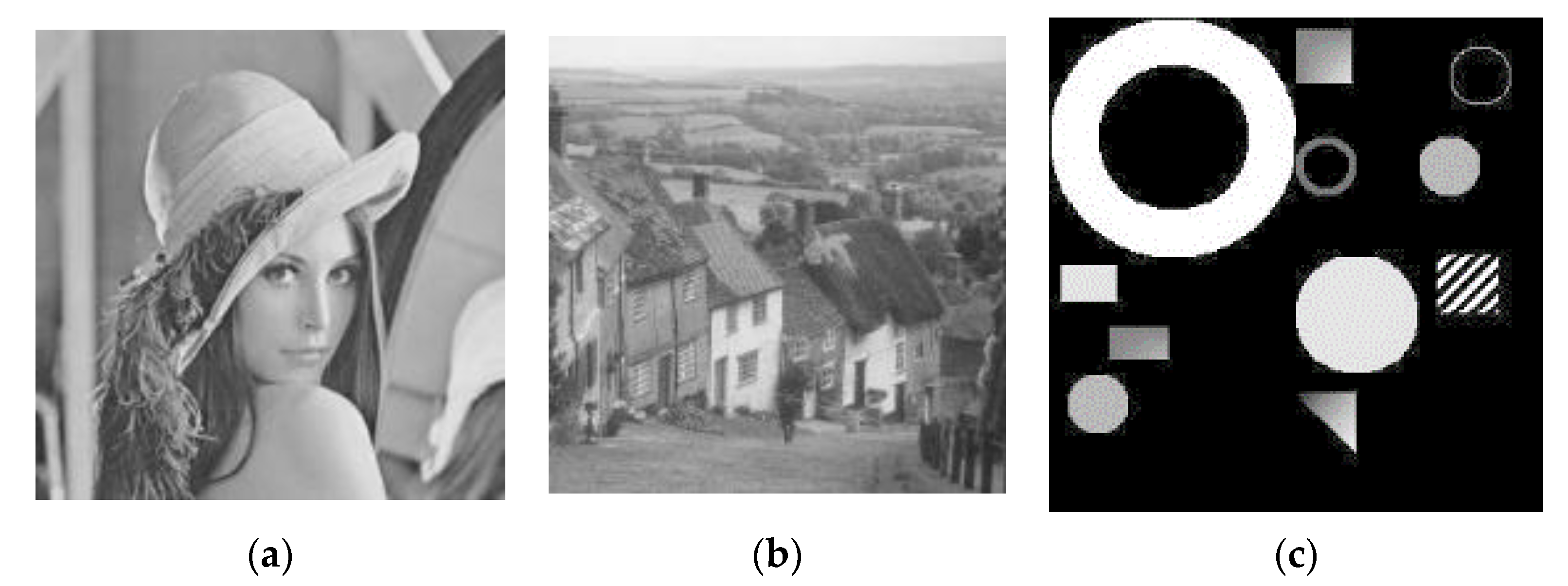
In this section, we give some numerical results to evaluate the performance of three wavelet inpainting models (TVL2, TVL0, TVL1). Three images (shown in Figure 1) are used for test, including “Lenna”, “Goldhill”, and a synthetic image. PSNR is used as a performance evaluation criterion, which is defined by
where is the original image, is the inpainted image.
Figure 1.
Test images. (a) Lenna. (b) Goldhill. (c) Synthetic.
In this paper, we apply the Daubechies 7-9 biorthogonal wavelets with symmetric extensions at the boundaries for decomposition. In all experiments, we choose as the acquired wavelet coefficients and as the received image, which is the back projection of . We fix (see [27] for details) and (see Proposition 1) for Algorithm 1. In the JPEG 2000 compression standard, the image is decomposed into wavelet sub-bands, and then each sub-band is divided into codeblocks. Therefore, we consider the codeblock loss of the wavelet coefficients in the experiments. For simplicity, we choose the codeblocks of 8 × 8 that randomly spread in the wavelet image as the loss mask. Recently, Wen et al. [22] proposed a primal–dual method for the TVL2 model, which is faster than the method used in [3]. Here, we employ this method to solve the TVL2 model.
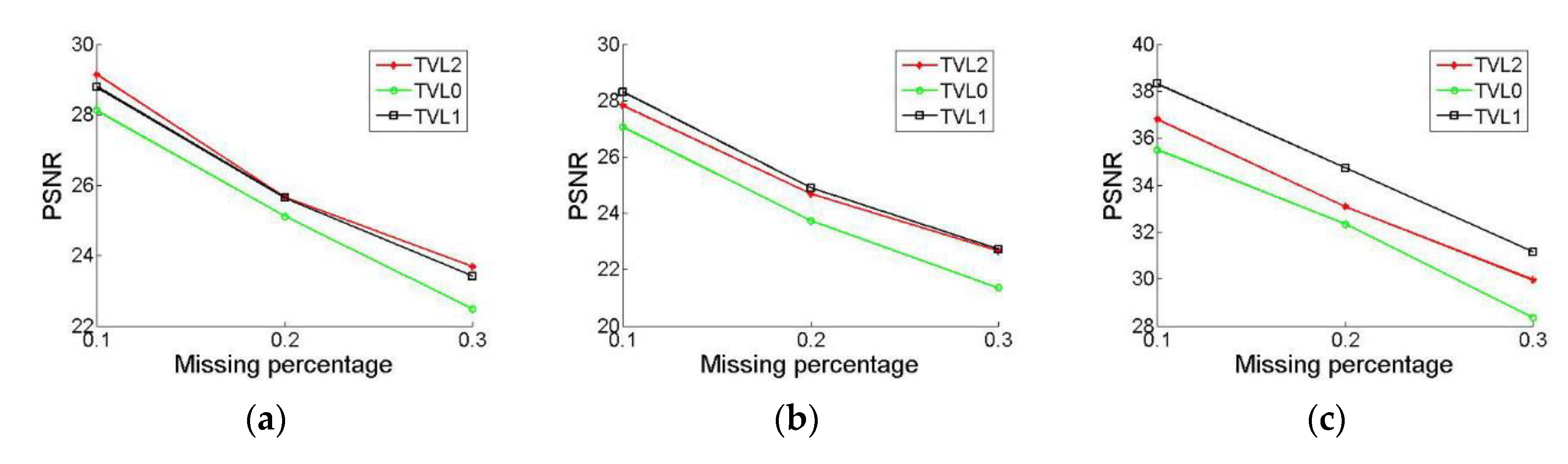
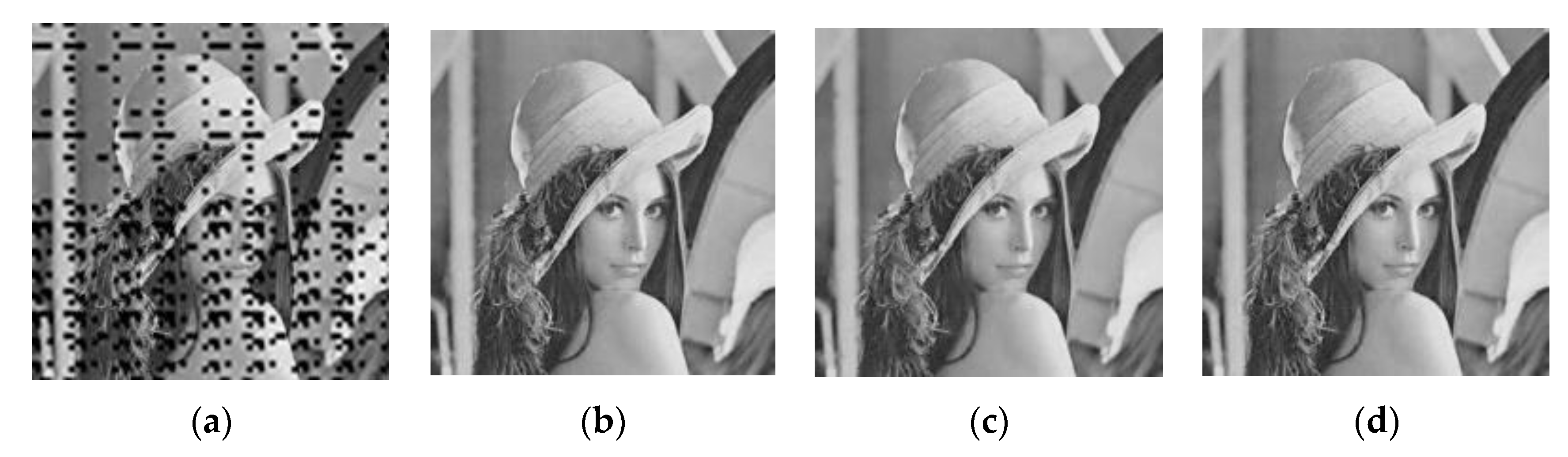
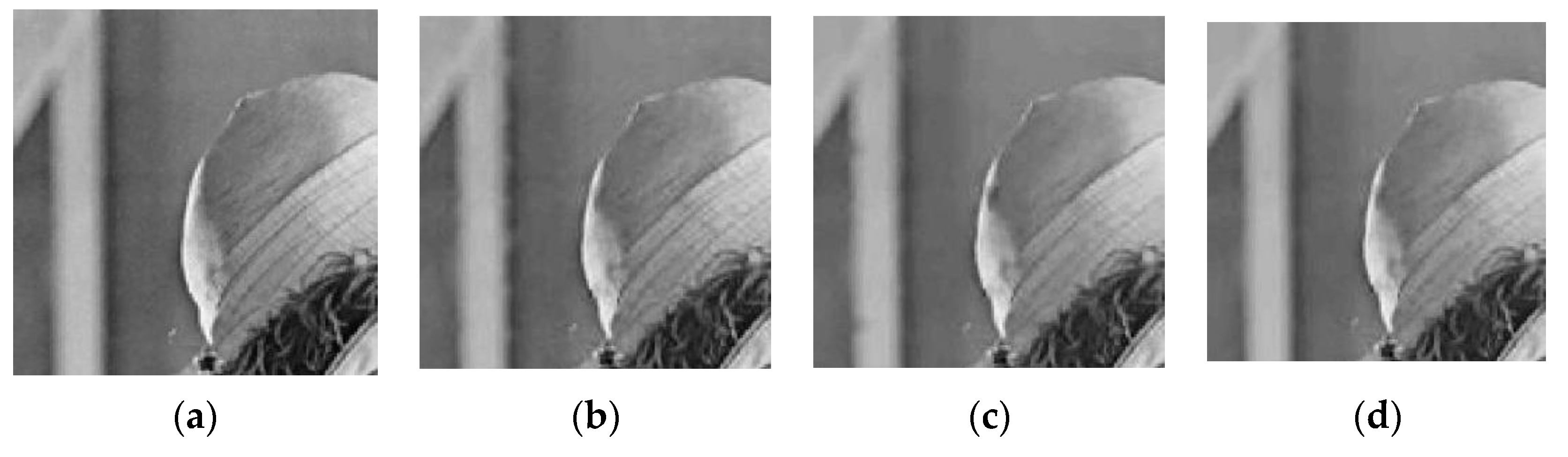
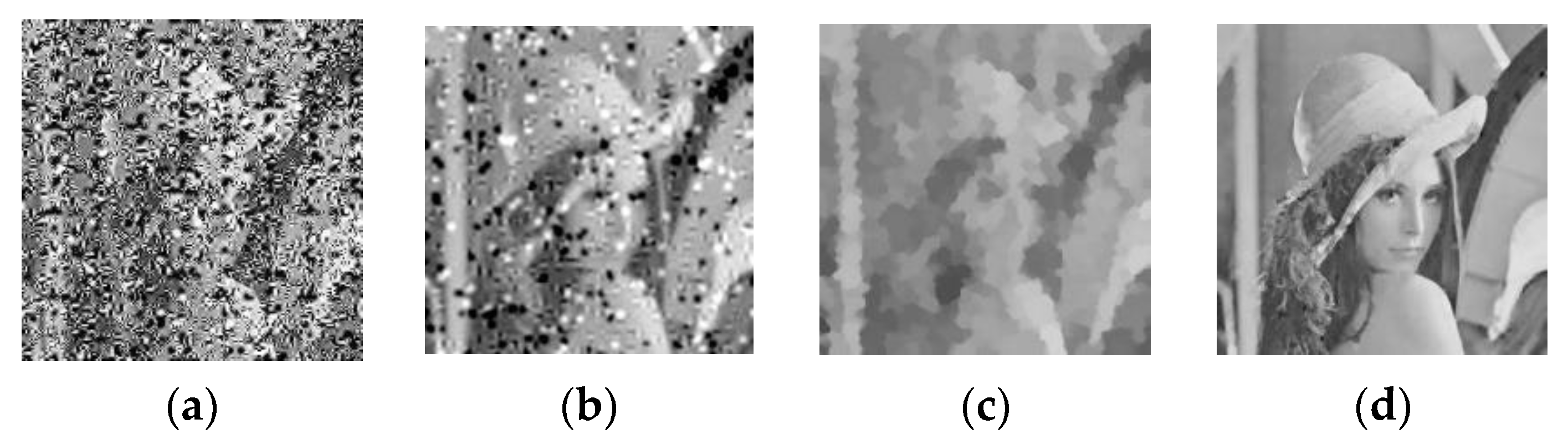
The first experiment is to perform the proposed algorithm on the images whose wavelet coefficients are randomly lost but not corrupted by noise. We choose the parameter values as follows: , for TVL1, for TVL2 and for TVL0 [18]; other parameter values for TVL2 and TVL0 are the same as ones in [22] and [18], respectively. We test each of the three images with their partial coefficients lost (10%, 20%, 30%). The PSNR values against the severity of the damage are shown in Figure 2. It is seen that the proposed model is superior to other models in term of PSNR. We show the received and reconstructed Lenna images in Figure 3. From their zoomed in views (Figure 4), we can see that TVL1 model gives better edge reconstruction (see the doorframes).
Figure 2.
PSNR comparison against the severity of damages for three images. (a) Lenna. (b) Goldhill. (c) Synthetic.
Figure 3.
10% wavelet coefficients of Lenna are randomly lost. (a) received image. (b–d) images reconstructed by TVL2, TVL0, and TVL1, respectively.
Figure 4.
Zoomed portions of the original and reconstructed Lenna. (a) original image. (b–d) images reconstructed by TVL2, TVL0, and TVL1, respectively.
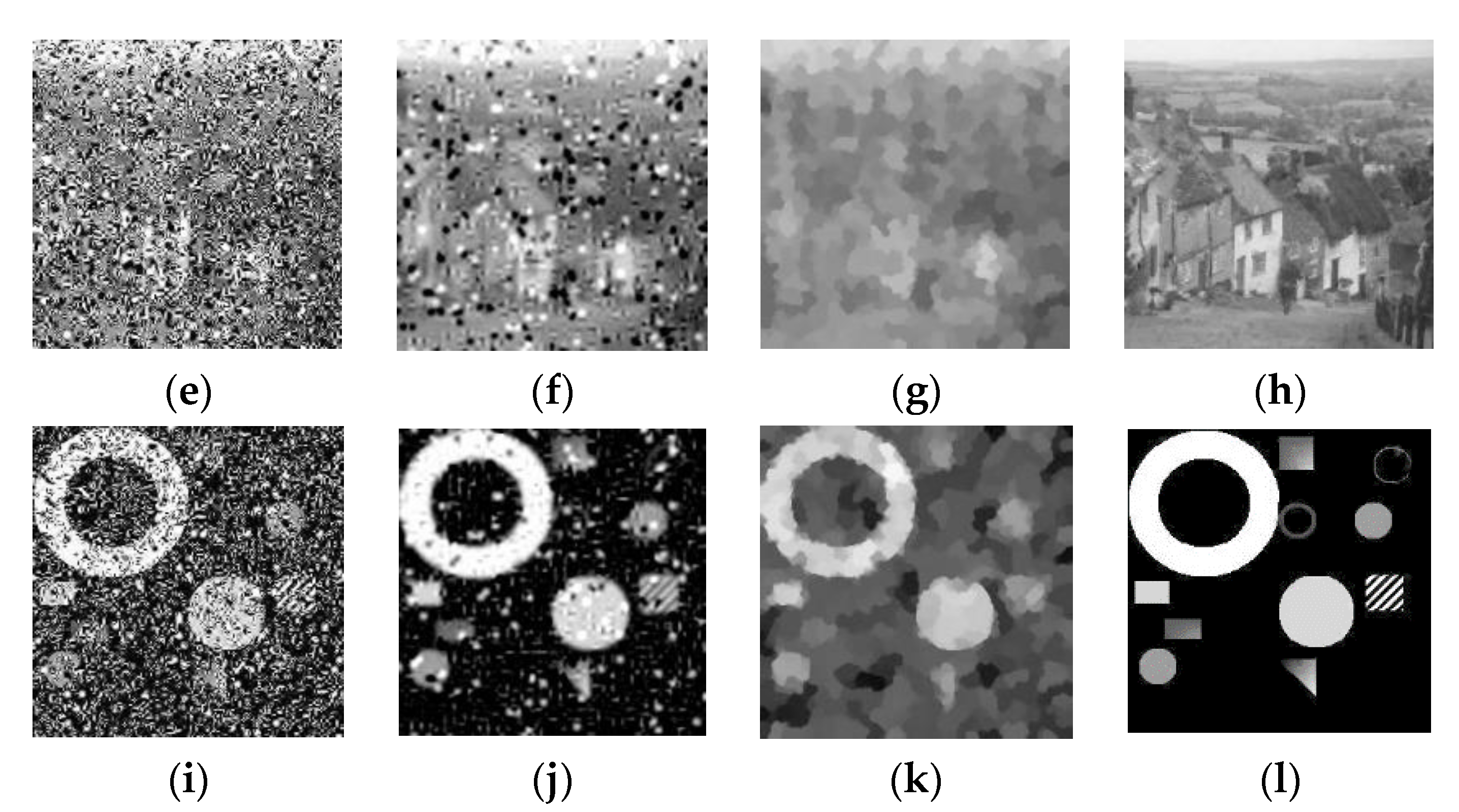
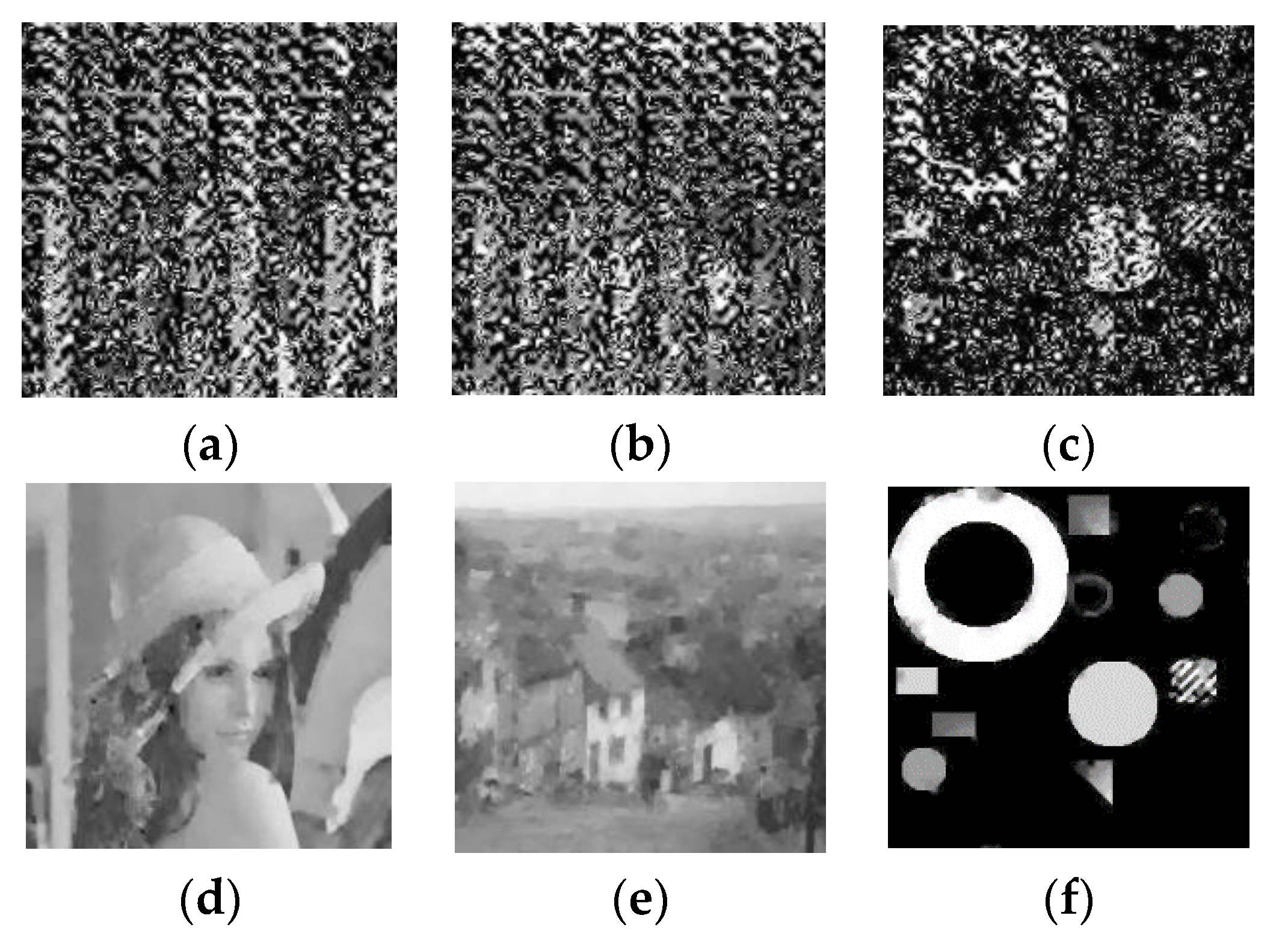
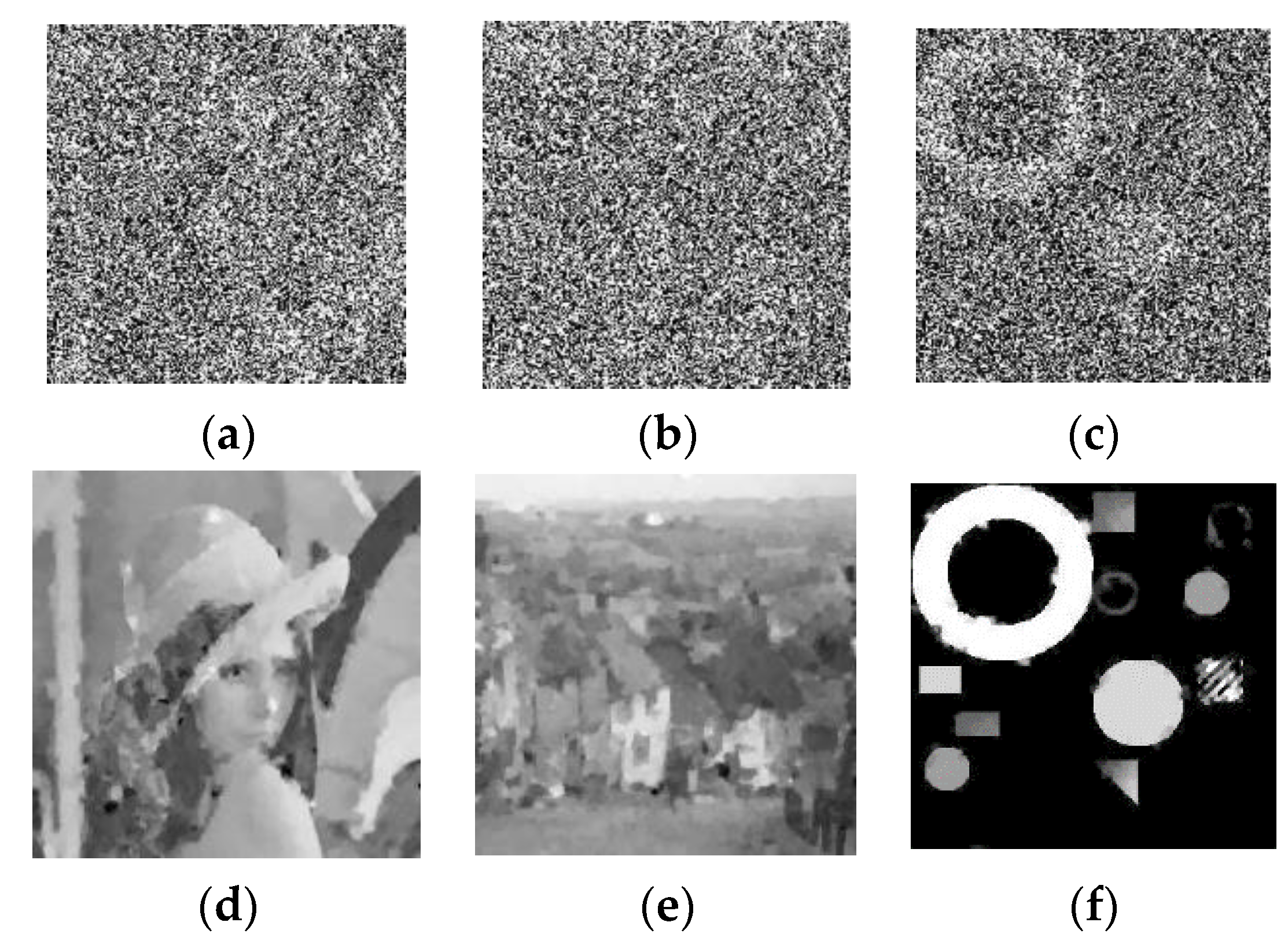
The second experiment is to perform the proposed algorithm and two other models on the images whose partial wavelet coefficients are randomly lost and corrupted by salt-pepper noise (a typical impulsive noise). For this case, the parameter values were chosen as follows: for TVL1, , ; for TVL0 and TVL2, we chose the best from 1 to 100 with the increment of each step set to 1, while other parameter values for TVL2 and TVL0 were the same as ones in [22] and [18], respectively. Firstly, we randomly corrupted 5% of the acquired wavelet coefficients with salt-pepper noise. The three models were then applied to recovering the images from their partial wavelet coefficients. Figure 5 lists the received images and reconstructed images by the three models from 90% corrupted wavelet coefficients. We can observe that both TVL2 and TVL0 models were not able to recover the damaged coefficients properly, while TVL1 model was able to reconstruct images with sharp edges and clean geometrical shapes. We show the reconstructed images by TVL1 model with 50% wavelet coefficients lost in Figure 6, from which we can see that TVL1 model can still produce images with visually acceptable quality. Secondly, we investigate the robustness of TVL1 model against the salt-pepper noise. In addition to losing 10% coefficients randomly, we corrupt at random 30% of the acquired coefficients with salt-pepper noise. The received and reconstructed images are shown in Figure 7. We can see that TVL1 can restore partial geometrical information, while the received images are severely damaged.

Figure 5.
5% wavelet coefficients are corrupted by salt-pepper noise and 10% coefficients are lost. (a,e,i) received images. (b,f,j) images reconstructed by TVL2 with λ = 10. (c,g,k) images reconstructed by TVL0 with λ = 3. (d,h,l) images reconstructed by TVL1.
Figure 6.
5% wavelet coefficients are corrupted by salt-pepper noise and 50% coefficients are lost. (a–c) received images. (d–f) images reconstructed by TVL1.
Figure 7.
30% wavelet coefficients are corrupted by salt-pepper noise and 10% coefficients are lost. (a–c) received images. (d–f) images reconstructed by TVL1.
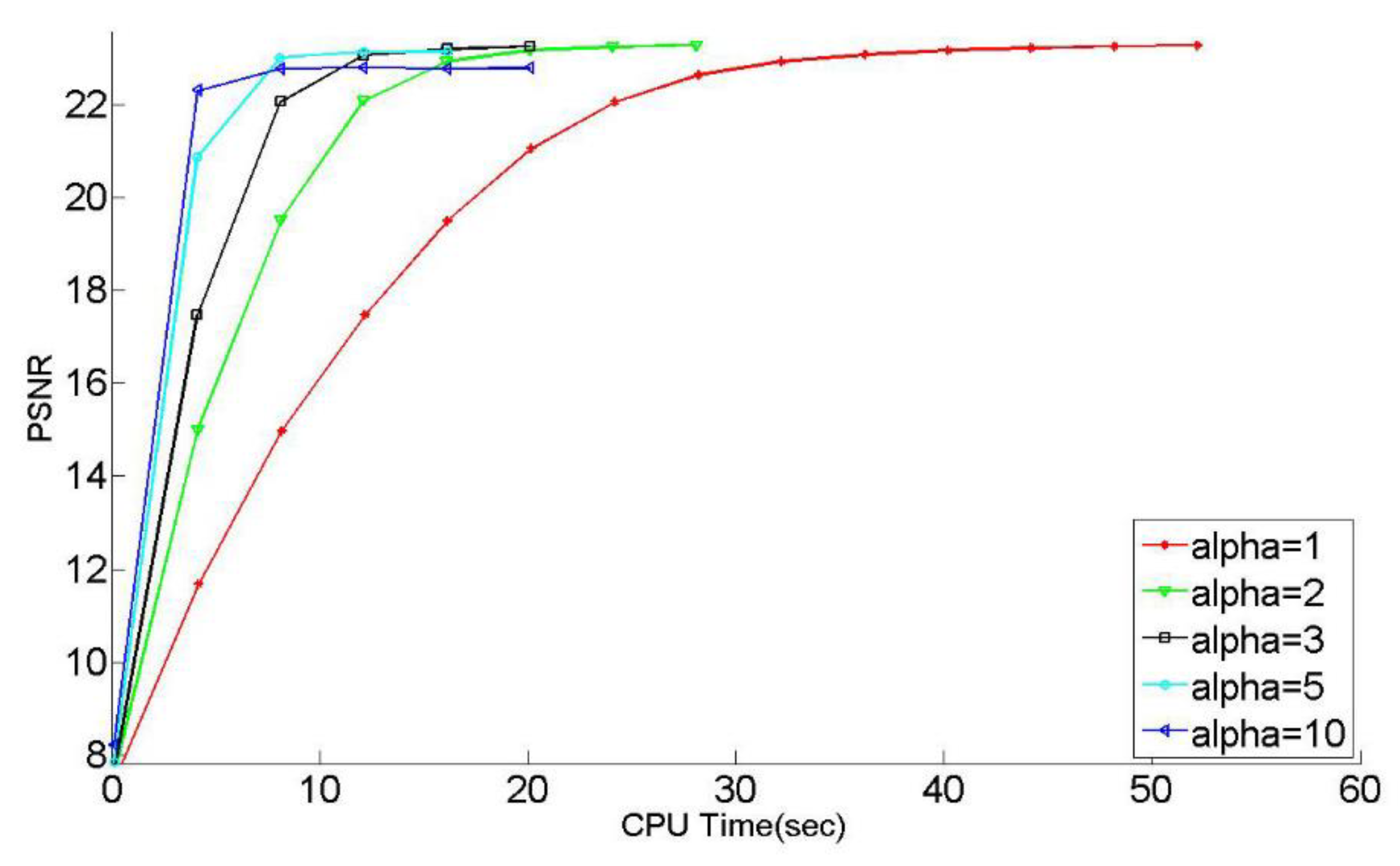
The final experiment is to discuss the parameter , which plays an important role in Algorithm 1. The value of determines how well the Moreau envelope approximates the function in (11). In the following, we experimentally investigated the performance of Algorithm 1 with different . In this experiment, 5% of the acquired wavelet coefficients were randomly corrupted by salt-pepper noise, and 10% of corrupted coefficients were lost. The PSNR value is shown in Table 1. We can see that the solution of the modified model with a smaller is a better approximate solution of the original model in term of objective metric (PSNR). Meanwhile, we show the plot of PSNR against CPU time for Lenna image in Figure 8. The faster convergence rate is shown with a larger . According to the above two laws, we suggested that the researcher can make a reasonable choice according to the needs of the application.
Table 1.
PSNR values for different .
Figure 8.
PSNR against CPU time for Lenna image with different .
5. Conclusions
This paper proposed the TVL1 model for inpainting wavelet coefficients corrupted by impulsive noise. The difficulty of numerical treatment lies in the non-differentiability of l1-norm fitting term. To address this problem, the l1-norm was smoothed by the corresponding Moreau envelope and then a primal–dual fixed-point algorithm based on proximity operator (PDFP2O) was applied to solving the modified TVL1 model. We considered the existence of solution for the proposed model and the convergence analysis of the developed iterative scheme in this paper. Experiment results show that this method can effectively recover incomplete wavelet coefficients with or without impulsive noise and preserve geometrical information in the pixel domain well.
Author Contributions
Conceptualization, Z.R. and Q.Z.; methodology, Z.R. and Q.Z.; software, Q.Z. and Y.Y.; validation, Z.R. and Q.Z.; formal analysis, Z.R. and Q.Z.; writing, Z.R., Q.Z. and Y.Y. All authors have read and agreed to the published version of the manuscript.
Funding
This research was funded by the key project of science and technology research program of Chongqing Education Commission of China, grant number KJZD-K202001503, and the National Natural Science Foundation of China, grant number 62061016.
Institutional Review Board Statement
Not applicable.
Informed Consent Statement
Not applicable.
Data Availability Statement
Not applicable.
Conflicts of Interest
The authors declare no conflict of interest.
References
- Yashtini, M.; Kang, S.H. A fast relaxed normal two split method and an effective weighted TV approach for Euler’s elastica image inpainting. SIAM J. Imaging Sci. 2016, 9, 1552–1581. [Google Scholar] [CrossRef]
- Ning, W.; Ma, S.; Li, J.; Zhang, Y.; Zhang, L. Multistage attention network for image inpainting. Pattern Recognit. 2020, 106, 107448. [Google Scholar]
- Chan, T.F.; Shen, J.; Zhou, H.M. Total variation wavelet inpainting. J. Math. Imag. Vis. 2006, 25, 107–125. [Google Scholar] [CrossRef]
- Ballester, C.; Bertalmio, M.; Caselles, V.; Sapiro, G.; Verdera, J. Filling-in by joint interpolation of vector fields and gray levels. IEEE Trans. Image Process. 2001, 10, 1200–1211. [Google Scholar] [CrossRef]
- Li, F.; Bao, Z.; Liu, R.H.; Zhang, G.X. Fast image inpainting and colorization by Chambolle’s dual method. J. Vis. Commun. Image R 2011, 22, 529–542. [Google Scholar] [CrossRef]
- Chan, T.F.; Shen, J. Mathematical models for local non-texture inpaintings. SIAM J. Appl. Math 2002, 62, 1019–1043. [Google Scholar]
- Cai, J.F.; Chan, R.H.; Shen, Z. A framelet-based image inpainting algorithm. Appl. Comput. Harm. Anal. 2008, 24, 131–149. [Google Scholar] [CrossRef]
- Chan, R.H.; Chan, T.F.; Shen, L.X.; Shen, Z. Wavelet algorithms for high-resolution image reconstruction. SIAM J. Sci. Comput. 2003, 24, 1408–1432. [Google Scholar] [CrossRef]
- Huang, Y.; Ng, M.K.; Wen, Y. Fast image restoration methods for impulse and Gaussian noises removal. IEEE Signal Process. Lett. 2009, 16, 457–460. [Google Scholar] [CrossRef]
- Fuchs, M.; Muller, J. A higher order TV-type variational problem related to the denoising and inpainting of images. Nonlinear Anal. 2017, 154, 122–147. [Google Scholar] [CrossRef][Green Version]
- Bertalmio, M.; Sapiro, G.; Caselles, V.; Ballester, C. Image inpainting. In Proceedings of the ACM SIGGRAPH, New Orleans, LA, USA, 23–28 July 2000; pp. 417–424. [Google Scholar]
- Chan, T.F.; Shen, J. Nontexture inpainting by curvature-driven diffusions. J. Vis. Commun. Image R. 2001, 12, 436–449. [Google Scholar] [CrossRef]
- Chan, T.F.; Kang, S.H.; Shen, J. Euler’s elastic and curvature-based inpainting. SIAM J. Appl. Math. 2002, 63, 564–592. [Google Scholar]
- Ren, Z. Adaptive active contour model driven by fractional order fitting energy. Signal Process. 2015, 117, 138–150. [Google Scholar] [CrossRef]
- Arias, P.; Facciolo, G.; Caselles, V.; Sapiro, G. A variational framework for exemplar-based image inpainting. Int. J. Comput. Vis. 2011, 93, 319–347. [Google Scholar] [CrossRef]
- Peyré, G.; Bougleux, S.; Cohen, L. Non-local regularization of inverse problems. Inverse Probl. Imaging 2011, 5, 511–530. [Google Scholar] [CrossRef]
- Jiang, L.; Yin, H. Wavelet inpainting by fractional order total variation. Multidimens. Syst. Signal Process. 2018, 29, 299–320. [Google Scholar] [CrossRef]
- Yau, A.C.; Tai, X.; Ng, M.K. L0-norm and Total Variation for wavelet inpainting. In Proceedings of the 2nd International Conference on Scale Space & Variational Methods in Computer Vision, Berlin/Heidelberg, Germany, 1–5 June 2009. [Google Scholar]
- Zhang, H.Y.; Peng, Q.C.; Wu, Y.D. Wavelet inpainting based on p-Laplace operator. Acta Autom. Sin. 2007, 33, 546–549. [Google Scholar] [CrossRef]
- Chan, R.H.; Yang, J.F.; Yuan, X.M. Alternating direction method for image inpainting in wavelet domains. SIAM J. Imaging Sci. 2011, 4, 807–826. [Google Scholar] [CrossRef]
- Zhang, X.Q.; Chan, T.F. Wavelet inpainting by Nonlocal total variation. Inverse Probl. Imaging 2010, 4, 191–210. [Google Scholar] [CrossRef]
- Wen, Y.W.; Chan, R.H.; Yip, A.M. A primal-dual method for total-variation-based wavelet domain inpainting. IEEE Trans. Image Process. 2012, 21, 106–114. [Google Scholar] [CrossRef]
- Durand, S.; Froment, J. Reconstruction of wavelet coefficients using total variation minimization. SIAM J. Sci. Comput. 2003, 24, 1754–1767. [Google Scholar] [CrossRef]
- Chan, T.F.; Zhou, H.M. Optimal Constructions of Wavelet Coefficients Using Total Variation Regularization in Image Compression; UCLA CAM Report 00-27; Department of Math. UCLA: Los Angeles, CA, USA, 2000. [Google Scholar]
- Wu, C.L.; Zhang, J.Y.; Tai, X.C. Augmented Lagrangian method for total variation restoration with non-quadratic fidelity. Inverse Probl. Imaging 2011, 5, 237–261. [Google Scholar] [CrossRef]
- Goldstein, T.; Osher, S. The Split Bregman method for L1-regularized problems. SIAM J. Imaging Sci. 2009, 2, 323–343. [Google Scholar] [CrossRef]
- Micchelli, C.A.; Shen, L.X.; Xu, Y.S. Proximity algorithms for image models: Denoising. Inverse Probl. 2011, 27, 045009. [Google Scholar] [CrossRef]
- Combettes, P.; Wajs, V.R. Signal recovery by proximal forward-backward splitting. Multiscale Model. Simul. 2005, 4, 1168–1200. [Google Scholar] [CrossRef]
- Chen, P.J.; Huang, J.; Zhang, X. A primal-dual fixed point algorithm for convex separable minimization with applications to image restoration. Inverse Probl. 2013, 29, 025011. [Google Scholar] [CrossRef]
- Liu, X.; Tang, Y.; Yang, Y. Primal-dual algorithm to solve the constrained second-order total generalized variational model for image denoising. J. Electron. Imaging 2019, 28, 043017. [Google Scholar] [CrossRef]
- Aujol, J.F.; Gilboa, G.; Chan, T.F.; Osher, S. Structure-texture image decomposition-modeling, algorithms, and parameter selection. Int. J. Comput. Vision. 2006, 67, 111–136. [Google Scholar] [CrossRef]
- Yang, J.; Yin, W. An efficient TVL1 algorithm for deblurring multichannel images corrupted by impulsive noise. SIAM J. Sci. Comput. 2009, 31, 2842–2865. [Google Scholar] [CrossRef]
- Chen, F.; Shen, S.; Xu, F.; Zeng, X. The Moreau envelope approach for the L1/TV image denoising model. Inverse Probl. Imaging 2017, 8, 53–77. [Google Scholar] [CrossRef]
- Rockafellar, R.T.; Wets, R.J. Variational Analysis, 3rd ed.; Springer: New York, NY, USA, 2009; p. 21. [Google Scholar]
Publisher’s Note: MDPI stays neutral with regard to jurisdictional claims in published maps and institutional affiliations. |
© 2022 by the authors. Licensee MDPI, Basel, Switzerland. This article is an open access article distributed under the terms and conditions of the Creative Commons Attribution (CC BY) license (https://creativecommons.org/licenses/by/4.0/).