Abstract
We consider the following stochastic fractional differential equation , where is the initial function, is the Caputo–Katugampola fractional differential operator of orders , the function is Lipschitz continuous on the second variable, denotes the generalized derivative of the Wiener process and represents the noise level. The main result of the paper focuses on the energy growth bound and the asymptotic behaviour of the random solution. Furthermore, we employ Banach fixed point theorem to establish the existence and uniqueness result of the mild solution.
Keywords:
asymptotic behaviour; Caputo–Katugampola; Caputo–Hadamard; energy-growth bounds; well-posedness MSC:
26A33; 34A08; 60H15; 82B44
1. Introduction
Fractional differential equations over the years have proven to be a powerful tool in modelling complex dynamics in physical, biological and engineering phenomena, especially anomalous systems with memory. In recent years, many different fractional differential operators have been studied by many researchers, and also applied to solve some real world problems, see [1,2,3,4,5,6,7,8,9,10]. Amongst the other fractional derivatives, this new fractional differential operator (Caputo–Katugampola fractional derivative) is advantageous because it combines and unites the Caputo and Caputo–Hadamard fractional differential operators, and preserves some basic and fundamental properties of the Caputo and Caputo–Hadamard fractional derivatives, see [11].
Katugampola in [12,13] developed generalized fractional integrals and fractional derivatives. See also [14,15] for the Caputo modification of the generalized fractional derivatives.
In 2016, Katugampola [16] used the derivative to study the existence and uniqueness for a class of generalized fractional differential equations of the form:
where and .
Later in 2019, Basti et al. in [17] applied the Katugampola generalized fractional derivative to investigate the existence and uniqueness of solutions to the following boundary value problem (BVP) of nonlinear fractional differential equations,
where and for is the Katugampola fractional derivative of order is a continuous function with finite positive constants .
As an application, Basti et al. [18] recently in 2021 used the Caputo–Katugampola derivative operator to formulate a modified fractional-order SIRD (susceptible, infected, recovered, and dead) mathematical model of the deadly COVID-19 epidemic, where the authors studied the existence, stability and control of the infectious (COVID-19) disease. The model is as follows: For and ,
with positive initial conditions:
where the initial total population has the following epidemiological classes:
- : susceptible class,
- : infected class,
- recovered class,
- : death class,
and the positive parameters could be described as follows:
- is the average number of contacts per person per time t,
- is the recovery rate,
- k is the death rate,
- is the vaccine of suspected population.
Motivated by the above applications of the derivative operator and the work of [16], we study the effect of Gaussian white noise-perturbation on a class of generalized Caputo–Katugampola fractional differential equation as follows
with a non–negative and bounded initial condition ; is the generalized Caputo–Katugampola fractional differential operator of orders , the function is Lipschitz continuous, denotes the generalized derivative of the Wiener process and represents the level of noise. Our main results involve the use of Banach fixed point theorem to prove the existence and uniqueness of solution and Gronwall inequality for the growth estimate. Fixed point techniques have physical application in the study of system of BVPs on the Methylpropane Graph [19], in the solution of time-fractional biological population model [20] and in the time-fractional (extended SEIR) SEIHR (susceptible, exposed, infected, hospitalized and recovered) model of COVID-19 [21].
Remark 1.
The above equation can be applied to model infectious diseases where some external factors such as government policies, people’s attitude to health policies and vaccines can affect the control of the diseases.
Here and thereafter, a generalized derivative of a deterministic function w is given below:
Definition 1.
Given that is a smooth and compactly supported function, then the generalized derivative of (not necessarily a differentiable function) is
Consequently,
1.1. Preliminaries
We give the definitions of the fractional derivatives and integrals we will make use of.
Definition 2
([16]). The left-sided Hadamard fractional integral and derivative are given by
and
for , and , where is a ceiling function.
The Caputo modification of the Hadamard fractional derivative is given as follows, see [22,23].
Definition 3.
For , the Caputo–Hadamard fractional derivative of ζ is given by
Let and consider to be a space of complex–valued Lebesgue measurable functions on with the norm
and for
Definition 4.
We define the generalized left-sided fractional integral of orders of to be
for , provided the integral exists.
The generalized left-sided fractional derivative, equivalent to the above generalized fractional integral is
where , and provided the integral exists.
Definition 5.
The generalized right-sided fractional integral of orders of is
for , provided the integral exists.
The generalized right-sided fractional derivative, corresponding to the above generalized fractional integral is
where , and provided the integral exists.
Remark 2.
- When one obtains the left and right Caputo fractional derivatives.
- When , applying L’Hospital’s rule as followsand thus,which is the Caputo–Hadamard fractional derivative.
Theorem 1
([11]). Let . Then,
Theorem 2
([11]). Let . Then,
Definition 6.
We give the following definitions.
- A complete normed space is called a Banach space.
- Let X be a norm space and . Then, is called a contraction mapping if there exists a positive real number such that for all ,
- A fixed point of a mapping is a point such that .
Theorem 3
(Banach Fixed Point Theorem). Let X be a complete metric space, and be a contraction on X. Then, there exists a unique such that
1.2. Formulation of the Solution
Using the decomposition formula for the Caputo–Katugampola derivative of Theorem 2 by applying the generalized fractional integral on both sides of Equation (1) as follows
and consequently,
Therefore, we define the mild solution to Equation (1) as follows:
For this paper, we let and define the norm of the random solution by
Remark 3.
- 1.
- Let be a probability space with , -Borel σ-algebra and a probability measure . We define to be a class of random variables on with finite pth moments.
- 2.
- The symbol is known as stochastic differential. It has a representation in terms of Itô integral given by , with the following property: Take second moment on the integral and use Itô isometry to obtainFrom the left hand side,
- 3.
- The space is a complete inner product space (Hilbert space).
2. Main Results
Assume that is Lipschitz continuous on the second variable:
Condition 1.
Let, then for all, one has
withfor convenience.
2.1. Some Auxilliary Results
Define the operator by
and we show that the fixed point of solves Equation (1).
The following Lemma(s) will be used in proving the existence and uniqueness of the solution.
Lemma 1.
Proof.
Applying Itó isometry, one gets
Now, use Condition 1 to get
Take supremum over of both sides to obtain
and the result follows. □
Remark 4.
We compute the integral in Equation (4) by method of integration by substitution: Let and . Additionally, when and when Thus,
for
Lemma 2.
Proof.
To avoid repetition, we skip the proof since it follows the same steps as the proof of Lemma 1. □
2.2. Existence and Uniqueness Result
The existence and uniqueness of the mild solution will be proved using Banach fixed point theorem. It suffices to show that the fixed point of (previously defined) gives the solution to Equation (1).
Theorem 4.
Suppose and Condition 1 holds. Given that there exist some positive contants such that , then Equation (1) has a unique solution, with
Proof.
Applying Banach fixed point theorem, we have and by Lemma 1,
to get Thus, whenever
Next, we prove the uniqueness of solution to Equation (1) by contraction principle. Suppose for contradiction that are two solutions of (1). So, from Lemma 2,
This gives Since , it follows that and this is a contradiction. Therefore, and the result follows. □
2.3. Energy Growth-Bound
The integral inequality below will be used in the proof of the upper growth moment bound.
Proposition 1
([24]). Given that , and the function is nondecreasing with for , and be nondecreasing with on . If
where k is a nonnegative constant, then for ,
with and chosen so that the right-hand side is well-defined.
The upper growth bound of the random solution was obtained; and given that the function is bounded above, then we have:
Theorem 5.
Let Condition 1 hold, then for all we have
where .
Proof.
We proceed by assuming so that
Let , to obtain
Now, we apply Proposition 1 for , and , with the inverse Thus, for in Proposition 1, we get
and the result readily follows. □
2.4. Asymptotic Behaviour
Our result above shows that the energy solution exhibits an exponential growth bound for some time . We therefore ask the question of “long time behaviour of the energy solution”, and observe that the rate of growth of the solution has a finite upper bound as the time becomes very large.
Corollary 1.
Let and conditions of Theorem 5 hold. Then,
Proof.
Recall from Theorem 5 that
Take log of both sides of the above equation, we have
Divide through by and take lim sup of both sides to get
and since □
3. Examples
- (1)
- To illustrate Theorem 4, we choose , and define by with Lipschitz constant . Then, the equationhas a unique solution when , where .
- (2)
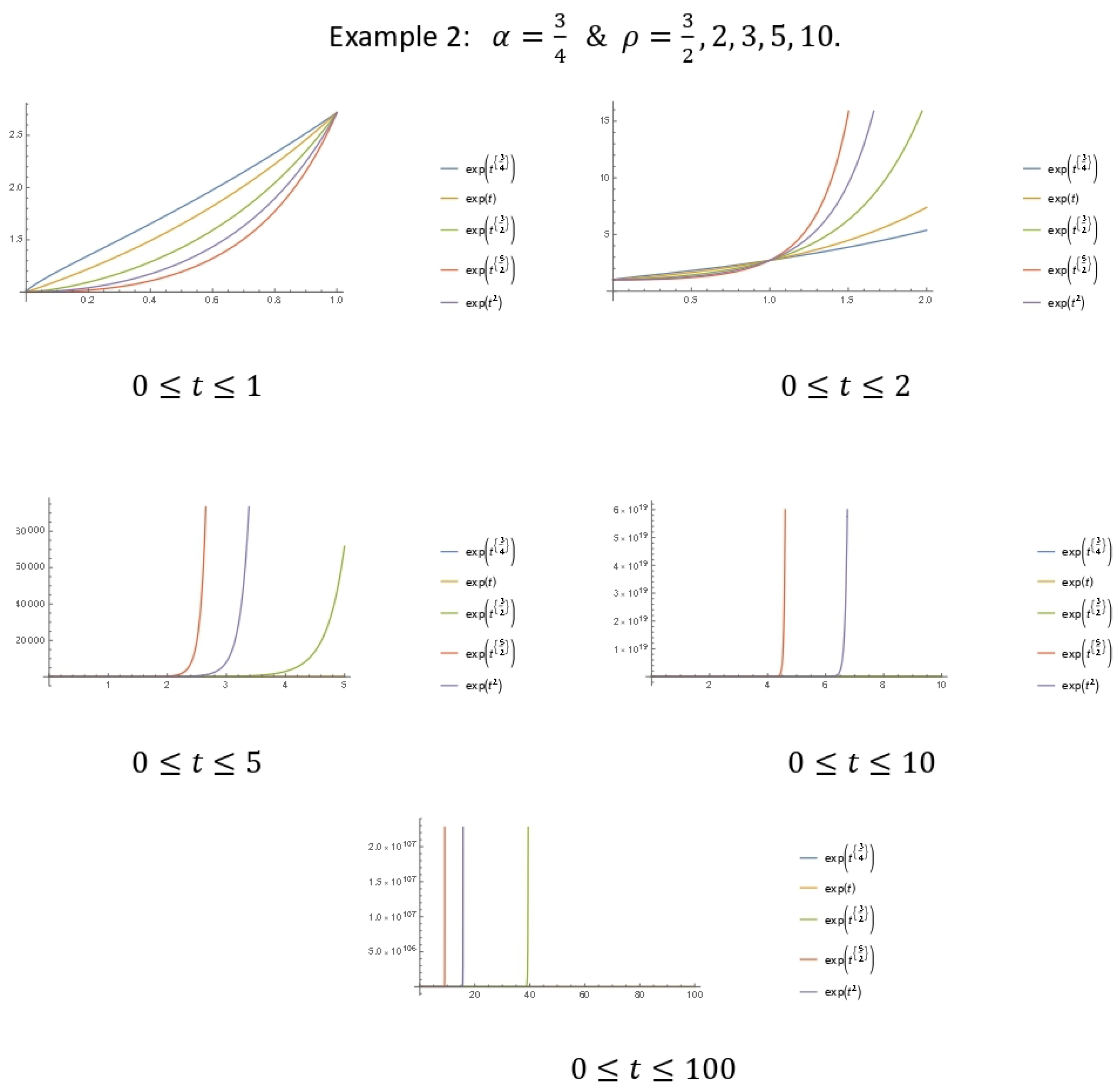
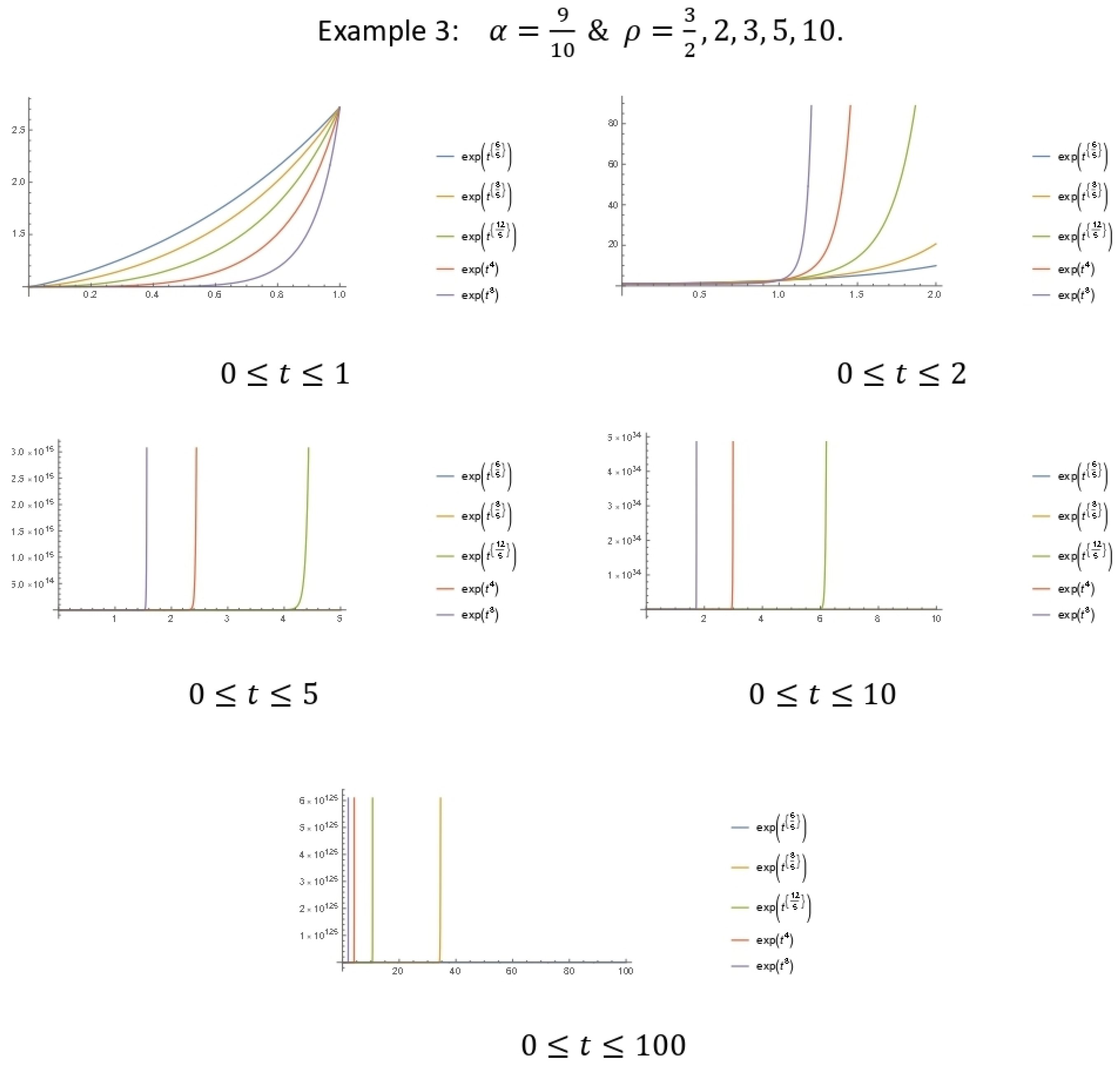
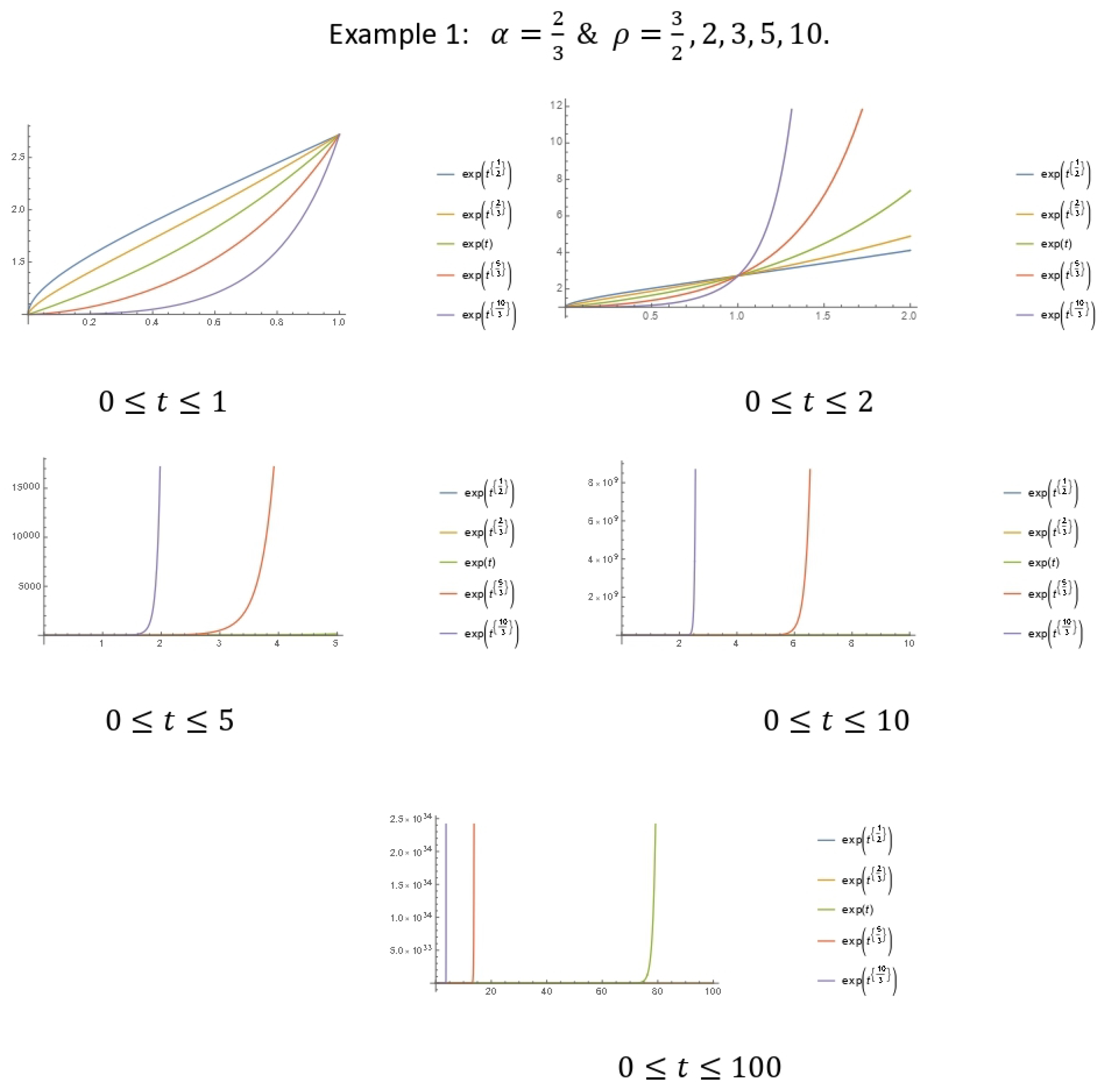
- Additionally, we give examples to illustrate the result in Theorem 5, which represent plots (graphs) for the upper bound growth of our energy solution. For convenience, we set the positive constants to be equal to one. That is, to havewhere and .
- In Figure 1, we consider and ;
Figure 1. Graphical illustration of the energy growth bounds. - Next, in Figure 2, we consider and ;
Figure 2. Graphical illustration of the energy growth bounds. - Lastly, in Figure 3, we consider and :
Figure 3. Graphical illustration of the energy growth bounds.
We observe that the values of and have little or no significant effect on the growth of the upper bound, however, as time t becomes large, the speed (rate) of growth becomes very sharp and fast. See the figures below.
4. Conclusions
The result suggests that lack of stringent enforcement of government policies, lack of adherence to public health policies (such as refusal to wear face-masks and non-compliance with social distancing) and rejection of vaccines administration, help in the spread (growth) of the infectious (COVID-19) disease. Mathematically put, the result investigated the properties of a class of Caputo–Katugampola stochastic fractional differential equation. Consequently, we estimated the upper growth bound of the random solution to the equation and showed that the energy solution grows exponentially at most at a precise rate. Banach fixed point theorem was applied to establish the existence and uniqueness result of the solution. We also noted that the solution exhibits some long time asymptotic behaviours. In the future, one can research on the lower bound estimate, stability and continuous dependence of the solution on the initial condition.
Author Contributions
Conceptualization, M.E.O.; methodology, M.E.O.; formal analysis, M.E.O.; writing—original draft preparation, M.E.O.; writing—review and editing, M.E.O.; project administration, H.A.S.; funding acquisition, M.E.O. All authors have read and agreed to the published version of the manuscript.
Funding
This research work was funded by Institutional Funding Program under project number IFP-A-2022-2-1-09.
Institutional Review Board Statement
Not applicable.
Informed Consent Statement
Not applicable.
Data Availability Statement
Not applicable.
Acknowledgments
The authors gratefully acknowledge technical and financial support from the Agency for Research and Innovation, Ministry of Education and University of Hafr Al Batin, Saudi Arabia. We also appreciate the reviewers for their insightful comments that broadened the scope of the paper.
Conflicts of Interest
The authors declare that there is no conflict of interest.
References
- Foondun, M.; Liu, W.; Tian, K. Moment bounds for a class of Fractional Stochastic Heat Equations. Ann. Probab. 2017, 45, 2131–2153. [Google Scholar] [CrossRef][Green Version]
- Foondun, M.; Liu, W.; Omaba, M.E. On Some Properties of a class of Fractional Stochastic Heat Equations. J. Theoret. Probab. 2017, 30, 1310–1333. [Google Scholar]
- Foondun, M.; Nane, E. Asymptotic properties of some space-time fractional stochastic equations. Math. Z. 2017, 287, 493–519. [Google Scholar] [CrossRef]
- Foondun, M.; Liu, W.; Nane, E. Some non-existence results for a class of stochastic partial differential equations. J. Differ. Equ. 2019, 266, 2575–2596. [Google Scholar] [CrossRef]
- Mijena, J.; Nane, E. Space-time fractional stochastic partial differential equations. Stoch. Process. Appl. 2015, 159, 3301–3326. [Google Scholar] [CrossRef]
- Nane, E.; Nwaeze, E.R.; Omaba, M.E. Asymptotic behavior and non-existence of global solution to a class of conformable time-fractional stochastic differential equation. Stat. Probab. Lett. 2020, 163, 108792. [Google Scholar] [CrossRef]
- Omaba, M.E.; Nwaeze, E.R. Moment Bound of Solution to a Class of Conformable Time-Fractional Stochastic Equation. Fractal Fract. 2019, 3, 18. [Google Scholar] [CrossRef]
- Omaba, M.E. On a mild solution to hilfer time-fractional stochastic differetial equation. J. Fract. Calc. Appl. 2021, 12, 1–10. [Google Scholar]
- Omaba, M.E.; Enyi, C.D. Atangana-Baleanu time-fractional stochastic integro-differential equation. Partial. Differ. Equ. Appl. Math. 2021, 4, 100100. [Google Scholar] [CrossRef]
- Sakthivel, R.; Revathi, P.; Ren, Y. Existence of solutions for nonlinear fractional stochastic differential equations. Nonlinear Anal. 2013, 81, 70–86. [Google Scholar] [CrossRef]
- Almeida, R.; Malinowska, A.B.; Odzijewicz, T. Fractional differential equations with dependence on the Caputo–Katugampola derivative. J. Comput. Nonlinear Dynam. 2016, 11, 061017. [Google Scholar] [CrossRef]
- Katugampola, U.N. New approach to a generalized fractional integral. Appl. Math. Comput. 2011, 218, 860–865. [Google Scholar] [CrossRef]
- Katugampola, U.N. A new approach to generalized fractional derivatives. Bull. Math. Anal. Appl. 2014, 6, 1–15. [Google Scholar]
- Jarad, F.; Ugurlu, E.; Abdeljawad, T.; Baleanu, D. On a new class of fractional operators. Adv. Differ. Equ. 2017, 2017, 247. [Google Scholar] [CrossRef]
- Jarad, F.; Abdeljawad, T.; Baleanu, D. On the generalized fractional derivatives and their Caputo modification. J. Nonlinear Sci. Appl. 2017, 10, 2607–2619. [Google Scholar] [CrossRef]
- Katugampola, U.N. Existence and uniqueness results for a class of generalized fractional differential equations. arXiv 2014, arXiv:1411.5229. [Google Scholar]
- Basti, B.; Arioua, Y.; Benhamidouche, N. Existence and uniqueness of solutions for nonlinear Katugampola fractional differential equations. J. Math. Appl. 2019, 42, 35–61. [Google Scholar] [CrossRef]
- Basti, B.; Hammami, N.; Berrabah, I.; Nouioua, F.; Djemiat, R.; Benhamidouche, N. Stability Analysis and Existence of solutions for a Modified SIRD Model of COVID-19 with fractional derivatives. Symmetry 2021, 13, 1431. [Google Scholar] [CrossRef]
- Rezapour, S.; Deressa, C.T.; Hussain, A.; Etemad, S.; George, R.; Ahmad, B. A Theoretical Analysis of a Fractional Multi-dimensional system of boundary value problems on the Methylpropane Graph via Fixed Point Technique. Mathematics 2022, 10, 568. [Google Scholar] [CrossRef]
- Rashid, S.; Ashraf, R.; Bonyah, E. On Analytical solution of Time-fractional Biological population model by means of Generalized Integral Transform with their Uniqueness and Convergence Analysis. Adv. Nonlinear Anal. Appl. 2022, 2022, 7021288. [Google Scholar] [CrossRef]
- Sintunavarat, W.; Turab, A. Mathematical analysis of an extended SEIR model of COVID-19 using the ABC-fractional operator. Math. Comput. Simul. 2022, 198, 65–84. [Google Scholar] [CrossRef] [PubMed]
- Gambo, Y.Y.; Jarad, F.; Baleanu, D.; Abdeljawad, T. On Caputo modification of the Hadamard fractional derivatives. Adv. Differ. Equ. 2014, 2014, 10. [Google Scholar] [CrossRef]
- Jarad, F.; Abdeljawad, T.; Baleanu, D. Caputo-type modification of the Hadamard fractional derivatives. Adv. Differ. Equ. 2012, 2012, 142. [Google Scholar] [CrossRef]
- Lipovan, O. A retarded Gronwall-Like Inequality and Its Applications. J. Math. Anal. Appl. 2000, 252, 389–401. [Google Scholar] [CrossRef]
Publisher’s Note: MDPI stays neutral with regard to jurisdictional claims in published maps and institutional affiliations. |
© 2022 by the authors. Licensee MDPI, Basel, Switzerland. This article is an open access article distributed under the terms and conditions of the Creative Commons Attribution (CC BY) license (https://creativecommons.org/licenses/by/4.0/).