


Abstract
This paper is a survey of results on centrally essential rings and semirings. A ring (respectively, semiring) is said to be centrally essential if it is either commutative or satisfies the property that for any non-central element a, there exist non-zero central elements x and y with ax = y. The class of centrally essential rings is very large; many corresponding examples are given in the work.
MSC:
16U70
1. Introduction
The work is based on papers [1,2,3,4,5,6,7,8,9,10,11,12,13,14,15,16,17,18].
The author is very grateful for the great help in editing the manuscript to Adel Abyzov, Oleg Lyubimtsev and Danil Tapkin.
In Introduction and Section 2, Section 3, Section 4, Section 5 and Section 6, the word ring means an associative ring. By default, it is assumed that a ring has ; the case of not necessarily unital rings is specially indicated.
In Section 7, the word ring means a not necessarily associative ring.
A not necessarily unital ring A is said to be a ring with an essential center or a centrally essential ring, or a CE ring if either A is commutative or for any non-central element , there are non-zero central elements x and y with .
It is clear that any commutative ring is centrally essential. A unital ring A with center is centrally essential if and only if the C-module A is an essential extension of .
In Section 2, we study general properties of centrally essential rings, semiprime and nonsingular centrally essential rings, local and semiperfect centrally essential rings, perfect and semi-Artinian centrally essential rings.
In Section 3, we study centrally essential Grassmann algebras over fields and rings.
In Section 4, we study centrally essential rings arising from various constructions. In particular, we consider polynomial and series rings, group and semigroup rings, rings of fractions, local subalgebras of triangular algebras, and endomorphism rings of Abelian groups.
In Section 5, we study centrally essential distributive and uniserial rings. In particular, we consider uniserial Artinian (resp., Noetherian) rings, rings with flat ideals, distributive Noetherian rings.
In Section 6, we study centrally essential semirings.
In Section 7, we study several types of centrally essential non-associative rings. In particular, we consider reduced and semiprime rings, Cayley–Dickson process and associative Centers, quaternion and octonion algebras.
From the definition of a centrally essential ring A, it might seem that such a ring is possibly commutative. Indeed, A satisfies many properties of commutative rings. The following are some examples:
- All idempotents of A are central; see Proposition 3 below.
- If A is semiprime, then A is commutative; see Theorem 1.
- If A is a centrally essential local ring, then the ring is a field and, in particular, is commutative; see Theorem 2.
- If A is a right or left semi-Artinian centrally essential ring, then the factor ring is commutative; see Theorem 5.
However, a centrally essential ring A may be very far from a commutative ring. The following are some examples:
- The factor ring of A with respect to the prime radical can be not centrally essential and, in particular, the semiprime ring can be non-commutative; see Theorem 17.
- For any ideal of A generated by central idempotents, the corresponding factor ring is not necessarily centrally essential; see Example 4.
- Factor rings of ring A are not necessarily centrally essential; see the two previous items.
- There are finite non-commutative centrally essential unital group algebras; see Example 1 below.
- There are finite non-commutative centrally essential Grassmann algebras; see Example 2 below;
- There are torsion-free Abelian groups G of finite rank such that their endomorphism rings are non-commutative centrally essential rings; see Theorem 20(c).
Example 1.
Let F be the field of order 2 and letbe the quaternion of the group of order 8, i.e., G is the group with two generatorsand three defining relations, and; see [19], [Section 4.4]. Then the group algebra is a non-commutative finite local centrally essential ring consisting of 256 elements; this follows from Proposition 16 below.
We give some necessary notions. For a ring A, we denote by (or ), , and the center, the Jacobson radical, the prime radical and the Köthe radical (i.e., the sum of all nil ideals, which is the largest nil ideal), respectively. We also set for any two elements of the ring A. For a group or a semigroup X, we denote by or the center of X.
Example 2.
We give one more example of a non-commutative finite centrally essential ring. Let F be a field consisting of three elements, V be a linear F-space with basis , and let be the Grassmann algebra (See Section 3.2) of the space V. Since and any product of generators is equal to the ±product of generators with ascending subscripts, we have that is a finite F-algebra of dimension 8 with basis
Therefore, if
then
Thus, if and only if In other words, the center of the algebra is of dimension 5. On the other hand, if , then
In addition, . A similar argument applies if or . Consequently, is a finite centrally essential non-commutative ring.
Example 3.
This example is due to the reviewer of the paper [10] who has kindly suggested a series of examples of non-commutative centrally essential rings arising from a construction described in [20]. The following statement and its proof were also proposed by the reviewer:
If B is an ideal of the ring A such that and is a field, then A is a centrally essential ring.
We assume that A is not commutative and a is a non-central element of A. If , then it is clear that . We assume the contrary, i.e., . Since and is a field, the element a is an invertible modulo B, i.e., for some and . For any , we have ; this implies that , x is a central idempotent, and A has a Peirce decomposition , where the both summands and are commutative. Therefore, A is commutative. This contradicts the choice of A, and is true.
It remains to be considered the simplest case of the construction given in [20] [Proposition 7] (we reserve the notation of this paper). Letbe the field of rational functions. We consider two partial derivationsand. Then the ringconsisting of matrices
and its ideal
satisfy the conditions of .
We give some definitions. For a module M, the socle is the sum of all simple submodules of M; if M does not contain simple submodules, then by definition. A module M is said to be finite-dimensional (in the sense of Goldie) if M does not contain a submodule which is an infinite direct sum of non-zero submodules. A module M is said to be Noetherian (respectively, Artinian) if M does not contain an infinite properly ascending (respectively, properly descending) chain submodules. Direct summands of free modules are called projective modules. A module M is said to be hereditary if all submodules of the module M are projective. A module M is said to be distributive (respectively, uniserial), if the submodule lattice of the module M is distributive (respectively, it is a chain). We recall that a module X is called an essential extension submodule Y of the module X if for any non-zero submodule Z in X. In this case, Y is called an essential submodule of the module X. A submodule Y of the module X is said to be closed (in X) if for any submodule of the module X, which is an essential extension of the module Y.
A ring A is called a domain if A does not have non-zero zero divisors. A commutative domain A is called a Dedekind domain if A is a commutative hereditary Noetherian domain. If A is a ring, then a proper ideal B of the ring A is said to be completely prime if the factor ring is a domain. A ring A is said to be right invariant (respectively, left invariant) if all right (respectively, left) ideals of the ring A are ideals. A ring R is said to be semiprime (respectively, prime), if R does not have nilpotent non-zero ideals (respectively, the product of any two non-zero ideals of the ring R is not equal to zero). A ring R is said to be arithmetical if the lattice of its two-sided ideals is distributive, i.e., for any three ideals of the ring R. It is clear that a commutative ring is right (respectively, left) distributive if and only if the ring is arithmetical. For a ring R, an element r is called a left non-zero divisor or a right regular element if the relation implies the relation for any . We note that one-sided zero divisors are two-sided zero divisors in a centrally essential ring; see Proposition 1(a). A ring R has the right (respectively, left) classical ring of fractions (respectively, ) if and only if for any two elements such that b is a non-zero divisor, there exist elements such that d is a non-zero-divisor and (respectively, ). If the rings and exist, then they are isomorphic to each other over R. In this case, one says that there exists the two-sided ring of fractions .
For a ring R and a subset S in R, we denote by the left annihilator of the set S. The right annihilator is defined similarly. For a right (respectively, left) R-module M, its fully invariant submodule consisting of all elements whose annihilators are essential right (respectively, left) ideals in R is called the singular submodule for M; it is denoted by . For (respectively, ), the ideal is called the right (respectively, left) singular ideal of the ring R.
Necessary information from ring theory is contained in [21,22,23,24,25,26]. See [27,28] for necessary information on Abelian groups.
2. Semiprime, Local, Perfect and Semi-Artinian Rings
In Section 2, the word ring means an associative ring. By default, it is assumed that the ring has a non-zero identity element; the case of not necessarily unital rings is specified separately.
2.1. General Properties
Remark 1.
If A is a ring such that the set B of all left zero divisors is an ideal, then B is a completely prime ideal.
Proof.
Let and . Then, there exists an element such that . If , then . Otherwise, it follows from relation that . □
Proposition 1.
Let A be a centrally essential ring.
- a.
- Every left (respectively, right) non-zero-divisor a of the ring A is a right (respectively, left) non-zero divisor of the ring A.
- b.
- The ring A is left uniform(a module M is said to be uniform if any two of its non-zero submodules have non-zero intersection) if and only if A is right uniform.
- c.
- If the ring A is right uniform and , then B is the set of all (left or right) zero divisors of ring A, and B is a completely prime ideal of ring A.
- d.
- If the ring A has a proper ideal B containing all left zero divisors of ring A, then factor ring is commutative.
- e.
- If an ideal B of the ring A contains all central zero-divisors of the ring A, then .
Proof.
- a.
- We consider only the case where a is a left non-zero divisor. We can assume that a is a central element of the ring A. We assume the contrary. Then, for some non-zero element b of ring A. Since , there exist non-zero central elements of ring A such that . Then . This is a contradiction.
- b.
- We assume that the ring A is right uniform and are non-zero elements of ring A. There exist non-zero central elements of the ring A such that and . Then
- c.
- By the definition of the right singular ideal, all its elements are left zero divisors. Conversely, let a be a left or right zero divisor of ring A. Then, by the first assertion of the lemma. In a right uniform ring, this means that is an essential right ideal, i.e., . Now we use Remark 1
- d.
- Let . There exist non-zero central elements such that . Then , i.e., is a left zero divisor. Therefore, .
- e.
- Let . There exist non-zero central elements of the ring A such that . It is clear that , whence x is not a zero divisor. Therefore, for every element , it follows from relations that .
□
Proposition 2.
Let A be a centrally essential ring and let B be its right ideal.
- a.
- If the right ideal B is not essential (this is the case if B is a proper closed right ideal), then there exists a non-zero central element y of the ring A such that and, consequently, . In particular, all elements of the right ideal B are zero divisors.
- b.
- There exists a centrally essential finite-dimensional algebra over a field which has a closed right ideal which is not ideal.
Proof.
- a.
- Since B is not essential, for some non-zero . Since A is centrally essential, for some non-zero central elements . Then .
- b.
- See Example 10.
□
Proposition 3.
If a not necessarily unital ring A is centrally essential, then every idempotent is contained in the center .
Proof.
We can assume that A is not commutative. Let . We have to prove that . First, we prove the relation . We assume the contrary, . Since the ring A is centrally essential, there exists such that
Then
This is a contradiction. Therefore, . Similarly, we have . Therefore, the idempotent e is central. □
Proposition 4
([5]). Let ring A be a not necessarily unital, centrally essential ring, , , and let
Then .
Proof.
We assume that . If the element is central, then
this is a contradiction.
Now we assume that element is not central. Since ring A is centrally essential and , there exist non-zero central elements such that . We note that . Therefore,
this is a contradiction. Therefore, . □
Proposition 5.
If A is a centrally essential ring with and M is a maximal right ideal of the ring A, then either M is an ideal or there exists a non-zero central element .
Proof.
We assume the contrary. Then there exist non-zero elements and such that . Since M is a maximal right ideal, there exist elements and such that . Since the ring A is centrally essential, there exist non-zero central elements such that . Then
and and . Therefore, and . Then . By repeating a similar argument, we obtain that . □
Proposition 6.
Let R be a ring and let A be a subring in R such that there exists a basis of the module contained in . If ring A is centrally essential, then ring R is centrally essential, as well.
Proof.
Let B be a basis of the module and . Every element has the unique decomposition of the form
We define a function by equating to the number of coefficients in the above decomposition (1) that are contained in for and . It is clear that if and only if . Now let . In the set , we take an element r such that the integer is minimal. We prove that . We assume the contrary. Then we can assume that in (1). Since the ring A is centrally essential, there exist non-zero central elements such that . Then , and ; this contradicts the choice of the element r. We obtain that . □
Proposition 7.
Let F be a field and let R be a centrally essential F-algebra. Then for any commutative F-algebra A, the algebra is centrally essential.
Proof.
If B is an F-basis of the commutative of the algebra A, then is a basis of the free module , which satisfies the conditions of Proposition 6. □
Remark 2.
If A is a centrally essential ring with center , then its right ideal B is an essential extension of the ideal , generated by central elements.
Proof.
Let be a non-empty set of all ideals of the ring A, which are contained in B and are direct sums of principal ideals generated by a central element. We define a partial order on such that ⇔, . By the Zorn lemma, contains a maximal element M. We assume that is not an essential extension of . Then there exists a non-zero element such that . Since A is a centrally essential ring, for some non-zero central of elements . Then and is an element of the set which exceeds maximal element M. This is a contradiction. □
Remark 3.
It is directly verified that any filtered product of centrally essential rings is a centrally essential ring. In particular, ultra-degrees of a centrally essential ring are centrally essential rings.
Problem 1.
Is it true that any tensor product of centrally essential algebras is centrally essential?
2.2. Semiprime and Nonsingular Rings
We recall that a ring A is said to be semiprime if A does not have non-zero nilpotent ideals. A ring A with non-zero 1 is said to be right nonsingular if the right annihilator of any non-zero element is not essential.
Lemma 1.
Let A be a centrally essential ring with center and let a be a non-zero element of the ring A. If (), then there exists a non-zero central element y of the ring A such that , and . Consequently, if at least one of the rings A and C is semiprime, then A does not have non-zero nilpotent elements.
Proof.
Since and the ring A is centrally essential, for some non-zero central elements x and y of the ring A. Then
□
Theorem 1
([10] [Theorem 1.3(a)]). Let A be a centrally essential ring. If at least one of the rings A and is semiprime, then A is a commutative ring without non-zero nilpotent elements.
Proof.
By Lemma 1,the ring A does not have non-zero nilpotent elements. We assume that the ring A is not commutative. Then for some . Let be the center of the ring A and let . We have that E is an ideal of the ring C. We take any element with . If , then for some . Therefore, , whence and . Therefore, and ; this is a contradiction. Therefore, , whence . Therefore, and . Then we obtain that . For any , we have , whence
and . However, for some , whence and therefore, ; this is a contradiction. Therefore, the ring A is commutative. □
Remark 4.
In connection to Theorem 1, we note that a ring A with semiprime center is not necessarily commutative. The corresponding example is the ring A of all matrices over ; the center of the ring A consists of scalar matrices.
Corollary 1.
If A is a centrally essential, right nonsingular ring, then A is commutative and does not have non-zero nilpotent elements.
Proof.
By Theorem 1, it is sufficient to prove that A is a ring without non-zero nilpotent elements. We assume the contrary. There exists a non-zero element a of ring A with . Since A is centrally essential, there exist non-zero central elements with . It follows from the Zorn lemma that there exists a right ideal B of ring A such that and right ideal is an essential. Since and , we have . Since right ideal is an essential, ; this is a contradiction. □
In connection to Theorem 1, we prove the following proposition.
Proposition 8
([5]). If A is a not necessarily unital, centrally essential ring and its the center is a semiprime ring, then ring A is commutative.
Proof.
We assume that the ring A is not commutative, i.e., there exist elements such that . Since ring A is centrally essential, there exist non-zero central elements x and y such that . We note that ; otherwise,
this is impossible since .
If , then there exist non-zero central elements such that . We consider the set . It is clear that . Now we assume that . Then , and ; this is a contradiction. Therefore, for some . However,
and this is a contradiction, as well.
Therefore, we have
We assume that . Then ; otherwise,
In addition, . Therefore, . However, ; this is a contradiction. Therefore, ring R is commutative. □
Remark 5.
If A is a ring and the factor ring is centrally essential, then all maximal right ideals of the ring A are ideals.
Proof.
Since is a centrally essential semiprime ring, it follows from Theorem 1 that the ring is commutative. In particular, all maximal right ideals of the ring are ideals. Then all maximal right ideals of the ring A are ideals. □
2.3. Local and Semiperfect Rings
Let A be a ring with Jacobson radical . Ring A is said to be local if the factor ring is a division ring. A ring A is said to be semiperfect if the factor ring is isomorphic to a finite direct product of matrix rings over division rings and every idempotent the factor of the ring is the image of some idempotent under the natural epimorphism .
Remark 6.
It is clear that any finite direct product of local rings is a semiperfect ring. In addition, all idempotents of any centrally essential of the ring are central by Proposition 3. Therefore, centrally essential semiperfect rings coincide with finite direct products of centrally essential of local rings, and their study is reduced to the study of centrally essential local rings.
Theorem 2.
Let A be a centrally essential local ring with Jacobson radical . Then, factor ring is a field (in particular, it is commutative) and for every minimal right ideal M.
Proof.
Let and . An element is invertible since A is local. Since and A is centrally essential, for some non-zero . Then
this is a contradiction. Therefore, and the ring is commutative.
Now we assume that for some minimal right ideal M of the ring A. Let m be a non-zero element of M. By assumption, there exist non-zero central elements x and y of the ring A such that . Since (otherwise, ), the element x is invertible in A and ; this is a contradiction. □
Theorem 3.
Let A be a centrally essential semiperfect ring with center . Then is a finite direct product of fields. In particular, ring is commutative. In addition, A is a finite direct product of centrally essential local rings and .
Proof.
By the definition of a semiperfect ring, the ring is the direct sum of simple Artinian rings, and each of them is isomorphic to a matrix ring over a division ring. Let be a complete system of indecomposable orthogonal idempotents of the ring . Then there exists a complete system of indecomposable orthogonal idempotents in A such that , . By Proposition 3, all idempotents are central. Therefore, is a decomposition of the ring A into a direct sum of local centrally essential rings. Consequently, all rings are commutative by Theorem 2. It is directly verified that all rings are centrally essential; therefore, division ring is commutative. Then the ring is commutative, as well.
It follows from the above that, without loss of generality, we can assume that ring A is local. We note that and C is a local ring.
Now let s be a non-zero element of . There exist non-zero central elements such that . It is clear that , since . Consequently, x is an invertible element and . □
Remark 7.
It follows from the above that if A is a centrally essential semiperfect ring, then .
2.4. Perfect and Semi-Artinian Rings
Let A be a ring with Jacobson radical .
Ring A is said to be left perfect if A is semiperfect and the radical is left T-nilpotent, i.e., for any sequence of elements in , there exists a subscript n such that . Right perfect rings are similarly defined.
Ring A is said to be semilocal if the factor ring is isomorphic to a finite direct product of matrix rings over division rings.
Module M is said to be semi-Artinian if either or every non-zero factor module of the module M is an essential extension of a semisimple module.
Theorem 4.
Let A be a right or left perfect ring with center .
- a.
- Ring A is centrally essential if and only if and all idempotents of the ring A are central.
- b.
- Assume that all idempotents of the ring A are central, the factor ring is commutative, , and for every minimal right ideal M. Then the ring A is centrally essential.
Proof.
- a.
- If A is centrally essential, then and all idempotents of the ring A are central by Proposition 3 and Theorem 3.Conversely, let and let all idempotents of the ring A be central. Since all idempotents are central, we can assume that A is a local ring. Then and is a field.Let x be a non-zero element of the ring A. If , then ; therefore, . Otherwise, there exists an element such that . If , then and ; otherwise, we take an element such that , and so on. Since the radical of the right perfect or left ring A is a T-nilpotent right or left and elements are central, this process stops at some finite step.
- b.
- By a, it is sufficient to prove the relation which is equivalent to the property that for any minimal right ideal M. By assumption, and the ring is commutative by assumption; therefore, we have , for all . For every , we have . On the other hand, since , we haveIn addition, . Consequently, is a non-zero right ideal of the ring A. Since M is a minimal right ideal, and . Therefore, .
□
Remark 8.
In Theorem 4, we cannot omit the condition that R is right or left perfect since every non-commutative local domain (for example, the formal power series ring in one variable over the Hamiltonian quaternion division ring) satisfies all remaining conditions of this theorem but this ring is not centrally essential.
Lemma 2.
Let A be a semiprime ring and let be the right socle. If S is an essential right ideal of the ring A and for all , then the ring A is commutative.
Proof.
We prove the following property of our ring A:
If and is a minimal right ideal, then the idempotent e is central. Indeed, let . Since S is an ideal, . By assumption,
Similarly, and the idempotent e is central.
We prove that for any elements . We assume that . It is well known that every minimal right ideal of a semiprime ring is generated by an idempotent. Since S is an essential right ideal and is generated, by the above, by idempotents, and for some idempotent . Then and by assumption.
By properties , the idempotent e is central. Then
this is a contradiction. Therefore, A is commutative. □
Lemma 3.
Let A be a centrally essential ring and let P be a semiprime nil-ideal of the ring A such that the right socle of the ring is an essential right ideal of the ring . Then the ring is commutative.
Proof.
We use the following well-known facts.
- a.
- In any semiprime ring R, the set of all minimal right ideals coincides with the set of all minimal left ideals and this set coincides with the set of all right ideals such that and is a division ring; in addition, .
- b.
- If R is a ring and P is a nil ideal of the ring R, then every idempotent of the ring is of the form , where .
Let be the natural epimorphism. For every subset X in A, we write instead of . By a, there exists an ideal S of the ring A such that and .
First, we show that the ideal is commutative. By a and b, any minimal left ideal V of the ring is generated by some primitive idempotent , which is of the form for some primitive idempotent e of the ring A. By Proposition 3, the idempotent e is central. Therefore, V is an ideal of , and are ideals in A, and . Therefore, the ring is centrally essential. In addition, and . Therefore, . However, P is a nil ideal, whence and . By Theorem 2, ring V is commutative. Therefore, is a commutative ring, as a direct sum of commutative rings. In addition, is an essential right ideal of the semiprime ring . Then is commutative by Lemma 2. □
Theorem 5.
If A is a centrally essential, left or right semi-Artinian ring, then is a commutative (von Neumann) regular ring.
Proof.
Let A be a centrally essential semi-Artinian right or left ring and . Since A is a right or left semi-Artinian ring, is a nil ideal by [29] [Proposition 3.2]. By Lemma 3, ring is commutative. Every commutative semi-Artinian semiprimitive ring is von Neumann regular by [29] [Theorem 3.1]. □
3. Graded Rings and Grassmann Algebras
3.1. Graded Rings
Let be a semigroup. A ring A is said to be S-graded if A is a direct sum of additive subgroups , , and for any elements .
For any , elements of the subgroup are called homogeneous elements of degree s.
If , then S-graded rings are called graded rings. It is directly verified that the identity element of a graded ring is contained in the subgroup . On an arbitrary graded ring , we can define -graduation:
One says that a graded ring is generalized anti-commutative if for any integers and arbitrary elements and , the relation holds.
If the graded ring satisfies the condition
then one says that R is a homogeneously faithful ring.
Proposition 9.
In any graded ring , the relation holds.
Proof.
The inclusion is obvious.
Let , where , . If for some , then and summands of the last sum are contained in distinct direct summands . Therefore, for any homogeneous element y and of all . Then since any element of the ring is a sum of homogeneous elements. □
Remark 9.
If S is a commutative cancellative semigroup, then the proof below remains true for every S-graded ring.
Proposition 10.
Let be a graded generalized anti-commutative homogeneously faithful ring which does not have additively 2-torsion elements. If there exists an odd positive integer n such that and , then . Otherwise, .
Proof.
It follows from the generalized anti-commutativity relation that . The following property follows from (2):
if such an integer n exists, then for and for ; in addition, if and , where and , then , i.e., . Conversely, let . By Proposition 9, we can assume that x is a homogeneous element of odd degree i. Let and . Then it follows from (2) that there exists an element such that . We obtain that ; this is a contradiction. Therefore, either or but , i.e., . □
Theorem 6.
Let be a graded generalized anti-commutative homogeneously faithful ring without additively 2-torsion elements. Ring A is centrally essential if and only if either or there exists an odd positive integer n such that and .
Proof.
Let A be a centrally essential ring, , and let . By (2), we have . We take an element and assume that such an integer n does not exist. By Remark 9, we have and , whence ; this is a contradiction.
Conversely, if , then since ring is commutative. We assume that there exists an odd positive integer n such that and . Let . We have , where , and we take the least odd positive integer m such that . It is clear that . We set and take an element such that . It is clear that . In addition, is a sum of homogeneous elements of even degree, and the element of odd degree n. Therefore, by Remark 9 and . □
3.2. Grassmann Algebras over Fields
Let F be a field of characteristic 0 or , be a vector space over F of dimension , and let be the Grassmann algebra of the space V [21] [§III.5] which is defined as a unital F-algebra with respect to multiplication operation ∧ with generators and defining relations for all .
The algebra has a natural graduation:
where , , is a vector space with basis
and for .
It is well known that Grassmann algebras are generalized anti-commutative.
Proposition 11.
The graded algebra is a homogeneously faithful ring.
Proof.
Let and . If , then the condition (2) holds. Now let and . We take a basis element , which has a non-zero coefficient in the representation of x. Since , there exist subscripts such that and . We set and note that the basis element of the space has the non-zero coefficient in the representation of the element , since products of remaining basis elements of the space by the element y are equal to either 0 or ±other basis elements of the space . □
Theorem 7.
Let F be a field of characteristic 0 or and let V be a finite-dimensional vector F-space. The Grassmann algebra of the space V is a centrally essential ring if and only if V is of an odd dimension.
Theorem 7 follows from Propositions 11 and 10.
If F is a finite field of odd characteristic and is an odd positive integer exceeding 1, then is a centrally essential non-commutative finite ring. Thus, if F is the finite field of order 3 and is an 8-dimensional F-algebra with basis
then is a centrally essential non-commutative finite ring of order .
Example 4.
If R is a centrally essential ring and B is a proper ideal of ring R generated by some infinite set of central idempotents and the factor ring does not have non-trivial idempotents, then ring is not necessarily centrally essential.
Let F be a field of order three, be the Grassmann algebra of the three-dimensional vector F-space , and let be the Grassmann algebra of two-dimensional vector F-of the space considered a subalgebra of algebra A. We consider the direct product of countable set of copies of ring A and its subring R consisting of all eventual constant sequences which stabilize at a finite step on elements of S depending on the sequence.
Let be a central idempotent which has the identity element of the field F on the i-th position and zeros on remaining positions. We denote by B the ideal of the ring R generated by all idempotents . It follows from Theorem 7 that R is a centrally essential ring and the factor ring is isomorphic to ring S, which is not centrally essential and does not have non-trivial idempotents.
3.3. Grassmann Algebras over Rings
This subsection is based on [10].
Let A be a not necessarily commutative ring with center and let be a finitely generated free module of rank n. We define the algebra of the module . Namely, , where is the Grassmann algebra of the free module over the commutative ring C; see [21] [§III.5].
Let be a basis of the module . For all , we identify with x and obtain that the set
is a basis of the A-module (we assume that the product is equal to 1 for ). It is clear that the ring has a natural graduation , where , for , and for .
Theorem 8.
For positive integer n and a ring A with center , the ring is centrally essential if and only if A is centrally essential and at least one of the following conditions holds.
- (a)
- n is an odd integer.
- (b)
- The ideal is an essential submodule of the module .
Proof.
We set . Let R be centrally essential.
Let and . Then . Therefore, there exists an element such that . We have , where , and . It is directly verified that . In addition, it is clear that , whence we have . For every , we have
whence , i.e., A is a centrally essential ring.
We assume that the ideal is not an essential submodule of the module and n is an even integer.
We take an element such that and . We consider the element .
Let and . We have , where is a linear combination of elements of the basis , which are equal to 1 and . It is clear that and , where both summands are contained in the center of the ring R.
We prove that . Indeed,
whence by the choice of a. Then and . However , . Then . This is a contradiction.
Now we assume that A is centrally essential, and at least one of the above conditions (a) or (b) holds.
Let (a) hold. We set . We note that N is an essential submodule in . We consider an arbitrary non-zero element . We have
where coefficients are contained in A. We can multiply x by elements and obtain a situation, where all coefficients in representation of x are contained in N. Indeed, if some coefficient is not contained in N, then there exists an element such that , i.e., under multiplication by c, the number of coefficients, contained in N, decreases. It remains to be noted that if all coefficients of their representation of x are contained in N. Indeed, for any , since and
We note that if the number s is even or , then . Otherwise,
where , i.e., we have . Since elements of the ring A and generate the ring R, we have , which is required.
Now we assume that condition (b) holds. We consider an arbitrary non-zero element . By repeating the argument from the previous case, we can use multiplication by elements of C to obtain such a situation that all coefficients x with respect to the basis are contained in C.
We take the least odd k such that the element of the basis is contained in the representation of x with non-zero coefficient a (if this is impossible, then ). Let
It is clear that integer m is even, whence . Then, it is directly verified that , where is a linear combination of elements of the basis with even degree s and coefficients in C. Therefore, we repeat the argument from the previous case and obtain that . Finally, it is directly verified that . The assertion is proved. □
Lemma 4.
If A is a ring of finite characteristic s and , then the following conditions are equivalent.
- (a)
- The ideal is an essential submodule of the module .
- (b)
- for some .
Proof.
(a) ⇒ (b). We assume the contrary. Then there exists an odd prime integer p dividing s. The non-zero ideal of the ring A has the zero intersection with the ideal . Therefore, the ideal is not an essential submodule of the module . This is a contradiction.
(b) ⇒ (a). Since , we have that for every , the relation holds for some . Then . Therefore, the ideal is an essential submodule of the module . □
If A is a ring of finite of characteristic or A does not have zero divisors, then the formulation of Theorem 8 can be simplified; see Theorem 9.
Theorem 9.
Let A be a ring with center and let n be a positive integer.
The ring is centrally essential if and only if A is centrally essential and at least one of the following conditions holds.
- a.
- If A is a ring of finite characteristic s (this is the case if the ring A is finite), then ring is centrally essential if and only if ring A is centrally essential and at least one of the following conditions holds.
- n is an odd integer.
- for some .
- b.
- If A is a domain, then the ring is centrally essential if and only if the ring A is centrally essential and at least one of the following conditions holds.
- n is an odd integer.
- A is a ring of characteristic 2
Proof.
We set .
- 1.
- The assertion follows from Theorem 8 and Lemma 4.
- 2.
- If A is a ring of characteristic 2 or n is an odd integer, then R is a centrally essential ring by a.
Now we assume that A is a domain and ring R is centrally essential. By Theorem 8, ring A is centrally essential and it is sufficient to consider the case, where n is an even integer and ideal is an essential submodule of the module . Since A is a domain, . Therefore, A is a ring of characteristic 2. □
4. Constructions of Rings
4.1. Polynomials, Series and Fractions
Section 4.1 is based on [15].
For arbitrary finite subset S of the monoid G and any ring A, we denote by the element of the monoid ring . For any element , we say that the set is the support of the element r; we denote this set by .
Proposition 12.
If A is a centrally essential ring and G is a commutative monoid, then the monoid ring is centrally essential.
Proof.
For any non-zero element , let
It is clear that . With the use of the induction on k, we prove that for , there exist non-zero central elements x and y such that .
If then for all and, therefore, .
Otherwise, if and , then we can take an element with . Since the ring A is centrally essential, there exist non-zero central elements x and y with . It is clear that and . By the induction hypothesis, there exist non-zero central elements u and v of the ring R such that . Since , the proof is completed. □
The following assertion is a corollary of Proposition 12.
Corollary 2.
For any centrally essential ring A, the polynomial ring and the polynomial Laurent ring are centrally essential.
Remark 10.
Let A be a centrally essential ring, Q be the ring of fractions of the ring A with respect to some central multiplicative system S consisting of non-zero-divisors, and let , . By assumption, there exist non-zero central elements with . Then is a central element of the ring Q and the ring Q is centrally essential. If Q is a centrally essential ring, then it is similarly proved that A is a centrally essential ring.
Remark 11.
Since the formal Laurent series ring is the ring of fractions of the ring formal power series with respect to the central multiplicative system , it follows from Remark 10 that the ring is centrally essential if and only if the ring is centrally essential.
Proposition 13.
If R is a finite-dimensional centrally essential algebra, then the formal power series ring is centrally essential.
Proof.
It is sufficient to prove that the ring is isomorphic to . First, we prove the injectivity of a natural homomorphism defined by the relation for every and . Indeed, every element of the algebra can be represented in the form , where , are linearly independent elements of the algebra R (for example, can be subset of some fixed finite or infinite of the basis for R). By assuming for some , we have that . Therefore, if , then for all , we have , whence we have and for all ; consequently .
If R is a finite-dimensional algebra with basis , then for any series with coefficients , we have , whence
□
Theorem 10.
If R is a finite-dimensional centrally essential algebra, then the following conditions are equivalent.
- (1)
- Ring R is centrally essential.
- (2)
- Power series ring is centrally essential.
- (3)
- Ring Laurent series is centrally essential.
Proof.
The implication (1) ⇒ (2) follows from Proposition 13.
The implication (2) ⇒ (1) is directly verified.
The equivalence (2) ⇔ (3) follows from Remark 11. □
4.2. Group Rings
Section 4.2 is based on [15].
Let R be a ring and let G be a group. We set for any elements of the group G; additive commutators and multiplicative commutators are denoted differently, since elements of the group are considered as elements of the group ring, as well. For any element g of the group G, we denote by the class of conjugated elements which contains g. For the group G, the upper central series of the group G is a chain of subgroups , where is the center of the group , . We denote by the nilpotence class of the group G, i.e., the least positive integer n with (if it there exists a).
A group G is called an -group if all classes of conjugated elements in G are finite.
Proposition 14.
Let A be a ring and G be a group. If the group ring is centrally essential, then A also is a centrally essential ring and the group G is an -group.
Proof.
Let . Since and R is centrally essential, there exists an element such that . We have and . It follows from relations for any that for all . Similarly, we have for any . Since there exists at least one element with , we obtain our assertion on the ring A.
Now let g be an arbitrary element of the group G. It is well known (e.g., see [30] [Lemma 4.1.1]) that is a free -module with basis
In particular,
Since is centrally essential, for some . By comparing coefficients in the left part and the right part of the relation , we obtain that for any , there exists an element such that . For any , we have , whence . Since , we have that , by (4). □
Lemma 5.
Let G be a group, F be a field of characteristic , and let q be a prime integer which is not equal to p. If the ring is centrally essential, then every q-subgroup in G is a normal commutative subgroup.
Proof.
First, let H be a finite q-subgroup of the group G. Then is a non-zero element of the field F and the element is an idempotent of the ring . By Proposition 3, is a central idempotent. Consequently, for any . By comparing coefficients in the both parts of the last relation, we see that , i.e., the subgroup H is normal.
Let be a prime subfield of the field F. We consider the finite ring . By the Maschke theorem, it is isomorphic to some finite direct product of matrix rings over division rings; in addition, any finite division ring is a field by the Wedderburn theorem. We assume that the group H is not commutative. Then one of the summands of the ring is the matrix ring of order over some field; this is impossible since such a matrix ring contains a non-central idempotent.
Now let H be an arbitrary q-subgroup in G. We take any element and an arbitrary element . Since h generates a cyclic q-subgroup , we have for any , i.e., the subgroup H normal.
If , then the subgroup is finite by Proposition 14. and the following Dicman’s lemma:
If are elements of finite order of an arbitrary group G and each of the elements has only a finite number of conjugated elements, then there exists a finite normal subgroup N of the group G containing (see [24] [Lemma C, Appendixes]).
By the first part of the proof, the subgroup is commutative, therefore, . □
In the case of finite groups, we have a more strong assertion which reduces the study of centrally essential group algebras of finite groups to the study of centrally essential group algebras of finite p-groups.
Proposition 15.
Let and let F be a field of characteristic . Then the following conditions are equivalent.
- (1)
- The ring is centrally essential.
- (2)
- , where P is the unique Sylow p-subgroup of the group G, the group H is commutative, and the ring is centrally essential.
Proof.
Let be centrally essential. By Lemma 5, every Sylow q-subgroup for is normal in G and it is commutative; consequently, the product H of all such subgroups is a commutative normal subgroup. Let . We note that , whence the element m is invertible in F.
We prove that the Sylow p-subgroup P is normal in G.
We consider the following linear mapping :
It is clear that and for any since the left part and right part of the relation contain equal summands. Now we assume that for some and . We set . It is directly verified that but ; this contradicts Proposition 4. Therefore, elements of P and H commute, and ; consequently, . By considering as the group ring , we obtain from Proposition 14 that is centrally essential.
The converse assertion directly follows from Proposition 12 and the isomorphism . □
Proposition 16.
Let G be a finite p-group and let F be a field of characteristic p. If , then ring is centrally essential.
Proof.
We recall that for any subgroup H of G, we denote by the right ideal of the ring generated by the set ; we also recall that this right ideal is an ideal if and only if the subgroup H is normal. It is well known (e.g., see [30] [Lemma 3.1.6]) that the ideal is nilpotent in our case.
Let . We consider all products , where . If at least one of them (say, ) is non-zero, then we consider the product and so on. This process terminates at some step, i.e., there exists an integer such that but (we assume that ). Then (see [30] [Lemma 3.1.2]). We note that . Indeed, if , then
Since . Therefore, by setting (or for ), we obtain and , which is required. □
Lemma 6.
Let F be a field of characteristic p and let G be a finite p-group, which satisfies the following condition:
for any element , there exists a non-trivial subgroup such that .
If , then the ring is not centrally essential.
Proof.
Let be a class of conjugated elements of the group G such that , and let H be a subgroup that satisfies . We note that for any , since for some and . Let be all distinct cosets for G with respect to H contained in K. Then K is a disjoint union of these cosets, whence . Now we note that for any since ; therefore, . Then we obtain that
Next, if , then there exists an element . This means that there exists an element such that . We consider element . We have
since . Consequently, . With the use of the basis (3), an arbitrary element can be represented in the form , where , , are classes of conjugated elements of the group G, and for all . We assume that . By (5), we have , whence . Since for any , we obtain that for some . If , then ; this is a contradiction. We obtain that . □
Lemma 7.
Let G be a group. If the centralizer of the subgroup is contained in , then G satisfies condition of Lemma 6.
Proof.
Let g be an element of . We assume that there exists an element such that
Now we consider two cases. If , then there exists an element such that . However, it follows from the definition of that , whence (6) is true.
It remains to consider the case . In this case, , whence there exists an element such that . However , since , we obtain (6). □
Remark 12
(A.Yu. Olshansky). There exists another series of groups which satisfies the conditions of Lemma 7. Namely, let p be a prime integer and let G be a free 3-generated group of the variety defined by identities and . Then is an elementary Abelian p-group; therefore, is the Frattini subgroup of the group G. If , then we can include in a system of free generators of the group ; consequently, the element g can be included in a system consisting of three generators of the group G. Since group G is finite, this generator system is free. Therefore, if , then G satisfies the identity ; this is impossible, since the group G can be homomorphically mapped onto the group of upper uni-triangular matrices of order 4 over , which does not satisfy this identity. Therefore, .
Proposition 17.
If F is a field of characteristic , then there exists a group G of order such that the group algebra is not centrally essential.
Proof.
We construct the group which satisfies the conditions of Lemma 7. We consider cases and separately.
Let . We consider the direct product N of the quaternion group and the cyclic group of order 2 with generator a, we also consider the automorphism of the group N defined on generators by relations , , . We set . We have the semidirect product whose elements are considered as products , where and and the operation is defined by the relation . Elements of the form are naturally identified with elements and elements of the form identified with elements . It is directly verified that , .
Now we assume that . We consider the semidirect product of the elementary Abelian group A of order with generators and the cyclic group , where is an automorphism of the group A defined on generators by relations
It is directly verified that and any element of the group N can be uniquely represented as the product , where . We prove that mapping defined by relations
can be extended to an automorphism of the group N. Indeed, for any , we set
This definition is correct since if . It is directly verified that for any , relations
hold. Consequently,
On the other hand,
It remains to note that we have the following identity
Now we set . It is directly verified that and . □
Theorem 11.
Let F be a field of characteristic .
- a.
- If G is an arbitrary finite group, then the group algebra is a centrally essential ring if and only if , where P is the unique Sylow p-subgroup of the group G, the group H is commutative, and the ring is centrally essential.
- b.
- If G is a finite p-group and the nilpotence class(it is well known that every finite p-group is nilpotent, for example, see [19] [Theorem 10.3.4]) of the group G does not exceed 2, then group algebra is a centrally essential ring.
- c.
- There exists a group G of order such that the group algebra is centrally essential.
Proof.
Theorem 11 follows from Proposition 15, Proposition 16 and Proposition 17. □
Remark 13.
- a.
- It is well known that a group ring is semiprime if and only if the ring A is semiprime and orders of finite normal subgroups of the group G are not zero-divisors in A.
- b.
- If A is a semiprime ring such that its additive group is torsion free and G is an arbitrary group, then the group ring is centrally essential if and only if the ring A and the group G are commutative. Indeed, by Theorem 1, any centrally essential semiprime ring is commutative. Therefore, Remark b follows from Remark a.
- c.
- Let F be an arbitrary field of zero characteristic and let G be a group G. In connection to Theorem 11, we note that the group algebra is centrally essential if and only if the algebra is commutative; see Remark b. Therefore, only the case of fields of positive characteristic is of interest under the study of centrally essential group algebras over fields.
- d.
- Let G be a finite p-group of nilpotence class 3. In connection to Theorem 11c, we note that group rings of G can be centrally essential and can be not centrally essential. More precisely, we used computer algebraic system GAP [31] to verify the property that for any group of order 16 and nilpotence class 3, its group algebra over a field is centrally essential.
- e.
- There exists a finite 2-group G such that the group algebra over the field F of order 2 is centrally essential and contains an element x such that but .
Proof.
Let be the dihedral group of order 8 defined by generators and defining relations . It is easy to verify that
Therefore, the group algebra is centrally essential.
In the same time, and
□
4.3. Rings of Fractions, Group and Semigroup Rings
This subsection is based on [3,6].
4.3.1. Rings of Fractions and Group Rings
For a fixed group G, we denote by and the torsion part G and the set of elements of the group G whose orders are degrees of prime integer p, respectively. In addition, is the center of the group G, K is a field of characteristic , and is the group algebra of the group G over K.
For an -group G, it is known that is a characteristic subgroup in G; see, for example [30] [Lemma 8.1.6].
In Theorem 11(a), it is proved that if a group G is finite, then is a centrally essential ring if and only if , where is the unique Sylow p-subgroup in G and the ring is centrally essential.
If G is a finitely generated -group, then the torsion part is a finite normal subgroup in G. In addition, is a finitely generated Abelian torsion-free group; see, for example [30] [Lemma 4.1.5]. Let
Then G is a semidirect product , where , is an infinite cyclic group, ; see [32] [Theorem 4].
Remark 14.
Let K be a field of zero characteristic, G be any group, and let the group algebra be centrally essential. In Remark 13(c), it is proved that is commutative.
Let R be a commutative ring and let G be a torsion-free group such that the group ring is centrally essential. Then the ring is commutative. Indeed, by Proposition 14, the ring R also is centrally essential and all classes of conjugated elements in G are finite. By [30] [Lemma 4.1.6], the group G is Abelian, the group ring is commutative and, consequently, has commutative classical ring of fractions.
Remark 15.
If the group G does not have elements of order p and the group algebra is centrally essential, then is commutative.
Proof.
It follows from [30] [Theorem 4.2.13] that is a semiprime algebra. Consequently, the centrally essential semiprime algebra is commutative by Theorem 1. □
Proposition 18.
Let R be a ring. If for any non-zero-divisor b, there exists a non-zero-divisor x such that (respectively, ), then R has the right (respectively, left) classical ring of fractions.
Proof.
Let , where b is a non-zero-divisor in R. Then . Therefore, the ring R satisfies the right Öre condition, , and the ring R satisfies the left Öre condition. □
Corollary 3.
Any centrally essential group algebra has the two-sided classical ring of fractions.
Proof.
Since the group G is an -group, it follows from [30] [Lemma 4.4.4] that for any non-zero-divisor b, there exists a non-zero-divisor such that () and y is a non-zero-divisor in . □
Remark 16.
Corollary 3 also follows from [33] since all classes of conjugated elements in G are finite.
Proposition 19.
Let G be a finitely generated group. If is a centrally essential ring, then G is an -group and is a centrally essential ring. If (under the above notations), then the converse is true, as well.
Proof.
By Proposition 14, the group G is an -group. As was mentioned above, is a centrally essential ring provided is a centrally essential ring. Consequently, without loss of generality, it is sufficient to prove that is a centrally essential ring.
By assumption, for , there exist non-zero central elements such that . Let , where be a natural projection defined by the relation . Let . Then it follows from [30] [Lemma 1.1.2] that
Therefore, . Next,
Therefore, and .
Let . We verify that is a non-zero-divisor in . It follows from [34] [Lemma 6] that is a non-zero-divisor in if and only if is a non-zero-divisor in the ring , where . Since the group H is a finitely generated normal torsion-free subgroup in G, we have that H has a finitely generated central torsion-free subgroup of finite index; see [30] [Lemma 4.1.8]. It follows from [35] [Corollary 2] that does not have zero divisors. Consequently, elements and are non-zero divisors in . Since has the classical ring of fractions , there exists a . Next, and ; see [30] [Theorem 4.4.5]. Then . Since , we have .
Conversely, we take the set as a transversal for the subgroup . It follows from [30] [Lemma 1.1.4] that F is a basis of the algebra over . Since and the algebra is a centrally essential ring, algebra also is a centrally essential ring by Proposition 6. □
Example 5.
Let K be a field. We consider the ring of all matrices of the form
where , a and b are contained in the polynomial ring in two non-commuting variables x and y over the field K with relations and , where , and ; for example, see [36].
We note that the ring is not commutative. Indeed,
Next,
In addition, if , then
Consequently, is a centrally essential ring. For any regular matrix
there exists a regular matrix
where , for some such that . It follows from Proposition 18 that is a non-commutative centrally essential ring which has the two-sided classical ring of fractions.
Proposition 20.
Let R be a centrally essential ring and let α be a non-zero-divisor in . Then α is a non-zero-divisor in R.
Proof.
Let for some . Then and there exist elements such that . Since is a non-zero-divisor in , we have that and . This is a contradiction. □
Proposition 21.
Let R be a centrally essential ring and R has the classical ring of fractions. Then .
Proof.
Let be a non-zero-divisor in . It follows from Proposition 20 that is a non-zero divisor in R. Consequently, there exists an element . We verify that .
Let . Since , we have that in the ring . Then
Therefore, . If is a zero divisor, then it follows from relations and that
Therefore, . The left-sided analogue is similarly verified. □
Theorem 12.
Every centrally essential group algebra over any field has two-sided classical ring of fractions. In addition, the group algebra over a field is centrally essential if and only if it has right classical ring of fractions which is a centrally essential ring.
Proof.
The first assertion of the theorem follows from Corollary 3. Let , where and s is a non-zero divisor. Since G is an -group, it follows from [30] [Lemma 4.4.4] that there exists a non-zero divisor such that and t is a non-zero divisor in . Therefore, we have that , in the ring . By assumption, for the non-zero element , there exist non-zero elements such that . By Proposition 21 (also see [30] [Theorem 4.4.5] ), any element of is central in , i.e., . Then
Conversely, let . By assumption, there exist elements such that . Since , we have that and for some . Then the relation implies that and
In addition, , since d is a non-zero-divisor in . □
Remark 17.
Let G be a group,
(i.e., is an -subgroup in G), and let
It is well known that and are characteristic subgroups in G; see details in [30]. If the group is finite, then the ring and is a quasi-Frobenius ring; in particular, it coincides with maximal ring of fractions ; see [34]. It follows from these facts and Theorem 12 that we obtain the following remark.
- a.
- If the subgroup of the group G is finite, then the following conditions are equivalent.
- is a centrally essential ring.
- is a centrally essential ring.
- is a centrally essential ring.
- b.
- A ring A is called a ring with large center if any non-zero ideal of the ring A has the non-zero intersection with the center of the ring A. In [37] [Theorem 2] is proved such that if R is a ring with large center, then . Since it is clear that any centrally essential ring is a ring with large center, the assertion of Proposition 21 remains true for the maximal rings of fractions, as well.
4.3.2. Rings of Fractions and Semigroup Rings
In this subsection, F is a field, S is a semigroup, F is a field, and is the semigroup F-algebra of the semigroup S. The centers of the semigroup S and the semigroup algebra are denoted by and , respectively. If , then .
Remark 18.
- a.
- A semigroup S is called a left cancellative semigroup if for any with . A right cancellative semigroup is defined dually. A right and left cancellative semigroup is called a cancellative semigroup. It is well known that a torsion cancellative semigroup is a group, e.g., see [38]. A cancellative semigroup is embedded in the right group of fractions if and only if the intersection of any two principal right ideals of the semigroup S is non-empty, i.e., for all (the right Öre condition). If S also satisfies the left Öre condition which is symmetrically defined, then the group is called the group of fractions of the semigroup S. Any element of the group can be written in the form and in the form , where .
- b.
- We recall that the subgroup of the group G and properties of are considered in Remark 17.
- c.
- Let S be a cancellative semigroup and . If for some , there exists an element such that , then the element t is uniquely defined; it is denoted by . Then is the set of elements such that elements are defined for all and the set is finite. If , then we set . It is clear that if S is embedded in the group of fractions , then for , the set is embedded in the set of conjugated elements for s in . If S is a cancellative semigroup, then is an F-subspace in generated by elements of the form , where ; see [39] [Theorem 9.10].
Proposition 22.
Let S be a cancellative semigroup. If the semigroup algebra is a centrally essential ring, then .
Proof.
Let . By assumption, for some . For any , there exists an element such that . It follows from [39] [Proposition 9.2(iii)] that . In addition, is a right and left Öre set in S and is an -group; see [39] [Corollary 9.6 and Proposition 9.8(iii)]. Consequently, , where , . For any , we have . Therefore, it follows from that , i.e., in the group . Then for the element , there exists (a) for any ; see [39] [Basic property (a), p.108]. Next,
The first set is finite since the set is finite.It follows from that the second set is finite. Therefore, the set is finite and . □
Corollary 4.
If is a centrally essential semigroup algebra of the cancellative semigroup S, then S has the group of fractions .
Proof.
By Proposition 22, we have . Since is a right and left Öre set, S has the group of fractions . □
By Corollary 4, under the study of centrally essential semigroup algebras of cancellative semigroups, it is sufficient to consider semigroups S which have the group of fractions .
Corollary 5.
Let F be a field with . Then any centrally essential semigroup F-algebra of a cancellative semigroup is commutative.
Proof.
The algebra is semiprime if and only if the algebra is semiprime; see [39] [Theorem 7.19]. It is well known that the group algebra over a field of characteristic 0 is semiprime; e.g., see [30] [Theorem 4.2.12]. By Theorem 1, all centrally essential semiprime rings are commutative. □
Example 6.
We consider the subring of the ring of all matrices of order 7 over a field F of characteristic 0 consisting of matrices of the form
Then is a non-commutative centrally essential ring by Example 10. Let , , , , , , be matrices, in which only non-null entry with value 1 in places α, a, b, c, d, e, f, respectively. We consider the semiring , where acts as zero. Then , where is the compressed semigroup algebra of the semigroup S over the field F. Since (see [39] [Corollary 4.9]), then is a centrally essential semigroup algebra as a direct sum of centrally essential algebras.
Theorem 13.
- a.
- Let S be a cancellative semigroup and let F be a field. The semigroup F-algebra is centrally essential if and only if the group of fractions of the semigroup S exists and the group algebra of the group is a centrally essential group algebra.
- b.
- There exist non-commutative centrally essential semigroup algebras over fields of characteristic zero (in addition, it is known that centrally essential group algebras over fields of characteristic 0 are commutative).
Proof.
- a.
- Let be a centrally essential ring and let , , where , . It is known that ; see [39] [Proposition 9.8(iv)]. Then for some , , . We set . We note that ; it is sufficient to verify that are distinct elements in . Indeed, if for , then we multiply this relation by and obtain , i.e., . This is a contradiction. By assumption, for some . Then , where and are central elements in which remain central in ; see [39] [Corollary 9.11(i)].Conversely, let , , where , . By assumption, for some , , , where . Let , , , , , . We set , , . ThenIt remains to be verified that . We haveIf and , then and ; this is a contradiction.
- b.
- The assertion follows from Example 6.
□
Example 7.
Let . It is directly verified that S is a cancellative semigroup which has the group of fractions . Since z is a central involution and , we have that the unique non-trivial commutator in is . Therefore, the commutant . We have . Let , , and . If , then ; see [30] [Lemma 3.1.2]. Since is the class 2 nilpotent group, then and for we have:
Thus, . If , then and . Consequently, the group algebra is centrally essential. By Theorem 13, the semigroup algebra is centrally essential, as well.
Example 8.
Let . The semigroup S has the group of fractions which is a free nilpotent group of nilpotence class 2; see [39] [Example 21]. It follows known that if the group does not contain of elements of order p, then centrally essential group algebra is commutative; see [3] [Proposition 1]. Therefore, the group algebra is not centrally essential. By Theorem 13, the semigroup algebra also is not centrally essential.
Lemma 8.
Let be a centrally essential semigroup algebra of the cancellative semigroup S. Then for every non-zero divisor , there exists a non-zero divisor such that .
Proof.
It follows from [30] [Lemma 4.4.4] that there exists a non-zero divisor such that . If , where , , (), then the element is a non-zero-divisor in and . □
Proposition 23.
If is a centrally essential semigroup algebra of the cancellative semigroup S, then has the classical ring of fractions.
Proof.
The assertion follows from Proposition 18, Lemma 8 and the property that their left-side analogues are true. □
The following theorem extends Theorem 12 to semigroup algebras of cancellative semigroups.
Theorem 14.
A semigroup algebra of a cancellative semigroup is centrally essential if and only if it has the right classical ring of fractions which is a centrally essential ring.
Proof.
Let be a centrally essential ring and , where s is a non-zero divisor in . Let a non-zero divisor be such that . Then in the ring . By assumption, for the element , there exist non-zero elements such that . Then
where . Consequently, is a centrally essential ring.
Conversely, let . By assumption, there exist elements such that . We note that ; cf. [30] [Theorem 4.4.5]. Indeed, let , , where and is a non-zero divisor. Then and . By Lemma 8, there exists a non-zero divisor such that . By denoting and , we obtain
In addition, . By considering the above, we have , for some . Then
and , since d is a non-zero-divisor in . □
Problem 2.
- a.
- Is it true the assertion of Remark 17(a) provided the subgroup of the group G is infinite?
- b.
- Is it true that every centrally essential ring has the right classical ring of fractions?
- c.
- Is it true that a centrally essential ring with right classical ring of fractions also has the left classical ring of fractions?
4.4. Construction of One Centrally Essential Ring
The main results of this subsection are proved in [12].
Let X be a countable set and let be the free ring with free generator set X. A classical identity (in the sense of Rowen) is an identity with integral coefficients, i.e., element of the free ring F contained in the kernel of any homomorphism from F into the ring R. A classical identity is called a polynomial identity if it is multilinear and has 1 as one its coefficients; a ring with polynomial identity is called a PI ring (see [40] [Definitions 1.1.12, 1.1.17]).
Let R be a ring with center . An element is said to be algebraic (respectively, integral) over the center if for some , there exist such that is a non-zero divisor in R (respectively, invertible element in R) and
We denote by (respectively, ) the least integer n which satisfies this condition. A ring R is said to be algebraic (respectively, integral) over its center if any element is algebraic (respectively, integral) over its center. We set and ; it is possible that , .
Finite rings and finite-dimensional algebras over fields are examples of rings R such that .
Example 9 (Example of a Ring Which Is Algebraic over Center of the Ring and Is Not Integral over The Center).
Let It is clear that the center of the ring R is of the form , where E is the identity matrix.
We note that the ring R is not integral over its center. Indeed, if , then the relation
where and , implies relations and
On the other hand, if , then for some , and are integers. Therefore, is a root of the polynomial by the Hamilton–Cayley theorem.
We note that classes of centrally essential rings, PI rings, and rings, which are algebraic or integral over its center, properly contain all commutative rings.
The main result of this subsection is Theorem 16.
For the proof of Theorem 16, we need the following familiar result.
Theorem 15
([30] [Theorem 5.3.9(ii)]). Let F be a field of characteristic . If the group algebra satisfies a polynomial identity of degree d, then there exists a subgroup H in G such that , where is some function integer d.
Theorem 16.
For any prime integer p and every field F of characteristic p, there exists a centrally essential F-algebra which is not a PI ring and is not algebraic over its center.
Proof.
We fix a prime integer p and the field F of characteristic p. We denote by the center of the group G.
For any positive integer n, we construct the group , see below. Let , and be three cyclic groups such that . We consider the automorphism defined on generators by relations and . It is clear that the identity automorphism; therefore, we have such a homomorphism that . This homomorphism corresponds to the semidirect product , which can be considered the group generated by elements which satisfy relations , , and . It follows from these relations that . It is directly verified that for any integers , we have
Therefore, and G is a group of nilpotence class 2.
Now let H be any subgroup of the group G. We prove that
We note that and ; consequently, it is sufficient to prove the inequality (9) in the case where . We set and denote by the images under the canonical homomorphism G onto the group . We also set . We have . It follows from the standard isomorphism that is a cyclic group which is isomorphic to some subgroup of the group . The group is cyclic, as well. Consequently, the group is generated by two elements of the form and for some non-negative integers . Therefore,
If , then the inequality (9) holds. If , then it follows from (8) and the property that elements and are contained in the subgroup H, that . Therefore, and we have
i.e., (9) holds in this case.
Now it is sufficient to take the direct product of the group algebras , , as the ring R. We note that the direct product of any set of rings is centrally essential if and only if every factor is a centrally essential ring. Therefore, ring R is centrally essential by Theorem 11(b). However, if algebra R satisfies some polynomial identity of degree d, then for any , the inequality follows from (9) and Theorem 15; this is impossible.
Now we prove that the constructed ring is not algebraic over its center.
It is well known (e.g., see [40] [Proposition 1.1.47] or [41]) [Lemma 5.2.6] that R satisfies the polynomial identity of degree provided .
We note that for any , there exists an integer such that ; in addition, we can take integers such that these integers form an ascending sequence. By the definition of , there exists an element which does not satisfy any relation of the form (7) of degree m. Now we consider the element , where , provides for some and otherwise. It is clear that if r satisfies to some relation of the form (7) of degree m, then every element satisfies the relation of the same degree; this is impossible by the choice of the element . □
4.5. Centrally Essential Rings R with Non-Commutative
Proposition 24.
Let be an arbitrary set of rings, , and let belong to the free ring with countable set of free generators. If for any , there exists infinitely many subscripts such that the ring does not satisfy the identity , then the ring does not satisfy the identity .
Proof.
By assumption, for any , there exists a subscript such that for some and all subscripts can be chosen pairwise distinct.
For any , we set , where
Then . It follows from (10) that for any , there exists a subscript such that ; therefore, and, consequently, . □
Proposition 25.
Under the conditions of Proposition 24, the ring does not satisfy the identity .
Proof.
For an arbitrary ring R, it follows from the Amitsur theorem [42] that for some nil ideal I of ring R. Therefore, we have . However, for our purposes, it is sufficient to use the following elementary remark: if , then the element is invertible. We write and compare coefficients of degrees t. We obtain that , for and , i.e., r is a nilpotent element. Therefore, . However, the ring does not satisfy the identity . Therefore, the ring does not satisfy this identity. □
We fix a prime integer p and the field F of characteristic p. Next, let be the center of the group G.
In the proof of Theorem 17 below, the results on centrally essential group rings of Section 4.2 are used for constructing a centrally essential ring R such that the rings and are not PI rings (and, in particular, and are not commutative).
Theorem 17.
There exists a centrally essential ring R such that the ring is not a PI ring.Consequently, the ring is not a PI ring, as well; in particular, the rings and are not commutative.
Proof.
We use the sequence of rings from Theorem 16.
We note that a direct product of any set of rings is centrally essential if and only if every direct factors of the product is a centrally essential ring. Therefore, the ring is centrally essential by the first assertion of Theorem 16.
For any polynomial identity of degree d and every integer , there exists an infinite set of integers such that the identity does not hold in the ring . If the ring satisfies the identity , then it also satisfies the polynomial identity of degree obtained by the linearization of this identity. By the second assertion of Theorem 16, this is impossible for infinite sets of integers k. It follows from Proposition 25 that is not a PI ring.
It remains to be noted that the polynomial ring in one variable over a centrally essential ring is centrally essential by Remark 13c. □
4.6. Local Sublgebras of Triangular Algebras
This subsection is based on [5]. In this subsection, we consider not necessarily unital rings and study local centrally essential subalgebras of the algebra of all upper triangular matrices, where is a field of characteristic . Such subalgebras are of interest, since, for , they are quasi-endomorphism algebras of strongly indecomposable torsion-free Abelian groups of finite rank n. Quasi-endomorphism algebras of all such groups are local matrix subalgebras of algebra of all matrices of order n over a field , e.g., see [28] [Chapter I, §5].
We note that the algebra is the quasi-endomorphism algebra of a strongly indecomposable Abelian torsion-free group of prime rank p if and only if is isomorphic to a local subalgebra of the algebra . Indeed, in this case; see [43] [Theorem 4.4.12], where is the Jacobson radical; it is nilpotent, since Artinian. It follows from the Weddenburn–Malcev theorem (for example, see [44] [Theorem 6.2.1]) that , where is the identity matrix. It is known that every nilpotent subalgebra of the matrix algebra over an arbitrary field is transformed by conjugation into nil-triangular subalgebra; see [45] [Chapter 2, Theorem 6]. Since diagonal matrices of a local matrix algebra have equal elements on the main diagonal, they are transformed to themselves under conjugation. Consequently, quasi-endomorphism algebras of such Abelian groups are realized as matrix subalgebras if and only if these subalgebras are conjugated with some local subalgebra of the algebra . Necessary information on Abelian groups is contained in [27,28].
Let be a field and let be a finite-dimensional -algebra. For the nil-algebra , the maximal nilpotence index of its elements is called the nil-index. If and , then k is the nilpotence index of the algebra , and this algebra is called an algebra of nilpotence index k.
Next, denotes a local subalgebra of the algebra and denotes the subalgebra of nilpotent matrices in (i.e., algebra of properly upper triangular matrices). We note that any matrix is of the form
We denote by the matrix unit, i.e., the matrix with 1 on the position and zeros on remaining positions; denotes the identity matrix. For a subset S of a vector space, the linear hull of S is denoted by .
Proposition 26.
Let be a local subalgebra of the algebra with Jacobson radical . The algebra is centrally essential if and only if is a centrally essential algebra.
Proof.
Let we have a matrix with . Since is a centrally essential algebra, there exists a matrix such that . Since is an ideal, we have . If , then ; this contradicts the choice of the matrix A.
Conversely, let . Since , we have
If and , then . Let and . Then there exists a matrix such that . It follows from relation (11) that and .
Let . Then , where , . If , then . Otherwise, for some . Then
Since , we have . We note that , since the matrix A is invertible. □
It follows from Proposition 26 that the problem of constructing local centrally essential subalgebras of the algebra is equivalent to the problem of constructing centrally essential subalgebras of the algebra .
Let be a subalgebra of the algebra of nilpotence index n. We assume that . There exists a matrix such that . We transform A to the Jordan normal form,
and pass to the corresponding conjugated subalgebra . We denote by the centralizer of the matrix A in . Since the minimal polynomial of the matrix A coincides with its characteristic polynomial, we have , where is the ring of all matrices which can be presented in the form , ; see [45] [Chapter 1, Theorem 5]. For , we have
In addition, , since the matrix B is nilpotent.
Remark 19.
If , then the algebra is commutative.
Proof.
Indeed, if , then . However, . This is a contradiction. □
Remark 20.
Let be a centrally essential algebra and . Then the algebra is commutative.
Proof.
Indeed, if is not commutative and the matrix is not in , then we have for any matrix . □
Remark 21.
If is a field of characteristic , then every centrally essential subalgebra of the algebra is commutative.
Proof.
Every matrix is of the form
Let be a non-commutative centrally essential subalgebra of the algebra of nilpotence index 3. Then . Let the matrix have the nilpotence index 3. We transform A to the Jordan normal form: . Now if , then . We note that ; in addition, by Remark 20. However, , and algebra is commutative by Remark 19. This is a contradiction. □
Remark 22.
It follows from Remark 21 that all centrally essential endomorphism rings of strongly indecomposable Abelian torsion-free groups of rank 3 are commutative.
Proposition 27.
Any centrally essential subalgebra of the algebra is commutative.
Proof.
If the algebra is of nilpotence index 2, then it is commutative. Let the nilpotence index of the algebra be equal to 4. There exists a matrix such that . Indeed, the algebra contains three matrices , , with , , . Otherwise, the nilpotence index is less than 4. As the required matrix, we can take a matrix such that , . We transform A to the Jordan normal form,
and pass to the corresponding conjugated subalgebra . For the matrix , we have
where . It follows from Remarks 19 and 20 that and if algebra is not commutative. Then any matrix is of the form
Since is a centrally essential algebra, we have that for a non-zero matrix , there exists a matrix such that . Since the matrix D is nilpotent, we have . In addition, is local; therefore, all elements on the main diagonal of the matrix D are equal to zero. In this case, it is directly verified that
If and , then for any matrix ; this is a contradiction. Let and for some matrix . We take an element such that . We set , . Then
Therefore, and . It follows from the obtained contradiction that algebra is commutative.
Let the nilpotence index of algebra be equal to 3. Then , i.e., contains a matrix A such that . Indeed, we assume the contrary, for all . If , then for some matrix . Then
Therefore, . This is a contradiction.
We transform the matrix A to a Jordan normal form,
In the corresponding conjugated subalgebra , the centralizer consists of matrices B of the form
see [45] [Chapter 3, §1]. In addition, if , then we have
Let have the nilpotence index 3. Then we can take a matrix in as the matrix A; see [45] [Chapter 1, Proposition 5, Corollary]. In this case, all matrices in are contained in . Then consists of matrices of the form (12) and matrices in of the form (13). If and , then for all . Then is not a centrally essential algebra. Let and for some matrix . Let and , . Then and . This is a contradiction.
Let be of nilpotence index 2. Then for , we obtain
It follows from relation for that
However, for any matrix . Consequently, if is a centrally essential algebra, then is commutative. □
Remark 23.
In Theorem 7, it is proved that the Grassmann algebra over a field of characteristic is a centrally essential algebra if and only if the dimension of the space V is odd. By considering the regular matrix representation of the algebra , we obtain that for an odd positive integer , there exists a non-commutative centrally essential subalgebra of the algebra ; also see Example 11 below. Therefore, the minimal order of matrices of non-commutative centrally essential Grassmann of the algebra is equal to 8.
We recall that for a right ideal I of the ring R, any right ideal J in R which is maximal with respect to the property , is said to be ∩-complement for I.
Example 10.
There exists a non-commutative centrally essential algebra of matrices which has a closed right ideal which is not an ideal.
We consider the subalgebra in consisting of matrices A of the form
Let for , we have and the remaining components coincide with the corresponding components of the matrix A. Then if and . Therefore, the algebra is not commutative. It is easy to see that consists of matrices C of the form
If , then for some matrix . Consequently, is a centrally essential algebra.
We consider the right ideal I in consisting of matrices of the form
It is directly verified that I is not an ideal of . In addition, I is a closed right ideal. Indeed, the ideal of , which has only the element c as a non-zero component, is a ∩-complement for I.
At the same time, the closed left ideal J in whose elements are matrices
is not an ideal. The ideal, which has only element c as the non-zero component, is a ∩-complement, also for J.
Theorem 18.
For any field of characteristic and an arbitrary positive integer , there exists a local non-commutative centrally essential subalgebra of the algebra of the upper triangular matrices.
Proof.
In , we consider the subalgebra of matrices A of the form
We note that the algebra is not commutative; also see Example 10. If , then
For , we have , . Let and , . Then . Indeed, let , . Then for all , . In addition, . Therefore, is a centrally essential algebra. □
4.7. Endomorphism Rings of Abelian Groups
In this subsection, we study Abelian groups A with centrally essential ring, and endomorphism ring . The subsection is based on [1].
We denote by the endomorphism ring of an Abelian group A. If is a decomposition of a torsion Abelian group A into a direct sum of p-components, then . We use the following notation: (respectively, ) is the residue ring (respectively, the additive group modulo ); (respectively, Q) is the ring (respectively, the additive group) of rational numbers; is a quasi-cyclic Abelian p-group; is the ring of p-adic integers.
An Abelian group A is said to be divisible if for any positive integer n. An Abelian group is said to be reduced if it does not contain non-zero divisible subgroups and non-reduced otherwise.
A subgroup B of an Abelian group A is said to be pure if the equation , which is solvable in the group A, also is solvable in B.
Remark 24.
Let A be an Abelian group which is either a torsion group or a non-reduced group and let the endomorphism ring be centrally essential. We prove below that the ring is commutative. Therefore, only reduced torsion-free groups and reduced mixed groups are of interest under the study of Abelian groups with non-commutative centrally essential endomorphism rings.
Theorem 20(c) below contains an example of an Abelian torsion-free group of finite rank with centrally essential non-commutative ring endomorphism ring. In Example 13 below, we give other examples of non-commutative centrally essential endomorphism rings of some Abelian torsion-free groups of infinite rank.
Let A be an Abelian torsion-free group. A pseudo-socle of the group A is the pure subgroup of the group A generated by all its minimal pure fully invariant subgroups.
Lemma 9.
Let A be a module and let be the direct decomposition of the module A. The endomorphism ring is centrally essential if and only if for every , all rings are centrally essential and all are fully invariant submodules in A.
Proof.
Let be a centrally essential ring. If is not a fully invariant submodule for some , then there exists a subscript , , such that , where and are projections from the module A onto the submodules and , respectively. In addition,
i.e., the idempotent is not central; this contradicts Proposition 3
If is a fully invariant submodule in A, , then , where is a complement direct summand for . It is clear that if the ring is not centrally essential, then and is not centrally essential.
We assume that for any , the ring is centrally essential and is a fully invariant submodule in A. Then and all rings are centrally essential. It is clear that is centrally essential, as well. □
Lemma 10.
For a divisible Abelian group A, the endomorphism ring of A is centrally essential if and only if or .
Proof.
Let , where is the torsion-free part and is the torsion part of the group A. Then the subgroup in A is not fully invariant (see [27] [Theorem 7.2.3]) and, by Lemma 9, the ring is not centrally essential. Hypothetically, or is the direct sum of groups or . It is clear that if the number of summands exceeds 1, then has a non-central idempotent; this is a contradiction. □
Let be the decomposition of the torsion Abelian group A into a direct sum of primary components of A. It follows from of Lemma 9 that is a centrally essential ring if and only if every ring is centrally essential.
Lemma 11.
The endomorphism ring of a primary Abelian group is centrally essential if and only if or .
Proof.
If the group is not indecomposable, then it has a cocyclic direct summand; see [27] [Corollary 5.2.3]. By considering [27] [Theorems 7.1.7–7.2.3], we see that this summand and complement summands of it are fully invariant in A. Consequently, or . The converse is obvious, since the rings and are commutative. □
Theorem 19.
Let be a non-reduced Abelian group, where and are the divisible part and the reduced part of the group A, respectively. The endomorphism ring of the group A is centrally essential if and only if , where and or ; are subsets of distinct prime numbers with .
Proof.
Let be a centrally essential ring. We verify that and are fully invariant of the subgroup in A. Indeed, it is well known that . If is a torsion-free group, then (see [27] [Theorem 7.2.3]); this contradicts Lemma 9. In addition, it is clear that if , are torsion groups and . It follows from Lemma 11 that is the direct sum of its cyclic p-components and it follows from Lemma 10 that or .
The converse assertion follows from Lemmas 9–11. □
Corollary 6.
The endomorphism ring of a non-reduced Abelian group is centrally essential if and only if the ring is commutative. In other words, only reduced Abelian groups can have non-commutative centrally essential endomorphism rings.
Proof.
Indeed, it follows from Theorem 19 that the centrally essential endomorphism ring of an arbitrary non-reduced Abelian group is a direct product of rings which can be only of the ring , and . □
Let A and B be two Abelian torsion-free groups. One says that A is quasi-contained in B if for some positive integer n. If A is quasi-contained in B and B is quasi-contained in A (i.e., if and for some ), then one says that A is quasi-equal to B (one writes ). A quasi-relation is called a quasi-decomposition (or a quasi-direct decomposition) of the Abelian group A; these subgroups are called quasi-summands of the group A. If the group A does not have non-trivial quasi-decompositions, then A is said to be strongly indecomposable. The ring is called the quasi-endomorphism ring of the group A. It is denoted by ; see details in [28] [Chapter I, §5]. Elements of the ring are called quasi-endomorphisms of the group A. We note that
It is well known ([28] [Proposition 5.2]) that the correspondence
between finite quasi-decompositions of the torsion-free group A and finite decompositions of the ring in direct sum of left ideals, where is a complete orthogonal system idempotent of the ring , is one to one.
Proposition 28.
For an Abelian torsion-free group A, the endomorphism ring E of A is centrally essential if and only if the quasi-endomorphism ring of A is centrally essential.
Proof.
Let . For some , we have and there exist with . In this case, , where , , i.e., is a centrally essential ring.
Conversely, for every , there exist non-zero with . In addition, there exist such that and . Then , where . □
Let be a decomposition of the Abelian torsion-free group A of finite rank into a quasi-direct sum of strongly indecomposable groups (e.g., see [28] [Theorem 5.5]). By using Lemma 9 and Proposition 28, we obtain that the ring is centrally essential if and only if all subgroups are fully invariant in , and every ring is centrally essential. Therefore, the problem of describing Abelian torsion-free groups of finite rank with centrally essential endomorphism rings is reduced to a similar problem for strongly indecomposable groups.
Proposition 29.
Let A be a strongly indecomposable Abelian group and . If the ring is centrally essential, then the ring is commutative.
Proof.
If , then is a semiprime ring (e.g., see [28] [Theorem 5.11]). By Theorem 1, the ring is commutative. □
Example 11.
We take centrally essential endomorphism rings of strongly indecomposable Abelian torsion-free groups of rank 2 and 3.
If A is a strongly indecomposable group of rank 2, then the ring is commutative (e.g., see [43] [Theorem 4.4.2]). Consequently, is a centrally essential ring. Let A be a strongly indecomposable group of rank 3. Then the algebra is isomorphic to one of the following -algebras ([46] [Theorem 2]):
The rings K, R, S are commutative; consequently, they are centrally essential. The ring T is not commutative (in addition, has the rank 1). We have
where M is a minimal right ideal of the ring T. We note that the ring is commutative but . It follows from Remark 25(a) that the ring T is not centrally essential. As a result, we obtain that endomorphism rings of strongly indecomposable groups of rank 2 or 3 are centrally essential if and only if they are commutative.
Remark 25.
Let R be a local Artinian ring with center , and R is not a division ring.
- a.
- If R is centrally essential, then is commutative and for every minimal ideal M.
- b.
- If is commutative, and for every minimal ideal M, then R is centrally essential.
Proof.
- a.
- Let R be centrally essential. By Theorem 2, the ring is commutative. Since R is Artinian, the ideal is nilpotent; let k be the nilpotence index . We note that if M is a minimal ideal of R, then .We assume that for some minimal ideal M. By assumption, for , there exist such that . Since (otherwise ), the element x is invertible in R and ; this is a contradiction.
- b.
- Let for every minimal ideal M. We verify that . Let . By assumption, is commutative. Therefore, for all . Then for every . In addition, since , we have and . Similarly, . In addition, and . Therefore, K is an ideal. Since the ideal M is minimal, we have that or . However, , whence and . Therefore, . By Theorem 1.4.1(b), the ring R is centrally essential.
□
Example 12.
Let V be a vector -space with basis and let be the Grassmann algebra of the space V, i.e., is an algebra with operation ∧, generators and defining relations
Then is a -algebra of dimension 8 with basis
and is a non-commutative centrally essential ring; see Example 2. We consider the regular representation . If and
then the matrix is of the form
We denote by R the corresponding subalgebra in . It is clear that the radical consists of properly upper triangular matrices in R and if and only if . In addition, and . Since , the corresponding condition of Remark 25(b) is not necessary.
Theorem 20.
Let A be a strongly indecomposable Abelian torsion-free group of finite rank, be the quasi-endomorphism algebra, and let .
- a.
- If is a centrally essential ring, then the ring is commutative and for every minimal right ideal M of the ring .
- b.
- Let the ring be commutative,and for every minimal right ideal M of the ring . Then the ring is centrally essential.
- c.
- Let be an odd integer. There exists a strongly indecomposable Abelian torsion-free group of rank such that its endomorphism ring is a non-commutative centrally essential ring.
Proof.
- a,b.
- It is known that the ring is a local Artinian ring (e.g., see [28] [Corollary 5.3]). It remains to use Remark 25.
- c.
- By Theorem 7, the Grassmann algebra over a field F of characteristic 0 or is a centrally essential ring if and only if the dimension of the space V is odd. We set . It is known (e.g., see [47]) that every -algebra of dimension n can be realized as the quasi-endomorphism ring of an Abelian torsion-free group of rank n. Therefore, we consider Example 25 and Proposition 28 and obtain the required property.
□
Under the conditions of Theorem 20, if the rank of the group A is square free, then the ring is commutative [43] [Lemma 4.2.1]. By considering Proposition 28, we obtain Corollary 7.
Corollary 7.
Let A be a strongly indecomposable Abelian torsion-free group of finite rank, , and let the rank of the group A be square-free.
- a.
- If the endomorphism ring of the group A is centrally essential, then for every minimal right ideal M of the ring .
- b.
- If for every minimal right ideal M of the ring , we have and , then the ring is centrally essential.
Example 13.
Let be the polynomial ring in two variables x and y. We use the construction described in [20] [Proposition 7]. We consider the ring
where , are two derivations of the ring , , . The ring is not commutative and , where is the matrix unit; ([20], Corollary 8). If , then . Therefore, is centrally essential. Since is a countable ring with reduced additive torsion-free group, it follows from the familiar Corner theorem (e.g., see ([28], Theorem 29.2)) that the ring contains of Abelian groups such that and for all , where is an arbitrary predetermined cardinal number; see [48,49]. We note that the endomorphism ring of a direct sum of such groups is a non-commutative centrally essential ring, as well.
5. Distributive and Uniserial Rings
5.1. Uniserial Artinian Rings
This subsection is based on [14].
The following fact is well known and is directly verified.
Lemma 12.
Let R be a ring with Jacobson radical . If J is nilpotent of nilpotence index n, then the following conditions are equivalent.
- (a)
- is a simple left R-module for all (we assume that ).
- (b)
- R is a left uniserial, left Artinian ring.
- (c)
- R is a local ring and J is a principal left ideal of R.
Lemma 13.
Let R be a left uniserial, left Artinian ring, , be a division ring, and let be the mapping defined by the relation
Then σ is a homomorphism from the division ring D into itself.
Proof.
First, we note that the mapping is well defined. Indeed, the existence of the element a from (14) follows from the property that is a two-sided ideal. If , , , and , then . However, is an one-dimensional linear space over the division ring generated by the element ; therefore, and .
Second, for any two elements , we have
Therefore, is a ring homomorphism. □
Remark 26.
Without using special links, we often use the property that for any centrally essential local ring R, the division ring is a field by Theorem 2. In particular, this is the case if R is a left or right uniserial centrally essential ring.
Proposition 30.
Let R be a left uniserial, left Artinian, centrally essential ring, , and let . Then the homomorphism σ from Lemma 13 is the identity automorphism.
Proof.
Let c be an element of the center of the ring R with . Let r be any element of the ring R. We have , where and . It follows from the relation that ; then we have and it follows from the relation that . Since , it follows from the relation that . □
Corollary 8.
If a left uniserial, left Artinian ring R is centrally essential, then R is a right uniserial, right Artinian ring.
Proof.
If for some element , it follows from Proposition 30 that and by the Nakayama lemma. It remains to be noted that the right-sided analogue of condition c) of Lemma 12 holds. □
We recall that for a ring R, we denote by the left annihilator of an subset S of R. The right annihilator is similarly defined.
Proposition 31.
Let R be a left Artinian, left uniserial ring with center and Jacobson radical J and let n be the nilpotence index of the ideal J. If , then the ring R is centrally essential.
Proof.
First, we note that for any . In particular,
Let . If , then . If , then it remarked above that . Therefore, and . In both cases, we have . □
Problem 3.
Is it true that the assertion, which is converse to Proposition 31, holds?
Now we prove that there exists a non-commutative uniserial centrally essential ring. For this purpose, we use the construction which is similar to the one described in [20].
For a field F, we recall that a derivation of F is an arbitrary endomorphism of the additive the group which satisfies the relation for any two elements . General properties of derivations are given, e.g., in [50] [§II.17]. Any field has the trivial derivation . An example of a non-trivial derivation is the ordinary derivation on the field of rational functions.
For a ring R, we denote by the commutator of two elements of the ring R and we denote by the ideal of R generated by the set , where are any two subsets of R. For any three elements , we have the following well-known properties of commutators: , .
Example 14.
Let F be a field with non-trivial derivation δ. Then there exists a non-commutative Artinian uniserial centrally essential ring R with .
We consider a mapping from the field F into the ring of matrices over F defined by the relation
It is directly verified that f is a ring homomorphism. We set
We consider the subring R of the ring generated by the set . It is easy to see that for any . Therefore, , and . It follows from Lemma 12 that R is a uniserial Artinian ring.
Since , it follows from Proposition 31 that ring R is centrally essential.
Finally, if and , then , therefore, ring R is not commutative.
Proposition 32.
Let R be a uniserial Artinian ring with radical such that is a field and for any . If ring R is not commutative, then field F has a non-trivial derivation.
Proof.
Let be an arbitrary mapping such that for any ; in other words, is a fixed representative of the coset . Without loss of generality, we can assume that . We set . Then any element is uniquely represented as the sum
where for all (we assume that ). Indeed, for the unique element . Next, if are already defined with , where , then the next coefficient is uniquely defined as from the relation
For , we obtain the required representation.
First, we assume that . By (15), we have . Let be the nilpotence index of . Then for some integer k with . By the induction on the positive integer m, we prove that for any . Indeed, this is true for by the choice of k. Further for any , we have
Thus, for any , we have for some . Therefore,
Since . It follows that
Since is a simple left module, it is an one-dimensional left vector space over the field with a basis consisting of one element . We define a mapping by the rule
If for some , we have that the coefficients of the representation (15) are equal to 0; therefore, . Therefore, for any , we have
Therefore, . The relation is similarly verified. Consequently, is a non-trivial derivation of the field .
Now we assume that . Then where . We choose an element such that and define a new mapping by the rule
where . We verify that is a derivation. First, we note that , since, for , we have in the representation (15) and
for any . It follows that for any , we have
On the other hand, for any , we have
Consequently . The relation is similarly verified. It follows that is a non-trivial derivation of the field . □
For a field F, it is well known (e.g., see [50] [§II.17]) that F does not have a non-trivial derivation, provided that F is a separable algebraic extension of its prime subfield (all finite fields and all fields of algebraic numbers are such fields) or F is a perfect field (i.e., and ).
Theorem 21.
A field F does not have a non-trivial derivation if and only if any left uniserial, left Artinian, centrally essential ring R with is commutative.
Proof.
Theorem 21 follows from Proposition 32 and Proposition 30. □
For a ring R and any element r (respectively, a subset S) of the ring R, we set (respectively, ). In particular, .
Theorem 22.
- a.
- Every finite, left uniserial, centrally essential ring R is commutative.
- b.
- There exists a non-commutative uniserial Artinian centrally essential ring.
Proof.
- a.
- For the finite local ring R, the division ring is a field by the Wedderburn theorem [22] [Theorem 3.1.1]. In addition, this field does not have a non-zero derivation. Then the ring R is commutative by Theorem 21.
- b.
- The assertion follows from Example 14.
□
5.2. Uniserial Noetherian Rings
This subsection is based on [14,16].
Remark 27.
- a.
- It is directly verified that the ring A is a right (respectively, left) uniserial, right (respectively, left) Noetherian ring if and only if R is a local principal right (respectively, left) ideal ring.
- b.
- It follows from a and Theorem 1 that centrally essential uniserial Noetherian semiprime rings coincide with commutative local principal right ideal domains.
- c.
- There exist right uniserial, right Noetherian rings, which are neither prime rings nor right Artinian rings, e.g., see [26] [Example 9.10(3)].
For convenience, we give brief proofs of the following two well-known assertions.
Remark 28.
- a.
- Let A be a right uniserial ring and B a completely prime ideal of A. Then for every .
- b.
- Let A be a commutative domain which has a non-zero finitely generated divisible torsion-free A-module M. Then A is a field.
Proof.
- a.
- Let . Since , we have . Therefore, for every , there exists an element with . Since B is a completely prime ideal, and .
- b.
- Let us assume the contrary. Then A has a non-zero maximal ideal and M naturally turns into a non-zero finitely generated module over the local ring with radical . Since the module M is divisible, we have that and by the Nakayama lemma. This is a contradiction.
□
Lemma 14.
Let A be a local ring and let for some element of nilpotence index n (maybe, ). For any two integers and each such that , , and , we have .
Proof.
It follows from the inclusion that . If for some , then it is clear that for some and since . We set and for some . Then , since the ring A is local and . Consequently, for some and . It remains to be remarked that since and . □
Lemma 15.
A right uniserial, right Artinian, centrally essential ring is a left uniserial, left Artinian ring.
Proof.
Let A be a right uniserial, right Artinian, centrally essential ring, , and let n be the nilpotence index of the ideal N. If , then the ring A is commutative by Theorem 1.2.2; there is nothing to prove in this case. Any right uniserial ring is a local ring; therefore, every element of is invertible. Let , i.e., . Since a right Noetherian (e.g., a right Artinian) right uniserial ring is a principal right ideal ring, for some element . There exist two elements with . Let for some k, . Then , whence . If , then it follows from Lemma 14 that ; consequently, . However, . This is a contradiction; therefore, for every . Consequently, , whence , i.e., . It follows from the left-side analogue of Lemma 14 that every left ideal of the ring A coincides with one of the ideals , i.e., A is a left uniserial, left Artinian ring. □
Theorem 23.
For a ring A, the following conditions are equivalent.
- (a)
- A is a right uniserial, right Noetherian, centrally essential ring.
- (b)
- A is a left uniserial, left Noetherian, centrally essential ring.
- (c)
- A is a commutative local principal ideal domain or a uniserial Artinian ring.
Proof.
It is sufficient to prove the equivalence of conditions (a) and (c).
(c) ⇒ (a). The implication is directly verified.
(a) ⇒ (c). We set . The ideal N is nilpotent, e.g., see [26] [9.2]. It follows from Proposition 1(c,d) that the ideal N is completely prime and contains all zero-divisors of the ring R and the ring is a commutative domain.
Therefore, the proposition is true for . Now let . We denote by n the nilpotence index of the ideal N. Then . It follows from Proposition 1(e) that . Next, for every , we have by Remark 28(a), whence . Consequently, is a divisible right -module and is a torsion-free -module since all zero-divisors of the ring A are contained in N. By Remark 28(b), the ring is a field and each of the cyclic -modules for is a simple module. Consequently, the right uniserial ring A is right Artinian. By Lemma 15, A is a uniserial Artinian ring. □
Example 15.
Let F be a field and let be two derivations of the field F with incomparable kernels (for example, we can take the field of rational functions in two independent variables as F and set , ).
Then for every positive integer , there exists a non-commutative uniserial, Artinian, centrally essential ring A such that and the nilpotence index of is equal to n.
Proof.
We use a construction which is similar to the one described in [20]. Let , be the matrix ring of order N over the field F, let denote the matrix unit for any , and let be the mapping defined by the rule
for every , where E is the identity matrix. Let A be the subring of the ring R generated by the set and the matrix . It is directly verified that , , and
for any . It follows from these relations that , for all and . It is clear that A is a uniserial Artinian ring. If and , then ; otherwise, and . Consequently, the ring A is centrally essential.
Finally, if and , then
i.e., the ring A is not commutative. □
Remark 29.
Until the end of Section 5.2, we assume that A is a non-simple ring and is an injective homomorphism from the ring A into itself such that .
We denote by the right skew power series ring in the sense of [26] [9.8]; this ring consists of all formal series , , the addition of series is component-wise and the multiplication is naturally defined with the use of the rule .
Lemma 16.
Let A be a non-simple ring, , and let I be a non-zero two-sided ideal of R. Then for some and some non-zero right ideal B of A, which is a left -module (we assume that is the identity mapping).
Proof.
Let . Since , there exists an integer such that and . Let , then it follows from [26] [9.9(3)] (there is a misprint in the text of [26] [9.9(3)]: the correct relation is .) that for some non-zero principal right ideal D of the ring A; in addition, we set , and obtain . It remains to set . We multiply the elements of I from the left and right by elements of the ring A and obtain that B is a -sub-bimodule in A. □
Lemma 17.
Let A be a non-simple ring, , and let . Then .
Proof.
We choose . Let . Then it follows from the relation that for any . The relation is impossible for , since and the ring A is a domain; therefore, for all , i.e., . □
Proposition 33.
Let A be a non-simple PI ring, , and let I be an ideal of R. Then is a PI ring if and only if .
Proof.
Let . By Lemma 16, we have that for some . If is an admissible identity of the ring , then the admissible identity
holds in the ring .
Let be a PI ring. We have to prove that R is not a PI ring under the conditions of the proposition. The rings A and R are domains; see [26] [9.9(1)].
We need the following well-known fact ; see [51] [Theorem 2].
If S is a semiprime PI ring, and I is a non-zero two-sided ideal of the ring S, then .
By applying to the proper non-zero ideal B of the ring A, we obtain that . By Lemma 17, ; in addition, is a non-zero two-sided ideal of the semiprime ring R. We again use and see that R cannot be a PI ring. □
Proposition 34.
Let A be a commutative non-simple ring, , and let I be an ideal of the ring R. Then the following conditions are equivalent.
- (a)
- .
- (b)
- is a commutative ring.
- (c)
- The ring is centrally essential.
Proof.
The implications (a) ⇒ (b)⇒ (c) are directly verified. Let us assume that (c) holds. Since the ring A is not simple (in the commutative case, this means that A is not a field), we have , whence by Lemma 17; this is impossible in a centrally essential ring. Consequently, .
By Lemma 16, we have , where B is a non-zero ideal of the ring A. If , then a holds. We assume that . For any element , we set . Since , we can identify the elements a and for any . Then any element of the ring can be considered the sum , where , , the coefficients are uniquely defined and is determined up to a summand which is an arbitrary element of B. Let . It follows from the relation (where ) that for any . If a is a non-zero non-invertible element of the ring A, we obtain for , whence . By c), there exist two elements such that . We set . Then , since . First, we assume that . Then it follows from the inclusion that and ; this is a contradiction. Thus, . Let . For , it follows from the relation that ; therefore, and and we have , since is invertible, i.e., . We assume that B is a proper ideal of the ring A. Then and for some , we have . Similar to the above case with c, it follows from the relation that , i.e., . This contradiction shows that and . □
Example 16.
There exists a right uniserial, right Noetherian, non-semiprimary PI ring with prime radical and Jacobson radical such that is not centrally essential, and is not left Noetherian or left uniserial, is a commutative discrete valuation domain, is a minimal right ideal, and .
Proof.
Let A be a non-simple ring and . We use the example [26] [9.10], where and . Then is a PI ring by Proposition 33; however, it is not a centrally essential ring by Proposition 34. □
Remark 30.
With the use of the above results of Section 5.2, it is easy verified that under the conditions of Example 16. On the other hand, the following example shows that the inclusion does not necessarily imply that the left uniserial, left Artinian ring R is centrally essential.
Example 17.
Let , , and let be the Frobenius automorphism of the field F. We consider the skew polynomial ring and its factor ring . Then R is a left and right uniserial ring, left and right Artinian ring, is a nilpotent ideal of nilpotence index 3, and ; however, R is not centrally essential.
Proof.
It is clear that , where is a root of the irreducible polynomial . We denote by x the image of the variable X under the canonical homomorphism from the ring S onto R and identify the elements of the field F with their images in R. It is directly verified that , is the nilpotence index of the ideal and the left (and right) modules and are one-dimensional vector spaces over . Consequently, R is a left and right uniserial, left and right Artinian ring by Lemma 12. We consider the element . It follows from the relation that
since is the identity automorphism and . Therefore, since x and generate the ring R (as a ring). It remains to be noted that and . □
5.3. Rings with Flat Ideals
The results of this subsection based on [52].
For a ring R, we write if R is a ring of weak global dimension at most one, i.e., R satisfies the following equivalent (the equivalence of the conditions is well known; e.g., see [26] [Theorem 6.12]) conditions.
- For every finitely generated right ideal X of R and each finitely generated left ideal Y of R, the natural group homomorphism is an isomorphism.
- Every finitely generated right (respectively, left) ideal of R is a flat (a right R-module X is said to be flat if for any left R-module Y, the natural group homomorphism is an isomorphism) right (respectively, left) R-module.
- Every right (respectively, left) ideal of R is a flat right (respectively, left) R-module.
- Every submodule of any flat (right or left) R-module is flat.
Since every projective module is a flat module, any right or left (semi)hereditary (a module M is said to be hereditary (respectively, semihereditary) if all submodules (respectively, finitely generated submodules) of M are projective, the ring is of weak global dimension, at most one. We also recall that ring R is of weak global dimension zero if and only if R is a von Neumann regular ring, i.e., for every element r of R. Von Neumann regular rings are widely used in mathematics; see [53,54].
Theorem 24
([55] [Theorem]). A commutative ring R is a ring of weak global dimension of at most one if and only if R is an arithmetical semiprime ring.
It is clear that a commutative ring is right (respectively, left) distributive if and only if the ring is arithmetical.
Example 18.
There exists a right hereditary ring R, which is neither right distributive nor semiprime; in particular, the right hereditary ring R is of weak global dimension at most one.
Let F be a field and let R be the 5-dimensional F-algebra consisting of all matrices of the form , where . Ring R is not semiprime, since the set is a non-zero nilpotent ideal of R. Let , and be ordinary matrix units. The ring R is not right or left distributive since every idempotent of a right or left distributive ring is central, see [56], but the matrix unit of R is not central. To prove that the ring R is right hereditary, it is sufficient to prove that is a direct sum of hereditary right ideals. We have that , where and are projective simple R-modules; in particular, and are hereditary R-modules. Any direct sum of hereditary modules is hereditary; see [57] [39.7, p.332]. Therefore, it remains to show that the R-module is hereditary, which is directly verified.
The following lemma is well known, e.g., see [26] [Assertion 6.13].
Lemma 18.
Let R be a ring whose principal right ideals are flat. If r and s are two elements of R with , then there exist two elements such that , , and .
Lemma 19.
There exists a right and left uniserial prime ring R, which has a non-flat principal right ideal.
Proof.
There exists a right and left uniserial prime ring R with two non-zero elements such that ; see [58] [p. 234, Corollary]. The uniserial ring R is local; therefore, the non-invertible elements of R form the Jacobson radical of R. The ring R is not a ring whose principal right ideals are flat. Indeed, let us assume the contrary. By Lemma 18, there exist two elements such that , , and . We have that either or ; in addition, . Therefore, at least one of the elements of the local ring R is invertible; in particular, this invertible element is not a right or left zero divisor. This contradicts the relations and . □
Lemma 20.
Let R be a centrally essential ring whose principal right ideals are flat. Then the ring R does not have non-zero nilpotent elements.
Proof.
Indeed, let us assume that there exists a non-zero element with . Since the ring R is centrally essential, there exist two non-zero central elements with . Since , we have that . Since , it follows from Lemma 18 that there exist two elements such that , , and . Then . This is a contradiction. □
Theorem 25.
For a centrally essential ring R, the following conditions are equivalent.
- a.
- R is a ring of weak global dimension at most one.
- b.
- R is a right (respectively, left) distributive semiprime ring.
- c.
- R is an arithmetical semiprime ring
Proof.
a ⇒ b. Since R is a centrally essential ring of weak global dimension at most one, it follows from Lemma 20 that the ring R does not have non-zero nilpotent elements. By Theorem 1, the centrally essential semiprime ring R is commutative. By Theorem 24, R is an arithmetical semiprime ring. Any commutative arithmetical ring is right and left distributive.
The implication b ⇒ c follows from the property that every right or left distributive ring is arithmetical.
c ⇒ a. Since R is a centrally essential semiprime ring, it follows from Theorem 1 that the ring R is commutative; in particular, R is centrally essential. In addition, R is arithmetical. By Theorem 24, the ring R is of weak global dimension of at most one. □
Remark 31.
It follows from Lemma 19 that the implication b ⇒ c of Theorem 25 is not true for arbitrary rings.
Corollary 9.
A ring R is a right (respectively, left) hereditary, right (respectively, left) Noetherian, centrally essential ring if and only if R is a finite direct product of commutative Dedekind domains.
Consequently, a ring R is a right (respectively, left) hereditary, right (respectively, left) Noetherian, indecomposable, centrally essential ring if and only if R is a commutative Dedekind domain.
Proof.
Since the right or left Noetherian ring R is a finite direct product of right or left Noetherian rings, we can assume that R is a right or left Noetherian indecomposable ring. In this case, it well known that R is a commutative hereditary ring if and only if R is a commutative Dedekind domain. Now we can use Theorem 25 and the well-known property that every flat module over a Noetherian ring is projective. □
5.4. Distributive Noetherian Rings
The results of this subsection are based on [59].
Proposition 35.
A ring R is a right (respectively, left) distributive, right (respectively, left) Noetherian, semiprime, centrally essential ring if and only if R is a finite direct product of commutative Dedekind domains.Consequently, a ring R is a right (respectively, left) distributive, right (respectively, left) Noetherian, indecomposable, centrally essential ring if and only if R is a commutative Dedekind domain.
Proof.
The assertion follows from Corollary 9 and the following well-known property: a commutative ring is a Dedekind domain if and only if R is a commutative distributive Noetherian domain. □
Definition 1
(The Notation in Lemmas 21–23). Let A be a ring, X be a right A-module, and let , be two subsets in X.
We denote by the subset of the ring A. If is a submodule in X, then is a right ideal of the ring A. If and are two submodules in X, then is an ideal in A.
We use some familiar properties of distributive modules and rings. For the convenience of readers, these properties are gathered in Lemmas 21–23.
Lemma 21
([56]). Let A be a ring and let X be a distributive right A module.
- a.
- For any two elements , there exist elements such that and . Consequently, for any elements .In particular, if , then there exist elements such that and .
- b.
- for any submodules of the module X such that .
- c.
- All idempotents of the ring are central.In particular, all idempotents of any right distributive ring are central. Therefore, the right distributive ring A is indecomposable into the ring direct product if and only if A does not have non-trivial idempotents.
- d.
- If the ring A is local, then M is a uniserial module.In particular, right distributive local rings coincide with right uniserial rings.
- e.
- If M is a Noetherian module, then M is an invariant (a module M is said to be invariant if every submodule of M is fully invariant in M) module.In particular, any right distributive right Noetherian ring is right invariant.
Proof.
- a.
- Since , there exist elements such that . Then .We set . Since , there exist elements such thatTherefore, and . We set and . Then
- b.
- Let , and . By (a), there exists an element such thatTherefore, and .
- c.
- With the use of (b), the assertion is directly verified.
- d.
- Let . It is sufficient to prove that the submodules and are comparable with respect to inclusion. By (a), there exist elements such that and . Since the ring A is local and , at least one of the right ideals , coincides with A. Therefore, at least one of inclusions , holds.
- e.
- The assertion is proved in [56].
□
The following Lemma 22 is a direct corollary of Lemma 21(d) and [60] [Proposition 2].
Lemma 22
([60] [Proposition 2]). A is a right distributive, right Noetherian, semiprime ring if and only if A is a finite direct product of right distributive, right Noetherian, right invariant domains.
Lemma 23
([61] [Lemma 20]). Let A be a right invariant ring and let M be a distributive right A-module.
- a.
- for any finite generated submodules X, Y of the module M.
- b.
- For any submodule of an arbitrary finitely generated submodule Z of the module M, there exists an ideal of the ring A such that .
- c.
- If M is a finite generated module, then M is an invariant module.
Proof.
- a.
- Since is a finitely generated module, there exists a positive integer n and elements , , such that . Since the module M is distributive, for any submodule Z in M.Let . For any , we haveTherefore, there exist elements and such thatTherefore, and . Consequently,Therefore,In particular,Therefore,
- b.
- Let Z be an n-generated module, . We use the induction on n. For , we can identify the cyclic A-module Z over the right invariant ring A with the right invariant factor ring of the ring A. In this case, the assertion is directly verified.Now we assume that the assertion is true for all k-generated submodules of the module M for . We can assume that , where X is a cyclic module and Y is an -generated module. By the induction hypothesis, there exist ideals B and C of the ring A such that . Therefore, By (a), . Therefore,where . Similarly , where .Let be a submodule in . We have to prove that there exists an ideal H of the ring A such that . By assumption, . By the induction hypothesis, there exist ideals D and E of the ring A such that and . In addition, and . Therefore,and is the required ideal of the ring A.
□
Lemma 24
([61] [Proposition 2]). For a ring A, the following conditions are equivalent.
- (a)
- A is a right distributive, right Noetherian, left finite-dimensional semiprime ring.
- (b)
- A is a left distributive, left Noetherian, right finite-dimensional semiprime ring.
- (c)
- A is a finite direct product of invariant hereditary Noetherian domains.
Lemma 25.
Let A be a right distributive, right Noetherian semiprime ring such that every non-zero left ideal of A contains a non-zero central element. Then A is a finite direct product of invariant hereditary Noetherian domains.
Proof.
By Lemma 24, it is sufficient to prove that the ring A is left finite dimensional. We assume the contrary. Then the ring A contains a left ideal B, which is a countable direct sum of non-zero left ideals , . By assumption, every left ideal contains non-zero central element , where the sum of all ideals is a direct sum. This contradicts the property that the ring A is right finite-dimensional. □
Proposition 36.
Let A be a right distributive right Noetherian indecomposable ring with the prime radical M. Then the ring A is right invariant, is a right distributive, right invariant, Noetherian domain, M is a completely prime Noetherian nilpotent right ideal. In addition, the following assertions are true.
- a.
- for any element .
- b.
- For any submodule N of the module , there exists an ideal D of the ring A such that for any element .
- c.
- If M contains a non-zero central element m, then A is a right uniserial right Artinian ring with radical M.
- d.
- If every non-zero left ideal of the ring A contains a non-zero central element, then either A is an invariant hereditary Noetherian domain or A is a right uniserial, right Artinian ring.
Proof.
By Lemma 21(c), the ring A is right invariant. Since M is the prime radical of the right Noetherian ring A, the nil-ideal M is nilpotent. Since M is a nil ideal, the idempotents of the factor ring are lifted to idempotents of the ring A. By Lemma 21(a), the indecomposable ring A does not have non-trivial idempotents. Therefore, the factor ring does not have non-trivial idempotents. By Lemma 22, is a right distributive, right invariant, right Noetherian domain. Therefore, the Noetherian nilpotent right ideal M is completely prime.
- a.
- Let and let y be an arbitrary element of the ideal M. By Lemma 1, there exist two elements such that , and . The ideal M is completely prime, and . Therefore, and element a is nilpotent. Therefore, the element is invertible; in addition, . Then for some . Since the element is contained in the completely prime ideal M and , we have that and . Since the element is arbitrary, we have .
- b.
- Let N be a submodule of the module and let . By Lemma 23, there exists an ideal D of the ring A with . In addition, . Therefore, .
- c.
- Let M contain a non-zero central element m. Since the ring A is right invariant and m is a non-zero central element, there exists a maximal ideal X of the ring A such that is a division ring and the ideal properly contains the ideal . If , then the ring A is local. By Lemma 21(b), A is a right uniserial ring. In addition, A is a right Noetherian ring with nilpotent Jacobson radical M. Therefore, A is a right uniserial right Artinian ring.
- d.
- If the completely prime ideal M is equal to the zero, then A is a domain and A is an invariant hereditary Noetherian domain, by Lemma 25. We assume that . By assumption, the ideal M contains a non-zero central element. It follows from c that A is a right uniserial right Artinian ring.
□
Theorem 26.
A centrally essential ring A is a right distributive, right Noetherian ring if and only if , where every ring is either a commutative Dedekind domain or a (not necessarily commutative) Artinian uniserial ring.
Proof.
Let A be a centrally essential ring. If , where every ring is either a commutative Dedekind domain or a (not necessarily commutative) Artinian uniserial ring, then the assertion follows from Lemma 24.
Now let A be a right distributive, right Noetherian ring. Without loss of generality, we can assume that A is an indecomposable ring. Since the ring A is centrally essential, every non-zero left or right ideal of the ring A contains a non-zero central element. It follows from Proposition 36(d) that either A is a right uniserial, right Artinian ring or A is an invariant hereditary Noetherian domain. If A is a right uniserial, right Artinian ring, then A is a uniserial Artinian ring, by Lemma 15. If A is a domain, then A is a commutative Dedekind domain by Proposition 35. □
6. Centrally Essential Semirings
In Section 6, we consider only unital semirings and rings, i.e., semirings and rings with 1.
In this section, we consider centrally essential semirings. Some semiring notions are defined below. Another required information on semirings is contained in ref. [62].
6.1. General Information
By a semiring, we mean a structure that differs from an associative ring, possibly, by the irreversibility of the additive operation. In a semiring S, the zero is multiplicative by definition: we have for every .
For a semiring S, the center of S is the set for all . This set is not empty since it contains 0 and 1; we also have that is a subsemiring in S.
A semiring S is said to be centrally essential if either S is commutative or for every non-zero element , there are non-zero central elements with .
It is clear that any centrally essential associative ring is a centrally essential semiring.
A semiring S is said to be reduced if for all with . If S is a ring, this is equivalent to the property that S has no non-zero nilpotent elements.
An element a of a semiring S is said to be left (respectively, right) zero-divisor if (respectively, ) for some . Similar to Proposition 1(a), it can be proved that one-sided zero divisors are two-sided zero divisors in a centrally essential semiring.
A semiring S without nilpotent ideals is said to be semiprime. A semiring S is said to be semisubtractive if for all with , there exists an element such that or .
A semiring S is said to be additively cancellative if the relation is equivalent to the relation for all .
A ring is called the ring of differences of the semiring if S is a subsemiring in and every element is the difference of some elements .
Remark 32.
It is well known that a semiring S can be embedded in the ring of differences if and only if S is additively cancellative.
The class of additively cancellative semirings contains all rings. The ring of differences is unique up to isomorphism over S; see [62] [Chapter II] for details.
By Proposition 3, the idempotents of centrally essential rings are central. For semirings, a similar result is not true; see Example 19 below.
For a semiring S, an idempotent e of S is said to be complemented if there exists an idempotent with .
Proposition 37.
In an additively cancellative centrally essential semiring S, any complemented idempotent is central.
Proof.
Let and for some . Since S is an additively cancellative semiring, it follows from that . Similarly, we have . Let and . Then and .
First, we assume that , i.e., . Since , we have . If , then there are with . Then
this is a contradiction. Therefore, and .
Now let . Then for some non-zero elements . In this case,
this is a contradiction. □
Remark 33.
If S is an additively cancellative semiring, then the semiring of all matrices and the semiring of all upper triangular matrices over S is not centrally essential for .
Proof.
For the identity matrices of the above semirings, we have , where are matrix units. It follows from [63] [Example 4.19] that is an additively cancellative semiring. The idempotents are non-central complemented idempotents. Consequently, the semirings and are not centrally essential. □
6.2. Examples, Constructions and Remarks
Proposition 38.
Let S be an additively cancellative semisubtractive centrally essential semiring with center . The following conditions are equivalent.
- S is a semiprime semiring.
- C is a semiprime semiring.
- S does not have non-zero nilpotent elements.
- S is a commutative semiring without non-zero nilpotent elements.
Proof.
By Remark 32, the semiring S can be embedded in the ring of differences . In addition, the relation holds if and only if S is a semisubtractive semiring; see [62] [Chapter II, Remark 5.12]. Then the assertion follows from Theorem 1. □
Example 19. 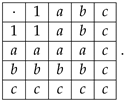
We consider a semigroup with multiplication table.
For a quick test of associativity, it is convenient to use the Light’s associativity test; see [38] [p. 7].
Let be the set of all subsets of the semigroup M. For any , operations and are defined. Then, S is a semiring with zero ∅ and the identity element ; see [63] [Example 1.10].
We have . We note that S does not contain zero sums, i.e., the relation implies the relation . In addition, S is additively idempotent and multiplicatively idempotent. The center is of the form
If , then . Consequently, S is a non-commutative centrally essential semiring.
Remark 34.
It follows from Example 19 that the assertion of Proposition 38 is not true without the assumptions of additive cancellativity and semisubtractivity.
Example 20.
We consider the semiring S generated by the matrices
where . Let and , where , , , and the remaining components are equal to each other. Then , i.e., S is a non-commutative semiring. It is directly verified that the center consists of matrices of the form
where . Since , where , with , we have that S is a non-commutative centrally essential semiring. However, the ring of differences is not a centrally essential ring since the ring has non-central idempotents. In addition, by Remark 21, any centrally essential subalgebra of a local triangular matrix algebra is commutative.
We give an example of a centrally essential ring R, which is the ring of differences for two proper subsemirings and of R such that is not a centrally essential semiring and is a centrally essential semiring.
Example 21.
Let R be a ring consisting of matrices of the form
over the ring of integers. In Example 10, it is proved that R is a non-commutative centrally essential ring. Let be a semiring generated by matrices of the form over and scalar matrices with and zeros on the remaining positions. Since consists of scalar matrices, is not a centrally essential semiring. We note that is a semiring without zero-divisors. At the same time, the semiring of matrices of the form (17) over the semiring is a centrally essential semiring.
Proposition 39.
Let S be a centrally essential semiring without zero divisors. If the ring does not contain zero divisors, the semiring S is commutative.
Proof.
Let . By assumption, and for some . Then
We need the following familiar property [62] [Chapter II, Theorem 5.13]: in any semiring S with ring of differences , any central element of S is contained in the center of .
Therefore, and , where . In addition, since does not contain zero-divisors. Then is a commutative ring by Theorem 1 □
We recall that the upper central series of a group G is the chain of subgroups
where is the center of the group , . For the group G, the nilpotence class of G is the least positive integer n with provided such an integer n exists.
Proposition 40
(cf. Proposition 16). Let G be a finite the group of nilpotence class and let S be a commutative semiring without zero divisors or zero sums. Then is a centrally essential group semiring.
Proof.
If , then the group G is Abelian and is a centrally essential group semiring; see Theorem 4(a).
Let . Similar to the case of the group rings (e.g., see [30] [Part 2]), the center is a free S-semimodule with basis
It is sufficient to verify that , where is the center of the group G. Indeed, if , then
since . □
In Example 22 below, a non-commutative centrally essential semiring without zero-divisors is constructed; this semiring is additively cancellative but is not semisubtractive.
Example 22.
Let be the quaternion the group, i.e., the group with two generators a, b and defining relations , and ; e.g., see, [19] [Section 4.4]. We have
the conjugacy classes of are
and the center is . We consider the group semiring , where . Since is a group of nilpotence class 2, it follows from Proposition 5.2.8 that is a centrally essential group semiring. To illustrate the above, we have
The the group ring of differences is a reduced ring; see [64]. Then is a reduced semiring. Indeed, if and , then in the ring ; this is not true. Thus, is a non-commutative reduced centrally essential semiring without zero-divisors. We note that the ring is not centrally essential, since centrally essential reduced rings are commutative.
Theorem 27.
There exists a non-commutative additively cancellative reduced centrally essential semiring without zero-divisors. An additively cancellative reduced semiring S is commutative if and only if the ring of differences of S is a centrally essential ring.
Proof.
It follows from Example 22 that there exists a non-commutative additively cancellative reduced centrally essential semiring without zero-divisors.
If a semiring S is commutative, then is a commutative ring, i.e., is centrally essential. Conversely, let be a centrally essential ring. Since S is a reduced semiring, is a reduced ring. Indeed, let . If , then . Therefore, , , and we have a contradiction. Then the ring is commutative, since is a reduced centrally essential ring. Consequently, S is a commutative semiring. □
An element x of a semiring is said to be left (respectively, right) multiplicatively cancellative if for all with (resp., ). A semiring S is said to be left (respectively, right) multiplicatively cancellative if every element is left (respectively, right) multiplicatively cancellative. A left and right multiplicatively cancellative semiring is said to be multiplicatively cancellative, e.g., see, [62] [Chapter I].
Remark 35.
A left (respectively, right) multiplicatively cancellative centrally essential semiring S is commutative.
Proof.
Let a and b be two non-zero elements of the semiring S. Since S is a centrally essential semiring, there exists an element with . A left multiplicatively cancellative semiring does not contain left zero-divisors; see [62] [Chapter I, Theorem 4.4]. Therefore, . Then
whence . A similar argument is true for right multiplicatively cancellative semirings. □
A semiring with division, which is not a ring, is called a division semiring.
A commutative division semiring is said to be semifield.
Any centrally essential division semiring is a semifield. Indeed, it follows from [62] [Chapter I, Theorem 5.5] that a division semiring with at lest two elements is multiplicatively cancellative. Therefore, our assertion follows from Remark 35.
7. Non-Associative Rings
In this section, the considered rings are not necessarily associative.
We use notation and terminology from [41]; also see [65].
7.1. Types of Centers and Central Essentiality
In this subsection, we consider rings which are not necessarily unital or associative.
Let R be a ring. We denote by the union of R with adjoint external unit.
The associator of three elements of the ring R is the element and the commutator of two elements is the element .
For a ring R, the associative center, commutative center and center of R (in the sense of [41] [§7.1]) are the sets
respectively. It is clear that and are subrings in R and the ring R is a unitary (left and right) -module and -module.
For ring R, we denote by the centroid of R, i.e., the set of endomorphisms of the additive the group , which commute with the left and right multiplications by elements of R.
It is clear that R can be considered a left or right module over the associative commutative ring ; R can be also considered a unitary module over the unital associative commutative ring and as a unitary module over the centroid .
Remark 36.
The associative center , the commutative center and the center of the ring R are -submodules in R.
Proof.
Let and . For any , we have
Consequently, .
Similarly, if , then for any , we have
Consequently, .
Finally, the assertion about the center directly follows from two previous assertions, since by definition. □
Definition 2.
A ring R with center is said to be centrally essential if for any non-zero element (equivalently, for any non-zero submodule K of the module , i.e., C is an essential submodule of the module ).
A ring R with the center is said to be strongly centrally essential (resp., weakly centrally essential) if (resp., ) for any non-zero element .
In the definition of a strongly centrally essential ring, we can formally replace by ; in this case, the ring R is called a left N-essential ring ring).
A ring R is said to be left K-essential if for any non-zero element , i.e., is an essential submodule of the module .
The following proposition is well known in the associative case.
Proposition 41.
Let R be a ring with the center .
- a.
- Any strongly centrally essential ring R is centrally essential.
- b.
- Any centrally essential ring R is weakly centrally essential.
- c.
- Any unital ring R is strongly centrally essential if and only if R is centrally essential, if and only if R is weakly centrally essential.
Proof.
- a.
- Since C is a subring in , we obtain the assertion.
- b.
- It is sufficient to note that multiplications by central elements and multiplications by integers belong to the centroid of R.
- c.
- It follows from a and b that it is sufficient to verify that if R is a weakly essential ring with the identity element 1, then R is strongly centrally essential. Let R be weakly centrally essential and . There exists an element with . Thensince by Remark 36. Thus, . Therefore, R is strongly centrally essential.
□
We give Examples 23 and 24 which show that the classes of strongly centrally essential, centrally essential and weakly centrally essential rings are distinct in the general case.
Example 23.
Any non-zero ring R with zero multiplication is a centrally essential ring which is not strongly centrally essential. Indeed, and for any non-zero element , we have but .
For the next example, we need Remark 37.
Remark 37.
Let R be a ring such that and let be an endomorphism of the group such that
Then . Indeed, for any two elements , since ; we also have , since .
Example 24.
Let be the field of order 3, be the Grassmann algebra of the two-dimensional linear space over F. Let be a basis of the space and let R be the subalgebra of the algebra with basis . Let be an arbitrary element of the ring R. It is easy to see that if and only if , i.e., and for any . In particular, and ; therefore, the ring R is not centrally essential. Now let . If , then , since contains the identity automorphism of the group . Let be the canonical homomorphism. If , then is a non-zero element of the two-dimensional space and there exists a linear mapping , for which . If , then by Remark 37 and . Consequently, R is a weakly centrally essential ring.
7.2. Reduced and Semiprime Rings
A ring is said to be reduced if it does not contain non-zero elements with zero square. We note that associative reduced rings are exactly the rings without non-zero nilpotent elements.
A ring R is said to be semiprime if R does not contain a non-zero ideal with zero multiplication; see [41] [§8.2].
Theorem 28.
Let R be a weakly centrally essential ring such that its center is a reduced ring.
- a.
- R is a strongly centrally essential ring.
- b.
- R is an associative ring.
- c.
- R is a commutative ring.
Proof.
- a.
- Let , and . Then . By Remark 36, . It is also clear that . Consequently, , i.e., R is a strongly centrally essential ring.
- b.
- By (a), R is a strongly centrally essential ring. We assume that the ring R is not associative and some elements of the ring R have the non-zero associator . Then, there exist two elements such thatWe note that ; otherwise,which is impossible. Therefore, there exists an element such that . We consider the set . It is clear that . Now we assume that . Thena contradiction. Therefore, for some . However,this is a contradiction. Thus, R is an associative ring.
- c.
- We assume that the ring R is not commutative and we have two elements with . Then there exist two elements such that . We note that , otherwise,this is impossible. Therefore, there exists an element such that . We consider the set . It is clear that . Now we assume that . Thena contradiction. Therefore, for some . However,this is a contradiction. Thus, R is a commutative ring.
□
Remark 38.
It is clear that the center of a semiprime ring is a reduced ring; the converse is not always true since the ring of upper triangular matrices over a field is a non-semiprime ring with reduced center.
Remark 39.
Let R be a centrally essential associative ring. In Propositions 3 and 8, it is proved that all idempotents of the ring R are central and the ring R is commutative if R is semiprime. In the introduction, examples of finite non-commutative centrally essential associative unital rings are constructed.
A ring R is said to be right alternative (respectively, left alternative) if (respectively, ) for any elements .
Right and left alternative rings are called alternative rings. A ring R is alternative if and only if for any elements , where denotes associator of elements of the ring R.
By the Artin theorem [41] [Theorem 2.3.2], the ring R is alternative if and only if any two elements of R generate the associative subring.
In connection to Remark 39, we prove Theorem 29.
Theorem 29.
Let R be a centrally essential ring.
- a.
- If the center of the ring R is semiprime, then the ring R is commutative and associative.
- b.
- If the ring R is alternative and e is an idempotent of the ring R, then .
Proof.
- a.
- It follows from Theorem 28 and Remark 38 that any weakly centrally essential semiprime ring is associative and commutative.
- b.
- If R is a weakly centrally essential alternative ring and e is an idempotent of the ring R, then we have to prove that .Let r be an arbitrary element of R. Further, we use several times the associativity of the subring generated by two elements e and r in the alternative ring R. If is an element of the centroid of the ring R such that , thenOn the other hand,Therefore, and . Since the ring R is weakly centrally essential, we have . It can be similarly verified that , whence .
□
Problem 4.
- a.
- Is it true that any N-essential (See Definition 2) ring is associative? Our assumption: It is not true.
- b.
- Is it true that any semiprime N-essential ring is associative?
The following example shows that analogous questions for K-essential Definition 2 rings have negative answers.
Example 25.
Let F be an arbitrary field and let R be the algebra over F with basis such that and its multiplication is defined on basis elements by the relations
We set , . It is easy to verify that . Indeed, if , where and , then and . Therefore, ; the converse inclusion follows from the definition of the multiplication in R.
Now we note that is an ideal in R and the ring is reduced. Therefore, if , then . If , then
where for all and or . If , then ; similarly, if , then
Thus, R is K-essential. We have that and are associative reduced rings. Therefore, for any element with . Especially, R does not have a non-zero ideal with zero multiplication, i.e., R is semiprime. In the same time, e and f are non-central idempotents of R; this is impossible in any associative semiprime weakly centrally essential ring.
Remark 40.
If R is an alternative ring without elements of order 3 in the additive the group, then R is K-essential if and only if R is centrally essential, since [41] [Corollary 7.1.1].
7.3. Cayley–Dickson Process and Associative Centers
Let R be a ring, M a left R-module, and S a subset of M. Then denotes the annihilator of S in R, i.e., . We denote by the ideal of the ring A generated by commutators of all elements in A.
The following definition slightly generalizes the definition of the Cayley–Dickson process given in [41] [§2.2], see [66].
Definition 3 (The Cayley–Dickson Processand the Rings ).
Let A be a ring with involution * (we recall that the ring anti-endomorphism is called an involution if its double application is the identity mapping) and α an invertible symmetrical element of the center of the ring A. We define a multiplication operation on the Abelian group as follows:
for any . We denote the obtained ring by .
The subset in consisting of elements in of the form () is a subring in which is isomorphic to the ring A; we identify the elements with the corresponding elements of A. We set . Then for any and . Thus, .
Note that many works were devoted to the study of the structure and the properties of rings and algebras obtained by this process, for instance, [65,67,68,69,70,71,72].
The following properties are directly verified with the use of the above relation (18).
- a.
- and for any element .
- b.
- is the identity element of the ring .
- c.
- The set is a subring of the ring , which is isomorphic to the ring A.
- d.
- The mapping , , is an involution of the ring .
Up to the end of Section 7.3, we fix a ring A and an element , which satisfy the conditions of the Cayley–Dickson process from Definition 3; we also set .
Lemma 26.
An element belongs to the ring if and only if for any elements , the following relation systems hold:
Proof.
Let . Since associators are linear, if and only if for any two elements , we have
By calculating associators from (21), we obtain the following system consisting of 12 relations
By equating components of equal elements of the ring R and considering that the element is invertible, we obtain the following equivalent system:
We replace the equations, both parts of which contain or , by relations of conjugate elements. We note that either u or stands in every equation. Therefore, we can put u instead of , since . Similarly, we replace by v. By choosing equations containing x, we obtain (19), the remaining equations form the system (20). □
Lemma 27.
Let . The relations (19) hold for all if and only if .
Proof.
Let and let relations (19) hold for all . The first three relations mean that . It follows from the fourth relation for that . Consequently, .
Lemma 28.
Let . The relations (20)
hold for all if and only if .
Proof.
Let and let relations (20) hold for all . First of all, we note that for , the first equation of (20)
turns into the equation ; this is equivalent to the inclusion , since the element u of A is arbitrary.
We verify that . For any two elements , we have
In these transformations, the number over the relation sign is the number of used equation in (20) (equations are numbered in rows from the left to right beginning with the first row). The number underscore denotes that, instead of the given equation, we use the equivalent equation obtained by the permutation of the variables .
Consequently, .
Finally, we take into account the proven to see that already the first equation of (20) implies that for any , i.e., .
Theorem 30.
Let A be a ring with center , , . Then .
Proof.
The assertion follows from Lemmas 26–28. □
Remark 41.
Theorem 30 implies the following classical result (cf. [41] [Exercise 2.2.2(a)]): the ring is associative if and only if the ring A is associative and commutative.
7.4. Cayley–Dickson Process and Central Essentiality
Theorem 31.
Let B be a subring of the center of the ring A and I an essential ideal of B. If B is an essential B-submodule of the module , then I is an essential B-submodule of the module .
Proof.
If r is a non-zero element of the ring R, then there exists an element with . Therefore, there exists an element such that and . □
Theorem 32.
Let A be a ring with center , , . The ring R is left (resp., right) N-essential if and only if A is centrally essential and I is an essential ideal in C.
Proof.
Let the ring A and the element satisfy the conditions of Definition 3 (the Cayley–Dickson process). It is obvious that , , and .
Let the ring be N-essential. Then for any non-zero element , there exists an element such that . By Theorem 30, and . If , then ; otherwise, . In the both cases, . Thus, A is centrally essential.
We prove that I is an essential ideal of C. Let . If , then and . Let . We consider the element . There exists an element such that . Since , , we have that and by Theorem 30. Consequently, , which is required.
Conversely, let us assume that A is a centrally essential ring and I is an essential ideal in C.
Let . There exists an element such that . Since , we have
If , then
If , then by Lemma 31 (for ), there exists an element such that . Then
Thus, the ring R is N-essential. □
Remark 42.
Up to the end of this subsection, we fix a ring A with center, , and an element α, which satisfy Definition 3 (the Cayley–Dickson process).
We set ,
We note that the sets B and J are invariant with respect to the involution and are closed by the multiplication by α.
Theorem 33.
.
Proof.
Let . Since , it follows from Theorem 30 that and . The relations imply the relations and . Consequently, and . Next, the relation () implies the relations and . The first relation holds for any and the second relation means that , i.e., . Consequently, .
Conversely, if and , then and for any we have
Thus, , whence . □
Theorem 34.
A ring is centrally essential if and only if B is an essential B-submodule of the ring R and is an essential ideal of the ring B.
Proof.
Let the ring be centrally essential. Then for any , there exists an element such that . By Theorem 33, and . If , then ; otherwise, . In the both cases, we have . Thus, B is an essential submodule of the module .
We prove that is an essential ideal of the ring B. Let . If , then and . Let . We consider element . There exists an element such that . Since and , we have that , and , by Theorem 33. Consequently, , which is required.
Conversely, let us assume that B is an essential B-submodule of the ring R and is an essential ideal of the ring B.
Let . First, we assume that . There exists an element such that . Since , we have . If , then . If , then by Lemma 6.4.1 (for ) there exists an element such that . Then
Now let . Then , and there exists an element such that . We obtain
Thus, the ring R is centrally essential. □
7.5. Quaternion and Octonion Algebras
Remark 43.
Let K be a commutative associative ring with the identity involution and a an invertible element of the ring R. We consider the ring . Then is a commutative associative ring, since , under the notation of Section 7.4. It is natural to write elements of the ring in the form , where are elements of the ring K, . On the ring , an involution is defined by the relation for any . We choose an invertible element . Then b is an invertible symmetrical element of the center of the ring and we can construct the ring . We consider the K-basis of the algebra , which is formed by the elements , , and . The relations
are directly verified. Consequently, the obtained ring is the generalized quaternion algebra . It is well known (and also follows from Theorem 30) that the ring is associative (e.g., see [41] [Example 7.2.III]). The center of the ring is of the form , where (see [73] [Lemma 2(b)]). Let be defined by equations in Remark 42 for . It is easy to verify that
Lemma 29.
Under the above notation, the ideal I is an essential ideal in B if and only if N is an essential ideal in K.
Proof.
Let I be an essential ideal in B. If , then there exists an element such that . We set
If , then . Otherwise, at least one of the elements is not equal to 0, and each of them belong to the ideal N, whence in this case too.
Conversely, if N is an essential ideal in K and
then . If , then there exists an element with . Then . If , then . Thus, I is an essential ideal of the ring B. □
From the above argument, we obtain the following
Proposition 42.
The quaternion algebra is a non-commutative centrally essential ring if and only if is a proper essential ideal of the ring K.
Now we consider an arbitrary invertible element and the ring . We set
It can be directly verified that the basis of the K-module satisfies the relations from [70] for basis elements of the generalized octonion algebra (for ).
Similar to Proposition 42, we obtain Proposition 43.
Proposition 43.
The octonion algebra is a non-associative centrally essential ring if and only if is a proper essential ideal of the ring K.
Example 26.
Let and . We prove that R is a non-associative non-commutative centrally essential ring.
Indeed, is an essential proper ideal in K. Therefore, the non-commutativity of the ring (and the non-commutativity of the ring R containing ) follows from Proposition 42 and the non-associativity of the ring R follows from Proposition 43.
We note that is an alternative ring and the ring is not even right alternative, i.e., does not satisfy the identity [41] [Exercise 7.2.2]. Thus, there are alternative non-associative finite centrally essential rings and non-alternative finite centrally essential rings.
Problem 5.
- a.
- Is it true that there exists a left N-essential ring which is not right N-essential?
- b.
- Is it true that there exists a commutative N-essential (equivalently, centrally essential) non-associative ring?
- c.
- Is it true that there exists a right alternative centrally essential or N-essential non-alternative ring?
- d.
- How can we generalize the obtained results to the case of non-unital rings and the case, where the element α in Definition 3 is not supposed to be invertible?
- e.
- Since the Cayley–Dickson process gives non-associative division algebras (see, e.g., [67,68]), it seems natural to state the following question:what can be said about N-essentiality of these division rings?
Note that centrally essential semiprime rings are commutative, but it is not known whether N-essential semiprime rings are associative.
Funding
This research received no external funding.
Institutional Review Board Statement
Not applicable.
Informed Consent Statement
Not applicable.
Data Availability Statement
Not applicable.
Conflicts of Interest
The author declares no conflict of interest.
Symbols
| and | left and right annihilators of the subset S | 4 |
| singular submodule of the module M | 4 | |
| element of the group ring | 15 | |
| support of the element r | 15 | |
| class of conjugate elements containing the element g | 17 | |
| quasi-endomorphism ring of the group A | 38 | |
| or | center of a semiring or the group S | 55 |
| subset of the right A-module | 51 | |
| union of the ring R with adjoint external unit | 59 | |
| associator of elements of the ring R | 59 | |
| associative center of the not necessarily associative ring R | 60 | |
| commutative center of the not necessarily associative ring R | 60 | |
| center of the non-associative ring R | 60 | |
| centroid of the not necessarily associative ring R | 60 | |
| ideal generated by commutators of all elements of A | 64 | |
| ring from the Cayley–Dickson process | 64 | |
| Index | ||
| additively cancellative semiring | 55 | |
| alternative ring | 63 | |
| annihilator | 4 | |
| arithmetical ring | 3 | |
| Artinian module | 3 | |
| associative center | 60 | |
| associator | 59 | |
| Cayley–Dickson process | 64 | |
| CE ring | 1 | |
| center of a non-associative ring | 60 | |
| center of a semiring | 55 | |
| centrally essential non-associative ring | 60 | |
| centrally essential ring | 1 | |
| centrally essential semiring | 55 | |
| centroid | 60 | |
| classical identity | 28 | |
| classical ring of fractions | 4 | |
| closed submodule | 3 | |
| commutative center of a non-associative ring | 60 | |
| commutator | 43 | |
| complemented idempotent | 55 | |
| derivation | 43 | |
| distributive module | 3 | |
| divisible Abelian group | 37 | |
| division semiring | 59 | |
| domain | 3 | |
| element algebraic over the center | 28 | |
| essential extension | 3 | |
| essential submodule | 3 | |
| -group | 17 | |
| finite-dimensional module | 3 | |
| flat module | 49 | |
| generalized anticommutative ring | 11 | |
| graded ring | 11 | |
| hereditary module | 3 | |
| homogeneously faithful ring | 11 | |
| integrality over the center | 29 | |
| invariant module | 52 | |
| invariant ring | 3 | |
| involution | 64 | |
| K-essential ring | 60 | |
| large center | 25 | |
| local ring | 8 | |
| multiplicatively cancellative semiring | 59 | |
| N-essential ring | 60 | |
| nil index | 32 | |
| nilpotence class | 17 | |
| nilpotence index | 32 | |
| Noetherian module | 3 | |
| non-reduced Abelian group | 37 | |
| non-singular module | 7 | |
| non-zero-divisor | 3 | |
| perfect ring | 9 | |
| PI ring | 28 | |
| polynomial identity | 28 | |
| prime ring | 3 | |
| projective module | 3 | |
| pseudo-socle | 37 | |
| pure subgroup | 37 | |
| quasi-contained the group | 38 | |
| quasi-decomposition of an Abelian group | 38 | |
| quasi-endomorphism | 38 | |
| quasi-endomorphism ring | 38 | |
| quasi-equal groups | 38 | |
| reduced Abelian group | 37 | |
| reduced semiring | 55 | |
| reduced non-associative ring | 61 | |
| regular element | 3 | |
| ring algebraic over the center | 29 | |
| ring of differences | 55 | |
| S-graded ring | 11 | |
| semi-Artinian module | 9 | |
| semifield | 59 | |
| semihereditary module | 50 | |
| semilocal ring | 9 | |
| semiperfect ring | 8 | |
| semiprime ring | 3 | |
| semiprime non-associative ring | 61 | |
| semiprime semiring | 55 | |
| semiring | 55 | |
| semisubtractive semiring | 55 | |
| singular ideal | 4 | |
| singular submodule | 4 | |
| socle | 3 | |
| strongly centrally essential ring | 60 | |
| strongly indecomposable group | 38 | |
| support | 15 | |
| T-nilpotent ideal | 9 | |
| uniform module | 4 | |
| uniserial module | 3 | |
| upper central series | 17 | |
| von Neumann regular ring | 50 | |
| weak global dimension | 49 | |
| weakly centrally essential ring | 60 |
References
- Lyubimtsev, O.V.; Tuganbaev, A.A. Centrally essential endomorphism rings of abelian groups. Commun. Algebra 2020, 48, 1249–1256. [Google Scholar] [CrossRef]
- Lyubimtsev, O.V.; Tuganbaev, A.A. Centrally essential torsion-free rings of finite rank. Beitr. Algebra Geom. 2021, 62, 615–622. [Google Scholar] [CrossRef]
- Lyubimtsev, O.V.; Tuganbaev, A.A. Centrally essential group algebras and classical rings of quotients. Lobachevskii J. Math. 2021, 2, 2890–2894. [Google Scholar] [CrossRef]
- Lyubimtsev, O.V.; Tuganbaev, A.A. Centrally Essential Semirings. Lobachevskii J. Math. 2022, 43, 1405–1410. [Google Scholar]
- Lyubimtsev, O.V.; Tuganbaev, A.A. Local Centrally Essential Subalgebras of Triangular Algebras. Linear Multilinear Algebra 2020. [Google Scholar] [CrossRef]
- Lyubimtsev, O.V.; Tuganbaev, A.A. Centrally Essential Semigroup Algebras. arXiv 2022, arXiv:2204.10518. [Google Scholar]
- Lyubimtsev, O.V.; Tuganbaev, A.A. Ideals and Factor Rings of Centrally Essential Rings. arXiv 2022, arXiv:2204.10507. [Google Scholar]
- Markov, V.T.; Tuganbaev, A.A. Centrally essential group algebras. J. Algebra 2018, 518, 109–118. [Google Scholar] [CrossRef]
- Markov, V.T.; Tuganbaev, A.A. Centrally essential rings. Discret. Math. Appl. 2019, 29, 189–194. [Google Scholar] [CrossRef]
- Markov, V.T.; Tuganbaev, A.A. Rings essential over their centers. Commun. Algebra 2019, 47, 189–194. [Google Scholar] [CrossRef]
- Markov, V.T.; Tuganbaev, A.A. Centrally essential rings which are not necessarily unital or associative. Discret. Math. Appl. 2019, 29, 215–218. [Google Scholar] [CrossRef]
- Markov, V.T.; Tuganbaev, A.A. Rings with Polynomial Identity and Centrally Essential Rings. Beiträge Algebra Geom. 2019, 60, 657–661. [Google Scholar] [CrossRef]
- Markov, V.T.; Tuganbaev, A.A. Cayley-Dickson Process and Centrally Essential Rings. J. Algebra Appl. 2019, 18, 1950229. [Google Scholar] [CrossRef]
- Markov, V.T.; Tuganbaev, A.A. Uniserial Artinian Centrally Essential Rings. Beiträge Algebra Geom. 2020, 61, 23–33. [Google Scholar] [CrossRef]
- Markov, V.T.; Tuganbaev, A.A. Constructions of Centrally Essential Rings. Commun. Algebra 2020, 48, 198–203. [Google Scholar] [CrossRef]
- Markov, V.T.; Tuganbaev, A.A. Uniserial Noetherian Centrally Essential Rings. Commun. Algebra 2020, 48, 149–153. [Google Scholar] [CrossRef]
- Markov, V.T.; Tuganbaev, A.A. Distributive Noetherian Centrally Essential Rings. J. Algebra Its Appl. 2023; Online Ready. [Google Scholar] [CrossRef]
- Tuganbaev, A.A. Centrally Essential Rings. Lobachevskii J. Math. 2020, 41, 136–144. [Google Scholar] [CrossRef]
- Hall, M. The Theory of Groups; Macmillan: New York, NY, USA, 1959. [Google Scholar]
- Jelisiejew, J. On commutativity of ideal extensions. Commun. Algebra 2016, 44, 1931–1940. [Google Scholar] [CrossRef][Green Version]
- Bourbaki, N.; Algebra, I. Chapters 1–3; Springer: Berlin, Germany, 1989. [Google Scholar]
- Herstein, I. Noncommutative Rings; Mathematical Association of America: Washington, DC, USA, 2005. [Google Scholar]
- Lam, T.Y. A First Course in Noncommutative Rings; Springer: Berlin/Heidelberg, Germany, 2001. [Google Scholar]
- Lambek, J. Lectures on Rings and Modules; AMS Chelsea Publishing: Rochester, NY, USA, 2009. [Google Scholar]
- Rowen, L.H. Ring Theory I; Academic Press: New York, NY, USA, 1988. [Google Scholar]
- Tuganbaev, A.A. Semidistributive Modules and Rings; Springer Netherlands (Kluwer): Dordrecht, The Netherlands; Boston, MA, USA; London, UK, 1998; 352p. [Google Scholar]
- Fuchs, L. Abelian Groups; Springer Monographs in Mathematics: Berlin/Heidelberg, Germany, 2015. [Google Scholar]
- Krylov, P.A.; Mikhalev, A.V.; Tuganbaev, A.A. Endomorphism Rings of Abelian Groups; Springer Netherlands (Kluwer): Dordrecht, The Netherlands; Boston, MA, USA; London, UK, 2003. [Google Scholar]
- Năstăsescu, C.; Popescu, N. Anneaux semi-artiniens. Bull. Soc. Math. Fr. 1968, 96, 357–368. [Google Scholar] [CrossRef]
- Passman, D.S. The Algebraic Structure of the Group Rings; John Wiley and Sons: New York, NY, USA, 1977. [Google Scholar]
- GAP—Groups, Algorithms, and Programming; Version 4.8.8/ The GAP Group. 2017. Available online: https://www.gap-system.org (accessed on 23 April 2022).
- Nishigori, N. On some properties of FC-groups. J. Hiroshima Univ. Ser. A 1957, 21, 99–105. [Google Scholar] [CrossRef]
- Herstein, N.; Small, L.W. Rings of quotients of the group algebras. J. Algebra 1971, 19, 153–155. [Google Scholar] [CrossRef][Green Version]
- Brown, K.A. Quotient rings of the group rings. Compos. Math. 1978, 36, 43–254. [Google Scholar]
- Brown, K.A. On zero divisors in the group rings. Bull. Lond. Math. Soc. 1976, 8, 251–256. [Google Scholar] [CrossRef]
- Elizarov, V.P. About Goldies Theorems. Sib. Math. J. 1969, 10, 41–44. [Google Scholar] [CrossRef]
- Zlydnev, D.V. Rings of quotients for rings with big center. Mosc. Univ. Math. Bull. 2014, 69, 67–72. [Google Scholar] [CrossRef]
- Clifford, A.H.; Prieston, G.B. The Algebraic Theory of Semigroups. AMS Surv. 1961, 1, 7. [Google Scholar]
- Okninski, J. Semigroup Algebras; Dekker: New York, NY, USA; Basel, Switzerland, 1991. [Google Scholar]
- Rowen, L.H. Polynomial Identities in Ring Theory; Academic Press Inc.: New York, NY, USA, 1980. [Google Scholar]
- Zhevlakov, K.A.; Slin’ko, A.M.; Shestakov, I.P.; Shirshov, A.I. Rings That Are Nearly Associative; Academic Press: New York, NY, USA; London, UK, 1982; xi+371p. [Google Scholar]
- Amitsur, S.A. Radicals of polynomial rings. Can. J. Math. 1956, 8, 355–361. [Google Scholar] [CrossRef]
- Faticoni, T. Direct Sum Decompositions of Torsion-Free Finite Rank Groups; Taylor & Francis Group: Abingdon, UK, 2007. [Google Scholar]
- Drozd, Y.A.; Kirichenko, V.V. Finite Dimensional Algebras; Springer: Berlin/Heidelberg, Germany, 1994. [Google Scholar]
- Suprunenko, D.A.; Tyschkevich, R.I. Commutative Matrices; Academic Press: New York, NY, USA, 1968. [Google Scholar]
- Cherednikova, A.V. Rings of quasi-endomorphisms of strongly indecomposable torsion-free Abelian groups of rank 3. Math. Notes 1998, 63, 670–678. [Google Scholar] [CrossRef]
- Pierce, R.S.; Vinsonhaler, C. Realizing central division algebras. Pacific J. Math. 1983, 109, 165–177. [Google Scholar] [CrossRef][Green Version]
- Corner, A.L.S.; Göbel, R. Prescribing endomorphism algebras, a unified treatmend. Proc. Lond. Math. Soc. 1985, 50, 447–479. [Google Scholar] [CrossRef]
- Dugas, M.; Göbel, R. Every cotorsion-free algebra is an endomorphism algebra. Math. Z. 1982, 181, 451–470. [Google Scholar] [CrossRef]
- Zariski, O.; Samuel, P. Commutative Algebra I; Springer: New York, NY, USA, 1975. [Google Scholar]
- Rowen, L.H. Some results on the center of a ring with polynomial identity. Bull. Am. Math. Soc. 1973, 79, 219–223. [Google Scholar] [CrossRef]
- Tuganbaev, A.A. On Rings of Weak Global Dimension at Most One. Mathematics 2021, 9, 2643. [Google Scholar] [CrossRef]
- Goodearl, K.R. Von Neumann Regular Rings; Pitman: London, UK, 1979. [Google Scholar]
- Kaplansky, I. Rings of Operators; Benjamin: New York, NY, USA, 1968. [Google Scholar]
- Jensen, C.U. A Remark on Arithmetical Rings. Proc. Am. Math. Soc. 1964, 15, 951–954. [Google Scholar] [CrossRef]
- Stephenson, W. Modules whose lattice of submodules is distributive. Proc. Lond. Math. Soc. 1974, 28, 291–310. [Google Scholar] [CrossRef]
- Wisbauer, R. Foundations of Module and Ring Theory; Gordon and Breach: Philadelphia, PA, USA, 1991. [Google Scholar]
- Dubrovin, N.I. Rational Closures of Group Rings of left-ordered Groups. Sb. Math. 1994, 79, 231–263. [Google Scholar] [CrossRef]
- Markov, V.T.; Tuganbaev, A.A. Distributive Noetherian Centrally Essential Rings. arXiv 2019, arXiv:1908.10034. [Google Scholar] [CrossRef]
- Camillo, V. Distributive modules. J. Algebra 1975, 36, 16–25. [Google Scholar] [CrossRef]
- Tuganbaev, A.A. Distributive semiprime rings. Math. Notes 1995, 58, 1197–1215. [Google Scholar] [CrossRef]
- Hebisch, U.; Weinert, H.J. Semirings: Algebraic Theory and Applications in Computer Science; World Scientific Publishing: Singapore, 1998. [Google Scholar]
- Golan, J.S. Semirings and Their Applications; Kluwer Academic Publishers: Dordrecht, The Netherlands; Boston, MA, USA; London, UK, 1999. [Google Scholar]
- Sehgal, K.S. Nilpotent elements in the group rings. Manuscripta Math. 1975, 15, 65–80. [Google Scholar] [CrossRef]
- Schafer, R.D. An Introduction to Nonassociative Algebras; Academic Press: New York, NY, USA, 1966. [Google Scholar]
- Albert, A.A. Quadratic forms permitting composition. Ann. Math. Second. Ser. 1942, 43, 161–177. [Google Scholar] [CrossRef]
- Brown, R.B. On generalized Cayley-Dickson algebras. Pac. Math. 1967, 20, 415–422. [Google Scholar] [CrossRef][Green Version]
- Flaut, C. Divison algebras with dimension 2t, t ∈ . Analele Stiintifice Ale Univ. Ovidius Constanta Ser. Mat. 2006, 13, 31–38. [Google Scholar]
- Flaut, C.; Shpakivskyi, V. Some identities in algebras obtained by the Cayley-Dickson process. Adv. Appl. Clifford Algebr. 2013, 23, 63–76. [Google Scholar] [CrossRef][Green Version]
- Flaut, C.; Ştefănescu, M. Some equations over generalized quaternion and octonion division algebras. Bull. Math. Soc. Sci. Math. Roum. 2009, 52, 427–439. [Google Scholar]
- Pumplun, S.; Astier, V. Nonassociative Quaternion Algebras over Rings. Isr. J. Math. 2006, 155, 125–147. [Google Scholar] [CrossRef]
- Waterhouse, W.C. Nonassociative quaternion algebras. Algebr. Groups Geom. 1987, 4, 365–378. [Google Scholar]
- Tuganbaev, A.A. Quaternion algebras over commutative rings. Math. Notes 1993, 53, 204–207. [Google Scholar] [CrossRef]
Publisher’s Note: MDPI stays neutral with regard to jurisdictional claims in published maps and institutional affiliations. |
© 2022 by the author. Licensee MDPI, Basel, Switzerland. This article is an open access article distributed under the terms and conditions of the Creative Commons Attribution (CC BY) license (https://creativecommons.org/licenses/by/4.0/).