1. Introduction
Science education increasingly emphasizes learners’ engagement in modelling, explanation, argumentation, and interpretation of evidence. The Framework for K-12 Science Education and the Next Generation Science Standards position these practices alongside disciplinary ideas and cross-cutting concepts (
National Research Council, 2012;
NGSS Lead States, 2013). Research on socio-scientific issues and science identity also asks whose contributions are recognized and how learners use science to examine socially consequential problems (
Carlone & Johnson, 2007;
Högström et al., 2025;
Smith et al., 2022;
Zeidler et al., 2005). Together, these perspectives make participation a central criterion for evaluating science learning.
For students with disabilities, participation depends partly on how scientific activity is organized. Diagrams, symbolic notation, laboratory materials, rapid classroom discussion, and written assessment can create different sensory, communicative, and cognitive demands. Physical presence in a classroom does not establish that a learner can inspect evidence, manipulate materials, explain an observation, or influence a group’s reasoning. Inclusive science education therefore requires attention to the relationship between accessibility and opportunities to contribute to these practices.
Assistive technology and accessible instructional design address this relationship at different levels. Individual tools may support a specific access need (
Chimicz, 2020), whereas universal design for learning (UDL) addresses variation in how learning environments are planned. Their relevance to science education lies in whether they connect access to representations with participation in inquiry. This provides a common focus for examining otherwise separate studies on accessible materials, communication supports, disability-inclusive STEM pathways, and school implementation.
The available supports illustrate this range. Text-to-speech and read-aloud tools address reading access (
Wood et al., 2018); tactile graphics, haptic materials, and three-dimensional (3D) models address spatial representations (
Mukhiddinov & Kim, 2021;
Rule, 2011;
Zebehazy et al., 2022). Augmentative and alternative communication (AAC), eye-gaze speech-generating devices (SGDs), and discussion-facilitation tools address communication opportunities (
Alzubaidi & Otoom, 2018;
Ibrahim et al., 2024;
Tegler et al., 2020). UDL and embedded assistive technology extend the focus to curriculum design, while artificial intelligence (AI) introduces additional possibilities and questions concerning accessibility (
Izzo, 2012;
Kohnke & Zaugg, 2025;
Fernández-Batanero et al., 2022;
Schreffler et al., 2019;
Kasneci et al., 2023). Evidence from these different contexts requires explicit consideration of its transferability to K-12 science.
The unresolved issue is how these supports relate to scientific participation across a fragmented evidence base. A tool can make information accessible without giving its user a consequential role in collaborative reasoning. Implementation research also identifies mismatches between devices, instructional routines, training, and sustained support (
Edyburn, 2000;
Hunt, 2021;
Karlsson et al., 2018;
Koch, 2017;
White & Robertson, 2015;
Roberts & Simpson, 2016). A mapping review can make these connections and gaps visible while distinguishing direct classroom evidence from the adjacent, conceptual, and implementation literature. This distinction is needed before broad claims about inclusive science learning can be drawn from heterogeneous technology studies.
This review examines the relationship between accessibility supports and participation in inclusive K-12 science and STEM education. Epistemic participation denotes opportunities to observe, model, explain, argue, and interpret evidence. Critical participation additionally concerns agency, recognition, and opportunities to question interpretations and the social implications of science. These concepts guide interpretation; they are not assumed to be outcomes measured in every included record. The review addresses the following questions:
RQ1. What barriers to learning and participation are described in the literature on inclusive K-12 science education?
RQ2. Which assistive technologies or accessibility frameworks address these barriers?
RQ3. How do these supports relate to access to scientific representations and participation in inquiry?
RQ4. What implementation conditions are reported as relevant to inclusive and critical science learning?
2. Materials and Methods
This study was conducted as a systematic mapping review with qualitative thematic synthesis, using the Preferred Reporting Items for Systematic Reviews and Meta-Analyses (PRISMA) 2020 framework to guide reporting of identification, screening, eligibility, and inclusion (
Page et al., 2021). A mapping design was selected because the literature spans classroom studies, stakeholder research, conceptual frameworks, technology evaluations, and earlier reviews. Mapping-oriented reviews characterize heterogeneous evidence rather than necessarily estimating pooled effects (
Grant & Booth, 2009). No meta-analysis was undertaken. Thematic synthesis principles informed the development of cross-cutting interpretations (
Thomas & Harden, 2008); limitations in the retained process documentation are reported below.
2.1. Search Strategy
Searches were conducted in two waves. The original search was conducted in November 2024, and a second search wave was conducted on 9 June 2026 to capture the literature published after the initial search window. Three sources were used in both waves: Crossref and OpenAlex for broad cross-disciplinary bibliographic coverage across education, disability studies, science education, STEM education, and technology-enhanced learning, and ERIC for targeted coverage of K-12 education, special education, and disability-inclusive pedagogy. Crossref was searched with six bibliographic strings: assistive technology science education students disabilities; STEM education students with disabilities assistive technology; inclusive science education disabilities technology; science classroom students with disabilities technology; universal design for learning STEM students disabilities; and tactile graphics science students visual impairments education. OpenAlex was searched with five related strings: assistive technology science education students disabilities STEM K-12; inclusive science education students with disabilities technology; tactile graphics science students visual impairments; universal design for learning STEM students disabilities; and AAC science classroom students disabilities participation. ERIC was searched using four strings: assistive technology K-12 science classroom disability; inclusive STEM education students with disabilities technology; universal design for learning science education disability; and tactile graphics visual impairment science instruction.
The sources were selected for complementary discovery functions: Crossref provides publisher-deposited bibliographic metadata across disciplines; OpenAlex supports cross-disciplinary scholarly discovery; and ERIC focuses on the education literature. This combination connected technical accessibility work with school and pedagogy research. It was not assumed to provide exhaustive coverage of specialist engineering or computing publications. Scopus, Web of Science, and IEEE Xplore were not searched; the implications for retrieval bias are discussed in
Section 5.
The conceptual literature on critical science education, socio-scientific issues, science identity, disability justice, AI equity, assessment accessibility, and review methodology informed framing and interpretation. Background sources were not included in the evidence map unless they met all eligibility criteria, including the 2010 publication-date threshold. During revision,
Edyburn (
2000) was identified as an incorrectly listed background source in
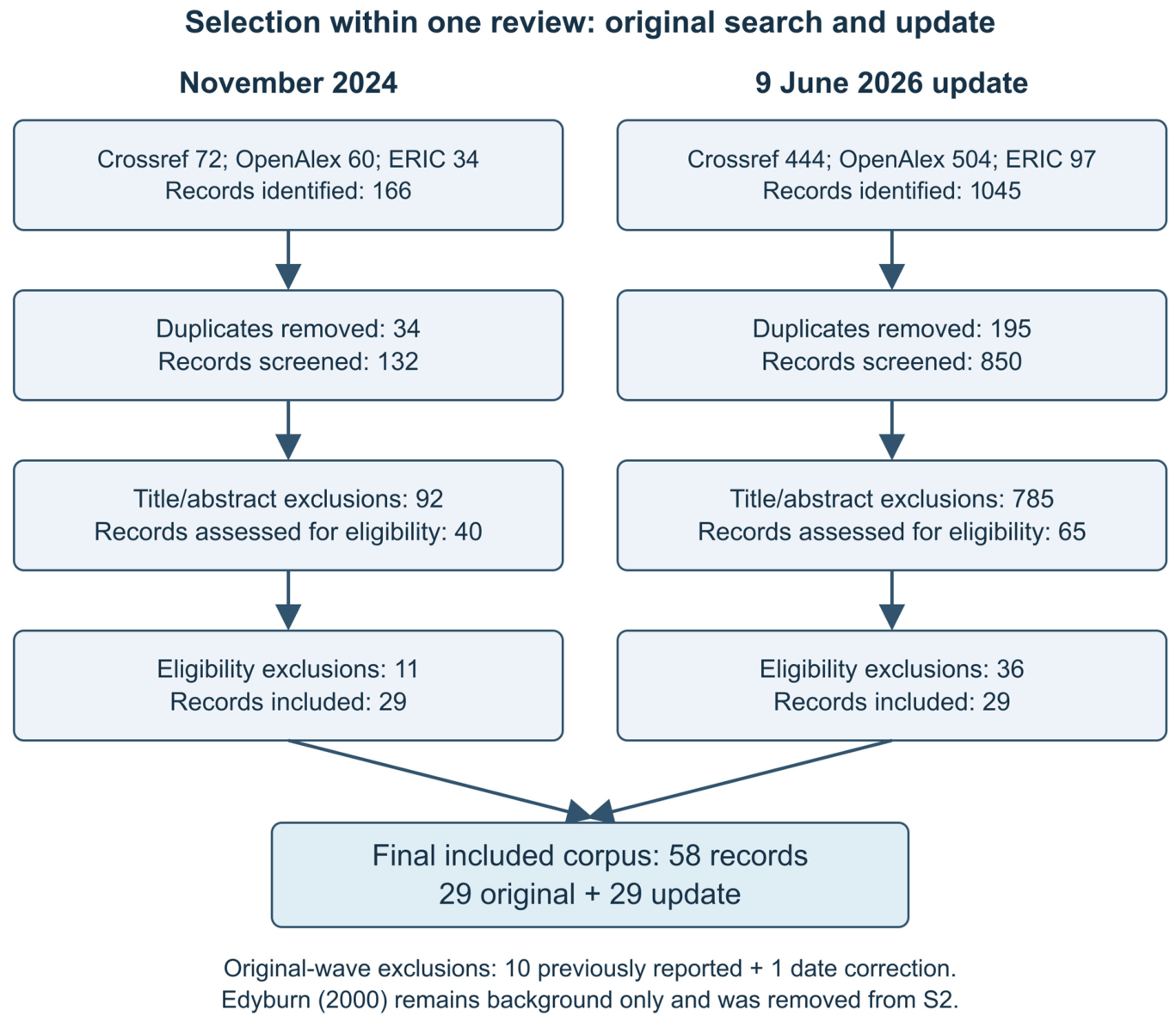
Supplementary Materials S2 and removed from the included set. It remains cited and retained in the reference list as a background source, but it is not part of the included 58-record evidence corpus. This correction reduced the original-wave inclusion count from 30 to 29 and the final corpus from 59 to 58; the search criteria and all other record decisions were unchanged.
The search window extended from 2010 to 9 June 2026, capturing contemporary accessibility, UDL, AAC, and the inclusive STEM literature. The update covered 1 November 2024 to 9 June 2026, with the overlapping late-2024 period checked against the original matrix. Because complete cross-wave record-level reconciliation was not retained, the number of cross-wave duplicates cannot be retrospectively reconstructed; the update was checked against the original matrix to avoid double counting. Searches used English-language terms and the review prioritized English-language records. Adjacent STEM and disability studies were retained only when they offered explicit relevance to K-12 science/STEM, accessible representation, inquiry participation, teacher preparation, or assessment.
Supplementary Materials S1 provides search strings, dates, counts, exclusion documentation, and a screening-process statement. It does not provide a complete independent-decision or AI-assistance log.
2.2. Eligibility Criteria
Eligibility criteria were organized using an adapted population, intervention, comparator, outcomes, and study-design (PICOS) framework. For this heterogeneous mapping review, educational context replaced a required comparator because no single intervention contrast was estimated.
Table 1 summarizes the inclusion and exclusion logic. Records had to fall within the 2010–2026 search window; earlier sources could be cited only as background.
2.3. Study Selection and Data Extraction
The original search identified 72 Crossref, 60 OpenAlex, and 34 ERIC records. After removal of 34 duplicates, 132 records underwent title/abstract screening; 92 were excluded and 40 proceeded to eligibility assessment. The corrected original-wave total was 29 included records and 11 exclusions: the 10 exclusions reported initially plus the out-of-range background record identified during revision. The June 2026 update identified 1045 records (444 Crossref, 504 OpenAlex, and 97 ERIC). Removal of 195 within-update duplicates left 850 records; 785 were excluded at title/abstract screening, 65 proceeded to eligibility assessment, 36 were excluded, and 29 were added. The final corpus comprised 58 records.
Figure 1 presents both search waves within this single review and identifies the date-eligibility correction.
Two researchers independently screened titles/abstracts and full texts against the predefined eligibility criteria. Disagreements were resolved through discussion, with assistance from a third researcher when required. Two researchers also independently extracted data using the structured matrix and cross-checked their entries. The update was checked against the original matrix to avoid double-counting. However, complete record-by-record independent judgments were not retained for every screening stage, and no Cohen’s kappa or other agreement coefficient was calculated and saved during the review. A defensible retrospective agreement statistic therefore cannot be supplied. Consensus resolution is not treated as measured inter-rater agreement. Predefined criteria, independent review, cross-checking, and adjudication supported procedural consistency, but the incomplete decision trail limits auditability and prevents quantitative assessment of screening reliability.
2.4. Evidence Characterization and Transferability Classification
Due to the methodological heterogeneity of the included literature, applying a single numerical risk-of-bias instrument designed for randomized controlled trials would have been inappropriate. The purpose of this stage was therefore not to assign a formal methodological quality score to every record, but to characterize the proximity and transferability of the evidence to inclusive K-12 science/STEM education. Methodological considerations were informed by principles from the Mixed Methods Appraisal Tool, which supports consideration of qualitative, quantitative, mixed-methods, and non-randomized evidence (
Hong et al., 2018), but no numerical MMAT scores were calculated. The synthesis used an explicit evidence-role classification approach, designating each record as direct K-12 science/STEM education evidence, adjacent STEM disability evidence, transferable assistive-technology implementation evidence, conceptual or review evidence, or emerging AI/assessment evidence. These categories indicate evidence role and transferability rather than a common quality metric across heterogeneous designs. Secondary reviews were treated as field-level evidence and were not interpreted as independent replication of the primary studies they summarized. This approach made the strength and transferability of each claim visible without overstating methodological comparability across diverse study designs.
2.5. Representative Mapping and Synthesis
For this revision, the cell assignments were audited against
Supplementary Materials S2 rather than retrospectively presented as exhaustive coding. The unit in
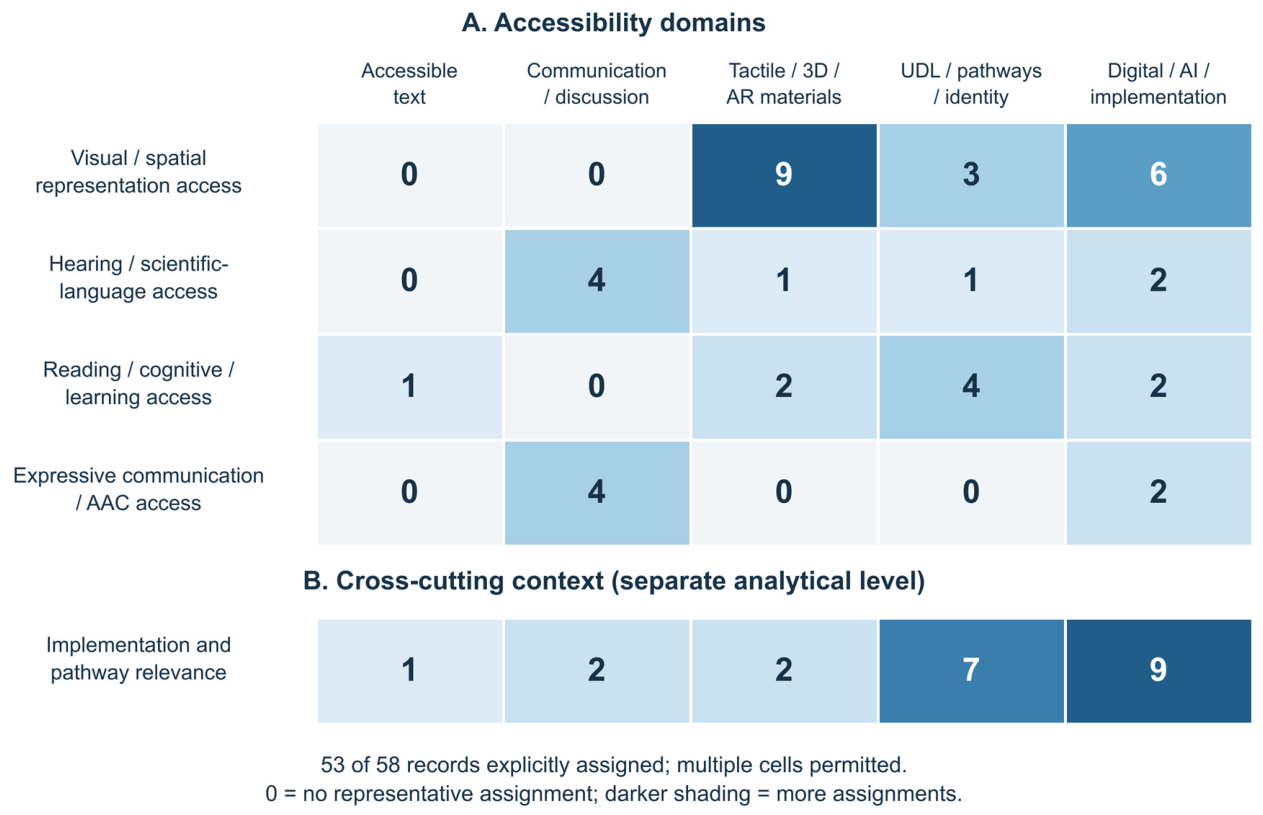
Table 2 and
Figure 2 is a bibliographic record within an explicitly assigned cell. Fifty-three of the 58 included records have assignments, whereas five are marked in
Supplementary Materials S2 as not explicitly assigned. The revised display retains these assignments. Panel A groups accessibility domains: visual/spatial representation, hearing/scientific-language access, reading/cognitive/learning access, and expressive communication. Panel B separately groups cross-cutting implementation and pathway relevance. Thus, an accessibility-domain assignment indicates an analytic relevance judgement in this review, not necessarily a disability diagnosis of study participants. For example, augmented reality (AR)-supported representation can be relevant to visual/spatial access even when participants have intellectual disabilities.
Support categories follow the documented technology or framework focus: accessible text; communication/discussion support; tactile, 3D, AR, or adaptive materials; UDL/pathways/identity; and digital tools, assessment, or implementation. A record contributes once per explicitly coded cell. Multiple cells are retained only where the supplied reconciliation sheet lists those assignments; no cross-product of all tags is inferred. Contextual assignments concern transferability and must not be interpreted as additional participants, interventions, or replications. These broad review categories are descriptive and are not a validated classification instrument. Coding and interpretation were undertaken by the researchers, not delegated to AI. The available record does not establish quantitative classification reliability.
The representative matrix and figure were generated programmatically from the reconciliation values in
Supplementary Materials S2 rather than estimated from image shading. Numeric labels reproduce its per-cell record counts, with darker blue indicating more assignments. Zero denotes no representative assignment, not absence of the relevant literature. The qualitative synthesis groups extracted barriers, support functions, and implementation conditions into five themes. Results summarize reported observations and evidence types; the Discussion considers their implications for scientific participation. The interpretive synthesis and
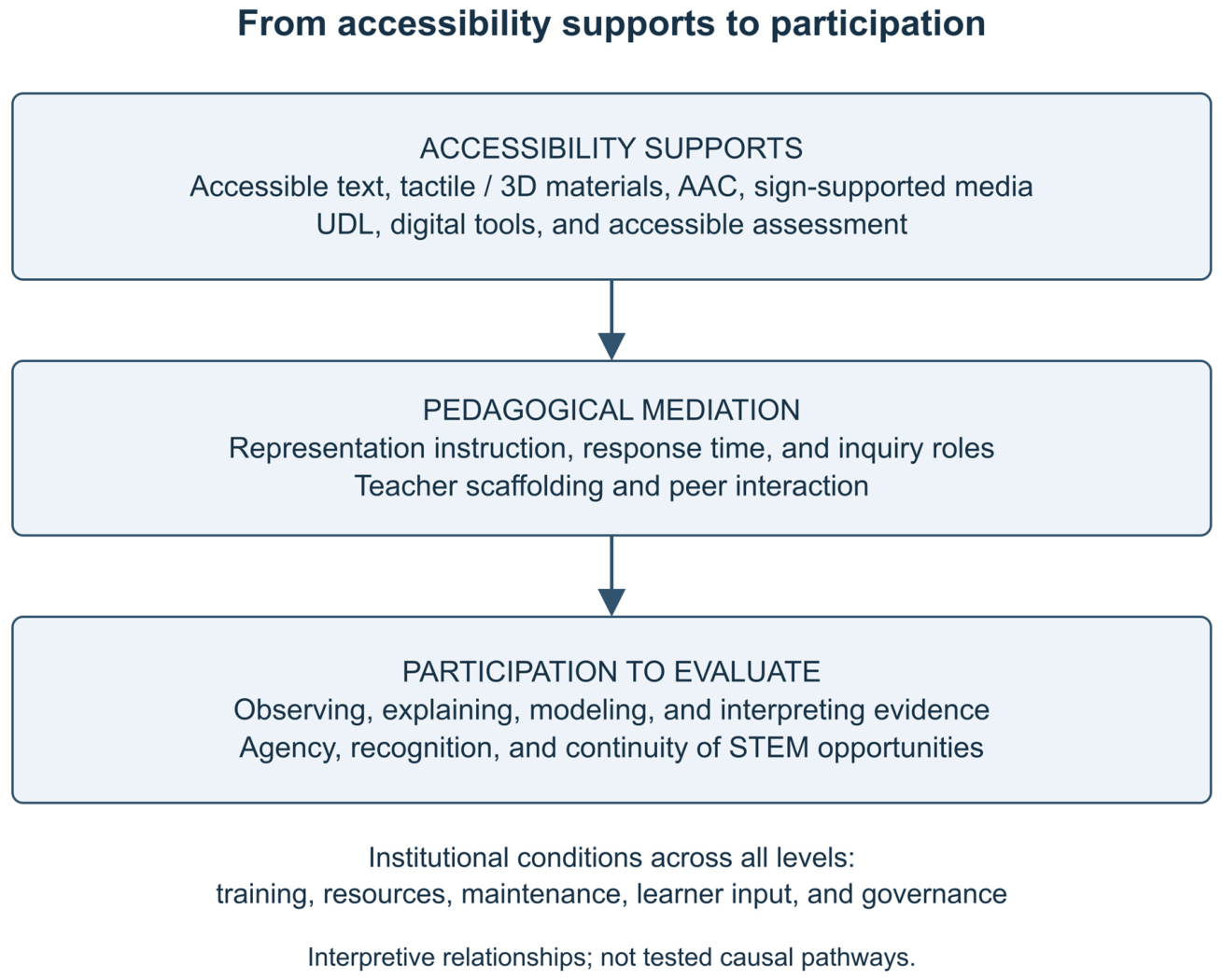
Figure 3 are explicitly identified as interpretive synthesis rather than empirical causal models.
2.6. AI and Automated Tools
During the original study, ChatGPT (GPT 4.0) (OpenAI) assisted with generating candidate search keywords, flagging possible duplicate records, language editing, and table organization. Candidate keywords and duplicate suggestions were checked by the researchers. AI did not make final inclusion or exclusion decisions, independently extract or judge study data, appraise evidence, assign codes, or synthesize results. Researchers made the substantive decisions, cross-checked data, and interpreted the findings. Complete AI-assistance logs were not retained, and exact model/version information is not available in the documentation supplied for this revision. These omissions limit the reproducibility of the auxiliary workflow.
During the present revision, OpenAI Codex (0.155.1) assisted with manuscript restructuring and editing, reviewer-response drafting, technical consistency checks across the supplied
supplementary files, and writing code for figure rendering and document preparation. This assistance was broader than language polishing and is disclosed separately from the original study. The revised plots use the documented reconciliation values; no AI-generated cell assignments were used. Authors retain responsibility for verifying the content and approving the final manuscript; automated preparation does not validate the original evidence.
3. Results
The corrected corpus comprises 58 records published between 2010 and 2026, including classroom studies, the adjacent STEM literature, implementation research, and conceptual or review contributions.
Table 2 presents representative cross-domain assignments, and
Figure 2 visualizes those same assignments. Fifty-three records have explicit cell assignments and five do not; the matrix is therefore a representative display rather than a complete frequency distribution of the included literature. Cell counts describe records, including secondary and conceptual sources, rather than independent interventions or effect estimates.
Within the representative display, visual/spatial representation access has nine assignments to tactile, 3D, augmented-reality (AR), or adaptive materials. Hearing/scientific-language access has four assignments to communication and discussion supports. Expressive communication has four assignments to that support category. The separate cross-cutting context has nine assignments to digital tools, assessment, or implementation and seven to UDL, pathways, or identity. These counts summarize the displayed coding only; they cannot establish relative prevalence across the complete field or the effectiveness of a support for a particular learner population.
The June 2026 update added school-level studies concerning interdisciplinary STEM lessons, tactile inquiry activities, AR-supported science concepts, and generative AI (GenAI) scaffolding. Their reported designs and findings are summarized by theme below. They are considered separately because the populations, activities, designs, and outcomes differ.
3.1. Access to Scientific Representations
The first theme concerned access to scientific representations. Science classrooms rely heavily on diagrams, graphs, maps, models, tables, procedures, symbolic notation, and written explanations.
Rule (
2011) demonstrates the representational problem concretely through tactile Earth and space science materials for contours, craters, asteroids, and Mars features; the scientific concepts were not diluted, but rebuilt in tactile-spatial form. The updated evidence confirms that this representational problem extends beyond early tactile graphics.
Suparmi et al. (
2024), for example, identified 506 Grade IV science terms in elementary materials, including 338 words and 168 phrases, showing how hearing-impaired students can be excluded when science vocabulary has no stable sign-language pathway.
Rosenblum et al. (
2025) documented 12 Braille readers aged 11–16 participating in a virtual hands-on rocket investigation with a 3D model, tactile graphics, experimentation, and data presentations.
Gulboy and Denizli-Gulboy (
2025) added small-n intervention evidence that three secondary students with intellectual disabilities acquired, maintained after five weeks, and generalized science concepts taught through augmented reality.
Other records examined the use of accessible representations.
Nashleanas (
2021) considered teachers’ questions about graphing instruction for students with visual impairments.
Zebehazy et al. (
2022) analyzed think-aloud accounts of graphic interpretation, including strategy selection and monitoring.
Ali et al. (
2024,
2025) addressed interactive access to mathematical expressions and missing-digit arithmetic using audio guidance, validation, and stepwise support.
Adelakun et al. (
2025) described equation-conversion software. These contributions address related representation problems, although mathematics-access findings remain adjacent evidence for science instruction.
3.2. Communication and Inquiry Participation
The second theme concerned communication opportunities relevant to inquiry.
Andzik et al. (
2016) examined AAC users’ communication opportunities in elementary classrooms.
Tegler et al. (
2020) analyzed response spaces in multiparty classroom interaction involving eye-gaze SGDs, and
Ibrahim et al. (
2024) examined the establishment of common ground between AAC users and teaching staff. These records concern classroom communication and are not all science-specific interventions.
Tang et al. (
2026) provided a directly relevant inclusive-science example: video-based interaction analysis identified educator scaffolding of ChatGPT use across instructional, literacy, emotional–behavioural, and technological domains.
Hearing-access records included discussion-facilitation technology (
Alzubaidi & Otoom, 2018) and elementary science-related multimedia (
Muzaini et al., 2025). The latter described sign-supported videos, visual simulations, and gamified applications. Together with the AAC literature, these records document communication channels and classroom organization; they do not provide a common measure of sustained inquiry participation.
3.3. STEM Pathways and Science Identity
The third theme concerned inclusive STEM pathways and science identity. STEM education is not a single classroom event but a pathway of experiences that shapes interest, identity, achievement, course-taking, and future opportunity.
Hwang et al. (
2024) provide unusually concrete school-level evidence: in a 40-week field test of interdisciplinary STEM lessons, nine students with learning disabilities made significant gains in science vocabulary and contextualized problem solving and maintained those gains two and four weeks after the intervention.
Locke et al. (
2025) extend the pathway argument through a systematic review of 16 K-12 STEM role-model studies for students with disabilities, emphasizing representation and classroom recommendations.
Yamamoto (
2026) further shifts the discussion toward secondary students’ attitudes toward STEM, while
McBride et al. (
2025) show how the mathematics experiences of 159 high-school students with visual impairments, as reported by 83 teachers, remain consequential for later STEM participation.
3.4. Implementation Conditions
The fourth theme concerned implementation ecology.
Koch (
2017) gives this theme its clearest practical vocabulary through the argument that assistive technology should ‘stay in the box’ of ordinary curriculum work rather than sit outside the lesson as a separate accommodation. The June 2026 update adds more direct evidence that implementation problems are often curricular and institutional.
Suprihatiningrum et al. (
2025) studied 25 science teachers across 16 inclusive schools and found that lesson planning was often identical for students with disabilities and their peers, even when visual scaffolds, audio/tactile resources, or structured routines were needed.
Awini (
2026) documented 21 Ghanaian teachers of STEM-related subjects in inclusive basic schools and found reliance on basic braille-related resources while low-vision devices, digital tools, and specialized STEM assistive technologies remained limited.
Mbowe and Anselimus (
2026) traced the problem further upstream in science teacher education, identifying the absence of a visual-impairment-specific curriculum, shortages of specialized tutors, scarce materials, and limited practicum preparation.
At the broader implementation level,
Murillo-Jiménez et al. (
2025) synthesized nine primary studies and identified training, digital competence, infrastructure, economic constraints, policy enforcement, and attitudes as reported barriers.
Timotheou et al. (
2023) reviewed digital transformation and school capacity. These broader records supply implementation context rather than direct estimates of assistive-technology effects in K-12 science.
3.5. Emerging AI and Accessible Assessment
The fifth theme comprised emerging digital tools and accessible assessment.
Kohnke and Zaugg (
2025) considered AI and UDL in STEM;
Clark et al. (
2025) discussed accessibility and construct-irrelevant variance in AI-supported science and mathematics assessment;
Sakowicz and Hamidi (
2025) considered GenAI-assisted material design. These are distinguished from
Tang et al. (
2026), which examined educator scaffolding in an inclusive science classroom. The evidence set includes proposed uses and reported classroom practices, without comparable outcome measures sufficient to infer a general AI effect.
3.6. Theme-Level Summary of Included Evidence
Table 3 summarizes the five thematic areas and distinguishes their evidence focus from the review’s interpretive implications. Full record-level extraction is supplied in
Supplementary Materials S2.
3.7. Cross-Theme Synthesis
The interpretive synthesis and
Figure 3 organize the cross-theme interpretation into accessibility supports, pedagogical mediation, participation, and institutional conditions. The connections are propositions generated by the synthesis, not relationships tested across a common dataset
Table 4.
4. Discussion
4.1. From Content Access to Epistemic Participation
The synthesis generates several implications for the transformation of science education from foundational access toward critical participation.
Rule (
2011) critically demonstrated that geological contour charts, crater forms, asteroids, and Martian surface features can be reconstructed as tactile science materials rather than merely described as inaccessible visual content. The update extends that insight across media:
Suparmi et al. (
2024) show that science terminology itself can become inaccessible for deaf learners;
Rosenblum et al. (
2025) show how Braille readers can participate in rocket-based inquiry when 3D and tactile materials are built into the event; and
Tang et al. (
2026) show that GenAI access depends on educator scaffolding in the moment of classroom interaction. The implication is straightforward: the question of whether a student has a tool is less consequential than the question of whether that tool is embedded in a science task that makes its use meaningful.
A related finding concerns the representational character of science exclusion. The barriers documented in this literature are not primarily physical barriers such as locked doors or inaccessible buildings—but epistemic: students encounter science encoded through printed text, standard-resolution visual diagrams, symbolic equations, rapid oral exchange, vision-dependent laboratory materials, and written-only assessment. Their sensory, motor, linguistic, or communicative repertoires may then be treated as mismatches to science itself, when the mismatch is actually with the representational design of instruction. A technology becomes educationally powerful when it opens access to the same conceptual terrain and participatory practice. This conclusion resonates with recent work on culturally responsive and sustaining science pedagogies, which treats access to science as a matter of recognition, representation, and justice rather than content delivery alone (
Smith et al., 2022).
4.2. Assistive Technology as a Critical Practice
The review also emphasizes participation. Much of inclusion discourse focuses on access, but science learning requires doing: asking questions, making observations, manipulating materials, comparing evidence, negotiating explanations, and communicating claims.
Andzik et al. (
2016) make this concrete by showing that AAC users’ communication opportunities in elementary classrooms must be deliberately organized.
Tegler et al. (
2020) show how eye-gaze speech-generating devices require interactional response spaces in multiparty talk, and
Ibrahim et al. (
2024) trace how common ground is built between children using AAC and teaching staff.
Tang et al. (
2026) update this interactional argument for GenAI: students with disabilities did not merely need access to ChatGPT; they needed educator support for reading, interpreting, regulating, and responding to AI output within an inclusive science activity. These studies make AAC, eye-gaze devices, captioning, sign-supported media, and AI dialogue supports central to inquiry design rather than peripheral accommodations.
The contrast between content access and practice access helps interpret these findings. Decoding a graph or laboratory instruction is an access outcome; using it to make a prediction, compare evidence, or contribute an explanation is a participation outcome. Neither establishes a change in science identity or critical agency. This distinction prevents a short-term gain in representation access from being treated as proof of broader inclusion. Communication studies suggest a plausible role for response time and assigned inquiry roles, but their application to science tasks requires direct testing where the original setting was not science-specific.
4.3. Educational and Policy Implications
For teachers, the evidence does not imply an obligation to become specialists in every assistive device. It points instead to sustained engagement with accessibility as a dimension of critical instructional design. The gap between having an inclusive policy and running an inclusive science lesson is bridged through task design, including decisions about which representations will be available, in what sequence, with what instructional scaffolding, and whose contributions will shape the inquiry. The update makes teacher preparation more visible.
Suprihatiningrum et al. (
2025) show that inclusive science planning can remain formally equal while substantively inaccessible;
Mbowe and Anselimus (
2026) show that pre-service science teachers may lack visual-impairment-specific curriculum, materials, and practicum support before entering classrooms;
Wilson et al. (
2026) show that middle-school STEM lessons shared publicly may underuse UDL representation. Professional learning should therefore include accessible laboratory design, multimodal representation choices, tactile and digital graphics, sign-supported media, AAC partner strategies, and critical AI/assessment literacy.
For school leaders and policymakers, the findings suggest that technology procurement is only one part of inclusion. Devices without training, maintenance, accessible materials, collaboration time, and assessment redesign are unlikely to transform learning.
Awini (
2026) shows that basic resources may exist while specialized STEM AT and digital tools remain scarce;
Murillo-Jiménez et al. (
2025) show that infrastructure, funding, policy enforcement, teacher competence, and attitudes repeatedly constrain technology implementation. Funding models should consider total implementation costs, including professional learning, technical support, replacement cycles, student consultation, and accessibility testing. Accountability systems should also look beyond placement and achievement scores to include participation, access to laboratory work, communication opportunities, assessment fairness, and belonging in science classrooms.
4.4. Future Research and Emerging Technologies
The review also has implications for research. The literature on disability and STEM remains stronger in broad STEM, postsecondary, and technology-development settings than in K-12 science classrooms, although the June 2026 update adds several school-level studies. There is still a need for classroom-based intervention studies that examine how specific technologies affect inquiry participation, representation understanding, laboratory engagement, assessment performance, science identity, and critical participation among younger learners. Researchers should also study technologies in combination, because students often need several supports: for example, text-to-speech for procedures, tactile graphics for data, AAC for discussion, sign-supported video for vocabulary, and UDL-based assessment for expression. Future reviews could also connect assistive-technology research with adjacent work on socio-scientific-issue pedagogy, where recent syntheses show the importance of dialogue, decision-making, and real-world problems in science classrooms (
Högström et al., 2025;
Zeidler et al., 2005).
Generative AI and related digital tools merit specific attention in this context, but the evidentiary status of AI claims must remain clear. In the updated 58-record map,
Tang et al. (
2026) provide direct classroom evidence from inclusive science, while
Kohnke and Zaugg (
2025),
Clark et al. (
2025),
Sakowicz and Hamidi (
2025), and
Pieriboni et al. (
2026) provide conceptual or review evidence on AI, UDL, information-and-communication-technology-enhanced tools, and accessible assessment. Taken together, these sources suggest that AI tools may help generate alternative explanations, draft descriptions of visual representations, support individualized materials, scaffold dialogue, or improve assessment accessibility. They may also reproduce inequity through bias, opacity, data risks, construct-irrelevant variance, and uneven access. For transformative science education, AI-supported assistive technologies should be evaluated by whether they expand learner agency, critical appraisal, and accountable participation in science, not by efficiency or personalization alone.
The review therefore cautions against both technological optimism and technological rejection. Assistive technologies should not be treated as solutions in themselves, and they should not be dismissed as distractions from pedagogy. They are mediating resources whose value depends on the quality of the educational ecology in which they are embedded. Inclusive K-12 science education requires accessible representations, participatory inquiry routines, prepared teachers, supportive peers, and aligned school systems.
For manuscript readers interested in classroom application, the review suggests several practical design principles. First, every science lesson that relies on a visual representation should include an accessibility plan: alternative text, tactile or physical representation, verbal description, or digital magnification should be chosen according to the learning goal rather than added generically. Second, every inquiry activity should include participation roles that do not depend solely on speed, handwriting, or oral fluency. Third, science assessments should allow students to demonstrate conceptual understanding through multiple forms of expression, including oral explanation, AAC-supported response, tactile model interpretation, labelled diagrams, or supported written work. Fourth, tasks should create space for students with disabilities to ask questions, challenge interpretations, and connect scientific ideas to lived and social concerns, so that inclusion becomes part of critical science practice rather than only a technical adaptation.
A further implication concerns equity in emerging technologies. AI-supported tools, automated tactile graphics, adaptive digital platforms, augmented reality, simulation environments, and assessment-generation systems are likely to become more common in science classrooms. These tools may help generate multimodal explanations, support translation across representations, or provide individualized practice. However, they may also introduce new forms of exclusion if they are not accessible, if they require devices unavailable to some students, if teachers do not understand their limitations, if assessment systems measure tool navigation rather than science understanding, or if algorithmic systems reproduce biased assumptions about disability and ability. Inclusive adoption of emerging technology should therefore include accessibility testing, data protection, teacher training, student feedback, construct-relevance review, and critical AI literacy (
Clark et al., 2025;
Kohnke & Zaugg, 2025;
Tang et al., 2026).
The review also suggests that future reviews should separate at least three outcome levels: access outcomes, participation outcomes, and identity/pathway outcomes. Access outcomes include whether students can perceive or decode material. Participation outcomes include whether students can contribute to inquiry, discussion, and collaborative work. Identity and pathway outcomes include whether students see themselves as science learners and continue into advanced STEM opportunities. Many current studies report one of these levels, but few connect all three. Stronger evidence will require longitudinal and classroom-based designs that follow how assistive technology changes students’ scientific participation over time.
5. Limitations
Database coverage limits this review. Crossref, OpenAlex, and ERIC offer complementary discovery routes, but Scopus, Web of Science, and IEEE Xplore were not searched. Research in engineering, computing, assistive-device development, and specialist conference proceedings may consequently be underrepresented. Overlap between discovery sources does not guarantee equivalent coverage, and topic-specific keyword queries may miss work indexed under other disability or technical terms. Dissertation-focused sources such as ProQuest Dissertations and Theses were not searched. Apparent gaps therefore reflect the search strategy and representative display as well as the available literature; they should not be interpreted as demonstrated absence of research.
Second, the evidence base is heterogeneous. Some records directly concern K-12 science classrooms, whereas others concern STEM education, postsecondary STEM, assistive-technology implementation, AAC participation, accessible mathematics, AI-supported assessment, or visual impairment and graphics. The review included transferable studies because the intersection of K-12 science education, disability, assistive technology, and participation remains underdeveloped. However, transferability should not be mistaken for direct evidence in every case. The critical science education literature cited for framing also informed interpretation rather than forming part of the 58-record evidence map unless the record met the eligibility criteria.
Third, the review did not conduct a formal risk-of-bias assessment or meta-analysis. The included literature varies in methodology and outcome focus, making pooled effect estimation inappropriate. The findings should therefore be read as a thematic synthesis and conceptual mapping of barriers and implementation conditions rather than as evidence that any specific technology has a uniform effect size. Fourth, English-language prioritization may have underrepresented relevant disability-inclusive science/STEM research published in other languages or indexed primarily in regional databases. This potential language and database bias should be considered when interpreting apparent evidence gaps across countries and educational systems. Fifth, the evidence map includes primary studies and secondary reviews alongside conceptual and transferable records. This breadth is appropriate for mapping the structure of an underdeveloped field, but some topical overlap may occur between primary studies and reviews that synthesize them. Record counts should therefore be interpreted as the breadth of the mapped literature rather than as a count of fully independent effect estimates.
Finally, the representative matrix is incomplete as a distribution of the corpus: five
Supplementary Materials S2 records have no explicit cell assignments. Some domain assignments concern transferability rather than participant characteristics, and classification reliability has not been quantified. Although independent screening and extraction were conducted, complete stage-specific independent decisions and AI-assistance logs were not retained. These documentation limits constrain auditability. The date-eligibility correction described in
Section 2.1 illustrates why background sources must be kept separate from included records.
6. Conclusions
This mapping review brings together heterogeneous evidence on accessibility and participation in inclusive K-12 science and STEM education. The literature describes tactile and digital representations, communication supports, UDL, and implementation practices, with emerging work on AI and assessment. A recurring interpretive implication is that access to a resource and participation in scientific activity require separate evaluation. Teachers’ scaffolding, communication routines, accessible assessment, and sustained institutional support warrant attention alongside tool design. Because the corpus combines direct, adjacent, conceptual, and review evidence, it does not establish comparative effectiveness or a causal progression from access to identity and critical participation. Future studies should test those relationships using explicit participation outcomes and transparent reporting of context and implementation.
Supplementary Materials
The following supporting information can be downloaded at
https://www.mdpi.com/article/10.3390/educsci16091551/s1, Supplementary Materials S1 contains search strings, corrected selection counts, exclusion documentation, and screening/AI-use statements. Supplementary Materials S2 contains the corrected 58-record extraction matrix, representative cell reconciliation, and revision audit. Original record identifiers are retained in Supplementary Materials S2 for traceability; record 23 (
Edyburn, 2000) was removed as an ineligible background source.
Author Contributions
Conceptualization, S.Z. and X.W.; methodology, S.Z. and X.W.; software, X.W.; validation, X.W. and C.L.; formal analysis, X.W.; investigation, X.W. and C.L.; resources, S.Z. and C.L.; data curation, X.W.; writing—original draft preparation, X.W.; writing—review and editing, S.Z., X.W. and C.L.; visualization, X.W.; supervision, S.Z.; project administration, S.Z.; funding acquisition, S.Z. and C.L. All authors have read and agreed to the published version of the manuscript.
Funding
This research was funded by the 2026 Key Project of Humanities and Social Sciences Research of Chongqing Municipal Education Commission, grant number 26SKGH051; the 2025 Key Project of Teaching Reform Research in Chongqing Educational Planning, grant number K25ZG2050093; the 2025–2026 Higher Education Scientific Research Project of Chongqing Association of Higher Education, grant number cqgj25041C; the 2025 General Project of Higher Education Teaching Reform Research in Chongqing, grant number 105; and the 2024 Research Project on Experimental Teaching and Teaching Laboratory Construction of Chongqing Normal University, grant number 4.
Institutional Review Board Statement
Not applicable.
Informed Consent Statement
Not applicable.
Data Availability Statement
The corrected 58-record extraction matrix and representative cell reconciliation are provided as
Supplementary Materials S2. Search and selection documentation and the revised screening/AI-use statements are provided as
Supplementary Materials S1. The revision audit documents the date-eligibility correction and the representative scope of
Table 2/
Figure 2. No new participant data were created. Complete stage-specific independent screening decisions and a complete AI-assistance process log were not retained.
Acknowledgments
The authors wish to thank the educators, researchers, and practitioners whose published work forms the empirical and conceptual basis of this review. Generative AI tools used in manuscript preparation included ChatGPT (OpenAI), which assisted with generating candidate search keywords, flagging possible duplicate records, language editing, and table organization during the original study. During the present revision, OpenAI Codex assisted with manuscript restructuring and editing, reviewer-response drafting, technical consistency checks across the
supplementary files, and writing code for figure rendering and document preparation. Exact model/version information is not available in the documentation supplied for this revision. The authors retain responsibility for the accuracy, originality, and integrity of the final manuscript.
Conflicts of Interest
The authors declare no conflicts of interest.
References
- Adeduyigbe, A. M., Adeduyigbe, A. E., & Tijani, B. E. (2024). Addressing students with hearing impairment’s current state and future needs: Reforming an inclusive science education. International Journal of Studies in Inclusive Education, 1(2), 12–15. [Google Scholar] [CrossRef] [Scilit]
- Adelakun, S. A., Abdulsalaam, A. O., Chukuka, E. U., Kehinde, M. A., & Shittu, M. A. (2025). Develop equation converter software for blind and visually impaired students in Nigeria. International Journal of Innovative Science and Research Technology, 10(8), 477–483. [Google Scholar] [CrossRef] [Scilit]
- Aghasafari, S., Needles, T., & Malloy, M. (2025). Multimedia arts learning: Connecting STEAM among special education students. Discover Education, 4(1), 44. [Google Scholar] [CrossRef] [Scilit]
- Ali, A., Khusro, S., & Alahmadi, T. J. (2024). Accessible interactive learning of mathematical expressions for school students with visual disabilities. PeerJ Computer Science, 10, e2599. [Google Scholar] [CrossRef] [Scilit] [PubMed]
- Ali, A., Khusro, S., & Algamdi, S. A. (2025). Accessible interactive learning of missing-digit arithmetic problems for students with visual disabilities. Scientific Reports, 15(1), 17804. [Google Scholar] [CrossRef] [Scilit] [PubMed]
- AlRawi, J. M., & AlKahtani, M. A. (2022). Universal design for learning for educating students with intellectual disabilities: A systematic review. International Journal of Developmental Disabilities, 68(6), 800–808. [Google Scholar] [CrossRef] [Scilit] [PubMed]
- Alzubaidi, M. A., & Otoom, M. (2018). Discussion-facilitator: Towards enabling students with hearing disabilities to participate in classroom discussions. International Journal of Technology Enhanced Learning, 10(1–2), 73–90. [Google Scholar] [CrossRef] [Scilit]
- Andzik, N. R., Chung, Y., & Kranak, M. P. (2016). Communication opportunities for elementary school students who use augmentative and alternative communication. Augmentative and Alternative Communication, 32(4), 272–281. [Google Scholar] [CrossRef] [Scilit] [PubMed]
- Awini, A. (2026). Teachers’ use of assistive technology in STEM instruction for students with visual impairment in inclusive basic schools in Ghana. Ghana Journal of Education and Teaching, 14(3), 79–102. [Google Scholar] [CrossRef] [Scilit]
- Álvarez Ariza, J., & Hernández Hernández, C. (2025). A systematic literature review of research-based interventions and strategies for students with disabilities in STEM and STEAM education. International Journal of Science and Mathematics Education, 23(7), 2863–2893. [Google Scholar] [CrossRef] [Scilit]
- Carabajal, I. G., Marshall, A. M., & Atchison, C. L. (2017). A synthesis of instructional strategies in geoscience education literature that address barriers to inclusion for students with disabilities. Journal of Geoscience Education, 65(4), 531–541. [Google Scholar] [CrossRef] [Scilit]
- Cardenas Castaneda, J. A., Lin, P.-C., Hung, P. C. K., Zhong, H.-X., Tseng, H.-A., Huang, Y.-F., & Ahmad, R. (2025). Designing inclusive tech playful educative solutions for visually impaired learners in STEM education. Smart Learning Environments, 12(1), 4. [Google Scholar] [CrossRef] [Scilit]
- Carlone, H. B., & Johnson, A. (2007). Understanding the science experiences of successful women of color: Science identity as an analytic lens. Journal of Research in Science Teaching, 44(8), 1187–1218. [Google Scholar] [CrossRef] [Scilit]
- Chimicz, D. (2020). The use of assistive technology for students with disabilities in inclusive education. Szkoła Specjalna, 81(3), 175–187. [Google Scholar] [CrossRef] [Scilit]
- Chrin, S. R., & Nardo, J. E. (2025). The representation of disability and accessibility in chemistry and STEM education research: An integrative literature review. Journal of Chemical Education, 102(7), 2786–2795. [Google Scholar] [CrossRef] [Scilit]
- Clark, A. K., Hirt, A., Whitcomb, D., Thompson, W. J., Wine, M., & Karvonen, M. (2025). Artificial intelligence in science and mathematics assessment for students with disabilities: Opportunities and challenges. Education Sciences, 15(2), 233. [Google Scholar] [CrossRef] [Scilit]
- Cunningham, W. F., & Zhang, K. (2024). Assistive technology integration for students with speech and language impairments: A mixed methods study. Journal of Teacher Education and Lifelong Learning, 6(2), 303–329. [Google Scholar] [CrossRef] [Scilit]
- Edyburn, D. L. (2000). Assistive technology and students with mild disabilities. Focus on Exceptional Children, 32(9), 1–24. [Google Scholar] [CrossRef] [Scilit]
- Fernández-Batanero, J. M., Montenegro-Rueda, M., Fernández-Cerero, J., & García-Martínez, I. (2022). Assistive technology for the inclusion of students with disabilities: A systematic review. Educational Technology Research and Development, 70(5), 1911–1930. [Google Scholar] [CrossRef] [Scilit]
- Filiz, A., & Albay, C. (2025). Global trends in STEM-based special education research: Bibliometric mapping of the literature. British Journal of Special Education, 52(4), 597–612. [Google Scholar] [CrossRef] [Scilit]
- Gilleran Stephens, C., Antwi, S. H., & Linnane, S. (2025). Universal design for learning (UDL): A framework for re-design of an environmental education (EE) outreach program for a more inclusive and impactful Science Festival event. Discover Education, 4(1), 217. [Google Scholar] [CrossRef] [Scilit]
- Grant, M. J., & Booth, A. (2009). A typology of reviews: An analysis of 14 review types and associated methodologies. Health Information & Libraries Journal, 26(2), 91–108. [Google Scholar] [CrossRef] [Scilit] [PubMed]
- Gulboy, E., & Denizli-Gulboy, H. (2025). Evaluating augmented reality to teach science for secondary students with intellectual disability. The Journal of Special Education, 59(1), 3–15. [Google Scholar] [CrossRef] [Scilit]
- Hong, Q. N., Fàbregues, S., Bartlett, G., Boardman, F., Cargo, M., Dagenais, P., Gagnon, M.-P., Griffiths, F., Nicolau, B., O’Cathain, A., Rousseau, M.-C., Vedel, I., & Pluye, P. (2018). The mixed methods appraisal tool (MMAT) version 2018 for information professionals and researchers. Education for Information, 34(4), 285–291. [Google Scholar] [CrossRef] [Scilit]
- Högström, P., Gericke, N., Wallin, J., & Bergman, E. (2025). Teaching socioscientific issues: A systematic review. Science & Education, 34(5), 3079–3122. [Google Scholar] [CrossRef] [Scilit]
- Hunt, P. F. (2021). Inclusive education: The case for early identification and early intervention in assistive technology. Assistive Technology, 33(Suppl. S1), S94–S101. [Google Scholar] [CrossRef] [Scilit] [PubMed]
- Hwang, J., Choo, S., Morano, S., Liang, M., & Kabel, M. (2024). From silos to synergy in STEM education: Promoting interdisciplinary STEM education to enhance the science achievement of students with learning disabilities. Learning Disabilities Research & Practice, 39(3), 117–131. [Google Scholar] [CrossRef] [Scilit]
- Hwang, J., & Taylor, J. (2016). Stemming on STEM: A STEM education framework for students with disabilities. Journal of Science Education for Students with Disabilities, 19(1), 39–49. [Google Scholar] [CrossRef] [Scilit]
- Ibrahim, S., Clarke, M., Vasalou, A., & Bezemer, J. (2024). Common ground in AAC: How children who use AAC and teaching staff shape interaction in the multimodal classroom. Augmentative and Alternative Communication, 40(2), 74–85. [Google Scholar] [CrossRef] [Scilit] [PubMed]
- Izzo, M. V. (2012). Universal design for learning: Enhancing achievement of students with disabilities. Procedia Computer Science, 14, 343–350. [Google Scholar] [CrossRef] [Scilit]
- Izzo, M. V., & Bauer, W. M. (2015). Universal design for learning: Enhancing achievement and employment of STEM students with disabilities. Universal Access in the Information Society, 14(1), 17–27. [Google Scholar] [CrossRef] [Scilit]
- Karlsson, P., Johnston, C., & Barker, K. (2018). Influences on students’ assistive technology use at school: The views of classroom teachers, allied health professionals, students with cerebral palsy and their parents. Disability and Rehabilitation: Assistive Technology, 13(8), 763–771. [Google Scholar] [CrossRef] [Scilit] [PubMed]
- Kasneci, E., Seßler, K., Küchemann, S., Bannert, M., Dementieva, D., Fischer, F., Gasser, U., Groh, G., Günnemann, S., Hüllermeier, E., & Krusche, S. (2023). ChatGPT for good? On opportunities and challenges of large language models for education. Learning and Individual Differences, 103, 102274. [Google Scholar] [CrossRef] [Scilit]
- Klingenberg, O. G., Holkesvik, A. H., Augestad, L. B., & Erdem, E. (2019). Research evidence for mathematics education for students with visual impairment: A systematic review. Cogent Education, 6(1), 1626322. [Google Scholar] [CrossRef] [Scilit]
- Koch, K. (2017). Stay in the box! Embedded assistive technology improves access for students with disabilities. Education Sciences, 7(4), 82. [Google Scholar] [CrossRef] [Scilit]
- Koehler, K., & Wild, T. (2019). Students with visual impairments’ access and participation in the science curriculum: Views of teachers of students with visual impairments. Journal of Science Education for Students with Disabilities, 22(1), 8. [Google Scholar] [CrossRef] [Scilit]
- Kohnke, S., & Zaugg, T. (2025). Artificial intelligence: An untapped opportunity for equity and access in STEM education. Education Sciences, 15(1), 68. [Google Scholar] [CrossRef] [Scilit]
- Locke, S., Rodrigues, J., & Mirielli, L. G. (2025). STEM role models for students with disabilities: A systematic review highlighting recommendations for the classroom and future research. School Science and Mathematics, 125(1), 48–61. [Google Scholar] [CrossRef] [Scilit]
- Mbowe, A. E., & Anselimus, S. M. (2026). Barriers to preparing pre-service science teachers for inclusive education of pupils with visual impairments in Tanzania. Discover Education, 5, 182. [Google Scholar] [CrossRef] [Scilit]
- McBride, C. R., Herzberg, T. S., & Nurpeisov, S. (2025). A survey of teachers of students with visual impairments to explore experiences of students with visual impairments in high school mathematics classes. Journal of Visual Impairment & Blindness, 119(4), 266–280. [Google Scholar] [CrossRef] [Scilit]
- Mukhiddinov, M., & Kim, S. (2021). A systematic literature review on the automatic creation of tactile graphics for the blind and visually impaired. Processes, 9(10), 1726. [Google Scholar] [CrossRef] [Scilit]
- Murillo-Jiménez, H., Centeno-Alarcón, M., Buele, J., & Yumbla, F. (2025). Analyzing barriers to the effective implementation of technological tools in inclusive education: A scoping review. Frontiers in Education, 10, 1687664. [Google Scholar] [CrossRef] [Scilit]
- Muzaini, M. C., Fadhilah, N., & Khoiriyah, Z. (2025). Enhancing digital literacy in inclusive IPAS learning: Applying the TPACK approach for students with disabilities in elementary schools. Journal of Educational Research and Practice, 3(3), 478–492. [Google Scholar] [CrossRef] [Scilit]
- Nashleanas, A. N. (2021). The perceptions of teachers of students with visual impairments on students with visual impairments and graphing: How to teach. Journal of Science Education for Students with Disabilities, 24(1), 1–19. [Google Scholar] [CrossRef] [Scilit]
- National Research Council. (2012). A framework for K-12 science education: Practices, crosscutting concepts, and core ideas. National Academies Press. [Google Scholar] [CrossRef] [Scilit] [PubMed]
- NGSS Lead States. (2013). Next generation science standards: For states, by states. National Academies Press. [Google Scholar] [CrossRef] [Scilit] [PubMed]
- Page, M. J., McKenzie, J. E., Bossuyt, P. M., Boutron, I., Hoffmann, T. C., Mulrow, C. D., Shamseer, L., Tetzlaff, J. M., Akl, E. A., Brennan, S. E., Chou, R., Glanville, J., Grimshaw, J. M., Hrobjartsson, A., Lalu, M. M., Li, T., Loder, E. W., Mayo-Wilson, E., McDonald, S., … Moher, D. (2021). The PRISMA 2020 statement: An updated guideline for reporting systematic reviews. BMJ, 372, n71. [Google Scholar] [CrossRef] [Scilit] [PubMed]
- Pieriboni, G., Buzzi, M., & Leporini, B. (2026). STEM education and ICT-enhanced tools for students with disabilities: A five-year review. Universal Access in the Information Society, 25(1), 3. [Google Scholar] [CrossRef] [Scilit]
- Roberts, J., & Simpson, K. (2016). A review of research into stakeholder perspectives on inclusion of students with autism in mainstream schools. International Journal of Inclusive Education, 20(10), 1084–1096. [Google Scholar] [CrossRef] [Scilit]
- Rosenblum, L. P., & Herzberg, T. S. (2015). Braille and tactile graphics: Youths with visual impairments share their experiences. Journal of Visual Impairment & Blindness, 109(3), 173–184. [Google Scholar] [CrossRef] [Scilit]
- Rosenblum, L. P., Herzberg, T. S., Larkin, S. K., Osterhaus, S. A., & Wild, T. (2025). Mission INSPIRE: A virtual STEM event for students aged 11–16 years who read Braille. Journal of Visual Impairment & Blindness, 119(1), 61–74. [Google Scholar] [CrossRef] [Scilit]
- Rule, A. C. (2011). Tactile earth and space science materials for students with visual impairments: Contours, craters, asteroids, and features of Mars. Journal of Geoscience Education, 59(4), 205–218. [Google Scholar] [CrossRef] [Scilit]
- Rule, A. C., Stefanich, G. P., Boody, R. M., & Peiffer, B. (2011). Impact of adaptive materials on teachers and their students with visual impairments in secondary science and mathematics classes. International Journal of Science Education, 33(6), 865–887. [Google Scholar] [CrossRef] [Scilit]
- Sakowicz, M., & Hamidi, F. (2025). Exploring the role of generative AI in supporting students with disabilities, through the lens of universal design for learning. American Journal of STEM Education, 15, 1–22. [Google Scholar] [CrossRef] [Scilit]
- Schreffler, J., Vasquez, E., III, Chini, J., & James, W. (2019). Universal design for learning in postsecondary STEM education for students with disabilities: A systematic literature review. International Journal of STEM Education, 6(1), 8. [Google Scholar] [CrossRef] [Scilit]
- Smith, T., Avraamidou, L., & Adams, J. D. (2022). Culturally relevant/responsive and sustaining pedagogies in science education: Theoretical perspectives and curriculum implications. Cultural Studies of Science Education, 17(3), 637–660. [Google Scholar] [CrossRef] [Scilit] [PubMed]
- Supalo, C. (2015). Fostering an inclusive STEM workforce. Journal of Science Education for Students with Disabilities, 18(1), 6. [Google Scholar] [CrossRef] [Scilit]
- Suparmi, M., Riastini, P. N., & Wirabrata, D. G. F. (2024). Investigation of science terminology for Grade IV elementary school students with hearing impairments: A first step towards inclusive science education. International Journal of Elementary Education, 8(4), 618–623. [Google Scholar] [CrossRef] [Scilit]
- Suprihatiningrum, J., Ristiyanti, S., Maulidina, F., & Wulayalin, K. A. (2025). Science teachers’ experiences to ensure science for all movement: From theory to practice. Science Education International, 36(3), 259–267. [Google Scholar] [CrossRef] [Scilit]
- Tang, K.-S., Rappa, N. A., Nonis, K., & Ilyas, K. (2026). Supporting students with disabilities to use generative AI: A classroom-based taxonomy of educator scaffolding practices. Journal of Special Education Technology. Advance online publication. [Google Scholar] [CrossRef] [Scilit]
- Tegler, H., Demmelmaier, I., Johansson, M. B., & Norén, N. (2020). Creating a response space in multiparty classroom settings for students using eye-gaze accessed speech-generating devices. Augmentative and Alternative Communication, 36(4), 203–213. [Google Scholar] [CrossRef] [Scilit] [PubMed]
- Thomas, J., & Harden, A. (2008). Methods for the thematic synthesis of qualitative research in systematic reviews. BMC Medical Research Methodology, 8(1), 45. [Google Scholar] [CrossRef] [Scilit] [PubMed]
- Timotheou, S., Miliou, O., Dimitriadis, Y., Villagrá Sobrino, S., Giannoutsou, N., Cachia, R., Martínez Monés, A., & Ioannou, A. (2023). Impacts of digital technologies on education and factors influencing schools’ digital capacity and transformation: A literature review. Education and Information Technologies, 28(6), 6695–6726. [Google Scholar] [CrossRef] [Scilit] [PubMed]
- White, D. H., & Robertson, L. (2015). Implementing assistive technologies: A study on co-learning in the Canadian elementary school context. Computers in Human Behavior, 51, 1268–1275. [Google Scholar] [CrossRef] [Scilit]
- Wilson, M. M., Lopez, D., Zafar, F., & Nichol, C. (2026). A study of middle school STEM lessons through the lens of universal design for learning. Journal for Multicultural Education, 20(1), 79–90. [Google Scholar] [CrossRef] [Scilit]
- Wood, S. G., Moxley, J. H., Tighe, E. L., & Wagner, R. K. (2018). Does use of text-to-speech and related read-aloud tools improve reading comprehension for students with reading disabilities? A meta-analysis. Journal of Learning Disabilities, 51(1), 73–84. [Google Scholar] [CrossRef] [Scilit] [PubMed]
- Yamamoto, S. H. (2026). US high school students with disabilities’ attitudes toward STEM: Enhancing opportunities through special education supports. Canadian Journal of Science, Mathematics and Technology Education, 26(1), 1. [Google Scholar] [CrossRef] [Scilit]
- Zebehazy, K. T., Wilton, A. P., & Velugu, B. (2022). Graphics out loud: Perceptions and strategic actions of students with visual impairments when engaging with graphics. Journal of Visual Impairment & Blindness, 116(2), 183–193. [Google Scholar] [CrossRef] [Scilit]
- Zeidler, D. L., Sadler, T. D., Simmons, M. L., & Howes, E. V. (2005). Beyond STS: A research-based framework for socioscientific issues education. Science Education, 89(3), 357–377. [Google Scholar] [CrossRef] [Scilit]
| Disclaimer/Publisher’s Note: The statements, opinions and data contained in all publications are solely those of the individual author(s) and contributor(s) and not of MDPI and/or the editor(s). MDPI and/or the editor(s) disclaim responsibility for any injury to people or property resulting from any ideas, methods, instructions or products referred to in the content. |