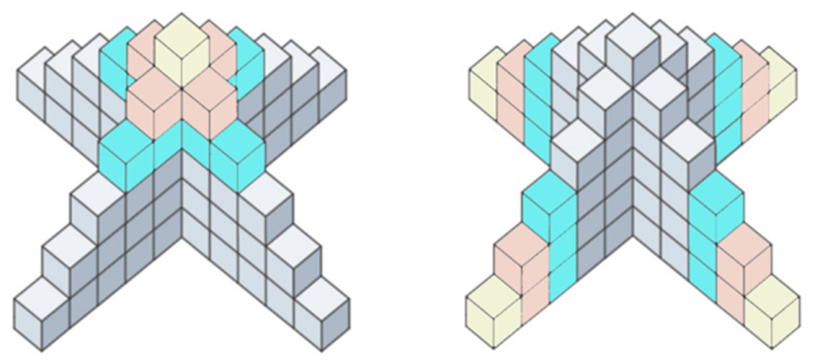
Analysis of a Structural Thinking Task Solved by Pre-Service Mathematics Teachers

Abstract
1. Introduction
2. Theoretical Background
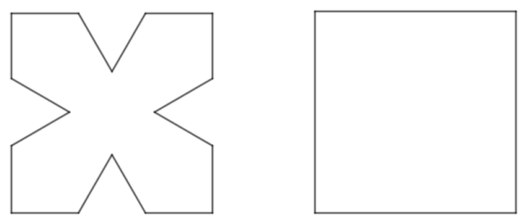
- (1)
- The area of a rectangle is equal to the product of the lengths of its sides.
- (2)
- If one region is contained within another region, then the area of the former cannot exceed the area of the latter.
- (3)
- If a region is the union of pairwise disjoint parts, then the area of the entire region is equal to the sum of the areas of its individual parts.
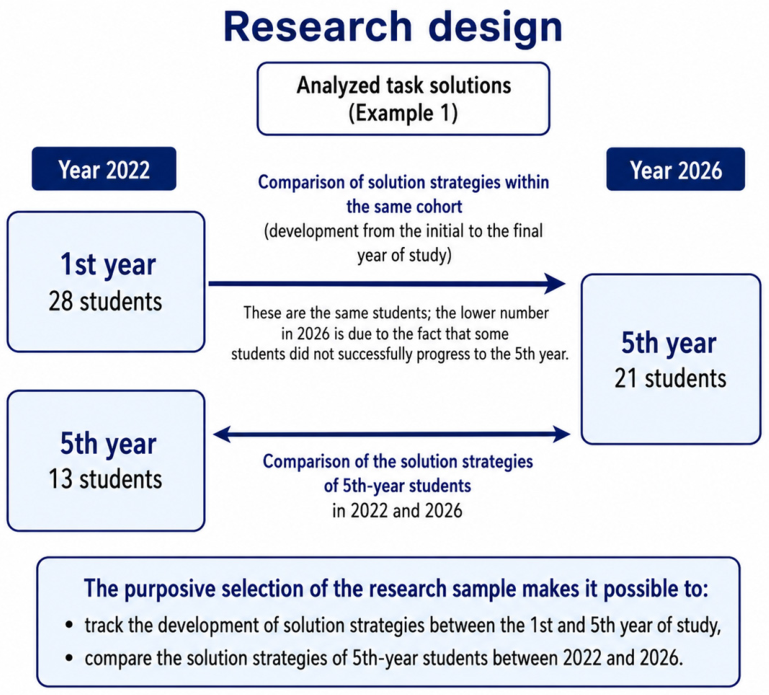
3. Materials and Methods
4. Results
4.1. RQ1: What Solution Strategies Do Pre-Service Mathematics Teachers Use When Solving a Task Focused on Identifying and Generalizing a Pattern?
4.2. RQ2: To What Extent Do Their Solutions Demonstrate Work with Local Relationships, and to What Extent Do They Involve the Formulation of a Generally Valid Relationship?
4.3. RQ3. What Types of Justification Do Prospective Mathematics Teachers Use When Formulating Their Conclusions?
5. Discussion
6. Conclusions
Author Contributions
Funding
Institutional Review Board Statement
Informed Consent Statement
Data Availability Statement
Acknowledgments
Conflicts of Interest
Appendix A
Appendix A.1. Operational Definitions and Inclusion Criteria for Categories

| Category | Definition | Inclusion Criteria |
|---|---|---|
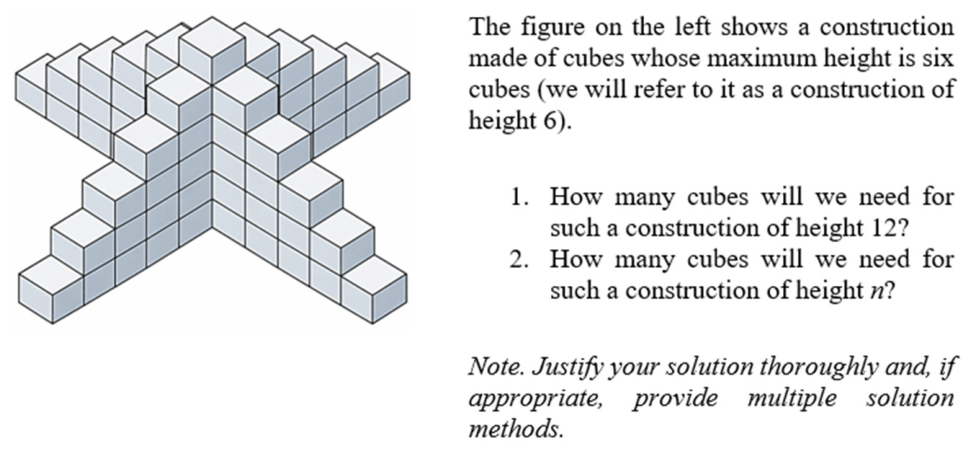
| (V1) Square and Rectangle | The solver restructures the original solid into two parts whose front views correspond to a square and a rectangle and uses the dimensions of these shapes to express the total number of cubes. | The solution must contain a recognizable decomposition equivalent to the square + rectangle representation. This decomposition may be represented graphically or expressed symbolically, provided that the method of decomposition can be clearly identified from the solution. |
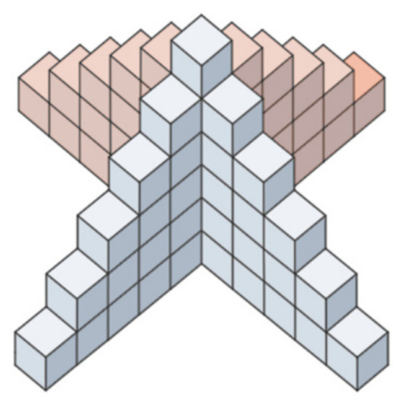
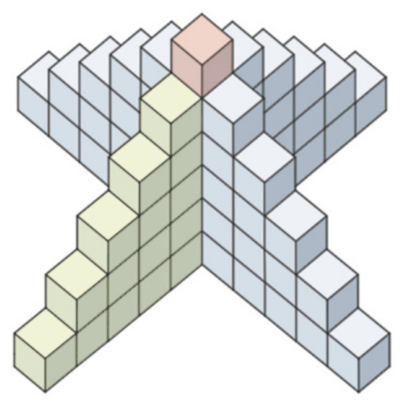
| (V2) Tower and Four Staircases | The solver decomposes the original solid into a central vertical tower and four surrounding staircase-shaped parts and determines the total number of cubes by combining the numbers of cubes in these parts. | The representation must contain an identifiable central tower and four staircase-shaped parts. The solver may determine the numbers of cubes in the staircase-shaped parts using different mathematically equivalent methods. |
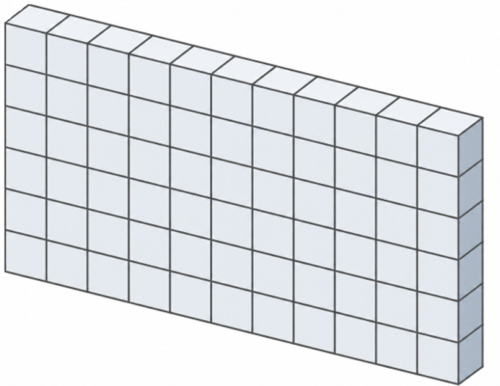
| (V3) Single Rectangle | The solver restructures the original solid so that its front view is a rectangle and uses the dimensions of the resulting rectangle to determine the total number of cubes. | The solution must clearly show that the original configuration is reorganized into a single rectangle, from whose dimensions the total number of cubes is determined directly. |
| (V4) Number of Cubes as the Sum of Parallel Slices | The solver decomposes the original solid into parallel sections (layers) and determines the total number of cubes by adding the numbers of cubes in the individual sections. | The defining feature is the decomposition of the solid into parallel sections whose numbers of cubes are subsequently added. The sections may be represented graphically, numerically, or symbolically. |
| (A1) Number of Cubes as the Sum of an Arithmetic Sequence with a Known Common Difference | The solver represents the numbers of cubes to be added as terms of an arithmetic sequence, identifies or uses the common difference between successive terms, and expresses the total number of cubes as the sum of this sequence. | The arithmetic sequence must constitute the primary representation of the situation being solved. The solver uses properties of the arithmetic sequence (the formula for the nth term or the sum of the first n terms) to determine the total number of cubes. |
| (A2) Number of Cubes as the Sum of a Recursively Defined Arithmetic Sequence | The solver represents the numbers of cubes using a recurrence relation that describes how each successive term is obtained from the preceding term, together with the specification of the initial value of the sequence. | The defining feature is the recursive growth rule, rather than an explicit expression for the nth term of the sequence or the direct use of the formula for the sum of an arithmetic sequence. |
| (C0) Task not solved | The participant provides no solution procedure from which a mathematically meaningful relationship relevant to the task can be identified. | The response is blank or contains no mathematically interpretable attempt to address either the specific or the general case. |
| (C1) Incorrect local relationship; no formulation of a general relationship | The student attempted to solve the task but did not obtain either a correct local relationship or a correct general relationship for the number of cubes. | There must be an identifiable attempt to solve the specific case that is based on a mathematically incorrect relationship, while no formulation of a general relationship is provided. |
| (C2) Correct local relationship; no formulation of a general relationship | The student obtained the correct solution for a specific height of the structure but did not provide a general relationship. | The specific case is structured and solved mathematically correctly, but the reasoning remains tied to the specific value and no generalization to arbitrary n is provided. |
| (C3) Correct local relationship; incorrect formulation of a general relationship | The student obtained the correct solution for a specific height of the structure but provided an incorrect general relationship. | A correct local relationship and a clear attempt at generalization must both be present. However, the general expression does not correctly determine the number of cubes for arbitrary n. |
| (C4) Correct local relationship; correct formulation of a general relationship | The student obtained the correct result for a specific height of the structure and also provided the correct general relationship for the number of cubes in a structure of height n. | The general relationship must be valid for arbitrary n. It may be expressed in any mathematically equivalent form; an explicit closed-form algebraic expression is not required for classification as C4. |
Appendix A.2. Examples of Raw Student Responses for Each Strategy
| Strategy | Example of Student Response |
|---|---|
| (V1) Square and Rectangle |  |
| (V2) Tower and Four Staircases | 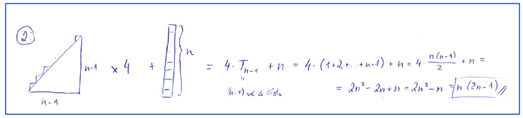 |
| (V3) Single Rectangle |  |
| (V4) Number of Cubes as the Sum of Parallel Slices |  |
| (A1) Number of Cubes as the Sum of an Arithmetic Sequence with a Known Common Difference |  |
| (A2) Number of Cubes as the Sum of a Recursively Defined Arithmetic Sequence |  |
References
- Abelson, H., & diSessa, A. A. (1981). Turtle geometry. MIT Press. [Google Scholar] [CrossRef] [Scilit]
- Balacheff, N. (1988). A study of students’ proving processes at the junior high school level. In Second UCSMP international conference on mathematics education. NCTM. [Google Scholar]
- Beaulieu, L. (1990). Proofs in expository writing: Some examples from Bourbaki’s early drafts. Interchange, 21(2), 35–45. [Google Scholar] [CrossRef] [Scilit]
- Birkhoff, G., & Mac Lane, S. (1958). A survey of modern algebra (Rev. ed.). Macmillan. [Google Scholar]
- Cohn, P. M. (1965). Universal algebra. Harper & Row. [Google Scholar]
- Creswell, J. W. (2012). Educational research: Planning, conducting, and evaluating quantitative and qualitative research (4th ed.). Pearson. [Google Scholar]
- Freudenthal, H. (1983). Didactical phenomenology of mathematical structures. Reidel. [Google Scholar]
- Freudenthal, H. (1991). Revisiting mathematics education. Kluwer Academic Publishers. [Google Scholar]
- Gross, H. I. (1978). Calculus revisited: Part 2 (2nd ed.). Massachusetts Institute of Technology. [Google Scholar]
- Hejný, M., & Litter, G. (2007). Building structures in mathematical knowledge. In D. Pitta-Pantazi, & C. Philippou (Eds.), European research in mathematics education V: Proceedings of the fifth congress of the European society for research in mathematics education (CERME 5, February 22–26, 2007). University of Cyprus; ERME. Available online: http://erme.site/cerme-conferences/cerme-5/ (accessed on 10 July 2026).
- Işıksal Bostan, M., Sevinç, Ş., Lada, M., & Kubáček, Z. (2025). The nature of reasoning-and-proving items in textbooks: The cases of Türkiye, Norway, and Slovakia. International Electronic Journal of Mathematics Education, 20(3), em0829. [Google Scholar] [CrossRef] [Scilit] [PubMed]
- Kieran, C. (2018). The early learning of algebra: A structural perspective. In C. Kieran (Ed.), Research issues in the learning and teaching of algebra (pp. 33–56). Routledge. [Google Scholar] [CrossRef] [Scilit]
- Mashaal, M. (2006). Bourbaki: A secret society of mathematicians. American Mathematical Society. [Google Scholar]
- Mason, J., Stephens, M., & Watson, A. (2009). Appreciating mathematical structure for all. Mathematics Education Research Journal, 21(2), 10–32. [Google Scholar] [CrossRef] [Scilit]
- Mulligan, J. T., & Mitchelmore, M. C. (2009). Awareness of pattern and structure in early mathematical development. Mathematics Education Research Journal, 21(2), 33–49. [Google Scholar] [CrossRef] [Scilit]
- Mulligan, J. T., Vale, C., & Stephens, M. (2009). Understanding and developing structure—Its importance for mathematics learning. Mathematics Education Research Journal, 21(2), 1–4. [Google Scholar] [CrossRef] [Scilit]
- Sevinç, S., Kohanová, I., Isiksal-Bostan, M., Kubáček, Z., Isler-Baykal, I., Lada, M., Cakiroglu, E., & Di Paola, B. (2022). Developing an integrated framework for analyzing ways of reasoning in mathematics. In Proceedings of the ICERI2022 (pp. 2082–2089). IATED Academy. [Google Scholar] [CrossRef] [Scilit]
- Stehlíková, N. (2004). Structural understanding in advanced mathematical thinking. Univerzita Karlova v Praze, Pedagogická fakulta. [Google Scholar]
- Stephens, M., & Wang, X. (2008). Some key junctures in relational thinking. Journal of Mathematics Education, 17(5), 36–40. [Google Scholar]
- Tapia Yagual, N. K., Placencia Ibadango, S. M., Román García, G. A., & Flores Rodríguez, J. W. (2026). Multiple representations and meaningful learning in mathematics education during the transition to higher education. Revista Tecnológica Ciencia Y Educación Edwards Deming, 10(2), 1–17. [Google Scholar] [CrossRef] [Scilit]
- Venkat, H., Askew, M., Watson, A., & Mason, J. (2019). Architecture of mathematical structure. For the Learning of Mathematics, 39(1), 13–17. [Google Scholar]
- Warren, E. (2003). The role of arithmetic structure in the transition from arithmetic to algebra. Mathematics Education Research Journal, 15(2), 122–137. [Google Scholar] [CrossRef] [Scilit]
- Warren, E. (2005). Young children’s ability to generalise the pattern rule for growing patterns. In H. Chick, & J. Vincent (Eds.), Proceedings of the 29th conference of the international group for the psychology of mathematics education (Vol. 4, pp. 305–312). University of Melbourne. [Google Scholar]


| Aspect of Structural Thinking | Characteristic | Theoretical Basis | Manifestation in Our Research |
|---|---|---|---|
| Structuring representation of the mathematical situation | Creation or selection of a representation that highlights essential mathematical properties and relationships (visualization, algebraic transformation, graph, table, diagram, etc.) | structuring activity (Kieran, 2018); organizing elements (Venkat et al., 2019); organizing phenomena (Freudenthal, 1983) | Visualization of the solid as a single rectangle, a square and a rectangle, staircases, and cross-sections |
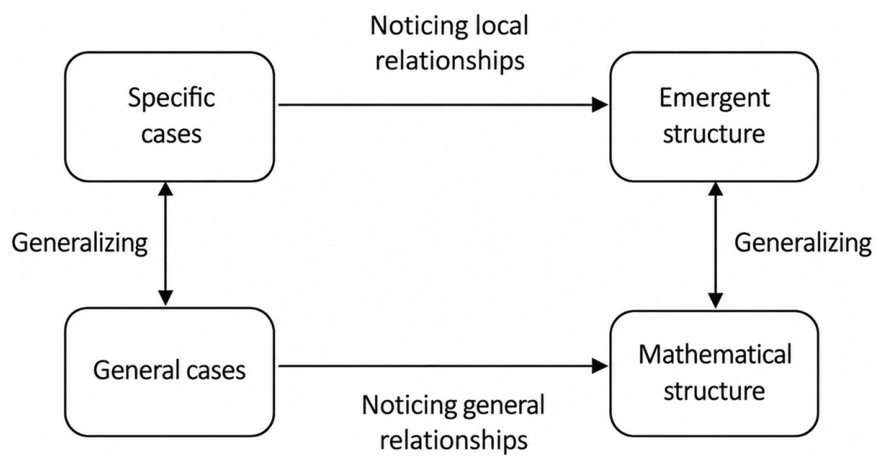
| Recognition or creation of a pattern | Identification of local relationships mediated by the selected representation | emergent structure (Venkat et al., 2019; Mulligan et al., 2009) | Identifying the way the number of cubes increases |
| Reorganization of mathematical objects or representations | A change in the representation or arrangement of objects leading to a new perspective on the situation | decomposition/recomposition (Kieran, 2018) | Rearrangement of the solid into a rectangle or another configuration |
| Identification of general properties | Recognition of properties extending beyond the specific case | (Mason et al., 2009; Freudenthal, 1983) | Awareness of the general relationship between the dimensions and the number of cubes |
| Formulation of a general rule | Expression of a general relationship using algebraic notation | (Warren, 2005; Mason et al., 2009) | Derivation of a formula for the number of cubes for height n |
| Different Ways of Reasoning | Brief Description |
|---|---|
| Appeal to authority | No explanation or reasoning, e.g., Euclid, a textbook, etc., says it is so. |
| Simple (1-step) deductive reasoning | A single deduction from one or more premises. |
| Mathematising | The explanation/justification of transformation/decontextualization of a word problem/a problem defined in the real world to a strictly mathematical form. |
| Reasoning by analogy | Involves making a conjecture based on similarities between two cases, one well known (the source) and another usually less well understood (the target). |
| Reasoning with empirical arguments/specific cases (Making claims and generalizing; Justification of claim) | Reasoning begins with specific cases and produces a generalization from these cases; Testing claims using evidence from examples (sometimes just one example) of direct measurements of quantities, substitutions of specific numbers in algebraic expressions, and so forth. |
| Developing conclusions/justifying/refuting through deductive reasoning (Generic example; Counterexample; Systematic enumeration; Other) | Conclusions are derived from known information (premises) based on formal logic rules, where conclusions are necessarily derived from the given information and there is no need to validate them by experiments. |
| Other | e.g., abductive reasoning—the search for a general rule from which a specific case would follow. |
| 2022, (Year 5) | 2022, (Year 1) | 2026, (Year 5) | ∑ | |
|---|---|---|---|---|
| Strategy V1 Square and Rectangle | 0 | 0 | 2 | 2 |
| Strategy V2 Tower and Four Staircases | 8 | 19 | 14 | 41 |
| Strategy V3 Single Rectangle | 0 | 0 | 1 | 1 |
| Strategy V4 Number of Cubes as the Sum of Parallel Slices | 0 | 2 | 5 | 7 |
| Strategy A1 Number of Cubes as the Sum of an Arithmetic Sequence with a Known Common Difference | 4 | 5 | 0 | 9 |
| Strategy A2 Number of Cubes as the Sum of a Recursively Defined Arithmetic Sequence | 1 | 0 | 0 | 1 |
| Not solved | 0 | 2 | 0 | 2 |
| ∑ | 13 | 28 | 22 | 63 |
| 2022, (Year 5) | 2022, (Year 1) | 2026, (Year 5) | ∑ | |
|---|---|---|---|---|
| (C0) Task not solved | 0 | 2 | 0 | 2 |
| (C1) Incorrect local relationship; no formulation of a general relationship | 0 | 0 | 0 | 0 |
| (C2) Correct local relationship; no formulation of a general relationship | 0 | 2 | 0 | 2 |
| (C3) Correct local relationship; incorrect formulation of a general relationship | 0 | 3 | 4 | 7 |
| (C4) Correct local relationship; correct formulation of a general relationship | 13 | 21 | 17 | 51 |
| ∑ | 13 | 28 | 21 | 62 |
| 2022, (Year 5) | 2022, (Year 1) | 2026, (Year 5) | ∑ | |
|---|---|---|---|---|
| Developing conclusions through deductive reasoning—Generic example | 9 | 22 | 20 | 51 |
| Developing conclusions through deductive reasoning (Recognizing known information—arithmetic sequence) | 3 | 3 | 0 | 6 |
| Developing conclusions through deductive reasoning (Recognizing known information—recursive definition of a sequence) | 1 | 0 | 0 | 1 |
| Reasoning with empirical arguments/specific cases—Making claims and generalizing | 0 | 1 | 0 | 1 |
| No reasoning | 0 | 2 | 1 | 3 |
| ∑ | 13 | 28 | 21 | 62 |
| Type of Structuring Representation | Representation Highlights | Transition to a General Relationship | Basis of Justification | Potential for Generalization | Interpretation |
|---|---|---|---|---|---|
| Representation revealing the general structure directly (V1, V3) | Reorganization of the situation directly exposes the underlying mathematical relationship | Direct | Developing conclusions through deductive reasoning—Generic example | High | The representation provides direct support for both the formulation and the justification of the general relationship |
| Representation revealing local regularities (V2, V4) | Visualizes growth or repetition | Indirect; requires further mathematical processing. | Developing conclusions through deductive reasoning—Generic example | Medium | The representation reveals a pattern, but a general relationship emerges only after additional mathematical interpretation. |
| Algebraic representation (A1) | Based on an already established mathematical structure (arithmetic sequence) | Direct | Developing conclusions through deductive reasoning—Recognizing known information (arithmetic sequence) | High | Generalization is supported by activating known mathematical relationships. |
| Recursive representation (A2) | Describes the situation through a recursive growth rule | Indirect | Developing conclusions through deductive reasoning—Recognizing known information (recursive definition of a sequence) | Low | The recursive representation captures the growth process but does not itself provide an explicit general relationship |
Disclaimer/Publisher’s Note: The statements, opinions and data contained in all publications are solely those of the individual author(s) and contributor(s) and not of MDPI and/or the editor(s). MDPI and/or the editor(s) disclaim responsibility for any injury to people or property resulting from any ideas, methods, instructions or products referred to in the content. |
© 2026 by the authors. Licensee MDPI, Basel, Switzerland. This article is an open access article distributed under the terms and conditions of the Creative Commons Attribution (CC BY) license.
Share and Cite
Vargová, M.; Vankúš, P. Analysis of a Structural Thinking Task Solved by Pre-Service Mathematics Teachers. Educ. Sci. 2026, 16, 1528. https://doi.org/10.3390/educsci16091528
Vargová M, Vankúš P. Analysis of a Structural Thinking Task Solved by Pre-Service Mathematics Teachers. Education Sciences. 2026; 16(9):1528. https://doi.org/10.3390/educsci16091528
Chicago/Turabian StyleVargová, Michaela, and Peter Vankúš. 2026. "Analysis of a Structural Thinking Task Solved by Pre-Service Mathematics Teachers" Education Sciences 16, no. 9: 1528. https://doi.org/10.3390/educsci16091528
APA StyleVargová, M., & Vankúš, P. (2026). Analysis of a Structural Thinking Task Solved by Pre-Service Mathematics Teachers. Education Sciences, 16(9), 1528. https://doi.org/10.3390/educsci16091528