1. Introduction
Over the last decade, heritage education has undergone profound conceptual, methodological, and technological transformations. Traditionally associated with the transmission and preservation of cultural knowledge, contemporary heritage education increasingly positions heritage as a dynamic, participatory, and socially constructed process connected to identity, sustainability, creativity, digital transformation, and citizenship. This shift reflects broader educational and cultural debates concerning how societies negotiate memory, cultural diversity, and collective belonging within rapidly changing global contexts.
The growing relevance of heritage education is closely linked to international frameworks promoted by UNESCO, particularly the Convention for the Safeguarding of the Intangible Cultural Heritage (
UNESCO, 2003) and the Convention on the Protection and Promotion of the Diversity of Cultural Expressions (
UNESCO, 2005). These frameworks emphasize the importance of education, participation, and intergenerational transmission for safeguarding both tangible and intangible cultural heritage. At the same time, the Sustainable Development Goals (SDGs), especially SDG 4 (Quality Education) and SDG 11 (Sustainable Cities and Communities), have reinforced the role of heritage and culture within sustainable development agendas.
Within this evolving landscape, arts-based learning has progressively emerged as one of the most significant pedagogical approaches in heritage education. Artistic methodologies—including visual arts, storytelling, performance, museum mediation, photography, digital creation, and participatory artistic practices—facilitate multisensory and affective experiences that enable learners to interpret, question, and recreate cultural meanings. Rather than understanding heritage exclusively as content to be transmitted, arts-based approaches position learners as active participants in processes of cultural interpretation, identity construction, and creative production.
The increasing integration of digital technologies has further transformed the field. Virtual museums, augmented reality, immersive environments, digital storytelling, QR-based learning, mobile technologies, and artificial intelligence are progressively redefining how heritage is accessed, mediated, and experienced. These transformations accelerated significantly after the COVID-19 pandemic, which intensified the use of hybrid and online educational models in museums, schools, universities, and cultural institutions.
At the same time, the literature demonstrates a growing convergence between heritage education, sustainability, territorial identity, social participation, and cultural resilience. Emerging themes identified across the corpus included critical heritage, community participation, emotional and affective learning, rural heritage, and sustainability-oriented pedagogies. These tendencies suggest that heritage education is progressively evolving toward interdisciplinary ecosystems where artistic creation, digital mediation, cultural memory, and social engagement intersect.
Despite this growing body of research, the field remains fragmented across disciplines, methodologies, educational stages, and technological approaches. Existing studies frequently focus on localized experiences, museum projects, or isolated digital innovations, while fewer investigations attempt to provide an integrated overview of how heritage education and arts-based learning are evolving internationally. These concerns are increasingly connected to broader debates regarding democratic participation, technological governance, and the concentration of algorithmic power within digital cultural infrastructures (
Coeckelbergh, 2024). Furthermore, the rapid emergence of immersive technologies and artificial intelligence has generated new educational possibilities while simultaneously raising ethical, methodological, and pedagogical challenges that remain insufficiently theorized.
Although several reviews have examined specific aspects of heritage education—such as museum learning, digital heritage, or arts-based pedagogies—few have provided an integrated synthesis of how these dimensions converge within contemporary educational research. Furthermore, the rapid expansion of artificial intelligence, immersive technologies, and sustainability-oriented pedagogies has outpaced the development of comprehensive review studies capable of examining their combined influence on heritage education. Consequently, there remains a need for an updated international synthesis that brings together these emerging strands within a single analytical framework.
To address these gaps in the literature, the present study aims to analyse the international evolution of heritage education research between 2015 and 2026 through a systematic review of publications indexed in Web of Science and Scopus. Particular attention is given to arts-based learning, museum mediation, digital transformation, sustainability, and teacher education. Beyond identifying publication trends, the review seeks to examine how these dimensions are reshaping contemporary heritage education and to identify emerging conceptual directions for future research and practice.
To address these objectives, the review was guided by the following research questions:
RQ1. How has heritage education research evolved internationally between 2015 and 2026?
RQ2. What educational contexts, heritage approaches, and arts-based methodologies characterize contemporary heritage education research?
RQ3. How are digital transformation and emerging technologies reshaping heritage education processes and learning experiences?
RQ4. What conceptual directions are emerging in heritage education regarding participation, sustainability, teacher education, and cultural engagement?
By integrating descriptive quantitative analysis with qualitative thematic synthesis, this review provides an updated overview of international research while proposing an interpretative framework for understanding the evolving relationships among heritage education, arts-based learning, museum participation, digital transformation, sustainability, and teacher education.
2. Theoretical Framework
2.1. Heritage Education: From Conservation to Participation
Heritage education has progressively evolved from traditional preservation-centered approaches toward participatory and socially engaged pedagogical models. Earlier perspectives frequently understood heritage as a static collection of monuments, artifacts, and institutional narratives that needed to be transmitted through formal educational systems. Contemporary scholarship, however, increasingly conceptualizes heritage as a dynamic cultural process shaped through social interaction, collective memory, identity construction, and community participation. This perspective aligns with
Smith’s (
2006) critique of the “authorized heritage discourse,” which questions institutionalized and hegemonic approaches to cultural heritage transmission.
This transformation has been strongly influenced by critical heritage studies, which question the neutrality of institutional heritage narratives and emphasize the political, emotional, and social dimensions of cultural memory. Critical heritage approaches increasingly emphasize the political, social, and affective dimensions of heritage, understanding cultural memory as a process shaped through negotiation, participation, and contemporary social challenges (
Harrison, 2013).
Smith (
2006) argued that heritage should not be understood merely as material objects but as a cultural process involving meaning-making, identity negotiation, and social participation. Similarly,
Harrison (
2013) emphasized the need to understand heritage as an active social practice connected to contemporary political, environmental, and cultural challenges. In a related vein,
Waterton (
2006) used discourse analysis of the Burra Charter to show how heritage significance is actively constructed through language and institutional practice rather than simply discovered in physical fabric, reinforcing the constructivist reading of heritage adopted throughout this review.
Recent scholarship has increasingly documented this conceptual shift across heritage education, museum studies, and critical pedagogy. This shift also reflects broader participatory and decolonial perspectives that advocate for more inclusive, community-based, and culturally diverse heritage narratives (
Waterton & Watson, 2013). Museum mediation, community learning, and arts-based methodologies have become increasingly prominent within contemporary heritage education literature.
Recent scholarship has increasingly examined the relationship between heritage education and sustainability, highlighting the educational value of territorial identity, community resilience, and cultural continuity. Previous scholarship has connected heritage learning with territorial resilience, ecological awareness, community participation, and local identity. This perspective aligns with UNESCO’s educational and cultural agendas, particularly the safeguarding of intangible heritage and the promotion of sustainable cultural development.
The empirical studies included in this review further illustrate this conceptual transition from transmission-oriented heritage education towards participatory and socially engaged models. Several investigations emphasise the integration of heritage education into initial teacher education through artistic and reflective pedagogies (
Fontal et al., 2021;
Romero Bello et al., 2024), while others propose structured methodologies for implementing heritage education in primary school contexts (
Romero & Gómez Morales, 2022). Recent contributions also highlight the growing importance of collective memory, intercultural dialogue, and community participation as key dimensions of contemporary heritage education (
Murillo-Ligorred et al., 2023;
Alonso-Sanz, 2024). Collectively, these studies reinforce the understanding of heritage education as an educational process that extends beyond conservation towards active cultural participation, identity construction, and socially sustainable learning.
2.2. Arts-Based Learning and Aesthetic Experience
Arts-based learning has become a prominent pedagogical approach within contemporary heritage education research. Recent scholarship has increasingly recognised arts-based methodologies as powerful pedagogical approaches for fostering affective, experiential, and participatory forms of heritage learning.
Theoretical contributions from
Eisner (
2002) emphasized that the arts develop forms of thinking capable of fostering imagination, interpretation, emotional understanding, and critical reflection. Similarly,
Greene (
1995) argued that aesthetic experience allows individuals to perceive reality more critically and imaginatively. These perspectives are particularly relevant within heritage education because heritage learning frequently involves emotional, symbolic, and multisensory engagement with memory, place, and cultural identity.
Previous research suggests that arts-based methodologies foster emotional engagement, creativity, collaborative learning, cultural interpretation, identity construction, and participatory meaning-making, thereby creating rich learning environments in which learners actively negotiate cultural meanings and personal connections with heritage.
Arts-Based Research has increasingly been recognised as a valuable methodological orientation within educational research. The literature describes artistic creation, visual interpretation, exhibitions, photography, and participatory artistic production as legitimate approaches for generating educational knowledge and exploring cultural experiences.
Overall, the literature suggests that the growing integration of arts-based methodologies is contributing to a gradual shift from transmissive pedagogies towards more creative, participatory, and interpretative approaches to heritage learning, in which learners actively construct relationships with cultural heritage.
The studies included in this review provide substantial empirical support for this pedagogical shift. Recent research has demonstrated the educational value of arts-based approaches across diverse learning environments, including museums, higher education, teacher education, and early childhood settings. For example, cross-disciplinary museum initiatives have shown how artistic mediation encourages contextual interpretation and collaborative learning (
Kim et al., 2024), while museum-based art education has been associated with improvements in preschool children’s visual perception and aesthetic development (
Noyat et al., 2025). Similarly, studies on co-constructive pedagogies in art museums (
McNaughton & Terreni, 2025), project-based learning through museum visits and creative photography in teacher education (
Huerta, 2025), and broader analyses of innovation in art education (
Guo, 2025) collectively illustrate how artistic practices increasingly function as mechanisms for creativity, critical thinking, participation, and heritage meaning-making. These findings reinforce theoretical perspectives that position aesthetic experience not simply as a complement to heritage education but as one of its principal pedagogical drivers. A recent quantitative study conducted with higher-education art students further corroborates this pedagogical centrality, showing through structural equation modelling that cultural-heritage integration is significantly associated with artistic perception and interpretation, while a transdisciplinary approach shows the strongest association with creative thinking (
Kakimova et al., 2026).
Taken together, these studies indicate that arts-based learning has evolved from a complementary pedagogical resource to a central mechanism for fostering heritage interpretation, creativity, and learner participation across diverse educational settings.
2.3. Museum Education and Cultural Mediation
Traditionally associated with conservation and exhibition of cultural collections, contemporary museums increasingly function as spaces for interaction, dialogue, creativity, and social participation. Accordingly, museums have increasingly adopted participatory models in which visitors actively contribute to processes of cultural interpretation and meaning-making (
Simon, 2010).
This educational transformation aligns with
Hooper-Greenhill’s (
2007) conception of museums as pedagogical environments centered on interpretation, learning, and visitor participation.
Museum education now frequently incorporates immersive technologies, artistic mediation, participatory curation, storytelling, and digital interaction to foster more engaging, inclusive, and learner-centred educational experiences.
This transformation reflects what
Parry (
2007) described as the “recoding” of museums, in which digital technologies progressively reshape institutional mediation, visitor interaction, and cultural participation.
Previous scholarship suggests that museums perform multiple pedagogical functions, acting as facilitators of cultural interpretation, mediators of identity and memory, providers of multisensory learning experiences, and spaces for social participation and community engagement.
These developments are closely connected to participatory digital heritage practices in which social media, collaborative platforms, and online interaction reshape how cultural heritage is produced, shared, and interpreted (
Giaccardi, 2012).
Digital transformation has further accelerated this evolution. Virtual museums, online exhibitions, augmented reality, QR-based learning, and immersive environments are progressively expanding museum accessibility and redefining educational mediation processes.
Taken together, these developments support contemporary understandings of museums as hybrid cultural and educational ecosystems in which physical, digital, artistic, and social dimensions converge to foster more participatory and meaningful heritage learning experiences.
The empirical evidence synthesised in this review strongly supports this transformation of museums into participatory educational environments. Recent studies demonstrate that museum education increasingly extends beyond object-centred interpretation to promote creativity, inclusion, collaborative learning, and community engagement. Research has highlighted the effectiveness of museum intervention strategies for stimulating children’s creative potential (
Ponce Delgado, 2022), self-directed learning through digital museum platforms (
Harper, 2022), and inclusive educational practices grounded in disability justice and anti-ableist pedagogies (
Kon & Zankowicz, 2022;
Richardson & Kletchka, 2022). More recent contributions further reinforce this evolution by examining museums as historical spaces of pedagogical innovation (
Rasmussen, 2023), analysing educational practices within national heritage institutions (
Alonso-Sanz, 2024), and identifying museums as catalysts for creativity, intercultural dialogue, and lifelong learning (
Huerta & Alfonso-Benlliure, 2025). Collectively, these empirical studies demonstrate that contemporary museum education is progressively evolving from object-centred interpretation towards participatory, inclusive, digitally mediated, and socially engaged educational practice.
2.4. Digital Transformation, Immersive Technologies, and Artificial Intelligence
Digital transformation has become one of the defining developments in contemporary heritage education, profoundly influencing how cultural heritage is accessed, interpreted, and experienced.
Recent scholarship has documented the growing integration of virtual museums, immersive environments, digital storytelling, and adaptive technologies as mechanisms for expanding access to and participation in heritage learning experiences (
Parry, 2007;
Giaccardi, 2012;
Giannini & Bowen, 2019).
The expansion of immersive technologies reflects a broader educational shift toward multisensory, interactive, and participatory learning experiences which encourage learners to engage with cultural heritage through exploration, interaction, and experiential learning. These technologies seek to increase engagement and accessibility while simultaneously transforming how learners interact with cultural heritage.
Digital culture has progressively redefined museum experiences through hybrid mediation, immersive interaction, online participation, and virtual accessibility (
Giannini & Bowen, 2019). A recent scoping review of co-creation in immersive cultural heritage learning further confirms that participatory design processes involving educators, learners, and cultural institutions can strengthen engagement and support the sustainable digital preservation of heritage, although genuinely shared decision-making remains uncommon across the reviewed projects (
Zhang & Peng, 2026).
Artificial intelligence has recently emerged as an important area of interest within digital heritage research, although its presence remains considerably more limited than that of broader digital mediation approaches. AI-related studies focused primarily on recommendation systems, adaptive learning environments, computational mediation, and machine learning applications for heritage interpretation.
Current scholarship identifies artificial intelligence as a promising area for innovation in digital heritage, particularly through adaptive mediation systems, data interpretation, virtual heritage environments, and intelligent cultural interfaces (
Münster, 2024).
Nevertheless, the literature also identifies important ethical and pedagogical challenges associated with digital transformation. Questions concerning accessibility, digital inequality, cultural bias, algorithmic mediation, authenticity, and the simplification of complex cultural narratives remain insufficiently addressed. Recent studies increasingly emphasize the ethical implications of AI applications within cultural heritage contexts, particularly regarding algorithmic bias, cultural representation, data governance, and accessibility (
Tiribelli et al., 2024;
Pant et al., 2023;
Boiano, 2024;
Shaikhon, 2025).
Consequently, the literature suggests that digital technologies should not be understood as neutral tools but rather as pedagogical and cultural mediators capable of reshaping heritage experiences, participation, and knowledge production.
From this perspective, digital heritage environments operate as cultural and epistemological systems that transform how heritage is represented, interpreted, and socially experienced (
Cameron & Kenderdine, 2007). This perspective provides the theoretical foundation for understanding the increasing integration of digital innovation within contemporary heritage education.
The studies included in this review demonstrate that digital transformation has evolved from supporting heritage dissemination to enabling new forms of participation, creativity, and personalised learning. Early applications focused on immersive technologies, such as spatial augmented reality for children’s art education (
Rossi, 2019), inquiry-based mobile learning in museum environments (
Yachulawetkunakorn et al., 2019), and mixed-reality serious games designed to facilitate the learning of traditional cultural practices (
Hang et al., 2023). More recent studies have expanded this perspective by exploring digital learning environments for future educators (
Re, 2024), computational analyses of users’ engagement with digital cultural heritage (
Ai et al., 2024), and critical reflections on educational digitalisation within museum and art education (
Pastore, 2025). Furthermore, although artificial intelligence remains an emerging topic within the reviewed corpus, recent investigations have begun to examine AI-supported artistic co-creation, diffusion models for aesthetic education, and the integration of AI into heritage education and teacher training (
Liu et al., 2025;
Condorelli & Berti, 2025;
Huerta & Rodríguez-López, 2025). Collectively, these studies suggest that contemporary digital heritage education is progressively shifting towards adaptive, interactive, and participatory learning ecosystems, while simultaneously highlighting the need to address ethical, pedagogical, and cultural challenges associated with emerging intelligent technologies. This evolution positions digital transformation not merely as a technological innovation but as a structural dimension reshaping contemporary heritage education.
2.5. Teacher Education, Sustainability, and Territorial Heritage
Teacher education has become a central theme in contemporary heritage education scholarship, reflecting the growing recognition of teachers as key agents in fostering critical, participatory, and sustainable approaches to heritage learning.
Previous scholarship emphasises the importance of preparing future teachers to integrate heritage into interdisciplinary curricula, employ arts-based methodologies, critically interpret cultural narratives, and make pedagogically meaningful use of digital technologies within educational contexts.
At the same time, sustainability has become a transversal conceptual framework closely associated with territorial identity, cultural continuity, and community resilience. Heritage education is increasingly understood as contributing to sustainable development, particularly in contexts affected by depopulation, cultural homogenisation, and the loss of intangible heritage practices.
The literature has paid increasing attention to rural heritage, local memory, and community-based educational initiatives. Previous research highlights the educational value of local traditions, craft practices, oral memory, and intergenerational transmission in strengthening social cohesion and promoting territorial sustainability. Consistent with this trend, a recent mixed-methods study of museum-based heritage education at primary-school level shows that structured museum interventions can strengthen pupils’ academic achievement together with their awareness of cultural heritage and sustainability, reinforcing the role of local museums as strategic spaces for cultural sustainability education (
Erbaş et al., 2026).
Contemporary scholarship increasingly portrays heritage education as an interconnected educational domain in which cultural memory, artistic mediation, digital technologies, sustainability, and social participation interact to shape meaningful learning experiences (
Fontal, 2013;
Waterton & Watson, 2013;
Giaccardi, 2012).
This interdisciplinary convergence provides a theoretical foundation for understanding heritage education as a transformative educational field capable of fostering cultural sustainability, critical citizenship, and socially engaged learning within contemporary society.
The empirical studies analysed in this review further demonstrate that teacher education has become one of the principal contexts through which heritage education is being renewed and expanded. Several investigations have explored how pre-service teachers develop more critical and participatory understandings of cultural heritage through arts-based pedagogies, museum experiences, and project-based learning (
Fontal et al., 2021;
Romero Bello et al., 2024;
Huerta, 2025). Comparative and international perspectives likewise indicate a growing integration of museum education into initial teacher preparation programmes (
Novak et al., 2025), while recent studies also highlight the contribution of digital education, artistic creation, and emerging technologies to the development of future educators’ professional competences (
Huerta & Rodríguez-López, 2025). In parallel, research addressing collective memory, intercultural heritage, and community participation (
Murillo-Ligorred et al., 2023), together with studies focused on children’s cultural identity in museum contexts (
Bhavnagri & Muhsin, 2025), demonstrates that heritage education increasingly contributes to cultural sustainability by strengthening identity, social cohesion, and intergenerational dialogue. These findings reinforce the view that teacher education and sustainability should not be understood as separate dimensions but as complementary components of an integrated heritage education ecosystem.
3. Materials and Methods
3.1. Research Design
This study was developed as a systematic literature review aimed at identifying, analyzing, and synthesizing international research trends related to heritage education and arts-based learning between 2015 and 2026. The review adopted a qualitative-dominant mixed review design combining descriptive quantitative analysis with thematic synthesis. This approach enabled the systematic identification of publication trends, methodological patterns, educational contexts, artistic methodologies, technological approaches, and emerging conceptual perspectives within the field.
The review followed the principles established by the PRISMA 2020 Statement (
Page et al., 2021), which provides updated guidelines for conducting and reporting systematic reviews with transparency, replicability, and methodological rigor.
The methodological process was structured into four stages:
Database search and identification of records;
Screening and eligibility assessment;
Coding and thematic categorization;
Quantitative descriptive analysis and qualitative thematic synthesis.
This design allowed the integration of bibliometric tendencies with interpretative analysis of the educational, artistic, technological, and cultural dimensions identified across the reviewed studies. PRISMA 2020 guided the identification, screening, eligibility assessment, and reporting of the review process, ensuring transparency in study selection and synthesis procedures. In addition, the PRISMA-S extension (
Rethlefsen et al., 2021) informed the documentation and reporting of database searches, search strategies, and retrieval procedures, thereby enhancing the reproducibility of the review.
3.2. Data Sources and Search Strategy
The literature search was conducted in the Web of Science Core Collection (WoS) and Scopus databases between 15 May and 30 June 2026. Only publications written in English or Spanish were considered. Eligible document types included peer-reviewed journal articles, review articles, and indexed conference proceedings. These databases were selected because of their broad international coverage of peer-reviewed research in education, heritage studies, museum education, arts education, and interdisciplinary social sciences.
The search strategy was designed to identify studies situated at the intersection of heritage education, arts-based learning, and educational practice. Searches were performed in the title, abstract, and keywords fields using Boolean operators.
The principal search equation used in (a) Scopus and (b) WOS was:
- (a)
TITLE-ABS-KEY ((“heritage education” OR “cultural heritage education” OR “patrimonial education”) AND (“arts-based learning” OR “arts education” OR “visual arts education”) AND (“teacher education” OR “school education” OR “higher education”)) AND PUBYEAR > 2014.
- (b)
TS ((“heritage education” OR “cultural heritage education” OR “patrimonial education”) AND (“arts-based learning” OR “arts education” OR “visual arts education”) AND (“teacher education” OR “school education” OR “higher education”)).
Because terminology in heritage education research is highly heterogeneous, the search strategy combined alternative descriptors for heritage education, arts-based learning, and educational contexts. The strategy was designed to maximise retrieval within the specific conceptual intersection defined by the research questions while maintaining consistency across both databases, see
Table 1.
The search strategy was applied consistently across both databases using equivalent search fields and Boolean operators adapted to the syntax of each platform. Retrieved records were exported, merged, deduplicated, and screened following the PRISMA 2020 Statement (
Page et al., 2021) and the PRISMA-S extension (
Rethlefsen et al., 2021). The complete study selection process is presented in
Figure 1.
The searches were limited to publications published between January 2015 and June 2026. Only peer-reviewed journal articles, review papers, and indexed conference proceedings were considered for inclusion. Records were exported, merged, deduplicated, and screened following the PRISMA 2020 Statement (
Page et al., 2021) and the PRISMA-S extension (
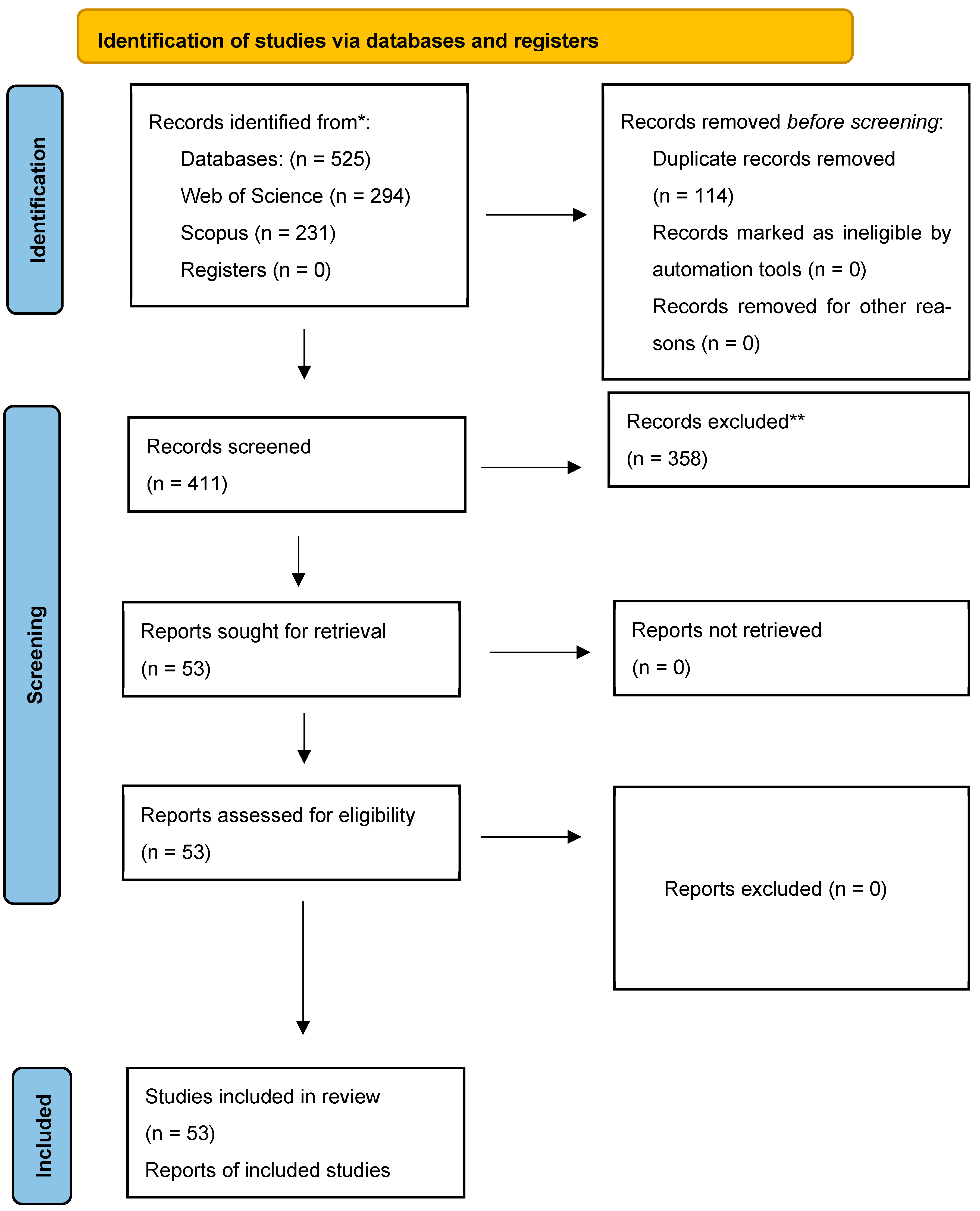
Rethlefsen et al., 2021). A total of 525 records were initially identified. After removing 114 duplicate records, 411 records underwent title and abstract screening. Fifty-three reports were subsequently assessed for full-text eligibility, all of which met the predefined inclusion criteria and were included in the final review. The complete study selection process is presented in
Figure 1. No formal review protocol was prospectively registered. Nevertheless, the review procedures, eligibility criteria, coding framework, and analytical strategy were defined prior to study selection and remained stable throughout the review process.
All studies retained after title and abstract screening met the predefined eligibility criteria during full-text assessment and were therefore included in the final corpus.
Figure 1 presents the complete PRISMA 2020 flow diagram summarizing the identification, screening, eligibility, and inclusion phases. The reporting of search procedures followed the recommendations of the PRISMA-S extension, including the documentation of databases, search fields, search equations, and selection decisions.
3.3. Sample and Eligibility Criteria
The search identified 525 records across the Web of Science Core Collection and Scopus databases. Following duplicate removal and title–abstract screening, 53 studies met the predefined eligibility criteria and were included in the final synthesis. The final corpus included: peer-reviewed journal articles, review articles, and a limited number of indexed conference proceedings relevant to digital heritage and educational technologies.
The inclusion criteria were: publications between 2015 and 2026; indexed in Web of Science or Scopus; studies addressing heritage education, museum education, arts-based learning, or cultural heritage learning; educational focus involving formal, non-formal, museum, community, or higher education contexts; explicit presence of artistic, creative, pedagogical, or digital mediation dimensions.
The exclusion criteria were(see
Table 2): studies focused exclusively on heritage conservation without educational implications; archaeological or technical heritage studies unrelated to learning processes; tourism-oriented heritage studies without pedagogical content; duplicate records; publications lacking sufficient methodological or conceptual information.
Although the final corpus included studies from multiple geographical contexts, European research—particularly from Spain—was more strongly represented.
3.4. Data Coding and Analytical Categories
Following the selection process, all included studies were incorporated into a unified coding matrix developed specifically for the review. The coding process combined deductive and inductive procedures.
Deductive categories were derived from the theoretical framework and research questions, while inductive categories emerged during repeated reading and comparative analysis of the studies.
The final coding matrix included the following analytical dimensions: publication year, country, educational stage, type of heritage, artistic methodology, technological approach, artificial intelligence presence, sustainability perspective, teacher education, museum mediation and methodological design. Each analytical category was coded as a binary presence/absence variable, with multiple categories assigned to individual studies whenever appropriate.
The coding process facilitated the identification of recurring educational, artistic, technological, and conceptual patterns across the corpus.
Particular attention was paid to: the role of museums as educational mediators, the expansion of digital technologies, the emergence of immersive learning, arts-based methodologies, sustainability frameworks, and teacher education contexts. The complete coding matrix used during the analysis process is presented in
Supplementary Materials. The coding process was conducted by the first author using the analytical framework developed for this review. To enhance methodological consistency, coding decisions and category assignments were subsequently reviewed by the second author. Any uncertainties regarding classification were discussed until consensus was reached. This iterative process contributed to the refinement of the coding matrix and the reliability of the thematic synthesis.
3.5. Quality Appraisal
To enhance methodological rigour, the included studies underwent a qualitative appraisal inspired by the Mixed Methods Appraisal Tool (MMAT) version 2018 (
Hong et al., 2018), see
Table 3. Because of the methodological diversity of the corpus, the appraisal adapted the general dimensions of the MMAT rather than applying the complete protocol. Quality assessment was descriptive and was not used as an exclusion criterion.
Studies were classified as High quality when all four appraisal dimensions were clearly satisfied, Moderate quality when one dimension presented minor limitations, and Limited quality when two or more dimensions showed substantial methodological weaknesses. The appraisal was used to describe the overall robustness of the corpus rather than as an exclusion criterion.
The evaluation considered four dimensions: (1) clarity of research objectives, (2) methodological coherence, (3) transparency of data collection and analysis procedures, and (4) relevance to heritage education and arts-based learning. Each study was categorized as high, moderate, or limited quality according to its overall methodological consistency. The appraisal indicated that 37 studies (69.8%) demonstrated high methodological quality, 13 studies (24.5%) showed moderate quality, and only 3 studies (5.7%) presented methodological limitations. Quality assessment informed the interpretation of findings but was not used as an exclusion criterion.
3.6. Data Analysis
The data analysis combined quantitative descriptive analysis and qualitative thematic synthesis.
Descriptive statistical analysis was used to identify temporal evolution of publications, geographical distribution, frequencies of educational stages, dominant artistic methodologies, prevalence of digital technologies, AI presence, sustainability approaches and methodological tendencies.
Frequencies and percentages were calculated from the final corpus (N = 53) using a structured coding matrix developed in spreadsheet format. The analysis also enabled the construction of tables, thematic distributions, and visual representations of the data.
The qualitative phase followed a reflexive thematic analysis approach inspired by
Braun and Clarke (
2021,
2022). This process involved:
Repeated reading of the corpus;
Identification of recurring themes;
Clustering of conceptual categories;
Interpretation of relationships between educational, artistic, technological, and cultural dimensions.
The thematic synthesis identified several major conceptual clusters: digital and immersive heritage learning, museum education, teacher education, arts-based methodologies, sustainability and territorial heritage, identity and memory and emerging AI-related pedagogies.
This combined analytical strategy enabled the review to move beyond descriptive bibliometric mapping toward a deeper interpretative understanding of how heritage education and arts-based learning are evolving within contemporary educational research.
3.7. Methodological Limitations
Several limitations should be acknowledged.
First, the review was restricted to publications indexed in Web of Science and Scopus, which may have excluded relevant local or non-indexed research, particularly from underrepresented geographical regions.
Second, the field demonstrates considerable methodological heterogeneity, including qualitative studies, arts-based research, case studies, technological reports, and review articles, which complicates direct comparison between studies. The relatively focused corpus reflects the specificity of the intersection between heritage education, arts-based learning, digital transformation, museum mediation, and sustainability-oriented pedagogies within indexed educational research.
Third, although digital technologies appeared strongly represented, artificial intelligence remains an emerging topic within the field, limiting the possibility of drawing generalized conclusions about its long-term educational impact.
Finally, the predominance of European and higher education contexts suggests the need for future reviews including broader representation of rural, community-based, early childhood, and non-Western heritage education experiences. The exclusion of grey literature, books, book chapters and institutional reports may have limited the representation of innovative heritage education initiatives developed outside indexed academic publications. Furthermore, the relatively focused corpus (N = 53) reflects the specificity of the intersection between heritage education, arts-based learning, museum mediation, digital transformation, and educational research within indexed databases. Although the final corpus comprised 53 studies, it represents a coherent and methodologically consistent body of international research directly aligned with the objectives of the review. Consequently, the emphasis of this study lies in the depth and thematic integration of the evidence rather than in the absolute size of the corpus.
Additional limitations relate to the review process itself. First, no review protocol was prospectively registered (e.g., in PROSPERO or an equivalent registry); although the eligibility criteria, coding framework, and analytical strategy were fixed prior to data extraction and are fully reported here, prospective registration would have further strengthened procedural transparency. Second, title/abstract screening and thematic coding were primarily conducted by the first author and subsequently reviewed by the second author through discussion until consensus, rather than through fully independent double screening and coding with a quantitative inter-rater reliability statistic (e.g., Cohen’s kappa); this is a common practice in two-author reviews but represents a less stringent reliability check than that used in some recent reviews in this field (e.g.,
Zhang & Peng, 2026). Third, the quality appraisal (
Section 3.5) adapted the general dimensions of the MMAT rather than applying a validated instrument in full, and inter-rater agreement on quality ratings was not formally quantified; the resulting quality levels should therefore be read as an indicative, descriptive characterisation of the corpus rather than a psychometrically validated assessment.
A further limitation concerns the relationship between the a priori theoretical framework used to structure the literature search (
Section 2) and the Arts-Based Heritage Learning Ecosystem proposed in
Section 6. Because the six dimensions of the proposed ecosystem closely mirror the sections of the theoretical framework that guided the review from the outset, the model should be read as a structured synthesis of the corpus organised around categories defined before data extraction, rather than as a framework that emerged inductively and independently from the coded data. This does not invalidate the model but qualifies its epistemic status, reinforcing the need for the future empirical validation already called for in
Section 6.
Finally, because database searches were completed on 30 June 2026, the systematically screened corpus (N = 53) cannot include eligible studies published after that date. To keep the discussion of very recent developments as current as possible without compromising the integrity of the reported PRISMA counts, three additional 2026 publications identified after the search cut-off (
Erbaş et al., 2026;
Kakimova et al., 2026;
Zhang & Peng, 2026) were incorporated as contextualising sources in the theoretical framework and discussion, but were not added to the systematically screened corpus of 53 studies,
Supplementary Materials, or the quantitative synthesis in
Section 4. Future updates of this review should consider a formal search update to determine whether these and other very recent studies meet the full eligibility criteria for inclusion in the corpus itself.
4. Results
The results are organised into seven complementary analytical dimensions that describe the temporal development, geographical distribution, educational contexts, methodological approaches, thematic trends, technological integration, and research gaps identified across the reviewed literature.
4.1. Temporal Evolution of Research
The final sample comprised 53 studies identified through the systematic integration of records retrieved from the Web of Science Core Collection and Scopus following duplicate removal and eligibility screening, see
Table 4. The temporal analysis reveals a progressive increase in scientific production on heritage education, arts-based learning, and digital heritage between 2015 and 2026, see
Table 5.
The earliest publications identified in the corpus appeared in 2015 (n = 5; 9.4%), followed by a relatively moderate production between 2016 and 2019. Following a temporary interruption in 2020, publication output increased markedly from 2021 onwards, reaching its highest level in 2025 (n = 13; 24.5%). This growth coincides with the expansion of digital learning environments, virtual museums, immersive technologies, and interdisciplinary educational research after the COVID-19 pandemic.
The years 2022 and 2024 also showed significant production peaks (n = 7; 13.2% each), indicating the consolidation of heritage education as an emerging interdisciplinary research field connected to sustainability, creativity, digital transformation, and teacher education.
No eligible studies matching the review criteria were identified for 2020.
Overall, the temporal distribution indicates a growing consolidation of heritage education as an interdisciplinary field characterised by increasing attention to digital innovation, participatory pedagogies, sustainability, and teacher education.
4.2. Geographical Distribution of Studies
The geographical distribution of the corpus reveals a strong concentration of research in European contexts, particularly in Mediterranean countries with established traditions in cultural heritage and museum education.
Spain emerged as the leading country within the corpus, representing 19 studies (35.8%), followed by the United States (8 studies; 15.1%), China (7 studies; 13.2%), Italy (5 studies; 9.4%), and Türkiye (3 studies; 5.7%), see
Table 6.
The predominance of Southern European countries may be associated with the strong institutionalization of heritage education and museum pedagogy within Mediterranean educational systems.
4.3. Educational Stages and Contexts
The analysis of educational contexts revealed a strong predominance of higher education and teacher education environments, see
Table 7.
Teacher education programmes were explicitly addressed in 23 studies (43.4%), demonstrating the strategic importance attributed to heritage education in the preparation of future educators.
Museum-based learning environments were identified in 35 studies (66.0%).
Beyond educational levels, the review identified several recurring educational contexts through which heritage education is currently being developed. These contexts reflect the increasing diversification of learning environments, institutional actors, and pedagogical approaches associated with heritage education and arts-based learning.
The findings indicate that museum-based and digital learning environments constitute the most prominent educational contexts identified in the literature, each appearing in 66.0% of the reviewed studies. Teacher education programmes also occupied a significant position, highlighting the growing recognition of heritage education as a professional competence for future educators. Community-based projects and sustainability-oriented initiatives further illustrate the expansion of heritage education beyond formal educational settings towards participatory and socially engaged approaches.
Overall, the educational-stage analysis demonstrates that heritage education is increasingly understood as a transversal and lifelong educational process extending beyond formal school contexts. The predominance of higher education contexts suggests that heritage education research continues to be strongly associated with university innovation projects and teacher-training initiatives rather than compulsory educational systems.
4.4. Artistic Methodologies
The reviewed literature revealed a strong predominance of arts-based and creative pedagogical methodologies, see
Table 8.
Visual arts and art education represented the most frequently reported artistic approach identified in the corpus, followed by museum-based artistic mediation, storytelling, digital creation, and immersive artistic experiences.
The predominance of visual arts these findings indicate that heritage learning continues to rely strongly on image-based and object-centered interpretative practices, while performative and craft-based pedagogies remain comparatively underexplored.
4.5. Emerging Themes
The thematic analysis identified several emerging conceptual clusters across the reviewed literature. Museum education emerged as one of the strongest dimensions identified across the reviewed corpus. Museum-based learning appeared in 66.0% of the studies, confirming the transformation of museums into participatory educational institutions. The thematic synthesis identified several recurring conceptual themes across the reviewed studies. Their relative frequency is presented in
Table 9.
Digital and immersive heritage constituted the most frequently identified thematic area, appearing in 35 studies (66.0%), followed by museum education and mediation (58.5%), teacher education (43.4%), and creativity and arts-based learning (41.5%). Identity and memory (34.0%), sustainability and territorial heritage (22.6%), and artificial intelligence (9.4%) were less frequently represented but reflect emerging directions within the field.
Museum education and mediation refers to thematic content, whereas museum-based learning refers to educational contexts. Consequently, the frequencies reported in
Table 7 and
Table 9 are not directly comparable.
Overall, these findings indicate that digital transformation, museum mediation, and teacher education constitute the principal thematic axes currently shaping research in heritage education and arts-based learning.
The results indicate that digital transformation, museum mediation, and teacher education constitute the dominant thematic axes of the current field.
4.6. Digital Technologies
The category Digital/Online Technologies appeared in 35 records (66.0%), making it the most frequent technological category identified in the review, making technological mediation one of the dominant dimensions of the field, see
Table 10.
The reviewed studies addressed a wide range of technological applications, including virtual museums, online exhibitions, digital storytelling, QR-based learning, augmented reality, immersive environments, and adaptive digital systems.
Artificial intelligence appeared explicitly in 5 studies, mainly connected to machine learning, recommendation systems, and intelligent mediation systems. These findings indicate that digital mediation has become a well-established dimension of heritage education, whereas artificial intelligence remains comparatively underrepresented within the current body of research.
4.7. Research Gaps
The synthesis also revealed several recurring gaps in the existing literature, see
Table 11.
Collectively, these gaps indicate the need for more comparative, longitudinal, interdisciplinary, and methodologically integrated research capable of advancing knowledge at the intersection of heritage education, artistic creation, sustainability, digital innovation, and social participation.
The complete coding matrix, including the classification of all 53 studies across the analytical categories, is provided in the
Supplementary Materials.
5. Discussion
The findings of this review reveal that heritage education is currently undergoing a substantial conceptual and pedagogical transformation. Consistent with the perspectives advanced by
Smith (
2006),
Harrison (
2013), and
Waterton and Watson (
2013), heritage increasingly appears not as a fixed body of knowledge to be transmitted, but as a dynamic cultural process through which individuals and communities construct meanings, negotiate identities, and engage with collective memory. This evolution reflects broader shifts within educational research towards participatory, learner-centred, and socially engaged approaches that emphasize interpretation, creativity, and cultural participation over traditional transmissive models.
The studies included in this review provide consistent empirical evidence supporting this transition. Across different educational contexts, heritage education is increasingly implemented through participatory, inquiry-based, and arts-oriented pedagogies that position learners as active interpreters of cultural heritage rather than passive recipients of historical knowledge. This tendency is evident in studies focusing on initial teacher education, museum learning, community-based heritage initiatives, and intercultural education, all of which emphasise dialogue, creativity, and collaborative meaning-making as defining characteristics of contemporary heritage education. Rather than representing isolated innovations, these approaches appear across multiple geographical and educational contexts, suggesting that participatory heritage education has become a consolidated international research trend.
Regarding RQ1, the review confirms the consolidation of heritage education as an expanding international field of research, particularly after 2020. The acceleration observed in recent years appears closely associated with the increasing relevance of museum innovation, digital mediation, sustainability agendas, and interdisciplinary educational approaches. Similar tendencies have been identified by
Parry (
2007),
Giaccardi (
2012), and
Giannini and Bowen (
2019), who describe how cultural institutions have progressively incorporated digital environments and participatory practices into their educational missions. The growth identified in the corpus therefore suggests that heritage education is no longer confined to conservation-oriented perspectives but is increasingly integrated into wider debates concerning citizenship, cultural sustainability, and social participation. This expansion is also reflected in the diversity of the reviewed studies. Recent contributions document heritage education in formal schooling, higher education, museums, community settings, and digital environments, demonstrating that the field has progressively diversified beyond its traditional association with conservation. Studies published in 2024 and 2025 particularly illustrate the growing integration of heritage education into teacher education programmes, interdisciplinary curricula, museum innovation, and digital learning environments, indicating that the field is increasingly responding to contemporary educational priorities related to inclusion, creativity, sustainability, and technological innovation. Earlier studies (2015–2019) were primarily concerned with museum education, heritage conservation, and arts education, whereas studies published after 2020 increasingly incorporated digital transformation, sustainability, teacher education, immersive technologies, community participation, and, more recently, artificial intelligence. This temporal evolution suggests that the field has progressively shifted from preservation-oriented educational models towards participatory, interdisciplinary, and digitally mediated heritage learning ecosystems. This shift was not limited to the incorporation of new technologies but also involved changes in educational aims, moving from knowledge transmission towards participation, co-creation, critical reflection, and community engagement.
Concerning RQ2, the findings indicate that arts-based learning has become one of the principal pedagogical frameworks within contemporary heritage education. Artistic methodologies are no longer employed solely as complementary educational resources; instead, they increasingly function as mechanisms for interpretation, participation, and knowledge construction. This tendency supports theoretical perspectives emphasizing the educational value of aesthetic experience, imagination, and creative inquiry (
Greene, 1995;
Eisner, 2002). Furthermore, the growing presence of Arts-Based Research within the corpus reinforces the argument that artistic creation can serve not only as a pedagogical strategy but also as a legitimate mode of knowledge production and cultural interpretation (
Barone & Eisner, 2012). Within heritage contexts, artistic practices appear particularly effective in fostering emotional engagement, identity construction, collaborative learning, and participatory meaning-making processes that connect learners with cultural memory and lived experience. The corpus also reveals considerable consistency regarding the educational outcomes associated with arts-based learning. Museum-based artistic interventions (
Noyat et al., 2025), project-based learning through museum visits (
Huerta, 2025), transmedia storytelling in higher education (
Wünsch-Nagy, 2025), and co-constructive pedagogies in museum contexts (
McNaughton & Terreni, 2025) were consistently associated with increased learner participation, creativity, critical reflection, and heritage interpretation. Although these methodologies differ substantially in their implementation, they converge in their capacity to facilitate experiential learning and strengthen the personal appropriation of cultural heritage. This convergence suggests that arts-based learning should be understood not simply as a complementary teaching strategy but as one of the principal pedagogical mechanisms through which contemporary heritage education is currently evolving.
Clear differences also emerge across educational contexts. Studies conducted in museums predominantly explore participation, creativity, visitor engagement, and inclusive mediation, whereas research undertaken in higher education focuses more strongly on teacher preparation, interdisciplinary pedagogies, project-based learning, and digital competence. By contrast, early childhood studies emphasise visual perception, artistic expression, aesthetic development, and experiential learning, while community-based and intercultural initiatives give greater prominence to identity construction, collective memory, social participation, and cultural sustainability. Although these educational contexts pursue different immediate objectives, they converge in positioning learners as active agents in the interpretation and co-construction of heritage meanings. These contextual differences indicate that heritage education evolves through multiple complementary trajectories rather than through a single pedagogical model. Despite these contextual differences, the reviewed studies consistently identify learner agency, creativity, and cultural participation as common educational outcomes across all settings.
The findings also confirm the strategic role of museums as educational mediators within contemporary heritage learning. In line with the work of
Hooper-Greenhill (
2007) and
Simon (
2010), museums increasingly operate as participatory environments where learning emerges through interaction, dialogue, and co-creation rather than through the passive reception of information. The reviewed studies demonstrate that museum education is progressively intertwined with artistic practices, community engagement, and digital mediation, suggesting that museums are becoming central actors within broader heritage learning ecosystems. This evolution supports contemporary understandings of museums as hybrid educational and cultural spaces where physical, digital, and social dimensions intersect (
Parry, 2007;
Giaccardi, 2012;
Huerta & Alfonso-Benlliure, 2025;
McNaughton & Terreni, 2025;
Noyat et al., 2025). Beyond confirming the centrality of museums within heritage education, the reviewed studies also reveal a diversification of museum pedagogies. Recent research documents inclusive museum education (
Kon & Zankowicz, 2022;
Richardson & Kletchka, 2022), digital self-directed learning (
Harper, 2022), creative mediation (
Ponce Delgado, 2022), museum innovation (
Kim et al., 2024), and museums as catalysts for creativity (
Huerta & Alfonso-Benlliure, 2025). Together, these developments indicate that museum education is progressively shifting from exhibition-centred models towards participatory educational ecosystems characterised by accessibility, collaboration, and shared cultural production. This diversification is further corroborated by recent empirical evidence showing that museum-based cultural heritage education can produce measurable gains in pupils’ academic achievement alongside stronger sustainability awareness, underscoring the pedagogical value of museums as sustainability-oriented learning ecosystems (
Erbaş et al., 2026).
With respect to RQ3, digital transformation emerged as one of the most influential dimensions shaping current heritage education research. The widespread presence of digital technologies across the corpus suggests that heritage learning increasingly takes place within hybrid environments where physical and virtual experiences coexist. These findings align with previous research highlighting the educational potential of virtual museums, immersive environments, digital storytelling, and online participation (
Parry, 2007;
Giannini & Bowen, 2019). Rather than replacing traditional heritage learning, digital technologies appear to expand educational participation through hybrid environments that combine physical, virtual, and community-based experiences. This hybridisation broadens opportunities for engagement while preserving the interpretative, social, and experiential dimensions that characterize heritage education. However, the review also reveals an important distinction between digital mediation broadly understood and artificial intelligence specifically. While digital technologies have become a consolidated component of heritage education, AI remains an exploratory and still limited area of inquiry. This finding is particularly relevant because contemporary debates frequently position AI as a transformative educational force despite the relatively limited empirical evidence currently available within heritage education research. Consequently, future developments should therefore balance technological innovation with ethical responsibility, ensuring accessibility, cultural diversity, transparency, and social justice in AI-mediated heritage education (
Coeckelbergh, 2024;
Münster, 2024;
Tiribelli et al., 2024;
Taddeo, 2024). One of the most significant findings emerging from the reviewed corpus concerns the changing role of digital technologies. Earlier studies primarily examined digital resources through augmented reality and inquiry-based museum learning (
Rossi, 2019;
Yachulawetkunakorn et al., 2019). More recent publications have progressively shifted towards mixed reality (
Hang et al., 2023), digital learning design for future educators (
Re, 2024), social media analytics (
Ai et al., 2024), AI-supported artistic creation (
Condorelli & Berti, 2025), and diffusion models for aesthetic education (
Liu et al., 2025). This progression suggests a gradual transition from digital mediation towards intelligent and personalised heritage learning environments. Nevertheless, the review also demonstrates that empirical research on artificial intelligence remains limited, with only a small proportion of the analysed studies (approximately one tenth of the corpus) explicitly addressing AI-supported educational practices. Consequently, the rapid technological development currently exceeds the available educational evidence, highlighting an important direction for future research. A recent scoping review of immersive and co-creative approaches to digital heritage learning reaches a convergent conclusion, showing that empirical validation of learning outcomes and genuinely shared decision-making remain limited even as participatory rhetoric around digital and AI-supported heritage education becomes more widespread (
Zhang & Peng, 2026).
Regarding RQ4, the review highlights an increasing convergence between heritage education, sustainability, territorial identity, and teacher education. Rather than appearing as separate lines of inquiry, these dimensions increasingly intersect within educational initiatives designed to strengthen cultural resilience, social responsibility, and democratic participation. This tendency is consistent with UNESCO’s cultural and educational agendas concerning sustainable development and with previous research emphasizing the social and civic potential of heritage education (
Fontal, 2013). Particularly significant is the growing recognition of heritage education as a professional competence within teacher education programmes. Future educators are increasingly expected not only to transmit cultural knowledge but also to facilitate critical, creative, and inclusive engagements with heritage through participatory and interdisciplinary pedagogies. Similarly, the reviewed studies consistently identify teacher education as one of the principal drivers of innovation in heritage education. Rather than treating heritage as an isolated curricular topic, recent research increasingly integrates heritage learning with artistic creation, museum experiences, digital competence, and project-based pedagogies within initial teacher education. At the same time, sustainability emerges less as an independent research topic than as a transversal perspective connecting cultural identity, territorial heritage, community participation, and intergenerational transmission. This convergence supports the interpretation of heritage education as an educational ecosystem in which teacher education, cultural sustainability, and active citizenship reinforce one another.
At the same time, the review identifies several persistent limitations within the field. The predominance of European contexts, especially Southern European countries, suggests an uneven geographical distribution of research that may limit the diversity of cultural perspectives represented in the literature. Similarly, although the corpus included studies employing qualitative, quantitative, mixed-methods, arts-based, and design-based methodologies, the marked methodological heterogeneity limited direct comparison across interventions and educational outcomes. The concentration of studies within higher education and teacher education contexts indicates that other educational stages remain comparatively underexplored. Rural heritage, textile practices, early childhood education, and non-Western perspectives continue to occupy relatively marginal positions within the international literature despite their considerable educational potential. Furthermore, the scarcity of longitudinal and mixed-methods studies limits current understanding of the long-term impact of heritage education interventions. These findings suggest the need for more geographically diverse, methodologically robust, and socially inclusive research agendas capable of capturing the complexity of heritage learning across different cultural contexts. Moreover, the diversity of methodological approaches and coding categories identified across studies limited direct comparison between educational interventions, reinforcing the need for greater conceptual and methodological standardisation within the field.
Taken together, the reviewed studies reveal several highly consistent patterns despite their methodological diversity. First, heritage education is increasingly participatory rather than transmissive. Second, arts-based pedagogies constitute the dominant educational approach across contexts. Third, museums continue to function as the principal institutional setting for heritage learning, although their role is progressively expanding towards community participation and digital mediation. Finally, teacher education and digital transformation emerge as the two fastest-growing research areas during the last five years.
Overall, the findings support the interpretation that contemporary heritage education is evolving towards interconnected learning ecosystems in which artistic creation, museum participation, digital mediation, sustainability, and cultural memory operate as mutually reinforcing dimensions. Rather than functioning independently, these elements increasingly interact to shape new forms of educational practice and cultural participation. Taken together, these findings indicate that heritage education is evolving from isolated educational practices towards integrated learning ecosystems capable of connecting cultural participation, artistic creativity, digital innovation, and sustainable citizenship. This conceptual convergence provides the basis for the proposed Arts-Based Heritage Learning Ecosystem as an integrative framework for interpreting current developments in heritage education.
Taken together, the reviewed studies demonstrate that contemporary heritage education can no longer be interpreted through isolated perspectives centred exclusively on museums, artistic practices, digital technologies, or sustainability. Instead, the corpus reveals the progressive emergence of interconnected educational ecosystems in which these dimensions interact dynamically to support participatory, creative, digitally mediated, and socially engaged learning. The Arts-Based Heritage Learning Ecosystem proposed in this article therefore does not constitute a purely theoretical model; rather, it represents a conceptual synthesis grounded in the converging evidence identified across the 53 studies included in this systematic review. By integrating these empirical trends into a single interpretative framework, the model provides a coherent basis for understanding the current evolution of heritage education while offering a foundation for future comparative and interdisciplinary research.
Arts-Based Heritage Learning Ecosystems: A Proposed Integrative Framework
The findings of this systematic review suggest that contemporary heritage education can no longer be adequately understood through linear models centred exclusively on cultural transmission or preservation. Instead, the reviewed literature points towards increasingly interconnected educational environments in which heritage learning emerges through the interaction of cultural, artistic, technological, educational, and social dimensions. Based on this convergence, this study proposes the concept of the Arts-Based Heritage Learning Ecosystem as an integrative theoretical framework for understanding current developments in heritage education. Unlike previous conceptualisations centred primarily on museums, digital heritage, or arts education independently, the proposed framework integrates these dimensions into a single educational ecosystem that emphasises interaction rather than linear knowledge transmission.
The proposed model conceptualises heritage education as a dynamic ecosystem rather than a sequential educational process. Within this ecosystem, learning is produced through the continuous interaction between learners, cultural institutions, communities, technologies, artistic practices, and territorial contexts. Heritage is therefore understood not as a static object of study but as an evolving process of meaning-making, participation, and cultural engagement.
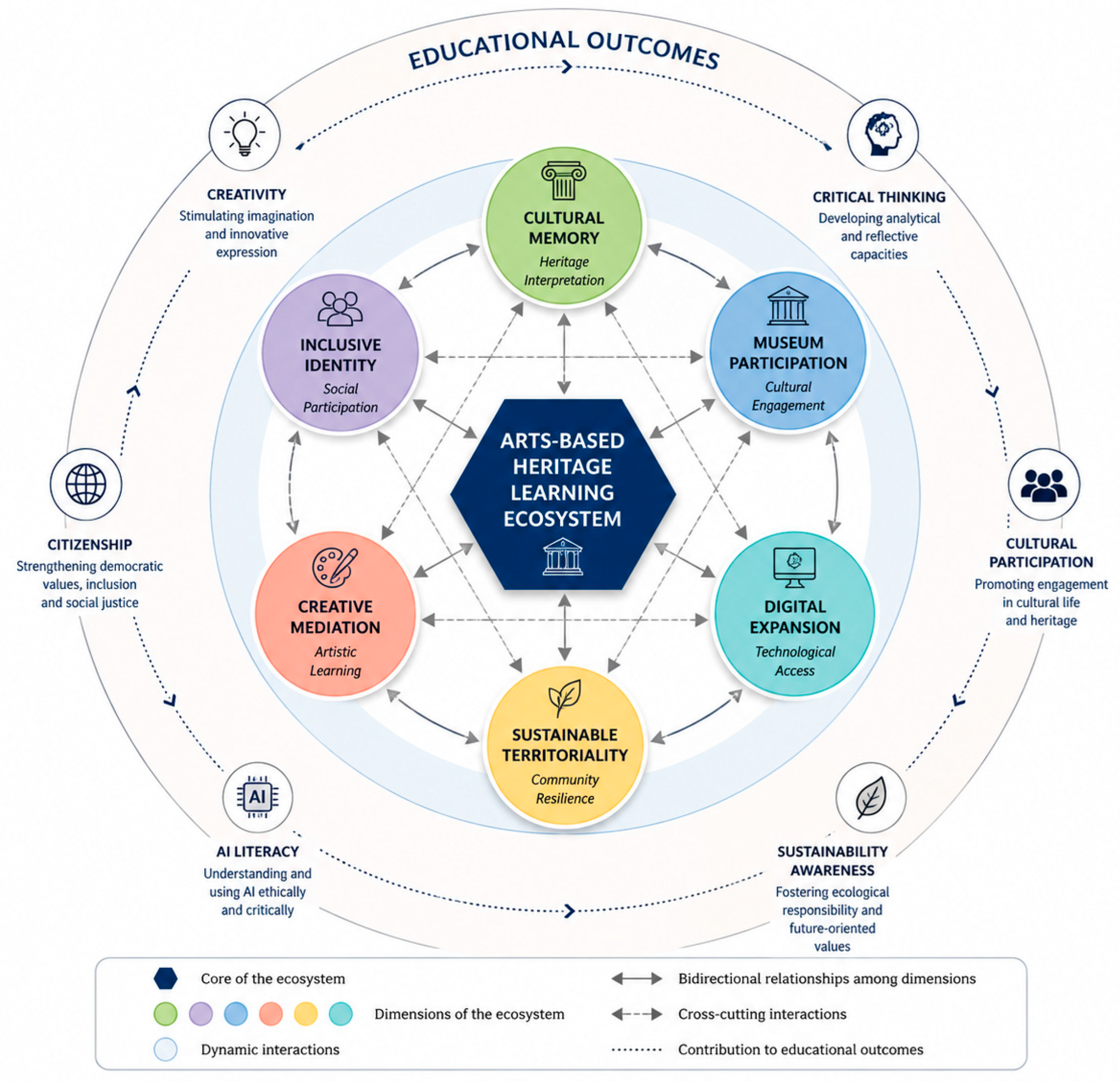
Six interconnected dimensions constitute the core of the proposed framework.
Cultural Memory represents the symbolic foundation of the ecosystem. Heritage learning is rooted in the interpretation of collective memory, identity construction, and the negotiation of cultural meanings. Consistent with critical heritage perspectives (
Smith, 2006;
Harrison, 2013), heritage is understood as a social process through which individuals and communities actively construct relationships with the past.
Artistic Mediation functions as the central pedagogical mechanism of the ecosystem. Arts-based methodologies facilitate emotional engagement, creativity, imagination, interpretation, and participatory meaning-making. Rather than acting merely as educational resources, artistic practices become vehicles through which learners explore, reinterpret, and communicate cultural experiences (
Greene, 1995;
Eisner, 2002;
Barone & Eisner, 2012).
Museum Participation represents the institutional and social dimension of the model. The reviewed studies demonstrate that museums increasingly operate as spaces for dialogue, co-creation, and collaborative learning. In line with participatory museum theories (
Hooper-Greenhill, 2007;
Simon, 2010), museum education emerges as a key mechanism for connecting formal education, community engagement, and cultural participation.
Digital Expansion incorporates the technological infrastructures that increasingly mediate access to heritage. Virtual museums, immersive environments, digital storytelling, online collections, and emerging AI applications expand opportunities for participation and interaction. However, the review also highlights the need for critical approaches capable of addressing ethical concerns related to accessibility, representation, algorithmic bias, and digital inequality (
Giannini & Bowen, 2019;
Coeckelbergh, 2024;
Tiribelli et al., 2024).
Sustainability and Territorial Heritage introduce a contextual and future-oriented perspective. Heritage education increasingly appears connected to cultural resilience, environmental awareness, local identity, and community sustainability. This dimension reflects growing alignment between heritage education and international sustainability agendas, particularly in relation to cultural continuity and social responsibility.
Finally, Teacher Education constitutes the professional and transformative dimension of the ecosystem. The review demonstrates that heritage education is increasingly recognised as a pedagogical competence that enables future educators to facilitate creative, critical, and inclusive engagements with cultural heritage. Teachers therefore function as mediators capable of connecting cultural memory, artistic practices, digital resources, and community participation within educational contexts.
Taken together, these six dimensions suggest that heritage education is evolving towards integrated learning ecosystems in which artistic creation, museum participation, digital mediation, sustainability, cultural memory, and teacher education operate as mutually reinforcing elements, see
Table 12. The Arts-Based Heritage Learning Ecosystem proposed here provides a conceptual framework for interpreting this transformation while offering a foundation for future empirical research, curriculum development, and educational innovation.
Figure 2 presents a visual representation of the proposed model and its principal dimensions.
Although derived from the reviewed literature, the proposed model should be considered a heuristic framework requiring future empirical validation in diverse educational contexts.
6. Educational Implications
The findings of this review suggest that heritage education should no longer be conceived as a peripheral curricular topic but as a strategic educational framework capable of integrating creativity, cultural participation, sustainability, digital literacy, and democratic citizenship. The proposed Arts-Based Heritage Learning Ecosystem provides an interpretative model through which these dimensions can be translated into educational practice across formal, non-formal, and informal learning environments.
From a curriculum perspective, heritage education should be embedded across disciplines rather than confined to isolated cultural content. The convergence identified between artistic creation, historical interpretation, digital participation, environmental responsibility, and community engagement demonstrates that heritage can operate as a transversal educational resource capable of promoting interdisciplinary inquiry and authentic learning experiences. Such an approach aligns with current international recommendations advocating competency-based curricula that connect cultural identity with sustainable development and global citizenship (
UNESCO, 2003).
The review also highlights the urgent need to strengthen teacher education. Preparing future educators now requires competencies that extend beyond heritage knowledge itself to include cultural mediation, arts-based pedagogies, museum collaboration, digital resource integration, and critical AI literacy. Teachers should be equipped not only to transmit cultural knowledge but also to facilitate participatory, creative, and socially engaged learning experiences capable of connecting learners with their cultural environments.
Another important implication concerns the growing role of museum–school–university partnerships. The reviewed studies consistently demonstrate that the most innovative educational experiences emerge from collaborative networks connecting educational institutions, museums, cultural organisations, and local communities. Such partnerships expand access to authentic heritage experiences while promoting co-creation, interdisciplinary learning, and civic participation beyond the classroom.
The increasing incorporation of digital technologies further requires a shift from instrumental digital competence towards critical digital and AI literacy. Although artificial intelligence remains an emerging area within heritage education, educators should be prepared to critically evaluate algorithmic decision-making, cultural representation, accessibility, transparency, and ethical implications associated with AI-mediated learning environments. Consequently, digital transformation should be understood not simply as technological innovation but as an opportunity to promote responsible, inclusive, and equitable participation in cultural heritage.
Finally, the review reinforces the educational potential of rural and territorial heritage as a driver of sustainability education. Local cultural practices, community memory, and everyday heritage constitute valuable educational resources for strengthening place-based learning, environmental responsibility, and social resilience. Integrating territorial heritage within educational programmes may therefore contribute to preserving cultural diversity while fostering active citizenship and long-term community sustainability.
Overall, these implications indicate that future educational policies should move beyond disciplinary and institutional boundaries towards integrated heritage learning ecosystems in which schools, museums, universities, cultural organisations, technologies, and local communities function as interconnected agents of educational innovation. In this sense, heritage education becomes not only an object of learning but also a catalyst for creativity, inclusion, sustainability, and democratic participation.
7. Conclusions
This systematic review provides a comprehensive overview of the international development of heritage education and arts-based learning between 2015 and 2026, identifying a clear shift from transmission-oriented conceptions of heritage towards participatory, creative, digitally mediated, and sustainability-oriented educational practices. The evidence confirms that heritage education is progressively consolidating itself as an interdisciplinary field situated at the intersection of culture, education, artistic practice, and social participation.
Beyond describing current research trends, this review makes a conceptual contribution through the proposal of the Arts-Based Heritage Learning Ecosystem, a theoretical framework that explains how cultural memory, artistic mediation, museum participation, digital expansion, sustainability, and teacher education interact as mutually reinforcing dimensions of contemporary heritage learning. Rather than representing isolated educational components, these dimensions form interconnected learning environments capable of fostering creativity, critical thinking, cultural identity, and democratic engagement.
The review also demonstrates that digital transformation is reshaping heritage education, although artificial intelligence should still be considered an emerging rather than consolidated area of research. Future developments should therefore balance technological innovation with ethical responsibility, ensuring accessibility, transparency, cultural diversity, and digital justice within AI-mediated heritage learning environments.
At the same time, important research gaps remain. The predominance of European case studies, the limited representation of rural and non-Western perspectives, the scarcity of longitudinal and mixed-methods research, and the still limited evidence concerning AI applications indicate that heritage education continues to offer significant opportunities for future investigation. Expanding geographical diversity and methodological robustness will be essential for consolidating the field.
Ultimately, this review argues that heritage education should no longer be understood merely as the preservation or transmission of cultural knowledge. Instead, it should be recognised as a dynamic educational ecosystem capable of connecting people, places, artistic practices, technologies, and communities through shared processes of meaning-making and cultural participation. In this perspective, heritage becomes not only a legacy from the past but also a collective resource for imagining more creative, inclusive, sustainable, and socially responsible educational futures.