1. Introduction
Psychological distress is one relevant correlate of student functioning. Symptoms of anxiety, depression, and broader emotional strain may coincide with difficulties sustaining academic energy, motivation, and adaptive functioning. In parallel, student engagement has long been central to explanations of persistence and academic success, from involvement-based accounts of the energy invested in the student experience (
Astin, 1984) to multidimensional perspectives emphasizing behavioral, emotional, and cognitive engagement (
Fredricks et al., 2004;
Kuh et al., 2008). More recent research continues to associate engagement with persistence-related outcomes, dropout intention, student well-being, and characteristics of the study environment (
Bulotaitė et al., 2025;
Galve-González et al., 2024;
Puiu et al., 2024). In the present study, engagement is operationalized specifically through the study-related dimensions of Vigor, Dedication, and Absorption (
Schaufeli et al., 2002,
2006).
The present study is also situated in the Greek higher-education context, where dropout tendency and prolonged study trajectories are institutionally relevant issues. Prior Greek evidence has shown that students’ tendency to drop out is shaped by academic-contextual factors, including satisfaction with the level and subject of studies, perceived relevance of knowledge for real-world problems, feedback from professors, perceived fairness in evaluation, clarity of course requirements, and satisfaction with teaching staff (
Androulakis et al., 2020;
C. Modiati et al., 2026a). This supports the view that dropout risk should not be reduced to a single individual deficit. Rather, it is a multidimensional construct shaped by academic, personal, institutional, social, and economic domains.
At the same time, engagement, burnout, and dropout risk are themselves multidimensional constructs. Engagement has been described as behavioral, emotional, and cognitive investment in learning (
Fredricks et al., 2004), and higher-education research has emphasized its dependence on student motivation, teacher–student transactions, institutional support, and broader learning conditions (
Zepke & Leach, 2010). Similarly, dropout risk includes more than intention to leave; it reflects a broader withdrawal propensity that may be shaped by academic integration, social support, economic strain, institutional fit, and perceived future value of studies (
Pusztai et al., 2022;
Tinto, 1975,
2012). Burnout also contains both a general strain component and more specific symptom domains.
The multidimensionality of these constructs creates an important measurement problem. Total scores may combine broad common variance with domain-specific variation, while no single latent structure can be assumed to represent all constructs adequately. Correlated-factor, higher-order, bifactor, and bifactor-(S−1) models provide different representations of multidimensionality and should therefore be compared on the basis of substantive interpretability, approximate fit, and statistical admissibility rather than imposing a common structure across constructs (
DeMars, 2013;
Rodriguez et al., 2016).
Accordingly, the present study examines psychological distress, student engagement, academic burnout, and dropout risk within an integrated latent-variable framework in which plausible measurement structures are evaluated before structural estimation. Its contribution lies not in proposing previously unexamined pairwise associations, but in testing whether these related constructs can be integrated while preserving differences in their measurement structure. The structural model evaluates direct associations among distress, engagement, burnout, and dropout risk, together with cross-sectional indirect associations through engagement. These associations are not interpreted as evidence of temporal or causal mediation. The objective of this study was to examine the cross-sectional associations among psychological distress, student engagement, academic burnout, and dropout risk while accounting for the multidimensional measurement structure of each construct. Specifically, theoretically plausible latent measurement models were compared before estimating direct associations and indirect statistical associations through engagement.
3. Materials and Methods
3.1. Participants and Procedure
The study used a cross-sectional questionnaire design with undergraduate students at the University of Patras, Greece. Data were collected in person between November and December 2023 following approval from the Research Ethics Committee of the University of Patras (Protocol/Ref. No. 16216/175). Participation was voluntary, informed consent was obtained before questionnaire completion, and no incentives were offered. The questionnaire was administered in Greek.
The final dataset comprised 3099 students from all 31 departments of the university. Women constituted 57.3% of the sample and men 42.7%. First-year students represented 42.5% of participants, followed by third-year students (23.2%), fourth-year students (15.6%), second-year students (11.1%), students in later years of study (4.7%), and fifth-year students (2.9%). Birth year was available for 3022 participants; after treating one implausible entry as invalid, approximate calendar-year age was available for 3021 students (M = 19.79 years, SD = 2.79, range = 17–60).
The sample represented all seven Schools of the University of Patras: Engineering (29.6%), Economics and Business (17.1%), Natural Sciences (16.5%), Humanities and Social Sciences (15.6%), Health Rehabilitation Sciences (12.9%), Agricultural Sciences (4.2%), and Health Sciences (4.1%). Thus, the sample covered a broad range of disciplinary areas rather than a single programme or field. The number of students approached was not recorded systematically; consequently, a conventional response rate could not be calculated. More detailed records of the recruitment pathway and formal eligibility criteria were not retained.
Item-level missingness was limited. All available cases were retained for structural equation modelling, with missing item responses handled using full-information maximum likelihood under the missing-at-random assumption.
3.2. Measures
The questionnaire was administered in Greek. For established instruments developed outside the Greek context, prior Greek-language validation evidence is reported below alongside reliability in the present sample. Because the present analysis evaluates the latent structure of each construct directly, earlier psychometric findings are treated as supporting evidence rather than as assumptions about the measurement structure in the current sample.
Psychological distress. Psychological distress was assessed with the 14-item Hospital Anxiety and Depression Scale (HADS), originally developed in English, comprising seven Anxiety and seven Depression items (
Zigmond & Snaith, 1983). Items are scored from 0 to 3 and were keyed so that higher values represented greater symptom burden. A Greek validation study involving 521 participants reported Cronbach’s α = 0.829 for Anxiety, α = 0.840 for Depression, and α = 0.884 for the total scale, together with a two-factor structure and high test–retest stability (
Michopoulos et al., 2008). In the present sample, α = 0.817 for Anxiety and α = 0.723 for Depression. The all-item coefficient was α = 0.842 but is reported descriptively only because the measurement analysis did not support simple HADS unidimensionality. One-factor, correlated Anxiety–Depression, and bifactor representations were therefore compared.
Student engagement. Student engagement was assessed with the 9-item student version of the Utrecht Work Engagement Scale (UWES-9S), covering Vigor, Dedication, and Absorption (
Schaufeli et al., 2002,
2006). Items are rated from 0 (
never) to 6 (
always), with higher scores indicating greater engagement. The nine-item UWES was established in a large cross-national validation study and showed satisfactory reliability and factorial validity (
Schaufeli et al., 2006). A subsequent evaluation among 462 Greek university students at the University of Patras supported a nine-item student measure and demonstrated measurement invariance across gender and order of departmental choice, although Vigor and a combined Dedication–Absorption dimension were favored in that sample (
Dimitriadou et al., 2021). In the present sample, the nine-item scale showed high internal consistency (α = 0.910). Given variation in previous dimensional findings, one-factor, correlated three-factor, higher-order, and bifactor structures were evaluated rather than imposing a structure a priori.
Academic burnout. Academic burnout was assessed using the 12 core items of the Burnout Assessment Tool (BAT-12), adapted to the study context and covering Exhaustion, Mental Distance, Cognitive Impairment, and Emotional Impairment. Items are rated from 1 (
never) to 5 (
always), with higher scores indicating greater burnout. The Greek BAT adaptation was produced through translation and back-translation from the English-language instrument and validated in 356 Greek employees (
Androulakis et al., 2023). For the Greek BAT-12, the earlier study reported α = 0.88 for the overall scale, with domain coefficients ranging from 0.67 to 0.83. Because that validation concerned an occupational rather than a student population, the latent structure was re-evaluated directly in the present student sample. Current-sample internal consistency was α = 0.860. One-factor, correlated four-factor, higher-order, and bifactor specifications were compared.
Dropout risk. Dropout risk was assessed with the 15-item APrISE-15 Dropout Tool, developed for the Greek higher-education context and covering Academic, Personal, Institutional, Social, and Economic domains. The present study used the Greek version. Each domain contains three items rated from 1 (completely disagree) to 7 (completely agree). Negatively keyed items were reverse-scored as 8 − x, so that higher values consistently represented greater dropout risk; Pers06 and Pers08 were retained in their original risk-oriented direction. The instrument-development study evaluated the 15-item Greek Dropout Tool using confirmatory factor analysis and item response theory in the same institutional sample of 3099 students (
C. K. Modiati et al., 2026b). It is therefore cited here as instrument-development evidence rather than as independent external replication. In the present scoring, internal consistency was α = 0.822. One-factor, correlated five-factor, higher-order, conventional bifactor, and bifactor-(S−1) specifications were evaluated.
3.3. Conceptual and Statistical Model
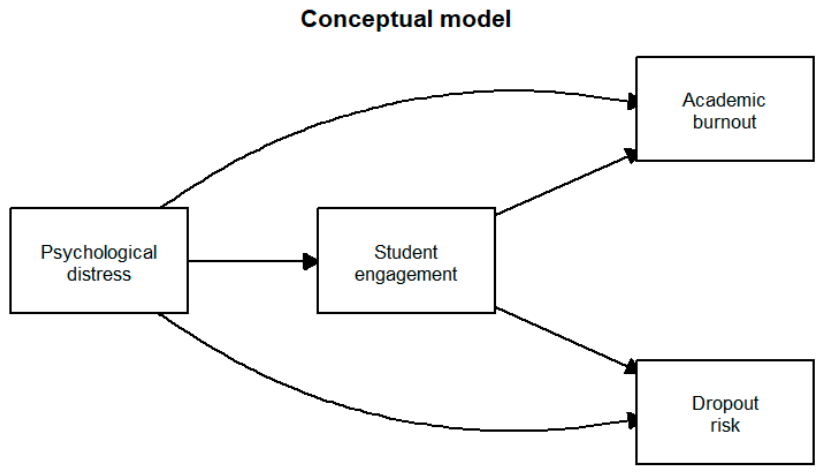
The conceptual model examined whether student engagement was statistically associated with the relation of psychological distress to academic burnout and dropout risk (
Figure 1).
Burnout and dropout risk were treated as related but distinct outcomes. Burnout represents study-related strain and depletion, whereas dropout risk represents a broader propensity toward withdrawal or discontinuation of studies. Because the cross-sectional design does not establish whether burnout precedes dropout risk, whether withdrawal-related concerns contribute to burnout, or whether both arise from common antecedents, no directional path was imposed between the two outcomes. Treating them as parallel endogenous constructs avoids introducing an additional temporal assumption that cannot be established from the present data. The hypothesized ordering of the remaining structural paths was theoretically specified, but the cross-sectional design does not establish temporal precedence or causal direction.
3.4. Statistical Analysis
Structural equation modelling was conducted in R 4.6.1 using lavaan (
Rosseel, 2012); exact package versions were archived with the revision outputs in sessionInfo.txt. Primary models were estimated using robust maximum likelihood (MLR) with full-information maximum likelihood for missing data. In lavaan, MLR provides Huber–White robust standard errors together with a scaled Yuan–Bentler test statistic. Full-information maximum likelihood was applied under the missing-at-random assumption, allowing all available item-level information to contribute to estimation. No observations were removed solely on the basis of multivariate-outlier screening. Because students were nested within 31 departments, the final structural model used department-clustered robust inference. Model fit was evaluated using the robust comparative fit index (CFI), Tucker–Lewis index (TLI), root mean square error of approximation (RMSEA), and standardized root mean square residual (SRMR).
Competing measurement structures were evaluated before structural estimation. For psychological distress, one-factor, correlated Anxiety–Depression, and bifactor HADS models were examined. For engagement, one-factor, three-correlated-factor, higher-order, and bifactor models were compared. Burnout was evaluated using one-factor, four-correlated-factor, higher-order, and bifactor specifications. Dropout risk was evaluated using one-factor, five-correlated-factor, higher-order, conventional bifactor, and bifactor-(S−1) models. Model selection considered theoretical interpretability, approximate fit, convergence, parameter admissibility, negative residual variances, latent correlations exceeding unity, and availability of finite standard errors and a valid parameter covariance matrix (
Rodriguez et al., 2016;
Vizoso et al., 2018). Models were estimated using unit-variance latent-variable scaling (std.lv = TRUE in lavaan) rather than marker-loading identification. The general distress and residual Anxiety and Depression factors in the HADS bifactor model were specified as orthogonal. In the Academic-reference bifactor-(S−1) model, no Academic-specific residual factor was estimated, while the Personal, Institutional, Social, and Economic residual specific factors were allowed to correlate. No item-level residual correlations were introduced on the basis of modification indices, and no equality constraints were added to improve model fit. Indirect associations were specified as defined parameters in lavaan; their standard errors and confidence intervals were obtained using the delta method from the robust parameter covariance matrix.
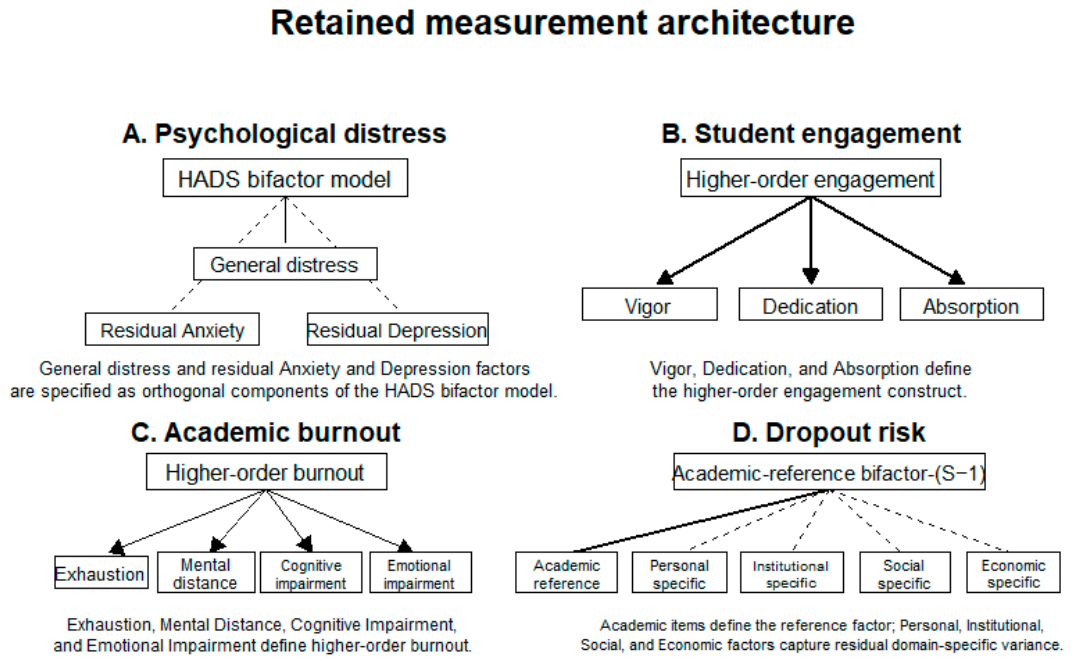
The retained measurement architecture comprised a HADS bifactor model with a general distress factor and residual Anxiety and Depression factors; a higher-order engagement factor defined by Vigor, Dedication, and Absorption; a higher-order burnout factor defined by Exhaustion, Mental Distance, Cognitive Impairment, and Emotional Impairment; and an Academic-reference bifactor-(S−1) model of dropout risk with correlated Personal, Institutional, Social, and Economic specific factors. In the bifactor-(S−1) specification, the Academic domain served as the reference facet. The resulting structural factor is therefore interpreted as Academic-referenced dropout risk, rather than as a content-free general dropout factor.
The structural model regressed higher-order engagement on general psychological distress. Higher-order burnout and Academic-referenced dropout risk were each regressed on psychological distress and engagement. Indirect associations from psychological distress to both outcomes through engagement were estimated. Because the data were cross-sectional, these estimates were interpreted as statistical indirect associations rather than temporal or causal mediation.
Weighted least squares mean- and variance-adjusted estimation (WLSMV), treating indicators as ordered categorical, was examined as an estimator-sensitivity analysis. Ordinal measurement models broadly supported multidimensional representations of the constructs; however, full item-level WLSMV structural solutions were not used for inference when the information matrix was non-invertible or standard errors were incomplete. Primary structural inference was therefore based on the admissible department-clustered MLR model.
4. Results
Competing measurement and structural specifications were evaluated before selection of the final model. Conventional bifactor specifications that failed post-estimation admissibility checks were not retained. The final model combined a HADS bifactor representation of psychological distress, higher-order engagement and burnout factors, and an Academic-reference bifactor-(S−1) representation of dropout risk. Primary inference used MLR with robust adjustment for clustering within 31 academic departments. Descriptive statistics for the observed study measures are reported in
Table 1.
Item-level descriptive statistics, missingness, skewness, kurtosis, and response-category distributions are provided in
Supplementary Table S2A,B.
4.1. Model Fit
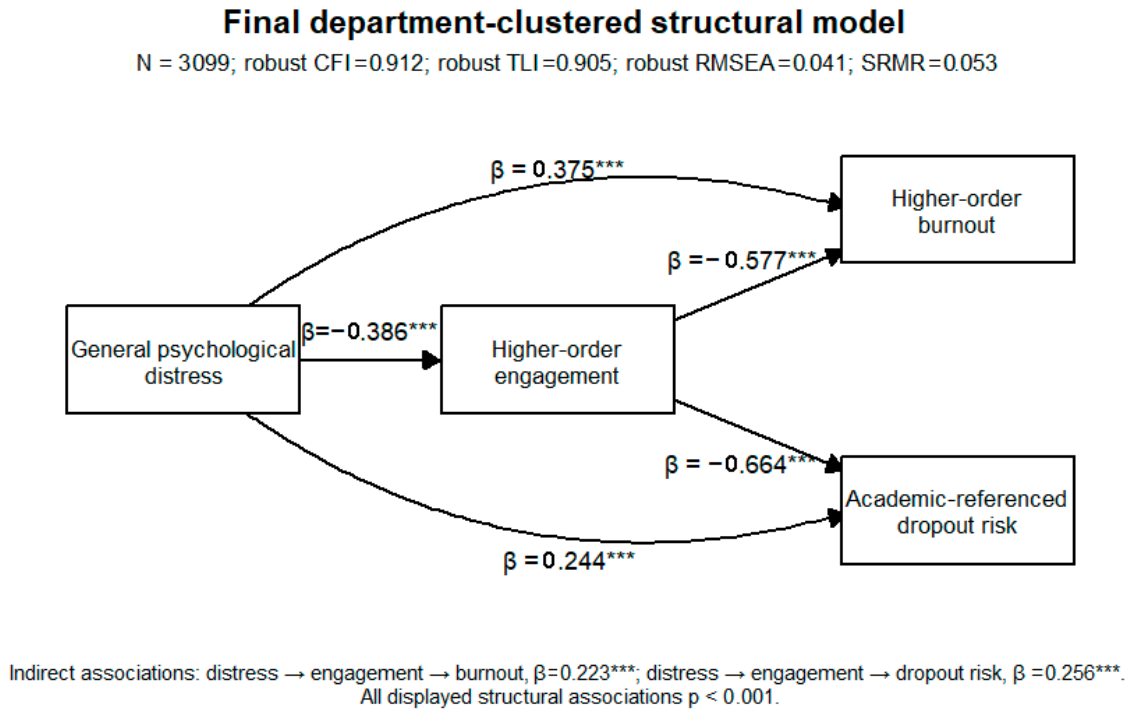
The final department-clustered model converged and satisfied the prespecified admissibility criteria. Approximate fit was acceptable overall, χ
2(1130) = 5948.72,
p < 0.001, robust CFI = 0.912, robust TLI = 0.905, robust RMSEA = 0.041, and SRMR = 0.053. The RMSEA and SRMR indicated relatively small residual misfit, whereas the incremental fit indices were more moderate. Given the large sample and complexity of the model, interpretation was based on the joint pattern of fit indices rather than the chi-square test alone (
Table 2).
4.2. Measurement-Model Selection
Competing measurement models showed that the constructs could not be represented adequately by uniformly unidimensional or conventional symmetrical bifactor structures (
Table 3). For HADS, the one-factor model fitted substantially less well (CFI = 0.841, TLI = 0.812, RMSEA = 0.088, SRMR = 0.061) than the correlated Anxiety–Depression model (CFI = 0.936, TLI = 0.923, RMSEA = 0.056, SRMR = 0.045). An admissible HADS bifactor model provided the strongest approximate fit while retaining a general distress factor (CFI = 0.971, TLI = 0.958, RMSEA = 0.041, SRMR = 0.025) and was therefore retained.
For engagement, the higher-order and three-correlated-factor models had equivalent global fit under MLR (CFI = 0.947, TLI = 0.921, RMSEA = 0.109, SRMR = 0.055). Although the standalone engagement bifactor model improved several fit indices, bifactor engagement specifications produced improper solutions when incorporated into the combined structural model. Higher-order engagement was therefore retained as the admissible representation supporting a common engagement construct.
For burnout, the four-correlated-factor model fitted well (CFI = 0.967, TLI = 0.954, RMSEA = 0.059, SRMR = 0.040), and the higher-order model showed closely comparable fit (CFI = 0.962, TLI = 0.950, RMSEA = 0.061, SRMR = 0.046). The conventional burnout bifactor solution produced a Heywood case and was not retained. The higher-order model was selected because it provided an admissible representation of shared burnout variance across the four domains (
Table 3).
For dropout risk, the conventional bifactor model containing an Academic-specific factor was improper. Under MLR, one Academic-specific standardized loading reached 19.905 and the solution contained an inadmissible residual variance. The Academic-reference bifactor-(S−1) model with correlated specific factors was admissible and showed adequate approximate fit (CFI = 0.955, TLI = 0.934, RMSEA = 0.054, SRMR = 0.037). In this specification, the Academic items define the reference facet, while Personal, Institutional, Social, and Economic factors capture residual domain-specific variance (
Figure 2).
Table 4 summarizes the signed standardized loading ranges for the retained measurement architecture.
Observed-score internal consistency was α = 0.817 for HADS Anxiety, α = 0.723 for HADS Depression, α = 0.910 for UWES-9S, α = 0.860 for BAT-12, and α = 0.822 for the risk-oriented APrISE-15. The all-item HADS coefficient (α = 0.842) is reported descriptively only because the measurement analyses did not support a simple one-factor representation. Signed standardized loadings are reported throughout; negative loadings on residual HADS factors represent residual associations after extraction of general distress variance and do not indicate inconsistent item keying. Model-implied correlations among the focal latent constructs are reported in
Table 5.
The focal latent correlations ranged from |r| = 0.386 to 0.761. Engagement was strongly negatively correlated with dropout risk (r = −0.758) and burnout (r = −0.721), while burnout and dropout risk were strongly positively correlated (r = 0.761). These associations indicate substantial conceptual proximity among the constructs but remain below unity; accordingly, the constructs were retained as distinct while their overlap was considered when interpreting the structural paths. The correlation between psychological distress and engagement, the two simultaneous predictors of both outcomes, was r = −0.386, corresponding to an implied VIF of approximately 1.18 and providing no indication of problematic predictor collinearity.
4.3. Structural Associations
All five focal structural associations in the final department-clustered model were statistically significant (
Table 6). General psychological distress was negatively associated with higher-order engagement, β = −0.386,
p < 0.001. Engagement was negatively associated with both higher-order burnout, β = −0.577,
p < 0.001, and Academic-referenced dropout risk, β = −0.664,
p < 0.001. General distress retained positive direct associations with burnout, β = 0.375,
p < 0.001, and Academic-referenced dropout risk, β = 0.244,
p < 0.001. Thus, lower engagement accompanied higher distress and was strongly associated with both outcomes, while distress also retained associations with burnout and dropout risk independent of engagement. The model explained 14.9% of the variance in engagement, 64.0% of the variance in burnout, and 62.6% of the variance in Academic-referenced dropout risk.
4.4. Indirect Associations Through Engagement
General psychological distress showed statistically significant indirect associations with both outcomes through engagement. The indirect association with burnout was β = 0.223,
p < 0.001, and the indirect association with Academic-referenced dropout risk was β = 0.256,
p < 0.001 (
Table 7). These estimates indicate that part of the cross-sectional association between distress and each outcome was statistically shared with lower engagement. Because substantial direct associations remained, engagement should not be interpreted as a complete explanatory mechanism (
Figure 3).
4.5. Departmental Clustering and Sensitivity Analyses
Department-level clustering was small for distress but more pronounced for the other study constructs. The intraclass correlations were 0.002 for distress, 0.037 for engagement, 0.043 for burnout, and 0.072 for dropout risk, corresponding to design effects of 1.23, 4.63, 5.19, and 8.02, respectively (
Table 8). These values supported the use of department-clustered robust inference in the primary structural model.
Alternative admissible structural specifications produced the same broad substantive pattern. In particular, a model representing HADS as correlated Anxiety and Depression factors was admissible, although the two dimensions showed differentiated associations with engagement. An observed HADS-total sensitivity model was also admissible. These results support the robustness of the principal associations while reinforcing that HADS should not be treated as empirically unidimensional.
Ordinal WLSMV measurement analyses likewise supported multidimensional representations of the study constructs. However, the full item-level WLSMV structural candidates produced non-invertible information matrices and incomplete standard errors and were therefore not used for inferential conclusions. Structural interpretations were consequently based on the admissible MLR models.
Two alternative directional specifications using the retained measurement architecture were also examined. Models specifying burnout before engagement and dropout risk before engagement showed slightly poorer approximate fit (CFI = 0.910, TLI = 0.903, RMSEA = 0.041, SRMR = 0.053) than the primary specification (CFI = 0.912, TLI = 0.905, RMSEA = 0.041, SRMR = 0.053). The differences were small and do not discriminate temporal ordering in cross-sectional data. These specifications were therefore treated as sensitivity analyses rather than competing causal models (
Supplementary Table S4A,B).
4.6. Exploratory Differences by Academic Year
Exploratory Welch tests indicated differences across academic-year groups in psychological distress, engagement, burnout, and dropout risk. After Holm adjustment across the four omnibus tests, differences remained significant for distress, F(5, 533.73) = 3.81, adjusted
p = 0.006; engagement, F(5, 533.08) = 2.38, adjusted
p = 0.045; burnout, F(5, 534.79) = 2.65, adjusted
p = 0.045; and dropout risk, F(5, 535.13) = 14.18, adjusted
p < 0.001. Pairwise differences were most consistent for dropout risk: students in the later-years group reported higher scores than each of the other academic-year groups, while third-year students also reported higher dropout-risk scores than first-, second-, and fourth-year students. Later-year students reported higher distress than first- and fourth-year students, whereas fifth-year students reported higher engagement than students in later years. No individual burnout comparison remained significant after pairwise adjustment. Full descriptive statistics and pairwise comparisons are reported in
Supplementary Table S3A–C. Because academic-year groups were unequal in size and measurement invariance was not established, these analyses are exploratory and should not be interpreted as evidence of developmental or longitudinal change.
5. Discussion
5.1. Summary of Main Findings
This study examined the cross-sectional associations among psychological distress, student engagement, academic burnout, and dropout risk in a large sample of Greek university students. Competing measurement models were evaluated before structural estimation, yielding a HADS bifactor representation of psychological distress, higher-order representations of engagement and burnout, and an Academic-reference bifactor-(S−1) representation of dropout risk. The final structural model accounted for clustering within 31 academic departments and showed acceptable approximate fit.
The substantive pattern was consistent across the principal structural associations. General psychological distress was negatively associated with engagement (β = −0.386), while engagement was negatively associated with burnout (β = −0.577) and Academic-referenced dropout risk (β = −0.664). Distress also retained positive direct associations with burnout (β = 0.375) and dropout risk (β = 0.244). Indirect associations through engagement were observed for both burnout (β = 0.223) and dropout risk (β = 0.256). The model explained 14.9% of the variance in engagement, 64.0% in burnout, and 62.6% in Academic-referenced dropout risk.
These findings support engagement as an important correlate within the joint pattern of distress, burnout, and dropout risk, but they do not establish engagement as a causal mechanism. The persistence of direct distress associations with both outcomes indicates that engagement accounts for only part of their shared cross-sectional variation.
5.2. Engagement in the Distress–Burnout–Dropout Pattern
Engagement showed strong negative associations with both burnout and dropout risk. This pattern is consistent with theoretical accounts that define engagement in terms of energy, dedication, and sustained involvement in academic activity (
Fredricks et al., 2004;
Schaufeli et al., 2002,
2006), and with higher-education research linking engagement with persistence, academic success, and lower dropout intention (
Lerdpornkulrat et al., 2018;
Truta et al., 2018).
The present analysis extends the literature by evaluating engagement as a higher-order latent construct defined by Vigor, Dedication, and Absorption within a broader structural model. Its association with burnout was substantial, and its association with Academic-referenced dropout risk was particularly strong. The model-implied latent correlations also indicated considerable overlap between engagement and burnout (r = −0.721) and between engagement and dropout risk (r = −0.758). These values support conceptual proximity without implying that the constructs are interchangeable.
The indirect associations through engagement should be interpreted conservatively. Because all variables were measured at the same time point, the estimated paths do not establish that distress precedes lower engagement or that lower engagement subsequently produces burnout or dropout risk. Reverse or reciprocal relations are plausible. Burnout may reduce students’ capacity to remain engaged, while students considering withdrawal may report weaker engagement with their studies. The results therefore support a coherent cross-sectional pattern rather than a temporal mediation sequence.
5.3. Burnout and Dropout Risk Outcomes
Burnout and dropout risk were strongly related but were not represented by the same measurement structure. Burnout was most defensibly represented as a higher-order construct defined by Exhaustion, Mental Distance, Cognitive Impairment, and Emotional Impairment. Dropout risk required an Academic-reference bifactor-(S−1) structure that retained Personal, Institutional, Social, and Economic residual specific factors.
The model-implied latent correlation between burnout and dropout risk was high (
r = 0.761), indicating substantial shared variance. This overlap is theoretically plausible because both constructs reflect adverse academic functioning, but they remain conceptually distinct. Burnout captures strain, depletion, distancing, and impaired functioning within the student role (
Calcatin et al., 2022;
Marôco et al., 2020;
Schaufeli et al., 2002). Dropout risk concerns a broader propensity toward withdrawal or discontinuation and may additionally reflect institutional, social, personal, and economic circumstances (
Pusztai et al., 2022;
Tinto, 2012).
Psychological distress also showed different direct associations with the two outcomes. Its standardized direct association was larger for burnout (β = 0.375) than for dropout risk (β = 0.244). Although the direct distress coefficient was larger for burnout than for dropout risk, this difference should not be interpreted as evidence that burnout is psychologically more proximal to distress because the outcomes were measured using different instruments and latent structures. It is more appropriately treated as a descriptive difference within the fitted model.
5.4. Contribution of the Multidimensional Measurement Results
A central methodological finding is that the same latent-variable structure was not appropriate for all four constructs. Formal comparison and admissibility assessment did not support the use of conventional bifactor models across engagement, burnout, and dropout risk. The retained architecture instead combined construct-specific representations selected on the basis of theoretical coherence, approximate fit, and statistical admissibility.
For HADS, a single distress factor fitted substantially less well than either a correlated Anxiety–Depression model or the retained bifactor model. The bifactor specification therefore allowed a general distress construct to be used in the structural model while retaining residual Anxiety- and Depression-specific variance. This finding argues against interpreting the HADS responses in this sample as simply unidimensional.
Engagement was most appropriately carried forward as a higher-order construct defined by Vigor, Dedication, and Absorption. Burnout was likewise represented by a higher-order factor because the conventional burnout bifactor solution was statistically improper. These results illustrate the importance of distinguishing theoretical preference from empirical admissibility when selecting latent measurement structures.
Dropout risk required an Academic-reference bifactor-(S−1) representation. The conventional full bifactor solution containing an Academic-specific factor was statistically improper, including an extreme Academic-specific loading and an inadmissible residual variance. In the retained bifactor-(S−1) model, Academic items define the reference facet, while Personal, Institutional, Social, and Economic factors capture residual domain-specific variance. The corresponding structural construct is therefore interpreted specifically as Academic-referenced dropout risk, not as a content-free general dropout propensity.
This multidimensional pattern is consistent with previous evidence that dropout tendency reflects academic, institutional, social, and contextual influences rather than a single homogeneous process (
Androulakis et al., 2020;
C. Modiati et al., 2026a;
Androulakis et al., 2021). More broadly, the findings illustrate why measurement structures should be compared explicitly rather than assuming that total scores or conventional bifactor models provide equivalent representations of multidimensional constructs (
Reise, 2012;
Rodriguez et al., 2016).
5.5. Academic-Year Group Differences
Exploratory analyses indicated academic-year differences in distress, engagement, burnout, and dropout risk, with the clearest differentiation observed for dropout risk. Later-year students reported higher dropout-risk scores than each of the other academic-year groups, while third-year students also exceeded several earlier-year groups. Some differences were also observed for distress and engagement, whereas no pairwise burnout contrast remained significant after adjustment.
These findings should be interpreted cautiously. Academic-year groups were unequal in size, the comparisons were cross-sectional, and measurement invariance across year groups was not established. The observed differences therefore cannot be interpreted as within-student developmental change. They nevertheless suggest that academic stage may be relevant to heterogeneity in student functioning and could be examined more rigorously in longitudinal or measurement-invariance studies.
5.6. Practical Implications
The findings support several cautious implications for student-support practice. Psychological distress was associated with lower engagement and with higher burnout and dropout risk, indicating that elevated distress co-occurs with broader difficulties in student functioning. However, the present model was not designed or validated as a predictive screening instrument. The coefficients should therefore not be converted into individual risk classifications or intervention thresholds without prospective validation.
Engagement may nevertheless warrant attention within supportive academic practices because of its strong associations with both burnout and dropout risk. Clear academic expectations, timely feedback, meaningful learning activities, accessible instructor communication, and opportunities to strengthen academic connection are consistent with practices intended to support engagement (
Kuh et al., 2008;
Zepke & Leach, 2010). The present cross-sectional findings do not establish that such practices would reduce burnout or dropout; they identify engagement as a construct warranting attention within broader student-support strategies.
Efforts to address burnout should not be framed solely around individual coping. Academic workload, clarity of requirements, perceived fairness, feedback, and institutional support may be relevant to students’ academic experience, although these institutional factors were not tested directly in the present model. Dropout-risk assessment should remain multidimensional because the retained model preserved residual Personal, Institutional, Social, and Economic variation beyond the Academic-referenced factor. Support systems should therefore avoid reducing withdrawal vulnerability to either psychological distress or a single intention-to-leave indicator. Any future use of these constructs for individual risk identification would require prospective validation of predictive accuracy and decision thresholds, together with safeguards concerning false-positive classifications, privacy, fairness across student groups, and the availability of appropriate referral and support capacity.
6. Conclusions, Limitations and Future Research
This study integrated psychological distress, student engagement, academic burnout, and dropout risk within a multidimensional latent-variable framework. After comparison of alternative measurement models, psychological distress was represented by a HADS bifactor model, engagement and burnout by higher-order structures, and dropout risk by an Academic-reference bifactor-(S−1) model. In the final department-clustered structural model, distress was associated with lower engagement, while lower engagement was associated with higher burnout and dropout risk. Distress also retained direct associations with both outcomes, and statistically significant indirect associations through engagement were observed.
The findings therefore identify engagement as an important component of the cross-sectional association pattern linking distress with burnout and dropout risk, but not as evidence of an established protective mechanism. They also show that the four constructs cannot be reduced to a common measurement form. In particular, dropout risk retained meaningful domain-specific structure and was most defensibly interpreted relative to its Academic reference facet.
Several limitations should be considered. First, the cross-sectional design does not establish temporal ordering or causal mediation. Reverse and reciprocal relations among distress, engagement, burnout, and withdrawal propensity remain plausible. Longitudinal research is required to evaluate temporal sequences and within-student change. The primary FIML analysis also relies on the missing-at-random assumption, which cannot be verified directly from the observed data. In addition, MLR treats the ordered item responses approximately continuously; measurement-level WLSMV analyses were therefore used to assess estimator sensitivity, but admissible full structural WLSMV inference was not available. Finally, department-clustered robust inference adjusts standard errors for within-department dependence but does not explicitly model between-department latent heterogeneity.
Second, all principal constructs were assessed by self-report within the same survey. This is appropriate for subjective experiences such as distress, engagement, burnout, and dropout propensity, but common-method variance cannot be separated from substantive covariance in the present design. Future studies should combine self-reports with administrative or behavioral indicators such as attendance, accumulated credits, examination progress, delayed completion, or observed dropout.
Third, although the retained measurement architecture was selected after comparison of alternative models, some structures remain sample-dependent and require replication. The HADS bifactor model retained residual Anxiety and Depression variance, engagement and burnout required higher-order representations, and dropout risk was most defensibly represented using an Academic-reference bifactor-(S−1) model. Replication should examine whether these structures remain admissible across independent samples and institutions.
Fourth, the primary structural analysis used robust maximum likelihood with department-clustered inference. Ordinal WLSMV models were examined as sensitivity analyses, but complete structural WLSMV solutions were not used for inference when information matrices were non-invertible or standard errors were incomplete. Future studies could examine whether the retained measurement and structural relations can be replicated under alternative estimators in independent datasets.
Fifth, participants were drawn from one large Greek public university. Although the sample was large and included 31 departments and multiple years of study, the findings should not be generalized automatically to Greek higher education as a whole or to other national systems. Replication across institutions is required. Future work should also evaluate measurement and structural invariance across relevant student groups, including gender, academic year, discipline, first-generation status, and employment status. Future research could also examine emotional intelligence and related regulatory beliefs as potential individual resources associated with engagement and burnout. Recent evidence indicates that emotional-intelligence-related mindsets may be associated with academic engagement and burnout, but emotional intelligence was not measured in the present study and cannot be evaluated from these data (
Jiang et al., 2025).
Overall, the study contributes evidence that psychological distress, engagement, burnout, and dropout risk can be examined jointly while preserving their distinct multidimensional measurement properties. The results support a strong association between engagement and both adverse outcomes, while emphasizing the need for longitudinal evidence before these relationships are interpreted as temporal or causal processes.