
Reading Instruction for Learners with Intellectual Developmental Disabilities and Complex Communication Needs

Abstract
1. Introduction
1.1. The Science of Reading
1.2. Statement of the Problem
1.3. Research Questions
- What are the effects of using a match-to-sample and errorless learning procedure to teach phonological awareness for students with complex communication needs?
- What are the effects of the intervention for repeated acquisition of phonological awareness skills?
- What are the effects of intervention on phonics skills (i.e., letter–sound correspondence)?
2. Materials and Methods
2.1. Participants
Consent and Assent Procedures
2.2. Setting and Materials
2.3. Measures
2.3.1. Randomization and Target Sound Selection
2.3.2. Data Collection Procedures
2.4. Reliability and Fidelity
2.5. Treatment Package
2.5.1. Pre-Baseline
2.5.2. Baseline
2.5.3. Phase 1 Auditory Matching Following Errorless Trials with Pre-Session Errorless Practice
2.5.4. Phase 2: Stimulus Shape Transformation
2.5.5. Phase 3: AAC Generalization
3. Results
3.1. Design and Analysis
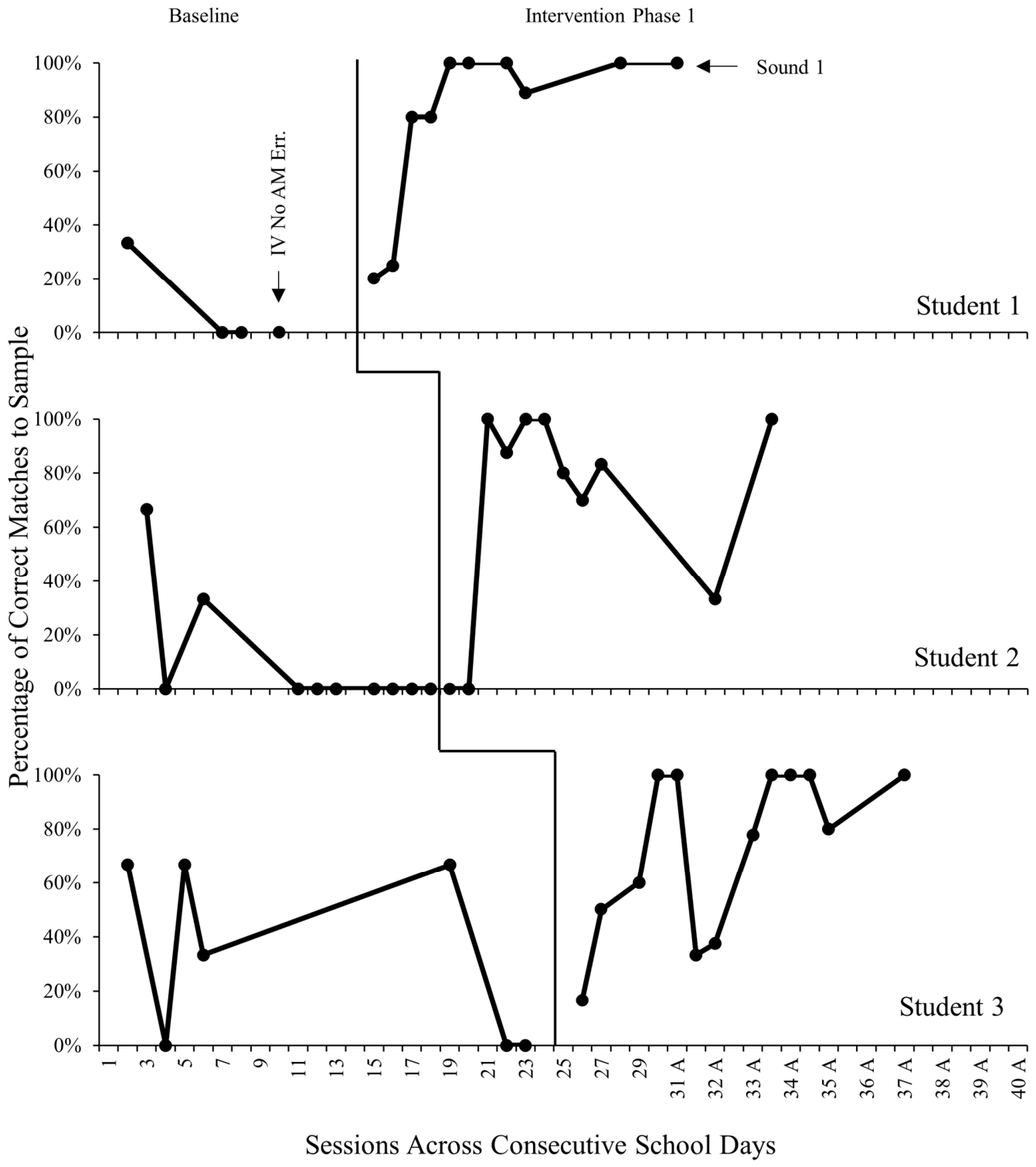
3.2. Across Participant Data
Participant Response Variability
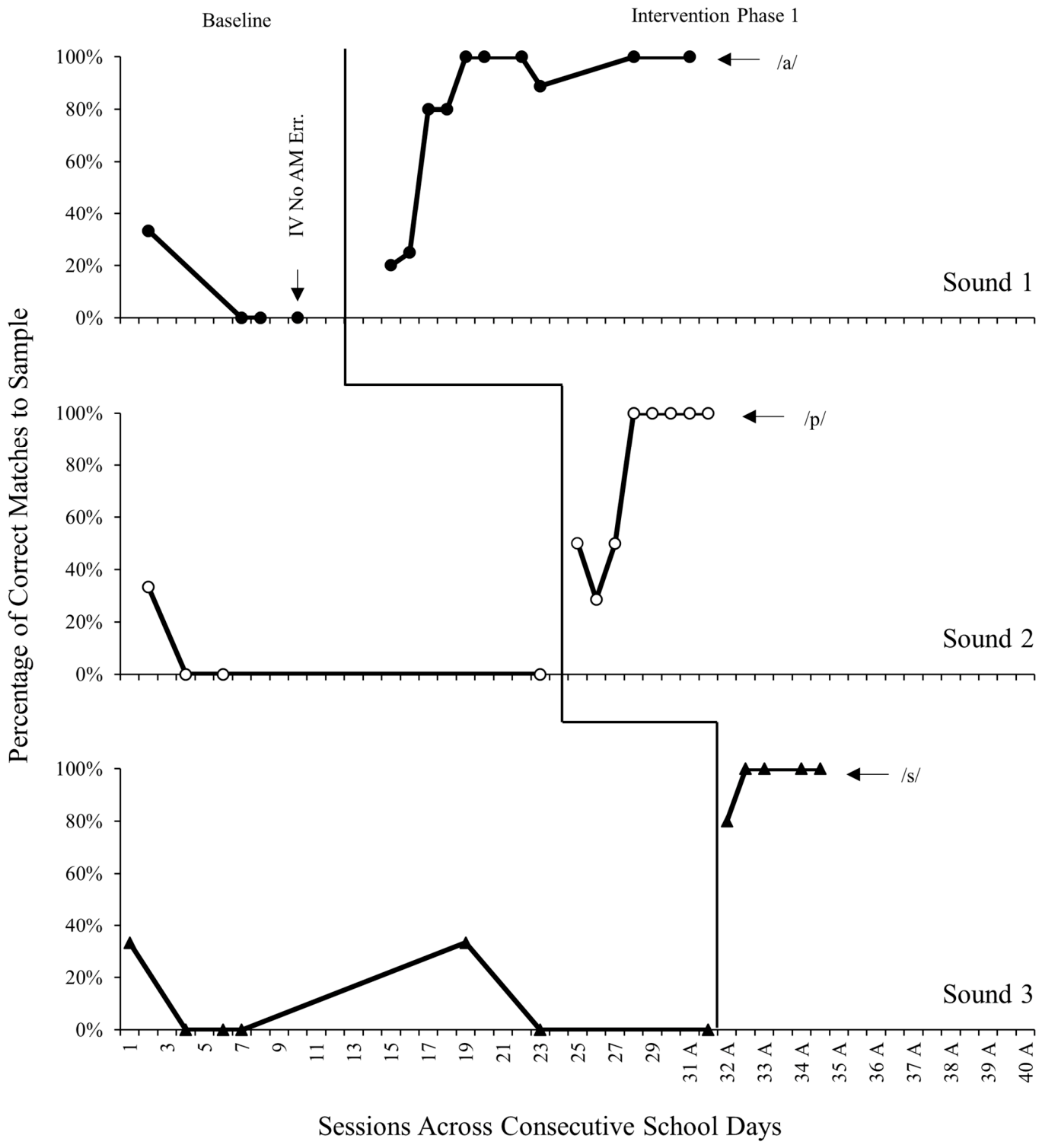
3.3. Student 1
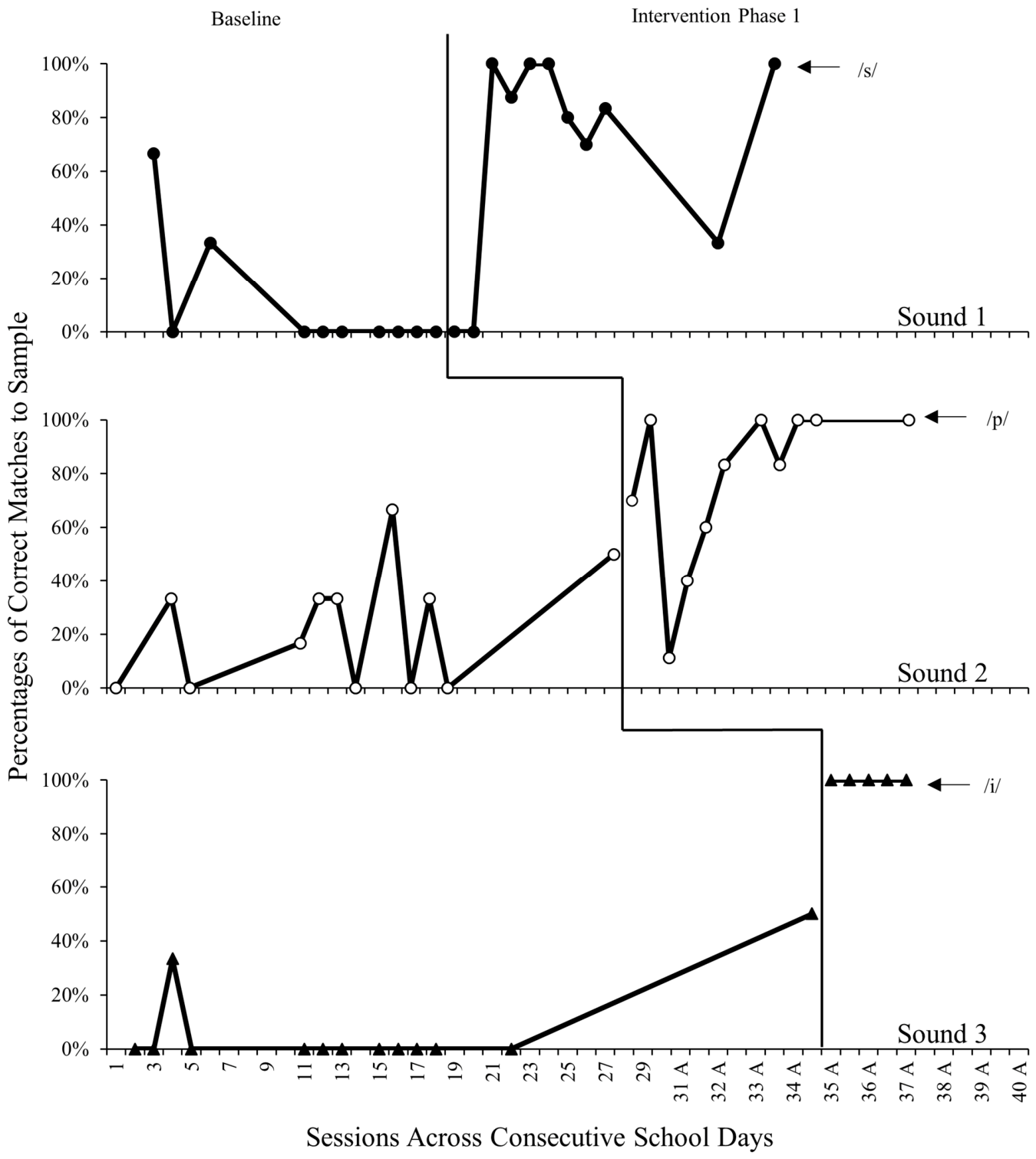
3.4. Student 2
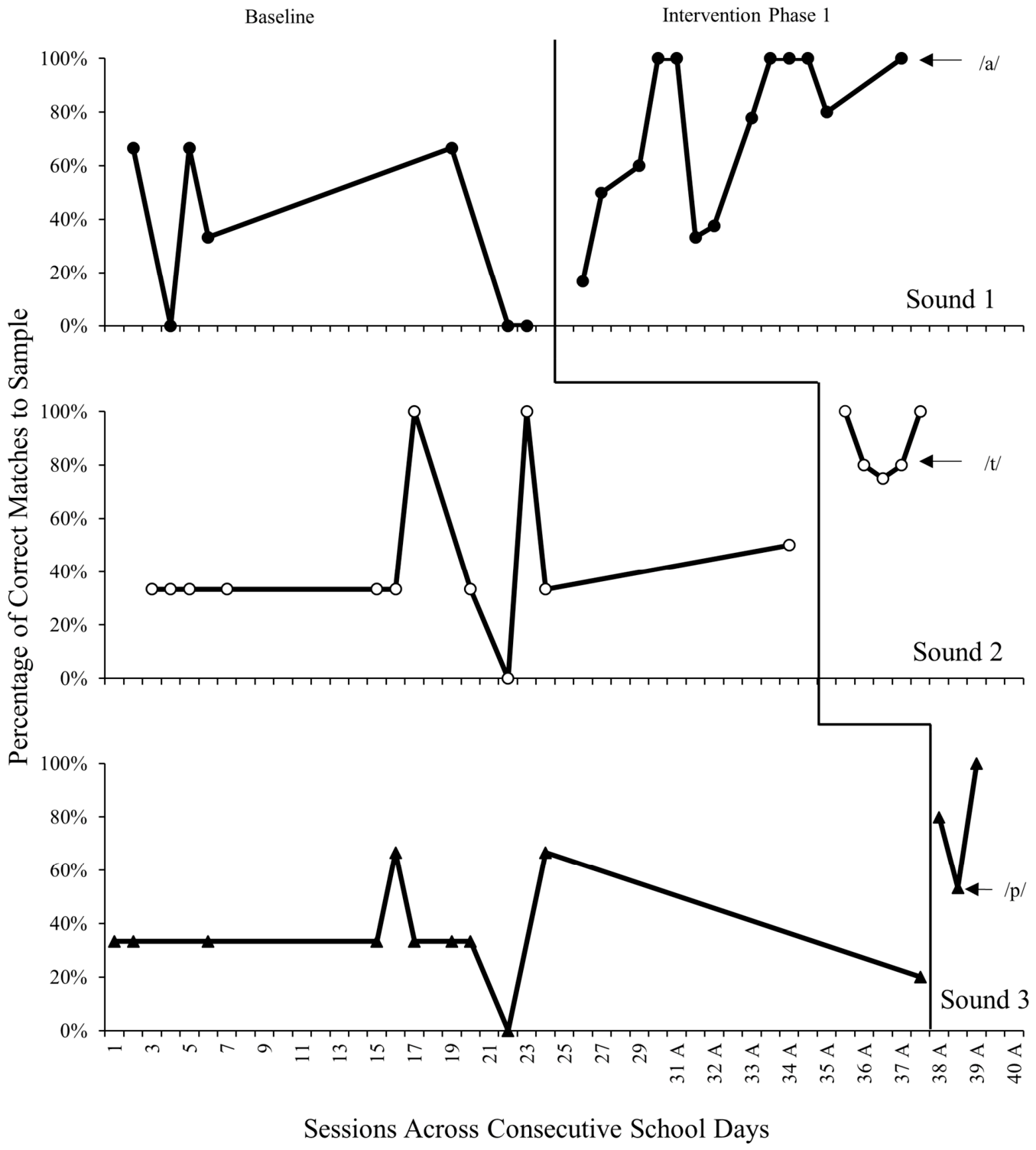
3.5. Student 3
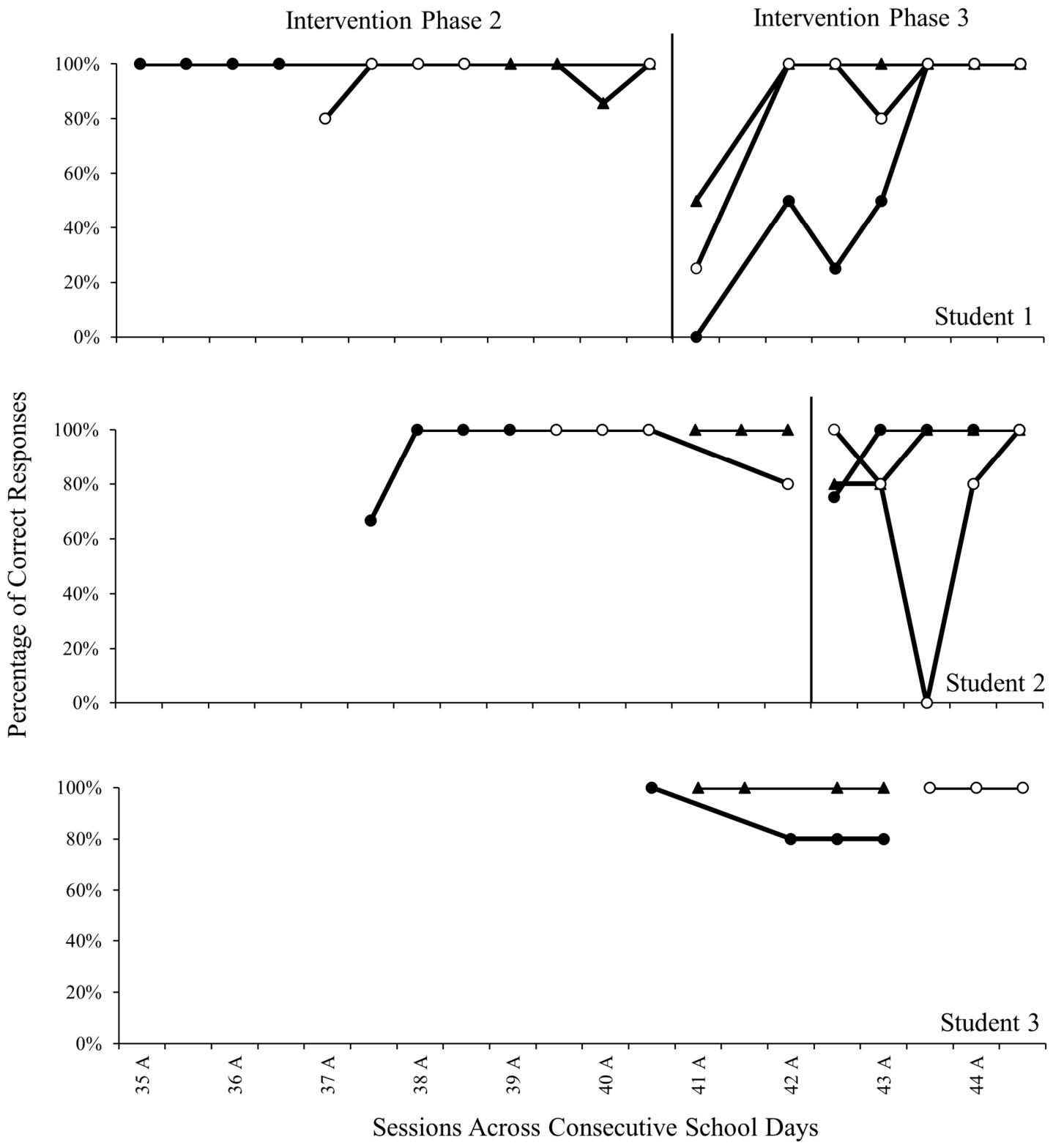
3.6. Phase 2: Stimulus Shape Transformation
3.7. Phase 3: AAC Generalization
4. Discussion
4.1. Limitations and Future Directions
4.2. Implications for Practitioners
5. Conclusions
Author Contributions
Funding
Institutional Review Board Statement
Informed Consent Statement
Data Availability Statement
Acknowledgments
Conflicts of Interest
Abbreviations
| IDD | Intellectual and Developmental Disabilities |
| SOR | The Science of Reading |
| AAC | Augmentative and Alternative Communication |
| MTS | Match-to-Sample |
| CCN | Complex Communication Needs |
Appendix A

References
- Ahlgrim-Delzell, L., Browder, D., & Wood, L. (2014). Effects of systematic instruction and an augmentative communication device on phonics skills acquisition for students with moderate intellectual disability who are nonverbal. Education and Training in Autism and Developmental Disabilities, 49(4), 517–532. [Google Scholar] [CrossRef] [Scilit]
- Browder, D. M., Wakeman, S. Y., Spooner, F., Ahlgrim-Delzell, L., & Algozzinexya, B. (2006). Research on reading instruction for individuals with significant cognitive disabilities. Exceptional Children, 72(4), 392–408. [Google Scholar] [CrossRef] [Scilit]
- Bruce, S. M., Lyons, V., & Chen, Y. (2026). Applying the communication bill of rights to enact principles of diversity, equity, inclusion, and accessibility. American Journal of Speech-Language Pathology, 35(1), 29–39. [Google Scholar] [CrossRef] [Scilit] [PubMed]
- Carter, S. L., & Wheeler, J. J. (2019). The social validity manual: Subjective evaluation interventions. Academic Press. [Google Scholar]
- Choi, J., Greer, R. D., & Keohane, D.-D. (2015). The effects of an auditory match-to-sample procedure on listener literacy and echoic responses. Behavioral Development Bulletin, 20(2), 186–206. [Google Scholar] [CrossRef] [Scilit]
- Cooper, J. O., Heron, T. E., & Heward, W. L. (2020). Applied behavior analysis (3rd ed.). Pearson. [Google Scholar]
- Fallon, K. A., Light, J., McNaughton, D., Drager, K., & Hammer, C. (2004). The effects of direct instruction on the single-word reading skills of children who require augmentative and alternative communication. Journal of Speech, Language, and Hearing Research, 47(6), 1424–1439. [Google Scholar] [CrossRef] [Scilit] [PubMed]
- Gast, D. L., Lloyd, B. P., & Ledford, J. R. (2018). Multiple baseline and multiple probe designs. In J. R. Ledford, & D. L. Gast (Eds.), Single case research methodology: Applications in special education and behavioral sciences (pp. 239–282). Routledge. [Google Scholar]
- Johnston, S. S., Davenport, L., Kanarowski, B., Rhodehouse, S., & McDonnell, A. P. (2009). Teaching sound letter correspondence and consonant-vowel-consonant combinations to young children who use augmentative and alternative communication. Augmentative and Alternative Communication, 25(2), 123–135. [Google Scholar] [CrossRef] [Scilit] [PubMed]
- Kratochwill, T. R., & Levin, J. R. (2014). Enhancing the scientific credibility of single-case intervention research: Randomization to the rescue. Psychological Methods, 15, 124–144. [Google Scholar] [CrossRef] [Scilit] [PubMed]
- Light, J., & Drager, K. (2007). AAC technologies for young children with complex communication needs: State of the science and future research directions. Augmentative and Alternative Communication, 23(3), 204–216. [Google Scholar] [CrossRef] [Scilit] [PubMed]
- Light, J., McNaughton, D., Weyer, M., & Karg, L. (2008). Evidence-based literacy instruction for individuals who require augmentative and alternative communication: A case study of a student with multiple disabilities. Seminars in Speech and Language, 17(2), 120–132. [Google Scholar] [CrossRef] [Scilit] [PubMed]
- National Center on Improving Literacy. (2024a). Features of structured literacy instruction. Available online: https://www.improvingliteracy.org/resource/features-of-structured-literacy-instruction (accessed on 3 March 2026).
- National Center on Improving Literacy. (2024b). The science of reading: An overview. Available online: https://improvingliteracy.org/resource/the-science-of-reading-an-overview/ (accessed on 3 March 2026).
- Patching, W., Kameenui, E., Carnine, D., Gersten, R., & Colvin, G. (1983). Direct instruction in critical reading skills. Reading Research Quarterly, 18(4), 406–418. [Google Scholar] [CrossRef] [Scilit] [PubMed]
- Reading Rockets. (2026). Structured literacy instruction: The basics. Available online: https://www.readingrockets.org/topics/about-reading/articles/structured-literacy-instruction-basics (accessed on 2 February 2026).
- Ruppar, A. L., Dymond, S. K., & Gaffney, J. S. (2011). Teachers’ perspectives on literacy instruction for students with severe disabilities who use augmentative and alternative communication. Research and Practice for Persons with Severe Disabilities, 36(3–4), 100–111. [Google Scholar] [CrossRef] [Scilit]
- Truxler, J. E., & O’Keefe, B. M. (2007). The effects of phonological awareness instruction on beginning word recognition and spelling. AAC: Augmentative & Alternative Communication, 23(2), 164–176. [Google Scholar] [CrossRef] [Scilit] [PubMed]
- Ulriksen, L. B., Bilet-Mossige, M., Moreira, H. C., Larsen, K., & Nordahl-Hansen, A. (2023). Reading intervention for students with intellectual disabilities without functional speech who require augmentative and alternative communication: A multiple single-case design with four randomized baselines. Trials, 24, 433. [Google Scholar] [CrossRef] [Scilit] [PubMed]
- Unugrean, B. C. (2021). Theoretical aspects of Intellectual disability—Definition, classification. Bulletin of the Transilvania University of Brasov. Series IX, Sciences of Human Kinetics, 14(63), 247–252. [Google Scholar] [CrossRef] [Scilit]
- Westover, J. M. (2010). Increasing the literacy skills of students who require AAC through modified direct instruction and specific instructional feedback [Doctoral dissertation, University of Oregon]. ProQuest Dissertations & Theses Global. Available online: https://ezproxy.bgsu.edu/login?url=https://www.proquest.com/dissertations-theses/increasing-literacy-skills-students-who-require/docview/749881596/se-2 (accessed on 13 July 2026).
- Yorke, A. M., Caron, J. G., Pukys, N., Sternad, E., Grecol, C., & Shermak, C. (2020). Foundational reading interventions adapted for individuals who require augmentative and alternative communication (AAC): A systematic review of the research. Journal of Developmental and Physical Disabilities, 33, 537–582. [Google Scholar] [CrossRef] [Scilit]



| Ahlgrim-Delzell et al. (2014) | Choi et al. (2015) | Present Study | |
|---|---|---|---|
| Design | Multiple Baselines Across Participants | Delayed Multiple Probes | Multiple Baselines Across Sounds and Participants |
| Methodology | |||
| Procedure | Match-to-sample | Match-to-sample | Match-to-sample |
| Setting | One-on-one phonics setting | Self-contained 3rd grade classroom | Elementary IDD classroom |
| Dependent Variable & Measurement | |||
| Targeted Skill | Letter/word/phrase–sound correspondence, Comprehension questions | Letter/word/phrase–sound correspondence | Auditory matching, letter–sound correspondence |
| Dependent Variables | Phoneme identification, blending sounds with and without picture referents | Correct responses to advanced listener literacy probe trials, echoic clarity | Correct responses to matching trials across AAC modalities |
| Intervention Implementation Materials | GoTalk Phonics | Computer-based auditory match-to sample software | Pre-programmed buttons, high-tech AAC letters |
| Student | Sound | BL | Phase 1 | Phase 2 | Phase 3 |
|---|---|---|---|---|---|
| 1 | 1 | 8.33% | 79.39% | 100.00% | 60.71% |
| 2 | 8.33% | 78.57% | 96.00% | 92.86% | |
| 3 | 11.11% | 80% | 96.43% | 86.43% | |
| 2 | 1 | 10.00% | 68.56% | 93.33% | 85.00% |
| 2 | 24.24% | 77.07% | 95.00% | 100.00% | |
| 3 | 6.41% | 100% | 100.00% | 100.00% | |
| 3 | 1 | 33.33% | 73.48% | 95.00% | N/A |
| 2 | 43.06% | 87.00% | 72.00% | N/A | |
| 3 | 35.15% | 77.78% | 92.00% | N/A | |
| Across Students Mean | 20.00% | 80.21% | 93.31% | 87.50% | |
Disclaimer/Publisher’s Note: The statements, opinions and data contained in all publications are solely those of the individual author(s) and contributor(s) and not of MDPI and/or the editor(s). MDPI and/or the editor(s) disclaim responsibility for any injury to people or property resulting from any ideas, methods, instructions or products referred to in the content. |
© 2026 by the authors. Licensee MDPI, Basel, Switzerland. This article is an open access article distributed under the terms and conditions of the Creative Commons Attribution (CC BY) license.
Share and Cite
Marr, K.; Anderson, E.J.; Mefford, A. Reading Instruction for Learners with Intellectual Developmental Disabilities and Complex Communication Needs. Educ. Sci. 2026, 16, 1403. https://doi.org/10.3390/educsci16091403
Marr K, Anderson EJ, Mefford A. Reading Instruction for Learners with Intellectual Developmental Disabilities and Complex Communication Needs. Education Sciences. 2026; 16(9):1403. https://doi.org/10.3390/educsci16091403
Chicago/Turabian StyleMarr, Katrina, Eric J. Anderson, and Ashlyn Mefford. 2026. "Reading Instruction for Learners with Intellectual Developmental Disabilities and Complex Communication Needs" Education Sciences 16, no. 9: 1403. https://doi.org/10.3390/educsci16091403
APA StyleMarr, K., Anderson, E. J., & Mefford, A. (2026). Reading Instruction for Learners with Intellectual Developmental Disabilities and Complex Communication Needs. Education Sciences, 16(9), 1403. https://doi.org/10.3390/educsci16091403