


Article

Examining the Preparation–Efficacy Relationship Through Program Learning Outcomes in Traditional Teacher Preparation

1
Mary Lou Fulton College for Teaching and Learning Innovation, Arizona State University, Tempe, AZ 85281, USA
2
Neag School of Education, University of Connecticut, Storrs, CT 06269, USA
*
Authors to whom correspondence should be addressed.
Educ. Sci. 2026, 16(8), 1308; https://doi.org/10.3390/educsci16081308
Submission received: 31 May 2026 / Revised: 26 July 2026 / Accepted: 13 August 2026 / Published: 16 August 2026
(This article belongs to the Special Issue Educator Preparation and Advancement Pathways)

Abstract

As schools navigate widening achievement gaps, learning recovery demands, and increasingly complex teaching contexts, understanding how educators are prepared to enter the profession has become increasingly important. Using end-of-program survey data from 473 completers of a large traditional teacher preparation (TTP) program in the southwestern United States collected across three post-pandemic semesters, the purpose of this study was to examine the relationship between program completers’ perceived preparation adequacy and their self-efficacy during the transition from program completion to the first year of teaching. Findings indicate that perceived preparation adequacy remained positively associated with self-efficacy, with program completers reporting high levels of confidence in key professional domains. Perceptions of preparedness and self-efficacy were consistently high across undergraduate and graduate pathways, suggesting that shared program learning outcomes (PLOs) and clinically rich preparation experiences may provide a coherent foundation for educator development across multiple routes. Descriptive data also indicate that most completers intended to enter the teaching workforce following program completion, a transition not always realized. Collectively, these findings highlight the potential usefulness of contemporary PLOs in traditional preparation that are reinforced with practice-based opportunities. Implications for educator preparation and workforce development are discussed.

1. Introduction

Globally, education systems face an urgent need to recruit and retain well-qualified teachers, with an estimated 44 million additional K–12 teachers needed by 2030 (UNESCO & International Task Force on Teachers for Education 2030, 2024). Yet this challenge is driven not only by an insufficient number of entrants into the profession but also by persistent attrition. A report published by UNESCO and the International Task Force on Teachers for Education 2030 found that more than 90% of the estimated teacher shortage in Europe and North America, equivalent to 4.8 million teachers, is attributable to teachers leaving the profession, while the global teacher attrition rate nearly doubled from 4.6% in 2015 to more than 9% in 2022 (UNESCO & International Task Force on Teachers for Education 2030, 2024). Recent Teaching and Learning International Survey (TALIS) findings further suggest that attrition risk is especially pronounced among younger teachers, with approximately 20% of teachers under age 30 expecting to leave teaching within five years and rates reaching as high as 50% in some education systems (OECD, 2025).
In the U.S., recent estimates indicated that more than 400,000 teaching positions nationwide are either unfilled or occupied by teachers who are not fully certified for their assignments, representing approximately one in eight teaching positions (Tan et al., 2025). Shortages vary substantially across labor markets, as workforce supply is shaped by geographic preferences and differs by region, teacher type, and school context (Edwards et al., 2025; Nguyen et al., 2024). At the same time, enrollment in traditional teacher preparation (TTP) pathways—also referred to as university-based programs, once considered key pipelines into the profession—has declined nationwide, while historically high teacher turnover persists, particularly in low-income schools (Evans et al., 2021; Grossman et al., 2025). The inability to recruit and retain qualified teachers poses a substantial challenge, as teachers have far-reaching influence on students’ academic, socio-emotional, and long-term life outcomes (Chetty et al., 2014; Jackson, 2018). Such shortages diminish the quality of education, negatively affecting student achievement (D. Boyd et al., 2006; Ronfeldt et al., 2013).
High teacher turnover was a major contributor to global teacher shortages even before the COVID-19 pandemic and has since been exacerbated by rising dissatisfaction, burnout, declining professional attractiveness, and workforce aging, although some studies report higher job fulfillment among early-career teachers (Barnum, 2023; Diliberti & Schwartz, 2022; Schaeffer, 2024). Teacher turnover strains school systems through larger class sizes, reduced course offerings, diminished collaboration, and greater reliance on underqualified educators, particularly in high-poverty schools (Levin et al., 2015; Sutcher et al., 2019). Despite the workforce challenges that predated the pandemic, COVID-19 further disrupted school systems through abrupt operational changes, shifting instructional models, increased professional demands on teachers, declines in academic standards and student attendance, broader societal instability, and tightening labor markets (Baker & Koedel, 2025). Subsequently, post-COVID educational environments have intensified challenges for teachers, with widening achievement gaps disproportionately affecting lower-performing and disadvantaged students alongside worsening working conditions characterized by greater classroom disruptions, declining student responsibility and safety, and reduced trust among teachers, administrators, parents, and colleagues (Backes et al., 2026; Baker & Koedel, 2025).
Given this context, it is important to understand how well TTP programs have adapted to prepare candidates for the contemporary realities of teaching amid abrupt and profound changes to the education system (e.g., COVID). Examining how TTP designs and implementation are effective at shaping early-career teachers’ preparedness and self-efficacy is valuable given that teachers who feel prepared and efficacious are more likely to persist through classroom challenges and implement effective instructional practices (Emiru & Gedifu, 2023; Tschannen-Moran & Woolfolk Hoy, 2001). As new pathways into teaching continue to emerge, questions remain about the role of TTP programs in preparing candidates for the demands of today’s classrooms (D. J. Boyd et al., 2009). Accordingly, this study examines recent program completers’ perceptions of preparation adequacy and teacher self-efficacy and the relationship between these constructs, to better understand how TTP programs are supporting entry into the profession.

1.1. Literature Review

1.1.1. Traditional Teacher Preparation Programs

At a time of global teacher shortages (UNESCO & International Task Force on Teachers for Education 2030, 2024), enrollment and completion rates in U.S. TTP programs have declined over the past decade, while participation in alternative routes has increased. Despite these shifts, TTPs still account for the largest share of new teachers, comprising an estimated 80% of public-school hires in the U.S. (Greenberg et al., 2013; NCES, 2022). TTP programs in the U.S. are typically housed within institutions of higher education (IHEs) and culminate in the awarding of a bachelor’s or master’s degree in education and meeting state requirements for certification or licensure. These IHE pathways generally include a period of supervised student teaching, during which teacher candidates work under the guidance of an experienced mentor teacher (Grossman et al., 2025). Although, more than half of all U.S. public-school teachers earn their teaching credentials in this manner (Kraft & Lyon, 2024), hiring trends and preferences indicate shifting priorities among state and local education leaders, who are looking for creative ways (i.e., alternative pathways, classroom-based preparation) to address shortages in high-need areas and who seek greater local control over teacher pipelines to ensure teachers are meeting the demands of accountability-focused school systems (Fraser & Lefty, 2018; Goldhaber et al., 2014).
In terms of structure and design, TTP programs typically include coursework on pedagogy, subject-specific content, and instruction tailored for particular student populations, such as English learners or students with disabilities (Jang et al., 2017). Additionally, clinical experiences or practice-based learning are a central feature in nearly all TPPs, usually required by state policy, and serve as a central component of both national and state standards for teacher preparation (American Association of Colleges for Teacher Education [AACTE], 2010). TTP programs are designed to equip candidates with essential knowledge, skills, and dispositions required to be effective educators while giving them the tools to promote positive student outcomes as well as persist in the field (Emerson et al., 2018).

1.1.2. TTP Programs’ Role in Addressing Teacher Shortages

TTP programs play a critical role in addressing teacher shortages, comprising the largest share of teachers entering the profession (King & Yin, 2022). However, completing a TTP program and earning a credential represents only the potential supply of new teachers, not the actual number who ultimately enter and remain in the workforce (Kraft & Lyon, 2024). Goldhaber et al. (2022) found that approximately 75% of credentialed individuals eventually join the public-school workforce, suggesting that attrition can begin even before teachers enter the classroom. Ensuring that graduates feel adequately prepared to transition into teaching roles is therefore especially important given the high attrition rates among early-career teachers (Ingersoll et al., 2018).
Perceptions of preparation adequacy have been strongly associated with retention. First-year teachers who feel well prepared are significantly more likely to remain in the profession, while uncertified teachers leave at substantially higher rates than certified teachers within the first five years (DeAngelis et al., 2013; Gray & Taie, 2015). Compared with alternatively prepared entrants, who often experience more variable preparation models, TTP completers have been found to demonstrate higher retention across grade levels, a trend linked to clinically rich preparation and methods-focused coursework (Ronfeldt et al., 2014). Similarly, Elyashiv and Rozenberg (2024), examining preparation, self-efficacy, and commitment in an international context, found that stronger perceptions of knowledge gained during teacher preparation were positively associated with early-career teachers’ preparedness and self-efficacy and indirectly contributed to professional commitment.

1.1.3. TTP Program Effectiveness

As the teaching profession continues to evolve, TTP programs must respond to a range of external forces, including broader economic conditions, political discourse, cultural shifts, developments in labor advocacy, and ongoing policy reforms (Kraft & Lyon, 2024). While program design must account for governmental accountability measures placed on schools, where teachers act as implementers and are ultimately responsible for student outcomes, TPP programs should also be envisioning schools for the future and preparing teachers for 21st-century schools (Basile et al., 2022). With the influx of educational technology and augmentative intelligence, TTP programs must prepare teachers to integrate technology in ways that promote digital responsibility and literacy, support higher-order thinking skills, and personalize learning for students (Tondeur et al., 2019; U.S. Department of Education, Office of Educational Technology, 2016). At the same time, shifting student demographics, including increases in students receiving special education services and English learners, require teachers to apply these practices within increasingly diverse and inclusive learning environments (NCES, 2024).
Comparative research on teacher preparation program effectiveness, often measured through student outcomes, has produced mixed findings. Some studies report little to no significant differences in effectiveness between teachers prepared through TTP and alternative pathways (D. Boyd et al., 2006; D. J. Boyd et al., 2009; Kane et al., 2008), whereas others identify small but statistically significant advantages for alternatively prepared teachers (Whitford et al., 2018). At the same time, research within TTP pathways shows how some programs consistently produce more effective teachers than others, indicating that program-specific features may meaningfully shape teacher outcomes (Gansle et al., 2012; Ronfeldt et al., 2014). However, the specific type, quality, and amount of preparation associated with optimal effectiveness remain unclear (Greenberg et al., 2013; Ronfeldt et al., 2014). Features such as endorsement area, program type, clinical placement structure, preparation duration, program size, and faculty composition have all been identified as factors that may influence program effectiveness (Bardelli et al., 2021).

1.1.4. Clinical Supervision, Mentoring, and Structured Induction

Clinical, or practice-based, learning is a central feature of TTP programs because it allows preservice teachers to connect coursework with classroom practice and develop the knowledge, skills, and dispositions needed for effective teaching (Darling-Hammond, 2014; Maistre & Paré, 2010). These experiences are most effective when they are intentionally supervised and embedded within coherent program structures that integrate university coursework, field-based practice, and feedback from school-based mentors and university faculty (Darling-Hammond, 2014; Ericsson, 2014). Research further suggests that clinically rich preparation experiences can strengthen instructional practice, teacher self-efficacy, and retention, particularly when candidates are provided sustained opportunities for guided practice, reflection, and feedback (D. J. Boyd et al., 2009; Ronfeldt, 2021).
However, clinical placements alone do not ensure preparedness. Their effectiveness depends on the quality of these learning opportunities that help candidates interpret classroom experiences, refine instructional practice, and develop professional judgment. Brownell et al. (2016) highlighted how focus, duration, and coherence function as essential domains of practice-based learning, operationalized through features such as modeling, spaced and varied learning, coaching and feedback, analysis and reflection, and scaffolding. Mentoring and practicum supervision are central to these features because they provide structured opportunities for candidates to observe effective teaching, rehearse practices, receive targeted feedback, and reflect on instructional decisions (Brownell et al., 2016).
Structured induction extends developmental support into the early years of teaching by providing organized activities that socialize novice teachers into the profession and bridge preservice preparation with teachers’ first years in the classroom (Benoliel et al., 2025; Heikkinen et al., 2018). Induction programs that include support for classroom management, instructional planning, and effective teaching practices can reduce the complexity of the transition into teaching and strengthen the retention of new teachers (Courtney et al., 2023). Seminal research on induction and mentoring further shows that beginning teachers who receive structured support often report stronger job satisfaction, commitment, retention, instructional practice, and, in some studies, student achievement outcomes (Ingersoll & Strong, 2011; Smith & Ingersoll, 2004).
Thus, clinical supervision, mentoring, and structured induction should be understood as interconnected supports that link preservice preparation to early-career preparedness, professional commitment, and persistence in the profession. This connection, and its variability, is especially important to examine in the post-COVID-19 context, where beginning teachers are entering classrooms shaped by more challenging working conditions across multiple dimensions, including increased classroom disruptions, declining student responsibility and safety, and reduced trust between teachers, principals, parents, and colleagues, trends that appear consistent across schools serving different socioeconomic populations (Baker & Koedel, 2025).

1.2. Theoretical Framework

This study draws on Bandura’s (1997) social cognitive theory and Shulman’s (1986, 1987) knowledge-base framework to examine how teacher candidates develop self-efficacy through preparation experiences, professional knowledge, and classroom practice. Bandura’s theory provides a lens for understanding how teacher candidates develop self-efficacy through preparation experiences, including clinical placements and practice-based learning. Self-efficacy refers to individuals’ beliefs in their capacity to organize and execute actions required to achieve desired outcomes (Bandura, 1997). In teacher education, these beliefs are important, considering teacher self-efficacy, a belief in their ability to effectively promote student learning and engagement, has been linked with instructional quality, classroom management, student engagement, and persistence in the profession (Tschannen-Moran & Woolfolk Hoy, 2001; Tschannen-Moran & Hoy, 2007; Zee & Koomen, 2016). Within Bandura’s framework, clinical placements can be understood as mastery experiences, which are considered the strongest source of self-efficacy because they allow candidates to enact teaching practices, receive feedback, and develop confidence through direct experience (Bandura, 1997; Tschannen-Moran & Hoy, 2007).
Shulman’s knowledge-base framework situates teacher preparation within the broader forms of professional knowledge required for effective teaching. Shulman (1986, 1987) argued that teaching requires the integration of content knowledge, pedagogical knowledge, curricular knowledge, knowledge of learners, and pedagogical content knowledge. The program learning outcomes examined in this study reflect these domains by organizing preparation around the knowledge and practices candidates are expected to develop within a TTP program. For example, domains related to instructional design and decision-making align with Shulman’s concept of pedagogical content knowledge, reflecting candidates’ ability to design instruction, make responsive instructional decisions, and adapt teaching to learners’ needs (Shulman, 1986, 1987). Other domains capture related dimensions of preparation, including assessment, inclusive practice, technology integration, and collaboration.

1.3. Purpose

Although the association between perceptions of preparation adequacy and self-efficacy has been established in teacher education research, less is known about whether this relationship persists in the increasingly demanding educational environments that have followed the COVID-19 pandemic, characterized by intensified expectations for beginning teachers, including demands related to learning recovery, behavioral support, inclusion, family engagement, and workforce instability (Backes et al., 2026; Baker & Koedel, 2025). This study extends prior international research (Elyashiv & Rozenberg, 2024) by examining these constructs within a large, comprehensive TTP program in the Southwestern United States, while situating preparation within contemporary program learning outcomes and a regional teacher workforce context (Edwards et al., 2025; Nguyen et al., 2024). Moreover, participants in this study represent those in a key transitional phase between program completion and early-career employment, when employment decisions remain uncertain, and graduates have yet to experience the full realities of classroom teaching (Goldhaber et al., 2022; Mintz, 2020).
Accordingly, this study contributes to the existing literature by using end-of-program survey data from 473 teacher candidates across three post-COVID-19 cohorts at one large public university located in the Southwestern United States to examine completers’ perceptions of preparation adequacy and self-efficacy as they enter the profession. Specifically, we investigated the extent to which completers perceived the program’s design and implementation as aligned with intended learning outcomes and how those perceptions were associated with their sense of efficacy. We posed the following research questions:
  • What do recent TTP program completers report regarding (a) the adequacy of their teacher preparation and (b) their sense of efficacy when applying learned skills, as they enter the workforce?
  • How do reports from TTP program completers regarding the adequacy of preparation correlate with their perceived efficacy in implementing these skills in practice?
  • What do TTP program completers identify as necessary for success as they transition into the workforce?

2. Materials and Methods

2.1. Setting

This study took place at a large teacher preparation program in the U.S. Southwest with both undergraduate and graduate students earning initial teacher certification. Encompassing the TTP program’s professional pathways, preservice teachers could pursue certification in early childhood education, elementary education, secondary education, and special education. Pathways were strategically developed using backwards design to ensure Program Learning Outcomes (PLOs) guided the development of the curriculum. Faculty members mapped PLOs across courses in each professional pathway, indicating when each was introduced, reinforced, and assessed for mastery (see Figure 1).
Practice-based learning was a core component of the studied TTP program and played a meaningful role in interpreting graduates’ perceptions of how effectively the program addressed their needs. The PLOs were intentionally designed to align with and support practice-based learning opportunities, which helped to ensure that practice-based learning opportunities were sufficiently embedded in the TTP program design and were “coherent, sequenced, and scaffolded” (Benedict et al., 2016, p. 2).
The studied TTP program developed PLOs aligned with national standards, including the Interstate Teacher Assessment and Support Consortium (Council of Chief State School Officers [CCSSO], 2013), the International Society for Technology in Education (ISTE; Crompton, 2023), the Council for Exceptional Children (CEC, 2020), and the National Association for the Education of Young Children (NAEYC, 2010), as well as Mary Lou Fulton College for Teaching and Learning Innovation (MLFC) initiatives (MLFC, 2024). Guided by outcome-based education principles (Ross, 2012), which emphasize identifying desired outcomes before designing the processes and experiences needed to achieve them, the program first established its PLOs and then aligned instruction, assessments, and clinical experiences to support candidates’ mastery by graduation. The PLOs addressed graduates’ knowledge, skills, and dispositions across four domains:
  • Education Design and Decision Making (DDM): Designing, implementing, and assessing effective learning environments for all students.
  • Professional Growth, Leadership, Advocacy, and Ethics (GLAE): Professional learning, responsibility, and advocacy for learners, families, and communities.
  • Educator Scholar (ES) for undergraduates/Educator Scholar and Integrative Knowledge (ESK) for graduates: Inquiry-minded problem-solving and application of knowledge to create positive change; ESK extends these skills to advanced, innovative solutions.
  • Next Education Workforce and Principled Innovation initiatives (NEWPI): Collaborative, team-based, and innovative teaching practices.

2.2. Participants

Participants were 473 program completers—preservice teachers in their final semester of undergraduate or graduate teacher preparation who were completing requirements for initial certification at the time of survey administration, including 391 undergraduate and 82 graduate students. Most undergraduate (79%; n = 312) and graduate (85%; n = 70) students identified as female. The majority of participants were White (55% of undergraduates; 59% of graduates), followed by Hispanic/Latino (33% and 24%, respectively), with smaller proportions identifying as Asian, Black/African American, American Indian/Alaska Native, or multiracial (see Table 1). Most participants reported plans to enter the teaching profession (91% of undergraduates; 98% of graduates), and approximately half considered teaching an “ideal career,” with 56% of undergraduates and 49% of graduates agreeing or strongly agreeing.

2.3. Procedures

Following university institutional review board and college approvals, we conducted secondary analyses of de-identified demographic and self-report survey data collected at three end-of-program timepoints: fall 2022, spring 2023, and fall 2023. The survey was administered during the final semester of program enrollment to students who were completing all requirements for initial teacher certification. Thus, participants were preservice teachers at the time of survey administration and are referred to throughout this study as program completers to indicate their status at the point of graduation. The survey captured completers’ end-of-program perceptions prior to full-time employment as teachers of record; therefore, responses should be interpreted as prospective assessments of perceived preparation and efficacy rather than retrospective reflections from practicing teachers. Eligible completers received the survey invitation by email, were informed that responses were confidential, and had one month to complete the survey. Weekly reminders were sent to eligible students who had not yet responded, and participants could skip any item. After de-identified data were shared with the authors, one author entered the data into Excel, and a second author independently checked the data entry for accuracy.

2.4. Measure

The end-of-program survey was developed by the college faculty and office of data strategy staff to gather information about students’ perceptions of the TTP program to inform continuous improvement efforts. To support content validity, survey items were aligned with the program’s learning outcomes, which were mapped to national professional standards, including InTASC, ISTE, CEC, and NAEYC, as well as program-specific initiatives. Faculty and data strategy staff reviewed items for alignment with the intended constructs, clarity of wording, and relevance to program outcomes. Based on this work, a 71-item survey was created and consisted of four sections: (1) Introduction and background information (5 items); (2) reflection on PLOs (45 items); (3) current teaching practices (14 items); and (4) future teaching plans (7 items). Section 1 gathered demographic and program information (see Table 1). Section 2 asked completers’ perceptions of how well the program prepared them to meet each PLO (program adequacy) and how prepared they felt to implement the PLO (self-efficacy). Questions in this section were rated on a 4-point Likert-type scale ranging from 1 = strongly disagree to 4 = strongly agree and included each PLO under the DDM (13), GLAE (11), ES (9)/ESK (12) domain, and also included items about NEWPI (9). Section 3 asked about completers’ current level of confidence in implementing 14 teaching practices. Items were rated on a 5-point Likert-type scale ranging from 1 = not at all confident to 5 = very confident. Questions within sections two and three were randomized when the survey was distributed to ensure data were collected more evenly in the event students did not complete the entire survey. Because the present study used secondary data from an existing program assessment instrument, no additional psychometric validation was conducted prior to analysis; however, we examined item-level distributions, means, standard deviations, and response patterns as part of the data-quality review.

2.5. Data Analytic Plan

First, we compiled all responses from the three included time points: fall 2022, spring 2023, and fall 2023. We analyzed and reported undergraduate and graduate students’ responses separately because they were in different classes and programs, which may have led to unique experiences. We assessed data quality by examining the number of responses and item-level descriptive statistics, including minima, maxima, distributions, means, and standard deviations.
To address research question one, regarding what TTP program completers reported concerning program adequacy and their sense of efficacy entering the field, we examined average subscale scores based on PLOs (DDM, GLAE, ES/ESK, and NEWPI) by pathway (early childhood education, elementary education, secondary education, and special education) for the undergraduate and graduate degree samples. To evaluate the extent to which these scores varied by degree type, we conducted a one-way ANOVA test to look for the main effect of degree type on mean score for each of these subscales. We applied a Bonferroni correction to our alpha threshold ( α = 0.00625) to account for the eight tests conducted with each dataset to avoid inflating our type I error rate.
To address research question two regarding the relation between program completers’ reporting of their program adequacy and their feelings of efficacy for implementing these skills in practice, we conducted correlation tests within each PLO domain. We interpret the magnitude of correlations as ≤0.35 is weak, 0.36 to 0.67 is moderate, and ≥ 0.68 is strong (Taylor, 1990).
To address research question three, about the skills TTP program completers identify as necessary for success, we examined the mean and standard deviation for each item on the Current Teaching Practices (CTP) subscale. Because each item represents a different skill, we conducted one-way ANOVA analyses to examine if item scores differed across program types. We applied a Bonferroni correction to our alpha threshold ( α = 0.004) to account for the 14 tests conducted with each dataset.

3. Results

3.1. TTP Program Completers Perceptions of Program and Self-Efficacy

To address Research Question 1, we examined program completers’ perceptions of program adequacy and self-efficacy across PLO domains by undergraduate and graduate pathways. Table 2 presents the subscale means and standard deviations for each PLO domain by program pathway and degree level. Subscale means were generally high, with nearly all averages exceeding 3.00 on the four-point scale, indicating that completers tended to agree that the program prepared them to meet the PLOs and that they felt efficacious in implementing those skills. Item-level variation within domains was limited, suggesting consistently positive ratings across preparation and efficacy items.
We then examined whether these subscale means differed by program type using one-way ANOVAs (Table 3). No comparisons met the Bonferroni-corrected significance threshold of α = 0.00625. Although two program adequacy comparisons were significant at the conventional p < 0.05 level—undergraduate DDM, F(1, 245) = 4.18, p = 0.04, and graduate NEWPI, F(1, 54) = 4.31, p = 0.04—these findings did not remain significant after correction for multiple tests. Graduate ES(K) program adequacy also approached conventional significance, F(1, 55) = 3.33, p = 0.07. Overall, Table 2 and Table 3 suggest that completers across program pathways reported broadly similar perceptions of program adequacy and self-efficacy, with no robust evidence of pathway-level differences across PLO domains.

3.2. Correlation Between TTP Program Completers’ Perceptions of Adequacy of Preparation and Perceived Efficacy

To address Research Question 2, we examined correlations between completers’ perceptions of program adequacy and self-efficacy within each PLO domain. All correlations were statistically significant and positive, indicating that completers who rated the program as more effective in preparing them to meet specific PLOs also tended to report stronger confidence in implementing those same practices. Most coefficients were in the strong range, suggesting a close relationship between perceived preparation and self-efficacy across domains. However, several coefficients exceeded 0.90, indicating substantial overlap between the two constructs as measured (Table 4). This pattern may suggest that completers perceived limited distinction between being prepared by the program and feeling efficacious in implementing the same PLOs. Therefore, while the findings support a strong preparation–efficacy relationship, they should be interpreted cautiously.

3.3. TTP Program Completers Identified Needs for Success

To address Research Question 3, we examined completers’ confidence in current teaching practices considered important for early-career success. Mean scores for all current teaching practice items exceeded 4.00 on the five-point scale, indicating that completers generally felt fairly confident to very confident in these skills (Table 5). Ratings were consistently high across instructional practice, classroom management, and student engagement items, suggesting that completers perceived themselves as prepared to enact a broad range of core teaching responsibilities as they transitioned out of the program.
We also tested whether confidence in current teaching practices differed by program type (Table 6). No statistically significant differences were found after applying the Bonferroni-corrected threshold of α = 0.004. These results suggest that completers across pathways reported similar confidence in the teaching practices assessed. Overall, findings for Research Question 3 indicate that completers identified a broad set of instructional, relational, and organizational practices as areas of confidence, rather than reporting strength in only one narrow dimension of teaching.

4. Discussion

Findings from this study provide program-level evidence of how TTP completers (n = 473) from a large comprehensive program in the Southwest United States perceived their preparation and self-efficacy at the point of program completion as they prepared to enter the profession. This study provides an early post-pandemic benchmark by examining whether the established relationship between preparation adequacy and teacher self-efficacy (Elyashiv & Rozenberg, 2024) remains evident among candidates preparing to enter classrooms fundamentally reshaped by the COVID-19 pandemic (Backes et al., 2026; Baker & Koedel, 2025). Situating the findings, additional survey items provided contextual insight into completers’ professional intentions and perceptions as they prepared to enter the workforce. Most respondents to the study planned to enter teaching after completion, including 91% of undergraduate- and 98% of graduate-level completers, and nearly half identified teaching as an ideal career pathway. Because TTP completion represents only a potential contribution to teacher supply, these intentions add contextual weight to the findings while still requiring caution, as they do not confirm actual workforce entry, persistence, or program effects (Goldhaber et al., 2022).
Regarding the first research question, our findings suggest that completers generally perceived the TTP program as effectively preparing them for the realities of classroom teaching. For example, high DDM scores indicate that candidates felt well prepared in assessment literacy and instructional design, competencies developed through their clinical experiences that are critical for addressing widening achievement gaps (Backes et al., 2026). The program’s intentional alignment of PLOs with embedded practice-based learning opportunities may function as mastery experiences, which are among the strongest sources of self-efficacy because they allow candidates to enact teaching practices, receive feedback, and interpret their developing competence through direct experience (Bandura, 1997). In this sense, intentionally designed clinical experiences that are sequenced, scaffolded, and integrated across coursework may become increasingly important for supporting candidate development as teacher preparation programs continue to evolve (Basile et al., 2022). Completers’ positive perceptions of readiness may reflect the extent to which these field-based experiences were reinforced through mentoring, supervision, feedback, and structured opportunities for reflection during clinical practice (Brownell et al., 2016).
Completers’ positive ratings suggest that the program’s core features—coursework, PLO alignment, and practice-based learning—were perceived as supporting their preparation for the profession. These findings align with research suggesting that TTP programs are most effective when they intentionally connect coursework, clinical experiences, and professional standards through coherent program design (Darling-Hammond, 2014; Ronfeldt et al., 2014). Practices such as instructional cycles, evidence-based growth planning, collaborative inquiry, and team-based problem solving provided embedded opportunities to connect theoretical knowledge with classroom practice through modeling, varied and spaced learning, coaching and feedback, guided reflection, and scaffolding (Brownell et al., 2016; Darling-Hammond, 2014). Such experiences are particularly important because practice-based learning and supervised clinical experiences are associated with teacher effectiveness, preparedness, and persistence in the profession (D. J. Boyd et al., 2009; Ingersoll & Strong, 2011). Interpreted through Shulman’s (1986, 1987) knowledge-base framework, these features suggest that the PLOs functioned as interconnected domains of professional knowledge rather than isolated competencies. This integration reflects the contemporary demands of teaching, which require candidates to combine content knowledge, pedagogy, learner knowledge, assessment, collaboration, and technology in context-specific ways (Tondeur et al., 2019).
Consistent with Bandura’s (1997) view that efficacy develops through opportunities to perform, evaluate, and refine practice, clinically rich experiences supported by mentoring, feedback, and reflection may have contributed to the outcomes observed in this study (Brownell et al., 2016; Darling-Hammond, 2014). Completers reported high levels of self-efficacy across instructional practice, classroom management, and student engagement domains commonly identified in the literature (Tschannen-Moran & Woolfolk Hoy, 2001). They expressed confidence in differentiating instruction and using assessment data to support diverse learners, including students with disabilities and English learners (Jang et al., 2017; NCES, 2024), as well as in maintaining productive classroom environments amid increasing post-COVID behavioral and classroom challenges (Baker & Koedel, 2025). Completers also reported confidence in fostering critical thinking, collaborating with families, and integrating technology, practices aligned with contemporary expectations for digital literacy and technology-enhanced instruction (Tondeur et al., 2019; U.S. Department of Education, Office of Educational Technology, 2016).
Regarding the second research question, findings reinforce the relation between perceived preparation adequacy and self-efficacy, whereby completers who viewed their preparation more positively also reported greater confidence in their teaching abilities. Across PLO domains, preparation adequacy was strongly associated with graduates’ perceived efficacy, suggesting that candidates’ confidence entering the profession was closely tied to how well they believed the program prepared them for core teaching responsibilities. Viewed through Shulman’s (1986, 1987) knowledge-base framework, these findings suggest that completers’ preparedness was shaped through the integration of pedagogical knowledge, pedagogical content knowledge, curricular knowledge, and knowledge of learners, features of the studied TTP that were intentionally designed and reinforced through practice-based opportunities. Consistent with Elyashiv and Rozenberg’s (2024) findings, the preparation–efficacy relationship remained evident among recent TTP completers; however, this study extends that work by examining these constructs within a post-pandemic U.S. context, where widening achievement gaps and increasingly challenging working conditions have created new demands for beginning teachers (Backes et al., 2026; Baker & Koedel, 2025).
While the TTP program appears to provide a solid foundation in core teaching practices and supports, its capacity to adapt to emerging imperatives, such as digital literacy, culturally responsive pedagogy, and technology-enhanced instruction (Tondeur et al., 2019), may not be fully captured by end-of-program survey data alone. However, these findings reinforce a body of research indicating that teachers who possess robust self-efficacy across critical instructional, behavioral, and engagement domains may be more likely to implement innovative, evidence-based practices, persist through complex classroom challenges, and maintain instructional enthusiasm (Emiru & Gedifu, 2023; Tschannen-Moran & Woolfolk Hoy, 2001).
Regarding the third research question, completers reported strong preparation for the profession and high self-efficacy across PLOs, expressing confidence in applying those competencies within their current teaching practice contexts. The scores were highly similar across program pathways, suggesting that the different degree levels and types led to completers feeling adequately prepared in various domains deemed important by the college faculty and the field (e.g., professional standards). The lack of robust pathway-level differences may indicate that the program’s PLO structure created a relatively coherent preparation experience across undergraduate and graduate pathways. Given that program-specific features such as clinical placement type, duration, program size, and faculty composition can shape preparation outcomes (Bardelli et al., 2021; Brownell et al., 2016; Darling-Hammond, 2014), these findings suggest that shared PLOs may provide one mechanism for maintaining consistency across distinct routes within the same institution.
Further, because these data capture completers’ perceptions immediately prior to workforce entry, they provide insight into confidence during a critical stage of teacher development rather than evidence of demonstrated classroom competence. Accordingly, this study adds to the literature by documenting a consistent pattern of perceived confidence across multiple domains of teaching and program pathways, while acknowledging that these findings reflect perceived readiness rather than demonstrated competence (Mintz, 2020; Ronfeldt, 2021), a distinction discussed further in the Section 4.1.

4.1. Limitations and Implications for Research

Although findings suggest positive outcomes for program completers, several methodological and sampling limitations must be considered. First, the study relied on self-reported survey data, which may be influenced by memory constraints, response tendencies, and psychological biases (Dunning et al., 2003; Matsko et al., 2020). For example, respondents may have been susceptible to social desirability bias due to their connection to their university as upcoming graduates (Börger, 2012). In addition, because both the outcome variables, perceived program adequacy and self-efficacy, were collected from the same respondents, at the same time, and on the same instrument, the observed correlations may be inflated by common method variance (Podsakoff et al., 2003). While previous studies have found a statistically significant correlation between these two constructs (Elyashiv & Rozenberg, 2024), additional inquiry is needed to better understand the relation between teachers’ perceptions of program adequacy and sense of efficacy.
Second, findings should be interpreted in light of evidence that self-efficacy may shift substantially during the transition from preservice preparation to novice teaching. Mintz (2020) found a considerable decline in beginning teachers’ attitudes, perceived knowledge, and self-efficacy related to inclusion from the end of preservice preparation to the end of the novice teacher year. This suggests that end-of-program efficacy ratings may capture completers’ perceived readiness at a transitional point, before they fully encounter the demands of independent classroom teaching. As beginning teachers assume responsibility for their own classrooms, their efficacy may be recalibrated through direct experience with instructional, behavioral, inclusion-related, and organizational demands. Thus, high end-of-program efficacy should not be interpreted as evidence of sustained efficacy or teaching effectiveness, but rather as a baseline measure of perceived readiness prior to full entry into the profession.
Third, self-reported preparedness should not be treated as a proxy for teaching quality. Ronfeldt (2021) found that preservice teachers’ self-perceptions of preparedness were not meaningfully related to classroom observation ratings, suggesting that perceived preparedness may have limited validity as an indicator of actual instructional performance. Additionally, variation in enrollment across teacher preparation programs resulted in smaller sample sizes for some programs, limiting the statistical power of between-program comparisons while reflecting actual program enrollment patterns. Future research should therefore pair end-of-program surveys with classroom observation data, supervisor or mentor ratings, interviews or focus groups, and longitudinal measures of retention and effectiveness. Such designs would allow researchers to examine whether perceived preparation and efficacy predict later classroom practice, professional commitment, and persistence in the teaching workforce.

4.2. Implications for Practice

Providing TTP program enrollees with meaningful opportunities to apply coursework in real-world settings while receiving expert mentorship and feedback may be a key feature of TTP programs, consistent with the preparation model examined in this study, effectively leveraging their developing knowledge, skills, and dispositions as well as the unique resources available within universities (Pinkerton et al., 2025). For example, TTP program enrollees taking reading methods courses may be placed in settings where they actively lead small- and large-group reading instruction rather than only observing. To achieve this, partnerships with local schools or districts must prioritize placements that provide “right-sized” roles aligned with and reinforcing candidates’ current learning. Furthermore, TTP programs may benefit from an ongoing evaluation process, incorporating common assessments aligned with PLOs across varying proficiency levels and generating data to pinpoint areas for improvement (Pinkerton et al., 2025). This practice should also serve as a defining feature that distinguishes TTPs from non-IHE alternative pathways, offering a systematic framework for facilitating reflective practice and supporting preservice teachers in building, refining, and sustaining their teaching over time.

4.3. Implications for Policy

Ensuring the long-term impact of these preparation models requires attention to the broader workforce landscape, where hiring patterns underscore the importance of aligning teacher preparation with local labor markets. Research shows that districts often prefer hiring teachers who reside nearby, and many teachers seek positions in geographically convenient locations (D. Boyd et al., 2006; Grossman et al., 2025). Notably, about 15% of teachers are ultimately employed at the same school where they completed their field placement (Goldhaber et al., 2014). Shifts in district hiring practices over the past two decades, with expanding alternative pathways, reflect both the persistent inability of TTP pipelines to address teacher shortages and the desire by superintendents to fill positions with more “classroom-ready” teachers who can meet the demands of accountability-driven systems focused on data and test scores (Fraser & Lefty, 2018). For TTP programs to remain competitive while contributing meaningfully to the teacher workforce, they must be flexible and accessible; PLOs must account for contextual factors, such as local school and community needs, and local and state policy environments (Pinkerton et al., 2025). Policies that prioritize strengthening TTPs by expanding financial support for prospective enrollees, incentivizing partnerships with districts to work collaboratively across curriculum and practice-based experiences and building a structured continuum of early-career development could help attract candidates who might otherwise be drawn to alternative approaches.

5. Conclusions

Overall, this study contributes to the literature by providing an early post-pandemic benchmark of perceived preparation adequacy and self-efficacy among recent TTP completers at the critical transition between program completion and workforce entry through the use of PLOs. Completers reported positive perceptions across PLO domains and high confidence in core teaching practices, suggesting that the program’s coursework, PLO alignment, and practice-based learning opportunities were viewed favorably at the point of program completion. These findings provide useful formative evidence for program improvement by identifying areas where candidates perceived strong preparation and where future refinements may be needed, while extending evidence on the preparation–self-efficacy relationship within a large, comprehensive TTP program in the regional context of the Southwestern United States.
At the same time, the findings should be interpreted within the limits of the study design. Because the data were self-reported, collected at a single end-of-program timepoint, and drawn from one institution, they cannot establish causal relationships between program features and later teaching effectiveness or persistence. Rather, the study offers a focused snapshot of perceived readiness during the transition from preparation to practice and examines whether the established preparation–efficacy relationship remains evident among program completers entering the profession in a post-pandemic context, which has been documented to bring new challenges that teachers must contend with and TTP programs prepare for. Future research should follow completers into their early teaching careers to examine how perceived preparation and self-efficacy relate to classroom practice, professional commitment, and persistence over time.
For practice, the findings underscore the value of using program-level data to guide continuous improvement in TTP programs. Strong school–university partnerships, carefully aligned clinical placements, and structured early-career supports may help programs better connect coursework with authentic teaching responsibilities. In a post-pandemic educational landscape characterized by heightened professional demands and continued workforce instability, intentionally fostering and monitoring candidates’ self-efficacy throughout preparation may represent an important potential protective factor against early-career burnout and attrition. Although perceptions of preparedness alone cannot predict future effectiveness or retention, they may provide an early indicator of candidates’ readiness to navigate the profession and have been associated with long-term persistence (DeAngelis et al., 2013; Ingersoll et al., 2018).
From a policy perspective, workforce shortages, competing preparation pathways, and intensified demands on beginning teachers underscore the importance of investing in traditional preparation programs, which continue to prepare the largest share of educators entering the profession and remain central to building a well-prepared teaching workforce. TTP programs should leverage evidence from program evaluation to strengthen preparation while remaining realistic about what end-of-program perceptions can, and cannot, demonstrate. By supporting candidates in graduating with strong confidence in their pedagogical capabilities, teacher preparation programs may contribute to a more resilient and sustainable teaching workforce. Continued attention to these areas may also help U.S.-based TTP programs remain competitive with alternative pathways while preparing teachers who are not only classroom-ready, but who also benefit from clinical experiences grounded in research-based practices that support long-term professional growth.

Author Contributions

B.D.T., R.L.S.A., and W.P.O. conceptualized and designed the study. W.P.O., B.D.T., R.L.S.A., and E.S. contributed to the methodology, including data entry and reliability. B.D.T. and K.S.L.P. conducted the data analysis. T.M.P., W.P.O., B.D.T., and R.L.S.A. contributed to the writing of the manuscript. All authors participated in editing, reviewing, and revising the manuscript. All authors have read and agreed to the published version of the manuscript.

Funding

This research received no external funding.

Institutional Review Board Statement

Not applicable.

Informed Consent Statement

Not applicable.

Data Availability Statement

The datasets presented in this article are not readily available due to technical limitations. Requests to access the datasets should be directed to wendy.oakes@asu.edu.

Acknowledgments

The author thanks all individuals who offered feedback, support, or assistance in the preparation of this manuscript.

Conflicts of Interest

The authors declare no conflicts of interest.

Abbreviations

The following abbreviations are used in this manuscript:
TTPTraditional teacher preparation
PLOProgram learning outcomes
DDMEducational design and decision-making
GLAEProfessional Growth, Leadership, Advocacy, and Ethics
ESEducator Scholar
NEWPINext Education Workforce and Principled Innovation

References

  1. American Association of Colleges for Teacher Education (AACTE). (2010). The clinical preparation of teachers: A policy brief. American Association of Colleges for Teacher Education (AACTE). [Google Scholar]
  2. Backes, B., DeArmond, M., Dizon-Ross, E., Goldhaber, D., & Salazar, A. (2026). A widening chasm: The divergent paths of high- and low-achieving students in Algebra I after the pandemic (CALDER Working Paper No. 338-0526). National Center for Analysis of Longitudinal Data in Education Research (CALDER). [Google Scholar] [CrossRef] [Scilit]
  3. Baker, S. P., & Koedel, C. (2025). The decline in teacher working conditions during and after the COVID pandemic (CALDER Working Paper No. 314-0325). National Center for Analysis of Longitudinal Data in Education Research (CALDER). [Google Scholar]
  4. Bandura, A. (1997). Self-efficacy: The exercise of control. W. H. Freeman. [Google Scholar]
  5. Bardelli, E., Ronfeldt, M., & Papay, J. (2021). Teacher preparation programs and graduates’ growth in instructional effectiveness (EdWorkingPaper 21-450). Annenberg Institute at Brown University. [Google Scholar] [CrossRef] [Scilit]
  6. Barnum, M. (2023, March 6). Teacher turnover hits new highs across the U.S. Chalkbeat. Available online: https://www.chalkbeat.org/2023/3/6/23624340/teacher-turnover-leaving-the-profession-quitting-higher-rate (accessed on 1 June 2026).
  7. Basile, C., Maddin, B., & Audrain, R. L. (2022). The next education workforce: How team-based staffing models can support equity and improve learning outcomes. Rowman & Littlefield Publishers. [Google Scholar] [CrossRef] [Scilit]
  8. Benedict, A. E., Holdheide, L. R., Brownell, M. T., & Foley, A. (2016). Learning to teach: Practice-based preparation in teacher education. Available online: https://files.eric.ed.gov/fulltext/ED585868.pdf (accessed on 1 June 2026).
  9. Benoliel, P., Liu, Y., & Liao, W. (2025). National policy, school contexts, and individual characteristics: Which matters most for teachers’ participation in induction programs? Studies In Educational Evaluation, 85, 101458. [Google Scholar] [CrossRef] [Scilit]
  10. Boyd, D., Grossman, P., Lankford, H., Loeb, S., & Wyckoff, J. (2006). How changes in entry requirements alter the teacher workforce and affect student achievement. Education Finance and Policy, 1(2), 176–216. [Google Scholar] [CrossRef] [Scilit]
  11. Boyd, D. J., Grossman, P. L., Lankford, H., Loeb, S., & Wyckoff, J. (2009). Teacher preparation and student achievement. Educational Evaluation and Policy Analysis, 31(4), 416–440. [Google Scholar] [CrossRef] [Scilit]
  12. Börger, T. (2012). Social desirability. In Social desirability and environmental valuation (NED-new ed., pp. 53–121). Peter Lang AG. [Google Scholar]
  13. Brownell, M. T., Sindelar, P. T., Kiely, M. T., & Danielson, L. C. (2016). Teacher quality and effectiveness in an era of accountability: Challenges and solutions in special education. Exceptional Children, 82(1), 55–83. [Google Scholar] [CrossRef] [Scilit]
  14. Chetty, R., Friedman, J. N., & Rockoff, J. E. (2014). Measuring the impacts of teachers II: Teacher value-added and student outcomes in adulthood. American Economic Review, 104(9), 2633–2679. [Google Scholar] [CrossRef] [Scilit]
  15. Council for Exceptional Children. (2020). Initial practice-based professional preparation standards for special educators. Council for Exceptional Children. [Google Scholar]
  16. Council of Chief State School Officers (CCSSO). (2013). Interstate Teacher Assessment and Support Consortium InTASC model core teaching standards and learning progressions for teachers 1.0: A resource for ongoing teacher development. Available online: https://753a0706.flowpaper.com/INTASCLearningProgressionsforTeachers/#page=2 (accessed on 1 June 2026).
  17. Courtney, S. A., Austin, C. K., & Zolfaghari, M. (2023). International perspectives on teacher induction: A systematic review. Teaching and Teacher Education, 125, 104047. [Google Scholar] [CrossRef] [Scilit]
  18. Crompton, H. (2023). Evidence of the ISTE standards for educators leading to learning gains. Journal of Digital Learning in Teacher Education, 39(4), 201–219. [Google Scholar] [CrossRef] [Scilit]
  19. Darling-Hammond, L. (2014). Strengthening Clinical Preparation: The Holy Grail of Teacher Education. Peabody Journal of Education, 89(4), 547–561. [Google Scholar] [CrossRef] [Scilit]
  20. DeAngelis, K. J., Wall, A. F., & Che, J. (2013). The impact of preservice preparation and early career support on novice teachers’ career intentions and decisions. Journal of Teacher Education, 64(4), 338–355. [Google Scholar] [CrossRef] [Scilit]
  21. Diliberti, M. K., & Schwartz, H. L. (2022). Districts continue to struggle with staffing, political polarization, and unfinished instruction: Selected findings from the fifth American school district panel survey (Research Report. RR-A956-13). RAND Corporation. [Google Scholar]
  22. Dunning, D., Heath, C., & Suls, J. M. (2003). Flawed self-assessment: Implications for health, education, and the workplace. Psychological Science in the Public Interest, 5(3), 69–106. [Google Scholar] [CrossRef] [Scilit] [PubMed]
  23. Edwards, D. S., Kraft, M. A., Christian, A., & Candelaria, C. A. (2025). Teacher shortages: A framework for understanding and predicting vacancies. Educational Evaluation and Policy Analysis, 47(3), 703–729. [Google Scholar] [CrossRef] [Scilit]
  24. Elyashiv, R. A., & Rozenberg, K. (2024). Fostering early career teachers’ preparedness, self-efficacy and professional commitment: The role of teacher education. Teaching and Teacher Education, 148, 104691. [Google Scholar] [CrossRef] [Scilit]
  25. Emerson, R., Clouse, W., & Beard, J. (2018). Problem-based learning in teacher education: Developing pedagogical content knowledge through real-world application. Journal of Teacher Education, 69(1), 1–12. [Google Scholar]
  26. Emiru, G. T., & Gedifu, D. W. (2023). Enhancing teacher self-efficacy for improved student engagement: Evidence from Ethiopian classrooms. Journal of Teacher Development, 47(1), 34–47. [Google Scholar]
  27. Ericsson, K. A. (2014). The road to excellence: The acquisition of expert performance in the arts and sciences, sports, and games. Psychology Press. [Google Scholar]
  28. Evans, B., Tomasik, S., & York, A. (2021). Teacher attrition and retention in low-income schools: Examining contributing factors. Educational Policy Review, 34(3), 189–205. [Google Scholar]
  29. Fraser, J. W., & Lefty, L. (2018). Teaching teachers: Changing paths and enduring debates. Johns Hopkins University Press. [Google Scholar]
  30. Gansle, K. A., Noell, G. H., & Burns, J. M. (2012). Do student achievement outcomes differ across teacher preparation programs? An analysis of teacher education in Louisiana. Journal of Teacher Education, 63(5), 304–317. [Google Scholar] [CrossRef] [Scilit]
  31. Goldhaber, D., Krieg, J., Theobald, R., & Liddle, S. (2022). Lost to the system? A descriptive exploration of teacher candidates’ career paths. Educational Researcher, 51(4), 255–264. [Google Scholar] [CrossRef] [Scilit]
  32. Goldhaber, D., Krieg, J. M., & Theobald, R. (2014). Knocking on the door to the teaching profession? Modeling the entry of prospective teachers into the workforce. Economics of Education Review, 43, 106–124. [Google Scholar] [CrossRef] [Scilit]
  33. Gray, L., & Taie, S. (2015). Public school teacher attrition and mobility in the first five years: Results from the first through fifth waves of the 2007–08 beginning teacher longitudinal study. National Center for Education Statistics. Available online: https://nces.ed.gov (accessed on 1 February 2026).
  34. Greenberg, J., McKee, A., & Walsh, K. (2013). Teacher prep review 2013. National Council on Teacher Quality. Available online: https://www.nctq.org (accessed on 1 June 2026).
  35. Grossman, P., Kaul, M., & Schneider Kavanagh, S. (2025). Landscape analysis of the teaching profession. William and Flora Hewlett Foundation. [Google Scholar]
  36. Heikkinen, H. L., Wilkinson, J., Aspfors, J., & Bristol, L. (2018). Understanding mentoring of new teachers: Communicative and strategic practices in Australia and Finland. Teaching and Teacher Education, 71, 1–11. [Google Scholar] [CrossRef] [Scilit]
  37. Ingersoll, R. M., Merrill, E., Stuckey, D., & Collins, G. (2018). Seven trends: The transformation of the teaching force—Updated October 2018. Consortium for Policy Research in Education. Available online: https://repository.upenn.edu/cpre_researchreports/108 (accessed on 1 July 2026).
  38. Ingersoll, R. M., & Strong, M. (2011). The impact of induction and mentoring programs for beginning teachers: A critical review of the research. Review of Educational Research, 81(2), 201–233. [Google Scholar] [CrossRef] [Scilit]
  39. Jackson, C. K. (2018). What do test scores miss? The importance of teacher effects on non–test score outcomes. Journal of Political Economy, 126(5), 2072–2107. [Google Scholar] [CrossRef] [Scilit] [PubMed]
  40. Jang, S., Kim, T., & Reeve, J. (2017). Teacher autonomy support and student learning: The mediating role of self-determination and engaged learning. Journal of Educational Psychology, 109(3), 355–370. [Google Scholar] [CrossRef] [Scilit]
  41. Kane, T. J., Rockoff, J. E., & Staiger, D. O. (2008). What does certification tell us about teacher effectiveness? Evidence from New York city. Economics of Education Review, 27(6), 615–631. [Google Scholar] [CrossRef] [Scilit]
  42. King, J. E., & Yin, J. (2022). The alternative teacher certification sector outside higher education: 2022 update. Center for American Progress. Available online: https://www.americanprogress.org/wp-content/uploads/sites/2/2022/06/AltCertification-report_CX.pdf (accessed on 1 May 2026).
  43. Kraft, M. A., & Lyon, M. A. (2024). The rise and fall of the teaching profession: Prestige, interest, preparation, and satisfaction over the last half century (EdWorkingPaper: 22-679). Annenberg Institute at Brown University. [Google Scholar] [CrossRef]
  44. Levin, J., Mulhern, J., & Schunck, J. (2015). Addressing teacher shortages and turnover in high-poverty schools. Educational Policy Insights, 32(4), 1–12. [Google Scholar]
  45. Maistre, C., & Paré, A. (2010). Whatever it takes: How beginning teachers learn to survive. Teaching and Teacher Education, 26(3), 559–564. [Google Scholar] [CrossRef] [Scilit]
  46. Mary Lou Fulton College of Teaching and Learning Innovation. (2024). Principled innovation in the systems of educator and leader preparation. Available online: https://pi.asu.edu/wp-content/uploads/2026/02/Framework-for-Principled-Innovation-2025.pdf (accessed on 1 June 2026).
  47. Matsko, K. K., Ronfeldt, M., Greene Nolan, H., Klugman, J., Reininger, M., & Brockman, S. L. (2020). Cooperating teacher surveys: An untapped source of information about teacher preparation. Journal of Teacher Education, 71(3), 292–307. [Google Scholar] [CrossRef] [Scilit]
  48. Mintz, J. (2020). The reality of reality shock for inclusion: How does teacher attitude, perceived knowledge and self-efficacy in relation to effective inclusion in the classroom change from the pre-service to novice teacher year? Teaching and Teacher Education 91, 103042. [Google Scholar] [CrossRef] [Scilit]
  49. National Association for the Education of Young Children (NAEYC). (2010). NAEYC standards for initial and advanced early childhood professional preparation programs. Available online: https://www.naeyc.org/accreditation/higher-ed/standards (accessed on 1 June 2026).
  50. National Center for Education Statistics (NCES). (2022). Characteristics of public school teachers who completed alternative route to certification programs. Condition of Education. U.S. Department of Education, Institute of Education Sciences. Available online: https://nces.ed.gov/programs/coe/indicator/tlc (accessed on 1 May 2026).
  51. National Center for Education Statistics (NCES). (2024). Demographic shifts in U.S. Classrooms: Implications for teacher preparation. National Center for Education Statistics (NCES).
  52. Nguyen, T., Lam, C., & Bruno, P. (2024). What Do We Know About the Extent of Teacher Shortages Nationwide? A Systematic Examination of Reports of U.S. Teacher Shortages. AERA Open, 10. [Google Scholar] [CrossRef] [Scilit]
  53. OECD. (2025). Results from TALIS 2024. In The state of teaching, TALIS. OECD Publishing. [Google Scholar] [CrossRef] [Scilit]
  54. Pinkerton, T., Ludlow, C., Causadias, J. M. O., Oakes, W. P., Thompson, N. L., Villarruel, H., & Basile, C. G. (2025). Shaping educator preparation to build a stronger education workforce. Education Sciences, 15(6), 640. [Google Scholar] [CrossRef] [Scilit]
  55. Podsakoff, P. M., MacKenzie, S. B., Lee, J.-Y., & Podsakoff, N. P. (2003). Common method biases in behavioral research: A critical review of the literature and recommended remedies. Journal of Applied Psychology, 88(5), 879–903. [Google Scholar] [CrossRef] [Scilit] [PubMed]
  56. Ronfeldt, M. (2021). Links among teacher preparation, retention, and teaching effectiveness. In National academy of education committee on evaluating and improving teacher preparation programs. National Academy of Education. [Google Scholar]
  57. Ronfeldt, M., Loeb, S., & Wyckoff, J. (2013). How teacher turnover harms student achievement. American Educational Research Journal, 50(1), 4–36. [Google Scholar] [CrossRef] [Scilit]
  58. Ronfeldt, M., Schwartz, N., & Jacob, B. A. (2014). Does preservice preparation matter? Examining an old question in new ways. Teachers College Record, 116(10), 1–46. [Google Scholar] [CrossRef] [Scilit]
  59. Ross, V. (2012). From transformative outcome-based education to blended learning. Futures, 44(2), 148–157. [Google Scholar] [CrossRef] [Scilit]
  60. Schaeffer, K. (2024, September 24). Key facts about public school teachers in the U.S. Pew Research Center. Available online: https://www.pewresearch.org/short-reads/2024/09/24/key-facts-about-public-school-teachers-in-the-u-s/ (accessed on 1 June 2026).
  61. Shulman, L. S. (1986). Those who understand: Knowledge growth in teaching. Educational Researcher, 15(2), 4–14. [Google Scholar] [CrossRef]
  62. Shulman, L. S. (1987). Knowledge and teaching: Foundations of the new reform. Harvard Educational Review, 57(1), 1–22. [Google Scholar] [CrossRef] [Scilit]
  63. Smith, T. M., & Ingersoll, R. M. (2004). What are the effects of induction and mentoring on beginning teacher turnover? American Educational Research Journal, 41(3), 681–714. [Google Scholar] [CrossRef] [Scilit]
  64. Sutcher, L., Darling-Hammond, L., & Carver-Thomas, D. (2019). Understanding teacher shortages: An analysis of teacher supply and demand in the United States. Education Policy Analysis Archives, 27(35). [Google Scholar] [CrossRef] [Scilit]
  65. Tan, T. S., Comai, S., & Patrick, S. K. (2025). State teacher shortages 2025 update: Teaching positions left vacant or filled by teachers without full certification. Learning Policy Institute. Available online: https://learningpolicyinstitute.org/product/state-teacher-shortages-vacancy-resource-tool-2025 (accessed on 1 May 2026).
  66. Taylor, R. (1990). Interpretation of the correlation coefficient: A basic review. Journal of Diagnostic Medical Sonography, 6(1), 35–39. [Google Scholar] [CrossRef] [Scilit]
  67. Tondeur, J., Scherer, R., Baran, E., Siddiq, F., Valtonen, T., & Sointu, E. (2019). Teacher educators as gatekeepers: Preparing the next generation of teachers for technology integration in education. British Journal of Educational Technology, 50, 1189–1209. [Google Scholar] [CrossRef] [Scilit]
  68. Tschannen-Moran, M., & Hoy, A. W. (2007). The differential antecedents of self-efficacy beliefs of novice and experienced teachers. Teaching and Teacher Education, 23(6), 944–956. [Google Scholar] [CrossRef] [Scilit]
  69. Tschannen-Moran, M., & Woolfolk Hoy, A. (2001). Teacher efficacy: Capturing an elusive construct. Teaching and Teacher Education, 17(7), 783–805. [Google Scholar] [CrossRef] [Scilit]
  70. UNESCO & International Task Force on Teachers for Education 2030. (2024). Global report on teachers: Addressing teacher shortages and transforming the profession. UNESCO. [Google Scholar] [CrossRef] [Scilit]
  71. U.S. Department of Education, Office of Educational Technology. (2016). Advancing educational technology in teacher preparation: Policy brief. U.S. Department of Education, Office of Educational Technology.
  72. Whitford, D. K., Zhang, D., & Katsiyannis, A. (2018). Traditional versus alternative teacher preparation programs: A meta-analysis. Journal of Special Education, 52(4), 215–227. [Google Scholar] [CrossRef] [Scilit]
  73. Zee, M., & Koomen, H. M. Y. (2016). Teacher self-efficacy and its effects on classroom processes, student academic adjustment, and teacher well-being: A synthesis of 40 years of research. Review of Educational Research, 86(4), 981–1015. [Google Scholar] [CrossRef] [Scilit]
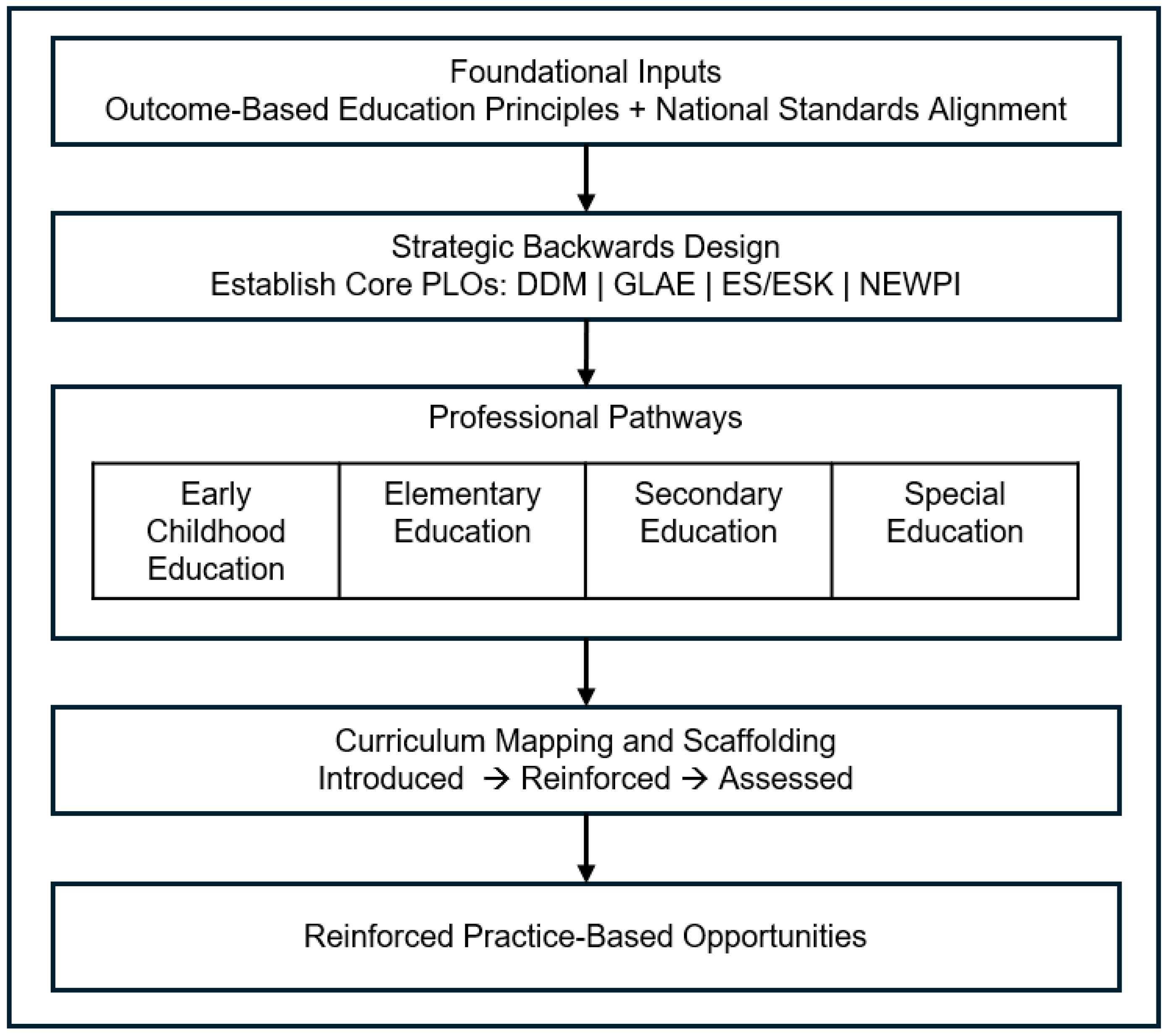
Figure 1. Conceptual Framework for TTP Program Design and Learning Outcomes. Note: Program design and national standard alignments are adapted from the following foundational frameworks: Outcome-Based Education principles (Ross, 2012); the Interstate Teacher Assessment and Support Consortium [InTASC] standards (Council of Chief State School Officers [CCSSO], 2013); the International Society for Technology in Education [ISTE] standards (Crompton, 2023); the Council for Exceptional Children [CEC] standards (CEC, 2020); the National Association for the Education of Young Children [NAEYC] standards (NAEYC, 2010); and local institutional initiatives (MLFC, 2024). Arrows represent progressive alignment and operationalization across program-design components, whereby foundational principles inform program learning outcomes, which are subsequently specified across professional pathways, scaffolded through curriculum mapping, and enacted through practice-based learning opportunities. Arrows indicate conceptual relationships rather than causal effects.
Education 16 01308 g001
Table 1. Participant Demographic Characteristics by Degree and Program Type.
Variable/LevelUndergraduate
n
Graduate
n
Total
ECESSESPEDTotalECESSESPED
Total sample113618470391724292282
Gender
  Male0671279136212
  Female113011268312621232070
Ethnicity
  Hispanic/Latino0525423129169420
  White16910835214515171148
  Asian06931802338
  Black or African American0333900123
  American Indian/Alaska Native0121400022
  Two or more races04631301001
  Not available0122510001
Prior work as educator
  No11141585432831318741
  Yes020201656410111439
Plans to teach
  No071612400101
  Yes18311244241515191554
Reports teaching to be their ideal career
  Strongly agree1404820109376723
  Agree0375419111048517
  Neither agree nor disagree01218333133310
  Disagree02711010304
  Strongly disagree0001101001
Note. EC = Early Childhood Education. ES = Elementary Education. SE = Secondary Education. SPED = Special Education. Data are presented for all who completed the item.
Table 2. Subscale Averages by Pathway.
Degree Program DDMGLEAES(K)NEWPI
ProgEffProgEffProgEffProgEff
nM (SD)M (SD)M (SD)M (SD)M (SD)M (SD)M (SD)M (SD)
Undergrad3923.35 (0.55)3.33 (0.54)3.36 (0.51)3.36 (0.52)3.28 (0.57)3.27 (0.56)3.26 (0.57)3.26 (0.59)
EC 14.00 (-)4.00 (-)4.00 (-)4.00 (-)4.00 (-)4.00 (-)4.00 (-)4.00 (-)
ELEM1363.46 (0.45)3.42 (0.48)3.45 (0.45)3.43 (0.46)3.31 (0.52)3.27 (0.52)3.37 (0.47)3.35 (0.47)
SEC1843.27 (0.60)3.26 (0.58)3.28 (0.56)3.29 (0.56)3.27 (0.62)3.27 (0.59)3.18 (0.65)3.17 (0.68)
SPED703.32 (0.55)3.34 (0.50)3.37 (0.48)3.43 (0.47)3.27 (0.53)3.26 (0.54)3.27 (0.49)3.32 (0.48)
Grad833.47 (0.61)3.41 (0.60)3.59 (0.59)3.59 (0.56)3.47 (0.70)3.51 (0.58)3.46 (0.68)3.45 (0.67)
EC 73.57 (0.60)3.73 (0.38)3.64 (0.41)3.64 (0.41)3.63 (0.53)3.73 (0.38)3.25 (1.06)3.25 (0.73)
ELEM243.30 (0.79)3.21 (0.79)3.39 (0.79)3.36 (0.81)3.09 (0.96)3.30 (0.83)3.28 (0.80)3.41 (0.83)
SEC303.37 (0.53)3.33 (0.49)3.56 (0.55)3.62 (0.44)3.48 (0.58)3.47 (0.49)3.39 (0.60)3.33 (0.67)
SPED223.73 (0.46)3.59 (0.55)3.81 (0.38)3.75 (0.42)3.75 (0.45)3.66 (0.44)3.77 (0.42)3.72 (0.44)
Note. DDM = Education Design and Decision Making; GLEA = Professional Growth, Leadership, Advocacy, and Ethics; NEWPI = Next Education Workforce and Principled Innovation initiatives; ES(K) = Educator Scholar (and Integrative Knowledge). Program (Prog) refers to the extent to which respondents believe their program covered the skill set. Efficacy (Eff) refers to respondents’ self-efficacy with the given skill set. Items are rated on a 4-point scale. SD was replaced with “-“ when fewer than five students completed the responses to the subscale. Undergrad = undergraduate. Grad = graduate. EC = early childhood. ELEM = elementary education. SEC = secondary education. SPED = special education.
Table 3. ANOVA for Subscale Means by Program Type.
Degree/Domain/
Outcome
Effect of Program TypeResiduals
SSMSFpDFSSMS
Undergraduate
DDM—Program1.121.234.180.04 *24572.350.30
Efficacy0.570.571.9740.16124370.180.29
GLEA—Program0.600.602.280.1324864.870.26
Efficacy0.150.150.540.4624465.410.27
ES(K)—Program0.120.120.370.5424880.930.33
Efficacy0.020.020.060.8024476.380.31
NEWPI—Program0.850.852.610.1124780.780.33
Efficacy0.340.340.990.3224484.690.35
Graduate
DDM—Program0.660.661.800.195520.090.37
Efficacy0.100.100.270.615319.280.36
GLEA—Program0.760.762.260.145418.120.34
Efficacy0.580.581.910.175316.210.31
ES(K)—Program1.571.573.330.075525.880.47
Efficacy0.210.210.620.445317.870.34
NEWPI—Program1.861.864.310.04 *5423.280.43
Efficacy0.970.972.220.145323.170.44
Note. DF = degrees of freedom; SS = Sum of Square; MS = Mean Square; F = F statistic; DDM = Education Design and Decision Making; GLEA = Professional Growth, Leadership, Advocacy, and Ethics; NEWPI = Next Education Workforce and Principled Innovation initiatives; ES(K) = Educator Scholar and Integrative Knowledge. * indicates significant at p < 0.05 level. Degrees of freedom for effect of program type were 1 for all tests conducted.
Table 4. Relation Between Program and Self-Efficacy Rating.
Degree ProgramDDMGLEAES(K)NEWPI
nrpnrpnrpnrp
Undergrad2440.83<0.012470.81<0.012470.84<0.012470.88<0.01
 EC------------
 ELEM850.85<0.01840.74<0.01850.82<0.01850.89<0.01
 SEC1170.84<0.011190.82<0.011180.86<0.011180.90<0.01
 SPED400.69<0.01420.84<0.01420.83<0.01420.75<0.01
Grad550.87<0.01550.80<0.01550.71<0.01550.88<0.01
 EC 50.98<0.0151.00<0.0151.00<0.0150.93<0.01
 ELEM140.87<0.01140.88<0.01140.58<0.01140.90<0.01
 SEC210.90<0.01200.60<0.01190.93<0.01200.90<0.01
 SPED150.81<0.01160.81<0.01170.70<0.01160.82<0.01
Note. Only one undergraduate student reported being in the Early Childhood Education program, so we could not estimate a correlation with n = 1. DDM = Education Design and Decision Making; GLEA = Professional Growth, Leadership, Advocacy, and Ethics; NEWPI = Next Education Workforce and Principled Innovation initiatives; ES(K) = Educator Scholar (and Integrative Knowledge). Undergrad = undergraduate. Grad = graduate. EC = early childhood. ELEM = elementary education. SEC = secondary education. SPED = special education.
Table 5. Item-Level Statistics—Current Teaching Practices.
ItemUndergraduateGraduate
nMSDnMSD
(1) Set challenging and appropriate goals for student learning and performance.2634.400.67554.560.57
(2) Plan instruction aligned with state standards.2634.530.66554.710.46
(3) Develop lessons that build on student experiences, interests, and abilities.2614.480.64554.560.63
(4) Maintain discipline and an orderly, purposeful learning environment2634.250.88554.620.59
(5) Develop positive and supportive relationships with students.2634.730.48554.750.48
(6) Develop a classroom environment that promotes respect and group responsibility.2624.630.58554.640.68
(7) Differentiate instruction based on student needs.2644.340.76554.510.84
(8) Provide purposeful feedback to students to guide their learning.2624.460.66554.670.51
(9) Help students think critically and solve problems.2624.360.73554.600.53
(10) Use technology in the classroom to improve learning outcomes.2634.460.72554.600.60
(11) Use a variety of assessments (e.g., tests, observations, portfolios, performance tasks) to monitor student learning.2634.400.69554.470.66
(12) Help students assess their own learning.2644.270.81554.450.66
(13) Analyze student performance data to improve effectiveness.2624.370.76554.580.69
(14) Work with parents and families to better understand and to support their learning.2634.100.97554.670.61
Note. CTPs 1, 2, 7, 8, 11, 12, and 13 = instructional practices; CTPs 4, 5, and 6 = classroom management; CTPs 3, 9, 10, and 14 = student engagement.
Table 6. ANOVA for Current Teaching Practices (CTP) Items by Program Type.
Program Type/ItemEffect of Program TypeResiduals
SSMSFpDFSSMS
Undergraduate
(1) Set learning goals0.020.020.050.83260118.700.46
(2) Align standards0.140.140.310.58260115.180.44
(3) Develop lessons0.090.090.220.64258104.820.41
(4) Maintain discipline0.360.360.460.50260201.020.77
(5) Relationships0.010.010.050.8226059.750.23
(6) Promote respect0.200.200.580.4525988.750.34
(7) Differentiate<0.01<0.01<0.010.98261150.900.58
(8) Provide feedback0.090.090.230.64259108.880.42
(9) Critical thinking0.070.071.140.71259134.620.52
(10) Use technology0.070.070.140.71260131.180.50
(11) Use assessments0.270.270.580.45260122.840.47
(12) Students assess0.080.080.130.72261168.650.65
(13) Analyze data0.030.030.060.81259148.920.58
(14) Families0.960.961.060.31260236.830.91
Graduate
(1) Set learning goals0.010.010.030.875317.520.33
(2) Align standards0.200.200.940.345311.150.21
(3) Develop lessons0.450.451.120.295321.080.40
(4) Maintain discipline0.790.792.310.135318.190.34
(5) Relationships0.250.251.080.305312.190.23
(6) Promote respect0.120.120.250.625324.610.46
(7) Differentiate0.350.350.490.495337.400.71
(8) Provide feedback0.290.291.110.305313.820.26
(9) Critical thinking0.330.331.180.285314.870.28
(10) Use technology0.330.330.930.345318.870.36
(11) Use assessments0.290.290.650.425323.420.44
(12) Students assess0.430.430.980.335323.210.44
(13) Analyze data0.700.701.510.235324.680.47
(14) Families0.290.290.770.385319.820.37
Note. items in this table are abbreviations from Table 5. Degrees of freedom for effect of program type were 1 for all tests conducted.
Disclaimer/Publisher’s Note: The statements, opinions and data contained in all publications are solely those of the individual author(s) and contributor(s) and not of MDPI and/or the editor(s). MDPI and/or the editor(s) disclaim responsibility for any injury to people or property resulting from any ideas, methods, instructions or products referred to in the content.


