The Paradox of Enjoyment: Unpacking the Relationships Among Enjoyment, Engagement, Burnout, and L2 Achievement Among Left-Behind Students

Abstract
1. Introduction
2. Literature Review
2.1. FLE and L2 Achievement
2.2. LE and L2 Achievement
2.3. LB and L2 Achievement
2.4. Interaction Among Enjoyment, Engagement, Burnout, and School Outcomes
2.5. Left-Behind Children as a “Special” Population
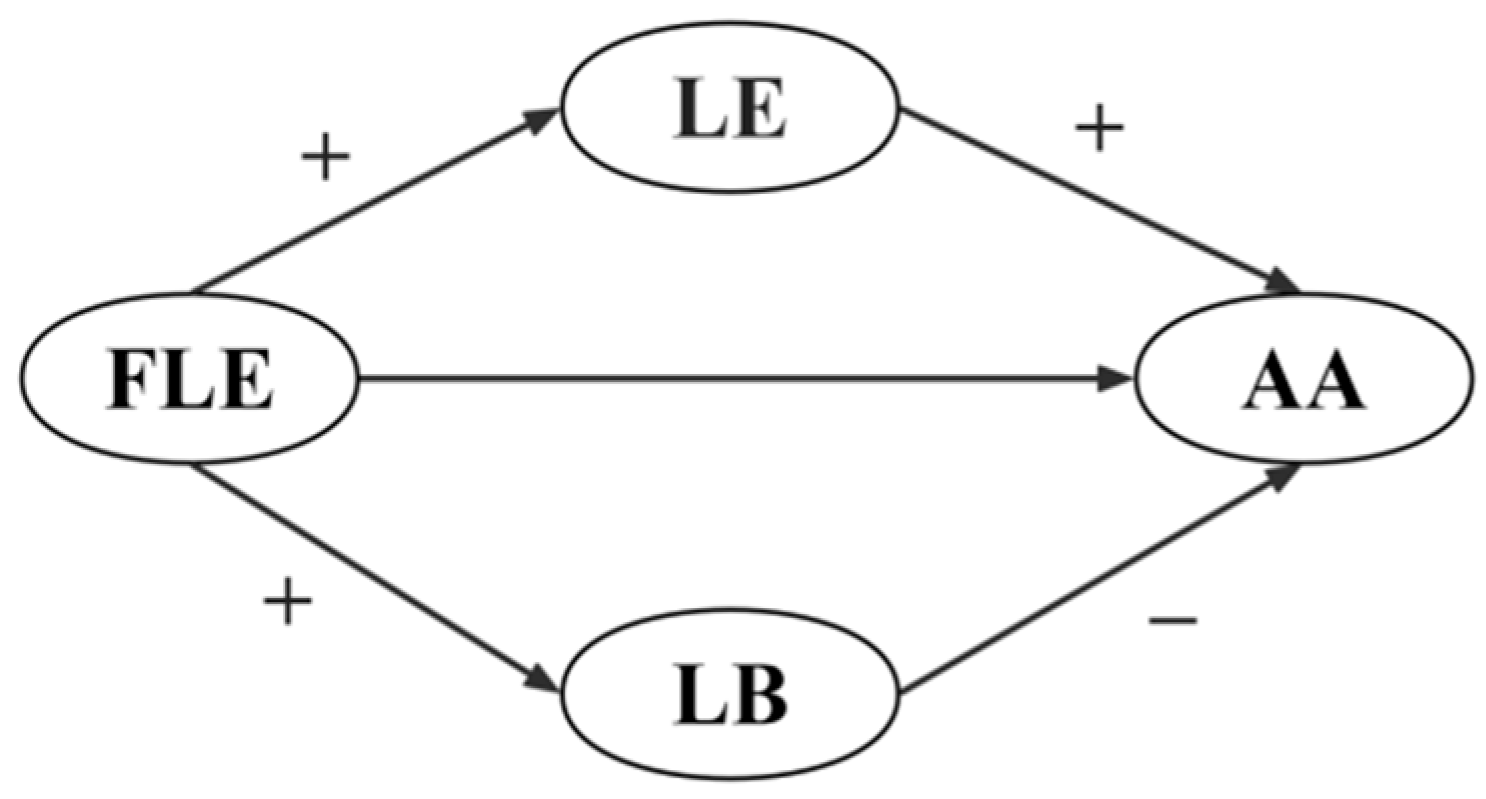
3. Current Study
- RQ1: What are the complex relationships among FLE, LE, and LB among LBC?
- RQ2: Are FLE, LE, and LB associated with L2 academic achievement among LBC?
- RQ3: Does LE serve as a positive mediator in the link between FLE and L2 academic achievement?
- RQ4: Does LB serve as a negative mediator in the link between FLE and L2 academic achievement?
4. Methods
4.1. Participants and Procedures
4.2. Measures
4.2.1. Foreign Language Enjoyment
4.2.2. Learning Engagement
4.2.3. Learning Burnout
4.2.4. Academic Achievement
4.3. Data Analysis
5. Results
5.1. Results of Confirmatory Factor Analysis
5.2. Descriptive Statistics and Preliminary Analyses
5.3. Structural Model
5.4. Path Coefficients and Direct Effects
5.5. Mediation Analysis
6. Discussion
6.1. The Absent Positive Link: Why Enjoyment Fails to Catalyze Achievement?
6.2. Counterintuitive Yet Significant Negative Link: The Paradox of Enjoyment and Burnout
6.3. The Emotional Symphony: Coactivation and Dynamism
6.4. Practical Implications
7. Conclusions
Author Contributions
Funding
Institutional Review Board Statement
Informed Consent Statement
Data Availability Statement
Acknowledgments
Conflicts of Interest
References
- Alqarni, N. A. (2024). Predictors of foreign language proficiency: Emotion regulation, foreign language enjoyment, or academic stress? System, 126, 103462. [Google Scholar] [CrossRef] [Scilit]
- Botes, E., Dewaele, J.-M., & Greiff, S. (2022). Taking stock: A meta-analysis of the effects of foreign language enjoyment. Studies in Second Language Learning and Teaching, 12(2), 205–232. [Google Scholar] [CrossRef] [Scilit]
- Carmona-Halty, M., Salanova, M., Llorens, S., & Schaufeli, W. B. (2021). Linking positive emotions and academic performance: The mediated role of academic psychological capital and academic engagement. Current Psychology, 40(6), 2938–2947. [Google Scholar] [CrossRef] [Scilit]
- Cong, Y., Yang, L., & Ergün, A. L. P. (2024). Exploring the relationship between burnout, learning engagement and academic self-efficacy among EFL learners: A structural equation modeling analysis. Acta Psychologica, 248, 104394. [Google Scholar] [CrossRef] [Scilit] [PubMed]
- Derakhshan, A., & Azari Noughabi, M. (2024). A self-determination perspective on the relationships between EFL learners’ foreign language peace of mind, foreign language enjoyment, psychological capital, and academic engagement. Learning and Motivation, 87, 102025. [Google Scholar] [CrossRef] [Scilit]
- Derakhshan, A., Dewaele, J. M., & Azari Noughabi, M. (2022). Modeling the contribution of resilience, well-being, and L2 grit to foreign language teaching enjoyment among Iranian English language teachers. System, 109, 102890. [Google Scholar] [CrossRef] [Scilit]
- Derakhshan, A., & Fathi, J. (2024). Longitudinal exploration of interconnectedness through a cross-lagged panel design: Enjoyment, anxiety, willingness to communicate, and L2 grit in English language learning. Journal of Multilingual and Multicultural Development, 46, 2393705. [Google Scholar] [CrossRef] [Scilit]
- Derakhshan, A., & Yin, H. (2024). Do positive emotions prompt students to be more active? Unraveling the role of hope, pride, and enjoyment in predicting Chinese and Iranian EFL students’ academic engagement. Journal of Multilingual and Multicultural Development, 46, 3099–3117. [Google Scholar] [CrossRef] [Scilit]
- Dewaele, J. M., & Li, C. (2021). Teacher enthusiasm and students’ social-behavioral learning engagement: The mediating role of student enjoyment and boredom in Chinese EFL classes. Language Teaching Research, 25(6), 922–945. [Google Scholar] [CrossRef] [Scilit]
- Dewaele, J. M., & MacIntyre, P. D. (2014). The two faces of Janus? Anxiety and enjoyment in the foreign language classroom. Studies in Second Language Learning and Teaching, 4(2), 237–274. [Google Scholar] [CrossRef] [Scilit]
- Dewaele, J. M., & MacIntyre, P. D. (2016). Foreign language enjoyment and foreign language classroom anxiety: The right and left feet of the language learner. In T. Gregersen, P. D. MacIntyre, & S. Mercer (Eds.), Positive psychology in SLA (pp. 215–236). Multilingual Matters. [Google Scholar]
- Dong, S., Wang, H., & Dong, J. (2026). The complex interactions between foreign language emotions and engagement in AI-assisted EFL classrooms. System, 137, 103900. [Google Scholar] [CrossRef] [Scilit]
- Emerson, D. J., Hair, J. F., & Smith, K. J. (2022). Psychological distress, burnout, and business student turnover: The role of resilience as a coping mechanism. Research in Higher Education, 64, 228–259. [Google Scholar] [CrossRef] [Scilit] [PubMed]
- Fan, N., Yang, C., Kong, F., & Zhang, Y. (2024). Low- to mid-level high school first-year EFL learners’ growth language mindset, grit, burnout, and engagement: Using serial mediation models to explore their relationships. System, 125, 103397. [Google Scholar] [CrossRef] [Scilit]
- Fellmeth, G., Rose-Clarke, K., Zhao, C., Busert, L. K., Zheng, Y., Massazza, A., Sonmez, H., Eder, B., Blewitt, A., Lertgrai, W., & Devakumar, D. (2018). Health impacts of parental migration on left-behind children and adolescents: A systematic review and meta-analysis. The Lancet, 392(10164), 2567–2582. [Google Scholar] [CrossRef] [Scilit] [PubMed]
- Feng, E., & Hong, G. (2022). Engagement mediates the relationship between emotion and achievement of Chinese EFL learners. Frontiers in Psychology, 13, 895594. [Google Scholar] [CrossRef] [Scilit] [PubMed]
- Fredricks, J. A. (2011). Engagement in school and out-of-school contexts: A multidimensional view of engagement. Theory into Practice, 50(4), 327–335. [Google Scholar] [CrossRef] [Scilit]
- Fredricks, J. A., Blumenfeld, P. C., & Paris, A. H. (2004). School engagement: Potential of the concept, state of the evidence. Review of Educational Research, 74(1), 59–109. [Google Scholar] [CrossRef] [Scilit]
- Fredricks, J. A., & McColskey, W. (2012). The measurement of student engagement: A comparative analysis of various methods and student self-report instruments. In Handbook of research on student engagement (pp. 763–782). Springer. [Google Scholar]
- Fredrickson, B. L. (2004). The broaden-and-build theory of positive emotions. Philosophical Transactions of the Royal Society of London. Series B: Biological Sciences, 359, 1367–1377. [Google Scholar] [CrossRef] [Scilit] [PubMed]
- Hobfoll, S. E. (1989). Conservation of resources: A new attempt at conceptualizing stress. American Psychologist, 44(3), 513–524. [Google Scholar] [CrossRef] [PubMed]
- Hobfoll, S. E., Halbesleben, J., Neveu, J.-P., & Westman, M. (2018). Conservation of resources in the organizational context: The reality of resources and their consequences. Annual Review of Organizational Psychology and Organizational Behavior, 5, 103–128. [Google Scholar] [CrossRef] [Scilit]
- Hu, B., Wu, H., Winsler, A., Fan, X., & Song, Z. (2020). Parent migration and rural preschool children’s early academic and social skill trajectories in China: Are ‘left-behind’ children really left behind? Early Childhood Research Quarterly, 51, 317–328. [Google Scholar] [CrossRef] [Scilit]
- Hu, L., & Wang, Y. (2023). The predicting role of EFL teachers’ immediacy behaviors in students’ willingness to communicate and academic engagement. BMC Psychology, 11(1), 318. [Google Scholar] [CrossRef] [Scilit] [PubMed]
- Hu, L. T., & Bentler, P. M. (1999). Cutoff criteria for fit indexes in covariance structure analysis: Conventional criteria versus new alternatives. Structural Equation Modeling: A Multidisciplinary Journal, 6(1), 1–55. [Google Scholar] [CrossRef] [Scilit]
- Hu, Q., Zhou, Y., Xu, C., Xu, C., Hu, F., English, A. S., Buschkuehl, M., Jaeggi, S. M., & Zhang, Q. (2024). The Relationship between socioeconomic status and academic achievement is mediated and moderated by executive functions. Journal of Youth and Adolescence, 53, 1593–1604. [Google Scholar] [CrossRef] [Scilit] [PubMed]
- Huang, Y., & Gong, H. (2022). Educational expectations of left-behind children in China: Determinants and gender differences. Applied Research in Quality of Life, 17(5), 2501–2523. [Google Scholar] [CrossRef] [Scilit]
- Huttunen, I., Upadyaya, K., & Salmela-Aro, K. (2024). Longitudinal associations between adolescents’ social-emotional skills, school engagement, and school burnout. Learning and Individual Differences, 115, 102537. [Google Scholar] [CrossRef] [Scilit]
- Jiang, S., Ren, Q., Jiang, C., & Wang, L. (2021). Academic stress and depression of Chinese adolescents in junior high schools: Moderated mediation model of school burnout and self-esteem. Journal of Affective Disorders, 295, 384–389. [Google Scholar] [CrossRef] [Scilit] [PubMed]
- Jiang, Y., & Dewaele, J. M. (2019). How unique is the foreign language classroom enjoyment and anxiety of Chinese EFL learners? System, 82, 13–25. [Google Scholar] [CrossRef] [Scilit]
- King, R. B., McInerney, D. M., Ganotice, F. A., Jr., & Villarosa, J. B. (2015). Positive affect catalyzes academic engagement: Cross-sectional, longitudinal, and experimental evidence. Learning and Individual Differences, 39, 64–72. [Google Scholar] [CrossRef] [Scilit]
- Kline, R. B. (2023). Principles and practice of structural equation modeling (5th ed.). The Guilford Press. [Google Scholar]
- Li, C. (2020). A positive psychology perspective on Chinese EFL students’ trait emotional intelligence, foreign language enjoyment and EFL learning achievement. Journal of Multilingual and Multicultural Development, 41(3), 246–263. [Google Scholar] [CrossRef] [Scilit]
- Li, C., Jiang, G., & Dewaele, J. M. (2018). Understanding Chinese high school students’ foreign language enjoyment: Validation of the Chinese version of the foreign language enjoyment scale. System, 76, 183–196. [Google Scholar] [CrossRef] [Scilit]
- Li, C., Pawlak, M., & Kruk, M. (2023). Achievement emotions and control-value appraisals in foreign language learning. Journal of Multilingual and Multicultural Development, 46, 364–378. [Google Scholar] [CrossRef] [Scilit]
- Li, C., Zhang, L. J., & Jiang, G. (2021). Conceptualization and measurement of foreign language learning burnout among Chinese EFL students. Journal of Multilingual and Multicultural Development, 45, 906–920. [Google Scholar] [CrossRef] [Scilit]
- Li, J., King, R. B., & Wang, C. (2022). Profiles of motivation and engagement in foreign language learning: Associations with emotional factors, academic achievement, and demographic features. System, 108, 102820. [Google Scholar] [CrossRef] [Scilit]
- Liu, H., Jin, L., Han, X., & Wang, H. (2024). Unraveling the relationship between English learning burnout and academic achievement: The mediating role of English learning resilience. Behavioral Sciences, 14, 1124. [Google Scholar] [CrossRef] [Scilit] [PubMed]
- Liu, H., Yao, M., & Li, J. (2020). Chinese adolescents’ achievement goal profiles and their relation to academic burnout, learning engagement, and test anxiety. Learning and Individual Differences, 83–84, 101945. [Google Scholar] [CrossRef] [Scilit]
- Luan, L., Jing, B., Hong, J., & Lin, P. (2025). The mediating effects of online learning engagement on the relationship between Chinese university students’ L2 grit and their English language achievement. System, 31, 103689. [Google Scholar] [CrossRef] [Scilit]
- Ma, Y. (2024). The impact of academic self-efficacy and academic motivation on Chinese EFL students’ academic burnout. Learning and Motivation, 85, 101959. [Google Scholar] [CrossRef] [Scilit]
- MacIntyre, P., & Gregersen, T. (2012). Emotions that facilitate language learning: The positive-broadening power of the imagination. Studies in Second Language Learning and Teaching, 2, 193. [Google Scholar] [CrossRef] [Scilit]
- Madigan, D. J., & Curran, T. (2021). Does burnout affect academic achievement? A meta analysis of over 100,000 students. Educational Psychology Review, 33(2), 387–405. [Google Scholar] [CrossRef] [Scilit]
- Maslach, C., & Pines, A. (1977). The burn-out syndrome in the day care setting. Child Care Quarterly, 6, 100–113. [Google Scholar] [CrossRef] [Scilit]
- Mercer, S., & Dornyei, Z. (2020). Engaging language learners in contemporary classrooms. Cambridge University Press. [Google Scholar] [CrossRef] [Scilit]
- Motti-Stefanidi, F., Masten, A., & Asendorpf, J. (2015). School engagement trajectories of immigrant youth. International Journal of Behavioral Development, 39(1), 32–42. [Google Scholar] [CrossRef] [Scilit]
- Olivier, E., Archambault, I., De Clercq, M., & Galand, B. (2018). Student self-efficacy, classroom engagement, and academic achievement: Comparing three theoretical frameworks. Journal of Youth and Adolescence, 48(2), 326–340. [Google Scholar] [CrossRef] [Scilit] [PubMed]
- Pekrun, R. (2006). The control-value theory of achievement emotions: Assumptions, corollaries, and implications for educational research and practice. Educational Psychology Review, 18(4), 315–341. [Google Scholar] [CrossRef] [Scilit]
- Pekrun, R., Elliot, A. J., & Maier, M. A. (2009). Achievement goals and achievement emotions: Testing a model of their joint relations with academic performance. Journal of Educational Psychology, 101(1), 115–135. [Google Scholar] [CrossRef] [Scilit]
- Pekrun, R., & Linnenbrink-Garcia, L. (2012). Academic emotions and student engagement. In S. L. Christenson, A. L. Reschly, & C. Wylie (Eds.), Handbook of research on student engagement (pp. 259–282). Springer. [Google Scholar] [CrossRef] [Scilit]
- Peng, J., & MacIntyre, P. D. (2025). Directional or reciprocal? A random intercept cross-lagged panel analysis of the relationships between emotions, motivation, willingness to communicate, and L2 achievement. Learning and Individual Difference, 118, 102638. [Google Scholar] [CrossRef] [Scilit]
- Perkmann, M., Salandra, R., Tartari, V., McKelvey, M., & Hughes, A. (2021). Academic engagement: A review of the literature 2011–2019. Research Policy, 50(1), 104114. [Google Scholar] [CrossRef] [Scilit]
- Qiu, H., Liang, X., & Dan, S. (2024). Parental migration, sibling migration, and the educational outcomes of children left behind in rural China. Children and Youth Services Review, 157, 107392. [Google Scholar] [CrossRef] [Scilit]
- Reeve, J. (2012). A self-determination theory perspective on student engagement. In S. L. Christenson, A. L. Reschly, & C. Wylie (Eds.), Handbook of research on student engagement (pp. 149–172). Springer. [Google Scholar] [CrossRef] [Scilit]
- Reeve, J., & Tseng, C. M. (2011). Agency as a fourth aspect of students’ engagement during learning activities. Contemporary Educational Psychology, 36(4), 257–267. [Google Scholar] [CrossRef] [Scilit]
- Salmela-Aro, K., Kiuru, N., Pietikainen, M., & Jokela, J. (2008). Does school matter? The role of school context in adolescents’ school-related burnout. European Psychologist, 13, 12–23. [Google Scholar] [CrossRef] [Scilit]
- Salmela-Aro, K., Read, S., Minkkinen, J., Kinnunen, J. M., & Rimpelä, A. (2018). Immigrant status, gender, and school burnout in Finnish lower secondary school students: A longitudinal study. International Journal of Behavioral Development, 42(2), 225–236. [Google Scholar] [CrossRef] [Scilit]
- Salmela-Aro, K., & Upadyaya, K. (2014). School burnout and engagement in the context of demands-resources model. British Journal of Educational Psychology, 84(1), 137–151. [Google Scholar] [CrossRef] [Scilit] [PubMed]
- Schaufeli, W. B., Martinez, I. M., Pinto, A. M., Salanova, M., & Bakker, A. B. (2002). Burnout and engagement in university students: A cross-national study. Journal of Cross-Cultural Psychology, 33(5), 464–481. [Google Scholar] [CrossRef] [Scilit]
- Shi, A., Xu, C., Zhao, W., Shanks, D. R., Hu, X., Luo, L., & Yang, C. (2022). Judgments of learning reactively facilitate visual memory by enhancing learning engagement. Psychonomic Bulletin & Review, 30, 676–687. [Google Scholar] [CrossRef] [Scilit] [PubMed]
- Song, Y. (2024). Assessing the interactions between learning enjoyment, motivation, burnout, and grit in EFL students: A mixed-methods approach. BMC Psychology, 12, 796. [Google Scholar] [CrossRef] [Scilit] [PubMed]
- Sukamto, I., Ayriza, Y., Hiryanto, Kumullah, R., Ero, P. E. L., Purwandari, S., Lince, R., & Maulina, D. (2026). Understanding academic burnout: A systematic literature review of its risk and protective factors. Social Sciences & Humanities Open, 13, 102441. [Google Scholar] [CrossRef] [Scilit]
- Tan, J., Mao, J., Jiang, Y., & Gao, M. (2021). The influence of academic emotions on learning effects: A systematic review. International Journal of Environmental Research and Public Health, 18(18), 9678. [Google Scholar] [CrossRef] [Scilit] [PubMed]
- Wang, H., Wang, Y., & Li, S. (2023). Unpacking the relationships between emotions and achievement of EFL learners in China: Engagement as a mediator. Frontiers in Psychology, 14, 1098916. [Google Scholar] [CrossRef] [Scilit] [PubMed]
- Wang, L., & Wang, L. (2025). Exploring enjoyment, motivation, self-efficacy, and engagement in AI-assisted English learning: A self-determination theory approach. Learning and Motivation, 92, 102197. [Google Scholar] [CrossRef] [Scilit]
- Wang, M., Chow, A., Hofkens, T., & Salmela-Aro, K. (2015). The trajectories of student emotional engagement and school burnout with academic and psychological development: Findings from Finnish adolescents. Learning and Instruction, 36, 57–65. [Google Scholar] [CrossRef] [Scilit]
- Wang, Y., Cao, Y., Gong, S., Wang, Z., Li, N., & Ai, L. (2022). Interaction and learning engagement in online learning: The mediating roles of online learning self-efficacy and academic emotions. Learning and Individual Differences, 94(2), 102128. [Google Scholar] [CrossRef] [Scilit]
- Wang, Y., Derakhshan, A., & Zhang, L. J. (2021). Researching and practicing positive psychology in second/foreign language learning and teaching: The past, current status and future directions. Frontiers in Psychology, 12, 731721. [Google Scholar] [CrossRef] [Scilit] [PubMed]
- Wang, Y., Tian, L., & Huebner, E. S. (2019). Basic psychological needs satisfaction at school, behavioral school engagement, and academic achievement: Longitudinal reciprocal relations among elementary school students. Contemporary Educational Psychology, 56, 130–139. [Google Scholar] [CrossRef] [Scilit]
- Wang, Y., Xin, Y., & Chen, L. (2024). Navigating the emotional landscape: Insights into resilience, engagement, and burnout among Chinese High School English as a Foreign Language Learners. Learning and Motivation, 86, 101978. [Google Scholar] [CrossRef] [Scilit]
- Wen, M., & Lin, D. (2012). Child development in rural china: Children left behind by their migrant parents and children of nonmigrant families. Child Development, 83(1), 120–136. [Google Scholar] [CrossRef] [Scilit] [PubMed]
- Wen, Y., Hou, W., Zheng, W., Zhao, X., Wang, X., Bo, Q., Pao, C., Tang, Y. L., Tan, T., Li, X. B., & Wang, C. (2021). The neglect of left-behind children in China: A meta-analysis. Trauma, Violence, & Abuse, 22(5), 1326–1338. [Google Scholar] [CrossRef] [Scilit] [PubMed]
- Wu, H., Xiao, Y., & Liu, W. (2025). Beyond emotional exhaustion: Mapping proximal profiles and distal triggers of second language burnout in Chinese high school students. System, 134, 103850. [Google Scholar] [CrossRef] [Scilit]
- Wu, H., Zeng, Y., & Fan, Z. (2024). Unveiling Chinese senior high school EFL students’ burnout and engagement: Profiles and antecedents. Acta Psychologica, 243, 104153. [Google Scholar] [CrossRef] [Scilit] [PubMed]
- Wu, J., & Zhao, Q. (2023). The contribution of mindfulness in the association between L2 learners’ engagement and burnout. Heliyon, 9, e21769. [Google Scholar] [CrossRef] [Scilit] [PubMed]
- Xie, J., Cho, K. W., Wei, T., Xu, J., & Fan, M. (2025). The effects of academic emotions on learning outcomes: A three-level meta-analysis of research conducted between 2000 and 2024. Learning and Motivation, 90, 102109. [Google Scholar] [CrossRef] [Scilit]
- Xu, J., & Feng, X. (2024). Mindsets, resilience and student engagement as predictors of L2 achievement among Chinese English learners: Insights from fuzzy-set qualitative comparative analysis. System, 124, 103358. [Google Scholar] [CrossRef] [Scilit]
- Xu, W., Yan, N., Chen, G., Zhang, X., & Feng, T. (2018). Parent-child separation: The relationship between separation and psychological adjustment among Chinese rural children. Quality of Life Research, 27, 913–921. [Google Scholar] [CrossRef] [Scilit] [PubMed]
- Xu, Y., Chen, S., Ye, Y., Wen, W., Zhen, R., & Zhou, X. (2025). Childhood neglect, depression, and academic burnout in left-behind children in China: Understanding the roles of feelings of insecurity and self-esteem. Child Protection and Practice, 5, 100168. [Google Scholar] [CrossRef] [Scilit]
- Yuan, H., Lv, M., & Wang, W. (2025). Emotions are a product of achievement: A network analysis of middle school students in second language acquisition. System, 132, 103714. [Google Scholar] [CrossRef] [Scilit]
- Zhang, J. Y., Shu, T., Xiang, M., & Feng, Z. C. (2021). Learning burnout: Evaluating the role of social support in medical students. Frontiers in Psychology, 12, 625506. [Google Scholar] [CrossRef] [Scilit] [PubMed]
- Zhang, X., Wang, J., & Ke, X. (2024). An investigation into academic burnout, enjoyment and engagement in EFL learning among Chinese junior high school students. Frontiers in Psychology, 14, 1292772. [Google Scholar] [CrossRef] [Scilit] [PubMed]
- Zhang, Y., Gan, Y., & Cham, H. (2007). Perfectionism, academic burnout and engagement among Chinese college students: A structural equation modeling analysis. Personality and Individual Differences, 43(6), 1529–1540. [Google Scholar] [CrossRef] [Scilit]
- Zhang, Z., Gao, X., & Liu, T. (2024). Enjoyment in foreign language learning: A systematic review. Heliyon, 10, e37215. [Google Scholar] [CrossRef] [Scilit] [PubMed]
- Zhao, X., & Wang, D. (2023). Grit, emotions, and their effects on ethnic minority students’ English language learning achievements: A structural equation modelling analysis. System, 113, 102979. [Google Scholar] [CrossRef] [Scilit]
- Zhen, R., Liu, R.-D., Ding, Y., Wang, J., Liu, Y., & Xu, L. (2017). The mediating roles of academic self-efficacy and academic emotions in the relation between basic psychological needs satisfaction and learning engagement among Chinese adolescent students. Learning and Individual Differences, 54, 210–216. [Google Scholar] [CrossRef] [Scilit]
- Zhou, M., & Wang, X. (2024). The influence of enjoyment, boredom, and burnout on EFL achievement: Based on latent moderated structural equation modeling. PLoS ONE, 19(9), e0310281. [Google Scholar] [CrossRef] [Scilit] [PubMed]
- Zou, M., Noughabi, M. A., & Peng, C. (2025). Modeling the associations between L2 grit, foreign language enjoyment, and student engagement among Chinese EFL English-major learners: A control-value theory perspective. System, 131, 103679. [Google Scholar] [CrossRef] [Scilit]



| Variables | χ2/df | CFI | TLI | RMSEA (90% CI) | SRMR |
|---|---|---|---|---|---|
| FLE | 8.97 | 0.950 | 0.941 | 0.099 (0.089–0.109) | 0.040 |
| LE | 8.00 | 0.962 | 0.954 | 0.083 (0.077–0.089) | 0.030 |
| LB | 6.42 | 0.942 | 0.913 | 0.073 (0.064–0.081) | 0.050 |
| Variables | M | SD | Skewness | Kurtosis | Cronbach’s α |
|---|---|---|---|---|---|
| FLE | 3.20 | 0.95 | 0.00 | −0.37 | 0.926 |
| LE | 3.18 | 0.94 | 0.14 | −0.23 | 0.965 |
| LB | 2.76 | 0.84 | 0.54 | 0.48 | 0.866 |
| Variables | AA | FLE | LE | LB |
|---|---|---|---|---|
| AA | 1 | |||
| FLE | 0.232 ** | 1 | ||
| LE | 0.171 ** | 0.623 ** | 1 | |
| LB | −0.107 ** | 0.162 ** | 0.128 ** | 1 |
| Fitting Parameter | Value | Reference Standard |
|---|---|---|
| χ2 | 188.73 | |
| df | 14 | |
| CFI | 0.962 | >0.90 |
| TLI | 0.929 | >0.90 |
| RMSEA | 0.096 | <0.08 |
| RMSEA 90% CI | [0.830, 0.109] | |
| SRMR | 0.067 | <0.08 |
| Path Direction | β | SE | 95% CI |
|---|---|---|---|
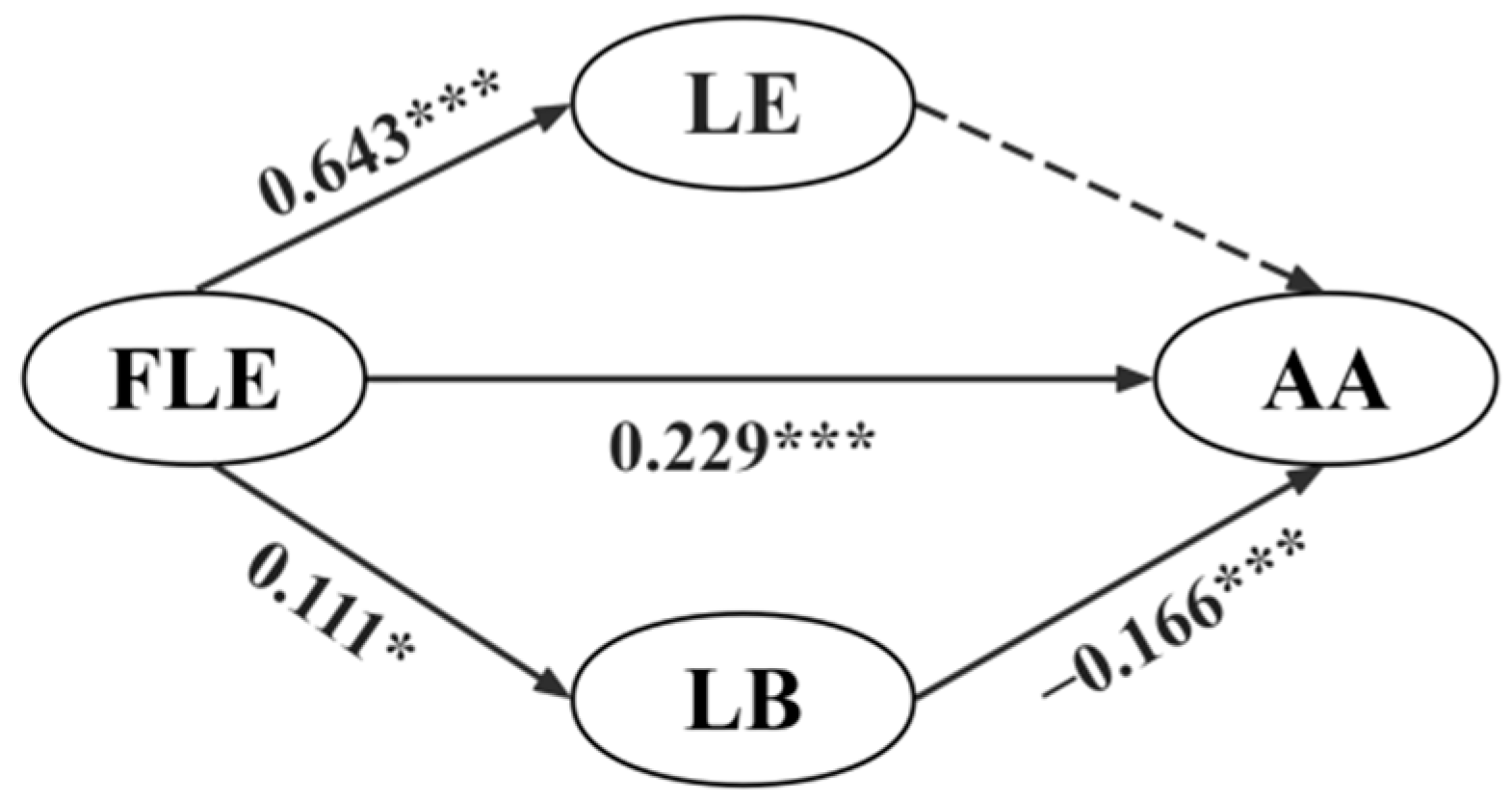
| FLE → LE | 0.643 *** | 0.025 | [0.612, 0.685] |
| FLE → LB | 0.111 * | 0.050 | [0.012, 0.203] |
| LE → AA | 0.037 | 0.041 | [−0.038, 0.118] |
| LB → AA | −0.166 *** | 0.032 | [−0.257, −0.100] |
| FLE → AA (direct effect) | 0.229 *** | 0.037 | [0.152, 0.288] |
| Mediating Path | β | SE | 95% BCa CI | Significance |
|---|---|---|---|---|
| FLE → LE → AA | 0.025 | 0.025 | [−0.025, 0.073] | Nonsignificant |
| FLE → LB → AA | −0.021 | 0.007 | [−0.048, −0.001] | Significant |
| Total indirect effect | 0.005 | 0.025 | [−0.049, 0.056] | Nonsignificant |
| Direct effect | 0.226 | 0.032 | [0.153, 0.283] | Significant |
| Total effect | 0.231 | 0.029 | [0.174, 0.287] | Significant |
Disclaimer/Publisher’s Note: The statements, opinions and data contained in all publications are solely those of the individual author(s) and contributor(s) and not of MDPI and/or the editor(s). MDPI and/or the editor(s) disclaim responsibility for any injury to people or property resulting from any ideas, methods, instructions or products referred to in the content. |
© 2026 by the authors. Licensee MDPI, Basel, Switzerland. This article is an open access article distributed under the terms and conditions of the Creative Commons Attribution (CC BY) license.
Share and Cite
Guan, J.; Liu, Y.; Wang, Y. The Paradox of Enjoyment: Unpacking the Relationships Among Enjoyment, Engagement, Burnout, and L2 Achievement Among Left-Behind Students. Educ. Sci. 2026, 16, 1239. https://doi.org/10.3390/educsci16081239
Guan J, Liu Y, Wang Y. The Paradox of Enjoyment: Unpacking the Relationships Among Enjoyment, Engagement, Burnout, and L2 Achievement Among Left-Behind Students. Education Sciences. 2026; 16(8):1239. https://doi.org/10.3390/educsci16081239
Chicago/Turabian StyleGuan, Jiayi, Yinuo Liu, and Yapeng Wang. 2026. "The Paradox of Enjoyment: Unpacking the Relationships Among Enjoyment, Engagement, Burnout, and L2 Achievement Among Left-Behind Students" Education Sciences 16, no. 8: 1239. https://doi.org/10.3390/educsci16081239
APA StyleGuan, J., Liu, Y., & Wang, Y. (2026). The Paradox of Enjoyment: Unpacking the Relationships Among Enjoyment, Engagement, Burnout, and L2 Achievement Among Left-Behind Students. Education Sciences, 16(8), 1239. https://doi.org/10.3390/educsci16081239