The Need to Experience Something New: Novelty as a Basic Psychological Need in University Students

Abstract
1. Introduction
1.1. Theoretical Framework
1.1.1. Basic Psychological Needs Theory
1.1.2. Novelty as a BPN
Novelty and perceived competence, therefore, represent two essential aspects of intrinsic motivation derived from original conceptualizations of the construct in self-determination theory. It is therefore surprising that competence has been conceived as a basic psychological need, the object of study of many studies, while novelty has not received comparable attention.(p. 160)
1.1.3. Novelty as Essential to Growth and Well-Being
Our interactions with art objects epitomize what it means to undergo an experience, a term with a very special meaning for Dewey. The arts do more than provide us with fleeting moments of elation and delight. They expand our horizons. They contribute meaning and value to future experience. They modify our ways of perceiving the world, thus leaving us and the world itself irrevocably changed.(p. 33)
1.1.4. Novelty as a Universal Need
1.1.5. Proposed Model
1.1.6. Current Research
1.1.7. Ethical Statement
2. Study 1: U.S. Sample
2.1. Materials and Methods
2.1.1. Procedure
2.1.2. Participants
2.1.3. Measures
2.1.4. Analysis
2.2. Results
2.2.1. Descriptive Statistics
2.2.2. Path Analysis Results
2.3. Discussion
3. Study 2: Kuwaiti Sample
3.1. Method
3.1.1. Procedure
3.1.2. Participants
3.1.3. Measures
3.1.4. Analysis
3.2. Results
3.2.1. Descriptive Statistics
3.2.2. Path Analysis Results
3.3. Discussion
4. General Discussion
4.1. Limitations and Future Directions
4.2. Implications
4.3. Conclusions
Supplementary Materials
Author Contributions
Funding
Institutional Review Board Statement
Informed Consent Statement
Data Availability Statement
Conflicts of Interest
| 1 | Our original intent, when we planned to include the U.S. and Kuwaiti samples in a single study, was to recruit 200 participants from each country. |
| 2 | Completing at least one teacher education course was a selection requirement as the study involved reflecting on teacher education course experience. |
| 3 | Rasch analysis could not be used on these measures as it requires items representing a range of performance. |
| 4 | These recommendations are for Cohen’s d. Interpretations of path coefficients are commonly based on Cohen’s rules of thumb for interpreting Cohen’s d. |
| 5 | Pugh et al. (2021, 2023) did include self-efficacy as a predictor along with interest. Self-efficacy is conceptually related to competence. |
References
- Alardhi, Y., & Pugh, K. J. (2025). The relationship between autonomy, relatedness, and students’ transformative experience: A cross-cultural study. Frontiers, 16, 1–15. [Google Scholar] [CrossRef]
- Alongi, M. C., Heddy, B. C., & Sinatra, G. M. (2016). Real-world engagement with controversial issues in history and social studies: Teaching for transformative experiences and conceptual change. Journal of Social Science Education, 15(2), 26–41. [Google Scholar] [CrossRef]
- Bagheri, L., & Milyavskaya, M. (2020). Novelty–variety as a candidate basic psychological need: New evidence across three studies. Motivation and Emotion, 44(1), 32–53. [Google Scholar] [CrossRef]
- Bond, T. G., & Fox, C. M. (2001). Applying the Rasch model: Fundamental measurement in the human sciences. Erlbaum. [Google Scholar]
- Brown, T. A. (2015). Confirmatory factor analysis for applied research (2nd ed.). Guilford Press. [Google Scholar]
- Byrne, B. M. (1994). Structural equation modeling with EQS and EQS/windows. Sage. [Google Scholar]
- Chen, C., Lee, S., & Stevenson, H. W. (1995). Response style and cross-cultural comparisons of rating scales among East Asian and North American students. Psychological Science, 6(3), 170–175. [Google Scholar] [CrossRef]
- Cheng, R. W., Shu, T., Zhou, N., & Lam, S. (2016). Motivation of Chinese learners: An integration of etic and emic approaches. In R. King, & A. Bernardo (Eds.), The psychology of Asian learners (pp. 355–368). Springer Singapore. [Google Scholar] [CrossRef]
- Chirkov, V., Ryan, R. M., Kim, Y., & Kaplan, U. (2003). Differentiating autonomy from individualism and independence: A self-determination theory perspective on internalization of cultural orientations and well-being. Journal of Personality and Social Psychology, 84(1), 97–110. [Google Scholar] [CrossRef]
- Cohen, J. (1988). Statistical power analysis for the behavioral sciences (2nd ed.). Erlbaum. [Google Scholar]
- Costa, P. T., & McCrae, R. R. (1992). Normal personality assessment in clinical practice: The NEO personality inventory. Psychological Assessment, 4(1), 5–13. [Google Scholar] [CrossRef]
- Dewey, J. (1933). How we think: A restatement of the relation of reflective thinking to the educative process. D. C. Heath and Co. [Google Scholar]
- Dewey, J. (1938). Experience and education. Macmillan. [Google Scholar]
- Dewey, J. (1980). Art as experience. Perigee Books. (Original work published 1934). [Google Scholar]
- Faul, F., Erdfelder, E., Lang, A.-G., & Buchner, A. (2007). G*Power 3: A flexible statistical power analysis program for the social, behavioral, and biomedical sciences. Behavior Research Methods, 39(2), 175–191. [Google Scholar] [CrossRef]
- Fulmer, S. M., & Frijters, J. C. (2009). A review of self-report and alternative approaches in the measurement of student motivation. Educational Psychology Review, 21(3), 219–246. [Google Scholar] [CrossRef]
- Girod, M., Twyman, T., & Wojcikiewicz, S. (2010). Teaching and learning science for transformative, aesthetic experience. Journal of Science Teacher Education, 21(7), 801–824. [Google Scholar] [CrossRef]
- Goldman, J., Cavazos, J., Heddy, B. C., & Pugh, K. J. (2024). Emotions, values, and engagement: Understanding motivation of first-generation college students. Scholarship of Teaching and Learning in Psychology, 10(1), 1–15. [Google Scholar] [CrossRef]
- González-Cutre, D., Brugarolas-Navarro, M., Beltrán-Carrillo, V. J., & Jiménez-Loaisa, A. (2023). The frustration of novelty and basic psychological needs as predictors of maladaptive outcomes in physical education. Physical Education and Sport Pedagogy, 30, 64–77. [Google Scholar] [CrossRef]
- González-Cutre, D., Romero-Elías, M., Jiménez-Loaisa, A., Beltrán-Carrillo, V. J., & Hagger, M. S. (2020). Testing the need for novelty as a candidate need in basic psychological needs theory. Motivation and Emotion, 44(2), 295–314. [Google Scholar] [CrossRef]
- González-Cutre, D., & Sicilia, Á. (2019). The importance of novelty satisfaction for multiple positive outcomes in physical education. European Physical Education Review, 25(3), 859–875. [Google Scholar] [CrossRef]
- González-Cutre, D., Sicilia, Á., Sierra, A. C., Ferriz, R., & Hagger, M. S. (2016). Understanding the need for novelty from the perspective of self-determination theory. Personality and Individual Differences, 102, 159–169. [Google Scholar] [CrossRef]
- Heddy, B. C., Danielson, R. W., Ross, K., & Goldman, J. A. (2023). Everyday engineering: The effects of transformative experience in middle school engineering. Journal of Engineering Education. Advance online publication. [CrossRef]
- Heddy, B. C., & Sinatra, G. M. (2013). Transforming misconceptions: Using transformative experience to promote positive affect and conceptual change in students learning about biological evolution. Science Education, 97(5), 723–744. [Google Scholar] [CrossRef]
- Heddy, B. C., & Sinatra, G. M. (2017). Transformative parents: Facilitating transformative experiences and interest with a parent involvement intervention. Science Education, 101(5), 765–785. [Google Scholar] [CrossRef]
- Heddy, B. C., Sinatra, G. M., Seli, H., Taasoobshirazi, G., & Mukhopadhyay, A. (2017). Making learning meaningful: Facilitating interest development and transfer in at-risk college students. Educational Psychology, 37(5), 565–581. [Google Scholar] [CrossRef]
- Hofstede Insights. (2023). Country comparison tool. Available online: https://www.theculturefactor.com/country-comparison-tool (accessed on 17 January 2026).
- Howard, J. L., Bureau, J., Guay, F., Chong, J. X. Y., & Ryan, R. M. (2021). Student motivation and associated outcomes: A meta-analysis from self-determination theory. Perspectives on Psychological Science, 16(6), 1300–1323. [Google Scholar] [CrossRef] [PubMed]
- Jackson, P. W. (1998). John Dewey and the lessons of art. Yale University Press. [Google Scholar]
- Kashdan, T. B., Stiksma, M. C., Disabato, D. J., McKnight, P. E., Bekier, J., Kaji, J., & Lazarus, R. (2018). The five-dimensional curiosity scale: Capturing the bandwidth of curiosity and identifying four unique subgroups of curious people. Journal of Research in Personality, 73, 130–149. [Google Scholar] [CrossRef]
- Kline, R. B. (2005). Principles and practice of structural equation modeling (2nd ed.). Guilford Press. [Google Scholar]
- Koskey, K. L. K., Stewart, V., Sondergeld, T., & Pugh, K. J. (2018). Applying the mixed methods instrument development and construct validity process: The case of the transformative experience questionnaire. Journal of Mixed Methods Research, 12(1), 95–122. [Google Scholar] [CrossRef]
- Magson, N. R., Craven, R. G., Ryan, R. M., Blacklock, F., Franklin, A., Mooney, J., Yeung, A. S., & Dillon, A. (2022). The associations between basic psychological need satisfaction at work and the wellbeing of Indigenous and non-Indigenous employees. Transcultural Psychiatry, 61, 440–456. [Google Scholar] [CrossRef]
- Manzanares, A. D., & Pugh, K. J. (2025). Interest and transformative experience as predictors of geoscience academic and career choice. Behavioral Sciences, 15(2), 233. [Google Scholar] [CrossRef]
- Markus, H. R., & Kitayama, S. (1991). Culture and the self: Implications for cognition, emotion, and motivation. Psychological Review, 98(2), 224–253. [Google Scholar] [CrossRef]
- McCrae, R. R., Terracciano, A., & 79 Members of the Personality Profiles of Cultures Project. (2005). Personality profiles of cultures: Aggregate personality traits. Journal of Personality and Social Psychology, 89(3), 407–425. [Google Scholar] [CrossRef]
- Oga-Baldwin, W. L. Q., Nakata, Y., Parker, P., & Ryan, R. M. (2017). Motivating young language learners: A longitudinal model of self-determined motivation in elementary school foreign language classes. Contemporary Educational Psychology, 49, 140–150. [Google Scholar] [CrossRef]
- Prentice, M., Jayawickreme, E., Hawkins, A., Hartley, A., Furr, R. M., & Fleeson, W. (2019). Morality as a basic psychological need. Social Psychological and Personality Science, 10(4), 449–460. [Google Scholar] [CrossRef]
- Pugh, K. J. (2002). Teaching for transformative experiences in science: An investigation of the effectiveness of two instructional elements. Teachers College Record, 104(6), 1101–1137. [Google Scholar] [CrossRef]
- Pugh, K. J. (2011). Transformative experience: An integrative construct in the spirit of Deweyan pragmatism. Educational Psychologist, 46(2), 107–121. [Google Scholar] [CrossRef]
- Pugh, K. J. (2020). Transformative science education: Change how your students experience the world. Teachers College Press. [Google Scholar]
- Pugh, K. J., Bergstrom, C. M., Heddy, B. C., & Krob, K. E. (2017a). Supporting deep engagement: The teaching for Transformative experience in science (TTES) model. Journal of Experimental Education, 85(4), 629–657. [Google Scholar] [CrossRef]
- Pugh, K. J., Bergstrom, C. M., Phillips, M. M., Sexton, J. M., Olson, C., & Riggs, E. M. (2023). Perceived connection to instructor and instructor passion as predictors of transformative experiences in science. Education Sciences, 13(5), 526. [Google Scholar] [CrossRef]
- Pugh, K. J., Bergstrom, C. M., & Spencer, B. (2017b). Profiles of transformative engagement: Identification, description, and relation to learning and instruction. Science Education, 101(3), 369–398. [Google Scholar] [CrossRef]
- Pugh, K. J., Bergstrom, C. M., Wilson, L., Geiger, S., Goldman, J., Heddy, B. C., Cropp, S., & Kriescher, D. (2019b). Transformative experience: A critical review and investigation of individual factors. In J. M. Spector, B. B. Lockee, & M. D. Childress (Eds.), Learning, design, and technology: An International compendium of theory, research, practice, and policy (pp. 1–36). Springer. [Google Scholar] [CrossRef]
- Pugh, K. J., Kriescher, D., Cropp, S., & Younis, M. (2020). Philosophical groundings for a theory of transformative experience. Educational Theory, 70(5), 539–560. [Google Scholar] [CrossRef]
- Pugh, K. J., Linnenbrink-Garcia, L., Koskey, K. L. K., Stewart, V. C., & Manzey, C. (2010a). Motivation, learning, and transformative experience: A study of deep engagement in science. Science Education, 94(1), 1–28. [Google Scholar] [CrossRef]
- Pugh, K. J., Linnenbrink-Garcia, L., Koskey, K. L. K., Stewart, V. C., & Manzey, C. (2010b). Teaching for transformative experiences and conceptual change: A case study and evaluation of a high school biology teacher’s experience. Cognition and Instruction, 28(3), 273–316. [Google Scholar] [CrossRef]
- Pugh, K. J., Paek, S. H., Phillips, M. M., Sexton, J. M., Bergstrom, C. M., Flores, S. D., & Riggs, E. M. (2021). Predicting academic and career choice: The role of transformative experience, connection to instructor, and gender accounting for interest/identity and contextual factors. Journal of Research in Science Teaching, 58(6), 822–851. [Google Scholar] [CrossRef]
- Pugh, K. J., Phillips, M. M., Sexton, J. M., Bergstrom, C. M., & Riggs, E. M. (2019a). A quantitative investigation of geoscience department factors associated with recruitment and retention of female students. Journal of Geoscience Education, 67(3), 266–284. [Google Scholar] [CrossRef]
- Rasch, G. (1980). Probabilistic models for some intelligence and attainment tests (Expanded ed.). University of Chicago Press. [Google Scholar]
- Ryan, R. M. (1982). Control and information in the intrapersonal sphere: An extension of cognitive evaluation theory. Journal of Personality and Social Psychology, 43(3), 450–461. [Google Scholar] [CrossRef]
- Ryan, R. M., & Deci, E. L. (2000). Intrinsic and extrinsic motivations: Classic definitions and new directions. Contemporary Educational Psychology, 25(1), 54–67. [Google Scholar] [CrossRef]
- Ryan, R. M., & Deci, E. L. (2017). Self-determination theory: Basic psychological needs in motivation, development, and wellness. Guilford Press. [Google Scholar]
- Ryan, R. M., & Deci, E. L. (2020). Intrinsic and extrinsic motivation from a self-determination theory perspective: Definitions, theory, practices, and future directions. Contemporary Educational Psychology, 61, 101860. [Google Scholar] [CrossRef]
- Ryan, R. M., Mims, V., & Koestner, R. (1983). Relation of reward contingency and interpersonal context to intrinsic motivation: A review and test using cognitive evaluation theory. Journal of Personality and Social Psychology, 45(4), 736–750. [Google Scholar] [CrossRef]
- Sperber, A. D., Devellis, R. F., & Boehlecke, B. (1994). Cross-cultural translation: Methodology and validation. Journal of Cross-Cultural Psychology, 25(4), 501–524. [Google Scholar] [CrossRef]
- Stoa, R., & Chu, T. L. (2023). An argument for implementing and testing novelty in the classroom. Scholarship of Teaching and Learning in Psychology, 9(1), 88–95. [Google Scholar] [CrossRef]
- Triandis, H. C. (1995). Individualism & collectivism. Westview Press. [Google Scholar]
- Triandis, H. C., & Gelfand, M. J. (2012). A theory of individualism and collectivism. In P. A. M. Van Lange, A. W. Kruglanski, & E. T. Higgins (Eds.), Handbook of theories of social psychology (Vol. 2, pp. 498–520). Sage Publications Ltd. [Google Scholar] [CrossRef]
- Van der Kaap-Deeder, J., Soenens, B., Ryan, R. M., & Vansteenkiste, M. (2020). Manual of the basic psychological need satisfaction and frustration scale (BPNSFS). Ghent University. [Google Scholar]
- Vansteenkiste, M., Aelterman, N., De Muynck, G.-J., Haerens, L., Patall, E., & Reeve, J. (2018). Fostering personal meaning and self-relevance: A self-determination theory perspective on internalization. The Journal of Experimental Education, 86(1), 30–49. [Google Scholar] [CrossRef]
- Vansteenkiste, M., Niemiec, C. P., & Soenens, B. (2010). The development of the five mini-theories of self-determination theory: An historical overview, emerging trends, and future directions. In T. C. Urdan, & S. A. Karabenick (Eds.), Advances in motivation and achievement, 16 part A (pp. 105–165). Emerald Group Publishing Limited. [Google Scholar] [CrossRef]
- Vansteenkiste, M., Ryan, R. M., & Soenens, B. (2020). Basic psychological need theory: Advancements, critical themes, and future directions. Motivation and Emotion, 44(1), 1–31. [Google Scholar] [CrossRef]
- Wong, D. (2007). Beyond control and rationality: Dewey, aesthetics, motivation, and educative experiences. Teachers College Record, 109(1), 192–220. [Google Scholar] [CrossRef]
- Wong, D., Pugh, K., & the Dewey Ideas Group at Michigan State University. (2001). Learning science: A Deweyan perspective. Journal of Research in Science Teaching, 38(3), 317–336. [Google Scholar] [CrossRef]
- Wright, B. D., & Linacre, M. (1994). Reasonable mean-square fit values. Rasch Measurement Transactions, 8, 370. Available online: http://www.rasch.org/rmt/rmt83b.htm (accessed on 23 January 2026).


| Study 1 U.S. Students (n = 278) | Study 2 Kuwaiti Students (n = 369) | |
|---|---|---|
| Gender 1 | ||
| Female | 212 (76.3%) | 344 (93.0%) |
| Male | 51 (18.3%) | 25 (6.8%) |
| Non-binary | 10 (3.6%) | |
| Questioning | 1(0.4%) | |
| Prefer not to say | 4 (1.4%) | |
| Missing | 0 (0.0%) | 1 (0.3%) |
| Race/Ethnicity 2 | ||
| White | 203 (73.0%) | |
| Hispanic/Latinx | 34 (12.2%) | |
| Multi-racial | 28 (10.1%) | |
| Other | 9 (3.2%) | |
| Prefer not to say | 4 (1.4%) | |
| Year in School | ||
| Year 1 | 12 (4.3%) | 20 (5.4%) |
| Year 2 | 72 (25.9%) | 70 (19.0%) |
| Year 3 | 102 (36.7%) | 132 (35.8%) |
| Year 4 | 76 (27.3%) | 132 (35.8%) |
| Year 5 | 16 (5.8)% | 15 (4.1%) |
| Courses Completed | ||
| 1 Course | 15 (5.4%) | 4 (1.1%) |
| 2–3 Courses | 53 (19.1%) | 10 (2.7%) |
| 4–5 Courses | 53 (19.1%) | 25 (6.8%) |
| 6 Courses or more | 157 (56.5%) | 330 (89.4%) |
| Major | ||
| Early Childhood/Elementary Education | 136 (48.9%) | 34 (9.2%) |
| Foreign Languages | 3 (1.1%) | 144 (39.0%) |
| Social Studies | 12 (4.3%) | 93 (25.2%) |
| Theater/Music/Arts | 35 (12.6%) | 17 (4.6%) |
| Science Education | 5 (1.8%) | 58 (15.7%) |
| Mathematics | 9 (3.2%) | 17 (4.6%) |
| Special Education | 40 (14.4%) | 0 (0.0%) |
| English Education | 26 (9.4%) | 0 (0.0%) |
| Physical Education | 3 (1.1%) | 0 (0.0%) |
| Other | 9 (3.2%) | 0 (0.0%) |
| Missing | 0 (0.0%) | 6 (1.6%) |
| Measure | Sample Item |
|---|---|
| NNSS 1 | I feel I do novel things in my teacher education courses. |
| BPNSFS 2 | |
| Autonomy | I feel a sense of choice and freedom in the things I undertake in my teacher education courses. |
| Competence | I feel confident that I can do things well in my teacher education courses. |
| Relatedness | I feel that the people I care about also care about me in my teacher education courses. |
| IMI 3 | The activities in my teacher education courses were fun to do. |
| TEQ 4 | |
| Motivated Use | Outside of school, I use the knowledge I’ve learned about teaching and learning. |
| Expansion of Perception | I notice examples of teaching and learning outside of class. |
| Experiential Value | I find that knowledge of teaching and learning make my current, out-of-school experience more meaningful. |
| Variable | U.S. | Kuwaiti | ||||||||||
|---|---|---|---|---|---|---|---|---|---|---|---|---|
| N | M | SD | N | M | SD | 1 | 2 | 3 | 4 | 5 | 6 | |
| 1. Novelty a | 278 | 3.80 | 0.70 | 369 | 3.89 | 0.71 | -- | 0.61 ** | 0.54 ** | 0.44 ** | 0.64 ** | 0.48 ** |
| 2. Autonomy a | 278 | 3.77 | 0.74 | 369 | 3.77 | 0.79 | 0.72 ** | -- | 0.64 ** | 0.61 ** | 0.65 ** | 0.50 ** |
| 3. Competence a | 278 | 4.03 | 0.69 | 369 | 3.98 | 0.70 | 0.52 ** | 0.63 ** | -- | 0.63 ** | 0.50 ** | 0.51 ** |
| 4. Relatedness a | 278 | 3.97 | 0.70 | 369 | 3.87 | 0.73 | 0.57 ** | 0.62 ** | 0.52 ** | -- | 0.49 ** | 0.50 ** |
| 5. IM a,c | 278 | 3.70 | 0.74 | 369 | 3.73 | 0.80 | 0.72 ** | 0.68 ** | 0.51 ** | 0.55 ** | -- | 0.45 ** |
| 6. TE b,d | 278 | 3.47 | 2.27 | 369 | 1.64 | 1.70 | 0.52 ** | 0.53 ** | 0.48 ** | 0.48 ** | 0.41 ** | -- |
| U.S. (n = 278) | Kuwait (n = 369) | ||||||
|---|---|---|---|---|---|---|---|
| β | p | 95% CI | β | p | 95% CI | ||
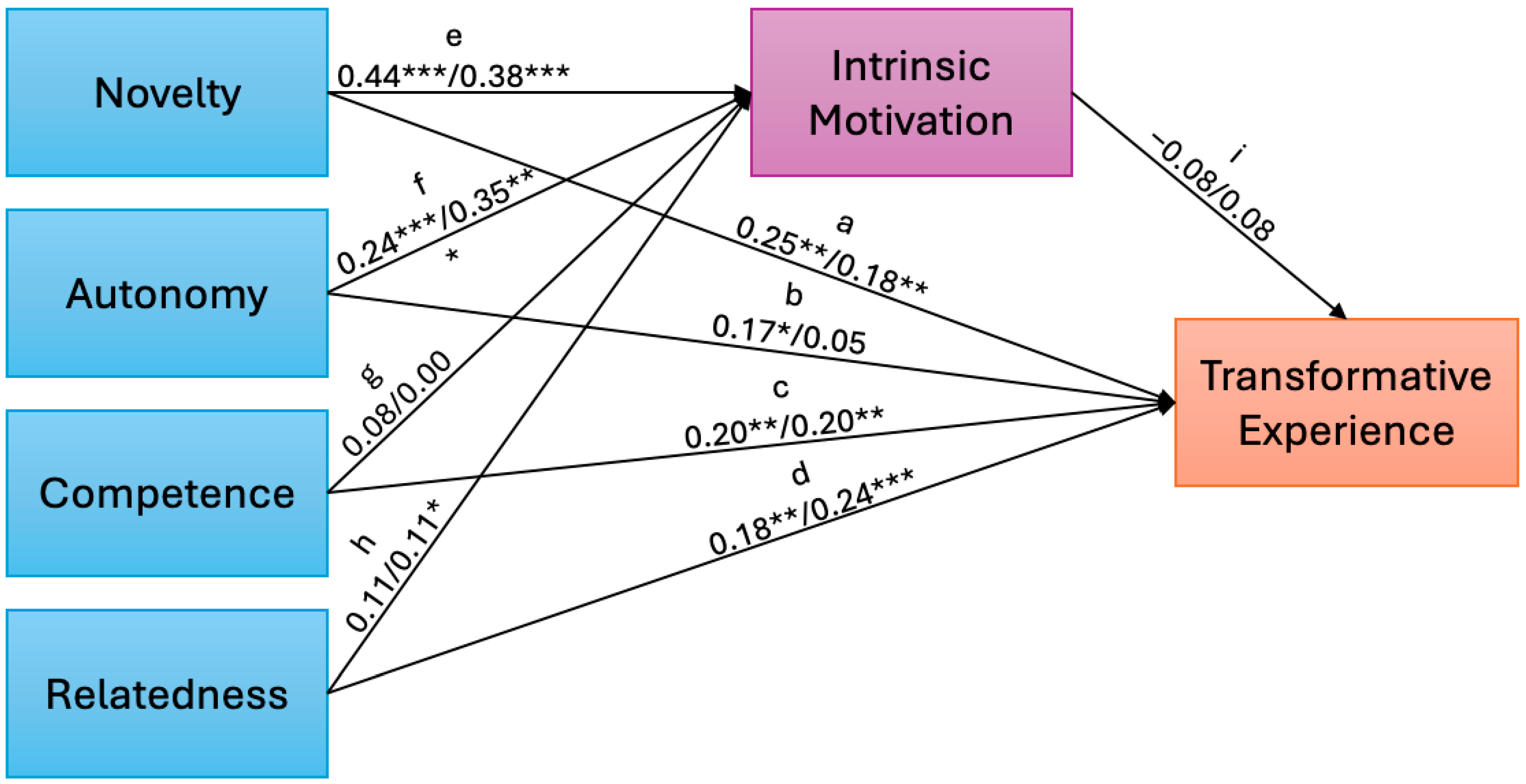
| Direct path coefficients | a | 0.25 ** | 0.001 | 0.10–0.41 | 0.18 ** | 0.004 | 0.06–0.31 |
| b | 0.17 * | 0.040 | 0.01–0.33 | 0.05 | 0.506 | −0.10–0.19 | |
| c | 0.20 ** | 0.003 | 0.07–0.32 | 0.20 ** | 0.002 | 0.08–0.33 | |
| d | 0.18 ** | 0.014 | 0.04–0.32 | 0.24 *** | <0.001 | 0.12–0.36 | |
| e | 0.44 *** | <0.001 | 0.33–0.56 | 0.38 *** | <0.001 | 0.28–0.48 | |
| f | 0.24 *** | <0.001 | 0.11–0.36 | 0.35 *** | <0.001 | 0.23–0.47 | |
| g | 0.08 | 0.108 | −0.02–0.18 | 0.00 | 0.948 | −0.11–0.12 | |
| h | 0.11 | 0.051 | 0.00–0.22 | 0.11 * | 0.044 | 0.00–0.21 | |
| i | −0.08 | 0.251 | −0.23–0.06 | 0.08 | 0.231 | −0.05–0.20 | |
| Indirect effects | e*i | −0.04 | 0.268 | −0.10–0.03 | 0.07 | 0.245 | −0.02–0.08 |
| f*i | −0.02 | 0.286 | −0.06–0.02 | 0.06 | 0.235 | −0.02–0.07 | |
| g*i | −0.01 | 0.385 | −0.02–0.01 | 0.00 | 0.959 | −0.01–0.01 | |
| h*i | −0.01 | 0.352 | −0.03–0.01 | 0.02 | 0.383 | −0.01–0.03 | |
| R2 | TE a | 0.37 *** | <0.001 | 0.37 *** | <0.001 | ||
| IM b | 0.58 *** | <0.001 | 0.53 *** | <0.001 | |||
Disclaimer/Publisher’s Note: The statements, opinions and data contained in all publications are solely those of the individual author(s) and contributor(s) and not of MDPI and/or the editor(s). MDPI and/or the editor(s) disclaim responsibility for any injury to people or property resulting from any ideas, methods, instructions or products referred to in the content. |
© 2026 by the authors. Licensee MDPI, Basel, Switzerland. This article is an open access article distributed under the terms and conditions of the Creative Commons Attribution (CC BY) license.
Share and Cite
Alardhi, Y.; Pugh, K.J. The Need to Experience Something New: Novelty as a Basic Psychological Need in University Students. Educ. Sci. 2026, 16, 926. https://doi.org/10.3390/educsci16060926
Alardhi Y, Pugh KJ. The Need to Experience Something New: Novelty as a Basic Psychological Need in University Students. Education Sciences. 2026; 16(6):926. https://doi.org/10.3390/educsci16060926
Chicago/Turabian StyleAlardhi, Yousef, and Kevin J. Pugh. 2026. "The Need to Experience Something New: Novelty as a Basic Psychological Need in University Students" Education Sciences 16, no. 6: 926. https://doi.org/10.3390/educsci16060926
APA StyleAlardhi, Y., & Pugh, K. J. (2026). The Need to Experience Something New: Novelty as a Basic Psychological Need in University Students. Education Sciences, 16(6), 926. https://doi.org/10.3390/educsci16060926