Article

The Need to Experience Something New: Novelty as a Basic Psychological Need in University Students

1
Department of Educational Psychology, College of Education, Kuwait University, Sabah Al Salem University City, P.O. Box 5969, Safat 13060, Shadadiya, Kuwait
2
School of Psychological Sciences, University of Northern Colorado, Greeley, CO 80639, USA
*
Author to whom correspondence should be addressed.
Educ. Sci. 2026, 16(6), 926; https://doi.org/10.3390/educsci16060926 (registering DOI)
Submission received: 7 April 2026 / Revised: 20 May 2026 / Accepted: 5 June 2026 / Published: 11 June 2026
(This article belongs to the Special Issue Educational Psychology from an International Perspective)

Abstract

The purpose of the current research was to investigate novelty as a potential basic psychological need (BPN) by investigating whether novelty met the essentiality (essential for overall growth and well-being) and universality (fulfillment or frustration can predict humans’ well-being across all demographics and cultures) criteria of a BPN. To this end, we tested a path model of relations between perceived novelty, the established BPNs (autonomy, competence, relatedness), and two growth and well-being outcomes: intrinsic motivation and transformative experience. We tested this model with a U.S. university student sample, representing an individualistic culture (Study 1), and a Kuwaiti university student sample, representing a collectivist culture (Study 2). In both studies, we found evidence for novelty meeting the essentiality criteria in that the direct paths from perceived novelty to the growth and well-being outcomes were statistically significant. The consistency of this finding across the two samples provides preliminary support for the universality of novelty. However, we could not directly compare U.S. and Kuwaiti results in a single model due to a lack of measurement invariance. Thus, the universality claims are tentative. These results suggest that novelty may function like a BPN for university students, and supporting novelty needs may foster beneficial educational outcomes.

1. Introduction

Research conducted from the perspective of self-determination theory has established that the satisfaction of basic psychological needs (BPNs) is critical to well-being and adaptive forms of motivation such as intrinsic and autonomous motivation, whereas frustration of BPNs is related to ill well-being and maladaptive motivation (Ryan & Deci, 2017, 2020). Further, the research has validated sense of autonomy, sense of competence, and sense of relatedness as core BPNs (Ryan & Deci, 2017). Recently, González-Cutre et al. (2016, 2020, 2023) proposed novelty as an additional BPN and provided initial evidence for novelty meeting established BPN criteria. However, Vansteenkiste et al. (2020) concluded that more research is needed before novelty can be confirmed as a BPN.
In the current study, we built on this research by investigating whether novelty meets the essentiality criteria of a BPN (Vansteenkiste et al., 2020); namely, whether novelty is essential for growth and well-being. We did so by investigating perceived novelty as a predictor of two growth and well-being outcomes: intrinsic motivation and transformative experience. Intrinsic motivation has previously been identified as a marker of growth and well-being in prior BPN research, including research on novelty as a BPN (González-Cutre et al., 2016). Transformative experience is a growth and well-being outcome derived from Dewey’s (1933, 1938, 1934/1980) theories of experience and growth. Transformative experience is characterized by expansion of perception and value; specifically, it involves instances in which students use school learning to see and experience the world in meaningful, new ways in their everyday, out-of-school lives (Pugh, 2011). To test these predictive relations, we used a path model that also included the established BPNs (autonomy, competence, and relatedness) as predictors of intrinsic motivation and transformative experience. Further, we investigated whether intrinsic motivation mediated the relation between the predictors and transformative experience. Finally, to investigate the potential of novelty meeting the universality criteria of a BPN (Vansteenkiste et al., 2020); that is, whether novelty predicts well-being across demographics and cultures, we conducted our research across a U.S. sample, representing an individualistic culture (Study 1) and a Kuwaiti sample, representing a collectivist culture (Study 2). Both samples were comprised of university students in teacher education programs.

1.1. Theoretical Framework

1.1.1. Basic Psychological Needs Theory

Within self-determination theory, psychological needs are defined as “a psychological nutrient that is essential for individuals’ adjustment, integrity, and growth” (Vansteenkiste et al., 2020, p. 1) and basic psychological needs (BPNs) are needs essential to such outcomes (Vansteenkiste et al., 2020). Basic psychological need theory, one of six mini-theories within SDT, further defines criteria of BPNs (Ryan & Deci, 2017; Vansteenkiste et al., 2010). As clarified by Vansteenkiste et al. (2020), these criteria specify that the need must be (a) psychological (focused on psychological, not physical, functioning), (b) essential (essential for overall growth and well-being), (c) inherent (inherent to human nature, driven by adaptive advantages), (d) distinct (not reliant on or derived from the frustration of other needs), and (e) universal (its fulfillment or frustration can predict human’s well-being across all demographics and cultures).
BPNs fitting these criteria and validated by research include autonomy, competence, and relatedness (Ryan & Deci, 2017). Autonomy refers to having a sense of choice and control over one’s actions, competence refers to experiencing a sense of mastery and skill development, and relatedness refers to feeling a sense of connection in one’s social environments (Ryan & Deci, 2017). These needs are clearly psychological and are distinct from each other and other needs. As evidence of their essentiality, when individuals feel a sense of autonomy, competence, and relatedness, they experience higher levels of intrinsic motivation and internalization (i.e., shift from controlling to autonomous motivation; Ryan & Deci, 2017, 2020). Additionally, satisfaction of these needs is associated with a wide range of desirable outcomes in diverse areas including healthcare, work environments, education, and overall well-being, further confirming their essentiality (Ryan & Deci, 2017). Multiple studies also support the universality of autonomy, competence, and relatedness (e.g., Chirkov et al., 2003; Magson et al., 2022; Oga-Baldwin et al., 2017). That is, these needs are important across people, but they may have culturally specific manifestations (Cheng et al., 2016; Magson et al., 2022). Ryan and Deci (2020) clarify, “Specifically, SDT makes etic claims concerning the universal importance of its basic psychological needs for autonomy, competence, and relatedness, yet it also recognizes emic variations in the salience, meaning and dynamics of needs between cultures” (p. 5).

1.1.2. Novelty as a BPN

Recently, researchers have advocated for the identification and inclusion of additional BPNs beyond autonomy, competence, and relatedness (for a summary, see Vansteenkiste et al., 2020). González-Cutre et al. (2016) proposed novelty as a BPN and González-Cutre et al. (2020) clarified the definition of novelty as the “inherent desire to seek out and engage in new activities, to feel new sensations, and to experience new contexts and situations” (p. 296). González-Cutre et al. (2016) clarified that original SDT theorizing and studies linked novelty with intrinsic motivation. Citing Deci and Ryan, they highlighted that intrinsic motivation involves “the inherent tendency to seek out novelty and challenges,” is “characterized by novelty,” and “leads people to encounter new challenges” (p. 160). They concluded,
Novelty and perceived competence, therefore, represent two essential aspects of intrinsic motivation derived from original conceptualizations of the construct in self-determination theory. It is therefore surprising that competence has been conceived as a basic psychological need, the object of study of many studies, while novelty has not received comparable attention.
(p. 160)
Furthermore, González-Cutre et al. (2016) described how the need for novelty is reflected in children’s stimulus seeking, adolescents’ identity exploration, and adults’ work and leisure activity seeking. They cited humanity’s focus on the development of new objects, ideas, and activities throughout history and concluded, “Life without the pursuit of novelty would mean individuals would not engage in exploratory pursuits to understand the self and their environment, to search for meaning, and for personal growth” (p. 160). They added, “Individuals are therefore compelled to seek out new experiences, a need that complements the desire to experience effectance and choice, mastery, and connectedness with others” (p. 160). In short, we all seem to have a need to experience something new.
In terms of meeting the criteria of a BPN clarified by Vansteenkiste et al. (2020), novelty is a psychological, as opposed to physical, need. In addition, González-Cutre et al. (2016) outlined the distinctness of novelty from other BPNs and, in confirmatory factor analysis, found novelty need satisfaction to be a different, but related, construct from autonomy, competence, and relatedness need satisfaction. In follow-up research, González-Cutre and Sicilia (2019) showed that novelty accounted for unique variance in outcomes beyond autonomy and competence. A related question concerns how novelty, as a BPN, is distinct from personality traits and motivational constructs that overlap with novelty-seeking, such as openness to experience, curiosity, and stimulation seeking. We argue that these constructs operate at a different level of analysis than novelty as a BPN. Openness to experience is a broad personality trait characterized by imaginativeness, sensitivity to aesthetics, intellectual curiosity, and behavioral flexibility (Costa & McCrae, 1992), whereas novelty as a BPN refers to the experienced psychological state of encountering something new, a need that, when satisfied or frustrated, predicts well-being outcomes (González-Cutre et al., 2020). Curiosity similarly can be understood as a multidimensional trait-level motivational response to novel stimuli rather than the need itself (Kashdan et al., 2018); indeed, Kashdan et al. (2018) note that curiosity shares conceptual territory with novelty seeking, yet treat it as a distinct construct warranting its own multidimensional measure. Stimulation seeking and exploratory behavior likewise describe behavioral tendencies associated with novelty-seeking but do not constitute a psychological need in the SDT sense, that is, a nutrient whose satisfaction or frustration reliably predicts growth and well-being. Critically, González-Cutre et al. (2020) found that the predictive effects of novelty satisfaction on well-being held even after accounting for openness to experience, and that openness moderated rather than explained the novelty–well-being relation, a pattern that is itself evidence of conceptual distinctness.
In a series of studies in a physical education context, González-Cutre et al. (2016, 2020, 2023) also found initial evidence for the essentiality of novelty. To clarify, a proposed BPN meets the essentiality criteria if “satisfaction of [the] basic need contributes to growth, well-being, and adjustment and the frustration of the need predicts problem behavior, ill-being, and psychopathology” (Vansteenkiste et al., 2020, p. 4). In these studies, novelty satisfaction positively predicted intrinsic and autonomous motivation and other well-being outcomes (vitality, life satisfaction, meaning in life), while novelty frustration negatively predicted these outcomes or predicted maladaptive outcomes (amotivation, boredom, entity beliefs). Bagheri and Milyavskaya (2020) found similar results for “novelty–variety” in a work setting. They also found initial support for the universality of novelty, as novelty–variety frustration effects were invariant across age and novelty-seeking preference.
However, Vansteenkiste et al. (2020) cautioned that more research is needed before novelty can be confirmed as a BPN. In the current study, we pursued such research. First, we further evaluated the essentiality of novelty by examining its relationship with intrinsic motivation and transformative experience. Second, we explored the universality of novelty across two contrasting cultural samples.

1.1.3. Novelty as Essential to Growth and Well-Being

Intrinsic motivation refers to the active engagement in an activity due to inherent satisfaction, enjoyment, and interest (Ryan & Deci, 2000) and has been conceptualized as a growth process and well-being outcome (e.g., Ryan & Deci, 2020; Vansteenkiste et al., 2018). Further, prior research has established its importance to other positive outcomes. For example, a recent meta-analysis confirmed intrinsic motivation is positively associated with students’ well-being and academic success (Howard et al., 2021). Thus, one way of testing whether novelty meets the essentiality criteria of a BPN is to investigate its relation to intrinsic motivation. González-Cutre et al. (2016, 2020) did just that and found that novelty predicted intrinsic motivation in the context of physical education. We built on these results by testing whether they could be replicated in a different educational context, that of preservice teacher education. In addition, we expanded on the prior research by investigating whether novelty predicted another growth and well-being outcome, that of transformative experience. As transformative experience is a relatively unknown construct, we discuss it in detail below.
The construct of transformative experience is derived from Dewey’s work on aesthetic and educational experience and represents a core growth outcome. Dewey (1933, 1938) believed life was about undergoing meaningful experience and increasing our capacity for meaningful experience. Miseducative experience, from Dewey’s (1938) perspective, is any experience that “has the effect of arresting or distorting the growth of future experience” (p. 25), whereas educative experience “live[s] fruitfully and creatively in subsequent experiences” (p. 28). Dewey turned to aesthetics to further develop his theory of experience, and in so doing, defined “an” experience. Jackson (1998) explained:
Our interactions with art objects epitomize what it means to undergo an experience, a term with a very special meaning for Dewey. The arts do more than provide us with fleeting moments of elation and delight. They expand our horizons. They contribute meaning and value to future experience. They modify our ways of perceiving the world, thus leaving us and the world itself irrevocably changed.
(p. 33)
An experience is “educative” experience in the sense that contributes to growth, transformation, expansion of perception, and enrichment of future experience (Dewey, 1934/1980).
Drawing on this work, Pugh (2011, 2020), Pugh et al. (2020) and Wong et al. (2001) conceptualized transformative experience as educational experiences in which students carry in-school learning into their everyday, out-of-school lives and use it to see and experience the world in meaningful, new ways. Specifically, Pugh (2011) defined it in terms of three characteristics: (1) motivated use (applying content in everyday life when not required to do so), (2) expansion of perception (“re-seeing” the world through the lens of curricular content in everyday life), and (3) experiential value (valuing the content for how it expands perception and developing a deeper appreciation for things that are re-seen). For example, Pugh (2002) described a high school biology student who thought about the biology concepts of adaptation and evolution when seeing birds, pets, zoo animals, and animals in movies (motivated use). Moreover, he described perceiving these animals through the lens of adaptation and evolution (expansion of perception). Finally, he explained that he became more interested in animals and valued the concepts of adaptation and evolution because they helped him understand animals in new ways (experiential value).
As evidence that transformative experience is a growth outcome, it is linked to other positive educational outcomes such as enduring learning (Girod et al., 2010; Pugh, 2002), conceptual change (Alongi et al., 2016; Heddy & Sinatra, 2013; Pugh, 2002), applied understanding (Pugh et al., 2017a, 2017b), far transfer of learning (Pugh et al., 2010a, 2010b), positive emotions (Heddy & Sinatra, 2013; Heddy et al., 2023), domain interest and identification (Girod et al., 2010; Heddy & Sinatra, 2013, 2017; Heddy et al., 2017, 2023; Manzanares & Pugh, 2025), and academic and career choice (Manzanares & Pugh, 2025; Pugh et al., 2019a, 2021).
Transformative experience was selected for the current study because of its unique conceptualization as a special type of experience associated with growth, aesthetic undergoing, and deep-level educational outcomes. Accordingly, establishing a predictive relation between novelty and transformative experience would further confirm that novelty meets the BPN essentiality characteristic. The current study investigated this proposed relation.

1.1.4. Novelty as a Universal Need

To further evaluate novelty as a BPN, research is needed on whether it meets the universality criteria. As mentioned previously, Bagheri and Milyavskaya (2020) found initial support for the universality of novelty in a work setting. Specifically, they found that novelty–variety did not interact with age or novelty-seeking preference when predicting well-being. However, research on the universality of novelty in educational settings is lacking. Research is also lacking on the universality of novelty with respect to culture and Vansteenkiste et al. (2020) argued that cultural differences may play a role in individuals’ need for novelty.
A key question is why cultures may differ in their perceptions of novelty. Self-construal theory (Markus & Kitayama, 1991) offers a useful framework. In individualistic cultures, where an independent self-construal predominates, novelty is congruent with personal identity exploration, self-expression, and opportunity for growth. In collectivist cultures, where an interdependent self-construal is more common, novelty tends to be evaluated in terms of its relational consequences, such as whether it disrupts group harmony or carries group endorsement. This focus on relational consequences may shape whether novelty is experienced as an opportunity for growth or a source of tension. Consistent with self-construal theory, cross-cultural research has found that cultures higher in individualism show higher aggregate levels of openness to experience, a trait linked to novelty-seeking (McCrae et al., 2005). Ryan and Deci (2020) argue that BPNs may have culturally specific manifestations yet still be universal needs across cultures. Thus, a central question of the current research is whether novelty functions as a universal psychological need despite these differences in cultural manifestations. To this end, we investigated the relation between novelty and transformative experience across collectivist (Kuwait) and individualistic (U.S.) societies.
Kuwait embodies an Eastern collectivist society characterized by a low individualism score of 25 (Hofstede Insights, 2023). The U.S. represents a Western individualistic society characterized by a high individualism score of 91 (Hofstede Insights, 2023). Broadly speaking, in collectivistic societies, there is an interconnected view of the self, whereas in individualistic cultures, the self is seen as autonomous (Markus & Kitayama, 1991). Furthermore, communal goals hold greater importance over individual objectives in collectivist societies, whereas individual goals are given priority in individualistic cultures (Triandis, 1995). In addition, norms and obligations govern people’s behavior in collectivist societies, while personal choice and individual rights drive behavior in individualistic cultures (Triandis & Gelfand, 2012).

1.1.5. Proposed Model

Figure 1 illustrates our proposed model of relations based on the research reviewed. We hypothesized that perceived novelty would have significant direct paths to intrinsic motivation and transformative experience. Confirmation of this hypothesis would provide further evidence that novelty meets the essentiality criteria of a BPN by predicting these growth and well-being outcomes. We accounted for the established BPNs in our model by including autonomy, competence, and relatedness. Further, we predicted significant direct paths from these BPNs to intrinsic motivation as this relation has been well-established in prior research (Ryan & Deci, 2017). We also predicted significant direct paths from these BPNs to transformative experience given that transformative experience is a growth and well-being outcome. However, this prediction was more tentative as prior research is lacking.
In our model, we also included a direct path from intrinsic motivation to transformative experience. Intrinsic motivation is characterized by self-directed action and such motivation is likely important to undergoing transformative experience as it involves motivated use (i.e., actively applying school learning when not required to do so; Pugh, 2011). Moreover, the construct of interest is conceptually related to intrinsic motivation and has been confirmed as a strong predictor of transformative experience (Heddy et al., 2023; Pugh et al., 2019b, 2021, 2023). Thus, we predicted a significant direct path from intrinsic motivation to transformative experience and predicted significant indirect paths from novelty, autonomy, competence, and relatedness to transformative experience through intrinsic motivation. That is, we predicted that the relation between novelty and the established BPNs to transformative experience would partially be through intrinsic motivation.

1.1.6. Current Research

The context for testing the proposed model was preservice teachers in a U.S. and Kuwaiti university. Preservice teachers were selected to reduce variance arising from different student population. In addition, transformative experiences are particularly relevant to preservice teachers as it is important for them to use their in-school learning to see and experience the world of education in meaningful, new ways. As explained previously, the U.S. represents an individualistic culture and Kuwait represents a collectivist culture. Thus, we planned to test the universality criteria of novelty as a BPN by testing if the direct and indirect paths in our path analysis model were invariant across the samples. However, we first tested for measurement invariance (i.e., whether the meaning and functioning of the measures themselves were invariant across samples) by individually examining the measurement invariance of each measure across samples in three sequential steps including configural, metric, and scalar invariance. We did not find satisfactory evidence to support measurement invariance across the two samples. Specifically, we found strong (scalar) invariance for the novelty measure, but only weak (metric) invariance for measures of the established BPNs and did not even find weak invariance for the measures of intrinsic motivation and transformative experience (see Supplemental Materials). Accordingly, we chose to test the U.S. and Kuwaiti data separately as two independent studies to improve the analytical rigor. These two studies shed light on novelty as a BPN in an individualistic and a collectivist culture, but do not allow for direct comparison.

1.1.7. Ethical Statement

This research was approved by the institutional review board at the University of Northern Colorado (#2307050101). Informed consent was obtained from all subjects. The authors have no financial or non-financial conflicts of interest to disclose.

2. Study 1: U.S. Sample

2.1. Materials and Methods

2.1.1. Procedure

Participants from a U.S. university were invited to participate by one of their instructors in the preservice teacher program. The invitation to participate was extended through the university classroom management system and included a link to participate via an online survey. Instructors were encouraged to provide a modest amount of extra credit as a voluntary incentive for participation, but it was not obligatory. Data were collected via an online survey during the Fall semester of 2023 after the first four weeks.

2.1.2. Participants

Based on the methodology proposed by Faul et al. (2007), a power analysis revealed that a minimum sample size of 138 participants is required for a path analysis model with five factors explaining the outcome. Given that a larger sample size is associated with less sampling error (Kline, 2005) and to ensure the accuracy and representativeness of the data, the aim was to recruit 200 participants1. Our initial sample comprised 333 individuals. Thirty of these had not completed any teacher education courses2 or had failed to provide course information and were dropped from the analysis. An additional 25 students did not complete at least two-thirds of the items on one or more scales and were also excluded from the analysis. The final sample included 278 preservice teachers. Demographic information is presented in Table 1. The majority of participants were female students, in their second to fourth year, and had completed six or more education courses.

2.1.3. Measures

Sample items for all scales are displayed in Table 2. In line with prior research, students responded to the transformative experience questionnaire on a 4-point Likert scale (1 = strongly disagree, 4 = strongly agree) and to the other measures on a 5-point Likert scale (1 = strongly disagree, 5 = strongly agree).
Confirmatory factor analysis (CFA) was used to verify the factor structure of the predictor variables (novelty, autonomy, competence, relatedness) and mediator variable (intrinsic motivation) for the U.S. sample. As indicators of good fit, we used the guidelines recommended by Byrne (1994) of RMSEA < 0.08, CFI > 0.90, TLI > 0.90, and SRMR < 0.08. The original CFA with all items from all measures had inadequate fit statistics. Consequently, we reviewed items with lower factor loadings, resulting in us dropping one novelty item and two intrinsic motivation items (see below for details). The final CFA had good fit statistics: RMSEA = 0.07, CFI = 0.92, TLI = 0.91, SRMR = 0.05.
The Novelty Need Satisfaction Scale (NNSS) (González-Cutre et al., 2016) was used to measure students’ perceptions of their novelty satisfaction in their teacher education courses. One item was dropped as it had a lower factor loading (0.67) compared to other items and dropping the item significantly improved the CFA fit statistics. The final 5-item scale had good reliability (α = 0.84).
The Basic Psychological Need Satisfaction and Frustration Scale (BPNSFS) (Van der Kaap-Deeder et al., 2020) was used to measure students’ perception of autonomy, competence, and relatedness satisfaction in their teacher education courses. Although the full scale measures both need satisfaction and frustration, only the satisfaction items were utilized in the current study. Reliability was good for the autonomy (4 items, α = 0.81), competence (4 items, α = 0.87), and relatedness (4 items, α = 0.84) subscales.
The interest and enjoyment subscale of the Intrinsic Motivation Inventory (IMI) (Ryan, 1982; Ryan et al., 1983) was used to measure students’ intrinsic motivation in their teacher education courses. Two items were dropped because they had low factor loadings (<0.4) and were the only reverse-coded items. Dropping these items significantly increased CFA fit statistics. The final 5-item subscale had strong reliability (α = 0.90).
The Transformative Experience Questionnaire (TEQ) (Koskey et al., 2018) was used to measure students’ perceptions of the degree to which they underwent transformative experiences in their teacher education courses. The 16-item measure assessed the three characteristics of transformative experience: motivated use, expansion of perception, and experiential value. In addition, the measure included items targeting a continuum of transformative engagement ranging from in-class engagement (e.g., During my teacher education classes, I notice examples of teaching and learning), to out-of-class engagement (e.g., I notice examples of teaching and learning outside of class), to active/enthusiastic out-of-class engagement (e.g., I look for examples of teaching and learning outside of class).
The TEQ was developed and validated using Rasch analysis (Rasch, 1980). With a complex construct like TE, Rasch provides information on whether the measure functions as a unidimensional construct (Bond & Fox, 2001). In addition, it creates a hierarchy of easier to harder endorse items and orders individuals along this hierarchy. In terms of the TEQ, this hierarchy reflects the continuum of transformative engagement and provides information about the reliability of ordering individuals along this continuum. In line with the development, validation, and prior use of the TEQ, we used Rasch analysis to evaluate the measure and develop a composite score. All item infit values were within the 0.60 to 1.40 cutoff recommended by Wright and Linacre (1994) confirming the measure assessed a holistic, unidimensional construct. Further, the TEQ demonstrated good person separation (2.55) indicating that participants were spread out along the continuum of transformative engagement. It also displayed strong personal reliability (0.87) indicating a reliable ordering of participants along the transformative experience continuum. Thus, the measure captured a range of transformative engagement, and we can have confidence in participants’ placement along this range relative to other participants. The TEQ similarly demonstrated strong item separation (4.66) and reliability (0.96).

2.1.4. Analysis

The TEQ required Rasch analysis and development of a composite score. To be consistent, we chose to conduct measurement analysis (i.e., CFA) on the other variables and likewise develop composite scores3. We then used path analysis to test the model proposed in Figure 1. Mplus8 was used to test the path model with maximum likelihood (ML) as the estimator. All paths and indirect paths were examined. The statistical assumptions of linearity, multivariate normality, independence, and homoscedasticity were met.

2.2. Results

2.2.1. Descriptive Statistics

Table 3 presents descriptive statistics capturing students’ mean level of responding for each variable and the correlations between variables. Participants generally “agreed” (~4 on 5-point scale) with items denoting perceived novelty, autonomy, competence, relatedness, and intrinsic motivation in relation to their teacher education courses. Participants reported high levels of transformative experience with preservice teachers being likely to endorse even the active/enthusiastic out-of-class transformative engagement items.
The four predictor variables (novelty, autonomy, competence, relatedness) showed statistically significant correlations with transformative experience. In addition, intrinsic motivation (proposed mediator) was significantly correlated with the predictors and transformative experience. These correlations ranged from moderate to large.

2.2.2. Path Analysis Results

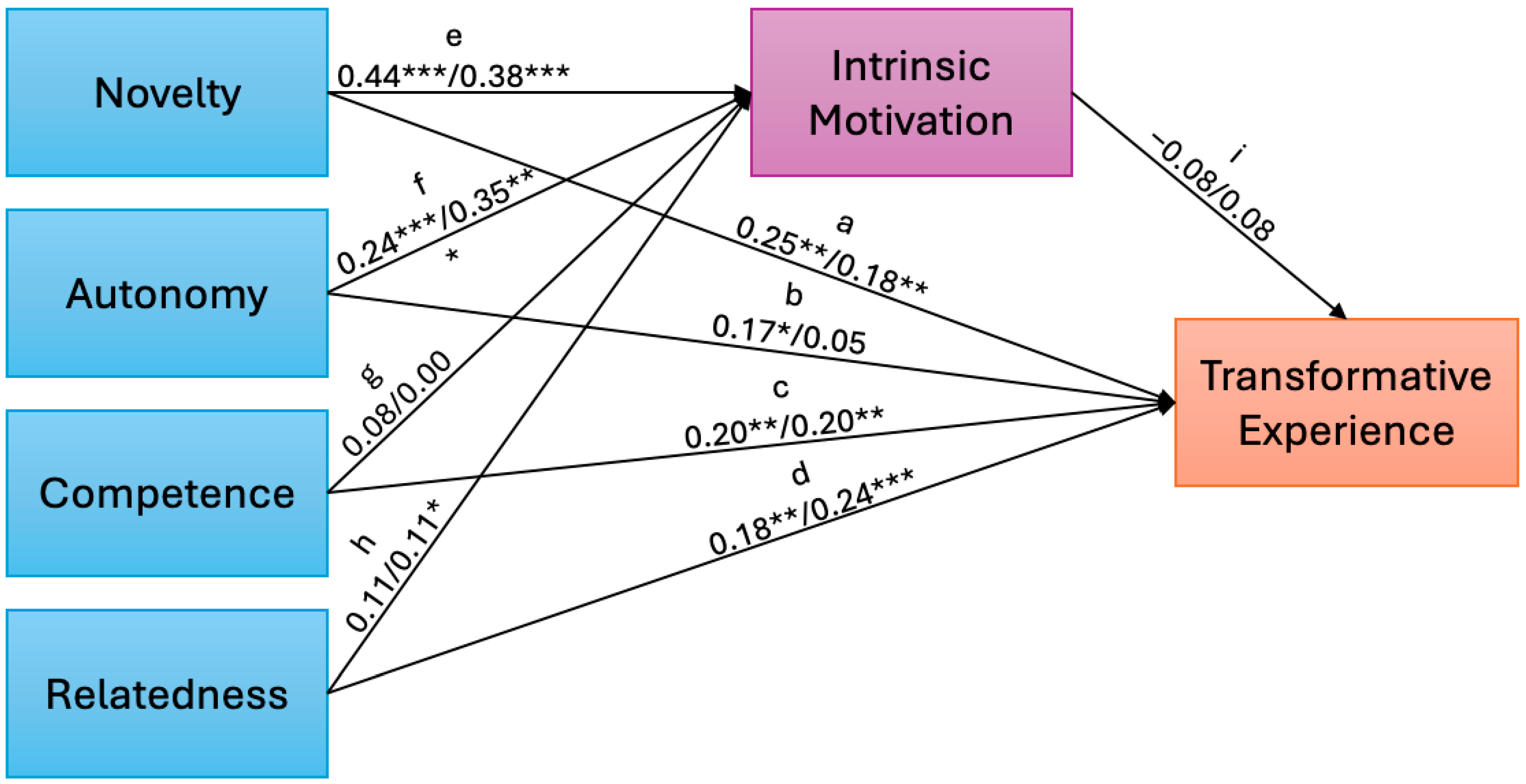
Figure 2 and Table 4 present the results of the path analysis. The model explained 37% of the variance in transformative experience scores and 58% of the variance in intrinsic motivation scores. In line with our theorizing and in support of novelty meeting the essentiality criteria, the direct paths from novelty to transformative experience (a) and novelty to intrinsic motivation (e) were statistically significant. The path coefficients were small to medium based on Cohen’s (1988) recommendations of: 0.20 = small, 0.50 = medium, and 0.80 = large4. The direct paths from the established BPNs (autonomy, competence, relatedness) to transformative experience (b, c, d) were statistically significant with small effect sizes. The direct path from autonomy to intrinsic motivation (f) was statistically significant with a small effect size, but surprisingly, the direct paths from competence and relatedness to intrinsic motivation (g, h) were not statistically significant.
Contrary to our hypothesis, the direct path from intrinsic motivation to transformative experience (i) was not significant. Consequently, the indirect paths from novelty, autonomy, competence, and relatedness to transformative experience through intrinsic motivation were not significant. These results suggest that the relations between the predictor variables and transformative experience are not mediated by intrinsic motivation.

2.3. Discussion

In study 1 with the U.S. sample, we found that perceived novelty met the essentiality criteria of a BPN as proposed by Vansteenkiste et al. (2020) in that it predicted the growth and well-being outcomes of transformative experience and intrinsic motivation. This result is in line with prior research findings that novelty predicted such outcomes as meaning, vitality, well-being, and intrinsic and autonomous motivation (Bagheri & Milyavskaya, 2020; González-Cutre et al., 2016, 2020). The results also build on prior research identifying factors predictive of transformative experience (Goldman et al., 2024; Heddy et al., 2023; Pugh et al., 2019b, 2021, 2023). In addition to novelty, the established BPNs of autonomy, competence, and relatedness were significant predictors of transformative experience. However, contrary to our predictions, the relation between novelty and transformative experience and the relations between the established BPNs and transformative experience were not mediated by intrinsic motivation.

3. Study 2: Kuwaiti Sample

3.1. Method

3.1.1. Procedure

As with the U.S. sample, individuals at a Kuwaiti university in the fall semester of 2023 were invited to participate by one of their preservice teacher instructors via a classroom management system and instructors offered extra credit at their discretion.

3.1.2. Participants

Based on the power analysis reported in study 1, we aimed to recruit 200 participants. Our initial sample comprised 459 individuals. Nine of these had not completed any teacher education courses or failed to provide course information and were dropped from the analysis. An additional 81 students did not complete at least two-thirds of the items on one or more of the scales and were also dropped from the analysis. The final sample included 369 preservice teachers. Demographic information is presented in Table 1. Similarly to the U.S. sample, the majority of participants were female students, in their second to fourth year, and had completed six or more education courses. Whereas the U.S. sample had a high percentage of early education/elementary education majors, the Kuwaiti sample had a uniquely high percentage of foreign language majors.

3.1.3. Measures

We used the same measures for the Kuwaiti sample as we did for the U.S. sample. All measures were translated to Arabic for the Kuwaiti sample by the first author and back translated into English and examined by a professional translator to ensure translation validity (Sperber et al., 1994). Confirmatory factor analysis (CFA) was used to verify the factor structure of the predictor variables (novelty, autonomy, competence, relatedness) and mediator variable (intrinsic motivation) for the Kuwaiti sample as was done for the U.S. The original CFA with all items from all measures had inadequate fit statistics. Consequently, we reviewed items with lower factor loadings and dropped one autonomy item, one competence item, one relatedness item, and two intrinsic motivation items (see below for details). The final CFA had adequate fit statistics: RMSEA = 0.08, CFI = 0.92, TLI = 0.90, SRMR = 0.05.
The full 6-item Novelty Need Satisfaction Scale (NNSS) (González-Cutre et al., 2016) was used and had good reliability (α = 0.89). One item was dropped from the autonomy subscale of the Basic Psychological Need Satisfaction and Frustration Scale (BPNSFS) (Van der Kaap-Deeder et al., 2020) because it had a lower factor loading (0.55) and dropping the item improved the fit statistics. The final 3-item scale had good reliability (α = 0.79). One item was also dropped from the competence subscale as it had a lower factor loading (0.64) and dropping the item improved the fit statistics. The final 3-item scale had good reliability (α = 0.79). In addition, one item was dropped from the relatedness subscale as it had a lower factor loading (0.54) and dropping the item improved the fit statistics. The final 3-item scale had good reliability (α = 0.76).
Two items were dropped from the Intrinsic Motivation Inventory (IMI) (Ryan, 1982; Ryan et al., 1983). As with the U.S. sample, the two reverse-coded items displayed low factor loadings (<0.44) and were dropped resulting in a significant increase in fit statistics. The final 5-item subscale had strong reliability (α = 0.92).
As with the U.S. sample, Rasch analysis was used to evaluate the reliability and validity of the Transformative Experience Questionnaire (TEQ) (Koskey et al., 2018) and develop a composite score. All item infit values were within the 0.60 to 1.40 cutoff recommended by Wright and Linacre (1994) confirming the measure assessed a unidimensional construct. Further, the TEQ demonstrated strong person separation (2.60) indicating the ability to distinguish different levels of engagement along the transformative experience continuum and strong personal reliability (0.87) indicating a reliable ordering of participants along the transformative experience continuum. The TEQ similarly demonstrated strong item separation (5.16) and reliability (0.96).

3.1.4. Analysis

As in the U.S. sample study, path analysis was used to test the model proposed in Figure 1. All paths and indirect paths were examined. The statistical assumptions of linearity, multivariate normality, independence, and homoscedasticity were met.

3.2. Results

3.2.1. Descriptive Statistics

Table 3 presents descriptive statistics. As with the U.S. sample, Kuwaiti participants generally “agreed” (~4 on 5-point scale) with items denoting perceived novelty, autonomy, competence, relatedness, and intrinsic motivation in relation to their teacher education courses. Also similar to the U.S. sample, participants reported high levels of transformative experience with preservice teachers being likely to endorse even the active/enthusiastic out-of-class engagement items. However, the U.S. sample mean Rasch score was higher and this difference was statistically significant (t(648) = 12.079, p < 0.001).
Again, similar to the U.S. sample, the four predictor variables (novelty, autonomy, competence, relatedness) showed statistically significant correlations with transformative experience. In addition, intrinsic motivation (proposed mediator) was significantly correlated with the predictors and transformative experience. These correlations were moderate to large.

3.2.2. Path Analysis Results

Figure 2 and Table 4 present the results of the path analysis. The model explained 37% of the variance in transformative experience scores and 53% of the variance in intrinsic motivation scores. As with the U.S. sample and in line with our hypotheses, the direct paths from novelty to transformative experience (a) and novelty to intrinsic motivation (e) were statistically significant, with small to small-medium effect sizes, respectively (Cohen, 1988). The direct paths from competence and relatedness to transformative experience (c, d) were statistically significant with small effect sizes. However, the direct path from autonomy to transformative experience (b) was not statistically significant. The direct paths from autonomy and relatedness to intrinsic motivation (f, h) were statistically significant with small-to-medium and very small effect sizes, respectively. The direct path from competence to intrinsic motivation (g) was not statistically significant.
Contrary to our hypothesis and similar to the U.S. sample, the direct path from intrinsic motivation to transformative experience (i) was not significant. Consequently, the indirect paths from novelty, autonomy, competence, and relatedness to transformative experience through intrinsic motivation were not significant.

3.3. Discussion

In line with prior research (Bagheri & Milyavskaya, 2020; González-Cutre et al., 2016, 2020) and our hypotheses, we found support that perceived novelty predicted the growth and well-being outcomes of transformative experience and intrinsic motivation, thus providing evidence of novelty meeting the essentiality criteria of a BPN established by Vansteenkiste et al. (2020). Contrary to our prediction, the relation between perceived novelty and transformative experience was not mediated by intrinsic motivation. Competence and relatedness were found to be significant predictors of TE, thus contributing to research on individual factors predictive of transformative experience (e.g., Goldman et al., 2024; Heddy et al., 2023; Pugh et al., 2019b).

4. General Discussion

González-Cutre et al. (2016, 2020) proposed novelty as a basic psychological need (BPN) in addition to autonomy, competence, and relatedness—three BPNs that have been well established in prior research and are core to self-determination theory (Ryan & Deci, 2017). Novelty was proposed as a BPN because it is implied in original conceptions of intrinsic motivation in self-determination theory and seems to be inherent to universal human behaviors such as stimulus seeking, identity exploration, and development of new objects, ideas, and activities (González-Cutre et al., 2016). Researchers have proposed other new BPNs (e.g., morality, Prentice et al., 2019) and one could imagine an increasingly long list of BPNs that dilutes their meaning and value. Accordingly, researchers have sought to define characteristics of BPNs and, recently, Vansteenkiste et al. (2020) proposed core criteria of a BPN. One of these criteria is essentiality, meaning a BPN is essential to overall growth and well-being. Initial research on novelty as a BPN found evidence for novelty meeting the essentiality criteria in that novelty predicted the growth and well-being outcomes of meaning, vitality, well-being, and intrinsic and autonomous motivation in a physical education context (González-Cutre et al., 2016, 2020) and novelty–variety predicted well-being in a work context (Bagheri & Milyavskaya, 2020).
The current research confirms and builds on these prior results. Using path analysis and in the context of university preservice teacher education, we found that perceived novelty was a statistically significant predictor of intrinsic motivation for both a U.S. and Kuwaiti sample. Interestingly, the path coefficients for the relation between novelty and intrinsic motivation were stronger than the path coefficients for the relations between the established BPNs (autonomy, competence, relatedness) and intrinsic motivation for both samples. These results confirm prior results linking novelty to intrinsic motivation (González-Cutre et al., 2016, 2020) and show that they hold up in a new context (i.e., preservice teacher education) and across U.S. and Kuwaiti samples. Further, our results extend prior research by showing that perceived novelty also significantly predicted the construct of transformative experience in both the U.S. and Kuwaiti samples. Transformative experience, like intrinsic motivation, is a growth and well-being outcome derived from Dewey’s conception of an experience—an optimal type of experience associated with overall growth (Dewey, 1934/1980, 1938; Pugh et al., 2020). In line with results found by González-Cutre and Sicilia (2019), novelty contributed unique variance in outcomes beyond autonomy, competence, and relatedness.
One caveat to these results is that the path coefficients for the relation between novelty and transformative experience were small for both the U.S. and Kuwaiti samples. However, the size of the relations between the established BPNs and transformative experience was also small for both samples, with the relation between autonomy and transformative experience being non-significant for the Kuwaiti sample.
We also predicted that perceived novelty would be related to transformative experience through intrinsic motivation. However, for both the U.S. and Kuwaiti samples, the path from intrinsic motivation to transformative experience was not significant and, consequently, the indirect paths from novelty to transformative experience through intrinsic motivation were not significant. Thus, contrary to our expectations, intrinsic motivation and transformative experience appear to be independent outcomes rather than serially related outcomes of novelty. This is surprising as prior research found interest, a related construct to intrinsic motivation, to be a significant and strong predictor of transformative experience (Heddy et al., 2023; Pugh et al., 2019b, 2021, 2023). It may be that the constructs and measures of interest used in the prior research are functionally different from the measure of intrinsic motivation used in the current study. However, this discrepancy may also be explained by the inclusion of BPNs in the predictive model in the current study. Intrinsic motivation and transformative experience were significantly and moderately strongly correlated in the current study. However, when entered in a predictive model with novelty, autonomy, competence, and relatedness, intrinsic motivation did not contribute unique variance in explaining transformative experience beyond that provided by the other predictors. The prior research did not include these predictors5. It may be that the constructs of interest and intrinsic motivation do not contribute explanatory power beyond that shared with novelty, autonomy, competence, and relatedness. Intrinsic motivation focuses on the reason for engaging in an activity. It may be that the reason for engaging in a learning activity is not critical to whether students undergo transformative experiences (i.e., use the learning as a lens for seeing and experiencing the world in meaningful new ways in everyday life). Instead, it may be more important that the learning activity satisfies basic psychological needs. Satisfaction of such needs may allow students to “surrender to the experience;” that is, open themselves up to being acted upon and transformed (Pugh et al., 2020; Wong, 2007). Future research is needed to explore these possibilities.
Another BPN criteria proposed by Vansteenkiste et al. (2020) is universality, meaning the BPN predicts well-being across all demographics and cultures. Prior research on the universality of novelty is very limited with only a single study investigating this issue. In this study, Bagheri and Milyavskaya (2020) found initial support for the universality of novelty in that novelty–variety did not interact with age or novelty-seeking preference when predicting well-being. To further test the universality of novelty, we intended to conduct a cross-cultural comparison in our path analysis model involving U.S. and Kuwaiti samples; the U.S. sample representing an individualistic culture and the Kuwaiti sample representing a collectivist culture. However, most of our measures did not achieve measurement invariance. Accordingly, we reported the results separately for the two samples. These results cannot be directly compared as we cannot be confident that the scales measure the same thing in the same way across the two cultural groups. More precisely, the novelty measure displayed strong (scalar) invariance, but the measures of the established BPNs only displayed weak (metric) invariance and the intrinsic motivation and transformative experience measures failed to show even weak (metric) invariance (see Supplemental Materials). Thus, although we found similar results for both samples, we can only make the tentative and preliminary claim that perceived novelty was related to growth and well-being outcomes for both an individualist and collectivist culture sample, but only the novelty measure had the same meaning and functioning across the samples. This latter result is somewhat surprising given that self-construal theory (Markus & Kitayama, 1991) suggests novelty is perceived through the lens of personal growth and identity exploration in individualistic cultures. Conversely, in collectivist cultures, novelty is more relationally endorsed or embedded in group contexts.
Although not a focus of the current research, the results also contribute to the literature on factors predictive of transformative experience. Prior research identified domain interest and identity, maintained situational interest, openness to experience, positive emotions and task values, low negative emotions, and students’ perception of a connection to their teachers and perception of their teachers’ passion for the content as positive predictors of transformative experience (Goldman et al., 2024; Heddy et al., 2023; Pugh et al., 2010a, 2019b, 2021, 2023). The current study contributes to this research by identifying perceived novelty as a predictor of transformative experience. In addition, the results yield information on the established BPNs as predictors of transformative experience. Specifically, in the U.S. sample, all three established BPNs (autonomy, competence, relatedness) were statistically significant predictors of transformative experience. In the Kuwaiti sample, competence and relatedness, but not autonomy, were statistically significant predictors of transformative experience. As with novelty, the established BPNs were not related to transformative experience through intrinsic motivation. These results partially align with those from a prior study (Alardhi & Pugh, 2025) in which we found autonomy and relatedness were statistically significant predictors of transformative experience for U.S. and Kuwaiti preservice teachers.

4.1. Limitations and Future Directions

As explained previously, we did not find measurement invariance between the U.S. and Kuwaiti samples, which limited inferences that can be made about the universality of novelty as a predictor of growth and well-being. In addition, we dropped a few items from established scales when conducting confirmatory factor analysis (CFA) for each sample. The same two items were dropped from the Intrinsic Motivation Inventory for both the U.S. and Kuwaiti samples. These were the only reverse coded items, and it is likely they functioned differently for that reason. However, to achieve adequate CFA fit statistic and confidence that the constructs were distinct in each sample, one novelty item was dropped for the U.S. sample, and one item was dropped from each of three subscales of the Basic Psychological Need Satisfaction and Frustration Scale for the Kuwaiti sample. These results suggest we need to be cautious when making cross-cultural comparisons. We cannot draw solid conclusions, but it may be that novelty is more conceptually similar to the other constructs for U.S. students and the basic psychological needs are less conceptually distinct for Kuwaiti students. Related to this point, there is no simple translation for the word “autonomy” in Arabic. Thus, there is some uncertainty about how the Kuwaiti participants interpreted the autonomy items. Overall, future research is needed to explore the meaning of constructs such as novelty, autonomy, and intrinsic motivation across cultures and develop measures that are uniform and display invariance.
The current study was correlational and cannot make causal claims. Experimental research is needed to test whether novelty interventions foster intrinsic motivation and transformative experience. Likewise, experimental research is needed to test whether autonomy, competence, and relatedness interventions foster transformative experience. In addition, the reliance on self-report measures poses a potential limitation (Fulmer & Frijters, 2009), as such measures may be vulnerable to response bias and individuals’ interpretations. Furthermore, because all variables were assessed via self-report, shared method variance may have inflated the observed relationships among novelty, the established BPNs, intrinsic motivation, and transformative experience. Additionally, cultural response styles may have influenced the results. Research suggests that individuals from collectivist cultures tend to use more moderate response options, whereas those from individualistic cultures are more likely to use extreme response options (Chen et al., 1995), which may have contributed to observed differences between the U.S. and Kuwaiti samples beyond true differences in the constructs measured.
Relatedly, because we used a self-report measure of novelty, the results need to be interpreted in terms of students’ perceptions of novelty.
An additional limitation of the current research is that the study’s findings might not extend to groups beyond preservice teachers in the U.S. and Kuwait. Further, both samples had a high percentage of female participants in line with the population of many teacher education programs. In addition, the U.S. and Kuwait only represent two cultural groups and there is cultural variation within each country. Future investigations of novelty as a BPN are needed that recruit participants from varied university disciplines, employ samples with a larger percentage of male participants, and address a wider variety of cultural groups. Such research is particularly important to investigating the universality of novelty as a BPN.
Finally, path analysis was used in place of structural equation modeling (SEM) due to the transformative experience questionnaire (TEQ) being developed and validated with Rasch methods. The TEQ was designed to assess transformative engagement ranging from in-class to active out-of-class engagement, which can be represented by Rasch analysis. Using SEM with the TEQ would be an invalid use of the measure.

4.2. Implications

Although experimental research is needed to establish causal relations, the results suggest that novelty-supportive educational environments may foster intrinsic motivation and transformative experience. Stoa and Chu (2023) suggest novelty can be fostered by changing classroom practices (e.g., breaking up lectures with short activities), implementing gamification, personalizing education, using new technology (although this can be expensive and transitory), highlighting what is new and different about the content, and challenging students to apply learning in new contexts.

4.3. Conclusions

The current research further investigated the proposal by González-Cutre et al. (2016) that novelty be considered a basic psychological need (BPN) by constructing and testing a path model of relations between perceived novelty, the established BPNs (autonomy, competence, relatedness), intrinsic motivation, and transformative experience in a U.S. and Kuwaiti sample. In support of novelty being considered a BPN, we found evidence for novelty meeting the essentiality criteria of a BPN (Vansteenkiste et al., 2020) in that perceived novelty predicted the growth and well-being outcomes of intrinsic motivation and transformative experience (i.e., experiences in which students use in-school learning to see and experience the world in meaningful new ways in their everyday, out-of-school lives). Further, these results were consistent across the U.S. and Kuwaiti samples, thus providing preliminary and tentative support for the universality criteria of BPN (Vansteenkiste et al., 2020). However, we did not find measurement invariance in the current study and, thus, cannot make direct comparisons between the samples as we cannot assume the measures meant the same thing to both samples. Overall, the current research lends further support for novelty meeting the criteria of a BPN.

Supplementary Materials

The following supporting information can be downloaded at: https://www.mdpi.com/article/10.3390/educsci16060926/s1, Table S1: Measurement invariance testing results. Reference (Brown, 2015) is cited in the supplementary materials.

Author Contributions

Investigation, data curation, and writing—original draft preparation, Y.A.; conceptualization, methodology, formal analysis, and writing—review and editing, Y.A. and K.J.P. All authors have read and agreed to the published version of the manuscript.

Funding

This research received no external funding.

Institutional Review Board Statement

The study was conducted in accordance with the Declaration of Helsinki, and approved by the Institutional Review Board at the University of Northern Colorado (protocol code #2307050101 and date of approval: 5 July 2023).

Informed Consent Statement

Informed consent was obtained from all subjects involved in the study.

Data Availability Statement

The data that support the findings of this study are available on request from the corresponding author. The data are not publicly available, due to them containing information that could compromise the privacy of research participants.

Conflicts of Interest

The authors declare no conflicts of interest.

Notes

1
Our original intent, when we planned to include the U.S. and Kuwaiti samples in a single study, was to recruit 200 participants from each country.
2
Completing at least one teacher education course was a selection requirement as the study involved reflecting on teacher education course experience.
3
Rasch analysis could not be used on these measures as it requires items representing a range of performance.
4
These recommendations are for Cohen’s d. Interpretations of path coefficients are commonly based on Cohen’s rules of thumb for interpreting Cohen’s d.
5
Pugh et al. (2021, 2023) did include self-efficacy as a predictor along with interest. Self-efficacy is conceptually related to competence.

References

  1. Alardhi, Y., & Pugh, K. J. (2025). The relationship between autonomy, relatedness, and students’ transformative experience: A cross-cultural study. Frontiers, 16, 1–15. [Google Scholar] [CrossRef]
  2. Alongi, M. C., Heddy, B. C., & Sinatra, G. M. (2016). Real-world engagement with controversial issues in history and social studies: Teaching for transformative experiences and conceptual change. Journal of Social Science Education, 15(2), 26–41. [Google Scholar] [CrossRef]
  3. Bagheri, L., & Milyavskaya, M. (2020). Novelty–variety as a candidate basic psychological need: New evidence across three studies. Motivation and Emotion, 44(1), 32–53. [Google Scholar] [CrossRef]
  4. Bond, T. G., & Fox, C. M. (2001). Applying the Rasch model: Fundamental measurement in the human sciences. Erlbaum. [Google Scholar]
  5. Brown, T. A. (2015). Confirmatory factor analysis for applied research (2nd ed.). Guilford Press. [Google Scholar]
  6. Byrne, B. M. (1994). Structural equation modeling with EQS and EQS/windows. Sage. [Google Scholar]
  7. Chen, C., Lee, S., & Stevenson, H. W. (1995). Response style and cross-cultural comparisons of rating scales among East Asian and North American students. Psychological Science, 6(3), 170–175. [Google Scholar] [CrossRef]
  8. Cheng, R. W., Shu, T., Zhou, N., & Lam, S. (2016). Motivation of Chinese learners: An integration of etic and emic approaches. In R. King, & A. Bernardo (Eds.), The psychology of Asian learners (pp. 355–368). Springer Singapore. [Google Scholar] [CrossRef]
  9. Chirkov, V., Ryan, R. M., Kim, Y., & Kaplan, U. (2003). Differentiating autonomy from individualism and independence: A self-determination theory perspective on internalization of cultural orientations and well-being. Journal of Personality and Social Psychology, 84(1), 97–110. [Google Scholar] [CrossRef]
  10. Cohen, J. (1988). Statistical power analysis for the behavioral sciences (2nd ed.). Erlbaum. [Google Scholar]
  11. Costa, P. T., & McCrae, R. R. (1992). Normal personality assessment in clinical practice: The NEO personality inventory. Psychological Assessment, 4(1), 5–13. [Google Scholar] [CrossRef]
  12. Dewey, J. (1933). How we think: A restatement of the relation of reflective thinking to the educative process. D. C. Heath and Co. [Google Scholar]
  13. Dewey, J. (1938). Experience and education. Macmillan. [Google Scholar]
  14. Dewey, J. (1980). Art as experience. Perigee Books. (Original work published 1934). [Google Scholar]
  15. Faul, F., Erdfelder, E., Lang, A.-G., & Buchner, A. (2007). G*Power 3: A flexible statistical power analysis program for the social, behavioral, and biomedical sciences. Behavior Research Methods, 39(2), 175–191. [Google Scholar] [CrossRef]
  16. Fulmer, S. M., & Frijters, J. C. (2009). A review of self-report and alternative approaches in the measurement of student motivation. Educational Psychology Review, 21(3), 219–246. [Google Scholar] [CrossRef]
  17. Girod, M., Twyman, T., & Wojcikiewicz, S. (2010). Teaching and learning science for transformative, aesthetic experience. Journal of Science Teacher Education, 21(7), 801–824. [Google Scholar] [CrossRef]
  18. Goldman, J., Cavazos, J., Heddy, B. C., & Pugh, K. J. (2024). Emotions, values, and engagement: Understanding motivation of first-generation college students. Scholarship of Teaching and Learning in Psychology, 10(1), 1–15. [Google Scholar] [CrossRef]
  19. González-Cutre, D., Brugarolas-Navarro, M., Beltrán-Carrillo, V. J., & Jiménez-Loaisa, A. (2023). The frustration of novelty and basic psychological needs as predictors of maladaptive outcomes in physical education. Physical Education and Sport Pedagogy, 30, 64–77. [Google Scholar] [CrossRef]
  20. González-Cutre, D., Romero-Elías, M., Jiménez-Loaisa, A., Beltrán-Carrillo, V. J., & Hagger, M. S. (2020). Testing the need for novelty as a candidate need in basic psychological needs theory. Motivation and Emotion, 44(2), 295–314. [Google Scholar] [CrossRef]
  21. González-Cutre, D., & Sicilia, Á. (2019). The importance of novelty satisfaction for multiple positive outcomes in physical education. European Physical Education Review, 25(3), 859–875. [Google Scholar] [CrossRef]
  22. González-Cutre, D., Sicilia, Á., Sierra, A. C., Ferriz, R., & Hagger, M. S. (2016). Understanding the need for novelty from the perspective of self-determination theory. Personality and Individual Differences, 102, 159–169. [Google Scholar] [CrossRef]
  23. Heddy, B. C., Danielson, R. W., Ross, K., & Goldman, J. A. (2023). Everyday engineering: The effects of transformative experience in middle school engineering. Journal of Engineering Education. Advance online publication. [CrossRef]
  24. Heddy, B. C., & Sinatra, G. M. (2013). Transforming misconceptions: Using transformative experience to promote positive affect and conceptual change in students learning about biological evolution. Science Education, 97(5), 723–744. [Google Scholar] [CrossRef]
  25. Heddy, B. C., & Sinatra, G. M. (2017). Transformative parents: Facilitating transformative experiences and interest with a parent involvement intervention. Science Education, 101(5), 765–785. [Google Scholar] [CrossRef]
  26. Heddy, B. C., Sinatra, G. M., Seli, H., Taasoobshirazi, G., & Mukhopadhyay, A. (2017). Making learning meaningful: Facilitating interest development and transfer in at-risk college students. Educational Psychology, 37(5), 565–581. [Google Scholar] [CrossRef]
  27. Hofstede Insights. (2023). Country comparison tool. Available online: https://www.theculturefactor.com/country-comparison-tool (accessed on 17 January 2026).
  28. Howard, J. L., Bureau, J., Guay, F., Chong, J. X. Y., & Ryan, R. M. (2021). Student motivation and associated outcomes: A meta-analysis from self-determination theory. Perspectives on Psychological Science, 16(6), 1300–1323. [Google Scholar] [CrossRef] [PubMed]
  29. Jackson, P. W. (1998). John Dewey and the lessons of art. Yale University Press. [Google Scholar]
  30. Kashdan, T. B., Stiksma, M. C., Disabato, D. J., McKnight, P. E., Bekier, J., Kaji, J., & Lazarus, R. (2018). The five-dimensional curiosity scale: Capturing the bandwidth of curiosity and identifying four unique subgroups of curious people. Journal of Research in Personality, 73, 130–149. [Google Scholar] [CrossRef]
  31. Kline, R. B. (2005). Principles and practice of structural equation modeling (2nd ed.). Guilford Press. [Google Scholar]
  32. Koskey, K. L. K., Stewart, V., Sondergeld, T., & Pugh, K. J. (2018). Applying the mixed methods instrument development and construct validity process: The case of the transformative experience questionnaire. Journal of Mixed Methods Research, 12(1), 95–122. [Google Scholar] [CrossRef]
  33. Magson, N. R., Craven, R. G., Ryan, R. M., Blacklock, F., Franklin, A., Mooney, J., Yeung, A. S., & Dillon, A. (2022). The associations between basic psychological need satisfaction at work and the wellbeing of Indigenous and non-Indigenous employees. Transcultural Psychiatry, 61, 440–456. [Google Scholar] [CrossRef]
  34. Manzanares, A. D., & Pugh, K. J. (2025). Interest and transformative experience as predictors of geoscience academic and career choice. Behavioral Sciences, 15(2), 233. [Google Scholar] [CrossRef]
  35. Markus, H. R., & Kitayama, S. (1991). Culture and the self: Implications for cognition, emotion, and motivation. Psychological Review, 98(2), 224–253. [Google Scholar] [CrossRef]
  36. McCrae, R. R., Terracciano, A., & 79 Members of the Personality Profiles of Cultures Project. (2005). Personality profiles of cultures: Aggregate personality traits. Journal of Personality and Social Psychology, 89(3), 407–425. [Google Scholar] [CrossRef]
  37. Oga-Baldwin, W. L. Q., Nakata, Y., Parker, P., & Ryan, R. M. (2017). Motivating young language learners: A longitudinal model of self-determined motivation in elementary school foreign language classes. Contemporary Educational Psychology, 49, 140–150. [Google Scholar] [CrossRef]
  38. Prentice, M., Jayawickreme, E., Hawkins, A., Hartley, A., Furr, R. M., & Fleeson, W. (2019). Morality as a basic psychological need. Social Psychological and Personality Science, 10(4), 449–460. [Google Scholar] [CrossRef]
  39. Pugh, K. J. (2002). Teaching for transformative experiences in science: An investigation of the effectiveness of two instructional elements. Teachers College Record, 104(6), 1101–1137. [Google Scholar] [CrossRef]
  40. Pugh, K. J. (2011). Transformative experience: An integrative construct in the spirit of Deweyan pragmatism. Educational Psychologist, 46(2), 107–121. [Google Scholar] [CrossRef]
  41. Pugh, K. J. (2020). Transformative science education: Change how your students experience the world. Teachers College Press. [Google Scholar]
  42. Pugh, K. J., Bergstrom, C. M., Heddy, B. C., & Krob, K. E. (2017a). Supporting deep engagement: The teaching for Transformative experience in science (TTES) model. Journal of Experimental Education, 85(4), 629–657. [Google Scholar] [CrossRef]
  43. Pugh, K. J., Bergstrom, C. M., Phillips, M. M., Sexton, J. M., Olson, C., & Riggs, E. M. (2023). Perceived connection to instructor and instructor passion as predictors of transformative experiences in science. Education Sciences, 13(5), 526. [Google Scholar] [CrossRef]
  44. Pugh, K. J., Bergstrom, C. M., & Spencer, B. (2017b). Profiles of transformative engagement: Identification, description, and relation to learning and instruction. Science Education, 101(3), 369–398. [Google Scholar] [CrossRef]
  45. Pugh, K. J., Bergstrom, C. M., Wilson, L., Geiger, S., Goldman, J., Heddy, B. C., Cropp, S., & Kriescher, D. (2019b). Transformative experience: A critical review and investigation of individual factors. In J. M. Spector, B. B. Lockee, & M. D. Childress (Eds.), Learning, design, and technology: An International compendium of theory, research, practice, and policy (pp. 1–36). Springer. [Google Scholar] [CrossRef]
  46. Pugh, K. J., Kriescher, D., Cropp, S., & Younis, M. (2020). Philosophical groundings for a theory of transformative experience. Educational Theory, 70(5), 539–560. [Google Scholar] [CrossRef]
  47. Pugh, K. J., Linnenbrink-Garcia, L., Koskey, K. L. K., Stewart, V. C., & Manzey, C. (2010a). Motivation, learning, and transformative experience: A study of deep engagement in science. Science Education, 94(1), 1–28. [Google Scholar] [CrossRef]
  48. Pugh, K. J., Linnenbrink-Garcia, L., Koskey, K. L. K., Stewart, V. C., & Manzey, C. (2010b). Teaching for transformative experiences and conceptual change: A case study and evaluation of a high school biology teacher’s experience. Cognition and Instruction, 28(3), 273–316. [Google Scholar] [CrossRef]
  49. Pugh, K. J., Paek, S. H., Phillips, M. M., Sexton, J. M., Bergstrom, C. M., Flores, S. D., & Riggs, E. M. (2021). Predicting academic and career choice: The role of transformative experience, connection to instructor, and gender accounting for interest/identity and contextual factors. Journal of Research in Science Teaching, 58(6), 822–851. [Google Scholar] [CrossRef]
  50. Pugh, K. J., Phillips, M. M., Sexton, J. M., Bergstrom, C. M., & Riggs, E. M. (2019a). A quantitative investigation of geoscience department factors associated with recruitment and retention of female students. Journal of Geoscience Education, 67(3), 266–284. [Google Scholar] [CrossRef]
  51. Rasch, G. (1980). Probabilistic models for some intelligence and attainment tests (Expanded ed.). University of Chicago Press. [Google Scholar]
  52. Ryan, R. M. (1982). Control and information in the intrapersonal sphere: An extension of cognitive evaluation theory. Journal of Personality and Social Psychology, 43(3), 450–461. [Google Scholar] [CrossRef]
  53. Ryan, R. M., & Deci, E. L. (2000). Intrinsic and extrinsic motivations: Classic definitions and new directions. Contemporary Educational Psychology, 25(1), 54–67. [Google Scholar] [CrossRef]
  54. Ryan, R. M., & Deci, E. L. (2017). Self-determination theory: Basic psychological needs in motivation, development, and wellness. Guilford Press. [Google Scholar]
  55. Ryan, R. M., & Deci, E. L. (2020). Intrinsic and extrinsic motivation from a self-determination theory perspective: Definitions, theory, practices, and future directions. Contemporary Educational Psychology, 61, 101860. [Google Scholar] [CrossRef]
  56. Ryan, R. M., Mims, V., & Koestner, R. (1983). Relation of reward contingency and interpersonal context to intrinsic motivation: A review and test using cognitive evaluation theory. Journal of Personality and Social Psychology, 45(4), 736–750. [Google Scholar] [CrossRef]
  57. Sperber, A. D., Devellis, R. F., & Boehlecke, B. (1994). Cross-cultural translation: Methodology and validation. Journal of Cross-Cultural Psychology, 25(4), 501–524. [Google Scholar] [CrossRef]
  58. Stoa, R., & Chu, T. L. (2023). An argument for implementing and testing novelty in the classroom. Scholarship of Teaching and Learning in Psychology, 9(1), 88–95. [Google Scholar] [CrossRef]
  59. Triandis, H. C. (1995). Individualism & collectivism. Westview Press. [Google Scholar]
  60. Triandis, H. C., & Gelfand, M. J. (2012). A theory of individualism and collectivism. In P. A. M. Van Lange, A. W. Kruglanski, & E. T. Higgins (Eds.), Handbook of theories of social psychology (Vol. 2, pp. 498–520). Sage Publications Ltd. [Google Scholar] [CrossRef]
  61. Van der Kaap-Deeder, J., Soenens, B., Ryan, R. M., & Vansteenkiste, M. (2020). Manual of the basic psychological need satisfaction and frustration scale (BPNSFS). Ghent University. [Google Scholar]
  62. Vansteenkiste, M., Aelterman, N., De Muynck, G.-J., Haerens, L., Patall, E., & Reeve, J. (2018). Fostering personal meaning and self-relevance: A self-determination theory perspective on internalization. The Journal of Experimental Education, 86(1), 30–49. [Google Scholar] [CrossRef]
  63. Vansteenkiste, M., Niemiec, C. P., & Soenens, B. (2010). The development of the five mini-theories of self-determination theory: An historical overview, emerging trends, and future directions. In T. C. Urdan, & S. A. Karabenick (Eds.), Advances in motivation and achievement, 16 part A (pp. 105–165). Emerald Group Publishing Limited. [Google Scholar] [CrossRef]
  64. Vansteenkiste, M., Ryan, R. M., & Soenens, B. (2020). Basic psychological need theory: Advancements, critical themes, and future directions. Motivation and Emotion, 44(1), 1–31. [Google Scholar] [CrossRef]
  65. Wong, D. (2007). Beyond control and rationality: Dewey, aesthetics, motivation, and educative experiences. Teachers College Record, 109(1), 192–220. [Google Scholar] [CrossRef]
  66. Wong, D., Pugh, K., & the Dewey Ideas Group at Michigan State University. (2001). Learning science: A Deweyan perspective. Journal of Research in Science Teaching, 38(3), 317–336. [Google Scholar] [CrossRef]
  67. Wright, B. D., & Linacre, M. (1994). Reasonable mean-square fit values. Rasch Measurement Transactions, 8, 370. Available online: http://www.rasch.org/rmt/rmt83b.htm (accessed on 23 January 2026).
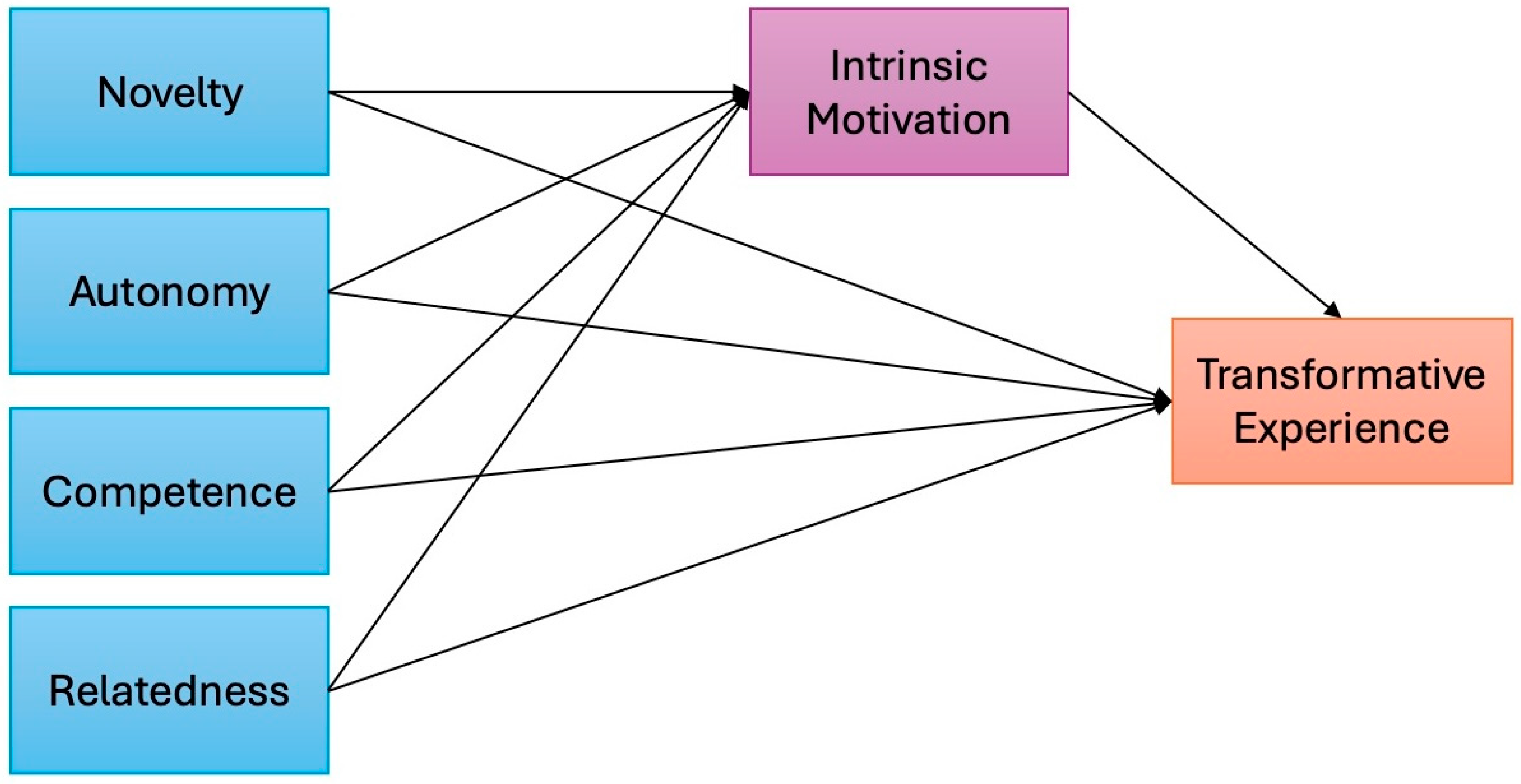
Figure 1. Proposed model.
Education 16 00926 g001
Figure 2. Path coefficients examining the relationships between basic psychological needs, novelty, intrinsic motivation and transformative experience by country. Note. Beta coefficients (betas) with corresponding p-values, denoted by asterisks for significance, have been added to each path. Values to the left of the slash represent U.S. students, and values to the right represent Kuwaiti students. * p < 0.05, ** p < 0.01, *** p < 0.001.
Education 16 00926 g002
Table 1. Demographics.
Study 1
U.S. Students
(n = 278)
Study 2
Kuwaiti Students
(n = 369)
Gender 1
Female212 (76.3%)344 (93.0%)
Male51 (18.3%)25 (6.8%)
Non-binary10 (3.6%)
Questioning 1(0.4%)
Prefer not to say4 (1.4%)
Missing0 (0.0%)1 (0.3%)
Race/Ethnicity 2
White203 (73.0%)
Hispanic/Latinx34 (12.2%)
Multi-racial28 (10.1%)
Other9 (3.2%)
Prefer not to say4 (1.4%)
Year in School
Year 112 (4.3%)20 (5.4%)
Year 272 (25.9%)70 (19.0%)
Year 3102 (36.7%)132 (35.8%)
Year 476 (27.3%)132 (35.8%)
Year 516 (5.8)%15 (4.1%)
Courses Completed
1 Course15 (5.4%)4 (1.1%)
2–3 Courses53 (19.1%)10 (2.7%)
4–5 Courses53 (19.1%)25 (6.8%)
6 Courses or more157 (56.5%)330 (89.4%)
Major
Early Childhood/Elementary Education136 (48.9%)34 (9.2%)
Foreign Languages3 (1.1%)144 (39.0%)
Social Studies12 (4.3%)93 (25.2%)
Theater/Music/Arts35 (12.6%)17 (4.6%)
Science Education5 (1.8%)58 (15.7%)
Mathematics9 (3.2%)17 (4.6%)
Special Education40 (14.4%)0 (0.0%)
English Education26 (9.4%)0 (0.0%)
Physical Education3 (1.1%)0 (0.0%)
Other9 (3.2%)0 (0.0%)
Missing0 (0.0%)6 (1.6%)
Note: 1 Non-binary is not legally recognized and not culturally accepted in Kuwait. 2 The core race categories are not culturally recognized in Kuwait.
Table 2. Survey sample items.
MeasureSample Item
NNSS 1I feel I do novel things in my teacher education courses.
BPNSFS 2
 AutonomyI feel a sense of choice and freedom in the things I undertake in my teacher education courses.
 CompetenceI feel confident that I can do things well in my teacher education courses.
 RelatednessI feel that the people I care about also care about me in my teacher education courses.
IMI 3The activities in my teacher education courses were fun to do.
TEQ 4
 Motivated UseOutside of school, I use the knowledge I’ve learned about teaching and learning.
 Expansion of PerceptionI notice examples of teaching and learning outside of class.
 Experiential ValueI find that knowledge of teaching and learning make my current, out-of-school experience more meaningful.
Note: 1 Novelty Need Satisfaction Scale. 2 Basic Psychological Need Satisfaction and Frustration Scale. 3 Intrinsic Motivation Inventory. 4 Transformative Experience Questionnaire.
Table 3. Descriptive statistics.
VariableU.S.Kuwaiti
NMSDNMSD123456
1. Novelty a2783.800.703693.890.71 --0.61 **0.54 **0.44 **0.64 **0.48 **
2. Autonomy a2783.770.743693.770.790.72 **--0.64 **0.61 **0.65 **0.50 **
3. Competence a2784.030.693693.980.700.52 **0.63 **--0.63 **0.50 **0.51 **
4. Relatedness a2783.970.703693.870.730.57 **0.62 **0.52 **--0.49 **0.50 **
5. IM a,c2783.700.743693.730.800.72 **0.68 **0.51 **0.55 **--0.45 **
6. TE b,d2783.472.273691.641.700.52 **0.53 **0.48 **0.48 **0.41 **--
Note: a Responses were on a 5-point Likert scale (1 = Strongly Disagree; 5 = Strongly Agree). b Rasch score < −0.5 = in-class engagement only; 0 = somewhat transformative; >0.75 = significantly transformative. c IM = Intrinsic Motivation. d TE = Transformative Experience. ** p < 0.01. Based on Cohen (1988) guidelines, r = 0.10, r = 0.30, and r = 0.50 are considered small, medium, and large effects, respectively. Correlations for the US and Kuwaiti samples are presented below and above the diagonal, respectively. Although the data for the U.S. and Kuwait studies are presented together for convenience, the measures were not found invariant across samples and the items retained were not identical for all scales and subscales.
Table 4. Path coefficients examining the relationships between basic psychological needs, novelty, intrinsic motivation, and transformative experience by country.
U.S. (n = 278)Kuwait (n = 369)
βp95% CIβp95% CI
Direct path coefficientsa0.25 **0.0010.10–0.410.18 **0.0040.06–0.31
b0.17 *0.0400.01–0.330.050.506−0.10–0.19
c0.20 **0.0030.07–0.320.20 **0.0020.08–0.33
d0.18 **0.0140.04–0.320.24 ***<0.0010.12–0.36
e0.44 ***<0.0010.33–0.560.38 ***<0.0010.28–0.48
f0.24 ***<0.0010.11–0.360.35 ***<0.0010.23–0.47
g0.080.108−0.02–0.180.000.948−0.11–0.12
h0.110.0510.00–0.220.11 *0.0440.00–0.21
i−0.080.251−0.23–0.060.080.231−0.05–0.20
Indirect effectse*i−0.040.268−0.10–0.030.070.245−0.02–0.08
f*i−0.020.286−0.06–0.020.060.235−0.02–0.07
g*i−0.010.385−0.02–0.010.000.959−0.01–0.01
h*i−0.010.352−0.03–0.010.020.383−0.01–0.03
R2TE a0.37 ***<0.001 0.37 ***<0.001
IM b0.58 ***<0.001 0.53 ***<0.001
Note. a Transformative experience. b Intrinsic motivation. * p < 0.05, ** p < 0.01, *** p < 0.001. As a general rule for interpreting β as an effect size, Cohen (1988) suggests, 0.10 to <0.30 = small, 0.30 to <0.50 = medium, ≥0.50 = large. Although the data for the U.S. and Kuwait studies are presented together for convenience, the measures were not found invariant across samples and the items retained were not identical for all scales and subscales.
Disclaimer/Publisher’s Note: The statements, opinions and data contained in all publications are solely those of the individual author(s) and contributor(s) and not of MDPI and/or the editor(s). MDPI and/or the editor(s) disclaim responsibility for any injury to people or property resulting from any ideas, methods, instructions or products referred to in the content.