1. Introduction: Motivation and Basis
Science education has become a challenge in many European countries. As shown by
Osborne et al. (
2003), in a study involving several thousand English middle-school students, the initially high level of interest in biology, geography, physics, and chemistry remained stable for biology and geography but declined within two years to “dislike” in physics and “strong dislike” in chemistry. Among 15-year-old respondents, only 4% considered physics to be an easy subject, although many recognized its usefulness for future employment.
A study among Spanish university students showed not only poor knowledge of physics but also poor efficiency of the didactics: some results of tests were worse after one semester of teaching than at the beginning (
Ablanque et al., 2024).
In Poland, matriculation examinations in physics (required, for example, for admission to medical schools) are taken by only about 4% of secondary-school graduates, and the distribution of results (in 2014) was Poisson-like, with the dominant at 21/100 score (
G. P. Karwasz & Wyborska, 2023). As discussed later in this Introduction, the research on the educational efficiency in physics is massive and varied and is supported by worldwide organizations like GIREP (see, for example, (
Guisasola et al., 2016)) and CERN (see, for example,
Featonby & Oliveira, 2026). In spite of this, the EU continues to press on new activities to trigger students’ interests in science, technology, engineering, and math (and recently also arts): STEAM programs. However, European reports suggest that methodological innovations alone, including new content and teaching technologies, are insufficient—the most important report on this question (
Rocard, 2007) is entitled “Science Education NOW: A Renewed Pedagogy for the Future of Europe.” In the USA, it was President George W. Bush who launched the “No Child Left Behind” initiative (2002).
In this work, we respond to these calls: we propose a new pedagogical approach in teaching physics at an early stage (elementary school), with the main aim to trigger (and maintain) a positive attitude toward this subject.
Numerous research groups try not only new methodologies of teaching, but also some cognitive approaches, such as narration and metaphor (
Close & Scherr, 2015;
U. Fuchs et al., 2018), argumentation (
Simon et al., 2006), and interactive games (
Fernando & Premadasa, 2024;
Akimkhanova et al., 2023). Even if we implement some of these solutions in our didactical practice (see, for example,
G. Karwasz & Kruk, 2012), they are not sufficient to change the generally negative attitude of students toward learning physics.
Numerous studies have demonstrated that experimental activities increase students’ interest in physics, enhance intrinsic motivation, and support conceptual understanding (
Holstermann et al., 2010;
Snětinová et al., 2018;
Okariz et al., 2023;
Nikitin et al., 2025). In particular, research consistently shows that hands-on activities are highly effective in promoting student engagement and motivation. A large-scale study conducted by
Nikitin et al. (
2025), involving nearly 10,000 participants, compared lecture demonstrations, science shows, and hands-on practical work, and found the latter to be the most effective in fostering intrinsic motivation.
Our approach builds on this evidence but extends it by combining demonstrations, active audience participation, and narrative-based instruction into a coherent pedagogical pathway. While the literature provides substantial evidence of the educational value of experiments, relatively few studies offer detailed, transferable teaching scenarios that can be readily adopted by teachers in different educational settings. Addressing this gap is one of the main objectives of the present study.
A stronger integration of physics didactics with contemporary pedagogical approaches is therefore needed: the social perception among young persons is changing so quickly (see, for example,
Siemieniecki, 2012) that “a renewed pedagogy is needed now”. We propose a new approach, in which the knowledge (and perception) of science acquired by pupils from the internet, smartphones and educational TV is a fundamental part of teaching. We propose new ways of presenting experiments and physical concepts, but the main novelty of our approach is exploiting several opportunities opened by modern pedagogy.
Several milestones toward modern pedagogy (and didactics) can be identified. The psychological constructivism dates to Jean Piaget and his study published in 1937 on how a child builds up their vision of the real world (
Piaget, 1954). Constructivism has been developed, among others, by
Ausubel et al. (
1978). Piaget showed how the concepts and capacities are auto-constructed by a child from “scratch”.
Ausubel et al. (
1978) add that new knowledge is acquired by relating it to existing cognitive structures.
Our approach, which we call hyper-constructivism (HC), relies on the individual cognitive activity of the child, but we use a collective knowledge of the whole group as the starting structure. An individual student need not know the answer to the question we ask in a chain of reasoning, but in the whole group, with the diversity of opinions, we can usually find a statement which is “correct”, i.e., useful for the next cognitive step. Then, the common point of arrival (a consensus) becomes the basis for the next piece of collective reasoning.
Jerome Bruner (
Bruner, 1956), a teacher of mathematics as the starting profession, stressed the importance of reasoning as a process of acquiring knowledge, rather than a linear transmission process. “We do not want to make children small, walking encyclopedia”. Bruner can be considered a founder of cognitivism (see
Bruner, 1990).
In our approach, we give neither definitions nor new names until they become absolutely necessary for the next cognitive step. For example, how can we say that the mains electricity is dangerous? By showing that the cell phone uses 3.7, and adding: this “V” written here says that we can touch the battery. With 220 (Volt)—never!” In our approach, we refrain from the common temptation of using many unknown words. On internet pages “Physics and Toys” (
G. P. Karwasz & Okoniewska, 2005), which receive on average 100 thousand visitors each year, in each description of a physical item, we use only 1 ½ new words: we explain one new word plus one, which will be explained in the next cognitive step.
We also refer to a deeper philosophical source: Immanuel Kant and his epistemology, which holds that we do not exploit reality but our concepts of it. Therefore, a proper cognitive category must be induced in the mind of the learner before we answer a subsequent constructivist question. How can we prove, and not only say, “The current can be dangerous”? We take a (brave) volunteer, make him (her) touch two bare wires, and with a loud “Bump!” we make him/her jump out of fright. Then, we apologize to the volunteer (who also laughs), but the entire audience will link the concepts of danger and electricity. This joke opens the way to the definition of Volt, as a measure of the potential danger of electrical devices.
The importance of pedagogy in didactics (Pedagogical Contents Knowledge, PCK) was stressed in the seminal work by Lee Schulman (
Shulman, 1986). Our observation of the practice of didactics in many EU countries is that even if the pedagogical approach is applied well in early school years, PCK complexity is missing from physics teaching, as it appears only at higher educational stages. Teachers usually have received some pedagogical training at universities, but they are not aware that teaching physics can exercise important pedagogic functions.
Nowadays, we must also include the valorization of the capacities of young learners, which we derive from Maria Montessori and her search for the dignity of the child. She wrote (
Montessori, 2004) that a mother cannot make a bigger offense to the dignity of a two-year-old child than feeding him/her with a spoon. If an experiment can be performed by a child, we leave him to do it independently.
And finally, our joint didactical and pedagogical approach contributes to the “reform of thinking”, not only of education, as invoked by
Morin (
1999,
2025). Teaching serves to build wisdom, and not knowledge solely. Therefore, modern didactics must be interdisciplinary and include the arts and humanities. We use proverbs, limericks, and quotations to enlarge the cognitive basis of teaching physics; we show that physics is not an abstract construction but the basis for everyday life, including walking in a vertical position, etc.
Generally, it is believed that constructivist teaching offers numerous advantages over traditional didactics (
Bada, 2015;
Sandoval et al., 2022). However, constructivism also carries objective risks and uncertainties for individual teachers (
Hills, 2007). In teaching physics, in particular, it is easier to find general guidelines (
Duit & Treagust, 2003) than practical teaching scenarios and experiments based on constructivism or cognitivism. Therefore, well-tested lessons and simple teaching aids, based on modern pedagogy, are urgently needed.
The constructivist methodology of teaching physics, even if soundly based on experiments (
Dvorak, 2019b), requires more than mere phenomenology: well-prepared scenarios in which one answer triggers a new question are needed. The pre-acquired students’ knowledge, even in the form of scientifically incorrect notions, becomes a starting point for narrations that only a teacher is able to weave. Barbara Rogoff (
Rogoff, 1990) calls it “providing bridges from the known to the new”.
Obviously, the starting points of these bridges are in each situation different, so the teacher must handle multiple complementary methods and content.
Fazio et al. (
2023) stress that a given physical subject must be presented from multiple perspectives and must induce students into a complex and varied learning environment. Italian pedagogist Piero Crispiani (
Crispiani, 2004) defines cognitivist didactics as a “non-definition”: an infinity of styles and methods, which aim to explore the mind of the student, and induce him/her to acquire the knowledge (and competences), which are planned a priori by the teacher. Obviously, the teacher must operate, with high ability, many possible styles and didactical means. We (
G. Karwasz, 2021) call this requirement the didactical principle “9:1”—the teacher must know nine times more than they have to transmit to the student. In agreement with PCK, the teacher must know not only the correct physical law, but he/she must understand why the student gives a wrong answer.
In this work, we apply such an extension of the constructivist (and cognitive) methodology: interactive lessons based exclusively on the prior knowledge of children, on a wisely organized narration and on full involvement of the audience. Our methodology extends much beyond the traditional active methods (see, for example,
Fazio, 2020): our lesson is more a spontaneous, collective playing than a mere transmission of notions. So, we call this methodology “hyper-constructivism”. The involvement of the public may not seem new. In fact, physics education, methods like physical theatre (
Carpineti et al., 2011) and embodiment (
H. U. Fuchs et al., 2021) have been developed. But our scenarios involve the whole audience, and at all steps of active and collective construction of knowledge: the lesson is a continuous interplay of questions, answers, experiments and jokes.
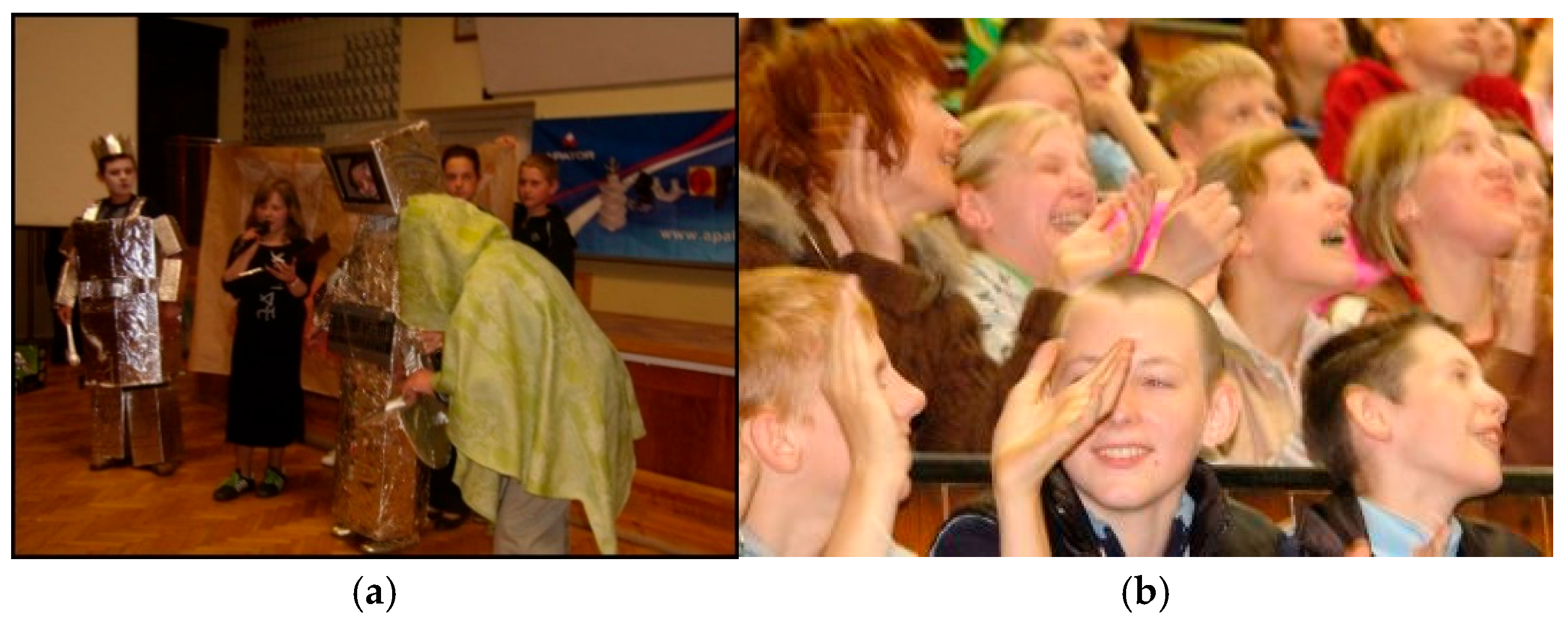
The forms of hyper-constructivism that we use to engage a young audience in physics are numerous. In
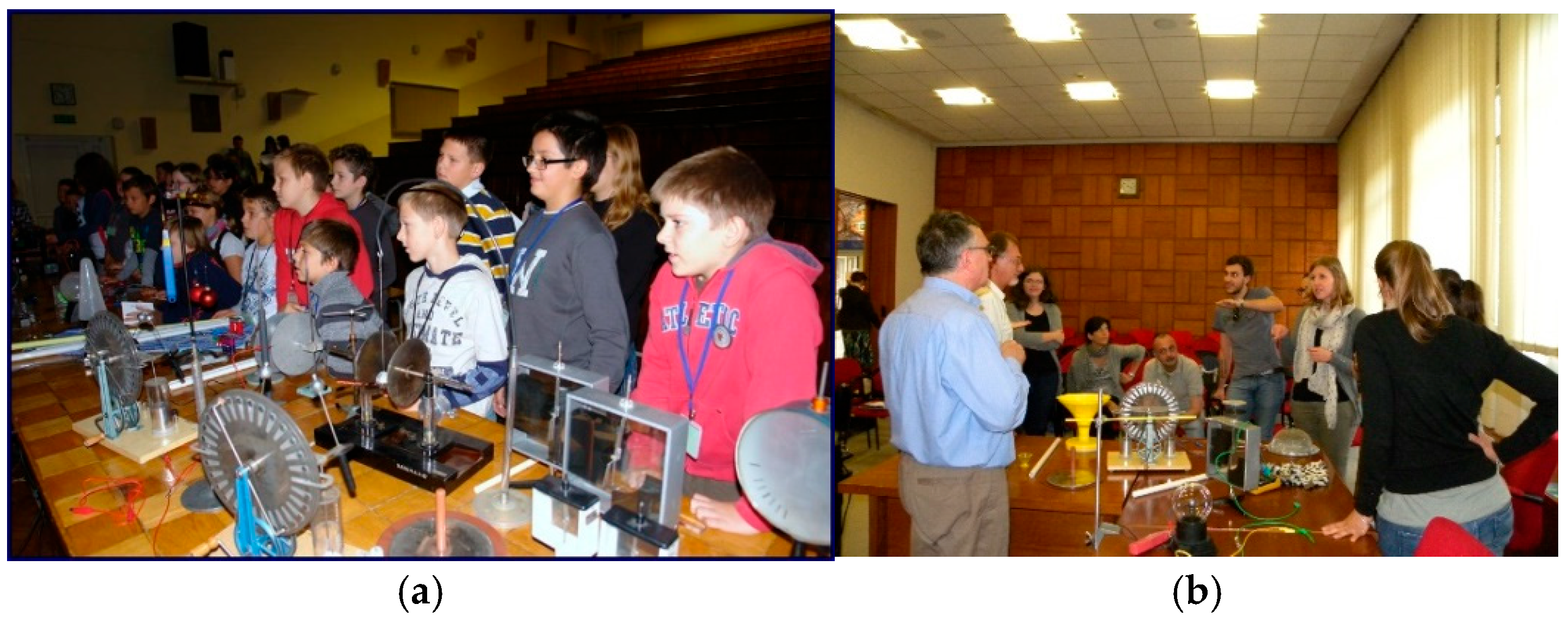
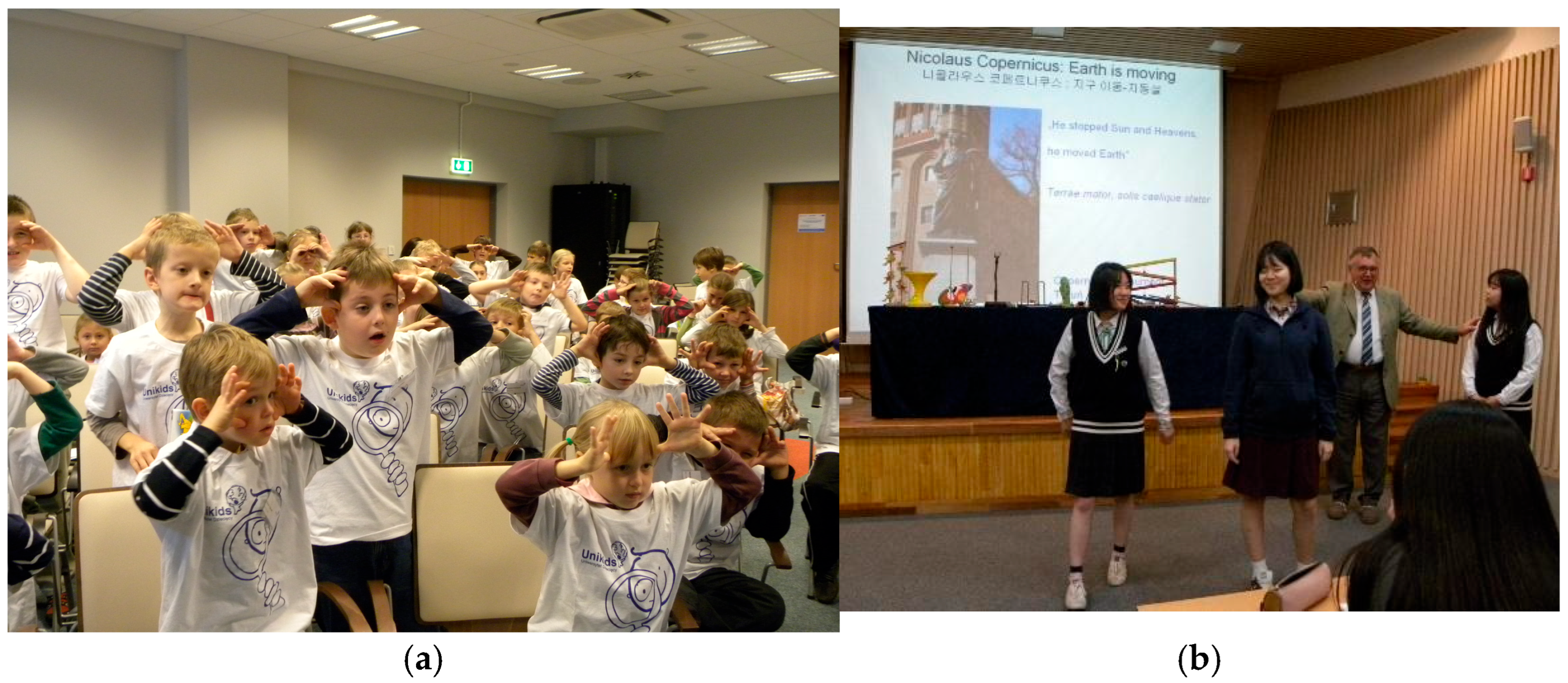
Figure 1, we show two of them: a competition for school classes in constructing a Montgolfier-like balloon (the prize was awarded not to the team that constructed the best balloon but for the class that made the loudest applause; see
Figure 1b) and a competition in theatre performances to illustrate “Fables for Robots”, written by Polish science fiction writer Stanisław Lem (see
Figure 1a).
The second “cornerstone” of our methodology is the use of a myriad of simple experiments. One can argue that this is neither a novelty. But usually experiments are separate “building blocks” of knowledge (see, for example,
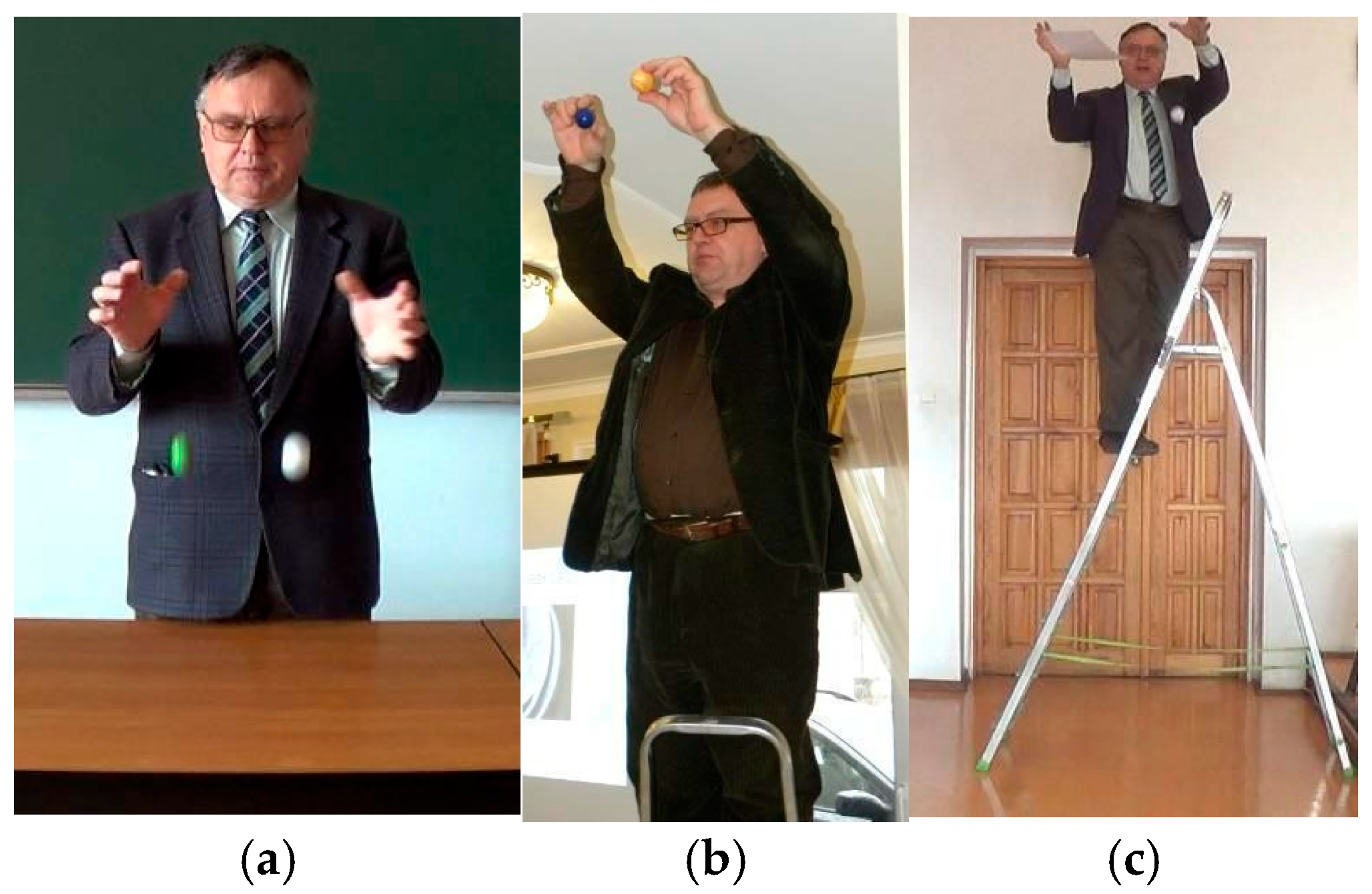
Planinšič, 2020). In our hyper-constructivist paths, ad hoc experiments are at the same time questions and answers, and they form a rigid sequence of narration. For example, in mechanics, two balls, a ping-pong one and a rubber one, show an equal time of free fall if dropped from a height of half a meter (
Figure 2a), and different times if dropped from a 3 m level (see
Figure 2b). Then, we performed a cross-check experiment with two identical pieces of paper (two halves of the same sheet)—one in the form of a ball (we formed the ball while climbing the ladder,
Figure 2c) and another in the form of a cone parachute. Experimental evidence in the live show is so striking that pupils do not need much explanation. Einstein said that everything should be explained as simply as possible, but not simpler. We say that every phenomenon, even a very abstract one, can be explained by a simple experiment. For us, the real, touchable objects are the core of explaining physics, especially in the age of virtual worlds. Therefore, we call this methodology neorealism.
In an effort to situate our approach within recent educational research, we must note the precarious duality of contemporary didactics. The works on the didactics of physics often focus on detailed, but fragmented implementations of specific concepts or methods, such as multimedia (
Moore, 2018), modeling (
Banda & Nzabahiman, 2021;
Dominguez et al., 2023), smartphones (
Organtini, 2021), microsensors (
Guentulle et al., 2024), interactivity (
Kämpf et al., 2025;
McLoughlin & van Kampen, 2019)—but without referring to pedagogical frameworks. On the other hand, founders of new trends in modern pedagogy, such as constructivism (
Novak et al., 1984), cognitivism (
Ausubel et al., 1978;
Crispiani, 2004), connectivism (
Siemens, 2006) and new epistemologies (
Morin, 2025) do not refer to didactics of physics—they consider this field too distant from the humanities. We find the “collaborative inquiry-based method” proposed by
Bell et al. (
2010) to be closest to our paradigm.
The present paper contributes to educational research by presenting and qualitatively validating a pedagogical framework rather than evaluating a single instructional intervention.
Here, we present hyper-constructivist, neorealistic pathways in teaching electrostatics. This subject is spectacular enough to also involve the youngest students, starting from the first years of elementary school, and experiments may be accomplished with low-cost materials. Even if the majority of the contents are known, we show how threading them on a narrative string allows us to transmit not only the mere phenomenology but also scientific contents and social competencies.
This paper demonstrates how a cognitive path can be constructed from seemingly familiar and simple experiments following the principles of phenomena-based learning. We illustrate how spark length can serve as a measure of electrostatic potential, how Christmas balls attract each other when voltage is applied, and how the interaction between a plastic rod and an aluminum can is far from trivial. Thus, our didactical paths utilize discrepant events, but our goal is not to astonish through the phenomenon alone, but to construct “cognitive adventures” that reveal the joy of interactive discovery of physical laws.
Finally, the present contribution does not follow the structure of a typical quantitative research paper in education—which usually includes alternative approaches, working hypotheses, and formal evaluation—but instead constitutes a complex pedagogical proposal validated through qualitative means. This approach has been successfully implemented in approximately one hundred didactical environments (ranging from primary schools to teacher training workshops). The effectiveness of these paths was assessed through a qualitative analysis of student-generated artifacts (e.g., graphical reports) and longitudinal observations of post-lesson inquiry, which we provide in detail to enable the implementation of our methods in other contexts.
2. Hyper-Constructivism and Neorealism
Here, we propose an extension of constructivism for teaching physics at various levels, from preschoolers to practicing teachers. In our conceptualization of teaching as a cognitive process (
G. P. Karwasz et al., 2015), we emphasize two key principles: hyper-constructivism and neorealism. Constructivism in physics teaching cannot be limited to the active construction of knowledge; it fundamentally requires addressing students’ “prior ideas,” which are often inconsistent with scientific laws. Unlike
Ausubel et al. (
1978), who stressed the importance of well-suited pre-knowledge, we also admit such apparently “wrong” ideas: they prove to be extremely useful in the process of a collective, interactive building of correct physical laws, which in many cases are also intuitive. This process involves building the above-mentioned “cognitive bridges” between intuitive understanding and abstract mathematical models.
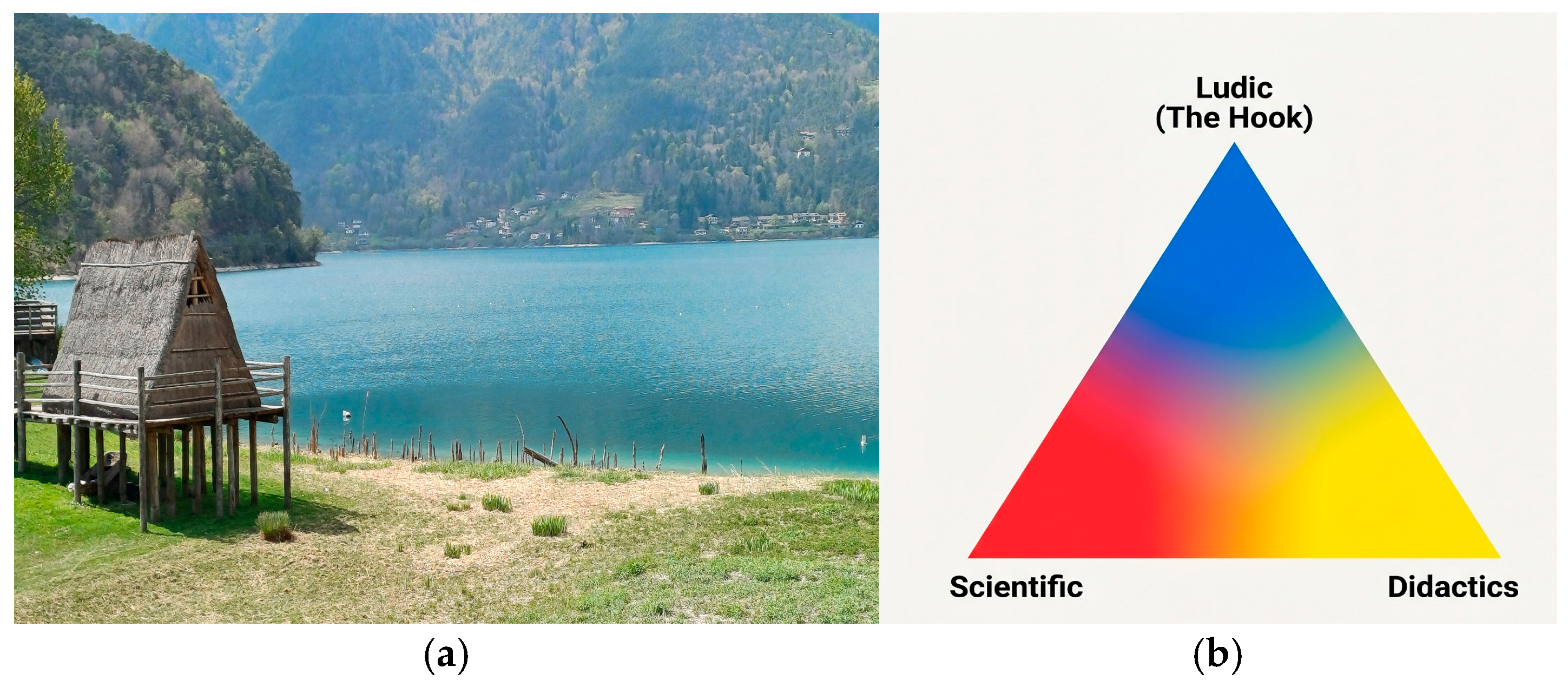
In hyper-constructivism, we compare the didactical path to crossing a lake over submerged logs. The teacher guides the student’s steps along hidden but solid structures of prior knowledge toward a clearly defined educational goal. The students need not know the planned endpoint of this educational path: the teacher hides it until the outcome of the lesson becomes evident for students, like the opposite bank of the lake that was hidden in a fog until the last step. Consequently, the exact learning path is different every time: the teacher must adjust methods (narration, experiments, examples) every time, according to the evolution of the lesson. Through neorealism—the use of real, tangible objects to illustrate concepts such as electrons or quarks—we aim to make this process not only didactically effective but also emotionally engaging, which is essential in the era of ubiquitous virtual reality.
Many authors (as quoted above) advocate constructivist teaching, but practical applications in physics are still sparse. We observe that the limited adoption of constructivism stems not only from teachers’ doubts or hesitations but primarily from the lack of appropriate, innovative, and stimulating teaching tools and content. The first requirement when proposing innovative didactics is to use one’s own imagination—surprising students in a cognitive way. Say, when we ask students (or teachers) to draw an electron, the first one will place a small dot on the board. The second student, drawing a proton, will do the same. When a third student enters the classroom and draws a quark as a dot, the entire audience bursts into laughter. “The Earth, seen from deep space, is also a dot; and yet no one imagines Tottenham fans arguing with Arsenal fans,” we joke. The same applies to small quarks: we fail to use our imagination.
The didactic principle we call neorealism is based on finding real, physical objects that can illustrate abstract concepts, phenomena, equations, or microscopic entities—usually beyond our direct perception. This is especially important in times of virtual or augmented “reality” (
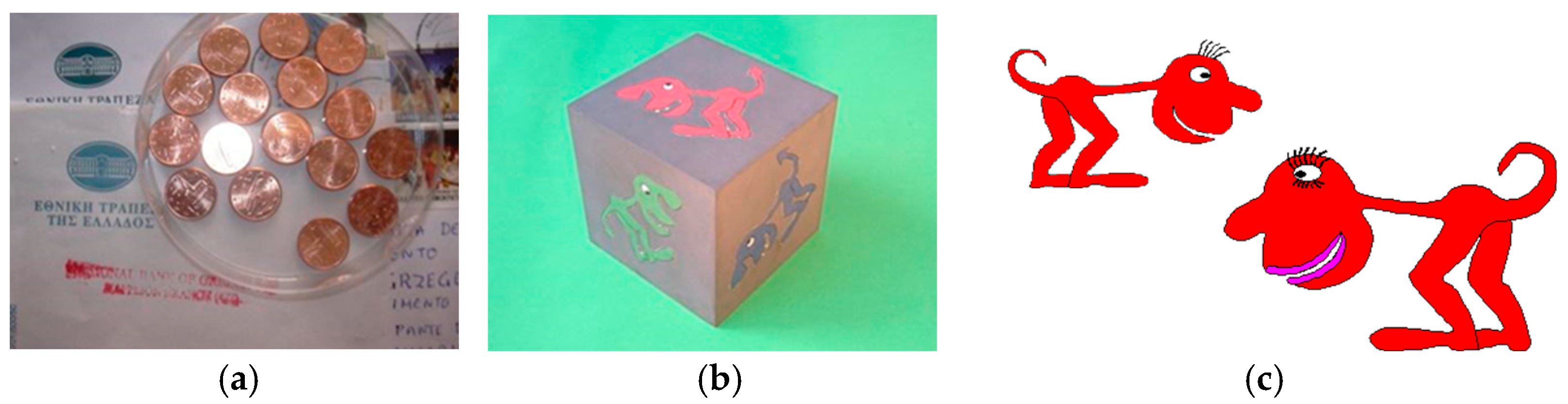
Dvorak, 2019a). The electron is classified as a light elementary particle: ΛΕΠΤO in Greek. Coincidentally, the Greek eurocent bears the same inscription. Thus, the mass of a 1 eurocent coin (2.7 g) becomes our fundamental unit. On this scale, a proton would weigh 4.9 kg. But a proton is not an elementary particle: it consists of three quarks, which cannot be isolated (
Gross, 2005). In our neorealism, the proton is modeled as an iron cube containing three colored quarks (see
Figure 3b)—visible, yet inseparable. The quarks themselves vary in mass, have positive or negative charges (right- or left-facing “noses”), and are classified as “up” or “down.” Heavier quarks are called “charming” and “beautiful” (see
Figure 3c).
The example of sequentially drawing elementary particles illustrates the second principle of our didactic approach: using the audience’s involvement and their pre-existing knowledge—whether in a school class, at a children’s university, or at a PhD seminar. Unlike in Socrates’ time, today’s students know so much that a skilled teacher can focus not on giving answers, but on prompting the appropriate questions. The hyper-cognitive method organizes experiments and stories sequentially, so students spontaneously formulate problems that guide them to the next steps of their reasoning. To encourage contributions from the entire audience, it is essential never to criticize answers. Even an incorrect response usually contains a fragment of a valid reasoning process. As Jerome Bruner, one of the founders of cognitivism, initially a teacher of mathematics, said: “If a student gives a wrong answer, he/she is usually answering a different question than the one the teacher asked” (
Bruner, 1956).
We compare this process to walking across submerged logs placed in the bed of a lake (see
Figure 4a). The teacher knows where the trunks are, and guides the steps—seemingly across the surface of the water, but in fact towards a clearly defined educational goal. Such an approach assures a balance between freedom and guidance, difficult to obtain in other methodologies (see
Bell et al., 2010).
Further, it is essential to define three “poles” of the hyper-constructivist teaching. The first is to astonish, amuse, and entertain—a role we refer to as the “hook”, which captures students’ attention and emotional engagement. The second vertex in our cognitive triangle (see
Figure 4b) is obviously didactics: a clear transmission of definitions, phenomena, explanations and laws. The third is the scientific dimension: complex, and only partially answered. This triadic model ensures that each audience walks away with a different perspective:
- −
The person on the street says, “That was fun!”
- −
The student says, “That was simple!”
- −
And the scientist says, “That was difficult…”
The three cognitive functions are complementary, like colors on the palette: the lesson/lecture/workshop must be correctly balanced in order not to be boring, too difficult or banal. And, again quoting
Crispiani (
2004) and
Fazio (
2020), it must address different cognitive abilities of single persons in the audience. Including all three cognitive elements in a unit of lesson is essential: a plain lesson is boring, scientific details are too difficult, and just fun teaches nothing.
3. Cognitive Didactical Path
In the field of electromagnetism, neorealism can take countless forms. These include simple hands-on experiments (
Dvorak, 2019a), curated collections such as “Toys in Physics” (
G. P. Karwasz & Okoniewska, 2005) or carefully structured demonstrations, with rising difficulty, arranged like pearls on a string (
Akimkhanova et al., 2021). However, even a few simple objects can be sufficient to construct interactive, cognitive learning paths.
The hyper-constructivist method draws upon the group’s pre-existing knowledge as the primary source for teaching and some amusement as a starting point. To make the lessons and lectures more intriguing, we give them titles that are borrowed from common sayings. A piece of poetry for children in Polish is entitled: “Click-clack!” (Pstryczek-elektryczek, by Julian Tuwim). So the lesson starts from recalling, all together, this poetry, and a child switching on and off the illuminations of the lecture hall. If the lesson uses the electrostatic Wimhurst machine or a small Van de Graaf generator, which yield long sparks, the lesson is entitled “Let the thunder hit it!” (a regional proverb in Silesia).
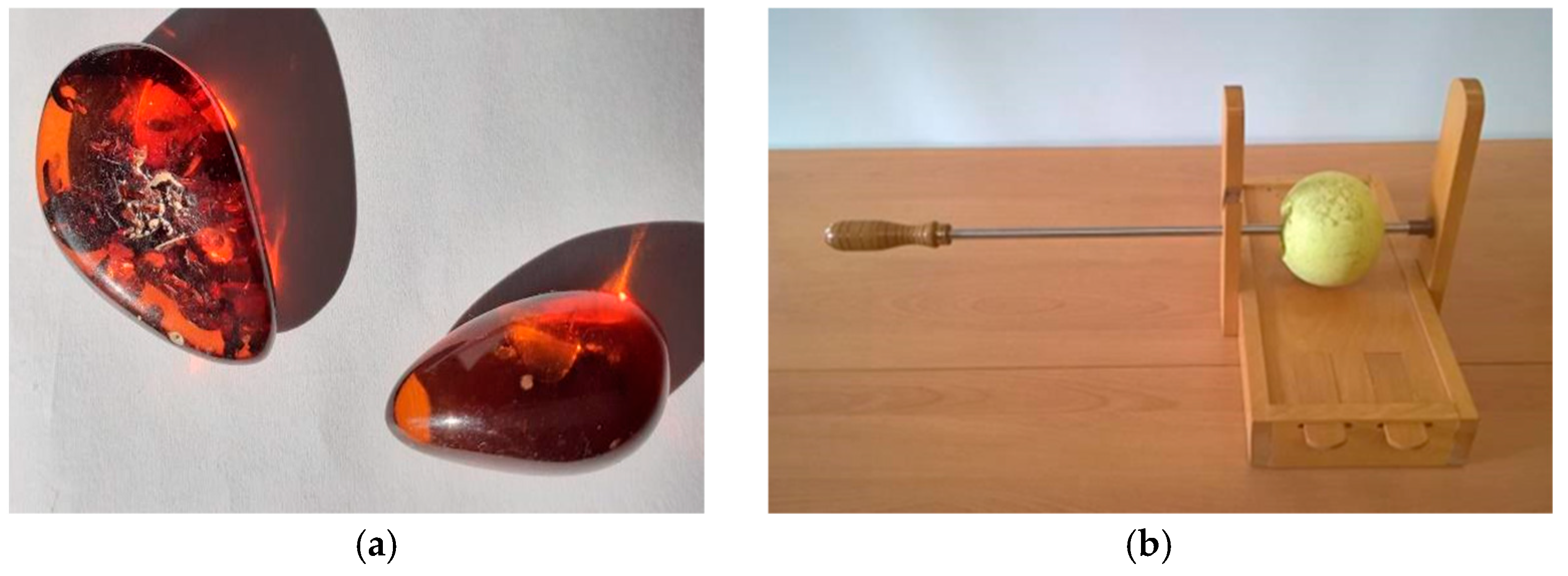
Our didactic path on electrostatics starts with showing a piece of amber, in Greek “electron” (
Figure 5a). Amber, originating from the Baltic Sea, is a natural prototype of modern plastics: it can be charged by rubbing, and it attracts small objects such as powders or feathers. The word “electricity” in all languages comes from the word “amber”, so every student must touch a piece.
A milestone in the history of electrostatics (1651) was Otto von Guericke’s sulfur sphere, the mayor of Magdeburg (
Figure 5b). Small paper confetti is stored in a box below the sphere—we place it outside before starting the experiment. The combination of these two examples transmits the notion that electrostatic “materials” are common. In 1769, Alessandro Volta, a school inspector in Como at that time, tried to organize different materials, including glass, amber, sulfur, human skin and cat’s fur, into a triboelectric series: the triboelectric series shows which materials charge easily and how. Volta’s electrostatics series was a scientific failure, but the very idea bloomed later into modern electrochemical cells. At the scientific vertex of our cognitive triangle, we add that, after a few thousand years since the discovery of the electrostatic properties of amber, we still do not quantitatively understand why certain materials charge positively and others negatively (see
de Silveira Balestrin et al., 2014).
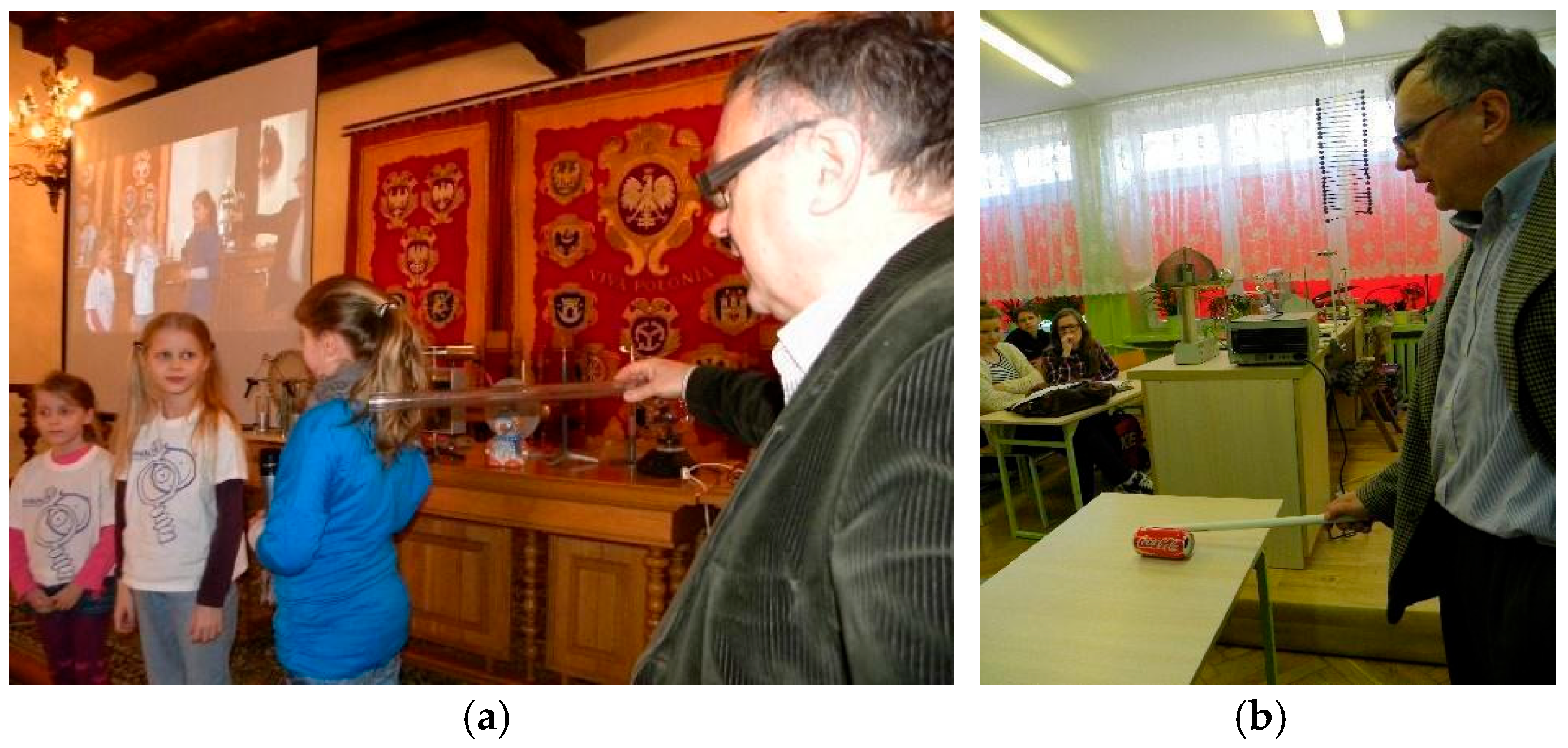
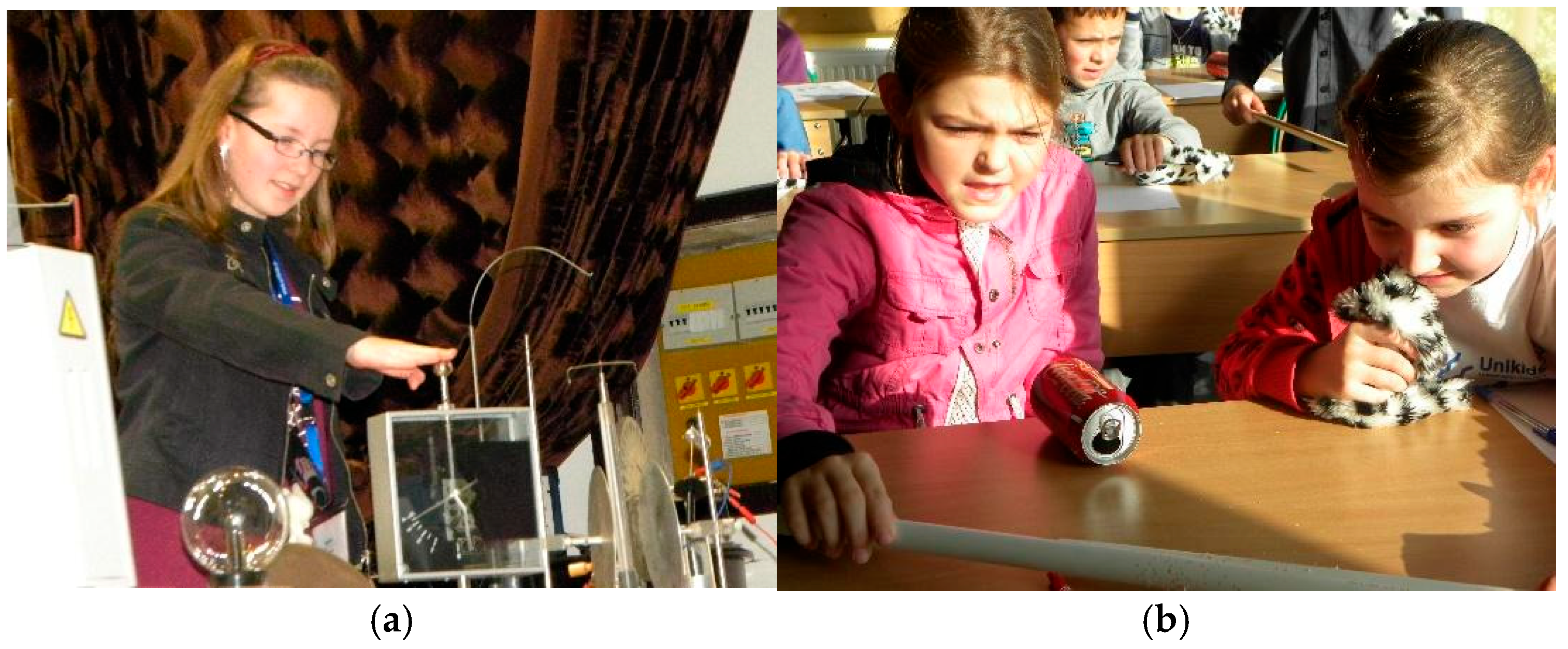
Neither amber nor sulfur proves to be very efficient for electrostatics. So, we move the lesson scenario into a small interactive “theater” with students, where a plastic rod charged by rubbing plays the main role (
Figure 6). To maintain students’ cognitive attention, we interweave didactic elements (like rubbing the piece of amber against the woolen jacket) with amusement, surprise, and joy. We select a blonde-haired girl (blonde hair tends to be finer, and girls wash their hair more frequently than boys) and act out the role of a hairdresser. Using the charged rod, we lift her hair—to the delight of the audience (see
Figure 6a). An even funnier (and quicker) version consists of lifting hair on the professor’s arm. Now, we invite students to try with their plastic pens and nylon dresses. Didactically, these experiments are not new, but we make from them a tool for pedagogy: amusement, inquiry, and collaboration.
The next step in our cognitive path is to “train” an aluminum can, using the same charged plastic rod (see
Figure 6b). As we discuss later, the interaction is short-range: the attractive force acts between the linear charge on the rod and the induced charges in the aluminum can. The can starts moving only when the distance is small (a few cm), then accelerates quickly. To keep the audience laughing, the demonstrator must reverse the direction rapidly—just like training a dog. Still, as the Polish pedagogist Kazimierz Sośnicki (
Sośnicki, 1947) noted, excessive amusement leads to infantilization. A physicist must stop the ludic performance and move beyond a mere phenomenon: he/she must quantify physics.
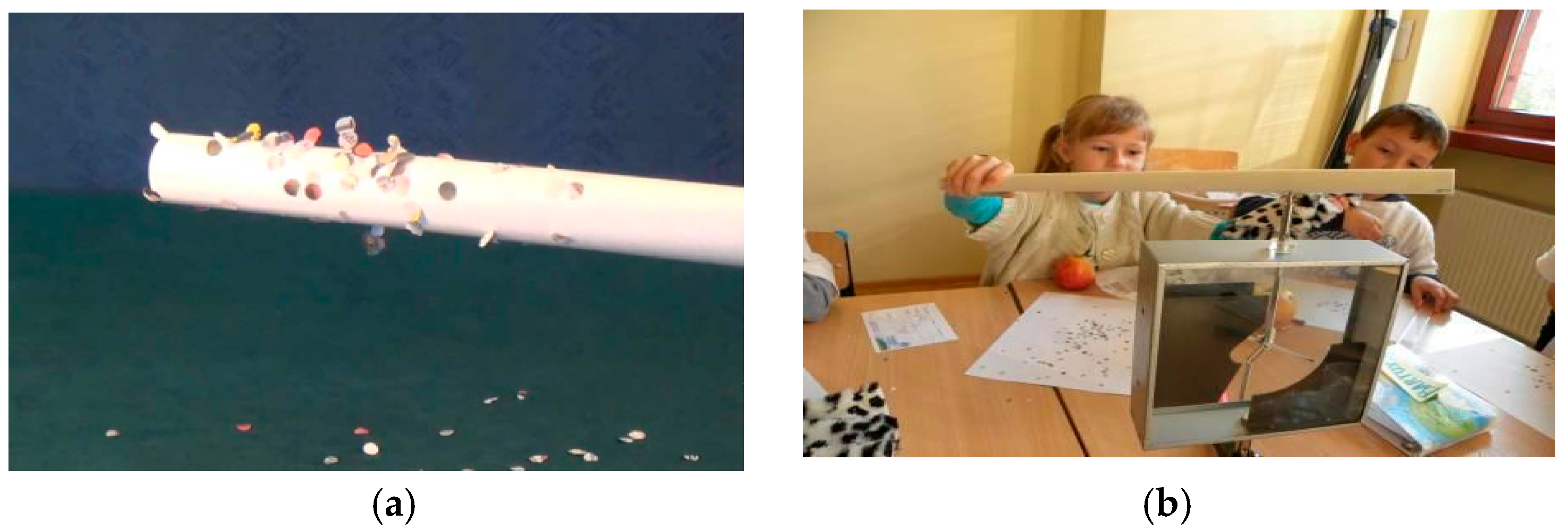
That is why we modified the most classical demonstration in electrostatics, which is with a plastic rod and small pieces of paper (see
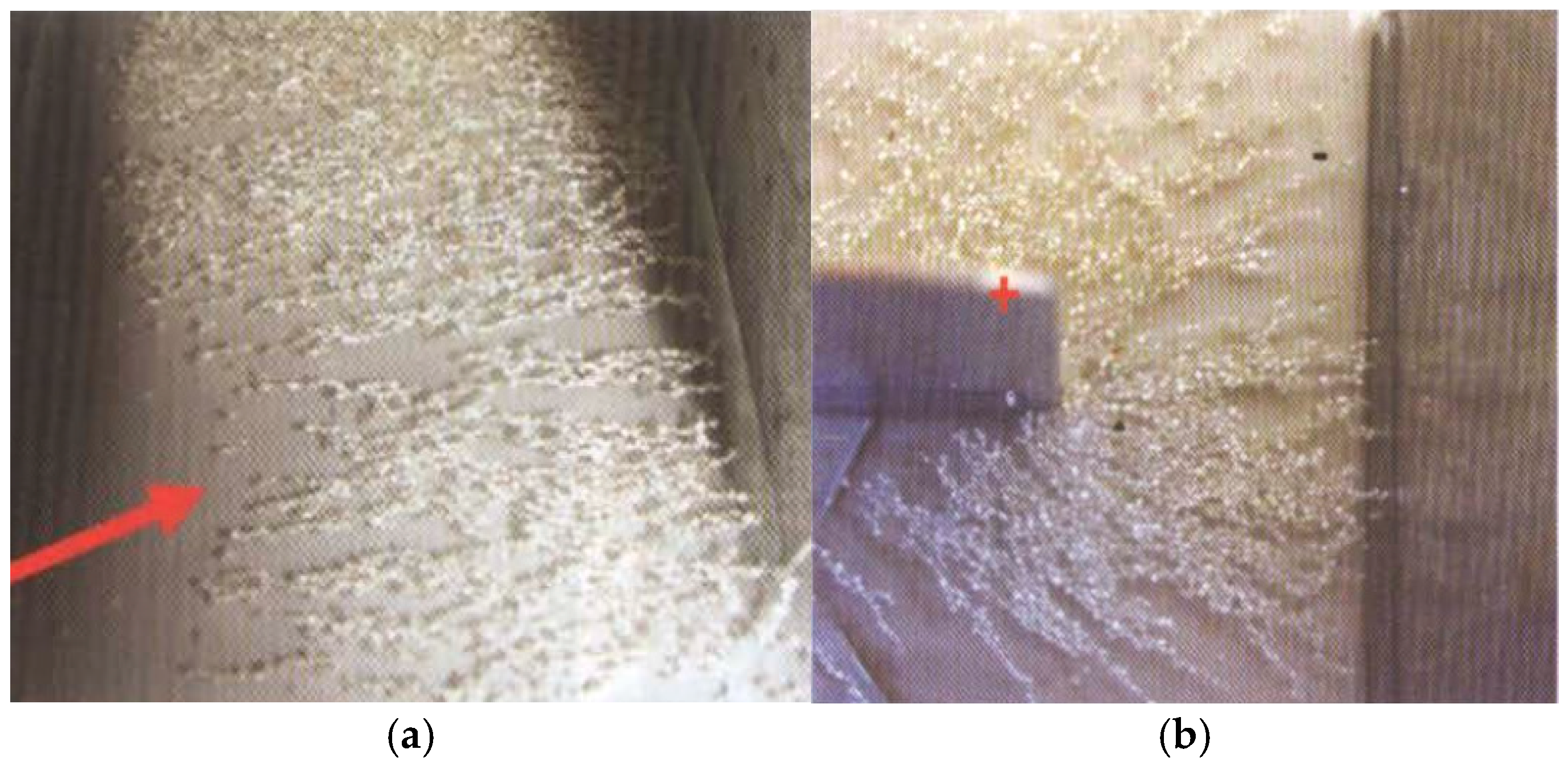
Figure 7a). In our version, all paper bits are small confetti, identical in size. This allows pupils to evaluate the charge accumulated on the rod by simply counting confetti pieces attached to it. Physics is not only about phenomena, but also about measuring them.
Moreover, as
Figure 7a clearly shows, the confetti adheres to the rod vertically. They align along electric field lines, which—due to the rod’s cylindrical symmetry—are perpendicular to its surface. Then, spontaneously absorbing the charge from the rod, the confetti are ejected one by one, always in a direction perpendicular to the tube’s axis. This is a clear manifestation of Gauss’s law: the electric field at any point around the rod is directed radially outward, i.e., perpendicular to the axis. We conclude the confetti experiment with the witty remark: “We do not need a vacuum cleaner anymore!” And obviously, when the lesson is addressed to children and not to university students who are able to apply Gauss’s law to the cylindrical geometry, we simply say, “look carefully at the confetti while they are ejected like from a catapult.”
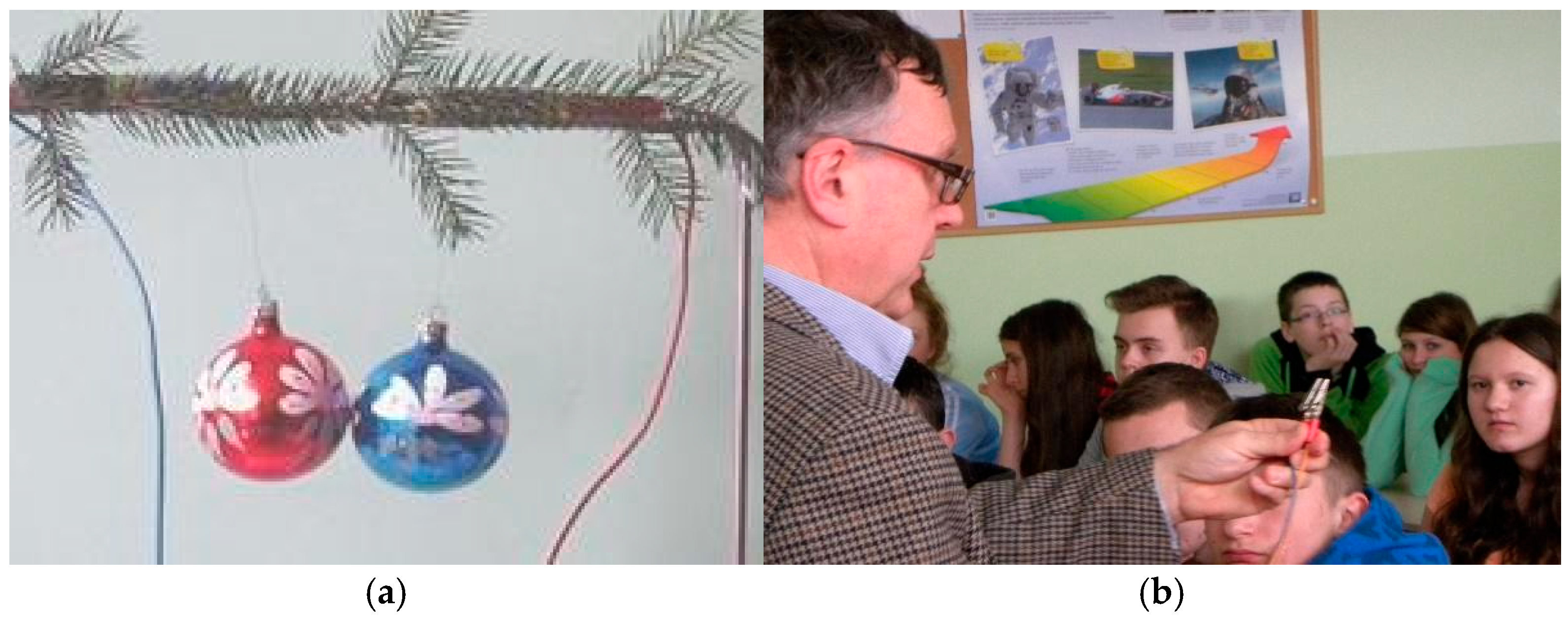
We conduct more precise quantization of the triboelectric charge using an electroscope (see
Figure 7b). First, following Immanuel Kant, we must invoke the appropriate cognitive category: the voltage. This is easy, since every (EU) plug is marked “250 V~/16 A”. In a hyper-constructivist manner, we ask a student to copy these symbols on the blackboard. Then, keeping in mind the social competences, we comment that such a voltage is simply lethal! A cell phone operates at a voltage of 3.7 V. Equipped with these two numbers, acquired through neorealism (we show the cell phone battery label), children recognize that electrostatic voltages can be dangerous. “Never touch the inside of a cell phone when—in winter, wearing woolen pants—getting out of a plastic chair: your parents will have to buy you a new phone!” In
Figure 7b, we also see how children working in small groups spontaneously share roles—acquiring social skills. Finally, from a scientific perspective (see
de Silveira Balestrin et al., 2014), we still do not know why triboelectric potentials are so high.
4. Coulomb’s Law
An introductory element in teaching electrostatics is Coulomb’s law. The typical manner to show it is the attraction (or repulsion) of two ebonite bars hanging on a kind of Cavendish’s balance: it is neither convincing nor quantitative. So, we propose Coulomb’s law as a “Christmas experiment”. Below, we present it in the form of a cognitive triangle: (1) experiment as a show, (2) simplified calculation, and (3) exact numerical modeling. The cognitive aim of the “Christmas experiment” is the study of the interaction of two (only) signs of electrical charges.
In 1759, Robert Symmer, a clerk at the English royal court, observed that two socks made of the same material—wool or silk—taken off the same leg repelled each other, while socks of different materials attracted. This seemingly trivial observation was actually the first experimental indication of the existence of two electric charges of opposite signs. That paper (
Symmer & Mitchell, 1759) is also an example of how scientific knowledge is constructed from “scratch”—by paying attention to what other observers overlooked. To demonstrate Symmer’s experiment, we use a nylon scarf pulled from a wool coat: its two ends repel one another; at the same time, the scarf is attracted by the coat. (One can also find another combination of some synthetic clothes.) Hyper-constructivism requires appealing to individual experiences of children: “Have you observed sparks while taking off a woolen pullover? This is electricity!”
Electrostatic voltages on the order of tens of thousands of volts can be generated using a cheap piezoelectric gas igniter. Using it and two glass Christmas ornaments, covered with a thin layer of metal (silver) on the inside, one can demonstrate and roughly measure Coulomb’s law (
Figure 8).
We hang two Christmas-tree glass ball ornaments side by side, about 1 cm apart, using thin (e.g., 0.1 mm diameter) insulated wire, like that from headphones. We strip the insulation off the wire at the ends. On the other side, the wires are connected to the two terminals of the piezoelectric igniter. The metal cap of the igniter must be removed to ensure that the spark ignites at the free ends of the wires (never touch electrodes! Voltages of a few kV are really unpleasant!).
Once the ornaments are connected to opposite terminals, we press the igniter—the balls collide instantly. If we connect a third ornament (always using only two colors), we observe how two balls of the same charge repel each other. (And, a technical note for teachers: if the balls have not touched one another, never take them in hand—they are still charged!)
Again, physics is an attractive, interactive, repetitive, but first of all, quantitative science. In the “zeroth” approximation, we calculate the Coulomb force assuming point-like charges, positioned in the centers of the balls. (Newton showed that this approach for the law of gravity is valid for spherical masses.) The igniter supplies a voltage of around 10 kV. The charge on each ornament is small (for a 4 cm diameter, the capacitance of a sphere is approximately 20 nC). Assuming the distance between the charges is 5 cm, Coulomb’s force would be quite small (1.4 mN). And the force needed to deflect a 5 g ornament by 1.5° from vertical (0.5 cm offset on a 20 cm string) is about 1.2 mN. Thus, for a collision to occur, the ornaments must be quite close. Didactically, it is a perfect experiment. It is also nice as an amusement. Scientifically, it is an oversimplification, as we show later in this paper. Of course, one could use an electrostatic machine and ping-pong balls wrapped in aluminum foil or coated with colloidal graphite—but then it would not be a Christmas experiment. Neorealism stays in using “at-hand” objects, and not “didactical ones”, prepared on purpose.
5. Gauss’s Law for Electrostatics
Our “Christmas experiment” is the illustration of the simplest case of two point-like charges. But already, the confetti ejected perpendicularly from the surface of a plastic tube (
Figure 7a) requires a more complex formalism. Can we translate Maxwell’s laws into an illustrative narration? Yes, but according to the already mentioned didactical principle 9:1, always keeping in mind the exact formulations, then translating them into simple language, hiding the mathematics but showing analogies with “at hand” objects.
The first of Maxwell’s equations says that in order to know a net charge (
Qint) enclosed by a surface (
S), we do not need to know single charges or their positions: we simply sum up (i.e., integrate) the electric flux through that surface.
where
E is the electric field vector, and
ε0 is the permittivity of vacuum. We apply full mathematical rigor here: the electric field
E and the surface element d
S are vectors, and their product here is a scalar. The product on the left side is called the flux of the electric field.
Obviously, we should explain what the flux is), but on the basic level, we can simply say that a fishing net in a stream works efficiently if it is positioned perpendicularly to the flow of the stream. Joking, we call Equation (1) the law of a fat professor: to estimate the professor’s mass, we do not need to weigh him on a scale—we can simply check the size of his jacket (see
Figure 6a). Size 56 (in EU standard) means that he is over 90 kg. “Check the size of your dress: it works!” Similarly, to determine the electric charge, we do not need to measure it directly—it is enough to surround it with a closed surface and measure (i.e., integrate) the electric field passing through that surface. The use of Gauss’s law is particularly useful in some symmetries, as we discuss later.
In Equation (1), we should explain/illustrate three elements: a closed surface, the lines of the electric field toward the outside of this surface, and the charge/charges that are confined
inside this surface. Many studies in physics education research indicate that students experience significant conceptual difficulties when learning Gauss’s law. In particular, students often struggle to recognize the symmetry of charge distributions and to select an appropriate Gaussian surface when solving an electrostatic problem (
Singh, 2006). Research also shows that learners frequently confuse the electric field with electric flux, treating them as equivalent quantities rather than distinct physical concepts. This misunderstanding makes it difficult for students to interpret the physical meaning of Gauss’s law and its connection to electric field sources (
Hernandez et al., 2025). Another common difficulty concerns the interpretation of graphical and mathematical representations of the electric field. Even when students are able to derive correct expressions for the field, they often fail to represent its spatial dependence consistently (
Maries et al., 2017). These findings suggest that effective instruction on Gauss’s law should emphasize conceptual reasoning, symmetry arguments, and qualitative analysis of field distributions rather than relying solely on formal mathematical derivations.
The strength of Gauss’s law lies in the possibility of ignoring the exact distribution of the electric charge: choosing an opportune geometry, we can derive the electric field (and, in consequence, voltages). As stated by Richard Feynman, in his “Lectures”, it is easier to imagine an angel than the electric field. To see an angel, you simply draw a person, possibly a woman, with wings. Then, you erase the drawing, because angels are invisible. But to imagine an electric field, one has to solve Poisson’s equation, according to Feynman.
As a first step in understanding Gauss’s law, we must visualize lines of the electric field: it is more difficult than in the case of magnetic fields. Lines of the electric field around a set of electrodes can be shown by tiny grains of semolina in oil (see
Figure 9). We have applied voltages in the keV range using Wimhurst’s electrostatic machine and tried different electrode configurations spaced by a few centimeters. Gauss’s law ensures that between two parallel plates the electric field is uniform, i.e., its lines are parallel (and perpendicular to the plates) (see
Figure 9a). This is analogous to the gravity force lines in our labs (a ball freely falling indicates the lines of the gravitational field).
In school, we need not introduce the notion that the electrostatic potential is an integral of the electric field (or, equivalently, the electric field is the gradient of potential). However, we can apply the same notion: when walking on steep stairs, a few steps cover a large height difference (and we walk up and down the aula stairs).
In analogy with our local (i.e., near-Earth surface) gravity, we can simply state that in the case of a uniform field, the potential (or the potential energy Ep of a mass m) rises with the altitude Ep = mgh, where g is an equivalent of the electric field intensity E).
A straightforward consequence of the picture in
Figure 9a is a rather surprising formula, that the capacitance
C of a condenser made of two parallel plates rises when reducing the distance
d between the plates,
C = ε
0 S/d (and rises with the surface of the plates, which is intuitively obvious; ε
0 is the electric permittivity of vacuum).
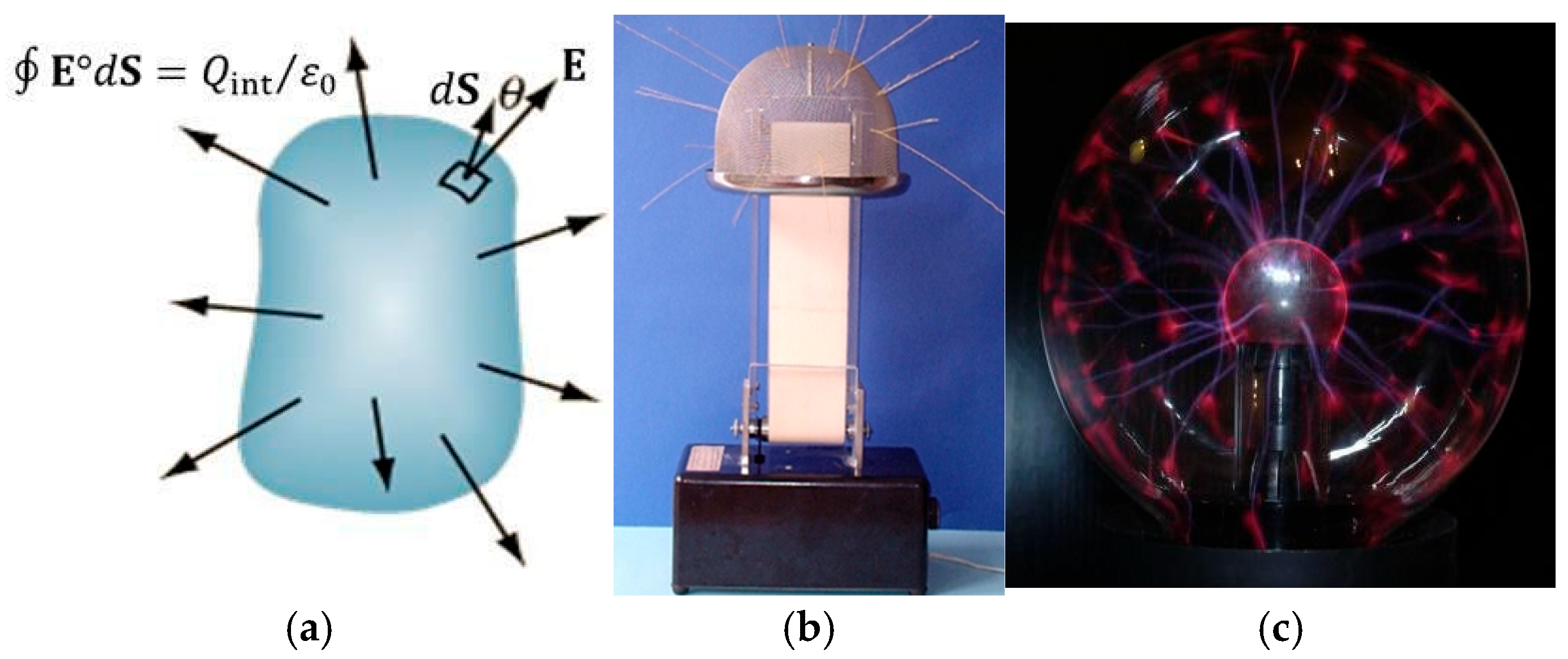
To illustrate Gauss’s law, we need objects resembling the schematic drawings commonly found in school textbooks or on the internet, such as that shown in
Figure 10a: a closed surface with electric field lines extending outward. From a strictly mathematical point of view, these lines do not necessarily have to be perpendicular to the surface. However, a quick survey of internet illustrations shows that they are almost always drawn perpendicular to it. This representation likely originates from a cognitively familiar image of electric field lines emerging perpendicularly from the metallic surface of a Van de Graaff generator, as shown in
Figure 10b. Similarly, lines in a plasma tube radiate outward from a central electrode (see
Figure 10c). This resembles the electric field lines of a point or spherical charge, a direct reference to the spherical symmetry in Gauss’s law.
The functioning of a Van de Graaff generator is somewhat surprising: using a simple rubber belt, we charge the sphere to extremely high potentials (say, up to 1 million volts in our setups (
Figure 10b). The “trick” is as follows: as the charges of the same sign repel, and the cloche is made of metal (i.e., a conductor), the whole charge accumulates on the outer surface. Consequently, there is no charge on the inner surface of the metal cloche. No charge inside the Gauss surface means no electric field through this surface. Choosing a virtual Gauss surface in any position below the outer surface of the cloche, we deduce that the potential of the inner surface is zero (i.e., ground): charges flow freely from the rubber belt to the comb, collecting them and connected to the inner side of the cloche. For much of the amusement, we take out the cell phone from the pocket, stay far away and activate the generator with the same long plastic stick used in hairdresser experiments. And when 10 cm long sparks occur, we jump up each time: teaching must involve emotions.
Somewhat reversed reasoning is needed to explain the apparent
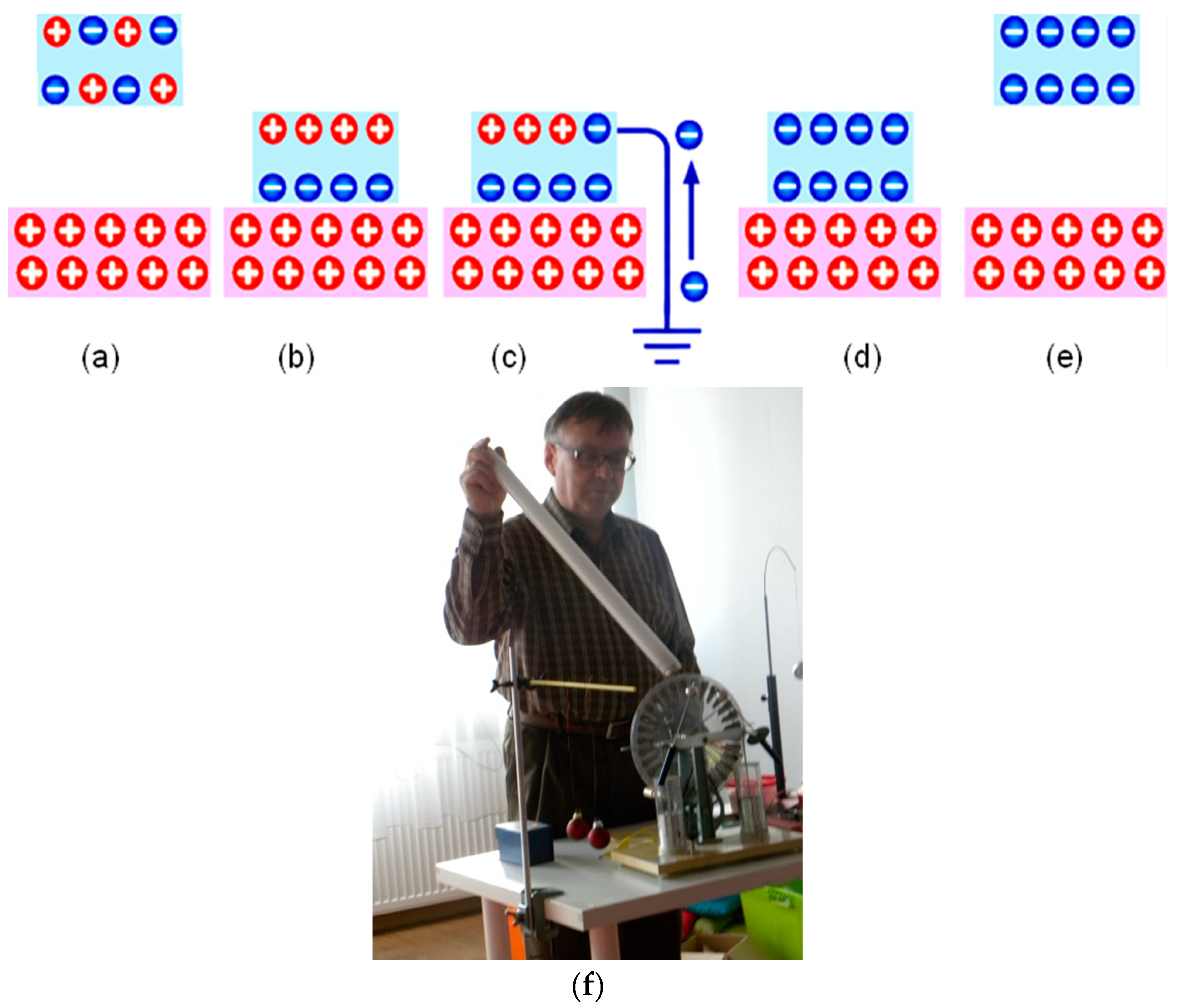
perpetuum mobile invention by Alessandro Volta, i.e., his electrophorus: a metal plate posed on an insulator. In this case, Gauss’s surface is chosen to intersect the metal plate and is cylindrical. The steps of its functioning are shown in
Figure 11.
The electrophorus consists of two parts: a plate made of an insulator (e.g., plastic) and a metal plate with an insulating rod for raising it. First, the insulator plate is electrified by rubbing—the triboelectric effect. When the metal plate is placed on the plastic plate, charges do not flow to the metal, but the electric carriers inside it get separated due to electrostatic induction (Coulomb interaction) (
Figure 11b). The operator then touches the top surface of the metal plate with a finger (
Figure 11c). This is done in a spectacular manner by simultaneously touching a water pipe or the grounding electrode of an electrical plug (which is external under the EU standard) with the other hand. The human body is a good conductor: the two extremes of both hands are at the same electric potential. This means that no electric field flows through the Gaussian surface, so no charges are contained within it. So, the charge from the top surface has flown to the ground, and, in the metal plate as a whole, only the charge originally present on the lower surface remains (
Figure 11d): the metal plate has acquired a net charge.
To measure this charge, we lift a metal plate and touch it to the electroscope. Alternatively, in dry room air (winter is the best time), holding an end electrode of the neon tube in the second hand, we touch the electrophorus: the lamp glows with a spark. We show (neorealism) that the lamp needs 220 V to glow: the professor (with the electrophorus) may serve as an electric station to supply the current to the bulb. Again, a burst of laughter!
But now comes the didactics: this procedure can be repeated almost indefinitely. Have we built a perpetual motion machine that generates energy from nothing? No! To lift a metal plate, negatively charged in our simplified diagram (
Figure 11a), we must overcome the force of attraction with the positive charge of the plastic plate. Work is performed by our hand lifting the metal plate against the attractive Coulomb interaction.
In a Van de Graaff shield, charges accumulate on the outer surface, so there is no electric field inside. This is the principle of the so-called Faraday cage. Even if a high voltage is applied to the cage, the person inside does not feel any electric field. This is comparable only when the person sticks their head out.
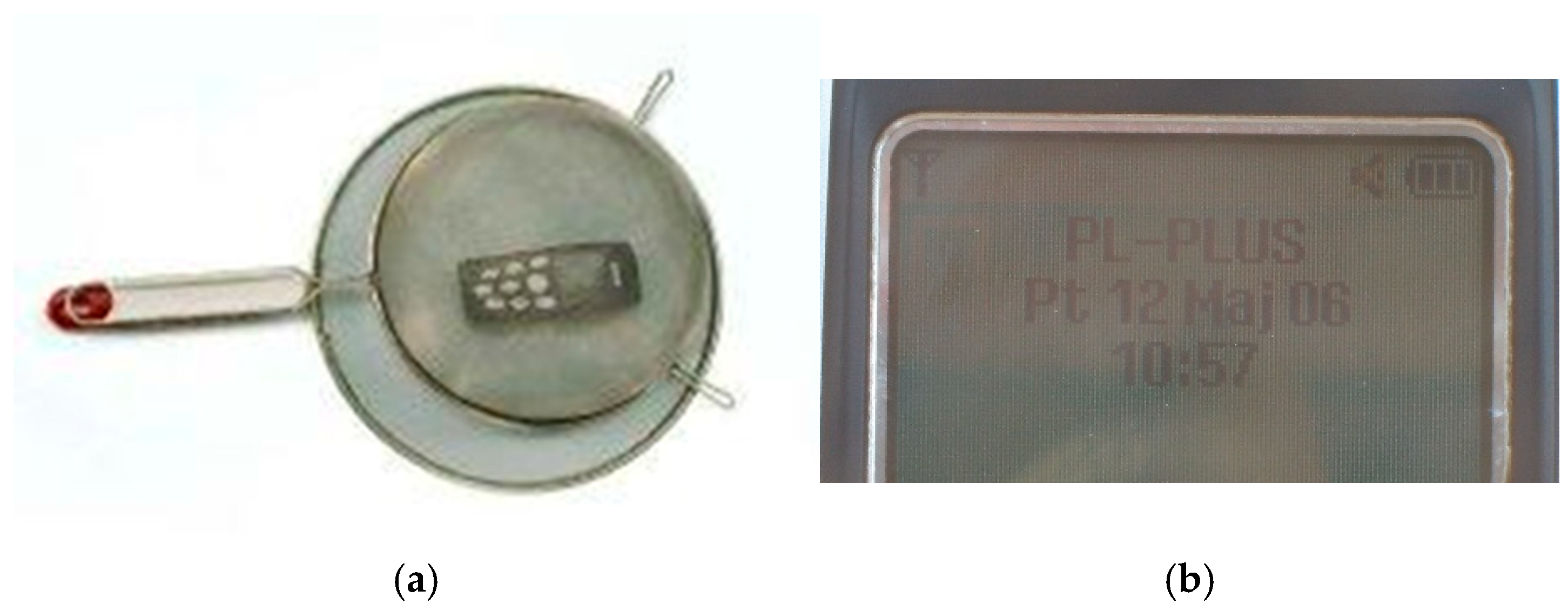
Our portable version of this experiment is shown in
Figure 12. Two sieves are from our (AK) kitchen and form Faraday’s cage. How can we show that there is no electric charge inside, even if the cage is in the external electric field? We need a small, portable radio (see
Figure 12): tune the radio and then close it with the semi-spherical sieve. The radio stops playing. Some years ago, we used a portable phone (see
Figure 12b). The communication used to be lost with the phone in the cage. Nowadays, the sensitivity of cell phones is too high, and the trick does not work, but it still works with a portable radio. In fact, we employ a pedagogical simplification, as the Faraday cage works for electrostatic fields, not for electromagnetic waves. But the hyper-constructivism in physics, in order to attract interest, must find a reasonable compromise between being “social media” and a treatise on electromagnetism. Continuous invitations for lessons in schools, universities, and UniKids—both in our country and abroad—are the best recommendation.
6. Scientific Insight
As shown in
Figure 4b, the third vertex of the cognitive triangle is scientific inquiry—the aim to trigger curiosity beyond just the amusement in the most talented students. The experiment with the “trained can” is far from trivial and is essential for explaining the “Christmas experiment”.
The can is electrically neutral, so from a naïve perspective, one might expect no interaction with the charged plastic rod. The underlying phenomenon is called polarization—the redistribution of charges within the metal. We trigger a hyper-constructivist reasoning: “Ya! But the net charge of the can is still zero, isn’t it?”—”Yes, but negative charges in the can are on the side which is closer to the positive rod, so the repulsion force is weaker than the attraction. Clear?”
The same polarization effect governs our Christmas balls: the distribution of charges is not spherically symmetric. This difference with the gravitationally interacting planets was clear already for Maxwell, and has been recently measured (
Vidak et al., 2023;
Hetherington, 1997), theoretically calculated (
Soules, 1990) and commented (
Hinrichsen, 2019). But students, nowadays, want pictures! And the teacher, according to the 9:1 principle, must be able to tell the student, particularly gifted, that these are not paintings, but rigorous, scientific models.
Today’s numerical packages allow not only to calculate the effects, but also to illustrate them. Here we used a finite element solver, COMSOL Multiphysics ver. 5.2 (
COMSOL, 2015), which solves partial differential equations using the finite element method (FEM). In this approach, the computational domain is divided into a finite number of small subdomains forming a mesh (
Pepper & Heinrich, 2005).
To calculate the force acting between charged bodies, one needs first to calculate the electrostatic potential by solving the Poisson equation (
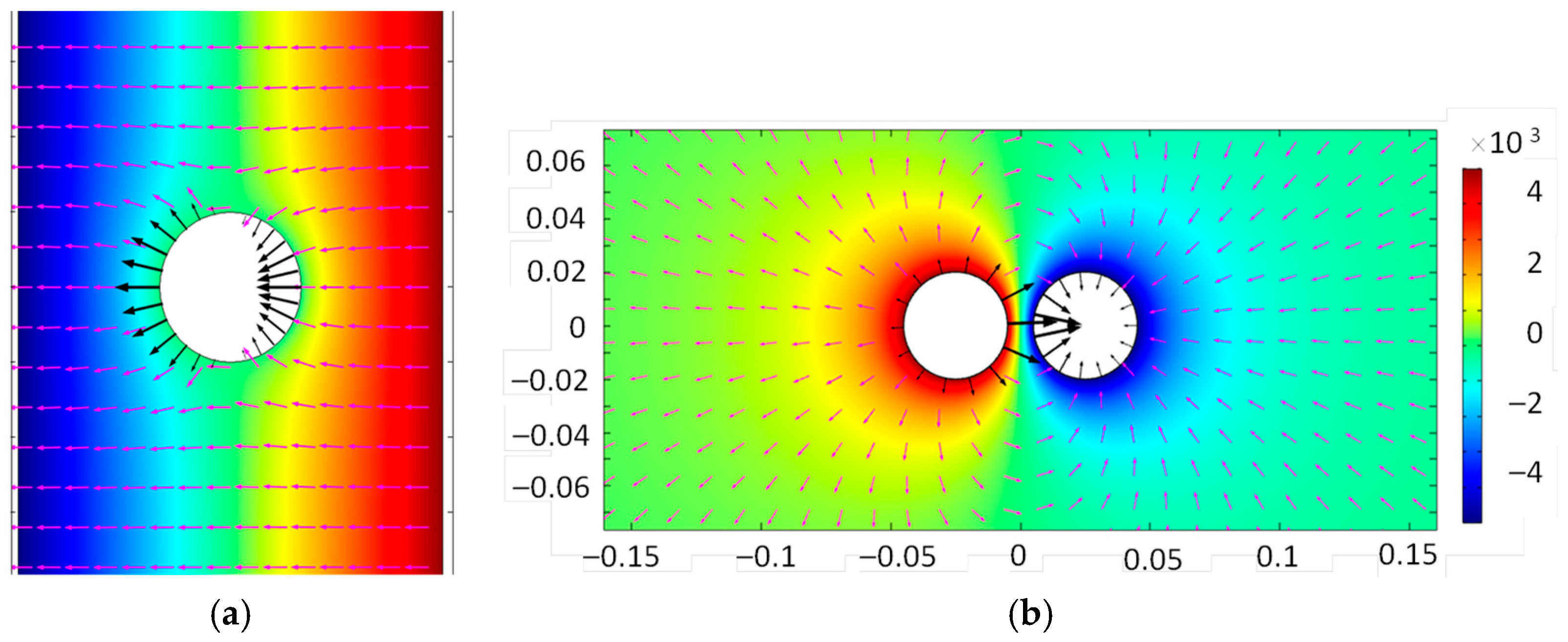
Griffiths, 2023). The electric field is then calculated from the potential. In order to calculate the force acting between the Christmas balls, one has to integrate the electrostatic force density (stress) over the surface of the balls. Results of the surface charge distribution on a conducting sphere placed in a uniform electrostatic field are shown in
Figure 13a, and around “Christmas” balls in
Figure 13b.
Polarization of electric charges in the metal changes the configuration of the field. The attractive force between two spheres is no longer Coulomb-like. The modeling, for the diameters of 4 cm and voltages of +5 kV and −5 kV, gives values of the force scaling with the distance d between the two centers as 9.2, 4.1, 2.5, 1.7 and 1.0 mN, and for d equal to 4.5, 5.0, 5.5, 6 cm and 7 cm, respectively. We do not attempt to describe this dependence analytically, because the spatial distribution of charges should be approximated by a series of multipoles; we refer the reader to advanced textbooks (
Byron & Fuller, 1992). Yet, for the distance of 5 cm, the force in our Christmas experiment is about three times bigger than calculated from Coulomb’s law for point-like charges. Didactics and science are complementary.
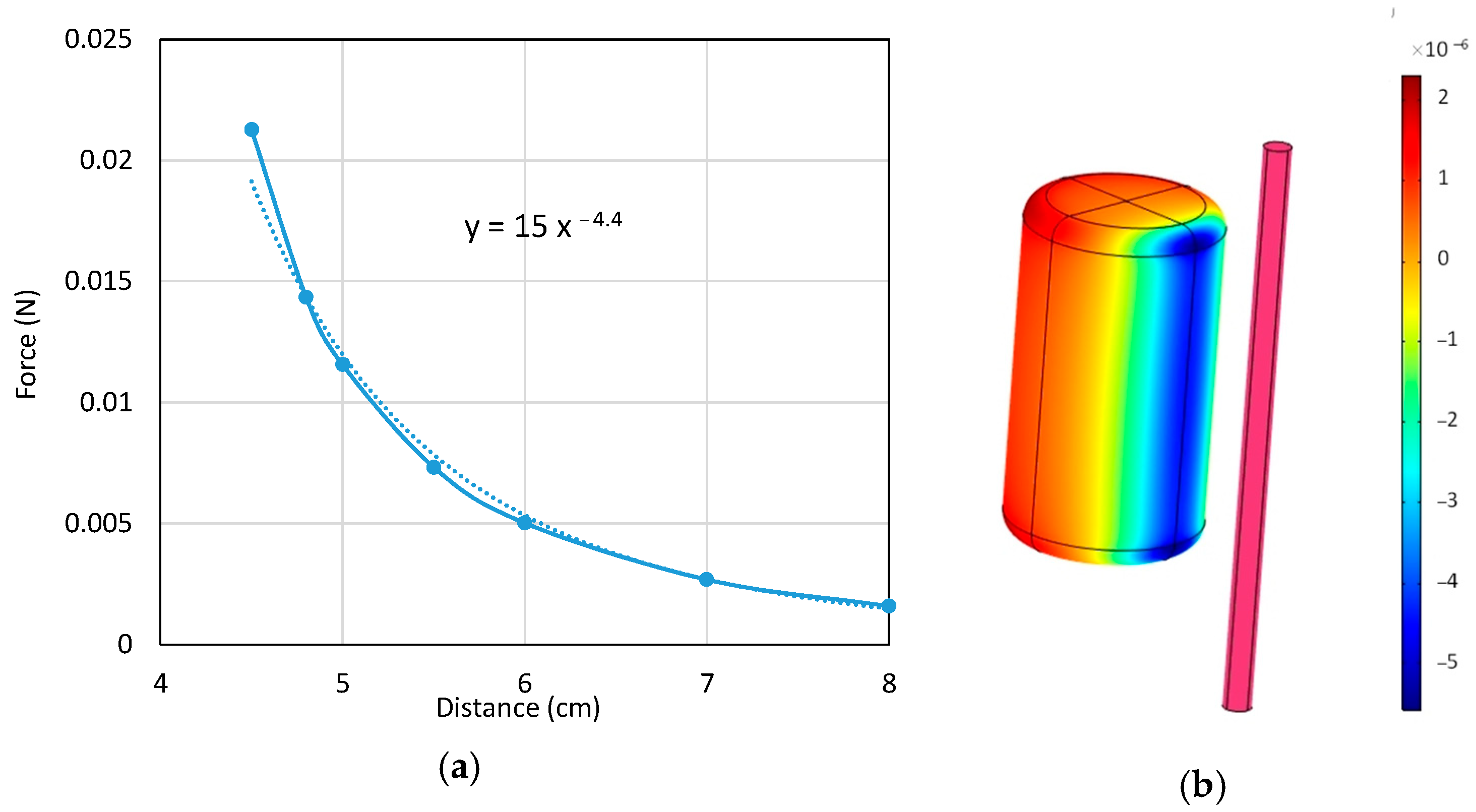
Finally, we turn to the “trained” aluminum can. We calculated the force acting between a 20 cm long, 1 cm diameter ebonite rod (the relative dielectric constant ε = 5) with a total charge of 100 nC on its surface and a 12 cm long, 7 cm-diameter metal cylinder. Results are shown in
Figure 14. At a distance of 4.5 cm between the axes of the rod and of the cylinder (i.e., with the rod 1 cm away from the wall of the can), the attractive force is 21 mN: suitable to lift a 2.1 g mass and make a 14 g can rotate. The force rises rapidly with a closer distance.
In atomic collisions, the attractive interaction between an incoming electron and a neutral atom can be approximated by a polarization potential varying with the distance as 1/r4; again, we refer to our advanced scientific papers. Our calculation for the rod and the can shows, within numerical accuracy, a similar dependence. Now, we can explain all the fun with confetti, hair and the can: these are polarization effects.
7. Evaluation
Rather than providing statistical evidence for the effectiveness of a single teaching method, this work proposes and qualitatively validates an integrated pedagogical framework—hyper-constructivism and neorealism. The framework aims to connect students’ intuitive ideas with formal physical laws through longitudinal action research.
Our approach builds upon constructivism (
Piaget, 1954;
Ausubel et al., 1978), cognitivism (
Bruner, 1956), and Pedagogical Content Knowledge (
Shulman, 1986). While these theories are widely recognized in education, their translation into practical physics teaching remains limited. We address this challenge by presenting concrete, experiment-based scenarios that combine narrative, collective reasoning, and hands-on activities.
Hyper-constructivism and neorealism are intended not merely to improve understanding of individual concepts such as electric charge or Coulomb’s law, but to reveal the richness of electrical phenomena through coherent didactical pathways. Unlike science centers, where experiments are often presented as isolated attractions, our approach integrates physical objects into a structured narrative that gradually leads students from observation to explanation and modeling.
Traditional evaluation methods based on control groups and standardized testing are difficult to apply in our educational context. The same set of experiments is implemented in diverse environments—including school classes, teacher training workshops, university courses, and public outreach activities—but the narration, pedagogical emphasis, and learning objectives are adapted to each audience. Consequently, learning outcomes emerge from interactions among students, teachers, and experiments, making each implementation unique.
For this reason, we rely on qualitative indicators of learning and engagement. Student-generated artifacts, graphical reports, experimental designs, and post-lesson discussions provide evidence of conceptual development and epistemic curiosity. Participants frequently demonstrate increasing independence in planning experiments, interpreting results, and proposing their own investigations. Objects initially introduced as demonstration tools later become instruments for the quantitative exploration of physical phenomena (
Figure 15a,b).
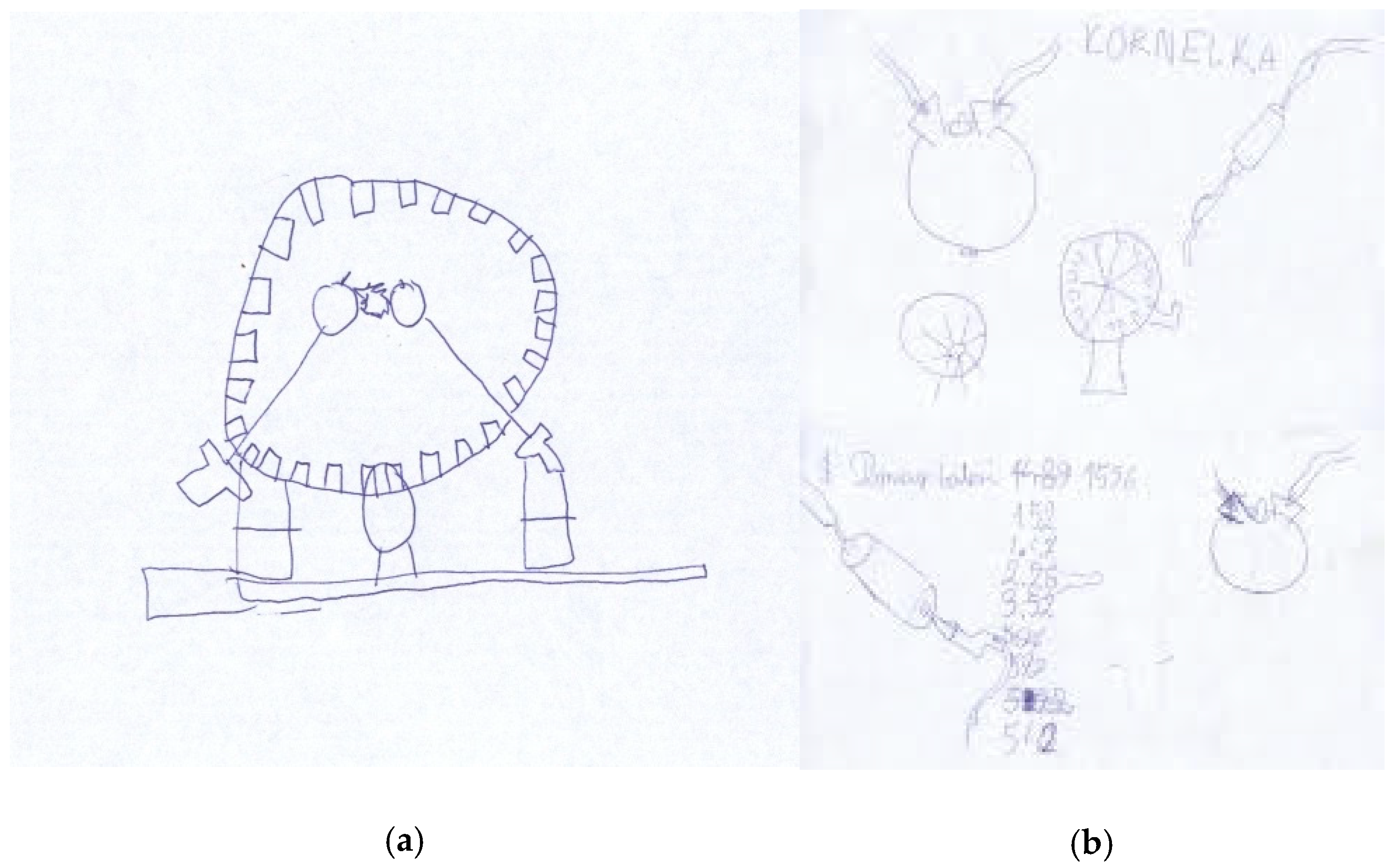
Students’ graphical reports offer further evidence of understanding. Some reproduce detailed experimental sequences, whereas others focus on quantitative observations or abstract relationships (
Figure 16a,b). These differences reflect individual cognitive strengths and support Bruner’s and Montessori’s emphasis on developing learners’ personal capacities.
Perhaps the strongest evidence of the effectiveness of the approach is the phenomenon of the “never-ending lesson” (
Figure 17). Students and teachers often remain engaged long after the formal session has ended, discussing additional questions and proposing new experiments. In this sense, the objective is not only to answer scientific questions but also to encourage students to formulate their own.
Although the qualitative nature of this action research does not allow broad statistical generalizations, the repeated implementation and refinement of these scenarios over more than twenty years provides a robust foundation for applying phenomena-based learning in diverse educational settings.