1. Introduction
Artificial Intelligence (AI), as one of the most prominent topics in current educational research, offers the possibility of individualized, promptly generated feedback. UNESCO argues that “teachers urgently need to be empowered to better understand the technical, ethical and pedagogical dimensions of AI.” (
Miao & Cukurova, 2024, p. 5). Considering this, the use of AI-assisted tools in the context of lesson planning seems reasonable. Research on AI implementation in teacher education has been rapidly emerging in recent years and reveals vast possibilities for the educational sector (including helping PSTs with their lesson plans (
Kessner & Kaka, 2025)). Results show that genAI tools like ChatGPT have the potential to support pre-service (PSTs) and in-service teachers (ISTs) in their lesson planning process by providing acceptable lesson plans (
Lee & Zhai, 2024). Positive results were also reported regarding the design of instructional materials and tasks (
Kieser et al., 2023;
Küchemann et al., 2023). Content analyses of AI-generated lesson plans revealed good alignment between objectives, activities, and assessments (
Baytak, 2024) and similar effectiveness to human-made lesson plans (
Karaman & Göksu, 2024). Nevertheless, there is also a risk that teachers may become too dependent on AI-supported tools, thereby weakening their creativity and critical thinking, and, consequently, their professional competencies (
Al-Zahrani & Alasmari, 2024).
Accordingly, this paper adopts a different approach: instead of providing ready-made lesson plans, the developed Lesson Planning Coach (an AI-assisted feedback (AIFB) tool) is designed to deliver constructive, self-efficacy-strengthening feedback on lesson plans created by PSTs. Lesson planning is conceptualized as a core professional practice, grounded in teacher professional knowledge and lesson planning competencies (
Mishra & Koehler, 2006;
Shulman, 1986;
Söll, 2021). Because of its central role in teacher education and teachers’ later professional life, lesson planning was chosen as the focal use case. Unlike applications such as assessment support, resource recommendation, formative feedback on student work, or content explanation, lesson planning sits at the integrative core of teacher professional knowledge and most directly shapes the pedagogical reasoning that PSTs are developing, making it both a high-leverage and high-risk site for AI support. Alternative educational applications are discussed in the outlook section of the paper. The feedback tool itself leverages self-efficacy theory to structure its prompts, thereby ensuring that AI-generated feedback aligns with professional standards, fosters reflective practice, and avoids purely corrective or decontextualized responses. By adopting these perspectives, the Lesson Planning Coach sets itself apart from currently implemented AI-supported educational tools and clearly frames the Lesson Planning Coach as a facilitator in the process of lesson planning, which has been shown as an important influence on users’ (e.g., teacher students) attitude towards genAI-supported educational tools (
Makransky et al., 2025;
Neumann et al., 2025). Simultaneously, it answers to the demand of careful and deliberate design processes for using genAI in educational contexts. For this, we rely on human-in-the-loop iterative prompt engineering, which has been proven to enhance the quality of genAI-based chatbots (
Watts et al., 2025). The distinguishing characteristic does not lie solely in the utilization of generative artificial intelligence for the purpose of lesson planning. Rather, it is the integration of a theory-constrained prompt architecture that incorporates a lesson-planning competence model, structured rubrics, and feedback cycles informed by self-efficacy. Furthermore, this work incorporates an international, transfer-oriented perspective by involving researchers from both Australian and German teacher education, with the aim of ensuring the tool’s applicability across diverse educational contexts.
As a conceptual contribution, this paper does not present empirical effectiveness data; the planned empirical evaluation is described in
Section 5 and will be reported in a subsequent article. This paper aims to provide a concise overview of the conceptualization and development of the Lesson Planning Coach. First, the theoretical perspectives informing the Lesson Planning Coach (i.e., lesson planning competence, educational feedback processes, self-efficacy, and integrated curricula), as well as their interconnections, are discussed in
Section 2. Second, the resulting Lesson Planning Coach with its design process, setting, and principles, as well as the interaction model, rubrics, and criteria, is introduced in
Section 3. Lastly, a discussion of the development, possible takeaways for educators, and an outlook on the accompanying research and transfer to the German teacher education context is provided in
Section 4 and
Section 5.
2. Theoretical Framework
Various theoretical perspectives are integrated into the Lesson Planning Coach to ensure structured, professionally relevant, corrective, and advisory feedback. For this, the authors focused on (a) conceptualizing lesson planning competence, (b) ensuring professionally relevant, pedagogically sound feedback, (c) fostering participants’ teacher self-efficacy beliefs through theory-informed, constructive feedback regarding lesson planning, (d) implementing the school curriculum to ensure the content correctness and relevancy of the submitted lesson plans and (e) linking all theoretical perspectives in a coherent construct chain.
2.1. Lesson Planning Competence
The present project aims to support PSTs in their lesson planning through an intervention in the form of the Lesson Planning Coach, with which PSTs can interact. Lesson planning can be identified as a key competence for both PSTs and ISTs (
König et al., 2021). A lesson plan itself can be described as a road map “which describes where the teacher hopes to go in a lesson, presumably taking the students along” (
Bailey, 1996, p. 18). Nevertheless, a majority of PSTs find developing a lesson plan challenging (
Cevikbas et al., 2024). Even though there is still debate about whether lesson planning competence should be treated as an individual competence or rather as a part of teacher competence, at its core, it is an integral part of professional knowledge (
Shulman, 1986) and can be described as a didactic analysis prior to instruction (
Klafki, 1995). Nevertheless, studies show that experienced teachers often refrain from detailed lesson plans and planning lessons according to pedagogical theories and frameworks used in teacher education (
König et al., 2021). Rather, they draw on their own practical experiences, which in turn are often not grounded in pedagogical theory (
Hatch & Clark, 2021) and instead focus on the selection and construction of lesson tasks and anticipated outcomes (
Yinger, 1980). Regarding the quality of lesson plans, research shows that both PSTs and ISTs can improve their lesson planning competencies through interventions (
Özyildirim Gümüş, 2022;
Tataroğlu Taşdan et al., 2022;
Taylan, 2018).
Cevikbas et al. (
2024) argue that this improvement can either happen through: (1) pedagogical/curricular considerations, (2) anticipating and encouraging students’ thinking and learning, and (3) interventions/professional developments (p. 108).
Given the international perspective and the desired transferability of the Lesson Planning Coach’s content across the Australian and German educational contexts, the authors decided to use a more general framework to conceptualize lesson-planning competencies. Therefore, the German model for lesson planning competencies, developed by
Söll (
2021), who based his work on the frameworks of
Heimann et al. (
1976) and
Klafki (
1995) will be used and implemented in the system prompt of the Lesson Planning Coach. Even though the model of lesson planning competencies was developed in the German teacher education context, its core components are transferable to the Australian context and therefore applicable for the Lesson Planning Coach. The model argues that PSTs and ISTs should be able to consider the goals, content, methods, media, and learner prerequisites when developing a lesson plan. Regarding the AI-supported feedback tool, we differentiated these dimensions to be clearly measurable for the AI model:
Goals of a lesson plan should be clearly operationalized and observable. They are always evaluated regarding their fit with the content, the tasks, and the diagnostics of the planned lesson.
The content of a lesson needs to be viable and correct and contextualized in a manner appropriate to the goal of the lesson. Additionally, suitability according to the curriculum needs to be considered.
Methods should facilitate active and problem-oriented learning, in line with the content and the goal of the lesson. In addition to the methods, scaffolding for the content of the lesson in order to reach the intended outcome also needs to be considered.
Media should address multiple representations of the content of the lesson and should always contribute to the intended learning outcome. Safety issues, as well as accessibility, need to be considered, too.
Learner prerequisites should be considered through diagnostics, language sensitivity, and adaptive support measures.
In order to address the interdependencies among the aforementioned dimensions of lesson planning, the dimension of time-coherence is also incorporated into the Lesson Planning Coach, evaluating the consistency of time, goals, content, methods, media, and diagnostics (
Söll, 2021).
The explicit interaction with and use of these theoretical dimensions in the Lesson Planning Coach are discussed in
Section 3. In addition to the theoretical perspective on lesson planning, research findings on effective educational feedback are considered.
2.2. Feedback in Educational Settings
Feedback is an integral part of teacher education programs across the world and has proven to be a powerful tool when it comes to influencing learning and performance (
Kulhavy et al., 1985;
Shute, 2008). Nevertheless, in the Australian teacher education context that frames this project, large professional experience and planning units commonly include cohorts of approximately 80 to 160 enrolments, with equivalent unit clusters sometimes exceeding 200 enrolments when internal, online, and Open Universities Australia offerings are considered together. Across the targeted implementation units, enrolments total approximately 1300 across the identified offerings. Many of these PSTs complete professional experience in dispersed placement contexts, where day-to-day planning support is provided by mentor teachers rather than university staff. Under these conditions, providing timely, individualized feedback on lesson plans from university teacher educators becomes difficult to sustain alongside other teaching and administrative responsibilities.
Feedback in general can be distinguished into four levels: task-level feedback (focuses on how well a specific task has been performed), process-level feedback (focuses on the processes underlying a task or related tasks), self-regulation-level feedback (focuses on how students monitor and regulate their own actions towards the goal of a task), and self-level feedback (feedback that focuses on the person itself) (
Hattie & Timperley, 2007). In addition, the complexity of feedback may vary depending on the amount of information it integrates.
Kulhavy et al. (
1985) argued that this complexity may influence the output of the respective feedback, and that overly complex feedback may not yield the best results for learners. With the increasingly widespread integration of genAI into educational processes, new perspectives on feedback processes arise.
Ba et al. (
2025) define “AI-assisted feedback (AIFB) as the use of AI technologies to analyze learning environments, tasks, and learner data in order to provide supportive actions that help learners progress toward specific learning goals.” (p. 2) and argue that research on learner-centered and pedagogically sound AIFB remains scarce. The present project aims to address this scarcity by synthesizing the potential of genAI tools with research findings on feedback implementation as well as self-efficacy as a target variable of AI-generated feedback. The feedback provided by the Lesson Planning Coach, therefore, directly aims to improve PSTs’ lesson planning self-efficacy. Accordingly, it incorporates both task-level as well as process-level and self-regulation-level feedback.
2.3. Self-Efficacy as a Mechanism for the Lesson Planning Coach
Self-efficacy theory provides the central psychological mechanism guiding the design of the Lesson Planning Coach. Self-efficacy refers to an individual’s belief in his or her ability to organize and execute the actions required to achieve specific outcomes (
Bandura, 1997). In the context of teacher education, this project focuses on developing PSTs’ self-efficacy in lesson planning. Rather than providing automated lesson plans, the feedback system supports PSTs in refining their own plans through iterative feedback processes designed to strengthen their perceived capability to design coherent, curriculum-aligned instruction. Research shows that teachers’ self-efficacy is a powerful contributor to students’ success (
Goddard et al., 2000;
Guskey, 2021;
Kim & Seo, 2018;
Tschannen-Moran et al., 1998). Additionally, multiple studies show positive associations with variables related to teacher success, including teaching quality (
Zee & Koomen, 2016) and job satisfaction (
Klassen & Chiu, 2010;
Stephanou et al., 2013;
Toropova et al., 2021).
Teacher self-efficacy has also been associated with instructional behavior, persistence when facing classroom challenges, and the willingness to implement more demanding teaching practices (
Goddard et al., 2000;
Kim & Seo, 2018;
Zee & Koomen, 2016). The concept builds on earlier attributional theories such as
Rotter’s (
1966) locus of control framework, which distinguishes between internal and external beliefs about personal influence over outcomes.
Guskey (
2021) describes that people with an internal locus believe in their own personal ability to influence the outcomes of specific situations. People with an external locus of control, on the other hand, believe that what happens around them and the actions of others are beyond their control (
Rotter, 1966).
Later,
Weiner et al. (
1971) added a dimension of temporal stability, arguing that people may have varying degrees of beliefs ranging from internal stable and internal unstable to external stable and external unstable. In the educational context, most studies aimed at enhancing teacher self-efficacy focus on Bandura’s social cognitive theory (
Täschner et al., 2025). Bandura proposes that there are four sources of self-efficacy development: mastery experiences, vicarious experiences, verbal and social persuasion, and emotional and physiological states (
Bandura, 1986,
1997). Mastery experiences occur when a person successfully engages in a specific task (e.g., formulating a clear, observable goal for a lesson plan). Vicarious experiences occur when individuals observe a model being successful in a specific task (e.g., other, more experienced teachers). Social persuasion refers to situations in which a person receives verbal support and encouragement for a specific action.
Lastly, physiological and emotional states focus on an individual’s interpretation of their own affective reactions in the context of a specific task (
Bandura, 1997). Higher levels of self-efficacy are associated with greater persistence when individuals encounter challenging professional tasks and a stronger willingness to engage in iterative improvement processes (
Bandura, 1997;
Zimmerman et al., 1992). The present project operationalizes these four sources of self-efficacy by structuring AI-generated feedback around mastery experiences, vicarious examples, social persuasion, and emotional reassurance (see
Section 3). In addition to the theoretical perspective on lesson planning, feedback, and self-efficacy, the school curriculum is incorporated as a theoretical background of the Lesson Planning Coach to ensure the planned lessons have accurate content and are suitable for students. In the following section, the conceptualization of the Western Australian curriculum, as well as adjustments for the German context, are discussed.
2.4. Curricular Framework
The design of the AI-assisted feedback tool is grounded in the Western Australian curriculum context in order to ensure that feedback on lesson plans reflects the expectations placed on pre-service teachers (PSTs) in teacher education programs. In Western Australia, school curriculum is guided by the Western Australian Curriculum and Assessment Outline developed by the School Curriculum and Standards Authority. This framework defines learning areas, content descriptions, and achievement standards that structure teaching and learning from Kindergarten to Year 10 (
SCSA, 2018). For PSTs, developing lesson planning competence therefore involves not only designing coherent learning activities but also ensuring that lesson objectives, instructional strategies, and assessment approaches are aligned with curriculum expectations.
The Western Australian primary and secondary school curricula also emphasize inclusive teaching practices and the development of general capabilities across learning areas. Teachers are expected to account for learner diversity and to incorporate differentiation strategies that respond to differences in prior knowledge, language background, and levels of ability (
SCSA, 2018). In addition, the Western Australian curriculum highlights a set of general capabilities, including literacy, numeracy, information and communication technology capability, critical and creative thinking, personal and social capability, ethical understanding, and intercultural understanding. These capabilities are intended to be integrated within subject teaching and reflected in classroom learning tasks.
For implementation in the German vocational context, the Lesson Planning Coach is adjusted by integrating the respective German curricula. For this, the ten professions with the most students in technical vocational education in Germany (derived from the
Bundesinstitut für Berufsbildung (
2025)) and their respective nationwide curricula are integrated into the tool. Like its Australian counterpart, the curriculum defines learning areas, content descriptions, and intended competency outcomes. In addition, the integration of vocational education curricula attests to the didactic principle of action orientation, which is the baseline for all technical and vocational education in Germany. It aims to align learning with professionally relevant content and strengthen learners’ professional competencies. All other theoretical principles (lesson planning, educational feedback, and self-efficacy) informing the Lesson Planning Coach are generalizable for the German vocational education context and therefore need no further adjustment.
Within the AI-assisted feedback tool, the curriculum functions as a reference framework for evaluating the coherence and appropriateness of lesson plans developed by PSTs. The Lesson Planning Coach requires users to identify curriculum links when formulating lesson objectives and planning instructional activities. It also requires PSTs to address learner prerequisites, differentiation strategies, and assessment approaches as part of the planning process. During the feedback phase, the AI model evaluates whether lesson goals, content, methods, media, learner considerations, and assessment strategies demonstrate alignment with curriculum expectations and broader capabilities defined within the Western Australian curriculum (
SCSA, 2018) or its German vocational education counterpart. Rather than generating curriculum-aligned lesson plans, the tool provides structured feedback that supports PSTs in refining their own plans while strengthening their lesson planning competence and self-efficacy.
2.5. Construct Chain and Operationalization
The developed Lesson Planning Coach aims to link the described theoretical perspective in a coherent construct chain. Specifically, the Lesson Planning Coach translates theory-based criteria (lesson-planning dimensions and curriculum and time coherence) into actionable micro-revisions intended to create repeated, low-threshold mastery experiences through explicit temporal feedback. Simultaneously, the Lesson Planning Coach provides vicarious examples, critical comparisons (as a form of social persuasion), and emotional reassurance. Across iterations, these experiences are expected to strengthen pre-service teachers’ lesson-planning self-efficacy and reduce over-reliance by keeping decision-making with PSTs. Because lesson planning in this project is conceptualized as an integral part of professional knowledge, changes in PSTs’ lesson-planning self-efficacy are operationalized at the measurement level via TPACK self-efficacy (pre-posttest design), which serves as an indicator of teachers’ perceived capability to design coherent, curriculum-aligned instruction using appropriate methods and media. We therefore map the dimensions of the TPACK model with the dimensions of lesson planning competencies.
To assess the participants’ TPACK self-efficacy, a validated measurement instrument (
Schmid et al., 2020) will be employed, mirroring the described mapping between lesson planning and TPACK dimensions. The instrument assesses PSTs’ self-perceptions in the dimensions of the TPACK model. Even though it is often claimed that these instruments capture the participants’ knowledge in the dimensions of the TPACK model, the authors argue that they measure participants’ TPACK self-efficacy instead (see a more detailed critique in
Scherer et al., 2017), making it applicable for the research at hand. The feedback tool aims to strengthen TPACK self-efficacy by providing feedback across the dimensions described in
Table 1 (which align with the seven TPACK dimensions) in a way that addresses the four main influences on self-efficacy (i.e., mastery experiences, vicarious experiences, verbal and social persuasion, and emotional and physiological states).
In this way, the Lesson Planning Coach distinguishes itself from generic AI tools by deliberately structuring feedback around the integration of pedagogical, content, and technological knowledge dimensions, addressing TPACK as an integrated competency rather than as separate knowledge silos, and supporting PSTs in developing the self-efficacy required to enact this integration in their lesson planning.
3. Design Outcomes: Conceptual Framework of the Lesson Planning Coach
To illuminate how research-based principles have been translated into practice, this section introduces the framework of the Lesson Planning Coach and details its conceptual underpinnings. In the following sections, the design process, setting, and principles, as well as the interaction model, rubrics, and criteria of the Lesson Planning Coach, are described in detail.
3.1. Design Process
The development of the Lesson Planning Coach followed a design-based research orientation (
Anderson & Shattuck, 2012), with iterative cycles of design, expert review, and refinement informed by the theoretical perspectives outlined in
Section 2. The approach reflected key characteristics of design-based research, including situatedness in an authentic educational context, focus on a designed intervention, researcher-practitioner collaboration, multiple iterations of refinement, and the development of transferable design principles. Within each cycle, prompt revisions were generated through human-in-the-loop iterative prompt engineering (
Watts et al., 2025), with reviewer input translated into adjustments to the system prompt, rubrics, and feedback templates. The present paper reports the conceptual design and formative review phase rather than empirical effectiveness testing. The development unfolded across three stages, summarized in
Table 2. Iteration continued until reviewer feedback had been addressed and no further substantive concerns were identified by the project team.
3.2. Setting
The first implementation is realized within the School of Education at Curtin University, Western Australia. Expected participants are 60 PSTs enrolled in Bachelor of Education programs specializing in early childhood, primary, and secondary education. These programs prepare PSTs for teaching across the early, primary, and secondary years of schooling and include coursework focused on curriculum design, pedagogy, and assessment aligned with the Western Australian Curriculum. Across the programs, PSTs progressively develop professional competencies required for classroom teaching, including the ability to design coherent lesson plans that align learning objectives, curriculum content, instructional strategies, and assessment approaches.
The teacher education programs follow a four-year structure combining theoretical coursework units with professional experience placements in schools. Within curriculum and pedagogy units, PSTs are required to design lesson plans that demonstrate alignment with curriculum outcomes, consideration of learner prerequisites, differentiation strategies, and appropriate assessment approaches. These planning tasks require PSTs to apply theoretical knowledge of pedagogy, curriculum, and learning design to authentic teaching scenarios. Lesson planning, therefore, represents a central professional competency in initial teacher education at Curtin University that PSTs must develop.
Within this context, the Lesson Planning Coach is introduced as a structured feedback tool integrated into the Learning Management System (LMS) for the unit. Students will access the tool through a dedicated LMS page that provides instructions for participation and links to the research components of the implementation. The page will guide students through three stages: completion of a pre-use survey, during which they generate a unique participant code, iterative interaction with the Lesson Planning Coach while developing their lesson plan, and completion of a post-use survey at the conclusion of the process. Each time students interact with the Lesson Planning Coach, they record the interaction using a separate interaction log.
Students will access the Lesson Planning Coach through a direct link to a custom ChatGPT environment and use the system by submitting draft lesson plans for feedback. The Lesson Planning Coach will provide structured feedback on elements such as learning goals, instructional strategies, curriculum alignment, learner considerations, and lesson coherence. Students will be encouraged to review the feedback, revise their lesson plans, and repeat the process across multiple iterations. An instructional video embedded within the LMS will provide guidance on how to use the tool.
A key pedagogical concern underlying the implementation is ensuring that students engage in the lesson planning process themselves rather than relying on the AI to generate complete instructional materials. The Lesson Planning Coach is therefore designed to provide feedback on student-generated lesson plans rather than producing full lesson plans automatically. In this way, the system is intended to support reflective practice and iterative improvement while maintaining the development of lesson planning competence as an active learning process undertaken by the PST.
3.3. Design Principles
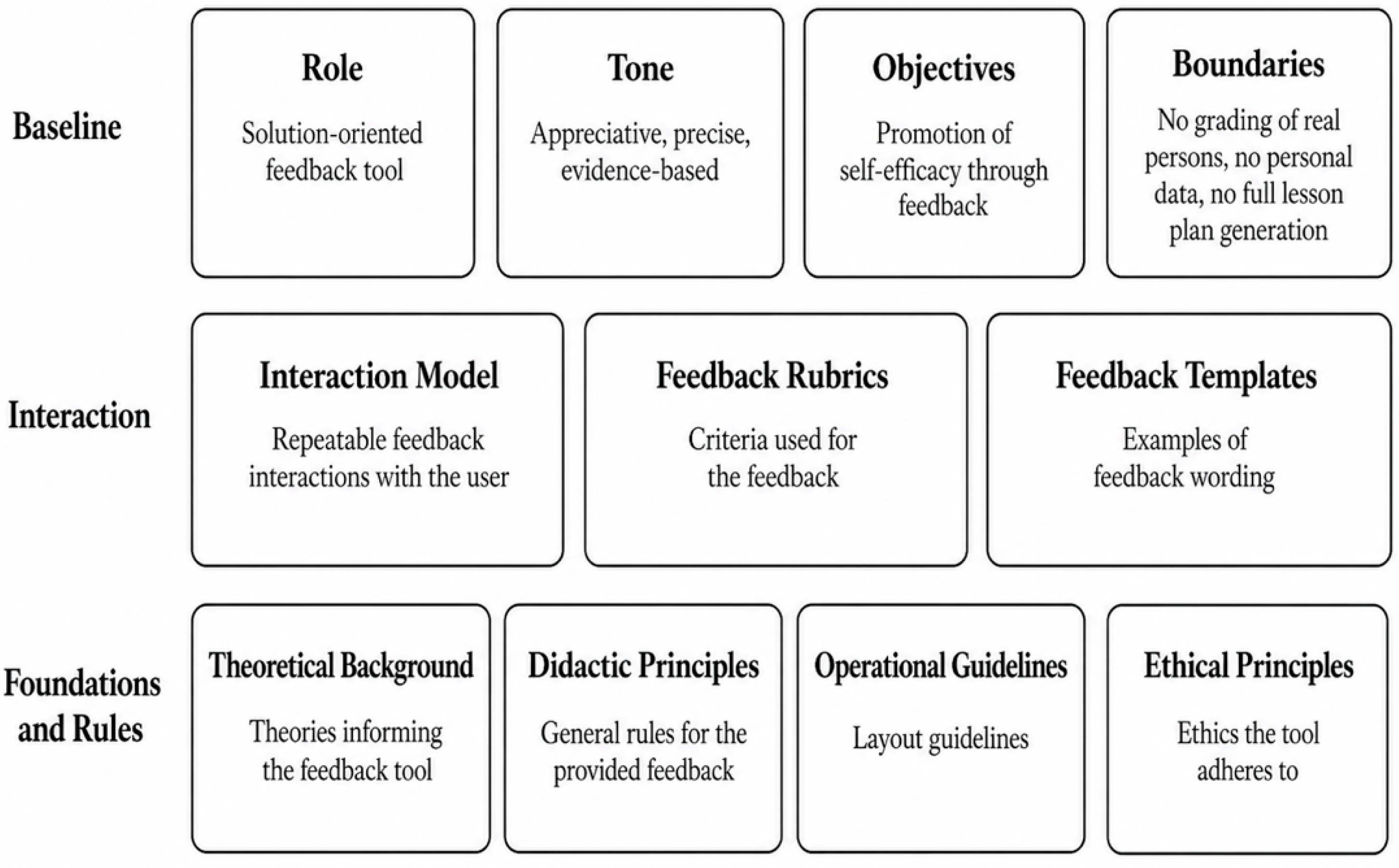
To ensure structured, pedagogically sound results from the Lesson Planning Coach, a clearly formulated system prompt was created. In total, the system prompt comprises 11 dimensions (as seen in
Figure 1).
The Lesson Planning Coach’s role, tone, objectives, and boundaries serve as the baseline. The role dimension identifies the Lesson Planning Coach as a feedback tool, aiming to strengthen lesson planning self-efficacy through feedback processes. The tone dimension attributes an appreciative, precise, evidence-based, and solution-oriented character to the Lesson Planning Coach, while the objectives clearly state the Lesson Planning Coach’s primary (promotion of self-efficacy in the dimensions of the lesson-planning competence model through mastery-oriented, criterial, vicarious, verbal-persuasive and—from iteration two onwards—temporal feedback processes) and secondary objective (improving the quality of planning in line with the lesson planning competency model; ensuring the coherence of objectives, content, methods, media, learning prerequisites, their interrelationships, and the didactic rationale behind lesson planning). The dimension of boundaries specifies the context of Australian primary and secondary education and sets boundaries for the Lesson Planning Coach not to grade real-life persons, collect any personal data, or generate full lesson plans. Additionally, constructive and respectfully formulated feedback is captured as an ethical principle for the Lesson Planning Coach. These baselines are followed by the interaction model, the feedback rubrics and feedback templates, the theoretical background, and the didactic principles and operational guidelines. The theoretical background provides information on the theoretical perspectives described in this paper, operationalized in a way usable by the Lesson Planning Coach. The interaction model and the feedback rubrics are discussed in the following sub-sections.
3.4. Interaction Model
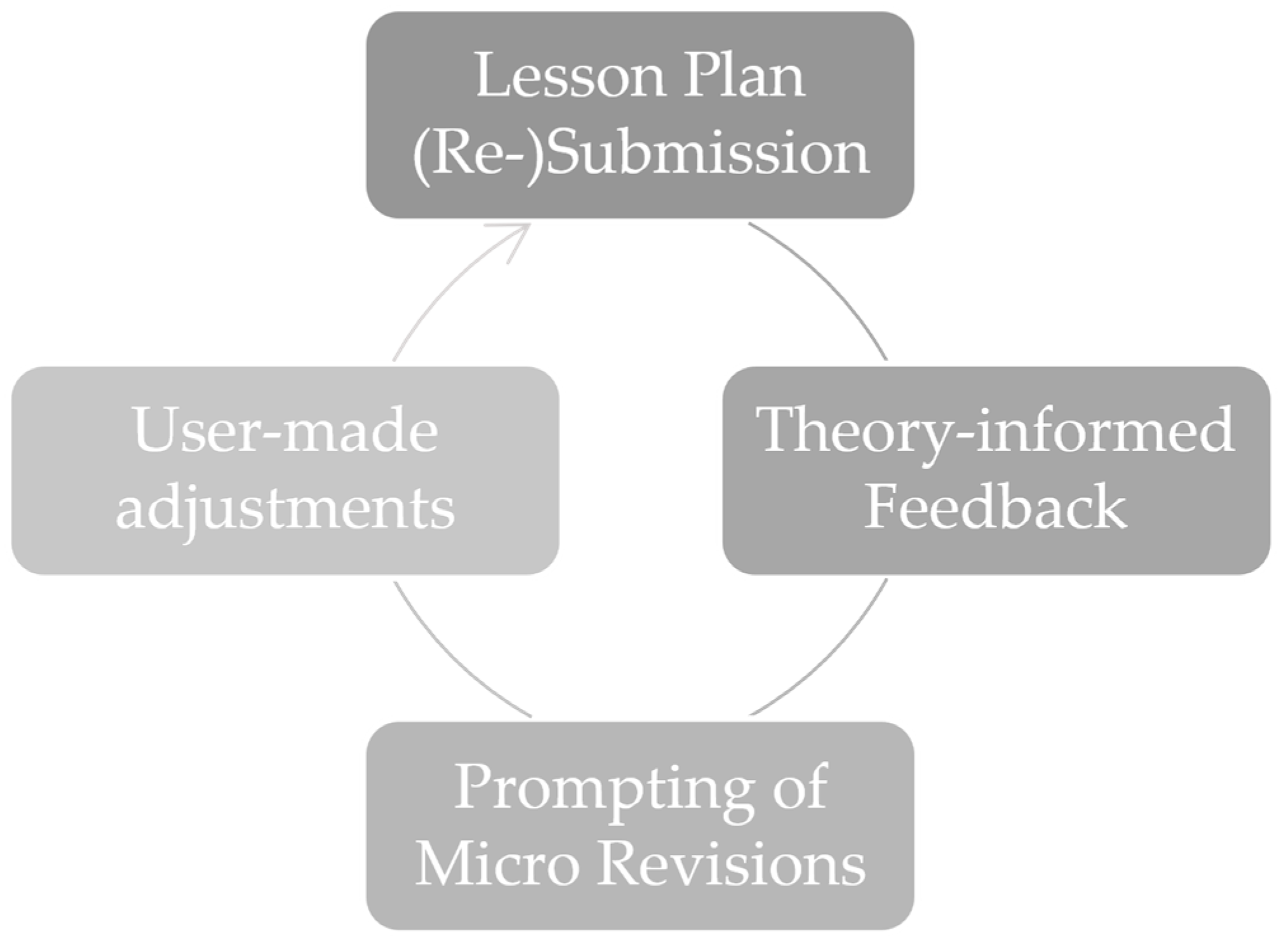
The core of the developed Lesson Planning Coach is the interaction model. This framework is based on the described theoretical principles and ensures that the Lesson Planning Coach follows a structured protocol while giving pedagogically sound, self-efficacy-strengthening feedback. It follows the steps illustrated in
Figure 2.
The interaction begins with a starting prompt inviting the user to upload their lesson plan. Additionally, if the user has not yet fully planned a lesson, the feedback tool provides guiding questions they can use while planning. The Lesson Planning Coach is advised to strictly follow the wording of the starting prompt.
“Please upload or paste your lesson plan text (Word/PDF/Markdown). I’ll extract goals, content, methods, media, learner prerequisites, competencies, tasks, diagnostics, timing, differentiation, and coherence.
If you do not yet have a lesson plan, here are some questions you can ask yourself that should guide you through the planning process […]. Once you are ready, just upload the file.”
The guiding questions address the dimensions of the described lesson-planning competence model (i.e., goals, content, methods, media, and learner prerequisites). Additionally, the fit with the Australian curriculum is incorporated as a direct link to access the curriculum. In order to ensure the practicality of the planned lesson, the time structure and feasibility are incorporated into the guiding questions. Lastly, the feedback tool urges the user to think about the planned lesson on a meta-level and focus on the coherence of goals, content, methods, and media. When the user has entered his or her lesson plan (either as a file or as direct input), the second phase of the interaction model is entered.
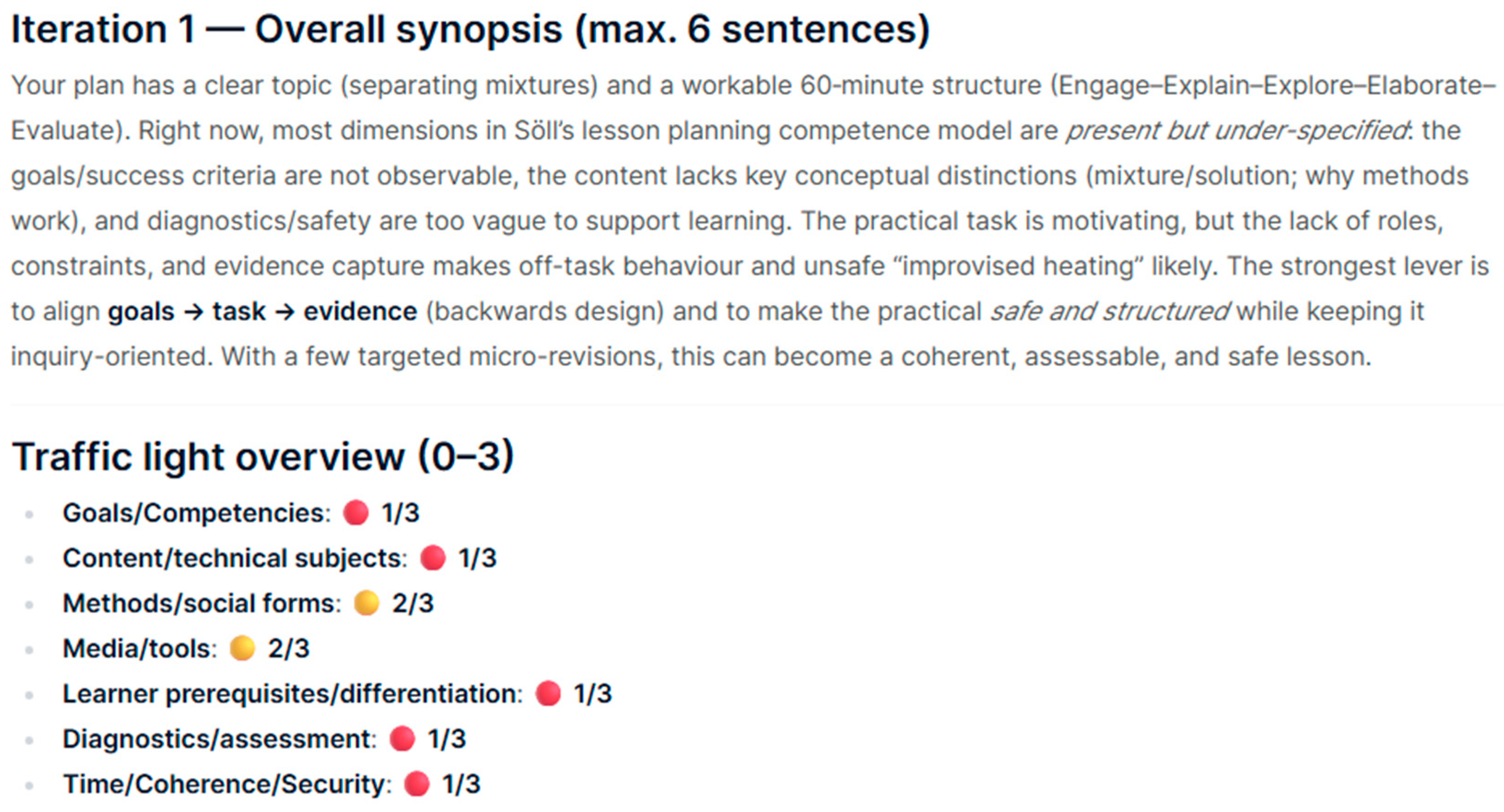
Here, the generative AI model maps the input to criteria for each dimension of the lesson-planning competence model and marks strengths and gaps using the feedback rubric, which is explained in more detail in the following section. This phase is directly preparatory for the third phase, which entails the actual feedback on the lesson plan. The third phase (the feedback phase) is structured into different feedback aspects. As seen in
Figure 3, the Lesson Planning Coach first provides a concise overall synopsis of the planned lesson, limited to 6 sentences to avoid overwhelming the user (seen at the top of
Figure 3). Next, traffic-light feedback for each dimension of the lesson-planning competence model is provided (ranging from zero to three, while ratings from zero to one are indicated as red, ratings at two are indicated as yellow and ratings at three are indicated as green). This aims to provide a quick and comprehensive overview for the user.
For each dimension, the feedback tool then provides information on aspects that are already positive, gaps that can be identified, and micro-revisions that may be appropriate (the specific criteria for each dimension are described in the rubrics section of the system prompt). This dimensional feedback is provided in the same dimensions as the traffic light feedback and aims to provide a more detailed insight and possible micro-revisions for the user. An example of this dimensional feedback can be seen in
Figure 4.
After this, self-efficacy-strengthening feedback is provided. This includes mastery-oriented feedback (i.e., positive aspects of the lesson plan with explanations), vicarious experience (i.e., good practice examples from comparable peers/more experienced teachers to provoke upward social comparisons (see
Wood (
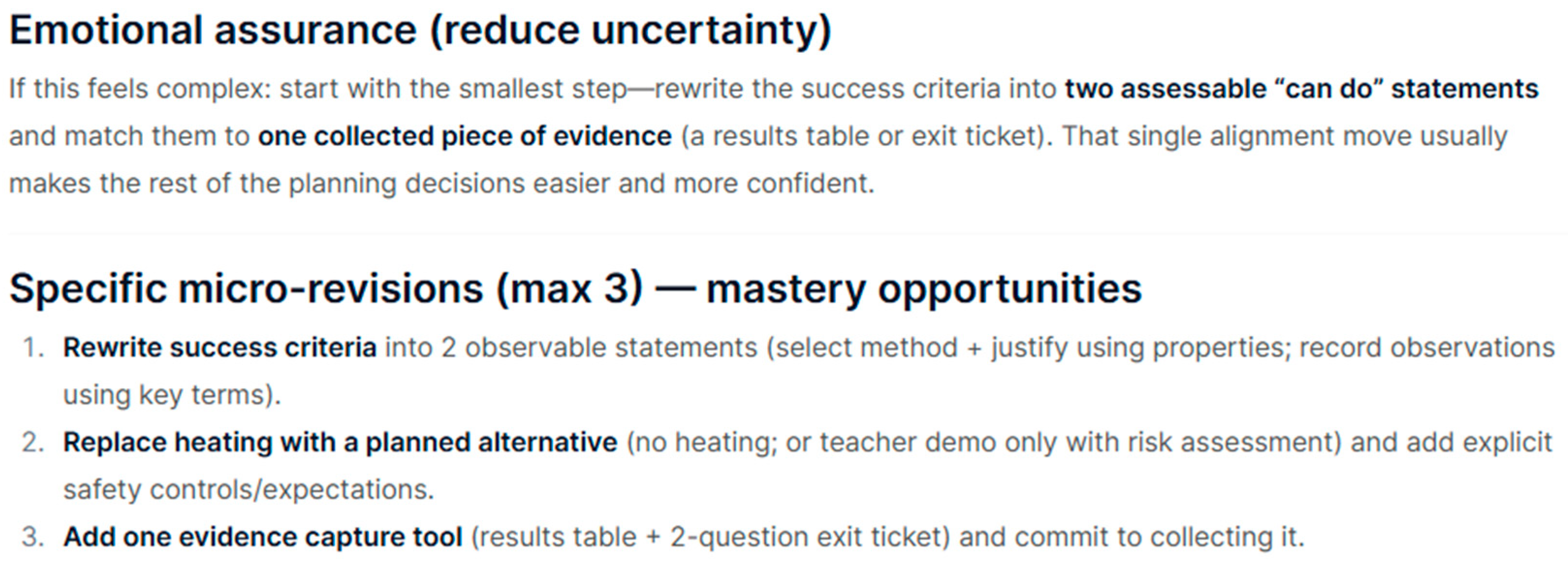
1996) for a detailed explanation on social comparisons with fictitious comparison individuals)), criterial comparison (as social persuasion in the form of verbal support cannot be fully depicted in the Lesson Planning Coach, criterial comparisons aim to approximate this) and emotional assurance (i.e., reducing the complexity of the feedback by pointing out one small, doable revision to improve the lesson plan).
In addition to strengthening self-efficacy feedback, the Lesson Planning Coach provides evaluations of the curriculum fit and time feasibility. Lastly, the feedback phase ends with specific micro-revisions presented as mastery opportunities and a self-efficacy reinforcement as an additional approximation to verbal support. An example of self-efficacy strengthening feedback, as well as proposed micro-revisions, can be seen in
Figure 5.
The feedback phase is followed by a brief summary of the Lesson Planning Coach’s feedback. This feedback allows the user to see a reduced version of the traffic light feedback, along with the micro-revisions provided. Lastly, the feedback loop concludes with a request for the user to incorporate the suggested revisions and then upload the new lesson plan again. Once the user uploads the revised lesson plan, the Lesson Planning Coach enters the feedback phase again. From iteration two onwards, the Lesson Planning Coach also provides temporal feedback, highlighting progressions between iterations of the lesson plan as another way of mastery experiences.
3.5. Rubric and Criteria
To enable the Lesson Planning Coach to provide criteria-based feedback to the user, specific rubrics are defined in the system prompt. This rubric focuses on the dimensions of the lesson planning competence model (i.e., goals, content, methods, media, and learner prerequisites). Additionally, rubrics of learning assessment and time coherence are incorporated into the system prompt. The Lesson Planning Coach is instructed to provide traffic-light feedback for each dimension (green, yellow, and red). These traffic lights are mapped to levels, which are then specified for each dimension (level three is mapped to green, level two to yellow, level one to red, and level zero (meaning this dimension is missing from the lesson plan) to red). The specifications for each dimension are shown in
Table 3.
The rubrics and criteria are accompanied by feedback templates aiming to give the AI model examples of how feedback can be generated (e.g., for mastery experiences: “Your lesson plan already shows very promising aspects in [dimension], for example [example/format]. This is a good idea, because [justification].”).
To illustrate how the rubric translates into actionable feedback, consider three brief examples. A lesson plan stating its goal as “students will understand photosynthesis” would be rated at level 1 (red) on the Goals dimension, prompting a micro-revision such as: “Your goal could be sharpened by specifying an observable action, for example, students will explain the role of chlorophyll in photosynthesis using a labelled diagram.” A lesson selecting a video as the primary medium without a clear instructional rationale would be rated at level 1 on the Media dimension, with feedback such as: “The video offers potential, but its function in the lesson is currently unclear. Consider how it links to your lesson goal and what learners should attend to while watching.” A lesson with detailed activities but no diagnostic check on prior knowledge would be rated at level 1 on the Learner Prerequisites dimension, generating feedback such as: “Your activities are well structured, but the lesson assumes prior knowledge without checking it. Adding a brief diagnostic at the start would let you adapt the lesson to where learners actually are.” These examples illustrate how rubric levels translate into specific, mastery-oriented feedback consistent with the four sources of self-efficacy.
By implementing a rigorous interaction model and a clearly defined rubric with criteria, the Lesson Planning Coach provides structured output aligned with the incorporated theoretical perspectives and the intended outcomes. The general structure of the system prompt is transferable to other educational contexts, with only the curriculum being specific to the Australian/German context. Further didactic principles that may be relevant in other educational contexts can be integrated as additional theoretical perspectives.
4. Discussion and Limitations
Artificial Intelligence, especially generative AI, has greatly affected educational processes in recent years and will likely bring profound changes to education and teacher education in the future. This paper aims to address the tension between harnessing the vast potential of genAI and the risk of teachers becoming overly reliant on it by developing a theory-informed Lesson Planning Coach applicable across various educational contexts. The key aspects of this feedback tool (differentiating it from the many other AI-supported educational chatbots) are (a) the focus on constructive feedback instead of providing fully generated lesson plans, and (b) the direct implementation of pedagogically relevant theory, like lesson planning competence, educational feedback, and self-efficacy strengthening feedback. The focus on constructive feedback aims to counteract students’ over-reliance on generative AI.
Compared with existing AI-supported educational tools, the Lesson Planning Coach occupies a distinctive position in the literature. Studies such as
Kessner and Kaka (
2025) and
Lee and Zhai (
2024) demonstrate that genAI can produce acceptable lesson plans for pre-service teachers, but these tools function primarily as content generators. Conversely, AI chatbots designed for instructional support, such as the system described by
Neumann et al. (
2025), focus on subject-matter dialogue rather than the planning process itself. Content analyses of genAI lesson plans (
Baytak, 2024;
Karaman & Göksu, 2024) suggest broad alignment between objectives, activities, and assessments, but do not engage with the question of how the planning process itself contributes to teacher development. The Lesson Planning Coach differs from these approaches in that it deliberately constrains generative capability and operationalises feedback theory (
Hattie & Timperley, 2007), self-efficacy theory (
Bandura, 1997), and a lesson planning competence model (
Söll, 2021) through a structured prompt architecture. In doing so, it aligns more closely with the design framework proposed by
Watts et al. (
2025) for theory-informed educational chatbots, while extending that approach to the specific domain of lesson planning in initial teacher education.
Regarding focus (a), the developed system prompt includes multiple didactic baselines, ensuring that the Lesson Planning Coach hints at possible gaps in the PSTs’ lesson plans and offers micro-revisions to improve. To ensure that not only experienced PSTs are able to use the feedback tool, guiding questions are provided to PSTs who may not yet have planned a lesson themselves. Equally, these guiding questions might provide further scaffolding for experienced PSTs, prompting them to improve their already planned lesson.
Regarding focus (b), the developed Lesson Planning coach aims at strengthening PSTs’ lesson-planning self-efficacy, addressing one of the key variables in teacher education. Through this, we intend not only to provide PSTs with a useful tool in one of the key aspects of their later working life as teachers, but also to strengthen their self-beliefs. Lastly the design principles and process may also provide guidance for educators from other fields to engage in developing educational chatbots for other purposes. To ensure adaptability for educators without genAI experience, the prompt-engineered version of the Lesson Planning Coach seemed to be the most accessible design compared to tools based on retrieval-augmented generation or external databases. Of course, these development processes could have provided similar results, but the prompt-engineered version aims to be adaptable by other educators.
Investment of time and the need for AI literacy on the researcher’s side need to be considered, nevertheless. Even though all researchers on the project had substantial prior experience with AI and developing small-scale individual AI chatbots, challenges arose during the development phase. As mentioned in
Section 3.1, multiple iterations of design and redesign were necessary to ensure the feedback tool yielded adequate results. Especially the inherent nature of genAI models, as they do not follow a programmed algorithm but always generate the statement most likely to respond to a user’s query, made the generation of structured results aligned with theoretical perspectives challenging.
Additionally, integrating all theoretical perspectives into the system prompt caused it to be overly complex at times, leading to unsatisfying results. In addition to the developmental challenges faced by the researchers on this project, ethical issues in AI use need to be considered. Possible biases in the generated feedback, as well as potential misuse, need to be analyzed in future implementations. The developed Lesson Planning Coach addresses the crucial gap of theory-informed educational AI chatbots. Meanwhile, this paper provides insights into the development and transferability of the respective tools. As this paper is conceptual, it does not yet provide empirical evidence of improvements in self-efficacy through the use of the Lesson Planning Coach. This has to be considered as a limitation. The present paper, therefore, should be understood as a conceptual guide to developing a theory-informed, pedagogically sound feedback tool that relies on genAI. The planned empirical research will be presented in the following section. The deliberate constraint of the feedback tool to not generate ready-to-go lesson plans for PSTs might seem like a further limitation, but it ensures that didactical decisions and reflection still remain with PSTs instead of with genAI. Even if PSTs might use other genAI tools to generate their initial lesson plan, the post hoc use of the Lesson Planning Coach still provides them with meaningful feedback, allowing them to critically reflect on lesson plans that may have been generated by generic genAI tools.
5. Outlook
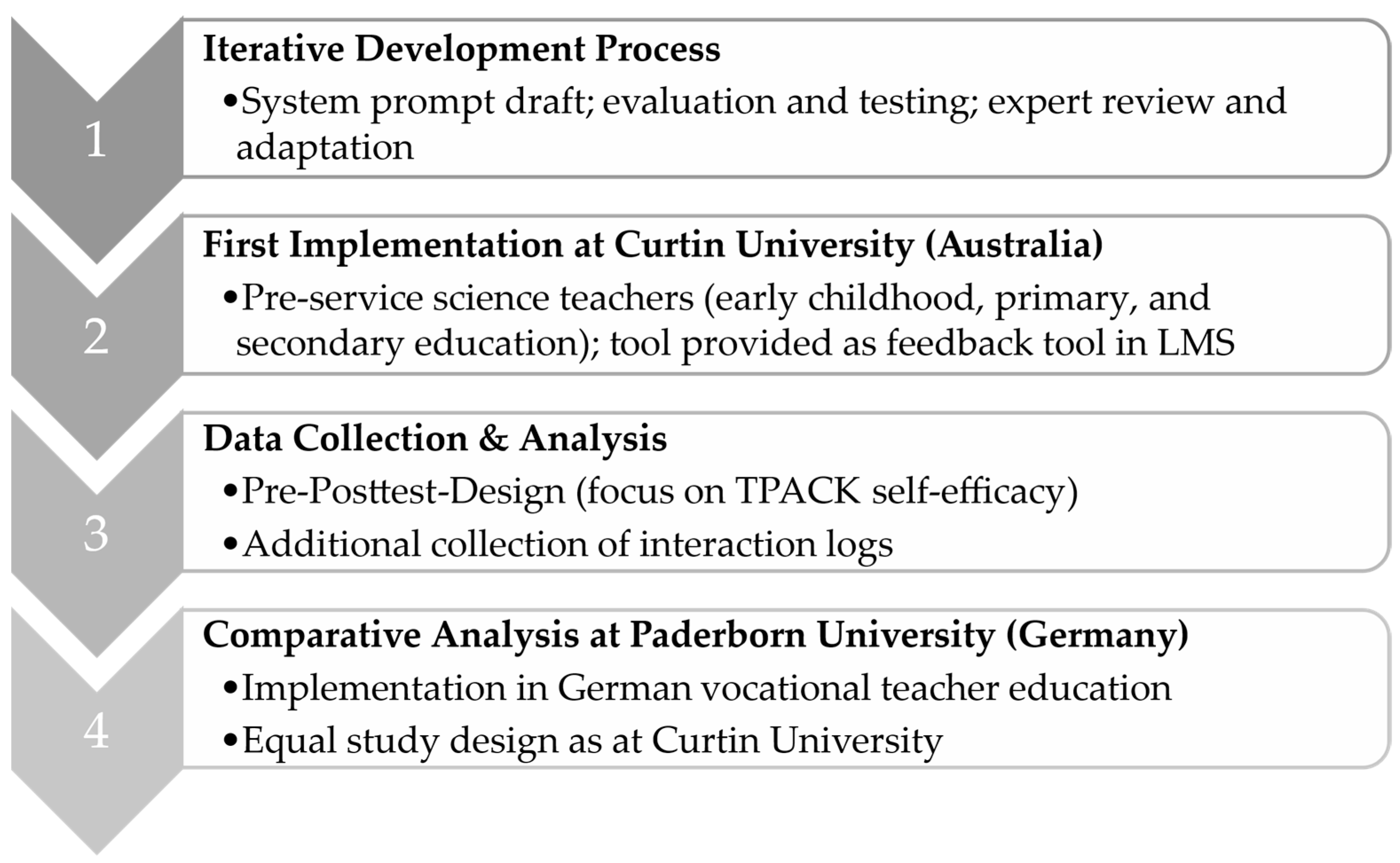
To monitor the intended objectives of the discussed AI-supported feedback tool, quantitative and qualitative investigations are being conducted during the Lesson Planning Coach’s implementation. The project design can be seen in
Figure 6.
As discussed in
Section 2.4, the first implementation of the feedback tool is realized at Curtin University’s School of Education (phase 2 in
Figure 6). The accompanying survey aims to generate proof-of-concept evidence on feasibility and acceptability, as well as early indicators of how AI-supported feedback relates to pre-service teachers’ self-reported lesson-planning self-efficacy. The accompanying study will follow a pre-post-test design, including surveys assessing the PSTs’ TPACK self-efficacy at the beginning and end of the study. Additionally, anonymized AI-generated feedback interactions will be collected to examine the structure, variability, and alignment with the intended design principles that inform the tool. These interaction data will be analyzed using qualitative content analysis to examine feedback features and alignment with targeted professional knowledge domains (phase 3 in
Figure 6). Finally, a comparative survey is conducted at a German University (phase 4 in
Figure 6). Through this, this work aims to strengthen teacher education programs by providing an easily available, pedagogically sound feedback tool. Simultaneously, it addresses the current gap in AI-related educational research regarding the theory-informed implementation and examination of AI-supported educational tools. To further expand these goals, adaptations of the Lesson Planning Coach are being considered. For this, an agentic version of the tool seems like a logical next step, allowing for automatic adjustment of the feedback tool for various educational tasks, such as formative and summative assessments, reflection on completed lessons, and many more possible use cases.
6. Conclusions
This paper has presented the conceptual design of the Lesson Planning Coach, a generative AI tool that provides theory-informed, self-efficacy-strengthening feedback on lesson plans created by pre-service teachers. By integrating a lesson planning competence model, feedback theory, and the four sources of self-efficacy within a deliberately constrained system prompt, the tool offers a worked example of how generative AI can be used to support rather than supplant professional planning practice in initial teacher education. The development followed a design-based research orientation across three iterative cycles, and the resulting prompt architecture is intended to be transferable across educational contexts, with the German vocational education adaptation serving as a first test of this transferability.
The contribution of the paper is necessarily bounded. As a conceptual paper, it does not yet provide empirical evidence of effectiveness, and the deliberate decision to restrict the tool to feedback rather than full lesson generation reflects a pedagogical commitment that may limit appeal in contexts where speed and convenience are prioritised over reflective practice. These choices are made explicit so that subsequent empirical work can examine their consequences directly.
Future work will focus on the planned pre-post empirical study at Curtin University, the comparative implementation in the German vocational education context, and the development of an agentic version of the tool capable of supporting adjacent tasks such as formative assessment, lesson reflection, and resource recommendation. Together, these directions are intended to test, refine, and extend the design principles articulated in this paper.