1. Introduction
The transformation of higher education systems toward sustainability-oriented models is one of the most urgent imperatives of the 21st-century global education agenda. Faced with the magnitude of interconnected challenges such as climate change, accelerated biodiversity loss, depletion of natural resources, and increasing socioeconomic inequalities, international frameworks have reaffirmed the strategic role of higher education institutions as agents of social transformation (
Filho et al., 2015;
UNESCO, 2017). The adoption of the 2030 Agenda and its 17 Sustainable Development Goals (SDGs) marked a normative turning point: since then, universities worldwide have intensified their efforts to align institutional missions, curricula, and governance practices with the principles of sustainable development (
Filho et al., 2025;
Lozano et al., 2013).
Education for Sustainable Development (ESD) proposes a profound transformation of the educational process that encompasses what is taught, how it is taught, and in what context learning takes place (
UNESCO, 2011). This approach has evolved from isolated thematic inclusion to a model based on transversal competencies that includes systems thinking, normative reasoning, anticipatory capacity, and strategic orientation (
Brundiers et al., 2020). However, empirical evidence shows that this transition is heterogeneous: sustainability often appears in strategic documents and institutional declarations, but frequently does not translate into systematic curricular integration or formal academic governance mechanisms (
Disterheft et al., 2016;
Lozano et al., 2022).
One aspect that is particularly underrepresented in the literature is the comparative analysis of the perceptions of internal institutional actors—faculty and students—regarding the integration of sustainability within their own institutions. Most existing studies adopt single-actor designs, analyzing either faculty or students separately (
Aleixo et al., 2021;
Barth & Rieckmann, 2012). This methodological fragmentation hinders the identification of convergences and perceptual gaps that would be fundamental for designing more effective institutional policies. Furthermore, most of the available empirical evidence comes from European or North American universities, which limits the understanding of sustainable transition processes in Latin American contexts, where budgetary constraints, regulatory centralization, and ongoing curricular reforms shape distinct institutional dynamics.
Given this situation, the present study was conducted at a higher education university in Ecuador and contributes to closing three gaps identified in the literature: (a) the lack of comparative designs between faculty and students within the same methodological framework; (b) the scarcity of mixed-methods approaches that integrate quantitative measurement with a qualitative understanding of the perceptual phenomenon; and (c) the limited representation of Latin American university contexts in high-impact journals on sustainability. The choice of a convergent–complementary mixed-methods design responds precisely to the multidimensional nature of the phenomenon: while the quantitative component allows for measuring levels of perception in five key dimensions, the qualitative component delves into the meanings, experiences, and discourses that the actors assign to sustainability in their university education (
Creswell & Clark, 2017).
Specifically, the study pursues the following objectives: (1) to describe and compare the levels of perception of teachers and students regarding the integration of sustainability in five dimensions: curriculum and teaching, participation and commitment, resources and institutional support, impact and expectations, and vision for the future; (2) to identify the emerging thematic categories and relational models that structure the discourses of both groups; and (3) to triangulate the quantitative and qualitative findings to offer an integrated interpretation of the process of institutionalizing sustainability in the analyzed context.
The rest of the article is structured as follows:
Section 2 presents the literature review;
Section 3 describes the methodological design;
Section 4 presents the results;
Section 5 develops the discussion; and
Section 6 presents the conclusions and implications of the study.
2. Literature Review
2.1. Methodological Approach of the Review: SALSA-Type Structured Approach
In order to guarantee analytical rigor and theoretical coherence, this literature review was developed under a structured approach based on the SALSA model (Search, Appraisal, Synthesis and Analysis), which allows for methodological transparency without reaching the level of a complete systematic review (
Grant & Booth, 2009).
2.1.1. Search
A search was conducted in the Scopus and Web of Science databases, prioritizing articles published between 2015 and 2025 in high-impact indexed journals in the areas of higher education, sustainability, and development.
Combinations of terms such as the following were used:
“sustainability in higher education”;
“education for sustainable development”;
“curriculum integration sustainability”;
“faculty perception sustainability”;
“student perception sustainability”;
“institutionalization sustainability university”.
2.1.2. Appraisal
The identified studies were selected according to the following criteria:
Empirical approach in higher education.
Explicit methodological clarity.
Analysis of curriculum integration or perceptions of institutional stakeholders.
Publication in indexed journals.
Research focused exclusively on operational environmental management without a pedagogical component was excluded.
2.1.3. Synthesis
The selected literature was organized into three thematic axes:
Institutionalization and governance of sustainability.
Curriculum integration and competency-based approach.
Studies of teacher and student perception.
Regional context: sustainability in Latin American higher education.
2.1.4. Analysis
Comparative analysis allowed the identification of recurring patterns:
Normative consolidation of the discourse on sustainability.
Persistent structural fragmentation in curriculum implementation.
Limited comparative evidence between internal actors.
Predominance of one-dimensional methodological designs.
Underrepresentation of Latin American institutional contexts in high-impact journals.
2.2. Institutionalization of Sustainability in Higher Education
Following the adoption of the 2030 Agenda, universities have assumed a strategic role as agents of social transformation (
Filho et al., 2015). Sustainability is no longer limited to isolated environmental initiatives, but involves reforms in governance, curriculum, research, and community engagement.
However, empirical evidence shows that the institutionalization of sustainability is an uneven process.
Lozano et al. (
2013), in a longitudinal analysis of implementation in universities, demonstrate that strategic commitment does not always translate into systemic integration. Many institutions incorporate sustainability into formal documents but maintain traditional organizational structures.
Similarly,
Disterheft et al. (
2016) point out that participatory evaluation models reveal tensions between institutional intention and operational capacity. A lack of structural incentives, disciplinary fragmentation, and limited interdepartmental coordination constitute recurring barriers.
Overall, the literature describes a persistent duality between normative legitimacy and effective structural transformation.
2.3. Curriculum Integration and Competency-Based Approach
One of the central debates in education for sustainable development (ESD) concerns how sustainability is integrated into curricula. The contemporary approach proposes a transition from thematic inclusion to a model based on transversal competencies.
Brundiers et al. (
2020) propose a consensus-based framework of key competencies in sustainability, which includes systems thinking, anticipatory competence, normative reasoning, and strategic capacity. This approach implies pedagogical redesign and not merely the incorporation of content.
However, the actual implementation presents significant heterogeneities.
Lozano et al. (
2022), in analyzing thirteen higher education institutions, conclude that the adoption of sustainable competencies is partial and depends on specific disciplinary dynamics.
Aleixo et al. (
2021) found that, although students recognize the relevance of sustainable development, they perceive limited curricular coherence and cross-curricular integration.
These findings suggest that, in many contexts, sustainability functions as an added thematic element rather than as a structuring principle of the curriculum.
2.4. Teacher and Student Perceptions: Convergences and Asymmetries
Perception-focused studies allow us to understand how sustainability is experienced by institutional actors.
From a teaching perspective,
Barth and Rieckmann (
2012) identify conceptual support for sustainability, but also difficulties associated with a lack of specific pedagogical training, institutional incentives, and interdisciplinary articulation.
In the case of students, the literature reports high levels of ethical appreciation, but mixed perceptions regarding institutional support and curricular coherence (
Aleixo et al., 2021).
Comparative research between faculty and students is relatively scarce. When such research is conducted, it often reveals asymmetries in the perception of institutional support and governance (
Disterheft et al., 2016). Faculty, being involved in academic planning and management, tend to adopt a more critical view of structural limitations. This divergence does not imply contradiction, but rather a differentiation stemming from each actor’s organizational position.
2.5. Regional Gap: The Latin American Context
Although research on sustainability in higher education has grown significantly in Europe and Asia, empirical evidence from Latin America remains less visible in high-impact journals.
The structural characteristics of Latin American university systems, such as budget constraints, centralized regulations, and ongoing curriculum reform processes, can influence how sustainability is institutionalized and perceived by internal stakeholders.
In this sense, analyzing the integration of sustainability in a higher education institution in Ecuador not only broadens regional representativeness but also contributes to diversifying the comparative understanding of institutional transition processes in emerging contexts.
Table 1 presents the main contributions and limitations identified in the recent literature on sustainability in higher education. This table summarizes relevant empirical and conceptual studies, highlighting their methodological approaches, the stakeholders analyzed, and the gaps identified.
As shown in
Table 1, the literature demonstrates significant progress in the conceptualization and institutionalization of sustainability in higher education. However, approaches focused on institutional analyses or single-actor studies predominate, with limited comparative integration between faculty and students within the same methodological design. Furthermore, limitations are identified in the articulation between quantitative measurement and qualitative understanding of the phenomenon.
3. Methodology
3.1. Research Approach and Design
The study was developed using a mixed-methods approach of a convergent–complementary nature, integrating ordinal descriptive quantitative analysis and qualitative analysis, which allowed for the triangulation and integration of results in the interpretive phase (
Creswell & Clark, 2017). This design made it possible to study how sustainability is integrated into higher education from two complementary angles: on the one hand, what teachers and students perceive in structured terms; on the other hand, what meanings and experiences underlie those perceptions.
The quantitative component was descriptive and non-parametric in scope. Its purpose was to measure the perception of sustainability in five dimensions: curriculum and teaching (D1), participation and commitment (D2), resources and institutional support (D3), impact and expectations (D4), and vision for the future (D5).
The qualitative component began with thematic content analysis. This aimed to identify emerging categories, nodes of meaning, and links between the different dimensions of the training process.
Finally, the results of both components were integrated through interpretive triangulation. This process allowed for a comparison of where the perceptions of the different institutional actors coincided and diverged.
3.2. Population and Sample
The sample consisted of faculty and students from university programs. The quantitative component included 597 students and 88 faculty members.
The study did not require formal ethics committee approval. Data collection did not involve sensitive personal information, vulnerable populations, or experimental procedures of any kind. All participation was voluntary and anonymous—no identifying information was collected at any point. Participants were told about the academic purpose of the study before filling out the questionnaire, and returning a completed form was taken as implicit consent.
Sampling followed a non-probability convenience approach, which is a common and accepted choice in institutional perception research where full population access is not feasible (
Babbie, 2020). In this kind of study, statistical representativeness matters less than the depth and richness of the data collected. The fact that student numbers far outnumber faculty in the sample is not a methodological weakness; it mirrors the actual composition of the institution, as has been noted in comparable studies (
Wals, 2014). The limitations of this sampling strategy are addressed in
Section 6.
One further reason this approach is justified here is the way the study was designed. Because the open-ended questions were built into the same questionnaire used for the quantitative component, both parts of the study draw from exactly the same group of participants. This keeps the data internally consistent and avoids the complications that would arise from using separate recruitment processes for each methodological strand.
3.3. Instruments
3.3.1. Structured Questionnaires
Two separate questionnaires were designed (one for teachers and one for students), each consisting of 15 items. The instruments included:
Hierarchical ordinal items (low, medium, and high levels);
Descriptive nominal items;
The ordinal scales were recoded into three analytical levels (1 = low, 2 = medium, 3 = high), following the classical theory of measurement scales, which states that only ordinal categories can be treated as aggregable ordinal variables.
Nominal items were analyzed exclusively using frequencies and percentages, without incorporation into synthetic indices.
3.3.2. Open-Ended Questions (Qualitative Component)
Open-ended questions were embedded within the same questionnaire administered to the quantitative sample, organized into five thematic dimensions aligned with the study’s analytical framework. This design ensured that both methodological strands shared an identical participant base, strengthening internal consistency and eliminating potential discrepancies arising from separate sampling procedures.
The open-ended questions addressed: (1) conception of sustainability; (2) training experiences related to sustainability; (3) perceived structural gaps; (4) necessary institutional transformations; and (5) sustainable professional projection. Responses were collected from the full sample (597 students and 88 faculty members), yielding a total corpus of 3425 written responses for qualitative analysis. Questionnaires were self-administered in written form and completed during a single session within regular class periods or scheduled faculty activities. Given the written nature of the open-ended responses, no interview duration applies; participants responded at their own pace within the same instrument. This format has been shown to reduce social desirability bias while allowing for richer elaboration than closed-ended items (
Salahange et al., 2024).
3.4. Quantitative Analysis Procedure
The analysis was performed using non-parametric ordinal descriptive statistics, avoiding the use of inferential tests due to the categorical nature of the data.
The following were calculated:
Two indices were constructed:
Only items with clearly hierarchical ordinal scales were included. Nominal items were excluded to avoid epistemological violations in data aggregation.
Interpretation was performed using the class width method:
Interpretation ranges:
1.00–1.66 → Low perception;
1.67–2.33 → Medium perception;
2.34–3.00 → High perception.
The overall index was obtained as a simple average of the dimensional indices, maintaining its descriptive nature.
Even though the study involves two groups—students and faculty—no inferential tests were run. The data are ordinal, and the research questions were never about proving statistically significant differences between groups. The goal was always more descriptive: to understand how each group perceives sustainability across five dimensions, not to test whether those perceptions are statistically distinct. Other perception-based studies in this field have taken the same approach, relying on descriptive non-parametric procedures rather than inferential ones (
Disterheft et al., 2015;
Taboada-González & Aguilar-Virgen, 2024).
The decision to build the indices through simple averaging follows the same logic. Each dimension carries equal weight in the final index, which keeps the interpretation straightforward and avoids introducing assumptions that would come with any kind of differential weighting (
Creswell & Clark, 2017).
3.5. Qualitative Analysis Procedure
The open-ended responses were analyzed using Atlas.ti. The whole research team worked through the coding together, combining two approaches: codes were first drawn directly from what participants wrote, and then organized into broader categories using the five analytical dimensions as a reference framework. This kind of hybrid inductive-deductive process is well documented in qualitative sustainability research (
Braun & Clarke, 2006;
Saldaña, 2017).
The analysis moved through two levels. At the micro level, the team identified units of meaning and built nodes within each dimension. At the macro level, those nodes were connected into relational sequences: Conception → Experience → Identification of gaps → Transformation → Future projection.
To keep the coding consistent, the team held regular review sessions where codes and categories were discussed and adjusted until everyone agreed. Atlas.ti helped organize the full corpus and made it possible to trace back every analytical decision to the original data.
3.6. Criteria for Methodological Rigor
The study adopted rigorous criteria consistent with its convergent mixed design, guaranteeing methodological consistency, validity of the instruments, and interpretive soundness.
3.6.1. Rigor in the Quantitative Component
In the quantitative phase, the questionnaire items were developed from scratch based on a review of the theoretical and empirical literature on sustainability in higher education, ensuring conceptual alignment with the five analytical dimensions of the study. Content validity was ensured through review by experts in higher education and sustainability, who assessed the relevance and clarity of the items in relation to the study’s analytical dimensions. A pilot test was conducted prior to full administration to identify ambiguities and refine item wording. The instrument’s internal consistency was evaluated using Cronbach’s alpha coefficient, yielding a value of α = 0.87, which indicates a high level of reliability and adequate internal coherence among the items comprising the scale.
The statistical analysis respected the ordinal nature of the data, employing exclusively non-parametric descriptive statistics. The construction of the synthetic indices (IPE and IPD) was performed using only hierarchical items, guaranteeing consistency between the level of measurement and the aggregation procedures.
3.6.2. Rigor in the Qualitative Component
The qualitative analysis was developed following widely accepted criteria in interpretive research.
The following principles were applied:
Credibility, through triangulation among actors (teachers and students) and iterative review of categories.
Transferability, through a sufficient contextual description that allows for assessing applicability in similar scenarios.
Dependability, ensured through the systematization of the coding process.
Confirmability, strengthened through cross-review of interpretations and analytical traceability.
The thematic analysis was carried out systematically, following procedures for coding, categorization, and construction of conceptual relationships.
3.6.3. Integration in the Mixed Approach
The validity of the mixed-methods design was strengthened through methodological triangulation, allowing for the identification of convergences and divergences between quantitative and qualitative results. This interpretive integration contributed to a deeper understanding of the phenomenon analyzed and reduced potential biases associated with the use of a single method. Both strands were treated as equally weighted, with neither subordinated to the other, in accordance with the convergent–complementary logic of the design (
Creswell & Clark, 2017).
3.7. Ethical Considerations
This study did not require formal ethics committee approval. The data collection process did not involve sensitive personal information, vulnerable populations, or experimental procedures of any kind. All participation was voluntary, and no identifying information was collected at any point. Prior to completing the questionnaire, participants were informed of the academic and research purpose of the study. The return of a completed questionnaire was considered implicit consent to participate. All data were treated with strict confidentiality and used exclusively for academic purposes, in accordance with standard ethical principles governing educational research.
4. Results
4.1. Quantitative Results
4.1.1. Global Level of Perception
The quantitative analysis reveals a generally favorable perception of sustainability in higher education among both students and faculty.
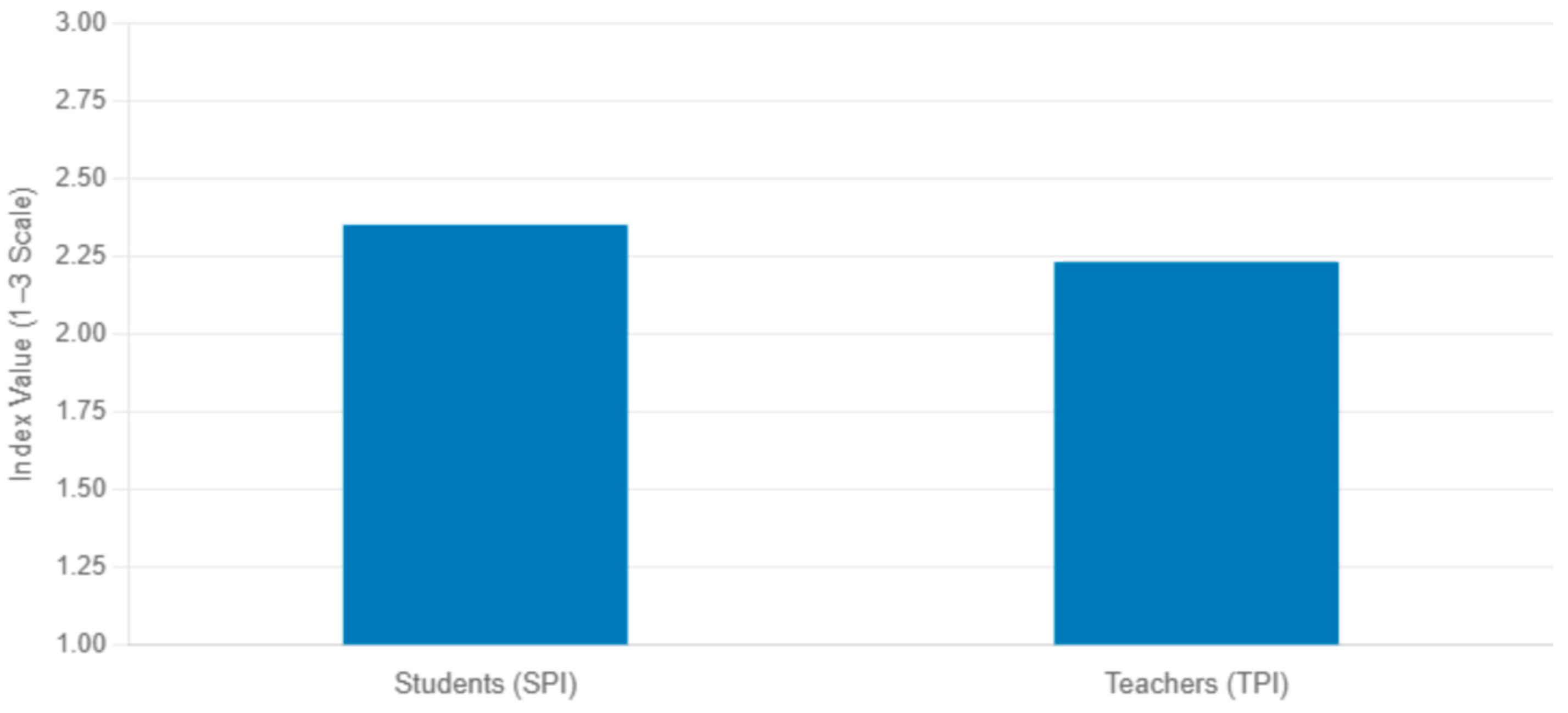
The Student Perception Index (SPI) reached an overall value of 2.35, corresponding to a medium–high level. Meanwhile, the Teacher Perception Index (TPI) obtained a value of 2.23, placing it at the medium level.
These results show a positive assessment in both groups, although with a slightly higher perception among students.
Figure 1 illustrates the overall perception index for students and faculty on an ordinal scale of 1 to 3.
4.1.2. Results by Dimension
Table 2 presents the comparison of the indices by dimension.
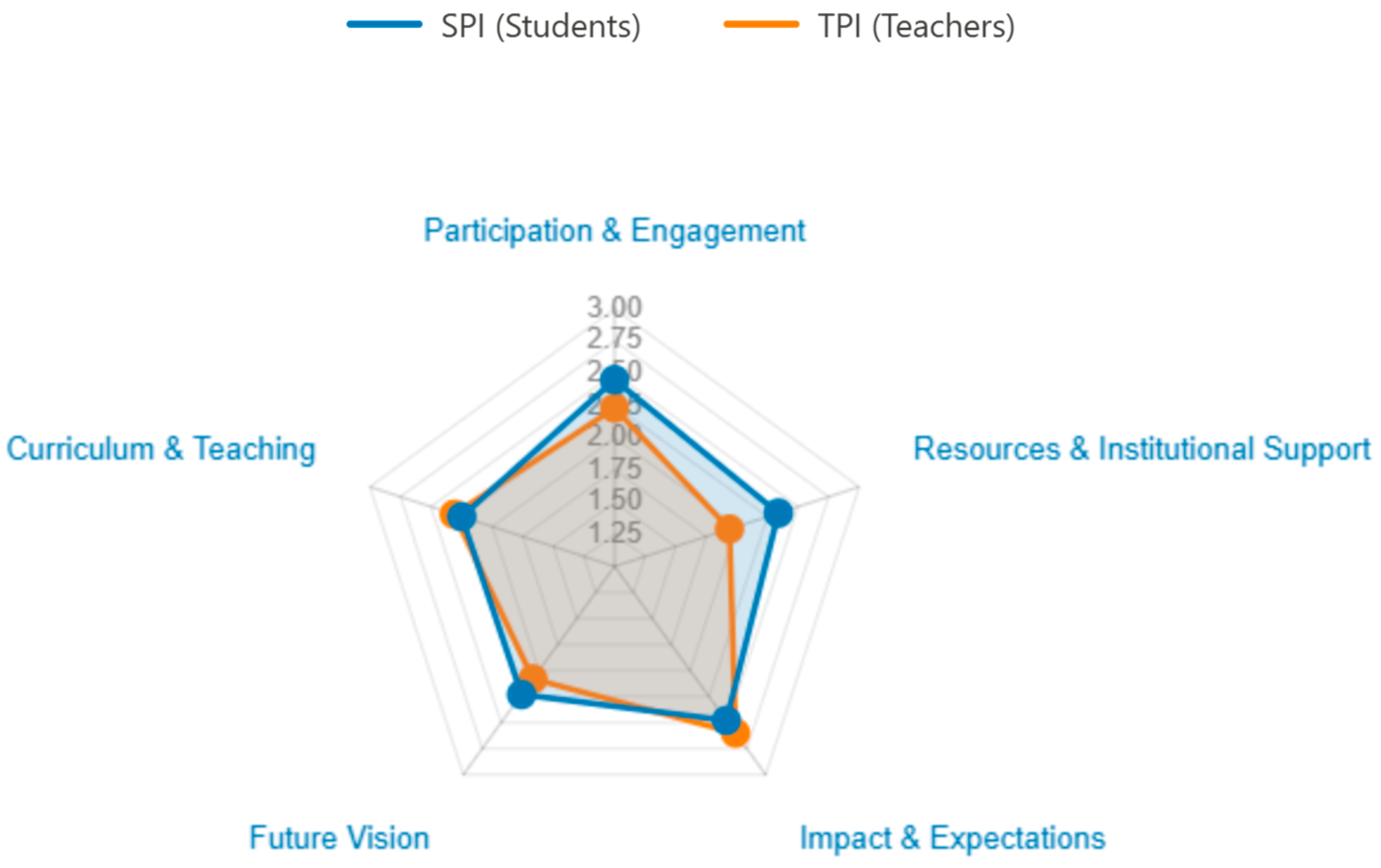
The results show that dimension D4, Impact and Expectations, presents the highest values in both groups (SPI = 2.48; TPI = 2.60), placing it at a high level of perception.
In contrast, dimension D3, Resources and Institutional Support, shows the greatest gap between actors, with a medium–high rating among students (2.34) and a medium–low rating among teachers (1.94).
Dimension D2, Participation and Engagement, reaches a medium–high level among students (2.45), while among teachers it remains at a medium level (2.23).
Meanwhile, D1, Curriculum and Teaching, and D5, Vision for the Future, are at medium levels in both groups, although with slight variations between actors.
Figure 2 presents the comparative distribution of student (SPI) and teacher (TPI) perception indices across the five analytical dimensions.
4.2. Qualitative Results
Thematic content analysis of the open-ended written responses allowed the identification of five thematic categories in both groups, structured in differentiated relational models.
4.2.1. Qualitative Results in Teachers
For faculty, sustainability is primarily conceived as an ethical principle linked to social responsibility and professional environmental awareness. Participants described it in terms of conscience-building and value formation, as illustrated by responses such as: “Forming awareness, promoting ethical values” and “Socio-environmental responsibility for the responsible use of resources”. One faculty member framed it broadly: “Sustainability trains students and future professionals with knowledge of the environment that surrounds them and society”.
The experiences that motivate its integration mostly emerge from professional practice and participation in specific projects, rather than from formal training. As one participant noted, “Projects I have participated in and respect and love for nature”, while another highlighted an institutional trigger: “My coordination role, where I precisely evaluate students’ lack of knowledge on the subject”.
Structural gaps have been identified, associated with weak cross-curricular integration and limited student engagement. Faculty responses pointed to a reductive understanding of sustainability: “In many cases it is limited to the environmental dimension and not to the full context that sustainability implies”. Others noted, “Lack of knowledge of fundamental aspects; there are no workshops to engage them in activities related to environmental care”.
Regarding necessary transformations, faculty emphasized the need for explicit curricular integration: “Sustainability should be included in the syllabus and analytical plan of each subject”. For professional projection, responses highlighted ethics and interdisciplinary skills: “Ethics, critical development, continuing education, collaborative work” and “Technology applied to sustainability, practical application”.
The relational faculty model demonstrates a progressive sequence: conception → experience → identification of gaps → curricular transformation → sustainable professional projection.
4.2.2. Qualitative Results in Students
For students, sustainability does not appear as something systematically integrated into their education, but rather as isolated experiences without clear connection between them. When asked about university contributions to their understanding of sustainability, responses were largely fragmented: “Innovation”, “Understanding the environment we are in”, while more elaborate responses highlighted the combination of theory and practice: “Projects and fieldwork show the real application of concepts, while campus activities and debates foster responsible habits and environmental awareness”.
Extra-university experiences carry significant weight in how students construct their understanding of sustainability. Family practices emerged as a primary reference: “Growing up in a home where recycling, water conservation, and waste reduction were practiced taught me from an early age the importance of sustainable habits.” Community and social media were also cited as influential: “Access to information on social media broadens my knowledge about global problems and sustainable solutions”.
Regarding participation barriers, students consistently identified time constraints and lack of institutional visibility: “Lack of time due to academic workload and other responsibilities” and “The participation of students in sustainability projects is limited by personal barriers, such as lack of time or not knowing how to get involved”.
What students propose is concrete and tangible. When asked about institutional initiatives, responses included: “Awareness and environmental education campaigns” and “Create a comprehensive university sustainability program combining practical workshops, recycling projects, and energy efficiency initiatives”.
For professional projection, students expressed a desire to integrate sustainable practices into their future careers: “Prioritizing solutions that reduce resource consumption, minimize waste, and use clean energy” and “Integrating responsible practices into my future profession, making decisions that minimize environmental impacts and promote a positive impact on society”.
The student relational model is structured sequentially: university contributions → external experiences → identification of barriers → proposals for improvement → ethical-professional development.
4.3. Integration of Results
The integration of quantitative and qualitative findings reveals significant convergences. Both groups agree on recognizing the high transformative potential of sustainability (D4), which is reflected both in the high indices and in discourses focused on training agents of change.
However, notable divergences also emerged. With respect to institutional support and meaningful participation, faculty members tended to be considerably more critical than students, likely reflecting their greater direct exposure to structural limitations. These differences are consistent with the gaps identified in the qualitative component.
In general, both faculty and students value sustainability positively at the university. But this positive assessment coexists with an unequal reality: sustainability is not yet equally integrated into curricula nor does it have the same structural support across all dimensions.
5. Discussion
5.1. Cultural Legitimation of Sustainability: Normative Consensus and Institutional Symbolic Capital
Of all the dimensions analyzed, Impact and Expectations received the highest scores in both groups. This is significant: it indicates that faculty and students share a similar vision of the transformative potential of sustainability in professional training. In other words, there is common ground, a kind of cultural consensus that makes sustainability seem valuable and desirable within the institution.
This is not a new finding. Since the 2030 Agenda, universities around the world have been incorporating sustainability into their official documents and strategic plans at a growing pace (
Filho et al., 2025). But having sustainability in a document is not the same as having it in practice and multiple studies have shown that the gap between the two is persistent (
Aleixo et al., 2021;
Lozano et al., 2022). Latin American universities are no exception. Research on the region shows that sustainability language tends to appear in mission statements and institutional declarations, but the structural changes needed to actually integrate it into curricula often lag far behind (
Filho et al., 2021).
The interviews reinforce this interpretation. Faculty members understand sustainability primarily as a social responsibility of the university, while students associate it more with professional ethics and civic engagement. Both narratives demonstrate axiological internalization, but they also show that this internalization operates mainly on a value-based and prospective level, rather than in the systematic curricular experience.
From a theoretical perspective, this phenomenon can be interpreted as a phase of normative consolidation prior to structural institutionalization, in which cultural consensus precedes organizational redesign.
5.2. Perceptual Asymmetries and Structural Position: Differentiated Understanding of the Institutional Process
One of the study’s most concrete contributions is the finding that faculty and students do not perceive the institution’s support for sustainability in the same way. The clearest gap emerged in the dimension of Resources and Institutional Support, where faculty were notably more critical.
This pattern is consistent with the structural position each group occupies within the institution. Faculty deal with curriculum planning, resource allocation, and academic governance on a daily basis—they run into the system’s limits in ways that students simply don’t. Students tend to judge sustainability by what they see and experience in their courses, which naturally produces a more limited view of how deep the structural problems go. Research has picked up on this pattern before: the gap between what institutions say about sustainability and what they actually do tends to be more visible to those who work inside the system (
Disterheft et al., 2016;
Lozano et al., 2022;
Qammar et al., 2023). These differences do not reflect contradictory assessments, but rather distinct vantage points shaped by each group’s role.
The interviews confirm this. In the institution analyzed, the implementation of sustainability in the classroom depends largely on whether there is a teacher willing to promote it independently. This is a clear indication that sustainability is not yet integrated into the university’s formal mechanisms, but rather relies on individual initiative.
5.3. Curriculum Fragmentation and Limited Transversality: Limitations of the Disciplinary Approach
The fact that sustainability is highly valued does not mean it is well integrated. The curriculum and strategic vision dimensions received average scores, which says something important: sustainability appears in specific subjects or projects, but it doesn’t run through the curriculum as a guiding thread.
The literature converges on this point: moving past fragmentation means rethinking how curricula are structured not merely incorporating sustainability content into existing subjects, but embedding it as a structuring principle across the curriculum (
Brundiers et al., 2020). When that doesn’t happen, sustainability stays at the surface: a topic that gets covered in certain classes but never really changes how students approach their work or think about their future roles. This pattern has been documented across diverse institutional contexts (
Aleixo et al., 2021;
Taboada-González & Aguilar-Virgen, 2024).
The interviews show exactly this. Students talk about isolated experiences, lacking continuity. Faculty, for their part, acknowledge that there is little coordination between departments. Looking at the whole picture, the institution seems to be at a stage where it has already incorporated sustainability as a topic, but has not yet integrated it as a structure that runs through the entire curriculum.
In pedagogical terms, the consequence is concrete: sustainability functions more as contextual content than as a competence that is systematically developed, practiced and evaluated.
5.4. From Rhetoric to Governance: Sustainability as an Organizational Process
The data points to a recurring tension throughout the analysis: sustainability enjoys significant support in discourse, but this support is not translated into formal structures to sustain it. In other words, it exists in the words but not fully in the mechanisms.
Research on this topic is consistent: for sustainability to truly become institutionalized, clear policies, indicators that allow for monitoring, committed leadership, and effective evaluation systems are needed (
Filho et al., 2020). Without them, everyone simply does what they can from their own position, without continuity or systematic support.
Faculty responses make this concrete. What teachers are asking for is not abstract: better training for working sustainability into their courses, and more coordination across departments so the effort doesn’t stay siloed. The fact that these needs come up so clearly in the data suggests that awareness of the problem already exists within the institution; what remains absent are the formal structures needed to translate that awareness into coordinated action. As
Filho et al. (
2020) put it, having motivated people is not enough on its own; without a proper institutional framework to organize, support, and evaluate sustainability efforts, those individuals end up working in isolation.
5.5. Pedagogical Implications: Towards a Model Based on Transformative Competencies
The findings suggest that moving towards structural sustainability involves adopting a competency-based approach, integrating systemic thinking, ethical responsibility, and complex problem-solving.
Recent research emphasizes that education for sustainability is most effective when it combines cognitive, attitudinal, and practical dimensions through active methodologies (
Brundiers et al., 2020). In the study, students demanded greater practical application, reinforcing the need for experiential learning and interdisciplinary projects.
Teacher training is emerging as a strategic priority. Without specific training in pedagogies for sustainability, curricular integration will hardly move beyond the declarative level.
5.6. Methodological Contribution and Emerging Interpretive Model
The convergent mixed-methods design allowed us not only to measure perceptions but also to understand the interpretive mediators of the institutional process. Triangulation revealed coherences and tensions that would not have been visible through a purely quantitative approach.
Based on the integration of results, a two-layered interpretive model is proposed:
Normative layer: high ethical legitimacy and transformative expectation.
Structural layer: partial institutionalization, dependent on individual initiatives and with limited curricular transversality.
This model provides a conceptual tool for understanding transition processes in Latin American universities, contributing to the debate on how institutions are moving from discursive alignment with the 2030 Agenda toward profound organizational transformations.
6. Conclusions
This study analyzes the perceptions of faculty and students regarding the integration of sustainability in an Ecuadorian higher education institution, using a convergent–complementary mixed-methods design. The findings allow for conclusions to be drawn at three levels: empirical, methodological, and implications for institutional practice.
The findings reveal favorable perceptions in both groups, with greater consensus around the transformative potential of sustainability and a notable gap in resources and institutional support, where faculty proved considerably more critical. These results confirm a strong cultural recognition of sustainability that has not yet translated into consolidated structural institutionalization.
Qualitative analysis identified distinct relational models. Faculty articulate sustainability through professional responsibility and curricular management, acknowledging structural gaps in training and interdepartmental coordination. Students construct sustainability from fragmented experiences and extra-university references, converging with faculty in the projection of a sustainable professional identity.
Triangulation of results led to the proposal of a two-layered interpretive model: a normative layer, characterized by high ethical legitimacy and a shared transformative expectation, and a structural layer, marked by partial curricular integration, dependence on individual faculty initiatives, and limited cross-cutting approaches. This model provides a useful conceptual framework for interpreting sustainable transition processes in Latin American universities that have incorporated sustainability into their strategic discourse but have not yet consolidated formal governance mechanisms.
The convergent mixed-methods design proved particularly well-suited to capturing both quantitative levels of perception and qualitative interpretive mediators. The convergences and divergences identified through triangulation would not have been visible with a single methodological approach, reinforcing the value of mixed-methods designs in research on education for sustainable development (ESD).
Future research could broaden the scope to include multi-institutional samples in Latin America, incorporate longitudinal designs to track changes following curricular interventions, and explore the mediating role of variables such as disciplinary area, teaching seniority, or year of study in shaping perceptions of sustainability.
Author Contributions
Conceptualization, K.S.C.-V., R.M.T., M.A. and M.C.C.; methodology, K.S.C.-V., R.M.T., M.A. and M.C.C.; software, K.S.C.-V. and R.M.T.; validation, K.S.C.-V., R.M.T., M.A. and M.C.C.; formal analysis, K.S.C.-V. and R.M.T.; investigation, K.S.C.-V. and R.M.T.; resources, K.S.C.-V. and R.M.T.; data curation, K.S.C.-V. and R.M.T.; writing—original draft preparation, K.S.C.-V. and R.M.T.; writing—review and editing, K.S.C.-V., R.M.T., M.A. and M.C.C.; visualization, K.S.C.-V. and R.M.T.; supervision, R.M.T.; project administration, K.S.C.-V. and R.M.T. All authors have read and agreed to the published version of the manuscript.
Funding
This research received no external funding.
Institutional Review Board Statement
The study was conducted in accordance with the Declaration of Helsinki, and approved by the Ethics Committee of Universidad Tecnológica Israel Exemption Certificate—Minimal Risk Classification and date 11 November 2025.
Informed Consent Statement
Informed consent was obtained from all subjects involved in the study.
Data Availability Statement
The data presented in this study are not publicly available. This research did not involve the collection or processing of personal or sensitive data, as confirmed by the institutional ethics committee. Data are available on request from the corresponding author.
Conflicts of Interest
The authors declare no conflicts of interest.
References
- Aleixo, A. M., Leal, S., & Azeiteiro, U. M. (2021). Higher education students’ perceptions of sustainable development in Portugal. Journal of Cleaner Production, 327, 129429. [Google Scholar] [CrossRef] [Scilit]
- Babbie, E. R. (2020). The practice of social research. Cengage Au. [Google Scholar]
- Barth, M., & Rieckmann, M. (2012). Academic staff development as a catalyst for curriculum change towards education for sustainable development: An output perspective. Journal of Cleaner Production, 26, 28–36. [Google Scholar] [CrossRef] [Scilit]
- Braun, V., & Clarke, V. (2006). Using thematic analysis in psychology. Qualitative Research in Psychology, 3, 77–101. [Google Scholar] [CrossRef] [Scilit]
- Brundiers, K., Barth, M., Cebrián, G., Cohen, M., Diaz, L., Doucette-Remington, S., Dripps, W., Habron, G., Harré, N., Jarchow, M., Losch, K., Michel, J., Mochizuki, Y., Rieckmann, M., Parnell, R., Walker, P., & Zint, M. (2020). Key competencies in sustainability in higher education—Toward an agreed-upon reference framework. Sustainability Science, 16(1), 13–29. [Google Scholar] [CrossRef] [Scilit]
- Creswell, J. W., & Clark, V. L. P. (2017). Designing and conducting mixed methods research 520. Sage. [Google Scholar]
- Disterheft, A., Caeiro, S., Azeiteiro, U. M., & Filho, W. L. (2015). Sustainable universities—A study of critical success factors for participatory approaches. Journal of Cleaner Production, 106, 11–21. [Google Scholar] [CrossRef] [Scilit]
- Disterheft, A., Caeiro, S. S., Leal Filho, W., & Azeiteiro, U. M. (2016). The INDICARE-model—Measuring and caring about participation in higher education’s sustainability assessment. Ecological Indicators, 63, 172–186. [Google Scholar] [CrossRef] [Scilit]
- Filho, W. L., Amaro, N., Avila, L. V., Brandli, L., Damke, L. I., Vasconcelos, C. R. P., Hernandez-Diaz, P. M., Frankenberger, F., Fritzen, B., Velazquez, L., & Salvia, A. (2021). Mapping sustainability initiatives in higher education institutions in Latin America. Journal of Cleaner Production, 315, 128093. [Google Scholar] [CrossRef] [Scilit]
- Filho, W. L., Eustachio, J. H. P. P., Ávila, L. V., Dinis, M. A. P., Hernandez-Diaz, P. M., Batista, K., Borsari, B., & Abubakar, I. R. (2025). Enhancing the contribution of higher education institutions to sustainable development research: A focus on post-2015 SDGs. Sustainable Development, 33, 1745–1757. [Google Scholar] [CrossRef] [Scilit]
- Filho, W. L., Eustachio, J. H. P. P., Caldana, A. C. F., Will, M., Salvia, A. L., Rampasso, I. S., Anholon, R., Platje, J., & Kovaleva, M. (2020). Sustainability leadership in higher education institutions: An overview of challenges. Sustainability, 12, 3761. [Google Scholar] [CrossRef] [Scilit]
- Filho, W. L., Manolas, E., & Pace, P. (2015). The future we wantKey issues on sustainable development in higher education after Rio and the UN decade of education for sustainable development. International Journal of Sustainability in Higher Education, 16, 112–129. [Google Scholar] [CrossRef] [Scilit]
- Grant, M. J., & Booth, A. (2009). A typology of reviews: An analysis of 14 review types and associated methodologies. Health Information & Libraries Journal, 26, 91–108. [Google Scholar] [CrossRef] [Scilit]
- Lozano, R., Barreiro-Gen, M., Pietikäinen, J., Gago-Cortes, C., Favi, C., Jimenez Munguia, M. T., Monus, F., Simão, J., Benayas, J., Desha, C., Bostanci, S., Djekic, I., Moneva, J. M., Sáenz, O., Awuzie, B., & Gladysz, B. (2022). Adopting sustainability competence-based education in academic disciplines: Insights from 13 higher education institutions. Sustainable Development, 30, 620–635. [Google Scholar] [CrossRef] [Scilit]
- Lozano, R., Lukman, R., Lozano, F. J., Huisingh, D., & Lambrechts, W. (2013). Declarations for sustainability in higher education: Becoming better leaders, through addressing the university system. Journal of Cleaner Production, 48, 10–19. [Google Scholar] [CrossRef] [Scilit]
- Qammar, N. W., Rehman Afridi, Z. U., & Qammar, S. W. (2023). Statistical analysis of the university sustainability in the higher education institution a case study from the Khyber Pakhtunkhwa province in Pakistan. Heliyon, 9, e16230. [Google Scholar] [CrossRef] [Scilit] [PubMed]
- Salahange, L., Sánchez-Martín, J., Dávila-Acedo, M. A., & Cañada-Cañada, F. (2024). A new validated instrument to assess sustainability perception among university students. Discover Sustainability, 5(1), 400. [Google Scholar] [CrossRef] [Scilit]
- Saldaña, J. (2017). The coding manual for qualitative researchers (3rd edition). Qualitative Research in Organizations and Management, 12, 169–172. [Google Scholar] [CrossRef] [Scilit]
- Taboada-González, P., & Aguilar-Virgen, Q. (2024). The perception of undergraduate students from different educational systems on sustainability. SAGE Open, 14. [Google Scholar] [CrossRef] [Scilit]
- UNESCO. (2011). Education for sustainable development: An expert review of processes and learning|department of economic and social affairs [WWW document]. Available online: https://sdgs.un.org/publications/education-sustainable-development-expert-review-processes-and-learning-17696 (accessed on 3 April 2026).
- UNESCO. (2017). Education for sustainable development goals: Learning objectives 62. UNESCO. [Google Scholar]
- Wals, A. E. J. (2014). Sustainability in higher education in the context of the UN DESD: A review of learning and institutionalization processes. Journal of Cleaner Production, 62, 8–15. [Google Scholar] [CrossRef] [Scilit]
| Disclaimer/Publisher’s Note: The statements, opinions and data contained in all publications are solely those of the individual author(s) and contributor(s) and not of MDPI and/or the editor(s). MDPI and/or the editor(s) disclaim responsibility for any injury to people or property resulting from any ideas, methods, instructions or products referred to in the content. |





 ,
,