A Framework for Co-Designing Social Media Literacy Education with Women from Migrant and Refugee Backgrounds: An Education Justice Approach


Abstract
1. Introduction
- RQ1: How do women from refugee backgrounds engage with social media in their everyday lives?
- RQ2: How can public libraries and refugee support organisations co-design social media literacy education interventions with women to support their social media aspirations?
2. Literature Review
2.1. Media Literacy Education and Social Media Literacy
2.2. CALD Refugee and Migrant Women, Settlement, and Social Media
3. Methods
4. Findings: Framework for Community-Led Social Media Literacy Education
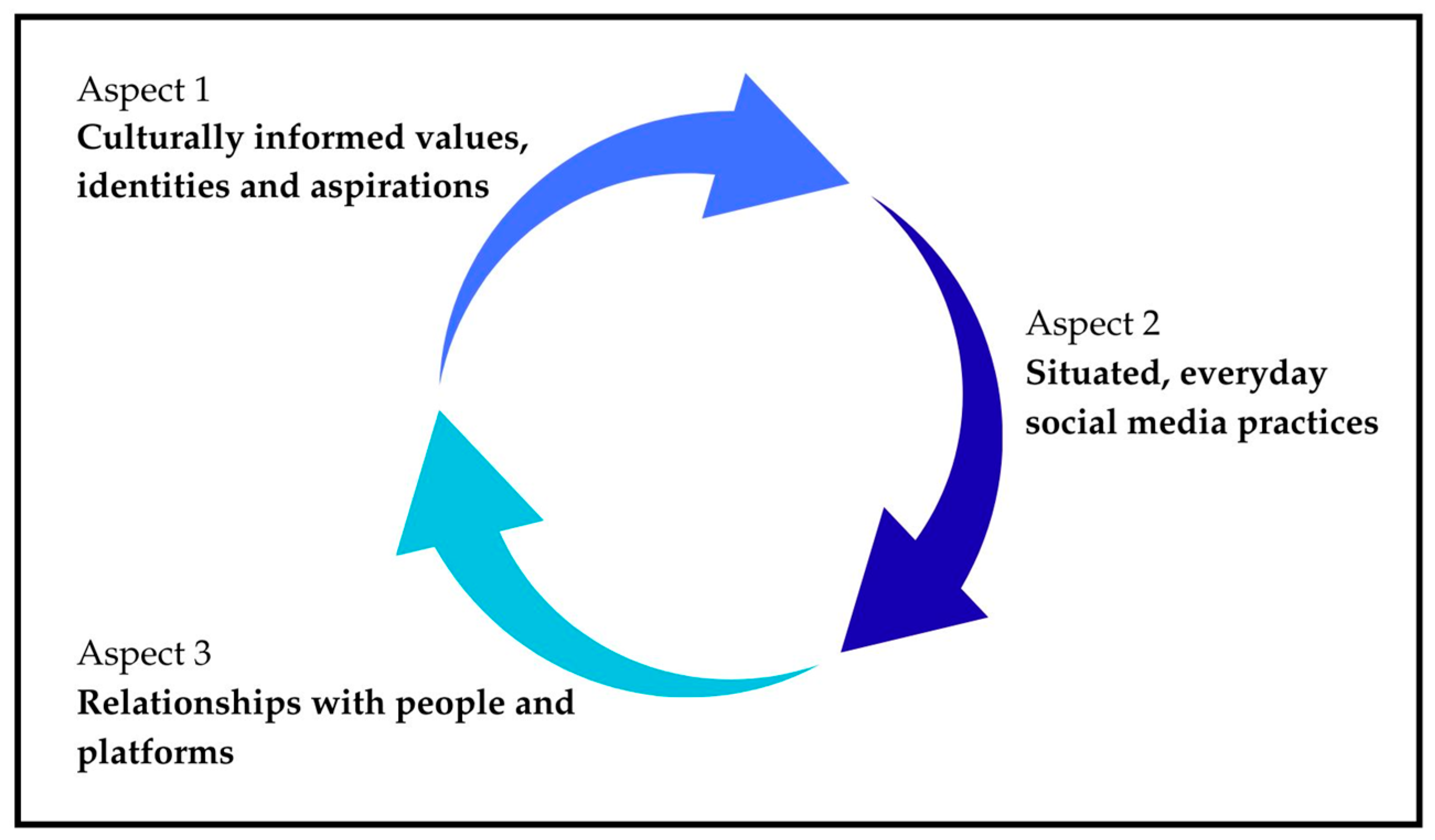
4.1. Defining Social Media Literacy Education for CALD Women
4.2. Desired Learning Objectives for Workshops
4.3. Principles for Co-Designing Social Media Literacy Education with Women
4.3.1. We Start by Exploring Women’s Existing Everyday Social Media Practices, Culturally Informed Literacies Shaped by Identities and Values, and Relationships with Both People and Platforms—Without Assuming Deficits or Denying Existing Knowledge
I use WhatsApp, Facebook—anything. It is cheap, and you can use it any time. I think if women stop using social media, they die… more than men, women are connected to families, and here they feel alone, they feel homesick.
When they call me refugee, it’s like I have no education in Iraq, no jobs, I don’t have anything. But in my country, I had certificate, I had a good job. I am also a woman—so it’s more problem… when someone tells me I am a refugee, I think I am weak and sick, like I am a homeless person. It makes me feel sad, sometimes. I know [it] makes other women sad too.
I post pictures of my community work, flyers of meetings. Also, [name of the organisation] interviews me, asks for permission, and they put my story and picture on their profile. They write about how we are successful as volunteers. Everybody comments on them, saying I do good work in the community… I am [a] volunteer and I’m a teacher for citizenship classes.
How about we plan for a workshop which can empower refugee women? We know that there are so many risks with social media, but why are we not highlighting the benefits for these women? So, the first thing, maybe get familiar with what they do, they are using different types of social media. These women are such good TikTok stars, you should see their creativity!
4.3.2. We Identify and Build on Women’s Existing Strengths, Skills, and Community Networks, Supporting Peer Leaders to Emerge and Lead Ongoing Peer-to-Peer Interventions
Anything you want to ask, you want support, you can ask here… which doctor to see, advice about marriages or husbands, which bank to use, or shampoo to use for hair. Women help you. We trust the group, because no one is coming in with a fake photo… If someone doing something wrong, they remove them. Women respect everyone.
This Facebook group is a big problem for us. My clients come to me and say, ‘we found this in [name of the Facebook group]’. I always repeat, ‘don’t believe whatever you hear on social media’… some people spread wrong information and scams.
If I have a question about social media, blocking bad content, blocking people, or anyone abusing me, I ask my son. Him and his friends help me. Sometimes they are not around, so I feel a bit lost, but sometimes I think it makes the bond strong.
In Australia, it is a new country. We can do more… We should know how to stand by ourselves… not ask community organisations… Sometimes, all of them don’t know what we went through.
Before organising any workshop, they should know how much [experience] we have with social media… So, first [recognise] that there are lot of levels, and then start to teach how women can use social media. Don’t [treat] all women like they don’t know anything.
4.3.3. We Embrace the Role of Facilitators (Rather than Experts) and Partner with and Share Resources/Responsibilities with Organisations That Share a Common Goal of Supporting the Agency of CALD Women
The programs are designed by the Community Learning team, and they are specialists in that field. So, they would be looking to the State Library of New South Wales, who has experts. We also check what other libraries are doing well, and that’s how we develop that specialty, librarians are media experts… no, they do not ask communities, but they keep their ears on the ground. So, the barriers would be the team that would be involved in it might not see there being any advantage in consulting communities, because they’re already the experts.
Probably Refugee Weeks witness our biggest collaborations—we have it every year with [the name of the refugee support organisation]… they have a storytelling activity. You sit in a circle, and you share your story on how you got to Australia… very helpful to understand experiences of refugees.
5. Discussion
6. Conclusions
Author Contributions
Funding
Institutional Review Board Statement
Informed Consent Statement
Data Availability Statement
Acknowledgments
Conflicts of Interest
References
- Ahmed, R., Veronis, L., & Alghazali, I. (2020). Syrian refugee youths’ use of social media as a space for communicating social support during resettlement. In L. K. Hamilton, L. Veronis, & M. Walton-Roberts (Eds.), A national project: Syrian refugee resettlement in Canada (pp. 151–172). McGill-Queen’s University Press. [Google Scholar] [CrossRef]
- Australian Media Literacy Alliance. (2022). Media literacy framework. Available online: https://medialiteracy.org.au/media-literacy-framework/ (accessed on 20 January 2026).
- Baganz, E., McMahon, T., Khorana, S., Magee, L., & Culos, I. (2024). ‘Life would have been harder, harder and more in chaos, if there wasn’t internet’: Digital inclusion among newly arrived refugees in Australia during the COVID-19 pandemic. Communication Research and Practice, 11, 24–43. [Google Scholar] [CrossRef]
- Balarin, M., & Milligan, L. O. (2024). Education as justice: Articulating the epistemic core of education to enable just futures. Global Social Challenges Journal, 3, 125–141. [Google Scholar] [CrossRef]
- Bartlett, A. I., Mena Montes, N., Verheijen, L., Leurs, K., & Broersma, M. (2026). Digital tactics of refugee women: Towards an inclusive framework for digital literacies. Social Inclusion, 14, 1–16. [Google Scholar] [CrossRef]
- Bayat, A. (2007). A women’s non-movement: What it means to be a woman activist in an Islamic state. Comparative Studies of South Asia, Africa, and the Middle East, 27(1), 160–172. [Google Scholar] [CrossRef]
- Berg, M. (2021). Women refugees’ media usage: Overcoming information precarity in Germany. Journal of Immigrant & Refugee Studies, 20(1), 125–139. [Google Scholar] [CrossRef]
- Braun, V., & Clarke, V. (2006). Using thematic analysis in psychology. Qualitative Research in Psychology, 3(2), 77–101. [Google Scholar] [CrossRef]
- Braun, V., & Clarke, V. (2019). Reflecting on reflexive thematic analysis. Qualitative Research in Sport, Exercise and Health, 11(4), 589–597. [Google Scholar] [CrossRef]
- Cho, H., Cannon, J., Lopez, R., & Li, W. (2022). Social media literacy: A conceptual framework. New Media & Society, 26(2), 941–960. [Google Scholar] [CrossRef] [PubMed]
- Costanza-Chock, S. (2020). Design justice: Community-led practices to build the worlds we need. The MIT Press. [Google Scholar] [CrossRef]
- Culos, I., McMahon, T., Khorana, S., Robertson, S., Baganz, E., Magee, L., & Agha, Y. (2022). Foundations for belonging 2022: Insights on newly arrived refugees: Family separation and reunion during the pandemic. Available online: https://www.ssi.org.au/images/FFB_Family_during_pandemic_final_screen.pdf (accessed on 2 January 2026).
- Culos, I., McMahon, T., Robertson, S., Baganz, E., & Magee, L. (2021). Foundations for belonging 2021 insights on newly arrived refugees: Women and digital inclusion. Settlement Services International; Institute for Culture and Society, Western Sydney University. Available online: https://www.ssi.org.au/wp-content/uploads/2023/09/FFB_Women_digital_inclusion_screen.pdf_FINAL.pdf.pdf (accessed on 2 January 2026).
- Dahya, N., Garrido, M., Yefimova, K., & Wedlake, S. (2020). Technology access & education for refugee women in Seattle & King county. Technology & Social Change Group, University of Washington Information School. Available online: https://digital.lib.washington.edu/server/api/core/bitstreams/8b13befd-4166-484d-9109-cc11d7ef0a4a/content (accessed on 5 January 2026).
- De Abreu, B. S., Mihailidis, P., Lee, A. Y. L., Melki, J., & McDougall, J. (Eds.). (2017). International handbook of media literacy education. Routledge. [Google Scholar] [CrossRef]
- Department of the Prime Minister and Cabinet. (2024). Charting the course for a diverse and sustainable news sector. Available online: https://ministers.pmc.gov.au/mccarthy/2024/charting-course-diverse-and-sustainable-news-sector (accessed on 23 March 2026).
- Dezuanni, M., Notley, T., & Di Martino, L. (2021). Towards a national strategy for media literacy: National consultation report. Australian Media Literacy Alliance. Available online: https://medialiteracy.org.au/wp-content/uploads/2022/03/AMLA-Consultation-Workshop-Report_UPDATE-25-10-2021.pdf (accessed on 5 January 2026).
- eSafety Commissioner. (2019). eSafety for women from culturally and linguistically diverse backgrounds. Available online: https://www.esafety.gov.au/sites/default/files/2019-07/summary-report-for-women-from-cald-backgrounds.pdf?v=1734422698002 (accessed on 5 January 2026).
- Haw, A., & Farquharson, K. (2024). COVID-19, migration, and racism in Australia: Key challenges and research directions. Journal of Intercultural Studies, 45(3), 381–391. [Google Scholar] [CrossRef]
- Johns, A., Harris, A., Booth, E., Caluya, G., & Walton, J. (2025). Beyond risk: Reducing the gap between diaspora youth digital citizenship needs and school curricula. Learning, Media and Technology, 1–15. [Google Scholar] [CrossRef]
- Kainat, K., Eskola, E.-L., & Widén, G. (2022). Sociocultural barriers to information and integration of women refugees. Journal of Documentation, 78(5), 1131–1148. [Google Scholar] [CrossRef]
- Kaplan, I. (2018, October 26). How smartphones and social media have revolutionised refugee migration. United Nations High Commissioner for Refugees. Available online: https://www.unhcr.org/blogs/smartphones-revolutionized-refugee-migration/ (accessed on 5 January 2026).
- Kaufmann, K. (2018). Navigating a new life: Syrian refugees and their smartphones in Vienna. Information, Communication & Society, 21(6), 882–898. [Google Scholar] [CrossRef]
- Khorana, S. (2022, November 8). Moving beyond the media’s ‘deficit lens’ is essential for racialised peoples to claim belonging. Here’s how they’re doing it. The Conversation. Available online: https://theconversation.com/moving-beyond-the-medias-deficit-lens-is-essential-for-racialised-peoples-to-claim-belonging-heres-how-theyre-doing-it-192739 (accessed on 5 January 2026).
- Khorana, S., & Thapliyal, N. (2024). Disinformation and calculated care beyond the Global North: Comparing refugee discourses in Australia and India. Frontiers in Sociology, 9, 1358556. [Google Scholar] [CrossRef] [PubMed]
- Kimmons, R. (2014). Social networking sites, literacy, and the authentic identity problem. TechTrends, 58, 93–98. [Google Scholar] [CrossRef]
- Leurs, K., Bozdağ, Ç., Neag, A., & Sprenger, S. (2023). Participatory action research and media literacy: Toward engaged, accountable, and collaborative knowledge production with marginalized communities. In P. Fastrez, & N. Landry (Eds.), Media literacy and media education research methods (pp. 62–79). Routledge. [Google Scholar] [CrossRef]
- Leurs, K., Omerović, E., Bruinenberg, H., & Sprenger, S. (2018). Critical media literacy through making media: A key to participation for young migrants? Communications, 43(3), 427–450. [Google Scholar] [CrossRef]
- Liamputtong, P., & Kurban, H. (2018). Health, social integration and social support: The lived experiences of young middle-eastern refugees living in Melbourne, Australia. Children and Youth Services Review, 85, 99–106. [Google Scholar] [CrossRef]
- Livingstone, S. (2014). Developing social media literacy: How children learn to interpret risky opportunities on social network sites. Communications, 39(3), 283–303. [Google Scholar] [CrossRef]
- Livingstone, S. (2015). From mass to social media? Advancing accounts of social change. Social Media + Society, 1(1), 1–3. [Google Scholar] [CrossRef]
- Ludwig, B. (2016). “Wiping the refugee dust from my feet”: Advantages and burdens of refugee status and the refugee label. International Migration, 54(1), 5–18. [Google Scholar] [CrossRef]
- Manca, S., Bocconi, S., & Gleason, B. (2021). “Think globally, act locally”: A glocal approach to the development of social media literacy. Computers and Education, 160, 104025. [Google Scholar] [CrossRef]
- McMahon, T., & Robertson, S. (2021, September 9). Technology is key for refugees starting new lives in Australia. But women and children don’t have equal access. The Conversation. Available online: https://theconversation.com/technology-is-key-for-refugees-starting-new-lives-in-australia-but-women-and-children-dont-have-equal-access-167272 (accessed on 5 January 2026).
- Merriam, S. B., & Tisdell, E. J. (2015). Qualitative research: A guide to design and implementation. John Wiley & Sons, Incorporated. [Google Scholar]
- Mihailidis, P. (2018). Civic media literacies: Re-imagining human connection in an age of digital abundance (1st ed.). Routledge. [Google Scholar]
- Mihailidis, P., Johnson, P. R., Foster, B., Burth, S., Ramasubramanian, S., & Tully, M. (2025). Equitable media literacies: Pedagogies and practices for healthy civic futures. Routledge. [Google Scholar] [CrossRef]
- Mihailidis, P., Ramasubramanian, S., Tully, M., Foster, B., Riewestahl, E., Johnson, P., & Angove, S. (2021). Do media literacies approach equity and justice? The Journal of Media Literacy Education, 13(2), 1–14. [Google Scholar] [CrossRef]
- Neag, A. (2019). Experts in their own lives—Involving young refugees in research. Bournemouth University Blog. Available online: https://www.bournemouth.ac.uk/news/2019-05-28/experts-their-own-lives-involving-young-refugees-research (accessed on 5 January 2026).
- Neag, A., Bozdağ, Ҫ., & Leurs, K. (2022). Media literacy education for diverse societies. In Oxford research encyclopedia of communication. Oxford University Press. [Google Scholar] [CrossRef]
- Nikunen, K. (2019). Once a refugee: Selfie activism, visualized citizenship and the space of appearance. Popular Communication, 17(2), 154–170. [Google Scholar] [CrossRef]
- Notley, T., Chambers, S., Park, S., & Dezuanni, M. (2021). Adult media literacy in Australia: Attitudes, experiences and needs. Western Sydney University; Queensland University of Technology; University of Canberra. Available online: https://medialiteracy.org.au/wp-content/uploads/2022/03/FINAL_Australian_adult_media_literacy_report_20212.pdf (accessed on 5 January 2026).
- Notley, T., Chambers, S., Park, S., & Dezuanni, M. (2024). Adult media literacy in 2024: Australian attitudes, experiences and needs. Western Sydney University; Queensland University of Technology; University of Canberra. Available online: https://medialiteracy.org.au/wp-content/uploads/2024/08/AML2024_report_final-compressed.pdf (accessed on 5 January 2026).
- Parajuli, J., Horey, D., & Avgoulas, M. I. (2019). Resettlement challenges and dilemmas: An in-depth case study of Bhutanese refugee women in Australia. The Australian Journal of Anthropology, 30(3), 309–323. [Google Scholar] [CrossRef]
- Park, S., Lee, J. Y., Notley, T., & Dezuanni, M. (2023). Exploring the relationship between media literacy, online interaction, and civic engagement. The Information Society, 39(4), 250–261. [Google Scholar] [CrossRef]
- Park, S., Notley, T., Thomson, T. J., Hourigan, A., & Dezuanni, M. (2024). Online misinformation in Australia: Adults’ experiences, abilities, and responses. University of Canberra; Western Sydney University. [Google Scholar] [CrossRef]
- Patterson, A. N., Howard, A., & Kinloch, V. (2016). Black feminism and critical media literacy: Moving from the margin to the center. Meridians, 15(1), 40–64. [Google Scholar] [CrossRef]
- Pittaway, E., & Pittaway, E. (2004). ‘Refugee Woman’: A dangerous label: Opening a discussion on the role of identity and intersectional oppression in the failure of the international refugee protection regime for refugee women. Australian Journal of Human Rights, 10(1), 119–135. [Google Scholar] [CrossRef]
- Polanco-Levicán, K., & Salvo-Garrido, S. (2022). Understanding social media literacy: A systematic review of the concept and its competences. International Journal of Environmental Research and Public Health, 19(14), 8807. [Google Scholar] [CrossRef]
- Ramasubramanian, S. (2023). Introduction to inclusive practice. In Y. Friesem, U. Raman, I. Kanižaj, & G. Y. Choi (Eds.), The Routledge handbook of media education futures post-pandemic (1st ed., pp. 15–18). Routledge. [Google Scholar] [CrossRef]
- Refugee Council of Australia. (2019). Refugee welcome zones: An initiative of the refugee council of Australia. Available online: https://www.refugeecouncil.org.au/wp-content/uploads/2019/01/RWZ-infosheet-for-councils.pdf (accessed on 5 January 2026).
- Robertson, S., & Aquino, K. (2017, July 14). Blaming migrants won’t solve Western Sydney’s growing pains. The Conversation. Available online: https://theconversation.com/blaming-migrants-wont-solve-western-sydneys-growing-pains-77403 (accessed on 5 January 2026).
- Sriprakash, A. (2023). Reparations: Theorising just futures of education. Discourse: Studies in the Cultural Politics of Education, 44(5), 782–795. [Google Scholar] [CrossRef]
- Sun, Y., & Suthers, D. D. (2023). From affordances to cultural affordances: An analytic framework for tracing the dynamic interaction among technology, people and culture. Cultures of Science, 6(2), 235–249. [Google Scholar] [CrossRef]
- Swist, T., Mallawa Arachchi, T., Condie, J., & Hanckel, B. (2023). Socio-technically just pedagogies: A framework for curriculum-making in higher education. Learning, Media and Technology, 49(3), 492–505. [Google Scholar] [CrossRef]
- Thomas, J., Barraket, J., Parkinson, S., Wilson, C., Holcombe-James, I., Kennedy, J., Mannell, K., & Brydon, A. (2021). Australian digital inclusion index: 2021. RMIT; Swinburne University of Technology; Telstra. [Google Scholar] [CrossRef]
- Tour, E., Creely, E., & Waterhouse, P. (2021). “It’s a black hole…”: Exploring teachers’ narratives and practices for digital literacies in the adult EAL context. Adult Education Quarterly (American Association for Adult and Continuing Education), 71(3), 290–307. [Google Scholar] [CrossRef]
- Tour, E., Creely, E., & Waterhouse, P. (2022). Enhancing digital literacies with adult English language learners: Theoretical and practical insights. Routledge. [Google Scholar]
- Tour, E., Creely, E., Waterhouse, P., Pham, X., Henderson, M., & Wallace, M. (2023). Navigating challenging digital literacy practices: The settlement experiences of adults from migrant and refugee backgrounds. Adult Education Quarterly, 73(4), 422–441. [Google Scholar] [CrossRef]
- Treem, J. W., & Leonardi, P. M. (2013). Social media use in organizations: Exploring the affordances of visibility, editability, persistence, and association. Communication Yearbook, 36(1), 143–189. [Google Scholar] [CrossRef]
- Udwan, G., Leurs, K., & Alencar, A. (2020). Digital resilience tactics of Syrian refugees in The Netherlands: Social media for social support, health, and identity. Social Media + Society, 6(2), 205630512091558. [Google Scholar] [CrossRef]
- United Nations High Commissioner for Refugees. (2021). Using social media in community-based protection. Available online: https://www.unhcr.org/innovation/wp-content/uploads/2021/01/Using-Social-Media-in-CBP.pdf (accessed on 5 January 2026).
- Vigil, Y. N., & Baillie Abidi, C. (2018). “We” the refugees: Reflections on refugee labels and identities. Refuge (Toronto. English Edition), 34(2), 52–60. [Google Scholar] [CrossRef]
- Wehrle, K., Klehe, U.-C., Kira, M., & Zikic, J. (2018). Can I come as I am? Refugees’ vocational identity threats, coping, and growth. Journal of Vocational Behavior, 105, 83–101. [Google Scholar] [CrossRef]
- Whiteside, N., Cooper, V., Vo-Tran, H., Tait, E., & Bachmann, B. (2022). Digital literacy programs in support of diverse communities—An Australian public library approach. Journal of the Australian Library and Information Association, 71(4), 388–407. [Google Scholar] [CrossRef]
- Windle, J. (2025). Struggles for justice in education through the lens of educational citizenship. Australian Educational Researcher, 52(4), 2941–2956. [Google Scholar] [CrossRef]
- Witteborn, S. (2018). The digital force in forced migration: Imagined affordances and gendered practices. Popular Communication, 16(1), 21–31. [Google Scholar] [CrossRef]


| Foundational Dimension | Objectives | |
|---|---|---|
| Reflect | Situated practices | Identify the social media platforms participants use (e.g., WhatsApp, Facebook, Instagram) and reflect on and articulate what they want to achieve using the platforms (such as family connection, information access, or community engagement). |
| Culturally informed practices/literacies | Reflect on how cultural values, migration experiences, gender roles, and safety concerns shape participants’ goals on social media, including what kinds of visibility, connection or influence they seek or avoid. | |
| Understand | Relational Practices | Consider how social media affords both risks (e.g., harassment, surveillance, scams, misinformation) and opportunities (e.g., connection, learning, activism, support), shaped by the design of platforms. |
| Develop an understanding of how platform affordances (e.g., privacy controls, reporting tools, group moderation) can be used to support women’s goals while managing risks, rather than limiting participation. | ||
| Act | Situated, culturally informed and relational practices | Support women to design and work on their own social media–related projects to address individual and community aspirations. This includes using social media affordances—such as visibility settings and algorithmic feeds—to strategically support these goals and strengthen meaningful participation. |
Disclaimer/Publisher’s Note: The statements, opinions and data contained in all publications are solely those of the individual author(s) and contributor(s) and not of MDPI and/or the editor(s). MDPI and/or the editor(s) disclaim responsibility for any injury to people or property resulting from any ideas, methods, instructions or products referred to in the content. |
© 2026 by the authors. Licensee MDPI, Basel, Switzerland. This article is an open access article distributed under the terms and conditions of the Creative Commons Attribution (CC BY) license.
Share and Cite
Mallawa Arachchi, T.; Notley, T.; Naidoo, L.; Condie, J. A Framework for Co-Designing Social Media Literacy Education with Women from Migrant and Refugee Backgrounds: An Education Justice Approach. Educ. Sci. 2026, 16, 518. https://doi.org/10.3390/educsci16040518
Mallawa Arachchi T, Notley T, Naidoo L, Condie J. A Framework for Co-Designing Social Media Literacy Education with Women from Migrant and Refugee Backgrounds: An Education Justice Approach. Education Sciences. 2026; 16(4):518. https://doi.org/10.3390/educsci16040518
Chicago/Turabian StyleMallawa Arachchi, Thilakshi, Tanya Notley, Loshini Naidoo, and Jenna Condie. 2026. "A Framework for Co-Designing Social Media Literacy Education with Women from Migrant and Refugee Backgrounds: An Education Justice Approach" Education Sciences 16, no. 4: 518. https://doi.org/10.3390/educsci16040518
APA StyleMallawa Arachchi, T., Notley, T., Naidoo, L., & Condie, J. (2026). A Framework for Co-Designing Social Media Literacy Education with Women from Migrant and Refugee Backgrounds: An Education Justice Approach. Education Sciences, 16(4), 518. https://doi.org/10.3390/educsci16040518