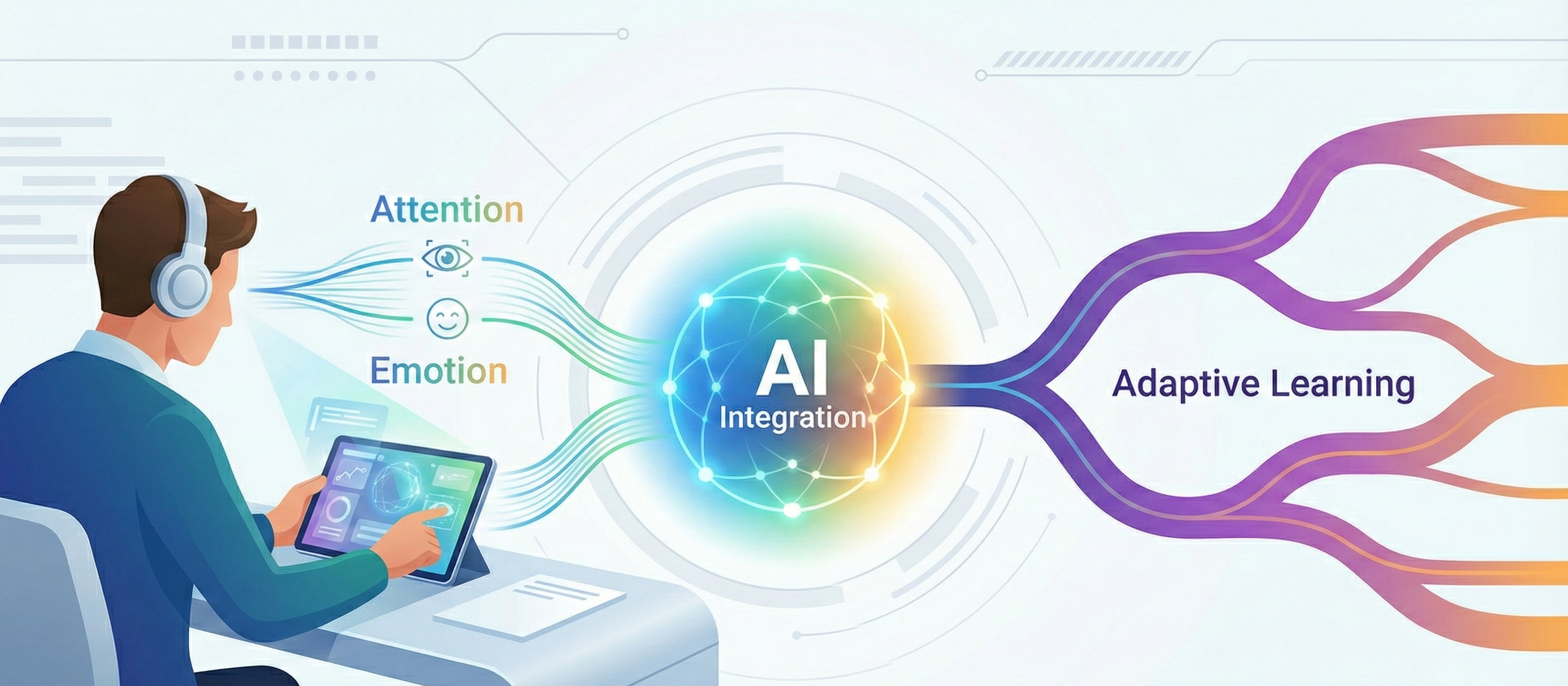
The Convergence of Artificial Intelligence in Measuring Attention and Emotion in Digital Technology-Enhanced Tertiary Education: A Scoping Review




Abstract
1. Introduction
2. Materials and Methods
2.1. Eligibility Criteria
2.2. Information Sources and Search Strategy
2.2.1. Scopus
2.2.2. Web of Science (WOS)
2.3. Study Selection and Data Extraction
2.4. Methodological Quality Appraisal
2.5. Data Analysis and Synthesis
2.6. Study Selection
3. Results
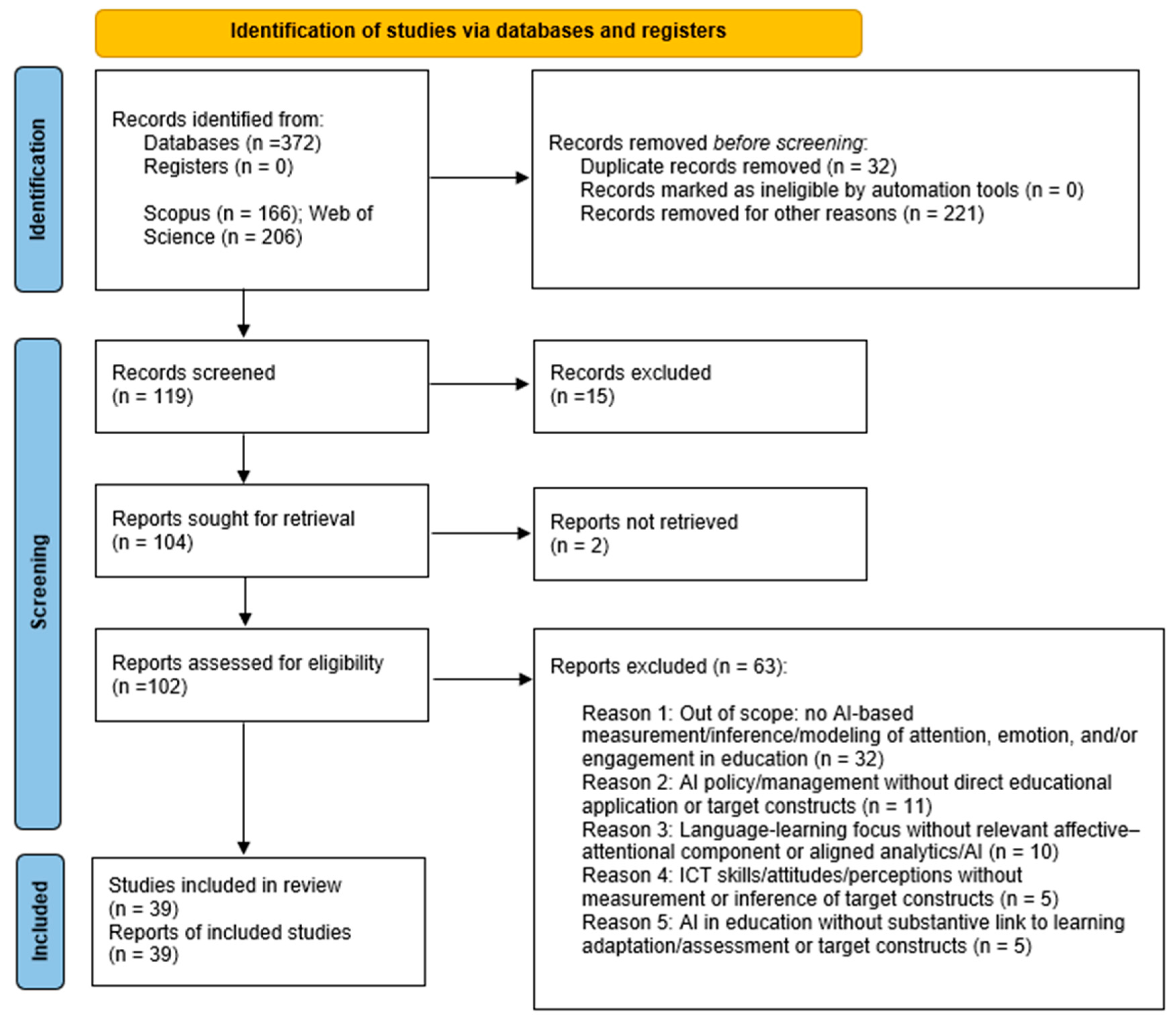
3.1. PRISMA-ScR Flow Diagram (Study Selection)
3.2. Characteristics of Included Studies
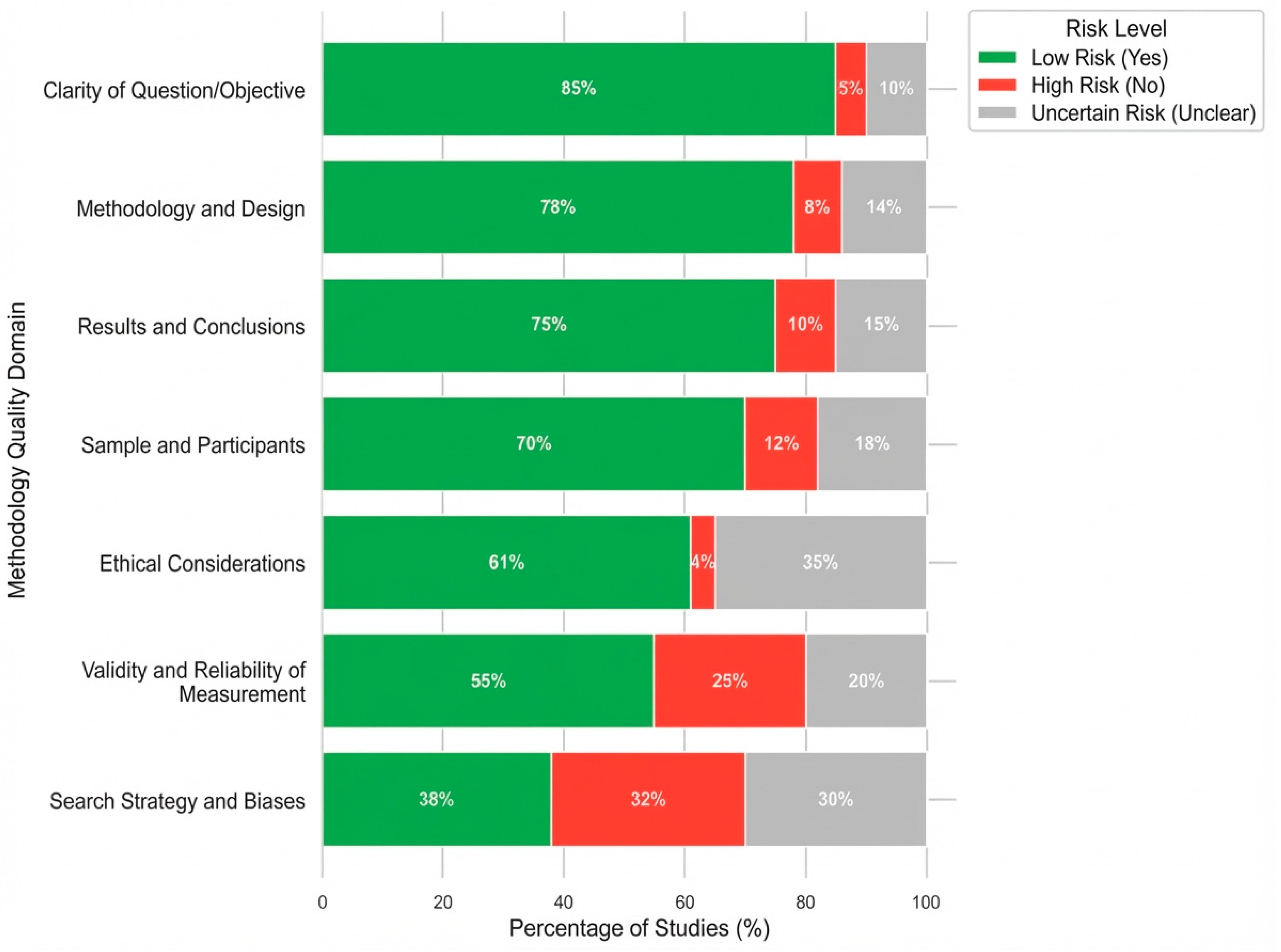
3.3. Risk of Bias and Quality Assessment Results
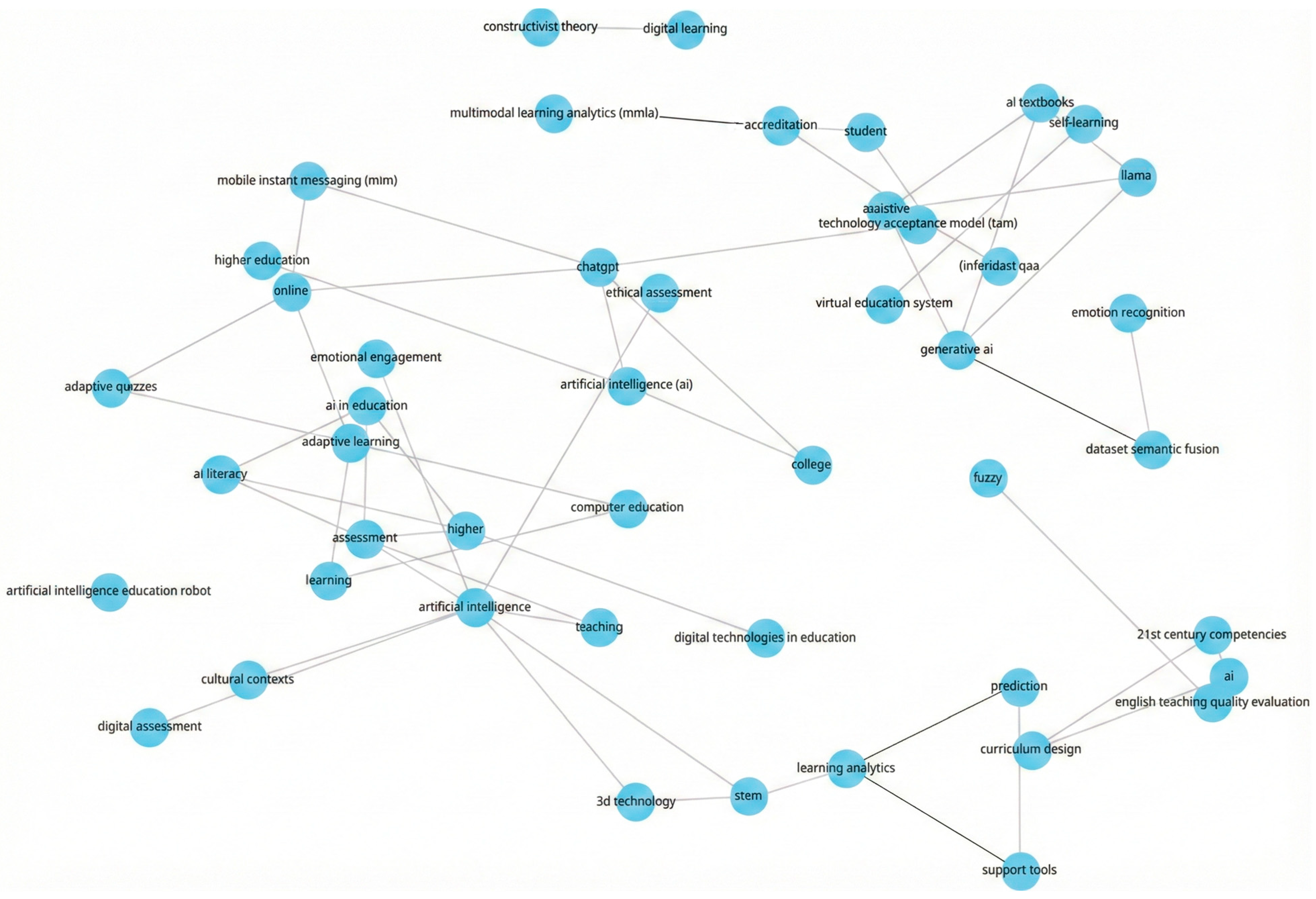
3.4. Bibliometric Analysis
3.5. Narrative Synthesis
4. Discussion and Conclusions
4.1. Interpretive Summary of Key Findings
4.2. Comparison with Existing Literature
4.3. Strengths of the Review
4.4. Limitations of the Review and the Evidence
4.5. Implications and Future Directions
4.6. Confirmation of the Conceptual and Terminological Gap
4.7. Conclusions
4.8. Responses to the Research Questions
Supplementary Materials
Author Contributions
Funding
Institutional Review Board Statement
Informed Consent Statement
Data Availability Statement
Conflicts of Interest
References
- Abbasi, B. N., Wu, Y., & Luo, Z. (2025). Exploring the impact of artificial intelligence on curriculum development in global higher education institutions. Education and Information Technologies, 30(1), 547–581. [Google Scholar] [CrossRef]
- Abou Gamie, E., Abou El-Seoud, M. S., & Salama, M. A. (2020). Comparative analysis for boosting classifiers in the context of higher education. International Journal of Emerging Technologies in Learning (iJET), 15(10), 16–26. [Google Scholar] [CrossRef]
- Al Daraai, S. B., Al Zakwani, M., Al Maqrashi, M., & Al Shaikh, Z. (2024). Integrating AI in higher education: Applications, strategies, ethical considerations. In N. H. Al Harrasi, & M. S. El Din (Eds.), Utilizing AI for assessment, grading, and feedback in higher education (pp. 189–211). IGI Global. [Google Scholar] [CrossRef]
- Al-Dokhny, A., Alismaiel, O., Youssif, S., Nasr, N., Drwish, A., & Samir, A. (2024). Can multimodal large language models enhance performance benefits among higher education students? An investigation based on the task–technology fit theory and the artificial intelligence device use acceptance model. Sustainability, 16(23), 10780. [Google Scholar] [CrossRef]
- Al Husaini, Y. N., Al Kishri, W., Al Husaini, M. A., Al Bahri, M., & Abrar, M. (2025). Predicting student academic success using deep learning: A multi-factor approach to performance prediction. Journal of Logistics, Informatics and Service Science, 12(1), 263–283. [Google Scholar] [CrossRef]
- Almusaed, A., Almssad, A., Yitmen, I., & Homod, R. Z. (2023). Enhancing student engagement: Harnessing “AIED”’s power in hybrid education—A review analysis. Education Sciences, 13(7), 632. [Google Scholar] [CrossRef]
- Amashi, R., Koppikar, U., & Vijayalakshmi, M. (2023). Investigating the association between student engagement with video content and their learning. IEEE Transactions on Education, 66(5), 479–486. [Google Scholar] [CrossRef]
- Barbosa, P. L. S., do Carmo, R. A. F., Gomes, J. P. P., & Viana, W. (2024). Adaptive learning in computer science education: A scoping review. Education and Information Technologies, 29, 9139–9188. [Google Scholar] [CrossRef]
- Camacho, V. L., de la Guía, E. D. L., Olivares, T., Flores, M. J., & Orozco-Barbosa, L. (2020). Data capture and multimodal learning analytics focused on engagement with a new wearable IoT approach. IEEE Transactions on Learning Technologies, 13(4), 704–717. [Google Scholar] [CrossRef]
- Cárdenas-López, H. M., Zatarain-Cabada, R., Barrón-Estrada, M. L., & Mitre-Hernández, H. (2023). Semantic fusion of facial expressions and textual opinions from different datasets for learning-centered emotion recognition. Soft Computing, 27(22), 17357–17367. [Google Scholar] [CrossRef]
- Chun, J., Kim, J., Kim, H., Lee, G., Cho, S., Kim, C., Chung, Y., & Heo, S. (2025). A comparative analysis of on-device AI-driven, self-regulated learning and traditional pedagogy in university health sciences education. Applied Sciences, 15(4), 1815. [Google Scholar] [CrossRef]
- Deri, M. N., Singh, A., Zaazie, P., & Anandene, D. (2024). Leveraging artificial intelligence in higher educational institutions: A comprehensive overview. Revista de Educación y Derecho (Education and Law Review). [Google Scholar] [CrossRef]
- Fang, K., Li, L., & Wu, Y. (2023). Research on student engagement in distance learning in sustainability science to design an online intelligent assessment system. Frontiers in Psychology, 14, 1282386. [Google Scholar] [CrossRef]
- Goldberg, E. (2001). The executive brain: Frontal lobes and the civilized mind. Oxford University Press. [Google Scholar]
- Huang, Y.-M., Chen, P.-H., Lee, H.-Y., Sandnes, F. E., & Wu, T.-T. (2025). ChatGPT-enhanced mobile instant messaging in online learning: Effects on student outcomes and perceptions. Computers in Human Behavior, 168, 108659. [Google Scholar] [CrossRef]
- Ismayilzada, A., Karimov, A., & Saarela, M. (2025). Serious games analytics in VR environments: A two-stage systematic literature review. Journal of Interactive Learning Research, 36(1), 57–69. [Google Scholar] [CrossRef]
- Joanna Briggs Institute. (2020). JBI manual for evidence synthesis. JBI. [Google Scholar]
- Kharchenko, A., Nalyvaiko, O., Kreydun, N., Sheiko, A., Ptushka, A., Khatuntseva, S., & Zotova, L. (2024). Digital technologies as a factor of transformation of learning in the university education. Revista Românească pentru Educaţie Multidimensională, 16(4), 97–126. [Google Scholar] [CrossRef]
- Khlaif, Z. N., Ayyoub, A., Hamamra, B., Bensalem, E., Mitwally, M. A. A., Ayyoub, A., Hattab, M. K., & Shadid, F. (2024). University teachers’ views on the adoption and integration of generative AI tools for student assessment in higher education. Education Sciences, 14(10), 1090. [Google Scholar] [CrossRef]
- Li, S., Wang, T., Zheng, J., & Lajoie, S. P. (2025). A complex dynamical system approach to student engagement. Learning and Instruction, 97, 102120. [Google Scholar] [CrossRef]
- Liu, Z., Zhang, X., Liu, W., Chen, W., Li, Y., & Zhou, Y. (2025). Application and optimization of digital situated teaching in university finance courses from a constructivist perspective: An analysis based on machine learning algorithms. Education and Information Technologies, 30, 13496. [Google Scholar] [CrossRef]
- Ma, S., Liu, S., Ma, L., Liu, C., Lu, J., & Wang, J. (2023). Philosophy of self-learning education implemented in a virtual education system. Learning and Motivation, 84, 101916. [Google Scholar] [CrossRef]
- Martucci, A., Graziani, D., Bei, E., Bischetti, L., Bambini, V., Gursesli, M. C., Guazzini, A., & Pecini, C. (2025). Emotional engagement in a humor-understanding reading task: An AI study perspective. Current Psychology, 44(9), 7818–7831. [Google Scholar] [CrossRef]
- Moreira-Choez, J. S., Lamus de Rodríguez, T. M., Núñez-Naranjo, A. F., Sabando-García, Á. R., Reinoso-Ávalos, M. B., Olguín-Martínez, C. M., Nieves-Lizárraga, D. O., & Salazar-Echeagaray, J. E. (2025). Validation of a teaching model instrument for university education in Ecuador through an artificial intelligence algorithm. Frontiers in Education, 10, 1473524. [Google Scholar] [CrossRef]
- Nayak, R., Yassin, H., Ramesh, G., & Godishala, A. (2024). Inclusive learning and assessment in the era of AI. SN Computer Science, 5(8), 975. [Google Scholar] [CrossRef]
- Oc, Y., Gonsalves, C., & Quamina, L. T. (2024). Generative AI in higher education assessments: Examining risk and tech-savviness on student’s adoption. Journal of Marketing Education. Advanced online publication. [Google Scholar] [CrossRef]
- Page, M. J., McKenzie, J. E., Bossuyt, P. M., Boutron, I., Hoffmann, T. C., Mulrow, C. D., Shamseer, L., Tetzlaff, J. M., Akl, E. A., Brennan, S. E., Chou, R., Glanville, J., Grimshaw, J. M., Hróbjartsson, A., Lalu, M. M., Li, T., Loder, E. W., Mayo-Wilson, E., McDonald, S., … Moher, D. (2021). The PRISMA 2020 statement: An updated guideline for reporting systematic reviews. BMJ, 372, n71. [Google Scholar] [CrossRef]
- Pang, T. Y., Kootsookos, A., & Cheng, C.-T. (2024). Artificial intelligence use in feedback: A qualitative analysis. Journal of University Teaching and Learning Practice, 21(6), 108–125. [Google Scholar] [CrossRef]
- Papamitsiou, Z., Pappas, I. O., Sharma, K., & Giannakos, M. N. (2020). Utilizing multimodal data through fsQCA to explain engagement in adaptive learning. IEEE Transactions on Learning Technologies, 13(4), 689–703. [Google Scholar] [CrossRef]
- Pekrun, R., Goetz, T., Frenzel, A. C., Barchfeld, P., & Perry, R. P. (2011). Measuring emotions in students’ learning and performance: The Achievement Emotions Questionnaire (AEQ). Contemporary Educational Psychology, 36(1), 36–48. [Google Scholar] [CrossRef]
- Plumley, R. D., Bernacki, M. L., Greene, J. A., Kuhlmann, S. L., Raković, M., Urban, C. J., Hogan, K. A., Lee, C., Panter, A. T., & Gates, K. M. (2024). Co-designing enduring learning analytics prediction and support tools in undergraduate biology courses. British Journal of Educational Technology, 55(5), 1860–1883. [Google Scholar] [CrossRef]
- Posner, M. I., & Petersen, S. E. (1990). The attention system of the human brain. Annual Review of Neuroscience, 13, 25–42. [Google Scholar] [CrossRef] [PubMed]
- Prinsloo, P., Slade, S., & Khalil, M. (2023). Multimodal learning analytics—In-between student privacy and encroachment: A systematic review. British Journal of Educational Technology, 54(6), 1566–1586. [Google Scholar] [CrossRef]
- Quigley, D., McNamara, C., Ostwald, J., & Sumner, T. (2017). Using learning analytics to understand scientific modeling in the classroom. Frontiers in ICT, 4, 24. [Google Scholar] [CrossRef]
- Ren, X., & Wu, M. L. (2025). Examining teaching competencies and challenges while integrating artificial intelligence in higher education. TechTrends, 69(3), 519–538. [Google Scholar] [CrossRef]
- Roig-Vila, R., Prendes Espinosa, P., & Cazorla, M. (2025). Implementation of artificial intelligence technologies for the assessment of students’ attentional state: A scoping review. Applied Sciences, 15(11), 5990. [Google Scholar] [CrossRef]
- Ross, B., Chase, A.-M., Robbie, D., Oates, G., & Absalom, Y. (2018). Adaptive quizzes to increase motivation, engagement and learning outcomes in a first year accounting unit. International Journal of Educational Technology in Higher Education, 15(1), 30. [Google Scholar] [CrossRef]
- Rybinski, K. (2022). Assessing how QAA accreditation reflects student experience. Higher Education Research & Development, 41(3), 898–918. [Google Scholar] [CrossRef]
- Song, X., Zhang, J., Yan, P., Hahn, J., Kruger, U., Mohamed, H., & Wang, G. (2024). Integrating AI in college education: Positive yet mixed experiences with ChatGPT. Meta-Radiology, 2, 100113. [Google Scholar] [CrossRef]
- Southworth, J., Migliaccio, K., Glover, J., Glover, J. N., Reed, D., McCarty, C., Brendemuhl, J., & Thomas, A. (2023). Developing a model for AI across the curriculum: Transforming the higher education landscape via innovation in AI literacy. Computers and Education: Artificial Intelligence, 4, 100127. [Google Scholar] [CrossRef]
- Tricco, A. C., Lillie, E., Zarin, W., O’Brien, K. K., Colquhoun, H., Levac, D., Moher, D., Peters, M. D. J., Horsley, T., Weeks, L., Hempel, S., Akl, E. A., Chang, C., McGowan, J., Stewart, L., Hartling, L., Aldcroft, A., Wilson, M. G., Garritty, C., & Straus, S. E. (2018). PRISMA extension for scoping reviews (PRISMA-ScR): Checklist and explanation. Annals of Internal Medicine, 169(7), 467–473. [Google Scholar] [CrossRef]
- Truong, V. L., & Pham, L. P. C. (2025). Determinants of adopting 3D technology integrated with artificial intelligence in STEM higher education: A UTAUT2 model approach. Computer Applications in Engineering Education, 33(1), e70019. [Google Scholar] [CrossRef]
- Ulla, M. B., Advincula, M. J. C., Mombay, C. D. S., Mercullo, H. M. A., Nacionales, J. P., & Entino-Señorita, A. D. (2024). How can GenAI foster an inclusive language classroom? A critical language pedagogy perspective from Philippine university teachers. Computers and Education: Artificial Intelligence, 7, 100314. [Google Scholar] [CrossRef]
- van Eck, N. J., & Waltman, L. (2010). Software survey: VOSviewer, a computer program for bibliometric mapping. Scientometrics, 84(2), 523–538. [Google Scholar] [CrossRef]
- Veerasamy, A. K., Laakso, M. J., & D’Souza, D. (2022). Formative assessment tasks as indicators of student engagement for predicting at-risk students in programming courses. Informatics in Education, 21(2), 375–393. [Google Scholar] [CrossRef]
- Wu, H., & Luo, X. (2024). Evaluating English teaching quality in colleges using fuzzy logic and online game-based learning. Computer-Aided Design and Applications, 21(S5), 237–251. [Google Scholar] [CrossRef]
- Yang, Q.-F., Lian, L.-W., & Zhao, J.-H. (2023). Developing a gamified artificial intelligence educational robot to promote learning effectiveness and behavior in laboratory safety courses for undergraduate students. International Journal of Educational Technology in Higher Education, 20, 18. [Google Scholar] [CrossRef]
- Yuan, T., Wang, Z., & Rau, P. L. P. (2023). Design of intelligent real-time feedback system in online classroom. In P. L. P. Rau (Ed.), Cross-cultural design. HCI 2023. Lecture notes in computer science (Vol. 14024, pp. 326–335). Springer. [Google Scholar] [CrossRef]
- Zaibout, N., Madrane, M., & Khamlichi, L. (2024). Towards advanced digital assessments: Artificial intelligence, gamification, and learning analytics. International Journal on Technical and Physical Problems of Engineering, 16(4), 93–105. [Google Scholar]



| ID | Year | Study Title | Authors | Source | Study Design | Population/Unit of Analysis | AI/Technology | Key Outcomes/ Measures |
|---|---|---|---|---|---|---|---|---|
| 1 | 2025 | Serious Games Analytics in VR Environments: A Two-Stage Systematic Literature Review | (Ismayilzada et al., 2025) | Journal of Interactive Learning Research | Systematic literature review (two-stage SLR). | Not applicable (synthesis; no empirical sample). Unit: 10 included studies (LAK + JLA) on VR serious games analytics. | Synthesis of AI/learning analytics methods used across included studies (e.g., ML, time series, social network analysis). | Reported constructs across included studies include cognitive engagement and visual attention (e.g., EEG and eye tracking). |
| 2 | 2023 | Semantic fusion of facial expressions and textual opinions from different datasets for learning-centered emotion recognition | (Cárdenas-López et al., 2023) | Soft Computing | Technical/computational study (multimodal model benchmarking). | Public datasets (facial images + text); no participant sample (not reported, NR). | Deep learning multimodal fusion (facial expression + text sentiment/opinion) for emotion recognition in learning-centred contexts. | Model performance metrics (e.g., accuracy/F1); emotion recognition (attention not directly measured). |
| 3 | 2025 | Exploring the impact of artificial intelligence on curriculum development in global higher education institutions | (Abbasi et al., 2025) | Education and Information Technologies | Cross-sectional survey study. | Higher education stakeholders (faculty and students), n ≈ 2000. | No experimental intervention; assesses AI use/impact perceptions in curriculum development. | Perceptions and use patterns; perceived benefits/challenges (includes engagement/innovation-related perceptions; no direct attention/emotion measures). |
| 4 | 2020 | Comparative Analysis for Boosting Classifiers in the Context of Higher Education | (Abou Gamie et al., 2020) | International Journal of Emerging Technologies in Learning (iJET) | Technical/computational comparison of algorithms. | Higher education academic datasets (Not reported, NR). | Boosting classifiers for predicting academic success. | Algorithm performance (accuracy, efficiency, validation); no direct attention/emotion measurement. |
| 5 | 2024 | Leveraging Artificial Intelligence in Higher Educational Institutions: A Comprehensive Overview | (Deri et al., 2024) | Revista de Educación y Derecho (Education and Law Review) | Narrative review/overview. | Not applicable (synthesis; no empirical sample). | Descriptive synthesis of AI applications in higher education (personalization, assessment/feedback, analytics, administration) and related ethical issues. | Conceptual discussion of benefits/risks (engagement, effectiveness, ethics/privacy); no primary quantitative measures. |
| 6 | 2023 | Research on student engagement in distance learning in sustainability science to design an online intelligent assessment system | (Fang et al., 2023) | Frontiers in Psychology | Qualitative study with system-design component. | n = 42 students and n = 2 educators (semi-structured interviews). | Design of an online intelligent assessment approach; uses ML to detect low engagement and support teacher feedback. | Operationalization of engagement; identification of low-engagement patterns; recommendations/support logic (no direct attention/emotion instrumentation). |
| 7 | 2022 | Formative Assessment Tasks as Indicators of Student Engagement for Predicting At-risk Students in Programming Courses | (Veerasamy et al., 2022) | Informatics in Education | Educational data mining/predictive modelling study. | Higher education programming course data (not reported, NR). | Analytics/ML to predict at-risk students using engagement indicators derived from formative tasks. | Engagement indicators + academic risk/prediction outcomes; no direct emotion/attention measures. |
| 8 | 2023 | Philosophy of self-learning education implemented in a virtual education system | (Ma et al., 2023) | Learning and Motivation | Applied implementation study. | Learners in an asynchronous virtual learning system (not reported, NR). | AI-supported virtual system with text-based emotion inference for personalization. | Use/retention and inferred affective signals; learning experience indicators (attention not directly measured). |
| 9 | 2024 | Towards advanced digital assessments: Artificial intelligence, gamification, and learning analytics | (Zaibout et al., 2024) | International Journal on Technical and Physical Problems of Engineering (IJTPE) | Conceptual/theoretical model proposal. | Not applicable (conceptual model; no empirical sample). | Proposes an assessment framework integrating AI, gamification, and learning analytics. | Expected outcomes discussed conceptually (engagement, motivation, performance); no direct attention/emotion measures. |
| 10 | 2023 | Multimodal learning analytics—In-between student privacy and encroachment: A systematic review | (Prinsloo et al., 2023) | British Journal of Educational Technology | Systematic review. | Not applicable (synthesis; no empirical sample). | Synthesizes multimodal data capture/analytics and associated privacy/ethical concerns. | Reported constructs across the literature (engagement, learning outcomes, proxy affect/attention signals) + ethical/privacy themes. |
| 11 | 2025 | Determinants of Adopting 3D Technology Integrated With Artificial Intelligence in STEM Higher Education: A UTAUT2 Model Approach | (Truong & Pham, 2025) | Computer Applications in Engineering Education | Cross-sectional survey (UTAUT2). | Higher education STEM participants (students and/or instructors), n ≈ 300. | No intervention; assesses adoption/intention regarding 3D technology integrated with AI. | UTAUT2 constructs; no direct attention/emotion measures. |
| 12 | 2024 | Can Multimodal Large Language Models Enhance Performance Benefits Among Higher Education Students? An Investigation Based on the Task–Technology Fit Theory and the Artificial Intelligence Device Use Acceptance Model | (Al-Dokhny et al., 2024) | Sustainability | Cross-sectional survey with SEM. | n = 550 higher education students. | Evaluates perceived benefits/acceptance of multimodal LLMs using TTF/AIDUA-based model. | Perceived performance benefits and acceptance/use; no direct attention/emotion instrumentation. |
| 13 | 2025 | Predicting Student Academic Success Using Deep Learning: A Multi-Factor Approach to Performance Prediction | (Al Husaini et al., 2025) | Journal of Logistics, Informatics and Service Science | Quantitative predictive modelling study. | OULAD dataset (n = 32,593 students; learning analytics traces). | Deep learning model (MLP) to predict academic success using multiple factors. | Prediction performance (classification metrics) and factor contribution; no direct emotion/attention measures. |
| 14 | 2024 | University Teachers’ Views on the Adoption and Integration of Generative AI Tools for Student Assessment in Higher Education | (Khlaif et al., 2024) | Education Sciences (MDPI) | Cross-sectional survey. | Higher education teachers (faculty) (not reported, NR). | Perception/adoption of generative AI tools for student assessment (no intervention). | Adoption drivers/barriers, perceived risks/benefits; no direct student emotion/attention measures. |
| 15 | 2025 | A Comparative Analysis of On-Device AI-Driven, Self-Regulated Learning and Traditional Pedagogy in University Health Sciences Education | (Chun et al., 2025) | Applied Sciences (MDPI) | Quasi-experimental mixed-methods study (AI group vs. control). | n = 86 higher education health sciences students. | On-device GenAI-supported learning (LLM-based) compared to traditional pedagogy. | Academic performance, learning time, satisfaction; engagement/perceptions (no direct attention/emotion instrumentation). |
| 16 | 2023 | Developing a model for AI Across the curriculum: Transforming the higher education landscape via innovation in AI literacy | (Southworth et al., 2023) | Computers and Education: Artificial Intelligence | Position paper/curricular framework proposal. | Not applicable (conceptual model; no empirical sample). | AI literacy model and recommendations for integrating AI across higher education curricula. | Conceptual outcomes (competencies, implementation guidance); no direct emotion/attention measures. |
| 17 | 2025 | A complex dynamical system approach to student engagement | (Li et al., 2025) | Learning and Instruction | Analytical multimodal modelling study. | n = 61 third-year medical students (higher education) in an ITS context. | OpenFace-based multimodal extraction (gaze/head pose/AUs) + dynamical modelling of engagement. | Cognitive engagement prediction using multimodal proxies (attention via gaze; affective facial cues). |
| 18 | 2018 | Adaptive quizzes to increase motivation, engagement and learning outcomes in a first year accounting unit | (Ross et al., 2018) | International Journal of Educational Technology in Higher Education | Quasi-experimental cohort comparison. | Higher education first-year accounting students (online unit) (not reported, NR). | Adaptive quizzes integrated into course platform. | Motivation and engagement (survey) + learning outcomes/grades. |
| 19 | 2024 | Integrating AI in college education: Positive yet mixed experiences with ChatGPT | (Song et al., 2024) | Meta-Radiology | Case study/descriptive evaluation. | Higher education course students (not reported, NR). | Integration of ChatGPT (ChatGPT-4 Turbo–enhanced teaching application integrated into course activities). | Usage and perceptions (usefulness, accuracy, concerns) and perceived engagement; no direct attention/emotion instrumentation. |
| 20 | 2025 | Emotional engagement in a humor-understanding reading task: an AI study perspective | (Martucci et al., 2025) | Current Psychology | Cross-sectional AI-based affect measurement study. | n = 132 university students. | Automated facial-expression analysis during humour-reading task. | Detected emotions/affective engagement + task performance; attention not directly measured. |
| 21 | 2023 | Developing a gamified artificial intelligence educational robot to promote learning effectiveness and behavior in laboratory safety courses for undergraduate students | (Yang et al., 2023) | International Journal of Educational Technology in Higher Education | Randomized controlled trial (RCT). | n = 53 undergraduate students (higher education). | Gamified AI educational robot intervention. | Motivation, flow, cognitive load, and performance; engagement via questionnaires/observations. |
| 22 | 2024 | Adaptive learning in computer science education: A scoping review | (Barbosa et al., 2024) | Education and Information Technologies | Scoping review. | Not applicable (synthesis; no empirical sample). | Maps adaptive learning approaches and reported metrics/technologies. | Reported constructs across studies (engagement, outcomes, methods); no direct attention/emotion measures. |
| 23 | 2025 | Application and optimization of digital situated teaching in university finance courses from a constructivist perspective: An analysis based on machine learning algorithms | (Liu et al., 2025) | Education and Information Technologies | Quasi-experimental/longitudinal analysis. | n = 514 university students (finance courses; multi-year dataset). | ML methods (clustering/trees/GBM) to analyze/optimize digital situated teaching. | Learning outcomes + participation/engagement indicators; no direct attention/emotion measures. |
| 24 | 2023 | Investigating the Association Between Student Engagement With Video Content and Their Learnings | (Amashi et al., 2023) | IEEE Transactions on Education | Analytical association study. | Students in video-based learning context (not reported, NR). | Learning analytics applied to video interaction data. | Engagement with video + learning outcomes; no direct attention/emotion instrumentation. |
| 25 | 2024 | Artificial Intelligence Use in Feedback: A Qualitative Analysis | (Pang et al., 2024) | Journal of University Teaching and Learning Practice | Qualitative study. | Higher education teachers (not reported, NR). | Explores AI use in feedback practices (no controlled intervention). | Qualitative themes: perceived utility, risks, adoption considerations; no direct attention/emotion measures. |
| 26 | 2022 | Assessing how QAA accreditation reflects student experience | (Rybinski, 2022) | Higher Education Research & Development | Document analysis/large-scale analytical study. | Accreditation documents + large-scale student experience evidence (dataset-based). | Analytics/AI to compare accreditation indicators with student experience metrics. | Experience/satisfaction indicators; no direct attention/emotion measures. |
| 27 | 2025 | Validation of a teaching model instrument for university education in Ecuador through an artificial intelligence algorithm | (Moreira-Choez et al., 2025) | Frontiers in Education | Instrument validation (quantitative; SEM). | n = 413 higher education teachers (Ecuador). | AI/SEM used as analytical support to validate an instrument (not an educational intervention). | Reliability/validity metrics; no direct attention/emotion measures. |
| 28 | 2024 | Integrating AI in Higher Education: Applications, Strategies, Ethical Considerations | (Al Daraai et al., 2024) | IGI Global | Narrative synthesis/position. | Not applicable (synthesis; no empirical sample). | Discusses AI applications, strategies, and ethical considerations in higher education. | Conceptual implications (ethics/privacy, adoption, engagement); no primary measures. |
| 29 | 2025 | ChatGPT-enhanced mobile instant messaging in online learning: Effects on student outcomes and perceptions | (Huang et al., 2025) | Computers in Human Behavior | Randomized controlled trial (RCT). | n = 63 graduate students (16-week intervention). | ChatMIM mobile instant messaging enhanced with ChatGPT for online learning. | Learning outcomes + perceptions/usage + engagement measures (not direct attention/emotion instrumentation). |
| 30 | 2020 | Utilizing Multimodal Data Through fsQCA to Explain Engagement in Adaptive Learning | (Papamitsiou et al., 2020) | IEEE Transactions on Learning Technologies | Case study with configurational analysis (fsQCA). | Adaptive learning multimodal dataset (not reported, NR). | fsQCA to identify configurations leading to high/low engagement. | Engagement as outcome; multimodal predictors (proxy signals). |
| 31 | 2024 | Generative AI in Higher Education Assessments: Examining Risk and Tech-Savviness on Student’s Adoption | (Oc et al., 2024) | Journal of Marketing Education | Longitudinal qualitative study. | Higher education students (not reported, NR). | Examines GenAI use in assessments; adoption shaped by perceived risk and tech-savviness. | Risk perception, adoption/use behaviours, and reported affective factors; no direct attention measures. |
| 32 | 2024 | Co-designing enduring learning analytics prediction and support tools in undergraduate biology courses | (Plumley et al., 2024) | British Journal of Educational Technology | Design and development (longitudinal co-design cycles). | Undergraduate biology course context (higher education) (not reported, NR). | Co-designed predictive analytics and support tools (incl. explainability/XAI). | Prediction/support for SRL/engagement; explainability outcomes; no direct attention/emotion instrumentation. |
| 33 | 2024 | Digital Technologies as a Factor of Transformation of Learning in the University Education | (Kharchenko et al., 2024) | Revista Românească para Educaţie Multidimensională | Mixed-methods study. | n = 200 teachers + n = 500 students (higher education). | Examines digital transformation and GenAI tools (ChatGPT, Gemini, and Copilot; versions not reported) in university learning contexts. | Perceived benefits/challenges and engagement-related perceptions; no direct attention/emotion instrumentation. |
| 34 | 2025 | Examining Teaching Competencies and Challenges While Integrating Artificial Intelligence in Higher Education | (Ren & Wu, 2025) | TechTrends | Systematic review. | Not applicable (synthesis; no empirical sample). | Synthesizes evidence on teaching competencies and challenges for AI integration in HE. | Themes/competencies/barriers; no primary attention/emotion measures. |
| 35 | 2024 | How can GenAI foster an inclusive language classroom? A critical language pedagogy perspective from Philippine university teachers | (Ulla et al., 2024) | Computers and Education: Artificial Intelligence | Qualitative study. | n = 14 university teachers (language classroom context). | Explores GenAI (e.g., ChatGPT) for inclusive pedagogy and critical language teaching. | Qualitative themes (inclusion, participation, confidence); no direct student attention/emotion instrumentation. |
| 36 | 2017 | Using learning analytics to understand scientific modeling in the classroom | (Quigley et al., 2017) | Frontiers in ICT | Case study (learning analytics). | Secondary school biology students using EcoSurvey (not reported, NR). | Clickstream analytics + ML to characterize scientific modelling processes. | Modelling complexity/completeness + engagement patterns (clickstreams); no direct attention/emotion instrumentation. |
| 37 | 2020 | Data Capture and Multimodal Learning Analytics Focused on Engagement with a New Wearable IoT Approach | (Camacho et al., 2020) | IEEE Transactions on Learning Technologies | Technical/applied system proposal with evaluation. | Educational context with wearable IoT data capture (not reported, NR). | Wearable IoT architecture for multimodal capture + learning analytics to infer engagement. | Engagement inferred from multimodal/proxy physiological signals; participation indicators. |
| 38 | 2024 | Evaluating English Teaching Quality in Colleges Using Fuzzy Logic and Online Game-Based Learning | (Wu & Luo, 2024) | Computer-Aided Design & Applications | Applied modelling study (fuzzy logic/IF-AHP). | Higher education (“colleges”); evaluation dataset (not reported, NR). | IF-AHP (fuzzy logic + AHP) applied to teaching-quality evaluation in an online game-based learning context. | Quality indicators and engagement-related metrics; no direct attention/emotion instrumentation. |
| 39 | 2024 | Inclusive Learning and Assessment in the Era of AI | (Nayak et al., 2024) | SN Computer Science | Survey/review article (conceptual synthesis). | Not applicable (synthesis; no empirical sample). | Discusses inclusive learning and assessment strategies in the AI era. | Conceptual themes: inclusion, assessment, participation, fairness; affective/engagement implications discussed (no direct measures). |
Disclaimer/Publisher’s Note: The statements, opinions and data contained in all publications are solely those of the individual author(s) and contributor(s) and not of MDPI and/or the editor(s). MDPI and/or the editor(s) disclaim responsibility for any injury to people or property resulting from any ideas, methods, instructions or products referred to in the content. |
© 2026 by the authors. Licensee MDPI, Basel, Switzerland. This article is an open access article distributed under the terms and conditions of the Creative Commons Attribution (CC BY) license.
Share and Cite
Arranz-Romero, J.; Roig-Vila, R.; Cazorla, M. The Convergence of Artificial Intelligence in Measuring Attention and Emotion in Digital Technology-Enhanced Tertiary Education: A Scoping Review. Educ. Sci. 2026, 16, 433. https://doi.org/10.3390/educsci16030433
Arranz-Romero J, Roig-Vila R, Cazorla M. The Convergence of Artificial Intelligence in Measuring Attention and Emotion in Digital Technology-Enhanced Tertiary Education: A Scoping Review. Education Sciences. 2026; 16(3):433. https://doi.org/10.3390/educsci16030433
Chicago/Turabian StyleArranz-Romero, Javier, Rosabel Roig-Vila, and Miguel Cazorla. 2026. "The Convergence of Artificial Intelligence in Measuring Attention and Emotion in Digital Technology-Enhanced Tertiary Education: A Scoping Review" Education Sciences 16, no. 3: 433. https://doi.org/10.3390/educsci16030433
APA StyleArranz-Romero, J., Roig-Vila, R., & Cazorla, M. (2026). The Convergence of Artificial Intelligence in Measuring Attention and Emotion in Digital Technology-Enhanced Tertiary Education: A Scoping Review. Education Sciences, 16(3), 433. https://doi.org/10.3390/educsci16030433