1. Introduction
Early offending behaviors in this article refers to “a juvenile’s actions or life conditions that legally allow the juvenile court system to intervene” (
Frazier et al., 2024, p. 175). Early offending behavior is operationalized in line with criminological definitions of juvenile delinquency, referring to actions that bring a young person within the jurisdiction of the juvenile court system. For example, youth who have committed an act classified as delinquent under criminal law (i.e., a crime if committed by an adult) constitute early offending behavior (
Loeber et al., 2003).
Autism and attention-deficit/hyperactivity disorder (ADHD) are neurodevelopmental disorders that do not inherently increase the likelihood of engaging in criminal behavior (
Brewer & Young, 2015). Thus, it is essential to recognize that autism or ADHD does not make someone more likely to be a criminal (
Rutten et al., 2017). Hence, it is crucial to approach this topic with sensitivity and avoid generalizing about people with autism and ADHD. Limited abilities in social interaction and awareness might result in adolescents with ADHD and autism being unaware of the implicit intentions others might have in social situations (
Gillberg, 2001;
Rosello et al., 2020). To further enhance their chances of making positive life choices, early establishment awareness of what constitutes offending behavior among adolescents with ADHD or autism is essential. Neurotypical adolescents usually generalize what they learn in one situation, retain it and use the knowledge in new situations, and learning is refined through social contexts (
Takemura, 2021). Different ways of understanding social contexts might be a challenge for people with autism and ADHD, as this involves trying to discern norms and expectations which are implicit in social discourse. Equity in education is based on maximizing the possibility of developing knowledge about how to prevent students with autism or ADHD from being involved in offending behavior. Proper diagnosis, understanding, and educational support can make a significant difference in helping individuals with ADHD and autism navigate social situations and make positive life choices (
Couzens et al., 2015).
In this study, the double empathy problem is used as a lens to understand the difficulties people with different perspectives can encounter in the same situations (
Milton et al., 2022). The double empathy problem refers to a breakdown in mutual understanding that arises during social interaction between individuals with different experiential and perceptual frameworks, rather than a deficit located solely within the individual with autism. In interactions between people with and without autism, misunderstandings are understood as reciprocal and relational, shaped by differences in social expectations, communication styles, and embodied experiences. This perspective challenges deficit-based accounts of autism by framing social difficulties as an interactional issue rather than an individual impairment. Mainly, the study addresses the risk of people with autism and ADHD being involved in offending behavior without understanding the hidden agendas of other people who are encouraging them to make questionable decisions. Based on this perspective, the double empathy problem also addresses people without a diagnosis and their intentions when using people with autism or ADHD to support offending behavior.
Autism is characterized by challenges in social communication and behavior. People with autism may have difficulty understanding social cues and engage in repetitive behaviors (
American Psychiatric Association, 2013). Although some people with autism may face challenges in social situations, it is essential to emphasize that autism in individuals does not predispose one to criminal behavior (
King & Murphy, 2014). Instead, it is found that people with autism are vulnerable to being victims of crime (
Woodbury-Smith, 2024). A study conducted in the U.S. found that adolescents with autism had a high risk of being stopped and questioned by law enforcement (19.5%) in their early twenties (
Rava et al., 2017). Factors such as low social motivation, lack of opportunities for interaction, and specific interference responses (i.e., a reduction in social behaviors) may be found suspicious from the perspective of an intendant. It might also comprise challenges which then lead to the development of offending behaviors (
Rosello et al., 2020). This finding aligns with results from a review by
Collins et al. (
2023), which pointed out different motivational factors for offending behavior in the autism group compared to neurotypical adolescents, such as social misunderstandings, idiosyncratic explanations, social naiveté, and circumscribed interests.
People with autism may also have a limited ability to generalize (
Erhard et al., 2024); previous experiences do not always help them judge what is expected of them in new situations. Particularly, adolescents with autism can have issues in social contexts due to difficulties in mutual understanding between people who have autism and those who do not have autism (
Milton et al., 2022). They may also have a limited ability to inhibit their behavior in social situations (
Hlavatá et al., 2018). Therefore, based on the difficulties they experience, some people with autism cannot automatically rely on emotional insights, loyalty, empathy, or compassion to determine whether an action is correct. If a person with autism experiences challenges in relating their behavior to the reactions of others, they might have an impaired ability to realize or recognize what actions may result in inappropriate social behavior (
Øzerk et al., 2021). If it becomes difficult to understand what is wrong, it also becomes difficult to understand judgment or punishment, and the risk of recidivism becomes high. Another risk factor of early offending behavior is deficits in empathy and moral reasoning, which might lead to a decreased ability to identify intentions related to eventual criminal activities (
Grant et al., 2018).
Adolescents with ADHD may struggle with attention, focus, and impulse control, which can affect their decision-making (
Mowinckel et al., 2015). Nevertheless, individuals with ADHD mainly live successful law-abiding lives with or without appropriate support. However, there is strong evidence that individuals with ADHD have a significantly increased risk of early offending behavior (
Retz et al., 2021). A national study in New Zealand showed that young adults with ADHD were significantly more likely to be subjected to offending behavior (
Anns et al., 2023). However, ADHD is not always diagnosed before a person enters the justice system. A study of prisoners who were screened for ADHD showed that 32.4% met the criteria for ADHD (
Capuzzi et al., 2022). In addition, individuals with ADHD might also suffer from the double empathy problem, in relation to executive function deficits (
Tatar & Cansız, 2022). Executive functions are cognitive skills that include reasoning, planning, problem-solving, and organizing one’s life (
Blair, 2017).
A 2001 study found that in a group of 126 convicted criminals, 15% had clear signs of autism and an additional 12% had a “high probability” of the condition (
Siponmaa et al., 2001). This number contrasts with the 1.08% prevalence in 2021 of the general population in Sweden
1. Another study found that 55 out of 100 convicted criminals who underwent forensic investigations had some form of neuropsychiatric disorder (
Soderstrom et al., 2005). Persons with autism or ADHD have impairments in their executive capacity (
Russell, 1997;
Tatar & Cansız, 2022) and, therefore, risk having a weaker ability to organize their lives. As criminality also requires planning and organizing skills, this ability impairment does not explain why these individuals are more frequently found in the justice system than neurotypical individuals. However, another study showed an increased risk of searching for stimulation and risk-taking for adolescents with ADHD (
Van Goozen et al., 2007), which may explain somewhat more impulsive than planned criminal acts. Impaired central coherence, including lack of contextual sensitivity or context blindness (
Vermeulen, 2015) and enhanced social naiveté, may increase the risk of early offending behavior, e.g., extremism (
Rousseau et al., 2023).
According to
Mayes (
2003), another reason people with ADHD or autism are convicted of crimes is that their impairments result in a decreased ability to participate effectively in hearings, lawsuits, and other situations in which they need to defend themselves.
Mayes (
2003) and
Wing (
2013) suggested that people with neuropsychiatric diagnoses are convicted and brought to trial more often than others because of their inability to defend themselves in court. Strategies of self-preservation to advance the rights of human beings are essential, and the ability to explain one’s intentions is vital in such situations. They might also appear suspicious and, therefore, be found guilty, even for crimes they have not committed (
Smith, 2022).
Wing (
2013) described adolescents with autism who joined criminal gangs to enjoy the closest friendships they had ever established. “It is probable that, sooner or later, [they] become the only member[s] of the gang to get caught, while the others are fast enough to get away” (
Wing, 2013, p. 201).
1.1. Theoretical Framework
This study examined adolescents’ awareness of early offending behavior using knowledge questions and stimuli recall interviews based on three fictionally written cases of offending behaviors. The study focused on awareness and knowledge of early offending behavior, which are aspects that adolescents with ADHD or autism need to be able to discern to avoid early offending behavior. Hence, variation theory (
Holmqvist, 2009;
Holmqvist et al., 2014;
Marton, 2014) was used to design the cases and analyze what aspects of the cases the participants discerned.
Variation theory is a theory used to analyze aspects of a phenomenon which are discerned and which are not yet discerned in specific situations or phenomena (
Holmqvist & Selin, 2019;
Marton, 2014). Based on variation theory (
Holmqvist et al., 2014;
Marton, 2014), this study’s phenomenon is offending behavior, and students’ awareness of what might be early offending behavior in different everyday situations. According to the theoretical framework, discerning aspects of a phenomenon not previously discerned allows for learning, and searching for these aspects offers knowledge of how a powerful learning situation can be designed. Such learning is crucial to create change and understand the difference between delinquent and non-early offending behaviors. Highlighting and directing learners’ attention to undiscerned aspects of a delinquent situation may improve their ability to recognize such behavior and thus avoid participating in future offending behavior. Identifying aspects that define early offending behavior is vital to the ability to learn and change behavior. General knowledge of the critical aspects of specific examples of early offending behavior can help students with autism and ADHD to avoid offending behavior. Using variation theory to define their awareness of these aspects makes it possible to design powerful learning situations preventing early offending behaviors. Furthermore, based on the dual empathy problem, there might be challenges for people with and without autism and ADHD, regarding how each group understands early offending behaviors, and it is important to highlight these issues to prevent vulnerable students from engaging in such activities.
1.2. Aim and Research Questions
As shown above, most students with ADHD or autism do not develop early offending behaviors. Nevertheless, their knowledge of what might be considered offending behaviors can be enhanced to prevent them from engaging in such activities.
Guina et al. (
2022) highlighted a research gap regarding knowledge about training to prevent people with neurodevelopmental disorders from early offending behavior, despite the group being overrepresented in the criminal justice system. Therefore, to decrease the risk of students with ADHD or autism being involved in early offending behavior, this study aimed to examine early offending behavior awareness in adolescents with ADHD or autism who did not have intellectual cognitive impairments and were not involved in any criminal acts or the criminal justice system, as decreased awareness is assumed as a risk for future early offending behavior. The respondents were adolescents in upper secondary school (grades 10–12; four women, nine boys). This study sought to learn how to prevent people with ADHD or autism from being at a higher risk of engaging in criminal activity than the rest of the population. The research question was as follows:
RQ. What early offending behavior awareness is expressed by students with ADHD or autism based on their reasoning about offending behavior portrayed in written fictive stories?
3. Results
Initially, the students’ answers for the 27 RC questions with right or wrong answers were summarized from all cases and reported descriptively, divided by the cases and questions focusing on physical or mental circumstances (Case 1–11, Case 2–8, and Case 3–8) (
Table 1). The results show a high level of reading comprehension. The case with lowest results is the football situation (assault). A case-related analysis of the RC questions is presented below.
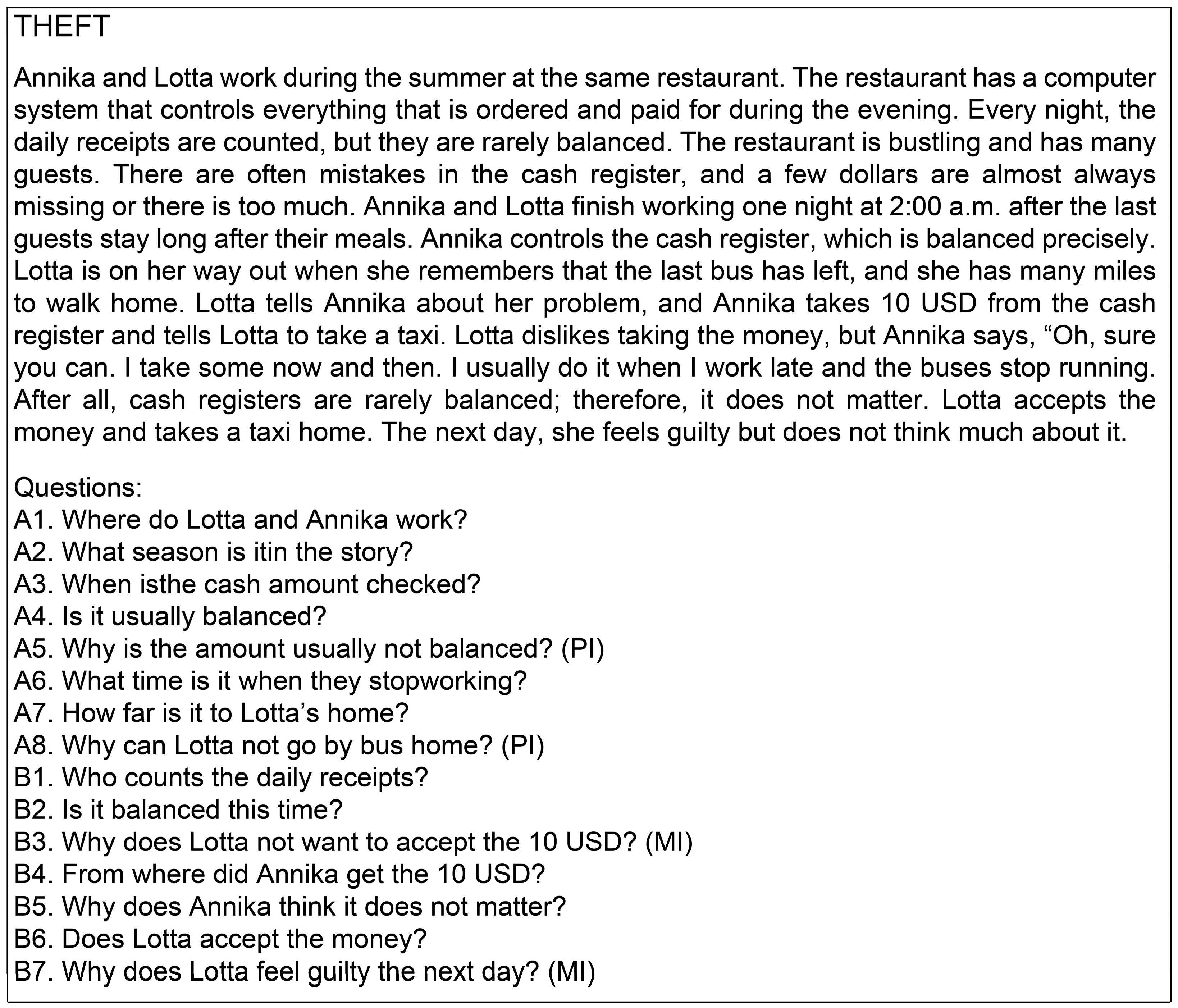
3.1. Theft
The results show that it was easy for participants to answer questions presented as facts in the text (
Table 2 and
Table 3). One question, inquiring about the season, only received a few correct answers, as the information may have been too peripheral (5 out of 13 points).
For questions concerning interactions and people, some respondents required clarification of the characters’ names, resulting in incorrect answers. The respondents generally required help with questions that required inferences based on the students’ conclusions. Question A5 (PI) asked why daily receipts and cash were seldom balanced and question A8 (PI) asked why Lotta could not go home by bus. Three students answered question A5 with more than one reason for the cash imbalance, suggesting staff, computer systems, or other variables as the cause.
However, most respondents referred to the specific text, such as the cash register needing to be balanced because Annika used to take money from it to go home by taxi. Question A8 was answered by all respondents for only one reason: the bus had already left. No comments were made about Lotta being late because the guests stayed too long. Comments were made about how Annika took the money and that Lotta was innocent because she did not take the money out of the cash register. The results showed that these adolescents had difficulty understanding different perspectives and had poor judgment of probability. Questions referring to MIs seemed even more difficult. Question B3 asked why Lotta was reluctant to take the money and question B8 asked why she felt guilty the following day. The respondents required help in predicting and understanding other people’s motivations and reactions. The answers to question B3 varied between “it was stolen” and “she wanted the daily cash to be balanced,” and those for question B8 varied between “the money was stolen” and “it was not right.” Only one respondent made other interferences: “You cannot feel guilty if you do not know it is stolen, but in this case, she knew, and so she felt guilty even if she did not take the money herself.” The answers presented were simplified and contextualized, representing a single perspective; however, the awareness of this act as offending behavior seemed to be discerned by most respondents.
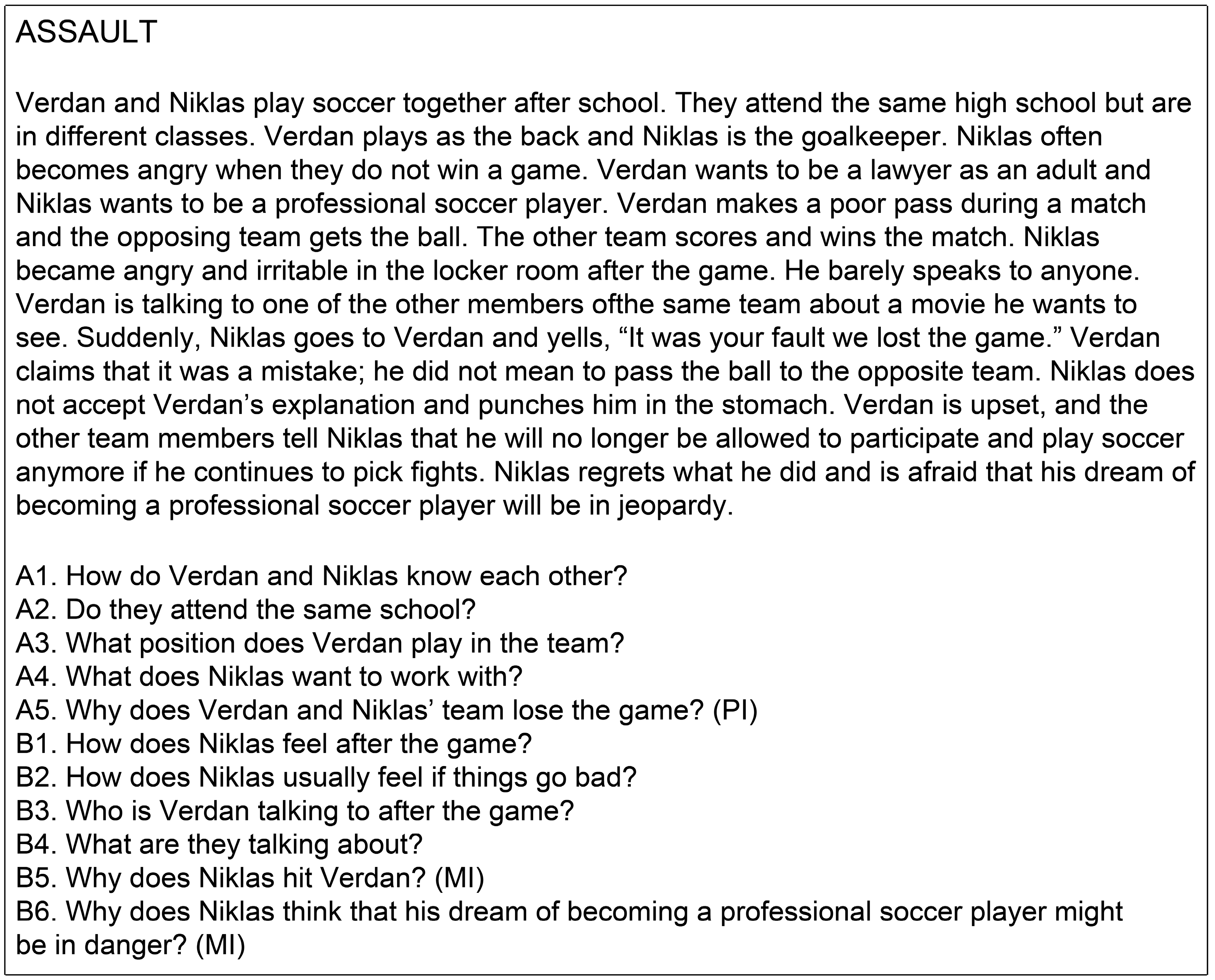
3.2. Assault
The results of the assault case aligned with those of the first case (
Table 4 and
Table 5). Only the first question with physical or factual focus, on how the boys knew each other, appeared difficult to discern. Even the mental and social questions seemed easy to understand, and the main error was mixing up the boys’ names or misremembering.
Vedran was talking about seeing a movie after the match, rather than the game. There were three inference questions: one for PI and two for MI. Question A5 asked why the team lost the game. The text described how Vedran made a wrong pass. Although one single pass would not likely be the only reason for losing an entire game, 12 out of 13 participants answered this question with “Vedran made a wrong pass, and that is why they lost,” or “a wrong pass.” No one reflected on the question from any other perspective, such as suggesting that the team not scoring or having a poor defense could have been the reason for the loss. Responses to the two MI questions (question B6, asking why Niklas hit Vedran and question B7, asking why Niklas thought his dream of becoming a professional player might be in danger), showed almost the same pattern. Question B6 was answered in one of two distinct ways by most respondents: either that it was Vedran’s fault that the team lost (6) or that Niklas was angry (6). However, for question B7, two respondents gave answers that considered different possibilities: one suggested that Niklas was angry at Vedran for the failed pass, and another proposed that the goalkeeper might have been disappointed in himself for allowing the goal. The analysis did not provide indications of awareness of hitting another person as an offending behavior.
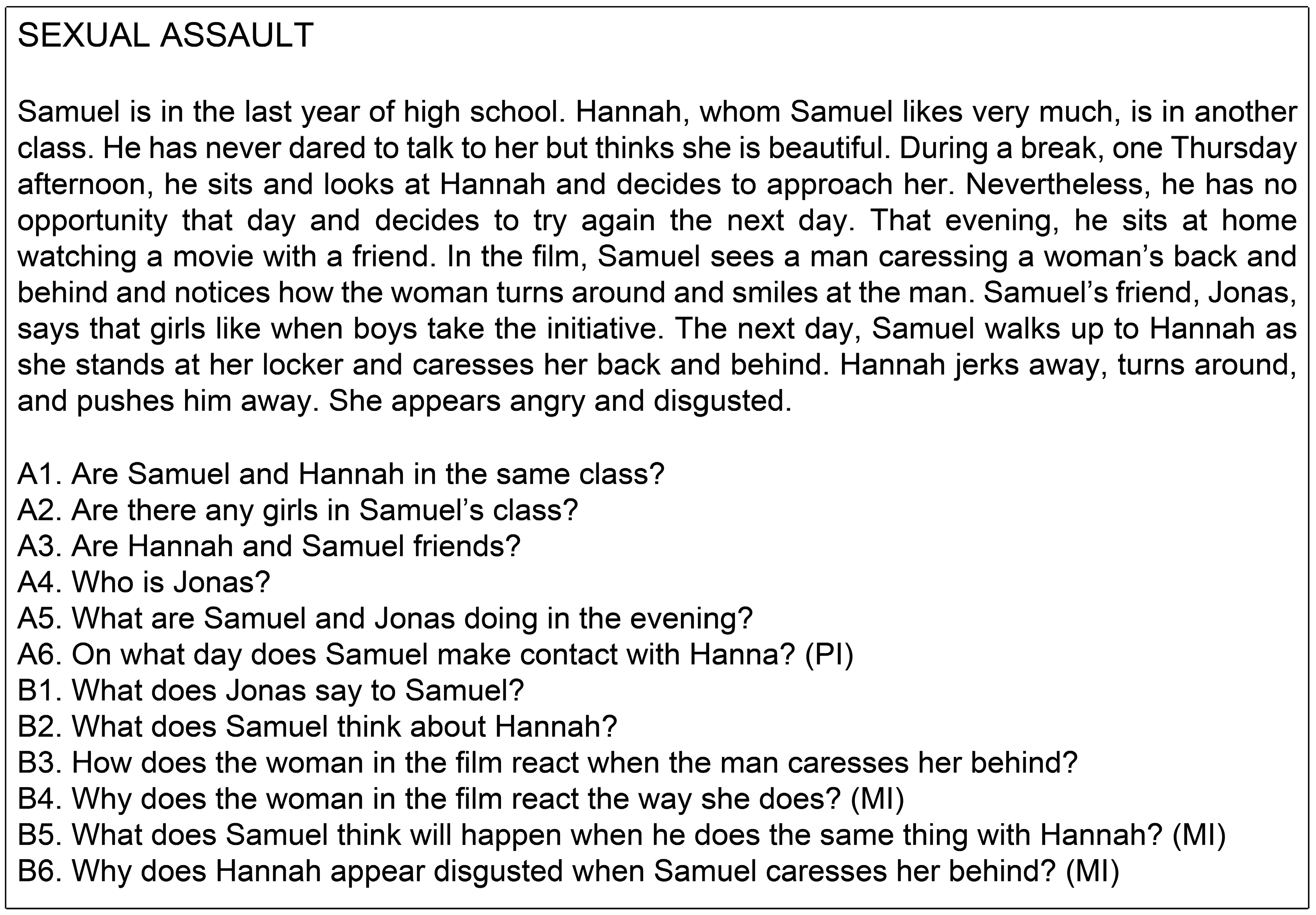
3.3. Sexual Assault
Following the results of the previous two cases, there were no difficulties related to what happened in the story (facts). The respondents missed answering some of the questions as they did not discern the answer and claimed that some information was “not being in the text.” It was easy for the respondents to understand what happened between the people in the film, and almost all the respondents recalled and answered any related questions correctly (
Table 6 and
Table 7).
In this case, one PI question was asked about the day Samuel met Hannah after watching the movie (question A6). The text stated that they met the day after Samuel had watched the movie, and that Samuel met Jonas on a Thursday. Six respondents made inferences to find the correct answer. The rest said that they did not know or “it was not in the text.” Finally, three MI questions were asked: B4 (why did the woman in the movie act as she did?), B5 (what did Samuel think would happen?), and B6 (why was Hannah angry?).
Again, very few answers reflected the consideration of different perspectives. Only one respondent answered question B4 with two alternative reasons: either that the actress’ behavior was part of her role or that she liked the man. The common answer was that she acted the way she did because it was a movie, and by implication, such behavior would not occur in real life. Most respondents answered question B5 by saying that Samuel thought Hannah would react as the woman in the movie did. Only one person said that Samuel hoped to be part of a couple and thought that this attempt at contact would make this happen. Question B6 was answered in several ways but with only one solution per respondent. Six answers were related to the opinion that Hannah did not like being touched by Samuel and was angry at him for his presumption. The analysis showed that the respondents did not discern what was wrong and how it might be an early offending behavior, as touching a person’s private parts without consent is defined as an offending behavior according to Swedish law. Even if the questions were based on Hannah’s perspective, no one noticed that Hannah had the right to be angry as an offending behavior had been conducted against her.