
School Principals’ Wellbeing Perceptions in Greek Primary Schools


Abstract
1. Introduction
2. Literature Review
2.1. Wellbeing in Education
2.2. Studies on School Principals’ Wellbeing
3. Materials and Methods
3.1. Research Design
3.2. Data Collection Instrument
3.3. Participants
3.4. Data Analysis Procedures
4. Results
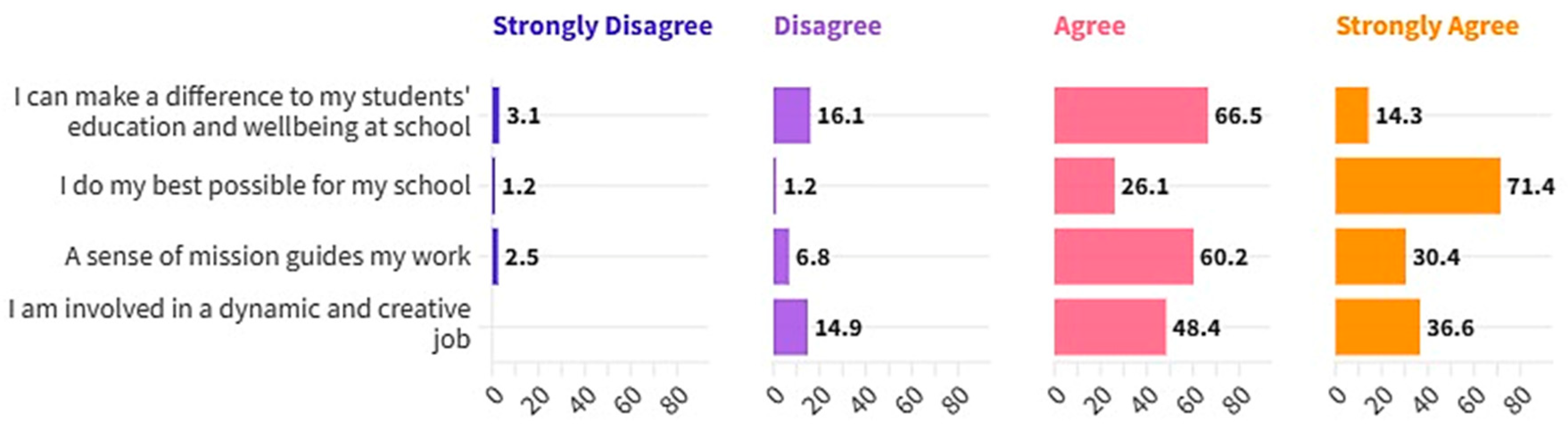
4.1. Research Question 1: School Principals’ Views on Their Wellbeing
4.2. Research Question 2: Differences in School Principals’ Views on Wellbeing in the Workplace

| Variable | N | Mean | SD | 95%CI Lower | 95% CI Upper | Df | χ2 | p | Effect Size (ε2) | Significant Differences |
|---|---|---|---|---|---|---|---|---|---|---|
| Didaskaleio | 17 | 4.09 | 0.12 | 4.04 | 4.14 | 3 | 105.817 | 0.001 | 0.52 | PhD–MA |
| BA | 17 | 3.72 | 0.13 | 3.67 | 3.77 | PhD–BA | ||||
| MA | 112 | 2.90 | 0.39 | 2.83 | 2.97 | PhD–Didaskaleio | ||||
| PhD | 15 | 1.84 | 0.25 | 1.77 | 1.91 | MA–BA | ||||
| Other | 0 | -- | -- | -- | -- | MA–Didaskaleio |
| Variable | N | Mean | SD | 95%CI Lower | 95%CI Lower | df | χ2 | p | Effect Size (ε2) | Significant Differences |
|---|---|---|---|---|---|---|---|---|---|---|
| 1–10 | 2 | 4.22 | 0.00 | 4.22 | 4.22 | 3 | 134.183 | 0.001 | 0.56 | >30|21–30 |
| 11–20 | 21 | 4.01 | 0.13 | 3.96 | 4.06 | >30|11–20 | ||||
| 21–30 | 74 | 3.26 | 0.26 | 3.19 | 3.33 | >30|1–10 | ||||
| >30 | 64 | 2.38 | 0.38 | 2.29 | 2.47 | 21–30|11–20 |
| Variable | N | Mean | SD | 95%CI Lower | 95% CI Upper | Df | χ2 | p | Effect Size (ε2) | Significant Differences |
|---|---|---|---|---|---|---|---|---|---|---|
| 1–5 | 90 | 3.48 | 0.39 | 3.42 | 3.54 | 3 | 128.733 | 0.003 | 0.54 | >16|6–10 |
| 6–10 | 28 | 2.81 | 0.83 | 2.63 | 2.99 | 0.001 | >16|1–5 | |||
| 11–15 | 25 | 2.40 | 0.14 | 2.33 | 2.47 | 11–15|1–5 | ||||
| >16 | 18 | 1.89 | 0.25 | 1.82 | 1.96 | 6–10|1–5 |
4.3. Research Question 3: Relationship Between Job Satisfaction and School Principals’ Wellbeing
| Variable | M | SD | 1 | 2 | 3 | 4 | 5 | 6 | 7 |
|---|---|---|---|---|---|---|---|---|---|
| 1. Job Satisfaction | 2.43 | 0.68 | 0.97 ** | 0.98 ** | 0.95 ** | 0.97 ** | 0.91 ** | 0.96 ** | |
| 2. Emotional Wellbeing | 2.68 | 0.60 | 0.97 ** | 0.96 ** | 0.95 ** | 0.86 ** | 0.96 ** | ||
| 3. Physical Wellbeing | 2.89 | 1.37 | 0.94 ** | 0.96 ** | 0.91 ** | 0.96 ** | |||
| 4. Cognitive Wellbeing | 2.99 | 0.50 | 0.91 ** | 0.85 ** | 0.96 ** | ||||
| 5. Social Wellbeing | 2.65 | 0.63 | 0.87 ** | 0.98 ** | |||||
| 6. Psychological Wellbeing | 3.63 | 0.41 | 0.86 ** | ||||||
| 7. Spiritual Wellbeing | 3.25 | 0.57 | 0.92 ** |
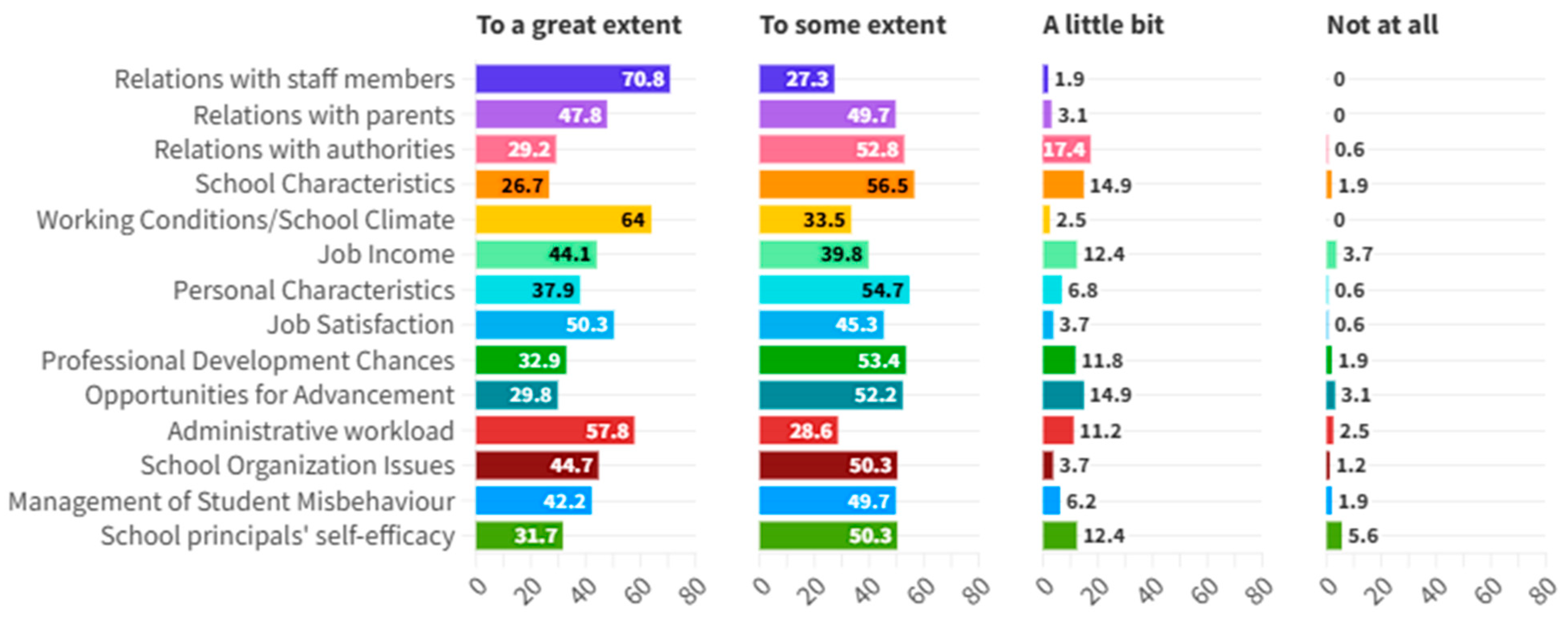
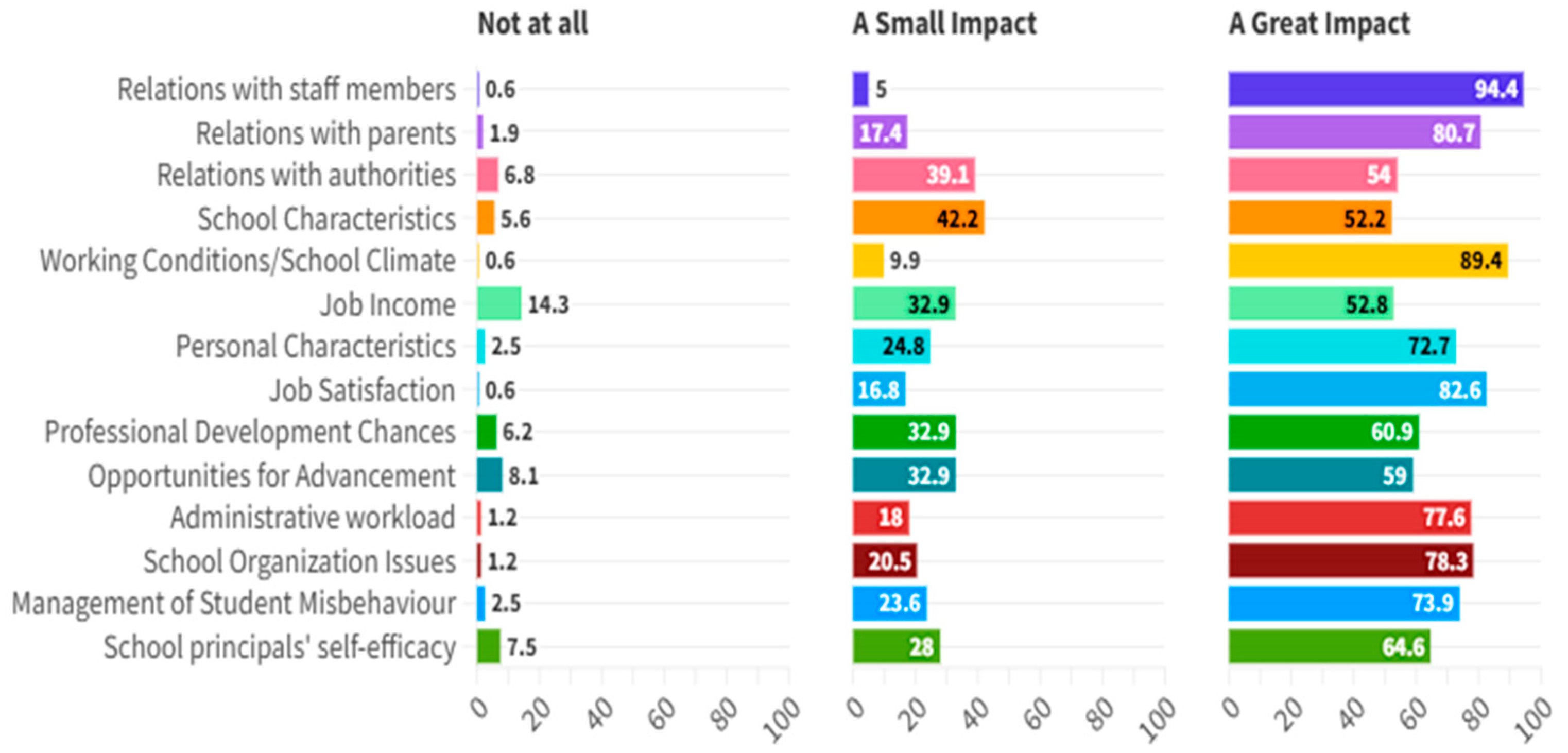
4.4. Research Question 4: School Principals’ Perceptions on the Impact of Wellbeing and Professional Practice Factors
5. Discussion
5.1. Findings of Note
5.2. Implications for Practice
6. Limitations and Future Directions
7. Conclusions
Author Contributions
Funding
Institutional Review Board Statement
Informed Consent Statement
Data Availability Statement
Conflicts of Interest
References
- Acton, R., & Glasgow, P. (2015). Teacher wellbeing in neoliberal contexts: A review of the literature. Australian Journal of Teacher Education, 40(8). [Google Scholar] [CrossRef]
- Aggarwal, R., & Ranganathan, P. (2019). Study designs: Part 2—Descriptive studies. Perspectives in Clinical Research, 10, 34–36. [Google Scholar] [CrossRef] [PubMed]
- Aravena, F., & Gonzalez, A. (2021). ‘Always ready and always well’: Exploring stress on school principals in Chile. International Journal of Educational Development, 84, 102399. [Google Scholar] [CrossRef]
- Arnold, B., Rahimi, M., & Riley, P. (2023). The mental health of leaders in Australian government schools: Stress and burnout over a decade (2011–2020). Educational Management Administration & Leadership, 53(6), 1502–1520. [Google Scholar] [CrossRef]
- Beausaert, S., Froehlich, D. E., Riley, P., & Gallant, A. (2021). What about school principals’ wellbeing? The role of social capital. Educational Management Administration and Leadership, 51(2), 405–421. [Google Scholar] [CrossRef]
- Carter, S. (2018). The journey of a novice principal: Her struggle to maintain subjective wellbeing and be spiritual school leader. International Journal of Education, 10(3), 119–142. [Google Scholar] [CrossRef]
- Chatzipanagiotou, P., & Katsarou, E. (2023). Crisis management, school leadership in disruptive times and the recovery of schools in the post COVID-19 era: A systematic literature review. Education Sciences, 13(2), 118. [Google Scholar] [CrossRef]
- Chaves, C. (2021). Wellbeing and flourishing. In M. L. Kernand, & M. L. Wehmeyer (Eds.), The Palgrave handbook of positive education (pp. 273–295). Palgrave. [Google Scholar]
- Chen, J., Walker, D. A., & Riley, P. (2023). Reconceptualizing principal wellbeing: State, measurement and consequences. Journal of Educational Administration, 61(5), 495–513. [Google Scholar] [CrossRef]
- Cherkowski, S., Kutsyuruba, B., & Walker, K. (2020). Positive leadership: Animating purpose, presence, passion and play for flourishing in schools. Journal of Educational Administration, 58(4), 401–415. [Google Scholar] [CrossRef]
- Cherkowski, S., & Walker, K. (2016). Purpose, passion and play. Exploring the construct of flourishing from the perspective of school principals. Journal of Educational Administration, 54(4), 378–389. [Google Scholar] [CrossRef]
- Cohen, L., Manion, L., & Morrison, K. (2017). Research methods in education (8th ed.). Routledge. [Google Scholar]
- Collie, R. J., Granziera, H., & Martin, A. J. (2020). School principals’ workplace wellbeing: A multination examination of the role of their job resources and job demands. Journal of Educational Administration, 58(4), 417–433. [Google Scholar] [CrossRef]
- Connery, L. A., & Frick, W. C. (2021). A formal administrator mentoring program: Perceived learning benefits and insights into leadership wellbeing. Inquiry in Education, 13(1), 3. [Google Scholar]
- Dadaczynski, K., Kotarski, C., Rathmann, K., & Okan, O. (2022). Health literacy and mental health of school principals. Results from a German cross-sectional survey. Health Education. [Google Scholar]
- Dicke, T., Marsh, H. W., Riley, P., Parker, P. D., Guo, J., & Horwood, M. (2018). Validating the Copenhagen Psychosocial Questionnaire (COPSOQ-II) using set-ESEM: Identifying psychosocial risk factors in a sample of school principals. Frontiers in Psychology, 9, 584. [Google Scholar] [CrossRef]
- Diener, E., Heintzelman, S. J., Kushlev, K., Tay, L., Wirtz, D., Lutes, L. D., & Oishi, S. (2017). Findings all psychologists should know from the new science on subjective wellbeing. Canadian Psychology, 58(2), 87–104. [Google Scholar] [CrossRef]
- Dimopoulos, K., Dalkavouki, K., & Koulaidis, V. (2014). Job realities of primary school principals in Greece: Similarities and variations in a highly centralized system. International Journal of Leadership in Education, 18(2), 197–224. [Google Scholar] [CrossRef]
- Dodge, R., Daly, A. P., Huyton, J., & Sanders, L. D. (2012). The challenge of defining wellbeing. International Journal of Wellbeing, 2(3), 222–235. [Google Scholar] [CrossRef]
- Doyle Fosco, S. L. (2022). Educational leader wellbeing: A systematic review. Educational Research Review, 37, 100487. [Google Scholar] [CrossRef]
- Doyle Fosco, S. L., Brown, M. A., & Schussler, D. L. (2023). Factors affecting educational leader wellbeing: Sources of stress and self-care. Educational Management Administration & Leadership, 53(3), 582–601. [Google Scholar] [CrossRef]
- Drago-Severson, E., & Blum-DeStefano, J. (2014). Leadership for transformational learning: A developmental approach to supporting leaders’ thinking and practice: A developmental approach to supporting leaders’ thinking and practice. Journal of Research on Leadership Education, 9(2), 113–141. [Google Scholar] [CrossRef]
- Drago-Severson, E., Maslin-Ostrowski, P., & Blum-Destefano, J. (2018). Looking behind the curtain: Principals’ internal experiences of managing pressing challenges. Journal of School Leadership, 28(3), 315–343. [Google Scholar] [CrossRef]
- European Commission. (2023). Promoting supportive learning environments and supporting wellbeing at school. Publications Office of the European Union. Available online: https://data.europa.eu/doi/10.2766/864948 (accessed on 4 February 2026).
- Hallinger, P. (2018). Bringing context out of the shadows of leadership. Educational Management Administration & Leadership, 46(1), 5–24. [Google Scholar] [CrossRef]
- Hascher, T., & Waber, J. (2021). Teacher wellbeing: A systematic review of the research literature from the year 2009–2019. Educational Research Review, 34(8), 100411. [Google Scholar] [CrossRef]
- Karanikola, M., Georganta, K., Kaikoushi, K., Koutroubas, V. S., & Kalafati, D. (2025). Qualitative inquiry into work-related distressing experiences in primary school principals. Societies, 15(2), 33. [Google Scholar] [CrossRef]
- Kutsyuruba, B., Arghash, N., & Al Makhamreh, M. (2024). School leader wellbeing: Perceptions of Canada’s outstanding principals. Education Sciences, 14, 667. [Google Scholar] [CrossRef]
- Lazaridou, A., & Beka, A. (2014). Personality and resilience characteristics of Greek primary school principals. Educational Management Administration & Leadership, 43(5), 772–791. [Google Scholar] [CrossRef]
- Leithwood, K., Harris, A., & Hopkins, D. (2020). Seven strong claims about successful school leadership revisited. School Leadership & Management, 40(1), 5–22. [Google Scholar] [CrossRef]
- Levin, S., & Bradley, K. (2019). Understanding and addressing principal turnover: A review of the research. National Association of Secondary School Principals and Learning Policy Institute. Available online: https://learningpolicyinstitute.org/product/nassp-understanding-addressing-principal-turnover-review-research-report (accessed on 27 September 2025).
- Lunenburg, F. C., & Irby, B. J. (2008). Writing a successful thesis or dissertation: Tips and strategies for students in the social and behavioral sciences. Crown Press. [Google Scholar]
- Mahfouz, J. (2018). Mindfulness training for school administrators: Effects on wellbeing and leadership. Journal of Educational Administration, 56(6), 602–619. [Google Scholar] [CrossRef]
- Mahfouz, J., & Richardson, J. W. (2021). At the crossroads: Wellbeing and principalship preparation. Journal of Research on Leadership Education, 16(4), 360–384. [Google Scholar] [CrossRef]
- Marsh, H. W., Dicke, T., Riley, P., Parker, P. D., Guo, J., Basarkod, G., & Martin, A. J. (2022). School principals’ mental health and well-being under threat: A longitudinal analysis of workplace demands, resources, burnout, and well-being. Health and Well-Being, 15(3), 999–1027. [Google Scholar] [CrossRef]
- Maxwell, A., & Riley, P. (2017). Emotional demands, emotional labour and occupational outcomes in school principals: Modelling the relationships. Educational Management Administration & Leadership, 45(3), 484–502. [Google Scholar]
- McCallum, F., & Price, D. (2016). Nurturing wellbeing development in education. Routledge. [Google Scholar]
- Netolicky, D. M. (2020). School leadership during a pandemic: Navigating tensions. Journal of Professional Capital and Community, 5(3–4), 391–395. [Google Scholar] [CrossRef]
- Noble, T., & McGrath, H. (2015). PROSPER: A new framework for positive education. Psychology of Wellbeing, 5, 2. [Google Scholar] [CrossRef]
- OECD. (2020). TALIS 2018 results (Volume II): Teachers and school leaders as valued professionals. TALIS, OECD Publishing. [Google Scholar] [CrossRef]
- OECD. (2022). Promoting health and wellbeing at work: Policy and practices, OECD health policy studies. OECD Publishing. [Google Scholar] [CrossRef]
- Perrone, F., & Tucker, P. D. (2019). Shifting profile of leadership preparation programs in the 21st century. Educational Administration Quarterly, 55(2), 253–295. [Google Scholar] [CrossRef]
- Pollock, K., & Wang, F. (2020). School principals’ work and wellbeing in Ontario. Available online: https://edst-educ.sites.olt.ubc.ca/files/2020/05/UWO-Principals-Work-Infographic-Booklet-2-Well-being-MAY19.pdf (accessed on 20 May 2022).
- Pollock, K., Wang, F., & Hauseman, D. C. (2017). Complexity and volume: An inquiry into factors that drive principals’ work. In K. Leithwood, J. Sun, & K. Pollock (Eds.), How school leaders contribute to student success: The four paths framework (pp. 209–238). Springer International Publishing. [Google Scholar] [CrossRef]
- Ray, J., Pijanowski, J., & Lasater, K. (2020). The self-care practices of school principals. Journal of Educational Administration, 58(4), 435–451. [Google Scholar] [CrossRef]
- Regmi, P. R., Waithaka, E., Paudyal, A., Simkhada, P., & van Teijlingen, E. (2016). Guide to the design and application of online questionnaire surveys. Nepal Journal of Epidemiology, 6(4), 640–644. [Google Scholar] [CrossRef] [PubMed]
- Riley, P. (2019). The Australian principal occupational health, safety & wellbeing survey: 2018 data. Available online: www.principalhealth.org/au/reports.php (accessed on 13 September 2025).
- Riley, P., See, S.-M., Marsh, H., & Dicke, T. (2021). The Australian principal occupational health, safety and wellbeing survey (IPPE report). Institute for Positive Psychology and Education, Australian Catholic University. [Google Scholar]
- Ryan, R. M., & Deci, E. L. (2001). On happiness and human potential: A review of research on hedonic and eudaimonic wellbeing. Annual Review of Psychology, 52, 141–166. [Google Scholar] [CrossRef]
- Ryff, C. D. (1989). Happiness is everything, or is it? Explorations on the meaning of psychological wellbeing. Journal of Personality and Social Psychology, 57(6), 1069–1081. [Google Scholar] [CrossRef]
- Saiti, A., & Fassoulis, K. (2012). Job satisfaction: Factor analysis of Greek primary school principals’ perceptions. International Journal of Educational Management, 11(4), 370–380. [Google Scholar] [CrossRef]
- Seligman, M. (2018). PERMA and the building blocks of wellbeing. The Journal of Positive Psychology, 13(4), 333–335. [Google Scholar] [CrossRef]
- Shirley, D., Hargreaves, A., & Washington-Wangia, S. (2020). The sustainability and unsustainability of teachers’ and leaders’ wellbeing. Teaching and Teacher Education, 92, 102987. [Google Scholar] [CrossRef]
- Steiner, E. D., Doan, S., Woo, A., Gittens, A. D., Lawrence, R. A., Berdie, L., Wolfe, R. L., Greer, L., & Schwarz, H. L. (2022). Restoring teacher and principal wellbeing is an essential step for rebuilding schools: Findings from the State of the American teacher and State of the American principal surveys (Research Report. RR-A1108-4). RAND Corporation.
- Su-Keene, E. J., & DeMatthews, D. E. (2025). Stress overload: A mixed-methods, single-case exploration of a principal’s stress accumulation, sleep, and wellbeing over a school year. Education Sciences, 15(9), 1142. [Google Scholar] [CrossRef]
- Swapp, D. H. (2020). Principal leadership and prioritizing equity in an era of work intensification: Must wellbeing be sacrificed? Canadian Journal of Educational Administration an Policy, 192, 52–59. [Google Scholar]
- Tahir, L. M., Wan Mohd Yunus, W. M. A., & Rosli, M. S. (2025). Stress and mental health among school principals: A scoping review. In School mental health. Springer. [Google Scholar] [CrossRef]
- UNESCO. (2024). Global education monitoring report 2024/5: Leadership in education: Lead for learning. UNESCO. [Google Scholar] [CrossRef]
- Viac, C., & Fraser, P. (2020). Teachers’ wellbeing: A framework for data collection and analysis. OECD Education Working Papers. OECD Publishing. [Google Scholar]
- Walker, A. R. (2020). God is my doctor”: Mindfulness meditation/prayer as a spiritual wellbeing coping strategy for Jamaican school principals to manage their work-related stress and anxiety. Journal of Educational Administration, 58(4), 467–480. [Google Scholar] [CrossRef]
- Wang, F. (2024). Principals’ wellbeing: Understanding its multidimensional nature. School Leadership & Management, 44(4), 442–465. [Google Scholar] [CrossRef]
- Wang, F., & Pollock, K. (2020). School principals work and wellbeing in British Columbia: What they say and why it matters. Technical Report. University of British Columbia. [Google Scholar]
- Wang, F., Pollock, K., & Hauseman, C. (2023). Time demands and emotionally draining situations amid work intensification of school principals. Educational Administration Quarterly, 59(1), 112–142. [Google Scholar] [CrossRef]
- Wang, F., Pollock, K., & Hauseman, D. C. (2018). Ontario principals’ and vice-principals’ wellbeing and coping strategies in the context of work intensification. In S. Cherkowski, & K. Walker (Eds.), Perspectives on flourishing schools (pp. 287–304). Lexington Books. [Google Scholar]
- Wells, C. M., & Klocko, B. A. (2018). Principal wellbeing and resilience: Mindfulness as a means to an end. NASSP Bulletin, 102(2), 161–173. [Google Scholar] [CrossRef]






| Variable | M | SD | 1 | 2 | 3 | 4 | 5 | 6 |
|---|---|---|---|---|---|---|---|---|
| 1. Emotional Wellbeing | 2.68 | 0.60 | 0.37 *** | 0.47 *** | −0.19 * | 0.06 | 0.15 | |
| 2. Physical Wellbeing | 2.89 | 1.37 | 0.24 ** | 0.07 | 0.24 ** | 0.20 | ||
| 3. Cognitive Wellbeing | 2.99 | 0.50 | −0.19 * | 0.08 | −0.03 | |||
| 4. Psychological Wellbeing | 2.65 | 0.63 | −0.12 | 0.05 | ||||
| 5. Social Wellbeing 6. Spiritual Wellbeing | 3.63 3.25 | 0.41 0.57 | 0.70 ** |
| Variable | n % |
|---|---|
| Gender | |
| Female | 99 (61.5%) |
| Male | 62 (38.5%) |
| Age | |
| 31–40 | 6 (3.7%) |
| 41–50 | 33 (20.5%) |
| >50 | 122 (75.8%) |
| Years of Teaching Experience | |
| 1–10 | 2 (1.2%) |
| 11–20 | 21 (13%) |
| 21–30 | 74 (46%) |
| >30 | 64 (39.8%) |
| Years of Experience as a Principal | |
| 1–5 | 90 (55.9%) |
| 6–10 | 28 (17.4%) |
| 11–15 | 25 (15.5%) |
| >16 | 18 (11.2%) |
| Years of Service as a Principal in Current School | |
| 1–3 | 113 (71.4%) |
| 4–6 | 12 (7.5%) |
| 7–9 | 15 (9.3%) |
| >10 | 21 (11.8%) |
| Academic Qualifications | |
| Didaskaleion * | 17 (10.6%) |
| Bachelor’s | 17 (10.6%) |
| Master’s | 112 (69.6%) |
| PhD | 15 (9.3%) |
| Other | - |
| School Location | |
| Urban Area | 103 (64%) |
| Suburban Area | 29 (18%) |
| Rural Area | 27 (16.8%) |
| Other | 2 (1.2%) |
| Reported Feelings | N | % of Respondents (n = 161) |
|---|---|---|
| Stressed | 78 | 48.4% |
| Exhausted | 55 | 34.1% |
| Tired | 100 | 62.1% |
| Energetic | 70 | 43.4% |
| Dynamic | 68 | 42.2% |
| Powerful | 26 | 16.1% |
| Tireless | 12 | 7.4% |
| Other | 7 | 4.3% |
| Responses | n % |
|---|---|
| For another 3 years | 22 (16.1%) |
| For another 4 years | 20 (14.7%) |
| For another 5 years | 15 (11.0%) |
| For another 6 years | 3 (2.2%) |
| For another 7 years | 3 (2.2%) |
| For another 8 years | 7 (5.1%) |
| For another 10 years | 6 (4.4%) |
| >10 years | 6 (4.4%) |
| ‘I will remain until my retirement’ | 25 (18.3%) |
| ‘I haven’t decided yet’ | 23 (16.9%) |
| ‘I would like to withdraw from school principalship’ | 3 (2.2%) |
| ‘I remain for other reasons (financial)’ | 2 (1.4%) |
| ‘I have no idea; that will depend upon the working conditions’ | 1 (0.7%) |
| Variable | N | Mean | SD | 95% CI Lower | 95% CI Upper | df | χ2 | p | Effect Size (ε2) | Significant Differences |
|---|---|---|---|---|---|---|---|---|---|---|
| =30 | 0 | -- | -- | -- | -- | 2 | 88.834 | 0.001 | 0.47 | >50|31–40 |
| 31–40 | 6 | 4.22 | 0.12 | 4.09 | 4.35 | >50|41–50 | ||||
| 41–50 | 33 | 3.79 | 0.20 | 3.72 | 3.86 | |||||
| >50 | 122 | 2.75 | 0.50 | 2.66 | 2.84 |
Disclaimer/Publisher’s Note: The statements, opinions and data contained in all publications are solely those of the individual author(s) and contributor(s) and not of MDPI and/or the editor(s). MDPI and/or the editor(s) disclaim responsibility for any injury to people or property resulting from any ideas, methods, instructions or products referred to in the content. |
© 2026 by the authors. Licensee MDPI, Basel, Switzerland. This article is an open access article distributed under the terms and conditions of the Creative Commons Attribution (CC BY) license.
Share and Cite
Theodosiou, V.; Chatzipanagiotou, P.; Katsarou, E. School Principals’ Wellbeing Perceptions in Greek Primary Schools. Educ. Sci. 2026, 16, 338. https://doi.org/10.3390/educsci16020338
Theodosiou V, Chatzipanagiotou P, Katsarou E. School Principals’ Wellbeing Perceptions in Greek Primary Schools. Education Sciences. 2026; 16(2):338. https://doi.org/10.3390/educsci16020338
Chicago/Turabian StyleTheodosiou, Valentina, Paraskevi Chatzipanagiotou, and Eirene Katsarou. 2026. "School Principals’ Wellbeing Perceptions in Greek Primary Schools" Education Sciences 16, no. 2: 338. https://doi.org/10.3390/educsci16020338
APA StyleTheodosiou, V., Chatzipanagiotou, P., & Katsarou, E. (2026). School Principals’ Wellbeing Perceptions in Greek Primary Schools. Education Sciences, 16(2), 338. https://doi.org/10.3390/educsci16020338