Principal Working Conditions, Burnout, and Job Satisfaction: The Mediating and Moderating Role of COVID-19 Stress




Abstract
1. Introduction
2. Literature Review
2.1. Conceptualization of Principal Wellbeing: Burnout and Job Satisfaction
2.2. Job Demands–Resources Model and Principal Wellbeing
2.3. Principal Stress Related to COVID-19: Mediating and Moderating Roles
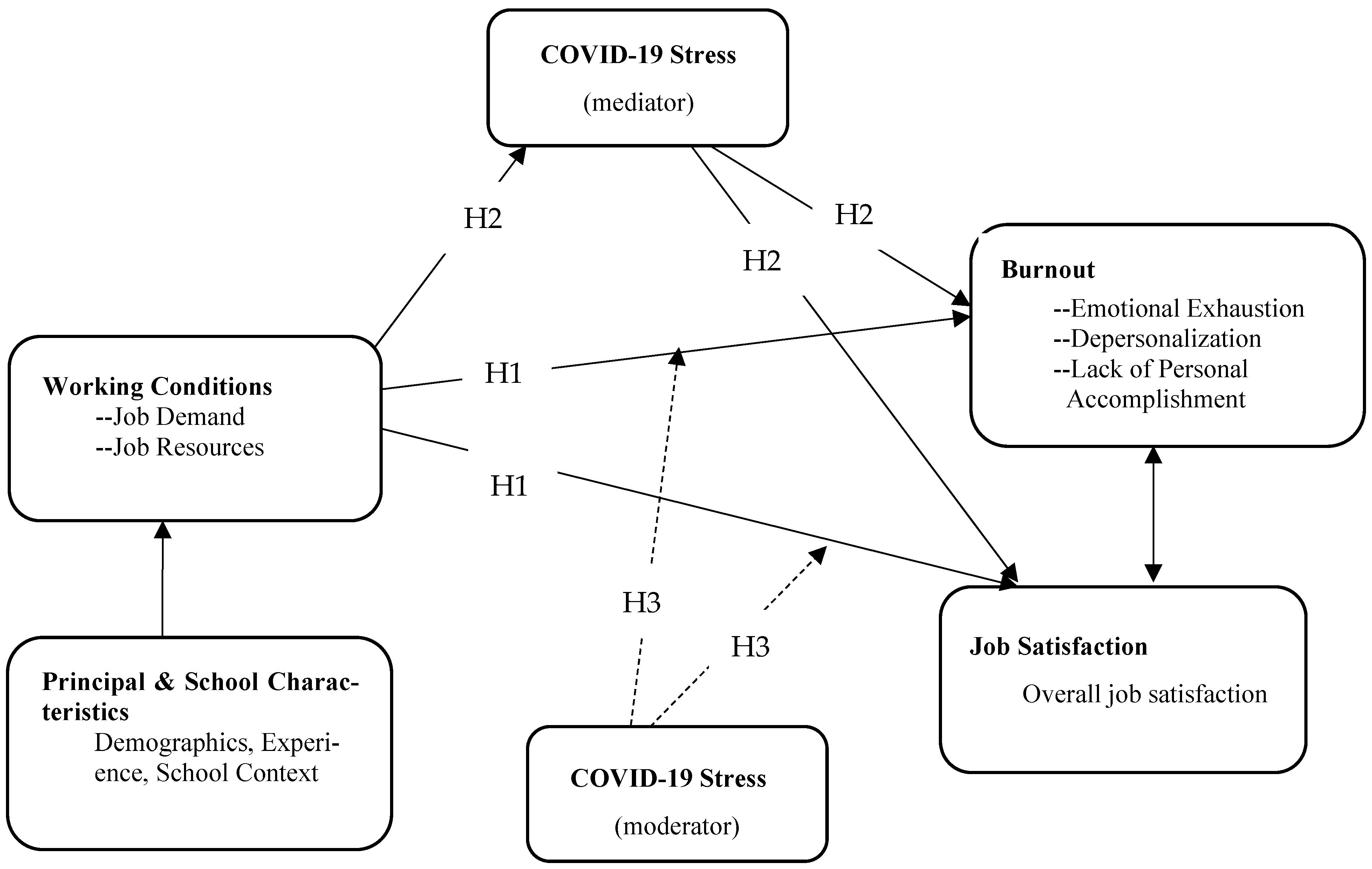
2.4. Conceptual Framework
3. Data and Methods
3.1. Participants and Data Collection
3.2. Measures
3.3. Analytical Strategies
4. Results
4.1. CFA Results and Descriptive Statistics
4.2. SEM Results
4.2.1. Main Effects of Work Conditions on Burnout and Job Satisfaction
4.2.2. COVID-19 Stress as Mediator
4.2.3. COVID-19 Stress as Moderator
4.2.4. Control Variable Effects
5. Discussion
5.1. Main Findings
5.2. Policy and Practice Implications
6. Conclusions
Author Contributions
Funding
Institutional Review Board Statement
Informed Consent Statement
Data Availability Statement
Acknowledgments
Conflicts of Interest
Appendix A

| 1 | 2 | 3 | 4 | 5 | 6 | |
|---|---|---|---|---|---|---|
| 1. Workload | ||||||
| 2. Job Resources | −0.335 ** | |||||
| 3. COVID-19 Stress | 0.306 ** | −0.328 ** | ||||
| 4. Emotional Exhaustion | 0.666 ** | −0.548 ** | 0.378 ** | |||
| 5. Lack of Personal Accomplishment | 0.223 ** | −0.545 ** | 0.063 | 0.537 ** | ||
| 6. Depersonalization | 0.264 ** | −0.354 ** | 0.303 ** | 0.765 ** | 0.454 ** | |
| 7. Job Satisfaction | −0.414 ** | 0.636 ** | −0.291 ** | −0.757 ** | −0.688 ** | −0.586 ** |
References
- Afshari, L., Hayat, A., Ramachandran, K. K., Bartram, T., & Balakrishnan, B. K. (2022). Threat or opportunity: Accelerated job demands during COVID-19 pandemic. Personnel Review, 51(9), 2482–2501. [Google Scholar] [CrossRef]
- Arastaman, G., & Çetinkaya, A. (2022). Stressors faced by principals, ways of coping with stress and leadership experiences during the COVID-19 pandemic. International Journal of Educational Management, 36(7), 1271–1283. [Google Scholar] [CrossRef]
- Bakker, A. B., & Demerouti, E. (2017). Job demands–resources theory: Taking stock and looking forward. Journal of Occupational Health Psychology, 22(3), 273–285. [Google Scholar] [CrossRef]
- Bakker, A. B., Demerouti, E., de Boer, E., & Schaufeli, W. B. (2003). Job demands and job resources as predictors of absence duration and frequency. Journal of Vocational Behavior, 62(2), 341–356. [Google Scholar] [CrossRef]
- Beausaert, S., Froehlich, D. E., Riley, P., & Gallant, A. (2023). What about school principals’ wellbeing? The role of social capital. Educational Management Administration & Leadership, 51(2), 405–421. [Google Scholar] [CrossRef]
- Cohen, S., & Wills, T. A. (1985). Stress, social support, and the buffering hypothesis. Psychological Bulletin, 98(2), 310–357. [Google Scholar] [CrossRef] [PubMed]
- Demerouti, E., Bakker, A. B., Nachreiner, F., & Schaufeli, W. B. (2001). The job demands-resources model of burnout. Journal of Applied Psychology, 86, 499–512. [Google Scholar] [CrossRef]
- Devos, G., Bouckenooghe, D., Engels, N., Hotton, G., & Aelterman, A. (2007). An assessment of well-being of principals in Flemish primary schools. Journal of Educational Administration, 45(1), 33–61. [Google Scholar] [CrossRef]
- Dicke, T., Stebner, F., Linninger, C., Kunter, M., & Leutner, D. (2018). A longitudinal study of teachers’ occupational well-being: Applying the job demands-resources model. Journal of Occupational Health Psychology, 23(2), 262–277. [Google Scholar] [CrossRef]
- Dolbier, C. L., Webster, J. A., McCalister, K. T., Mallon, M. W., & Steinhardt, M. A. (2005). Reliability and validity of a single-item measure of job satisfaction. American Journal of Health Promotion, 19(3), 194–198. [Google Scholar] [CrossRef]
- Ertem, H. Y. (2024). School leadership fostering mental health in the times of crisis: Synthesis of school principals’ views and PISA 2022. BMC Psychology, 12(1), 695. [Google Scholar] [CrossRef] [PubMed]
- Federici, R. A., & Skaalvik, E. M. (2012). Principal self-efficacy: Relations with burnout, job satisfaction and motivation to quit. Social Psychology of Education, 15(3), 295–320. [Google Scholar] [CrossRef]
- Fogarty, T. J., Singh, J., Rhoads, G. K., & Moore, R. K. (2000). Antecedents and consequences of burnout in accounting: Beyond the role stress model. Behavioral Research in Accounting, 12, 31–68. [Google Scholar]
- Fraser, J., & Brock, B. L. (2006). Catholic school principal job satisfaction: Keys to retention and recruitment. Catholic Education: A Journal of Inquiry and Practice, 9(4), 13. [Google Scholar] [CrossRef][Green Version]
- Friedman, I. A. (2002). Burnout in school principals: Role related antecedents. Social Psychology of Education, 5, 229–251. [Google Scholar] [CrossRef]
- Gaziel, H. (1993). Occupational stress as experienced by educators and its possible determinates: The Israeli setting. Curriculum and Teaching, 8(1), 81–90. [Google Scholar]
- Grady, M. L., Kristine, J. C., & Brock, B. L. (1992). School administrators: The next generation. Journal of School Leadership, 2(4), 443–455. [Google Scholar] [CrossRef]
- Grissom, J., Egalite, A. J., & Lindsay, C. A. (2021). How principals affect students and schools. A systematic synthesis of two decades of research. The Wallace Foundation. [Google Scholar]
- Horwood, M., Parker, P. D., Marsh, H. W., Guo, J., & Dicke, T. (2022). School autonomy policies lead to increases in principal autonomy and job satisfaction. International Journal of Educational Research, 115, 102048. [Google Scholar] [CrossRef]
- Jimenez, P., & Dunkl, A. (2017). The buffering effect of workplace resources on the relationship between the areas of worklife and burnout. Frontiers in Psychology, 8, 12. [Google Scholar] [CrossRef] [PubMed]
- Kaufman, J. H., Diliberti, M. K., & Hamilton, L. S. (2022). How principals’ perceived resource needs and job demands are related to their dissatisfaction and intention to leave their schools during the COVID-19 pandemic. AERA Open, 8, 23328584221081234. [Google Scholar] [CrossRef]
- Lazarus, R. S., & Folkman, S. (1984). Stress, appraisal, and coping. Springer. [Google Scholar]
- Leiter, M. P., & Maslach, C. (2011). Areas of worklife survey manual (5th ed.). Mind Garden, Inc. [Google Scholar]
- Leksy, K., Wójciak, M., Gawron, G., Muster, R., Dadaczynski, K., & Okan, O. (2023). Work-related stress of Polish school principals during the COVID-19 pandemic as a risk factor for burnout. International Journal of Environmental Research and Public Health, 20(1), 805. [Google Scholar] [CrossRef]
- Liu, Y., & Werblow, J. (2019). The operation of distributed leadership and the relationship with organizational commitment and job satisfaction of principals and teachers: A multi-level model and meta-analysis using the 2013 TALIS data. International Journal of Educational Research, 96, 41–55. [Google Scholar] [CrossRef]
- Locke, E. A. (1969). What is job satisfaction? Organizational Behavior and Human Performance, 4(4), 309–336. [Google Scholar] [CrossRef]
- Marsh, H. W., Dicke, T., Guo, J., & Parker, P. D. (2023). School principals’ mental health and well-being under threat: A longitudinal analysis of workplace demands, resources, burnout, and well-being. Applied Psychology: Health and Wellbeing, 15(2), 405–431. [Google Scholar] [CrossRef] [PubMed]
- Maslach, C., & Jackson, S. E. (1981). The measurement of experienced burnout: SUMMARY. Journal of Occupational Behavior (Pre-1986), 2(2), 99. [Google Scholar] [CrossRef]
- Maslach, C., Jackson, S. E., Leiter, M. P., Schaufeli, W. B., & Schwab, R. L. (2018). Maslach burnout inventory manual (4th ed.). Mind Garden. [Google Scholar]
- Mijakoski, D., Atanasovska, A., Bislimovska, D., Brborović, H., Brborović, O., Cvjeanov Kezunović, L., Milošević, M., Minov, J., Önal, B., Pranjić, N., Rapas, L., Stoleski, S., Vangelova, K., Žaja, R., Bulat, P., Milovanović, A., & Karadžinska-Bislimovska, J. (2023). Associations of burnout with job demands/resources during the pandemic in health workers from Southeast European countries. Frontiers in Psychology, 14, 1258226. [Google Scholar] [CrossRef]
- Ni, Y., Li, B., Su, S., & Xia, J. (2024). Unveiling leadership priorities: A comparative study of principal time allocation across high school types. Journal of Educational Administration, 62(2), 255–273. [Google Scholar] [CrossRef]
- Persson, R., Leo, U., Arvidsson, I., Håkansson, C., Nilsson, K., & Österberg, K. (2021). Prevalence of exhaustion symptoms and associations with school level, length of work experience and gender: A nationwide cross-sectional study of Swedish principals. BMC Public Health, 21(1), 331. [Google Scholar] [CrossRef]
- Rogers, L., Nguyen, T., Timmer, M., & Samson, J. (2025). Principal burnout: A systematic review (SSRN scholarly paper No. 5096001). Social Science Research Network. [Google Scholar] [CrossRef]
- Skaalvik, E. M., & Skaalvik, S. (2020). Teacher burnout: Relations between dimensions of burnout, perceived school context, job satisfaction and motivation for teaching. A longitudinal study. Teachers and Teaching, 26(7–8), 602–616. [Google Scholar] [CrossRef]
- Taie, S., & Lewis, L. (2022). Characteristics of 2020–2021 public and private K–12 school principals in the United States: Results from the national teacher and principal survey. U.S. Department of Education, National Center for Education Statistics. Available online: https://nces.ed.gov/pubsearch/pubsinfo.asp?pubid=2022112 (accessed on 21 October 2025).
- Tedeschi, R. G., & Calhoun, L. G. (2004). Posttraumatic growth: Conceptual foundations and empirical evidence. Psychological Inquiry, 15(1), 1–18. [Google Scholar] [CrossRef]
- Upadyaya, K., Toyama, H., & Salmela-Aro, K. (2021). School principals’ stress profiles during COVID-19, demands, and resources. Frontiers in Psychology, 12, 731929. [Google Scholar] [CrossRef]
- Wallis, H., Holzen, V., Sieverding, T., Matthies, E., & Schmidt, K. (2023). How do appraisal as threat or challenge, efficacy, and environmental quality affect wellbeing in the COVID-19 pandemic? Frontiers in Psychiatry, 13, 1009977. [Google Scholar] [CrossRef] [PubMed]
- Wang, F. (2024). Principals’ well-being: Understanding its multidimensional nature. School Leadership & Management, 44(4), 442–465. [Google Scholar] [CrossRef]
- Wang, F., Pollock, K., & Hauseman, C. (2018). School principals’ job satisfaction: The effect of work intensification in Ontario. Canadian Journal of Educational Administration and Policy, 185, 73–90. [Google Scholar]
- Wanous, J. P., Reichers, A. E., & Hudy, M. J. (1997). Overall job satisfaction: How good are single-item measures? Journal of Applied Psychology, 82(2), 247–252. [Google Scholar] [CrossRef] [PubMed]
- Yang, Y., & Li, X. (2021). The impact of challenge and hindrance stressors on thriving at work double mediation based on affect and motivation. Frontiers in Psychology, 12, 613871. [Google Scholar] [CrossRef]
- Yildirim, F., & Dinc, M. S. (2019). Factors influencing burnout of the principals: A pilot study in Flemish schools of Belgium. Economic Research-Ekonomska Istraživanja, 32(1), 3538–3553. [Google Scholar] [CrossRef]
- Zhou, T., Xu, C., Wang, C., Sha, S., Wang, Z., Zhou, Y., Zhang, X., Hu, D., Liu, Y., Tian, T., Liang, S., Zhou, L., & Wang, Q. (2022). Burnout and well-being of healthcare workers in the post-pandemic period of COVID-19: A perspective from the job demands-resources model. BMC Health Services Research, 22(1), 284. [Google Scholar] [CrossRef]

| Sample (%) (N = 184) | Population (N = 1075) | |
|---|---|---|
| Women | 54.9 | 54.8 |
| Principals of color | 7.1 | 4.6 |
| Age | ||
| 44 or younger | 31.0 | 31.5 |
| 45–54 | 50.0 | 45.7 |
| 55 and older | 19.0 | 22.4 |
| Principal experience | ||
| 0–5 years | 39.1 | 51.5 |
| 6–10 years | 35.3 | 28.3 |
| 11–15 years | 14.7 | 13.0 |
| 16 and more years | 10.9 | 7.2 |
| School level | ||
| Elementary | 71.2 | 57.5 |
| Middle School/Junior High | 11.4 | 9.3 |
| High school | 11.4 | 26.7 |
| Other | 6.0 | |
| Location | ||
| Rural | 18.5 | 14.7 |
| Suburban | 67.9 | 68.0 |
| Urban | 13.6 | 16.9 |
| Job satisfaction | ||
| Very unsatisfied | 7.1 | |
| Dissatisfied | 22.3 | |
| Neutral | 21.2 | |
| Satisfied | 38.6 | |
| Very satisfied | 10.9 | |
| Stress during COVID-19 | ||
| Increased | 82.1 | |
| No change or decreased | 17.9 |
| Mean | SD | Factor Loading | |
|---|---|---|---|
| Emotional Exhaustion (α = 0.92) | 3.70 | 1.29 | |
| I feel emotionally drained from my work | 4.43 | 1.36 | 0.79 |
| I feel used up at the end of the workday | 4.82 | 1.31 | 0.74 |
| I feel fatigued when I get up in the morning and have to face another day on the job | 4.01 | 1.68 | 0.76 |
| I feel burned out from my work | 3.79 | 1.76 | 0.90 |
| I feel frustrated by my job | 3.92 | 1.55 | 0.84 |
| I feel I’m working too hard on my job | 4.07 | 1.81 | 0.73 |
| Working with people directly puts too much stress on me | 2.03 | 1.60 | 0.55 |
| I feel like I’m at the end of my rope | 2.53 | 1.89 | 0.79 |
| Lack of Personal Accomplishment (α = 0.83) | 1.63 | 0.98 | |
| I deal very effectively with the problems of my recipients (R) | 0.90 | 0.91 | 0.50 |
| I feel I’m positively influencing other people’s lives through my work (R) | 1.45 | 1.30 | 0.75 |
| I feel very energetic (R) | 2.23 | 1.54 | 0.64 |
| I can easily create a relaxed atmosphere with my recipients (R) | 1.51 | 1.33 | 0.64 |
| I feel exhilarated after working closely with my recipients (R) | 1.89 | 1.37 | 0.69 |
| I have accomplished many worthwhile things in this job (R) | 1.80 | 1.48 | 0.81 |
| Depersonalization (α = 0.77) | 3.07 | 1.56 | |
| I’ve become more callous toward people since I took this job | 2.64 | 1.84 | 0.84 |
| I worry that this job is hardening me emotionally | 2.98 | 2.06 | 0.94 |
| I feel recipients blame me for some of their problems | 3.59 | 1.71 | 0.46 |
| Latent Variables/Individual Items | Mean | SD | Factor Loading |
|---|---|---|---|
| Workload (α = 0.81) | 3.88 a | 0.83 | |
| I do not have time to do the work that must be done. | 4.02 | 1.09 | 0.79 |
| I work intensely for prolonged periods of time. | 4.24 | 0.89 | 0.80 |
| I have so much work to do on the job that it takes me away from my personal interests. | 4.02 | 1.09 | 0.81 |
| I have enough time to do what’s important in my job. (R) | 3.49 | 1.15 | 0.66 |
| I leave my work behind when I go home at the end of the workday. (R) | 3.60 | 1.26 | 0.50 |
| Control (α = 0.76) | 3.38 | 0.74 | |
| I have control over how I do my work. | 3.42 | 0.98 | 0.55 |
| I can influence management to obtain the equipment and space I need for my work. | 3.28 | 1.05 | 0.61 |
| I have professional autonomy/independence in my work. | 3.44 | 0.92 | 0.66 |
| I have influence in the decisions affecting my work. | 3.36 | 0.93 | 0.74 |
| Community (α = 0.83) | 3.72 | 0.69 | |
| People trust one another to fulfill their roles. | 3.52 | 0.92 | 0.64 |
| I am a member of a supportive work group. | 4.02 | 0.77 | 0.83 |
| Members of my work group cooperate with one another. | 3.92 | 0.75 | 0.80 |
| Members of my work group communicate openly. | 3.61 | 0.93 | 0.74 |
| I don’t feel close to my colleagues. (R) | 3.53 | 1.05 | 0.57 |
| Reward (α = 0.88) | 2.96 | 0.94 | |
| I receive recognition from others for my work. | 3.03 | 1.15 | 0.84 |
| My work is appreciated. | 3.28 | 1.06 | 0.84 |
| My efforts usually go unnoticed. (R) | 2.86 | 1.09 | 0.81 |
| I do not get recognized for all the things I contribute. (R) | 2.65 | 1.12 | 0.61 |
| Fairness (α = 0.84) | 2.95 | 0.81 | |
| Resources are allocated fairly here. | 3.15 | 1.09 | 0.59 |
| Opportunities are decided solely on merit. | 2.41 | 0.95 | 0.45 |
| There are effective appeal procedures available when I question the fairness of a decision. | 2.98 | 1.06 | 0.72 |
| Management treats all employees fairly. | 3.22 | 1.10 | 0.85 |
| Favoritism determines how decisions are made at work. (R) | 3.14 | 1.13 | 0.72 |
| It’s not what you know but who you know that determines a career here. (R) | 2.81 | 1.19 | 0.69 |
| Values (α = 0.72) | 3.84 | 0.57 | |
| My values and the Organization’s values are alike. | 3.73 | 0.80 | 0.75 |
| My personal career goals are consistent with the Organization’s stated goals. | 3.72 | 0.78 | 0.66 |
| The Organization is committed to quality. | 3.98 | 0.80 | 0.62 |
| 1 | 2 | 3 | 4 | 5 | |
|---|---|---|---|---|---|
| 1. Workload | |||||
| 2. Control | −0.460 | ||||
| 3. Community | −0.237 | 0.732 | |||
| 4. Fairness | −0.241 | 0.667 | 0.471 | ||
| 5. Reward | −0.224 | 0.624 | 0.716 | 0.484 | |
| 6. Values | −0.147 | 0.693 | 0.514 | 0.719 | 0.501 |
| Outcome Variable | Predictor | β (SE) |
|---|---|---|
| Emotional Exhaustion | ||
| Job Resources | −0.439 (0.061) *** | |
| Workload | 0.543 (0.051) *** | |
| Lack of Personal Accomplishment | ||
| Job Resources | −0.635 (0.077) *** | |
| Workload | 0.046 (0.064) | |
| Depersonalization | ||
| Job Resources | −0.359 (0.084) *** | |
| Workload | 0.164 (0.070) * | |
| Job Satisfaction | ||
| Job Resources | 0.657 (0.067) *** | |
| Workload | −0.220 (0.056) *** | |
| Job Resources | ||
| Woman | −0.109 (0.123) | |
| Principal 6–10 years | −0.032 (0.137) | |
| Principal 11–15 years | −0.379 (0.182) * | |
| Principal 16+ years | −0.281 (0.211) | |
| Workload | ||
| Woman | 0.457 (0.145) ** | |
| Principal 6–10 years | 0.169 (0.161) | |
| Principal 11–15 years | 0.279 (0.214) | |
| Principal 16+ years | −0.028 (0.249) | |
| Outcome Variable | Predictor | Direct Effect | Indirect Effect | Total Effect |
|---|---|---|---|---|
| β (SE) | β (SE) | β (SE) | ||
| Emotional Exhaustion | ||||
| Job Resources | −0.406 (0.063) *** | −0.033 (0.018) † | −0.439 (0.062) *** | |
| Workload | 0.519 (0.052) *** | 0.024 (0.014) † | 0.543 (0.052) *** | |
| COVID-19 Stress | 0.288 (0.139) * | - | 0.288 (0.139) * | |
| Lack of Personal Accomplishment | ||||
| Job Resources | −0.679 (0.080) *** | 0.045 (0.024) † | −0.635 (0.079) *** | |
| Workload | 0.079 (0.066) | −0.033 (0.018) † | 0.046 (0.066) | |
| COVID-19 Stress | −0.392 (0.176) * | - | −0.392 (0.176) * | |
| Depersonalization | ||||
| Job Resources | −0.303 (0.088) ** | −0.055 (0.027) * | −0.359 (0.087) *** | |
| Workload | 0.124 (0.073) | 0.040 (0.021) † | 0.164 (0.072) * | |
| COVID-19 Stress | 0.485 (0.193) * | - | 0.485 (0.193) * | |
| Job Satisfaction | ||||
| Job Resources | 0.643 (0.070) *** | 0.013 (0.018) | 0.657 (0.068) *** | |
| Workload | −0.211 (0.058) *** | −0.010 (0.013) | −0.220 (0.057) *** | |
| COVID-19 Stress | −0.115 (0.154) | - | −0.115 (0.154) | |
| COVID-19 Stress | ||||
| Job Resources | −0.114 (0.032) *** | - | −0.114 (0.032) *** | |
| Workload | 0.083 (0.027) ** | - | 0.083 (0.027) ** | |
| Job Resources | ||||
| Woman | −0.114 (0.128) | - | −0.114 (0.128) | |
| Principal 6–10 years | −0.043 (0.144) | - | −0.043 (0.144) | |
| Principal 11–15 years | −0.390 (0.189) * | - | −0.390 (0.189) * | |
| Principal 16+ | −0.294 (0.219) | - | −0.294 (0.219) | |
| Workload | ||||
| Woman | 0.478 (0.151) ** | - | 0.478 (0.151) ** | |
| Principal 6–10 years | 0.177 (0.169) | - | 0.177 (0.169) | |
| Principal 11–15 years | 0.287 (0.223) | - | 0.287 (0.223) | |
| Principal 16+ | −0.012 (0.257) | - | −0.012 (0.257) |
| Outcome Variable | Predictor | Decreased or No Change in Stress During COVID-19 (n = 33) | Increased Stress During COVID-19 (n = 151) | Group Difference |
|---|---|---|---|---|
| β (SE) | β (SE) | |||
| Emotional Exhaustion | ||||
| Job Resources | −0.730 (0.206) *** | −0.376 (0.067) *** | 0.354 † | |
| Workload | 0.428 (0.108) *** | 0.529 (0.060) *** | 0.101 | |
| Lack of Personal | ||||
| Accomplishment | Job Resources | −1.316 (0.272) *** | −0.619 (0.082) *** | 0.697 * |
| Workload | 0.079 (0.143) | 0.040 (0.074) | −0.039 | |
| Depersonalization | ||||
| Job Resources | −0.811 (0.253) *** | −0.256 (0.094) ** | 0.555 * | |
| Workload | 0.029 (0.133) | 0.123 (0.085) | 0.094 | |
| Job Satisfaction | ||||
| Job Resources | 0.860 (0.229) *** | 0.624 (0.074) *** | −0.136 | |
| Workload | −0.134 (0.120) | −0.223 (0.067) *** | −0.089 | |
| Job Resources | ||||
| Woman | 0.154 (0.210) | −0.115 (0.137) | −0.269 | |
| Principal 6–10 years | −0.065 (0.237) | 0.011 (0.154) | 0.076 | |
| Principal 11–15 years | 0.117 (0.287) | −0.489 (0.205) * | 0.606 | |
| Principal 16+ years | 0.707 (0.338) * | −0.498 (0.236) * | −1.205 ** | |
| Workload | ||||
| Woman | 0.103 (0.372) | 0.481 (0.151) *** | 0.378 | |
| Principal 6–10 years | 0.128 (0.419) | 0.131 (0.169) | 0.003 | |
| Principal 11–15 years | 0.176 (0.508) | 0.296 (0.225) | 0.120 | |
| Principal 16+ years | −1.635 (0.597) ** | 0.333 (0.260) | 1.968 ** | |
Disclaimer/Publisher’s Note: The statements, opinions and data contained in all publications are solely those of the individual author(s) and contributor(s) and not of MDPI and/or the editor(s). MDPI and/or the editor(s) disclaim responsibility for any injury to people or property resulting from any ideas, methods, instructions or products referred to in the content. |
© 2026 by the authors. Licensee MDPI, Basel, Switzerland. This article is an open access article distributed under the terms and conditions of the Creative Commons Attribution (CC BY) license.
Share and Cite
Ni, Y.; Cox, D.S.; Rorrer, A.K.; Ezirim, A.A. Principal Working Conditions, Burnout, and Job Satisfaction: The Mediating and Moderating Role of COVID-19 Stress. Educ. Sci. 2026, 16, 246. https://doi.org/10.3390/educsci16020246
Ni Y, Cox DS, Rorrer AK, Ezirim AA. Principal Working Conditions, Burnout, and Job Satisfaction: The Mediating and Moderating Role of COVID-19 Stress. Education Sciences. 2026; 16(2):246. https://doi.org/10.3390/educsci16020246
Chicago/Turabian StyleNi, Yongmei, Dale S. Cox, Andrea K. Rorrer, and Arinze A. Ezirim. 2026. "Principal Working Conditions, Burnout, and Job Satisfaction: The Mediating and Moderating Role of COVID-19 Stress" Education Sciences 16, no. 2: 246. https://doi.org/10.3390/educsci16020246
APA StyleNi, Y., Cox, D. S., Rorrer, A. K., & Ezirim, A. A. (2026). Principal Working Conditions, Burnout, and Job Satisfaction: The Mediating and Moderating Role of COVID-19 Stress. Education Sciences, 16(2), 246. https://doi.org/10.3390/educsci16020246