“Is AI Inevitable?” Development of Attitudes and Practices of Czech Teachers Between 2023 and 2025


Abstract
1. Introduction
Contribution of the Study
2. Literature Review
2.1. AI in Education: Opportunities and Challenges
2.2. Teachers’ Roles, Competencies, and Attitudes Toward AI
2.3. Differences Across Educational Levels and Emerging Competence Frameworks
2.4. Teacher Training, Professional Development, and Pedagogical Models
2.5. Ethical and Professional Dimensions of AI Integration
2.6. AI Literacy and the Preparation of Future Teachers
2.7. Barriers to AI Implementation and Teachers’ Needs
2.8. Toward Reflective and Responsible Practice
3. Methodology
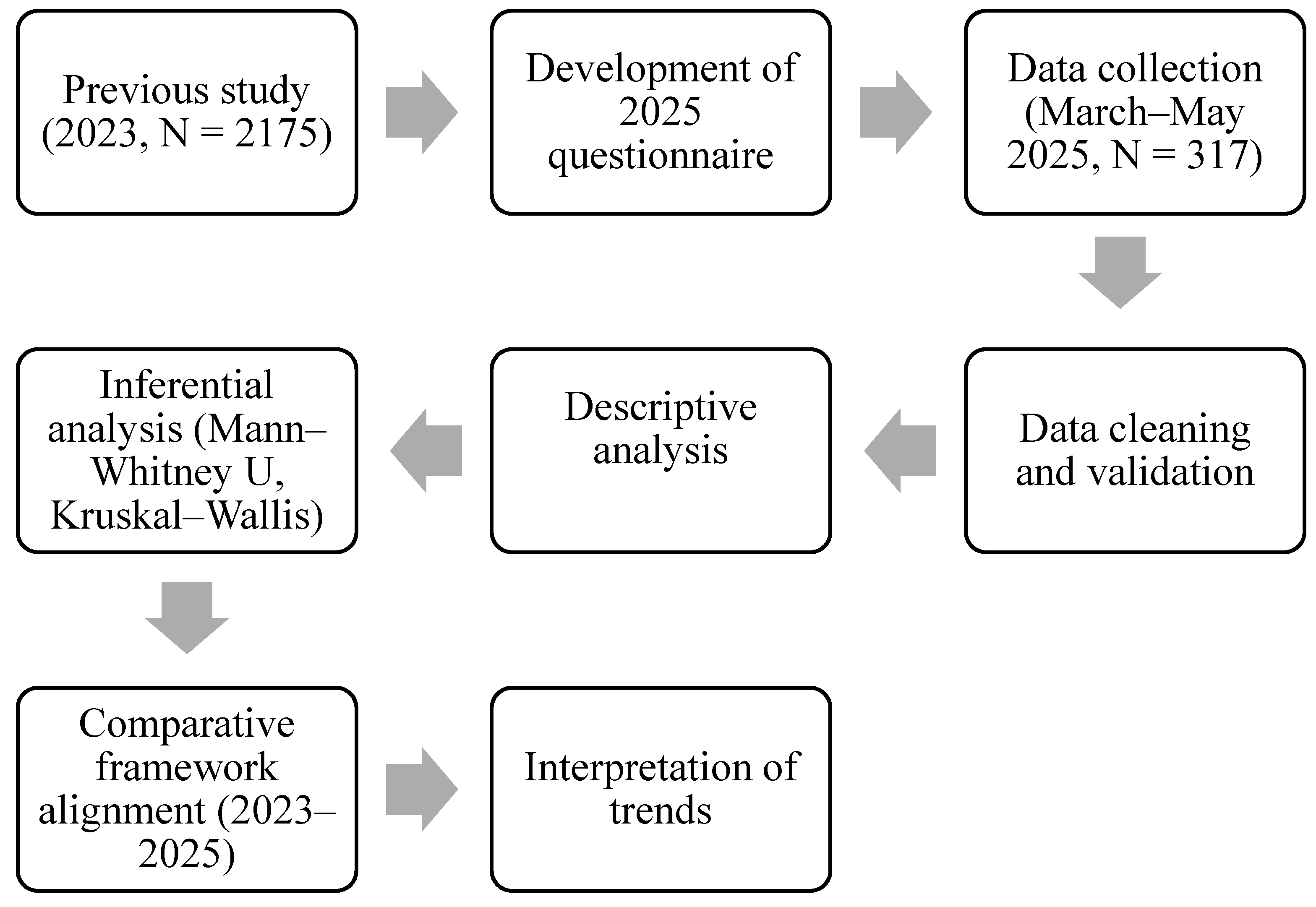
3.1. Research Design
3.2. Research Tool
- Demographic data: age, gender, length of teaching experience, approval, type of school, and region.
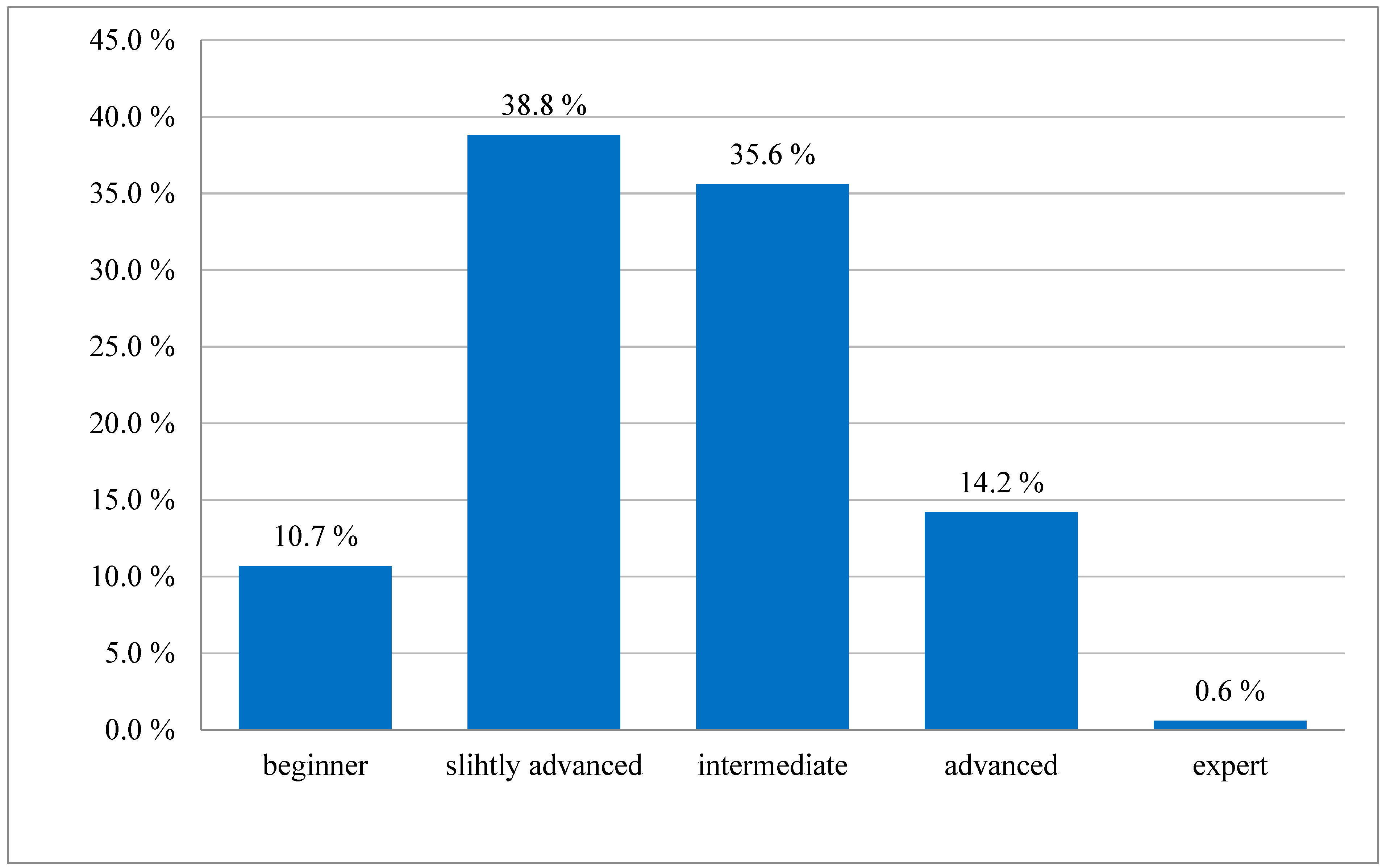
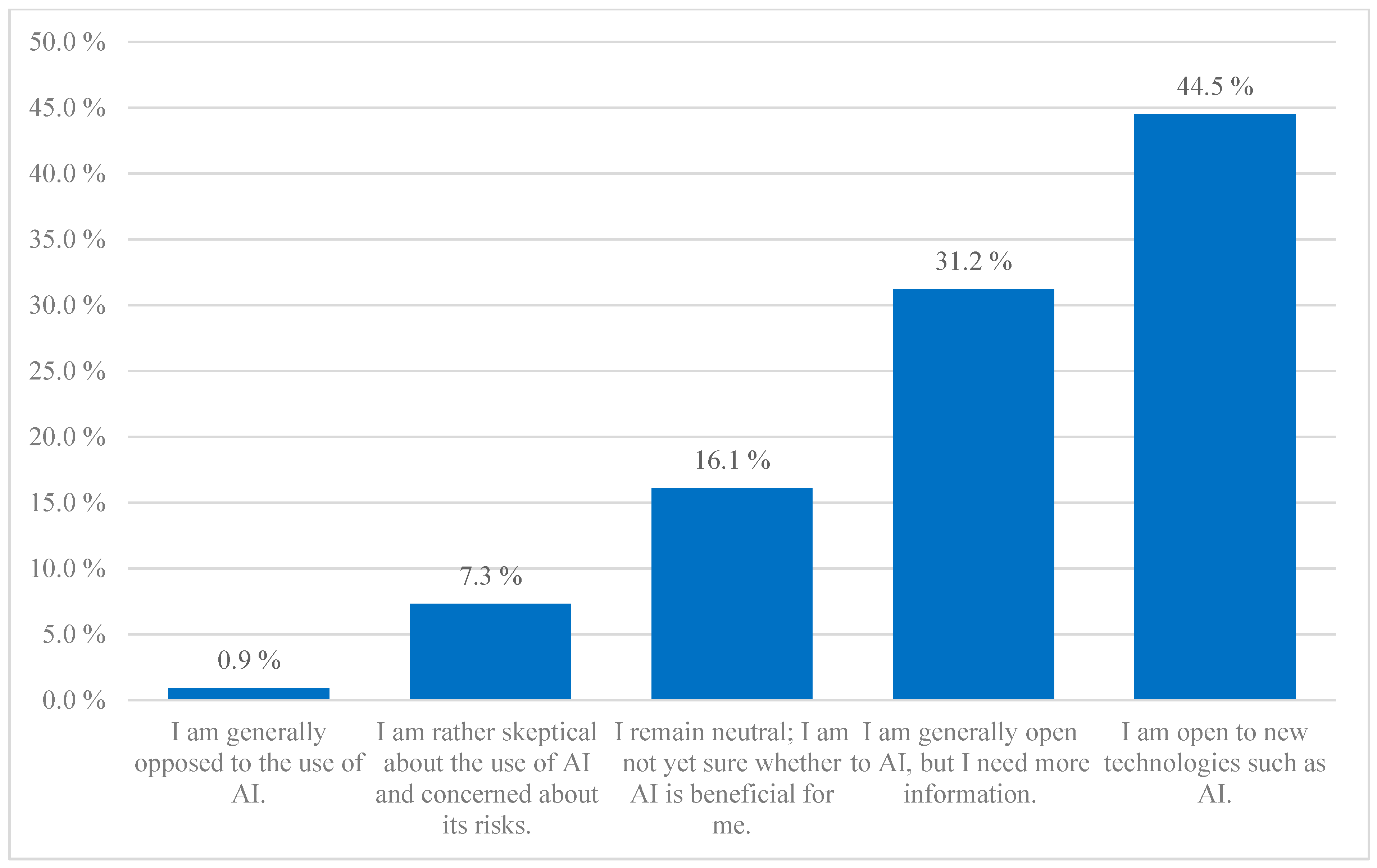
- Self-assessment of knowledge and attitudes towards AI: level of knowledge, personal approach, and experience with AI tools.
- Experience with AI: tools used, frequency of use (in preparation, in teaching, in personal life), reasons for not using them.
- Use of AI in the school context: purposes of use in lesson preparation, directly in the lesson, and forms of student involvement.
- Abuse of AI by students: teachers’ experiences with cheating cases, types of tasks, and tools.
- Support and education needs: type of preferred support, training, and institutional background.
- Attitudes towards AI: a set of statements reflecting benefits, risks, readiness, support from school management, perceived inevitability, and impact on the teaching profession.
3.3. Data Analysis
3.4. Data Collection and Research File
4. Results
4.1. Self-Assessment of Teachers’ Knowledge and Attitudes Towards AI
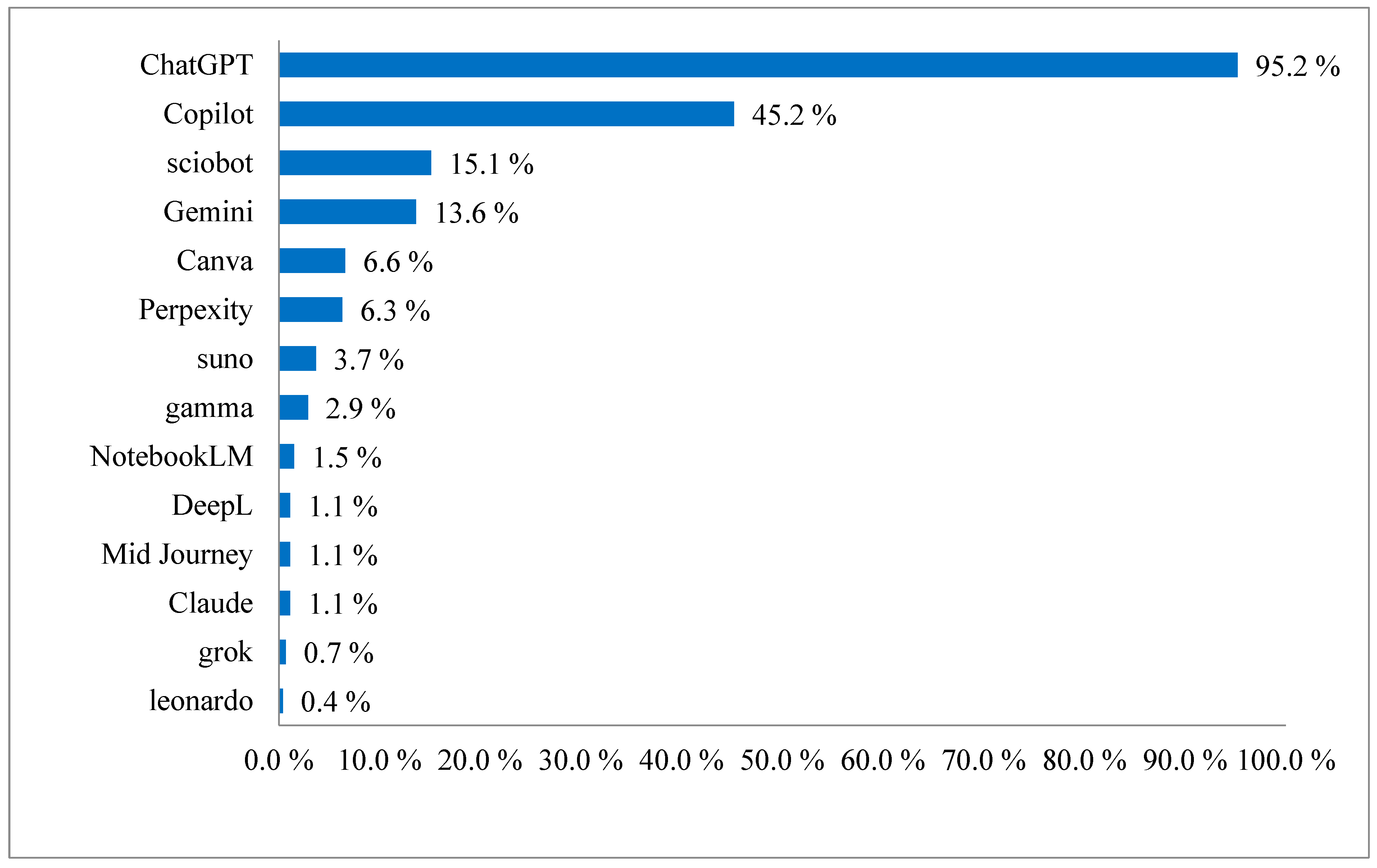
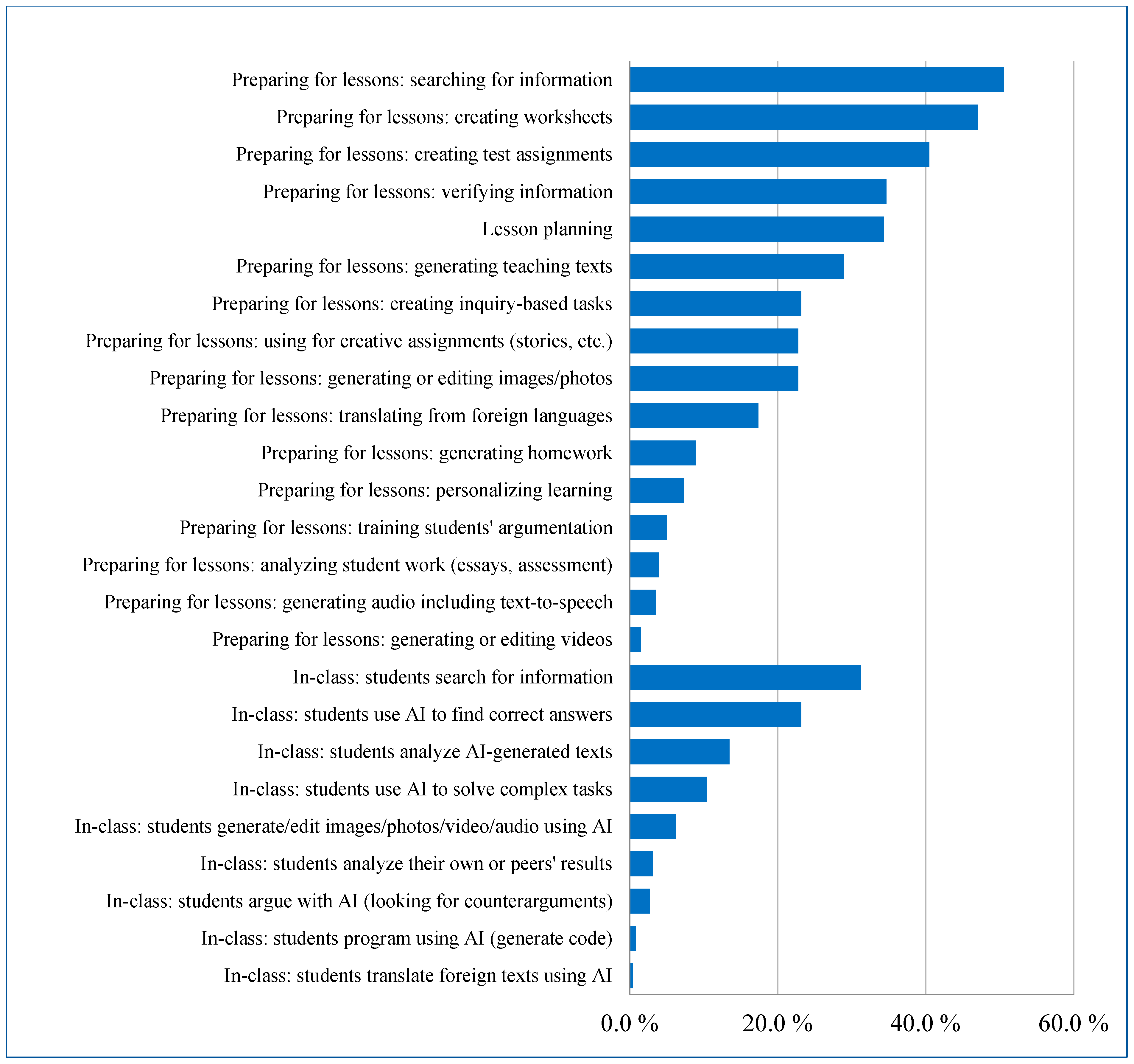
4.2. Using AI in Teaching
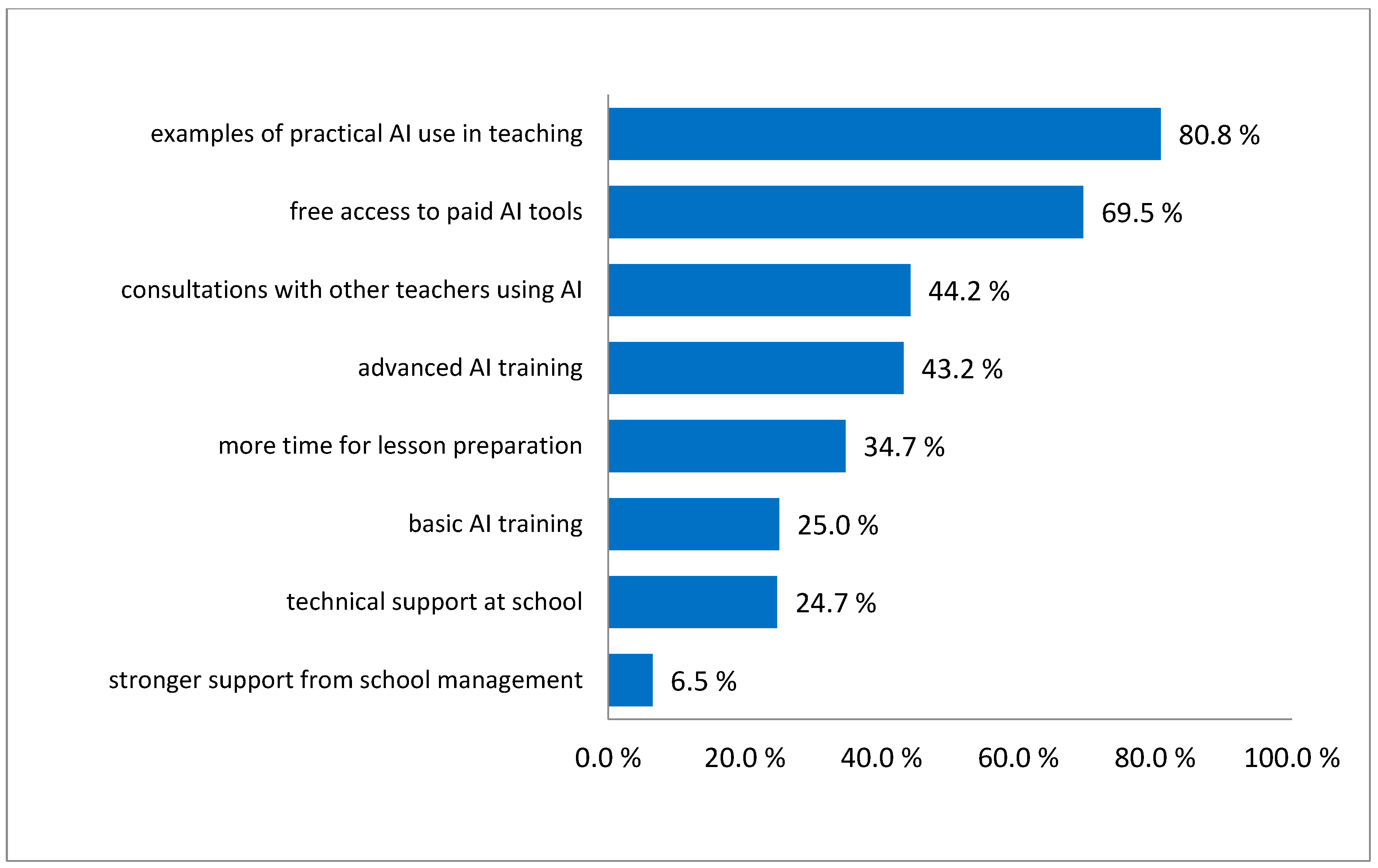
4.3. Barriers and Reasons for Not Using AI
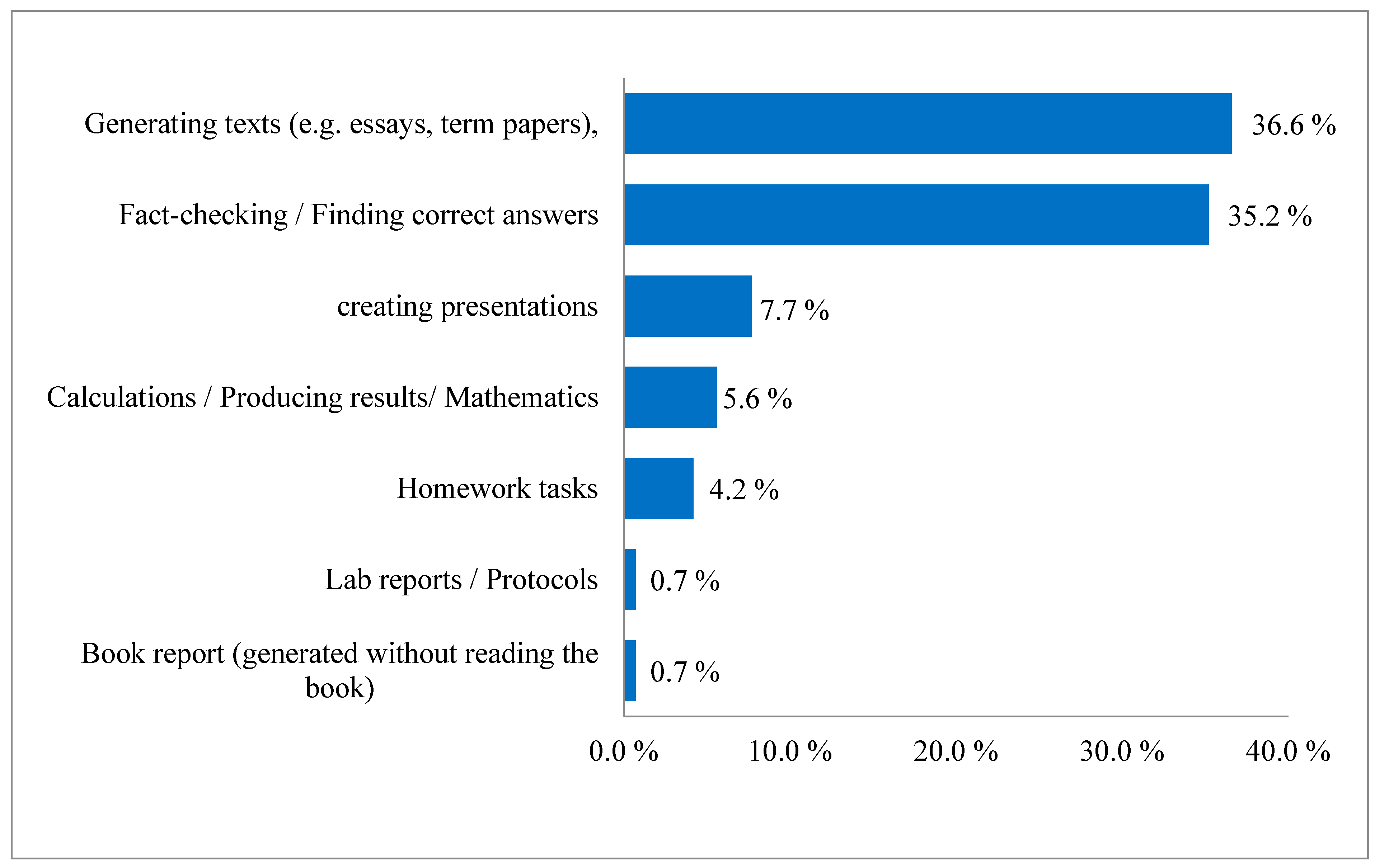
4.4. Misuse of AI by Students
4.5. Teachers’ Attitudes Towards AI
4.5.1. Positives and Benefits of AI in Education (S3, S4, S5, S8, S9, S10)
4.5.2. Concerns and Risks in the Work of a Teacher (S1, S2, S16, S17, S19)
4.5.3. Needs and Professional Changes (S13, S14, S15)
4.5.4. Institutional Support and Preparedness (S6, S7, S12)
4.5.5. The Inevitability of AI Involvement (S11) and Use of AI in Home Preparation by Students (S18)
4.5.6. Differences Between Groups
5. Discussion
5.1. Changing Attitudes and Readiness (RQ1)
5.2. Frequency and Purposes of AI Use (RQ2)
5.3. Barriers and Reasons for Non-Use (RQ3)
5.4. Student Misuse of AI (RQ4)
5.5. Transformation of the Teacher’s Role (RQ5)
5.6. Implications and Future Directions
6. Research Limits
7. Conclusions
Supplementary Materials
Author Contributions
Funding
Institutional Review Board Statement
Informed Consent Statement
Data Availability Statement
Conflicts of Interest
References
- Abd-alrazaq, A., AlSaad, R., Alhuwail, D., Ahmed, A., Healy, P. M., Latifi, S., Aziz, S., Damseh, R., Alrazak, S. A., & Sheikh, J. (2023). Large language models in medical education: Opportunities, challenges, and future directions. In JMIR medical education (Vol. 9). JMIR Publications, Inc. [Google Scholar] [CrossRef]
- Casal-Otero, L., Catala, A., Fernández-Morante, C., Taboada, M., Cebreiro, B., & Barro, S. (2023). AI literacy in K-12: A systematic literature review. International Journal of STEM Education, 10(1), 29. [Google Scholar] [CrossRef]
- Celik, I., Dindar, M., Muukkonen, H., & Järvelä, S. (2022). The promises and challenges of artificial intelligence for teachers: A systematic review of research. TechTrends, 66(4), 616–630. [Google Scholar] [CrossRef]
- Chen, R., Lee, V. R., & G Lee, M. (2025). A cross-sectional look at teacher reactions, worries, and professional development needs related to generative AI in an urban school district. Education and Information Technologies, 30(11), 16045–16082. [Google Scholar] [CrossRef]
- Chiu, T. K. F., Ahmad, Z., & Çoban, M. (2025). Development and validation of teacher artificial intelligence (AI) competence self-efficacy (TAICS) scale. Education and Information Technologies, 30(5), 6667–6685. [Google Scholar] [CrossRef]
- Delcker, J., Heil, J., & Ifenthaler, D. (2025). Evidence-based development of an instrument for the assessment of teachers’ self-perceptions of their artificial intelligence competence. Educational Technology Research and Development, 73(1), 115–133. [Google Scholar] [CrossRef]
- Ding, A.-C. E., Shi, L., Yang, H., & Choi, I. (2024). Enhancing teacher AI literacy and integration through different types of cases in teacher professional development. Computers and Education Open, 6, 100178. [Google Scholar] [CrossRef]
- Efe, R., & Aslan Efe, H. (2025). Science teachers’ perceptions of the artificial intelligence in science education: Challenges, readiness, benefits, and impact on student learning. Journal of Baltic Science Education, 24(4), 655–669. [Google Scholar] [CrossRef]
- Ghamrawi, N., Shal, T., & Ghamrawi, N. A. R. (2024). Exploring the impact of AI on teacher leadership: Regressing or expanding? Education and Information Technologies, 29(7), 8415–8433. [Google Scholar] [CrossRef]
- Heng, J. J. Y., Teo, D. B., & Tan, L. F. (2023). The impact of Chat Generative Pre-trained Transformer (ChatGPT) on medical education. Postgraduate Medical Journal, 99(1176), 1125–1127. [Google Scholar] [CrossRef] [PubMed]
- Kamalov, F., Calonge, D. S., & Gurrib, I. (2023). New era of artificial intelligence in education: Towards a sustainable multifaceted revolution. Sustainability, 15, 12451. [Google Scholar] [CrossRef]
- Kasneci, E., Sessler, K., Küchemann, S., Bannert, M., Dementieva, D., Fischer, F., Gasser, U., Groh, G., Günnemann, S., Hüllermeier, E., Krusche, S., Kutyniok, G., Michaeli, T., Nerdel, C., Pfeffer, J., Poquet, O., Sailer, M., Schmidt, A., Seidel, T., … Kasneci, G. (2023). ChatGPT for good? On opportunities and challenges of large language models for education. Learning and Individual Differences, 103, 102274. [Google Scholar] [CrossRef]
- Kazmaci, A., Cek, K., Altinay, F., Altinay, Z., & Dagli, G. (2025). Influence of theoretical and practical artificial intelligence knowledge on the primary school teachers’ sustainable AI integration ability: Mediating effects of beliefs and attitudes. Frontiers in Psychology, 16, 1628557. [Google Scholar] [CrossRef]
- Kim, J. (2024a). Leading teachers’ perspective on teacher-AI collaboration in education. Education and Information Technologies, 29(7), 8693–8724. [Google Scholar] [CrossRef]
- Kim, J. (2024b). Types of teacher-AI collaboration in K-12 classroom instruction: Chinese teachers’ perspective. Education and Information Technologies, 29(13), 17433–17465. [Google Scholar] [CrossRef]
- Kopecký, K., Szotkowski, R., Voráč, D., Krejčí, V., & Dobešová, P. (2023). Czech schools and artificial intelligence—research report. Pedagogická Fakulta Univerzity Palackého v Olomouci. Available online: https://www.e-bezpeci.cz/index.php/ke-stazeni/vyzkumne-zpravy/163-ceske-skoly-a-umela-inteligence-2023/file (accessed on 1 September 2025).
- Li, K., Wang, P., & Chen, G. (2025). How can AI be integrated into teacher professional development programs? A systematic review based on an adapted technology-based learning model. Teaching and Teacher Education, 168, 105219. [Google Scholar] [CrossRef]
- Nguyen, A., Ngo, H. N., Hong, Y., Dang, B., & Nguyen, B.-P. T. (2023). Ethical principles for artificial intelligence in education. Education and Information Technologies, 28(4), 4221–4241. [Google Scholar] [CrossRef]
- Shi, L., Ding, A.-C., & Choi, I. (2024). Investigating teachers’ use of an AI-enabled system and their perceptions of AI integration in science classrooms: A case study. Education Sciences, 14(11), 1187. [Google Scholar] [CrossRef]
- Tagare, D., Karki, T., & Yu, W. (2025). K-12 teachers’ ethical competencies for AI literacy: Insights from a systematic literature review. Computers & Education, 239, 105435. [Google Scholar] [CrossRef]
- Traga Philippakos, Z. A., & Rocconi, L. (2025). AI literacy: Elementary and secondary teachers’ use of AI-tools, reported confidence, and professional development needs. Education Sciences, 15(9), 1186. [Google Scholar] [CrossRef]
- Tripathi, T., Sharma, S. R., Singh, V., Bhargava, P., & Raj, C. (2025). Teaching and learning with AI: A qualitative study on K-12 teachers’ use and engagement with artificial intelligence. Frontiers in Education, 10, 1651217. [Google Scholar] [CrossRef]
- Velander, J., Taiye, M. A., Otero, N., & Milrad, M. (2024). Artificial Intelligence in K-12 education: Eliciting and reflecting on Swedish teachers’ understanding of AI and its implications for teaching & learning. Education and Information Technologies, 29(4), 4085–4105. [Google Scholar] [CrossRef]
- Viberg, O., Cukurova, M., Feldman-Maggor, Y., Alexandron, G., Shirai, S., Kanemune, S., Wasson, B., Tømte, C., Spikol, D., Milrad, M., Coelho, R., & Kizilcec, R. F. (2025). What explains teachers’ trust in AI in education across six countries? International Journal of Artificial Intelligence in Education, 35(3), 1288–1316. [Google Scholar] [CrossRef]
- Wang, J., Tang, Y., Hare, R., & Wang, F.-Y. (2023). Parallel intelligent education with ChatGPT. In Frontiers of information technology & electronic engineering. Zhejiang University Press. [Google Scholar] [CrossRef]
- Xiao, J., Yang, Y., & Li, M. (2025). Empirical study on the feasibility of hybrid-flexible training model for developing teachers’ artificial intelligence competence. Education and Information Technologies, 30(12), 16835–16860. [Google Scholar] [CrossRef]
- Yau, K. W., Chai, C. S., Chiu, T. K. F., Meng, H., King, I., & Yam, Y. (2023). A phenomenographic approach on teacher conceptions of teaching Artificial Intelligence (AI) in K-12 schools. Education and Information Technologies, 28(1), 1041–1064. [Google Scholar] [CrossRef]
- Yue, M., Jong, M. S.-Y., & Ng, D. T. K. (2024). Understanding K–12 teachers’ technological pedagogical content knowledge readiness and attitudes toward artificial intelligence education. Education and Information Technologies, 29(15), 19505–19536. [Google Scholar] [CrossRef]
- Zhang, D., Wijaya, T. T., Wang, Y., Su, M., Li, X., & Damayanti, N. W. (2025). Exploring the relationship between AI literacy, AI trust, AI dependency, and 21st century skills in preservice mathematics teachers. Scientific Reports, 15(1), 14281. [Google Scholar] [CrossRef] [PubMed]



| Research Theme | Key Findings in the Literature | Representative Studies | Identified Gaps Addressed in This Study |
|---|---|---|---|
| Teachers’ attitudes toward AI | Growing openness but persistent ethical concerns | (Viberg et al., 2025; Wang et al., 2023) | Need for longitudinal comparison after AI normalization |
| AI competencies and professional development | Training increases confidence and adoption | (Xiao et al., 2025; Yue et al., 2024) | Lack of comparative evidence over time |
| AI integration into teaching practice | AI used mainly for preparation rather than in-class instruction | (Efe & Aslan Efe, 2025; Tripathi et al., 2025) | Limited data on shift toward structured pedagogical use |
| Ethical concerns and student misuse | Concerns about misinformation and cheating | (Kasneci et al., 2023; Tagare et al., 2025) | Evolving nature of misuse in generative AI era |
| Institutional support and policy | School-level support predicts adoption | (Velander et al., 2024) | Insufficient comparative national-level evidence |
| (Statement) | Results (Kopecký et al., 2023) | Results 2025 (This Study) | M (2025) | Mdn (2025) | Interpretation/Trend |
|---|---|---|---|---|---|
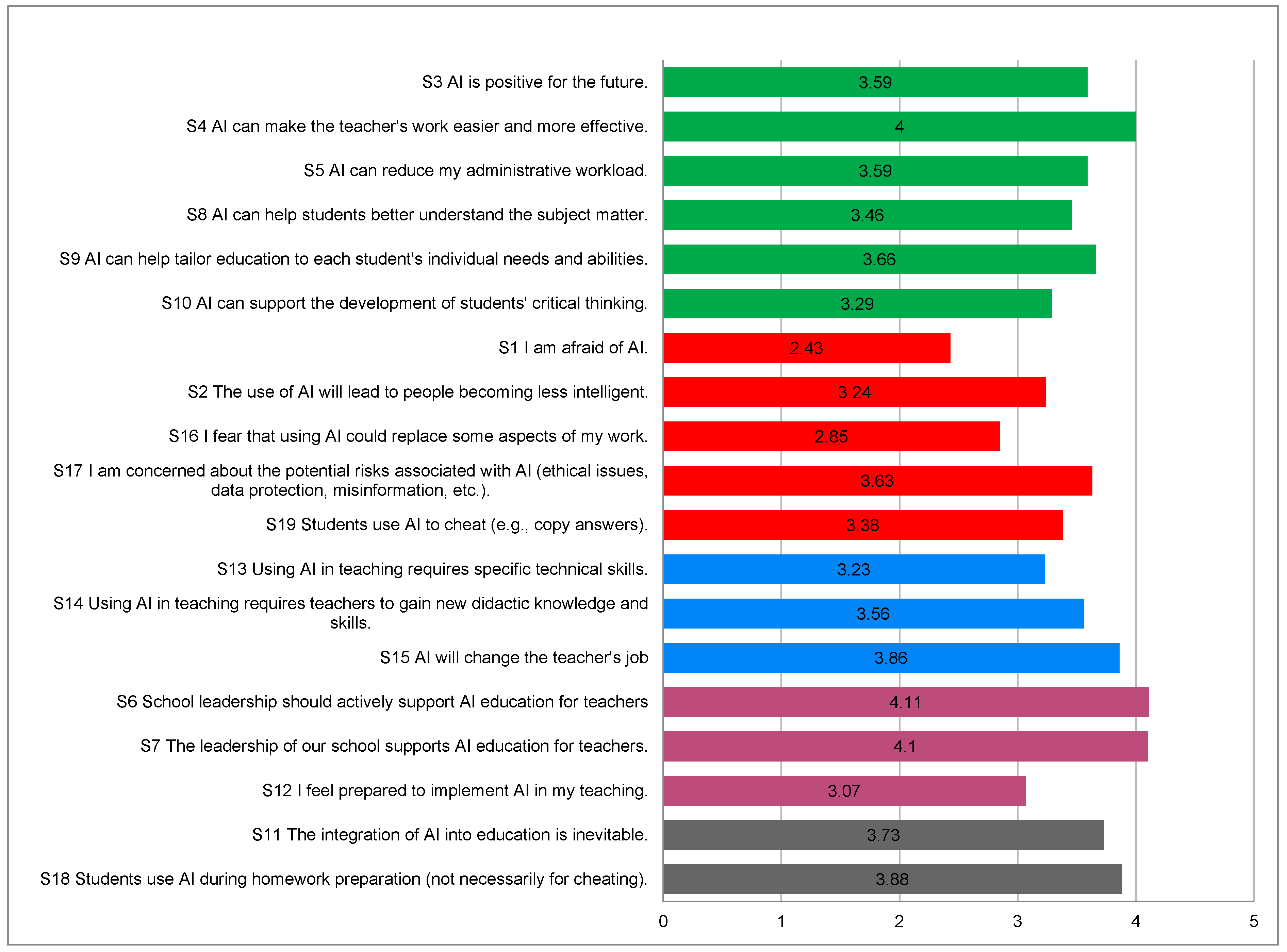
| S3: AI is positive for the future. | 45.5% agree/19.8% disagree | 58% agree/6% disagree | 3.59 | 4 | A clear shift toward greater optimism; AI is increasingly viewed as a natural and beneficial element of future education. |
| S4: AI can make the teacher’s work easier and more effective. | — | 82% agree/7% disagree | 4.00 | 4 | AI is broadly perceived as a practical pedagogical aid that enhances efficiency and supports teachers’ work. |
| S5: AI can reduce my administrative workload. | — | 59.6% agree/16.1% disagree | 3.59 | 4 | AI is seen as helpful for reducing routine administrative tasks, though its full potential in this area is still emerging. |
| S8: AI can help students better understand the subject matter. | — | 52.7% agree/14% disagree | 3.46 | 4 | AI is viewed as a supportive tool for improving student understanding and learning outcomes. |
| S9: AI can help tailor education to each student’s individual needs and abilities. | — | 59% agree/14% disagree | 3.66 | 4 | AI is increasingly recognized as a means of personalizing learning and addressing individual student needs. |
| S10: AI can support the development of students’ critical thinking. | — | 45.7% agree/22.7% disagree | 3.29 | 3 | Teachers acknowledge AI’s potential in fostering critical thinking, but many still view it as supplementary rather than central to this goal. |
| S1: I am afraid of AI. | 35.4% agree/30.1% disagree | 19% agree/61% disagree | 2.43 | 2 | Fear of AI has decreased substantially; teachers are more familiar with AI and therefore less apprehensive. |
| S2: The use of AI will lead to people becoming less intelligent. | 46.8% agree/27.6% disagree | 45% agree/25% disagree | 3.24 | 3 | Concerns about cognitive decline persist, although attitudes appear less emotionally driven and more reflective. |
| S16: I fear that using AI could replace some aspects of my work. | — | 29% agree/40% disagree | 2.85 | 3 | A realistic concern has emerged about partial automation of teaching tasks, though full replacement is not feared. |
| S17: I am concerned about the potential risks associated with AI (ethical issues, data protection, misinformation, etc.). | — | 62.1% agree/14.6% disagree | 3.63 | 4 | Heightened attention to ethical, data-security, and misinformation risks; educators expect clearer institutional guidance. |
| S19: Students use AI to cheat (e.g., copy answers). | 46.7% agree/25.2% disagree | 48% agree/20% disagree | 3.38 | 3 | Teachers are increasingly noticing abuse of AI; awareness of the risks has increased. |
| S13: Using AI in teaching requires specific technical skills. | — | 48.6% agree/29% disagree | 3.23 | 3 | Most teachers acknowledge the need for technical competencies to use AI effectively. |
| S14: Using AI in teaching requires teachers to gain new didactic knowledge and skills. | 82.3% agree/6.5% disagree | 61% agree/21% disagree | 3.56 | 4 | Didactic preparation remains essential, yet AI integration is increasingly perceived as manageable with appropriate support. |
| S15: AI will change the teacher’s job | 83.4% agree/4.9% disagree | 74% agree/9% disagree | 3.86 | 4 | Teachers still expect substantial changes to their profession, though predictions are now less dramatic and more pragmatic. |
| S6: School leadership should actively support AI education for teachers | 80.4% agree/4.4% disagree | 4.11 | 4 | Institutional support for teacher training in AI is widely viewed as essential. | |
| S7: The leadership of our school supports AI education for teachers. | 22.5% agree/26.8 disagree | 80% agree/6% disagree | 4.10 | 4 | Strong increase in perceived support from school leadership, signaling a systemic shift toward AI-inclusive school policy |
| S12: I feel prepared to implement AI in my teaching. | 24.2% agree/51.6% disagree | 44% agree/34% disagree | 3.07 | 3 | Growing sense of readiness, although a notable portion of teachers still require confidence-building and training. |
| S11: The integration of AI into education is inevitable. | — | 66% agree/10.8% disagree | 3.73 | 4 | AI integration is widely regarded as inevitable, though with greater emphasis on responsibility and ethical guardrails. |
| S18: Students use AI during homework preparation (not necessarily for cheating). | — | 71.9% agree/6.6% disagree | 3.88 | 4 | Student use of AI for learning has become routine, reflecting widespread adoption beyond the classroom. |
Disclaimer/Publisher’s Note: The statements, opinions and data contained in all publications are solely those of the individual author(s) and contributor(s) and not of MDPI and/or the editor(s). MDPI and/or the editor(s) disclaim responsibility for any injury to people or property resulting from any ideas, methods, instructions or products referred to in the content. |
© 2026 by the authors. Licensee MDPI, Basel, Switzerland. This article is an open access article distributed under the terms and conditions of the Creative Commons Attribution (CC BY) license.
Share and Cite
Marsalek, R.; Teplá, M. “Is AI Inevitable?” Development of Attitudes and Practices of Czech Teachers Between 2023 and 2025. Educ. Sci. 2026, 16, 335. https://doi.org/10.3390/educsci16020335
Marsalek R, Teplá M. “Is AI Inevitable?” Development of Attitudes and Practices of Czech Teachers Between 2023 and 2025. Education Sciences. 2026; 16(2):335. https://doi.org/10.3390/educsci16020335
Chicago/Turabian StyleMarsalek, Roman, and Milada Teplá. 2026. "“Is AI Inevitable?” Development of Attitudes and Practices of Czech Teachers Between 2023 and 2025" Education Sciences 16, no. 2: 335. https://doi.org/10.3390/educsci16020335
APA StyleMarsalek, R., & Teplá, M. (2026). “Is AI Inevitable?” Development of Attitudes and Practices of Czech Teachers Between 2023 and 2025. Education Sciences, 16(2), 335. https://doi.org/10.3390/educsci16020335