


The Sport Education Model in the Development of Psychosocial Factors in Primary School: A Systematic Review

 , and
, and 
Abstract
1. Introduction
2. Materials and Methods
2.1. Eligibility Criteria
2.2. Search Strategy
2.3. Study Selection and Data Processing
2.4. Quality Assessment
2.5. Data Collection
3. Results
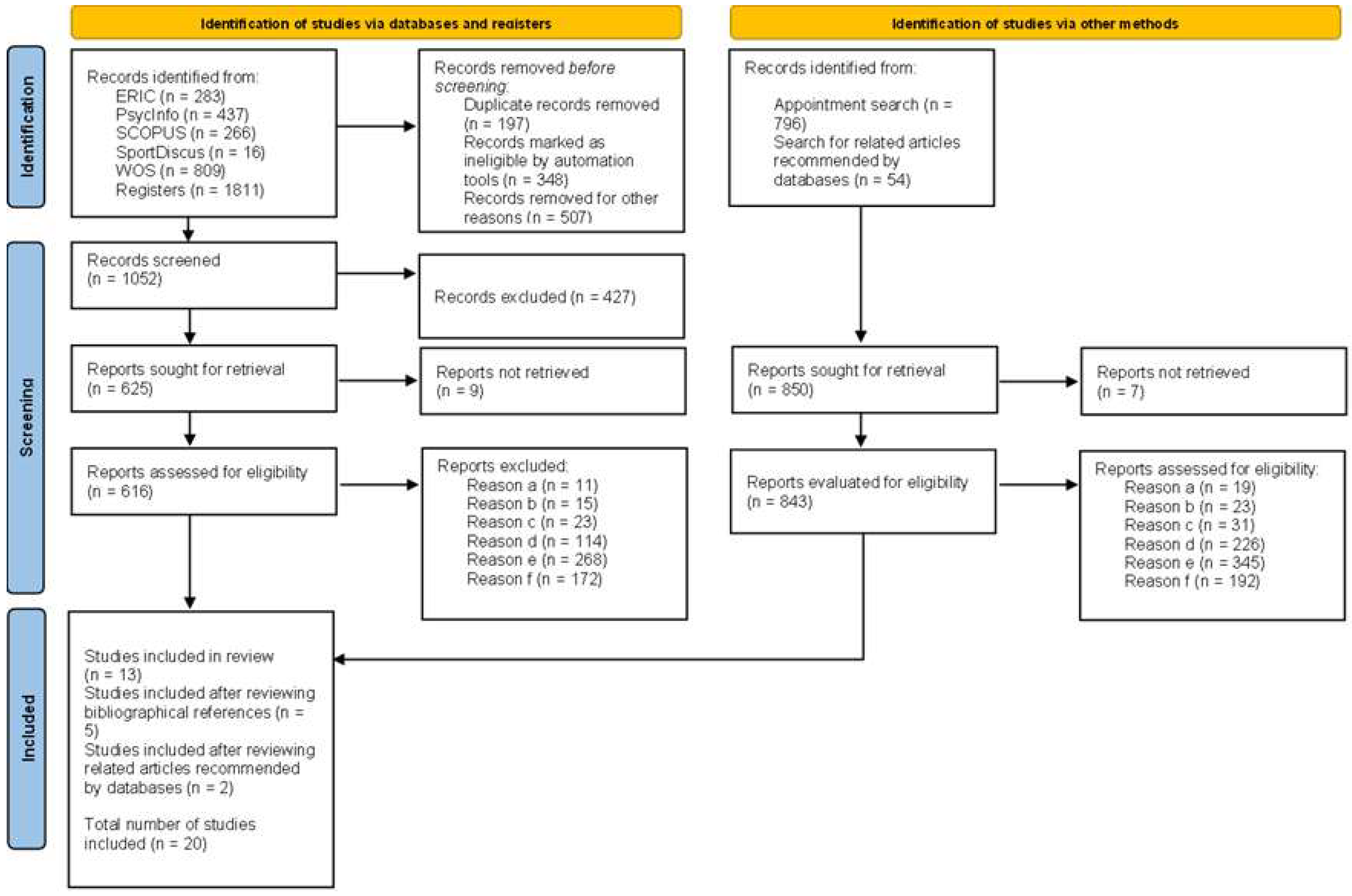
3.1. Study Selection
3.2. Study Quality
3.3. Characteristics of the Studies
4. Discussion
5. Conclusions
Author Contributions
Funding
Institutional Review Board Statement
Informed Consent Statement
Data Availability Statement
Conflicts of Interest
Abbreviations
| SEM | Sport Education Model |
| PE | Physical Education |
| SL | Service Learning |
| BPN | Basic Psychological Needs |
| DI | Direct Instruction |
| PROSPERO | Prospective International Register of Systematic Reviews |
| NR | No reported |
| NCG | No control group |
References
- Abellán, J., Segovia, Y., Gutiérrez, D., & García, L. M. (2022). Disability awareness through an integrated program of sport education and service-learning. Retos. Nuevas Tendencias en Educación Física, Deporte y Recreación, 43, 477–487. [Google Scholar] [CrossRef]
- Ander-Egg, E. (1995). Técnicas de investigación social (24th ed.). Lumen. [Google Scholar]
- Ang, S. C., & Penney, D. (2013). Promoting social and emotional learning outcomes in physical education: Insights from a school-based research project in Singapore. Asia-Pacific Journal of Health, Sport and Physical Education, 4(3), 267–286. [Google Scholar] [CrossRef]
- Aparicio, R., Sánchez, A., Cenizo, J. M., & Vázquez, F. J. (2024). The BigBall-X through a hybridization of models to contribute to SDG 5 and SDG 17 in Physical Education. Retos. Nuevas Tendencias en Educación Física, Deporte y Recreación, 56, 216–227. [Google Scholar] [CrossRef]
- Armada-Crespo, J. M., Montávez, M., & González, I. (2020). Influencia de la Expresión Corporal en el desarrollo de las Habilidades Socioafectivas en Educación Secundaria. Movimento (ESEFID/UFRGS), 26, e26080. [Google Scholar] [CrossRef]
- Baena-Morales, S., Ferriz-Valero, A., & García-Taino, O. (2022). Influence of cooperative strategies and mindfulness on the perception and control of emotions in primary physical education. A proposal to improve sustainability in the social dimension. Journal of Physical Education and Sport, 22(7), 1590–1598. [Google Scholar]
- Calderón, A., Hastie, P. A., & Martínez de Ojeda, D. (2010). Aprendiendo a enseñar mediante el Modelo de Educación Deportiva (Sport Education Model). Experiencia inicial en Educación Primaria. Cultura, Ciencia y Deporte, 5(15), 169–180. [Google Scholar] [CrossRef]
- Calderón, A., Martínez de Ojeda, D., Valverde, J. J., & Méndez-Giménez, A. (2016). “Ahora nos ayudamos más”: Docencia compartida y clima social de aula. Experiencia con el modelo de Educación. Deportiva. RICYDE. Revista Internacional de Ciencias Del Deporte, 12(44), 121–136. [Google Scholar] [CrossRef]
- Cecchini, J. A., Méndez-Giménez, A., & García-Romero, C. (2018). Validation of the Emotional Intelligence Questionnaire in Physical Education. Revista de Psicología del Deporte, 27(1), 87–96. [Google Scholar]
- Chen, G. M., & Starosta, W. J. (2000). The development and validation of the Intercultural Sensitivity Scale. Human Communication, 3(1), 2–14. [Google Scholar]
- da Costa, C. M., de Mattos, C. A., & Cuce, M. R. (2007). The PICO strategy for the research question construction and evidence search. Revista Latino-Americana de Enfermagem, 15(3), 508–511. [Google Scholar] [CrossRef]
- de Almeida, E., & Arantes, L. (2022). Necessidades psicológicas básicas e aulas de educação física: Potencialidades do sport education model. Humanidades & Inovação, 9(12), 128–140. [Google Scholar]
- Del Rey, R., Casas, J. A., & Ortega-Ruiz, R. (2017). The Development and Validation of the Schoolwide Climate Scale. Universitas Psychologica, 16(1), 275–285. [Google Scholar] [CrossRef]
- Fernández-Berrocal, P., Extremera, N., & Ramos, N. (2004). Validity and reliability of the Spanish modified version on the Trait Meta-Mood Scale. Psychological Reports, 94, 751–755. [Google Scholar] [CrossRef] [PubMed]
- Fernández-Bustos, J.-G., López, L. M. G., Gutiérrez, D., González-Martí, I., & Abellán, J. (2024). Impact of a service-learning and sport education program on social competence and learning. Educacion XX1, 27(2), 301–339. [Google Scholar] [CrossRef]
- Garaigordóbil, M. (2008). Intervención psicológica con adolescentes. Un programa para el desarrollo de la personalidad y la educación en derechos humanos. Pirámide. [Google Scholar]
- Garaigordóbil, M. (2009). A comparative analysis of empathy in childhood and adolescence: Gender differences and associated socio-emotional variables. International Journal of Psychology and Psychological Therapy, 9(2), 217–235. [Google Scholar]
- García-López, L. M., & Gutiérrez, D. (2015). The effects of a sport education season on empathy and assertiveness. Physical Education and Sport Pedagogy, 20(1), 1–16. [Google Scholar] [CrossRef]
- García-López, L. M., Gutiérrez, D., González-Víllora, S., & Valero-Valenzuela, A. (2012). Cambios en la empatía, la asertividad y las relaciones sociales por la aplicación del modelo de instrucción educación deportiva. Revista de Psicología Del Deporte, 21(2), 321–330. [Google Scholar]
- González, G., Ubago, J. L., Castro, M., García, I., & Sánchez, M. (2019). Prevención y tratamiento de lesiones lumbares con herramientas físico-médicas. Una revisión sistemática. Sportis. Scientific Journal of School Sport, Physical Education and Psychomotricity, 5(2), 232–249. [Google Scholar] [CrossRef]
- González-Cutre, D., Martínez Galindo, C., Alonso, N., Cervelló, E., Conte, L., & Moreno, J. A. (2007). Las creencias implícitas de habilidad y los mediadores psicológicos como variables predictoras de la motivación autodeterminada en deportistas adolescentes. In J. Castellano, & O. Usabiaga (Eds.), Investigación en la Actividad Física y el Deporte II (pp. 407–417). Universidad del País Vasco. [Google Scholar]
- Gómez-Ortiz, O., Romera-Félix, E. M., & Ortega-Ruiz, R. (2017). Multidimensionalidad de la competencia social: Medición del constructo y su relación con los roles del bullying. Revista de Psicodidáctica, 22(1), 37–44. [Google Scholar] [CrossRef]
- Guijarro, E., Rocamora, I., Evangelio, C., & González Víllora, S. (2020). Sport education model in Spain: A systematic review. Retos. Nuevas Tendencias en Educación Física, Deporte y Recreación, 38, 886–894. [Google Scholar] [CrossRef]
- Gutierrez, D., & García-López, L. M. (2012). Gender differences in game behaviour in invasion games. Physical Education & Sport Pedagogy, 17(3), 289–301. [Google Scholar] [CrossRef]
- Gutiérrez, D., García-López, L. M., Hastie, P., & Calderón, A. (2013). Spanish students’ perceptions of their participation in season of Sport Education. The Global Journal of Health and Physical Education Pedagogy, 2(2), 111–127. [Google Scholar]
- Gutiérrez, D., Segovia, Y., García-López, L. M., & Fernández-Bustos, J. G. (2019). Service-learning integrated into the sport education model as a facilitator of the transition to secondary education. Publicaciones de La Facultad de Educacion y Humanidades del Campus de Melilla, 49(4), 89–110. [Google Scholar] [CrossRef]
- Hastie, P., & Sinelnikov, O. A. (2006). Russian students’ participation in and perceptions of a season of sport education. European Physical Education Review, 12, 131–150. [Google Scholar] [CrossRef]
- Hay, I. (2008). Physical activity and sport profile. Faculty of Education, University of Tasmania. [Google Scholar]
- Hellison, D. (2011). Teaching personal and social responsibility through physical activity. Human Kinetics. [Google Scholar]
- Hoyo-Guillot, A., Fernández, F. T. G., & Ruíz-Montero, P. J. (2025). Effects of sport education model and physical fitness on motivation and prosociality for a healthy approach in secondary students using an experimental design. Sports, 13(8), 274. [Google Scholar] [CrossRef]
- Kellis, I., Vernadakis, N., Albanidis, E., Derri, V., & Kourtesses, T. (2010). The development of a student´s behaviors’self-evaluation scale (SBSS) in multicultural physical education class settings. Educational Research and Review, 5(11), 637–645. [Google Scholar]
- Kmet, L. M., Lee, R. C., & Cook, L. S. (2004). Standard quality assessment criteria for evaluating primary research papers from a variety of fields. Alberta Heritage Foundation for Medical Research. [Google Scholar]
- Koo, T. K., & Li, M. Y. (2016). A guideline of selecting and reporting intraclass correlation coefficients for reliability research. Journal of Chiropractic Medicine, 15(2), 155–163. [Google Scholar] [CrossRef] [PubMed]
- Mahedero, M. (2020). El modelo de educación deportiva. In B. Sánchez-Alcaraz, A. Valero, D. Navarro, & A. Merino (Eds.), Metodologías emergentes en educación física (pp. 161–172). Wanceulen. [Google Scholar]
- Martínez de Ojeda, D., Méndez-Giménez, A., & Valverde, J. (2016). Efectos del modelo educación deportiva en el clima social del aula, la competencia percibida y la intención de ser físicamente activo: Un estudio prolongado en primaria. SPORTTK: Revista Euroamericana de Ciencias Del Deporte, 5(2), 153–166. [Google Scholar]
- Martínez de Ojeda, D., Puente-Maxera, F., Méndez-Giménez, A., & Mahedero-Navarrete, M. P. (2019). Initial experience with the Sport Education model in primary school first-grade. Students and teachers’ perceptions. Retos. Nuevas Tendencias en Educación Física, Deporte y Recreación, 36, 203–210. [Google Scholar] [CrossRef]
- Martorell, C., González, R., Ordóñez, A., & Gómez, O. (2011). Estudio confirmatorio del cuestionario de conducta prosocial (CP) y su relación con variables de personalidad y socialización. Revista Iberoamericana de Diagnóstico y Evaluación, 32(2), 35–52. [Google Scholar]
- Martorell, M. C., & González, R. (1992). Cuestionario de conducta antisocial. Universidad de Valencia. [Google Scholar]
- Méndez-Giménez, A. (2014). Modelos de enseñanza y síntesis de las investigaciones recientes. In A. Méndez-Giménez (Ed.), Modelos de enseñanza en educación física. Ciclo Grupo 5. [Google Scholar]
- Méndez-Giménez, A., Martínez de Ojeda-Pérez, D., & Valverde-Pérez, J. J. (2017). Inteligencia emocional y mediadores motivacionales en una temporada de Educación Deportiva sobre mimo. Ágora Para la Educación Física y el Deporte, 19(1), 52–72. [Google Scholar] [CrossRef]
- Michelson, L., & Wood, R. (1982). Development and psychometric properties of the Children’s Assertive Behavior Scale. Journal of Behavioral Assessment, 4(1), 3–13. [Google Scholar] [CrossRef]
- Moher, D., Shamseer, L., Clarke, M., Ghersi, D., Liberati, A., Petticrew, M., Shekelle, P., & Stewart, L. A. (2015). Preferred reporting items for systematic review and meta-analysis protocols (PRISMA-P) 2015 statement. Systematic Reviews, 4(1), 1. [Google Scholar] [CrossRef]
- Mohr, D. J., Townsend, J. S., Rairigh, R., & Mohr, C. (2003). Students’ perceptions of Sport Education when taught using the pedagogical approach to Sport Education (PASE) planning and instructional framework. Research Quarterly for Exercise and Sport, 74, A51–A52. [Google Scholar]
- Molina, M., Gutiérrez, D., Segovia, Y., & Hopper, T. (2020). The sport education model in a rural school: Friendship, responsibility and psychological basic needs. Retos. Nuevas Tendencias en Educación Física, Deporte y Recreación, 83, 291–299. [Google Scholar]
- Molina, M., Segovia, Y., & Gutiérrez, D. (2023). Propuesta de una temporada de educación deportiva multinivel: Aplicación en la escuela rural. Journal of Sport and Health Research, 15(1), 131–150. [Google Scholar] [CrossRef]
- Montero-Carretero, C., Barbado, D., & Cervelló, E. (2020). Predicting Bullying through motivation and teaching styles in physical education. International Journal of Environmental Research and Public Health, 17(1), 87. [Google Scholar] [CrossRef] [PubMed]
- Moreno, J. A., López, M., Martínez Galindo, C. M., Alonso, N., & González-Cutre, D. (2007a). Validación preliminar de la escala de percepción del clima motivacional de los iguales (CMI) y la escala de las orientaciones de meta en el ejercicio (GOES) con practicantes españoles de actividades físico-deportivas. Revista Iberoamericana de Psicología del Ejercicio y el Deporte, 1(2), 13–28. [Google Scholar]
- Moreno, J. A., Moreno, R., & Cervelló, E. (2007b). The physical self-concept as predictor of the intention of being physically active. Psicología y Salud, 17(2), 261–267. [Google Scholar]
- Moreno, J. L. (1972). Fundamentos de la sociometría. Paidós. [Google Scholar]
- Murillo-Pulido, J. L., Amar-Cantos, F. E., Aguilar-Herrero, M. D., Rodríguez-Cano, A., & Armada-Crespo, J. M. (2025). Emotional intelligence in physical education in primary education: A systematic review. Healthcare, 13(23), 3166. [Google Scholar] [CrossRef] [PubMed]
- Page, M. J., McKenzie, J. E., Bossuyt, P. M., Boutron, I., Hoffmann, T. C., Mulrow, C. D., Shamseer, L., Tetzlaff, J. M., & Moher, D. (2021). Updating guidance for reporting systematic reviews: Development of the PRISMA 2020 statement. Journal of Clinical Epidemiology, 134, 103–112. [Google Scholar] [CrossRef] [PubMed]
- Pelegrín, A., Garcés, E., & Cantón, E. (2010). Estudio de conductas prosociales y antisociales. Comparación entre niños y adolescentes que practican y no practican deporte. Informació Psicològica, 99, 64–78. [Google Scholar]
- Pérez, A., Ramos, G., & López, E. (2009). Diseño y análisis de una escala para la valoración de la variable clima social aula en alumnos de Educación Primaria y Secundaria. Revista de Educación, 350, 221–252. [Google Scholar]
- Pérez-Pueyo, Á., Hortigüela-Alcalá, D., & Fernández-Río, J. (2021). Los modelos pedagógicos en educación física: Qué, cómo, por qué y para qué. Universidad de León. [Google Scholar]
- Puente-Maxera, F., Martínez de Ojeda, D., Méndez-Giménez, A., Valverde, J. J., & Jiménez-Martínez, I. (2023). Effects of a sport education season of an alternative sport on school climate, emotional intelligence, and perceived competence of elementary school students in a culturally diverse context. Retos. Nuevas Tendencias en Educación Física, Deporte y Recreación, 50, 1019–1028. [Google Scholar] [CrossRef]
- Puente-Maxera, F., Méndez-Giménez, A., & Martínez de Ojeda Pérez, D. (2018a). Efectos del modelo de educación deportiva sobre la interculturalidad: El papel del alumno-entrenador en estudiantes de primaria. ESPIRAL. Cuadernos del Profesorado, 11(22), 1–14. [Google Scholar] [CrossRef]
- Puente-Maxera, F., Méndez-Giménez, A., & Martínez de Ojeda Pérez, D. (2018b). Sport education model and roles’ dynamics. Effects of an intervention on motivational variables of elementary school’s students. Cultura, Ciencia y Deporte, 13(39), 281–290. [Google Scholar] [CrossRef]
- Rivera-Mancebo, M. C., Gutiérrez, D., Segovia, Y., & Valcárcel, J. V. (2020). Effect of the sport education model on prosocial behavior in primary. Cultura, Ciencia y Deporte, 15(46), 561–574. [Google Scholar] [CrossRef]
- Rocamora, I., González-Víllora, S., Fernández-Río, J., & Arias-Palencia, N. M. (2019). Physical activity levels, game performance and friendship goals using two different pedagogical models: Sport education and direct instruction. Physical Education and Sport Pedagogy, 24(1), 87–102. [Google Scholar] [CrossRef]
- Ryan, R. M., & Deci, E. L. (2002). Overview of self-determination theory: An organismic dialectical perspective. In E. L. Deci, & R. M. Ryan (Eds.), Handbook of self-determination research (pp. 3–33). The University of Rochester. [Google Scholar]
- Sánchez-Queija, I., García-Moya, I., & Moreno, C. (2017). Trend analysis of bullying victimization prevalence in spanish adolescent youth at school. Journal of School Health, 87(6), 457–464. [Google Scholar] [CrossRef]
- Segovia, Y., & Gutiérrez, D. (2018). Efecto de una unidad didáctica de educación deportiva por proyectos sobre las relaciones sociales y nivel de autonomía. EmásF. Revista Digital de Educación Física, 9(51), 89–103. [Google Scholar]
- Segura, M. (1994). Habilidades sociales en la escuela. Fundación ECCA. [Google Scholar]
- Siedentop, D., Hastie, P., & Van der Mars, H. (2019). Complete guide to sport education. Human Kinetics. [Google Scholar]
- Sierra-Díaz, M. J., Evangelio, C., Pérez-Torralba, A., & González-Víllora, S. (2018). Hacia un comportamiento más social y cooperativo en educación física: Aplicación del modelo de educación deportiva. SPORT TK-Revista EuroAmericana de Ciencias del Deporte, 7, 83–91. [Google Scholar] [CrossRef]
- Sierra-Díaz, M. J., González-Víllora, S., Pastor-Vicedo, J. C., & López-Sánchez, G. F. (2019). Can we motivate students to practice physical activities and sports through models-based practice? A systematic review and meta-analysis of psychosocial factors related to physical education. Frontiers in Psychology, 10, 2115. [Google Scholar] [CrossRef]
- Vera-Fernández, D., Pizarro-Mateo, D., & Valero-Valenzuela, A. (2025). Efectos de un programa hibridado entre el Modelo de Educación Deportiva y el Modelo Ludotécnico sobre la motivación y la intención de ser físicamente activo en Educación Física en la Educación Secundaria. Publicaciones, 55(1), 81–101. [Google Scholar] [CrossRef]
- Vlachopoulos, S. P., & Michailidou, S. (2006). Development and initial validation of a mesaure of autonomy, competence, and relatedness in exercise: The basic psychological needs in exercise scale. Measurement in Physical Education and Exercise Science, 10(3), 179–201. [Google Scholar] [CrossRef]
- WHO. (1996). Introduction. In Life skills education planning for research as an integral part of life skills education development, implementation and maintenance (pp. 1–12). World Health Organization (WHO). [Google Scholar]
- WHO. (1997). Introduction to life skills for psychosocial competence. In Life skills education for children and adolescents in schools (pp. 1–8). World Health Organization (WHO). [Google Scholar]
- Zhang, J., Geok Soh, K., Bai, X., Mohd Anuar, M. A., & Xiao, W. (2024). Optimizing learning outcomes in physical education: A comprehensive systematic review of hybrid pedagogical models integrated with the Sport Education Model. PLoS ONE, 19(12), E0311957. [Google Scholar] [CrossRef]

| Studies | Observer 1 | Observer 2 |
|---|---|---|
| García-López et al. (2012) | 0.90 | 0.75 |
| Ang and Penney (2013) | 0.95 | 0.90 |
| García-López and Gutiérrez (2015) | 0.90 | 0.75 |
| Calderón et al. (2016) | 0.90 | 0.80 |
| Martínez de Ojeda et al. (2016) | 0.90 | 0.75 |
| Méndez-Giménez et al. (2017) | 0.85 | 0.75 |
| Puente-Maxera et al. (2018a) | 0.95 | 0.80 |
| Puente-Maxera et al. (2018b) | 0.85 | 0.70 |
| Segovia and Gutiérrez (2018) | 0.80 | 0.65 |
| Sierra-Díaz et al. (2018) | 0.88 | 0.75 |
| Gutiérrez et al. (2019) | 0.80 | 0.75 |
| Martínez de Ojeda et al. (2019) | 0.85 | 0.80 |
| Rocamora et al. (2019) | 0.90 | 0.80 |
| Molina et al. (2020) | 0.90 | 0.80 |
| Rivera-Mancebo et al. (2020) | 0.85 | 0.75 |
| Abellán et al. (2022) | 0.90 | 0.80 |
| de Almeida and Arantes (2022) | 0.85 | 0.80 |
| Molina et al. (2023) | 0.85 | 0.75 |
| Puente-Maxera et al. (2023) | 0.92 | 0.80 |
| Fernández-Bustos et al. (2024) | 0.86 | 0.75 |
| Author(s) | Country | Subjects | Age | Methodology | Type of Study | Duration | Protocol | |
|---|---|---|---|---|---|---|---|---|
| Control Group | Experimental Group | |||||||
| García-López et al. (2012) | Spain | 21 students (10 boys/11 girls) | 10 to 11 years | Mixed | Quasi-experimental | 18 sessions | NR | The intervention was divided into pre-season, regular season and final phase. The teams, consisting of five or six players, rotated roles as coach, physical trainer and referee. |
| Ang and Penney (2013) | Singapore | 256 students (140 boys/116 girls) | 10 to 12 years | Mixed | Quasi-experimental | 15 weeks (15 sessions—60 min) | NR | Over 15 weeks, organised into three phases (teacher-led, responsibility-taking, and student-led), an Ultimate Frisbee season was used to strengthen confidence, emotional and social skills, and coping with defeat. The students had no previous experience in SEM and no developed social and emotional skills. |
| García-López and Gutiérrez (2015) | Spain | 154 students (76 boys/78 girls) | 11 to 14 years | Mixed | Quasi-experimental | 18 sessions (60 min) | NR | A handball programme based on the Sports Education model was implemented. The programme was carried out in co-educational teams of five players, with assigned roles (coach, physical trainer, referee, etc.). The teams were selected by the students through a draft system, and the weekly meetings of the teachers were recorded to resolve doubts and share solutions. |
| Calderón et al. (2016) | Spain | 112 students (60 boys/47 girls) | 9.85 (±1.20) | Mixed | Quasi-experimental | 10 sessions (60 min) | Two classes received SEM with traditional grouping, one teacher per class | Four classes experienced the application of SEM with shared teaching, i.e., with two teachers per class |
| Martínez de Ojeda et al. (2016) | Spain | 51 students (34 boys/17 girls) | 8.86 (±0.75) | Mixed | Quasi-experimental | 10 sessions (60 min) | NR | Work was carried out with football and handball, organising students into teams with assigned roles (coach, physical trainer, journalist and equipment manager), using co-teaching and rotation so that everyone also took on the roles of referee and scorekeeper. |
| Méndez-Giménez et al. (2017) | Spain | 94 students (50 boys/44 girls) | 11.62 (±0.79) | Mixed | Quasi-experimental | 12 sessions (60 min) | The teachers in charge of teaching did not use SEM. They developed introductory sports teaching units | with previous experience in SEM, experienced a season of mime structured around the characteristic phases of the model: Introductory, Guided, Independent Practice with Student Director, Independent Practice with Duty Team, and Final Competition |
| Puente-Maxera et al. (2018a) | Spain | 18 students (18 children) | 11.65 (±0.76) | Mixed | Quasi-experimental | 10 sessions (60 min) | NR | An ultimate frisbee teaching unit was developed in five phases (Introductory, Guided, Independent Practice, Formal Competition, and Final Event), with groups formed according to learning level and nationality. Each team assumed the roles of coach, physical trainer, equipment manager, occupational risk manager, referee, and scorekeeper. |
| Puente-Maxera et al. (2018b) | Spain | 36 students (17 boys/19 girls) | 11 to 13 years | Mixed | Quasi-experimental | 10 sessions (60 min) | Group B developed a handball teaching unit using SEM with weekly role rotations. It included the usual SEM phases: Introductory, Directed, Independent Practice, Formal Competition, and Final Event. | Group “A” carried out a teaching unit on handball using SEM, without role rotation. The unit consisted of five phases: Introductory, Guided, Independent Practice, Formal Competition, and Final Event. The units included introductory sessions, guided sessions, independent sessions, competitions, and a final celebration. In Years 3 and 4, pichi was played, and in Years 5 and 6, handball was practised. |
| Segovia and Gutiérrez (2018) | Spain | 47 students (22 boys/25 girls) | 11 to 12 years | Mixed | Quasi-experimental | 21 sessions | NR | A unit on “Traditional Games Around the World” was implemented using SEM and Project-Based Learning, divided into three phases: interdisciplinary preparation, development with a league and final tournament, and communication, where students taught games during recess. Heterogeneous teams took on the roles of referee, coach, and journalist, promoting the inclusion of a student with special educational needs. |
| Sierra-Díaz et al. (2018) | Spain | 51 students (28 boys/23 girls) | 10.72 (±0.76) | Quantitative | Experimental | 8 sessions (60 min) | Group B developed strategies focused on individual improvements | Group A developed a floorball teaching unit using SEM aimed at promoting prosocial behaviour |
| Gutiérrez et al. (2019) | Spain | 142 primary school students 64 secondary and sixth form students | NR | Mixed | Quasi-experimental | 15 sessions | NR | The programme was implemented in five educational centres with a teaching unit focused on ringo, using the SEM model and integrating Service-Learning (SL) actions. |
| Martínez de Ojeda et al. (2019) | Spain | 18 students (10 boys/8 girls) | 6.61 (±0.50) | Mixed | Quasi-experimental | 10 sessions (60 min) | NR | A teaching unit on “pichi” was developed in five phases: Introductory, Directed, Independent Practice, Formal Competition, and Final Event. Students were organised into mixed teams according to ability, gender, and origin, assuming roles as players, coach, equipment manager, health manager, physical trainer, referees, and scorekeepers. |
| Rocamora et al. (2019) | Spain | 88 students (44 boys/44 girls) | 11.16 (±0.63) | Mixed | Experimental | 15 sessions (45 min) | A 15-session handball teaching unit was carried out using Direct Instruction (DI), with classes structured into warm-up, main part and cool-down, focused on technical and tactical learning, without autonomy or roles for the students | SEM-based programme is divided into pre-season, season and final event. Students, organised into mixed teams, took on roles as players, captains and referees, participating in formal competitions and recreational activities to encourage affiliation and commitment. |
| Molina et al. (2020) | Spain | 24 students | 10.12 (±1.29) | Mixed | Quasi-experimental | 18 sessions (45 min) | NR | A basketball season based on the structure and identity aspects of SEM, where content teaching was organised around ECD |
| Rivera-Mancebo et al. (2020) | Spain | 45 students (18 boys/27 girls) | 11.44 (±0.50) | Mixed | Pre-experimental | 15 sessions (45 min) | NR | A season of ringo with SEM, divided into three phases: pre-season, regular season and final phase. The students, organised into mixed teams, took on roles such as coach and referee, promoting social interactions and prosocial behaviour. |
| Abellán et al. (2022) | Spain | 101 Primary school pupils 80 secondary school students (84 boys/97 girls) | 11.86 (±2.05) | Qualitative | Quasi-experimental | 14 sessions (30 min) | NR | Educational intervention combining SEM and SL with sitting volleyball to raise awareness about disability. The project was divided into four phases: design, teacher training, implementation, and evaluation through interviews. Teachers received theoretical and practical training on SEM and SL |
| de Almeida and Arantes (2022) | Brazil | 17 students (11 boys/6 girls) | NR | Qualitative | Quasi-experimental | 20 sessions (120 min) | NR | Throughout the sessions, a SEM season was developed based on athletics and, more specifically, on endurance running, high jump and javelin throw. The structure of the intervention was divided into four phases: Introduction, Pre-season, Season and Final Event. |
| Molina et al. (2023) | Spain | 24 students (6 boys/18 girls) | 11.12 (±1.29) | Mixed | Quasi-experimental | 18 sessions (45 min) | NR | The basketball programme, implemented with SEM. The teams, made up of 4–5 students from different educational levels, were designed to be heterogeneous within each team and homogeneous between groups. The season was structured into a pre-season, regular season and final, combining teams from different classes to encourage interaction and cooperation between students. |
| Puente-Maxera et al. (2023) | Spain | 77 students (42 boys/35 girls) | 10.87 (±1.09) | Quantitative | Quasi-experimental | 10 sessions (60 min) | Fourth and fifth grade students who were taught using traditional teaching methods, applying SEM | SEM season focused on colpbol, implemented in two sixth-grade groups through co-teaching. For five weeks, the students, organised into heterogeneous teams, took on the roles of players, coaches and referees. The programme included data recording and ended with a culminating event. The implementation was validated with recordings and external observations |
| Fernández-Bustos et al. (2024) | Spain | 276 students Primary Education 202 secondary education students | NR | Quantitative | Quasi-experimental | 18–21 sessions for secondary education 14–18 sessions for primary school | In the first phase, GC students in Primary Education and Secondary Education participated in a ringo unit using traditional methodology. In the second phase, Primary Education students familiar with SEM continued with regular physical activities without SEM or SL integration | In the first phase, SEM was implemented with a ringo unit and SL actions, where Secondary Education students visited Primary Education centres and organised final events. The methodology combined SEM and SL to facilitate the transition between educational levels. In the second phase, Primary Education students participated in training, competitions and final events with a SEM season that included modified games |
| Studies | Variables | Instruments | Objectives | Main Results |
|---|---|---|---|---|
| García-López et al. (2012) | Level of participation Fulfilment of roles Empathy Assertive behaviour Friendship | Empathy Assessment Questionnaire (Garaigordóbil, 2008) Assertive Behaviour Scale for Children (Segura, 1994) Sociometric Questionnaire (J. L. Moreno, 1972) | Analyse the development of empathy, assertiveness and social relationships that are often attributed to SEM | There were no improvements in empathy, assertiveness or general aggression. Nor did the total number of positive or negative friends change. There was less passive behaviour in the group. Aggression decreased in some roles and negative friends decreased among girls. Positive friends increased within each team |
| Ang and Penney (2013) | Confidence Development of social skills Development of emotional skills Stress management in the face of failure Self-concept regarding sports and physical activity skills | Physical Activity and Sport Profile (Hay, 2008) Ad hoc questionnaires Focus group Structured observation | Explore the influence of SEM in responding to students’ attitudes and abilities to cope with defeat or failure in PE sessions | Improved physical self-concept, resilience and social-emotional learning. Better stress management in the face of defeat. Greater satisfaction with practice and sessions. Less skilled players were excluded |
| García-López and Gutiérrez (2015) | Empathy Assertiveness | Empathy Questionnaire (Garaigordóbil, 2009) Children’s Assertiveness Behaviour Scale (Michelson & Wood, 1982) | Analyse the effect of SEM on students’ empathy and assertiveness | Assertiveness increased after the intervention. The group and the team were key. SEM was effective, but requires consistent teaching strategies and attention in the classroom |
| Calderón et al. (2016) | Classroom Social Climate | Social Climate Scale Classroom (Pérez et al., 2009) Interviews with students Teachers’ diaries Interviews with teachers/headteacher | Explore the impact of the model by implementing a joint intervention between two teachers in PE classes, in order to assess its influence on variables that can improve student learning and participation, such as the Classroom Social Climate | The intervention and shared teaching improved the social climate in the classroom. Co-teaching increased student involvement and cooperation |
| Martínez de Ojeda et al. (2016) | Classroom Social Climate Intention to be physically active Perceived competence | Classroom Social Climate Scale (Pérez et al., 2009) | Analyse the impact of the prolonged application of the Sports Education model on the social environment of the classroom, the perception of competence and the motivation to remain physically active in primary school students | The social climate improved, especially among boys, and remained so over time. The intention to be active remained high; girls equalled boys. Perceived competence remained stable, with a slight decline among boys. Variables with positive correlations. The model helped reduce disruptive behaviour and encourage physical activity |
| Méndez-Giménez et al. (2017) | Self-reported emotional intelligence BPN Satisfaction with the development of the experience | Trait Meta–Mood Scale (Fernández-Berrocal et al., 2004) Motivational Mediators in Sport Scale (González-Cutre et al., 2007) Interviews with students and teachers Teacher diaries | Explore the effects of SEM during the development of a mime season on students’ emotional intelligence and motivational mediators | Improved emotional intelligence and BPN. The content and model, used together, enhance its benefits |
| Puente-Maxera et al. (2018a) | Positive emotional response Intercultural behaviour | Positive Emotional Response Subscale (Chen & Starosta, 2000) Student Behaviour Self-Assessment Scale (Kellis et al., 2010) Interviews with students and teachers Teacher diaries | Assess the impact of SEM use, through an ultimate teaching unit, on students’ behaviour and intercultural sensitivity. To determine its specific impact on the student-coach role | SEM promoted student inclusion. It improved intercultural sensitivity. There were no clear changes in intercultural behaviour, but there were qualitative improvements |
| Puente-Maxera et al. (2018b) | Motivational orientation Motivational climate BPN satisfaction | Exercise Goal Orientation Scale (J. A. Moreno et al., 2007a) Peer Motivational Climate Perception Scale (J. A. Moreno et al., 2007b) Motivational Mediators in Sport Scale (González-Cutre et al., 2007) Interviews with students and teachers | To understand the influence of fixed and rotating roles on goal orientations, motivational climate and self-determined motivation among students | Task goals and psychological needs improved, especially among female and Spanish students. The ego climate decreased, especially in the rotation group. Role rotation favoured task orientation. Girls excelled in task goals and perception of competence |
| Segovia and Gutiérrez (2018) | Positive and negative relationships in class group cohesion Evolution of social relationships Degree of autonomy | Sociometric questionnaire (Ander-Egg, 1995) Open-ended anecdotal field notebook (Calderón et al., 2010) | Analyse whether the implementation of a project-based SEM teaching unit promotes the improvement of social and civic competences, as well as a sense of initiative and entrepreneurial spirit | Improved autonomy and social relationships, especially in leadership roles. Project-based SEM enhances bonds, social skills and autonomy |
| Sierra-Díaz et al. (2018) | Social behaviour | Antisocial Behaviour Questionnaire (M. C. Martorell & González, 1992) | Analyse and compare the application of SEM in combination with pedagogical strategies that promote prosocial behaviour among participants | Antisocial behaviour decreased in group A. SEM works best when combined with strategies to encourage prosocial behaviour |
| Gutiérrez et al. (2019) | Key competence: Social and civic awareness Student perception Social interactions | Focus groups Physical Education Season Survey questionnaire (Hastie & Sinelnikov, 2006), Spanish version (Gutiérrez et al., 2013) Edmodo social network | Present and evaluate a proposal based on the integration of the SEM pedagogical model and SL, aimed at facilitating the transition from primary to secondary education through the development of the key competence of social and civic awareness | Social and Civic competence improved, especially in primary education. Participants rated the experience positively, highlighting relationships and motivation. More interaction between groups and greater use of Edmodo were suggested, especially in primary education. SEM was well received, although there were difficulties in managing roles and behaviours. |
| Martínez de Ojeda et al. (2019) | Students’ perception of SEM Teachers’ perceptions of SEM BPN | Teacher and student interviews Teacher diary Argumentative drawing Sports education questionnaire (Mohr et al., 2003) | To understand the influence of SEM on teachers’ and students’ perceptions of the model itself, as well as on BPN | Improved sports culture and enthusiasm for the model. Students rated the roles positively, but there were negative experiences with peer feedback. Improvements in competence and autonomy were highlighted, positively impacting BPN |
| Rocamora et al. (2019) | Levels of physical activity Friendship goals Game performance | Actigraph GT3X accelerometers Questionnaires Game Performance Assessment Instrument (GPAI) | To analyse the effects of two pedagogical approaches, SEM and Direct Instruction (DI), on levels of physical activity intensity, game performance and friendship-related goals in primary school pupils | SEM students engaged in more light and moderate physical activity. They showed greater approach and avoidance goals in friendships. The DI group was more sedentary. Both groups improved in game performance, with SEM showing greater improvement |
| Molina et al. (2020) | Level of satisfaction with BPNs. Friendship preferences. Level of personal and social responsibility. Student perception. | PE-adapted version of the Basic Psychological Needs in Exercise Scale (BPNES) (Vlachopoulos & Michailidou, 2006) Sociometric questionnaire. Five cumulative levels (Hellison, 2011, pp. 32–34) Discussion groups | Analyse the effect of a Sports Education season on BPN satisfaction, the promotion of responsibility and the development of social relationships in students | Competition, relationship and responsibility needs improved The negative friend variable decreased. Progress in social relationships, suggesting that multilevel relationships optimise the benefits of the model |
| Rivera-Mancebo et al. (2020) | Prosocial behaviour Student relationships | Subscales of the BAS-3 socialisation battery and the prosocial behaviour questionnaire (C. Martorell et al., 2011) Field notes | Examine the effect of sports education on prosocial behaviour in primary school children | Prosocial behaviours increased: consideration, leadership, empathy and quality of relationships. Disruptive behaviours decreased, and conflict resolution skills improved. Interactions between genders increased and excluded students were integrated |
| Abellán et al. (2022) | Teachers’ perceptions | Semi-structured interviews | Encouraging acceptance by peers is a way to promote the inclusion of students with special educational needs in the classroom. | They expressed a favourable perception, highlighting, among other benefits, the promotion of awareness among primary school students and the development of empathy among secondary school students |
| de Almeida and Arantes (2022) | BPN | Assess Affective Domain End-of-season Survey Students’ written work | Measuring the impact of SEM on student BPN satisfaction | BPN satisfaction improved. Students felt more autonomous and competent in making decisions. Social relationships, socialisation and feelings of friendship increased. |
| Molina et al. (2023) | Student perception Teacher perception | Discussion group Physical Education Season Survey questionnaire by Mohr et al. (2003) modified by Hastie and Sinelnikov (2006) in its Spanish translation (Gutiérrez et al., 2013) Interview | Design a season in a rural centre with multilevel groups, making adaptations in the planning and structuring of SEM, and evaluate the perception of students and teachers regarding their participation in the programme | SEM in multi-level groups promoted collaborative learning and social cohesion. Students valued the interaction between different ages, although there were tensions due to skill differences The model promoted respect, emotional management and sportsmanship, especially among older students, who took on leadership roles |
| Puente-Maxera et al. (2023) | Educational climate Emotional intelligence Perceived competence | Peer social network and normative adjustment subscales (Del Rey et al., 2017) Emotional Intelligence in Physical Education Questionnaire (Cecchini et al., 2018) Perceived competence subscale, included in the Physical Self-concept Scale for teenagers (J. A. Moreno et al., 2007b) | To analyse the effect of a season of colpbol, based on SEM, on school coexistence, emotional intelligence and perceived competence in primary school students | Significant improvements in sixth grade in all variables. In fifth grade, perceived competence and emotional control improved. There were no changes in the fourth grade group |
| Fernández-Bustos et al. (2024) | Social Competencies Execution and decision-making in the game Theoretical knowledge of ringo | Multidimensional Social Competence Questionnaire for Adolescents (Gómez-Ortiz et al., 2017) Game Performance Assessment Instrument (GPAI) Assessment questionnaire | Analyse the effect of a programme combining SL with SEM on social competence (SC) and student learning | Participants demonstrated significant learning. Phase 2 of SEM-SL improved social competence and its dimensions The integration of both methodologies promoted the development of socio-emotional skills and sports knowledge, especially for volunteers |
| Variables | Subjects | Observed Improvements |
|---|---|---|
| Autonomy and Perceived Competence | Students in the SEM and multilevel groups (different grades of Primary Education) | Increased autonomy and perception of competence |
| Social Relations | Students participating in the SEM, especially in interaction between different age groups. | Improved social relations and quality of interpersonal interactions. |
| Emotional Management and Conflict Resolution | Groups that participated in the SEM and the collaborative methodology | Improved emotional regulation and conflict resolution skills |
| Anti-social behaviour | Groups participating in the SEM | Significant reduction in anti-social behaviour |
| Motivation for Physical Activity | SEM students, especially women | Increased motivation to participate in physical activity |
| Inclusion and Cooperation | Multi-level groups (different grades of Primary Education), with emphasis on leadership roles. | Improved inclusion and cooperation, especially in leadership roles, where older students supported younger ones. |
| Impact on Social Competence | Groups participating in the SEM-SL, especially issuers of the service | Improvements in social competence and its dimensions (Cognitive Reassessment, Social Adjustment, Social Efficacy, Normative Adjustment). |
| Sport Specific Skill Development | Groups participating in the SEM-SL | Advances in learning sport skills, related to social interaction and competition. |
| Satisfaction of Basic Psychological Needs | All groups participating in the SEM | Improved satisfaction of basic psychological needs, especially autonomy and competence. |
| Socialisation and Sense of Friendship | Groups of SEM students and in integration contexts | Increased socialisation and sense of friendship, especially in previously excluded groups of students. |
Disclaimer/Publisher’s Note: The statements, opinions and data contained in all publications are solely those of the individual author(s) and contributor(s) and not of MDPI and/or the editor(s). MDPI and/or the editor(s) disclaim responsibility for any injury to people or property resulting from any ideas, methods, instructions or products referred to in the content. |
© 2026 by the authors. Licensee MDPI, Basel, Switzerland. This article is an open access article distributed under the terms and conditions of the Creative Commons Attribution (CC BY) license.
Share and Cite
Caracuel-Cáliz, R.F.; Armada-Crespo, J.M.; Abad Robles, M.T. The Sport Education Model in the Development of Psychosocial Factors in Primary School: A Systematic Review. Educ. Sci. 2026, 16, 312. https://doi.org/10.3390/educsci16020312
Caracuel-Cáliz RF, Armada-Crespo JM, Abad Robles MT. The Sport Education Model in the Development of Psychosocial Factors in Primary School: A Systematic Review. Education Sciences. 2026; 16(2):312. https://doi.org/10.3390/educsci16020312
Chicago/Turabian StyleCaracuel-Cáliz, Rafael Francisco, José Manuel Armada-Crespo, and Manuel Tomás Abad Robles. 2026. "The Sport Education Model in the Development of Psychosocial Factors in Primary School: A Systematic Review" Education Sciences 16, no. 2: 312. https://doi.org/10.3390/educsci16020312
APA StyleCaracuel-Cáliz, R. F., Armada-Crespo, J. M., & Abad Robles, M. T. (2026). The Sport Education Model in the Development of Psychosocial Factors in Primary School: A Systematic Review. Education Sciences, 16(2), 312. https://doi.org/10.3390/educsci16020312

