


Abstract
Objective: This study set out to develop a Chinese version of the Attitude Survey towards Inclusive Education–Students and to examine its psychometric properties among Grade 4–6 primary students. Method: Rasch analysis was conducted using a convenience sample of 295 students from two primary schools in Chongqing and Chengdu to investigate the psychometric properties of the instrument, including dimensionality, validity, and reliability. Results: Both sub-scales of the Chinese version of the Attitude Survey towards Inclusive Education-Students are unidimensional; the reliability of the affective and behavioral sub-scales is 0.85 and 0.89, respectively. Except for the negatively worded items, all the other items have acceptable model-data fit indices (weighted and unweighted), ranging from 0.5 to 1.5; both sub-scales can be used to distinguish students with moderate to low levels of inclusive educational attitudes, rather than those with upper levels. Conclusions: The Chinese version of the Attitude Survey towards Inclusive Education-Students has good reliability and validity, making it a suitable tool for research on inclusive educational attitudes among Grade 4–6 students.
1. Introduction
Inclusive education is a key strategy by the United Nations to ensure equitable access to education for all (UNESCO, 1994, 2009). It advocates placing children with disabilities in mainstream schools and regular classrooms, where they can learn and grow alongside their typically developing peers, rather than being segregated in special classes or schools (Zhang, 2008). In May 2017, China issued and implemented the Regulations on the Education of Persons with Disabilities, which explicitly called for reforms in general education to address the challenges faced by children with disabilities in regular school, indicating that China is fully committed to promoting inclusive education (Xu et al., 2018). As increasing numbers of children with disabilities are learning in regular classrooms, the attitudes of their peers toward inclusion—in other words, their acceptance of classmates with disabilities—have become a critical factor influencing the extent to which these children can participate fully in school and community life (Stoneman, 1993). Such attitudes are even regarded as one of the greatest challenges to the development of inclusive education (Nowicki & Sandieson, 2002; De Boer et al., 2012a, 2012b). Helping children with disabilities integrate into regular schools as part of regular classes, and fostering mutual acceptance, interaction, and support between students with and without disabilities, is essential not only for promoting the psychological well-being, school adjustment, and social inclusion of children with disabilities, but also for providing typically developing students with an education of life—cultivating understanding, respect, and an acceptance of human differences and diversity. Therefore, students’ attitudes toward inclusive education constitute both a prerequisite for educational equity and equity and fairness for all, which is also the foundation for the social inclusion of children with disabilities.
To promote inclusive education, it is essential to develop effective instruments to measure the attitudes of typically developing students toward inclusion. The definition, structure, and theoretical foundations of attitude provide the basis for constructing such measurement tools. As a well-established topic in social psychology, an attitude refers to an individual’s specific positive or negative response toward a particular object, comprising three interrelated components: cognition, affect, and behavioral tendency (De Boer et al., 2012b; Favazza et al., 2000). This means that an individual’s attitude toward an object can be established based on relevant information (cognition), feelings and emotional responses (emotion), or previous behaviors and reactions (behavior) (Ju & Xu, 2017). The cognitive, emotional, and behavioral components of an attitude, respectively, refer to people’s knowledge or beliefs about a specific object, emotional experiences (such as liking or sympathy), and tendencies to act or respond (De Boer et al., 2012b; Favazza et al., 2000). The attitude scale for inclusive education, similar to the disability attitude scale, focuses on the social recognition of people with disabilities and reflects general societal perceptions (X. H. Li et al., 2019). Research on attitudes toward inclusive education draws on theoretical developments in social psychology, reflecting society’s knowledge, emotions, and potential behavioral tendencies toward the inclusion of children with disabilities. The debate suggested a strong relationship among the three, and it favors a one-component (De Boer et al., 2012a; Albarracín et al., 2005) or two-component model (Ajzen, 2005). These debates arouse interest in testing the structure of primary students’ attitudes, suggesting that a two-component model including affective and behavioral dimensions might be appropriate (De Boer et al., 2012a). This study, thus, attempted to verify the two-component model by using a Chinese sample.
International research on attitudes toward people with disabilities or inclusive education has a history of nearly three to four decades (Zheng, 2015), during which many well-developed measurement scales have been established (De Boer et al., 2012a, 2012b). Among these instruments, the CATCH scale (Chedoke-McMaster Attitudes Toward Children with Handicaps), developed by Canadian scholar Rosenbaum et al., includes three dimensions—cognitive, affective, and behavioral—and has been widely used to measure the attitudes of typically developing children aged 9 to 13 toward their peers with disabilities (Rosenbaum et al., 1986). The CATCH scale has been translated into various languages, including Belgian, Dutch, and French, and has been culturally adapted and validated in countries such as the United Kingdom (Armstrong et al., 2017), Turkey (Çiçek-Gümüş & Öncel, 2020; Aydın et al., 2023), Canada (King et al., 1989), and the Netherlands (De Laat et al., 2013). For example, researchers in Turkey conducted a methodological study involving 400 students aged 9–13 after completing the translation and cultural adaptation process. The study retained the original three-dimensional structure of the scale, with Cronbach’s α coefficients exceeding 0.70 across all dimensions. Confirmatory factor analysis results indicated a good model fit, and the scale was able to distinguish students by gender and disability-related peer experience, demonstrating good construct and discriminant validity in the Turkish context (Çiçek-Gümüş & Öncel, 2020). However, studies using more rigorous measurement approaches, such as the Rasch model, have revealed structural limitations in the CATCH scale. Armstrong et al. (2017) applied the Rasch measurement model to the CATCH and found that the original 36-item scale was not unidimensional, with several items showing misfits and differential item functioning within the cognitive dimension (Armstrong et al., 2017). This suggests that although traditional methods such as confirmatory factor analysis and reliability testing can evaluate internal consistency, the Rasch model—as a modern psychometric framework—can further identify measurement bias, item misfit, and structural validity, thereby providing a more robust foundation for localized scale adaptation.
Developed by Danish mathematician Georg Rasch in 1960, the Rasch model has been widely applied in educational and rehabilitation measurement (Sumintono & Widhiarso, 2015). It enables rigorous testing of unidimensionality, item invariance, differential item functioning, and interval-level scaling, thus ensuring measurement reliability, validity, and fairness. In the field of inclusive education, the Rasch model has been extensively used in developing and validating teachers’ attitude and competency scales (Isnani et al., 2019). For example, Boyle and Costello employed Rasch analysis to refine the Teacher Attitudes to Inclusion Scale (Boyle et al., 2022), while Sari and Saleh validated an inclusive education attitude scale among pre-service Islamic education teachers in Indonesia, demonstrating sound psychometric properties (Sari & Saleh, 2022). In contrast, research in China focusing on primary and secondary students’ attitudes toward inclusive education has largely relied on self-developed questionnaires or sociometric methods, lacking standardized tools and rigorous validation through the Rasch model. Consequently, the psychometric precision and fairness of these instruments remain limited.
Furthermore, the CATCH scale was published in 1986, while inclusive education was officially proposed by the United Nations’ Salamanca Declaration in 1994. This means that the CATCH scale might not be able to reflect the core connotation of inclusive education as proposed by the United Nations. Moreover, the term “handicaps,” used in the scale, carries an overtly discriminatory connotation. In light of subsequent changes in international models of disability, definitions of disability, and the educational and rehabilitative philosophies concerning people with disabilities (Qiu et al., 2018), the CATCH scale developed by Rosenbaum et al. also requires reconsideration. On this basis, De Boer et al. (2012a) constructed the ASIE-S (Attitude Survey Inclusive Education-Students) by drawing on the aforementioned definition of attitude and its three components—cognitive, affective, and behavioral—while taking the CATCH scale as a foundation. Empirical evidence has verified that the ASIE-S scale removed the cognitive dimension of the CATCH scale, retaining only the affective and behavioral dimensions. It demonstrates high reliability and validity and serves as a new instrument for measuring typically developing students’ attitudes toward inclusive education (De Boer et al., 2012a; De Boer & Pijl, 2016). De Boer et al. (2012b) shared the same view as Rosenbaum et al. (1986) that excluding the cognitive dimension allows a two-dimensional model—affective and behavioral—to assess primary school students’ attitudes toward inclusive education more effectively (De Boer & Pijl, 2016; Rosenbaum et al., 1986).
In China, existing research has examined primary school students’ acceptance of peers with disabilities in inclusive settings (Yuan et al., 2022; Liu & Zhang, 2017; X. H. Li et al., 2019; Jiang & Wang, 2013; Ju & Xu, 2017; Wang & Li, 2020). However, most studies have relied on non-standardized instruments, such as self-developed questionnaires (X. H. Li et al., 2019; Jiang & Wang, 2013) or sociometric methods (Liu & Zhang, 2017), without adequate psychometric validation. Although a Chinese version of the CATCH scale has been used in rural schools (Yuan et al., 2022) and minority areas (Wang & Li, 2020), it lacks documented cultural adaptation, has not been validated using the Rasch model, and still retains the cognitive dimension, which may introduce measurement errors among younger students. These limitations underscore the need for a culturally adapted and psychometrically robust instrument to assess primary students’ attitudes toward inclusive education. To address that gap, this study selected fourth-, fifth-, and sixth-grade students, from mainstream primary schools that have already implemented inclusive education, as the sample. The ASIE-S was translated and revised, and on this basis, the reliability and validity of the Chinese version (CASIE-S) were further examined using the Rasch model, to ensure that it can effectively contribute to the theoretical exploration and educational practice of disability education, rehabilitation, and inclusive education in mainstream schools in China. The current study tested for its psychometric properties and aimed to answer the following two research questions (RQs):
- Is the Chinese version of the ASIE-S valid and reliable in the Chinese context?
- Is the two-component model stable under Chinese students’ attitudes towards inclusive education?
2. Method
2.1. Sampling
A convenience sample of 295 students was recruited from two primary schools in Chongqing and Chengdu, China. They were aged 9–13 years (M = 10.23, SD = 1.03). Among them, 149 were boys (53.6%), 129 were girls (46.4%), and 17 did not indicate their gender. Among the sample, 154 students were from Grade 4 (52.2%), 39 from Grade 5 (13.2%), and 102 from Grade 6 (34.6%). According to Linacre’s (1994) guideline regarding the sample size for Rasch analysis, 250 participants are sufficient for most purposes even for the estimation of high-stake tests, with the item or person measure stable within ±½ logit at the 99% confidence interval. Also, the test lengths for the two subscales are 6 and 9, respectively; 20 participants for 1 item are sufficient for Rasch analysis, which requires minimum sample sizes of 120 and 180, respectively. The sample size for the current study is 295. Hence, the results of this study are reliable.
2.2. Instrument and Procedure
The ASIE-S was examined by De Boer et al. (2012a), according to the “Chedoke-McMaster Attitudes Towards Children with Handicaps” (CATCH; developed by Rosenbaum et al., 1986). The ASIE-S was tested with a sample of 1157 primary students aged 8 to 12 years old, consisting of 14 items across affective and behavioral dimensions (De Boer et al., 2012a; De Boer & Pijl, 2016). The affective dimension involves 6 items, reflecting students’ feelings or emotions (such as worry, fear, like, and willingness) about learning with peers with disabilities in general schools. For example, “I would feel good doing a school project with ‘Mark’.” The behavioral dimension includes 8 items, indicating students’ behavioral tendency to interact with and support peers with disabilities during their school time and/or free time. For example, “I would miss recess to keep ‘Mark’ company.” The ASIE-S includes vignettes that describe school inclusion of three types of disabilities for the purpose of helping students make responses to items. The wording of the items in the questionnaire was related to the content of three vignettes that represented a hypothetical child showing characteristics of a specific type of disability, but without using terms such as handicapped, disability, impairment, or special needs (De Boer et al., 2012b). Students would read one of the three stories and then respond to each item. The ASIE-S is a 4-point scale, where scores 1, 2, 3, and 4 represent strongly disagree, disagree, agree, and strongly agree, respectively. Higher scores indicate a more positive attitude towards learning with students with disabilities.
Translation and validation of the ASIE-S were conducted after obtaining permission from the original author. The first and third authors carried out independent translations, and then they discussed, compared, and adjusted any ambiguous parts to ensure semantic equivalence and agreement with the theoretical and conceptual framework of the original questionnaire. The second author conducted a reverse translation and verified it, making further adjustments to the Chinese version of the questionnaire. The three authors conducted further discussion and comparison between the original English scale and the reversed English scale to reach a consensus regarding the cultural equivalence of the original English version and the Chinese version. Two specific revisions were made: (1) adding one item on the behavioral dimension, ‘I would try my best to offer help if ‘Mark’ asks me’, which is more culturally suitable for primary students in China. That is, the addition of this item is due to a traditional virtue in China that emphasizes being willing to help others, which has been a basic moral requirement for students in the school system of China (Xu et al., 2018); (2) adjusting the 4-point questionnaire to 5-point, in order to allow neutral opinions when primary students find it difficult to make decisions. Neutral choice is an authentic and true response of a human being, especially when they are not familiar with a specific object. This is totally different from the degree of agreement or disagreement toward a specific object. Most importantly, the Chinese culture places great emphasis on the principle of “moderation”, referring to a balanced and conciliatory attitude towards life and dealing with others (Y. H. Li et al., 2006). Thus, the final Chinese version of ASIE-S is a 5-point questionnaire, and its scores 1, 2, 3, 4, and 5 represent strongly disagree, disagree, neutral, agree, and strongly agree, respectively.
Two mainstream teachers and three resource room teachers were interviewed to examine the readability, clarity, and cultural appropriateness of the revised questionnaire. These teachers made minor textural revisions to better suit primary students. The final Chinese version of the ASIE-S included 15 items, with 6 items in the affective dimension and 9 items in the behavioral dimension. Among them, items 5, 7, and 13 are reverse questions, on which students’ answers were coded reversely. The questionnaire took about 10 min to complete.
This study was ethically approved by the Human Research Ethics Committee (HREC) of the first author’s university. This study also strictly followed the research regulations and guidelines of the HREC. The informed consent letter was presented to parents of students before their children completed the items on the Chinese version of the questionnaire. Only if the parents read the informed consent letter and allowed their children to participate in this study were their children presented with items and gave responses.
2.3. Statistical Analysis
In this study, the psychometric properties of the scale were analyzed using the Rasch partial credit model with the computer software Winsteps (version 4.4.1) (Linacre, 2018; Masters & Wright, 1993). The unidimensionality of each subscale was determined through a principal component analysis of the Rasch model residuals. The Rasch residuals represent the differences between the observed responses and the model-expected values. When the eigenvalue of the first contrast in the residuals is less than 2.0, the data are considered to support the assumption of a unidimensional construct. The Rasch model also examines whether each item fits the model expectations. Generally, items with a fit statistic greater than 2.0 may decrease or distort the measurement precision of the scale, while items with fit values between 1.5 and 2.0 neither contribute to nor damage the scale. Items with fit values between 0.5 and 1.0 contribute most to the measurement, whereas those below 0.5 contribute less but do not harm the overall measurement quality (Linacre, 2018).
Therefore, this study focused on examining whether any items had a fit statistic greater than 2.0. In addition, the Rasch item separation index and the conventional Cronbach’s alpha were calculated to estimate item reliability. Generally, the two indices produce similar results, as both estimate the proportion of true-score variance in the total test-score variance. Finally, this study also examined the functioning of the response categories, that is, whether the Rasch threshold measures between adjacent categories increased as expected. In other words, students with higher subscale scores were expected to be more likely to choose “agree”.
3. Results
3.1. Test of Unidimensionality
The Rasch model was applied to examine the unidimensionality of the two subscales of the Chinese version of the Elementary School Students’ Attitudes toward Inclusive Education Scale. A principal component analysis of the Rasch model residuals showed that the eigenvalues of the first contrast were 1.66 for the affective subscale and 2.00 for the behavioral subscale, both below the criterion of 2.0 (Linacre, 2018). In addition, the Rasch model explained 42.3% of the variance in students’ responses on the affective subscale and 36.8% on the behavioral subscale. These results indicate that both subscales possess unidimensional structures, confirming that the data were suitable for Rasch model analysis.
3.2. Item Fit
The item fit statistics and other relevant parameters for the two subscales are presented in Table 1. Most items showed acceptable fit statistics (both weighted and unweighted mean squares) within the range of 0.5 to 1.5, indicating good item fit. However, three items demonstrated less-than-ideal fit: Item 5 (“I would try to stay away from ‘Mark’.”), Item 7 (“I would not like to sit next to ‘Mark’ in the class.”), and Item 13 (“I would not like to play with ‘Mark’ at his place.”). The weighted mean square fit statistics for these three items were 1.53, 1.89, and 1.89, respectively, while the unweighted fit statistics were 2.07, 2.68, and 2.13. Considering that unweighted fit statistics are more sensitive to extreme responses from students with very high or very low abilities, and that the weighted fit values adjusted for student ability were all below 2.0, these items neither contribute to nor damage the scale and therefore were regarded as acceptable. Furthermore, all items showed positive point–measure correlations with their corresponding measures, indicating good internal consistency between the items and the underlying construct.
Table 1.
Item fit statistics for the two subscales.
3.3. Scale Reliability
The Cronbach’s alpha coefficient for the affective subscale was 0.85, and that for the behavioral subscale was 0.89, indicating good internal consistency reliability. The Rasch person separation indices for the affective and behavioral subscales were 1.00 and 1.24, respectively, both below the threshold of 2.0, suggesting that these subscales did not adequately distinguish between high-ability and low-ability students in the present sample (Linacre, 2018). Given the total sample of 295 students, the number of items in both subscales may have been insufficient. The Rasch item separation indices for the affective and behavioral subscales were 2.20 and 4.30, respectively. A separation index below 3.0 for the affective subscale suggests that the sample size may have been too small to establish the hierarchical structure of item difficulty, or that the items themselves were too similar in difficulty. As shown in Table 1, Items 3, 4, 8, and 9 displayed very small differences in difficulty. When these four items were ordered by difficulty, the gaps between adjacent items were smaller than the standard error (0.70), which explains the relatively low item separation index for the affective subscale.
3.4. Item Difficulty
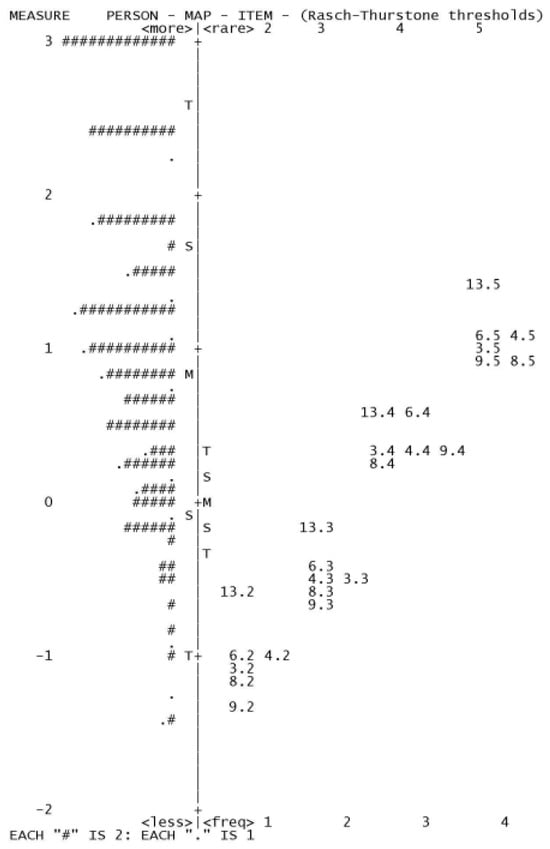
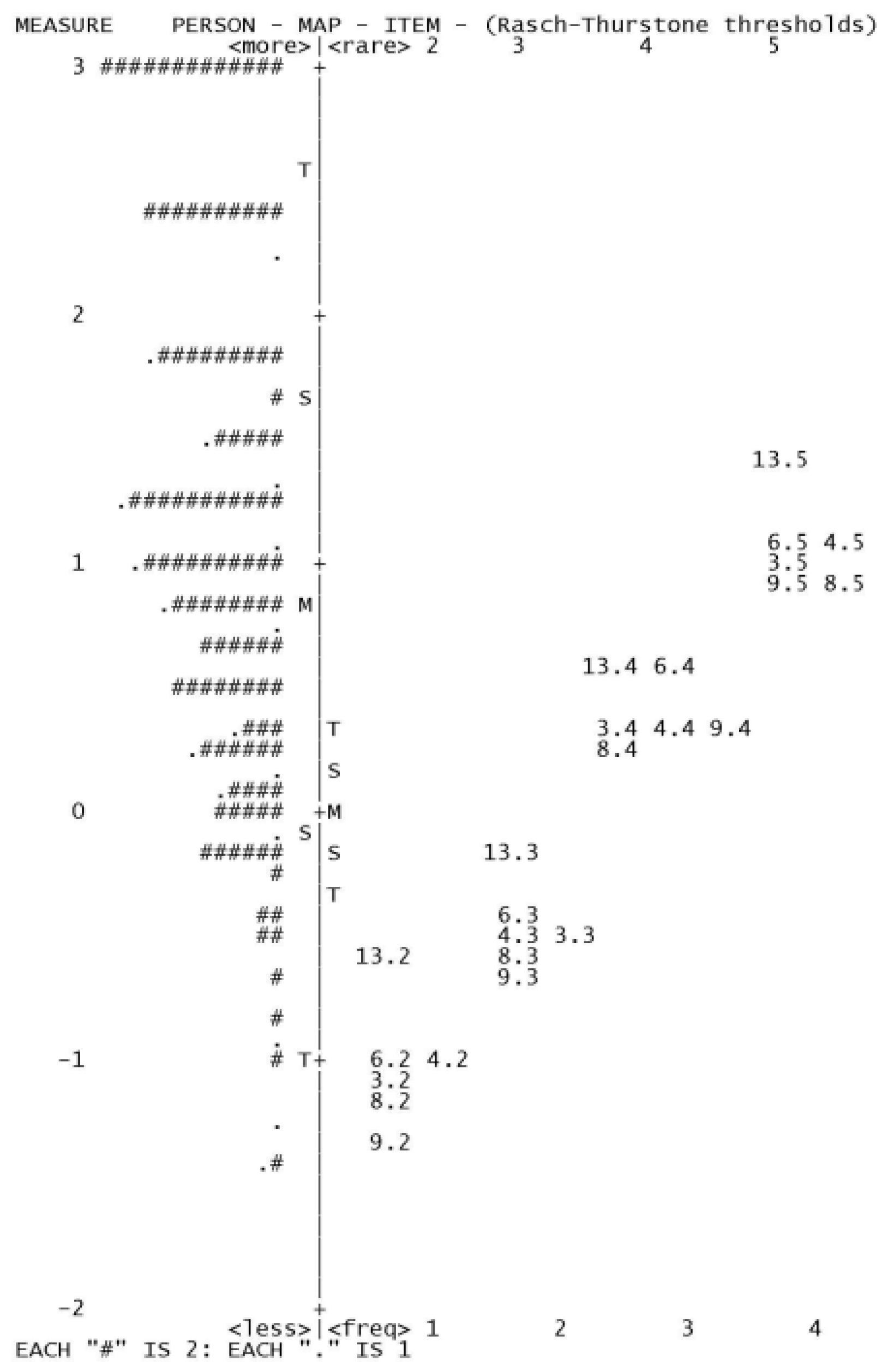
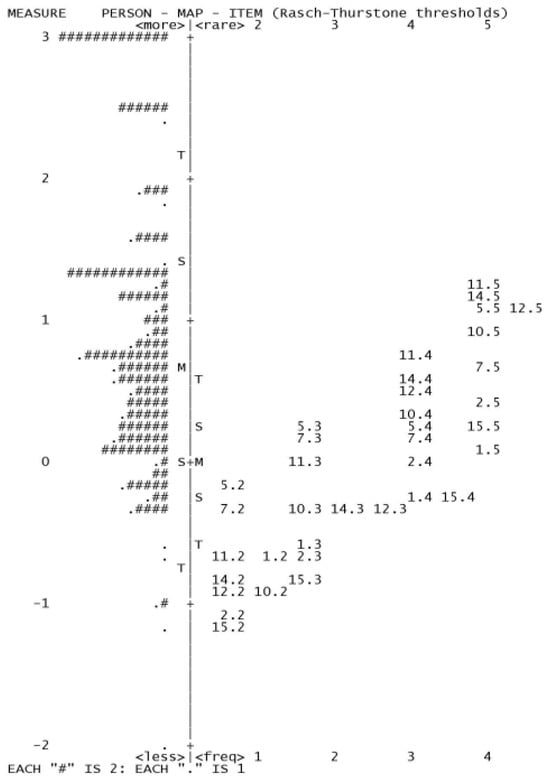
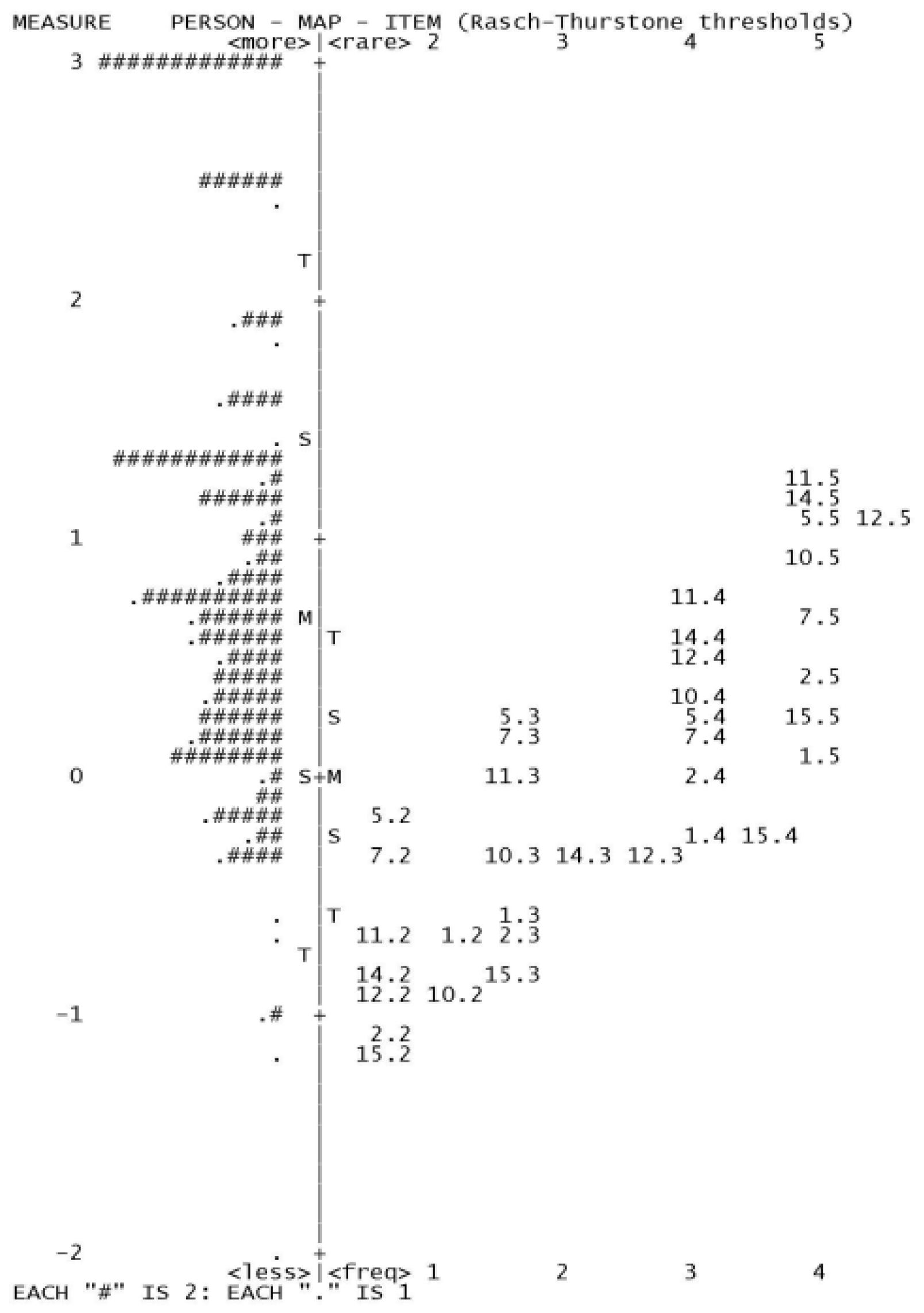
From the item difficulty column in Table 1, it can be seen that the difficulty levels of the affective subscale items ranged from −0.18 to 0.35 (with the mean item difficulty set at 0), while those of the behavioral subscale ranged from −0.48 to 0.37 (with the mean item difficulty also set at 0). Figure 1 and Figure 2 illustrate the relationship between student ability and item difficulty on the two subscales, with the left side of the vertical line representing the distribution of student ability and the right side representing the distribution of item difficulty. As shown in both figures, although the item difficulty of the two subscales covered most of the students’ ability levels, neither subscale contained items that targeted high-ability students. Moreover, the mean person measure for the affective subscale is 1.51 and that for the behavioral subscale is 1.13, greater than 1 logit, indicating poor alignment between the subscales and the students. The person separations for the affective and behavioral subscales are lower than 2 (1.00 and 1.24, respectively). All of these imply that these two subscales could not effectively distinguish students with higher levels of acceptance of inclusive education (either affective or behavioral), but they could effectively differentiate students with moderate or lower attitudes toward inclusive education.
Figure 1.
Distribution of student ability levels (left of the vertical line, logit scale) and item difficulty levels (right of the vertical line, logit scale) for the Affective Subscale.
Figure 2.
Distribution of student ability levels (left of the vertical line, logit scale) and item difficulty levels (right of the vertical line, logit scale) for the Behavioral Subscale.
3.5. Response Option Statistics
Table 2 presents the statistical values for each response option of all items. Items 5, 7, and 13 were reverse-coded and were treated as positively scored items in subsequent analyses. The proportion of students selecting strongly agree ranged from 39.79% to 66.89%, while the proportion selecting agree ranged from 10.31% to 28.09%. Overall, the combined frequency of agreement (including both strongly agree and agree) ranged from 55.37% to 83.50%. However, none of the items met the Rasch model’s assumption of ordered category thresholds. Disordered thresholds—where the expected increase in Rasch step difficulty between adjacent response categories does not hold—were mainly observed between categories 2 and 3, and between 3 and 4.
Table 2.
Response option statistics.
3.6. Grade and Gender DIF
The results of DIF analysis showed no substantial gender or grade DIF. Specifically, the gender DIF contrasts for the affective subscale ranged between 0.05 and 0.23 and those for the behavioral subscale ranged between 0.00 and 0.19; these ranges for the grade DIF are between 0.01 and 0.33 for the affective subscale and 0.01 and 0.39 for the behavioral subscale. All of the DIF contrasts were less than 0.43, indicating negligible DIF (Linacre, 2018).
4. Discussion
This study examined the psychometric properties of the Chinese version of the Elementary Students’ Attitudes toward Inclusive Education Scale. Using the Rasch partial credit model, the two subscales were analyzed separately. The results showed that the eigenvalues of the first residual contrast for both subscales did not exceed the criterion of 2.0 (Linacre, 2018), indicating no evidence of a second latent dimension. The Rasch model explained more than one-third of the variance in students’ responses for both subscales, suggesting that each subscale could be used to measure primary school students’ affective and behavioral attitudes toward inclusive education.
However, the reverse-coded items in the two subscales may have reduced measurement precision. Specifically, the affective subscale included one reverse-coded item—Item 5 (I would try to stay away from ‘Mark’)—while the behavioral subscale included two—Item 7 (I would not like to sit next to ‘Mark’ in the class) and Item 13 (I would not like to play with ‘Mark’ at his place). The weighted mean square (MNSQ) fit values of these items ranged from 1.5 to 2.0, while their unweighted fit values exceeded 2.0, suggesting that for students at the extreme ends of the ability continuum (those who were highly accepting or unaccepting of inclusion), these items may have impaired measurement accuracy. Nevertheless, since all weighted fit values were below 2.0 and all items showed positive point–measure correlations, indicating consistency between the items and the latent construct, these items were considered acceptable for the current study. In future research, these three reverse-worded items could be rephrased as positive statements, as elementary school students may find reverse wording difficult to comprehend.
Both subscales demonstrated good internal consistency reliability, with Cronbach’s alpha coefficients of 0.85 (affective) and 0.89 (behavioral). However, the Rasch person separation indices for both subscales were below 2.0, suggesting that neither subscale effectively differentiated between students with higher and lower levels of ability (Favazza et al., 2000). This pattern was also evident from the high percentage of students who agreed with each item’s statement—most students expressed agreement. Similarly, the item–person maps for both subscales confirmed that no items targeted the higher end of the attitude continuum. One possible explanation is that inclusive education in China currently focuses on students with mild to moderate disabilities—primarily those with intellectual, visual, or hearing impairments (Xu et al., 2018)—which presents challenges to teachers and peers that remain manageable. As inclusive practices expand to include students with more complex or severe disabilities, general education teachers and peers may face greater challenges. Future revisions of the scale could therefore include more items reflecting affective and behavioral tendencies toward students with different types and levels of disability to increase item difficulty and the measurement range.
In addition, the item separation index for the affective subscale was below 3.0, possibly due to the small number of items (six) and the very similar difficulty levels among Items 3, 4, 8, and 9. When ranked by difficulty, the differences between these items were smaller than the standard error of the difficulty estimates. To improve precision, future studies could consider removing one or two of these items when adding new, more challenging items.
Moreover, none of the items met the Rasch model’s assumption of ordered category thresholds. Disordered thresholds were mainly observed between categories 2 and 3 and between 3 and 4. This may be due to the inclusion of a neutral response option. The “neutral tendency” response was not prominent, possibly because these students have not yet been influenced by the traditional Confucian ideal of moderation (Y. H. Li et al., 2006). The results of this study may also suggest that Chinese primary school students do not have a clear understanding of the concept of “neutrality”. This might also be due to the fact that at the basic education stage in China, standardized examinations that mainly consist of objective questions are often used, and students tend to have a thinking habit of either getting the answer right or wrong, ignoring the diversity and openness of the questions. It is worth noting that the original ASIE-S scale used a four-point Likert format without a neutral option, as De Boer et al. (2012b) found that 10–35% of respondents tended to select the neutral category (De Boer et al., 2012b). Although the neutral responses of Chinese and Western students on the scale were slightly different, future research may consider removing the “neutral” option. Because this “neutral tendency” response neither reflects respondents’ true attitudes nor carries clear interpretive meaning (Y. H. Li et al., 2006), De Boer et al. argued that a four-point scale encourages respondents to express their opinions more directly (De Boer et al., 2012b).
In summary, both subscales demonstrated unidimensional structures and satisfactory reliability. They can be used to measure primary school students’ acceptance of inclusive education and serve as a valuable contribution to quantitative research on inclusion attitudes in China. The questionnaire can be utilized for intervention effects by comparing pre-and post-test analysis. Nevertheless, the Chinese version of the Elementary Students’ Attitudes toward Inclusive Education Scale still has room for improvement in item design, and further validation or revision with larger and more diverse samples is recommended.
Author Contributions
Conceptualization, S.Q.X.; methodology and software, J.Z.; formal analysis, J.Z. and X.L.; investigation and resources, S.Q.X.; writing, S.Q.X., J.Z., and W.L. funding acquisition, S.Q.X. All authors have read and agreed to the published version of the manuscript.
Funding
This study is supported by Humanities and Social Science Fund of Ministry of Education of the People’s Republic of China (23YJA880062), and the Key Project of Higher Education Teaching Reform in Jiangxi Province (JXJG-22-43-2).
Institutional Review Board Statement
This study has obtained ethical approval from the Key Laboratory of Psychological Diagnosis and Educational Technology for Special Children at Chongqing Normal University (Approval Code: CSTJ-RE-20250624010).
Informed Consent Statement
Informed consent was obtained from all subjects’ parents involved in the study.
Data Availability Statement
The data that support the findings of this study are available on request from the corresponding author. The data is not publicly available due to the restrictions of Chongqing Normal University.
Conflicts of Interest
On behalf of all authors, the corresponding author states that there is no conflict of interest.
References
- Ajzen, I. (2005). Attitudes, personality and behavior. Open University Press. [Google Scholar]
- Albarracín, D., Johnson, B. T., & Zanna, M. P. (2005). The handbook of attitudes. Erlbaum. [Google Scholar]
- Armstrong, M., Morris, C., Tarrant, M., Abraham, C., & Horton, M. C. (2017). Rasch analysis of the Chedoke–McMaster attitudes towards children with handicaps scale. Disability and Rehabilitation, 39(3), 281–290. [Google Scholar] [CrossRef] [Scilit] [PubMed]
- Aydın, A., Albayrak, S., Çal, A., Beşer, A., & Ocakçı, A. F. (2023). The validity and reliability study of the Turkish version of the Chedoke–McMaster attitudes towards children with handicaps. Progress in Health Sciences, 13(1), 33–41. [Google Scholar] [CrossRef] [Scilit]
- Boyle, C., Costello, S., Anderson, J., Collett, K., Page, A., & Allen, K. A. (2022). Further development of the teacher attitudes to inclusion scale: Principal components and Rasch analysis. International Journal of Inclusive Education, 28(10), 2122–2137. [Google Scholar] [CrossRef] [Scilit]
- Çiçek-Gümüş, E., & Öncel, S. (2020). Validity and reliability of the Chedoke–McMaster attitudes towards children with handicaps scale in Turkey: A methodological study. Florence Nightingale Journal of Nursing, 28(1), 1–12. [Google Scholar] [CrossRef] [Scilit]
- De Boer, A., & Pijl, S. J. (2016). The acceptance and rejection of peers with ADHD and ASD in general secondary education. Journal of Educational Research, 109(3), 325–332. [Google Scholar] [CrossRef] [Scilit]
- De Boer, A., Pijl, S. J., & Minnaert, A. (2012a). Students’ attitudes towards peers with disabilities: A review of the literature. International Journal of Disability, Development and Education, 59(4), 379–392. [Google Scholar] [CrossRef] [Scilit]
- De Boer, A., Timmerman, M., Pijl, S. J., & Minnaert, A. (2012b). The psychometric evaluation of a questionnaire to measure attitudes towards inclusive education. European Journal of Psychology of Education, 27, 573–589. [Google Scholar]
- De Laat, S., Freriksen, E., & Vervloed, M. P. (2013). Attitudes of children and adolescents toward persons who are deaf, blind, paralyzed or intellectually disabled. Research in Developmental Disabilities, 34(2), 855–863. [Google Scholar] [CrossRef] [Scilit]
- Favazza, P., Phillipsen, L., & Kumar, P. (2000). Measuring and promoting acceptance of young children with disabilities. Exceptional Children, 66(4), 491–508. [Google Scholar] [CrossRef] [Scilit]
- Isnani, I., Utami, W. B., Susongko, P., & Lestiani, H. T. (2019). Estimation of college students’ ability on real analysis course using Rasch model. REiD (Research and Evaluation in Education), 5(2), 2. [Google Scholar] [CrossRef] [Scilit]
- Jiang, X. Y., & Wang, J. (2013). A survey report on rural primary school students’ attitudes towards inclusive classmates. Chinese Journal of Special Education, 12, 48–53. (In Chinese) [Google Scholar]
- Ju, S. H., & Xu, Q. (2017). An intervention study on ordinary primary students’ attitudes toward children with disabilities. Modern Special Education (Higher Special Education Research), 7, 16–21. (In Chinese) [Google Scholar]
- King, S. M., Rosenbaum, P., Armstrong, R. W., & Milner, R. (1989). An epidemiological study of children’s attitudes toward disability. Developmental Medicine and Child Neurology, 31(2), 237–245. [Google Scholar] [CrossRef] [Scilit] [PubMed]
- Li, X. H., Fu, Z. J., & Liu, J. (2019). Reliability and validity of the disability identity scale. Chinese Journal of Rehabilitation Theory and Practice, 25(4), 455–459. (In Chinese) [Google Scholar]
- Li, Y. H., Tan, B. P., Wang, Y., & Shen, J. (2006). A comparative study of Likert scales with different levels: A case of satisfaction research. Data Analysis, 1(2), 159–173. (In Chinese) [Google Scholar]
- Linacre, J. M. (1994). Sample size and item calibration stability. Rasch Measurement Transaction, 7(4), 328. [Google Scholar]
- Linacre, J. M. (2018). A user’s guide to Winsteps® Rasch-model computer programs: Program manual 4.1.0. Winsteps.com. [Google Scholar]
- Liu, F., & Zhang, G. L. (2017). An intervention study on primary school students’ attitudes towards physically disabled peers in regular classes. Chinese Journal of Special Education, 5, 80–85. (In Chinese) [Google Scholar]
- Masters, G. N., & Wright, B. D. (1993). The partial credit model. In W. J. van der Linden, & R. K. Hambleton (Eds.), Handbook of polytomous item response theory models (pp. 101–121). Springer. [Google Scholar]
- Nowicki, E. A., & Sandieson, R. A. (2002). meta-analysis of school-age children’s attitudes towards persons with physical or intellectual disabilities. International Journal of Disability, Development and Education, 49(3), 243–265. [Google Scholar] [CrossRef] [Scilit]
- Qiu, Z. Y., Li, A. Q., & Huang, K. (2018). Research on the definition and measurement of disability by international organizations based on ICF and the UN convention on the rights of persons with disabilities. Chinese Journal of Rehabilitation Theory and Practice, 24(10), 1117–1121. (In Chinese) [Google Scholar]
- Rosenbaum, P., Armstrong, R., & King, S. (1986). Children’s attitudes toward disabled peers: A self-report measure. Journal of Pediatric Psychology, 11(4), 517–530. [Google Scholar]
- Sari, R., & Saleh, M. N. I. (2022). Rasch model application: Instrument development of readiness to conduct inclusive learning. Psympathic: Journal Ilmiah Psikologi, 9(2), 227–236. [Google Scholar] [CrossRef] [Scilit]
- Stoneman, Z. (1993). Attitudes toward young children with disabilities: Cognition, affect, and behavioral intent. In C. A. Peck, S. L. Odom, & D. Bricker (Eds.), Integrating young children with disabilities in a community program: From research to implementation (pp. 223–248). Paul H. Brookes. [Google Scholar]
- Sumintono, B., & Widhiarso, W. (2015). Application of Rasch modeling in educational assessment. Trim Komunikata Publishing House. [Google Scholar]
- UNESCO. (1994). The Salamanca statement and framework for action on special needs education: Access and quality. In World conference on special needs education: Access and quality, Salamanca, Spain, June 7–10. Ministry of Education and Science of Spain. [Google Scholar]
- UNESCO. (2009). Policy guidelines on inclusion in education. Available online: http://unesdoc.unesco.org/images/0017/001778/177849e.pdf (accessed on 10 October 2023).
- Wang, M. M., & Li, H. (2020). General students’ attitudes towards inclusive education in Xinjiang minority area. Chinese Journal of Special Education, 2020(3), 23–29. (In Chinese) [Google Scholar]
- Xu, S. Q., Cooper, P., & Sin, K. (2018). The “Learning in Regular Classrooms” initiative for inclusive education in China. International Journal of Inclusive Education, 22(1), 54–73. [Google Scholar] [CrossRef] [Scilit]
- Yuan, Y. J., Li, C. N., & Yuan, D. D. (2022). A survey on ordinary rural students’ attitudes towards children with special needs: A case study of a county in Guangdong province. Modern Special Education (Higher Education Research), 18, 60–65. (In Chinese) [Google Scholar]
- Zhang, W. (2008). Ronghe Jiaoyu Yu Jiaoxue [Inclusive education and teaching]. Guangxi Normal University Press. (In Chinese) [Google Scholar]
- Zheng, X. (2015). Assessment of college students’ attitudes towards persons with disabilities. Chinese Journal of Rehabilitation Theory and Practice, 11(9), 772–773. (In Chinese) [Google Scholar]

Disclaimer/Publisher’s Note: The statements, opinions and data contained in all publications are solely those of the individual author(s) and contributor(s) and not of MDPI and/or the editor(s). MDPI and/or the editor(s) disclaim responsibility for any injury to people or property resulting from any ideas, methods, instructions or products referred to in the content. |
© 2026 by the authors. Licensee MDPI, Basel, Switzerland. This article is an open access article distributed under the terms and conditions of the Creative Commons Attribution (CC BY) license.