
Educating Engineering Students on Business Model Innovation: Exploring a Dynamic Framework

Abstract
1. Introduction
2. Theoretical Background
2.1. Business Modeling
2.2. Business Model Canvas and Its Criticisms
2.3. Business Model Dynamics
2.4. Criteria for a Dynamic Business Model Framework
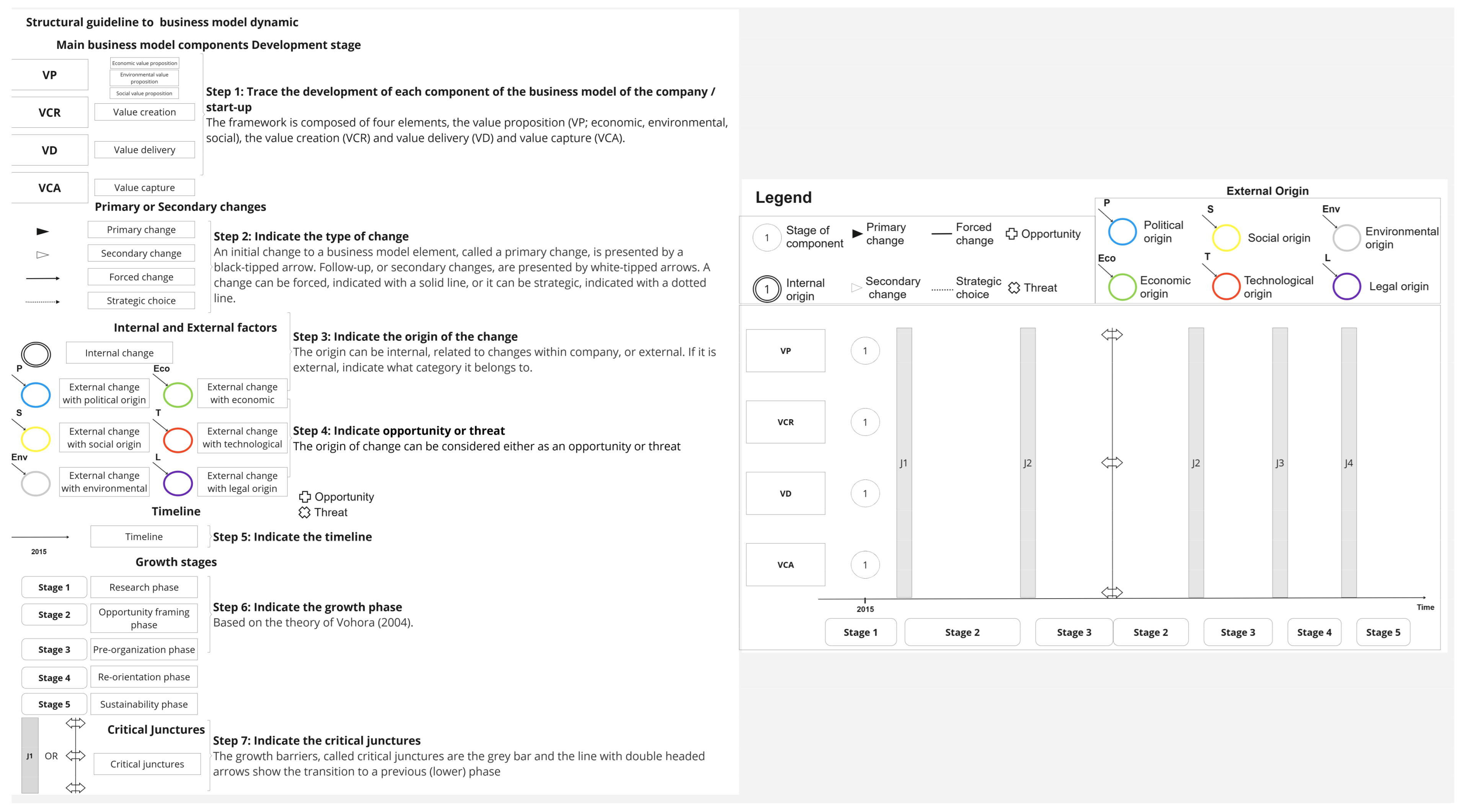
- The business model is subdivided into four main components: value proposition, value creation, value delivery, and value capture.
- There are different factors affecting the business model, which can lie inside or outside the company.
- The origin of change can be considered either as an opportunity or a threat.
- The initial change in the business model refers to one particular business model element.
- Business model consistency typically requires follow-up changes in one or more of the other business model elements.
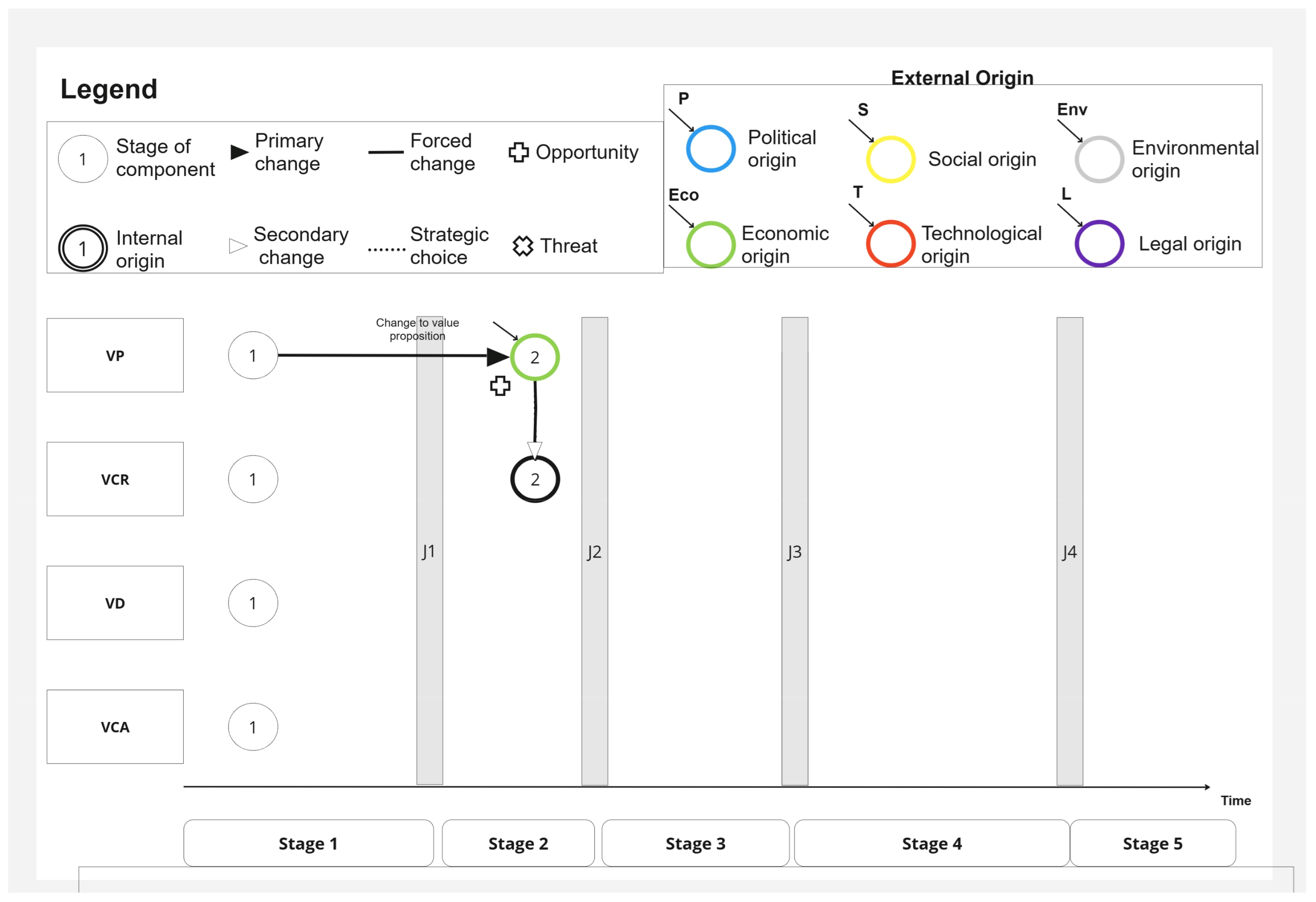
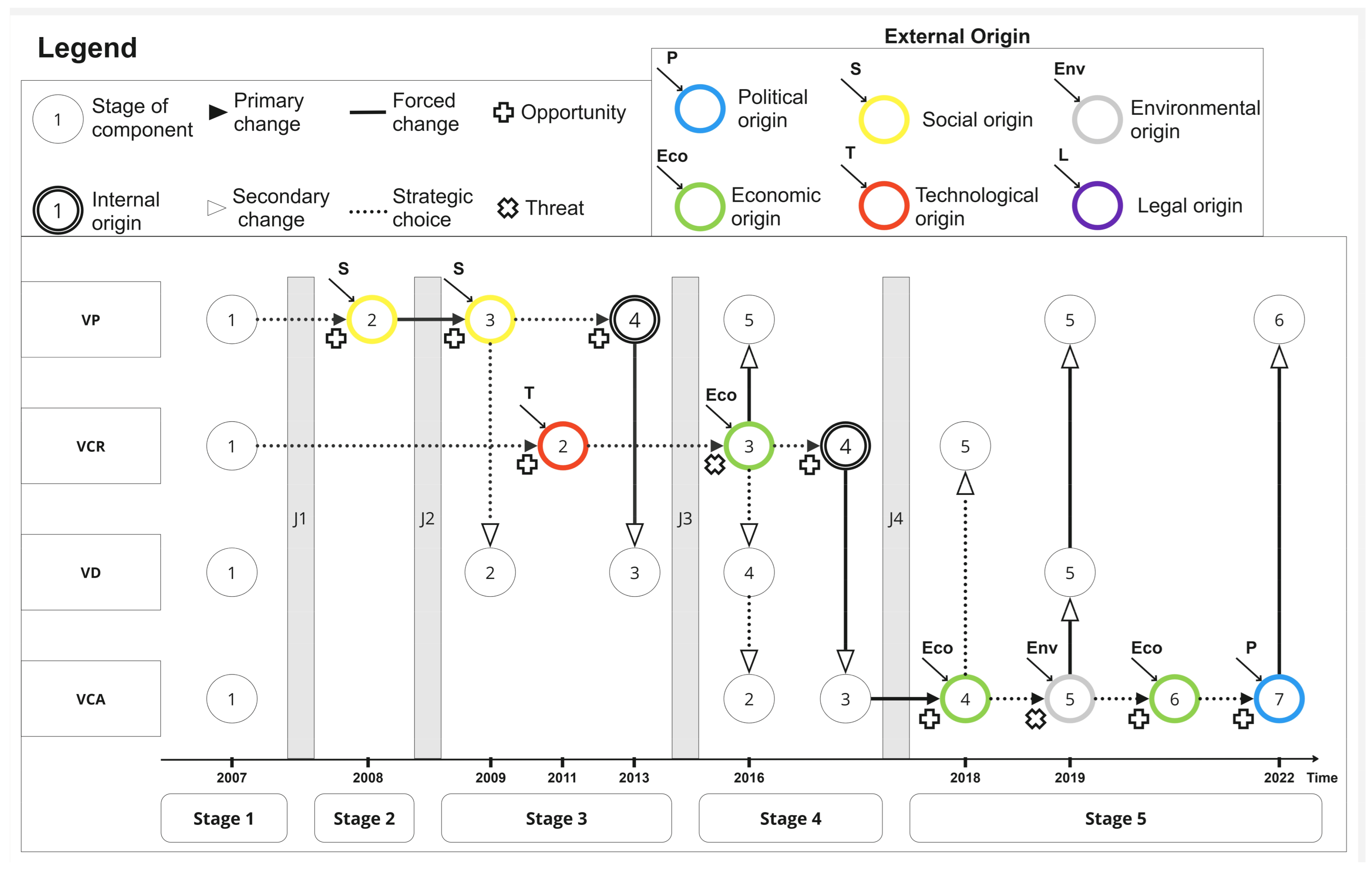
- The initial changes are called primary changes, and the possible follow-up changes are called secondary changes.
- Business model changes can be either forced changes or strategic choices.
- The timeline of the growth stages of the start-ups is included in the framework.
- Critical junctures are identified in the framework.
3. Research Design
3.1. Data Collection
3.2. Data Analysis
3.2.1. Evaluating the Current Business Model Canvas
3.2.2. Evaluation of Proposed Business Model Dynamic Framework
4. Result
4.1. Business Model Canvas Limitations from Thematic Analysis
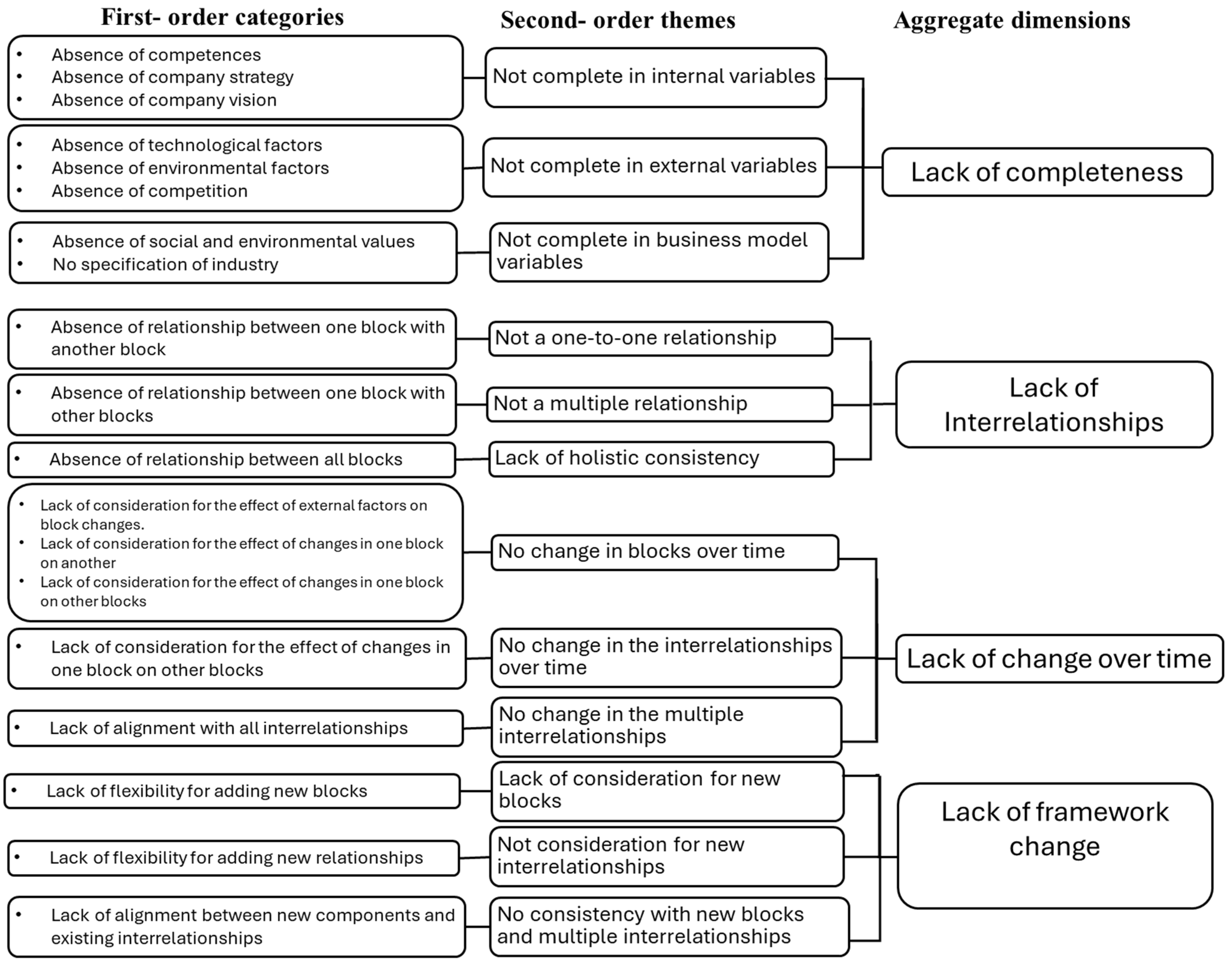
4.1.1. Lack of Completeness
4.1.2. Lack of Interrelationship
4.1.3. Lack of Change over Time
4.1.4. Lack of Framework Change
4.2. Business Model Dynamic Framework, Student Assessment
5. Discussion
6. Implication for Technology Entrepreneurship Education
7. Limitations and Future Research
8. Conclusions
Author Contributions
Funding
Institutional Review Board Statement
Informed Consent Statement
Data Availability Statement
Conflicts of Interest
References
- Abdelkafi, N., Makhotin, S., & Posselt, T. (2013). Business model innovations for electric mobility—What can be learned from existing business model patterns? International Journal of Innovation Management, 17(1), 1340003. [Google Scholar] [CrossRef]
- Achtenhagen, L., Melin, L., & Naldi, L. (2013). Dynamics of business models—Strategizing, critical capabilities and activities for sustained value creation. Long Range Planning, 46(6), 427–442. [Google Scholar] [CrossRef]
- Amit, R., & Zott, C. (2001). Value creation in e-business. Strategic Management Journal, 22(6–7), 493–520. [Google Scholar] [CrossRef]
- Amit, R., & Zott, C. (2012). Creating value through business model innovation. Sloan Management Review, 53(3), 41–49. [Google Scholar]
- Archibald, M. M., Radil, A. I., Zhang, X., & Hanson, W. E. (2015). Current mixed methods practices in qualitative research: A content analysis of leading journals. International Journal of Qualitative Methods, 14(2), 5–33. [Google Scholar] [CrossRef]
- Arpiainen, R. L., & Kurczewska, A. (2017). Learning risk-taking and coping with uncertainty through experiential, team-based entrepreneurship education. Industry and Higher Education, 31, 143–155. [Google Scholar] [CrossRef]
- Baden-Fuller, C., & Haefliger, S. (2013). Business models and technological innovation. Long Range Planning, 46(6), 419–426. [Google Scholar] [CrossRef]
- Baden-Fuller, C., & Morgan, M. S. (2010). Business models as models. Long Range Planning, 43(2–3), 156–171. [Google Scholar] [CrossRef]
- Bandera, C., Collins, R., & Passerini, K. (2018). Risky business: Experiential learning, information and communications technology, and risk-taking attitudes in entrepreneurship education. International Journal of Management in Education, 16(2), 224–238. [Google Scholar] [CrossRef]
- Bell, R. (2020). Adapting to constructivist approaches to entrepreneurship education in the Chinese classroom. Studies in Higher Education, 45(8), 1694–1710. [Google Scholar] [CrossRef]
- Blank, S. (2013). Why the lean start-up changes everything. Harvard Business Review, 91(5), 63–72. [Google Scholar]
- Bocken, N., & Snihur, Y. (2020). Lean startup and the business model: Experimenting for novelty and impact. Long Range Planning, 53(4), 1019–1053. [Google Scholar] [CrossRef]
- Bocken, N. M. P., Schuit, C. S. C., & Kraaijenhagen, C. (2018). Experimenting with a circular business model: Lessons from eight cases. Environmental Innovation and Societal Transitions, 28, 79–95. [Google Scholar] [CrossRef]
- Bouwman, H., & Fielt, E. (2008). Service innovation and business models. In H. Bouwman, H. de Vos, & T. Haaker (Eds.), Mobile service innovation and business models (pp. 9–30). Springer. [Google Scholar]
- Braun, V., & Clarke, V. (2006). Using thematic analysis in psychology. Qualitative Research in Psychology, 3(2), 77–101. [Google Scholar] [CrossRef]
- Carter, M., & Carter, C. (2020). The creative business model canvas. Social Enterprise Journal, 16(2), 141–158. [Google Scholar] [CrossRef]
- Casadesus, R., & Ricart, J. E. (2011). How to design a winning business model. Harvard Business Review, 89(1/2), 100–107. [Google Scholar]
- Cavalcante, S. A. (2014). Designing business model change. International Journal of Innovation Management, 18(02), 1450018. [Google Scholar] [CrossRef]
- Chang, J., & Rieple, A. (2013). Assessing students’ entrepreneurial skills development in live projects. Journal of Small Business and Enterprise Development, 20(1), 225–241. [Google Scholar] [CrossRef]
- Ching, H. Y., & Fauvel, C. (2013). Criticisms, variations and experiences with business model canvas. European Journal of Agriculture and Forestry Research, 1(2), 26–37. [Google Scholar]
- Clarysse, B., Mosey, S., & Lambrecht, I. (2009). New trends in technology management education: A view from Europe. Academy of Management Learning & Education, 8(3), 427–443. [Google Scholar]
- Cosenz, F. (2015, September 10–12). Conceptualizing innovative business planning frameworks to improving new venture strategy communication and performance. A preliminary analysis of the “dynamic business model canvas”. The XXXVII AIDEA Conference, Piacenza, Italy. [Google Scholar]
- DaSilva, C. M., & Trkman, P. (2014). Business model: What it is and what it is not. Long Range Planning, 47(6), 379–389. [Google Scholar] [CrossRef]
- Demil, B., & Lecocq, X. (2010). Business model evolution: In search of dynamic consistency. Long Range Planning, 43(2–3), 227–246. [Google Scholar] [CrossRef]
- Demil, B., Lecocq, X., Ricart, J. E., & Zott, C. (2015). Introduction to the SEJ special issue on business models: Business models within the domain of strategic entrepreneurship. Strategic Entrepreneurship Journal, 9(1), 1–11. [Google Scholar] [CrossRef]
- Doganova, L., & Eyquem-Renault, M. (2009). What do business models do? Innovation devices in technology entrepreneurship. Research Policy, 38(10), 1559–1570. [Google Scholar] [CrossRef]
- Eppler, M. J., Hoffmann, F., & Bresciani, S. (2011). New business models through collaborative idea generation. International Journal of Innovation Management, 15(6), 1323–1341. [Google Scholar] [CrossRef]
- Euchner, J., & Ganguly, A. (2014). Business model innovation in practice. Research-Technology Management, 57(6), 33–39. [Google Scholar]
- Farber, V. A., Prialé, M. A., & Fuchs, R. M. (2015). An entrepreneurial learning exercise as a pedagogical tool for teaching CSR: A Peruvian study. Industry and Higher Education, 29(5), 345–360. [Google Scholar] [CrossRef]
- Fayolle, A. (2008). Entrepreneurship education at crossroads: Towards a more mature teaching field. Journal of Enterprising Culture, 16(4), 325–337. [Google Scholar] [CrossRef]
- Fielt, E. (2014). Conceptualising business models: Definitions, frameworks and classifications. Journal of Business Models, 1(1), 85–105. [Google Scholar]
- Foss, N. J., & Saebi, T. (2017). Fifteen years of research on business model innovation: How far have we come, and where should we go? Journal of Management, 43(1), 200–227. [Google Scholar] [CrossRef]
- Foss, N. J., & Saebi, T. (2018). Business models and business model innovation: Between wicked and paradigmatic problems. Long Range Planning, 51(1), 9–21. [Google Scholar] [CrossRef]
- Fritscher, B., & Pigneur, Y. (2015). Classifying business model canvas usage from novice to master: A dynamic perspective. In International symposium on business modeling and software design (pp. 134–151). Springer International Publishing. [Google Scholar]
- Giesen, E., Riddleberger, E., Christner, R., & Bell, R. (2010). When and how to innovate your business model. Strategy & Leadership, 38, 17–26. [Google Scholar]
- Gioia, D. A., Corley, K. G., & Hamilton, A. L. (2013). Seeking qualitative rigor in inductive research: Notes on the Gioia methodology. Organizational Research Methods, 16, 15–31. [Google Scholar] [CrossRef]
- Giones, F., & Brem, A. (2017). Digital technology entrepreneurship: A definition and research agenda. Technology Innovation Management Review, 7(5), 44–51. [Google Scholar] [CrossRef][Green Version]
- Greene, P. G., & Rice, M. P. (2007). Entrepreneurship education. Edward Edgar Publishing. [Google Scholar]
- Günzel, F., & Holm, A. B. (2013). One size does not fit all—Understanding the front-end and back-end of business model innovation. International Journal of Innovation Management, 17(1), 1340002. [Google Scholar] [CrossRef]
- Johnson, M. W., Christensen, C. M., & Kagermann, H. (2008). Reinventing your business model. Harvard Business Review, 86(12), 50–59. [Google Scholar]
- Jouison-Laffitte, E., & Verstraete, T. (2008). Business model et création d’entreprise. Revue Française de Gestion, 181(1), 175–197. [Google Scholar] [CrossRef]
- Joyce, A., & Paquin, R. L. (2016). The triple layered business model canvas: A tool to design more sustainable business models. Journal of Cleaner Production, 135, 1474–1486. [Google Scholar] [CrossRef]
- Kakouris, A., & Morselli, D. (2020). Addressing the pre/post-university pedagogy of entrepreneurship coherent with learning theories. In Entrepreneurship education: A lifelong learning approach (pp. 35–58). Springer International Publishing. [Google Scholar]
- Kakouris, A., Morselli, D., & Pittaway, L. (2023). Educational theory driven teaching in entrepreneurship. The International Journal of Management Education, 21(2), 100814. [Google Scholar] [CrossRef]
- Kamp, L. M., Meslin, T. A., Khodaei, H., & Ortt, J. R. (2021). The dynamic business model framework—Illustrated with renewable energy company cases from Indonesia. Journal of Open Innovation: Technology, Market, and Complexity, 7(4), 231. [Google Scholar] [CrossRef]
- Khanagha, S., Volberda, H., & Oshri, I. (2014). Business model renewal and ambidexterity: Structural alteration and strategy formation process during transition to a cloud business model. R&D Management, 44(3), 322–340. [Google Scholar] [CrossRef]
- Kharbeet, G., Khodaei, H., Scholten, V. E., & Ortt, R. (2024). Business model dynamics during the growth stages of technology-based start-ups. In Academy of management proceedings (Vol. 2024, p. 16915). Academy of Management. [Google Scholar]
- Khodaei, H., & Ortt, R. (2019). Capturing dynamics in business model frameworks. Journal of Open Innovation: Technology, Market, and Complexity, 5(1), 8. [Google Scholar] [CrossRef]
- Kolb, D. A. (1984). Experiential learning: Experience as the source of learning and development. Prentice Hall. [Google Scholar]
- Kranich, P., & Wald, A. (2018). Does model consistency in business model innovation matter? A contingency-based approach. Creativity and Innovation Management, 27(2), 209–220. [Google Scholar] [CrossRef]
- Krathwohl, D. R. (2002). A revision of Bloom’s taxonomy: An overview. Theory into Practice, 41(4), 212–218. [Google Scholar] [CrossRef]
- Kremer, F., Jouison, E., & Verstraete, T. (2017). Learning and teaching the business model: The contribution of a specific and dedicated web application. Journal of Entrepreneurship Education, 20(2), 1–14. [Google Scholar]
- Leschke, J. (2013). Business model mapping: An application and experience in an introduction to entrepreneurship course. Journal of Entrepreneurship Education, 16, 77–92. [Google Scholar]
- Magretta, J. (2002). Why business models matter. Harvard Business Review, 80(5), 86–92. [Google Scholar]
- Maresch, D., Harms, R., Kailer, N., & Wimmer-Wurm, B. (2016). The impact of entrepreneurship education on the entrepreneurial intention of students in science and engineering versus business studies university programs. Technological Forecasting and Social Change, 104, 172–179. [Google Scholar] [CrossRef]
- Markides, C. (2006). Disruptive innovation: In the need for a better theory. Journal of Product Innovation Management, 23(1), 19–25. [Google Scholar] [CrossRef]
- Maurya, A. (2010). Why lean canvas vs. business model canvas? Practice trumps theory. Available online: https://www.leanfoundry.com/articles/why-lean-canvas-versus-business-model-canvas (accessed on 9 October 2013).
- Morris, M., Schindehutte, M., & Allen, J. (2005). The entrepreneur’s business model: Toward a unified perspective. Journal of Business Research, 58(6), 726–735. [Google Scholar] [CrossRef]
- Morris, M. H., & Liguori, E. (2016). Preface: Teaching reason and the unreasonable. In Annals of entrepreneurship education and pedagogy (pp. xiv–xxii). Edward Elgar Publishing. [Google Scholar]
- Motta, V. F., & Galina, S. V. R. (2023). Experiential learning in entrepreneurship education: A systematic literature review. Teaching and Teacher Education, 121, 103919. [Google Scholar] [CrossRef]
- Nabi, G., Linan, F., Fayolle, A., Krueger, N., & Walmsley, A. (2017). The impact of entrepreneurship education in higher education: A systematic review and research agenda. The Academy of Management Learning and Education, 16(2), 277–299. [Google Scholar] [CrossRef]
- Neck, H. M., & Corbett, A. C. (2018). The scholarship of teaching and learning entrepreneurship. Entrepreneurship Education and Pedagogy, 1(1), 8–41. [Google Scholar] [CrossRef]
- Neck, H. M., & Greene, P. G. (2011). Entrepreneurship education: Known worlds and new frontiers. Journal of Small Business Management, 49(1), 55–70. [Google Scholar] [CrossRef]
- Neergaard, H., Tanggaard, L., Krueger, N., & Robinson, S. (2012, November 6–8). Pedagogical interventions in entrepreneurship from behaviorism to existential learning. 2012 Institute for Small Business and Entrepreneurship, Dublin, Ireland. [Google Scholar]
- Nelson, A. J., & Monsen, E. (2014). Teaching technology commercialization: Introduction to the special section. The Journal of Technology Transfer, 39(5), 774–779. [Google Scholar] [CrossRef]
- Ohland, M. W., Frillman, S. A., Zhang, G., Brawner, C. E., & Miller, T. K., III. (2004). The effect of an entrepreneurship program on GPA and retention. Journal of Engineering Education, 93(4), 293–301. [Google Scholar] [CrossRef]
- Osterwalder, A., & Pigneur, Y. (2009). Business model creation. Modderman Drukwerk. [Google Scholar]
- Osterwalder, A., Pigneur, Y., Bernarda, G., & Smith, A. A. (2014). Value proposition design. John Wiley & Sons, Inc. [Google Scholar]
- Osterwalder, A., Pigneur, Y., & Clark, T. (2010). Business model generation: A handbook for visionaries, game changers, and challengers. Wiley. [Google Scholar]
- Othman, N., Hashim, N., & Ab Wahid, H. (2012). Readiness towards entrepreneurship education: Students and Malaysian universities. Education+ Training, 54(8/9), 697–708. [Google Scholar] [CrossRef]
- Paulet, E., & Rowley, C. (2017). The China business model: Originality and limits. Chandos Publishing. [Google Scholar]
- Pittaway, L., & Thorpe, R. (2012). A framework for entrepreneurial learning: A tribute to Jason Cope. Entrepreneurship & Regional Development, 24(9–10), 837–859. [Google Scholar] [CrossRef]
- Politis, D. (2005). The process of entrepreneurial learning: A conceptual framework. Entrepreneurship Theory and Practice, 29(4), 399–424. [Google Scholar] [CrossRef]
- Pynnönen, M., Hallikas, J., & Ritala, P. (2012). Managing customer-driven business model innovation. International Journal of Innovation Management, 16(4), 1250022. [Google Scholar] [CrossRef]
- Qiao, S., Chen, G., & Ray, P. (2022). Applicability of business model canvas in the context of entrepreneurship in Asia: A systematic literature review. In Technology entrepreneurship and sustainable development (pp. 69–96). Springer. [Google Scholar]
- Rae, D., & Carswell, M. (2001). Towards a conceptual understanding of entrepreneurial learning. Small Business and Enterprise Development, 8(2), 150–158. [Google Scholar] [CrossRef]
- Ries, E. (2011). The lean startup: How today’s entrepreneurs use continuous innovation to create radically successful businesses. Crown Currency. [Google Scholar]
- Rosenberg, A., von Rosing, M., Chase, G., Omar, R., Taylor, J., & von Scheel, H. (2011). Applying real-world BPM in an SAP environment (1st ed.). SAP Press. [Google Scholar]
- Saebi, T., Lien, L., & Foss, N. J. (2016). What drives business model adaptation? The impact of opportunities, threats and strategic orientation. Long Range Planning, 50(5), 567–581. [Google Scholar] [CrossRef]
- Schneckenberg, D., Matzler, K., & Spieth, P. (2022). Theorizing business model innovation: An organizing framework of research dimensions and future perspectives. R&D Management, 52, 593–609. [Google Scholar]
- Schneider, S., & Spieth, P. (2013). Business model innovation: Towards an integrated future research agenda. International Journal of Innovation Management, 17(1), 1340001. [Google Scholar] [CrossRef]
- Snihur, Y., & Bocken, N. (2022). A call for action: The impact of business model innovation on business ecosystems, society and planet. Long Range Planning, 55(6), 102182. [Google Scholar] [CrossRef]
- Snihur, Y., & Markman, G. (2023). Business model research: Past, present, and future. Journal of Management Studies, 60(8), e1–e14. [Google Scholar] [CrossRef]
- Snihur, Y., & Wiklund, J. (2019). Searching for innovation: Product, process, and business model innovations and search behavior in established firms. Long Range Planning, 52(3), 305–325. [Google Scholar] [CrossRef]
- Snihur, Y., Zott, C., & Amit, R. (2021). Creating and capturing value from emerging technologies: Strategic business model design. Strategy Science, 6(1), 22–38. [Google Scholar] [CrossRef]
- Souitaris, V., Zerbinati, S., & Al-Laham, A. (2007). Do entrepreneurship programmes raise entrepreneurial intention of science and engineering students? The effect of learning, inspiration and resources. Journal of Business Venturing, 22(4), 566–591. [Google Scholar] [CrossRef]
- Strauss, A., & Corbin, J. (1990). Basics of qualitative research: Grounded theory procedures and techniques. Sage. [Google Scholar]
- Teece, D. J. (2010). Business models, business strategy and innovation. Long Range Planning, 43(2–3), 172–194. [Google Scholar] [CrossRef]
- Tete, M. F., Limongi, R., De Almeida, M. I. S., & Borges, C. (2014). Experiential learning as teaching strategy for entrepreneurship: Assessment of a Brazilian experience. International Journal of Innovation and Learning, 16(4), 428–447. [Google Scholar] [CrossRef]
- Toro-Jarrín, M. A., Ponce-Jaramillo, I. E., & Güemes-Castorena, D. (2016). Methodology for the of building process integration of business model canvas and technological roadmap. Technological Forecasting and Social Change, 110, 213–225. [Google Scholar] [CrossRef]
- Trimi, S., & Berbegal-Mirabent, J. (2012). Business model innovation in entrepreneurship. International Entrepreneurship and Management Journal, 8(4), 449–465. [Google Scholar] [CrossRef]
- Upward, A., & Jones, P. (2015). An ontology for strongly sustainable business models: Defining an enterprise framework compatible with natural and social science: Defining an enterprise framework compatible with natural and social science. Organization & Environment, 29(1), 97–123. [Google Scholar]
- Verrue, J. (2014). A critical investigation of the Osterwalder business model canvas: An in-depth case study. Available online: http://biblio.ugent.be/publication/5712151/file/5712152.pdf (accessed on 14 September 2025).
- Vohora, A., Wright, M., & Lockett, A. (2004). Critical junctures in the development of university high-tech spinout companies. Research Policy, 33(1), 147–175. [Google Scholar] [CrossRef]
- Wilson, K. E. (2008). Chapter 5: Entrepreneurship education in Europe. In Entrepreneurship and higher education (Chapter 5). OECD. [Google Scholar]
- Zott, C., & Amit, R. (2010). Business model design: An activity system perspective. Long Range Planning, 43(2–3), 216–226. [Google Scholar] [CrossRef]
- Zott, C., Amit, R., & Massa, L. (2011). The business model: Recent developments and future research. Journal of Management, 37(4), 1019–1042. [Google Scholar] [CrossRef]



| Criteria | Degrees in Which Criteria Can Be Met |
|---|---|
| 1. Completeness | a. Not complete variables |
| b. Completeness assumed but not specified | |
| c. Completeness specified | |
| 2. Interrelationships | a. No interrelationships distinguished |
| b. Relationships assumed but not specified | |
| c. Relationships specified | |
| 3. Interrelationships over time | a. No interrelationships over time distinguished |
| b. Relationships over time assumed but not specified | |
| c. Relationships over time specified | |
| 4. Framework changes | a. No framework changes distinguished |
| b. Framework changes assumed but not specified | |
| c. Framework changes specified |
| Learning Objectives and Teaching Material (Number of Students (N) = 370, Disagree = 1, Agree = 7): Item Description | Mean | SD |
| The business model dynamic framework helps me better understand the business model dynamics of the company. | 5.0378 | 2.1482 |
| The business model dynamic framework helps me better illustrate and communicate the business model dynamics of the company. | 5.9318 | 1.3595 |
| The business model dynamic framework helps me in better applying the business model dynamics of the company. | 5.8207 | 1.3744 |
| User-Friendliness (N = 370, Disagree = 1, Agree = 7): Item Description | ||
| The tool has clear instructions for using its different parts and is easy to navigate. | 4.8924 | 1.5620 |
| The tool facilitates interaction between team members and develops teamwork. | 4.1464 | 1.9721 |
| Structure and Design (N = 370, Disagree = 1, Agree = 7): Item Description | ||
| I can easily add, edit text, and choose the layout. | 4.8647 | 1.6390 |
| It is easy to export the final document. | 4.9678 | 1.6973 |
| The design of the application (images, text, graphics and animation) is appropriate. | 5.1642 | 1.4223 |
| The New Business Model Dynamic Framework Meets the Dynamic Criteria (N = 370, Disagree = 1, Agree = 7); Item Description | ||
| Completeness | 5.2581 | 1.5893 |
| Interrelationship | 5.4509 | 1.4673 |
| Interrelationship over time | 5.5711 | 1.5113 |
| Framework change | 5.4145 | 1.4829 |
Disclaimer/Publisher’s Note: The statements, opinions and data contained in all publications are solely those of the individual author(s) and contributor(s) and not of MDPI and/or the editor(s). MDPI and/or the editor(s) disclaim responsibility for any injury to people or property resulting from any ideas, methods, instructions or products referred to in the content. |
© 2026 by the authors. Licensee MDPI, Basel, Switzerland. This article is an open access article distributed under the terms and conditions of the Creative Commons Attribution (CC BY) license.
Share and Cite
Khodaei, H.; Scholten, V. Educating Engineering Students on Business Model Innovation: Exploring a Dynamic Framework. Educ. Sci. 2026, 16, 248. https://doi.org/10.3390/educsci16020248
Khodaei H, Scholten V. Educating Engineering Students on Business Model Innovation: Exploring a Dynamic Framework. Education Sciences. 2026; 16(2):248. https://doi.org/10.3390/educsci16020248
Chicago/Turabian StyleKhodaei, Hanieh, and Victor Scholten. 2026. "Educating Engineering Students on Business Model Innovation: Exploring a Dynamic Framework" Education Sciences 16, no. 2: 248. https://doi.org/10.3390/educsci16020248
APA StyleKhodaei, H., & Scholten, V. (2026). Educating Engineering Students on Business Model Innovation: Exploring a Dynamic Framework. Education Sciences, 16(2), 248. https://doi.org/10.3390/educsci16020248