
Professional Development in Enhancing Teachers’ Cybersecurity Awareness: Current Status and Future Directions of Media Literacy Training


Abstract
1. Introduction
1.1. Importance of Teachers’ Cybersecurity Awareness
1.2. Media Literacy Imperatives
1.3. Protection Motivation Theory as a Framework
1.4. Current Practices in Hong Kong
1.5. The Present Study
2. Materials and Methods
2.1. Participants
2.2. Measures
2.2.1. Awareness Toward Data Protection
2.2.2. Perceived Severity, Perceived Vulnerability, and Self-Efficacy Scale
2.2.3. Data Protection Scale
2.2.4. Data Fabrication Scale
2.3. Data Collection
2.4. Data Analysis
2.5. Ethical Considerations
3. Results
4. Discussion
4.1. Recommendations and Implications for Future Research, Education, and Professional Practice
4.1.1. Enhancing Cybersecurity Awareness and Data Protection Strategies
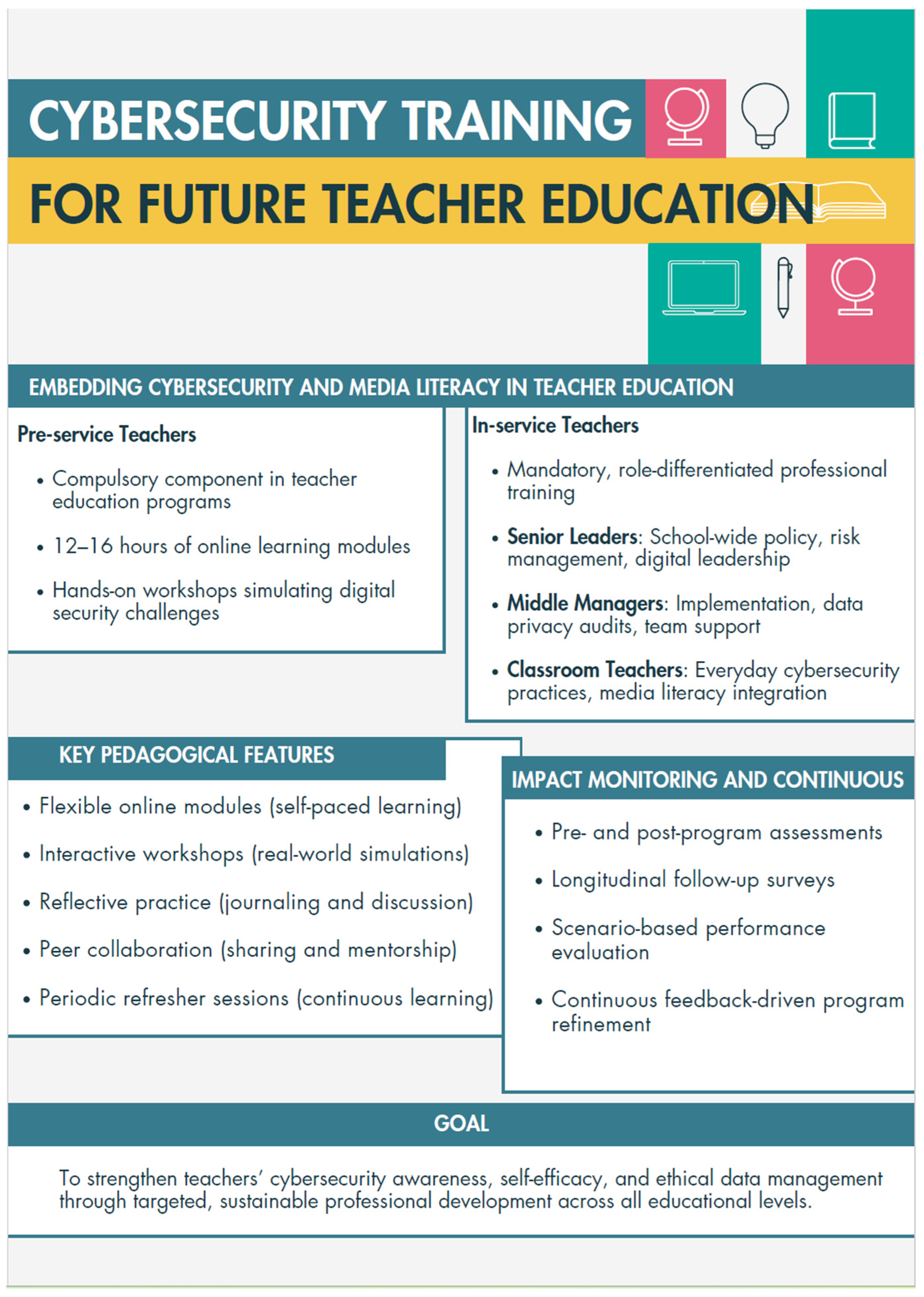
4.1.2. Necessity of Cybersecurity Training for Future Teacher Education
4.2. Limitations
5. Conclusions
Author Contributions
Funding
Institutional Review Board Statement
Informed Consent Statement
Data Availability Statement
Conflicts of Interest
Abbreviations
| IoT | Internet of Things |
| PMT | Protection Motivation Theory |
References
- Adhikari, K., & Panda, R. K. (2018). Users’ Information privacy concerns and privacy protection behaviors in social networks. Journal of Global Marketing, 31(2), 96–110. [Google Scholar] [CrossRef]
- Ajzen, I. (1991). The theory of planned behavior. Organizational Behavior and Human Decision Processes, 50(2), 179–211. [Google Scholar] [CrossRef]
- Akter, S., Uddin, M. R., Sajib, S., Lee, T. W. J., Michael, K., & Hossain, M. A. (2025). Reconceptualizing cybersecurity awareness capability in the data-driven digital economy. Annals of Operations Research, 350, 673–698. [Google Scholar] [CrossRef] [PubMed]
- American Psychological Association. (2024). Ethical principles of psychologists and code of conduct. Available online: https://www.apa.org/ethics/code (accessed on 23 January 2026).
- Anastasiades, P. S., & Vitalaki, E. (2011). Promoting internet safety in Greek primary schools: The teacher’s role. Journal of Educational Technology & Society, 14(2), 71–80. [Google Scholar]
- Arpaci, I., & Basol, G. (2020). The impact of preservice teachers’ cognitive and technological perceptions on their continuous intention to use flipped classroom. Education and Information Technologies, 25(5), 3503–3514. [Google Scholar] [CrossRef]
- Arpacı, D., & Bardakçı, M. (2015). Adaptation of early teacher identity measure into Turkish. Journal of Social Sciences, 14(3), 687–719. [Google Scholar] [CrossRef]
- CBC News. (2024, August 15). SINs, banking, and personal information stolen in U of Winnipeg cyberattack: Investigation concludes. CBC News. Available online: https://www.cbc.ca/news/canada/manitoba/university-of-winnipeg-cybersecurity-attack-information-stolen-1.7295997 (accessed on 23 January 2026).
- Cheng, E. C. K., & Wang, T. (2022). Institutional strategies for cybersecurity in higher education institutions. Information, 13(4), 192. [Google Scholar] [CrossRef]
- Coffey, L. (2023, October 25). Hackers access data of up to 230,000 at University of Michigan. Inside Higher Ed. Available online: https://www.insidehighered.com/news/quick-takes/2023/10/25/hackers-access-data-230k-university-michigan (accessed on 23 January 2026).
- Congress.gov. (2019). 116th congress (2019–2020): H.R. 4668—Digital citizenship and media literacy act. Available online: https://www.congress.gov/bill/116th-congress/house-bill/4668 (accessed on 23 January 2026).
- De Abreu, B. S. (2019). Teaching media literacy. American Library Association. [Google Scholar]
- Eshetu, A. Y., Mohammed, E. A., & Salau, A. O. (2024). Cybersecurity vulnerabilities and solutions in Ethiopian university websites. Journal of Big Data, 11, 118. [Google Scholar] [CrossRef]
- Floyd, D. L., Prentice-Dunn, S., & Rogers, R. W. (2000). A meta-analysis of research on protection motivation theory. Journal of Applied Social Psychology, 30(2), 407–429. [Google Scholar] [CrossRef]
- Freeman, C. (2025, April 2). Sensitive data was leaked in 2024 Highline Public Schools ransomware attack. The Seattle Times. Available online: https://www.seattletimes.com/education-lab/sensitive-data-was-leaked-in-2024-highline-public-schools-ransomware-attack/ (accessed on 23 January 2026).
- Grizzle, A., Moore, P., Dezuanni, M., Asthana, S., Wilson, C., Banda, F., & Onumah, C. (2013). Media and information literacy: Policy and strategy guidelines. Available online: https://unesdoc.unesco.org/ark:/48223/pf0000225606 (accessed on 23 January 2026).
- Guillén-Gámez, F. D., Martínez-García, I., Alastor, E., & Tomczyk, Ł. (2024). Digital competences in cybersecurity of teachers in training. Computers in the Schools, 41(3), 281–306. [Google Scholar] [CrossRef]
- Hair, J. F., Black, W. C., Babin, B. J., & Anderson, R. E. (2019). Multivariate data analysis (8th ed.). Cengage Learning. [Google Scholar]
- Herath, T., & Rao, H. (2009). Protection motivation and deterrence: A framework for security policy compliance in organisations. European Journal of Information Systems, 18, 106–125. [Google Scholar] [CrossRef]
- Hermida, M., Imlig-Iten, N., Schrackmann, I., & Marinus, E. (2022). Assessing and priming pre-service teachers’ attitudes about online privacy and their protection strategies for social networks, email and cloud storage. Teaching Education, 34(3), 265–282. [Google Scholar] [CrossRef]
- Hinduja, S., & Patchin, J. W. (2010). Bullying, cyberbullying, and suicide. Archives of Suicide Research, 14(3), 206–221. [Google Scholar] [CrossRef]
- Ho, K. (2024, December 12). Hong Kong records over 36,000 fraud cases in first 10 months of 2024; rise in scams involving bogus gov’t officials. Hong Kong Free Press. Available online: https://hongkongfp.com/2024/12/12/hong-kong-records-over-36000-fraud-cases-in-first-10-months-of-2024-rise-in-scams-involving-bogus-govt-officials/ (accessed on 23 January 2026).
- Ho, W. W. Y., Lau, Y. H. Y., Leung, L. Y. L., Li, E. K. L., & Ma, R. K. K. (2024). Enigma of social media use: Complexities of social media addiction through the serial mediating effects of emotions and self-presentation. Frontiers in Psychology, 15, 1448168. [Google Scholar] [CrossRef]
- Hong Kong Productivity Council. (2024). Hong Kong enterprise cyber security readiness index and AI security survey 2024. Available online: https://www.pcpd.org.hk/english/resources_centre/publications/surveys/files/AISecuritySurvey2024.pdf (accessed on 23 January 2026).
- Ifinedo, P. (2012). Understanding information systems security policy compliance: An integration of the theory of planned behavior and the protection motivation theory. Computers & Security, 31(1), 83–95. [Google Scholar] [CrossRef]
- Javadpour, A., Ja’fari, F., Taleb, T., Shojafar, M., & Benzaïd, C. (2024). A comprehensive survey on cyber deception techniques to improve honeypot performance. Computers & Security, 40, 103792. [Google Scholar] [CrossRef]
- Johnston, A. C., Warkentin, M., McBride, M., & Carter, L. (2016). Dispositional and situational factors: Influences on information security policy violations. European Journal of Information Systems, 25(3), 231–251. [Google Scholar] [CrossRef]
- Liu, O. (2025, July 31). Cybersecurity crime losses in Hong Kong up 15% year on year in first half of 2025. South China Morning Post. Available online: https://www.scmp.com/news/hong-kong/law-and-crime/article/3320309/cybersecurity-crime-losses-hong-kong-15-year-year-first-half-2025 (accessed on 23 January 2026).
- Mendez-Padilla, B. (2025, July 25). Ransomware attacks in education jump 23% year over year. Higher Ed Dive. Available online: https://www.highereddive.com/news/ransomware-attacks-education-jump-23-percent-h1-2025/754011/ (accessed on 23 January 2026).
- Meso, P., Ding, Y., & Xu, S. T. (2014). Applying protection motivation theory to information security training for college students. Journal of Information Privacy and Security, 9(1), 47–67. [Google Scholar] [CrossRef]
- Microsoft Hong Kong. (2024, November 7). Microsoft’s latest cyber signals report highlights the rising cyberattacks across higher education sector and K-12 institutions. Available online: https://news.microsoft.com/en-hk/2024/11/07/microsofts-latest-cyber-signals-report-highlights-the-rising-cyberattacks-across-higher-education-sector-and-k-12-institutions/ (accessed on 23 January 2026).
- Milne, S., Orbell, S., & Sheeran, P. (2002). Combining motivational and volitional interventions to promote exercise participation: Protection motivation theory and implementation intentions. British Journal of Health Psychology, 7(2), 163–184. [Google Scholar] [CrossRef]
- National Security Agency. (2025). GenCyber. DoD cyber exchange. Available online: https://public.cyber.mil/gencyber (accessed on 23 January 2026).
- Ng, K. C. (2020, January 7). Hong Kong schools urged to keep closer watch on computer systems after hacker attack on nine networks. South China Morning Post. Available online: https://www.scmp.com/news/hong-kong/education/article/3045068/hong-kong-schools-urged-keep-closer-watch-computer-systems (accessed on 23 January 2026).
- Norman, P., Boer, H., & Seydel, E. R. (2005). Protection motivation theory. In M. Conner, & P. Norman (Eds.), Predicting health behaviour (pp. 81–127). Open University Press. [Google Scholar]
- Office of the Privacy Commissioner for Personal Data, Hong Kong. (2015). Children online privacy: Practical tips for parents and teachers. Available online: https://www.pcpd.org.hk/english/resources_centre/publications/files/leaflet_childrenonlineprivacy_e.pdf (accessed on 23 January 2026).
- Patchin, J. W., & Hinduja, S. (2010). Cyberbullying and self-esteem. Journal of School Health, 80(12), 614–621. [Google Scholar] [CrossRef]
- Pawlick, J., Colbert, E., & Zhu, Q. Y. (2019). A game-theoretic taxonomy and survey of defensive deception for cybersecurity and privacy. ACM Computing Surveys, 52(4), 1–28. [Google Scholar] [CrossRef]
- Politou, E., Alepis, E., Virvou, M., & Patsakis, C. (2022). Privacy and data protection challenges in the distributed era. Springer. [Google Scholar]
- Prakash, M. (2023, October 28). Ransomware group threatens to leak Stanford police data. The Stanford Daily. Available online: https://stanforddaily.com/2023/10/28/ransomware-group-threatens-to-leak-stanford-police-data/ (accessed on 23 January 2026).
- Pusey, P., & Sadera, W. A. (2011). Cyberethics, cybersafety, and cybersecurity: Preservice teacher knowledge, preparedness, and the need for teacher education to make a difference. Journal of Digital Learning in Teacher Education, 28(2), 82–85. [Google Scholar] [CrossRef]
- Rippetoe, P. A., & Rogers, R. W. (1987). Effects of components of protection-motivation theory on adaptive and maladaptive coping with a health threat. Journal of Personality and Social Psychology, 52(3), 596–604. [Google Scholar] [CrossRef]
- Rogers, R. W. (1975). A protection motivation theory of fear appeals and attitude change. The Journal of Psychology, 91(1), 93–114. [Google Scholar] [CrossRef]
- Rogers, R. W. (1983). Cognitive and physiological processes in fear appeals and attitude change: A revised theory of protection motivation. In J. Cacioppo, & R. Petty (Eds.), Social psychophysiology (pp. 153–177). Guilford Press. [Google Scholar]
- Shen, A. (2018, June 14). Cyberattacks could cost Hong Kong massive US$32 billion annually, according to study. South China Morning Post. Available online: https://www.scmp.com/news/hong-kong/hong-kong-economy/article/2150875/cyberattacks-could-cost-hong-kong-massive-us32 (accessed on 23 January 2026).
- Sing Tao Daily. (2025, January 10). The Education Bureau organized teacher workshops to strengthen cybersecurity education [教局辦教師工作坊加強網絡安全教學]. Sing Tao Daily. Available online: https://www.stheadline.com/article/3418321/%E6%95%99%E5%B1%80%E8%BE%A6%E6%95%99%E5%B8%AB%E5%B7%A5%E4%BD%9C%E5%9D%8A%E5%8A%A0%E5%BC%B7%E7%B6%B2%E7%B5%A1%E5%AE%89%E5%85%A8%E6%95%99%E5%AD%B8#goog_rewarded (accessed on 23 January 2026).
- The Canadian Press. (2025, May 7). Toronto school board says it got a ransom demand over stolen student data. Global News. Available online: https://globalnews.ca/news/11169149/tdsb-cyber-attack-ransom-demand-student-data/ (accessed on 23 January 2026).
- The Government of the Hong Kong Special Administrative Region. (2023, May 27). Police force engages in metaverse exploring threats and opportunities of Web3. Available online: https://www.info.gov.hk/gia/general/202305/27/P2023052700671.htm (accessed on 23 January 2026).
- The Government of the Hong Kong Special Administrative Region of the People’s Republic of China, Education Bureau. (2019). Information security in schools—Recommended practice (September 2019). Available online: https://www.edb.gov.hk/en/edu-system/primary-secondary/applicable-to-primary-secondary/it-in-edu/Information-Security/information-security-in-school.html (accessed on 23 January 2026).
- The Government of the Hong Kong Special Administrative Region of the People’s Republic of China, Education Bureau. (2024a). “Information literacy for Hong Kong students” learning framework (2024). Available online: https://www.edb.gov.hk/attachment/tc/edu-system/primary-secondary/applicable-to-primary-secondary/it-in-edu/Information-Literacy/IL_learningFramework/InformationLiteracyforHongKongStudentsLearningFramework(2024)_20250320_ENG.pdf (accessed on 23 January 2026).
- The Government of the Hong Kong Special Administrative Region of the People’s Republic of China, Education Bureau. (2024b). Introduction to information literacy for Hong Kong students. Available online: https://www.edb.gov.hk/en/edu-system/primary-secondary/applicable-to-primary-secondary/it-in-edu/information-literacy/il-index.html (accessed on 23 January 2026).
- The Government of the Hong Kong Special Administrative Region of the People’s Republic of China, Education Bureau. (2025). STEAM related teacher professional development programmes. Available online: https://www.edb.gov.hk/en/curriculum-development/kla/technology-edu/resources/STEAM_Related_Teacher_Professional_Development_Programmes/resources.html (accessed on 23 January 2026).
- The Standard. (2024, May 10). Over 8,100 affected as HK college falls victim to cyber attack. The Standard. Available online: https://www.thestandard.com.hk/breaking-news/article/216252/ (accessed on 23 January 2026).
- van ’t Hoff-de Goede, M. S., Leukfeldt, E. R., van de Weijer, S. G. A., & van der Kleij, R. (2025). Does protection motivation predict self-protective online behaviour? Comparing self-reported and actual online behaviour using a population-based survey experiment. Computers in Human Behavior Reports, 18(2025), 100649. [Google Scholar] [CrossRef]
- Wani, A. T., Mendoza, A., Gray, K., & Smolenaers, F. (2022). Status of bring-your-own-device (BYOD) security practices in Australian hospitals—A national survey. Health Policy and Technology, 11(3), 100627. [Google Scholar] [CrossRef]
- Willard, N. E. (2007). Cyberbullying and cyberthreats: Responding to the challenge of online social aggression, threats, and distress. Research Press. [Google Scholar]
- Wilson, C. (2012). Media and information literacy: Pedagogy and possibilities. Comunicar, 20(39), 15–24. [Google Scholar] [CrossRef]
- Wilson, C., Grizzle, A., Tuazon, R., Akyempong, K., & Cheung, C. K. (2011). Media and information literacy curriculum for teachers. UNESCO. [Google Scholar]
- Woon, I., Tan, G. W., & Low, R. (2005). A protection motivation theory approach to home wireless security. International Conference on Information Systems 2005 Proceedings, 31, 367–380. [Google Scholar]
- Workman, M., Bommer, W. H., & Straub, D. (2008). Security lapses and the omission of information security measures: A threat control model and empirical test. Computers in Human Behavior, 24(6), 2799–2816. [Google Scholar] [CrossRef]
- World Medical Association. (2025). WMA Declaration of Helsinki—Ethical principles for medical research involving human subjects. Available online: https://www.wma.net/policies-post/wma-declaration-of-helsinki-ethical-principles-for-medical-research-involving-human-subjects/ (accessed on 23 January 2026).
- Wu, M. M. (2004). Information literacy and media literacy: Literacies and literacy education in the digital age [資訊素養與媒體素養—數位時代的素養與素養教育]. Taiwan Education, 629, 9–14. [Google Scholar] [CrossRef]
- Wurtele, S. K. (1988). Increasing women’s calcium intake: The role of health beliefs, intentions, and health value. Journal of Applied Social Psychology, 18(8), 627–639. [Google Scholar] [CrossRef]
- Wurtele, S. K., & Maddux, J. E. (1987). Relative contributions of protection motivation theory components in predicting exercise intentions and behavior. Health Psychology, 6(5), 453–466. [Google Scholar] [CrossRef] [PubMed]
- Yeboah-Boateng, E. O., & Boaten, F. E. (2016). Bring-Your-Own-Device (BYOD): An evaluation of associated risks to corporate information security. International Journal of Information Technology & Engineering, 4(8), 12–30. [Google Scholar] [CrossRef]
- Yusif, S., & Hafeez-Baig, A. (2023). Cybersecurity policy compliance in higher education: A theoretical framework. Journal of Applied Security Research, 18(2), 267–288. [Google Scholar] [CrossRef]


| n | % | ||
|---|---|---|---|
| Gender | Male | 12 | 10.0 |
| Female | 106 | 88.3 | |
| Non-binary | 2 | 1.7 | |
| Age (years) | Young Adults (aged 18–35 years) | 113 | 94.2 |
| Middle Adults (aged 36–55 years) | 7 | 5.8 | |
| Educational attainment | Secondary 4–6/university preparatory school | 28 | 23.3 |
| Sub-degree program (e.g., certificate, higher diplomas, diplomas) | 33 | 27.5 | |
| Bachelor’s degree | 50 | 41.7 | |
| Master’s, postgraduate diploma, postgraduate certificate, postgraduate diploma in education) | 6 | 5.0 | |
| PhD, EdD | 2 | 1.7 | |
| Other | 1 | 0.8 | |
| Employment status | Working full-time | 16 | 13.4 |
| Working part-time | 15 | 12.5 | |
| Student (pre-service training) | 88 | 73.3 | |
| Other | 1 | 0.8 | |
| Teaching experience | 5 years or below | 106 | 88.3 |
| 6 to 10 years | 5 | 4.2 | |
| 11 to 15 years | 3 | 2.5 | |
| 16 to 20 years | 3 | 2.5 | |
| 21 years or above | 3 | 2.5 | |
| School settings | Early childhood setting | 46 | 38.3 |
| Primary school | 6 | 5.0 | |
| Secondary school | 2 | 1.7 | |
| Tertiary education | 46 | 38.3 | |
| Other | 20 | 16.7 | |
| Funding source | Public | 24 | 20.0 |
| Private | 76 | 63.3 | |
| N/A | 3 | 7.5 |
| n | % | ||
|---|---|---|---|
| Social media | 95 | 79.2 | |
| 117 | 97.5 | ||
| 21 | 17.5 | ||
| Signal | 1 | 0.8 | |
| Snapchat | 60 | 50.0 | |
| Threads | 2 | 1.7 | |
| TikTok | 20 | 16.7 | |
| 50 | 41.7 | ||
| 77 | 64.2 | ||
| 110 | 91.7 | ||
| Xiaohongshu | 56 | 46.7 | |
| Gmail | 118 | 98.3 | |
| Yahoo mail | 44 | 36.7 | |
| Outlook | 105 | 87.5 | |
| iCloud mail | 42 | 35.0 | |
| QQ mail | 14 | 11.7 | |
| Cloud storage | Google Drive | 107 | 89.2 |
| iCloud | 93 | 77.5 | |
| Dropbox | 10 | 8.3 | |
| OneDrive | 1 | 0.8 | |
| Google photo | 1 | 0.8 |
| Teachers’ Perception of Student Information as Sensitive Data | n | % |
|---|---|---|
| Student name | 83 | 69.2 |
| Student address | 114 | 95 |
| Student parents’ information | 110 | 91.7 |
| Students’ academic results | 82 | 68.3 |
| Others (e.g., students’ age, birth date, sex, special needs, race) | 120 | 100 |
| Variable | M | SD | 1 | 2 | 3 | 4 |
|---|---|---|---|---|---|---|
| 16.47 | 2.69 | 0.36 | |||
| 143.31 | 26.02 | 0.28 ** | 0.92 | ||
| 60.24 | 10.91 | 0.27 ** | 0.47 *** | 0.79 | |
| 8.15 | 3.23 | −0.09 | 0.11 | 0.31 *** | 0.88 |
Disclaimer/Publisher’s Note: The statements, opinions and data contained in all publications are solely those of the individual author(s) and contributor(s) and not of MDPI and/or the editor(s). MDPI and/or the editor(s) disclaim responsibility for any injury to people or property resulting from any ideas, methods, instructions or products referred to in the content. |
© 2026 by the authors. Licensee MDPI, Basel, Switzerland. This article is an open access article distributed under the terms and conditions of the Creative Commons Attribution (CC BY) license.
Share and Cite
Leung, S.L.T.; Ho, W.; Tam, W.K.C. Professional Development in Enhancing Teachers’ Cybersecurity Awareness: Current Status and Future Directions of Media Literacy Training. Educ. Sci. 2026, 16, 196. https://doi.org/10.3390/educsci16020196
Leung SLT, Ho W, Tam WKC. Professional Development in Enhancing Teachers’ Cybersecurity Awareness: Current Status and Future Directions of Media Literacy Training. Education Sciences. 2026; 16(2):196. https://doi.org/10.3390/educsci16020196
Chicago/Turabian StyleLeung, Suzanne Lok Tung, Wing Ho, and Warren Ka Chun Tam. 2026. "Professional Development in Enhancing Teachers’ Cybersecurity Awareness: Current Status and Future Directions of Media Literacy Training" Education Sciences 16, no. 2: 196. https://doi.org/10.3390/educsci16020196
APA StyleLeung, S. L. T., Ho, W., & Tam, W. K. C. (2026). Professional Development in Enhancing Teachers’ Cybersecurity Awareness: Current Status and Future Directions of Media Literacy Training. Education Sciences, 16(2), 196. https://doi.org/10.3390/educsci16020196