


Abstract
The growing emphasis on inclusive education highlights teachers’ attitudes and self-efficacy as interrelated yet distinct correlates of inclusive teaching. Building on prior literature that underscores their conceptual proximity, this study aimed to examine how teachers’ views on inclusion relate to their self-reported intentions and perceived self-efficacy for inclusive teaching. Given the cross-sectional, self-report design, the study addresses associations among attitudes, perceived self-efficacy, and intentions, rather than enacted inclusive practice. A cross-sectional survey was conducted with 323 Greek secondary special education teachers using three validated and culturally adapted instruments: the Attitudes toward Inclusive Education Scale (AIS), the Inclusive Classroom Teaching Intentions Scale (ITICS), and the Teacher Efficacy for Inclusive Practices Scale (TEIP). Pearson correlation analyses revealed strong within-instrument associations, indicating good internal coherence, and moderate cross-instrument associations, suggesting meaningful but not redundant relationships between attitudes, intentions, and self-efficacy. To further explore the latent structure, an Exploratory Factor Analysis (EFA) of AIS, ITICS, and TEIP items yielded a four-factor solution explaining 56.14% of the variance: Attitudes toward Inclusive Education, Intentions to Teach in Inclusive Classrooms, Self-efficacy for Behavior Management, and Self-efficacy for Collaboration and Professional Support. This study advances the field by clarifying how teachers’ attitudes, self-efficacy, and intentions covary, thereby informing the development of more targeted and theoretically grounded interventions.
1. Introduction
In recent years, inclusive education has come to be recognized as a central organizing principle of schooling, with the expectation that all learners—irrespective of disability, background, or learning profile—are educated together in shared classroom settings where teaching, materials and supports are adapted to secure full and equitable participation (Kenny et al., 2023). This shift has been strongly driven by the United Nations Convention on the Rights of Persons with Disabilities (UNCRPD), which affirms the right to inclusive education (Article 24) and has accelerated policy commitments toward inclusive systems internationally (United Nations, 2006). Greece ratified the UNCRPD in April 2012 through Law 4074/2012 (Government Gazette A’ 88/11-04-2012; Hellenic Republic, 2012), reinforcing national obligations to advance inclusive education across all levels of schooling (United Nations, n.d.). Teachers are pivotal in translating this principle into everyday practice (Chow et al., 2024). Their beliefs about inclusion, their sense of capability to respond to diverse needs, and their willingness to act on these beliefs are key determinants of whether inclusive policies are actually enacted in classrooms (Dignath et al., 2022). In this context, three psychological dimensions have been identified as especially salient: teachers’ attitudes toward inclusion, their self-efficacy for inclusive practices, and their behavioral intentions to teach in inclusive ways (Ainscow, 2020).
There is empirical evidence showing a strong positive correlation between these concepts (Yada et al., 2022; Savolainen et al., 2022). Teachers who hold more favorable attitudes toward inclusion typically report stronger self-efficacy, and this combination is linked to greater perceived readiness to employ inclusive practices (Emmers et al., 2019). Nevertheless, a persistent “intention–action gap” has been documented: teachers may endorse inclusive values yet experience constraints or a lack of confidence that hinder them from adapting instruction, managing heterogeneous classrooms, or collaborating effectively (Sepadi, 2025; Woodcock et al., 2022). This pattern is evident not only among newly qualified teachers but also among serving teachers more broadly; for example, studies on newly qualified teachers (NQTs) and inclusion consistently show that NQTs report limited confidence in implementing inclusive practices (Hick et al., 2019; O’Reilly & Colum, 2021). Taken together, attitudes, self-efficacy, and intentions—while related—remain analytically distinct. Most existing studies have treated these constructs separately, relying on overall scores from instruments such as the Attitudes toward Inclusive Education Scale (AIS; Sharma & Jacobs, 2016), the Teachers’ Efficacy for Inclusive Practices scale (TEIP; Sharma et al., 2012) and the Intention to Teach in Inclusive Classrooms Scale (ITICS; Sharma & Jacobs, 2016), and have paid limited attention to the shared latent dimensions that might span across them.
Furthermore, empirical evidence on how these constructs are configured among secondary-school special education teachers is still scarce, even though they often play a crucial role in supporting inclusion in mainstream contexts (Mastrothanasis et al., 2021). The present study directly addresses this gap by focusing on attitudes, self-efficacy and intentions within this specific teacher population.
In Greece, efforts toward inclusive schooling for students with special educational needs (SEN) are implemented through a range of educational arrangements across secondary education, including special schools as well as support provision within mainstream schools. The statutory framework for special education and the educational support of students with disabilities and/or special educational needs in Greece is set out in Law 3699/2008 (Government Gazette A’ 199/02-10-2008; Hellenic Republic, 2008). Within this system, special education teachers are key actors in enabling inclusive participation, as they often provide targeted instructional support, contribute to individualized planning, and work alongside mainstream staff to facilitate adaptations for students with SEN. Their role frequently involves collaboration with general teachers, school leadership, families, and other professionals, which can make inclusive implementation highly dependent on both individual capacities and contextual conditions. This makes them a particularly informative group for examining inclusive readiness and the potential intention–action gap.
Against this background, the present study examines teachers’ attitudes, self-efficacy, and intentions for inclusion concurrently in a sample of 323 special education teachers working in Greek secondary schools. In line with Social Cognitive Theory and the Theory of Planned Behavior, these three constructs are treated as interrelated components of teachers’ inclusive readiness.
Focusing on these three constructs concurrently is therefore theoretically and practically justified, as together they constitute proximal predictors of inclusive teaching. Accordingly, the study addresses the following research questions (RQ):
RQ1. What is the relationship between teachers’ attitudes and their self-efficacy for inclusion?
RQ2. What does the latent structure of the pooled AIS, ITICS, and TEIP items imply for teachers’ perceived readiness to implement inclusion?
2. Theoretical Framework
2.1. Teachers’ Attitudes Toward Inclusive Education
Attitudes are typically understood as evaluative tendencies that combine cognitive beliefs, affective reactions and behavioral dispositions toward a given object or practice (Shareef et al., 2023). In the case of inclusive education, teachers’ attitudes reflect how desirable, fair and realistic they perceive the inclusion of students with SEN in mainstream classrooms to be (Desombre et al., 2021). A growing body of research has examined teachers’ attitudes in different countries and school levels. Initially, Mouchritsa et al. (2022) showed that Greek secondary general and special education teachers tend to express moderately positive attitudes toward inclusion, with variation depending on prior training and teaching experience. The results by Hamid and Mohamed (2021) showed that future teachers in Qatar generally held positive attitudes toward inclusive education, but their willingness to include students varied according to the severity and nature of disability, with a clear preference for teaching students with milder difficulties. In addition, a recent mixed-methods systematic review by Camedda and Tarantino (2023) presented at the European Conference on Educational Research synthesized two decades of studies and showed that teachers’ attitudes toward inclusive education are associated with teacher characteristics (e.g., age, teaching experience) and school-level factors such as class size and school level. Several instruments have been developed to assess teachers’ attitudes toward inclusive education.
2.2. Self-Efficacy for Inclusive Practices and Social Cognitive Theory
Social Cognitive Theory conceptualizes human functioning as the result of reciprocal interactions between personal factors, behavior and environment, and places self-efficacy at the core of action regulation (Bandura, 1986). Self-efficacy refers to individuals’ judgments about their capability to organize and execute the actions required to attain particular goals, and these beliefs influence the effort people invest, their resilience in the face of difficulties, and the choices they make (Bandura, 1997). In inclusive education, teachers’ self-efficacy concerns their perceived capability to differentiate instruction, manage heterogeneous classrooms and collaborate with colleagues and specialists to support diverse learners (Sahli Lozano et al., 2023).
Empirical work has linked higher inclusion-related self-efficacy with stronger endorsement of inclusive practices and more frequent use of adaptive strategies (Herzig Johnson, 2023). First, the results by Narkun and Smogorzewska (2019) showed that Polish teachers’ self-efficacy for inclusive practices was positively associated with their attitudes toward inclusion. In addition, a recent systematic review by Kristiana and Hendriani (2018) on teaching efficacy in inclusive education in Asian developing countries showed that teachers generally reported relatively high levels of efficacy for inclusive practices and highlighted the role of factors such as prior training and knowledge of disability legislation in strengthening this efficacy. Furthermore, a study by Mudhar et al. (2024) identified four distinct profiles of upper secondary teachers characterized by different combinations of self-efficacy and attitudes toward inclusive education; teachers in the profile high in both self-efficacy and attitudes reported higher levels of emotional support, collective teacher efficacy and collegial collaboration than teachers in profiles with lower self-efficacy.
2.3. Behavioral Intentions and the Theory of Planned Behavior
The Theory of Planned Behavior (TPB) offers a complementary framework for understanding how teachers’ beliefs are translated into behavior, positing that behavioral intentions—shaped by attitudes toward the behavior, subjective norms and perceived behavioral control—are the most proximal predictors of action (Ajzen, 1991). Perceived behavioral control overlaps conceptually with self-efficacy, as both refer to individuals’ sense of capability to perform a behavior under typical constraints (Ajzen, 2006). Several studies have applied TPB to teachers’ intentions and behavior in inclusive education. Initially, a study by Urton et al. (2023) explored primary teachers’ intention to arrange lessons in an inclusive way and found that specific components of their attitudes toward inclusion and their self-efficacy for inclusive practices significantly predicted this intention.
Furthermore, Gülsün et al. (2025) demonstrated that teachers’ affective attitudes towards inclusive education, subjective norms regarding inclusive practices and self-efficacy for inclusive practices all contributed to their intentions to teach in inclusive classrooms, which in turn predicted their self-reported inclusive practices. Another study by Almalky and Alrabiah (2024) investigated how Saudi teachers’ attitudes towards inclusive education, self-efficacy, perceived support and concerns relate to their intentions to implement inclusive education. Their regression analysis showed that teachers’ self-efficacy and their major (special vs. general education) significantly predicted their intentions, whereas attitudes, perceived support and concerns did not remain significant predictors when considered together. In addition, the results by Kupers et al. (2024) compared a Theory of Planned Behavior model and a Self-Determination Theory model to explain teachers’ behavioral intentions towards differentiated instruction for inclusion, showing that attitudes, subjective norms, perceived behavioral control and perceived autonomy together significantly predicted teachers’ intentions.
2.4. Inclusive Readiness
Drawing on Social Cognitive Theory (Bandura, 1986), self-efficacy is conceptualized as a critical mechanism enabling positive beliefs about inclusion to translate into sustained, effortful engagement with inclusive practices (Foykas et al., 2025; Reichenberg et al., 2023). Complementarily, the Theory of Planned Behavior highlights that attitudes and perceived control jointly shape behavioral intentions (Ajzen, 2020), which serve as proximal correlates of classroom action (Dierendonck et al., 2024; Jia et al., 2025). Integrating these strands, the present study conceptualizes attitudes, self-efficacy, and intentions not as isolated constructs but as interconnected components of teachers’ inclusive readiness—a broader disposition indicating how prepared they feel to adopt and sustain inclusive pedagogical approaches in mainstream classrooms (Adams et al., 2023; Arboiz & Aoanan, 2024; Wahyuni et al., 2024). Within this integrated framework, favorable attitudes toward inclusion, combined with strong self-efficacy beliefs and supportive normative and contextual conditions, are expected to strengthen teachers’ intentions to adopt inclusive practices.
The term “inclusive readiness” is used as a shorthand for the psychological resources that support teachers’ efforts to include students with SEN in everyday practice (Nissim & Shamma, 2025). Rather than referring to formal qualifications or structural conditions, inclusive readiness is understood here as a set of interrelated beliefs and perceptions closely tied to teachers’ self-reported preparedness for classroom action: how teachers evaluate the idea of inclusion (attitudes), how capable they feel of handling its demands (self-efficacy), and how strongly they intend to use inclusive strategies in their teaching (Sahli Lozano et al., 2024). This conceptualization is consistent with research showing that teachers’ attitudes toward inclusion, their efficacy beliefs, and their classroom practices are frequently systematically linked (Burak et al., 2025).
3. Methodology
3.1. Study Design
The present study employed a quantitative, cross-sectional survey design to examine the interrelations among secondary special education teachers’ attitudes toward inclusive education, self-efficacy for inclusive practices, and intentions to teach in inclusive classrooms. The primary objective was to examine the latent structure that emerges when these three constructs—traditionally examined independently—are assessed together and to explore how this structure relates to teachers’ perceived readiness for inclusion. To ensure consistency and comparability across participants, all constructs were measured using standardized, validated self-report scales integrated into a single questionnaire.
3.2. Participants and Sampling
Participants were 323 special education teachers working in Greek secondary education across two main contexts: (a) special secondary schools and (b) inclusion/support provision in mainstream secondary schools. They were employed in a variety of inclusive arrangements, including special schools, co-teaching settings and resource rooms that support students with SEN. Teachers were approached through school networks and professional contacts and were invited to complete the questionnaire if they were currently teaching or had recent experience in secondary-level special education. Because the invitation was disseminated via multiple professional channels and networks, the exact number of teachers who received the invitation could not be determined; therefore, a precise response rate cannot be calculated. Furthermore, participants were recruited using convenience sampling through school networks and professional contacts. Because participation depended on voluntary response within these channels, the sample should be considered non-probabilistic. Accordingly, findings should be generalized cautiously, primarily to Greek secondary special-education contexts with similar organizational and cultural characteristics, and not assumed to represent all Greek teachers or other educational systems.
Participation was voluntary. Before completing the questionnaire, teachers were informed about the aims of the study, the anonymous and confidential nature of their responses, and their right to withdraw at any stage without any consequences. No identifying information was collected, and responses were recorded and analyzed in aggregated form only. Data collection procedures thus safeguarded participants’ privacy and complied with national ethical guidelines for research in educational settings. Ethics approval was obtained from the Internal Ethics and Deontology Committee of the Department of Special Education, University of Thessaly (Approval No. 314/4-3-25, approved on 11 April 2025).
3.3. Instrument
Data were collected using a structured questionnaire comprising 46 items organized into four parts.
Part 1—Demographic and professional characteristics. This section gathered participants’ gender, age, years of teaching experience, school type, prior training in inclusive education, and exposure to students with SEN. These variables were used to describe the sample and provide contextual information.
Part 2—Attitudes toward Inclusive Education Scale. Teachers’ attitudes were assessed with the Attitudes toward Inclusive Education Scale (AIS) (Sharma & Jacobs, 2016), originally consisting of 10 items across two dimensions and rated on a seven-point Likert scale. For the purposes of this study, two items were removed during linguistic adaptation, leaving eight items (coded A1–A8). The AIS evaluates teachers’ perceptions of the benefits and challenges of including students with SEN in mainstream classrooms. For the pooled EFA, one additional AIS item (A8) was excluded because it did not meet the pre-specified retention criteria (see Item retention and exclusions; Appendix A, Table A1), resulting in a final contribution of seven AIS items (A1–A7) to the factor solution.
Part 3—Intentions to teach in inclusive classrooms. Behavioral intentions were measured using the Intention to Teach in Inclusive Classrooms Scale (ITICS) (Sharma & Jacobs, 2016), comprising seven items across two dimensions (coded B1–B7). This scale captures teachers’ willingness to work in inclusive settings and to implement inclusive teaching practices in their daily work.
Part 4—Self-efficacy for inclusive practices. Teachers’ perceived capability to implement inclusive strategies was assessed with the Teacher Efficacy for Inclusive Practices (TEIP) scale (Sharma et al., 2012), comprising 18 items rated on a six-point Likert scale and organized into three subscales: teaching, collaboration, and behavior management (coded C1–C18).
Although the AIS, ITICS, and TEIP have been validated and standardized as separate instruments in prior research, in the present study, they were administered together in a single questionnaire to provide a comprehensive assessment of teachers’ inclusive readiness. All items were scored such that higher values indicate more positive attitudes, stronger intentions, and higher levels of self-efficacy. Composite scores were computed for each scale or subscale according to the authors’ recommendations, while item-level responses were retained for the exploratory factor analysis described below.
3.4. Data Analysis
The analysis strategy was descriptive, correlational and exploratory. First, descriptive statistics (means, standard deviations and score ranges) were calculated for all scale scores to summarize the distribution of attitudes, self-efficacy and intentions in the sample. Second, Pearson correlation coefficients were computed between the composite scores derived from the AIS, ITICS and TEIP scales in order to address the research question concerning the relationships among these three constructs. Missing data were handled as follows. For Pearson correlations among composite scores, pairwise deletion was used to maximize the use of available information. For the pooled EFA, listwise deletion was applied to ensure a complete correlation matrix for factor extraction.
To investigate the common latent structure across the three constructs, an exploratory factor analysis (EFA) was then conducted on the pooled item set from the AIS, ITICS and TEIP. Prior to the EFA, item scores from the three instruments were standardized to account for differences in response scale formats. The suitability of the data for factor analysis was examined using the Kaiser–Meyer–Olkin (KMO) measure of sampling adequacy and Bartlett’s test of sphericity, with values indicating that the correlation matrix was appropriate for EFA (Field, 2018; Kaiser, 1974).
Factors were extracted using Maximum Likelihood (ML) estimation with Direct Oblimin rotation, allowing the resulting factors to be correlated, in line with recommendations for the analysis of conceptually related psychological constructs (Fabrigar et al., 1999; Tabachnick & Fidell, 2019). The number of factors to retain was determined using multiple criteria, including inspection of the scree plot, eigenvalues greater than one and the results of a parallel analysis.
Items were retained in the final solution if they loaded substantially (≥0.35) on a single factor and did not exhibit problematic cross-loadings, following established guidelines for EFA (Costello & Osborne, 2005; Hair et al., 2019). Importantly, the purpose of the EFA in this study was not to develop or validate a new instrument but to explore how items from three existing, validated scales coalesce into broader latent dimensions of teachers’ inclusive readiness. Consequently, a confirmatory factor analysis (CFA) was not conducted on the same dataset, as doing so would not provide a stringent test of validity and could capitalize on sample-specific characteristics. A proper CFA would require an independent sample or a clearly separated validation subset (Worthington & Whittaker, 2006). In this context, the EFA served as a hypothesis-generating tool to identify potential underlying dimensions that reflect the interrelated constructs of attitudes, self-efficacy, and behavioral intentions toward inclusion. Importantly, the factor solution from the pooled EFA was treated as hypothesis-generating and interpretive. We did not compute or use individual factor scores as composite variables in subsequent analyses within this sample. All correlational analyses addressing RQ1 were conducted using composite scores from the original validated instruments (AIS, ITICS, TEIP) following the authors’ scoring recommendations.
4. Results
4.1. Correlations Among Attitudes, Self-Efficacy and Intentions
Descriptive statistics (means and standard deviations) and Pearson product–moment correlations among the AIS, ITICS and TEIP factors are presented in Table 1. The within-scale correlations were substantial, with coefficients between the AIS factors (beliefs and perceived skills), the ITICS factors (willingness and acceptance), and the TEIP factors (teaching, collaboration and behavior management) ranging from r = 0.57 to r = 0.79.
Table 1.
Pearson correlations between AIS, ITICS and TEIP factors.
The correlations across the three instruments were more moderate, ranging from r = 0.23 to r = 0.55, which overall can be interpreted according to Cohen’s guidelines (Cohen, 1988) as small (r ≈ 0.10), moderate (r ≈ 0.30), and large (r ≥ 0.50).
Specifically, several correlations, such as between AIS2 (perceived skills) and TEIP2 (collaboration; r = 0.34) or ITICS1 (willingness) and TEIP3 (behavior management; r = 0.51), fall into the large range, whereas others, such as AIS1 (beliefs) and TEIP2 (collaboration; r = 0.23), are in the small range. Overall, teachers who reported more positive attitudes toward inclusion also tended to report higher self-efficacy for inclusive practices and stronger intentions to teach in inclusive classrooms. The vast majority of the correlations were statistically significant at p < 0.001, indicating that the constructs are related but not redundant.
4.2. Exploratory Factor Analysis (EFA)
An exploratory factor analysis (EFA) was conducted on the combined pool of items from the AIS, ITICS, and TEIP scales in this sample to identify latent dimensions capturing the shared variance across the three measures. The analysis yielded a four-factor solution that accounted for 56.14% of the total variance, with an excellent level of sampling adequacy (KMO = 0.91) and a highly significant Bartlett’s test of sphericity (χ2 = 4079.711, p < 0.001). The factor loadings for the final solution are shown in Table 2.
Table 2.
Factor loadings of the four-dimensional structure of questionnaire.
Based on the pre-specified retention criteria (primary loading ≥ 0.35 and absence of problematic cross-loadings), the final ML/Oblimin solution retained A1–A7 (Factor 1), B1 and B3–B7 (Factor 2), C7–C12 (Factor 3), and C2 and C15–C18 (Factor 4), corresponding to 7, 6, 6, and 5 items per factor, respectively (Table 2). Items excluded in the final solution were AIS item A8, ITICS item B2, and TEIP items C1, C3, C4, C5, C6, C13, and C14 (see Table A1, Appendix A). These items were excluded in preliminary runs because they failed to meet the retention criteria—specifically, they displayed either a primary loading < 0.35 or a problematic cross-loading (secondary loading ≥ 0.35 on a non-target factor)—with the item-specific trigger for each exclusion reported in Table A1 (Appendix A); therefore, they were omitted from the final solution, and Table 2 presents primary loadings and uniqueness for the retained items only. To enhance transparency, Table A2 (Appendix A) provides the item wording and instrument source (AIS/ITICS/TEIP) for all retained items, which can be read alongside Table 2 to verify whether factors reflect cross-instrument clustering or instrument-specific structure.
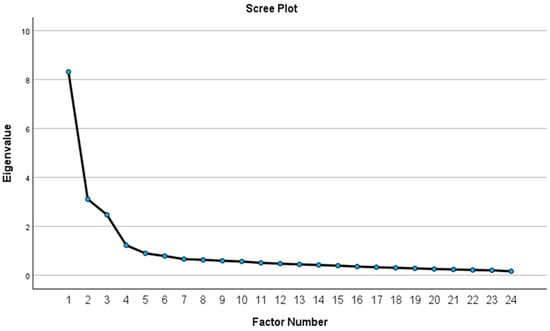
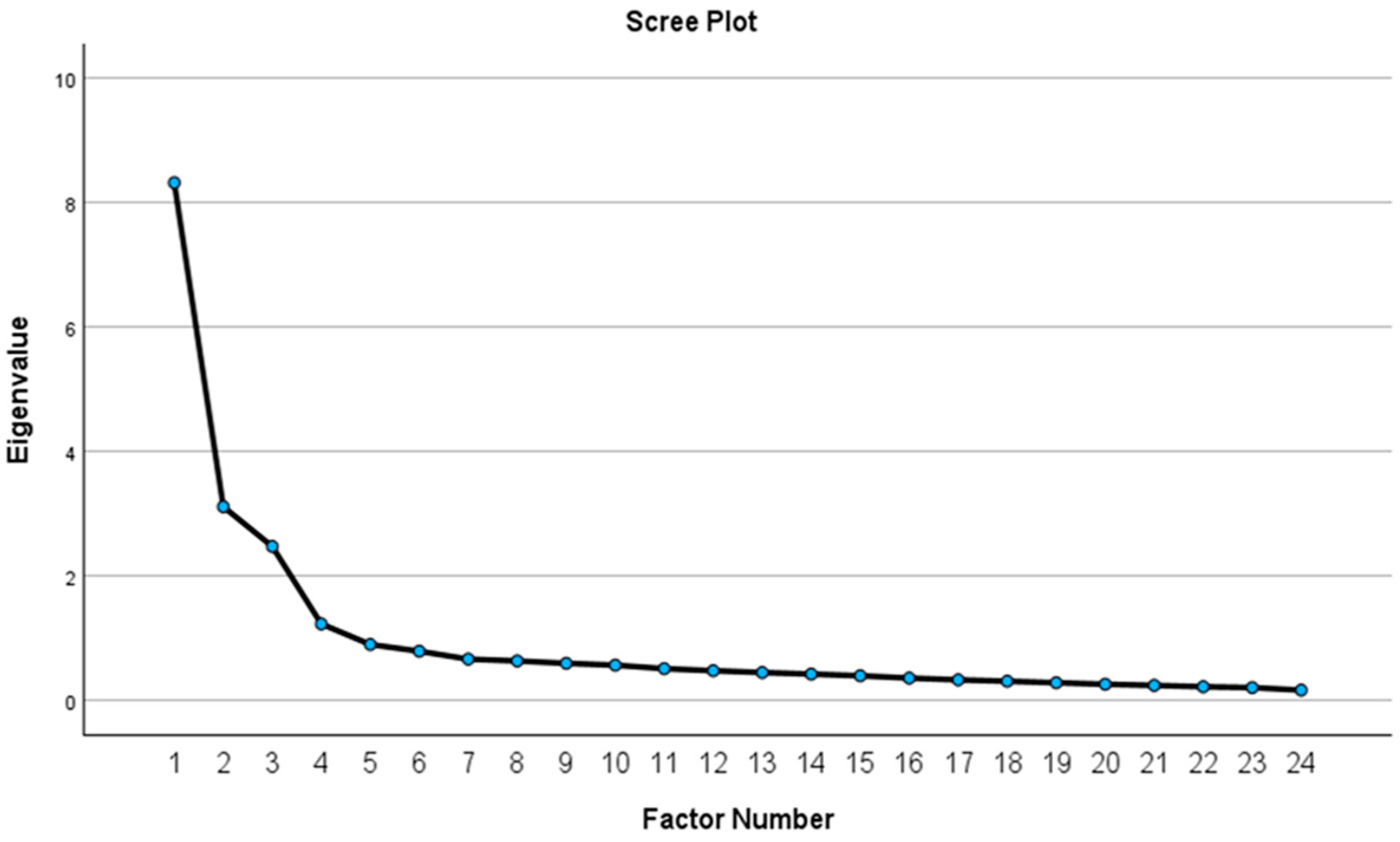
Figure 1 summarizes the retention criteria, and Table 3 presents the parallel analysis. As illustrated in Figure 1, the scree plot shows the existence of four factors with eigenvalues greater than unity, according to the Kaiser criterion. The clear elbow after the fourth factor suggested that additional factors explained minimal variance, supporting a four-factor solution. This decision was further confirmed by parallel analysis (1000 random datasets), in which only the first four observed eigenvalues exceeded those generated from random data (see Table 3).
Figure 1.
Scree plot of eigenvalues for extracted factor.
Table 3.
Parallel analysis results for factor retention.
The approach best reflects the theoretical complexity of the latent data structures. EFA with the ML method with direct oblimin rotation provided a four-factor solution, based on the interpretability of the structure and the loadings ≥ 0.35 (Rogers, 2022). The pattern of loadings is presented in Table A3 (Appendix A). Most items showed strong and distinct loadings on their respective latent factors. No secondary loadings ≥ 0.35 were observed among the retained items. Items not retained were excluded due to loadings < 0.35 and cross-loadings, following the stated criteria.
Factor retention was supported by the scree plot and parallel analysis, which both favored a four-factor solution (see Table A4, Appendix A). Thus, the four-factor solution is supported by converging retention criteria. This four-factor structure also provides preliminary construct validity evidence, as the extracted factors correspond to the theoretically anticipated dimensions of teachers’ readiness for social inclusion. For comparison purposes, the PAF method yielded the same four-factor solution. However, the subsequent results are based on ML extraction with Direct Oblimin rotation, as defined in the Methods section.
The EFA of the pooled AIS, ITICS, and TEIP items yielded a coherent four-factor solution. Notably, the factors largely aligned with the source instruments, indicating that attitudes (AIS) and intentions (ITICS) remained empirically distinguishable, while self-efficacy (TEIP) split into two dimensions. The factors were interpreted as follows:
- Attitudes toward Inclusive Education (AIS)—consisting exclusively of AIS items (A1–A7), capturing teachers’ evaluative beliefs and feelings toward inclusive schooling.
- Intentions to Teach in Inclusive Classrooms (ITICS)—comprising ITICS items (B1, B3–B7), reflecting teachers’ intentions and willingness to enact inclusive teaching practices.
- Self-efficacy for Behavior Management (TEIP)—including TEIP items (C7–C12), representing teachers’ perceived capability to prevent and manage disruptive or challenging classroom behavior in inclusive settings.
- Self-efficacy for Collaboration and Professional Support (TEIP)—comprising TEIP items (C2, C15–C18), representing teachers’ perceived capability to collaborate with other professionals and support inclusive implementation.
Overall, the pooled EFA suggests that the constructs remained largely instrument-specific, with self-efficacy differentiating into two interpretable dimensions. Importantly, this pooled EFA solution should not be interpreted as strong evidence for a single unified underlying construct. Rather, it is reported as a preliminary, hypothesis-generating structure contingent on the present sample and analytic specifications.
A preliminary principal component analysis (PCA) produced eigenvalues of 8.32, 3.12, 2.48, and 1.23; parallel analysis independently supported retaining four factors. Both ML and PAF were examined for factor extraction. Table 4 presents a PAF/Oblimin solution representing 56.14% of the total variance, for completeness. However, the main solution and all subsequent analyses are based on ML extraction with Direct Oblimin rotation. To examine the suitability of all data for factor analysis, we used the KMO, which was excellent and specifically at 0.91 (see Table A5, Appendix A), according to Kaiser’s criteria (Kaiser, 1974).
Table 4.
Total variance explained.
4.3. Reliability Analysis
The overall internal consistency of the pooled measure was α = 0.91 and ω = 0.90. The reliability measures of the four factors were computed using Cronbach’s Alpha (α) and McDonald’s omega (ω): Factor 1 (α = 0.89/ω = 0.89), Factor 2 (α = 0.91/ω = 0.91), Factor 3 (α = 0.85/ω = 0.86) and Factor 4 (α = 0.74/ω = 0.76). For more details, see Table 5.
Table 5.
Reliability analysis of factors.
5. Discussion
The findings of the present study indicate that teachers’ attitudes and intentions do not perfectly coincide but are meaningfully related while remaining empirically distinguishable. In particular, beliefs about the importance of inclusion (“I should”) are closely linked with perceived capabilities (“I can”), demonstrating overlapping yet distinct contributions of attitudes and self-efficacy. Rather than indicating a merger of constructs at the item level, the pooled EFA suggests that attitudes (AIS) and intentions (ITICS) largely retained their instrument-specific structure, while self-efficacy (TEIP) differentiated into two interpretable dimensions. This pattern supports the conceptualization of teachers’ inclusive readiness as a multidimensional, interconnected psychological resource composed of related but non-redundant components.
More specifically, the present findings directly address RQ1 by examining the relationship between teachers’ attitudes toward inclusion and their self-efficacy for inclusive practices. The observed correlations indicate a meaningful, though not redundant, association: teachers who hold more favorable attitudes generally report higher self-efficacy in implementing inclusive strategies. This pattern aligns with previous studies showing that positive beliefs about inclusion are linked to greater confidence in instructional adaptation, classroom management, and collaboration (Emmers et al., 2019; Yada et al., 2022; Savolainen et al., 2022). Importantly, the correlations were moderate rather than strong, suggesting that holding favorable attitudes alone does not fully determine teachers’ perceived capability, consistent with the well-documented intention–action gap discussed in the literature on inclusive teaching (Sepadi, 2025; Woodcock et al., 2022). These results reinforce the theoretical premise of Social Cognitive Theory that beliefs influence self-efficacy but do not automatically ensure implementation in practice, and they support the relevance of the Theory of Planned Behavior in framing attitudes as a predictor—but not a guarantee—of intended behavior (Ajzen, 1991; Opoku et al., 2021; Urton et al., 2023).
Overall, these findings suggest that interventions aiming to support inclusive implementation may benefit from targeting both attitudes and self-efficacy simultaneously to strengthen teachers’ readiness and capability for inclusive education. From an applied perspective, differentiation can be viewed as a concrete pathway through which inclusive readiness may be expressed in classroom-relevant ways, particularly when domain-specific self-efficacy supports teachers’ ability to adapt instruction under real classroom constraints (Wang et al., 2025). Compared with prior work that often treats these constructs separately, our pooled analysis suggests that they remain empirically distinct but interrelated, pointing to inclusive readiness as a multidimensional configuration rather than a unitary construct. More specifically, prior studies typically operationalize these constructs separately (often via overall scores within AIS/TEIP/ITICS) and then relate them through correlations or regressions, leaving open whether item-level overlap yields cross-cutting readiness dimensions. By pooling items across instruments, our analysis provides a complementary lens: the constructs are empirically distinct yet interrelated, while self-efficacy differentiates into domain-specific facets that are plausibly consequential for classroom demands. From this standpoint, differentiated instruction is the most concrete pedagogical arena in which attitudes and intentions can be expressed and should be measured directly in future research to evaluate the intention–action gap beyond self-report.
The exploratory factor analysis (EFA) of the combined AIS, ITICS, and TEIP items directly addresses RQ2 by identifying a coherent four-factor structure that largely aligned with the source instruments: (1) Attitudes toward Inclusive Education, (2) Intentions to Teach in Inclusive Classrooms, (3) Self-efficacy for Behavior Management, and (4) Self-efficacy for Collaboration and Professional Support. Τhis pattern indicates that attitudes, intentions, and self-efficacy remained empirically distinguishable in this sample, while self-efficacy differentiated into two domain-specific dimensions. Accordingly, the EFA results should be interpreted as evidence of separability with structured internal differentiation (within self-efficacy), rather than as convergence of items from different instruments within the same latent factors. From an applied perspective, this suggests that professional development may benefit from addressing attitudes and intentions as distinct targets while also strengthening domain-specific self-efficacy—particularly for managing challenging behavior and for collaborating with other professionals to support inclusive implementation. Overall, the latent structure underscores that teachers’ readiness for inclusion cannot be fully understood by examining attitudes, self-efficacy, or intentions in isolation; instead, it is better conceptualized as a set of related but distinct psychological resources, consistent with Social Cognitive Theory and the Theory of Planned Behavior (Bandura, 1997; Ajzen, 1991).
6. Implications
The findings for the first research question highlight the importance of addressing both teachers’ beliefs and perceived capabilities in intervention programs, as enhancing self-efficacy may support the alignment of positive attitudes into inclusive implementation, a link that should be tested directly using behavioral or observational measures. Regarding the second research question, the results provide a theoretically and practically grounded explanation for structured interrelations across attitudes, self-efficacy, and intentions. This supports the conceptualization of inclusive readiness as a multidimensional construct in which Social Cognitive Theory and the Theory of Planned Behavior mechanisms—self-efficacy, attitudes, perceived control, and intentions—jointly shape teachers’ preparedness to implement inclusion effectively.
7. Limitations
Several limitations should be acknowledged, the most notable being the cross-sectional design, which precludes causal inferences, and the exclusive reliance on self-report measures, which may be susceptible to social desirability bias. The exclusively quantitative, self-report approach limits insight into the meanings, reasoning, and situational experiences underlying participants’ responses; thus, the absence of qualitative evidence (e.g., interviews or observational data) restricts a more nuanced interpretation of how attitudes, intentions, and perceived self-efficacy are understood and expressed in practice. A further limitation is that recruitment relied on convenience sampling via professional networks; therefore, the sample is non-probabilistic, and findings should be generalized cautiously beyond Greek secondary special education contexts. Furthermore, because the invitation was disseminated through multiple channels, the exact number of invitees could not be tracked, and a precise response rate could not be computed. Moreover, although internal consistency indices were strong, considerations of content coverage are warranted. Factors 3 and 4 were predominantly composed of TEIP items, reflecting two self-efficacy domains (behavior management and collaboration/professional support). While item-level sampling adequacy was high across the pooled item set (see KMO/MSA results in Table A5, Appendix A), the TEIP-heavy composition of these factors may imply relative under-representation of some facets—particularly broader collaborative practices beyond instructional support.
In addition, the present study did not include school- or class-level structural indicators (e.g., class composition, availability of support staff, organizational resources, or formal inclusion arrangements). We also collected teacher-level contextual indicators (e.g., prior training in inclusive education and participation in professional learning communities), but these were not analyzed as covariates or predictors in the present study. As a result, the findings reflect teacher-level psychological correlates of inclusive readiness and do not capture how structural and contextual conditions may facilitate or constrain the translation of intentions into enacted practice. Finally, because the pooled EFA combined items from different instruments with differing response formats and ordinal response options, the extracted structure should be considered preliminary and requires replication and confirmatory validation (e.g., CFA/SEM) before firmer conclusions can be drawn about its stability and generalizability.
8. Conclusions
This study provides empirical evidence that teachers’ attitudes, self-efficacy, and intentions are interrelated yet distinct components of inclusive readiness. The exploratory factor analysis revealed a coherent four-factor latent structure that largely aligned with the source instruments (AIS, ITICS, and TEIP), indicating that attitudes and intentions remained empirically distinguishable while self-efficacy differentiated into two domains (behavior management and collaboration/professional support). Rather than demonstrating broad convergence of items across the three constructs, the pooled EFA suggests separability with meaningful internal differentiation within self-efficacy. Accordingly, inclusive readiness is best understood as a multidimensional set of related but non-redundant psychological resources—encompassing attitudes toward inclusion, intentions to use inclusive practice, and domain-specific self-efficacy for managing behavior and collaborating to support inclusion. Overall, the results underscore the importance of considering these interrelated components together when designing interventions and professional development programs to enhance effective inclusion in secondary education.
9. Recommendations
Longitudinal studies and cross-cultural validations are needed to examine the stability of inclusive readiness dimensions and their impact on actual classroom practices. Moreover, with the appropriate statistical techniques (e.g., confirmatory factor analysis, structural equation modeling), the latent structure identified in this study could be leveraged as a practical assessment tool for teachers’ inclusive readiness, enabling researchers and practitioners to measure, monitor, and support readiness for inclusive teaching more systematically. Practically, the four-factor profile could inform differentiated professional development: for example, when attitudes and intentions are strong (Factors 1–2) but self-efficacy lags (Factor 3 for behavior management and/or Factor 4 for collaboration/professional support), training can combine attitude-building with targeted coaching and guided practice in the specific domain of need. Future studies should incorporate teacher-level contextual variables, such as prior training in inclusive education and participation in professional learning communities related to inclusive practices, either as control variables or as key predictors of inclusive readiness. In addition, future longitudinal and multilevel research could examine self-efficacy not only as a facilitating mechanism but also as a moderator that shapes how teachers’ beliefs and intentions interact with contextual constraints to influence inclusive implementation. Finally, future research should cross-validate the pooled EFA structure using CFA/SEM in an independent sample (or via split-sample validation where feasible) before factor scores are used as composite variables in substantive predictive models.
Author Contributions
Conceptualization, E.B., N.R. and E.F.; methodology, E.F.; software, E.F.; validation, E.F.; formal analysis, E.F.; investigation, E.F.; resources, E.F.; data curation, E.F.; writing—original draft preparation, E.B., N.R. and E.F.; writing—review and editing, E.B., N.R. and E.F.; visualization, E.B., N.R. and E.F.; supervision, E.B., N.R. and E.F.; project administration, E.B.; funding acquisition, E.B. All authors have read and agreed to the published version of the manuscript.
Funding
The research is conducted in the operating framework of the University of Thessaly Innovation, Technology Transfer Unit and Entrepreneurship Center “One Planet Thessaly”, under the “University of Thessaly Grants for Scientific Publication Support” action and is funded by the Special Account of Research Grants of the University of Thessaly.
Institutional Review Board Statement
The study was conducted in accordance with the Declaration of Helsinki and approved by the Ethics Committee of the University of Thessaly (protocol code 314/4-3-25, with approval granted on 11 April 2025).
Informed Consent Statement
Informed consent was obtained from all subjects involved in the study.
Data Availability Statement
The datasets presented in this article are not readily available because the data are part of an ongoing study. Requests to access the datasets should be directed to vgsfoukas@gmail.com.
Conflicts of Interest
The authors declare no conflict of interest.
Abbreviations
The following abbreviations are used in this manuscript:
| AIS | Attitudes toward Inclusive Education Scale |
| CFA | Confirmatory Factor Analysis |
| EFA | Exploratory Factor Analysis |
| ITICS | Inclusive Classroom Teaching Intentions Scale |
| ML | Maximum Likelihood |
| PCA | Principal Component Analysis |
| RQ | Research Question |
| SEN | Special Educational Needs |
| TEIP | Teacher Efficacy for Inclusive Practices Scale |
| TPB | Theory of Planned Behavior |
Appendix A
Table A1.
Excluded items and exclusion criteria (pooled EFA, ML/Oblimin).
Table A2.
Retained items in the pooled EFA: instrument source, item wording, and factor membership.
Table A3.
Pattern matrix (maximum likelihood, direct oblimin; loadings ≥ 0.35).
Table A4.
Goodness-of-fit indices for ML model.
Table A5.
Kaiser–Meyer–Olkin (KMO) test—measure of sampling adequacy (MSA).
References
- Adams, D., Mohamed, A., Moosa, V., & Shareefa, M. (2023). Teachers’ readiness for inclusive education in a developing country: Fantasy or possibility? Educational Studies, 49(6), 896–913. [Google Scholar] [CrossRef] [Scilit]
- Ainscow, M. (2020). Promoting inclusion and equity in education: Lessons from international experiences. Nordic Journal of Studies in Educational Policy, 6(1), 7–16. [Google Scholar] [CrossRef] [Scilit]
- Ajzen, I. (1991). The theory of planned behavior. Organizational Behavior and Human Decision Processes, 50(2), 179–211. [Google Scholar] [CrossRef] [Scilit]
- Ajzen, I. (2006). Perceived behavioral control, self-efficacy, locus of control, and the theory of planned behavior. Journal of Applied Social Psychology, 32(4), 665–683. [Google Scholar] [CrossRef] [Scilit]
- Ajzen, I. (2020). The theory of planned behavior: Frequently asked questions. Human Behavior and Emerging Technologies, 2(4), 314–324. [Google Scholar] [CrossRef] [Scilit]
- Almalky, H. A., & Alrabiah, A. H. (2024). Predictors of teachers’ intention to implement inclusive education. Children and Youth Services Review, 158, 107457. [Google Scholar] [CrossRef] [Scilit]
- Arboiz, A. C., & Aoanan, G. O. (2024). Teacher efficacy and attitude in inclusive education as predictors of readiness for inclusive education: An explanatory sequential design. EPRA International Journal of Multidisciplinary Research, 10(5), 838–851. [Google Scholar] [CrossRef] [Scilit]
- Bandura, A. (1986). Social foundations of thought and action: A social cognitive theory. Prentice-Hall. [Google Scholar]
- Bandura, A. (1997). Self-efficacy: The exercise of control. W. H. Freeman. [Google Scholar]
- Burak, Y., Ahmetoglu, E., & Sakalli-Gümüş, S. (2025). Teachers’ attitudes towards inclusion and views on self-efficacy and classroom practices regarding inclusive education. Journal of Research in Special Educational Needs, 26(1), e70047. [Google Scholar] [CrossRef] [Scilit]
- Camedda, D., & Tarantino, G. (2023, August 21–22). Teachers’ attitudes towards inclusive education: A systematic review of the literature. [Paper presentation]. European Conference on Educational Research (ECER 2023), Glasgow, UK. Available online: https://eera-ecer.de/ecer-programmes/conference/28/contribution/54637 (accessed on 22 October 2025).
- Chow, W. S. E., de Bruin, K., & Sharma, U. (2024). A scoping review of perceived support needs of teachers for implementing inclusive education. International Journal of Inclusive Education, 28(13), 3321–3340. [Google Scholar] [CrossRef] [Scilit]
- Cohen, J. (1988). Statistical power analysis for the behavioral sciences (2nd ed.). Routledge. [Google Scholar] [CrossRef] [Scilit]
- Costello, A. B., & Osborne, J. W. (2005). Best practices in exploratory factor analysis: Four recommendations for getting the most from your analysis. Practical Assessment, Research & Evaluation, 10(1), 7. [Google Scholar] [CrossRef]
- Desombre, C., Delaval, M., & Jury, M. (2021). Influence of social support on teachers’ attitudes toward inclusive education. Frontiers in Psychology, 12, 736535. [Google Scholar] [CrossRef] [Scilit]
- Dierendonck, C., Poncelet, D., & Tinnes-Vigne, M. (2024). Why teachers do (or do not) implement recommended teaching practices? An application of the theory of planned behavior. Frontiers in Psychology, 15, 1269954. [Google Scholar] [CrossRef] [Scilit] [PubMed]
- Dignath, C., Rimm-Kaufman, S., van Ewijk, R., & Kunter, M. (2022). Teachers’ beliefs about inclusive education and insights on what contributes to those beliefs: A meta-analytic study. Educational Psychology Review, 34, 2609–2660. [Google Scholar] [CrossRef] [Scilit]
- Emmers, E., Baeyens, D., & Petry, K. (2019). Attitudes and self-efficacy of teachers towards inclusion in higher education. European Journal of Special Needs Education, 35(2), 139–153. [Google Scholar] [CrossRef] [Scilit]
- Fabrigar, L. R., Wegener, D. T., MacCallum, R. C., & Strahan, E. J. (1999). Evaluating the use of exploratory factor analysis in psychological research. Psychological Methods, 4(3), 272–299. [Google Scholar] [CrossRef]
- Field, A. (2018). Discovering statistics using IBM SPSS statistics (5th ed.). Sage. [Google Scholar]
- Foykas, E., Raikou, N., Beazidou, E., & Karalis, T. (2025). Transformative potential in special education: How perceived success, training, exposure and experience contribute to teacher readiness for inclusive practice. Education Sciences, 15(11), 1476. [Google Scholar] [CrossRef] [Scilit]
- Gülsün, İ., Malinen, O.-P., Yada, A., & Savolainen, H. (2025). Applying the theory of planned behaviour to examine teachers’ intentions to teach in inclusive classrooms and their inclusive practices. British Educational Research Journal, 1–26. [Google Scholar] [CrossRef] [Scilit]
- Hair, J. F., Jr., Black, W. C., Babin, B. J., & Anderson, R. E. (2019). Multivariate data analysis (8th ed.). Cengage. [Google Scholar]
- Hamid, M. S., & Mohamed, N. I. A. (2021). Empirical investigation into teachers’ attitudes towards inclusive education: A study of future faculty of Qatari schools. Cypriot Journal of Educational Science, 16(2), 580–593. [Google Scholar] [CrossRef] [Scilit]
- Hellenic Republic. (2008). Law 3699/2008: Special education and training of persons with disabilities or with special educational needs (Government Gazette A’ 199/02-10-2008). Hellenic Republic.
- Hellenic Republic. (2012). Law 4074/2012: Ratification of the United Nations convention on the rights of persons with disabilities and the optional protocol to the convention on the rights of persons with disabilities (Government Gazette A’ 88/11-04-2012). Hellenic Republic.
- Herzig Johnson, S. (2023). The role of teacher self-efficacy in the implementation of inclusive practices. Journal of School Leadership, 33(5), 516–534. [Google Scholar] [CrossRef] [Scilit]
- Hick, P., Matziari, A., Mintz, J., Ó Murchú, F., Cahill, K., Hall, K., Curtin, C., & Solomon, Y. (2019). Initial teacher education for inclusion: Final report to the National Council for Special Education. National Council for Special Education. Available online: https://ncse.ie/wp-content/uploads/2020/01/04611_NCSE-Initial-Teacher-Education-RR27.pdf (accessed on 22 October 2025).
- Jia, Q., Martínez-Hernández, C., & Peña-Martínez, J. (2025). Mapping the integration of theory of planned behavior and self-determination theory in education: A scoping review on teachers’ behavioral intentions. Education Sciences, 15(11), 1529. [Google Scholar] [CrossRef] [Scilit]
- Kaiser, H. F. (1974). An index of factorial simplicity. Psychometrika, 39(1), 31–36. [Google Scholar] [CrossRef] [Scilit]
- Kenny, N., McCoy, S., & O’Higgins Norman, J. (2023). A whole education approach to inclusive education: An integrated model to guide planning, policy, and provision. Education Sciences, 13(9), 959. [Google Scholar] [CrossRef] [Scilit]
- Kristiana, I. F., & Hendriani, W. (2018). Teaching efficacy in inclusive education (IE) in Indonesia and other Asia, developing countries: A systematic review. Journal of Education and Learning (EduLearn), 12(2), 166–171. [Google Scholar] [CrossRef] [Scilit]
- Kupers, E., de Boer, A., Bakker, A., de Jong, F., & Minnaert, A. (2024). Explaining teachers’ behavioural intentions towards differentiated instruction for inclusion: Using the theory of planned behavior and the self-determination theory. European Journal of Special Needs Education, 39(4), 638–647. [Google Scholar] [CrossRef] [Scilit]
- Mastrothanasis, K., Zervoudakis, K., & Xafakos, E. (2021). Secondary special education teachers’ beliefs towards their teaching self-efficacy. Preschool and Primary Education, 9(1), 28–51. [Google Scholar] [CrossRef] [Scilit]
- Mouchritsa, M., Romero, A., Garay, U., & Kazanopoulos, S. (2022). Teachers’ attitudes towards inclusive education at Greek secondary education schools. Education Sciences, 12(6), 404. [Google Scholar] [CrossRef] [Scilit]
- Mudhar, G., Ertesvåg, S. K., & Pakarinen, E. (2024). Patterns of teachers’ self-efficacy and attitudes toward inclusive education associated with teacher emotional support, collective teacher efficacy, and collegial collaboration. European Journal of Special Needs Education, 39(3), 446–462. [Google Scholar] [CrossRef] [Scilit]
- Narkun, Z., & Smogorzewska, J. (2019). Studying self-efficacy among teachers in Poland is important: Polish adaptation of the Teacher Efficacy for Inclusive Practice (TEIP) scale. Exceptionality Education International, 29(2), 110–126. [Google Scholar] [CrossRef] [Scilit]
- Nissim, M., & Shamma, F. (2025). Supporting teacher professionalism for inclusive education: Integrating cognitive, emotional, and contextual dimensions. Education Sciences, 15(10), 1317. [Google Scholar] [CrossRef] [Scilit]
- Opoku, M. P., Cuskelly, M., Pedersen, S. J., & Rayner, C. S. (2021). Applying the theory of planned behaviour in assessments of teachers’ intentions towards practicing inclusive education: A scoping review. European Journal of Special Needs Education, 36(4), 577–592. [Google Scholar] [CrossRef] [Scilit]
- O’Reilly, E., & Colum, M. (2021). Newly qualified teachers and inclusion in higher education: Policy, practice and preparation. Journal of Higher Education Policy and Leadership Studies, 2(1), 64–78. [Google Scholar] [CrossRef] [Scilit]
- Reichenberg, M., Thunberg, G., Holmer, E., Palmqvist, L., Samuelsson, J., Lundälv, M., Mühlenbock, K., & Heimann, M. (2023). Will an app-based reading intervention change how teachers rate their teaching self-efficacy beliefs? A test of social cognitive theory in Swedish special educational settings. Frontiers in Education, 8, 1184719. [Google Scholar] [CrossRef] [Scilit]
- Rogers, P. (2022). Best practices for your exploratory factor analysis: A factor tutorial. Revista de Administração Contemporânea, 26(6), e210085. [Google Scholar] [CrossRef] [Scilit]
- Sahli Lozano, C., Wüthrich, S., Baumli, N., Sharma, U., Loreman, T., & Forlin, C. (2023). Development and validation of a short form of the Teacher Efficacy for Inclusive Practices Scale (TEIP-SF). Journal of Research in Special Educational Needs, 23(4), 375–388. [Google Scholar] [CrossRef] [Scilit]
- Sahli Lozano, C., Wüthrich, S., Kullmann, H., Knickenberg, M., Sharma, U., Loreman, T., Romano, A., & Avramidis, E. (2024). How do attitudes and self-efficacy predict teachers’ intentions to use inclusive practices? A cross-national comparison between Canada, Germany, Greece, Italy, and Switzerland. Exceptionality Education International-Special Issue on Inclusive Education: Canada’s Connection to the World, 34(1), 17–41. [Google Scholar] [CrossRef] [Scilit]
- Savolainen, H., Malinen, O. P., & Schwab, S. (2022). Teacher efficacy predicts teachers’ attitudes towards inclusion—A longitudinal cross-lagged analysis. International Journal of Inclusive Education, 26(9), 958–972. [Google Scholar] [CrossRef] [Scilit]
- Sepadi, M. D. (2025). Teachers’ understanding of implementing inclusion in mainstream classrooms in rural areas. Education Sciences, 15(7), 889. [Google Scholar] [CrossRef] [Scilit]
- Shareef, M. A., Akram, M. S., Malik, F. T., Kumar, V., Dwivedi, Y. K., & Giannakis, M. (2023). An attitude–behavioral model to understand people’s behavior towards tourism during COVID-19 pandemic. Journal of Business Research, 161, 113839. [Google Scholar] [CrossRef] [Scilit]
- Sharma, U., & Jacobs, D. K. (2016). Predicting in-service educators’ intentions to teach in inclusive classrooms in India and Australia. Teaching and Teacher Education, 55(3), 13–23. [Google Scholar] [CrossRef] [Scilit]
- Sharma, U., Loreman, T., & Forlin, C. (2012). Measuring teacher efficacy to implement inclusive practices. Journal of Research in Special Educational Needs, 12(1), 12–21. [Google Scholar] [CrossRef] [Scilit]
- Tabachnick, B. G., & Fidell, L. S. (2019). Using multivariate statistics (7th ed.). Pearson. [Google Scholar]
- United Nations. (n.d.). Convention on the rights of persons with disabilities: Greece (ratification status). United Nations Treaty Collection. [Google Scholar]
- United Nations. (2006). Convention on the rights of persons with disabilities. Available online: https://treaties.un.org/pages/viewdetails.aspx?chapter=4&clang=_en&mtdsg_no=iv-15&src=treaty (accessed on 22 October 2025).
- Urton, K., Wilbert, J., Krull, J., & Hennemann, T. (2023). Factors explaining teachers’ intention to implement inclusive practices in the classroom: Indications based on the theory of planned behaviour. Teaching and Teacher Education, 132, 104225. [Google Scholar] [CrossRef] [Scilit]
- Wahyuni, S., Novembli, M. S., & Hasanah, N. (2024). Self-efficacy: Readiness of teachers in inclusive schools. Al-Ishlah: Journal of Pendidikan, 16(3), 3018–3028. [Google Scholar] [CrossRef] [Scilit]
- Wang, T., Deng, M., & Tian, G. (2025). Facilitating teachers’ inclusive education intentions: The roles of transformational leadership, school climate, and teacher efficacy. Humanities and Social Sciences Communications, 12, 636. [Google Scholar] [CrossRef] [Scilit]
- Woodcock, S., Sharma, U., Subban, P., & Hitches, E. (2022). Teacher self-efficacy and inclusive education practices: Rethinking teachers’ engagement with inclusive practices. Teaching and Teacher Education, 117, 103802. [Google Scholar] [CrossRef] [Scilit]
- Worthington, R. L., & Whittaker, T. A. (2006). Scale development research: A content analysis and recommendations for best practices. The Counseling Psychologist, 34(6), 806–838. [Google Scholar] [CrossRef] [Scilit]
- Yada, A., Leskinen, M., Savolainen, H., & Schwab, S. (2022). Meta-analysis of the relationship between teachers’ self-efficacy and attitudes toward inclusive education. Teaching and Teacher Education, 109, 103521. [Google Scholar] [CrossRef] [Scilit]

Disclaimer/Publisher’s Note: The statements, opinions and data contained in all publications are solely those of the individual author(s) and contributor(s) and not of MDPI and/or the editor(s). MDPI and/or the editor(s) disclaim responsibility for any injury to people or property resulting from any ideas, methods, instructions or products referred to in the content. |
© 2026 by the authors. Licensee MDPI, Basel, Switzerland. This article is an open access article distributed under the terms and conditions of the Creative Commons Attribution (CC BY) license.