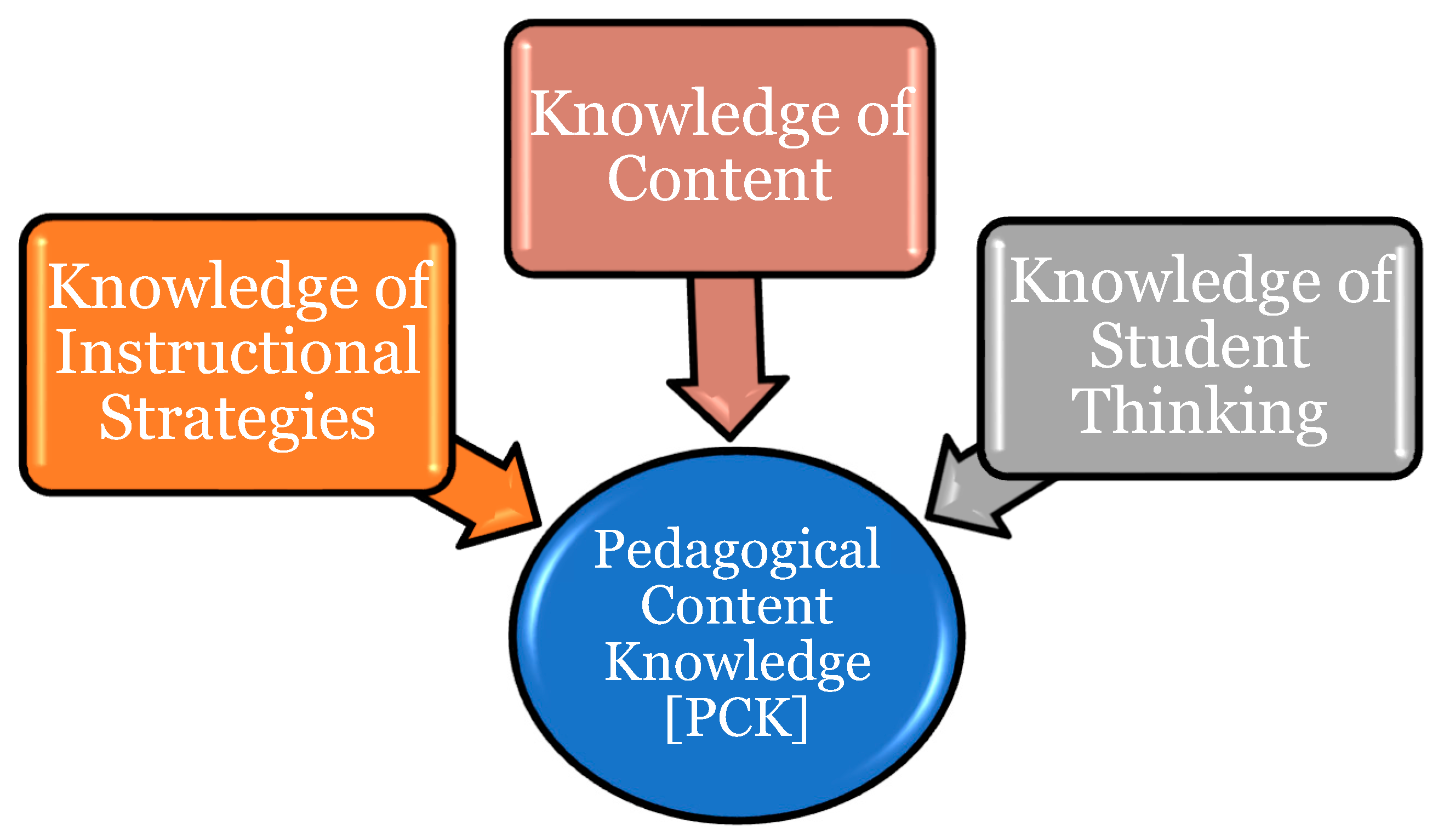
Mathematics Teachers’ Pedagogical Content Knowledge in Strengthening Conceptual Understanding in Students with Learning Disabilities: A Practice-Based Conceptual Synthesis

Abstract
1. Introduction
2. PCK in Mathematics Education
2.1. Defining PCK
2.2. Understanding PCK in the Context of Students with LD
3. Core Domains of Mathematics Teachers’ PCK
3.1. Knowledge of Content
3.2. Knowledge of Student Thinking and Misconceptions
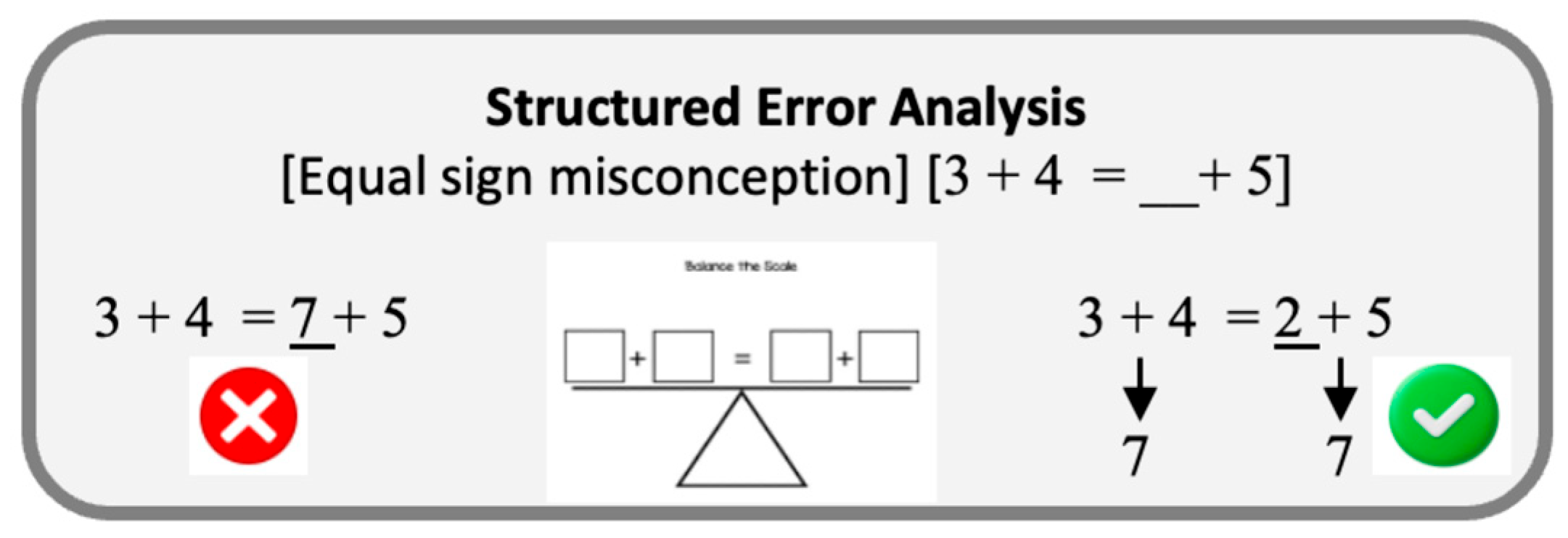
- Misinterpreting the equal sign as a directive to compute rather than as a symbol of equivalence (Booth et al., 2017; Knuth et al., 2006), for example, when presented with an equation such as 3 + 4 = 5 + 2, students may compute only the left-hand side, revealing a limited understanding of relational equality.
- Place-value confusion (Van de Walle et al., 2019), such as reading 42 as “4 + 2” or reversing digits as 24, indicates an incomplete understanding of the base-ten system.
- Additive reasoning applied to multiplication (e.g., interpreting 4 × 3 as 4 + 3), reflecting an incomplete grasp of multiplicative relationships (L. S. Fuchs et al., 2016).
- Overgeneralization of patterns without conceptual grounding (Van de Walle et al., 2019), such as assuming all odd numbers end in “1,” further illustrates how students may misapply learned rules without conceptual grounding.
3.3. Knowledge of Instructional Strategies
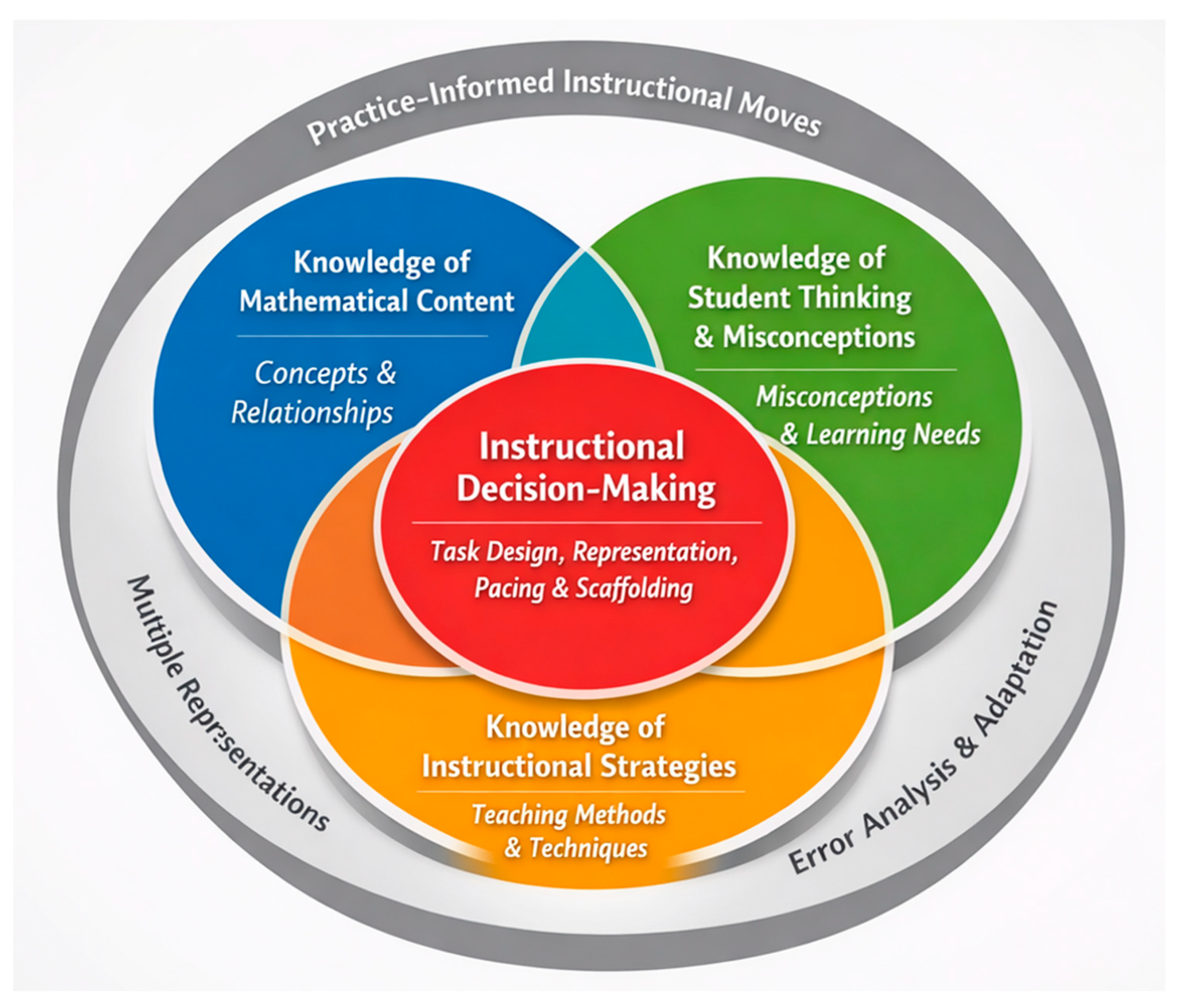
3.4. Integrating PCK Domains to Support Conceptual Understanding

4. Empirical Evidence on Teachers’ PCK and Mathematics Instruction
4.1. Evidence from Meta-Analyses and Systematic Reviews
4.2. Professional Development Studies Targeting Mathematics Teachers’ PCK
4.3. Key PCK Components Supporting Conceptual Understanding for Students with LD
5. From Empirical Evidence to Classroom Enactment
5.1. Bridging PCK and Practice
5.2. Instructional Vignettes and Classroom Applications
5.2.1. Vignette 1: Building Number Sense with Multiple Representations
Instructional Context
- Grade: 3rd grade, inclusive classroom.
- Content focus: Place value and two-digit number reading.
- Learning goal: Students will understand the value of digits in two-digit numbers and avoid digit-reversal errors (e.g., reading “43” as “34”).
PCK Component Illustrated
- Content knowledge: Place value concepts.
- Knowledge of student thinking/misconceptions: Digit reversals, misunderstanding of tens and ones.
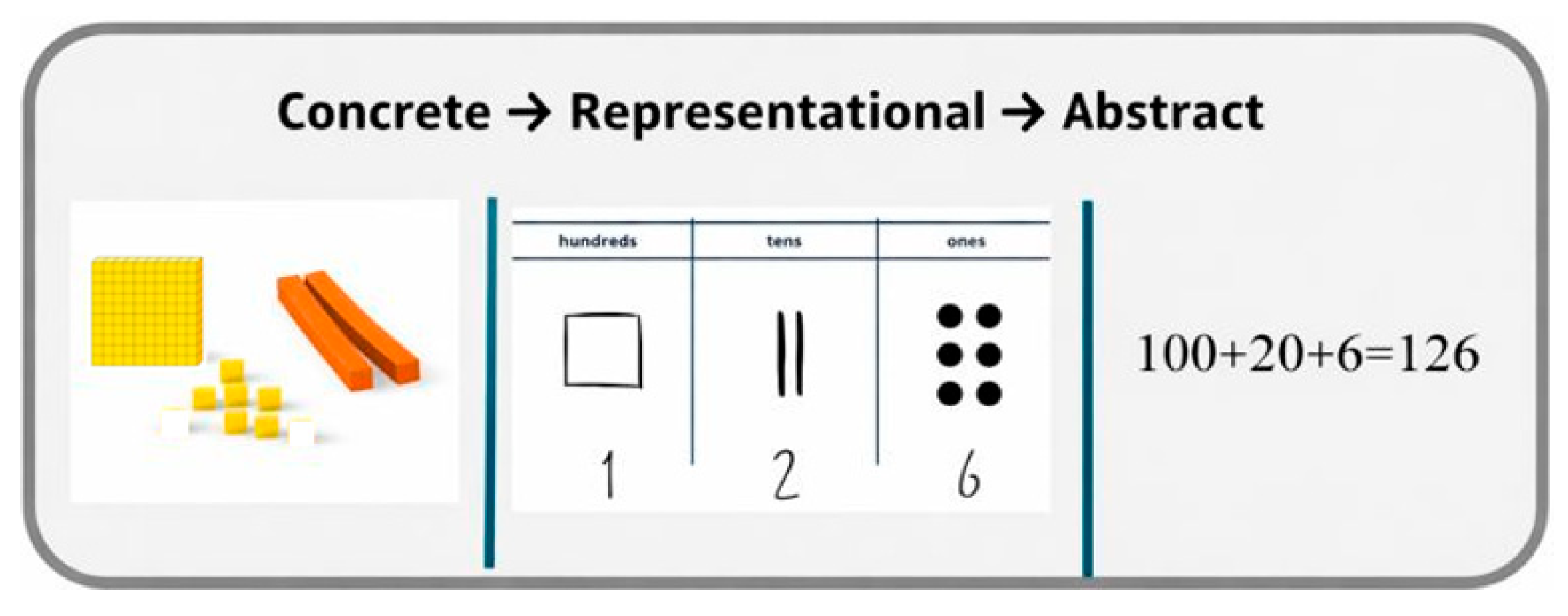
- Instructional strategies: CRA sequence, guided questioning, small-group modeling.
Instructional Decision and Rationale
Conceptual Payoff for Students with LD
Key Insights
5.2.2. Vignette 2: Unpacking the Equal Sign Through Error Analysis
Instructional Context
- Grade: Upper elementary, resource-room setting.
- Content focus: Relational understanding of the equal sign.
- Learning goal: Students will interpret the equal sign as indicating equivalence between expressions, rather than as a signal to compute a result.
PCK Component Illustrated
- Knowledge of student thinking/misconceptions: Misinterpretation of the equal sign as a “do something” symbol.
- Instructional strategies: Error analysis, balance-scale modeling, guided discussion.
Instructional Decision and Rationale
Conceptual Payoff for Students with LD
Key Insights
5.2.3. Vignette 3: Building Multiplicative Reasoning Through an Explicit Instruction Approach
Instructional Context
- Grade: 4th grade, inclusive classroom.
- Content focus: Multiplication and understanding equal groups.
- Learning goal: Students will develop multiplicative reasoning, shifting from additive strategies to conceptualizing multiplication as combining equal groups.
PCK Component Illustrated
- Content knowledge: Multiplication concepts, equal groups.
- Knowledge of student thinking/misconceptions: Tendency to apply additive reasoning (e.g., 5 × 3 as 5 + 3).
- Instructional strategies: Think-aloud modeling, guided practice, Number Talks, multiple practice opportunities (IR flashcards), scaffolding, distributed practice.
Instructional Decision and Rationale
Conceptual Payoff for Students with LD
Key Insights
6. Teacher Development and Support for Strengthening PCK
6.1. Professional Learning Models Supporting PCK Growth
6.2. Practical Recommendations for Educators and Schools
- Daily Reflection Logs: Teachers may set aside five minutes at the end of each lesson to document which representations were effective, which misconceptions emerged, and how students responded to instructional scaffolds. Brief, structured reflection supports professional learning through reflection-on-action (Schon, 1983).
- Mini Data Chats: Teachers may participate in brief weekly meetings to share one focal data point (e.g., accuracy on IR flashcards or exit tickets) and collaboratively determine next instructional steps. Such focused collaboration promotes collective responsibility for instructional decision-making (C. C. Lewis et al., 2009).
- Lesson Planning with PCK Prompts: Lesson plans may incorporate explicit prompts, such as: What prior knowledge will students draw on? Where might misconceptions arise? Which representations will best clarify this concept? Embedding these prompts supports anticipatory instructional planning grounded in PCK (Ball et al., 2008).
- Peer Coaching Cycles: Teachers may engage in short cycles of peer observation or co-teaching focused on a single PCK component (e.g., use of visual models or questioning strategies), followed by targeted feedback. Coaching models that emphasize modeling, observation, and reflection have been shown to strengthen instructional fidelity and responsiveness (Knight, 2007).
Reflective Practice and Self-Assessment of Teachers’ PCK
- Content Knowledge: Which mathematical relationships do my students struggle to connect, and how effectively do I explain these connections?
- Knowledge of Student Thinking: What evidence do I gather to identify students’ misconceptions, and how promptly and accurately do I respond?
- Instructional Strategies: How varied and purposeful are the representations I use, and do students receive sufficient opportunities for practice with feedback?
- Which instructional move had the greatest impact on student understanding during this unit, and why?
- What misconceptions emerged that were not anticipated, and how should future lessons be adjusted to address them more proactively?
- Which representations were most effective, and which need refinement?
- How did students with LD respond differently, and which supports proved most helpful?
- Which aspect of my PCK will I prioritize next, and what resources, collaboration, or coaching will support that focus?
7. Discussions and Implications
7.1. Implications for Practice
- Dedicated PD Time: Allocating scheduled, sustained opportunities for collaborative planning, reflection, model teaching, and data analysis enables teachers to continuously refine their PCK (Cojorn & Sonsupap, 2024; Darling-Hammond et al., 2009). Embedding professional learning within the school calendar through recurring PLCs fosters accountability and collective ownership of instructional improvement.
- Resource Accessibility: Ensuring ready access to instructional resources, including physical and digital manipulatives, video exemplars of effective mathematics instruction, diagnostic assessment probes, and fidelity checklists, empowers teachers to implement evidence-based practices with conceptual clarity and confidence.
- Instructional Coaching: On-site instructional coaches or specialists can provide just-in-time feedback, co-teaching support, and personalized mentoring, reinforcing teachers’ application of PCK and troubleshooting challenges in authentic classroom contexts (Knight, 2007; Motto, 2021).
- General and Special Education Collaboration: Collaboration between general and special education teachers is essential for inclusive mathematics instruction. Co-teaching models, such as station teaching and team teaching, allow educators to integrate complementary expertise, co-design differentiated tasks, and dynamically adjust supports for students with learning needs within general education settings (Friend & Cook, 2010). Additionally, joint lesson study, in which teachers collaboratively plan, observe, and refine instruction, promotes peer learning and shared problem-solving around conceptual challenges (C. C. Lewis et al., 2006; C. Lewis et al., 2019).
7.2. Implications for Future Research
7.3. Limitations
8. Conclusions
Author Contributions
Funding
Institutional Review Board Statement
Informed Consent Statement
Data Availability Statement
Conflicts of Interest
Abbreviations
| CRA | Concrete–representational–abstract |
| IR | Incremental rehearsal |
| LD | Learning disabilities |
| PCK | Pedagogical content knowledge |
| PD | Professional Development |
| PLC | Professional learning communities |
References
- Archer, A. L., & Hughes, C. A. (2011). Explicit instruction: Effective and efficient teaching. Guilford Press. [Google Scholar]
- Ball, D. L., Thames, M. H., & Phelps, G. (2008). Content knowledge for teaching: What makes it special? Journal of Teacher Education, 59(5), 389–407. [Google Scholar] [CrossRef]
- Baroody, A. J., Bajwa, N. P., & Eiland, M. (2009). Why can’t Johnny remember the basic facts? Developmental Disabilities Research Reviews, 15, 69–79. [Google Scholar] [CrossRef]
- Booth, J. L., McGinn, K. M., Barbieri, C., & Young, L. K. (2017). Misconceptions and learning algebra. In S. Stewart (Ed.), And the rest is just algebra (pp. 63–78). Springer International Publishing. [Google Scholar]
- Bouck, E. C., Satsangi, R., & Park, J. (2017). The concrete–representational–abstract approach for students with learning disabilities: An evidence-based practice synthesis. Remedial and Special Education, 39(4), 211–228. [Google Scholar] [CrossRef]
- Bruner, J. S. (1966). Toward a theory of instruction. Harvard University Press. [Google Scholar]
- Bryant, D. P., Bryant, B. R., Roberts, G., Vaughn, S., Pfannenstiel, K. H., Porterfield, J., & Gersten, R. (2011). Early numeracy intervention program for first-grade students with mathematics difficulties. Exceptional Children, 78(1), 7–23. [Google Scholar] [CrossRef]
- Burns, M. K. (2005). Using incremental rehearsal to increase fluency of single-digit multiplication facts with children identified as learning disabled in mathematics computation. Education and Treatment of Children, 28(3), 237–249. [Google Scholar]
- Burns, M. K., Walick, C., Simonson, G. R., Dominguez, L., Harelstad, L., Kincaid, A., & Nelson, G. S. (2015). Using a conceptual understanding and procedural fluency heuristic to target math interventions with students in early elementary. Learning Disabilities Research & Practice, 30(2), 52–60. [Google Scholar] [CrossRef]
- Buswell, G. T., & Judd, C. H. (1925). Summary of educational investigations relating to arithmetic. University of Chicago Press. [Google Scholar]
- Clements, D. H., Lizcano, R., & Sarama, J. (2023). Research and pedagogies for early math. Education Sciences, 13(8), 839. [Google Scholar] [CrossRef]
- Codding, R. S., Archer, J., & Connell, J. (2010). A systematic replication and extension of using incremental rehearsal to improve multiplication skills: An investigation of generalization. Journal of Behavior Education, 19, 93–105. [Google Scholar] [CrossRef]
- Cojorn, K., & Sonsupap, K. (2024). A collaborative professional development and its impact on teachers’ ability to foster higher-order thinking. Journal of Education and Learning, 18(2), 561–569. [Google Scholar] [CrossRef]
- Copur-Gencturk, Y., Ezaki, J., & Jacobson, E. (2025). Missing link: How teachers’ understanding of student common struggles is key to their instructional response. Journal of Mathematics Teacher Education, 28. [Google Scholar] [CrossRef]
- Darling-Hammond, L., Hyler, M. E., & Gardner, M. (2017). Effective teacher professional development. Learning Policy Institute. Available online: https://files.eric.ed.gov/fulltext/ED606741.pdf (accessed on 1 August 2025).
- Darling-Hammond, L., Wei, R. C., Andree, A., Richardson, N., & Orphanos, S. (2009). Professional learning in the learning profession: A status report on teacher development in the United States and abroad. National Staff Development Council. Available online: https://edpolicy.stanford.edu/sites/default/files/publications/professional-learning-learning-profession-status-report-teacher-development-us-and-abroad_0.pdf (accessed on 1 August 2025).
- Davey, B. (1983). Think-aloud: Modeling the cognitive processes of reading comprehension. Journal of Reading, 27(1), 44–47. [Google Scholar]
- Dennis, M. S., Sharp, E., Chovanes, J., Thomas, A., Burns, R. M., Custer, B., & Park, J. (2016). A meta-analysis of empirical research on teaching students with mathematics learning difficulties. Learning Disabilities Research & Practice, 31(3), 156–168. [Google Scholar] [CrossRef]
- Depaepe, F., Verschaffel, L., & Kelchtermans, G. (2013). Pedagogical content knowledge: A systematic review of the way in which the concept has pervaded mathematics educational research. Teaching and Teacher Education, 34, 12–25. [Google Scholar] [CrossRef]
- Desimone, L. M. (2009). Improving impact studies of teachers’ professional development: Toward better conceptualizations and measures. Educational Researcher, 38(3), 181–199. [Google Scholar] [CrossRef]
- Doabler, C. T., Clarke, B., Kosty, D. B., Fien, H., Smolkowski, K., Liu, M., & Baker, S. K. (2021). Measuring the quantity and quality of explicit instructional interactions in an empirically validated tier 2 kindergarten mathematics intervention. Learning Disability Quarterly, 44(1), 50–62. [Google Scholar] [CrossRef]
- Filgona, J., John, S., & Gwany, D. M. (2020). Teachers’ pedagogical content knowledge and students’ academic achievement: A theoretical overview. Journal of Global Research in Education and Social Science, 14(2), 14–44. Available online: https://www.ikprress.org/index.php/JOGRESS/article/view/5405 (accessed on 1 June 2025).
- Fitz, J. (2025). Positive conditions for mathematics learning: An overview of the research. Learning Policy Institute. [Google Scholar] [CrossRef]
- Franklin, A. V., & Chang, M. (2025). Meta-analysis for math teachers’ professional development and students’ achievement. Education Sciences, 15(9), 1156. [Google Scholar] [CrossRef]
- Friend, M., & Cook, L. (2010). Interactions: Collaboration skills for school professionals (6th ed.). Pearson. [Google Scholar]
- Frischemeier, D., Raßbach, A., Kortüm, L., Wember, F. B., Nührenbörger, M., Korten, L., & Selter, C. (2025). Teachers’ knowledge of adapting tasks for inclusive mathematics instruction. Mathematics Education Research Journal, 37. [Google Scholar] [CrossRef]
- Fuchs, D., & Fuchs, L. S. (2006). Introduction to response to intervention: What, why, and how valid is it? Reading Research Quarterly, 41(1), 93–99. [Google Scholar] [CrossRef]
- Fuchs, D., Fuchs, L. S., & Vaughn, S. (2014). What is intensive instruction and why is it important? Teaching Exceptional Children, 46(4), 13–18. [Google Scholar] [CrossRef]
- Fuchs, L. S., & Fuchs, D. (2002). Mathematical problem-solving profiles of students with mathematics disabilities with and without comorbid reading disabilities. Journal of Learning Disabilities, 35(6), 564–574. [Google Scholar] [CrossRef]
- Fuchs, L. S., Fuchs, D., Compton, D. L., Wehby, J., Schumacher, R. F., Gersten, R., & Jordan, N. C. (2015). Inclusion versus specialized intervention for very-low-performing students: What does access mean in an era of academic challenge? Exceptional Children, 81(2), 134–157. [Google Scholar] [CrossRef]
- Fuchs, L. S., Fuchs, D., Powell, S. R., Seethaler, P. M., Cirino, P. T., & Fletcher, J. M. (2008). Intensive intervention for students with mathematics disabilities: Seven principles of effective practice. Learning Disability Quarterly: Journal of the Division for Children with Learning Disabilities, 31(2), 79–92. [Google Scholar] [CrossRef]
- Fuchs, L. S., Schumacher, R. F., Long, J., Namkung, J., Malone, A. S., Wang, A., Hamlett, C. L., Jordan, N. C., Siegler, R. S., & Changas, P. (2016). Effects of intervention to improve at-risk fourth graders’ understanding, calculations, and word problems with fractions. Elementary School Journal, 116(4), 625–651. [Google Scholar] [CrossRef]
- Fukaya, T., Fukuda, M., & Suzuki, M. (2024). Relationship between mathematical pedagogical content knowledge, beliefs, and motivation of elementary school teachers. Frontiers in Education, 8, 276439. [Google Scholar] [CrossRef]
- Fukaya, T., Nakamura, D., Kitayama, Y., & Nakagoshi, T. (2025). A systematic review and meta-analysis of research on mathematics and science pedagogical content knowledge: Exploring its associations with teacher and student variables. Teaching and Teacher Education, 155, 104881. [Google Scholar] [CrossRef]
- Geary, D. C. (2004). Mathematical disabilities: Cognitive, neuro-psychological, and genetic components. In A. Pohl, & L. Anderson (Eds.), Handbook of special education (pp. 97–110). Springer. [Google Scholar]
- Geary, D. C., Hoard, M. K., Nugent, L., & Bailey, D. H. (2013). Adolescents’ functional numeracy is predicted by their school entry number system knowledge. PLOS ONE, 8(1), e54651. [Google Scholar] [CrossRef] [PubMed]
- Gersten, R., Beckmann, S., Clarke, B., Foegen, A., Marsh, L., Star, J. R., & Witzel, B. S. (2022). Assisting students struggling with mathematics: Intervention in the elementary grades (WWC 2022-01). What Works Clearinghouse, Institute of Education Sciences. Available online: https://ies.ed.gov/ncee/wwc/PracticeGuide/20 (accessed on 1 July 2025).
- Gersten, R., Chard, D., Jayanthi, M., Baker, S., Morphy, P., & Flojo, J. (2009). Mathematics instruction for students with learning disabilities: A meta-analysis of instructional components. Review of Educational Research, 79(3), 1202–1242. [Google Scholar] [CrossRef]
- Griffin, C. C., Dana, N. F., Pape, S. J., Algina, J., Bae, J., Prosser, S. K., & League, M. B. (2018). Prime Online: Exploring teacher professional development for creating inclusive elementary mathematics classrooms. Teacher Education and Special Education, 41(2), 121–139. [Google Scholar] [CrossRef]
- Grigaliūnienė, M., Lehtinen, E., Verschaffel, L., & Depaepe, F. (2025). Systematic review of research on pedagogical content knowledge in mathematics: Insights from a topic-specific approach. ZDM–Mathematics Education, 57(5), 777–794. [Google Scholar] [CrossRef]
- Güven, N. D., Gürefe, N., & Arıkan, A. (2022). Inclusive pedagogical content knowledge of mathematics teachers: Learning disabilities vs. hearing impairments. International Journal of Disability, Development and Education, 69(1), 15–32. [Google Scholar] [CrossRef]
- Hattie, J., & Timperley, H. (2007). The power of feedback. Review of Educational Research, 77(1), 81–112. [Google Scholar] [CrossRef]
- Hill, H. C., Ball, D. L., & Schilling, S. G. (2008). Unpacking pedagogical content knowledge: Conceptualizing and measuring teachers’ topic-specific knowledge of students. Journal for Research in Mathematics Education, 39(4), 372–400. [Google Scholar] [CrossRef]
- Hill, K. M., & Luft, J. A. (2015). Exploring beginning teachers’ content knowledge. In J. A. Luft, & S. L. Dubois (Eds.), Newly hired teachers of science: A better beginning (pp. 55–74). Sense Publishers. [Google Scholar] [CrossRef]
- Individuals with Disabilities Education Act. (2004). 20 U.S.C. § 1400 et seq. Available online: https://sites.ed.gov/idea/statute-chapter-33/subchapter-i/1400 (accessed on 1 June 2025).
- Jordan, N. C., Hanich, L. B., & Kaplan, D. (2003). A longitudinal study of mathematical competencies in children with specific mathematics difficulties versus children with comorbid mathematics and reading difficulties. Child Development, 74(3), 834–850. [Google Scholar] [CrossRef] [PubMed]
- Juárez-Ruiz, E., Flores-Medrano, E., Otero-Valega, K., & Tascón-Cardona, L. (2025). Levels of complexity in mathematics teachers’ knowledge connections: An approach based on MTSK and Piaget’s schemas. Education Sciences, 15(6), 641. [Google Scholar] [CrossRef]
- Juma, A. A. (2024). Self-reflection in teaching: A comprehensive guide to empowering educators and enhancing student learning. International Journal of Science and Research Archive (IJSRA), 12(1), 2835–2844. [Google Scholar] [CrossRef]
- Kaskens, J., Segers, E., Goei, S. L., Van Luit, J. E. H., & Verhoeven, L. (2020). Impact of children’s math self-concept, math self-efficacy, math anxiety, and teacher competencies on mathematical development. Teaching and Teacher Education, 94, 103096. [Google Scholar] [CrossRef]
- Kazemi, E., & Hubbard, A. (2008). New directions for the design and study of professional development: Attending to the co-evolution of teachers’ participation across contexts. Journal of Teacher Education, 59(5), 428–441. [Google Scholar] [CrossRef]
- Knight, J. (2007). Instructional coaching: A partnership approach to improving instruction. SAGE. [Google Scholar]
- Knuth, E. J., Stephens, A. C., McNeil, N. M., & Alibali, M. W. (2006). Does understanding the equal sign matter? Evidence from solving equations. Journal for Research in Mathematics Education, 37(4), 297–312. [Google Scholar]
- Kroesbergen, E. H., & Van Luit, J. E. H. (2003). Mathematics interventions for children with special educational needs: A meta-analysis. Remedial and Special Education, 24(2), 97–114. [Google Scholar] [CrossRef]
- Lee, H.-J., Han, C., Kim, H.-j., & Herner-Patnode, L. (2021). Teaching multiplication to students with mathematical learning disabilities (MLD): Analysis of preservice teachers’ lesson design. Sustainability, 13(21), 11813. [Google Scholar] [CrossRef]
- Lesh, R., Post, T., & Behr, M. (1987). Representations and translations among representations in mathematics learning and problem solving. In C. Janvier (Ed.), Problems of representation in the teaching and learning of mathematics (pp. 33–40). Erlbaum. [Google Scholar]
- Lewis, C., Friedkin, S., Emerson, K., Henn, L., & Goldsmith, L. (2019). How does lesson study work? Toward a theory of lesson study process and impact. In R. Huang, A. Takahashi, & J. P. da Ponte (Eds.), Theory and practice of lesson study in mathematics: An international perspective (pp. 13–37). Advances in Mathematics Education. Springer. [Google Scholar] [CrossRef]
- Lewis, C. C., Perry, R. R., & Hurd, J. (2009). Improving mathematics instruction through lesson study: A theoretical model and North American case. Journal of Mathematics Teacher Education, 12(4), 285–304. [Google Scholar] [CrossRef]
- Lewis, C. C., Perry, R. R., & Murata, A. (2006). How should research contribute to instructional improvement? The case of lesson study. Educational Researcher, 35(3), 3–14. [Google Scholar] [CrossRef]
- Li, J., & Copur-Gencturk, Y. (2024). Learning through teaching: The development of pedagogical content knowledge among novice mathematics teachers. Journal of Education for Teaching, 50(4), 582–597. [Google Scholar] [CrossRef]
- Lin, T.-H., & Riccomini, P. J. (2025). Understanding error patterns in integer operations of students with and without mathematics difficulty: A descriptive analysis. Learning Disabilities Research & Practice. [Google Scholar] [CrossRef]
- Lin, T.-H., Riccomini, P. J., & Liang, Z. (2025). Mathematical error patterns of students with mathematics difficulty: A systematic review. Learning Disability Quarterly, 48(4), 242–256. [Google Scholar] [CrossRef]
- Lynch, K. S., Gonzalez, K., Hill, H., & Merritt, R. (2025). A meta-analysis of the experimental evidence linking mathematics and science professional development interventions to teacher knowledge, classroom instruction, and student achievement. AERA Open, 11, 23328584251335302. [Google Scholar] [CrossRef]
- McCoy, D. C., Yoshikawa, H., Ziol-Guest, K. M., Duncan, G. J., Schindler, H. S., Magnuson, K., Yang, R., Koepp, A., & Shonkoff, J. P. (2017). Impacts of early childhood education on medium- and long-term educational outcomes. Educational Researcher, 46(8), 474–487. [Google Scholar] [CrossRef]
- McCray, J. S., & Chen, J.-Q. (2012). Pedagogical content knowledge for preschool mathematics: Construct validity of a new teacher interview. Journal of Research in Childhood Education, 26(3), 291–307. [Google Scholar] [CrossRef]
- McNeil, N. M., & Alibali, M. W. (2005). Why won’t you change your mind? Knowledge of operational patterns hinders learning and performance on equations. Child Development, 76(4), 883–899. [Google Scholar] [CrossRef]
- Miller, A. H., Espinas, D. R., McNeish, D., & Barnes, M. A. (2025). Dosage response in intensive mathematics interventions for early elementary students with or at-risk for mathematics learning disability. Educational Psychology Review, 37, 91. [Google Scholar] [CrossRef]
- Miller, D. I., Pinerua, I., Margolin, J., & Gerdeman, D. (2022). Teachers’ pedagogical content knowledge in mathematics and science: A cross-disciplinary synthesis of recent DRK-12 projects. American Institutes for Research. Available online: https://www.air.org/sites/default/files/2022-05/Teachers-Pedagogical-Content-Knowledge-in-Math-and-Science-April-2022.pdf (accessed on 1 June 2025).
- Milton, J. H., Flores, M. M., Moore, A. J., Taylor, J. J., & Burton, M. E. (2018). Using the concrete–representational–abstract sequence to teach conceptual understanding of basic multiplication and division. Learning Disability Quarterly, 42(1), 32–45. [Google Scholar] [CrossRef]
- Minott, M. A. (2010). Reflective teaching as self-directed professional development: Building practical or work-related knowledge. Professional Development in Education, 36(1), 325–338. [Google Scholar] [CrossRef]
- Misri, S. I., Rosli, R., Khairuddin, K. F., Nor, S. M., Abdul Razak, F., Hui Min, L., & Abdul Rahim, S. S. (2025). Knowledge needed for teaching students with learning disabilities in mathematics: A systematic literature review. International Journal of Learning, Teaching and Educational Research, 24(7), 595–610. [Google Scholar] [CrossRef]
- Motto, M. (2021). Instructional coaching cycles and career and technical educators’ TPACK. Issues and Trends in Learning Technologies, 9(2), 42–59. [Google Scholar] [CrossRef]
- National Center for Education Statistics. (2024). Mathematics results: Grade 8 (2024 NAEP mathematics assessment). In The nation’s report card. U.S. Department of Education. Available online: https://www.nationsreportcard.gov/reports/mathematics/2024/g4_8/?grade=8 (accessed on 1 July 2025).
- National Council of Teachers of Mathematics (NCTM) & Council for Exceptional Children (CEC). (2020). Teaching mathematics to students with disabilities (Position statement). NCTM. [Google Scholar]
- National Research Council (NRC). (2001). Adding it up: Helping children learn mathematics. National Academy Press. [Google Scholar]
- Organization for Economic Co-operation and Development. (2023). PISA 2022 results (volume I and II)—County notes: United States. Available online: https://www.oecd.org/en/publications/pisa-2022-results-volume-i-and-ii-country-notes_ed6fbcc5-en/united-states_a78ba65a-en.html (accessed on 1 July 2025).
- Parrish, S. (2010). Number talks: Whole number computation, grades K–5. Math Solutions Publications. [Google Scholar]
- Penso, S. (2002). Pedagogical content knowledge: How do student teachers identify and describe the causes of their pupils’ learning difficulties? Asia-Pacific Journal of Teacher Education, 30(1), 25–37. [Google Scholar] [CrossRef]
- Powell, S. R., Bouck, E. C., Sutherland, M., Clarke, B., Arsenault, T. L., & Freeman-Green, S. (2023). Essential Components of Math Instruction. Teaching Exceptional Children, 56(1), 14–24. [Google Scholar] [CrossRef]
- Radatz, H. (1979). Error analysis in mathematics education. Journal for Research in Mathematics Education, 10(3), 163–172. [Google Scholar] [CrossRef]
- Rittle-Johnson, B., & Schneider, M. (2015). Developing conceptual and procedural knowledge of mathematics. Journal of Education Psychology, 107(4), 909–915. [Google Scholar]
- Rittle-Johnson, B., Schneider, M., & Star, J. R. (2015). Not a one-way street: Bidirectional relations between procedural and conceptual knowledge of mathematics. Educational Psychology Review, 27(4), 587–597. [Google Scholar] [CrossRef]
- Roberts, J. L., & Inman, T. F. (2021). Strategies for differentiating instruction: Best practices for the classroom (3rd ed.). Routledge. [Google Scholar] [CrossRef]
- Rojo, M. M., Knight, B., & Bryant, D. P. (2021). Teaching place value to students with learning disabilities in mathematics. Intervention in School and Clinic, 57(1), 33–41. [Google Scholar] [CrossRef]
- Schon, D. (1983). The reflective practitioner: How professionals think in action. Basic Books. [Google Scholar]
- Sherin, M. G., & van Es, E. A. (2009). Effects of video club participation on teachers’ professional vision. Journal of Teacher Education, 60(1), 20–37. [Google Scholar] [CrossRef]
- Shulman, L. S. (1986). Those who understand: Knowledge growth in teaching. Educational Researcher, 15(2), 4–14. [Google Scholar] [CrossRef]
- Shulman, L. S. (1987). Knowledge and teaching: Foundations of the new reform. Harvard Educational Review, 57, 1–22. [Google Scholar] [CrossRef]
- Smith, M. S., & Stein, M. K. (2011). 5 Practices for orchestrating productive mathematics discussions. NCTM. [Google Scholar]
- Swanson, H. L., Jerman, O., & Zheng, X. (2008). Growth in working memory and mathematical problem solving in children at risk and not at risk for serious math difficulties. Journal of Educational Psychology, 100(2), 343–379. [Google Scholar] [CrossRef]
- Topal, B., & Özsoy, G. (2024). Opinions and suggestions about teaching mathematics from teachers who support pupils with special learning difficulties in primary schools. International Electronic Journal of Elementary Education, 17(1), 115–134. [Google Scholar] [CrossRef]
- Tripp, T., & Rich, P. J. (2012). The influence of video analysis on teacher reflection and decision making. Teaching and Teacher Education, 28(2), 728–739. [Google Scholar]
- Trocki, A., Taylor, C., Starling, T., Sztajn, P., & Heck, D. (2015). Launching a discourse-rich mathematics lesson: Adapted from literacy instruction for use in mathematics, the think-aloud strategy models mathematical thinking. Teaching Children Mathematics, 21(5), 277–281. [Google Scholar]
- Tucker, J. A. (1989). Basic flashcard technique when vocabulary is the goal [Unpublished teaching materials]. University of Tennessee at Chattanooga.
- Tularam, G. A., & Hassan, O. M. (2025). Persistent misconceptions in algebra: A critical analysis of errors with implications for teaching and further research. Journal of Social Sciences, 21(1), 38–50. [Google Scholar] [CrossRef]
- Tzur, R., & Xin, Y. P. (2022). Nurturing multiplicative reasoning with whole numbers. In Y. P. Xin, R. Tzur, & H. Thouless (Eds.), Enabling mathematics learning of struggling students (pp. 291–314). Springer. [Google Scholar] [CrossRef]
- Van de Walle, J. A., Karp, K. S., & Bay-Williams, J. M. (2019). Elementary and middle school mathematics: Teaching developmentally (10th ed.). Pearson. [Google Scholar]
- Vescio, V., Ross, D., & Adams, A. (2008). A review of research on the impact of professional learning communities on teaching practice and student learning. Teaching and Teacher Education, 24(1), 80–91. [Google Scholar] [CrossRef]
- Vygotsky, L. S. (1978). Mind in society: The development of higher psychological processes. Harvard University Press. [Google Scholar]
- Witzel, B. S., Mercer, C. D., & Miller, M. D. (2003). Teaching algebra to students with learning difficulties: An investigation of an explicit instruction model. Learning Disabilities Research & Practice, 18(2), 121–131. [Google Scholar] [CrossRef]
- Xin, Y. P., Chiu, M. M., Tzur, R., Ma, X., Park, J. Y., & Yang, X. (2019). Linking teacher–learner discourse with mathematical reasoning of students with learning disabilities: An exploratory study. Learning Disability Quarterly, 43(1), 43–56. [Google Scholar] [CrossRef]
- Xin, Y. P., Kim, S. J., Lei, Q., Liu, B. Y., Wei, S., Kastberg, S. E., & Chen, Y. V. (2023). The effect of model-based problem solving on the performance of students who are struggling in mathematics. The Journal of Special Education, 57(3), 181–192. [Google Scholar] [CrossRef]
- Xin, Y. P., Liu, J., Jones, S., Tzur, R., & Si, L. (2016). A preliminary discourse analysis of constructivist-oriented mathematics instruction for a student with learning disabilities. The Journal of Educational Research, 109(4), 436–447. [Google Scholar] [CrossRef]
- Xin, Y. P., Tzur, R., & Thouless, H. (Eds.). (2022). Enabling mathematics learning of struggling students. Springer. [Google Scholar] [CrossRef]
- Xin, Y. P., Wang, Y., Yilmaz Yenioglu, B., & Yu, L. (2025). Conceptual model-based problem solving: An evidence-based review for students who are struggling in mathematics. Education Sciences, 15(12), 1664. [Google Scholar] [CrossRef]




| PCK Component | Self-Rating (1–5) | Evidence/Examples | Action Steps for Improvement |
|---|---|---|---|
| Content Knowledge: I clearly explain mathematical relationships and connections (e.g., why multiplication is combined equal groups). | |||
| Student Thinking: I anticipate common misconceptions (e.g., equal-sign errors) and accurately diagnose student reasoning. | |||
| Instructional Strategies: I use multiple representations (concrete, visual, symbolic) and select scaffolds that target identified conceptual gaps. | |||
| Questioning Techniques: I use open-ended and probing questions to elicit students’ mathematical thinking. | |||
| Feedback and Assessment: I provide timely, specific feedback and use formative probes (e.g., curriculum-based measurement fluency checks) to guide instruction. | |||
| Differentiation and Inclusivity: I adapt tasks and grouping to meet diverse learner needs, including students with LD. | |||
| Reflection and Collaboration: I regularly engage in video reflection, peer discussion, or PLC discussions to refine my practice. |
Disclaimer/Publisher’s Note: The statements, opinions and data contained in all publications are solely those of the individual author(s) and contributor(s) and not of MDPI and/or the editor(s). MDPI and/or the editor(s) disclaim responsibility for any injury to people or property resulting from any ideas, methods, instructions or products referred to in the content. |
© 2026 by the authors. Licensee MDPI, Basel, Switzerland. This article is an open access article distributed under the terms and conditions of the Creative Commons Attribution (CC BY) license.
Share and Cite
Johnson, F.; Roy, F.G. Mathematics Teachers’ Pedagogical Content Knowledge in Strengthening Conceptual Understanding in Students with Learning Disabilities: A Practice-Based Conceptual Synthesis. Educ. Sci. 2026, 16, 176. https://doi.org/10.3390/educsci16020176
Johnson F, Roy FG. Mathematics Teachers’ Pedagogical Content Knowledge in Strengthening Conceptual Understanding in Students with Learning Disabilities: A Practice-Based Conceptual Synthesis. Education Sciences. 2026; 16(2):176. https://doi.org/10.3390/educsci16020176
Chicago/Turabian StyleJohnson, Friggita, and Finita G. Roy. 2026. "Mathematics Teachers’ Pedagogical Content Knowledge in Strengthening Conceptual Understanding in Students with Learning Disabilities: A Practice-Based Conceptual Synthesis" Education Sciences 16, no. 2: 176. https://doi.org/10.3390/educsci16020176
APA StyleJohnson, F., & Roy, F. G. (2026). Mathematics Teachers’ Pedagogical Content Knowledge in Strengthening Conceptual Understanding in Students with Learning Disabilities: A Practice-Based Conceptual Synthesis. Education Sciences, 16(2), 176. https://doi.org/10.3390/educsci16020176