Rethinking the Work of Early Childhood Educators: What Are the Links Between the Quality of the Teacher–Child Relationship and the Child’s Executive Functions?
 , and
, and
Abstract
1. Introduction
2. Theoretical Background
2.1. The Expression of Executive Functions in Early Childhood
2.2. The Links Between Executive Functions and Teacher–Child Relationships
3. Materials and Methods
3.1. Participants and Procedure
3.2. Assessment Tools
3.2.1. Student–Teacher Relationship Scale (STRS)
3.2.2. Childhood Executive Functioning Inventory (CHEXI)
3.3. Data Analysis
4. Results
4.1. Descriptive Statistics and Correlation of the Study Variables
4.2. Teacher–Child Relationships Differences According to Sex and Age
4.3. Children’s Executive Functions Differences According to Sex and Age
4.4. Teacher–Child Relationships as a Predictor of Children’s Executive Functioning
5. Discussion
6. Recommendations
- -
- Teachers should pay attention to certain aspects of the classroom climate. Clear routines, reinforcement, and the language of emotional recognition are likely to reduce conflicts with and between children and facilitate the development of self-regulation in young children;
- -
- Short preliminary “reminder” instructions, visual cues, and structured transitions can be helpful for children with lower working memory capacities. Such pedagogical tools would help them participate in the activity (without falling behind), remind them of the most important aspects, and, hopefully, enable them to experience educational success;
- -
- Our research results showed that teachers provide a lot of help to older children. Therefore, we would recommend that teachers carefully consider the strategy of “proximity with measured assistance”. This means that teachers should strive to create a close, sensitive, supportive relationship, while providing space for the child’s active participation and action. Proper “dosing” of help—waiting (perhaps the child can solve the challenge themselves), a single hint, and creating conditions for the child to act independently, etc.—reduces unnecessary dependence.
7. Conclusions
Author Contributions
Funding
Institutional Review Board Statement
Informed Consent Statement
Data Availability Statement
Acknowledgments
Conflicts of Interest
References
- Ainsworth, M. D. S., Blehar, M. C., Waters, E., & Wall, S. (1978). Patterns of attachment: A psychological study of the strange situation. Lawrence Erlbaum. [Google Scholar]
- Almarzouki, A. F. (2024). Stress, working memory, and academic performance: A neuroscience perspective. Stress, 27(1), 2364333. [Google Scholar] [CrossRef] [PubMed]
- Baardstu, S., Coplan, R. J., Eliassen, E., Brandlistuen, R. E., & Wang, M. V. (2022). Exploring the role of teacher–child relationships in the longitudinal associations between childhood shyness and social functioning at school: A prospective cohort study. School Mental Health: A Multidisciplinary Research and Practice Journal, 14(4), 984–996. [Google Scholar] [CrossRef]
- Becker, S. J., & Börnert-Ringleb, M. (2025). Stress and anxiety in schools: A multilevel analysis of individual and class-level effects of achievement and competitiveness. Frontiers in Education, 9, 1519161. [Google Scholar] [CrossRef]
- Best, J. R., & Miller, P. H. (2010). A developmental perspective on executive function. Child Development, 81, 1641–1660. [Google Scholar] [CrossRef] [PubMed]
- Blair, C. (2016). Developmental science and executive function. Current Directions in Psychological Science, 25(1), 3–7. [Google Scholar] [CrossRef]
- Blair, C., & McKinnon, R. D. (2016). Moderating effects of executive functions and the teacher–child relationship on the development of mathematics ability in kindergarten. Learning and Instruction, 41, 85–93. [Google Scholar] [CrossRef]
- Blair, C., & Raver, C. C. (2014). Closing the achievement gap through modification of neurocognitive and neuroendocrine function: Results from a cluster randomized controlled trial of an innovative approach to the education of children in kindergarten. PLoS ONE, 9(11), e112393. [Google Scholar] [CrossRef]
- Blair, C., & Raver, C. C. (2015). School readiness and self-regulation: A developmental psychobiological approach. Annual Review of Psychology, 66, 711–731. [Google Scholar] [CrossRef]
- Bowlby, J. (1988). A secure base: Parent-child attachment and healthy human development. Basic Books. [Google Scholar]
- Brooks-Gunn, J., & Markman, L. B. (2005). The contribution of parenting to ethnic and racial gaps in school readiness. The Future of Children, 15(1), 139–168. [Google Scholar] [CrossRef]
- Cohen, L., Manion, L., & Morrison, K. (2018). Research methods in education. Routledge. [Google Scholar]
- Cuartas, J., Hanno, E., Lesaux, N. K., & Jones, S. M. (2022). Executive function, self-regulation skills, behaviors, and socioeconomic status in early childhood. PLoS ONE, 17(11), e0277013. [Google Scholar] [CrossRef]
- Diamond, A. (2013). Executive functions. Annual Review of Psychology, 64, 135–168. [Google Scholar] [CrossRef]
- Domitrovich, C. E., Cortes, R. C., & Greenberg, M. T. (2007). Improving young children’s social and emotional competence: A randomized trial of the preschool “PATHS” curriculum. Journal of Primary Prevention, 28, 67–91. [Google Scholar] [CrossRef]
- Eadie, P., Page, J., Levickis, P., Elek, C., Murray, L., Wang, L., & Lloyd-Johnsen, C. (2024). Domains of quality in early childhood education and care: A scoping review of the extent and consistency of the literature. Educational Review, 76(4), 1057–1086. [Google Scholar] [CrossRef]
- Fernandes, B., Wright, M., & Essau, C. A. (2023). The role of emotion regulation and executive functioning in the intervention outcome of children with emotional and behavioural Problems. Children, 10(1), 139. [Google Scholar] [CrossRef]
- Finch, J. E., Johnson, A. D., & Phillips, D. A. (2015). Is sensitive caregiving in child care associated with children’s effortful control skills? An exploration of linear and threshold effects. Early Childhood Research Quarterly, 31, 125–134. [Google Scholar] [CrossRef]
- Garon, N., Bryson, S. E., & Smith, I. M. (2008). Executive function in preschoolers: A review using an integrative framework. Psychological Bulletin, 134(1), 31–60. [Google Scholar] [CrossRef]
- Hamre, B., Hatfield, B., Pianta, R., & Jamil, F. (2014). Evidence for general and domain-specific elements of teacher-child interactions: Associations with preschool children’s development. Child Development, 85(3), 1257–1274. [Google Scholar] [CrossRef]
- Hiltunen, V., Raiziene, S., & Silinskas, G. (2025). The role of teacher–child relationships in kindergarten on children’s motivation and reading skills in grade 1. Reading and Writing, 38, 2415–2434. [Google Scholar] [CrossRef]
- Kong, S., Qiu, L., Su, Y., Zhang, Y., & Sun, K. (2025). Mindfulness, cognitive load, and performance: Examining the interplay of stress and self-regulation in physical education. BMC Psychology, 13, 518. [Google Scholar] [CrossRef] [PubMed]
- Koşkulu-Sancar, S., Blom, E., van de Weijer-Bergsma, E., Grandfield, E., Verhagen, J., & Mulder, H. (2024). Teachers matter in early childhood: The relation between teacher behaviours and executive function development in toddlerhood. Infant and Child Development, 33(3), e2474. [Google Scholar] [CrossRef]
- Madanipour, P., Garvis, S., Cohrssen, C., & Pendergast, D. (2025). Early childhood teachers’ understanding of executive functions and strategies employed to facilitate them. Frontiers in Education, 9, 1488410. [Google Scholar] [CrossRef]
- Mischel, W., Shoda, Y., & Rodriguez, M. L. (1989). Delay of gratification in children. Science, 244(4907), 933–938. [Google Scholar] [CrossRef]
- Miyake, A., & Friedman, N. P. (2012). The nature and organization of individual differences in executive functions: Four general conclusions. Current Directions in Psychological Science, 21(1), 8–14. [Google Scholar] [CrossRef]
- Mokhele-Ramulumo, M., Adekola, O. A., & Phala, T. (2025). Exploring children’s emotional responses to pollution: Implications for environmental education. Journal of Early Childhood Education Research, 14, 28–46. [Google Scholar] [CrossRef]
- Muir, R. A., Howard, S. J., & Kervin, L. (2023). Interventions and approaches targeting early self-regulation or executive functioning in preschools: A systematic review. Educational Psychology Review, 35(1), 27. [Google Scholar] [CrossRef]
- Pianta, R. C. (2001). STRS: Student-teacher relationship scale. Professional manual. Psychological Assessment Resources. [Google Scholar]
- Pianta, R. C., & Nimetz, S. L. (1991). Relationships between children and teachers: Associations with classroom and home behavior. Journal of Applied Developmental Psychology, 12(3), 379–393. [Google Scholar] [CrossRef]
- Ramirez, E. G., Whittaker, J. E., DeCoster, J., Pianta, R. C., & Vitiello, V. E. (2025). Teacher-child relationship quality and kindergarten outcomes: The moderating role of classroom activity settings. Early Childhood Research Quarterly, 72, 295–306. [Google Scholar] [CrossRef]
- Ramos, C., Pereira, A. F., Feher, A., & Baptista, J. (2023). How does sensitivity influence early executive function? A critical review on hot and cool processes. Infant Behavior and Development, 73, 101895. [Google Scholar] [CrossRef]
- Sabol, T. J., & Pianta, R. C. (2012). Recent trends in research on teacher–child relationships. Attachment & Human Development, 14(3), 213–231. [Google Scholar] [CrossRef]
- Schröer, L., Cooper, R. P., & Mareschal, D. (2023). Assessing executive functions in free-roaming 2- to 3-year-olds. Frontiers in Psychology, 14, 1210109. [Google Scholar] [CrossRef] [PubMed]
- Smith, K. E., & Pollak, S. D. (2022). Early life stress and neural development: Implications for understanding the developmental effects of COVID-19. Cognitive, Affective, & Behavioral Neuroscience, 22, 643–654. [Google Scholar] [CrossRef]
- Spilt, J. L., & Koomen, H. M. (2022). Three decades of research on individual teacher-child relationships: A chronological review of prominent attachment-based themes. Frontiers in Education, 7, 920985. [Google Scholar] [CrossRef]
- Thorell, L. B., & Nyberg, L. (2008). The Childhood Executive Functioning Inventory (CHEXI): A new rating instrument for parents and teachers. Developmental Neuropsychology, 33(4), 536–552. [Google Scholar] [CrossRef]
- Törmänen, M. R. K., Schaub, S., Ramseier, E., Koch, C., Lanfranchi, A., Kalkusch, I., Rodcharoen, P., Neuhauser, A., & Klaver, P. (2025). How do psychosocial stress of the family, early-term birth and early childhood intervention affect the development of children’s executive functions? Using Baileys scale III as a measurement for executive functions in children between 0 and 3 years. Frontiers in Developmental Psychology, 3, 1503647. [Google Scholar] [CrossRef]
- Ursache, A., & Noble, K. G. (2016). Socioeconomic status, white matter, and executive function in children. Brain and Behavior, 6(10), e00531. [Google Scholar] [CrossRef] [PubMed]
- Vidal Carulla, C., Christodoulakis, N., & Adbo, K. (2021). Development of preschool children’s executive functions throughout a play-based learning approach that embeds science concepts. International Journal of Environmental Research and Public Health, 18(2), 588. [Google Scholar] [CrossRef]
- Vrantsidis, D., Clark, C. A. C., Chevalier, N., Espy, K. A., & Wiebe, S. (2020). Socioeconomic status and executive function in early childhood: Exploring proximal mechanisms. Developmental Science, 23(3), e12917. [Google Scholar] [CrossRef]
- Werchan, D. M., Ku, S., Berry, D., & Blair, C. (2023). Sensitive caregiving and reward responsivity: A novel mechanism linking parenting and executive functions development in early childhood. Developmental Science, 26(2), e13293. [Google Scholar] [CrossRef] [PubMed]
- Wiebe, S. A., Sheffield, T., Nelson, J. M., Clark, C. A., Chevalier, N., & Espy, K. A. (2011). The structure of executive function in 3-year-olds. Journal of Experimental Child Psychology, 108, 436–452. [Google Scholar] [CrossRef]
- Williford, A. P., Maier, M. F., Downer, J. T., Pianta, R. C., & Howes, C. (2013). Understanding how children’s engagement and teachers’ interactions combine to predict school readiness. Journal of Applied Developmental Psychology, 34(6), 299–309. [Google Scholar] [CrossRef]
- Xue, Y., Atkins-Burnett, S., Vogel, C., & Cannon, J. (2022). Teacher-child relationship quality and beyond: Unpacking quality in early head start classrooms in 2018 (OPRE report No. 2022-122). Administration for Children & Families. Available online: https://eric.ed.gov/?id=ED626047 (accessed on 9 September 2025).
- Zelazo, P. D., & Carlson, S. M. (2012). Hot and cool executive function in childhood and adolescence: Development and plasticity. Child Development Perspectives, 6(4), 354–360. [Google Scholar] [CrossRef]
- Zysset, A. E., Kakebeeke, T. H., Messerli-Bürgy, N., Meyer, A. H., Stülb, K., Leeger-Aschmann, C. S., Schmutz, E. A., Arhab, A., Puder, J. J., Kriemler, S., Munsch, S., & Jenni, O. G. (2018). Predictors of executive functions in preschoolers: Findings from the SPLASHY study. Frontiers in Psychology, 9, 2060. [Google Scholar] [CrossRef] [PubMed]


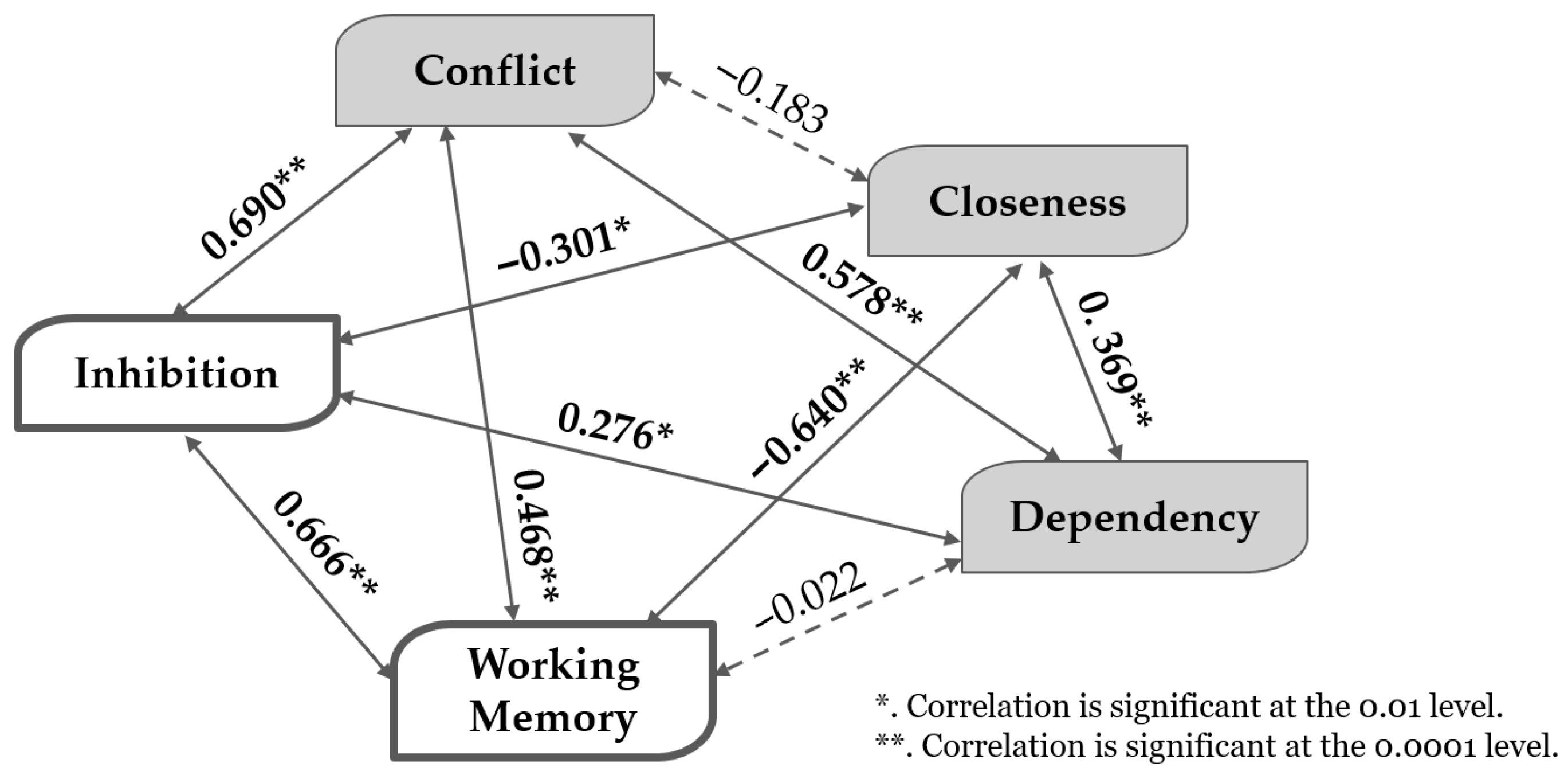
| M | SD | 1 | 2 | 3 | 4 | 5 | |
|---|---|---|---|---|---|---|---|
| 1. Closeness | 43.06 | 7.68 | - | ||||
| 2. Conflict | 21.09 | 9.72 | −0.183 | - | |||
| 3. Dependence | 10.69 | 4.42 | 0.369 ** | 0.578 ** | - | ||
| 4. Working memory | 35.01 | 13.80 | −0.640 ** | 0.468 ** | −0.022 | - | |
| 5. Inhibition | 32.62 | 10.27 | −0.301 * | 0.690 ** | 0.276 * | 0.666 ** | - |
| 6. Age (months) | 52 | 12.35 | 0.419 ** | 0.144 | 0.436 ** | −0.187 | 0.142 |
| Quartile I (0–25%) | Quartile II (26–50%) | Quartile III (51–75%) | Quartile IV (76–100%) | ||
|---|---|---|---|---|---|
| Closeness | Boys | 14 | 13 | 16 | 8 |
| Girls | 16 | 12 | 13 | 7 | |
| Conflict | Boys | 16 | 12 | 10 | 13 |
| Girls | 19 | 12 | 8 | 9 | |
| Dependence | Boys | 15 | 7 | 14 | 15 |
| Girls | 21 | 11 | 5 | 11 | |
| Total scale | Boys | 18 | 8 | 18 | 7 |
| Girls | 9 | 16 | 12 | 11 |
| Quartile I (0–25%) | Quartile II (26–50%) | Quartile III (51–75%) | Quartile IV (76–100%) | ||
|---|---|---|---|---|---|
| Closeness | Up to 42 months old | 16 | 3 | 8 | 1 |
| 43–54 months old | 10 | 18 | 17 | 9 | |
| Over 54 months old | 4 | 4 | 4 | 5 | |
| Conflict | Up to 42 months old | 11 | 8 | 6 | 3 |
| 43–54 months old | 18 | 12 | 10 | 14 | |
| Over 54 months old | 6 | 4 | 2 | 5 | |
| Dependence | Up to 42 months old | 13 | 2 | 11 | 2 |
| 43–54 months old | 22 | 9 | 7 | 16 | |
| Over 54 months old | 1 | 7 | 1 | 8 | |
| Total scale | Up to 42 months old | 8 | 9 | 10 | 1 |
| 43–54 months old | 13 | 13 | 14 | 14 | |
| Over 54 months old | 6 | 2 | 6 | 3 |
| M | SD | t-Test/ANOVA | ||
|---|---|---|---|---|
| Closeness | Boys | 42.10 | 7.59 | t = −1.290; p = 0.200 |
| Girls | 44.08 | 7.73 | ||
| Up to 42 months old | 38.71 | 8.21 | F = 7.205; p = 0.001 | |
| 43–54 months old | 44.50 | 6.80 | ||
| Over 54 months old | 45.65 | 6.73 | ||
| Conflict | Boys | 22.53 | 10.15 | t = 1.529; p = 0.130 |
| Girls | 19.56 | 9.09 | ||
| Up to 42 months old | 19.21 | 7.76 | F = 0.860; p = 0.426 | |
| 43–54 months old | 22.17 | 10.87 | ||
| Over 54 months old | 20.76 | 8.65 | ||
| Dependence | Boys | 10.94 | 4.02 | t = 0.589; p = 0.557 |
| Girls | 10.42 | 4.83 | ||
| Up to 42 months old | 9.43 | 3.07 | F = 3.807; p = 0.026 | |
| 43–54 months old | 10.59 | 4.89 | ||
| Over 54 months old | 13.06 | 3.96 | ||
| Total scale | Boys | 110.63 | 15.50 | t = −1.838; p = 0.069 |
| Girls | 116.10 | 14.04 | ||
| Up to 42 months old | 112.07 | 12.25 | F = 0.125; p = 0.882 | |
| 43–54 months old | 113.74 | 16.62 | ||
| Over 54 months old | 113.82 | 14.31 |
| M | SD | t-Test/ANOVA | ||
|---|---|---|---|---|
| Working memory | Boys | 36.12 | 13.28 | t = 0.545; p = 0.587 |
| Girls | 33.83 | 14.37 | ||
| Up to 42 months old | 38.50 | 11.47 | F = 1.30; p = 0.277 | |
| 43–54 months old | 33.91 | 13.06 | ||
| Over 54 months old | 32.76 | 18.66 | ||
| Inhibition | Boys | 33.80 | 11.31 | t = 1.396; p = 0.166 |
| Girls | 31.35 | 8.97 | ||
| Up to 42 months old | 30.39 | 8.34 | F = 0.918; p = 0.403 | |
| 43–54 months old | 33.56 | 11.30 | ||
| Over 54 months old | 33.29 | 9.65 |
| Unstandardized Coefficients | Standardized Coefficients β | t | p | ||
|---|---|---|---|---|---|
| Β | Std. Error | ||||
| Working Memory (R2 = 0.454; F = 40.687, p < 0.0001) | |||||
| Constant | 99.943 | 10.102 | 9.893 | 0.0001 | |
| Teacher–child relationship | −0.577 | 0.090 | −0.674 | −6.379 | 0.0001 |
| Inhibition (R2 = 0.511; F = 51.135, p < 0.0001) | |||||
| Constant | 91.481 | 8.143 | 11.234 | 0.0001 | |
| Teacher–child relationship | −0.521 | 0.073 | −0.715 | −7.151 | 0.0001 |
| Unstandardized Coefficients | Standardized Coefficients β | t | p | ||
|---|---|---|---|---|---|
| Β | Std. Error | ||||
| Working memory (R2 = 0.327; F = 22.330, p < 0.0001) | |||||
| Constant | 101.770 | 14.480 | 7.029 | 0.0001 | |
| Teacher–child relationship | −0.585 | 0.124 | −0.572 | −4.725 | 0.0001 |
| Inhibition (R2 = 0.389; F = 29.313, p < 0.0001) | |||||
| Constant | 77.635 | 8.609 | 9.018 | 0.0001 | |
| Teacher–child relationship | −0.399 | 0.074 | −0.624 | −5.414 | 0.0001 |
Disclaimer/Publisher’s Note: The statements, opinions and data contained in all publications are solely those of the individual author(s) and contributor(s) and not of MDPI and/or the editor(s). MDPI and/or the editor(s) disclaim responsibility for any injury to people or property resulting from any ideas, methods, instructions or products referred to in the content. |
© 2026 by the authors. Licensee MDPI, Basel, Switzerland. This article is an open access article distributed under the terms and conditions of the Creative Commons Attribution (CC BY) license.
Share and Cite
Lazauninkiene, S.; Daugirdiene, A.; Cesnaviciene, J.; Brandisauskiene, A. Rethinking the Work of Early Childhood Educators: What Are the Links Between the Quality of the Teacher–Child Relationship and the Child’s Executive Functions? Educ. Sci. 2026, 16, 99. https://doi.org/10.3390/educsci16010099
Lazauninkiene S, Daugirdiene A, Cesnaviciene J, Brandisauskiene A. Rethinking the Work of Early Childhood Educators: What Are the Links Between the Quality of the Teacher–Child Relationship and the Child’s Executive Functions? Education Sciences. 2026; 16(1):99. https://doi.org/10.3390/educsci16010099
Chicago/Turabian StyleLazauninkiene, Sonata, Ausra Daugirdiene, Jurate Cesnaviciene, and Agne Brandisauskiene. 2026. "Rethinking the Work of Early Childhood Educators: What Are the Links Between the Quality of the Teacher–Child Relationship and the Child’s Executive Functions?" Education Sciences 16, no. 1: 99. https://doi.org/10.3390/educsci16010099
APA StyleLazauninkiene, S., Daugirdiene, A., Cesnaviciene, J., & Brandisauskiene, A. (2026). Rethinking the Work of Early Childhood Educators: What Are the Links Between the Quality of the Teacher–Child Relationship and the Child’s Executive Functions? Education Sciences, 16(1), 99. https://doi.org/10.3390/educsci16010099