Next Article in Journal
Presence, Participation and Learning in Educational Inclusion: A Systematic Mapping Review of Barriers in School Contexts According to Booth and Ainscow
Previous Article in Journal
Investigating Course Level Effects on Student Evaluations of Teaching in Higher Education
Previous Article in Special Issue
How Do Gender and Previous Contact with People with Disabilities Affect Students’ Attitudes Towards Inclusion in Physical Education? A Chilean–Spanish Experience
error_outline You can access the new MDPI.com website here. Explore and share your feedback with us.
 
 
Article

Understanding Teachers’ Intention and Behaviour Towards Inclusive Education in Ghana: Applying the Theory of Planned Behaviour


1
School of Education, Western Sydney University, Penrith, NSW 2751, Australia
2
School of Education, Translational Health Research Institute, Western Sydney University, Penrith, NSW 2751, Australia
*
Author to whom correspondence should be addressed.
Educ. Sci. 2026, 16(1), 93; https://doi.org/10.3390/educsci16010093
Submission received: 30 September 2025 / Revised: 20 December 2025 / Accepted: 27 December 2025 / Published: 8 January 2026
(This article belongs to the Special Issue Teachers and Teaching in Inclusive Education)

Abstract

United Nations Sustainable Development Goal 4 advocates for equitable access to and participation in quality inclusive education for all learners. Inclusive education has gained worldwide recognition for promoting equity and social justice for students with special educational needs. Although the existing literature acknowledges the significant role of teachers’ intention and behaviour towards the successful implementation of inclusive education, this area is under-researched in Sub-Saharan countries, including Ghana. In this study, applying the theory of planned behaviour (TPB), 484 teachers at pilot inclusive schools completed an online survey assessing the factors predicting their intention and teaching behaviour towards inclusive education. A path analysis of the TPB variables revealed that only attitude and self-efficacy significantly predicted the teachers’ intention to teach in inclusive classrooms. Moreover, both self-efficacy and intention were found to significantly predict inclusive behaviour. This study’s findings will strengthen the national commitment to implementing inclusive education policy and guide future research aimed at improving and expanding inclusive education in Ghana.

1. Introduction

The Salamanca Statement and other international policy frameworks have promoted calls for the right of individuals with special educational needs (SENs) to equal opportunities for quality education (UNESCO, 1994). These policies have contributed to the adoption and development of national policies, frameworks and legislation in various countries to provide educational programmes that capture the differential learning needs of all students, including those with SENs (Kuyini, 2025; Mann et al., 2024; Pérez-Vera et al., 2025). Inclusive education (IE) has been touted as a panacea supporting the advancement of fundamental human rights and social justice for students with SENs (Hoult et al., 2024; Schwab et al., 2022), and the existing literature recognises the enormous benefits of IE in terms of academic, social and economic gains for students with and without disabilities, their families, and society (Kupers et al., 2023; Sepadi, 2025; Tracey et al., 2021). Following the rise of IE practices in many Western countries, such as Australia and Finland, Ghana has enacted a national policy to implement a similar course of action (Nketsia, 2018).
Empirical studies have identified the critical contribution of teachers in the implementation of IE. For example, how their intention and teaching behaviour impact students’ access and participation in inclusive settings is an important aspect (Hyassat et al., 2024; Malahlela & Johnson, 2024). Similar research has found a relationship between teachers’ attitudes, self-efficacy, subjective norms, intention, teaching behaviour and the successful implementation of IE (Knauder & Koschmieder, 2019; Sharma et al., 2018). With a dearth of local studies, it is crucial to advance knowledge regarding the perspectives of Ghanaian teachers in pilot inclusive schools to further the expansion and successful implementation of IE.

2. Context of This Study

Access to education in Ghana is a basic right, and education is free and compulsory for all school-aged children (Ministry of Education, 2015). The Ghanaian school system provides both regular and special education programmes. Students with severe sensory impairments (e.g., hearing and visual) and intellectual disabilities attend special schools, while those with non-severe impairments attend regular schools (Agbenyega, 2011; Kuyini et al., 2020). Following the introduction of the Salamanca Statement, Ghana began piloting IE in 35 schools in the 2003–2004 academic year to ensure that students with SENs were educated alongside their peers without SENs in regular classrooms.
The teaching staff in the pilot inclusive school system comprises regular and resource teachers, each of whom is assigned a specific teaching role. Resource teachers are specially trained in IE and provide specialised support to students with SENs, while regular teachers teach all students with or without SENs. Despite Ghana’s adoption of a national IE policy in 2015, many students with SENs are still excluded from regular school education (Kuyini et al., 2020; Ministry of Education, 2015; Mprah et al., 2015; Nketsia et al., 2020). Recent evidence suggests that although IE has been piloted for over 18 years, schools still encounter numerous issues affecting smooth programme implementation (Opoku et al., 2023). For example, students with SENs struggle with a rigid curriculum, inaccessible environments, and infrastructure that affect their learning and academic progress. Significantly, there is a dearth of research on teachers’ motivation to implement IE, indicating that Ghana is an under-researched context in need of theoretical and empirical investigation to elucidate the gap between policy and practice.

3. Theoretical Framework

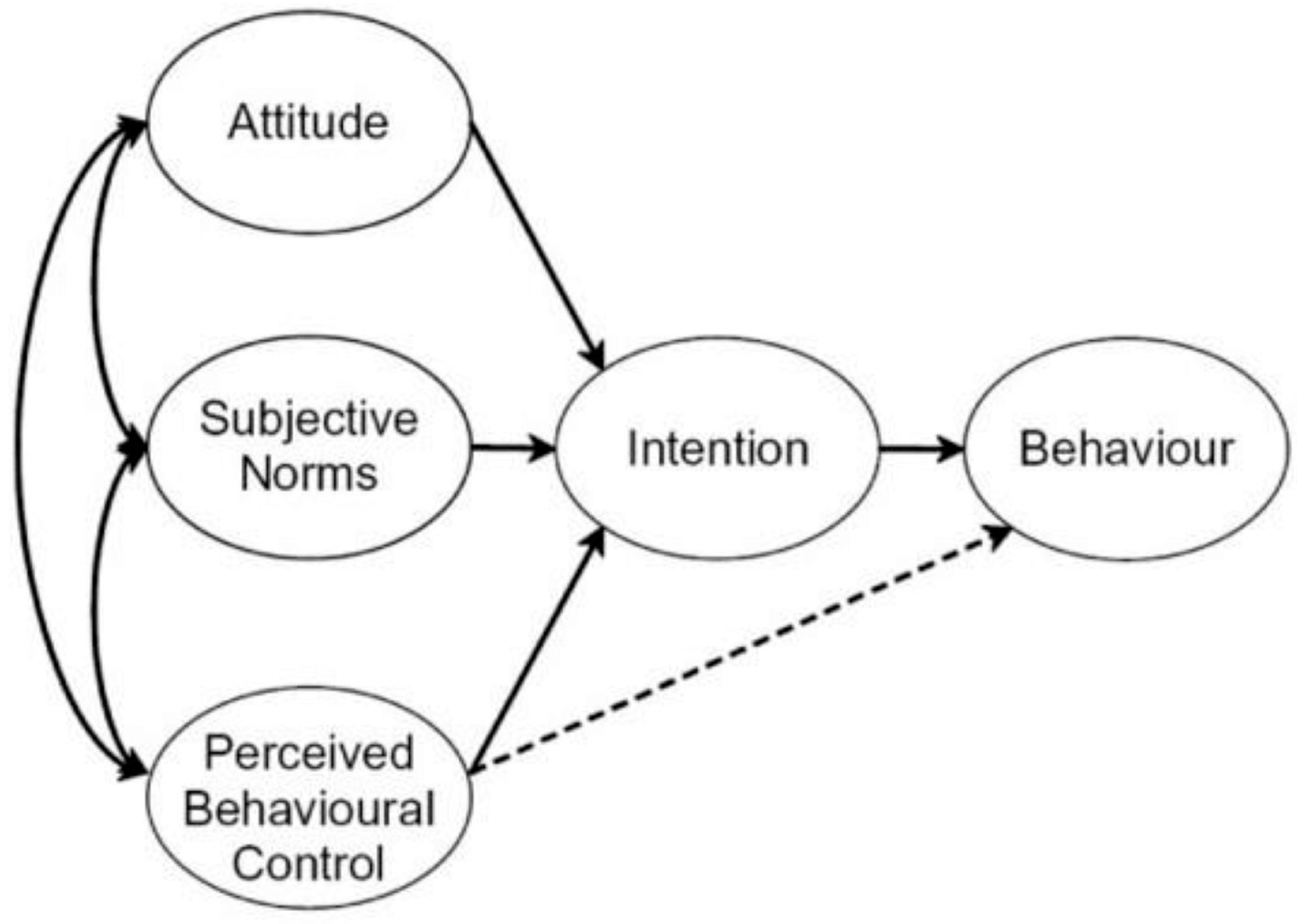
The theory of planned behaviour (TPB) (Ajzen, 1991) provides a comprehensive framework for determining the factors influencing teachers’ intention and behaviour towards IE. Ajzen (1991, 2011) posited that three interrelated beliefs—attitudes, subjective norms, and perceived behavioural control—combine to predict an individual’s behavioural intention, that is, one’s eagerness or readiness to perform a given behaviour. Attitudes towards behaviour are conceptualised as an individual’s positive or negative sentiment regarding a specific behaviour. The second predictor (subjective norms) represents an individual’s perception of significant others’ opinions as to whether a behaviour is appropriate. The third determinant of intention (perceived behavioural control) is an individual’s belief in their ability to perform a given behaviour.
The three interconnected factors (see Figure 1) combine to form an intention that is predictive of behaviour (Ajzen, 1991; Fishbein & Ajzen, 1981). The theory posits that teachers are likely to have the intention to perform a behaviour if they have positive attitudes, positive subjective norms, and high perceived behavioural control. A high level of intention alongside perceived behavioural control increases the probability of teachers demonstrating a behaviour.
Previous studies operationalised perceived behavioural control as teacher self-efficacy (Bandura, 1977) towards IE (e.g., Avramidis et al., 2019; Sharma et al., 2018); this construct is also applied in this study. A variety of subjective norms have been considered, such as teachers’ perceptions of barriers to IE (Ahmmed et al., 2014), resources (Opoku et al., 2021), and whether their significant others advocate for IE (Yan & Sin, 2014). Teachers’ willingness to teach in inclusive classrooms is often considered behavioural intention (Sharma & Jacobs, 2016), and inclusive teaching techniques or practices are considered behaviours (Emmers et al., 2019).
The literature contains a variety of theories used to study factors influencing teachers’ implementation of IE, among which the TPB is popular and has been applied in many international studies (e.g., Kupers et al., 2023; Malak et al., 2018; Yan & Sin, 2014). However, it has been minimally applied to teachers’ intention and behaviour in Ghanaian inclusive settings; thus, this study presents a unique opportunity to advance policy and practice (Opoku et al., 2021). By identifying predictor variables that influence intention and behaviour, actionable recommendations can be made to further the implementation of IE.

4. Teachers’ Intention and Behaviour Towards IE

In recent years, researchers have investigated teachers’ intention to teach in inclusive classrooms, primarily considering its predictors (Aiello & Sharma, 2018; Hellmich et al., 2019; Sharma & Jacobs, 2016). This research (e.g., Kupers et al., 2023) has demonstrated the suitability of the TPB for examining the influence of teacher-related variables on IE. Among teachers, positive attitudes, higher self-efficacy, and positive subjective norms are critical factors promoting IE. However, subjective norms have been conceptualised in a variety of ways and found to exert the least influence on intention relative to attitudes and self-efficacy (Malahlela & Johnson, 2024; Urton et al., 2023).
Prior studies reported mixed findings on the predictive relationships within the TPB (e.g., Chi-Kin Lee et al., 2021; Malahlela & Johnson, 2024), demonstrating that attitudes, subjective norms and self-efficacy are significant predictors of teachers’ intention (Ahmmed et al., 2014; Hellmich et al., 2019; Yan & Sin, 2014). For example, Ahmmed et al. (2014) adapted the Multidimensional Attitudes Towards Inclusive Education Scale (Mahat, 2008) to investigate Bangladeshi teachers’ intention to teach in inclusive classrooms. They found that teachers’ attitudes, self-efficacy and subjective norms predicted their intention to implement IE, with subjective norms being the most significant contributor. However, the reliability of the scale fell below the acceptable threshold of 7.0. Studies by Hellmich et al. (2019) in Germany and Yan and Sin (2014) in Hong Kong reported similar findings. In these studies, the authors either did not verify the validity of the scale used (Hellmich et al., 2019) or recruited participants from a single city (Yan & Sin, 2014). Though their findings are consistent with TPB propositions, the former did not measure behaviour to provide a more complete picture of the variables in Ajzen’s theory.
Conversely, other studies have reported that only attitudes and self-efficacy predict teachers’ intention, and subjective norms do not (Malak et al., 2018; Sharma et al., 2018). In a comparative study by Sharma et al. (2018) of Australian and Italian teachers, subjective norms did not predict intention, unlike attitudes and self-efficacy. A critique of that study revealed that the items on the scale used for subjective norms did not reflect Ajzen’s consideration of the influence of social pressure, and the study did not measure behaviour.
According to Ajzen (1991), a person’s intention to perform a set of behaviours is the best predictor of actual behaviour. Some studies have applied the TPB to study teachers’ behaviour towards IE (e.g., Emmers et al., 2019; Yan & Sin, 2014), while others have failed to include and measure the behavioural component (e.g., Ahmmed et al., 2014). Some findings have shown that inclusive teaching behaviour is predicted by intention and self-efficacy (Wilson et al., 2019; Yan & Sin, 2014), while others have reported findings parallel to the TPB hypothesis (MacFarlane & Woolfson, 2013; Sharma & Sokal, 2016). For instance, in Sharma and Sokal’s (2016) study in Canada, self-efficacy and subjective norms predicted teachers’ inclusive behaviour. This study is among the few that developed an observation scale to measure inclusive behaviour; however, it was limited by its small sample size (five teachers), potentially resulting from onerous observational methodology. It appears that the participants were not willing to be observed, potentially indicating why many authors (e.g., Sharma et al., 2018) either omit the behavioural component of the TPB or measure behaviour using self-report instruments (e.g., Emmers et al., 2019; Yan & Sin, 2014).
Elsewhere, teachers’ inclusive behaviour has been predicted by subjective norms and intentions (MacFarlane & Woolfson, 2013) or attitudes and intentions (Hellmich et al., 2019). Hellmich et al. (2019) expanded the TPB based on the assumption that behaviour can be directly predicted by attitudes towards inclusion and perceptions of social norms. However, they failed to report the psychometric properties of the scale used to measure behaviour.
It is noteworthy that the TPB is a popular theory and has frequently been used to study teacher-related factors influencing IE (e.g., Malak et al., 2018; Wilson et al., 2019), largely in Western countries and other parts of the world. Nevertheless, most studies have neglected the inclusive teaching behaviour component (e.g., Sharma et al., 2018), indicating a gap in the application of the full theoretical model.

5. Research on IE in Ghana

Although research has been conducted on IE in Ghana, systematic understanding of the teacher factors influencing IE remains limited (e.g., Agbenyega, 2011; Amponteng et al., 2019). Some research has applied the TPB to study IE teachers, but the few studies that did so did not examine all of the variables (Kuyini & Desai, 2007; Opoku et al., 2021). In one study of secondary school teachers’ intention towards IE in Ghana (Opoku et al., 2021), teacher attitude and self-efficacy predicted their intention to teach in inclusive classrooms. Subjective norms were operationalised as support from school leaders, leaving out other key stakeholders, such as government, parents, and teachers. The study of Opoku et al. (2021) was the first to utilise the Intention to Teach in Inclusive Classroom scale in the Ghanaian context; however, the study omitted the behavioural component of the TPB. Consequently, the assumption that intention reflects behaviour, as indicated by the authors, is a limitation.
Kuyini and Desai (2007) developed an observation checklist to measure the factors predicting teachers’ behaviour and reported that attitude and knowledge of inclusion combined to predict effective inclusive teaching practices, unlike subjective norms. The subjective norm assessed by the authors (i.e., principals’ expectations) was narrow compared to Ajzen’s definition, potentially affecting its ability to influence teachers’ intentions. Even though this was a robust study, it was conducted over a decade ago, and IE had emerged only a couple of years prior. Additionally, the study did not include intention, which is the immediate antecedent of behaviour. Furthermore, previous studies did not involve resource teachers, despite their central role (see Opoku et al., 2021). Together, these shortcomings necessitate more robust research in the Ghanaian context, given the government’s low implementation success despite extensive policy commitment.

6. Aims and Research Questions

Extensive research has used the TPB to determine the factors influencing IE in Western countries. No studies have applied all the components of the TPB to examine the teacher-related factors influencing IE in Ghana. This indicates a need to narrow the empirical and theoretical gaps to improve inclusive practices by measuring all the components of the theory and testing the TPB in a Ghanaian sample. Against this backdrop, this study addresses the following research questions:
  • To what extent can Ghanaian teachers’ intention to teach in inclusive classrooms be explained by the factors specified in the TPB (attitude, self-efficacy, and subjective norms)?
  • How do Ghanaian teachers’ self-efficacy and intention predict their reported inclusive teaching behaviour?

7. Methods

7.1. Study Participants

Participants in this study comprised teachers in pilot inclusive schools. Convenience sampling was used to select 484 teachers (416 regular and 68 resource teachers) from three regions in Ghana. The schools were selected from the Ashanti, Eastern, and Central Regions of Ghana because these geographical areas participated in the initial trial of IE. A total of 20 schools were selected from each region based on access and the researcher’s resources and time.
The demographic characteristics of the participants are reported in Table 1. Among the participants, 58% were male and 42% were female. Most of the teachers (49%) were aged 30–39 years, and the highest qualification held by the greatest number of participants was a bachelor’s degree (62%).

7.2. Instruments

A survey, which included five scales, was administered to collect the participants’ demographic data (e.g., age, gender, role in school, years of teaching experience). The scales used are described below.
The Attitudes Towards Inclusion Scale (AIS; Sharma & Jacobs, 2016): The AIS comprises 10 items rated on a seven-point Likert response scale ranging from strongly disagree (1) to strongly agree (7). The scale has two subscales: Beliefs about Inclusion and Feelings about Inclusion. The AIS achieved Cronbach’s alphas of 0.81 and 0.71 for samples of teachers from Australia and Italy, respectively (Sharma & Jacobs, 2016), while a Cronbach’s alpha of 0.85 was reported in a Ghanaian study (Opoku et al., 2021).
The Teacher Efficacy for Inclusive Practices (TEIP) scale (Sharma et al., 2012): This 18-item instrument is rated on a six-point Likert response scale ranging from strongly disagree (1) to strongly agree (6). It consists of three subscales: Efficacy to Use Inclusive Instructions, Efficacy in Managing Behaviour, and Efficacy in Collaboration. Opoku et al. (2021) recorded a Cronbach’s alpha of 0.88 when the scale was used in Ghana, while Sharma et al. (2012) reported Cronbach’s alpha values ranging from 0.85 to 0.93.
The Subjective Norm Scale (SNS; Yan & Sin, 2014): This five-item instrument is rated on a five-point Likert-type response scale ranging from strongly disagree (1) to strongly agree (4). The SNS received a Cronbach’s alpha of 0.72 in a Hong Kong study of teachers (Yan & Sin, 2014) and has never been used in Ghana.
The Intention to Teach in Inclusive Classrooms Scale (ITICS; Sharma & Jacobs, 2016): The ITICS consists of two subscales: Curriculum Changes and Consult with Others. This scale comprises seven items, and responses are provided on a seven-point Likert-type scale ranging from extremely unlikely (1) to extremely likely (7). In previous research, the ITICS achieved Cronbach’s alpha values of 0.82 and 0.62 in Australian and Italian samples, respectively (Sharma et al., 2018). In a Ghanaian study, it received a Cronbach’s alpha of 0.88 (Opoku et al., 2021).
The Reported Inclusive Teaching Behaviour Scale (RITBS) was recently created to measure teachers’ inclusive behaviour. It consists of seven items, each rated on a seven-point Likert-type scale ranging from extremely unlikely (1) to extremely likely (7). This scale was adapted from the ITICS by altering each item to mirror the participants’ self-reported performance of a set of behaviours. It has never been used in Ghana to measure teachers’ inclusive behaviour. Given that this measure is new, factor analysis and reliability tests were conducted. Whilst full details and the results are available in Amponteng (2024), reliability is reported in the Results, and the factor analysis is reported in the Supplementary Materials.

7.3. Procedure for Recruitment

This study was part of a larger mixed-methods study, which was approved by the Human Research and Ethics Committee at Western Sydney University and the Special Education Division of the Ghana Education Service. Following approval from the Ghana Education Service, sixty pilot inclusive schools were selected from three regions based on access and the researcher’s resources and time. The head teachers at the participating schools were emailed copies of the approval letters to inform them about the study. The first author was temporarily added to the teachers’ WhatsApp groups to post a link to the online survey and provide potential participants with information. Participants who provided consent to participate completed the online survey. The information provided to participants described the study aims, ethical procedures, and guidelines for completing the survey. Consent was implied, and the participants could withdraw at any time without notifying the researchers.

7.4. Data Analysis

All analyses were carried out using IBM SPSS Statistics version 27.0 and IBM SPSS AMOS version 27.0. First, preliminary analyses were performed to check the assumptions of normality, linearity, multicollinearity, and homoscedasticity (see Pallant, 2017), none of which were violated except for normality. As the sample size for this study was large, the violation of the assumption of normality did not affect the results (Field, 2018). Second, a confirmatory factor analysis was conducted to determine the factor structure of all the original scales (Byrne, 2012; Field, 2018). Third, a path analysis was constructed in a structural equation model using AMOS software to test the TPB model. The maximum likelihood estimation (MLE) method was used. To analyse the goodness-of-fit of the CFA and path, the models were evaluated using the recommended comparative fit index (CFI), Tucker–Lewis index (TLI), and root mean square error of approximation (RMSEA) to assess the specified path analysis model. The following cut-off points were used: For the CFI and TLI indices, values of 0.90 to 0.94 and 0.95 were considered acceptable and a good fit, respectively (Byrne, 2012; Hidayat et al., 2018; Hu & Bentler, 1999). An RMSEA value less than 0.06 was considered a good fit, and less than 0.08 was considered an acceptable fit (Byrne, 2012; Hair et al., 2018). In addition, the chi-square (χ2) test result was required to be nonsignificant, and the ratio of χ2 to degrees of freedom (df) was required to be 2 or less (Schreiber et al., 2006).

8. Results

8.1. Reliability

The reliability of each instrument was tested using Cronbach’s alpha (see Table 2). A Cronbach’s alpha of 0.70 is commonly accepted for internal reliability (Field, 2018). The findings revealed that all instruments showed acceptable reliability except for the RITBS, for which the value fell slightly below (by 0.02) the recommended value of 0.70 (see Field, 2018).

8.2. Predictors of Intention

Path analysis was used to examine the predictive relationships among the TPB variables. The model was estimated using confirmatory factor analysis. According to the results (see Table 3), the constructed model attained acceptable fit indices (χ2 = 2.666, df = 2, p = 0.264; TLI = 0.995; CFI = 0.999; RMSEA = 0.026; AIC = 28.666), suggesting a good fit to the data. This is because although the CFI and TLI were greater than 0.95, the RMSEA value of less than 0.05 meets the recommended threshold for an acceptable fit (Brown, 2006; Hu & Bentler, 1999) (see Table 3). This suggests that the model provides a statistically significant representation of the relationships between the variables.
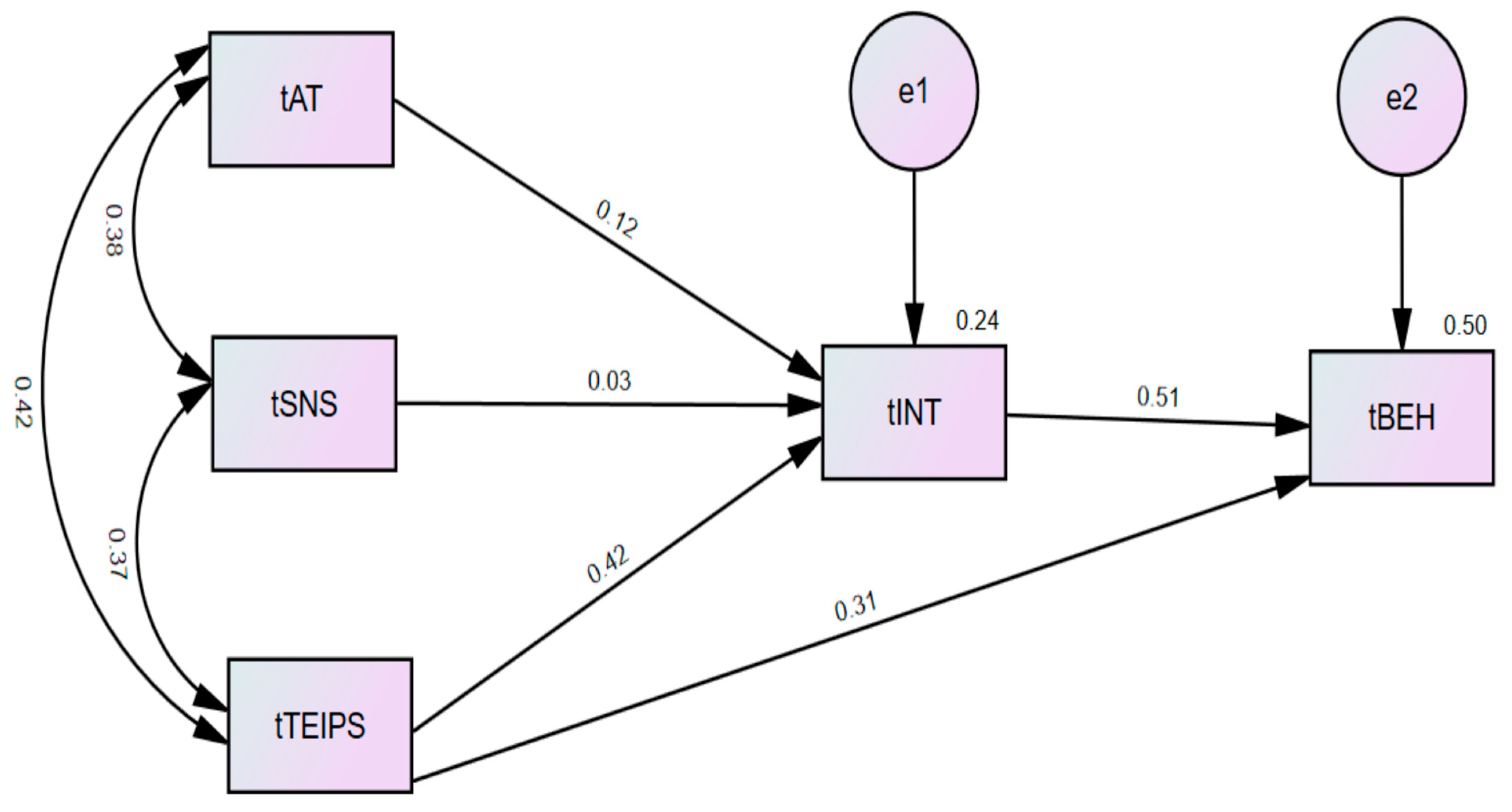
In the path analysis model (see Figure 2), the variables attitude, self-efficacy, and experienced social norms (subjective norms) were predictors of intention, and intention was the mediating variable between predictors and the outcome variable (behaviour). The findings revealed that attitude (tAT), self-efficacy (tTEIPS), and experienced social norms (tSNS) covaried significantly (p < 0.001). The power coefficient between the predictor variables was acceptable, ranging from 0.37 to 0.42.
The results (see Figure 2 and Table 4) indicated significant positive relationships among some of the TPB variables: attitude and intention (beta = 0.12, p = 0.008), subjective norms and intention (beta = 0.03, p = 0.463), and self-efficacy and intention (beta = 0.42, p < 0.001). This suggests that while both attitude (beta = 0.12, p = 0.008) and self-efficacy (beta = 0.42, p < 0.001) predicted intention, experienced social norms (beta = 0.03, p = 0.463) did not significantly predict intention. As shown in Figure 2, the predictors contributed 24% of the variance in intention. Among the three predictive variables, self-efficacy emerged as the strongest predictor of intention (0.42, p < 0.001). These findings provide partial support for the Theory of Planned Behaviour (Ajzen, 1991).
The significant correlations between attitude, self-efficacy, and social norms showed satisfactory convergent validity (see Table 4). There were significant positive correlations between attitude and self-efficacy (r = 0.42, p < 0.001) and between attitude and experienced social norms (r = 0.38, p < 0.001). The correlation between experienced social norms and self-efficacy was also significant (r = 0.38, p < 0.001). The observed intercorrelations clearly indicate that the variables have meaningful relationships and continue to play distinct predictive roles.

8.3. Predictors of Reported Inclusive Teaching Behaviour

The results (see Figure 2 and Table 3) revealed that intention and self-efficacy significantly predicted inclusive teaching behaviour (intention and inclusive behaviour: beta = 0.51, p < 0.001; self-efficacy and inclusive behaviour: beta = 0.31, p < 0.001). The predictors contributed to 50% of the variation in behaviour, with intention being the strongest significant predictor. The analysis also showed that teacher attitudes towards IE directly influence intention and indirectly influence behaviour (beta = 0.050, p < 0.001). Teacher self-efficacy with respect to IE had a significant direct effect on both the intention to teach in an inclusive classroom and inclusive teaching behaviour. Similarly, intention had a significant direct effect on behaviour (beta = 0.509, p < 0.001). However, experienced social norms did not have a significant direct effect on behaviour (beta = 0.034, p < 0.001), and its direct effect on intention was not statistically significant (beta = 0.032, p = 0.463).

9. Discussion

This novel study examined how the TPB applies to Ghanaian teachers’ attitudes, self-efficacy, experienced social norms, intention, and reported behaviour towards IE. Specifically, the TPB framework was adopted to understand the factors (i.e., attitudes, self-efficacy, and subjective norms) predicting intention and whether both intention and self-efficacy could predict behaviour. The TPB acknowledges the substantial influence of all these factors on the implementation of IE. Thus, it is imperative to understand their relationship so that intervention can be targeted for maximum impact. The TPB, however, has not been tested or applied in the context of Ghanaian pilot inclusive schools in empirical research. As such, this study advances theory, measurement, and empirical research in this under-researched area.
First, the results of the path analysis showed that teachers’ attitudes and self-efficacy significantly predicted their intention to teach in inclusive classrooms, while experienced social norms did not. This suggests that teachers with positive attitudes and higher self-efficacy are more likely to have a stronger intention to teach in inclusive classrooms. This finding differs slightly from Ajzen’s (1991) TPB proposition that attitude, self-efficacy, and subjective norms (i.e., experienced social norms) all predict intention. However, the results of this study do show positive correlations among attitude, subjective norms, and self-efficacy, which supports Ajzen’s hypothesis. The results also revealed that self-efficacy strongly predicted intention, more so than attitude. These findings are consistent with those of a Ghanaian study (Opoku et al., 2021) and previous international studies in which attitudes and self-efficacy significantly predicted intention (e.g., Sharma et al., 2018, in Australia and Italy; Sharma & Jacobs, 2016, in Australia and India). It is recommended that IE initiatives focus on bolstering teachers’ self-efficacy and attitudes to enhance their intention to teach in an inclusive classroom. Providing teachers training on how to use inclusive strategies and Universal Design for Learning has been identified as the most effective way to improve teacher self-efficacy (Nketsia et al., 2025; Sharma et al., 2018).
In contrast to the present findings, previous studies in a range of contexts reported that attitude, self-efficacy, and subjective norms predicted behavioural intention (e.g., Ahmmed et al., 2014; Hellmich et al., 2019). In these studies, teachers’ subjective norms predicted their intentions. These differences in findings could be due to the other studies’ operationalisation of the subjective norms of concern or support, unlike the present study, which focused on pressure from significant others (e.g., government, parents and teachers).
In this study, experienced social norms failed to predict intention, affecting theoretical implications and policy recommendations. It is possible that the propositions of the TPB are not experienced universally across cultures and locations. Further studies should be conducted in the Ghanaian context to explore this further. A possible explanation is that in Ghana, the pressure to implement IE derives from individual internal beliefs, such as attitudes and self-efficacy, rather than external stakeholders. As reported elsewhere (e.g., Amponteng et al., 2025; Kuyini et al., 2020), teachers blame the government and other stakeholders for failing to provide the resources to promote IE, potentially explaining why the hypothesis that subjective norms predict intention has yielded varying results in Ghana. Within Ghana’s traditional beliefs, the cause of disability is often attributed to spiritual and cultural factors, such as curses or punishment for misconduct. The enduring existence of these beliefs suggests that external stakeholders play a minimal role in shaping teachers’ behaviour regarding the implementation of IE. Therefore, it is crucial for the government to engage with stakeholders and launch advocacy campaigns to promote IE to the community and teachers. The non-significant effect of experienced social norms in the Ghanaian context can also be ascribed to systemic and cultural factors. The implementation of inclusive education is restricted by inadequate policy implementation and a lack of administrative supervision and resources. As a result, teachers may not feel strong normative pressure from policy-makers, school administrators, or the wider community to implement inclusive education practices. In contexts with limited resources like Ghana, teachers tend to be more strongly affected by their personal attitude and self-efficacy than social influence (Opoku et al., 2021).
Second, the results from the path analysis revealed that both self-efficacy and intention significantly predicted behaviour, although intention was better at predicting behaviour. This finding confirms Ajzen’s (1991) hypothesis that a combination of self-efficacy and intention predicts behaviour, although the low reliability of the RITBS should be noted. The findings suggest that teachers in pilot inclusive schools are confident in their abilities and willing to teach demonstrate inclusive teaching behaviour, which are essential factors for the successful implementation of IE. Given that the majority of participants (62%) hold a bachelor’s degree, this finding may be attributed to their study of IE. It is noteworthy that a few of the studies applying the TPB to investigate inclusive behaviour (e.g., Emmers et al., 2019; Sharma & Sokal, 2016; Wilson et al., 2019; Yan & Sin, 2014) used different scales to assess behaviour. This study’s findings are consistent with those of an earlier study in Hong Kong (Yan & Sin, 2014), where teachers’ self-efficacy and intention predicted their inclusive behaviour. However, the present findings differ from those of the only study conducted in Ghana (Kuyini & Desai, 2007) that measured inclusive behaviour. This study recruited both regular and resource teachers from pilot inclusive schools, which could account for the differences in findings compared with previous studies (e.g., Kuyini & Desai, 2007). Stakeholders should focus on enhancing teachers’ self-efficacy and intention by providing professional development programmes and resources to support their commitment to inclusive teaching practices and programme expansion. Other studies measuring inclusive teaching behaviour have reported interesting findings. For example, inclusive behaviour has been found to be predicted by attitudes and self-efficacy (Wilson et al., 2019), perceived social norms and intentions (Malahlela & Johnson, 2024; Schule et al., 2016), and attitudes and intentions (Hellmich et al., 2019). While these findings do not align with the TPB, Ajzen (2015) did posit that the predictive variables of intention (i.e., attitudes, subjective norms, and self-efficacy) could change in a given population or situation. The lack of research regarding teachers’ inclusive teaching behaviour could be due to the absence of a robust measure, although some studies (e.g., Sharma et al., 2018) recommend the use of observation checklists for measuring behaviour. It is noteworthy that observations limit the scale of a study, as more resources are required than in the case of self-reporting. This study’s findings advance knowledge on inclusive teaching behaviour in Ghana as well as internationally. This is the first study in Ghana to assesses all the components of the TPB model, thereby narrowing measurement and theoretical gaps in understanding how to improve inclusive practices.

9.1. Study Limitations

Whilst the present study advances current methodological and theoretical knowledge, it is important that the results are interpreted with caution due to some limitations. First, the participants were recruited from public pilot inclusive schools by means of convenience sampling, which suggests that the findings cannot be generalised across all schoolteachers, constraining interpretability. Future researchers should consider recruiting a nationwide sample comprising both private and non-inclusive schools. This would provide data for assessing the TPB factors impacting IE across the country. Second, the reliability of the ITICS and RITBS subscales and the Efficacy to Use Inclusive Instruction subscale fell marginally below the recommended threshold (see Amponteng, 2024). Despite the robust validity of these scales, which are essential for future studies, researchers should interpret the findings with caution. Finally, teachers’ inclusive teaching behaviour was measured using a new self-report scale (RITBS), but it would be more prudent to directly observe classroom teaching in future studies to better understand the actual behaviour.

9.2. Conclusions and Implications

This is the first study in the Ghanaian context to provide a comprehensive assessment of all the components of the TPB and expand previous research, which either neglected to measure the behavioural component (e.g., Opoku et al., 2021) or excluded intention (Kuyini & Desai, 2007). This study offers new insights into teachers’ intention and reported inclusive teaching behaviour in the Ghanaian context. The findings fill empirical and theoretical gaps, advancing knowledge in understanding teachers’ intention and behaviour in Ghana and internationally.
According to Ajzen, the three determinants of the TPB combine to predict intention. The finding that attitude and self-efficacy predict intention did not support the TPB assumption. However, the finding that both self-efficacy and intention contribute significantly to behaviour confirmed the TPB model in relation to Ghanaian pilot inclusive schools. Self-efficacy strongly predicted intention, while intention contributed significantly to behaviour. This finding affirms the influence of teacher-related variables in IE. Therefore, policymakers could take steps to directly or indirectly increase teachers’ attitudes, self-efficacy, and intention, as these factors have a direct effect on the implementation of IE in Ghana. For example, the Ministry of Education could implement training programmes to develop positive perspectives and confidence regarding IE (Amponteng, 2024). The Ministry could collaborate with teacher training institutions (Universities and affiliated colleges). Given the role of teachers as the implementers of IE policy, evidence-based practices that have been established in other countries (e.g., Australia and Finland) could be considered. In this study, experienced social norms (subjective norms) did not contribute to intention, warranting further research in this specific cultural setting. This finding suggests that significant others do not influence teachers to implement IE, although the contributions of significant others have been widely recognised as key to IE. The Ministry of Education could consider strategies to influence the community’s expectations of IE occurring—for example, launching a national awareness campaign to educate the community and stakeholders on the current IE policy and practices, and its benefits.
Lastly, this study was conducted in pilot inclusive schools. IE has remained limited to pilot schemes for over 18 years despite national policy commitments. The Ministry of Education and Special Education Division could use the results of this study to expand IE to other schools or nationwide, while keeping the limitations of this study, including the use of a convenient sample, in mind. Improving teachers’ attitudes and self-efficacy would provide equitable learning opportunities for students with SENs, who have largely been excluded, directly or indirectly, and help realise the global agenda of IE.

Supplementary Materials

The following supporting information can be downloaded at: https://www.mdpi.com/article/10.3390/educsci16010093/s1. The supplementary materials show a validity analysis of the Reported Inclusive Teaching Behaviour Scale. Figure S1. Measurement model for the Reported Inclusive Teaching Behaviour Scale. Table S1. Detailed items on the Scale. Table S2. Standardised estimates for the Reported Inclusive Teaching Behaviour Scale. Table S3. Goodness-of-Fit Indicators of the Reported Inclusive Teaching Behaviour Scale.

Author Contributions

Conceptualisation, M.A.; Methodology, M.A.; Software, M.A.; Validation, M.A.; Formal analysis, M.A.; Investigation, M.A.; Resources, M.A.; Data curation, M.A.; Writing—original draft, M.A.; Writing—review and editing, M.A., D.T. and W.N.; Visualisation, M.A.; Supervision, M.A.; Project administration, M.A. All authors have read and agreed to the published version of the manuscript.

Funding

This research received no external funding.

Institutional Review Board Statement

The study was approved by the Special Education Division of the Ghana Education Service (with reference number SE1201/Vol.4/120Accra on 21 July 2020).

Informed Consent Statement

Informed consent was obtained from all participants involved in the study.

Data Availability Statement

Data are available per request due to ethical reasons.

Acknowledgments

The authors would like to thank all the teachers who participated in this study.

Conflicts of Interest

The authors declare no conflicts of interest.

Abbreviations

The following abbreviations are used in this manuscript:
IEInclusive Education
SENsSpecial Educational Needs

References

  1. Agbenyega, J. S. (2011). Building new identities in teacher preparation for inclusive education in Ghana. Current Issues in Education, 14(1), 1–37. [Google Scholar]
  2. Ahmmed, M., Sharma, U., & Deppeler, J. (2014). Variables affecting teachers’ intentions to include students with disabilities in regular primary schools in Bangladesh. Disability & Society, 29(2), 317–331. [Google Scholar] [CrossRef]
  3. Aiello, P., & Sharma, U. (2018). Improving intentions to teach in inclusive classrooms: The impact of teacher education courses on future learning support teachers. Form@re—Open Journal Per La Formazione in Rete, 18(1), 207–219. [Google Scholar] [CrossRef]
  4. Ajzen, I. (1991). The theory of planned behaviour. Organizational Behaviour and Human Decision Processes, 50(2), 179–211. [Google Scholar] [CrossRef]
  5. Ajzen, I. (2011). The theory of planned behaviour: Reactions and reflections. Pyschology and Health, 26(9), 1113–1127. [Google Scholar] [CrossRef]
  6. Ajzen, I. (2015). The theory of planned behaviour is alive and well, and not ready to retire: A commentary on Sniehotta, Presseau, and Araújo-Soares. Health Psychology Review, 9(2), 131–137. [Google Scholar] [CrossRef] [PubMed]
  7. Amponteng, M. (2024). Perceptions of teachers in pilot inclusive schools towards the implementation of inclusive education in Ghana [Unpublished doctoral dissertation, School of Education, Western Sydney University]. [Google Scholar]
  8. Amponteng, M., Opoku, M. P., Agyei-Okyere, E., Afriyie, S. A., & Tawiah, R. (2019). Understanding of inclusive education practices among parents in Ghana. Journal of Research in Special Educational Needs, 19(3), 207–219. [Google Scholar] [CrossRef]
  9. Amponteng, M., Tracey, D., & Nketsia, W. (2025). Exploring teachers’ concerns and recommendations regarding inclusive education in Ghana: An application of the ecological systems theory. International Journal of Inclusive Education, 1–18. [Google Scholar] [CrossRef]
  10. Avramidis, E., Toulia, A., Tsihouridis, C., & Strogilos, V. (2019). Teachers’ attitudes towards inclusion and their self-efficacy for inclusive practices as predictors of willingness to implement peer tutoring. Journal of Research in Special Educational Needs, 19(1), 49–59. [Google Scholar] [CrossRef]
  11. Bandura, A. (1977). Self-efficacy: Toward a unifying theory of behavioral change. Psychological Review, 84(2), 191–215. [Google Scholar] [CrossRef] [PubMed]
  12. Brown, T. A. (2006). Confirmatory factor analysis for applied research. Guilford Press. [Google Scholar]
  13. Byrne, B. M. (2012). Choosing structural equation modeling computer software: Snapshots of LISREL, EQS, AMOS, and Mplus. In R. H. Hoyle (Ed.), Handbook of structural equation modeling (pp. 307–324). The Guilford Press. [Google Scholar]
  14. Chi-Kin Lee, J., Wong, K. L., & Kong, R. H. M. (2021). Secondary school teachers’ self-efficacy for moral and character education and its predictors: A Hong Kong perspective. Teachers and Teaching, 27(1–4), 32–47. [Google Scholar] [CrossRef]
  15. Emmers, E., Baeyens, D., & Petry, K. (2019). Attitudes and self-efficacy of teachers towards inclusion in higher education. European Journal of Special Needs Education, 35(2), 139–153. [Google Scholar] [CrossRef]
  16. Field, A. (2018). Discovering statistics using IBM SPSS statistics (5th ed.). SAGE Publications. [Google Scholar]
  17. Fishbein, M., & Ajzen, I. (1981). Attitudes and voting behaviour: An application of the theory of reasoned action. In G. M. Stephenson, & J. M. Davis (Eds.), Progress in applied social psychology (Vol. 1, pp. 253–313). Wiley. [Google Scholar]
  18. Hair, J. F., Babin, B. J., Anderson, R. E., & Black, W. B. (2018). Multivariate data analysis: A global perspective (8th ed.). Cengage Learning EMEA. [Google Scholar]
  19. Hellmich, F., Löper, M. F., & Görel, G. (2019). The role of primary school teachers’ attitudes and self-efficacy beliefs for everyday practices in inclusive classrooms—A study on the verification of the “theory of planned behaviour”. Journal of Research in Special Educational Needs, 19(1), 36–48. [Google Scholar] [CrossRef]
  20. Hidayat, R., Zamri, S. N. A. S., & Zulnaidi, H. (2018). Exploratory and confirmatory factor analysis of achievement goals for Indonesian students in mathematics education programmes. EURASIA Journal of Mathematics, Science and Technology Education, 14(12), em1648. [Google Scholar] [CrossRef]
  21. Hoult, E. C., Durrant, J., Holme, R., Lewis, C., Littlefair, D., McCloskey-Martinez, M., & Oberholzer, L. (2024). The contribution of Teacher education to universities: A case study for international teacher educators. Teachers and Teaching, 31(3), 487–505. [Google Scholar] [CrossRef]
  22. Hu, L. T., & Bentler, P. M. (1999). Cutoff criteria for fit indexes in covariance structure analysis: Conventional criteria versus new alternatives. Structural Equation Modeling: A Multidisciplinary Journal, 6(1), 1–55. [Google Scholar] [CrossRef]
  23. Hyassat, M., Al-Bakar, A., Al-Makahleh, A., & al-Zyoud, N. (2024). Special education teachers’ perceptions of parental involvement in inclusive education. Education Sciences, 14(3), 294. [Google Scholar] [CrossRef]
  24. Knauder, H., & Koschmieder, C. (2019). Individualized student support in primary school teaching: A review of influencing factors using the theory of planned behaviour (TPB). Teaching and Teacher Education, 77, 66–76. [Google Scholar] [CrossRef]
  25. Kupers, E., de Boer, A., Bakker, A., de Jong, F., & Minnaert, A. (2023). Explaining teachers’ behavioural intentions towards differentiated instruction for inclusion: Using the theory of planned behaviour and the self-determination theory. European Journal of Special Needs Education, 39(4), 638–647. [Google Scholar] [CrossRef]
  26. Kuyini, A. B. (2025). Educational accountability in inclusive schools: Exploring perspectives and proposing a model for accountability in policy and practice. Education Sciences, 15(6), 783. [Google Scholar] [CrossRef]
  27. Kuyini, A. B., & Desai, I. (2007). Principals’ and teachers’ attitudes and knowledge of inclusive education as predictors of effective teaching practices in Ghana. Journal of Research in Special Educational Needs, 7(2), 104–113. [Google Scholar] [CrossRef]
  28. Kuyini, A. B., Desai, I., & Sharma, U. (2020). Teachers’ self-efficacy beliefs, attitudes and concerns about implementing inclusive education in Ghana. International Journal of Inclusive Education, 24(14), 1509–1526. [Google Scholar] [CrossRef]
  29. MacFarlane, K., & Woolfson, L. M. (2013). Teacher attitudes and behaviour toward the inclusion of children with social, emotional and behavioural difficulties in mainstream schools: An application of the theory of planned behaviour. Teaching and Teacher Education, 29, 46–52. [Google Scholar] [CrossRef]
  30. Mahat, M. (2008). The Development of a psychometrically-sound instrument to measure teachers’ multidimensional attitudes toward inclusive education. International Journal of Special Education, 23(1), 82–92. [Google Scholar]
  31. Malahlela, M. K., & Johnson, E. (2024). South African teachers’ application of inclusive education policies and their impact on learners with learning disabilities: Implications for teacher education. Education Sciences, 14(7), 743. [Google Scholar] [CrossRef]
  32. Malak, M. S., Sharma, U., & Deppeler, J. M. (2018). Predictors of primary schoolteachers’ behavioural intention to teach students demonstrating inappropriate behaviour in regular classrooms. Cambridge Journal of Education, 48(4), 495–514. [Google Scholar] [CrossRef]
  33. Mann, G., Gilmore, L., Robertson, A., Kennedy-Wood, L., & Maia-Pike, L. (2024). Little things mean a lot: Parent perspectives on positive teacher-parent communication when students have disability. Teachers and Teaching, 30(1), 102–115. [Google Scholar] [CrossRef]
  34. Ministry of Education. (2015). Inclusive education policy implementation plan. Ministry of Education, Republic of Ghana.
  35. Mprah, W. K., Amponteng, M., & Owusu, I. (2015). Barriers to inclusion of children with disabilities in inclusive schools in Ghana. Journal of Disability Studies, 1(1), 15–22. [Google Scholar]
  36. Nketsia, W. (2018). Inclusive education policy and practice in Ghana: Air castle or realistic goal? In S. Pather, & R. Slee (Eds.), Challenging inclusive education policy and practice in Africa (pp. 69–86). Brill Sense. [Google Scholar]
  37. Nketsia, W., Opoku, M. P., & Amponteng, M. (2025). Inclusive teaching practices in secondary schools: Understanding teachers’ competence in using differentiated instruction to support secondary school students with disabilities. Education Sciences, 15(12), 1613. [Google Scholar] [CrossRef]
  38. Nketsia, W., Opoku, M. P., Saloviita, T., & Tracey, D. (2020). Teacher educators’ and teacher trainees’ perspective on teacher training for sustainable development. Journal of Teacher Education for Sustainability, 22(1), 49–65. [Google Scholar] [CrossRef]
  39. Opoku, M. P., Cuskelly, M., Pedersen, S. J., & Rayner, C. S. (2021). Attitudes and self-efficacy as significant predictors of intention of secondary school teachers towards the implementation of inclusive education in Ghana. European Journal of Psychology of Education, 36(3), 673–691. [Google Scholar] [CrossRef]
  40. Opoku, M. P., Nketsia, W., Amponteng, M., Mprah, W. K., & Kumi, E. O. (2023). Attitudes and self-efficacy of preservice teachers toward teaching gifted and talented students. Journal for the Education of the Gifted, 46(2), 167–193. [Google Scholar] [CrossRef]
  41. Pallant, J. (2017). SPSS survival manual: A step by step guide to data analysis using IBM SPSS (7th ed.). McGraw-Hill Education. [Google Scholar] [CrossRef]
  42. Pérez-Vera, L., Sánchez-Herrera, S., Mendoza, L. D. C., & Fernández-Sánchez, M. J. (2025). Addressing the quality of inclusive education in the context of primary school in Spain: What is the perception of families of students with functional diversity? Education Sciences, 15(9), 1094. [Google Scholar] [CrossRef]
  43. Schreiber, J. B., Nora, A., Stage, F. K., Barlow, E. A., & King, J. (2006). Reporting structural equation modeling and confirmatory factor analysis results: A review. The Journal of Educational Research, 99(6), 323–338. [Google Scholar] [CrossRef]
  44. Schule, C., Schriek, J., Besa, K. S., & Arnold, K. H. (2016). The connection of the theory of planned behaviour with the self-reported individualization practice of teachers. Empirical Special Education, 8(2), 140–152. [Google Scholar] [CrossRef]
  45. Schwab, S., Lindner, K. T., Helm, C., Hamel, N., & Markus, S. (2022). Social participation in the context of inclusive education: Primary school students’ friendship networks from students’ and teachers’ perspectives. European Journal of Special Needs Education, 37(5), 834–849. [Google Scholar] [CrossRef]
  46. Sepadi, M. D. (2025). Teachers’ understanding of implementing inclusion in mainstream classrooms in rural areas. Education Sciences, 15(7), 889. [Google Scholar] [CrossRef]
  47. Sharma, U., Aiello, P., Pace, E. M., Round, P., & Subban, P. (2018). In-service teachers’ attitudes, concerns, efficacy and intentions to teach in inclusive classrooms: An international comparison of Australian and Italian teachers. European Journal of Special Needs Education, 33(3), 437–446. [Google Scholar] [CrossRef]
  48. Sharma, U., & Jacobs, D. K. (2016). Predicting in-service educators’ intentions to teach in inclusive classrooms in India and Australia. Teaching and Teacher Education, 55, 13–23. [Google Scholar] [CrossRef]
  49. Sharma, U., Loreman, T., & Forlin, C. (2012). Measuring teacher efficacy to implement inclusive practices. Journal of Research in Special Educational Needs, 12(1), 12–21. [Google Scholar] [CrossRef]
  50. Sharma, U., & Sokal, L. (2016). Can teachers’ self-reported efficacy, concerns, and attitudes toward inclusion scores predict their actual inclusive classroom practices? Australasian Journal of Special Education, 40(1), 21–38. [Google Scholar] [CrossRef]
  51. Tracey, D., Barker, K., Valuka, P., Baambu, W., Gene, K., Moko, E., Robert, S., Robin, G., Sowi, C., Wanis, J., Wine, D., Nelson, G., & Arifeae, P. (2021). Furthering inclusive education in Papua New Guinea through teacher training: Reflections on challenges and transformations. International Journal of Inclusive Education, 28(5), 525–542. [Google Scholar] [CrossRef]
  52. UNESCO. (1994). The salamanca statement and framework for action on special needs education. UNESCO. Available online: https://unesdoc.unesco.org/ark:/48223/pf0000098427 (accessed on 20 September 2025).
  53. Urton, K., Wilbert, J., Krull, J., & Hennemann, T. (2023). Factors explaining teachers’ intention to implement inclusive practices in the classroom: Indications based on the theory of planned behaviour. Teaching and Teacher Education, 132, 104225. [Google Scholar] [CrossRef]
  54. Wilson, C., Woolfson, L. M., & Durkin, K. (2019). The impact of explicit and implicit teacher beliefs on reports of inclusive teaching practices in Scotland. International Journal of Inclusive Education, 26(4), 378–396. [Google Scholar] [CrossRef]
  55. Yan, Z., & Sin, K.-F. (2014). Inclusive education: Teachers’ intentions and behaviour analysed from the viewpoint of the theory of planned behaviour. International Journal of Inclusive Education, 18(1), 72–85. [Google Scholar] [CrossRef]
Figure 1. Relationships between TPB Variables. Note. Adapted from Ajzen (1991) (perceived behavioural control operationalised as self-efficacy).
Education 16 00093 g001
Figure 2. Path analysis model of the relationship between the TPB Variables. Note. The path analysis shows the relationship between attitude (AT), self-efficacy (TEIPS), experienced social norm (SNS) and intention (INT), as well as intention and behaviour (BEH).
Education 16 00093 g002
Table 1. Participant characteristics.
Characteristic (N = 484)Frequency%
Gender
  Male28057.9
  Female20442.1
Role in School
  Regular Teacher41686.0
  Resource Teacher6814.0
Region of School
  Ashanti19640.5
  Central15932.8
  Eastern12926.7
Age (in years)
  20–29 years8818.2
  30–39 years23949.4
  40–49 years13227.3
  50 years and above255.1
Highest Qualification
  Diploma12225.2
  Bachelor’s29961.8
  Master’s5010.3
  Other132.7
Note. N = 484.
Table 2. Cronbach’s Alpha for the study instruments.
ScaleNumber of ItemsCronbach’s Alpha
Attitudes Towards Inclusion Scale (AIS)80.81
Teacher Efficacy for Inclusive Practices (TEIP)130.85
Subjective Norm Scale (SNS)40.79
Intention to Teach in Inclusive Classroom Scale (ITICS)70.70
Reported Inclusive Teaching Behaviour Scale (RITBS)70.68
Table 3. Goodness-of-fit indicators of the relationships between the TPB variables.
Modelχ2dfχ2/dfTLICFIAICRMSEAp-Value
Default2.66621.3330.9950.99928.6660.0260.264
Note. χ2 = chi-square; TLI = Tucker–Lewis index; CFI = comparative fit index; AIC = Akaike information criterion; RMSEA = root mean square error of approximation.
Table 4. Results from testing the predictive relationship between the TPB variables.
PathPC SECRp-Value
tINT ← tAT0.1190.0182.6330.008
tINT ← tSNS0.0320.0690.7340.463
tINT ← tTEIPS0.4180.0289.318<0.001
tBEH ← tINT0.5090.03813.903<0.001
tBEH ← tTEIPS0.3070.0248.380<0.001
Note. PC = path coefficient; SE = standard error of the estimate; CR = critical ratio; p = p-value.
Disclaimer/Publisher’s Note: The statements, opinions and data contained in all publications are solely those of the individual author(s) and contributor(s) and not of MDPI and/or the editor(s). MDPI and/or the editor(s) disclaim responsibility for any injury to people or property resulting from any ideas, methods, instructions or products referred to in the content.