ChatGPT in Programming Education: An Empirical Study on Its Impact on Student Performance, Creativity, and Teamwork
 , , ,
, , ,  and
and
Abstract
1. Introduction
- The first part focuses on text-based programming and examines whether there is a relationship between ChatGPT use frequency and students’ academic performance. A greater danger here is that students can over-trust the chatbot, which could affect the acquisition of knowledge and skills.
- The second part examines the effect of using ChatGPT on students’ creativity, confidence, and performance in developing graphical user interfaces. In this context, the role of the chatbot is expected to be more supportive than entirely substitutive, which provides an opportunity to study its impact on teamwork and the decision-making process in more complex software projects.
- RQ1: Within the context of Study 1, is there a relationship between the frequency of ChatGPT use and academic performance in text-based programming?
- RQ2: Within the context of Study 2, how does the use of ChatGPT versus traditional sources of information and support affect students’ effectiveness, confidence, and creativity during software project development?
- RQ3: Within the context of Study 2, how does the use of ChatGPT versus traditional sources of information and support affect team communication and collaboration during software project development?
2. Literature Review
2.1. The Most Important Applications of ChatGPT in Programming Education
2.2. Main Advantages of Using ChatGPT in Programming Education
2.3. Limitations and Disadvantages of Using ChatGPT in Programming Education
2.4. Ethical Considerations and Challenges in Using ChatGPT in Education
3. Materials and Methods
3.1. Context
- “Software Development Practicum 2”, focused on object-oriented C++ programming in a text-based programming environment;
- “Developing a Graphical User Interface—C#”, aimed at developing a graphical user interface in Visual Studio.
3.2. Design and Participants
- Study 1: This research investigates whether the frequency of using ChatGPT affects the academic performance of the students in the course “Software Development Practicum 2”;
- Study 2: This research examines how the use of ChatGPT affects the creativity, confidence, and work efficiency of the learners when developing team projects in visual programming.
3.2.1. Study 1
3.2.2. Study 2
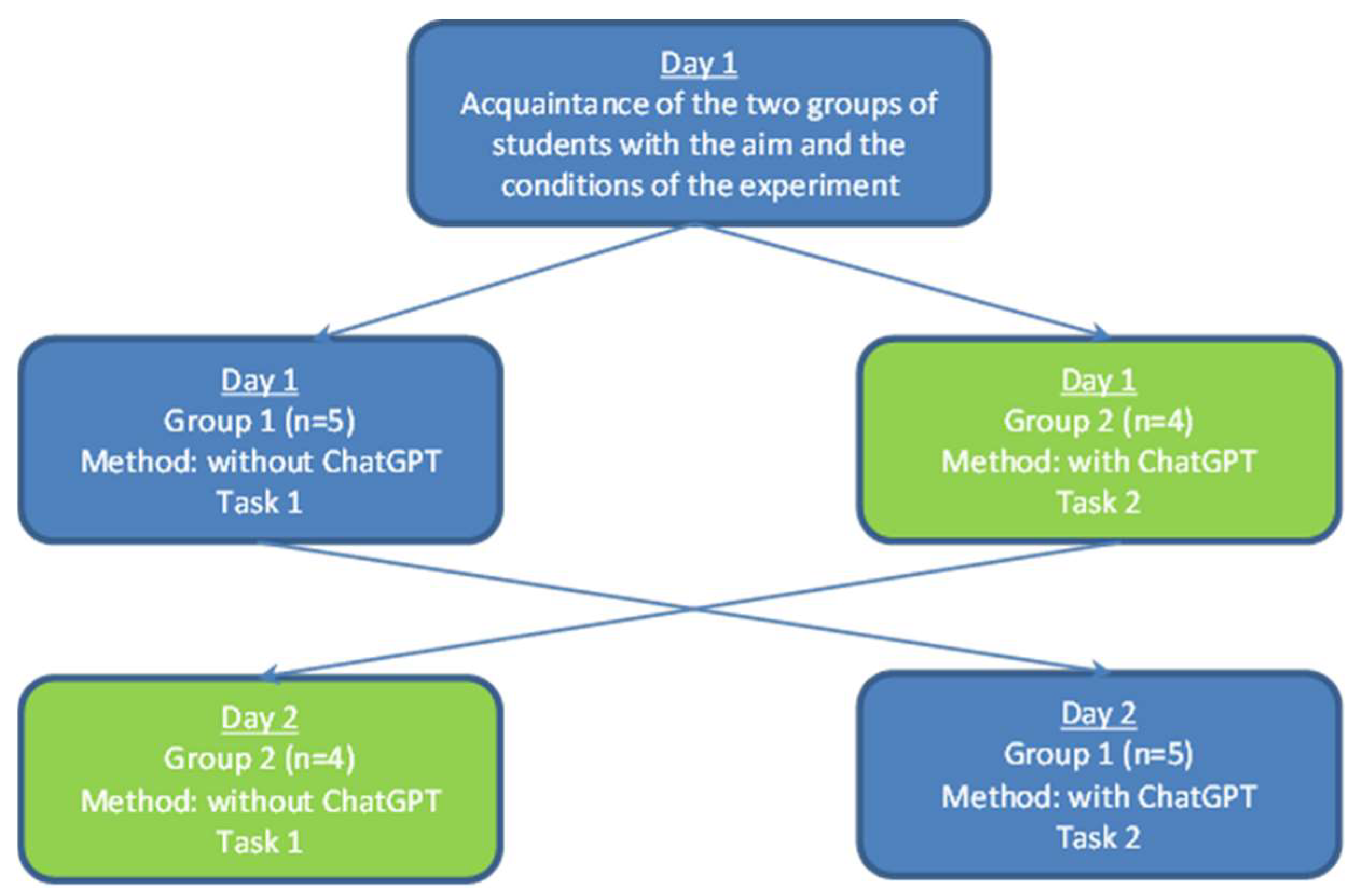
- Group 1: 5 students;
- Group 2: 4 students.
- With ChatGPT;
- Without ChatGPT (using traditional resources such as Internet search engines, electronic learning materials, paper textbooks, etc.).
- Task 1 (Mathematics game): to create an educational game for 1st class pupils, intended to support them in learning mathematics. The game should help children develop skills in comparing, adding, and subtracting numbers from 1 to 10.
- Task 2 (Language game): to create an educational game, helping 1st class pupils in their Bulgarian language and literature training. The game should help children develop the ability to recognize the printed letters of the Bulgarian alphabet.
- The following components must be used: Label, Button, Picture Box, Timer, Message Box;
- Only components discussed during the training sessions must be used;
- Feedback to the player must be provided on correct or incorrect answers;
- The number of correct answers must be counted;
- When the preset time expires, the player’s score should be displayed;
- The interface should be tailored to the age of the target group—8-year-old children.
3.3. Data Collection Techniques
3.3.1. Study 1
3.3.2. Study 2
3.4. Ethical Considerations
4. Results
4.1. Study 1
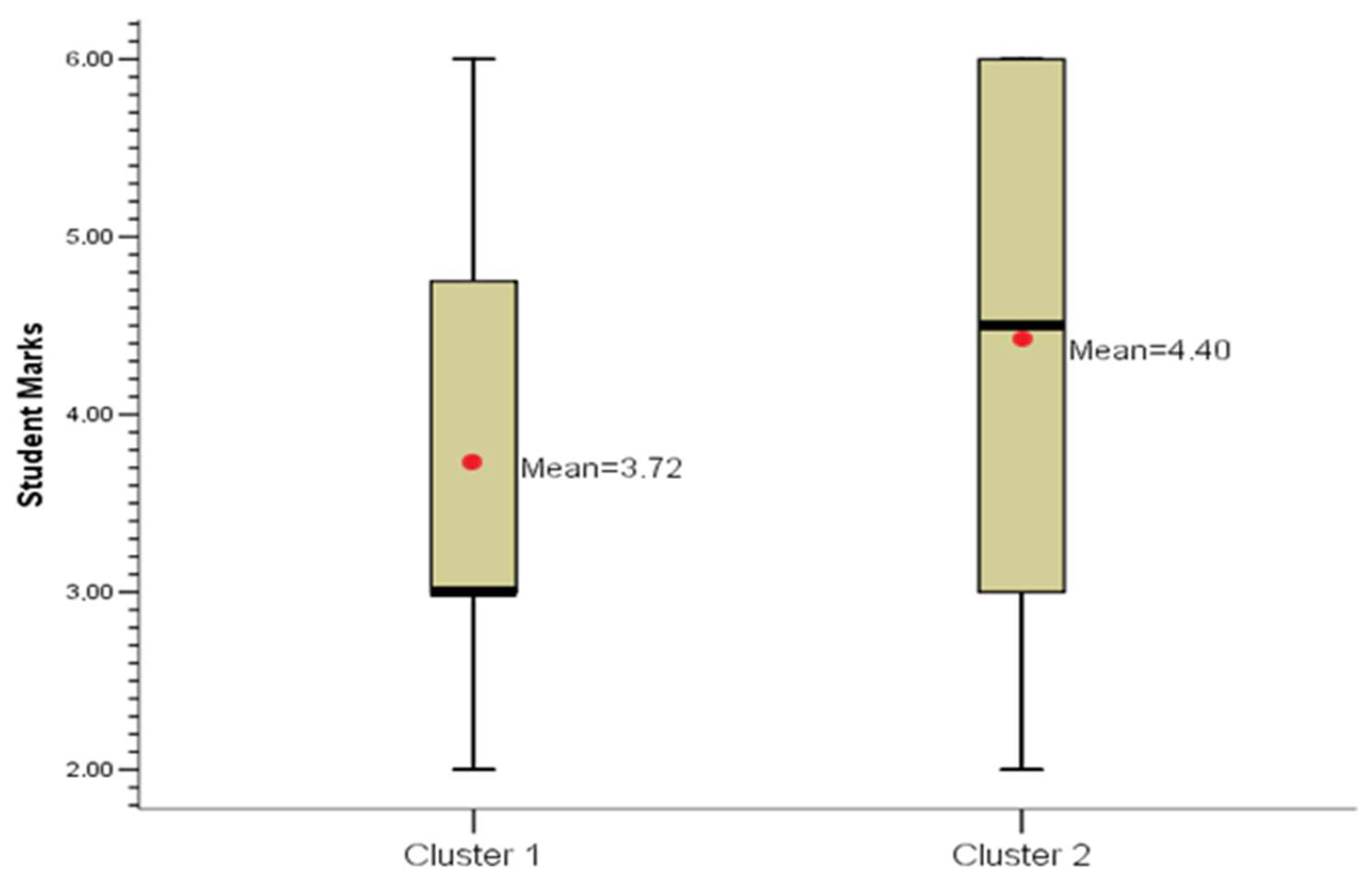
- Cluster 1 (n = 32). This is the group of students actively using ChatGPT. It is characterized by higher mean values of the answers to all questions Q2–Q7, varying from 2.97 to 4.22.
- Cluster 2 (n = 24)—the group of students, rarely using ChatGPT, characterized by lower mean values of the answers to all questions, ranging from 1.71 to 3.00. The highest mean value in this cluster (3.00) is reported for the question “How often do you use ChatGPT as a resource?”
4.2. Study 2
4.2.1. Results of the Evaluation of the Developed Projects
4.2.2. Analysis of the Semi-Structured Interview with the Students
5. Discussion
6. Limitations of the Study
- The study was conducted at a specific point in time and reflects the students’ opinions, identified benefits, and potential risks associated with the use of ChatGPT in programming education at that specific time.
- The sample consisted of students from a single faculty at one university.
- Due to the small number of participants, especially in the second study, it cannot be claimed that the conclusions are statistically significant or representative.
- Some of the data were collected through self-assessment questions, which poses a risk of bias and inaccuracies in self-reporting.
- In Study 1, ChatGPT was used in an uncontrolled environment, making it impossible to verify whether participants used the free or paid version of the tool or to identify the specific underlying language model; this lack of control may have affected the consistency of AI support among participants.
- In Study 2, the experiment was conducted in a controlled university environment with equal access to the free version of ChatGPT; therefore, the findings are limited to this specific access level.
- As this study focuses specifically on ChatGPT, the findings may not be directly generalizable to other large language models or AI-based programming assistants operating under different access conditions.
- The experiment in the second study was limited to solving two specific programming tasks, which provided a more focused rather than comprehensive view of ChatGPT’s capabilities, especially when solving complex software problems.
7. Conclusions
- Providing students with the opportunity to work on projects, using both approaches—with and without ChatGPT—to make an informed comparison and determine for themselves in which situations the tool is useful and in which it is not.
- Including tasks, structured according to the Reverse Bloom’s Taxonomy model (Pesovski et al., 2024b), starting from higher cognitive levels—for example, modifying, optimizing, and extending existing code. Tasks of this type stimulate active thinking and limit passive copying of ChatGPT-generated solutions, being at the same time consistent with the reverse engineering practices in the software industry. In this context, the chatbot can act as a consultant, assisting in clarifying concepts, detecting errors, and analyzing alternative approaches, and this method of using it can be effective even for students with limited prior experience.
Author Contributions
Funding
Institutional Review Board Statement
Informed Consent Statement
Data Availability Statement
Conflicts of Interest
References
- Adel, A., Ahsan, A., & Davison, C. (2024). ChatGPT promises and challenges in education: Computational and ethical perspectives. Education Sciences, 14(8), 814. [Google Scholar] [CrossRef] [Scilit]
- Almanasra, S., & Suwais, K. (2025). Analysis of ChatGPT-generated codes across multiple programming languages. IEEE Access, 13, 23580–23596. [Google Scholar] [CrossRef] [Scilit]
- Anagnostopoulos, C.-N. (2023). ChatGPT impacts in programming education: A recent literature overview that debates ChatGPT responses. arXiv, arXiv:2309.12348. [Google Scholar] [CrossRef] [Scilit]
- Biswas, S. (2023). Role of ChatGPT in computer programming. Mesopotamian Journal of Computer Science, 2023, 9–15. [Google Scholar] [CrossRef] [Scilit]
- Bringula, R. (2024). ChatGPT in a programming course: Benefits and limitations. Frontiers in Education, 9, 1248705. [Google Scholar] [CrossRef] [Scilit]
- Bucaioni, A., Ekedahl, H., Helander, V., & Nguyen, P. T. (2024). Programming with ChatGPT: How far can we go? Machine Learning with Applications, 15, 100526. [Google Scholar] [CrossRef] [Scilit]
- Campillo-Ferrer, J. M., López-García, A., & Miralles-Sánchez, P. (2025). Student perceptions of the use of gen-AI in a higher education program in Spain. Digital, 5(3), 29. [Google Scholar] [CrossRef] [Scilit]
- Chang, C. I., Choi, W. C., & Choi, I. C. (2024). Challenges and limitations of using artificial intelligence generated content (AIGC) with ChatGPT in programming curriculum: A systematic literature review. In Proceedings of the 2024 7th artificial intelligence and cloud computing conference (pp. 372–378). Association for Computing Machinery. [Google Scholar] [CrossRef] [Scilit]
- Chen, E., Huang, R., Chen, H.-S., Tseng, Y.-H., & Li, L.-Y. (2023). GPTutor: A ChatGPT-powered programming tool for code explanation. In N. Wang, G. Rebolledo-Mendez, V. Dimitrova, N. Matsuda, & O. C. Santos (Eds.), Artificial intelligence in education. Posters and late breaking results, workshops and tutorials, industry and innovation tracks, practitioners, doctoral consortium and blue sky (Vol. 1831, pp. 321–327). Springer Nature Switzerland. [Google Scholar] [CrossRef] [Scilit]
- Clarke, C. J. S. F., & Konak, A. (2025). The impact of AI use in programming courses on critical thinking skills. Journal of Cybersecurity Education, Research and Practice, 2025(1), 5. [Google Scholar] [CrossRef] [Scilit]
- Farah, J. C., La Scala, J., Ingram, S., & Gillet, D. (2025, April 27). Supporting brainstorming activities with bots in software engineering education. 2025 IEEE/ACM International Workshop on Bots in Software Engineering (BotSE) (pp. 23–27), Ottawa, ON, Canada. [Google Scholar] [CrossRef] [Scilit]
- Gill, S. S., Xu, M., Patros, P., Wu, H., Kaur, R., Kaur, K., Fuller, S., Singh, M., Arora, P., Parlikad, A. K., Stankovski, V., Abraham, A., Ghosh, S. K., Lutfiyya, H., Kanhere, S. S., Bahsoon, R., Rana, O., Dustdar, S., Sakellariou, R., … Buyya, R. (2024). Transformative effects of ChatGPT on modern education: Emerging era of AI chatbots. Internet of Things and Cyber-Physical Systems, 4, 19–23. [Google Scholar] [CrossRef] [Scilit]
- Groothuijsen, S., Van Den Beemt, A., Remmers, J. C., & Van Meeuwen, L. W. (2024). AI chatbots in programming education: Students’ use in a scientific computing course and consequences for learning. Computers and Education: Artificial Intelligence, 7, 100290. [Google Scholar] [CrossRef] [Scilit]
- Haindl, P., & Weinberger, G. (2024a). Does ChatGPT help novice programmers write better code? Results from static code analysis. IEEE Access, 12, 114146–114156. [Google Scholar] [CrossRef] [Scilit]
- Haindl, P., & Weinberger, G. (2024b). Students’ experiences of using ChatGPT in an undergraduate programming course. IEEE Access, 12, 43519–43529. [Google Scholar] [CrossRef] [Scilit]
- Haque, M. A., & Li, S. (2023). The potential use of ChatGPT for debugging and bug fixing. EAI Endorsed Transactions on AI and Robotics, 2(1), e4. [Google Scholar] [CrossRef] [Scilit]
- Hartley, K., Hayak, M., & Ko, U. H. (2024). Artificial intelligence supporting independent student learning: An evaluative case study of ChatGPT and learning to code. Education Sciences, 14(2), 120. [Google Scholar] [CrossRef] [Scilit]
- Hazelhurst, S., Johnson, Y., & Sanders, I. (2011). An empirical analysis of the relationship between web usage and academic performance in undergraduate students. arXiv, arXiv:1110.6267. [Google Scholar] [CrossRef] [Scilit]
- Huang, D., Zhang, J. M., Bu, Q., Xie, X., Chen, J., & Cui, H. (2023). Bias testing and mitigation in LLM-based code generation. arXiv, arXiv:2309.14345. [Google Scholar] [CrossRef] [Scilit]
- Huesca, G., Martínez-Treviño, Y., Molina-Espinosa, J. M., Sanromán-Calleros, A. R., Martínez-Román, R., Cendejas-Castro, E. A., & Bustos, R. (2024). Effectiveness of using ChatGPT as a tool to strengthen benefits of the flipped learning strategy. Education Sciences, 14(6), 660. [Google Scholar] [CrossRef] [Scilit]
- Humble, N., Boustedt, J., Holmgren, H., Milutinovic, G., Seipel, S., & Östberg, A.-S. (2023). Cheaters or AI-enhanced learners: Consequences of ChatGPT for programming education. Electronic Journal of e-Learning, 22, 16–29. [Google Scholar] [CrossRef] [Scilit]
- Husain, A. (2024). Potentials of ChatGPT in computer programming: Insights from programming instructors. Journal of Information Technology Education: Research, 23, 002. [Google Scholar] [CrossRef] [Scilit] [PubMed]
- Ilieva, G., Yankova, T., Klisarova-Belcheva, S., Dimitrov, A., Bratkov, M., & Angelov, D. (2023). Effects of Generative chatbots in higher education. Information, 14(9), 492. [Google Scholar] [CrossRef] [Scilit]
- Jamil, M. T., Abid, S., & Shamail, S. (2025, April 28–29). Can LLMs generate higher quality code than humans? An empirical study. 2025 IEEE/ACM 22nd International Conference on Mining Software Repositories (MSR) (pp. 478–489), Ottawa, ON, Canada. [Google Scholar] [CrossRef] [Scilit]
- Jukiewicz, M. (2024). The future of grading programming assignments in education: The role of ChatGPT in automating the assessment and feedback process. Thinking Skills and Creativity, 52, 101522. [Google Scholar] [CrossRef] [Scilit]
- Kiesler, N., Lohr, D., & Keuning, H. (2023, October 18–21). Exploring the potential of large language models to generate formative programming feedback. 2023 IEEE Frontiers in Education Conference (FIE) (pp. 1–5), College Station, TX, USA. [Google Scholar] [CrossRef] [Scilit]
- Kosar, T., Ostojić, D., Liu, Y. D., & Mernik, M. (2024). Computer science education in ChatGPT era: Experiences from an experiment in a programming course for novice programmers. Mathematics, 12(5), 629. [Google Scholar] [CrossRef] [Scilit]
- Lehmann, M., Cornelius, P. B., & Sting, F. J. (2025). AI meets the classroom: When do large language models harm learning? arXiv, arXiv:2409.09047. [Google Scholar] [CrossRef] [Scilit]
- León-Domínguez, U. (2024). Potential cognitive risks of generative transformer-based AI chatbots on higher order executive functions. Neuropsychology, 38(4), 293–308. [Google Scholar] [CrossRef] [Scilit]
- Lin, C.-C., Huang, A. Y. Q., & Yang, S. J. H. (2023). A review of AI-driven conversational chatbots implementation methodologies and challenges (1999–2022). Sustainability, 15(5), 4012. [Google Scholar] [CrossRef] [Scilit]
- Liu, Q., Zhou, Y., Huang, J., & Li, G. (2024). When ChatGPT is gone: Creativity reverts and homogeneity persists. arXiv, arXiv:2401.06816. [Google Scholar] [CrossRef] [Scilit]
- López-Fernández, D., & Vergaz, R. (2025). ChatGPT in computer science education: A case study on a database administration course. Applied Sciences, 15(2), 985. [Google Scholar] [CrossRef] [Scilit]
- McCulloh, I., Rodriguez, P., Kumar, S., Gupta, M., Sharma, V. R., Johnson, B., & Johnson, A. N. (2025). Generative AI in computer science education: Accelerating python learning with ChatGPT. arXiv, arXiv:2505.20329. [Google Scholar] [CrossRef] [Scilit]
- Ouh, E. L., Gan, B. K. S., Shim, K. J., & Wlodkowski, S. (2023). ChatGPT, can you generate solutions for my coding exercises? An evaluation on its effectiveness in an undergraduate java programming course. arXiv, arXiv:2305.13680. [Google Scholar] [CrossRef] [Scilit]
- Penney, J., Acharya, P., Hilbert, P., Parekh, P., Sarma, A., Steinmacher, I., & Gerosa, M. A. (2025). Outcomes, perceptions, and interaction strategies of novice programmers studying with ChatGPT. In Proceedings of the 7th ACM conference on conversational user interfaces (pp. 1–15). Association for Computing Machinery. [Google Scholar] [CrossRef] [Scilit]
- Pesovski, I., Santos, R., Henriques, R., & Trajkovik, V. (2024a). Generative AI for customizable learning experiences. Sustainability, 16(7), 3034. [Google Scholar] [CrossRef] [Scilit]
- Pesovski, I., Vorkel, D., & Trajkovik, V. (2024b, November 6–8). AI-powered education: Rethinking the way programming is taught using AI tools and reversed bloom’s taxonomy. 2024 21st International Conference on Information Technology Based Higher Education and Training (ITHET) (pp. 1–6), Paris, France. [Google Scholar] [CrossRef] [Scilit]
- Rahe, C., & Maalej, W. (2025). How do programming students use generative AI? Proceedings of the ACM on Software Engineering, 2, 978–1000. [Google Scholar] [CrossRef] [Scilit]
- Rahman, M. M., & Watanobe, Y. (2023). ChatGPT for education and research: Opportunities, threats, and strategies. Applied Sciences, 13(9), 5783. [Google Scholar] [CrossRef] [Scilit]
- Raihan, N., Siddiq, M. L., Santos, J. C. S., & Zampieri, M. (2025). Large language models in computer science education: A systematic literature review. In Proceedings of the 56th ACM technical symposium on computer science education V. 1 (pp. 938–944). Association for Computing Machinery. [Google Scholar] [CrossRef] [Scilit]
- Rajan, S., & Niranjan, L. R. (2025). The double-edged sword of ChatGPT: Fostering and hindering creativity in postgraduate academics in Bengaluru. International Journal of Educational Management, 39(2), 317–337. [Google Scholar] [CrossRef] [Scilit]
- Ray, P. P. (2023). ChatGPT: A comprehensive review on background, applications, key challenges, bias, ethics, limitations and future scope. Internet of Things and Cyber-Physical Systems, 3, 121–154. [Google Scholar] [CrossRef] [Scilit]
- Sánchez-Ruiz, L. M., Moll-López, S., Nuñez-Pérez, A., Moraño-Fernández, J. A., & Vega-Fleitas, E. (2023). ChatGPT challenges blended learning methodologies in engineering education: A case study in mathematics. Applied Sciences, 13(10), 6039. [Google Scholar] [CrossRef] [Scilit]
- Silva, C. A. G. D., Ramos, F. N., De Moraes, R. V., & Santos, E. L. D. (2024). ChatGPT: Challenges and benefits in software programming for higher education. Sustainability, 16(3), 1245. [Google Scholar] [CrossRef] [Scilit]
- Stoyanova, D., Stoyanova-Petrova, S., & Mileva, N. (2025). Exploring students’ and teachers’ perceptions about using ChatGPT in programming education. International Journal of Engineering Pedagogy (iJEP), 15(2), 15–41. [Google Scholar] [CrossRef] [Scilit]
- Sun, D., Boudouaia, A., Yang, J., & Xu, J. (2024a). Investigating students’ programming behaviors, interaction qualities and perceptions through prompt-based learning in ChatGPT. Humanities and Social Sciences Communications, 11(1), 1447. [Google Scholar] [CrossRef] [Scilit]
- Sun, D., Boudouaia, A., Zhu, C., & Li, Y. (2024b). Would ChatGPT-facilitated programming mode impact college students’ programming behaviors, performances, and perceptions? An empirical study. International Journal of Educational Technology in Higher Education, 21(1), 14. [Google Scholar] [CrossRef] [Scilit]
- Surameery, N. M. S., & Shakor, M. Y. (2023). Use chat GPT to solve programming bugs. International Journal of Information Technology and Computer Engineering, 31, 17–22. [Google Scholar] [CrossRef] [Scilit]
- Uandykova, M., Baitenova, L., Mukhamejanova, G., Yeleukulova, A., & Mirkassimova, T. (2024). Java coding using artificial intelligence. Frontiers in Computer Science, 6, 1473870. [Google Scholar] [CrossRef] [Scilit]
- Vaithilingam, P., Zhang, T., & Glassman, E. L. (2022). Expectation vs. experience: Evaluating the usability of code generation tools powered by large language models. In CHI conference on human factors in computing systems extended abstracts (pp. 1–7). Association for Computing Machinery. [Google Scholar] [CrossRef] [Scilit]
- Wu, T.-T., Lee, H.-Y., Li, P.-H., Huang, C.-N., & Huang, Y.-M. (2024). Promoting self-regulation progress and knowledge construction in blended learning via ChatGPT-based learning aid. Journal of Educational Computing Research, 61(8), 1539–1567. [Google Scholar] [CrossRef] [Scilit]
- Xue, Y., Chen, H., Bai, G. R., Tairas, R., & Huang, Y. (2024). Does ChatGPT help with introductory programming? An experiment of students using ChatGPT in CS1. In Proceedings of the 46th international conference on software engineering: Software engineering education and training (pp. 331–341). Association for Computing Machinery. [Google Scholar] [CrossRef] [Scilit]
- Yang, Q. (2024). Systematic evaluation of AI-generated python code: A comparative study across progressive programming tasks. Research Square. [Google Scholar] [CrossRef] [Scilit]
- Yang, T.-C., Hsu, Y.-C., & Wu, J.-Y. (2025). The effectiveness of ChatGPT in assisting high school students in programming learning: Evidence from a quasi-experimental research. Interactive Learning Environments, 33(6), 3726–3743. [Google Scholar] [CrossRef] [Scilit]
- Yilmaz, R., & Karaoglan Yilmaz, F. G. (2023). Augmented intelligence in programming learning: Examining student views on the use of ChatGPT for programming learning. Computers in Human Behavior: Artificial Humans, 1(2), 100005. [Google Scholar] [CrossRef] [Scilit]
- Zviel-Girshin, R. (2024). The good and bad of AI tools in novice programming education. Education Sciences, 14(10), 1089. [Google Scholar] [CrossRef] [Scilit]


| Frequency | Percent | |
|---|---|---|
| Never | 0 | 0 |
| Rarely | 7 | 12.5 |
| Sometimes | 28 | 50.0 |
| Often | 18 | 32.1 |
| Very Often | 3 | 5.4 |
| Total | 56 | 100.0 |
| Cluster 1 Actively Using ChatGPT | Cluster 2 Rarely Using ChatGPT | |
|---|---|---|
| Q2 | 4.00 | 3.00 |
| Q3 | 3.56 | 2.38 |
| Q4 | 2.97 | 2.17 |
| Q5 | 4.22 | 2.08 |
| Q6 | 3.31 | 1.71 |
| Q7 | 3.69 | 2.25 |
| Category | Scores Group 1 | Scores Group 2 | ||
|---|---|---|---|---|
| With ChatGPT | Without ChatGPT | With ChatGPT | Without ChatGPT | |
| Completeness and effectiveness of the code | 4.5 | 3.5 | 5 | 4 |
| Organization and readability of the code | 4 | 4.5 | 4 | 4.5 |
| Interface quality | 3.75 | 4 | 3.75 | 4.25 |
| Creativity | 3 | 5 | 4 | 5 |
| Time for completion | 3 h 15 min | 4 h 10 min | 3 h 30 min | 4 h 15 min |
Disclaimer/Publisher’s Note: The statements, opinions and data contained in all publications are solely those of the individual author(s) and contributor(s) and not of MDPI and/or the editor(s). MDPI and/or the editor(s) disclaim responsibility for any injury to people or property resulting from any ideas, methods, instructions or products referred to in the content. |
© 2025 by the authors. Licensee MDPI, Basel, Switzerland. This article is an open access article distributed under the terms and conditions of the Creative Commons Attribution (CC BY) license.
Share and Cite
Stoyanova, D.; Stoyanova-Petrova, S.; Shotarova, S.; Lyubomirov, S.; Mileva, N. ChatGPT in Programming Education: An Empirical Study on Its Impact on Student Performance, Creativity, and Teamwork. Educ. Sci. 2026, 16, 19. https://doi.org/10.3390/educsci16010019
Stoyanova D, Stoyanova-Petrova S, Shotarova S, Lyubomirov S, Mileva N. ChatGPT in Programming Education: An Empirical Study on Its Impact on Student Performance, Creativity, and Teamwork. Education Sciences. 2026; 16(1):19. https://doi.org/10.3390/educsci16010019
Chicago/Turabian StyleStoyanova, Diana, Silviya Stoyanova-Petrova, Snezha Shotarova, Slavi Lyubomirov, and Nevena Mileva. 2026. "ChatGPT in Programming Education: An Empirical Study on Its Impact on Student Performance, Creativity, and Teamwork" Education Sciences 16, no. 1: 19. https://doi.org/10.3390/educsci16010019
APA StyleStoyanova, D., Stoyanova-Petrova, S., Shotarova, S., Lyubomirov, S., & Mileva, N. (2026). ChatGPT in Programming Education: An Empirical Study on Its Impact on Student Performance, Creativity, and Teamwork. Education Sciences, 16(1), 19. https://doi.org/10.3390/educsci16010019