1. Introduction
The increasing diversity among students in higher education is a phenomenon observed worldwide. It also applies to students at the Danish university colleges, which train welfare professionals, such as schoolteachers, nurses, early childhood teachers, and social workers. In a Danish context, the growing diversity has changed the composition of students in Early Childhood and Social Education program over the past two decades. There has been an increase in the proportion of students with the lowest grades from high school. Likewise, the share of students with psychological or mental health challenges has risen. At the same time, many students come from lower-level economic backgrounds and have parents with low levels of education. These changes in student demographics are not unique to Denmark but can be observed globally (
Antczak et al., 2025).
The growing diversity among students calls on higher education institutions to create inclusive learning environments that both challenge and retain students with very different academic backgrounds, while also establishing conditions that enable all students, regardless of prior educational experiences, to develop a sense of belonging in the educational program and the profession it prepares them for. In this paper, diversity is linked to belonging, as diversity both challenges and necessitates greater attention to students’ sense of belonging. This is inspired by
Gravett and Ajjawi (
2021), who note a need for further elaborating the concept of belonging due to the growing global diversification of student populations within higher education.
The aim of this paper is to contribute to discussions on how to initiate a more equitable distribution of the sense of belonging and participation among students in higher education, with a particular focus on Early Childhood and Social Education. The paper is based on a research project at University College Copenhagen
1 considering the significance of educational architecture for students’ learning processes and sense of belonging. The purpose of the research project is to examine how more diverse educational settings can be fostered and how belonging and participation can be more equitably distributed in the Early Childhood and Social Education program. One third of this program consists of internships in, for example, kindergartens, nurseries, after-school facilities, special classes in public schools, or residential institutions for young people and adults with disabilities. The remaining two-thirds of the program primarily takes place on campus, where students are taught in classes of approximately forty students. Teaching varies between traditional classroom instruction, where the lecturer communicates the academic content, and creative and aesthetic subjects such as music, sports, and drama. In addition, there is a strong emphasis on group work and larger project assignments, which students complete in groups. The university college campuses are intentionally designed to include a variety of spatial typologies: traditional classrooms, subject-specific rooms, a limited number of creative learning spaces, and large, open learning landscapes featuring smaller workstations and flexible spatial configurations. These environments are conceived as shared learning spaces, intended to facilitate collaboration and mutual inspiration among students across all programs. The classrooms on campus follow a more conventional design, furnished with tables and chairs for approximately thirty to forty students, complemented by a smartboard and a teacher’s desk.
3. Materials and Methods
The empirical study of the research project underpinning this paper involved group interviews with 120 students in Early Childhood and Social Education program, organized in groups of four to six participants. The sample included students at different semesters of the program, some in their second semester, others in their fourth or fifth, in order to ensure a diversity of perspectives on the education. Students participated as entire class cohorts (30–40 students), and the interviews were conducted during scheduled class hours, resulting in a high participation rate. The classes were selected to ensure variation across semesters. Since the interviews were conducted during scheduled lessons, we chose classes whose instructors were willing to allocate 4–6 class hours for this purpose. The same classes participated in two stages of group interviews (outlined below). The interviews were carried out by a research team comprising ten members under the supervision of the author of this paper (see Acknowledgments). Detailed interview guides were developed to secure consistency in interview techniques. These guides were further refined and elaborated during collaborative research workshops, which also lay the foundation for the analytical process carried out collaboratively by the research team.
The empirical study draws on qualitative methods inspired by sociomaterial and affect-oriented approaches. The study draws on qualitative studies examining how school and classroom architecture shapes social educational life. Examples include research on how high school architecture interplays with experiences of distress among adolescent girls (
Lenz Taguchi & Palmer, 2013); studies of how humans and material objects (e.g., smartboards, chairs, the branding on a T-shirt) intra-act to produce university classrooms as gendered spaces (
Taylor, 2013); Juelskjær’s analysis of school architecture as material-discursive arrangements that co-produces the educational life (
M. Juelskjær, 2013); and
De Freitas and Sinclair’s (
2014) study of the student body as emergent within assemblages of human and non-human forces (such as pencils, rulers, and compasses), challenging the notion of the body as an individual entity with fixed and determinate boundaries.
The interviews were conducted by using an architectural plan-based interview approach, that builds on methodological work developed in a research project, Thinking Technology for Spatialized Leadership of Rhythms and Routes (2014–2016)
4, as well as in my doctoral dissertation (2017). The architectural plan-based interview approach comprising three interrelated methodological approaches, designed to foreground students’ sensory experiences and embodied movements. Together, these methods generated insight into how students’ social and academic belonging intertwine with spatial practices (
Falkenberg & Lind, 2023;
M. Juelskjær et al., 2018). The first stage comprised group interviews based on freehand architectural drawings of the campus and classroom spaces (Method 1). In these interviews, students collaboratively produced hand-drawn sketches of classrooms and marked the places they preferred (with green color) and the places they avoided (with red og orange color) when moving around and when seating themselves. Then, they mapped their movements and locations within the open learning landscapes of the campus while discussing similarities and differences in how they inhabited and navigated these spaces. The interviewer facilitated these conversations by ensuring that students spoke in turn, refrained from interrupting one another, and were given opportunities to elaborate on and nuance each other’s perspectives. In addition, the interviewer explicitly addressed conflicting viewpoints to ensure that all student voices and positions were heard. This facilitation was made possible by the presence of two interviewers: one focusing on the substantive dimensions of the interview, while the other attended to its social dynamics of the interview. The fact that students were interviewed twice and had the opportunity to revisit the themes emerged during the first round of interviews enabled them to reconsider and refine their views and perceptions. This approach lends greater weight to participants’ perspectives while minimizing the interviewer’s influence. The freehand drawings served as elicitation tools, prompting students to recall places, movements, and experiences that felt meaningful to them.
After an initial analysis of the hand-drawn mappings of students’ lives on campus, new group interviews were conducted with the same participants. In this second methodological step (Method 2), group interviews were conducted using prefabricated architect-designed plans of the built campus environment. We subsequently included drawings of three classroom layouts that many students had identified as typical during the initial interviews: the row arrangement, the group-table arrangement, and the horseshoe arrangement. The students detailed and elaborated their previous drawings and narratives about the interplay between movements in classroom and in the open learning environments learning, engagement, and belonging. These drawings on prefabricated architectural plans encouraged new reflections on spaces, movements and activities that had not emerged in the freehand drawings, thereby adding further nuance to the students’ accounts of spatial practice and belonging. Also, the interviews based on the prefabricated architectural plans (Method 2) further enriched the themes that had emerged during the initial stage of interviews using freehand architectural drawings (Method 1).
Group interviews provided opportunities for participants to challenge and enrich the reflections of one another, yet they did not always capture the depth of individual experiences. To address this issue, a third methodological approach was added (Methods 3): walking interviews, in which selected students described their study life on campus while walking through the campus environment. Conducting interviews in motion allowed for a different sensory engagement with the built environment than the drawing-based methods afforded (
Falkenberg & Lind, 2023). The walking interviews were inspired by walking methodologies (
Springgay & Truman, 2018;
Sauzet, 2023), which foreground embodied ways of knowing and rest on the premise that body and environment are mutually constituted through movement (
Springgay & Truman, 2018;
De Freitas & Sinclair, 2014).
The architectural plan interview approach draws on educational research that foreground the significance of materialities (e.g., interior design), spatial configurations, and places, as well as immaterial components such as moods, emotions, and affects in shaping educational practices (
De Freitas, 2011;
Fenwick et al., 2010;
Jackson, 2013;
M. Juelskjær, 2013;
J. Juelskjær & Staunæs, 2016;
MacLure, 2013;
Mazzei, 2014;
St. Pierre & Jackson, 2014;
Taylor, 2013;
Thrift, 2008). This body of scholarship highlights how the social and the pedagogical are produced not only through linguistic practices but also through atmospheres, emotions, and affective intensities. Consequently, it calls for multisensory research methodologies that both attend to the sensory dimensions of social and pedagogical practices and employ sensory-based methodological approaches (
Falkenberg, 2023;
Falkenberg & Sauzet, 2023).
Guided by sociomaterial and affective methodologies, the analytical process sought to trace how affects, movements, and spatial relations co-constituted students’ sense of belonging. Following the first phase of data collection, the research team conducted a preliminary thematic analysis of the recorded interviews (
Braun & Clarke, 2006). Four themes were identified and subsequently informed the design of the second interview round: Discomfort and Gazes, Group Work and Crowding, Break-Time Life, and Homeliness and Belonging in the Open Learning Landscapes. As mentioned earlier, the second round of interviews served to elaborate and deepen these analytical themes. The theme of discomfort and gaze foregrounds questions of belonging in close relation to the spatial configurations of the classroom, whereas the remaining themes illuminate aspects of student life within open learning environments. These include the challenges of locating spaces conducive to group work in such settings, students’ longing for designated areas that anchor their identity as students in Early Childhood and Social Education, and the ways in which some students cultivate preferred spots during breaks—spaces that become contested and actively claimed. These themes served as the coding framework for the subsequent analysis, which was organized as an iterative process in which the research group discussed interpretations to ensure analytical depth. By working collaboratively, we enhanced validity through triangulation of perspectives and critical reflection. The group discussions were central to refining themes and identifying patterns across the material.
This paper specifically focuses on the theme Discomfort and Gazes, drawing on data that illuminate how students’ narratives about their positioning within classrooms intertwine with constructions of student identity and subjectivity (
Davies & Harré, 1990).
4. Results
As outlined earlier, the classrooms are furnished with tables and chairs for approximately 30–40 students. According to the students, three typical spatial configurations dominate: the row arrangement, the horseshoe arrangement, and the group-table arrangement. Regardless of the specific setup, students consistently identify three zones within the classroom: the front area near the smartboard and teacher’s desk, the middle area, and the back. These zones are not physical boundaries, but immaterial divisions produced through students’ affective perceptions and mutual positionings. The classrooms typically feature white walls and sparse decoration, as they are shared by multiple programs and thus do not ‘belong’ to any single discipline. Within Early Childhood and Social Education, these spaces host subject-specific teaching that alternates between traditional lectures, in which the lecturer presents disciplinary knowledge and students take notes, group work, where students actively engage with course material, and plenary discussions, which synthesize or extend the group activities.
The following analysis examines students’ narratives of their spatial positioning in classrooms, focusing on where they prefer to sit—front, middle, or back—and the reasons for these choices. The analysis explores how students’ awareness of being watched by peers shapes their bodily and spatial positioning, and how these dynamics, by means of the circulation of gazes, contribute to the production of student identities and ‘appropriate’ ways of being a student. Acts of positioning thus emerge as embodied and spatial work, in which peers’ gazes operate as powerful affective forces. The theme of Discomfort and Gazes emerged empirically from the attention to the bodily and immaterial dimensions of classroom life. The analysis subsequently integrates theory and data to address the question: what do students’ gazes and discomfort do? Which student positions become possible, and how is this positioning work entangled with classroom arrangements and spatial placements?
Ahmed’s (
2004) concept of the stickiness of affect offers an analytical lens for understanding how affects, for instance, gazes and discomfort, connect and attune certain subjects while differentiating and distancing others.
4.1. The Affective Force of Peers’ Gazes
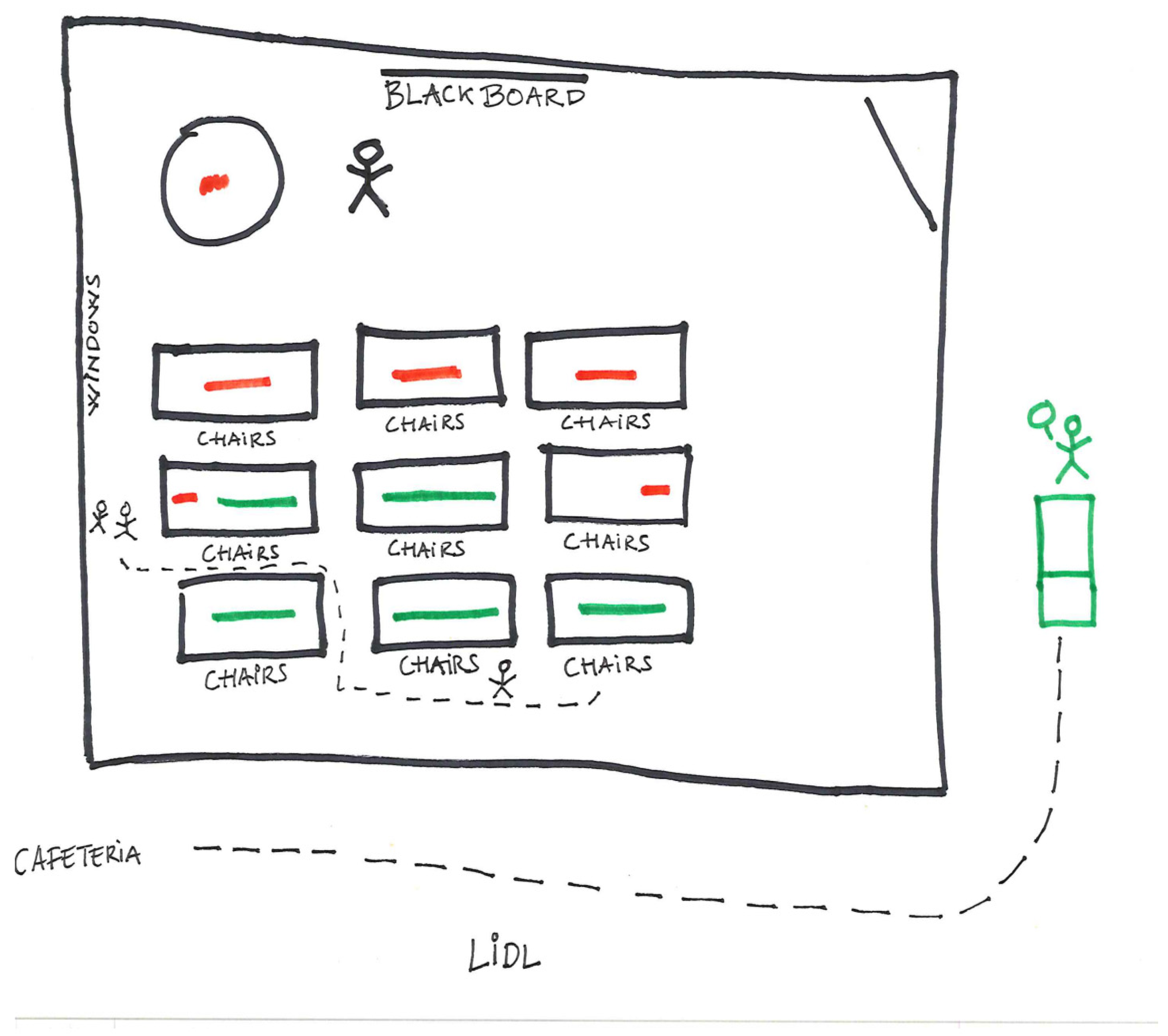
From the student interviews, it becomes evident that the gazes of peers trigger some students to move towards the back of the classroom as a way of avoiding these gazes: “I like sitting in the back. It just feels better when I can see everyone. When I sit up front, it’s like I sense the eyes in the back of my head”, one student explains during an interview. This point is illustrated in
Figure 1 which is a student’s drawing of seats that the student respectively prefers and avoids. It illustrates how the student has coloured the seats at the back green, indicating that these are the seats the student prefers. Many other students similarly emphasize the value of maintaining an overview of the room and point to the discomfort of not being able to see the entire classroom and their fellow students:
It’s also about having people sitting behind you. It’s kind of metaphorical, you know? Like, people can talk behind your back in a way, and you can’t really follow what’s going on. When people are in front of you, you sort of have eyes on the conversation. You can see if they turn their heads towards you or something like that. So, I guess it’s a kind of safety thing, even though I don’t actually think anyone’s saying anything bad about me.
The discomfort is linked to the feeling that others might be talking behind one’s back. Even if this is not actually the case, the students sense the potentiality. In this regard, the discomfort relates to the feeling of being judged by peers, for instance, through potential negative comments or imagined disapproval. This sense of discomfort and possible judgment is sometimes felt so strong that it pushes students to the back of the classroom, away from the front area, even though this may make it harder to stay focused on the learning agenda, as several students explain. From the students’ narratives of positioning themselves in the back to avoid the gazes and judgment of others, the classroom emerges as a social and affective space that requires a certain social energy or capacity to navigate:
If you’re having an off day, when you’re not really at your best, it’s nice to sit at the back. That way, you don’t feel as if everyone’s judging you if you’re not constantly taking notes on your laptop. Even though everyone probably does it, takes a short break or drifts off now and then, you still feel a bit judged for not paying enough attention, for not writing or following powerpoint all the time.
The gazes, or, as one student describes it, the feeling of having eyes on the back of one’s head, affect and attune students in ways that influence where they choose to place themselves within the classroom. Through an affect-theoretical lens, gazes can be understood as students’ embodied sensations of self and others. Together with these gazes emotions circulate between student bodies, tuning them in to one another (
Snaza, 2020). Theoretically, students’ bodily positioning within the room is perceived as a manifestation of affective interactions, where peers’ gazes function as non-verbal and pre-cognitive stimuli (
Massumi, 2002) that guide their spatial movements and engagement in classroom activity. These pre-cognitive and non-verbal sensations push and pull student bodies in ways that affect where they sit and, consequently, how they concentrate and engage with the learning agenda. At the same time, these gazes serve as affective forces that influence how students connect and attune to some peers while distancing or differentiating themselves from others (
Ahmed, 2004, p. 117).
4.2. Gazes and the Making of Social Categories
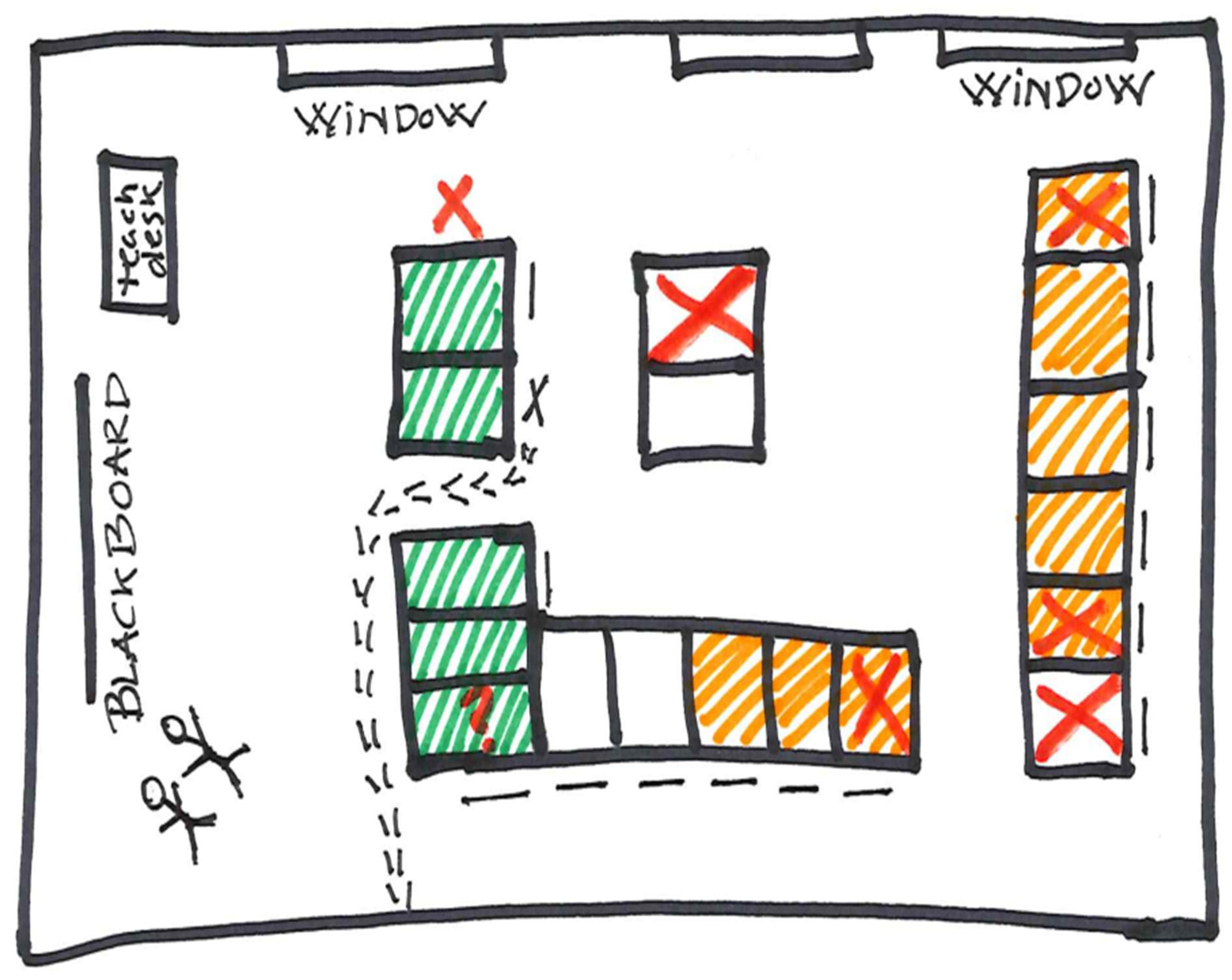
Several students choose to place themselves in the front area of the classroom despite their awareness of the discomfort associated with having their backs towards other students’ attention and conversations.
Figure 2 is a drawing by one of those students who prefers the front seats, which are therefore marked in green. In the front area, students continually work to overcome the embodied discomfort produced by the presence of others’ gazes. Students who prefer the front seats describe how this discomfort and the sensation of the gazes are sensed bodily and manifests as physical adjustments and heightened self-consciousness: “When you sit at the front, it feels like someone’s breathing down your neck. You can deal with it, but it makes you more aware of how you sit, and you tend to straighten up a bit”. Another student adds: “I also feel a bit more self-conscious when I’m sitting up front”.
Sensing the gazes of peers affects and intensifies students’ self-awareness. The discomfort associated with sitting at the front is thus also tied to an intensified awareness of one’s own bodily presence in the room. Students straighten their backs and consciously attempt to portray themselves in appropriate ways, working to be recognized as appropriate students, neither overly ambitious nor passive or unintelligent. The awareness of others’ gazes heightened the students’ self-gaze and awareness of the ongoing processes of positioning, in which they are constantly engaged:
You’re still aware of how other people see you and of how you want to present yourself. What do people think? Do they think you’re approachable or not? Are you the one who always raises your hand? Oh no, do they think you’re a bit of a nerd, or that you don’t leave room for others’ participation in class? But if you say nothing, would they think you’re stupid? You still have those thoughts as a young person, and they take up a lot of mental space.
The advantage of sitting in the front area of the classroom is that it improves concentration on the learning agenda. The disadvantage, however, is that it activates a continuous balancing act between having a position as an overachieving student and a position as a silent or less competent one. If speaking too often, marking oneself too visibly, or taking up too much space, the student risks being recognized as an overachiever. Conversely, in the effort to not be recognized as overly ambitious, the student might speak too little and thereby risk being recognized as unintelligent. Balancing between over- and underachiever positions is affectively exhausting and felt bodily: students straighten their posture and direct their self-gaze towards their physical appearance. The work of presenting oneself as an appropriate student is not exclusive to those who sit at the front, yet it is sensed more intensely there, where the judging gazes of peers are felt most strongly. In this sense, social categories such as the overachieving student stick to the front area of the classroom. By occupying this space, students are easily recognized as overachievers, which in turn, attunes the body in particular manners as a way of preventing them being recognized as an overachiever (e.g., the hand is raised either too often nor too rarely). Social categories and positionings are thus spatially produced, emerging through students’ spatial placements within the room. Consequently, such categories are not fixed or predetermined but continuously negotiated among students where spatial positioning functions as a central material and relational component in this negotiation work. Social categories, then, are produced in the specific entanglements between multiple components: student bodies, gazes, ways of being, and spatial positions within the classroom (
M. Juelskjær & Rosén, 2019).
4.3. Gazes and Processes of Differentiation
The students’ narratives and drawings about avoiding the back area of the classroom illuminate the entanglements of the spatial configurations and student positioning. Several students avoid sitting at the back, as they sense how classroom placement is also tied to judgments from both peers and teachers. For many students, the back rows connote what they refer to as the slacker area or slacker rows. The slacker category thus sticks to the back of the classroom and to those who sit there, just as the overachiever category sticks to the front rows and to the students seated there. One student, who consciously avoids the back rows, explains that there tends to be a lot of talking at the back and that it is easy to adopt a more laid-back attitude when sitting there:
It’s also just like … You just have it in the back of your mind. Like from high school. I’ve always thought that if you sit all the way at the back, it gives the impression that you don’t really care. I don’t know … maybe it’s kind of unconscious that I choose to sit in the middle of the room.
Students thus avoid the back area in order not to be recognized by teachers and peers as unserious or overly talkative. One student who avoids sitting at the back describes those who choose to sit there:
That’s where people sit and chat. They’re the ones doing all sorts of things on their laptops, not paying attention. They’re just present so they don’t get marked absent. They don’t really do much. It might sound a bit harsh, but it’s true. I don’t sit next to them. Not even if they sat somewhere else. And I don’t talk to them during the breaks either.
When zooming in on the students’ narratives about avoiding the back area of the classroom, a more nuanced picture emerges of how their spatial positioning is also tied to the kinds of student identities they strive to be associated with. In the back area, the gazes of the peers are not sensed as intensely as in the front, and it is, therefore, less socially exhausting to sit there. However, students risk being recognized as slackers; that is, unserious students who are not engaged in the teaching, since the slacker position is affectively and spatially attached to the back of the classroom. Being recognized as a slacker occurs both by means of one’s spatial placement (the back area) and by association with others seated there.
Thus, students negotiate proximity and distance, connecting with or distancing themselves from peers and student positions, through their spatial positioning in the classroom. In this way, spatial positioning (in the front or back areas) are entangled with students’ perceptions of similarity and difference, shaping who they collaborate with academically and engage with socially. To sit together and connect with someone is, at the same time, to distance and differentiate oneself from others (
Ahmed, 2004). Students’ spatial placements thus contribute to processes of differentiation that co-produce similarities and differences (
M. Juelskjær & Rosén, 2019). By not sitting in the back area (a spatial position), students distance themselves from the slacker position. However, some students contest the notion that the back zone connotes a “slacker zone.” They argue that one can be a serious student and still choose to sit in the rear area, noting that peer conversations often concern the lecturer’s presentation and thus carry academic content. In this sense, students actively negotiate the categories associated with particular seating positions. These differentiations and negotiations do not necessarily take place at a cognitive or linguistic level but rather operate through affective components (the gazes) and spatial dimensions (spatial placements within the classroom). These affective and spatial processes of differentiation among students add nuance to the texture of their social relations and to the ways in which they connect with one another. Such connections form the basis for developing a sense of belonging to the educational program, as social relationships among peers constitute a central component of educational belonging (
Ahn & Davis, 2020;
Guyotte et al., 2021).
4.4. The Middle Area as a Neutral Zone
As the preceding analysis reveals, students sense being recognized as a particular kind of student depending on where they position themselves in the classroom and with whom they choose to sit. Processes of positioning are thus at play around the front and back areas of the classroom, where students must make efforts to disentangle themselves from the social categories that stick to these spatial zones (
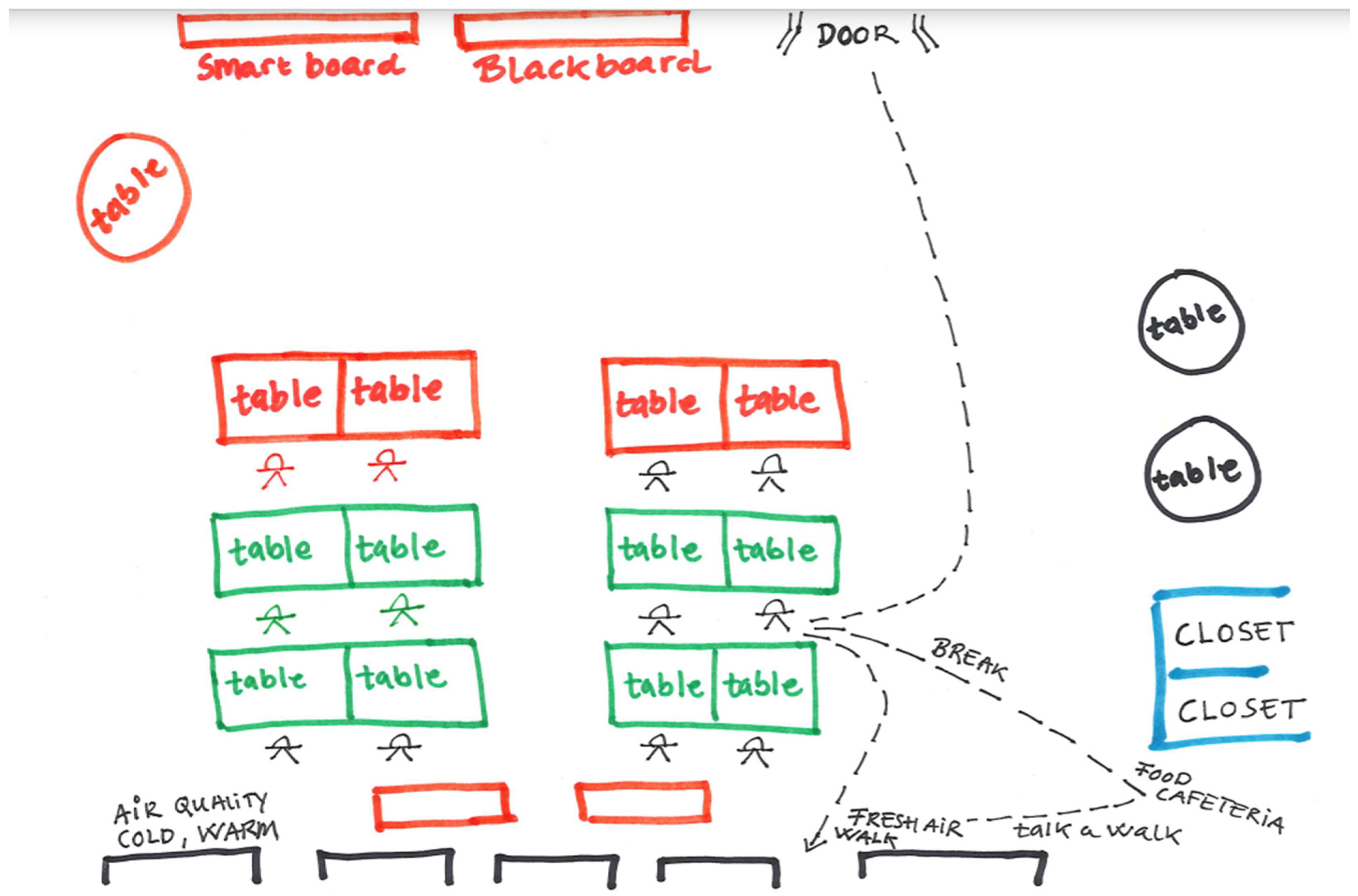
Ahmed, 2004). This is not the case in the middle area of the classroom, where the intensity of gazes diminishes. In this middle area, the students do not experience the gazes of their peers as strongly as in the front rows, as they sense being partially shielded by one another. The middle area is described as a safe zone, where the qualities of both the front and back areas are combined, allowing students to zone in and out of the teaching without being recognized as either nerds, overachievers, or slackers. This point is illustrated in
Figure 3, which is a student’s drawing in which the middle seats are marked in green, while both the front and the very back seats are marked in red as an indicator of seats the student does not like. A student explains the benefits of the middle area:
It’s actually because I don’t want to look like that nerd sitting at the front, or like the slacker sitting at the back. So, really, it’s for strategic reasons that I sit where I do. [If you sit up front], you’re a nerd—and then the teacher, you know, wants your attention. You must stay focused the whole time. But if you sit at the back, you’re not really following along. When you sit here, it’s kind of on and off, you tune in, you tune out. You talk to the teacher, then you switch off for a bit, talk again, switch off … That’s why I choose this seating, because then the teachers don’t get the impression that I’m a nerd, but not a slacker either. It’s a safe zone.
In the middle area, students are thus not recognized as either slackers or nerds. Social categories do not stick to these seats with the same intensity. At the same time, students can shift between moments of concentration, where they zone in, and brief mental breaks, where they zone out, which makes the teaching situation more manageable. Positioning oneself in the middle also gives students a sense of being situated at the center of the class, making them feel part of the group. In this way, the middle is felt to be a socially safe place.
The students’ narratives about the middle seats provide insight into what constitutes good seating positions from their perspective. First, the middle seats offer good opportunities for connecting to the learning agenda, as they are free from the distractions and chatter that characterize the back area. Likewise, students in the middle do not have to manage the intensity of peers’ gazes as those seated at the front do. Second, the work of presenting oneself as an appropriate student is less exhausting here, since students need to resist neither the slacker position nor the nerd position. This enables a wider space for action and greater opportunities for collaboration, particularly in relation to group work activities, which are a central component of the program. Third, from the middle seats, students sense the collective atmosphere of the class more intense.
Taken together, the analysis has shown that the students’ narratives about their seating choices are also narratives about different student positions and how such positions are both claimed and ascribed. These positionings occur through linguistic actions, but also, perhaps more significantly, through bodily practices and spatial placements. Student positions and identities are negotiated among peers in subtle and affective ways through the circulation of gazes within the classroom. Part of this affective negotiation involves how students judge or evaluate one another. The point that negotiation is simultaneously a process of judgment highlights that classrooms are social and affective spaces in which students continuously tune in to one another, connecting to and distancing themselves from others. These affective dynamics shape how students listen, respond, and engage in the learning process and agenda.
The analysis of how spatial positioning and student positions intertwine and how these intertwinements are fortified by the circulation of peers’ gazes contributes to understanding how affect circulates between student bodies and how educational belonging is deeply tied to affective processes. Attending these affective dimensions thus helps illuminate how students’ sense of belonging involves an ongoing social and emotional work. Analyses of the affective dimensions of education and classroom life can, in other words, help make visible micro-practices of belonging: the direction of the gaze, the feeling of being looked at, posture, facial expression, and bodily gestures.
5. Discussion
This paper demonstrates how educational belonging is constituted through complex micro-practices involving both human components (e.g., direction of gaze, bodily posture, facial expression) and material components (e.g., desk and chair arrangements, campus environment). The study contributes to higher education research by illuminating how students’ spatial positioning within the classroom enables different possibilities for developing belonging, as well as for connecting to or distancing oneself from others.
The three spatial zones identified in students’ narratives—the front, middle, and back—map the classroom as an affective landscape in which gazes, atmospheres, and embodied micro-practices attune student bodies in particular ways. In this sense, educational belonging is not merely a matter of social acceptance or academic participation, but an ongoing affective work through which students continuously attune themselves to peers, teachers, and the learning agenda.
Ahmed’s (
2004) notion of the stickiness of affect provides a lens for understanding how particular signs (e.g., ‘nerd’ or ‘slacker’) become attached to places and bodies over time, influencing who comes to feel ‘appropriate’ within the learning environment. The socio-material figures identified in the analysis—the slacker category that sticks to the back and the nerd category that sticks to the front—both connect and differentiate students. Consequently, the classroom risks functioning as a ‘differentiation machine’ (
M. Juelskjær & Rosén, 2019), where informal norms and affective intensities sort students into legitimate modes of participation. Such dynamics are problematic in all educational contexts, but especially in programs characterized by high levels of diversity, where differences in learning experiences and participation capacities are already unevenly distributed. In light of an increasing diversity of the student population, students’ affective and spatial work should not be understood solely as an individual challenge but as an organizational condition for participation that must be addressed at the institutional level. Accordingly, findings from this study have been discussed in workshops with all faculty members in the Early Childhood and Social Education program, focusing on the interplay between spatial design, learning processes, and didactic reflection. These discussions have inspired several pedagogical experiments carried out by instructors: first, assigning students specific seats; second, collaborative classroom design projects where teachers and students rearrange the space while jointly reflecting on processes of positioning; and third, peer-to-peer interviews using the architectural plan method to collectively map how zones, positioning, and the affective force of the gaze shape participation, collaboration, and experiences of belonging at the Early Childhood and Social Education program. Such experimental approaches are now central to the ongoing development of classroom management practices that explicitly engage the affective dimensions of teaching and learning. The research findings, as well as the experimental work, are central to discussions on how to enhance an inclusive learning environment—one that explicitly seeks to create opportunities for participation for all students. The interventions have clearly had an impact on instructors’ daily practices and have extended their didactic work to include considerations of classroom design and the allocation of student seating. At the same time, the interventions have contributed to the initiation of rebuilding several teaching spaces.
6. Conclusions
This paper examined how teaching situations function as social and affective events through an analysis of students’ narratives and mappings of where they prefer or avoid sitting in classroom spaces. In the students’ reflections on spatial positioning, peers’ gazes emerge as a particularly powerful component that produces discomfort and shapes their seating choices. Thus, students’ decisions about where to sit do not merely reflect preferences for visibility or concentration, but also their positioning in relation to the gazes of others and the social categories these gazes co-produce. The classroom, therefore, constitutes a dynamic space in which spatial placement and social positioning are closely intertwined. Students continuously work to balance their positions to avoid being recognized as either overachievers or slackers, and their seating choices relate not only to the teaching agenda but also to a social landscape where belonging, identity, and interaction are materially and affectively negotiated.
In addressing how students’ spatial placements and social positionings interact, the analysis demonstrates that belonging in higher education is not a fixed or purely cognitive state, but an embodied and affective process shaped by spatial, social, and material relations. Attending to these dynamics contributes to ongoing discussions on how to initiate a more equitable distribution of belonging and participation among students. The study shows that such equity cannot be achieved solely through individual adjustment or motivation; it requires institutional and pedagogical attention to how classroom arrangements, spatial practices, and affective atmospheres enable or constrain participation.
By foregrounding the affective and material dimensions of classroom life, this paper challenges dominant discourses that frame students’ learning, knowledge, and competencies as inherent, personal traits. Instead, these are revealed as relational and contextually produced capacities, emerging through complex interactions between bodies, spaces, and affects. This perspective offers a basis for rethinking inclusive pedagogical practices and educational design in higher education towards more equitable conditions for belonging and participation.