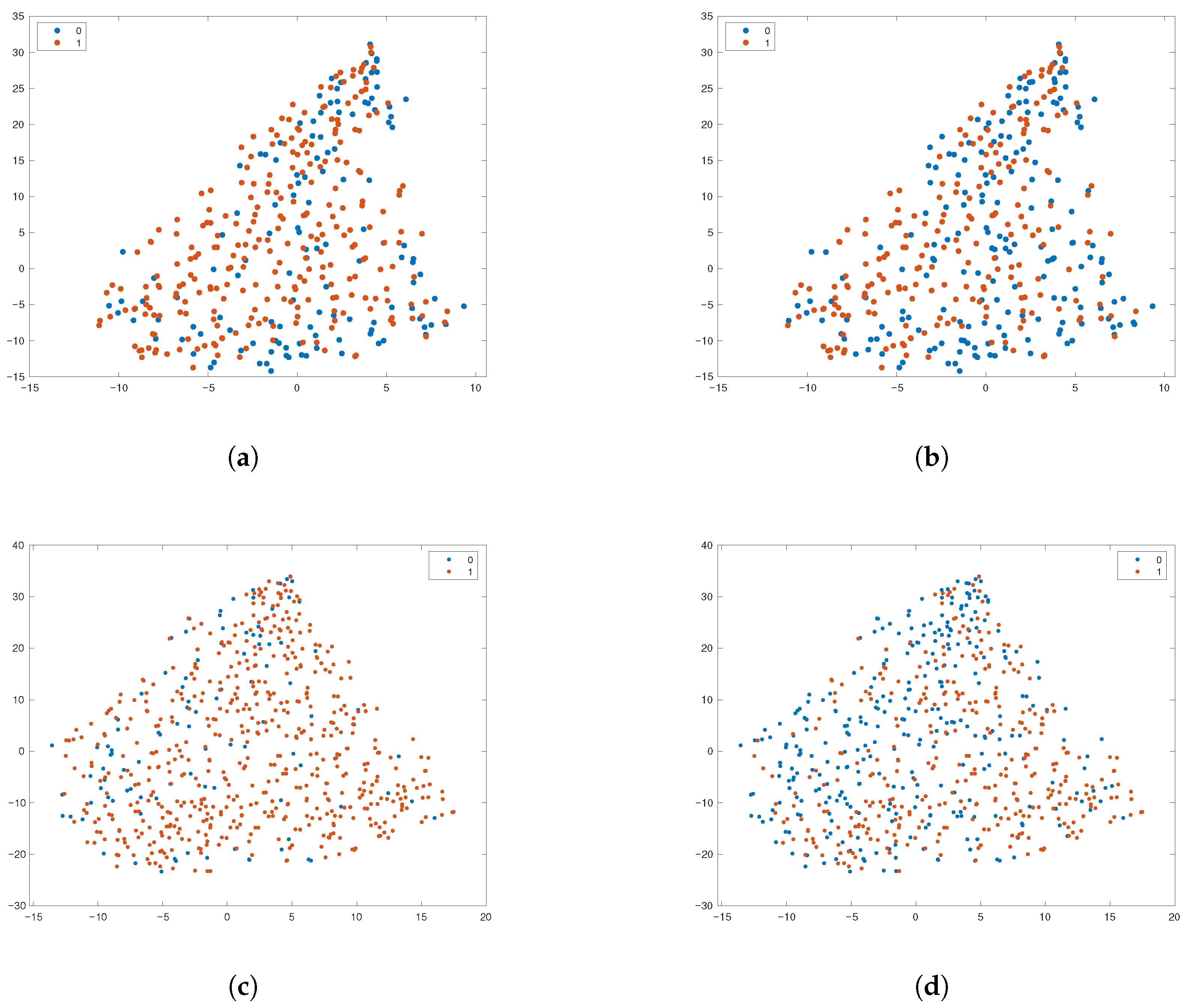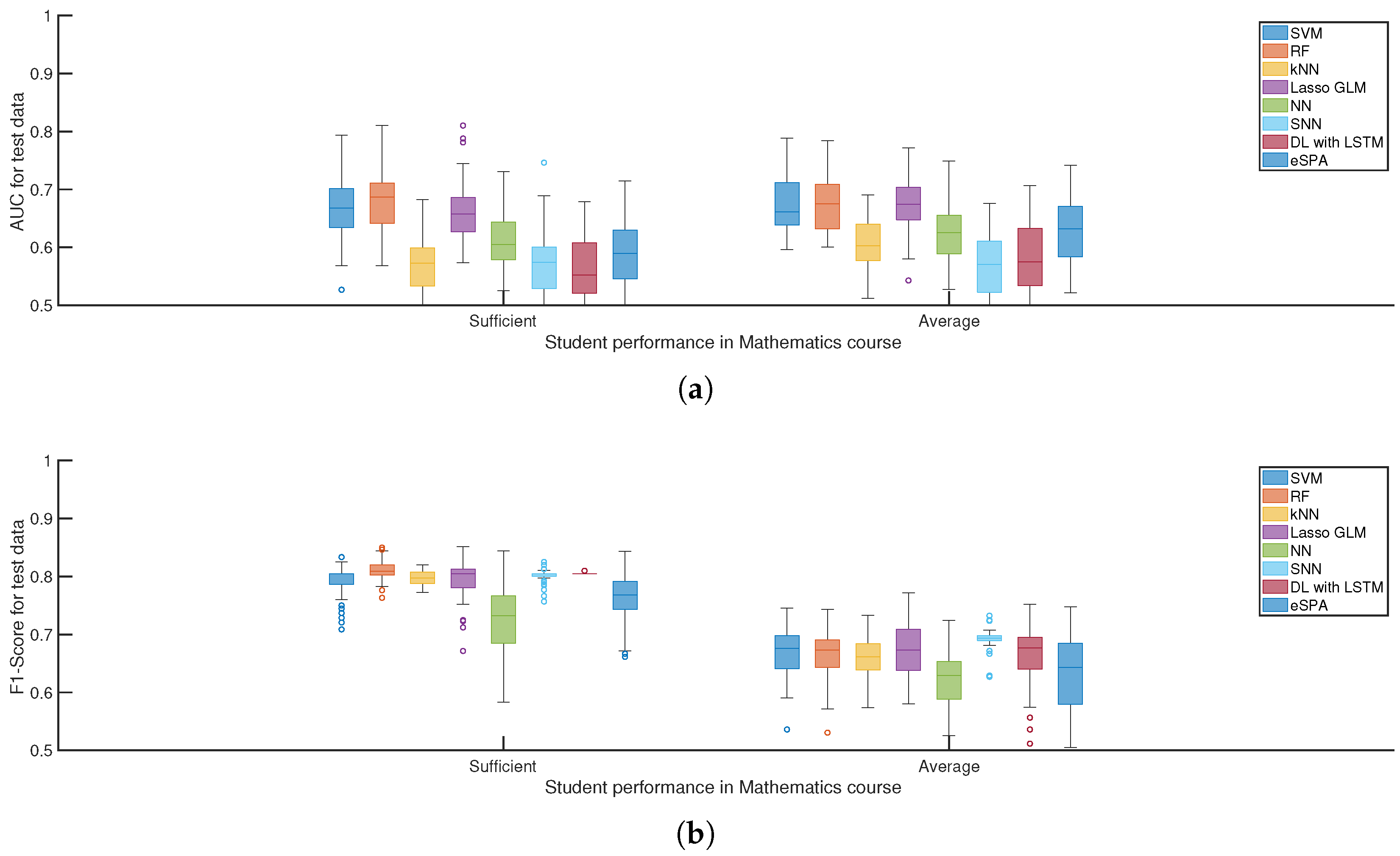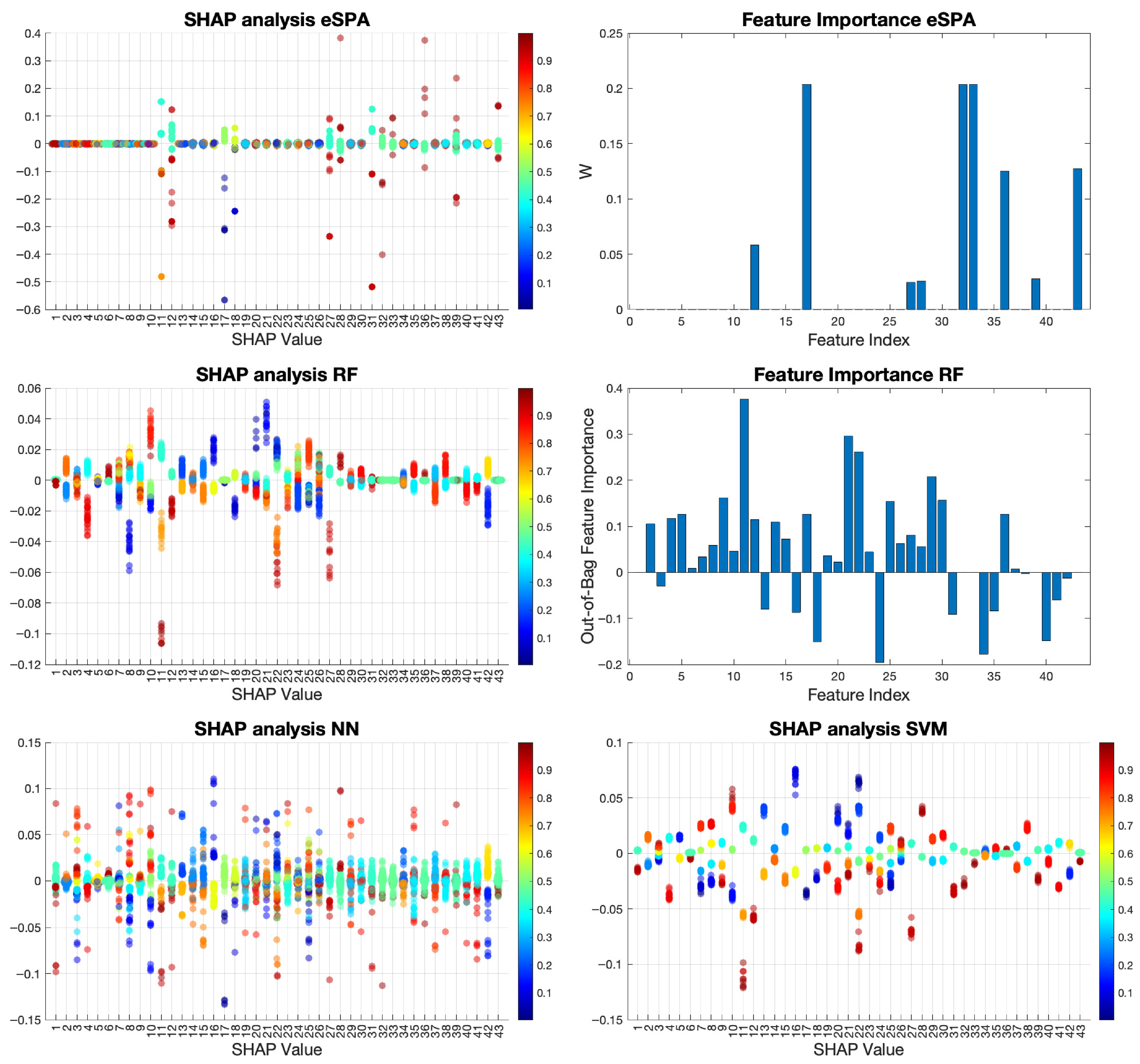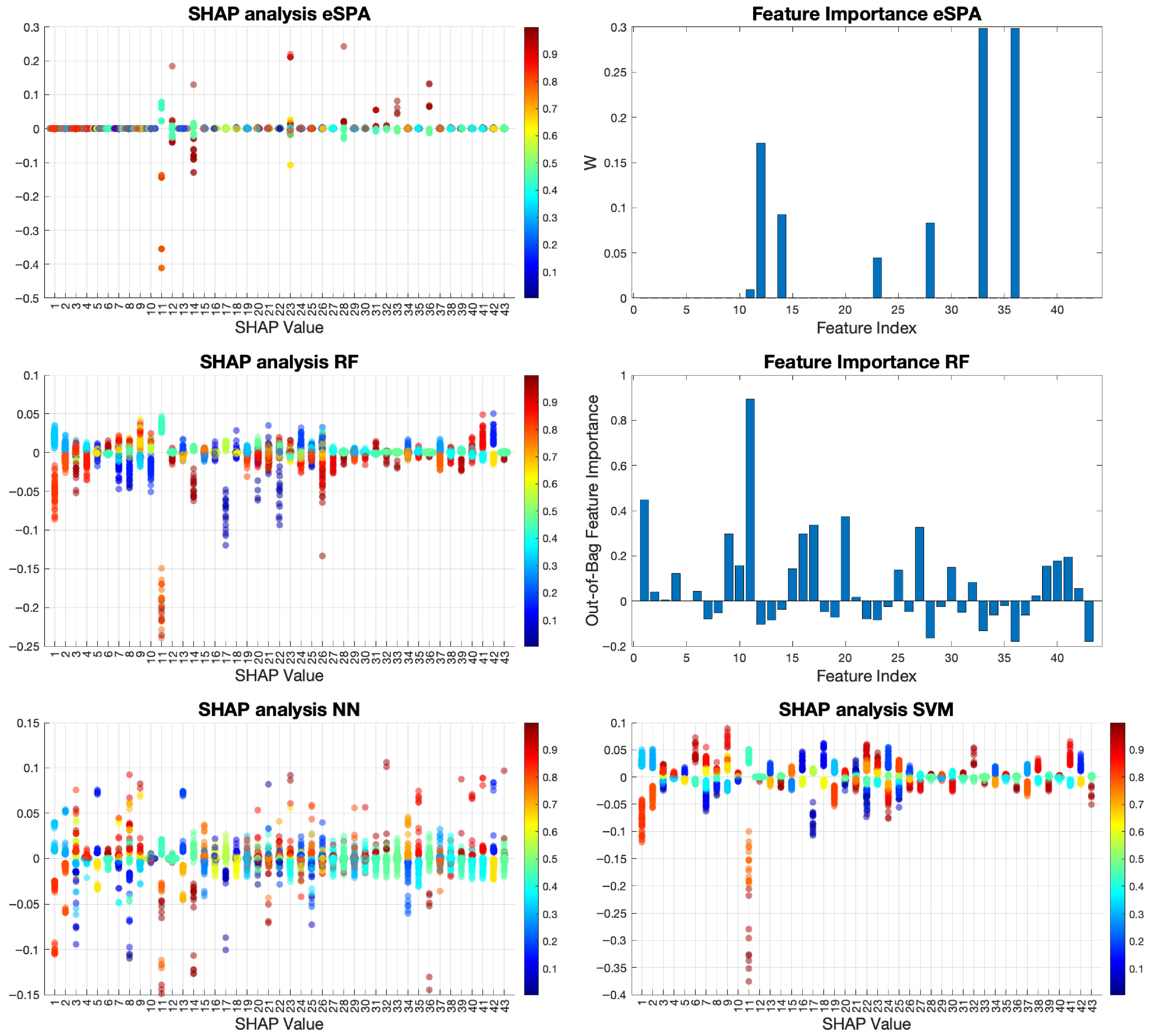

Investigating the Efficacy and Interpretability of ML Classifiers for Student Performance Prediction in the Small-Data Regime

Abstract
1. Introduction
- RQ1.
- How do a broad range of ML models perform in predicting student performance in a secondary education setting under small-data constraints?
- RQ2.
- How do these models differ in terms of interpretability and their ability to identify the most relevant explanatory features without prior dimensionality reduction or specific feature importance assumptions?
- RQ3.
- To what extent do ML models rely on prior grade features, and how does their removal affect predictive performance in a small-data setting?
2. Materials and Methods
2.1. Datasets Description and Preprocessing
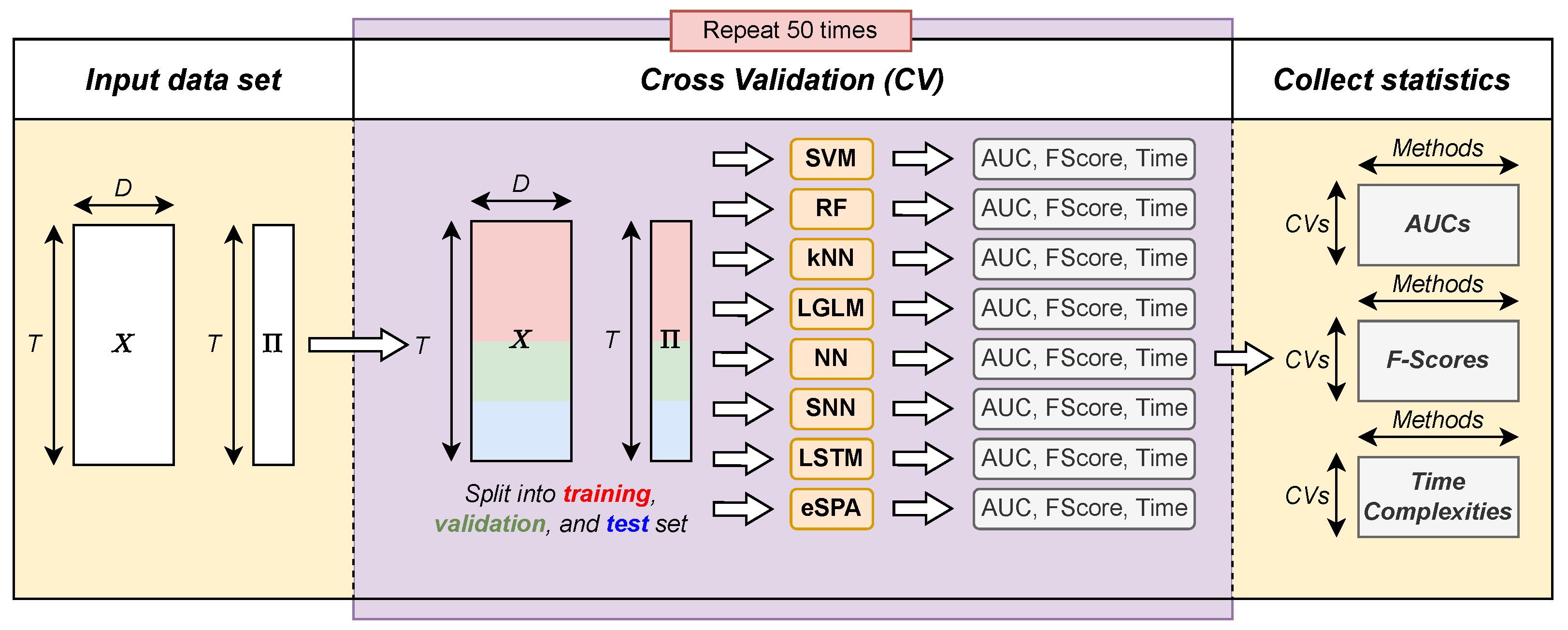
2.2. Benchmark Analysis
2.3. Methods Selection, Hyperparameter Tuning, and Further Implementation Details
2.3.1. Support Vector Machine (SVM)
2.3.2. Random Forest (RF)
2.3.3. k-Nearest Neighbours (kNN)
2.3.4. Lasso Generalized Linear Model (Lasso GLM)
2.3.5. Neural Network (NN)
2.3.6. Shallow Neural Network (SNN)
2.3.7. Deep Learning System with Long Short-Term Memory (DL with LSTM)
2.3.8. Entropic Scalable Probabilistic Approximation Algorithm (eSPA)
2.4. Performance Metrics
2.5. Feature Importance
3. Discussion of the Results
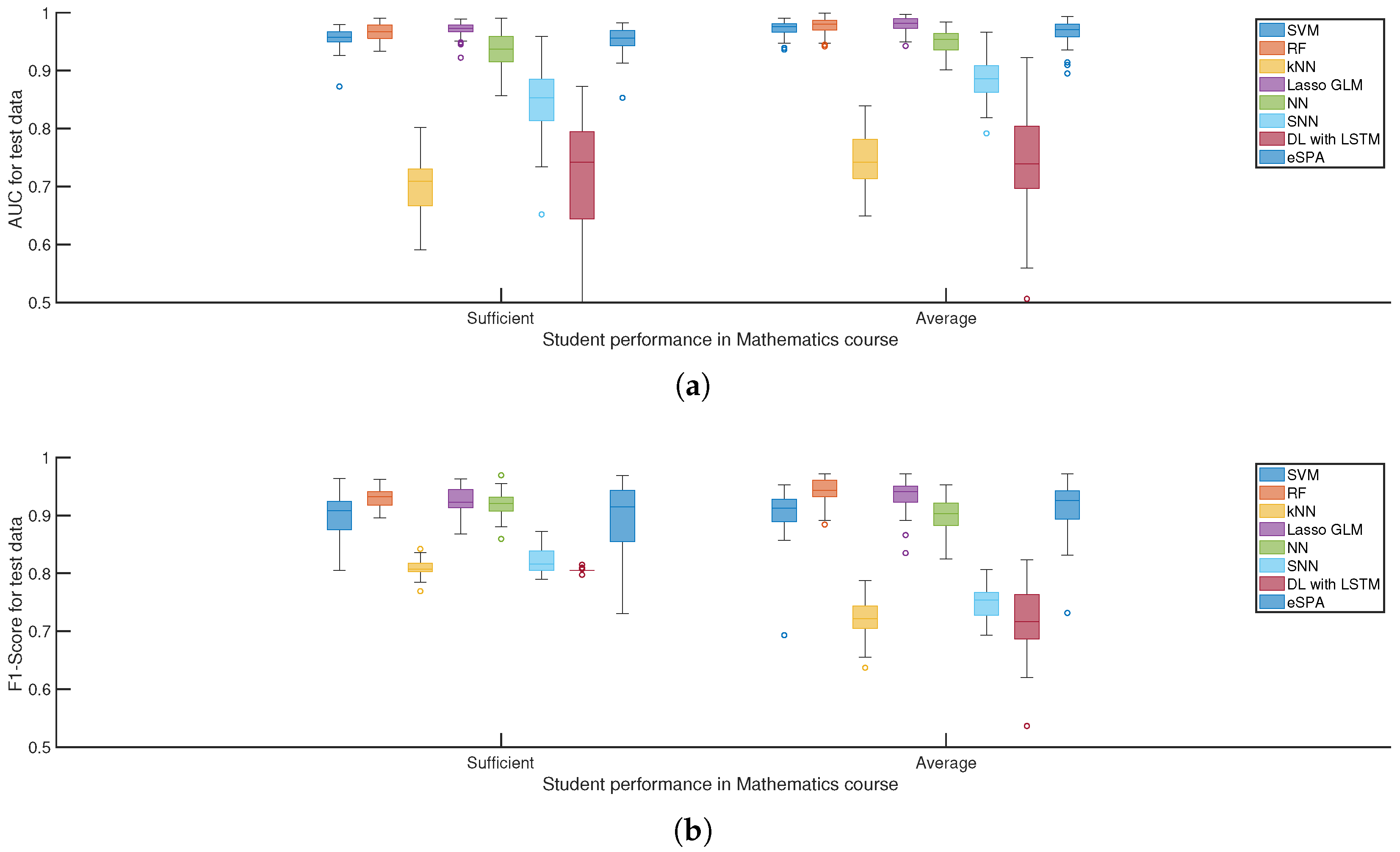
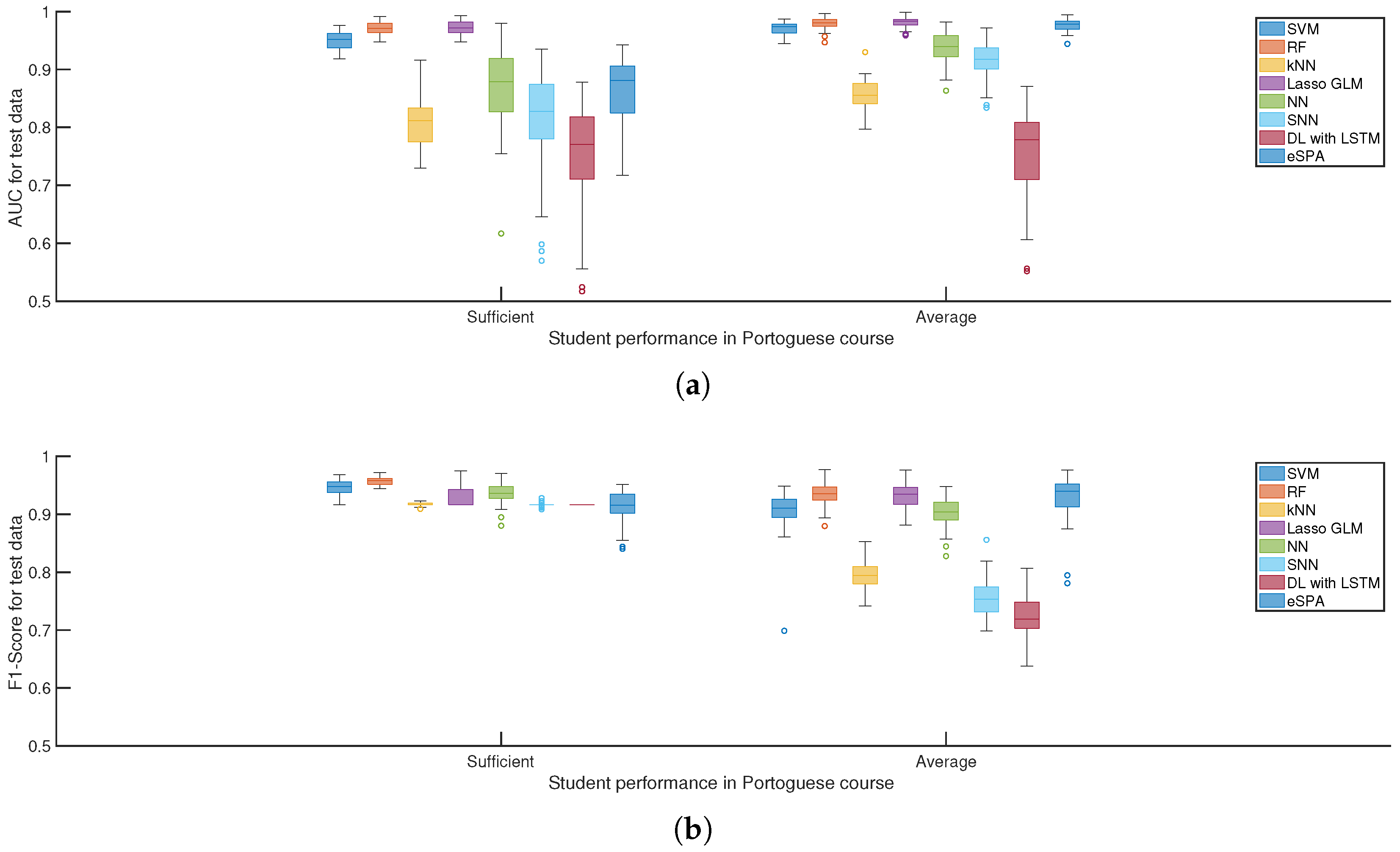
3.1. Evaluation of ML Methods’ Performance
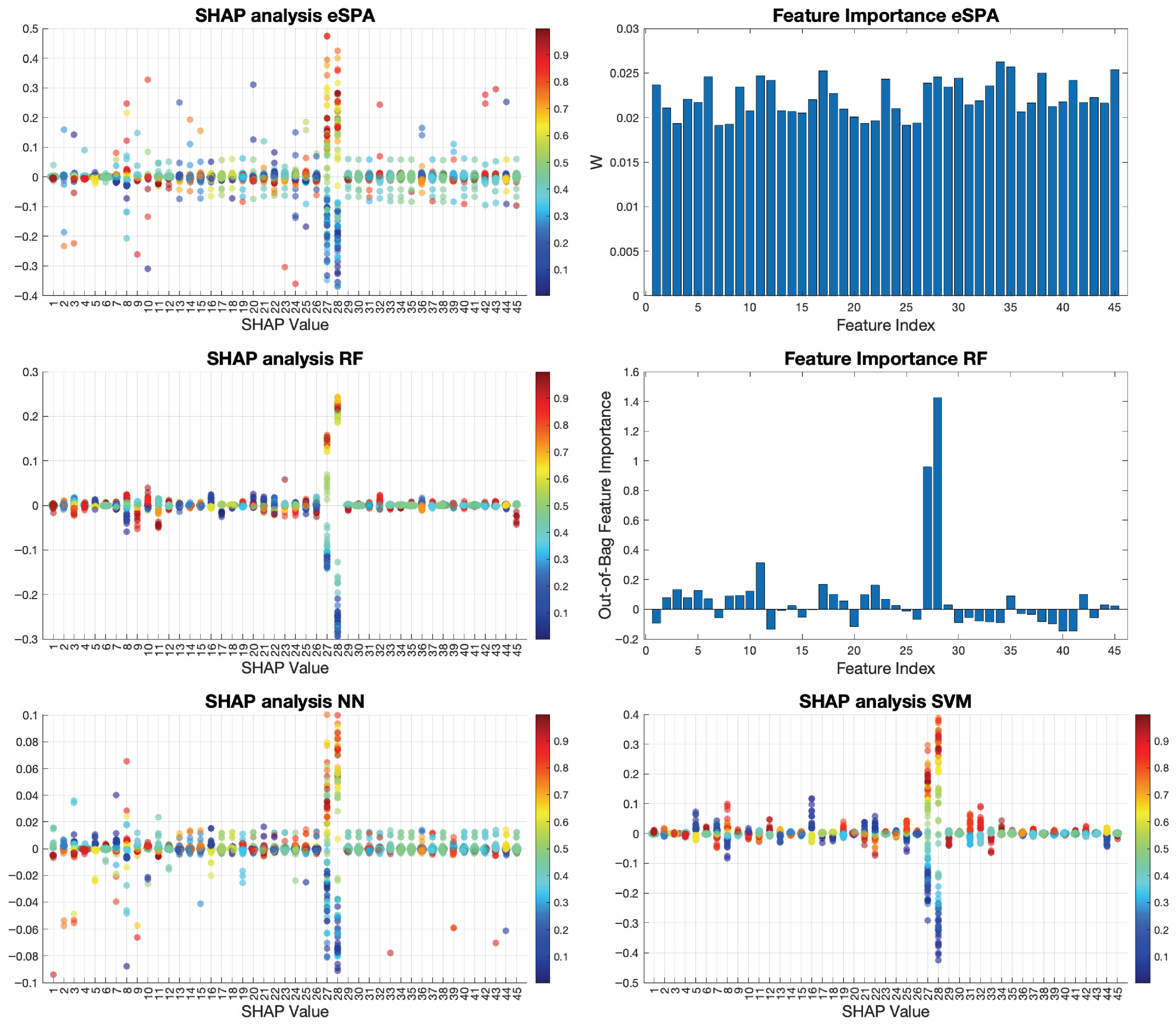
3.2. Feature Importance Analysis
3.3. Additional Experiments on Feature Importance Discrimination
4. Conclusions
Funding
Institutional Review Board Statement
Informed Consent Statement
Data Availability Statement
Conflicts of Interest
Appendix A. Description of Dataset Explanatory Features

| Idx | Idx | Label | Name | Type | Description |
|---|---|---|---|---|---|
| 1 | 1 | school | School | Binary | MS: 1, GP: 0 |
| 2 | 2 | sex | Sex | Binary | Male: 1, Female: 0 |
| 3 | 3 | age | Age | Numerical | |
| 4 | 4 | address | Home address type | Binary | Rural: 1, Urban: 0 |
| 5 | 5 | famSize | Family size | Binary | Size : 1, Size : 0 |
| 6 | 6 | pStatus | Parent’s cohabitation status | Binary | Apart: 1, Together: 0 |
| 7 | 7 | Medu | Mother’s education (Table A2) | Categorical | |
| 8 | 8 | Fedu | Father’s education (Table A2) | Categorical | |
| 9 | 9 | traveltime | Home to school travel time (Table A3) | Categorical | |
| 10 | 10 | studytime | Weekly study time (Table A4) | Categorical | |
| 11 | 11 | failures | Number of past school failures | Numerical | n if , else 4 |
| 12 | 12 | schoolsup | Extra educational school support | Binary | Yes: 1, No: 0 |
| 13 | 13 | famsup | Extra educational family support | Binary | Yes: 1, No: 0 |
| 14 | 14 | paid | Extra paid classes | Binary | Yes: 1, No: 0 |
| 15 | 15 | activities | Extracurricular activities | Binary | Yes: 1, No: 0 |
| 16 | 16 | nursery | Attendance at nursery school | Binary | Yes: 1, No: 0 |
| 17 | 17 | higher | Aim to pursue higher education | Binary | Yes: 1, No: 0 |
| 18 | 18 | internet | Internet access at home | Binary | Yes: 1, No: 0 |
| 19 | 19 | romantic | Romantic relationship | Binary | Yes: 1, No: 0 |
| 20 | 20 | famrel | Quality of family relationship | Numerical | |
| 21 | 21 | freetime | Free time after school | Numerical | |
| 22 | 22 | goout | Going out with friends | Numerical | |
| 23 | 23 | Dalc | Work-day alcohol consumption | Numerical | |
| 24 | 24 | Walc | Week-end alcohol consumption | Numerical | |
| 25 | 25 | health | Current health status | Numerical | |
| 26 | 26 | absences | Number of absences | Numerical | |
| 27 | – | grade_1 | First period grade | Numerical | |
| 28 | – | grade_2 | Second period grade | Numerical | |
| 29 | 27 | Mjob_home | Mother’s job field: At home | Binary | Yes: 1, No: 0 |
| 30 | 28 | Mjob_health | Mother’s job field: Healthcare | Binary | Yes: 1, No: 0 |
| 31 | 29 | Mjob_other | Mother’s job field: Other | Binary | Yes: 1, No: 0 |
| 32 | 30 | Mjob_serv | Mother’s job field: Services | Binary | Yes: 1, No: 0 |
| 33 | 31 | Mjob_teach | Mother’s job field: Teaching | Binary | Yes: 1, No: 0 |
| 34 | 32 | Fjob_home | Father’s job field: At home | Binary | Yes: 1, No: 0 |
| 35 | 33 | Fjob_health | Father’s job field: Healthcare | Binary | Yes: 1, No: 0 |
| 36 | 34 | Fjob_other | Father’s job field: Other | Binary | Yes: 1, No: 0 |
| 37 | 35 | Fjob_serv | Father’s job field: Services | Binary | Yes: 1, No: 0 |
| 38 | 36 | Fjob_teach | Father’s job field: Teaching | Binary | Yes: 1, No: 0 |
| 39 | 37 | reason_course | School choice reason: Course | Binary | Yes: 1, No: 0 |
| 40 | 38 | reason_near | School choice reason: Closeness | Binary | Yes: 1, No: 0 |
| 41 | 39 | reason_rep | School choice reason: Reputation | Binary | Yes: 1, No: 0 |
| 42 | 40 | reason_other | School choice reason: Other | Binary | Yes: 1, No: 0 |
| 43 | 41 | guardian_f | Student’s guardian: Father | Binary | Yes: 1, No: 0 |
| 44 | 42 | guardian_m | Student’s guardian: Mother | Binary | Yes: 1, No: 0 |
| 45 | 43 | guardian_o | Student’s guardian: Other | Binary | Yes: 1, No: 0 |
| Category | Description | |
|---|---|---|
| 0 | None | |
| 1 | Primary education (4th grade) | Basic education |
| 2 | 5th to 9th grade | |
| 3 | Secondary education | |
| 4 | Higher education |
| Category | Description |
|---|---|
| 1 | Less than 15 min |
| 2 | 15 to 30 min |
| 3 | 30 min to 1 h |
| 4 | More than 1 h |
| Category | Description |
|---|---|
| 1 | Less than 2 h |
| 2 | 2 to 5 h |
| 3 | 5 to 10 h |
| 4 | More than 10 h |
| 1 | In ML, we indicate with overfitting the phenomenon by which a model adapts too closely to the training data and then loses the ability to generalize to new unseen data. |
| 2 | In ML applications, we define as a hyperparameter each input variable necessary to tune or modify the algorithm modeling strategy. Usually, hyperparameters cannot be determined a priori, but they need to be inferred from the specific learning domain and from the intrinsic characteristics of the data considered. |
References
- Ackerman, D. S., & Gross, B. L. (2003). Is time pressure all bad? Measuring the relationship between free time availability and student performance and perceptions. Marketing Education Review, 13(2), 21–32. [Google Scholar] [CrossRef]
- Ahmed, W., Wani, M. A., Plawiak, P., Meshoul, S., Mahmoud, A., & Hammad, M. (2025). Machine learning-based academic performance prediction with explainability for enhanced decision-making in educational institutions. Scientific Reports, 15(1), 26879. [Google Scholar] [CrossRef]
- Alamri, R., & Alharbi, B. (2021). Explainable student performance prediction models: A systematic review. IEEE Access, 9, 33132–33143. [Google Scholar] [CrossRef]
- Albreiki, B., Zaki, N., & Alashwal, H. (2021). A systematic literature review of student’ performance prediction using machine learning techniques. Education Sciences, 11(9), 552. [Google Scholar] [CrossRef]
- Althnian, A., AlSaeed, D., Al-Baity, H., Samha, A., Dris, A. B., Alzakari, N., Abou Elwafa, A., & Kurdi, H. (2021). Impact of dataset size on classification performance: An empirical evaluation in the medical domain. Applied Sciences, 11(2), 796. [Google Scholar] [CrossRef]
- Ampofo, E. T., & Osei-Owusu, B. (2015). Students’ academic performance as mediated by students’ academic ambition and effort in the public senior high scjools in Ashanti Mampong Municipality of Ghana. International Journal of Academic Research and Reflection, 3(5), 19–35. [Google Scholar]
- Arsad, P. M., Buniyamin, N., & Manan, J.-l. A. (2013, November 25–27). A neural network students’ performance prediction model (NNSPPM). 2013 IEEE International Conference on Smart Instrumentation, Measurement and Applications (ICSIMA) (pp. 1–5), Kuala Lumpur, Malaysia. [Google Scholar] [CrossRef]
- Awan, A. G., & Kauser, D. (2015). Impact of educated mother on academic achievement of her children: A case study of District Lodhran-Pakistan. Journal of Literature, Languages and Linguistics, 12(2), 57–65. [Google Scholar]
- Balsa, A. I., Giuliano, L. M., & French, M. T. (2011). The effects of alcohol use on academic achievement in high school. Economics of Education Review, 30(1), 1–15. [Google Scholar] [CrossRef] [PubMed]
- Bernstein, B. (2006). Vertical and horizontal discourse: An essay. In Education and society (pp. 53–73). Routledge. [Google Scholar]
- Bianchini, M., & Scarselli, F. (2014). On the complexity of neural network classifiers: A comparison between shallow and deep architectures. IEEE Transactions on Neural Networks and Learning Systems, 25(8), 1553–1565. [Google Scholar] [CrossRef]
- Bo, D., Hwangbo, H., Sharma, V., Arndt, C., & TerMaath, S. (2023). A randomized subspace-based approach for dimensionality reduction and important variable selection. Journal of Machine Learning Research, 24(76), 1–31. [Google Scholar]
- Bolikulov, F., Nasimov, R., Rashidov, A., Akhmedov, F., & Young-Im, C. (2024). Effective methods of categorical data encoding for artificial intelligence algorithms. Mathematics, 12(16), 2553. [Google Scholar] [CrossRef]
- Bolu-steve, F., & Sanni, W. (2013). Influence of family background on the academic performance of secondary school students in Nigeria. IFE PsychologIA: An International Journal, 21(1), 90–100. Available online: https://hdl.handle.net/10520/EJC150670 (accessed on 19 November 2025).
- Breiman, L. (2001). Random forests. Machine Learning, 45, 5–32. [Google Scholar] [CrossRef]
- Camacho-Miñano, M.-d.-M., del Campo, C., Urquía-Grande, E., Pascual-Ezama, D., Akpinar, M., & Rivero, C. (2020). Solving the mystery about the factors conditioning higher education students’ assessment: Finland versus Spain. Education+ Training, 62(6), 617–630. [Google Scholar] [CrossRef]
- Colak Oz, H., Güven, Ç., & Nápoles, G. (2023). School dropout prediction and feature importance exploration in Malawi using household panel data: Machine learning approach. Journal of Computational Social Science, 6(1), 245–287. [Google Scholar] [CrossRef]
- Cortez, P. (2014). Student performance. UCI Machine Learning Repository. [Google Scholar] [CrossRef]
- Daud, A., Aljohani, N. R., Abbasi, R. A., Lytras, M. D., Abbas, F., & Alowibdi, J. S. (2017). Predicting student performance using advanced learning analytics. In Proceedings of the 26th international conference on world wide web companion (pp. 415–421). Republic and Canton of Geneva, CHE: International World Wide Web Conferences Steering Committee. [Google Scholar] [CrossRef]
- Espinosa, E., & Figueira, A. (2023). On the quality of synthetic generated tabular data. Mathematics, 11(15), 3278. [Google Scholar] [CrossRef]
- Fadelelmoula, T., & Colleges, R. S. A. A. (2018). The impact of class attendance on student performance. International Research Journal of Medicine and Medical Sciences, 6(2), 47–49. [Google Scholar] [CrossRef]
- Fernández-Delgado, M., Cernadas, E., Barro, S., & Amorim, D. (2014). Do we need hundreds of classifiers to solve real world classification problems? The Journal of Machine Learning Research, 15(1), 3133–3181. [Google Scholar]
- Gajwani, J., & Chakraborty, P. (2021). Students’ performance prediction using feature selection and supervised machine learning algorithms. In D. Gupta, A. Khanna, S. Bhattacharyya, A. E. Hassanien, S. Anand, & A. Jaiswal (Eds.), International conference on innovative computing and communications (pp. 347–354). Springer Singapore. [Google Scholar] [CrossRef]
- Gracia, A., González, S., Robles, V., & Menasalvas, E. (2014). A methodology to compare dimensionality reduction algorithms in terms of loss of quality. Information Sciences, 270, 1–27. [Google Scholar] [CrossRef]
- Grandini, M., Bagli, E., & Visani, G. (2020). Metrics for multi-class classification: An overview. arXiv, arXiv:2008.05756. [Google Scholar] [CrossRef]
- Grinsztajn, L., Oyallon, E., & Varoquaux, G. (2022). Why do tree-based models still outperform deep learning on typical tabular data? Advances in Neural Information Processing Systems, 35, 507–520. [Google Scholar]
- Guleria, P., & Sood, M. (2023). Explainable AI and machine learning: Performance evaluation and explainability of classifiers on educational data mining inspired career counseling. Education and Information Technologies, 28(1), 1081–1116. [Google Scholar] [CrossRef] [PubMed]
- Gunasekara, S., & Saarela, M. (2025). Explainable AI in education: Techniques and qualitative assessment. Applied Sciences, 15(3), 1239. [Google Scholar] [CrossRef]
- Ha, W., Ma, L., Cao, Y., Feng, Q., & Bu, S. (2024). The effects of class attendance on academic performance: Evidence from synchronous courses during COVID-19 at a Chinese research university. International Journal of Educational Development, 104, 102952. [Google Scholar] [CrossRef]
- Hancock, J. T., & Khoshgoftaar, T. M. (2020). Survey on categorical data for neural networks. Journal of Big Data, 7(1), 28. [Google Scholar] [CrossRef]
- Hegde, V., & Prageeth, P. P. (2018, January 19–20). Higher education student dropout prediction and analysis through educational data mining. 2018 2nd International Conference on Inventive Systems and Control (ICISC) (pp. 694–699), Coimbatore, India. [Google Scholar] [CrossRef]
- Hochreiter, S., & Schmidhuber, J. (1997). Long short-term memory. Neural Computation, 9(8), 1735–1780. [Google Scholar] [CrossRef] [PubMed]
- Horenko, I. (2020). On a scalable entropic breaching of the overfitting barrier for small data problems in machine learning. Neural Computation, 32(8), 1563–1579. [Google Scholar] [CrossRef]
- Hotelling, H. (1936). Relations between two sets of variates. Biometrika, 28(3/4), 321–377. [Google Scholar] [CrossRef]
- Isaacs, S. (2006). The educational value of the nursery school. Early Years Education: Major Themes in Education, 1, 134. [Google Scholar]
- James, G., Witten, D., Hastie, T., & Tibshirani, R. (2013). An introduction to statistical learning (Vol. 112). Springer. [Google Scholar] [CrossRef]
- Kabakchieva, D. (2013). Predicting student performance by using data mining methods for classification. Cybernetics and Information Technologies, 13(1), 61–72. [Google Scholar] [CrossRef]
- Kesgin, K., Kiraz, S., Kosunalp, S., & Stoycheva, B. (2025). Beyond performance: Explaining and ensuring fairness in student academic performance prediction with machine learning. Applied Sciences, 15(15), 8409. [Google Scholar] [CrossRef]
- Kobak, D., & Berens, P. (2019). The art of using t-SNE for single-cell transcriptomics. Nature Communications, 10(1), 5416. [Google Scholar] [CrossRef] [PubMed]
- Kobak, D., & Linderman, G. C. (2021). Initialization is critical for preserving global data structure in both t-SNE and UMAP. Nature Biotechnology, 39(2), 156–157. [Google Scholar] [CrossRef] [PubMed]
- Kushik, N., Yevtushenko, N., & Evtushenko, T. (2020). Novel machine learning technique for predicting teaching strategy effectiveness. International Journal of Information Management, 53, 101488. [Google Scholar] [CrossRef]
- Li, M., Huang, C., Wang, D., Hu, Q., Zhu, J., & Tang, Y. (2019). Improved randomized learning algorithms for imbalanced and noisy educational data classification. Computing, 101(6), 571–585. [Google Scholar] [CrossRef]
- Li, Z., & Qiu, Z. (2018). How does family background affect children’s educational achievement? Evidence from Contemporary China. The Journal of Chinese Sociology, 5(1), 1–21. [Google Scholar] [CrossRef]
- Lin, Y., Chen, H., Xia, W., Lin, F., Wang, Z., & Liu, Y. (2025). A comprehensive survey on deep learning techniques in educational data mining. Data Science and Engineering, 10(4), 564–590. [Google Scholar] [CrossRef]
- Liu, X.-Y., Wu, J., & Zhou, Z.-H. (2009). Exploratory undersampling for class-imbalance learning. IEEE Transactions on Systems, Man, and Cybernetics, Part B (Cybernetics), 39(2), 539–550. [Google Scholar] [CrossRef]
- Lundberg, S. M., & Lee, S.-I. (2017). A unified approach to interpreting model predictions. In Proceedings of the 31st international conference on neural information processing systems, Long Beach, CA, USA, December 4–9 (pp. 4768–4777). Curran Associates Inc. [Google Scholar]
- Machado, P., Fernandes, B., & Novais, P. (2022, November 24–26). Benchmarking data augmentation techniques for tabular data. International Conference on Intelligent Data Engineering and Automated Learning (pp. 104–112), Manchester, UK. [Google Scholar]
- Maniaci, G., La Cascia, C., Giammanco, A., Ferraro, L., Palummo, A., Saia, G. F., Pinetti, G., Zarbo, M., & La Barbera, D. (2023). The impact of healthy lifestyles on academic achievement among Italian adolescents. Current Psychology, 42(6), 5055–5061. [Google Scholar]
- Mathew, R. M., & Gunasundari, R. (2021, March 4–5). A review on handling multiclass imbalanced data classification in education domain. 2021 International Conference on Advance Computing and Innovative Technologies in Engineering (ICACITE) (pp. 752–755), Greater Noida, India. [Google Scholar]
- McGowan, R. J., & Johnson, D. L. (1984). The mother-child relationship and other antecedents of academic performance: A causal analysis. Hispanic Journal of Behavioral Sciences, 6(3), 205–224. [Google Scholar] [CrossRef]
- Miletic, M., & Sariyar, M. (2024). Challenges of using synthetic data generation methods for tabular microdata. Applied Sciences, 14(14), 5975. [Google Scholar] [CrossRef]
- Minaei-Bidgoli, B., Kashy, D., Kortemeyer, G., & Punch, W. (2003, November 5–8). Predicting student performance: An application of data mining methods with an educational Web-based system. 33rd Annual Frontiers in Education, 2003, FIE 2003 (Vol. 1, p. T2A-13), Westminster, CO, USA. [Google Scholar] [CrossRef]
- Mohammad, A. S., Al-Kaltakchi, M. T., Alshehabi Al-Ani, J., & Chambers, J. A. (2023). Comprehensive evaluations of student performance estimation via machine learning. Mathematics, 11(14), 3153. [Google Scholar] [CrossRef]
- Mohammed, R., Rawashdeh, J., & Abdullah, M. (2020, April 7–9). Machine learning with oversampling and undersampling techniques: Overview study and experimental results. 2020 11th International Conference on Information and Communication Systems (ICICS) (pp. 243–248), Irbid, Jordan. [Google Scholar] [CrossRef]
- Molnar, C. (2020). Interpretable machine learning. Lulu.com. [Google Scholar]
- Motrenko, A., Strijov, V., & Weber, G.-W. (2014). Sample size determination for logistic regression. Journal of Computational and Applied Mathematics, 255, 743–752. [Google Scholar] [CrossRef]
- Nachouki, M., Mohamed, E. A., Mehdi, R., & Abou Naaj, M. (2023). Student course grade prediction using the random forest algorithm: Analysis of predictors’ importance. Trends in Neuroscience and Education, 33, 100214. [Google Scholar] [CrossRef]
- Niu, T., Liu, T., Luo, Y. T., Pang, P. C.-I., Huang, S., & Xiang, A. (2025). Decoding student cognitive abilities: A comparative study of explainable AI algorithms in educational data mining. Scientific Reports, 15(1), 26862. [Google Scholar] [CrossRef] [PubMed]
- Nnadi, L. C., Watanobe, Y., Rahman, M. M., & John-Otumu, A. M. (2024). Prediction of students’ adaptability using explainable AI in educational machine learning models. Applied Sciences, 14(12), 5141. [Google Scholar] [CrossRef]
- Noble, W. S. (2006). What is a support vector machine? Nature biotechnology, 24(12), 1565–1567. [Google Scholar] [CrossRef]
- Osmanbegovic, E., & Suljic, M. (2012). Data mining approach for predicting student performance. Economic Review: Journal of Economics and Business, 10(1), 3–12. [Google Scholar]
- Pallathadka, H., Sonia, B., Sanchez, D. T., De Vera, J. V., Godinez, J. A. T., & Pepito, M. T. (2022). Investigating the impact of artificial intelligence in education sector by predicting student performance. Materials Today: Proceedings, 51, 2264–2267. [Google Scholar] [CrossRef]
- Pallathadka, H., Wenda, A., Ramirez-Asís, E., Asís-López, M., Flores-Albornoz, J., & Phasinam, K. (2023). Classification and prediction of student performance data using various machine learning algorithms. Materials Today: Proceedings, 80, 3782–3785. [Google Scholar] [CrossRef]
- Rastrollo-Guerrero, J. L., Gómez-Pulido, J. A., & Durán-Domínguez, A. (2020). Analyzing and predicting students’ performance by means of machine learning: A review. Applied Sciences, 10(3), 1042. [Google Scholar] [CrossRef]
- Ribeiro, M. T., Singh, S., & Guestrin, C. (2016, August 13–17). “Why should i trust you?” Explaining the predictions of any classifier. Proceedings of the 22nd ACM Sigkdd International Conference on Knowledge Discovery and Data Mining (pp. 1135–1144), San Francisco, CA, USA. [Google Scholar]
- Roy, K., Nguyen, H.-H., & Farid, D. M. (2023). Impact of dimensionality reduction techniques on student performance prediction using machine learning. CTU Journal of Innovation and Sustainable Development, 15, 93–101. [Google Scholar] [CrossRef]
- Shrestha, S., & Pokharel, M. (2019, November 5). Machine Learning algorithm in educational data. 2019 Artificial Intelligence for Transforming Business and Society (AITB) (Vol. 1, pp. 1–11), Kathmandu, Nepal. [Google Scholar] [CrossRef]
- Shwartz-Ziv, R., & Armon, A. (2022). Tabular data: Deep learning is not all you need. Information Fusion, 81, 84–90. [Google Scholar] [CrossRef]
- Sirin, S. R. (2005). Socioeconomic status and academic achievement: A meta-analytic review of research. Review of Educational Research, 75(3), 417–453. [Google Scholar] [CrossRef]
- Steinbach, M., & Tan, P.-N. (2009). kNN: K-nearest neighbors. In The top ten algorithms in data mining (pp. 151–162). Chapman and Hall/CRC. [Google Scholar] [CrossRef]
- Sweeney, M., Lester, J., & Rangwala, H. (2015, October 29–November 1). Next-term student grade prediction. 2015 IEEE International Conference on Big Data (Big Data) (pp. 970–975), Santa Clara, CA, USA. [Google Scholar] [CrossRef]
- Taras, H. (2005). Physical activity and student performance at school. Journal of School Health, 75(6), 214–218. [Google Scholar] [CrossRef]
- Thammasiri, D., Delen, D., Meesad, P., & Kasap, N. (2014). A critical assessment of imbalanced class distribution problem: The case of predicting freshmen student attrition. Expert Systems with Applications, 41(2), 321–330. [Google Scholar] [CrossRef]
- Van der Maaten, L., & Hinton, G. (2008). Visualizing data using t-SNE. Journal of Machine Learning Research, 9(86), 2579–2605. [Google Scholar]
- Vecchi, E., Bassetti, D., Graziato, F., Pospíšil, L., & Horenko, I. (2024a). Gauge-optimal approximate learning for small data classification. Neural Computation, 36(6), 1198–1227. [Google Scholar] [CrossRef]
- Vecchi, E., Berra, G., Albrecht, S., Gagliardini, P., & Horenko, I. (2023). Entropic approximate learning for financial decision-making in the small data regime. Research in International Business and Finance, 65, 101958. [Google Scholar] [CrossRef]
- Vecchi, E., Kardoš, J., Lechekhab, M., Wächter, A., Horenko, I., & Schenk, O. (2024b). Structure-exploiting interior-point solver for high-dimensional entropy-sparsified regression learning. Journal of Computational Science, 76, 102208. [Google Scholar] [CrossRef]
- Vecchi, E., Pospíšil, L., Albrecht, S., O’Kane, T. J., & Horenko, I. (2022). eSPA+: Scalable entropy-optimal machine learning classification for small data problems. Neural Computation, 34(5), 1220–1255. [Google Scholar] [CrossRef]
- Villegas, W., Guevara-Reyes, R., Ortiz-Garcés, I., Andrade, R., & Cox-Riquetti, F. (2025). Machine learning models for academic performance prediction: Interpretability and application in educational decision-making. Frontiers in Education, 10, 1632315. [Google Scholar] [CrossRef]
- Wen, X., & Juan, H. (2023). Early prediction of students’ performance using a deep neural network based on online learning activity sequence. Applied Sciences, 13(15), 8933. [Google Scholar] [CrossRef]
- Wongvorachan, T., He, S., & Bulut, O. (2023). A comparison of undersampling, oversampling, and SMOTE methods for dealing with imbalanced classification in educational data mining. Information, 14(1), 54. [Google Scholar] [CrossRef]
- Wu, J., Zhang, J., & Wang, C. (2023). Student performance, peer effects, and friend networks: Evidence from a randomized peer intervention. American Economic Journal: Economic Policy, 15(1), 510–542. [Google Scholar] [CrossRef]
- Wu, Y.-c., & Feng, J.-w. (2018). Development and application of artificial neural network. Wireless Personal Communications, 102, 1645–1656. [Google Scholar] [CrossRef]
- Ying, X. (2019). An overview of overfitting and its solutions. Journal of Physics: Conference Series, 1168(2), 022022. [Google Scholar] [CrossRef]
- Yılmaz, N., & Sekeroglu, B. (2020). Student performance classification using artificial Intelligence techniques. In R. A. Aliev, J. Kacprzyk, W. Pedrycz, M. Jamshidi, M. B. Babanli, & F. M. Sadikoglu (Eds.), 10th international conference on theory and application of soft computing, computing with words and perceptions—ICSCCW-2019 (pp. 596–603). Springer International Publishing. [Google Scholar] [CrossRef]
- Yousafzai, B. K., Hayat, M., & Afzal, S. (2020). Application of machine learning and data mining in predicting the performance of intermediate and secondary education level student. Education and Information Technologies, 25(6), 4677–4697. [Google Scholar] [CrossRef]
- Zhang, X., Xue, R., Liu, B., Lu, W., & Zhang, Y. (2018, July 28–30). Grade prediction of student academic performance with multiple classification models. 2018 14th International Conference on Natural Computation, Fuzzy Systems and Knowledge Discovery (ICNC-FSKD) (pp. 1086–1090), Huangshan, China. [Google Scholar] [CrossRef]
- Zohair, A., & Mahmoud, L. (2019). Prediction of student’s performance by modelling small dataset size. International Journal of Educational Technology in Higher Education, 16(1), 27. [Google Scholar] [CrossRef]


| Course | Grade Threshold | Class Distribution | |
|---|---|---|---|
| Class 0 | Class 1 | ||
| Mathematics | Sufficient | 129 (32.74%) | 265 (67.26%) |
| Average | 185 (46.95%) | 209 (53.05%) | |
| Portuguese | Sufficient | 100 (15.41%) | 549 (84.59%) |
| Average | 301 (46.38%) | 348 (53.62%) | |
| Method | Mathematics | Portuguese | ||
|---|---|---|---|---|
| Average | Sufficient | Average | Sufficient | |
| SVM | 0.0040 ± 0.0002 | 0.0045 ± 0.0003 | 0.0053 ± 0.0004 | 0.0067 ± 0.0007 |
| RF | 0.4385 ± 0.1050 | 0.5293 ± 0.1144 | 0.5255 ± 0.1065 | 0.4700 ± 0.0974 |
| kNN | 0.0028 ± 0.0002 | 0.0059 ± 0.0025 | 0.0043 ± 0.0004 | 0.0039 ± 0.0003 |
| Lasso GLM | 2.2828 ± 0.6870 | 4.2894 ± 1.0392 | 5.1766 ± 1.6717 | 5.5041 ± 1.9936 |
| NN | 0.0753 ± 0.0205 | 0.0455 ± 0.3539 | 0.1580 ± 0.0440 | 0.2524 ± 0.0859 |
| SNN | 0.3073 ± 0.0329 | 0.0108 ± 0.0397 | 0.4348 ± 0.0303 | 0.3863 ± 0.0325 |
| DL (LSTM) | 0.8366 ± 0.1675 | 0.9001 ± 0.1334 | 0.8847 ± 0.1122 | 1.4121 ± 0.2109 |
| eSPA | 0.0002 ± 0.0001 | 0.0002 ± 0.0001 | 0.0003 ± 0.0001 | 0.0003 ± 0.0001 |
| Sufficient Grade | ||||
| Rank | eSPA (*) | RF | NN | SVM |
| 1 | grade_2 | grade_2 | grade_2 | grade_2 |
| 2 | grade_1 | grade_1 | grade_1 | grade_1 |
| 3 | traveltime | failures | Walc | failures |
| 4 | failures | nursery | failures | school |
| 5 | schoolsup | school | school | higher |
| Average Grade | ||||
| Rank | eSPA | RF | NN | SVM |
| 1 | grade_2 | grade_2 | grade_2 | grade_2 |
| 2 | – | grade_1 | grade_1 | grade_1 |
| 3 | – | higher | health | failures |
| 4 | – | failures | failures | paid |
| 5 | – | goout | Pstatus | health |
Disclaimer/Publisher’s Note: The statements, opinions and data contained in all publications are solely those of the individual author(s) and contributor(s) and not of MDPI and/or the editor(s). MDPI and/or the editor(s) disclaim responsibility for any injury to people or property resulting from any ideas, methods, instructions or products referred to in the content. |
© 2026 by the author. Licensee MDPI, Basel, Switzerland. This article is an open access article distributed under the terms and conditions of the Creative Commons Attribution (CC BY) license.
Share and Cite
Vecchi, E. Investigating the Efficacy and Interpretability of ML Classifiers for Student Performance Prediction in the Small-Data Regime. Educ. Sci. 2026, 16, 149. https://doi.org/10.3390/educsci16010149
Vecchi E. Investigating the Efficacy and Interpretability of ML Classifiers for Student Performance Prediction in the Small-Data Regime. Education Sciences. 2026; 16(1):149. https://doi.org/10.3390/educsci16010149
Chicago/Turabian StyleVecchi, Edoardo. 2026. "Investigating the Efficacy and Interpretability of ML Classifiers for Student Performance Prediction in the Small-Data Regime" Education Sciences 16, no. 1: 149. https://doi.org/10.3390/educsci16010149
APA StyleVecchi, E. (2026). Investigating the Efficacy and Interpretability of ML Classifiers for Student Performance Prediction in the Small-Data Regime. Education Sciences, 16(1), 149. https://doi.org/10.3390/educsci16010149