
Six Institutional Intervention Areas to Support Ethical and Effective Student Use of Generative AI in Higher Education: A Narrative Review

 ,
,  ,
, 
 and
and
Abstract
1. Introduction
- To systematically review and synthesise relevant literature, identify and code key concepts related to AI interventions, organise these codes into sub-themes and overarching themes, develop a comprehensive intervention framework grounded in these themes.
- To provide actionable recommendations for educators and academic institutions aiming to support student learning through ethical and effective AI use.
2. Current State of Research on Generative AI in Higher Education
2.1. Uniqueness of the Current Review
2.2. What Is Ethical Use of Generative AI in Education?
2.3. What Is Effective Use of Generative AI in Education?
3. Review Methodology
3.1. Phase 1—Mapping the Field Through a Scoping Review
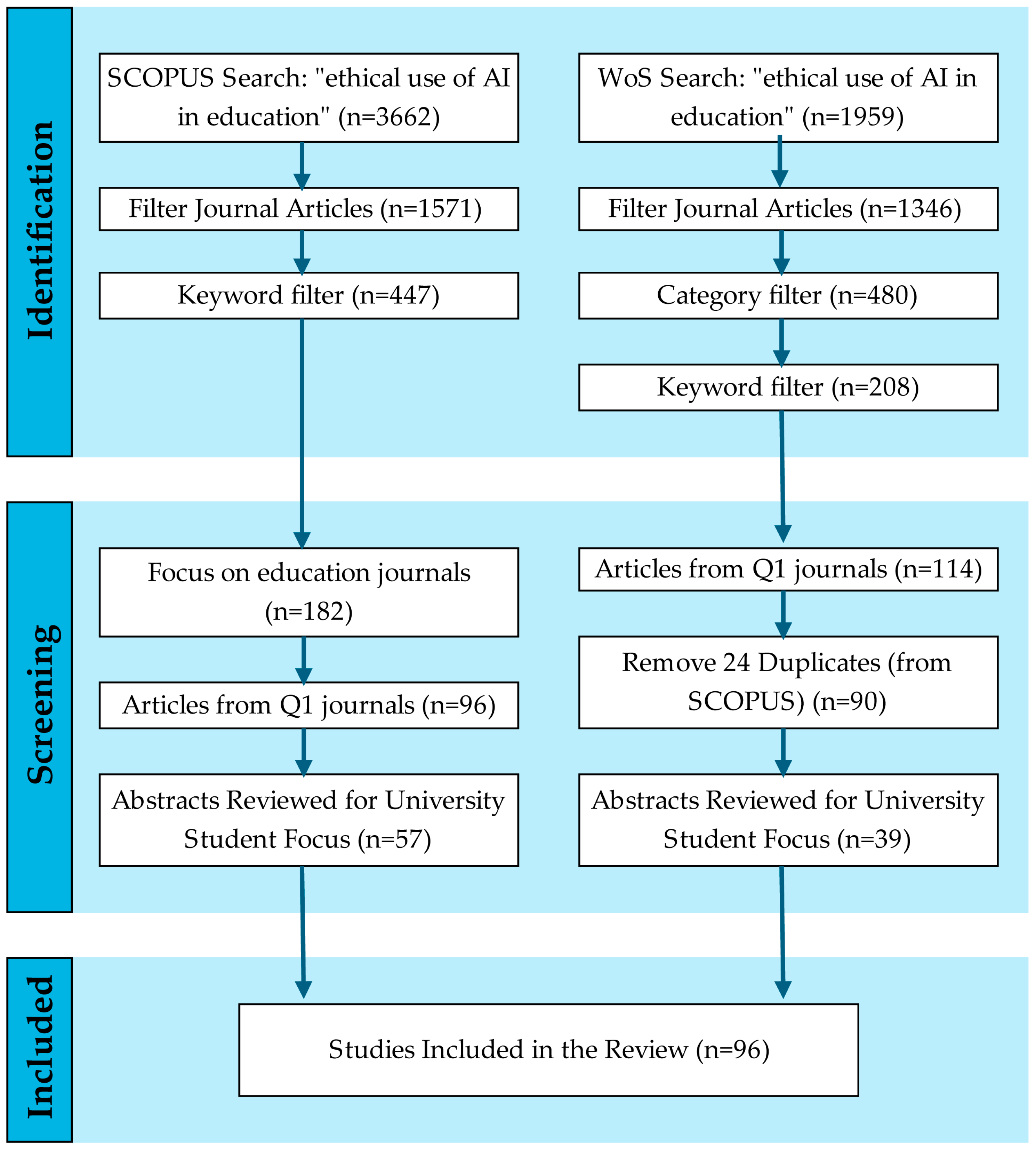
3.2. Phase 2—Comprehensive Search
3.3. Phase 3—Quality Assessment
3.4. Phase 4—Data Extraction
3.5. Phase 5 and 6—Data Synthesis and Write-Up

| Characteristic | Inclusion Criteria |
|---|---|
| Publication medium | Peer-reviewed journal articles, Q1-ranked (SCImago Journal Rank) |
| Languages | English |
| Period | From 2023 to 2025 |
| Research design | Conceptual, empirical (quantitative, qualitative, and mixed-methods), and systematic reviews |
| Content | Studies focusing on ethical and effective use of generative AI in higher education, specifically addressing university students and including student-focused or pedagogical interventions |
| Source | Scopus and Web of Science databases |
4. Findings
4.1. Overview of the Included Articles
4.2. Curriculum Integration Interventions
4.3. Policy and Governance Interventions
4.4. Faculty Development and Support
4.5. Student-Centred Interventions
4.6. Assessment Adaptation Interventions
4.7. Technology and Infrastructure Interventions
5. Discussion
5.1. Theoretical Implications
5.2. Practical Implications
5.3. Limitations of the Study and Suggestions for Future Research
6. Conclusions
Author Contributions
Funding
Institutional Review Board Statement
Informed Consent Statement
Data Availability Statement
Conflicts of Interest
References
- Abduljawad, S. A. (2024). Investigating the impact of ChatGPT as an AI tool on ESL writing: Prospects and challenges in Saudi Arabian higher education. International Journal of Computer-Assisted Language Learning and Teaching, 14(1), 1–19. [Google Scholar] [CrossRef]
- Acosta-Enriquez, B. G., Ballesteros, M. A. A., Vargas, C. G. A. P., Ulloa, M. N. O., Ulloa, C. R. G., Romero, J. M. P., Jaramillo, N. D. G., Orellana, H. U. C., Anzoátegui, D. X. A., & Roca, C. L. (2024a). Knowledge, attitudes, and perceived ethics regarding the use of ChatGPT among generation Z university students. International Journal for Educational Integrity, 20(1), 10. [Google Scholar] [CrossRef]
- Acosta-Enriquez, B. G., Vargas, C. G. A. P., Jordan, O. H., Ballesteros, M. A. A., & Morales, A. E. P. (2024b). Exploring attitudes toward ChatGPT among college students: An empirical analysis of cognitive, affective, and behavioral components using path analysis. Computers and Education: Artificial Intelligence, 7, 100320. [Google Scholar] [CrossRef]
- Ajzen, I. (1991). The theory of planned behavior. Organizational Behavior and Human Decision Processes, 50(2), 179–211. [Google Scholar] [CrossRef]
- Aladsani, H. K. (2025). Developing postgraduate students’ competencies in generative artificial intelligence for ethical integration into academic practices: A participatory action research. Interactive Learning Environments, 33, 5747–5765. [Google Scholar] [CrossRef]
- Aldulaijan, A. T., & Almalky, S. M. (2025). The impact of generative AI tools on postgraduate students’ learning experiences: New insights into usage patterns. Journal of Information Technology Education: Research, 24, 003. [Google Scholar] [CrossRef]
- Alghazo, R., Fatima, G., Malik, M., Abdelhamid, S. E., Jahanzaib, M., Nayab, D. E., & Raza, A. (2025). Exploring ChatGPT’s role in higher education: Perspectives from Pakistani university students on academic integrity and ethical challenges. Education Sciences, 15(2), 158. [Google Scholar] [CrossRef]
- Alharbi, W. (2024). Mind the gap, please!: Addressing the mismatch between teacher awareness and student AI adoption in higher education. International Journal of Computer-Assisted Language Learning and Teaching, 14(1), 1–28. [Google Scholar] [CrossRef]
- Alshamy, A., Al-Harthi, A. S. A., & Abdullah, S. (2025). Perceptions of generative AI tools in higher education: Insights from students and academics at Sultan Qaboos University. Education Sciences, 15(4), 501. [Google Scholar] [CrossRef]
- Al-Sofi, B. B. M. A. (2024). Artificial intelligence-powered tools and academic writing: To use or not to use ChatGPT. Saudi Journal of Language Studies, 4(3), 145–161. [Google Scholar] [CrossRef]
- Al-Zahrani, A. M. (2024). The impact of generative AI tools on researchers and research: Implications for academia in higher education. Innovations in Education and Teaching International, 61(5), 1029–1043. [Google Scholar] [CrossRef]
- Alzubi, A. A. F., Nazim, M., & Alyami, N. (2025). Do AI-generative tools kill or nurture creativity in EFL teaching and learning? Education and Information Technologies, 30, 15147–15184. [Google Scholar] [CrossRef]
- An, Y., Yu, J. H., & James, S. (2025). Investigating the higher education institutions’ guidelines and policies regarding the use of generative AI in teaching, learning, research, and administration. International Journal of Educational Technology in Higher Education, 22(1), 10. [Google Scholar] [CrossRef]
- Azcárate, A. L.-V. (2024). Foresight methodologies in responsible GenAI education: Insights from the intermedia-lab at Complutense University Madrid. Education Sciences, 14(8), 834. [Google Scholar] [CrossRef]
- Balalle, H., & Pannilage, S. (2025). Reassessing academic integrity in the age of AI: A systematic literature review on AI and academic integrity. Social Sciences & Humanities Open, 11, 101299. [Google Scholar] [CrossRef]
- Bandura, A., & Walters, R. H. (1971). Social learning theory. Prentice Hall. [Google Scholar]
- Barus, O. P., Hidayanto, A. N., Handri, E. Y., Sensuse, D. I., & Yaiprasert, C. (2025). Shaping generative AI governance in higher education: Insights from student perception. International Journal of Educational Research Open, 8, 100452. [Google Scholar] [CrossRef]
- Bearman, M., & Ajjawi, R. (2023). Learning to work with the black box: Pedagogy for a world with artificial intelligence. British Journal of Educational Technology, 54(5), 1160–1173. [Google Scholar] [CrossRef]
- Behrens, K. A., Marbach-Ad, G., & Kocher, T. D. (2024). AI in the genetics classroom: A useful tool but not a replacement for creative writing. Journal of Science Education and Technology, 34, 621–635. [Google Scholar] [CrossRef]
- Biggs, J. (1996). Enhancing teaching through constructive alignment. Higher Education, 32(3), 347–364. [Google Scholar] [CrossRef]
- Bikanga Ada, M. (2024). It helps with crap lecturers and their low effort: Investigating computer ccience students’ perceptions of using ChatGPT for learning. Education Sciences, 14(10), 1106. [Google Scholar] [CrossRef]
- Bills, K. (2025). A learning tool or hazard? Concerns related to AI misuse in social work courses. Social Work Education, 1–11. [Google Scholar] [CrossRef]
- Blahopoulou, J., & Ortiz-Bonnin, S. (2025). Student perceptions of ChatGPT: Benefits, costs, and attitudinal differences between users and non-users toward AI integration in higher education. Education and Information Technologies, 30, 19741–19764. [Google Scholar] [CrossRef]
- Braun, V., & Clarke, V. (2006). Using thematic analysis in psychology. Qualitative Research in Psychology, 3(2), 77–101. [Google Scholar] [CrossRef]
- Caccavale, F., Gargalo, C. L., Gernaey, K. V., & Krühne, U. (2024). Towards education 4.0: The role of large language models as virtual tutors in chemical engineering. Education for Chemical Engineers, 49, 1–11. [Google Scholar] [CrossRef]
- Cacho, R. M. (2024). Integrating generative AI in university teaching and learning: A model for balanced guidelines. Online Learning, 28(3), 55–81. [Google Scholar] [CrossRef]
- Cai, L., Msafiri, M. M., & Kangwa, D. (2025). Exploring the impact of integrating AI tools in higher education using the zone of proximal development. Education and Information Technologies, 30(6), 7191–7264. [Google Scholar] [CrossRef]
- Cao, X., Lin, Y.-J., Zhang, J.-H., Tang, Y.-P., Zhang, M.-P., & Gao, H.-Y. (2025). Students’ perceptions about the opportunities and challenges of ChatGPT in higher education: A cross-sectional survey based in China. Education and Information Technologies, 30, 12345–12364. [Google Scholar] [CrossRef]
- Chaaban, Y. (2025). Exploring research ethics through the lens of critical posthumanism in the age of Artificial Intelligence. Teaching in Higher Education, 30(7), 1740–1755. [Google Scholar] [CrossRef]
- Chaaban, Y., Qadhi, S., Chen, J., & Du, X. (2024). Understanding researchers’ AI readiness in a higher education context: Q methodology research. Education Sciences, 14(7), 709. [Google Scholar] [CrossRef]
- Chan, C. K. Y. (2023). A comprehensive AI policy education framework for university teaching and learning. International Journal of Educational Technology in Higher Education, 20(1), 38. [Google Scholar] [CrossRef]
- Chan, C. K. Y., & Hu, W. (2023). Students’ voices on generative AI: Perceptions, benefits, and challenges in higher education. International Journal of Educational Technology in Higher Education, 20(1), 43. [Google Scholar] [CrossRef]
- Chan, C. K. Y., & Lee, K. K. W. (2023). The AI generation gap: Are gen Z students more interested in adopting generative AI such as ChatGPT in teaching and learning than their Gen X and millennial generation teachers? Smart Learning Environments, 10(1), 60. [Google Scholar] [CrossRef]
- Chan, C. K. Y., & Zhou, W. (2023). An expectancy value theory (EVT) based instrument for measuring student perceptions of generative AI. Smart Learning Environments, 10(1), 64. [Google Scholar] [CrossRef]
- Chen, L., Chen, P., & Lin, Z. (2020). Artificial intelligence in education: A review. IEEE Access, 8, 75264–75278. [Google Scholar] [CrossRef]
- Chu, H.-C., Lu, Y.-C., & Tu, Y.-F. (2025). How GenAI-supported multi-modal presentations benefit students with different motivation levels: Evidence from digital storytelling performance, critical thinking awareness, and learning attitude. Educational Technology & Society, 28(1), 250–269. [Google Scholar] [CrossRef]
- Cong-Lem, N., Ali, S., & Tsering, D. (2025). A systematic review of the limitations and associated opportunities of ChatGPT. International Journal of Human–Computer Interaction, 41(7), 3851–3866. [Google Scholar] [CrossRef]
- Corbin, T., Dawson, P., Nicola-Richmond, K., & Partridge, H. (2025). ‘Where’s the line? It’s an absurd line’: Towards a framework for acceptable uses of AI in assessment. Assessment & Evaluation in Higher Education, 50, 705–717. [Google Scholar] [CrossRef]
- Cotton, D. R. E., Cotton, P. A., & Shipway, J. R. (2024). Chatting and cheating: Ensuring academic integrity in the era of ChatGPT. Innovations in Education and Teaching International, 61(2), 228–239. [Google Scholar] [CrossRef]
- Cowling, M., Crawford, J., Allen, K.-A., & Wehmeyer, M. (2023). Using leadership to leverage ChatGPT and artificial intelligence for undergraduate and postgraduate research supervision. Australasian Journal of Educational Technology, 39(4), 89–103. [Google Scholar] [CrossRef]
- Curran, C., Burchardt, T., Knapp, M., McDaid, D., & Li, B. (2007). Challenges in multidisciplinary systematic reviewing: A study on social exclusion and mental health policy. Social Policy & Administration, 41(3), 289–312. [Google Scholar] [CrossRef]
- Dai, Y., Lai, S., Lim, C. P., & Liu, A. (2024). University policies on generative AI in Asia: Promising practices, gaps, and future directions. Journal of Asian Public Policy, 18, 260–281. [Google Scholar] [CrossRef]
- Davis, F. D. (1989). Perceived usefulness, perceived ease of use, and user acceptance of information technology. MIS Quarterly, 13(3), 319–340. [Google Scholar] [CrossRef]
- Davis, J., Mengersen, K., Bennett, S., & Mazerolle, L. (2014). Viewing systematic reviews and meta-analysis in social research through different lenses. SpringerPlus, 3(1), 511. [Google Scholar] [CrossRef]
- Dolenc, K., & Brumen, M. (2024). Exploring social and computer science students’ perceptions of AI integration in (foreign) language instruction. Computers and Education: Artificial Intelligence, 7, 100285. [Google Scholar] [CrossRef]
- Duan, S., Liu, C., Rong, T., Zhao, Y., & Liu, B. (2025). Integrating AI in medical education: A comprehensive study of medical students’ attitudes, concerns, and behavioral intentions. BMC Medical Education, 25(1), 599. [Google Scholar] [CrossRef]
- English, R., Rebecca, N., & Mackenzie, H. (2025). ‘A rather stupid but always available brainstorming partner’: Use and understanding of generative AI by UK postgraduate researchers. Innovations in Education and Teaching International, 63, 193–207. [Google Scholar] [CrossRef]
- Espartinez, A. S. (2024). Exploring student and teacher perceptions of ChatGPT use in higher education: A Q-Methodology study. Computers and Education: Artificial Intelligence, 7, 100264. [Google Scholar] [CrossRef]
- Essel, H. B., Vlachopoulos, D., Essuman, A. B., & Amankwa, J. O. (2024). ChatGPT effects on cognitive skills of undergraduate students: Receiving instant responses from AI-based conversational large language models (LLMs). Computers and Education: Artificial Intelligence, 6, 100198. [Google Scholar] [CrossRef]
- Essien, A., Teslim, B. O., Xianghan, O. D., & Kremantzis, M. (2024). The influence of AI text generators on critical thinking skills in UK business schools. Studies in Higher Education, 49(5), 865–882. [Google Scholar] [CrossRef]
- Farinosi, M., & Melchior, C. (2025). ‘I use ChatGPT, but should I?’ A multi-method analysis of students’ practices and attitudes towards AI in higher education. European Journal of Education, 60(2), e70094. [Google Scholar] [CrossRef]
- Filgueiras, F. (2024). Artificial intelligence and education governance. Education, Citizenship and Social Justice, 19(3), 349–361. [Google Scholar] [CrossRef]
- Fitzek, S., & Bârgăoanu, A. (2025). Introducing large language models in communication and public relations education: A mixed-methods pilot study. International Journal of Artificial Intelligence in Education, 35, 2478–2494. [Google Scholar] [CrossRef]
- Fleischmann, K. (2025). The commodification of creativity: Integrating generative artificial intelligence in higher education design curriculum. Innovations in Education and Teaching International, 62, 1843–1857. [Google Scholar] [CrossRef]
- Genovese, A., Borna, S., Gomez-Cabello, C. A., Haider, S. A., Prabha, S., Trabilsy, M., & Forte, A. J. (2025). The current landscape of artificial intelligence in plastic surgery education and training: A systematic review. Journal of Surgical Education, 82(8), 103519. [Google Scholar] [CrossRef]
- Gerlich, M. (2025). AI tools in society: Impacts on cognitive offloading and the future of critical thinking. Societies, 15(1), 6. [Google Scholar] [CrossRef]
- Gonsalves, C. (2025). Addressing student non-compliance in AI use declarations: Implications for academic integrity and assessment in higher education. Assessment & Evaluation in Higher Education, 50(4), 592–606. [Google Scholar] [CrossRef]
- Gupta, S., & Jaiswal, R. (2024). How can we improve AI competencies for tomorrow’s leaders: Insights from multi-stakeholders’ interaction. The International Journal of Management Education, 22(3), 101070. [Google Scholar] [CrossRef]
- Hanna, M. G., Pantanowitz, L., Jackson, B., Palmer, O., Visweswaran, S., Pantanowitz, J., Deebajah, M., & Rashidi, H. H. (2025). Ethical and bias considerations in artificial intelligence/machine learning. Modern Pathology, 38(3), 100686. [Google Scholar] [CrossRef]
- Haq, M. Z. U., Cao, G., & Abukhait, R. M. Y. (2025). Examining students’ attitudes and intentions towards using ChatGPT in higher education. British Journal of Educational Technology, 56, 2428–2452. [Google Scholar] [CrossRef]
- Haroud, S., & Saqri, N. (2025). Generative AI in higher education: Teachers’ and students’ perspectives on support, replacement, and digital literacy. Education Sciences, 15(4), 396. [Google Scholar] [CrossRef]
- Hechanova, R. M., & Cementina-Olpoc, R. (2013). Transformational leadership, change management, and commitment to change: A comparison of academic and business organizations. The Asia-Pacific Education Researcher, 22(1), 11–19. [Google Scholar] [CrossRef]
- Hossain, Z., Biswas, M. S., & Khan, G. (2025). AI literacy of library and information science students: A study of Bangladesh, India and Pakistan. Journal of Librarianship and Information Science. [Google Scholar] [CrossRef]
- Huang, W., Taoli, W., & Tong, Y. (2024). The effect of gamified project-based learning with AIGC in information literacy education. Innovations in Education and Teaching International, 63, 130–144. [Google Scholar] [CrossRef]
- Ichikawa, T., Olsen, E., Vinod, A., Glenn, N., Hanna, K., Lund, G. C., & Pierce-Talsma, S. (2025). Generative artificial intelligence in medical education—Policies and training at US osteopathic medical schools: Descriptive cross-sectional survey. JMIR Medical Education, 11, e58766. [Google Scholar] [CrossRef]
- Jabar, M., Elena, C.-J., & Pradubmook Sherer, P. (2024). Qualitative ethical technology assessment of artificial intelligence (AI) and the internet of things (IoT) among filipino Gen Z members: Implications for ethics education in higher learning institutions. Asia Pacific Journal of Education, 45(4), 1344–1358. [Google Scholar] [CrossRef]
- Jayasinghe, S. (2024). Promoting active learning with ChatGPT: A constructivist approach in Sri Lankan higher education. Journal of Applied Learning and Teaching, 7(2), 141–154. [Google Scholar] [CrossRef]
- Jayasinghe, S., Arm, K., & Gamage, K. A. A. (2025). Designing culturally inclusive Case studies with generative AI: Strategies and considerations. Education Sciences, 15(6), 645. [Google Scholar] [CrossRef]
- Jin, Y., Yan, L., Echeverria, V., Gašević, D., & Martinez-Maldonado, R. (2025). Generative AI in higher education: A global perspective of institutional adoption policies and guidelines. Computers and Education: Artificial Intelligence, 8, 100348. [Google Scholar] [CrossRef]
- Kajiwara, Y., & Kawabata, K. (2024). AI literacy for ethical use of chatbot: Will students accept AI ethics? Computers and Education: Artificial Intelligence, 6, 100251. [Google Scholar] [CrossRef]
- Kasneci, E., Sessler, K., Küchemann, S., Bannert, M., Dementieva, D., Fischer, F., Gasser, U., Groh, G., Günnemann, S., Hüllermeier, E., Krusche, S., Kutyniok, G., Michaeli, T., Nerdel, C., Pfeffer, J., Poquet, O., Sailer, M., Schmidt, A., Seidel, T., … Kasneci, G. (2023). ChatGPT for good? On opportunities and challenges of large language models for education. Learning and Individual Differences, 103, 102274. [Google Scholar] [CrossRef]
- Khlaif, Z. N., Ayyoub, A., Hamamra, B., Bensalem, E., Mitwally, M. A. A., Ayyoub, A., Hattab, M. K., & Shadid, F. (2024). University teachers’ views on the adoption and integration of generative AI tools for student assessment in higher education. Education Sciences, 14(10), 1090. [Google Scholar] [CrossRef]
- Kim, J., Klopfer, M., Grohs, J. R., Eldardiry, H., Weichert, J., Cox, L. A., & Pike, D. (2025). Examining faculty and student perceptions of generative AI in university courses. Innovative Higher Education, 50, 1281–1313. [Google Scholar] [CrossRef]
- Koehler, M., & Mishra, P. (2009). What is technological pedagogical content knowledge (TPACK)? Contemporary Issues in Technology and Teacher Education, 9(1), 60–70. [Google Scholar] [CrossRef]
- Kramm, N., & McKenna, S. (2023). AI amplifies the tough question: What is higher education really for? Teaching in Higher Education, 28(8), 2173–2178. [Google Scholar] [CrossRef]
- Kutty, S., Chugh, R., Perera, P., Neupane, A., Jha, M., Li, D., Gunathilake, W., & Perera, N. C. (2024). Generative AI in higher education: Perspectives of students, educators and administrators. Journal of Applied Learning & Teaching, 7(2), 47–60. [Google Scholar] [CrossRef]
- Li, J., King, R. B., Chai, C. S., Zhai, X., & Lee, V. W. Y. (2025). The AI Motivation Scale (AIMS): A self-determination theory perspective. Journal of Research on Technology in Education, 1–22. [Google Scholar] [CrossRef]
- Lim, W. M., Gunasekara, A., Pallant, J. L., Pallant, J. I., & Pechenkina, E. (2023). Generative AI and the future of education: Ragnarök or reformation? A paradoxical perspective from management educators. The International Journal of Management Education, 21(2), 100790. [Google Scholar] [CrossRef]
- Lin, X., Chan, Y., Sharma, S., & Bista, K. (2024). ChatGPT and global higher education. STAR Scholars Press. [Google Scholar]
- Luckin, R., Cukurova, M., Kent, C., & du Boulay, B. (2022). Empowering educators to be AI-ready. Computers and Education: Artificial Intelligence, 3, 100076. [Google Scholar] [CrossRef]
- Lyu, W., Zhang, S., Chung, T., Sun, Y., & Zhang, Y. (2025). Understanding the practices, perceptions, and (dis)trust of generative AI among instructors: A mixed-methods study in the U.S. higher education. Computers and Education: Artificial Intelligence, 8, 100383. [Google Scholar] [CrossRef]
- Maheshwari, G. (2024). Factors influencing students’ intention to adopt and use ChatGPT in higher education: A study in the Vietnamese context. Education and Information Technologies, 29(10), 12167–12195. [Google Scholar] [CrossRef]
- Mahrishi, M., Abbas, A., Radovanović, D., & Hosseini, S. (2024). Emerging dynamics of ChatGPT in academia: A scoping review. Journal of University Teaching and Learning Practice, 21(1). [Google Scholar] [CrossRef]
- Maita, I., Saide, S., Putri, A. M., & Muwardi, D. (2024). Pros and cons of artificial intelligence–ChatGPT adoption in education settings: A literature review and future research agendas. IEEE Engineering Management Review, 52(3), 27–42. [Google Scholar] [CrossRef]
- Malik, A. R., Pratiwi, Y., Andajani, K., Numertayasa, I. W., Suharti, S., Darwis, A., & Marzuki. (2023). Exploring artificial intelligence in academic essay: Higher education student’s perspective. International Journal of Educational Research Open, 5, 100296. [Google Scholar] [CrossRef]
- Mariyam, H., & Karthika, V. K. (2025). AI-enabled networked learning: A posthuman connectivist approach in an English for specific purposes classroom. Education and Information Technologies, 30, 18181–18211. [Google Scholar] [CrossRef]
- Matsiola, M., Lappas, G., & Yannacopoulou, A. (2024). Generative AI in education: Assessing usability, ethical implications, and communication effectiveness. Societies, 14(12), 267. [Google Scholar] [CrossRef]
- McDonald, N., Johri, A., Ali, A., & Collier, A. H. (2025). Generative artificial intelligence in higher education: Evidence from an analysis of institutional policies and guidelines. Computers in Human Behavior: Artificial Humans, 3, 100121. [Google Scholar] [CrossRef]
- Medina-Gual, L., & Parejo, J.-L. (2025). Perceptions and use of AI in higher education students: Impact on teaching, learning, and ethical considerations. European Journal of Education, 60(1), e12919. [Google Scholar] [CrossRef]
- Memarian, B., & Doleck, T. (2023). Fairness, accountability, transparency, and ethics (FATE) in artificial intelligence (AI) and higher education: A systematic review. Computers and Education: Artificial Intelligence, 5, 100152. [Google Scholar] [CrossRef]
- Merzifonluoglu, A., & Gunes, H. (2025). Shifting dynamics: Who holds the reins in decision-making with artificial intelligence tools? Perspectives of gen Z pre-service teachers. European Journal of Education, 60(1), e70053. [Google Scholar] [CrossRef]
- Michel-Villarreal, R., Vilalta-Perdomo, E., Salinas-Navarro, D. E., Thierry-Aguilera, R., & Gerardou, F. S. (2023). Challenges and opportunities of generative AI for higher education as explained by ChatGPT. Education Sciences, 13(9), 856. [Google Scholar] [CrossRef]
- Mohamed, A. M., Shaaban, T. S., Bakry, S. H., Guillén-Gámez, F. D., & Strzelecki, A. (2025). Empowering the faculty of education students: Applying AI’s potential for motivating and enhancing learning. Innovative Higher Education, 50(2), 587–609. [Google Scholar] [CrossRef]
- Mongeon, P., & Paul-Hus, A. (2016). The journal coverage of Web of Science and Scopus: A comparative analysis. Scientometrics, 106(1), 213–228. [Google Scholar] [CrossRef]
- Mumtaz, S., Carmichael, J., Weiss, M., & Nimon-Peters, A. (2025). Ethical use of artificial intelligence based tools in higher education: Are future business leaders ready? Education and Information Technologies, 30(6), 7293–7319. [Google Scholar] [CrossRef]
- Mzwri, K., & Turcsányi-Szabo, M. (2025). The impact of prompt engineering and a generative AI-driven tool on autonomous learning: A case study. Education Sciences, 15(2), 199. [Google Scholar] [CrossRef]
- Narayan, R., Rodriguez, C., Araujo, J., Shaqlaih, A., & Moss, G. (2013). Constructivism—Constructivist learning theory. In B. J. Irby, G. Brown, R. Lara-Alecio, & S. Jackson (Eds.), The handbook of educational theories (pp. 169–183). IAP Information Age Publishing. [Google Scholar]
- Neshaei, S. P., Mejia-Domenzain, P., Davis, R. L., & Käser, T. (2025). Metacognition meets AI: Empowering reflective writing with large language models. British Journal of Educational Technology, 56, 1864–1896. [Google Scholar] [CrossRef]
- Nguyen, K. V. (2025). The use of generative AI tools in higher education: Ethical and pedagogical principles. Journal of Academic Ethics, 23, 1435–1455. [Google Scholar] [CrossRef]
- Niloy, A. C., Hafiz, R., Hossain, B. M. T., Gulmeher, F., Sultana, N., Islam, K. F., Bushra, F., Islam, S., Hoque, S. I., Rahman, M. A., & Kabir, S. (2024). AI chatbots: A disguised enemy for academic integrity? International Journal of Educational Research Open, 7, 100396. [Google Scholar] [CrossRef]
- Nofal, A. B., Ali, H., Hadi, M., Ahmad, A., Qayyum, A., Johri, A., Al-Fuqaha, A., & Qadir, J. (2025). AI-enhanced interview simulation in the metaverse: Transforming professional skills training through VR and generative conversational AI. Computers and Education: Artificial Intelligence, 8, 100347. [Google Scholar] [CrossRef]
- North, D. C. (1990). Institutions, institutional change and economic performance. Cambridge University Press. [Google Scholar]
- Okamoto, S., Kataoka, M., Itano, M., & Sawai, T. (2025). AI-based medical ethics education: Examining the potential of large language models as a tool for virtue cultivation. BMC Medical Education, 25(1), 185. [Google Scholar] [CrossRef]
- Oncioiu, I., & Bularca, A. R. (2025). Artificial intelligence governance in higher education: The role of knowledge-based strategies in fostering legal awareness and ethical artificial intelligence literacy. Societies, 15(6), 144. [Google Scholar] [CrossRef]
- Ou, A. W., Stöhr, C., & Malmström, H. (2024). Academic communication with AI-powered language tools in higher education: From a post-humanist perspective. System, 121, 103225. [Google Scholar] [CrossRef]
- Ozfidan, B., El-Dakhs, D. A. S., & Alsalim, L. A. (2024). The use of AI tools in English academic writing by Saudi undergraduates. Contemporary Educational Technology, 16(4), ep527. [Google Scholar] [CrossRef]
- Pallant, J. L., Blijlevens, J., Campbell, A., & Jopp, R. (2025). Mastering knowledge: The impact of generative AI on student learning outcomes. Studies in Higher Education, 1–22. [Google Scholar] [CrossRef]
- Park, J. J., & Milner, P. (2025). Enhancing academic writing integrity: Ethical implementation of generative artificial intelligence for non-traditional online students. TechTrends, 69(1), 176–188. [Google Scholar] [CrossRef]
- Pranckutė, R. (2021). Web of Science (WoS) and Scopus: The titans of bibliographic information in today’s academic world. Publications, 9(1), 12. [Google Scholar] [CrossRef]
- Qian, Y. (2025). Pedagogical applications of generative AI in higher education: A systematic review of the field. TechTrends, 69, 1105–1120. [Google Scholar] [CrossRef]
- Qu, Y., & Wang, J. (2025). The impact of AI guilt on students’ use of ChatGPT for academic tasks: Examining disciplinary differences. Journal of Academic Ethics, 23, 2087–2110. [Google Scholar] [CrossRef]
- Rasul, T., Nair, S., Kalendra, D., Robin, M., de Oliveira Santini, F., Ladeira, W. J., Sun, M., Day, I., Rather, R. A., & Heathcote, L. (2023). The role of ChatGPT in higher education: Benefits, challenges, and future research directions. Journal of Applied Learning and Teaching, 6(1), 41–56. [Google Scholar] [CrossRef]
- Rawas, S. (2024). ChatGPT: Empowering lifelong learning in the digital age of higher education. Education and Information Technologies, 29(6), 6895–6908. [Google Scholar] [CrossRef]
- Rienties, B., John, D., Subby, D., Christothea, H., Felipe, T., & Whitelock, D. (2025). What distance learning students want from an AI digital assistant. Distance Education, 46(2), 173–189. [Google Scholar] [CrossRef]
- Rogers, E. M. (1995). Diffusion of innovations. Free Press. [Google Scholar]
- Saihi, A., Ben-Daya, M., Hariga, M., & As’ad, R. (2024). A Structural equation modeling analysis of generative AI chatbots adoption among students and educators in higher education. Computers and Education: Artificial Intelligence, 7, 100274. [Google Scholar] [CrossRef]
- Salinas-Navarro, D. E., Vilalta-Perdomo, E., Michel-Villarreal, R., & Montesinos, L. (2024). Using generative artificial intelligence tools to explain and enhance experiential learning for authentic assessment. Education Sciences, 14(1), 83. [Google Scholar] [CrossRef]
- Samala, A. D., Rawas, S., Wang, T., Reed, J. M., Kim, J., Howard, N.-J., & Ertz, M. (2025). Unveiling the landscape of generative artificial intelligence in education: A comprehensive taxonomy of applications, challenges, and future prospects. Education and Information Technologies, 30(3), 3239–3278. [Google Scholar] [CrossRef]
- Sarıkahya, S. D., Özbay, Ö., Torpuş, K., Usta, G., & Özbay, S. Ç. (2025). The impact of ChatGPT on nursing education: A qualitative study based on the experiences of faculty members. Nurse Education Today, 152, 106755. [Google Scholar] [CrossRef]
- Sekli, G. M., Godo, A., & Véliz, J. C. (2024). Generative AI solutions for faculty and students: A review of literature and roadmap for future research. Journal of Information Technology Education: Research, 23, 014. [Google Scholar] [CrossRef]
- Silvola, A., Kajamaa, A., Merikko, J., & Muukkonen, H. (2025). AI-mediated sensemaking in higher education students’ learning processes: Tensions, sensemaking practices, and AI-assigned purposes. British Journal of Educational Technology, 56, 2001–2018. [Google Scholar] [CrossRef]
- Southworth, J., Migliaccio, K., Glover, J., Glover, J. N., Reed, D., McCarty, C., Brendemuhl, J., & Thomas, A. (2023). Developing a model for AI Across the curriculum: Transforming the higher education landscape via innovation in AI literacy. Computers and Education: Artificial Intelligence, 4, 100127. [Google Scholar] [CrossRef]
- Strzelecki, A., & ElArabawy, S. (2024). Investigation of the moderation effect of gender and study level on the acceptance and use of generative AI by higher education students: Comparative evidence from Poland and Egypt. British Journal of Educational Technology, 55(3), 1209–1230. [Google Scholar] [CrossRef]
- Summers, A., Haddad, M. E., Prichard, R., Clarke, K.-A., Lee, J., & Oprescu, F. (2024). Navigating challenges and opportunities: Nursing student’s views on generative AI in higher education. Nurse Education in Practice, 79, 104062. [Google Scholar] [CrossRef]
- Sweller, J. (2011). Cognitive load theory. In J. P. Mestre, & B. H. Ross (Eds.), Psychology of learning and motivation (Vol. 55, pp. 37–76). Academic Press. [Google Scholar] [CrossRef]
- Swidan, A., Lee, S. Y., & Romdhane, S. B. (2025). College students’ use and perceptions of AI tools in the UAE: Motivations, ethical concerns and institutional guidelines. Education Sciences, 15(4), 461. [Google Scholar] [CrossRef]
- Szabó, F., & Szoke, J. (2024). How does generative AI promote autonomy and inclusivity in language teaching? ELT Journal, 78(4), 478–488. [Google Scholar] [CrossRef]
- Tan, X., Cheng, G., & Ling, M. H. (2025). Artificial intelligence in teaching and teacher professional development: A systematic review. Computers and Education: Artificial Intelligence, 8, 100355. [Google Scholar] [CrossRef]
- Tossell, C. C., Tenhundfeld, N. L., Momen, A., Cooley, K., & de Visser, E. J. (2024). Student perceptions of ChatGPT use in a college essay assignment: Implications for learning, grading, and trust in artificial intelligence. IEEE Transactions on Learning Technologies, 17, 1069–1081. [Google Scholar] [CrossRef]
- Urban, M., Děchtěrenko, F., Lukavský, J., Hrabalová, V., Svacha, F., Brom, C., & Urban, K. (2024). ChatGPT improves creative problem-solving performance in university students: An experimental study. Computers & Education, 215, 105031. [Google Scholar] [CrossRef]
- Urquhart, C., Cheuk, B., Lam, L., & Snowden, D. (2025). Sense-making, sensemaking and sense making—A systematic review and meta-synthesis of literature in information science and education: An Annual Review of Information Science and Technology (ARIST) paper. Journal of the Association for Information Science and Technology, 76(1), 3–97. [Google Scholar] [CrossRef]
- Usher, M., & Barak, M. (2024). Unpacking the role of AI ethics online education for science and engineering students. International Journal of STEM Education, 11(1), 35. [Google Scholar] [CrossRef]
- Valdivieso, T., & González, O. (2025). Generative AI tools in Salvadoran higher education: Balancing equity, ethics, and knowledge management in the global south. Education Sciences, 15(2), 214. [Google Scholar] [CrossRef]
- Vieriu, A. M., & Petrea, G. (2025). The impact of artificial intelligence (AI) on students’ academic development. Education Sciences, 15(3), 343. [Google Scholar] [CrossRef]
- Wang, H., Dang, A., Wu, Z., & Mac, S. (2024). Generative AI in higher education: Seeing ChatGPT through universities’ policies, resources, and guidelines. Computers and Education: Artificial Intelligence, 7, 100326. [Google Scholar] [CrossRef]
- Wang, S., Wang, F., Zhu, Z., Wang, J., Tran, T., & Du, Z. (2024). Artificial intelligence in education: A systematic literature review. Expert Systems with Applications, 252, 124167. [Google Scholar] [CrossRef]
- Wang, Z., Chai, C.-S., Li, J., & Lee, V. W. Y. (2025). Assessment of AI ethical reflection: The development and validation of the AI ethical reflection scale (AIERS) for university students. International Journal of Educational Technology in Higher Education, 22(1), 19. [Google Scholar] [CrossRef]
- Wass, R., Tracy, R., Kim, B., Kelby, S.-H., Jacqueline, T., David, B., & Gallagher, S. (2023). Pedagogical training for developing students’ metacognition: Implications for educators. International Journal for Academic Development, 1–14. [Google Scholar] [CrossRef]
- Xu, X., Qiao, L., Cheng, N., Liu, H., & Zhao, W. (2025). Enhancing self-regulated learning and learning experience in generative AI environments: The critical role of metacognitive support. British Journal of Educational Technology, 56, 1842–1863. [Google Scholar] [CrossRef]
- Yan, L., Martinez-Maldonado, R., Jin, Y., Echeverria, V., Milesi, M., Fan, J., Zhao, L., Alfredo, R., Li, X., & Gašević, D. (2025). The effects of generative AI agents and scaffolding on enhancing students’ comprehension of visual learning analytics. Computers & Education, 234, 105322. [Google Scholar] [CrossRef]
- Yusuf, A., Pervin, N., & Román-González, M. (2024). Generative AI and the future of higher education: A threat to academic integrity or reformation? Evidence from multicultural perspectives. International Journal of Educational Technology in Higher Education, 21(1), 21. [Google Scholar] [CrossRef]
- Zembylas, M. (2023). A decolonial approach to AI in higher education teaching and learning: Strategies for undoing the ethics of digital neocolonialism. Learning, Media and Technology, 48(1), 25–37. [Google Scholar] [CrossRef]
- Zhou, X., Zhang, J., & Chan, C. (2024). Unveiling students’ experiences and perceptions of artificial intelligence usage in higher education. Journal of University Teaching and Learning Practice, 21(06). [Google Scholar] [CrossRef]
- Zou, M., & Huang, L. (2024). The impact of ChatGPT on L2 writing and expected responses: Voice from doctoral students. Education and Information Technologies, 29(11), 13201–13219. [Google Scholar] [CrossRef]

| Main Themes (Intervention Types) | Sub-Themes | Codes |
|---|---|---|
| Curriculum Integration Interventions | Embedding AI Literacy | AI ethics education |
| Responsible AI use modules | ||
| Critical thinking development | ||
| Alignment with Learning Outcomes | ULO/CLO integration | |
| Discipline-specific AI applications | ||
| Pedagogical Redesign | AI-informed teaching strategies | |
| Collaborative learning with AI | ||
| Policy and Governance Interventions | Institutional AI Policies | AI use regulations |
| Academic integrity enforcement | ||
| Transparent Communication | Plagiarism prevention | |
| Student and faculty guidelines | ||
| Policy dissemination | ||
| Stakeholder Involvement | Faculty-student collaboration | |
| Cross-departmental AI governance committees | ||
| Faculty Development and Support | Professional Training | AI pedagogical skills workshops |
| Ethics training for educators | ||
| Resource Provision | Access to AI tools | |
| Instructional materials for AI integration | ||
| Ongoing Support | AI integration coaching | |
| Communities of practice | ||
| Student-Centred Interventions | Ethical AI Use Education | Workshops on responsible AI |
| Promoting academic honesty | ||
| Skill Development | AI tool proficiency training | |
| Critical evaluation of AI outputs | ||
| Reflective Practices | Guided reflection on AI use | |
| AI impact discussions | ||
| Assessment Adaptation Interventions | AI-Resilient Assessment Design | Authentic assessments |
| AI detection mechanisms | ||
| Feedback and Monitoring | Student centred AI feedback mechanisms | |
| Formative feedback on AI use | ||
| Alternative Evaluation Methods | Portfolio assessments | |
| Oral examinations | ||
| Technology and Infrastructure Interventions | Tool Accessibility | Providing AI platforms |
| Ensuring equitable access | ||
| Integration with Learning Management Systems | Embedding AI tools into LMS | |
| Technical support | ||
| Data Privacy and Security | Secure data handling | |
| Compliance with ethical standards |
Disclaimer/Publisher’s Note: The statements, opinions and data contained in all publications are solely those of the individual author(s) and contributor(s) and not of MDPI and/or the editor(s). MDPI and/or the editor(s) disclaim responsibility for any injury to people or property resulting from any ideas, methods, instructions or products referred to in the content. |
© 2026 by the authors. Licensee MDPI, Basel, Switzerland. This article is an open access article distributed under the terms and conditions of the Creative Commons Attribution (CC BY) license.
Share and Cite
Jayasinghe, S.; Gamage, K.A.A.; Yang, D.; Cheng, C.; Disanayake, C.; Apeji, U.D. Six Institutional Intervention Areas to Support Ethical and Effective Student Use of Generative AI in Higher Education: A Narrative Review. Educ. Sci. 2026, 16, 137. https://doi.org/10.3390/educsci16010137
Jayasinghe S, Gamage KAA, Yang D, Cheng C, Disanayake C, Apeji UD. Six Institutional Intervention Areas to Support Ethical and Effective Student Use of Generative AI in Higher Education: A Narrative Review. Education Sciences. 2026; 16(1):137. https://doi.org/10.3390/educsci16010137
Chicago/Turabian StyleJayasinghe, Shan, Kelum A. A. Gamage, Dandan Yang, Chuang Cheng, Chamara Disanayake, and Uje Daniel Apeji. 2026. "Six Institutional Intervention Areas to Support Ethical and Effective Student Use of Generative AI in Higher Education: A Narrative Review" Education Sciences 16, no. 1: 137. https://doi.org/10.3390/educsci16010137
APA StyleJayasinghe, S., Gamage, K. A. A., Yang, D., Cheng, C., Disanayake, C., & Apeji, U. D. (2026). Six Institutional Intervention Areas to Support Ethical and Effective Student Use of Generative AI in Higher Education: A Narrative Review. Education Sciences, 16(1), 137. https://doi.org/10.3390/educsci16010137