


Abstract
Perceived social support is considered essential for enhancing the inner academic motivational resources of students, in particular motivational self-regulation. We aimed to examine the possible associative mediation of motivational regulation strategies in the relationship between perceived support from family and teachers and academic achievement. A convenience sample of secondary education students was recruited. The students were asked to complete self-report questionnaires on perceived social support and motivational self-regulation strategies, and their academic grades were also recorded. Mediation regression analysis was used to test the mediation model proposed in the study. Three motivational regulation strategies mediated the relationship between perceived support and academic achievement: work-avoidance self-talk, self-efficacy enhancement, and enhancement of situational interest. Different support provisions were found to have cumulative positive and negative associations with the strategies. The findings suggest that perceived social support is associated with more autonomous forms of motivational regulation and lower levels of work-avoidance among students.
1. Introduction
Family and school environments represent two of the most proximal contexts that may directly affect psychological development (Bronfenbrenner & Morris, 2006; Collins & Steinberg, 2006). There is consistent evidence indicating a relationship between the social support perceived in these contexts and academic adjustment and achievement (Martínez-López et al., 2023; Mishra, 2020). We can improve our understanding of the possible mechanisms that could underlie this relationship by exploring the mediational role of plausibly intervening personal dimensions. In this regard, motivational self-regulation deserves to be investigated, since maintaining an adequate level of motivation is essential for engagement, effort, and persistence in academic tasks (Miele & Scholer, 2016; Villar et al., 2024). In the following, we will briefly introduce the constructs of motivational self-regulation and perceived social support and their educational implications, and we will then outline the theoretical assumptions that serve to establish the connection between social support and motivational self-regulation.
Self-regulated learning has garnered significant attention in contemporary educational psychology (OECD, 2018) due to its positive association with academic engagement (Cleary et al., 2020; Hey et al., 2024), adjustment (Cazan, 2012; García-Ros et al., 2018; Uka & Uka, 2020), and achievement (Dent & Koenka, 2016; Fong et al., 2021). It is defined as the ability of learners to plan and adapt their own thoughts, feelings, and actions, proactively and reactively, towards the attainment of personal academic goals, in interaction with environmental factors (Tinajero et al., 2024). Adolescence is a particularly sensitive period for the development of this set of skills. Indeed, secondary school has been recognized as a key developmental period for shaping students’ attitudes, beliefs, and motivations towards learning (Hoyle & Dent, 2018; Yeager et al., 2017).
Four different areas of self-regulation have been identified: (meta)cognition, behavior, context, and motivation (Pintrich, 2002). The motivational facet has increasingly attracted the attention of researchers (Bakhtiar & Hadwin, 2021; Tinajero et al., 2024), since motivation is considered necessary for engagement, effort, and persistence (Miele & Scholer, 2016; Villar et al., 2024). Motivational self-regulation can be defined as monitoring one’s state or level of motivation and implementing measures aimed at activating, maintaining, and/or increasing motivation (Grunschel et al., 2016; Wolters, 2003). The control of personal motivation takes place through a variety of motivational learning strategies (Wolters, 2003).
1.1. Motivational Regulation Strategies
Several motivational regulation strategies (MRSs) have been described, and some evidence has already been produced and synthesized regarding their relationship with academic outcomes during secondary education (Fong et al., 2024; Villar et al., 2024). MRSs can be grouped according to the motivational dimension with which they are most closely aligned. Self-management of academic goals has received special attention, since it is considered the starting point for self-regulated learning in any learning episode (Miele & Scholer, 2018; Wolters, 2003). Three different goal orientations have been identified: mastery (focusing on improving competence), performance (interest in demonstrating competence and academic outcomes), and work-avoidance (seeking to avoid effort during academic tasks) (Pintrich, 2000). Within performance goal orientation, a distinction between approach and avoidance tendencies has often been made (Schunk & DiBenedetto, 2020). The approach focus, referred to as performance-approach or self-enhancing, directs learners’ effort towards attaining positive or desired outcomes (high achievement, looking smart), while the avoidance focus, known as performance-avoidance or self-defeating, is characterized by concentrating on preventing negative or unwanted states (low achievement, avoiding looking stupid). Additionally, when adopting a performance orientation, students can focus on personal standards, such as obtaining high grades or avoiding obtaining low grades, or on normative standards, such as obtaining higher grades or avoiding obtaining lower grades than their peers (Hayamizu & Weiner, 1991; Hulleman et al., 2010). Students manage their goals by means of goal-directed self-talk strategies (Wolters & Benzon, 2013). Namely, mastery self-talk involves trying to persuade oneself to focus on the aim of learning or making it more salient. On the other hand, when regulating performance goals, students can engage in personally referred self-talk (emphasizing improvement of current personal achievement), self-enhancing self-talk (addressing demonstration of self-worth in terms of normative standards), or self-defeating self-talk (focusing on avoiding being negatively judged by others). In addition, in work-avoidance self-talk, learners focus on eluding effort (Villar et al., 2024). In the last two strategies mentioned, an avoidant attitude of the learner is manifested, either to protect their ego by preventing them from being seen as incompetent by others (i.e., self-defeating self-talk) or towards the workload of academic tasks (i.e., work-avoidance self-talk).
Additionally, when self-regulating their motivation, students can boost their self-efficacy via self-efficacy enhancement (self-affirming one’s strengths and capabilities), increase their interest in the task at hand through enhancement of situational interest (trying to make the academic task more enjoyable or appealing), appreciate the relevance of investing personal effort by cost appraisal (estimating the adequacy of the investment of personal resources to achieve the desired academic gains), or condition themselves by self-consequating (providing positive consequences for engagement in academic tasks) (Villar et al., 2024).
Students’ use of MRSs has been linked to different academic outcomes during secondary education. Namely, mastery self-talk has been reported to be positively related with (meta)cognitive strategies, effort, engagement, involvement, and achievement (Martínez-López et al., 2024; Smit et al., 2017; Wang et al., 2017). The available evidence on performance self-talk is mixed, with some studies suggesting a positive association with academic achievement, engagement, and effort (Fritea & Fritea, 2013; Smit et al., 2017) and others reporting non-significant results (Schwinger & Stiensmeer-Pelster, 2012; Suárez-Riveiro et al., 2016). Unsurprisingly, work-avoidance self-talk has been related to poor academic outcomes (Suárez-Riveiro et al., 2016). Beyond goal-directed self-talk, MRSs have been positively correlated with academic outcomes such as higher achievement (Fritea & Fritea, 2013; Grunschel et al., 2016), greater use of (meta)cognitive strategies (Suárez-Riveiro et al., 2001; Wolters, 1999), less avoidance of challenge (Wang et al., 2017), and increased effort (Schwinger & Stiensmeer-Pelster, 2012; Smit et al., 2017). Nevertheless, globally considered data on MRSs is scarce, mainly referring to university students, and is somewhat inconsistent, with some reports of non-significant associations (Villar et al., 2024).
1.2. Perceived Social Support and Motivational Self-Regulation
As previously stated, self-regulated learning is a situated process. Thus, environmental conditions are expected to influence the development and implementation of the process (Järvenoja et al., 2015; Tinajero et al., 2024). Among these conditions, perceived social support has received special attention, since it is considered essential for enhancing inner motivational resources, particularly motivational self-regulation (Martínez-López et al., 2023; Reeve et al., 2022; Skinner et al., 2008). The self-determination theory (Ryan, 2023; Ryan & Deci, 2017) provides a theoretical framework for understanding how social support may foster self-regulated learning. It contends that students are more likely to internalize and integrate externally provided values and regulatory guidelines in their self-system to the extent that their basic psychological needs for relatedness (to feel appreciated, loved, and connected to significant others), competence (to perceive oneself as effective when interacting with the environment), and autonomy (to feel a sense of self and volition) are satisfied.
Supportive environments are expected to satisfy these psychological needs by exhibiting three characteristics, delimited by the self-system model of motivational development (Connell & Wellborn, 1991; Skinner et al., 2008). Thus, involvement (communication of interest, time investment, and affective shelter) would mainly satisfy the need for relatedness, while structure (supply of contingent and consistent information on expectancies and consequences regarding the individuals’ behavior) is expected to satisfy the need for competence, and autonomy support (valuing the other’s perspective and feelings, encouraging self-initiative, and providing options and choices) would satisfy the need for autonomy. In turn, these characteristics can be theoretically matched to specific types of perceived social support, commonly referred to as support provisions in the scientific literature on social support (Cohen et al., 1985; Cutrona & Russell, 1987). Thus, we can expect involvement to provide the foundation for emotional support provision (conceived as perceived availability of attachment, affection, and care), structure to favor guidance provision (referring to perceived accessibility of advice or information on desired outcomes and structure), and autonomy support to facilitate reassurance of worth provision (denoting a sense of recognition of one’s competence and respect for personal abilities and values on the part of others). Perceived support is thought to remain stable over time and constitute an essential part of the mental model that people form about their personal relationships (Sarason et al., 1983).
From the perspective of the self-determination theory, the extent to which social support satisfies students’ basic psychological needs may condition the individual’s position in a self-regulation continuum (Ryan & Deci, 2000). This continuum ranges from amotivation (lack of interest and/or effort when performing a task) to intrinsic motivation (performance guided by inherent interest and satisfaction). Extrinsic motivation (orientation towards the attainment of an external outcome) occupies an intermediate position and includes four types of regulation: external (dependent on external contingencies), introjected (reliant on partially internalized contingencies), identified (dependent on personally valued goals), and integrated (involving the assimilation of values in the self-system). In addition, MRSs can be considered particularly well-attuned to regulation types close to the intrinsic/autonomous pole of the continuum (e.g., mastery self-talk, self-efficacy enhancement, enhancement of situational interest, and cost appraisal), to more extrinsic/controlled types of regulation (e.g., performance self-talk, self-consequating, and generation of external attributions), or to amotivation (e.g., work-avoidance self-talk) (P. Hu & Zhang, 2017; Ilishkina et al., 2022; Wolters, 1998).
As expected, perceived social support has been linked to the use of (meta)cognitive and resource management learning strategies (Martínez-López et al., 2023). Regarding motivational self-regulation, the available evidence supports the association between perceived support and more autonomous types of regulation (Martínez-López et al., 2024). However, studies exploring the relationship between perceived social support and the use of MRSs are scarce, and, as far as we know, they only include that by Martínez-López et al. (2023). In this study, a direct positive association between perceived support from family and teachers, globally considered, and mastery self-talk was reported for a sample of adolescents, while perceived social support from both sources was found to be negatively related to work-avoidance self-talk.
1.3. Perceived Support from Family and Teachers
Family and school environments represent two of the most proximal contexts that may directly affect the positive development of adolescents (Bronfenbrenner & Morris, 2006; Collins & Steinberg, 2006). Although adolescents tend to distance themselves from their parents, family relationships remain central (La Guardia & Ryan, 2002; Laursen & Collins, 2009). This may be attributed to the high levels of availability, responsiveness, and unconditional support parents are expected to display (Kobak et al., 2007; Appelbaum et al., 2018). In this line, families are assumed to provide emotional support (involvement) by investing resources such as time, warmth, and caring (Furrer & Skinner, 2003; Lerner et al., 2022). The provision of guidance (structure) from the family is thought to manifest in practices aimed at clarifying the pathways to achieving desired outcomes and avoiding undesired outcomes (offering clear and consistent rules, guidelines, expectations, and rationales), as well as offering opportunities and assistance to follow those pathways (through detailed, predictable consequences or informational feedback) (Farkas & Grolnick, 2010; Skinner et al., 2005). Finally, families can provide reassurance of worth (autonomy support) in various ways, including jointly establishing rules, facilitating open exchange of opinions and views, acting empathically, offering choices to meet the previously defined rules, and minimizing the use of controlling techniques (Soenens & Vansteenkiste, 2005; Van der Kaap-Deeder et al., 2015).
Regarding the academic context, teacher support is particularly important. Due to the very nature of their educational endeavors, teachers can support their students in various ways. Namely, they can dedicate resources (time and energy) and act affectionately (showing personal interest), empathically (caring about students’ relevant matters), and dependably (being supportive regardless of success or failure), thus providing emotional support (Furrer & Skinner, 2003; Roorda et al., 2017). Teachers can also provide guidance by clearly establishing expectations (e.g., defining and communicating learning goals), offering help during activities (e.g., scaffolding, leading, and addressing obstacles), giving constructive feedback, and acting consistently (i.e., providing the expected consequences) (Jang et al., 2010; Vansteenkiste et al., 2012). Finally, teachers can provide reassurance of worth by creating an enabling environment (considering students’ perspectives, and supporting their capacity for autonomous self-regulation) and also by presenting interesting and challenging activities or encouraging self-initiated activities (Schuitema et al., 2016; Vansteenkiste et al., 2012).
1.4. The Present Study
We aimed to examine the possible associative mediational role of MRSs in the relationships between perceived support from family and teachers and academic achievement in adolescents. A positive association of perceived social support with the use of (meta)cognitive strategies has consistently been shown (Martínez-López et al., 2023). However, the relationship between social support and MRSs remains unexplored, and the relation of this type of learning strategies with academic achievement requires further investigation (Villar et al., 2024). Considering this research gap, the following research questions were formulated: (1) Is perceived support from family and teachers related to the use of MRSs? (2) Are the two sources of support differently related to the various types of MRSs? (3) Are specific provisions of perceived social support differently related to MRSs? (4) Do MRSs mediate the relation of support provisions with academic achievement? Building on the aforementioned theoretical assumptions and research, we expected that perceived social support provisions from the family and the teachers would be associated with the use of MRSs, which, in turn, would be related to academic achievement (Figure 1).
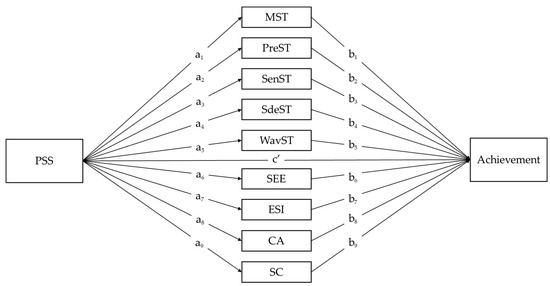
Figure 1.
Conceptual model tested for each perceived provision and source of perceived social support (PSS). Note. MST = mastery self-talk; PreST = personally referred self-talk; SenST = self-enhancing self-talk; SdeST = self-defeating self-talk; WavST = work-avoidance self-talk; SEE = self-efficacy enhancement; ESI = enhancement of situational interest; CA = cost appraisal; and SC = self-consequating.
Perceived emotional support, guidance, and reassurance of worth were considered separately. We aimed to explore their potentially cumulative effect and/or relative centrality in relation to specific MRSs. We also aimed to compare the relationships of perceived support from the family and the teachers with MRSs.
Thus, the present study was guided by the following hypotheses:
H1.
The provisions of emotional support, guidance, and reassurance of worth from family and teachers are significantly associated with the use of MRSs; the direction of the association varies depending on the type of strategy. The support provisions show a cumulative statistical association. No a priori suppositions were assumed for the relative centrality of family and teachers as support sources.
H2.
The use of MRSs is associated with academic achievement; the direction of the association varies depending on the type of strategy.
H3.
The association between support provisions and achievement is associatively mediated by the use of MRSs. Provisions tend to be negatively related to those strategies negatively associated with achievement and positively related to those strategies positively associated with achievement.
2. Materials and Methods
2.1. Participants
The study sample consisted of 463 students (54.10% female) enrolled in secondary schools (1st grade = 31.30%, 2nd grade = 24.40%, 3rd grade = 27.20%, and 4th grade = 17.10%) and of a mean age of 13.50 years (SD = 1.19). The minimum sample size for the study was determined a priori using G*Power 3.1.9.7 (Faul et al., 2009), and an F test for an increase in R-squared was computed, assuming a 0.05 significance level, a 0.95 power level, and an effect size of 0.05. The recommended sample size was 402 participants. To maximize the representativeness while using convenience sampling, five schools with different levels of urbanization were selected for study (European Commission, 2014): one from a sparsely populated area (n = 86), one from an intermediately populated area (n = 132), and three from densely populated areas (n = 245). Students’ response rates ranged from 18.1% to 27.3%, depending on the school. Those aged between 12 and 18 years, enrolled in one of the selected secondary schools, who provided informed consent and completed all study instruments, were included in the study.
2.2. Measures
2.2.1. Perceived Support Provisions from Family and Teachers
The perceived support provisions from family and teachers were assessed using three subscales from the Spanish version of the Relational Support Inventory—Adolescence (RSI-A, Musitu et al., 2001; Scholte et al., 2001). These subscales allowed scores related to the individual’s appreciation of the availability of emotional support to be obtained (e.g., “They accept me the way I am”), guidance (e.g., “They explain to me why things are right or wrong”), and reassurance of worth (e.g., “They help me make decisions for myself”). Each subscale includes 6 items and was scored on a five-point scale, with 1 = strongly disagree and 5 = strongly agree. Previous studies with Spanish samples have demonstrated the adequacy of RSI-A in terms of reliability and construct validity (Antonio-Agirre et al., 2019; Musitu et al., 2001). In the present study, internal consistency for subscales was calculated using the McDonald Omega coefficient (ω), and the values ranged between 0.76 and 0.84. Confirmatory factor analysis (CFA) was conducted for each subscale. All models yielded a good fit according to L. T. Hu and Bentler’s (1999) criteria: χ2 2.77–22.90 (d.f. = 5–9, p > 0.05), TLI = 0.95–1.00, CFI = 0.97–1.00, SRMR = 0.01–0.03, and RMSEA = 0.00–0.06.
2.2.2. Motivational Regulation Strategies
The use of MRSs by students was measured by nine subscales of the Spanish version of the Motivational Regulation Survey (Rojas-Ospina & Valencia-Serrano, 2019; Wolters & Benzon, 2013) and the Escalas de Estrategias Motivacionales del Aprendizaje-Versión Secundaria (Suárez-Riveiro & Fernández-Suárez, 2011). Students were asked to complete the questionnaire on a scale ranging from 1 = strongly disagree to 6 = strongly agree. Sample items are given in Table 1. The reliability and validity of both scales have been confirmed in previous studies conducted with Spanish samples (Navea-Martín & Suárez-Riveiro, 2017; Rojas-Ospina & Valencia-Serrano, 2019; Suárez-Riveiro & Fernández-Suárez, 2011). The content validity of subscales is reflected in their correspondence with the motivational dimensions that are supposed to be monitored and controlled by the students and the similarity of their items with those of other tests commonly used to evaluate the same motivational self-regulation strategies (Villar et al., 2024). In the current study sample, the McDonald Omega coefficient (ω) for subscales ranged from 0.81 to 0.89. The CFA yielded good model fit indexes: χ2 1.46–10.25 (d.f. = 2–5, p > 0.05), CFI = 0.91–1.00, TLI = 0.97–1.00, SRMR = 0.01–0.02, and RMSEA = 0.01–0.06. The CA subscale produced a saturated CFA model (d.f. = 0), which cannot be assessed using the global fit indexes. Model evaluation was therefore based on the standardized factor loadings, all of which were higher than 0.70, indicating strong relationships between the items and the latent construct.

Table 1.
Sample items of the subscales used to measure motivational regulation strategies.
2.2.3. Academic Achievement
The adolescents’ academic achievement was calculated by averaging scores in four main subjects (math, Spanish, Galician, and foreign language). Rank-order correlations between the global academic achievement score and the original scores for each subject were high, ranging from 0.833 to 0.894 (p < 0.001 in all cases). The maximum mark for all subjects was 10, with a pass mark of 5. The CFA was carried out for the scores obtained in math, Spanish, Galician, and foreign language, by using maximum likelihood estimates using MPlus version 8.10, to test if the scores were essentially tau-equivalent, thus confirming the existence of a common underlying true score for achievement (Graham, 2006). For fit index values, the results supported the existence of a single academic achievement factor for the four subjects (chi-square = 0.354; d.f. = 5; p = 0.09; TLI = 0.99; CFI = 0.99; RSMR = 0.07; and RSMEA = 0.04). Standardized regression weights were high for all subjects, ranging from 0.79 to 0.88. Cronbach’s alpha for the total scale was very high (0.901).
2.2.4. Covariates
Sociodemographic information about the students was obtained by administering an ad hoc questionnaire including the following: sex (0 = female, 1 = male), age, courses repeated (yes/no), private lessons outside of classes (yes/no), and special educational needs (yes/no).
The data collection procedure took place one year after the COVID-19 pandemic, using an ad hoc 6-point Likert scale (9 items, α = 0.73) to assess the perceived impact on personal well-being derived from the health situation. This scale, elaborated from previous studies (Aristovnik et al., 2020; Green et al., 2021; Padrón et al., 2021; Prowse et al., 2021), considers both potential stressors derived from the pandemic (e.g., “The presence of conflicts with my close family have increased”) and the possible repercussions (e.g., “My mental health has been affected”).
2.3. Procedure
The data were collected by two members of the research team during the second trimester of the academic year 2021/2022, after obtaining approval from the university ethics committee. Written informed consent was obtained from all students and their families prior to data collection. At the time of data collection, all adolescents were informed that their participation in the study was voluntary and that they could withdraw at any time. At the beginning of the second trimester, a questionnaire on perceived social support, self-regulated motivation, and sociodemographic information was administered collectively by researchers in the classroom during the normal academic schedule; assessments lasted approximately 45 min. At the end of the second trimester, students’ academic grades were obtained from the transcription of their academic records provided by the students in an online form in Microsoft Forms. No compensation was offered for participation in the study.
2.4. Data Analysis
Preliminary analyses were conducted to compute means, medians, standard deviations, normality tests, and correlations for the variables of interest. Tests were performed using SPSS 29.0 (IBM Corporation, 2023). The low incidence of missing data (less than 2% of cases) was handled by listwise deletion. Imputation was not applied.
Given that students were nested within classes, and classes were nested within schools, the potentially clustered nature of the data was addressed (Peugh, 2010). To test the assumption of independence between observations, intraclass correlation coefficients (ICCs) were calculated for all dependent variables in the model by using Mplus version 8.10 (L. K. Muthén & Muthén, 1998–2017), considering school and class as clustering variables. Additionally, to test whether the ICCs indicated that the clustered nature of the data should be considered, the design effect (deff) for each ICC was also calculated (B. O. Muthén, 1994; Peugh, 2010).
As we were testing models with a relatively large number of predictors and parameters, a regularization strategy was employed. Regularization methods penalize complexity, selecting the optimal subset of predictors. For our models, we applied the lasso (least-absolute-shrinkage-and-selection-operator) method (Tibshirani, 1996). Different values of penalization coefficients (λ) were tested for each model (0.01 to 10), using 10,000 iterations and a convergence criterion of 0.000001. For selection of the most parsimonious model, Bayesian Information Criteria (BIC) values were used. Also, bootstrapping was performed for each model with 10,000 replications. All models included all nine motivational strategies for each provision of social support. Sex, age, courses repeated (yes/no), attendance at private classes (yes/no), special educational needs (yes/no), and the self-perceived impact of the COVID-19 pandemic were also considered as covariates.
Mediation regression analysis was then conducted to test the mediating role of MRSs on the relationship between the different perceived provisions of support from family, teachers, and academic achievement. All models were tested with Mplus version 8.10 (L. K. Muthén & Muthén, 1998–2017) and using maximum likelihood with robust estimators (MLR) as the estimation method. A restricted model, constructed by including only the significant parameters provided by the lasso method, was then tested. Bootstrapping resampling with 10,000 runs was conducted to generate 95% confidence intervals; coefficients were considered significant when estimates for the 95% interval did not include zero (Preacher et al., 2007).
Given the large number of statistical tests involved in testing the six saturated models (3 provisions of support × 2 sources of support), the Benjamini–Hochberg procedure (Benjamini & Hochberg, 1995) for correcting false discovery rates (FDR) was applied to all indirect paths (a × b) of the 6 models, selecting a type I error rate of 0.05.
Testing a multiple mediation model rather than separate single mediation models has several advantages (Preacher & Hayes, 2008): (1) it is analogous to conducting a regression analysis with several predictors to test for the existence of an overall effect; (2) it enables identification of the variables mediating the effect of X on Y; (3) it reduces the likelihood of parameter bias due to omitted variables; and (4) it enables calculation of the relative magnitudes of specific indirect effects and testing competing theories. However, these models are much more complex than single mediation models because it is difficult to tease apart individual mediating effects when several potential mediators may overlap in content, as in our data (See Table 1). To test for the existence of multicollinearity problems, Tolerance and Variance Inflation Factor (VIF) values were computed for all mediators, taking Tolerance ≤ 0.10 and VIF ≥ 5 as threshold values indicating the presence of multicollinearity.
Pattern-centered analyses were carried out in three steps to explore possible cumulative effects of support provision. The first step was to recode perceived support scores as above (“high”) or below (“low”) the median for each provision. Students were then classified into one of four mutually exclusive categories regarding each source of support: (a) All high (i.e., all types of provision above the median), (b) two high (i.e., two types of provision were above the median), (c) one high (i.e., one type of provision above the median), and (d) no high (i.e., all three types of provision below the median). Finally, the four groups were compared considering significant mediator MRSs as dependent variables. As the data did not meet the assumption of normality required for parametric tests (see Table 2), the Kruskal–Wallis H test for multiple independent samples and the Mann–Whitney U test for pairwise comparisons were used (with Bonferroni correction of alpha values for these post hoc tests). Additionally, to test if a certain source of support was more central than the other for a particular MRS, path coefficients for family and teachers were later compared by using an unbiased z test (Paternoster et al., 1998).
Table 2.
Descriptive statistics, results of the Kolmogorov–Smirnov test, Cronbach’s alpha, and correlations for the variables of interest.
3. Results
3.1. Preliminary and Correlation Analysis
The observed power for the analysis (N = 463) was 0.975. Means, standard deviations, medians, and results of the Kolmogorov–Smirnov tests for the main variables of the study are presented in Table 2.
Both positive and negative significant correlations were obtained between perceived social support and most of the MRSs. Regarding achievement, all provisions and sources of support were positively correlated with this outcome. Conversely, the correlations between MRSs and achievement were mixed, including positive, negative and non-significant coefficients.
As moderate correlations existed between some of the MRSs, Tolerance and VIF values were computed for all mediators. No multicollinearity problems were found either for Tolerance (0.365 to 0.751) or VIF (1.332 to 2.739) values.
Before testing mediational models, intraclass correlation coefficients (ICCs) were calculated for all nine mediators and achievement for each course. The ICC values were quite low, ranging from 0.002 to 0.198. To test whether these ICC values supported the assumption of independence between observations, the design effect (deff) was also calculated for each ICC by using the average cluster size for each course. The number of clusters per course ranged between 16 and 22, whereas the average cluster size ranged between 4.9 and 7. These numbers can be considered low for multilevel analysis (Hox & Maas, 2002; B. O. Muthén & Satorra, 1995). Deff values were always below 2, ranging from 1.001 to 1.810. It is commonly assumed that deff values below 2 indicate that a single-level approach does not involve a great risk of incorrect rejections due to biased standard errors, while values of 2 or higher indicate that a multilevel approach should be considered (Peugh, 2010). Despite this and given that some deff values were close to the threshold value, a multilevel approach was employed for all models (students nested within classes and schools), thus ensuring that the hierarchical structure was properly addressed (Peugh, 2010; Hox & Maas, 2002).
3.2. Mediational Regression Analysis
Six restricted models were generated, only including the significant path coefficients selected by lasso regularization. Additionally, the Benjamini–Hochberg FDR procedure was applied to all mediational paths (a × b) included in these models. All mediators remained significant after the FDR procedure.
3.2.1. MRSs as Associative Mediators in the Relationship Between Emotional Support from Family and Teachers and Achievement
Acceptable goodness-of-fit indexes were obtained for both emotional support from family (χ2 = 16.976; d.f. = 7; p = 0.9175; CFI = 0.974; TLI = 0.919; RMSEA = 0.056; and SRMR = 0.036) and teachers (χ2 = 0.250; d.f. = 2; p = 0.8826; CFI = 1.000; TLI = 1.000; RMSEA = 0.000; and SRMR = 0.008).
Perceived emotional support from both family and teachers was significantly associated with academic achievement through work-avoidance self-talk (see Figure 2). However, the strategies of self-efficacy enhancement and enhancement of situational interest only mediated the relationship between family emotional support and academic achievement. Specifically, self-efficacy enhancement showed a positive associative mediation, whereas enhancement of situational interest showed a negative associative mediation, owing to its negative relationship with academic achievement (see Table 3).
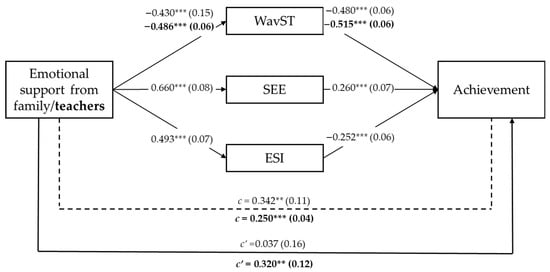
Figure 2.
MRSs significantly mediate the relationship between emotional support from family and teachers (in bold) and academic achievement. Note. Standard errors are shown in parentheses. WavST = work-avoidance self-talk; SEE = self-efficacy enhancement; and ESI = enhancement of situational interest. ** p < 0.01, and *** p < 0.001.
Table 3.
Standardized estimates, errors, and confidence intervals for mediation in the models for emotional support from family and teachers.
Finally, while associative mediations were total for family emotional support (non-significant c’ path), the direct association of teachers’ emotional support with achievement persisted after including work-avoidance self-talk (see Figure 2). Thus, emotional support from teachers was positively and significantly associated with academic achievement, irrespective of its relationship with students’ regulation of motivation.
3.2.2. MRSs as Associative Mediators in the Relationship Between Guidance from Family and Teachers and Achievement
Acceptable goodness-of-fit indexes were obtained for both guidance from family (χ2 = 8.770; d.f. = 5; p = 0.1186; CFI = 0.990; TLI = 0.957; RMSEA = 0.041; and SRMR = 0.024) and teachers (χ2 = 0.003; d.f. = 1; p = 0.9614; CFI = 1.000; TLI = 1.000; RMSEA = 0.000; and SRMR = 0.001).
Regarding the association between guidance from both family and teachers and academic achievement, similar results were obtained for both sources (see Figure 3). Guidance was significantly associated with academic achievement through work-avoidance self-talk, self-efficacy enhancement, and enhancement of situational interest. The associative mediation of the first two strategies was positive, while that of the third was negative (see Table 4).
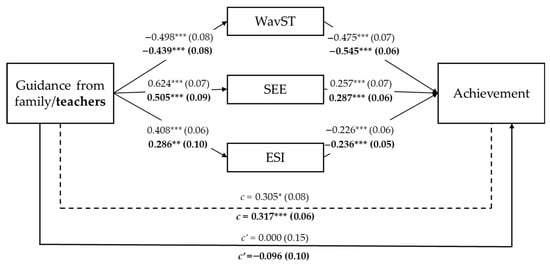
Figure 3.
MRSs significantly mediate the relationship between guidance from family and teachers (in bold) and academic achievement. Note. Standard errors are shown in parentheses. WavST = work-avoidance self-talk; SEE = self-efficacy enhancement; and ESI = enhancement of situational interest. * p < 0.05, ** p < 0.01, and *** p < 0.001.
Table 4.
Standardized estimates, errors, and confidence intervals for mediation in the models for guidance from family and from teachers.
The path coefficients of all MRSs on academic achievement were very similar for both sources of support, but family guidance was more strongly associated with all MRSs than teacher guidance. Mediated relationships were total for both sources, as none of the direct associations (path c’) remained significant after the inclusion of the MRSs (see Figure 3).
3.2.3. MRSs as Associative Mediators in the Relationship Between Reassurance of Worth from Family and Teachers and Achievement
Acceptable goodness-of-fit indexes were obtained for both reassurance of worth from family (χ2 = 0.626; d.f. = 3; p = 0.8904; CFI = 1.000; TLI = 1.000; RMSEA = 0.000; and SRMR = 0.010) and teachers (χ2 = 0.018; d.f. = 1; p = 0.8926; CFI = 1.000; TLI = 1.000; RMSEA = 0.000; and SRMR = 0.002).
Perceived reassurance of worth from both family and teachers was significantly associated with achievement through work-avoidance self-talk and self-efficacy enhancement (see Figure 4). The associative mediation of these strategies was positive. On the other hand, enhancement of situational interest was found to be a negative mediator in the relationship between reassurance of worth from family and teachers and achievement (see Table 5).
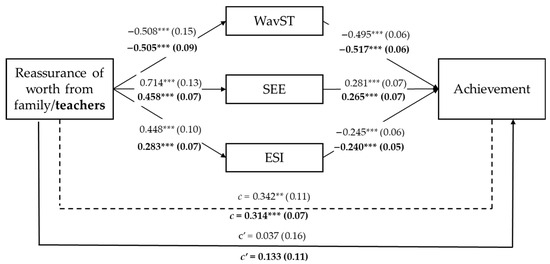
Figure 4.
MRSs significantly mediate the relationship between reassurance of worth from family and teachers (in bold) and academic achievement. Note. Standard errors are shown in parentheses. WavST = work-avoidance self-talk; SEE = self-efficacy enhancement; and ESI = enhancement of situational interest. ** p < 0.01, and *** p < 0.001.
Table 5.
Standardized estimates, errors, and confidence intervals for mediation in the models for reassurance of worth from family and teachers.
As in previous analyses, the path coefficients of all MRSs on academic achievement were quite similar for both sources of support, but the path coefficient for family support was higher for self-efficacy enhancement. Mediated relationships were total for both sources, as none of the direct associations (path c’) remained significant after the inclusion of the MRSs (see Figure 4).
3.2.4. Sensitivity Analysis
Model results for enhancement of situational interest were counterintuitive and contrary to Hypothesis 3: The association between support provisions and achievement should be positively related to those strategies also positively related to achievement, and vice versa. Enhancement of situational interest, however, was positively related to the different sources of provision but negatively related to achievement. Furthermore, enhancement of situational interest had no significant correlation with achievement (see Table 2). This may indicate a suppression effect of enhancement of situational interest, due to its relationship with other mediators included in the model. Enhancement of situational interest was highly correlated with self-efficacy enhancement (r = 0.52; see Table 2), so we tested the effect on enhancement of situational interest coefficients when self-efficacy enhancement was removed, and the effect on self-efficacy enhancement coefficients when enhancement of situational interest was removed. Results showed that when SEE was removed from the model, the relationship (both direct and indirect) between enhancement of situational interest and achievement became non-significant. Also, when enhancement of situational interest was removed from the model, self-efficacy enhancement coefficients remained significant, but much smaller. Thus, enhancement of situational interest seems to behave as a classical suppressor, removing irrelevant variance in self-efficacy enhancement. That is, the inclusion of enhancement of situational interest in the associative mediational model improves both the importance of self-efficacy enhancement and the overall predictive power of the model.
3.3. Pattern-Centered Analysis
3.3.1. Cumulative Effects
A significant positive cumulative relationship for the support provisions from family was found regarding self-efficacy enhancement and enhancement of situational interest (Table 6). On the other hand, the scores on work-avoidance self-talk decreased as the number of perceived provisions above the median increased. There were no significant differences, neither between the two high and all high groups, nor between the no high and one high groups, for the use of any of the MRSs.
Table 6.
Comparison of the different categories of family support.
A similar pattern of results was found for teacher support (Table 7). Thus, as the number of provisions above the median increased, the scores for self-efficacy enhancement and enhancement of situational interest increased, while the scores for work-avoidance self-talk decreased.
Table 7.
Comparisons of the different categories of teacher support.
3.3.2. Centrality of Sources
Finally, differences between both sources of support were tested regarding the relationships with each MRS (paths a) for the three mediational models using an unbiased z test based on the differences between b coefficients (Paternoster et al., 1998). No significant differences were found for any of the sources of support.
4. Discussion
The present study aimed to explore the associative mediation pathways of MRSs in the relationships between perceived social support from family and from teachers and academic achievement. Based on available theoretical assumptions and data, we created six empirical models, including emotional support, guidance, and reassurance of worth from family and from teachers as independent variables and academic achievement as the dependent variable. Nine different MRSs were considered potentially mediating dimensions. Additionally, we explored the potentially cumulative association of the three provisions of support and the relative centrality of each source of support for every MRS.
4.1. The Association of Perceived Social Support from Family and from Teachers with Motivational Self-Regulation
As expected, both sources of support were found to have a significant association with MRSs, which is consistent with the presumed role of families and teachers in the development of self-regulation in adolescents (Bardach et al., 2023; La Guardia & Ryan, 2002). In line with the propositions of the self-determination theory (Ryan, 2023; Ryan & Deci, 2017) and the self-system model of motivational development (Connell & Wellborn, 1991; Skinner et al., 2009), this association can be tentatively attributed to the students’ perception of the availability of those provisions of social support that are believed to contribute to satisfaction of learners’ basic psychological needs for relatedness, competence, and autonomy.
4.1.1. The Relation of Emotional Support with Motivational Self-Regulation
Emotional support (involvement) manifests as sensitive responding, time investment, and affective shelter (Furrer & Skinner, 2003; Lerner et al., 2022). Thus, individuals can perceive family as providing attention, warmth, and caring to a greater or lesser degree. Similarly, teachers can be appraised as dedicating resources and acting affectionately, empathically, and dependably to a greater or lesser degree (Farkas & Grolnick, 2010; Skinner et al., 2005). These properties of the social context are thought to satisfy the need for relatedness, making the individual feel appreciated, loved, and connected to significant others and conferring confidence to the individual (Connell & Wellborn, 1991; Skinner & Belmont, 1993). Indeed, relatedness and perceived emotional support have been shown to be related to positive self-perceptions of competence and control (Gonzalez-DeHass et al., 2005; He et al., 2024; Skinner et al., 2009; Yang et al., 2021), as well as to metacognitive knowledge and the use of learning strategies (Bong, 2008; Karlen, 2016; Patrick et al., 2007). Consistent with these premises and evidence, the study findings showed that perceived emotional support from family was positively associated with autonomous forms of motivational regulation, such as focusing on one’s personal potential (by the strategy of self-efficacy enhancement) or on the task at hand, by making it more enjoyable or appealing (using the strategy of enhancement of situational interest). Regarding the negative regression association between emotional support from family and teachers and work-avoidance self-talk, this can be explained by the increase in confidence gained by the individual through emotional support (Boudreault-Bouchard et al., 2013).
4.1.2. The Relation of Guidance with Motivational Self-Regulation
The provision of guidance (structure) involves supplying contingent and consistent orientation about expectations and consequences regarding the behavior of individuals (Connell & Wellborn, 1991; Skinner & Belmont, 1993). Families are seen to facilitate this provision by providing consistent guidelines, rules, rationales, and consequences, as well as offering opportunities and assistance to meet parental expectations (Farkas & Grolnick, 2010; Skinner et al., 2005). Teachers, on the other hand, are expected to provide guidance by establishing clear learning goals, providing feedback and consistent consequences, and offering the necessary help to complete academic tasks (Jang et al., 2010; Vansteenkiste et al., 2012). Regardless of the specific procedures through which each source offers guidance, this is assumed to satisfy the need for competence, encouraging the individual’s sense of agency and effectiveness, which is expected to influence the predisposition to self-regulate learning. In fact, perceived guidance from both sources has been related to the use of (meta)cognitive learning strategies (Choe, 2020; Yildirim, 2012). As the present study findings indicate, the perceived availability of guidance from both family and teachers could also incline students to adopt autonomous forms of motivational self-regulation. Thus, we found that perceived guidance was positively associated with self-efficacy enhancement and situational interest enhancement strategies, while it was negatively associated with work-avoidance self-talk.
4.1.3. The Relation of Reassurance of Worth with Motivational Self-Regulation
Reassurance of worth was also considered a separate predictor of students’ motivational self-regulation in our study. This implies valuing other people’s perspectives and feelings, encouraging self-initiative, and providing options and choices (Connell & Wellborn, 1991; Skinner & Belmont, 1993). In this regard, families may facilitate open exchange of opinions and views, favor joint establishment of rules, and offer chances to act in accordance (Soenens & Vansteenkiste, 2005; Van der Kaap-Deeder et al., 2015). Teachers, on the other hand, can provide autonomy support by offering choice, relevance, and respect, and by presenting interesting and challenging tasks (Schuitema et al., 2016; Vansteenkiste et al., 2012). These behaviors are expected to satisfy students’ need for autonomy, ultimately fostering a sense of volition and ownership and laying the foundations for autonomous self-regulation of motivation (Reeve, 2009; Stefanou et al., 2004). Some data in accordance with this expectation are available (Mageau & Joussemet, 2023; Mih, 2013), and our findings are consistent with the reported arguments and evidence, as we registered a positive association of perceived autonomy support on self-efficacy enhancement and enhancement of situational interest, as well as a negative association with work-avoidance self-talk.
4.1.4. Cumulative Effect of Support Provisions on Motivational Regulation Strategies
A positive cumulative relation of support provisions from family and teachers with self-efficacy enhancement and enhancement of situational interest was observed, along with a negative cumulative relation of support with work-avoidance self-talk. These results are consistent with the assumptions of the self-system model of motivational development (Connell & Wellborn, 1991; Skinner et al., 2008), in which three types of social context properties are distinguished that favor self-regulation by different paths. According to our results, the provisions each may contribute to favoring the use of MRSs, and they are probably mutually reinforcing.
4.2. The Association of Motivational Regulation with Academic Achievement
The study findings showed that self-efficacy enhancement was a positive associative predictor of academic achievement, while work-avoidance self-talk was a negative associative predictor. These results, which are consistent with those observed in previous studies (Villar et al., 2024), can be explained in terms of the differential influence the MRSs may have on the effort learners invest in their academic tasks (Schwinger et al., 2009; Trautner & Schwinger, 2020; Wolters & Benzon, 2013). Self-efficacy enhancement is expected to give rise to positive expectations about the results pursued (Miele & Scholer, 2016), ultimately increasing students’ engagement and persistence (Reeve, 2012; Vansteenkiste et al., 2004).
On the other hand, work-avoidance self-talk is expected to diminish students’ effort and, ultimately, to have a negative impact on achievement (Miele & Scholer, 2016). When individuals embrace a work-avoidance goal orientation, success is actually defined as minimal involvement, thus hindering effort expenditure and deep processing strategies (King & McInerney, 2014). A previous study that explored how work-avoidance self-talk was related to self-regulated learning (Suárez-Riveiro et al., 2016) observed, as expected, a negative relationship between that motivational strategy and the use of (meta)cognitive strategies.
Finally, the results of our sensitivity analyses showed that the enhancement of situational interest in our models acted as a suppressor variable affecting self-efficacy enhancement. Coefficients for self-efficacy enhancement increased when the enhancement of situational interest was included in the model. However, the coefficients for the enhancement of situational interest turned out to be non-significant when self-efficacy enhancement was removed from the model. When students employ enhancement of situational interest, they attempt to adjust the characteristics of the task at hand to make it more enjoyable or appealing (Schwinger et al., 2007; Schwinger & Otterpohl, 2017). This may involve adding entertainment features to the task at hand, which could distract attention from its fundamental requirements. Adjusting the characteristics of the task to make it more enjoyable or appealing can demand substantial cognitive resources, which would no longer be available for other activities required to perform the task (Paas & van Merriënboer, 2020; Sayed, 2021), such as mastering the content. This would explain why we did not find a significant correlation between the enhancement of situational interest and academic performance. In fact, in previous studies, negative correlational relationships were found between enhancement of situational interest and academic achievement (Fritea & Fritea, 2013; Grunschel et al., 2016; Kryshko et al., 2020).
5. Conclusions
This study aimed to disentangle the possible mechanisms through which perceived social support from family and teachers may affect academic achievement in adolescents. We explored the cognitive assessment that individuals make of different provisions of support based on their accumulated experience of their availability or lack thereof. We were specifically interested in those provisions that are assumed to be related to the satisfaction of basic psychological needs. Our findings are consistent with the supposed role of perceived support provision from family and teachers in shaping a favorable motivational state in the face of academic work. The findings have also allowed us to advance some ideas about the possible underlying processes. By testing the mediating role of motivational self-regulation on the relationship between emotional support, guidance, and reassurance of worth and academic achievement, we found that three MRSs mediated the relationship between support provisions and academic achievement, namely work-avoidance self-talk, self-efficacy enhancement, and enhancement of situational interest. All three provisions, from both family and teacher support, were positively associated with MRSs in line with autonomous types of motivational regulation. Perceived family support was associated with higher rates of predictive power than perceived teacher support. Thus, current findings suggest that perceived social support may serve as a marker of vulnerability/protection in regard to the challenges typically faced in secondary school, as well as of the difficulties/potential for self-regulation and academic achievement. Moreover, the findings may lay the foundation for outlining guidelines and intervention programs aimed at favoring the adjustment of adolescents in the educational system. The inclusion of social support as a dimension of learning skills programs would be expected to enhance the effectiveness of such programs. Teacher support should be considered when the intention is to create a classroom climate conducive to engagement and learning, as well as guidance aimed at promoting parental support skills.
6. Limitations and Future Research
The present study has several limitations. Motivational regulation, like any other area of self-regulated learning, is a situated process, influenced by the characteristics of the tasks addressed by the students. Hence, not only the quantity, but also the quality and suitability of the strategies used by learners should be considered (Eckerlein et al., 2019; Engelschalk et al., 2017). Although the present study explored a wide range of MRSs, future research would benefit from also examining the suitability of these strategies in different educational contexts and situations. On the other hand, the current study relied on cross-sectional data, and therefore, causal links could not be explored. Moreover, considering the reciprocal nature of the relationship between family and teacher support, the acquisition of new skills (such as self-regulated motivation), and academic adjustment, future studies should further explore the issue of directionality (Garn & Morin, 2021; Kilday & Ryan, 2022). Finally, the use of a non-probability convenience sample limits the generalizability of the results. Moreover, the reliance on self-reported data potentially introduces response biases, including social desirability bias.
Author Contributions
Conceptualization, C.T. and N.S.; methodology, J.E.R.D.; validation, M.E.M.; formal analysis, J.E.R.D.; investigation, Z.M.-L.; resources, M.E.M.; data curation, J.E.R.D.; writing—original draft preparation, C.T. and N.S.; writing—review and editing, J.E.R.D., Z.M.-L., M.E.M. and C.T.; visualization, Z.M.-L. and N.S.; supervision, C.T.; project administration, C.T.; funding acquisition, C.T. All authors have read and agreed to the published version of the manuscript.
Funding
This publication is part of Project PID2021-126981OB-I00, funded by MICIU/AEI/10.13039/501100011033 by “ERDF A way of making Europe”, and by Xunta de Galicia (ED431C 2022/17). The funders had no role in the design of the study; in the collection, analyses, or interpretation of data; in the writing of the manuscript; or in the decision to publish the results.
Institutional Review Board Statement
The study was conducted in accordance with the Declaration of Helsinki and approved by the Bioethical Committee of the University of Santiago de Compostela (protocol code: 29/2020, and date of approval: 3 December 2020) for studies involving humans.
Informed Consent Statement
Informed consent was obtained from all subjects involved in the study.
Data Availability Statement
The data (anonymized, with no identifying information) are available: https://osf.io/yv46d/overview (accessed on 12 January 2026).
Acknowledgments
We would like to thank everyone who agreed to participate in the research.
Conflicts of Interest
The authors declare no conflicts of interest and that the funders had no role in the design of the study; in the collection, analyses, or interpretation of data; in the writing of the manuscript; or in the decision to publish the results.
Abbreviations
The following abbreviations are used in this manuscript:
| ACH | Academic achievement |
| CA | Cost appraisal |
| ESI | Enhancement of situational interest |
| MRSs | Motivational regulation strategies |
| MST | Mastery self-talk |
| PSS | Perceived social support |
| PSS-F-EM | Perceived emotional support from family |
| PSS-F-GU | Perceived guidance from family |
| PSS-F-RE | Perceived reassurance of worth from family |
| PSS-T-EM | Perceived emotional support from teachers |
| PSS-T-GU | Perceived guidance from teachers |
| PSS-T-RE | Perceived reassurance of worth from teachers |
| PreST | Personally referred self-talk |
| SC | Self-consequating |
| SdeST | Self-defeating self-talk |
| SEE | Self-efficacy enhancement |
| SenST | Self-enhancing self-talk |
| WavST | Work-avoidance self-talk |
References
- Antonio-Agirre, I., Rodríguez-Fernández, A., & Revuelta, L. (2019). Social support, emotional intelligence and academic performance in secondary education. European Journal of Investigation in Health, Psychology and Education, 9(2), 109–118. [Google Scholar] [CrossRef]
- Appelbaum, M., Cooper, H., Kline, R. B., Mayo-Wilson, E., Nezu, A. M., & Rao, S. M. (2018). Journal article reporting standards for quantitative research in psychology: The APA publications and communications board task force report. American Psychologist, 73(1), 3–25. [Google Scholar] [CrossRef] [PubMed]
- Aristovnik, A., Keržič, D., Ravšelj, D., Tomaževič, N., & Umek, L. (2020). Impacts of the COVID-19 pandemic on life of higher education students: A global perspective. Sustainability, 12(20), 8438. [Google Scholar] [CrossRef]
- Bakhtiar, A., & Hadwin, A. F. (2021). Motivation from a self-regulated learning perspective: Application to School Psychology. Canadian Journal of School Psychology, 37(1), 93–116. [Google Scholar] [CrossRef]
- Bardach, L., Yanagida, T., Goetz, T., Jach, H., & Pekrun, R. (2023). Self-regulated and externally regulated learning in adolescence: Developmental trajectories and relations with teacher behavior, parent behavior, and academic achievement. Developmental Psychology, 59(7), 1327–1345. [Google Scholar] [CrossRef]
- Benjamini, Y., & Hochberg, Y. (1995). Controlling the false discovery rate: A practical and powerful approach to multiple testing. Journal of the Royal Statistical Society, Series B (Methodological), 57(1), 289–300. [Google Scholar] [CrossRef]
- Bong, M. (2008). Effects of parent–child relationships and classroom goal structures on motivation, help-seeking avoidance, and cheating. The Journal of Experimental Education, 76(2), 191–217. [Google Scholar] [CrossRef]
- Boudreault-Bouchard, A. M., Dion, J., Hains, J., Vandermeerschen, J., Laberge, L., & Perron, M. (2013). Impact of parental emotional support and coercive control on adolescents’ self-esteem and psychological distress: Results of a four-year longitudinal study. Journal of Adolescence, 36(4), 695–704. [Google Scholar] [CrossRef]
- Bronfenbrenner, U., & Morris, P. A. (2006). Adolescent development in interpersonal context. In N. Damon, & R. M. Lerner (Eds.), Handbook of child psychology: Vol. 1. Theoretical models of human development (pp. 793–828). John Wiley & Sons. [Google Scholar]
- Cazan, A. M. (2012). Self-regulated learning strategies—Predictors of academic adjustment. Procedia—Social and Behavioral Sciences, 33, 104–108. [Google Scholar] [CrossRef]
- Choe, D. (2020). Parents’ and adolescents’ perceptions of parental support as predictors of adolescents’ academic achievement and self-regulated learning. Children and Youth Services Review, 116, 1–9. [Google Scholar] [CrossRef]
- Cleary, T. J., Slemp, J., & Pawlo, E. R. (2020). Linking student self-regulated learning profiles to achievement and engagement in mathematics. Psychology in the Schools, 58(3), 443–457. [Google Scholar] [CrossRef]
- Cohen, S., Mermelstein, R., Kamarck, T., & Hoberman, H. M. (1985). Measuring the functional components of social support. In I. G. Sarason, & B. R. Sarason (Eds.), Social support: Theory, research and, applications (pp. 73–94). Martinus Nijhoff Publishers. [Google Scholar]
- Collins, W. A., & Steinberg, L. (2006). Adolescent development in interpersonal context. In N. Eisenberg, N. Damon, & R. M. Lerner (Eds.), Handbook of child psychology: Vol. 3. Social, emotional, and personality development (6th ed., pp. 1003–1067). John Wiley & Sons. [Google Scholar]
- Connell, J. P., & Wellborn, J. G. (1991). Competence, autonomy, and relatedness: A motivational analysis of self-system processes. In M. R. Gunnar, & L. A. Sroufe (Eds.), Self-processes and development (Vol. 23, pp. 43–77). Lawrence Erlbaum. [Google Scholar]
- Cutrona, C. E., & Russell, D. W. (1987). The provisions of social relationships and adaptation to stress. In D. Perlma, & W. Jones (Eds.), Advances in personal relationships (pp. 37–67). JAI Press Inc. [Google Scholar]
- Dent, A. L., & Koenka, A. C. (2016). The relation between self-regulated learning and academic achievement across childhood and adolescence: A meta-analysis. Educational Psychology Review, 28, 425–474. [Google Scholar] [CrossRef]
- Eckerlein, N., Roth, A., Engelschalk, T., Steuer, G., Schmitz, B., & Dresel, M. (2019). The role of motivational regulation in exam preparation: Results from a standardized diary study. Frontiers in Psychology, 10, 00081. [Google Scholar] [CrossRef] [PubMed]
- Engelschalk, T., Steuer, G., & Dresel, M. (2017). Quantity and quality of motivational regulation among university students. Educational Psychology, 37(9), 1154–1170. [Google Scholar] [CrossRef]
- European Commission. (2014). A harmonised definition of cities and rural areas: The new degree of urbanisation. Available online: https://ec.europa.eu/regional_policy/en/newsroom/news/2014/05/new-regional-working-paper-a-harmonised-definition-of-cities-and-rural-areas-the-new-degree-of-urbanisation (accessed on 12 January 2026).
- Farkas, M. S., & Grolnick, W. S. (2010). Examining the components and concomitants of parental structure in the academic domain. Motivation and Emotion, 34, 266–279. [Google Scholar] [CrossRef]
- Faul, F., Erdfelder, E., Buchner, A., & Lang, A. G. (2009). Statistical power analyses using G*Power 3.1: Tests for correlation and regression analyses. Behavior Research Methods, 41, 1149–1160. [Google Scholar] [CrossRef]
- Fong, C. J., Altan, S., Gonzales, C., Kirmizi, M., Adelugba, S. F., & Kim, Y. (2024). Stay motivated and carry on: A meta-analytic investigation of motivational regulation strategies and academic achievement, motivation, and self-regulation correlates. Journal of Educational Psychology, 116(6), 997–1018. [Google Scholar] [CrossRef]
- Fong, C. J., Krou, M. R., Johnston-Ashton, K., Hoff, M. A., Lin, S., & Gonzales, C. (2021). LASSI’ s great adventure: A meta-analysis of the learning and study strategies inventory and academic outcomes. Educational Research Review, 34, 100407. [Google Scholar] [CrossRef]
- Fritea, I., & Fritea, R. (2013). Can motivational regulation counteract the effects of boredom on academic achievement? Procedia—Social and Behavioral Sciences, 78, 135–139. [Google Scholar] [CrossRef]
- Furrer, C., & Skinner, E. (2003). Sense of relatedness as a factor in children’s academic engagement and performance. Journal of Educational Psychology, 95(1), 148–162. [Google Scholar] [CrossRef]
- García-Ros, R., Pérez-González, F., Cavas-Martínez, F., & Tomás, J. M. (2018). Social interaction learning strategies, motivation, first-year students’ experiences and permanence in university studies. Educational Psychology, 38(4), 451–469. [Google Scholar] [CrossRef]
- Garn, A. C., & Morin, A. J. S. (2021). University students’ use of motivational regulation during one semester. Learning and Instruction, 74, 101436. [Google Scholar] [CrossRef]
- Gonzalez-DeHass, A. R., Willems, P. P., & Holbein, M. F. D. (2005). Examining the relationship between parental involvement and student motivation. Educational Psychology Review, 17(2), 99–123. [Google Scholar] [CrossRef]
- Graham, J. M. (2006). Congeneric and (essentially) tau-equivalent estimates of score reliability: What they are and how to use them. Educational and Psychological Measurement, 66(6), 930–944. [Google Scholar] [CrossRef]
- Green, K. H., van de Groep, S., Sweijen, S. W., Becht, A. I., Buijzen, M., de Leeuw, R. N. H., Remmerswaal, D., van der Zanden, R., Engels, R. C. M. E., & Crone, E. A. (2021). Mood and emotional reactivity of adolescents during the COVID-19 pandemic: Short-term and long-term effects and the impact of social and socioeconomic stressors. Scientific Reports, 11(1), 11563. [Google Scholar] [CrossRef]
- Grunschel, C., Schwinger, M., Steinmayr, R., & Fries, S. (2016). Effects of using motivational regulation strategies on students’ academic procrastination, academic performance, and well-being. Learning and Individual Differences, 49, 162–170. [Google Scholar] [CrossRef]
- Hayamizu, T., & Weiner, B. (1991). A test of Dweck’s model of achievement goals as related to perceptions of ability. The Journal of Experimental Education, 59(3), 226–234. [Google Scholar] [CrossRef]
- He, L., Feng, L., & Ding, J. (2024). The relationship between perceived teacher emotional support, online academic burnout, academic self-efficacy, and online English academic engagement of Chinese EFL learners. Sustainability, 16(13), 5542. [Google Scholar] [CrossRef]
- Hey, R., McDaniel, M., & Hodis, F. A. (2024). How undergraduate students learn: Uncovering interrelationships between factors that support self-regulated learning and strategy use. Metacognition and Learning, 19, 743–772. [Google Scholar] [CrossRef]
- Hox, J. J., & Maas, C. J. M. (2002). Sample sizes for multilevel modeling. In J. Blasius, J. J. Hox, E. de Leeuw, & P. Schmidt (Eds.), Social science methodology in the new millennium: Proceedings of the fifth international conference on logic and methodology (2nd expanded ed.). Leske + Budrich. [Google Scholar]
- Hoyle, R. H., & Dent, A. L. (2018). Developmental trajectories of skills and abilities relevant for self-regulation of learning and performance. In D. H. Schunk, & J. A. Greene (Eds.), Handbook of self-regulation of learning and performance (2nd ed., pp. 49–63). Routledge/Taylor & Francis Group. [Google Scholar]
- Hu, L. T., & Bentler, P. M. (1999). Cutoff criteria for fit indexes in covariance structure analysis: Conventional criteria versus new alternatives. Structural Equation Modeling: A Multidisciplinary Journal, 6(1), 1–55. [Google Scholar] [CrossRef]
- Hu, P., & Zhang, J. (2017). A pathway to learner autonomy: A self-determination theory perspective. Asia Pacific Education Review, 18, 147–157. [Google Scholar] [CrossRef]
- Hulleman, C. S., Schrager, S. M., Bodmann, S. M., & Harackiewicz, J. M. (2010). A meta-analytic review of achievement goal measures: Different labels for the same constructs or different constructs with similar labels? Psychological Bulletin, 136(3), 422–449. [Google Scholar] [CrossRef] [PubMed]
- IBM Corporation. (2023). IBM SPSS statistics for windows (Version 29.0) [Computer software]. IBM Corporation. [Google Scholar]
- Ilishkina, D. I., de Bruin, A., Podolskiy, A. I., Volk, M. I., & Van Merriënboer, J. J. G. (2022). Understanding self-regulated learning through the lens of motivation: Motivational regulation strategies vary with students’ motives. International Journal of Educational Research, 113, 101956. [Google Scholar] [CrossRef]
- Jang, H., Reeve, J., & Deci, E. L. (2010). Engaging students in learning activities: It is not autonomy support or structure but autonomy support and structure. Journal of Educational Psychology, 102(3), 588–600. [Google Scholar] [CrossRef]
- Järvenoja, H., Järvelä, S., & Malmberg, J. (2015). Understanding regulated learning in situative and contextual frameworks. Educational Psychologist, 50(3), 204–2019. [Google Scholar] [CrossRef]
- Karlen, Y. (2016). Perceived learning environments and metacognitive strategy knowledge at the upper secondary school level. Journal for Educational Research Online, 8(2), 212–232. [Google Scholar] [CrossRef]
- Kilday, J. E., & Ryan, A. M. (2022). The intersection of the peer ecology and teacher practices for student motivation in the classroom. Educational Psychology Review, 34, 2095–2127. [Google Scholar] [CrossRef]
- King, R. B., & McInerney, D. M. (2014). The work avoidance goal construct: Examining its structure, antecedents, and consequences. Contemporary Educational Psychology, 39(1), 42–58. [Google Scholar] [CrossRef]
- Kobak, R., Rosenthal, N. L., Zajac, K., & Madsen, S. D. (2007). Adolescent attachment hierarchies and the search for an adult pair-bond. New Directions for Child and Adolescent Development, 117, 57–72. [Google Scholar] [CrossRef]
- Kryshko, O., Fleischer, J., Waldeyer, J., Wirth, J., & Leutner, D. (2020). Do motivational regulation strategies contribute to university students’ academic success? Learning and Individual Differences, 82, 101912. [Google Scholar] [CrossRef]
- La Guardia, J. G., & Ryan, R. M. (2002). What adolescents need. A self-determination theory perspective on development within families, school, and society. In T. Urdan, & F. Pajares (Eds.), Academic motivation of adolescents (pp. 193–218). IAP. [Google Scholar]
- Laursen, B., & Collins, W. A. (2009). Parent-child relationships during adolescence. In R. M. Lerner, & L. Steinberg (Eds.), Handbook of adolescent psychology: Vol. 2. Contextual influences on adolescent development (pp. 3–42). John Wiley & Sons. [Google Scholar]
- Lerner, R. E., Grolnick, W. S., Caruso, A. J., & Levitt, M. R. (2022). Parental involvement and children’s academics: The roles of autonomy support and parents’ motivation for involvement. Contemporary Educational Psychology, 68, 1020039. [Google Scholar] [CrossRef]
- Mageau, G. A., & Joussemet, M. (2023). Autonomy-supportive behaviors: Common features and variability across socialization domains. In R. M. Ryan (Ed.), The Oxford handbook of self-determination theory (pp. 507–528). Oxford University Press. [Google Scholar]
- Martínez-López, Z., Morán, V. E., Mayo, M. E., & Tinajero, C. (2024). Perceived social support and its relationship with self-regulated learning, goal orientation self-management, and academic achievement. European Journal of Psychology of Education, 39, 813–835. [Google Scholar] [CrossRef]
- Martínez-López, Z., Nouws, S., Villar, E., Mayo, M. E., & Tinajero, C. (2023). Perceived social support and self-regulated learning: A systematic review and meta-analysis. International Journal of Educational Research Open, 5, 100291. [Google Scholar] [CrossRef]
- Miele, D. B., & Scholer, A. A. (2016). Self-regulation of motivation. In K. R. Wentzel, & D. B. Miele (Eds.), Handbook of motivation at school (pp. 363–384). Routledge/Taylor & Francis Group. [Google Scholar]
- Miele, D. B., & Scholer, A. A. (2018). The role of metamotivational monitoring in motivation regulation. Educational Psychologist, 53(1), 1371601. [Google Scholar] [CrossRef]
- Mih, V. (2013). Role of parental support for learning, autonomous/control motivation, and forms of self-regulation on academic attainment in high school students: A path analysis. Cognition, Brain, Behavior, 17(1), 35–59. [Google Scholar]
- Mishra, S. (2020). Social networks, social capital, social support and academic success in higher education: A systematic review with a special focus on ‘underrepresented’ students. Educational Research Review, 29, 1003077. [Google Scholar] [CrossRef]
- Musitu, G., Buelga, S., Lila, M., & Cava, M. (2001). El modelo de estrés familiar en la adolescencia (modelo E.F.A.) [The family stress model in adolescence (E.F.A. model)]. In G. Musitu, S. Buelga, M. Lila, & M. J. Cava (Eds.), Familia y adolescencia: Un modelo de análisis e intervención psicosocial [Family and adolescence: A model of analysis and psychosocial intervention] (pp. 93–134). Síntesis. [Google Scholar]
- Muthén, B. O. (1994). Multilevel covariance structure analysis. Sociological Methods and Research, 22, 376–398. [Google Scholar] [CrossRef]
- Muthén, B. O., & Satorra, A. (1995). Complex sample data in structural equation modeling. Sociological Methodology, 25, 267–316. [Google Scholar] [CrossRef]
- Muthén, L. K., & Muthén, B. O. (1998–2017). Mplus user’s guide (8th ed.). Muthén & Muthén. [Google Scholar]
- Navea-Martín, A., & Suárez-Riveiro, J. M. (2017). Study on the use of self-motivational strategies in university students. Psicología Educativa, 23(2), 115–121. [Google Scholar] [CrossRef]
- OECD. (2018). The future of education and skills: The future we want. E2030 Position Paper. Available online: https://www.oecd.org/content/dam/oecd/en/about/projects/edu/education-2040/position-paper/PositionPaper.pdf (accessed on 12 January 2026).
- Paas, F., & van Merriënboer, J. J. G. (2020). Cognitive-load theory: Methods to manage working memory load in the learning of complex tasks. Current Directions in Psychological Science, 29(4), 394–398. [Google Scholar] [CrossRef]
- Padrón, I., Fraga, I., Vieitez, L., Montes, C., & Romero, E. (2021). A study on the psychological wound of COVID-19 in university students. Frontiers in Psychology, 12, 589927. [Google Scholar] [CrossRef]
- Paternoster, R., Brame, R., Mazerolle, P., & Piquero, A. (1998). Using the correct statistical test for the equality of regression coefficients. Criminology, 36(4), 859–866. [Google Scholar] [CrossRef]
- Patrick, H., Ryan, A. M., & Kaplan, A. (2007). Early adolescents’ perceptions of the classroom social environment, motivational beliefs, and engagement. Journal of Educational Psychology, 99(1), 83–98. [Google Scholar] [CrossRef]
- Peugh, J. L. (2010). A practical guide to multilevel modeling. Journal of School Psychology, 48(1), 85–112. [Google Scholar] [CrossRef] [PubMed]
- Pintrich, P. R. (2000). The role of goal orientation in self-regulated learning. In M. Boekaerts, P. R. Pintrich, & M. Zeidner (Eds.), Handbook of self-regulation (pp. 451–502). Academic Press. [Google Scholar]
- Pintrich, P. R. (2002). The role of metacognitive knowledge in learning, teaching, and assessing. Theory Into Practice, 41(4), 219–225. [Google Scholar] [CrossRef]
- Preacher, K. J., & Hayes, A. F. (2008). Asymptotic and resampling strategies for assessing and comparing indirect effects in multiple mediator models. Behavior Research Methods, 40(3), 879–891. [Google Scholar] [CrossRef]
- Preacher, K. J., Rucker, D. D., & Hayes, A. F. (2007). Addressing moderated mediation hypothesis: Theory, methods, and prescriptions. Multivariate Behavioral Research, 42(1), 185–227. [Google Scholar] [CrossRef]
- Prowse, R., Sherratt, F., Abizaid, A., Gabrys, R. L., Hellemans, K. G. C., Patterson, Z. R., & McQuaid, R. J. (2021). Coping with the COVID-19 pandemic: Examining gender differences in stress and mental health among university students. Frontiers in Psychiatry, 12, 650759. [Google Scholar] [CrossRef]
- Reeve, J. (2009). Why teachers adopt a controlling motivating style toward students and how they can become more autonomy supportive. Educational Psychologist, 44(3), 159–175. [Google Scholar] [CrossRef]
- Reeve, J. (2012). A Self-determination theory perspective on student engagement. In S. L. Christenson, A. L. Reschly, & C. Wylie (Eds.), Handbook of research on student engagement (pp. 149–172). Springer. [Google Scholar]
- Reeve, J., Ryan, R. M., Cheon, S. H., Matos, L., & Kaplan, H. (2022). Supporting students’ motivation. Strategies for success. Routledge/Taylor & Francis Group. [Google Scholar]
- Rojas-Ospina, T., & Valencia-Serrano, M. (2019). Adaptación y validación de un cuestionario sobre estrategias de autorregulación de la motivación en estudiantes universitarios [Adaptation and validation of a questionnaire on motivation self-regulation strategies in college students]. Psykhe, 28(1), 1–15. [Google Scholar] [CrossRef]
- Roorda, D. L., Jak, S., Zee, M., Oort, F. J., & Koomen, H. M. Y. (2017). Affective teacher–student relationships and students’ engagement and achievement: A meta-analytic update and test of the mediating role of engagement. School Psychology Review, 46(3), 239–261. [Google Scholar] [CrossRef]
- Ryan, R. M. (Ed.). (2023). The Oxford handbook of self-determination theory. Oxford University Press. [Google Scholar]
- Ryan, R. M., & Deci, E. L. (2000). Self-determination theory and the facilitation of intrinsic motivation, social development, and well-being. American Psychologist, 55(1), 68–78. [Google Scholar] [CrossRef] [PubMed]
- Ryan, R. M., & Deci, E. L. (2017). Self-determination theory: Basic psychological needs in motivation, development, and wellness. The Guilford Press. [Google Scholar]
- Sarason, I. G., Levine, H. M., Basham, R. B., & Sarason, B. R. (1983). Assessing social support: The social support questionnaire. Journal of Personality and Social Psychology, 44(1), 127–139. [Google Scholar] [CrossRef]
- Sayed, A. A. (2021). The relationships between cognitive load and affective strategies used in learning situations among general diploma students in faculty of education. Egyptian Journal of Educational Sciences, 1(2), 69–101. [Google Scholar] [CrossRef]
- Scholte, R. H. J., van-Lieshout, C. F. M., & van-Aken, M. A. G. (2001). Perceived relational support in adolescence: Dimensions, configurations, and adolescent adjustment. Journal of Research on Adolescence, 11(1), 71–94. [Google Scholar] [CrossRef]
- Schuitema, J., Peetsma, T., & van der Veen, I. (2016). Longitudinal relations between perceived autonomy and social support from teachers and students’ self-regulated learning and achievement. Learning and Individual Differences, 49, 32–45. [Google Scholar] [CrossRef]
- Schunk, D. H., & DiBenedetto, M. K. (2020). Motivation and social cognitive theory. Contemporary Educational Psychology, 60, 101832. [Google Scholar] [CrossRef]
- Schwinger, M., & Otterpohl, N. (2017). Which one works best? Considering the relative importance of motivational regulation strategies. Learning and Individual Differences, 53, 122–132. [Google Scholar] [CrossRef]
- Schwinger, M., Steinmayr, R., & Spinath, B. (2009). How do motivational regulation strategies affect achievement: Mediated by effort management and moderated by intelligence. Learning and Individual Differences, 19(4), 621–627. [Google Scholar] [CrossRef]
- Schwinger, M., & Stiensmeer-Pelster, J. (2012). Effects of motivational regulation on effort and achievement: A mediation model. International Journal of Educational Research, 56, 35–47. [Google Scholar] [CrossRef]
- Schwinger, M., Von der Laden, T., & Spinath, B. (2007). Strategien zur Motivationsregulation und ihre Erfassung [Motivational regulation strategies and their measurement]. Zeitschrift Für Entwicklungspsychologie Und Pädagogische Psychologie, 39(2), 57–69. [Google Scholar] [CrossRef]
- Skinner, E., & Belmont, M. (1993). Motivation in the classroom: Reciprocal effects of teacher behavior and student engagement across the school year. Journal of Educational Psychology, 85(4), 571–581. [Google Scholar] [CrossRef]
- Skinner, E., Furrer, C., Marchand, G., & Kindermann, T. (2008). Engagement and disaffection in the classroom: Part of a larger motivational dynamic? Journal of Educational Psychology, 100(4), 765–781. [Google Scholar] [CrossRef]
- Skinner, E., Johnson, S., & Snyder, T. (2005). Six dimensions of parenting: A motivational model. Parenting: Science and Practice, 5(2), 175–235. [Google Scholar] [CrossRef]
- Skinner, E., Kindermann, T., Connell, J., & Wellborn, J. (2009). Engagement and disaffection as organizational constructs in the dynamics of motivational development. In K. R. Wentzel, & A. Wigfield (Eds.), Handbook of motivation at school (pp. 223–245). Routledge/Taylor & Francis Group. [Google Scholar]
- Smit, K., De Brabander, C. J., Boekaerts, M., & Martens, R. L. (2017). The self-regulation of motivation: Motivational strategies as mediator between motivational beliefs and engagement for learning. International Journal of Educational Research, 82, 124–134. [Google Scholar] [CrossRef]
- Soenens, B., & Vansteenkiste, M. (2005). Antecedents and outcomes of self-determination in 3 life domains: The role of parents’ and teachers’ autonomy support. Journal of Youth and Adolescence, 34(6), 589–604. [Google Scholar] [CrossRef]
- Stefanou, C. R., Perencevich, K. C., DiCintio, M., & Turner, J. C. (2004). Supporting autonomy in the classroom: Ways teachers encourage student decision making and ownership. Educational Pscyhology Review, 39(2), 97–110. [Google Scholar] [CrossRef]
- Suárez-Riveiro, J. M., & Fernández-Suárez, A. P. (2011). Evaluación de las estrategias de autorregulación afectivo-motivacional de los estudiantes: Las EEMA-VS [Assessmentof students’ affective-motivational self-regulatory strategies: The EEMA-VS]. Anales de Psicología, 27(2), 369–380. [Google Scholar]
- Suárez-Riveiro, J. M., Fernández-Suárez, A. P., Rubio-Sánchez, V., & Zamora-Menéndez, Á. (2016). Incidencia de las estrategias motivacionales de valor sobre las estrategias cognitivas y metacognitivas en estudiantes de secundaria [Incidence of value motivational strategies on high-school students’ cognitive and metacognitive strategies]. Revista Complutense de Educación, 27(2), 421–435. [Google Scholar] [CrossRef]
- Suárez-Riveiro, J. M., González-Cabanach, R., & Valle-Arias, A. (2001). Multiple-goal pursuit and its relation to cognitive, self-regulatory, and motivational strategies. British Journal of Educational Psychology, 71, 561–572. [Google Scholar] [CrossRef]
- Tibshirani, R. (1996). Regression shrinkage and selection via the lasso. Journal of the Royal Statistical Society: Series B (Statistical Methodology), 58, 267–288. [Google Scholar] [CrossRef]
- Tinajero, C., Mayo, M. E., Villar, E., & Martínez-López, Z. (2024). Classic and modern models of self-regulated learning: Integrative and componential analysis. Frontiers in Psychology, 15, 1307574. [Google Scholar] [CrossRef] [PubMed]
- Trautner, M., & Schwinger, M. (2020). Integrating the concepts self-efficacy and motivation regulation: How do self-efficacy beliefs for motivation regulation influence self-regulatory success? Learning and Individual Differences, 80, 101890. [Google Scholar] [CrossRef]
- Uka, A., & Uka, A. (2020). The effect of students’ experience with the transition from primary to secondary school on self-regulated learning and motivation. Sustainability, 12(20), 8519. [Google Scholar] [CrossRef]
- Van der Kaap-Deeder, J., Vansteenkiste, M., Soenens, B., Loeys, T., Mabbe, E., & Gargurevich, R. (2015). Autonomy-supportive parenting and autonomy-supportive sibling interactions: The role of mothers’ and siblings’ psychological need satisfaction. Personality and Social Psychology Bulletin, 41(11), 1590–1604. [Google Scholar] [CrossRef]
- Vansteenkiste, M., Sierens, E., Goossens, L., Soenens, B., Dochy, F., Mouratidis, A., Aelterman, N., Haerens, L., & Beyers, W. (2012). Identifying configurations of perceived teacher autonomy support and structure: Associations with self-regulated learning, motivation and problem behavior. Learning and Instruction, 22(6), 431–439. [Google Scholar] [CrossRef]
- Vansteenkiste, M., Simons, J., Sheldon, K. M., & Deci, E. L. (2004). Motivating learning, performance, and persistence: The synergistic effects of intrinsic goal contents and autonomy-supportive contexts. Journal of Personality and Social Psychology, 87(2), 246–260. [Google Scholar] [CrossRef]
- Villar, E., Mayo, M. E., Martínez-López, Z., & Tinajero, C. (2024). What are the principal and most effective strategies for motivational self-regulation? A systematic review and meta-analyses. Learning and Individual Differences, 113, 102480. [Google Scholar] [CrossRef]
- Wang, J., Liu, R.-D., Ding, Y., Xu, L., Liu, Y., & Zhen, R. (2017). Teacher’s autonomy support and engagement in math: Multiple mediating roles of self-efficacy, intrinsic value, and boredom. Frontiers in Psychology, 8, 01006. [Google Scholar] [CrossRef]
- Wolters, C. A. (1998). Self-regulated learning and college students’ regulation of motivation. Journal of Educational Psychology, 90(2), 224–235. [Google Scholar] [CrossRef]
- Wolters, C. A. (1999). The relation between high school students’ motivational regulation and their use of learning strategies effort, and classroom performance. Learning and Individual Differences, 11(3), 281–299. [Google Scholar] [CrossRef]
- Wolters, C. A. (2003). Regulation of motivation: Evaluating an underemphasized aspect of self-regulated learning. Educational Psychologist, 38(4), 189–205. [Google Scholar] [CrossRef]
- Wolters, C. A., & Benzon, M. B. (2013). Assessing and predicting college students’ use of strategies for the self-regulation of motivation. The Journal of Experimental Education, 81(2), 199–221. [Google Scholar] [CrossRef]
- Yang, Y., Li, G., Su, Z., & Yuan, Y. (2021). Teacher’s emotional support and math performance: The chain mediating effect of academic self-efficacy and math behavioral engagement. Frontiers in Psychology, 12, 651608. [Google Scholar] [CrossRef]
- Yeager, D. S., Lee, H. Y., & Dahl, R. E. (2017). Competence and motivation during adolescence. In A. J. Elliot, C. S. Dweck, & D. S. Yeager (Eds.), Handbook of competence and motivation (pp. 431–448). Guilford. [Google Scholar]
- Yildirim, S. (2012). Teacher support, motivation, learning strategy use, and achievement: A multilevel mediation model. The Journal of Experiential Education, 80(2), 150–172. [Google Scholar] [CrossRef]
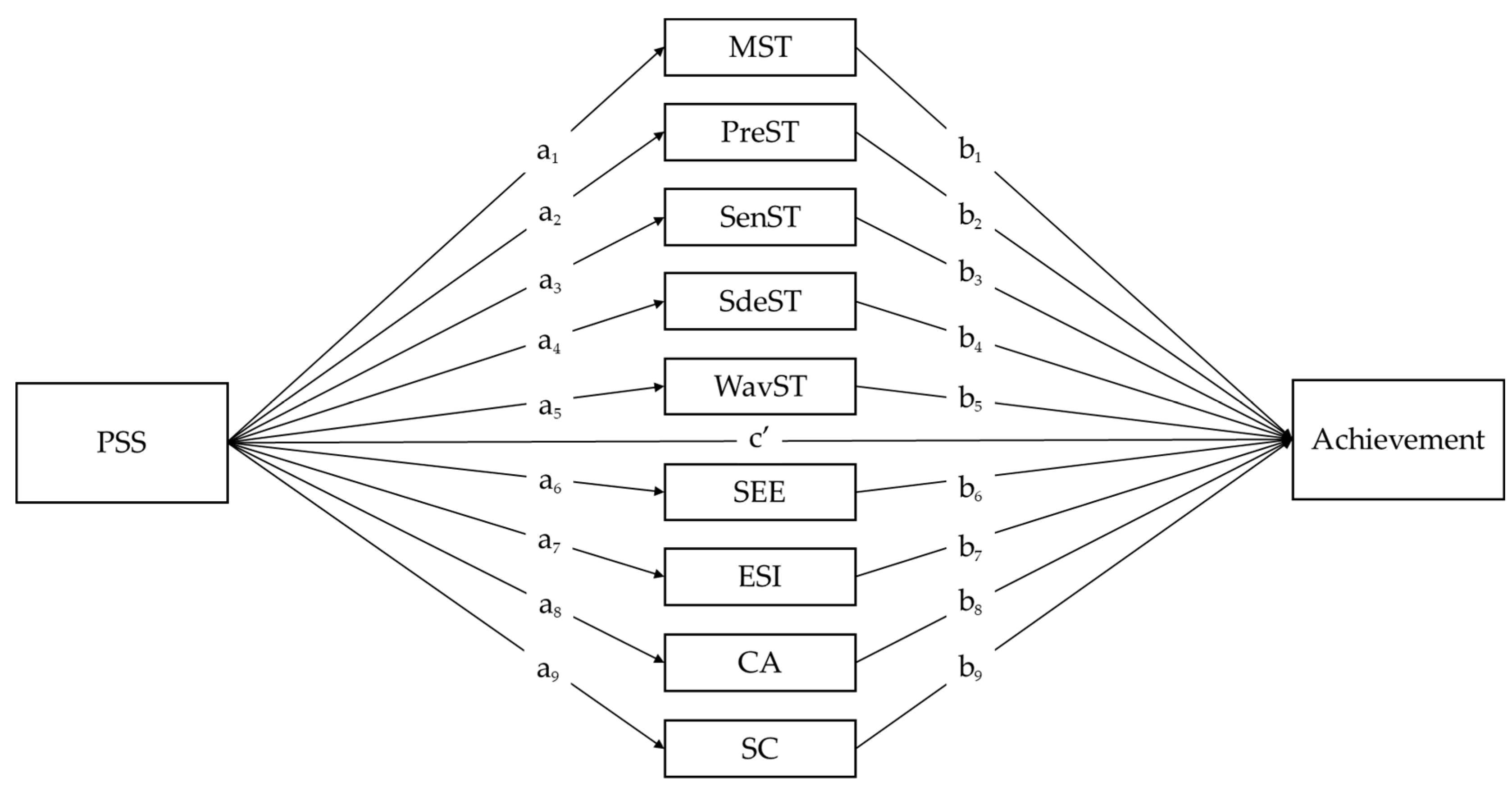
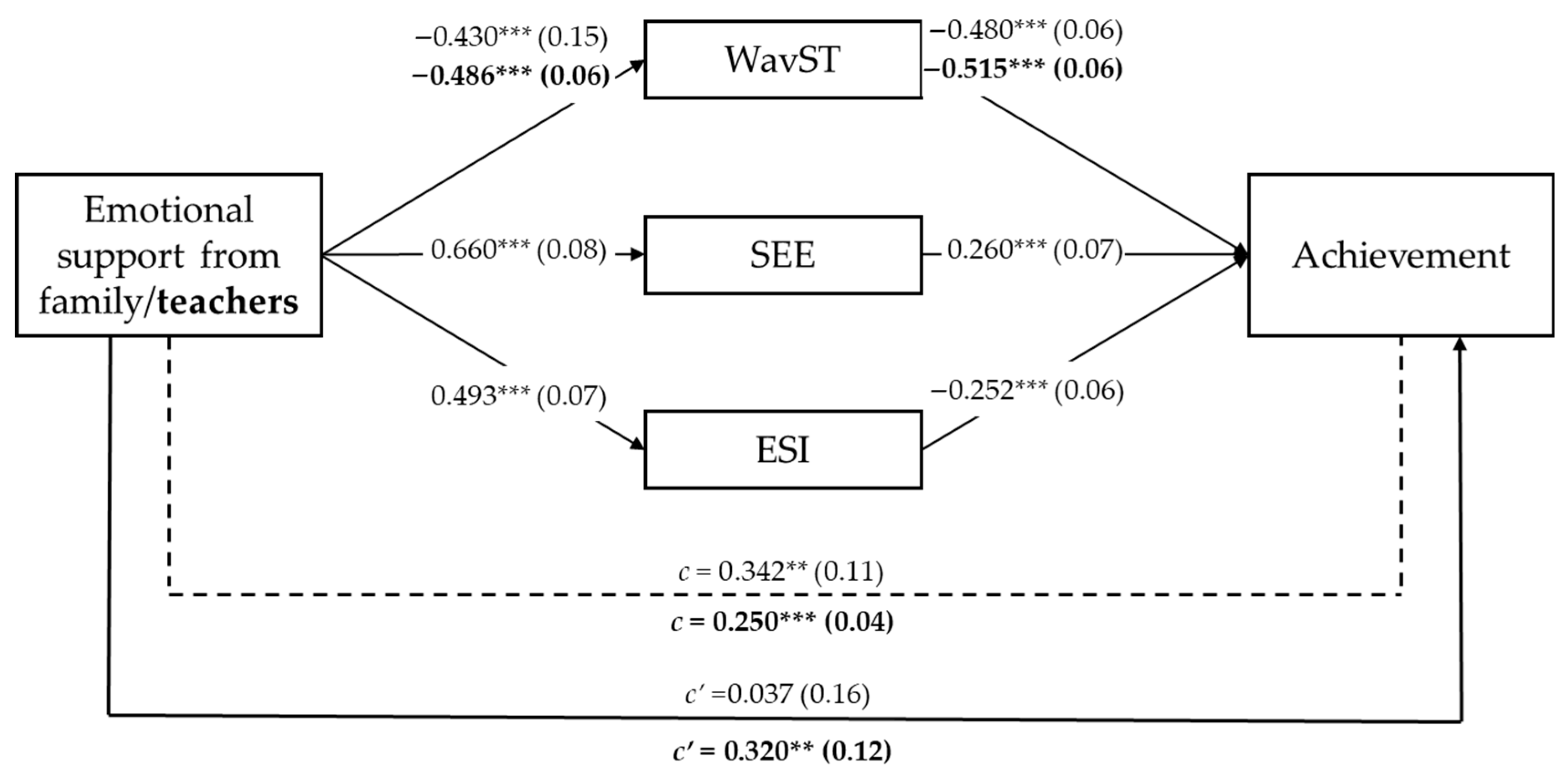
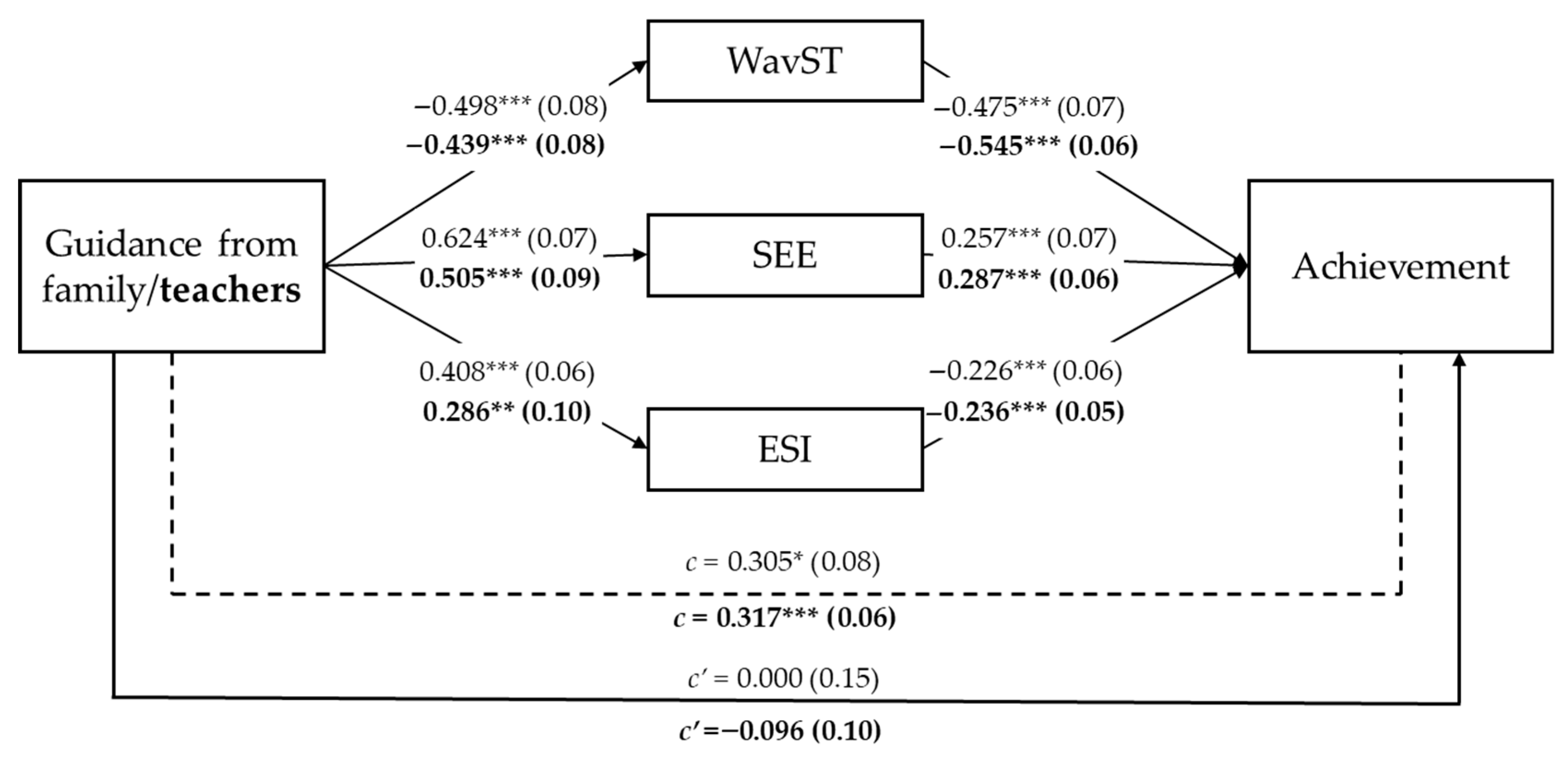
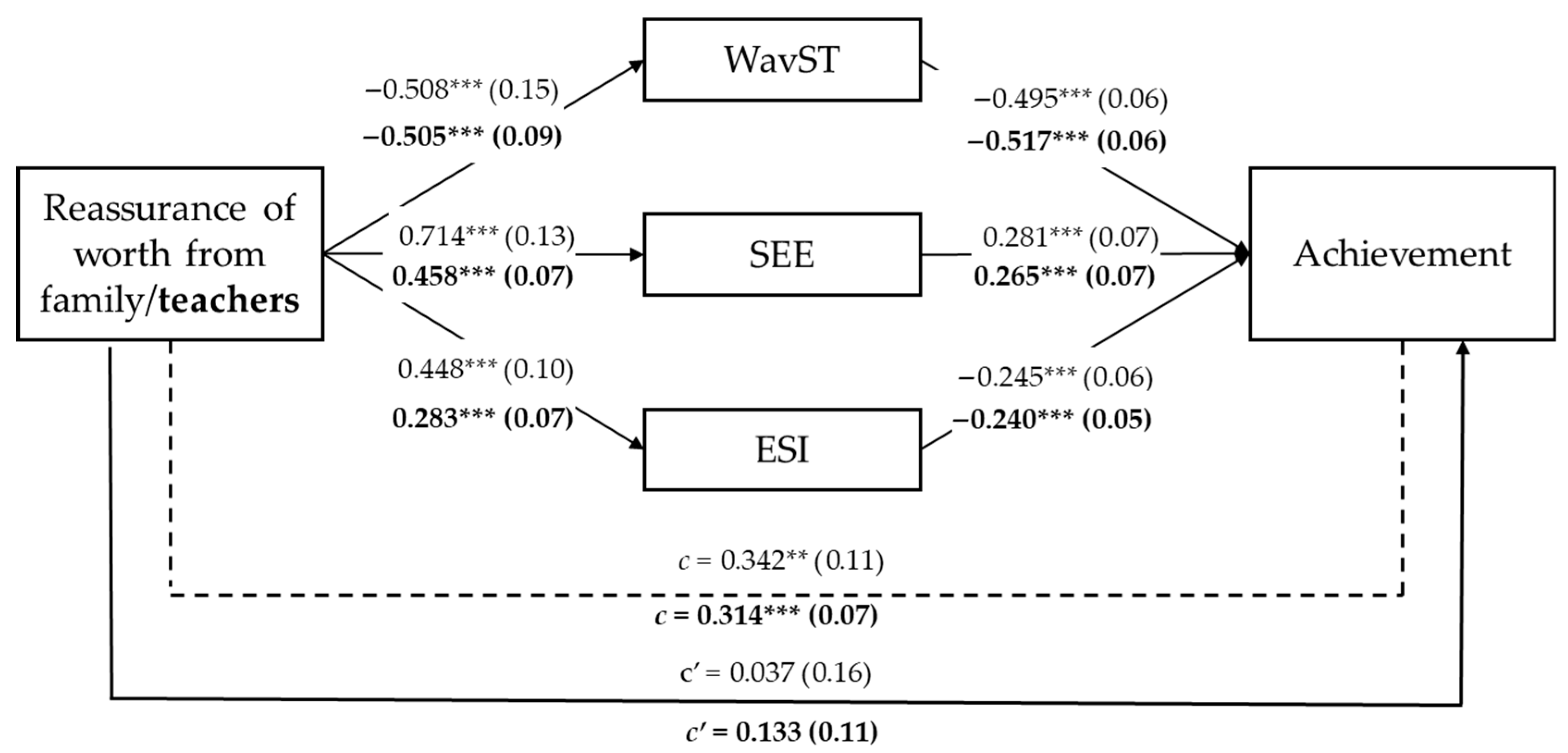
Disclaimer/Publisher’s Note: The statements, opinions and data contained in all publications are solely those of the individual author(s) and contributor(s) and not of MDPI and/or the editor(s). MDPI and/or the editor(s) disclaim responsibility for any injury to people or property resulting from any ideas, methods, instructions or products referred to in the content. |
© 2026 by the authors. Licensee MDPI, Basel, Switzerland. This article is an open access article distributed under the terms and conditions of the Creative Commons Attribution (CC BY) license.