Systematic Review

Enhancing Informal Education Through Augmented Reality: A Systematic Review Focusing on Institutional Informal Learning Places (2018–2025)


Department of Educational Sciences, TUM School of Social Sciences and Technology, Technical University of Munich, Arcisstraße 21, 80333 Munich, Germany
*
Author to whom correspondence should be addressed.
Educ. Sci. 2026, 16(1), 114; https://doi.org/10.3390/educsci16010114
Submission received: 27 November 2025 / Revised: 30 December 2025 / Accepted: 31 December 2025 / Published: 13 January 2026
(This article belongs to the Special Issue Investigating Informal Learning in the Age of Technology)

Abstract

Informal learning in institutional settings plays a vital role in lifelong education by fostering self-directed knowledge acquisition. With the increasing integration of digital media into these environments, augmented reality (AR) has emerged as a particularly promising technology due to its ability to overlay virtual content in real-time and across multiple sensory modalities. This systematic literature review investigates the use of AR in institutional informal learning places (IILPs) from 2018 to 2025, aiming to synthesize findings across the following overall research questions: (1) In which IILP contexts has AR been implemented, and what are the characteristics of the technology? (2) What learning-relevant functions and (3) outcomes are associated with AR in these settings? (4) Which learning theories underpin the design of AR interventions? Following the PRISMA guidelines, empirical studies were identified through comprehensive database searches (Scopus, Web of Science, IEEE Xplore, FIS Bildung) and cross-referencing. Forty-four studies were analyzed via qualitative content analysis. The goal is to provide a descriptive overview of findings, patterns, and relationships. Findings indicate that AR is widely adopted across diverse domains and institutional contexts, primarily through mobile-based AR applications for K–12 learning. Native app development signals growing technological maturity. AR enhances both cognitive and emotional-motivational outcomes, though its potential to support social interaction remains insufficiently investigated. The predominant function of AR is the provision of information. Most of the examined studies are grounded in constructivist or cognitivist learning theories, particularly the Cognitive Theory of Multimedia Learning. Only limited references to emotional-motivational frameworks and minimal references to behaviorist frameworks were found.

1. Introduction

Institutional Informal Learning Places (IILPs), including learning settings such as museums, zoos, and botanical gardens, are playing an increasingly significant role in education (Falk & Dierking, 2018; Schwan & Lewalter, 2020). These free-choice learning environments (Falk & Dierking, 2018) offer visitors opportunities to engage with authentic settings and real-world objects that are often inaccessible in classrooms or everyday life. For example, visitors of technical museums can interact with historical machinery, explore engineering principles through hands-on exhibits, and observe demonstrations of scientific phenomena. Furthermore, archeological artifacts can be physically examined in historical museums, while animals can be observed in their naturalistic habitats in zoos—experiences that are typically limited to textbook images in formal education.
Considering this, the question arises as to how such informal learning environments can be further enhanced to meet the evolving demands of a digital society. New cutting-edge digital technologies have revolutionized and irreversibly transformed all areas of our existence, including informal education (Xu et al., 2021). The integration of digital media in informal learning can enrich learning experiences by offering multimodal content, visual, auditory, and mixed-reality formats, and by adapting to individual learners’ prior knowledge and interests. Among such emerging technologies, Augmented Reality (AR) stands out as a particularly promising tool for supporting informal learning: It enables a blended experience by overlaying digital information onto the physical world in real-time, thereby creating immersive and interactive learning opportunities (Bachiller et al., 2023; C. Y. Chang et al., 2023; Innocente et al., 2023; Johnson et al., 2006). In museum learning, AR is often linked to facilitating access to otherwise unobservable phenomena or digital exhibit-related information (Zhou et al., 2022).
Despite its potential, the educational use of AR in IILPs remains insufficiently investigated. Previous reviews have primarily addressed AR in formal education settings (e.g., Akçayır & Akçayır, 2017; Garzón et al., 2019; Gopalan et al., 2023; Gonnermann-Müller & Krüger, 2025; Harnal et al., 2024; Hidayat & Wardat, 2023; Ibáñez & Delgado-Kloos, 2018; Kozlova et al., 2025; Pellas et al., 2019; Radu, 2014; Na & Yun, 2024). For example, Garzón et al. (2019) provided a comprehensive overview of AR in education across formal contexts, from early childhood education to the doctoral level. Hidayat and Wardat (2023) focused on STEM learning, and Gonnermann-Müller and Krüger (2025) on cognitive load during AR-based learning. Yet, less attention has been given to the role of digital media and AR in informal learning settings. In this regard, existing literature reviews regarding informal learning settings offer valuable insights into the use of digital media, in particular VR and AR (e.g., Degner et al., 2022; Goff et al., 2018; Markouzis et al., 2022; Ramsurrun et al., 2024; Stymne, 2020; Yun et al., 2022; Zhou et al., 2022). However, they focus on specific contexts (e.g., Zhou et al., 2022, on traditional museum learning, or Yun et al., 2022, on intergenerational group learning), specific age groups (such as youth aged7 to 18 years in Ramsurrun et al., 2024), and/or they require updating to account for the growing interest in AR in informal learning contexts (e.g., Goff et al., 2018). Recent developments—such as faster mobile Internet, enhanced computing capabilities, and the educational shifts prompted by the COVID-19 pandemic—have significantly influenced both AR technology and informal learning environments. Furthermore, Sommerauer and Müller (2018a) as well as Ramsurrun et al. (2024) noted that it is essential to solidify the learning-theoretical foundations of AR utilization to build cumulative knowledge on AR-based instructional design and its effectiveness, which is also a gap of the existing literature on AR in IILPs.
To address these gaps, this study presents a systematic and up-to-date literature review of empirical research on AR-based learning in IILPs, published between 2018 and 2025. This review aims to provide a contribution beyond prior work by mapping contexts, functions, outcomes, and underlying learning theories of AR use in IILPs. The review aims to investigate the recent educational use of AR in IILPs, focusing on (1) the context and characteristics of AR use in IILPs, (2) the instructional functions of AR interventions, (3) the learning outcomes of AR in IILPs, and (4) the theoretical frameworks guiding its use.

2. Theoretical Background

2.1. Institutional Informal Learning Places

Learning outside formal learning settings is increasingly taking place in environments such as museums, zoos, aquariums, science centers, open science labs, planetariums, exhibitions, botanical gardens, theme parks, or historical sites, which are collectively referred to as Institutional Informal Learning Places (IILPs). These settings provide learners with the opportunity to explore topics independently and through direct, hands-on experiences that are often unavailable in formal education or everyday life. For example, museum visitors can examine authentic archeological artifacts, while zoos and aquariums allow for real-time observation of animals in naturalistic environments—experiences that go beyond textbook learning.
Although informal learning lacks a universally agreed-upon definition, it is generally described as a lifelong, self-directed learning process that occurs outside of structured educational systems (Gerber et al., 2001; European Commission, 2002). Livingstone (2001) defines informal learning as any activity intended to foster knowledge and understanding that occurs outside of a prescribed curriculum. Unlike formal learning, it does not follow predefined goals, schedules, or instructional guidance, and it does not lead to certification. Learners choose what, when, and how they learn, often driven by curiosity or the need to solve real-world problems (Callanan et al., 2011). The process is typically holistic and experiential, with outcomes rooted in (practical) understanding. Visitors engage with IILPs either individually or in groups, each with distinct motivations such as entertainment, education, aesthetic appreciation, relaxation, social interaction, or interest in the location itself (Phelan et al., 2018). IILPs are primarily considered informal learning environments because they promote a lifelong process of self-directed learning that occurs outside formal educational systems and is, for example, mostly unintentional and not organized in terms of objectives (Cedefop, 2014). However, they can also be regarded as non-formal learning spaces when learning in informal settings occurs through organized programs or structured educational activities, such as school field trips to museums, even when a certain level of guidance and framing is provided. Thus, this review includes places that are considered informal because they do not award any form of certification, yet they extend into the non-formal domain through activities such as organized school visits.
Learning experiences in IILPs can spark interest, shape personal identity, and foster long-term engagement—particularly in scientific and natural domains (Schwan et al., 2014). To support these processes, IILPs are increasingly incorporating various learning materials, including digital tools such as institution-specific apps with AR features (Degner et al., 2022; Kampschulte et al., 2019), which aim to expand and support learning.

2.2. Digital Media in IILPs

Digital media, often referred to as ICT (Information and Communication Technology), enable interactive, multimedia-rich learning experiences that can be tailored to individual needs, supporting self-directed learning and helping overcome learning barriers (Moser & Lewalter, 2021).
In IILPs, digital media can present information in diverse formats, including visual, auditory, and immersive experiences like VR and AR. These tools are available in stationary forms (e.g., screens, audio terminals) and mobile formats (e.g., apps on tablets or smartphones), enabling personalized, self-paced learning. While digital media offers autonomy in interaction, overly complex choices may hinder learning; thus, intuitive and low-threshold designs are key (Schwan & Lewalter, 2020). Digital media can also support both the preparation and follow-up of visits and can transform passive observation into active exploration (Schwan et al., 2018). Accordingly, digital tools serve two main roles: as supplementary aids (e.g., animations explaining abstract concepts) and as interactive learning environments that also promote media literacy (Kampschulte et al., 2019). They help create engaging designs and improve accessibility (J. Li et al., 2024)
Digital media serve multiple educational functions in formal and informal learning environments. According to Ojstersek and Kerres (2010), they can support learning by (1) presenting information through varied formats, (2) enabling communication and collaboration, and (3) helping regulate learning processes. Petko (2020) expands this framework to five functions: (1) Information and presentation: conveying content through text, images, audio, or video, (2) Designing learning tasks: linking multimedia to real-world contexts, (3) Tools for creative work: supporting activities like writing or visualizing ideas, (4) Guidance and communication: facilitating interaction via chats, forums, or video calls, and (5) Assessment: enabling digital testing and feedback. In their review on AR in higher education, G. Li et al. (2025) found that the content delivery function was most used, with the largest effect sizes in their review.
Digital media have become increasingly relevant in IILPs, offering valuable support for informal learning by enhancing cognitive, communicative, and motivational processes (Jin et al., 2019; Degner et al., 2022). A study by Kampschulte et al. (2019) involving 120 IILPs found that digital media are primarily used for presenting information, followed by designing tasks and supporting creative work. Communication and assessment functions were used less frequently. Further studies in IILPs show that digital tools can foster knowledge acquisition, interest, and social interaction, though their collaborative potential remains underutilized (Zhou et al., 2022; Degner et al., 2022). Xu et al. (2021) found that the application of technology had a moderate to high effect on learning in museums.

2.3. AR in Informal Learning

Augmented Reality (AR) creates a blended experience of virtual and real elements by overlaying computer-generated, multisensory information, such as text, images, sounds, animations, or simulations, onto the physical world in real-time (Milgram & Kishino, 1994; Azuma, 1997; Sommerauer, 2019). This fusion of realities has led some researchers to refer to AR as “augmented immersive reality” (Cen et al., 2019).
Milgram and Kishino’s (1994) mixed reality continuum illustrates the spectrum between fully real and fully virtual environments. Within this, AR is positioned closer to the real end, as it supplements reality with digital content. According to Azuma, AR supplements reality, rather than completely replacing it (Azuma, 1997). Additionally, Azuma et al. (2001) introduced the concept of mediated or diminished reality, where real objects are visually removed by overlaying them with background-matching virtual content. Recent technological developments challenge the fluidity of the reality–virtuality continuum proposed by Milgram and Kishino (1994). While they suggest that AR and VR can be considered together, differences in design goals and user experiences complicate this view. Similarly, Azuma’s (1997) VR-centric perspective treats AR as a mere variation, which has been criticized (Rauschnabel et al., 2022). Rauschnabel et al. (2022) argued for a clear distinction: AR includes the physical environment as part of the experience, whereas VR excludes it entirely. Thus, simultaneous immersion in both is not feasible. They also highlighted differing use cases—AR is ideal when blending real and virtual elements is beneficial (e.g., overlaying historical reconstructions on ancient artifacts in a museum or showing animated animal behaviors in the wild next to real enclosures in a zoo), while VR suits scenarios where the real-world is inaccessible or unsuitable (e.g., exploring a fully reconstructed ancient city or experiencing deep-sea ecosystems that cannot be visited in person). Moreover, AR allows real-world social interaction, whereas VR relies on avatars for communication. They further propose an AR experience spectrum, ranging from assisted reality, with a low perceived presence of virtual elements, to mixed reality, where virtual content is more fully integrated into the physical environment.
Benefits and Challenges of AR-Based Learning: Research shows that AR can significantly improve learning outcomes, including performance, motivation, engagement, enjoyment, and positive attitudes (Akçayır & Akçayır, 2017; Bacca et al., 2014; Radu, 2012). It supports learner-centered, experiential learning and fosters collaboration, confidence, and multisensory engagement. Usability, realism, and interactivity are key factors contributing to its effectiveness (Gopalan et al., 2023). Meta-analyses also highlight AR’s role in improving the comprehension of abstract concepts, as well as both lower- and higher-order cognitive skills, and autonomy (Garzón et al., 2019; Ibáñez & Delgado-Kloos, 2018). Gamification elements further enhance engagement, especially in informal learning settings (Ramadhan et al., 2022). Moreover, augmented reality can deliver personalized information and feedback tailored to users’ choices or be integrated with interactive digital storytelling technologies to create a more immersive learning experience (Markouzis et al., 2022). Studies conducted in informal learning environments have documented beneficial outcomes, such as enhanced memory retention (Sommerauer & Müller, 2014), deeper comprehension of specialized content (Yoon et al., 2017), and improved collaborative engagement (Yoon et al., 2012; Yun et al., 2022).
However, technical and user-related challenges persist in learning with AR. Common issues include unstable content rendering, sensor inaccuracies, and display limitations (Bacca et al., 2014; Azuma et al., 2001). Usability problems, cognitive overload, and distraction due to novelty can hinder learning (Sommerauer, 2019; Dunleavy et al., 2009). Accessibility remains limited, especially for learners with special needs, and privacy concerns arise from data collection via cameras and GPS (Rauschnabel et al., 2022). While most studies reported positive outcomes, experts suggest that AR should complement rather than replace traditional learning, emphasizing its complementary role in deepening engagement (Yun et al., 2022; Goff et al., 2018).

2.4. Learning-Theoretical Foundations of AR Use in IILPs

To understand how AR supports learning in IILPs, it is essential to consider basic learning theories and the cognitive processing of knowledge (Petko, 2020). According to Zhou et al. (2022), the theoretical foundations for incorporating immersive media, such as AR, in museum learning are grounded in experiential learning, situated and active learning, as well as multimedia learning theories. Scavarelli et al. (2021) mention various learning theories in the context of AR, including constructivism, social cognitive theory, connectivism, and activity theory. Bower et al. (2014) contend that AR is well-suited for informal learning environments, as its application aligns with key pedagogical frameworks, including situated learning, game-based learning, and inquiry-based learning. Sommerauer and Müller (2018a) reviewed AR studies regarding learning-supportive design principles suggested by multimedia theories, theories related to mobile learning, game-based and simulation-based learning theories, experiential learning, and situated learning theories. Ramsurrun et al. (2024) stated that the use of digital technologies in informal science education is based on these theories that help design learning and teaching methods to improve engagement, collaboration, and build knowledge. They advocate that more studies should investigate these underlying learning theories.
In general, learning is commonly defined as a process resulting in relatively lasting changes in behavior or behavioral potential through experience (Bodenmann et al., 2016; Rogers, 2014). Over the past century, educational theory has evolved through three major paradigms: behaviorism, cognitivism, and constructivism, each offering distinct perspectives that may coexist in real learning situations (Sommerauer & Müller, 2018a). In the following section, we outline the basic ideas of each paradigm and sketch in broad terms selected theories or approaches and their potential for understanding AR’s contribution to possible learning processes and outcomes.
Behaviorist Perspectives: Behaviorism views learning as a response to external stimuli, with the learner playing a passive role (e.g., Skinner, 1974). Learning occurs through conditioning and imitation, as illustrated by Pavlov’s dog experiments (Pavlov, 1928). Educational applications include drill-and-practice programs designed to reinforce specific behaviors. It is an open question whether and in which way actual studies on AR use behaviorist learning theories as a theoretical foundation. This could be the case, for example, by demonstrating tasks or tool usage with immediate feedback, helping learners adjust their actions accordingly. However, in their study, Sommerauer and Müller (2018a) were unable to find an article that used behaviorist theories as the foundation for the design of AR learning evaluation.
Cognitivist Perspectives: An approach frequently used in current educational and psychological research lies in cognitivism, which views learning as an active mental process where learners organize, store, and retrieve information through activities such as communication, problem-solving, and recombination (Rogers, 2014). Cognitivist theories focus on various aspects of learning, including memory models, cognitive load during learning, the design of learning materials, and types of knowledge.
A key model is the multi-store memory model by Atkinson and Shiffrin (1968), which describes how sensory input is briefly registered, filtered, and either forgotten or transferred to short-term memory. This memory holds about 7 ± 2 information units for up to 20 s. Through rehearsal and elaboration, information can be encoded into long-term memory, which stores data either consciously or unconsciously (Petko, 2020). Building on this, Cognitive Load Theory (CLT) (Chandler & Sweller, 1991) emphasizes the limits of working memory and distinguishes three types of cognitive load: Intrinsic load (complexity of the content), Extraneous load (distractions from poor design), and Germane load (mental effort for building new knowledge structures; Sweller et al., 1998). Mayer’s Cognitive Theory of Multimedia Learning (CTML) (Mayer, 2005) integrates these ideas, proposing that learners process information through two separate channels—visual and verbal—with limited capacity. Effective learning requires active selection, organization, and integration of multimedia content with prior knowledge. Building on Cognitive Load Theory (CLT) and Mayer’s Cognitive Theory of Multimedia Learning (CTML), twelve multimedia design principles were developed to optimize digital learning materials (Mayer & Fiorella, 2014). These include combining words and images (multimedia principle), using narration with graphics (modality), placing related content close together in time and space (contiguity), and avoiding redundant or irrelevant elements (coherence and redundancy). Additional principles include segmenting content, highlighting key information (signaling), pre-training, using conversational language (personalization), and avoiding unnecessary visuals, such as speaker images (image principle).
Cognitivist theory also distinguishes between three types of knowledge: (1) Declarative knowledge: factual and conceptual understanding (e.g., definitions, categories, mental maps), (2) Procedural knowledge: practical application of declarative knowledge, often unconscious and situational, and (3) Metacognitive knowledge: awareness of one’s own learning strategies and self-regulation (Pintrich, 2002; Petko, 2020). Effective learning often involves all three types of learning. For example, media and information literacy requires factual understanding, practical skills, and reflective awareness (Dobryakova et al., 2023).
Regarding AR, Akçayır and Akçayır (2017) argue that applying the CTML principles to AR helps reduce cognitive load and support sensory-based understanding, especially relevant for younger learners. Accordingly, Sommerauer and Müller (2018a) found that AR studies frequently referenced CTML principles, noting AR’s ability to balance visual and auditory input and reduce extraneous load. They argue that the major design elements for content creation should focus on the learning content itself and be supported by cognitive theories and, therefore, independent from aspects derived from other, e.g., constructivist, learning theories. Several studies in their review successfully constructed their learning content in this way. However, they noted that not all CTML principles seem to be applicable for AR learning. They also found that embodied learning principles (e.g., the effects and actions of the body and its movements) serve as a basis for AR learning environments. J. Chen et al. (2023c) further support this, showing that AR visualizations ease mental effort and enhance task performance. However, not all principles apply equally to AR; Sommerauer (2019) highlights the relevance of the multimedia, modality, contiguity, and signaling principles. For example, mobile AR supports spatial contiguity by embedding information directly into the physical environment, reducing attention shifts (Schwan et al., 2018). These principles are also relevant to IILPs, as demonstrated in art exhibitions, where personalization (e.g., biographies) and multimodal content have been shown to increase engagement. While text offers flexibility in use, museums rely heavily on visuals, and audio guides help balance cognitive load. Studies show that audio guides increase dwell time, indicating deeper interest and elaboration (Schwan & Lewalter, 2020). In their review, Gonnermann-Müller and Krüger (2025) evaluated the overall impact of AR attributes on cognitive load and provided additional recommendations for AR design. To what extent cognitivist theories provide theoretical foundations for current AR research in IILPs remains an open question that this study aims to address.
Constructivist Perspectives: Evolving further, constructivism places the learner at the center of knowledge acquisition, suggesting that they are an active constructor of flexible cognitive network structures built from personal experiences, social interactions, and their reflection (e.g., Piaget, 1954). However, rather than receiving knowledge from external sources, learners seek to make meaning of their experiences through problem-solving and engagement in motivational and interactive contexts, utilizing self-directed task-based learning. Thus, learners construct their own individual understanding of the world. Knowledge cannot be transferred, as suggested in cognitivism or behaviorism, but its individual development can only be stimulated. Whether and how learning occurs lies in the responsibility of the learner (Sefton-Green, 2004; Rogers, 2014; Sommerauer & Müller, 2018a; Petko, 2020). Constructivist didactics, therefore, aim to provide learners with experiences through which they can independently expand or revise their prior knowledge, comprising principles such as situated learning, game-based learning, experiential learning, cooperative learning, or mobile learning (Sommerauer & Müller, 2018a; Sommerauer, 2019). Traditional constructivism focuses on individual gains but is often enriched by the contributions of Vygotsky (1978), who developed a more socio-cultural learning theory, namely social constructivism, where existing collective knowledge bases are not only assimilated but also co-constructed and shaped within contexts of specific communities, since humans are social beings. Consequently, social competencies such as communication (observing, receiving, and participating in information exchange, as well as sharing diverse opinions) and collaboration (cooperative teamwork towards common goals through shared responsibilities, problem-solving, decision-making, and conflict resolution) are emphasized, particularly in the recognition that collective efforts can achieve more knowledge (Sefton-Green, 2004; Rogers, 2014; Sommerauer & Müller, 2018a; Sommerauer, 2019; Petko, 2020).
Learning with digital media, such as AR in IILPs, can be viewed as a constructivist process under the aforementioned conditions (Lewalter & Noschka-Roos, 2009). Ramsurrun et al. (2024) noted that digital tools support constructivist learning by providing interactive platforms for simulations and multimedia exploration, thereby reducing cognitive load and offering adaptive experiences tailored to individual needs. To explain the positive outcomes of AR/VR usage in museum learning, Zhou et al. (2022) argue that AR/VR provides settings that are conducive to enabling experiential or situated learning. Sommerauer and Müller (2018a) found, consistent with Zhou and colleagues (Zhou et al., 2022), that constructivist theories were the primary basis for AR interventions with subcategories including situated learning, game-based learning, and experiential learning.
Emotion- and Motivation-Psychological Perspectives: Emotions play a crucial role in learning, although their influence in informal contexts has received limited scholarly attention (Rowe et al., 2023). Positive emotions and attitudes tend to foster meaningful learning experiences, while negative ones can hinder it (Petko, 2020). Motivation is the internal process that initiates, guides, and sustains goal-directed activity, such as learning activities. It emerges when an individual’s personal needs, values, or interests align with supportive environmental conditions, such as perceived autonomy, competence and relatedness (Ryan & Deci, 2017), enabling self-regulated engagement in learning (Urhahne & Wijnia, 2023). For example, the Self-Determination Theory (SDT), as proposed by Ryan and Deci (2017), distinguishes between different forms of extrinsic motivation (driven to a varying extent by external factors) and intrinsic motivation (driven by curiosity, enjoyment, or personal goals). Increasingly, determined forms of extrinsic motivation and intrinsic motivation are strengthened when learners experience competence, autonomy, and relatedness, three basic psychological needs. However, as research has shown, social interaction remains underrepresented in many AR applications (Degner et al., 2022).
Another relevant emotion and motivation-related model is Keller’s (1987) ARCS model, which outlines four key elements for motivation: Attention (evoked through novelty and engaging design), Relevance (connection to learners’ goals or experiences), Confidence (belief in success through achievable tasks), and Satisfaction (positive outcomes that reinforce engagement).
Regarding AR-based learning in IILPs, it can be assumed that the basic needs can be addressed by enabling self-regulated activities, providing technical reliability, and offering appropriately challenging tasks with constructive feedback (Buchner, 2017; Garzón et al., 2019; Moser & Lewalter, 2021). However, as research has shown, social interaction remains underrepresented in many AR applications (Degner et al., 2022). Y.-S. Chang et al. (2020) utilized the ARCS motivational framework to develop an augmented reality-supported situational classroom for English instruction. Their findings indicated that this approach significantly improved learner satisfaction during the experimental teaching phase. Thus, the mentioned frameworks help explain why AR can be a powerful tool for increasing motivation and emotional involvement in informal learning environments.
Overall, the behaviorist, cognitivist, constructivist, and emotion-, and motivation-based perspectives offer distinct approaches to learning, all of which are reflected in the use of AR within IILPs. Behaviorist models focus on stimulus-response patterns and immediate feedback, whereas cognitivist theories emphasize the processing and organization of information, considering the limitations of working memory. Constructivist approaches highlight active, self-directed knowledge construction in social contexts. Complementing these, motivational frameworks such as Self-Determination Theory and the ARCS model illustrate how emotional factors and the fulfillment of psychological needs can positively influence learning behavior. For AR to be effectively implemented in informal learning environments, it requires instructional design that thoughtfully takes up these theoretical foundations.
It is notable that in Sommerauer and Müller’s (2018a) review, several papers referenced more than one theory from a single paradigm, e.g., referencing both cognitivist and constructivist theories. They concluded that creating an effective learning experience may require incorporating ideas from multiple learning theories.

3. Research Questions

The theoretical background has shown that informal learning plays a vital role in lifelong knowledge acquisition. Among various contexts, IILPs, such as museums, nature parks, and science centers, offer authentic, self-directed learning opportunities for diverse audiences. The integration of digital media, especially AR, enhances these environments by enabling adaptive, exploratory, and socially interactive experiences within a free-choice learning environment.
AR has gained attention for its ability to overlay virtual content onto the real world, supporting multisensory immersion and improving comprehension, motivation, and collaboration. Constructivist theories explain AR’s potential for experiential knowledge building, while cognitivist models highlight its role in reducing cognitive load through multimedia design principles (e.g., CLT and CTML). Motivation theories such as Self-Determination Theory (SDT) and Keller’s ARCS model further justify AR’s effectiveness by addressing psychological needs and engagement factors.
Although interest in AR-based learning is growing, research on its use in informal learning seems somewhat limited. Studies often lack a detailed analysis of learning processes in varied IILP contexts, and many AR-related reviews focus on formal education or specific subjects, technologies, or venues. Moreover, there is a need for reviews that account for recent technological advances, which have been driven forward by, among other things, the COVID-19 pandemic as an important driving force.
To address these gaps, this study conducts an updated, comprehensive, and systematic literature review of empirical research on AR in informal learning from 2018 to 2025. It examines the IILPs in which AR has been studied, the functions of AR employed, the design of AR-based learning activities, the learning outcomes considered and the learning theories underpinning these studies. The following research questions guide this investigation:
RQ 1a. 
In which IILPs have AR applications been investigated?
RQ 1b. 
What are the characteristics of the AR media used?
RQ 2. 
Which learning-relevant functions are present in AR interventions examined in IILPs?
RQ 3. 
Which learning outcomes of AR interventions are studied in IILPs?
RQ 4. 
Which learning theories are cited in the studies as the basis for AR interventions?

4. Methods

The review process follows the PRISMA guidelines (https://www.prisma-statement.org/scoping; accessed on 27 October 2025) for comprehensive literature reviews, ensuring transparency in the eligibility criteria, information sources, search and selection strategies, as well as the data collection and synthesis process.

4.1. Manuscript Selection Process

4.1.1. Query Terms and Search Protocol in Selected Databases

To identify relevant literature, four well-established academic research databases were selected: Scopus, Web of Science, IEEE Xplore, and FIS Bildung. The latter also aggregates content from databases such as ERIC, Casalini Libri, Online Contents, Library of Congress, EBSCOhost eBooks, and BASE. These digital libraries are particularly relevant to the fields of education, information technology, and the social sciences, ensuring broad coverage of reputable scholarly publications that align with the research questions of this study. All selected databases offer extensive collections of peer-reviewed literature, are accessible either freely or via institutional access, and provide efficient tools for downloading or linking to original sources.
The literature review was based on bibliometric data from 2018 to 2025 and carried out in two stages: the initial search in December 2023 by the first reviewer, followed by an update in November 2025 by a second reviewer to ensure the inclusion of the most recent publications. Search terms were organized into three thematic groups corresponding to the core topics of this review: the use of Augmented Reality (AR) (9 terms), its application in informal learning (11 terms), and its integration into Institutional Informal Learning Places (IILPs) (31 terms) (see Table 1).
The search phrases for ‘AR’ and ‘informal learning’ included not only these explicit terms but also their synonyms. Although terms like mixed reality and non-formal learning are not strictly synonymous with AR and informal learning, they have been used interchangeably in scholarly discourse and were therefore included. Additionally, the term ‘digital learning’ was incorporated under ‘informal learning’ due to its prevalence in recent educational research and its relevance to AR-based learning, which inherently relies on digital technologies. Keywords for the area of IILPs were derived from theoretical considerations, supplemented by a thesaurus-based descriptor search in ERIC and informed by Degner et al.’s (2022) findings and recommendations.
In addition to specific terms such as museum or after-school, more general descriptors like center (or centre in British English) were included to capture a broad range of informal learning environments, such as science centers, entertainment venues, environmental education facilities, and visitor centers. This inclusive approach aimed to reflect the diversity of potential informal settings for AR-based learning. Similarly, the term park was used to encompass both theme parks and nature parks, camp referred to contexts such as summer camps, garden was used in conjunction with botanical garden, and event or festival were applied to occasions like science festivals. The search strategy involved combining three thematic groups of keywords using the Boolean operator AND, while individual terms within each group were connected via OR and enclosed in quotation marks to ensure exact phrase matching. Asterisks were employed to account for grammatical variations, including plural forms. This method was designed to ensure a comprehensive and representative search by systematically linking relevant keywords and synonyms from all three thematic domains in alignment with the research questions.

4.1.2. Multistep Elimination Based on Inclusion and Exclusion Criteria

In accordance with the outlined search strategy, specific inclusion and exclusion criteria were defined to identify eligible studies for this review (see Table 2). For example, to be considered for inclusion, a publication had to constitute an original research contribution and undergo a peer-review process. Accordingly, only peer-reviewed empirical journal articles and book chapters were included, while literature reviews, meta-analyses, book reviews, and editorials were excluded.
Eligible studies had to be published in either English or German, as publications in other languages were excluded due to limitations in language proficiency. Furthermore, only studies published from the year 2018 onwards were considered, reflecting the review’s focus on digital media and its relevance to contemporary educational technologies.
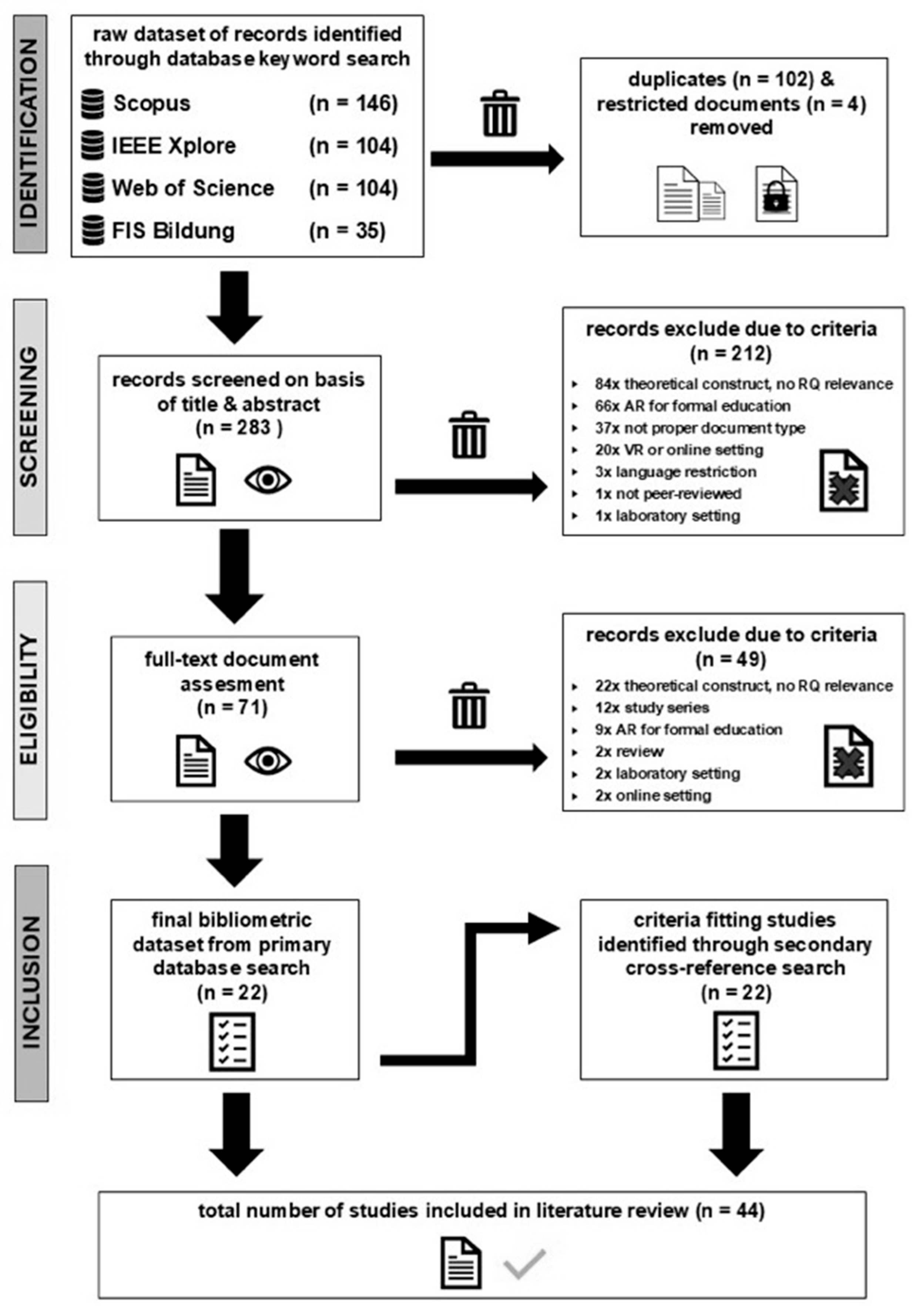
Based on this search, a total of 389 hits emerged, 146 from Scopus, 104 from IEEE Xplore, 104 from Web of Science, and 35 from FIS Bildung database. The identified hits were checked for duplicate entries across databases, and 102 duplicates and four restricted documents were removed. In the next step, the title and abstract of the remaining 283 hits were screened for eligibility, and another 212 hits were excluded because, for example, 84 manuscripts focused on theoretical frameworks that were not relevant to the research questions, and 66 articles dealt with AR in formal education. All exclusion criteria are outlined in the flowchart in Figure 1. The remaining 71 hits were reviewed in detail to determine whether they were appropriate for the underlying research purposes. A further 49 articles were excluded, including 22 that focused on theoretical frameworks not relevant to the research questions, and 12 studies reported study series. This search contributed 22 articles as part of the systematic review (Figure 1).
In a second step, the articles identified in the initial search, along with relevant literature reviews, were cross-referenced to uncover additional eligible studies. This process included backward referencing (examining reference lists) and forward referencing via Google Scholar (identifying citing publications). As a result, 22 further studies meeting all of the inclusion criteria were identified. A total of 44 studies were included for detailed analysis. The assessments were conducted independently by the reviewers; in cases of uncertainty, consensus was sought with the first author. No formal registration of the review protocol was undertaken.

4.2. Analysis Regarding the Research Questions

4.2.1. Research Question 1a and 1b

To enable a more detailed analysis, Research Question 1 was divided into two sub-questions: RQ 1a: In which IILPs have AR applications been investigated? And RQ 1b: What are the characteristics of the AR media used?
RQ 1a aimed to provide an overview of the study contexts (see Table S1, see Supplementary Materials). Eight categories were defined: (1) study (authors and year), (2) document type (journal article, book chapter, conference paper, (3) learner type (e.g., general public, families, Kindergarden/K–12/tertiary/post-secondary/non-tertiary level learners, with a distinction between organized, curriculum-embedded excursions and non-specified institutional trips (which still imply a certain level of institutional structuring, and are therefore more formalized than general public visits), (4) age group (e.g., preschoolers, teenagers, different age groups of adults), (5) sample size (small [30 or less], medium [31–200], large [over 200]), (6) group size (e.g., pairs, 3–4, 5+), (7) domain (such as Architecture, Biology, Literature, Medicine, Mathematics, etc.) and place (e.g., museum, park), and (8) intervention duration (short-term, long-term, cross-sectional, longitudinal).
RQ 1b focused on the technical and design aspects of AR media (see Tables S2 and S3 in the Supplementary Materials). Three main categories were defined: (1) hardware: subdivided into device type (e.g., head-worn, handheld), ownership (provided vs. private), and mobility (mobile vs. stationary); (2) software: included application name, development tool, availability (web-based vs. native), and AR deployment type (marker-based, location-based, outline-based, projection-based), and (3) AR format: eight subcategories were identified: text, image, audio, video, animation/simulation, web redirection, tangible interface (e.g., gesture-based interaction), and other formats—to capture the diversity of AR content delivery.

4.2.2. Research Question 2

To address RQ 2 (Which learning-relevant functions are present in AR interventions examined in IILPs?), a category system was developed based on the five pedagogical functions of digital media as outlined by Petko (2020) and Degner et al. (2022) (see Table S4 in the Supplementary Materials). These categories include: (1) information (content delivery function, provision of augmented content such as facts, visualizations, or explanations), (2) task (AR-supported learning tasks with specific instructions), (3) communication and collaboration (AR-mediated interactions among learners), (4) documentation and processing (AR functionalities that enable learners to record, manipulate, or transform content), and (5) assessment and feedback (use of AR for evaluating performance or offering feedback).

4.2.3. Research Question 3

To address RQ 3 (Which learning outcomes of AR interventions are studied in IILPs?), five overarching categories were developed (see Table S5, in the Supplementary Materials): (1) research design (no comparison = single AR condition; comparison = AR vs. non-AR condition; and instructional variation = different AR-based conditions, e.g., scaffolding types), (2) research method and data collection (methodological: qualitative, quantitative, mixed methods; instrumental: questionnaires and surveys, knowledge tests, interviews, artifacts such as worksheets, and observations), (3) cognitive learning outcomes, (domain-specific declarative knowledge such as factual, conceptual, spatial understanding; procedural knowledge such as hands-on skills and problem-solving; metacognitive knowledge such as self-regulation and reflection; media literacy related to AR technology; multisensory outcomes such as motor skills; cognitive load as well as unspecified general learning), (4) emotional-motivational learning outcomes (emotions and attitudes such as enjoyment, empathy, confusion; attention and interest such as curiosity, novelty, boredom; relevance such as perceived usefulness or intention for future use; satisfaction; autonomy such as self-paced learning; intrinsic or extrinsic motivation), and (5) social learning outcomes (communication; joint engagement; collaboration).
All learning outcomes were extracted primarily from the results sections of the studies to ensure a focus on empirical findings rather than interpretative commentary. Both positive and negative outcomes were included and marked accordingly (+/−) to provide a nuanced overview.

4.2.4. Research Question 4

To address RQ 4 (Which learning theories are cited in the studies as the basis for AR interventions?), a categorical analysis was conducted based on the theoretical framework outlined in the theory section. Studies were classified according to four overarching categories: (1) behaviorist, (2) cognitivist, (3) constructivist, and (4) emotional-motivational learning theories (see Table S6, in Supplementary Materials). Only explicitly stated theoretical foundations were considered. Deductive interpretations of learning theories found in the discussion sections were excluded, as the focus of this research question lies in the predefined theoretical rationale for employing AR in informal learning contexts.

5. Results

The results were synthesized through a combination of quantitative analysis and a narrative approach. The results are presented both narratively and quantitatively, organized by category. Overview tables (see Supplementary Materials) were used to present key characteristics and findings. The goal was to provide a descriptive overview of findings, patterns, and relationships.

5.1. IILP—Context Description of AR Use Investigated

RQ 1a aimed to provide an overview of the study contexts via eight categories (see Table S1 in the Supplementary Materials).
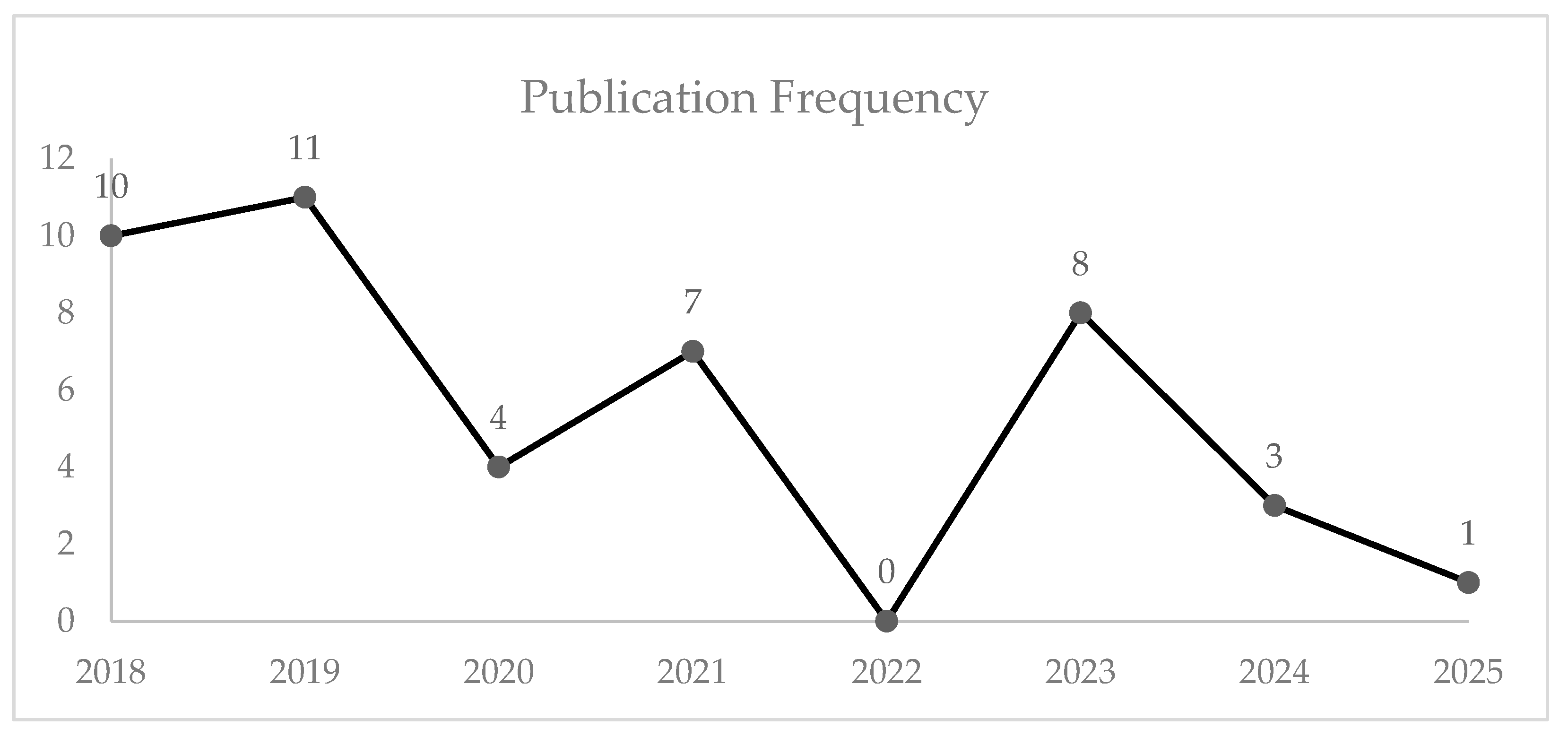
(1) Study: Ten studies were published in 2018, and eleven studies in 2019. For the remaining years, each recorded fewer than 10 publications in contrast to 2018 and 2019, with four in 2020, seven in 2021, eight in 2023, three in 2024, and one in 2025 (see Figure 2).
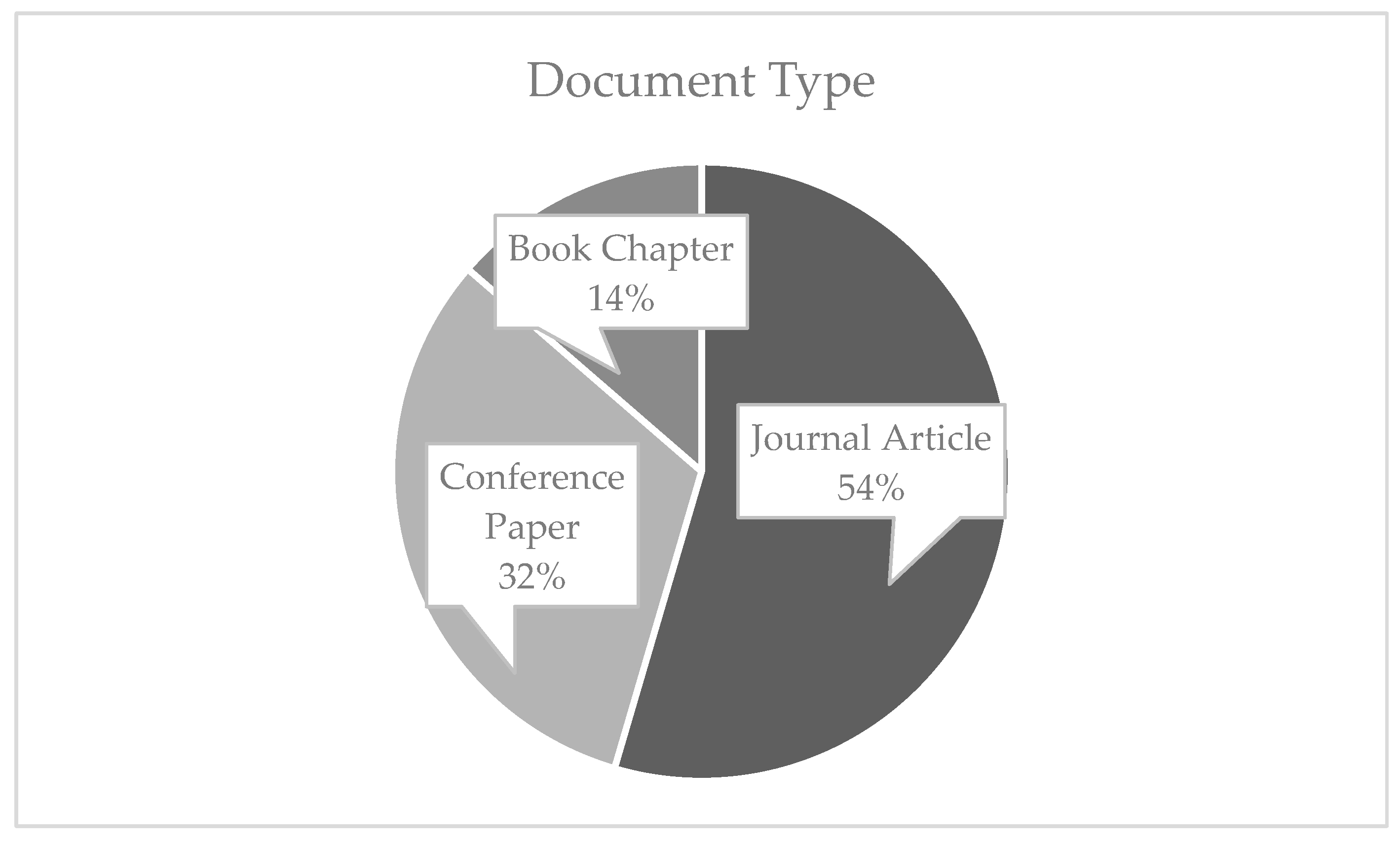
(2) Document Type: 24 journal articles were found, while 14 studies were attributed to conference proceedings, and only six were published as book chapters (see Figure 3).
(3) Learner Type: Across the analyzed studies, K–12 learners represented one of the two largest learner groups, appearing 19 times in total (including both 10x organized and 9x unspecified visits). Within this category, primary school learners were the most frequently mentioned (10 occurrences), followed by secondary school learners (7 occurrences), and an additional 2 instances referring to K–12 learners in general, without specifying the grade level. The same overall frequency (19 occurrences) was found for the general public, making these two groups the most addressed audiences in the reviewed literature. In contrast, tertiary learners appeared noticeably less often, with 7 occurrences across organized and unspecified visits. Notably, no studies reported explicit visits involving kindergarten learners from kindergarten institutions. Example of an organized K–12 field trip at the primary level (Aguayo & Eames, 2023): Pre- and post-visit in-class activities were implemented, into which the excursion to the Marine Discovery Center was embedded, in order to enhance learners’ understanding of complex marine conservation science. Nevertheless, free-choice learning was possible at the center; learners followed their own interests rather than a predetermined sequence. Example of an unspecified school trip (Cesário & Nisi, 2023): The study mentions that teenagers aged 15–19 from several schools took part, but it does not specify whether the exhibition topics were aligned with the curriculum or whether pre- or post-visit lessons were conducted in school. Example for the general public (Barbosa et al., 2021): Although four tasks were provided for the general public—namely, voluntary adult participants—to complete, they were still free to explore other exhibits and content. This represents a mix of non-formal and informal learning (which is likely common, as AR needs structured elements for testing purposes, while simultaneously incorporating the benefits of free-choice, self-regulated learning typical of IILP settings). One example emerged at the post-secondary/non-tertiary level in Sugiura et al.’s (2019) study, where nurse and paramedical students visited an AR-enhanced medical museum alongside medical university students, showcasing that multiple learner types were often the target group. Lastly, the subcategory of families as participating learner type was identified once, specifically in H. T. Zimmerman et al.’s (2023) study, which exclusively invited family groups to participate in the investigation on AR-based learning in an arboretum. One study (Lee et al., 2025) targeted kindergarten, K–12 learners, as well as their parents, but they were grouped as the general public because they participated as voluntary museum visitors selected at random. Two studies remained unspecified regarding the type of learner.
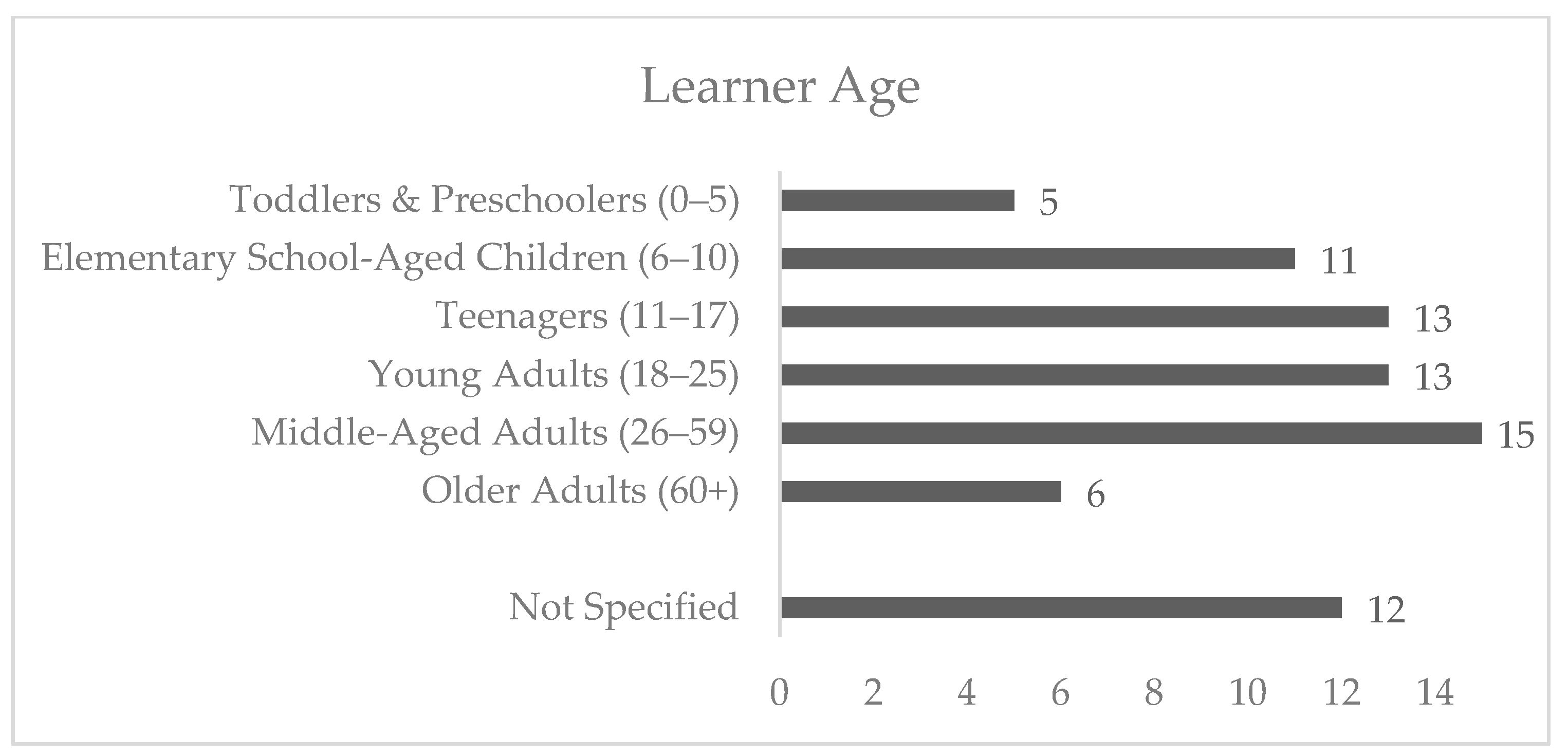
(4) Age Group: Middle-aged adults (26–59 years) were the most frequent participants with 15 counts in total (see Figure 4), closely followed by teenagers (11–17 years) and young adults (18–25 years) with 13 counts, and elementary school-aged children (6–10 years) with 11 counts. Toddlers and preschoolers (0–5 years), respectively, and older adults (60+ years) were less often identified, particularly in only five, respectively, six cases. A total of 27% of the reviewed studies (12 cases) did not mention the age of their participants at all. However, a combination of various age groups in the investigations, which mentioned the participants’ ages, was encountered 16 times, e.g., Guedes et al. (2024) or Lee et al. (2025).
(5) Sample Size: Most studies involved medium-sized samples (31–200 participants, 26 instances), followed by small samples (≤30 participants, 15 instances), and, lastly, large samples (>200 participants, 3 instances). The overall sample sizes in the reviewed studies ranged from 5 (Barbosa et al., 2021, or El Bedewy et al., 2024) to 374 (Yoon et al., 2018), with a combined total of at least 3234 participants across the 44 studies.
(6) Group Size: The most common group size was pairs (ten instances), followed by small groups of three to four learners (seven instances), while groups of five and more learners were the least frequent (three instances). In some studies (6 studies), different group sizes were combined, as in Rodrigues et al. (2023), where participants were assigned to all three configurations during the AR intervention. However, the majority of studies did not report group size (29 instances). Here, an individual use of the AR intervention can be assumed.
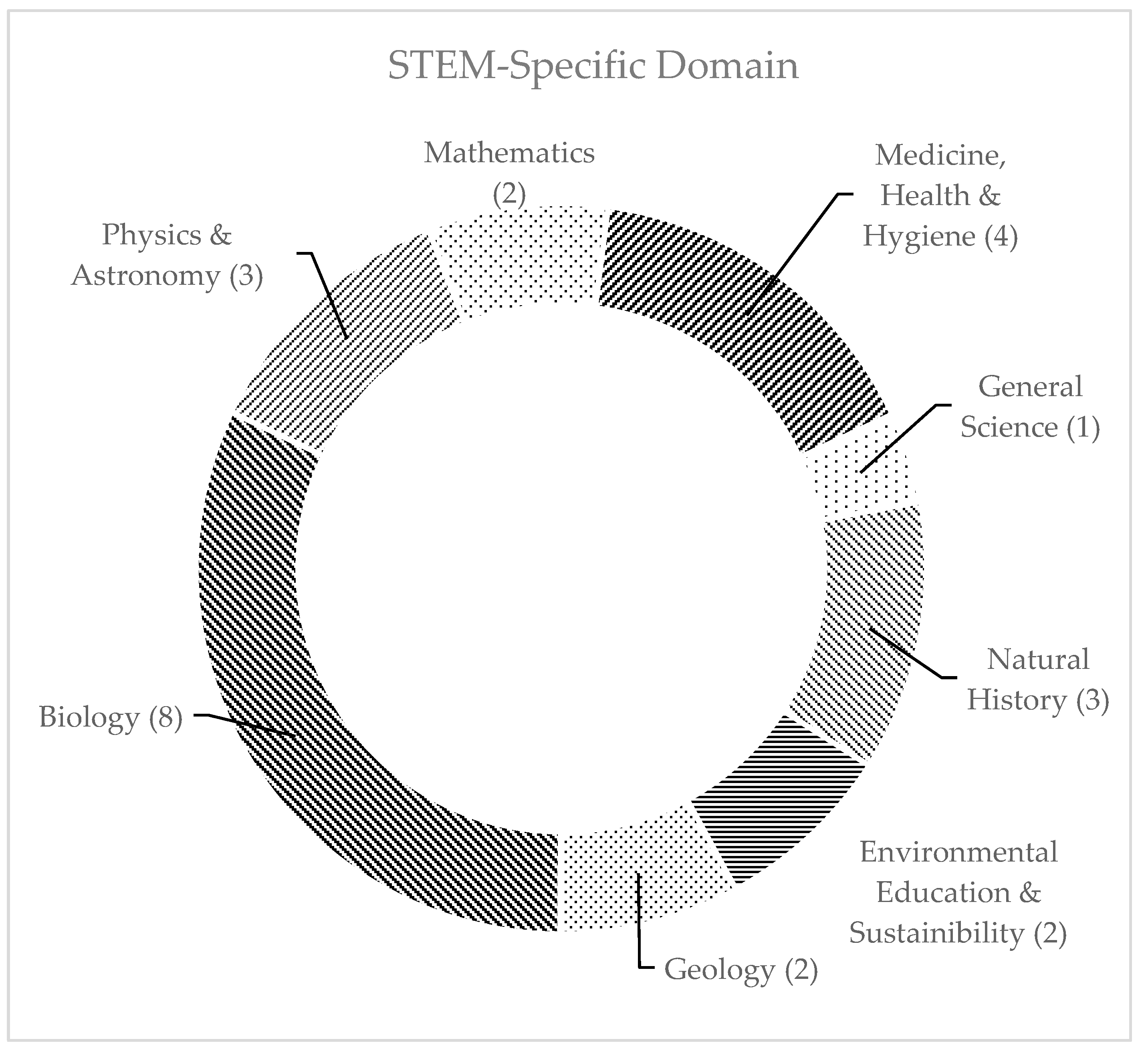
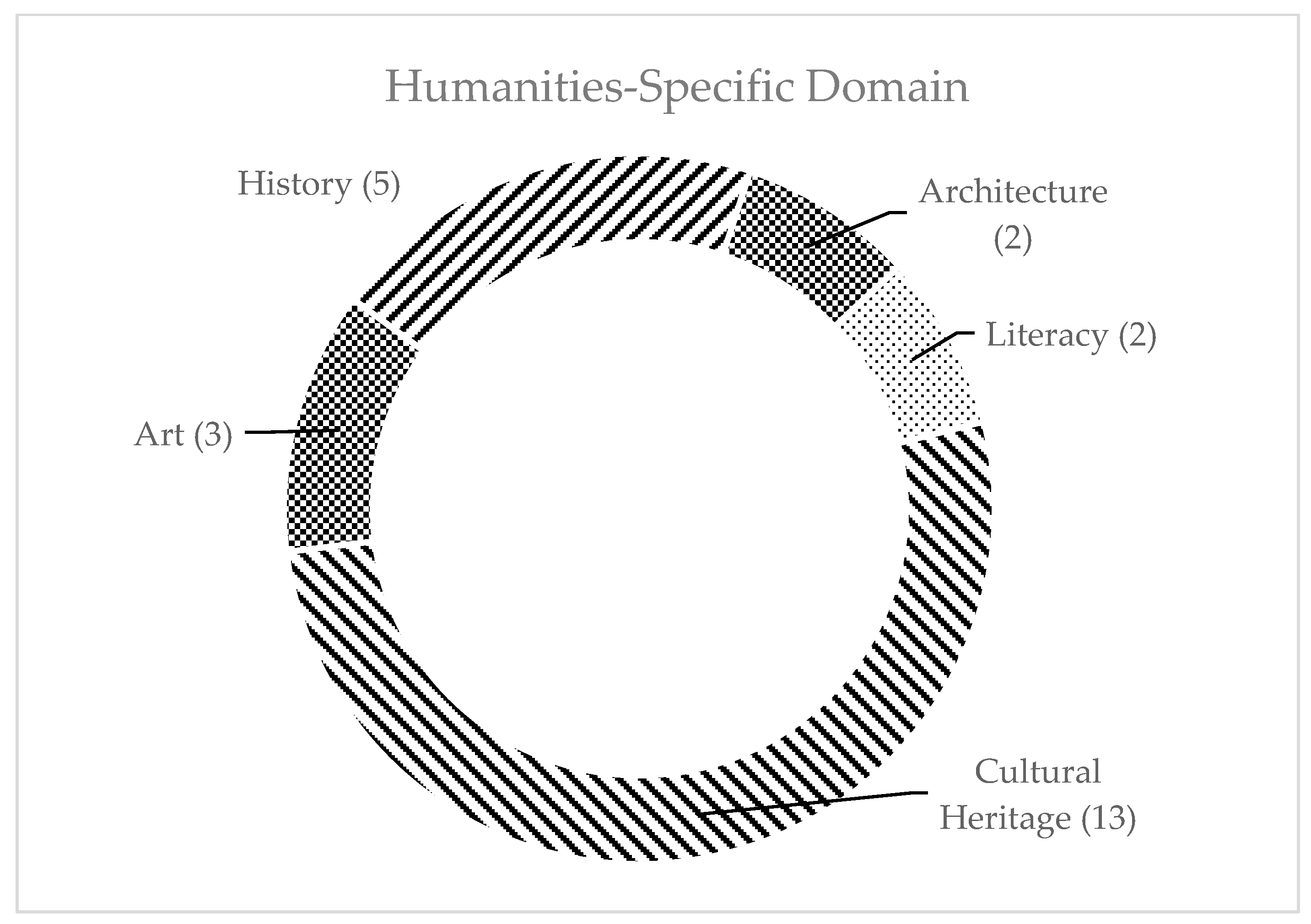
(7) Domain and Place: STEM-related domains were the most frequent subject area, with overall 25 occurrences. These encompassed subjects such as biology, which appeared the most often with eight occurrences, followed by medicine, health and hygiene (four occurrences) and physics and astronomy, and natural history (three occurrences each), mathematics, geology, and environmental education and sustainability, each appearing twice, and finally, science in general was found once (see Figure 5). Humanities-related domains encompassing cultural heritage were the most frequent single subject, with 13 occurrences (see Figure 6), followed by history (five occurrences), art (three occurrences), and architecture and literacy, both of which were mentioned twice each. Furthermore, the study by Bell and Smith (2020) included combinations of up to two subjects, such as biology and mathematics. However, no study was found that crossed STEM and humanities subjects.
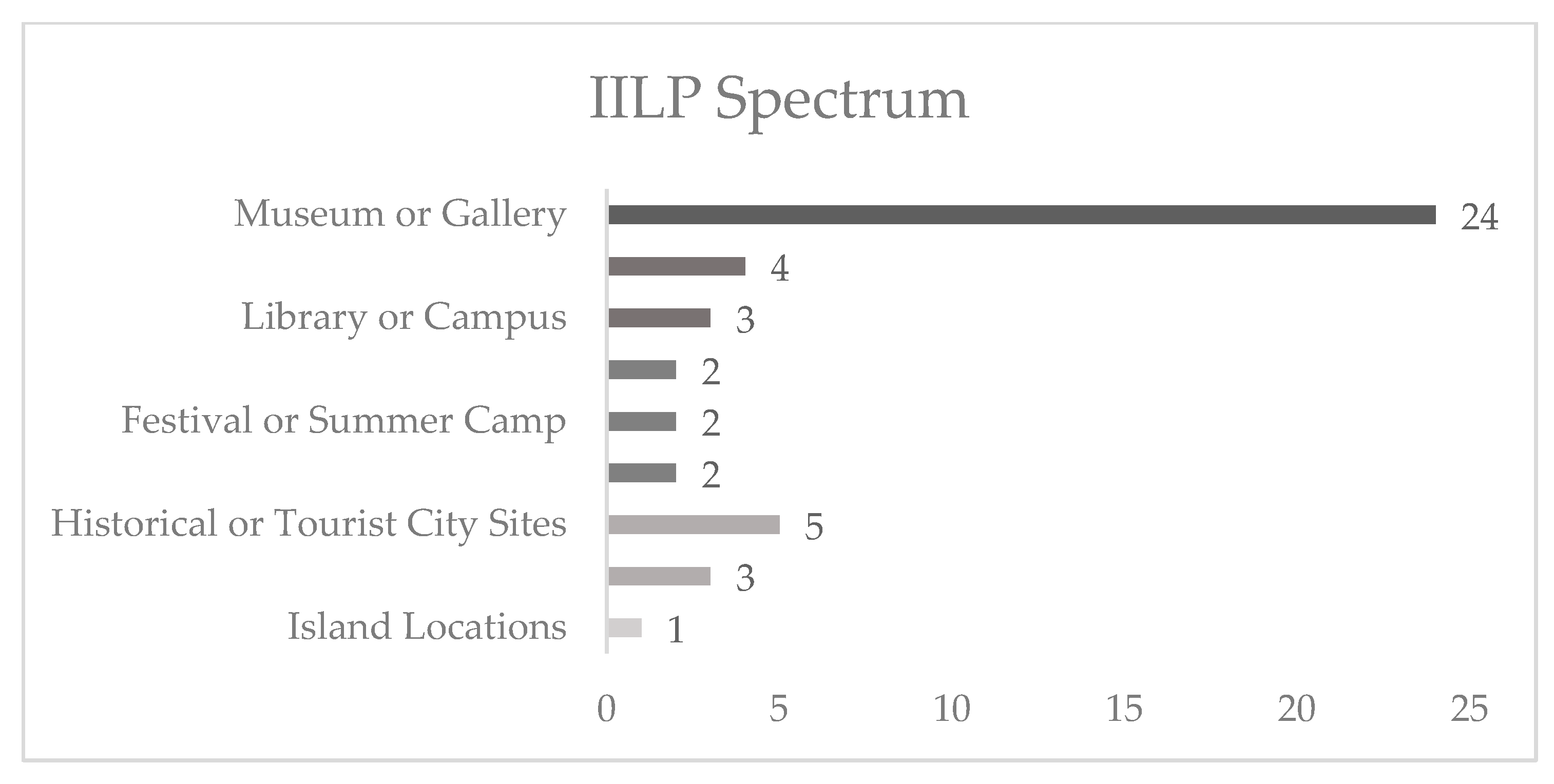
The most frequent places were museums and galleries, concretely captured 24 times (12 times STEM themed museum exhibits and 11 times museum exhibits concerning art, cultural heritage, architecture, etc., gallery just once), followed by historical or tourist cites (e.g., a temple in Weng et al., 2021) in five cases, discovery or science centers and laboratories in four cases, a library or campus, as well as a garden or nature park in three cases each, zoos or arboretums, festivals or summer camps, as well archeological sites (e.g., a cave with prehistoric paintings in Blanco-Pons et al., 2019) in two cases each, and lastly different locations on an island in one case, namely in the study of Koutromanos et al. (2018). Here, AR activities for students were organized at a lignite plant, a sanitary landfill, a shipwreck, a recycling bin, and on the island’s beach. This example illustrates that, in addition to numerous solitary activities, a variety of heterogeneous outdoor IILPs were identified, contrasting with the predominance of traditional IILPs such as museums (see Figure 7).
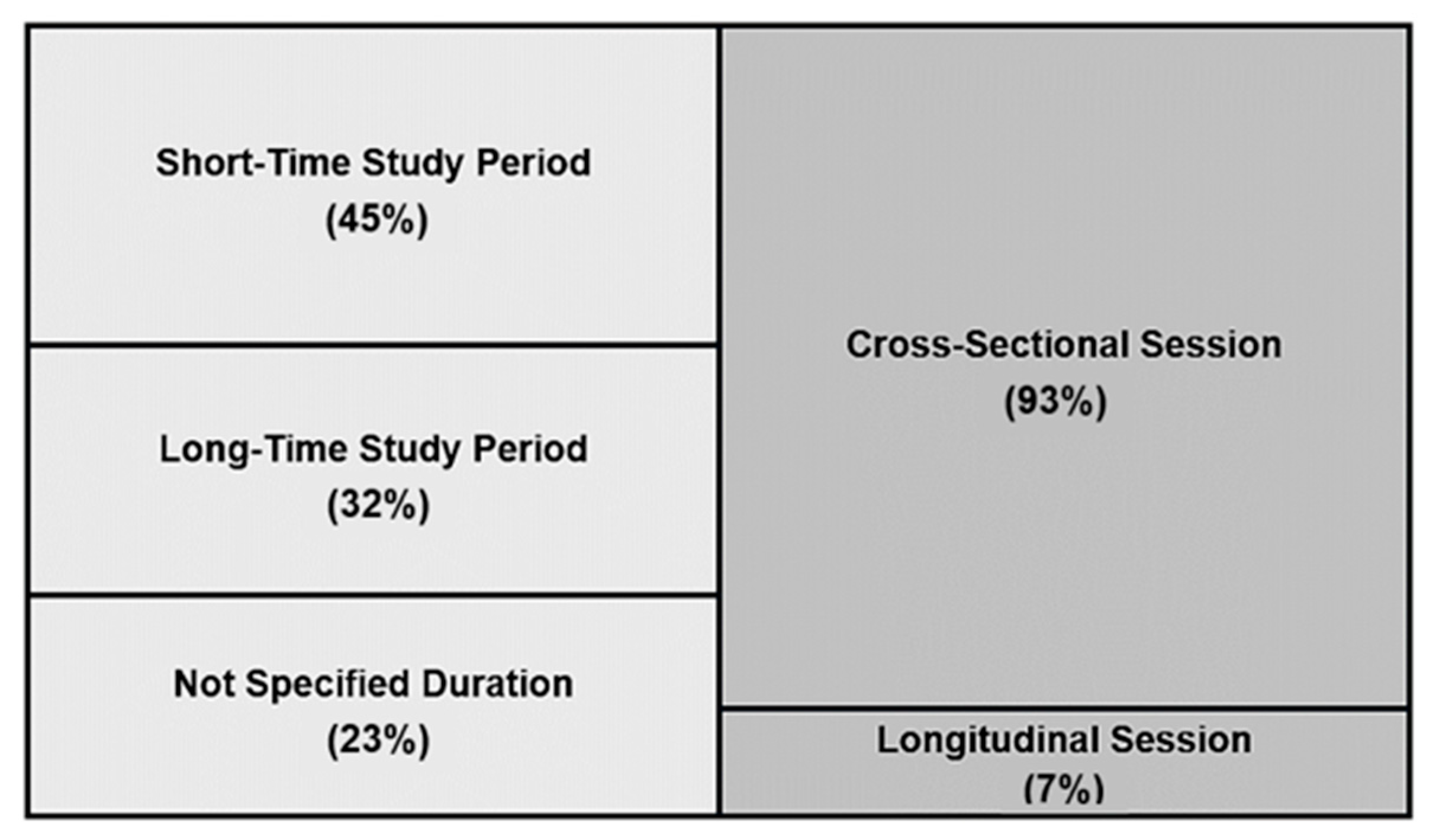
(8) Intervention Duration: Short-time study periods were reported 20 times, ranging from two to 120 min within a single day. Long-term study periods occurred 14 times, spanning from two days to as much as six months. However, 10 studies did not specify their duration. Cross-sectional sessions, which involve one-time surveys of a cohort, accounted for 93% of the studies (41 instances), whereas longitudinal sessions, involving repeated surveys of the same cohort, were conducted only three times (see Figure 8).

5.2. Characteristics of AR Media Used for Learning Purposes in IILPs

RQ 1b addresses a general overview of the characteristics of the AR media used for learning purposes in IILPs (see Tables S2 and S3 in the Supplementary Materials). Three main categories were defined: (1) hardware, (2) software, and (3) AR format.
(1)
Hardware:
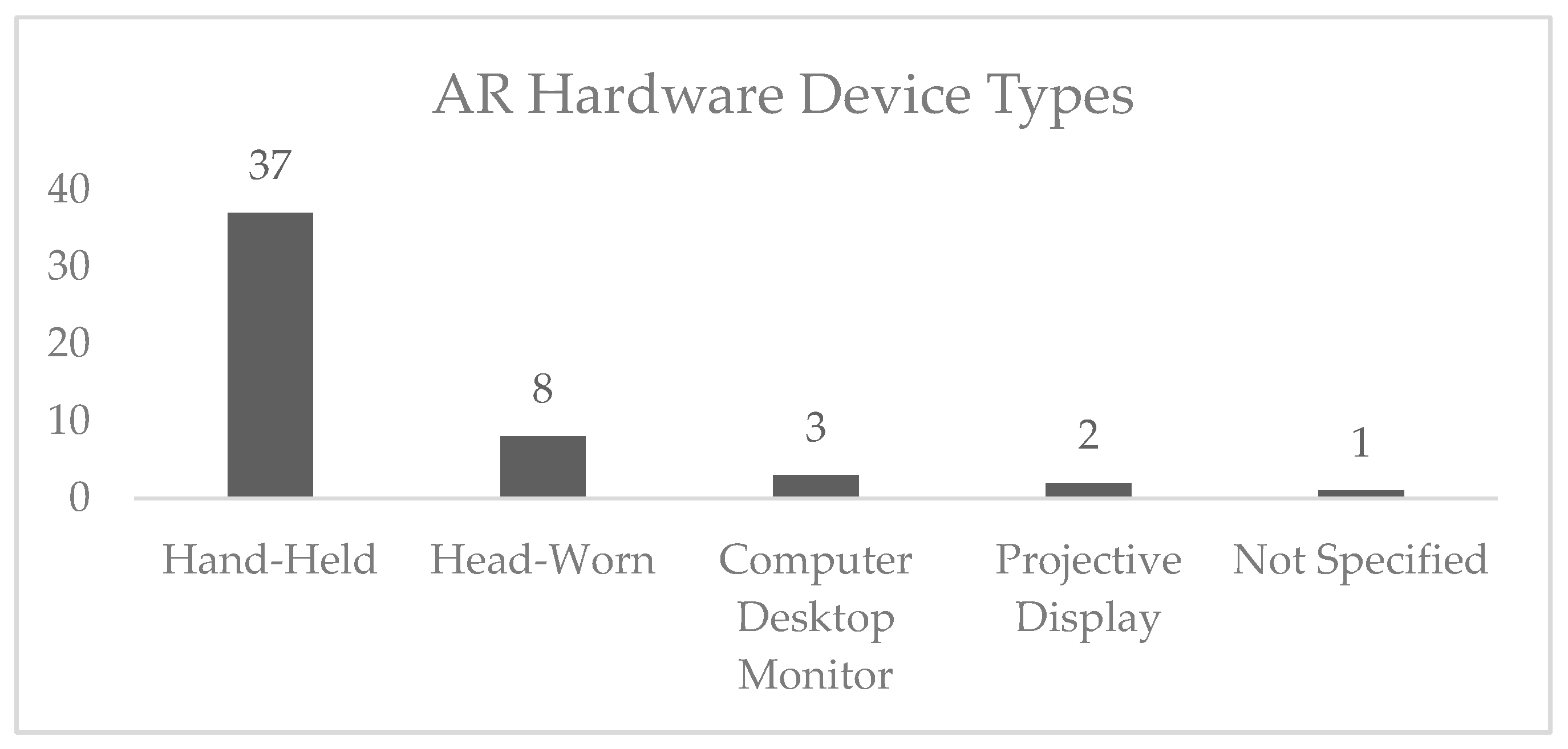
Device type: AR content was primarily delivered via hand-held devices in 37 studies (see Figure 9). In contrast, head-worn equipment was reported in only eight studies, while fixed desktop monitors in three and projective displays in only two. Bell and Smith (2020) did not specify the device type used. Among the handheld devices, smartphones and tablets were the most common. Boboc et al. (2019) notably employed a phablet—a hybrid of tablets and smartphone. Head-worn hardware encompassed HMDs such as Microsoft HoloLens, Google Cardboards, smart glasses, or headphones for audio AR formats. Combinations of device types, such as smartphones paired with headphones (Boletsis & Chasanidou, 2018), were also observed.
Ownership: Most studies provided the necessary equipment (27 times) while five studies relied on the participants’ personal devices. Only two studies offered both options—using one’s own device or borrowing it for the AR experience. Nine studies did not report on this aspect.
Mobility: Mobile use via portable devices was observed in 38 studies, whereas stationary setups appeared only four times. El Bedewy et al. (2024) reported using both mobile and stationary configurations, while Bell and Smith (2020) provided no information on this matter.
(2)
Software:
Application name: More than half of the examined studies (25 times) gave their app a short, succinct, and thematically relevant name, such as ‘SmokAR’ by Borovanska and colleagues (Borovanska et al., 2020), to educate youth about smoking risks through AR organ visualizations.
Development tool: Forty-seven different kinds of tools were identified, among which Unity (11 times) and Vuforia (eight times) were the most frequently used.
Availability: Twenty-eight studies utilized native AR apps, while the web-based counterparts could only be determined in two cases. For eleven studies, it was not possible to determine whether they used web-based or native apps. Three studies implemented a hybrid form of AR app availability, combining web-based and native functionalities. The study by Borovanska et al. (2020) described a prominent inclusivity feature in the design of the native ‘SmokAR’ app, specifically the avoidance of red and green colors due to the possibility of color blindness among users.
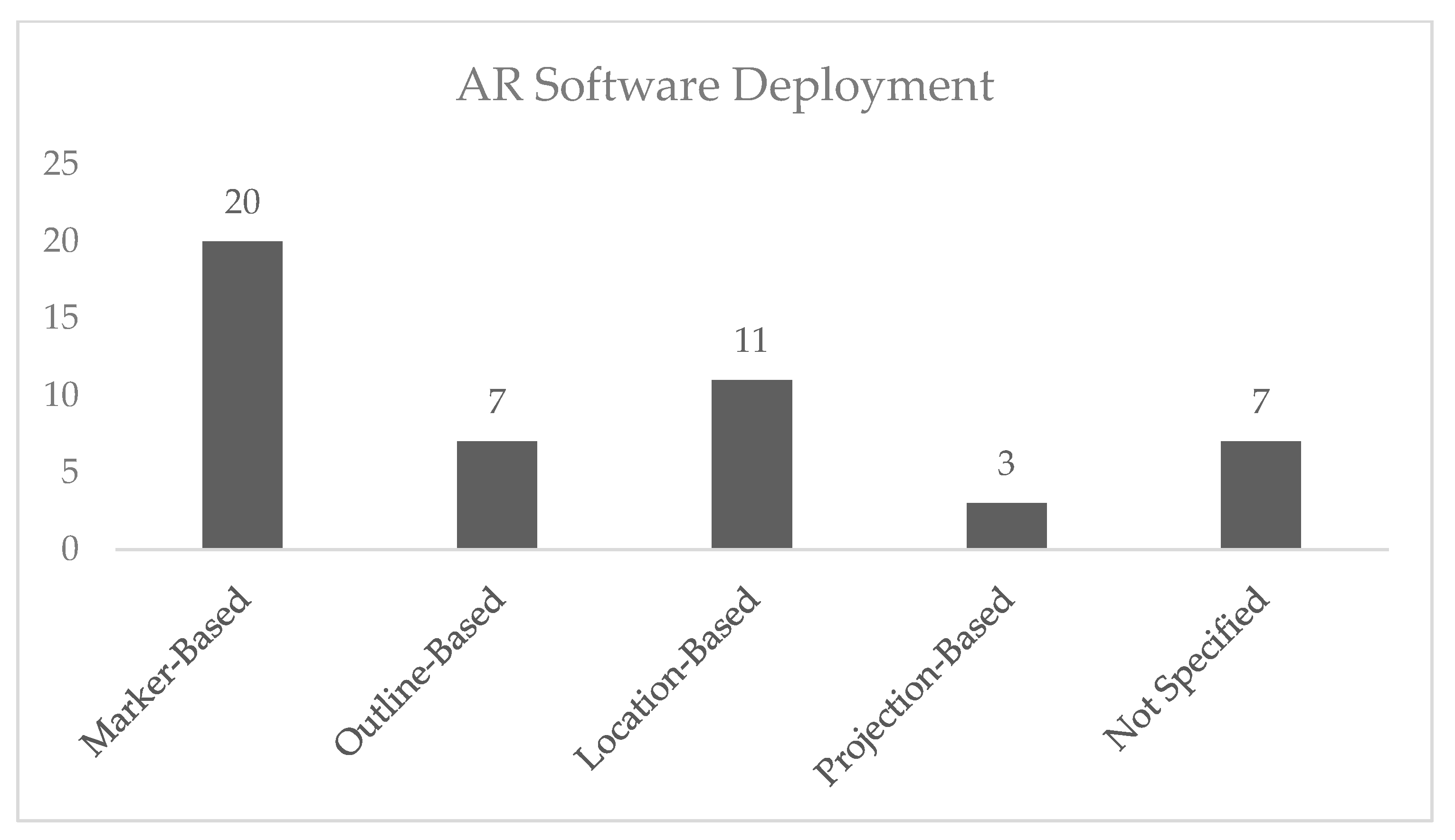
AR deployment type: Marker-based AR apps are the leading form (20 times), followed by location-based (11 times) and outline-based (seven times) deployments, with three studies reporting the use of projection-based AR deployments. Seven studies did not provide information on this subcategory (see Figure 10). Interestingly, marker- and outline-based deployments sometimes also occurred in combinations.
(3)
AR Format:
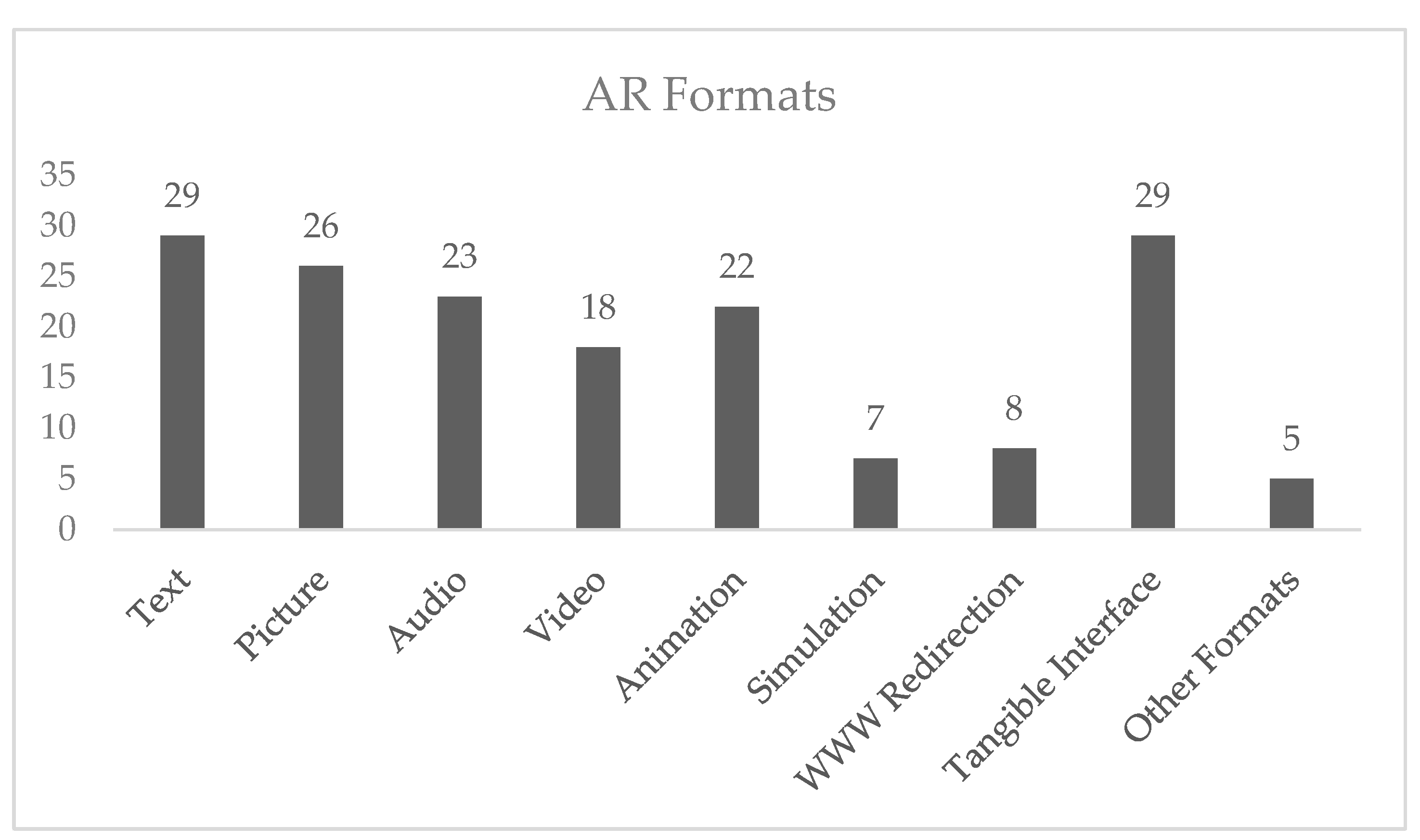
It was found that texts (29 times) and tangible interfaces (29 times) were the most common formats, closely followed by pictures (26 times), audios (23 times), animations (22 times), and videos (18 times). Web redirections and simulations were registered in only eight and seven cases, respectively, while other formats, such as self-created maps with GPS positioning and avatars representing the user or prompted empty fields for taking notes, were recorded only five times, indicating them as the least prevalent variant. Two studies did not specify which formats they used (see Figure 11).
Most studies combined multiple AR formats, rather than just one. The most frequent combination counts involved three or five formats in a single AR application. Two studies implemented six formats. While no study combined all eight AR formats, the intervention by Cesário and Nisi (2023) was remarkable for offering seven formats in their application.
Another standout study was conducted by Barbosa et al. (2021), which was the only study including an AR video with sign language. Additionally, three studies provided bilingual options in their AR text format. Overall, it can be concluded that all AR Formats were represented in relatively high numbers, as well as at high combination levels.

5.3. Learning-Relevant Functions of AR Interventions

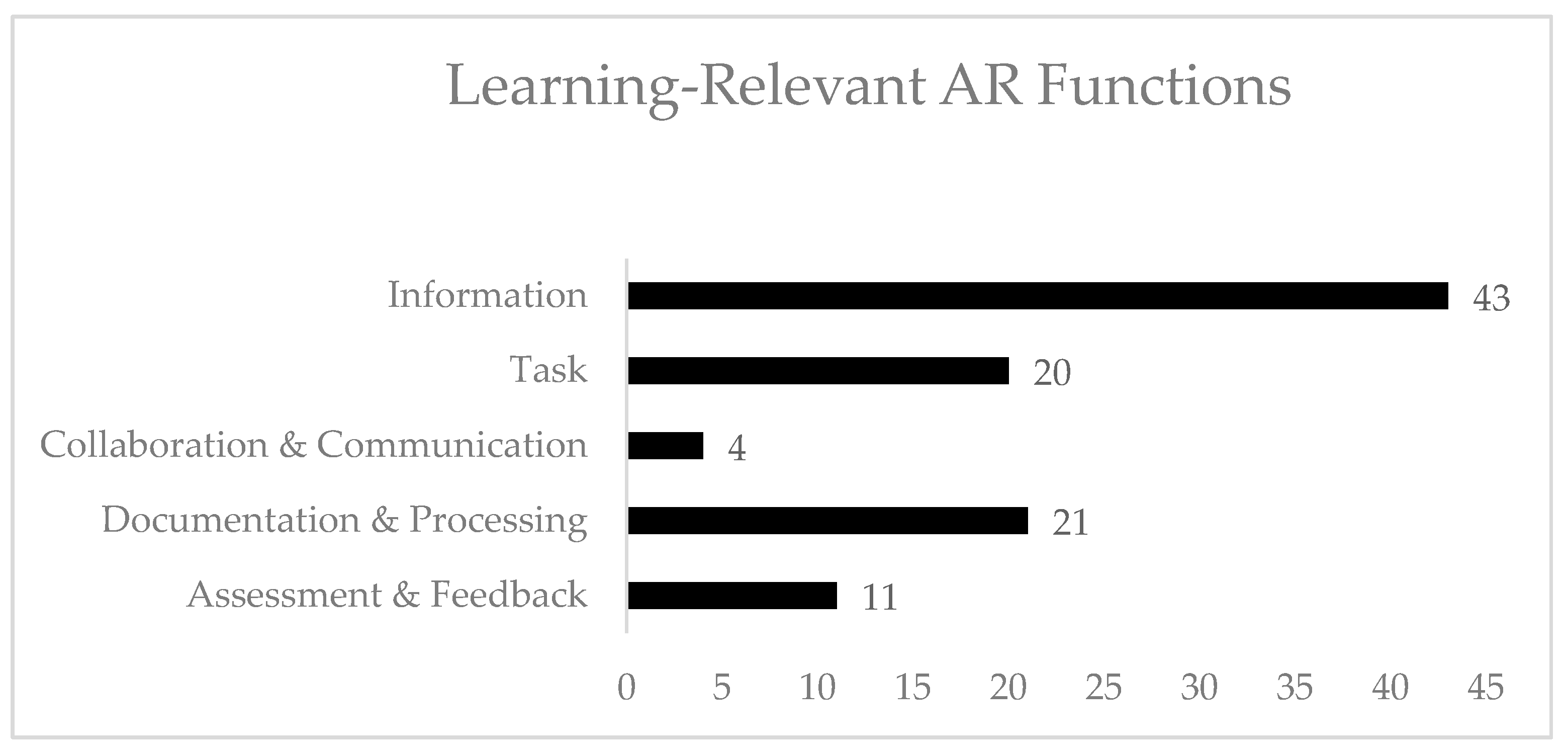
To address RQ 2 (Which learning-relevant functions are present in AR interventions examined in IILPs?), five pedagogical functions were analyzed (see Table S4 in Supplementary Materials and Figure 12).
(1) Information: This category was the most frequently provided AR learning function, quantified in 43 studies in total. Thus, nearly all studies (except for Bell & Smith, 2020) provided some form of content delivery within their AR applications.
(2) Task: Twenty studies provided tasks that encompassed instances like prompted screen instructions or quiz pop-ups, enabled through scanning AR markers or through location-based positioning, like in Lim et al.’s (2021) study, but also treasure hunts for markers (see Rodrigues et al., 2023).
(3) Collaboration and communication: This function was identified in just four studies, for instance, such as social media sharing possibilities of AR content, location-based AR discussion prompts or collaborative role assignments, where certain participants had to be in charge of the AR marker scans, as well as indirect methods like no production of AR sounds when users were not inside a distinct sight radius to keep social interaction (see Boletsis & Chasanidou, 2018).
(4) Documentation and processing: Twenty-one studies included quite versatile options like the generation of AR content by students in the study of Bell and Smith (2020), or entering names of unknown zoo animals into prompted fields if the outline-based recognition by the AR app failed (see Ogi et al., 2019), but also the manipulation of AR simulations, route planning through location-based map positioning, making memories with AR selfies, and scan-enabled challenges that needed to be processed for continuation.
(5) Assessment and feedback: Eleven studies provided this function through AR, e.g., by allowing only one right answer option in AR quizzes, score collection through right answers and scanned AR markers, trail unlocking after task completions, reward AR selfies, and finally help in the case of wrong answers with more supplied AR information or further explanation and evaluation of answers. One such example is documented in the study of Sánchez-Francisco et al. (2019), where users had to answer questions and collect AR cannon fragments on a campus. Short explanations of the questions assured successful learning, and when the assembly of the AR cannon was finished, the users could fire a rewarding AR cannonball in line with the historic narrative.

5.4. Learning Outcomes of AR Interventions

To analyze RQ 3 concerning the learning outcomes (LOs), five overarching categories were analyzed (see Table S5 in the Supplementary Materials):
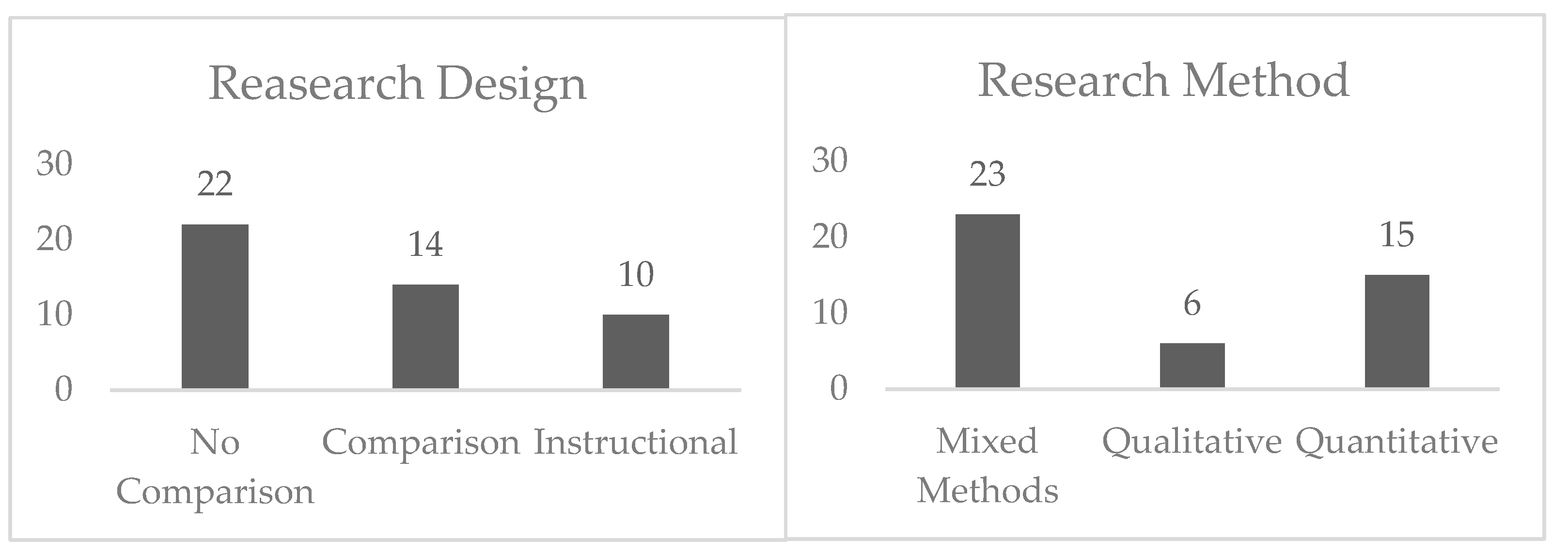
(1) Research design: Most studies carried out the investigations without any comparison by just using the AR medium (22 times), followed by 14 studies that established a comparative design with and without AR conditions, and 10 studies that implemented only AR conditions but under different instructional procedures (e.g., different scaffold types in Yoon et al., 2018) (see Figure 13). Interestingly, two studies employed a combination of comparative and instructional designs.
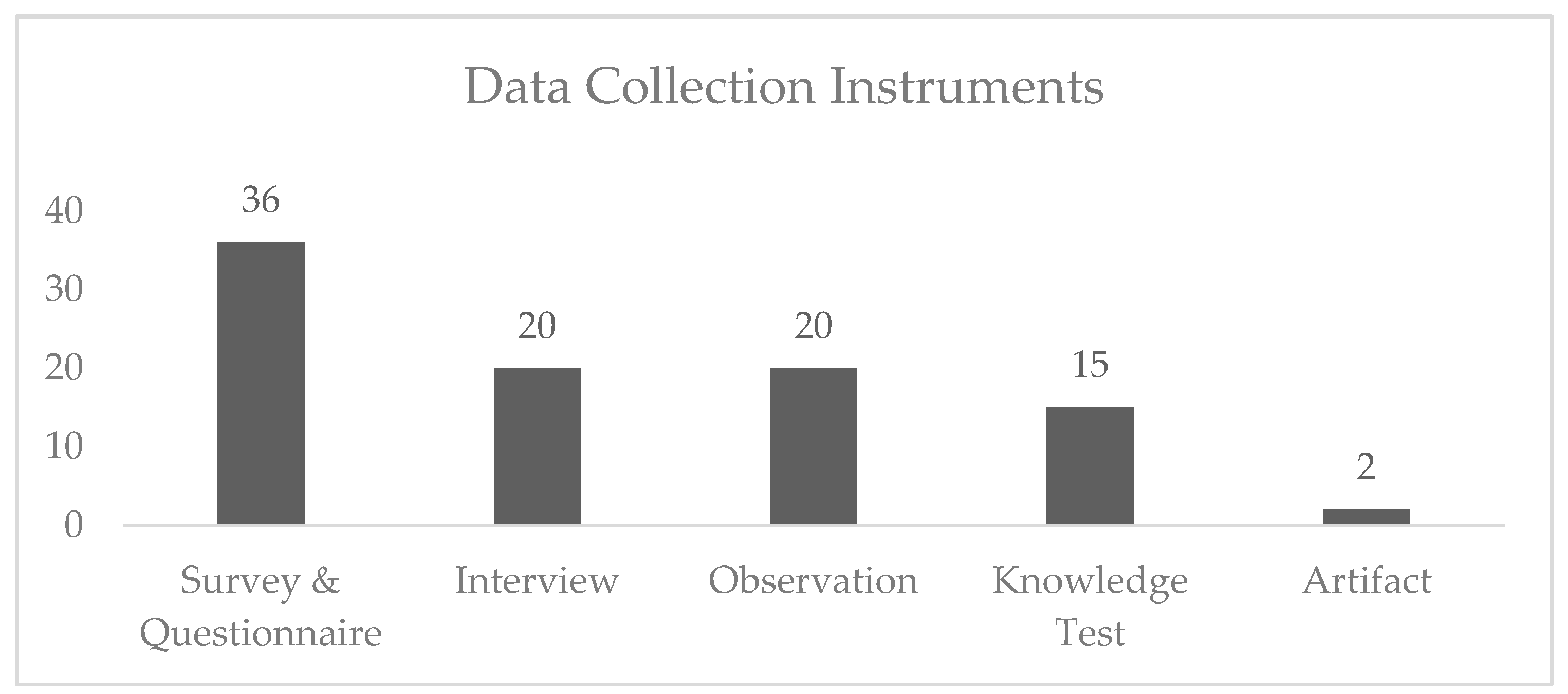
(2) Research method and data collection: Over half of the studies proceeded with mixed method approaches, mainly combining questionnaires, interviews, and observations (23 times), while purely quantitative methods were found 15 times and purely qualitative methods in six cases (see Figure 13). Surveys and questionnaires were mainly utilized for gathering data (see Figure 14). It was further noted that retention assessments in pre-post knowledge tests were rare and typically occurred between two weeks and three months after the intervention.
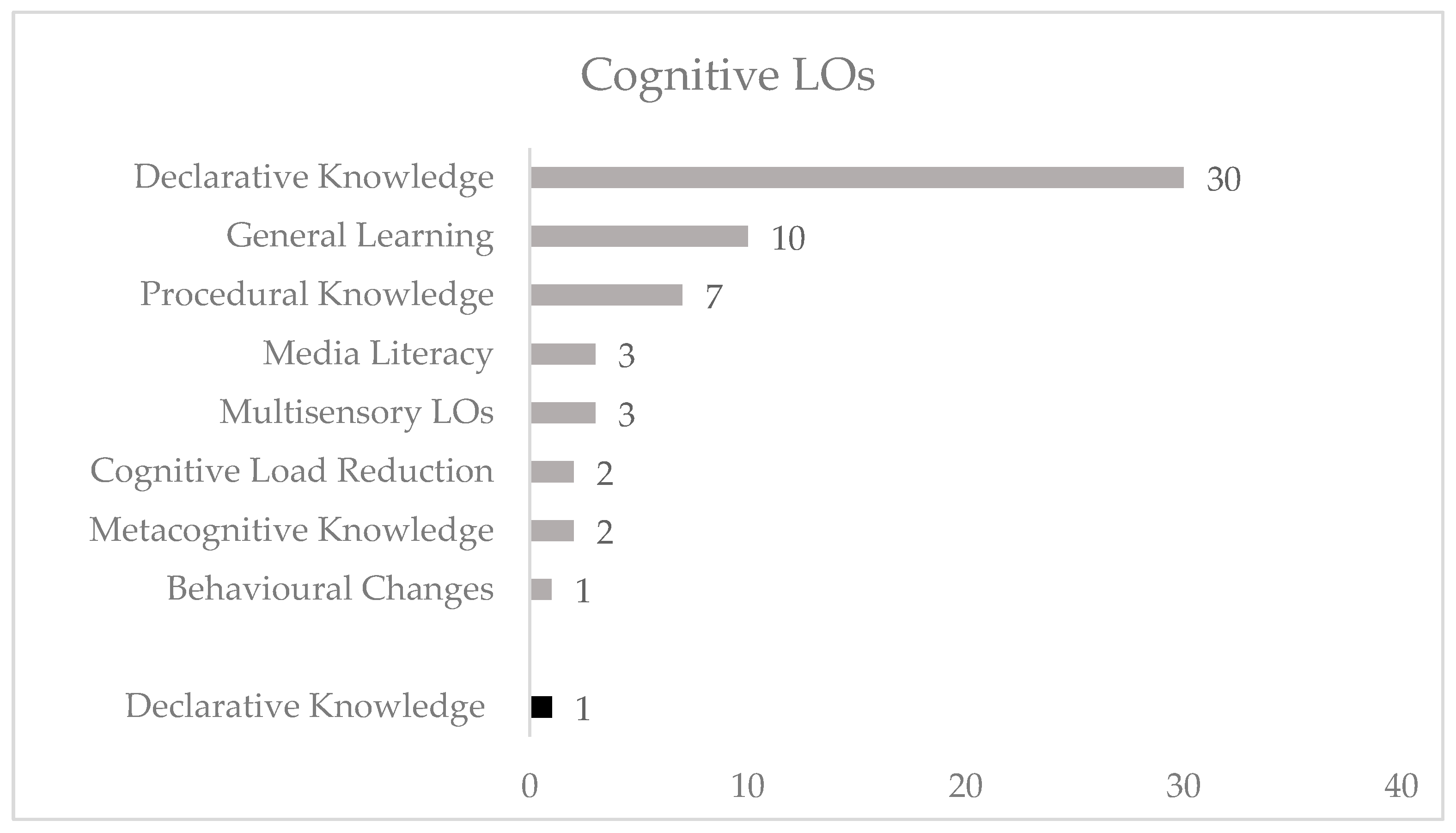
(3) Cognitive LOs: Thirty-five studies measured cognitive LOs. Domain-specific declarative knowledge, including factual memory and conceptual understanding, was the most frequently measured cognitive LO (30 times) (see Figure 15). Overall, the studies reported a positive development of knowledge. One negative finding on cognitive learning was noted: the negative impact on remembering domain-specific declarative knowledge due to the distracting novelty of AR technology (as found by tom Dieck et al., 2018b, through qualitative interview analysis comparing AR and non-AR conditions with a large sample size).
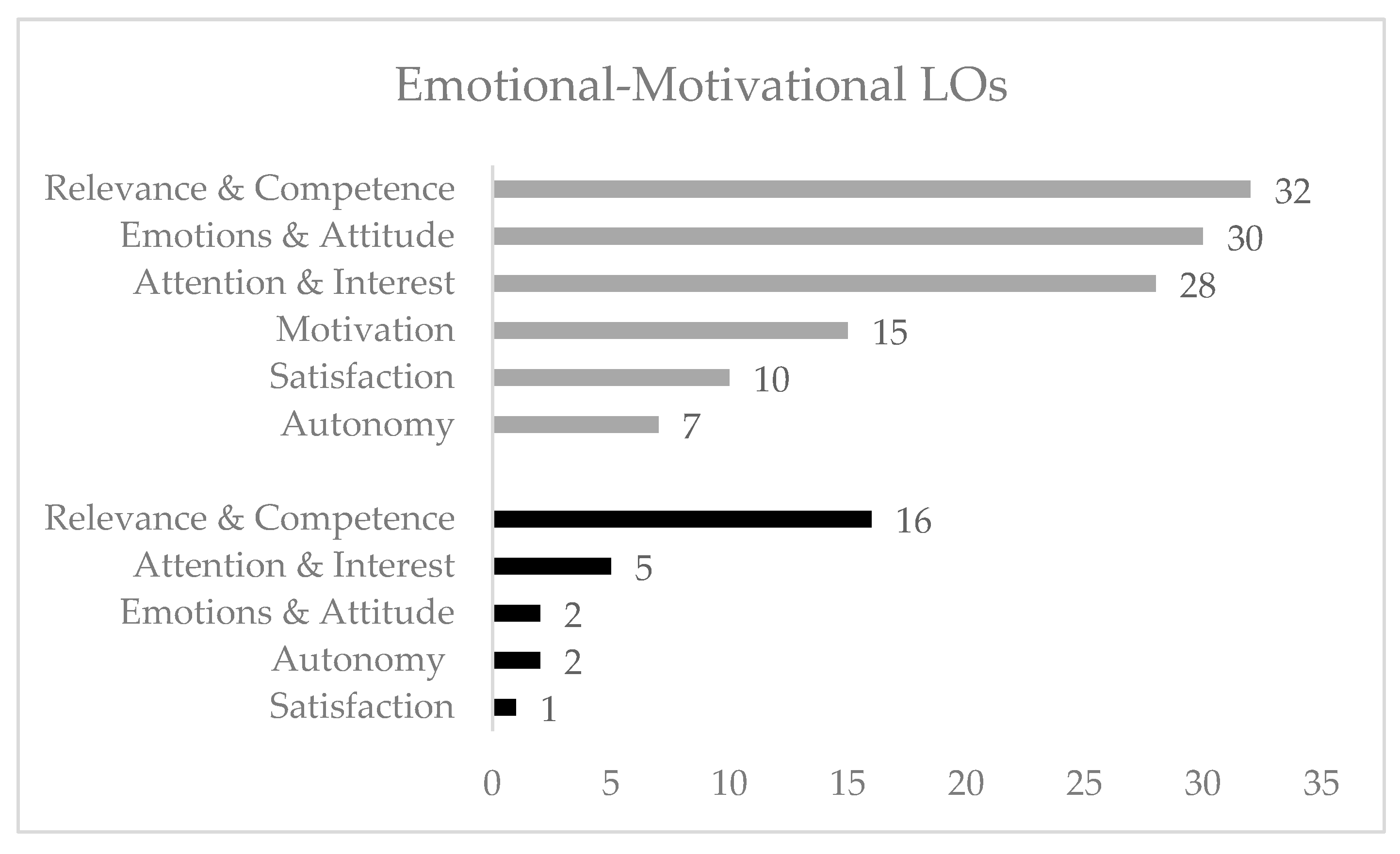
(4) Emotional-motivational LOs: Nearly all studies (42) measured emotional-motivational LOs, with mostly positive outcomes (see Figure 16). Perceived relevance and competence were the most prominent (32 times) due to reports of positive usability, usefulness, future reuse intentions, and effective immersion. Positive emotions and attitudes (e.g., enjoyment and engagement) were also frequently measured (30 times), as were attention and interest (28 times). However, negative findings were also identified (26 times), mostly in the subcategory of perceived relevance and competence. These issues arose primarily from problems related to usability and usefulness, such as tasks that were too complex for users, for example, the challenging AR content-generation assignment for students in the digital laboratory in Bell and Smith’s (2020) study, with a medium sample size in a qualitative study. They also stemmed from a lack of structure and clear instructions, which reduced the perceived importance of the content and introduced challenges that learners could potentially struggle with.
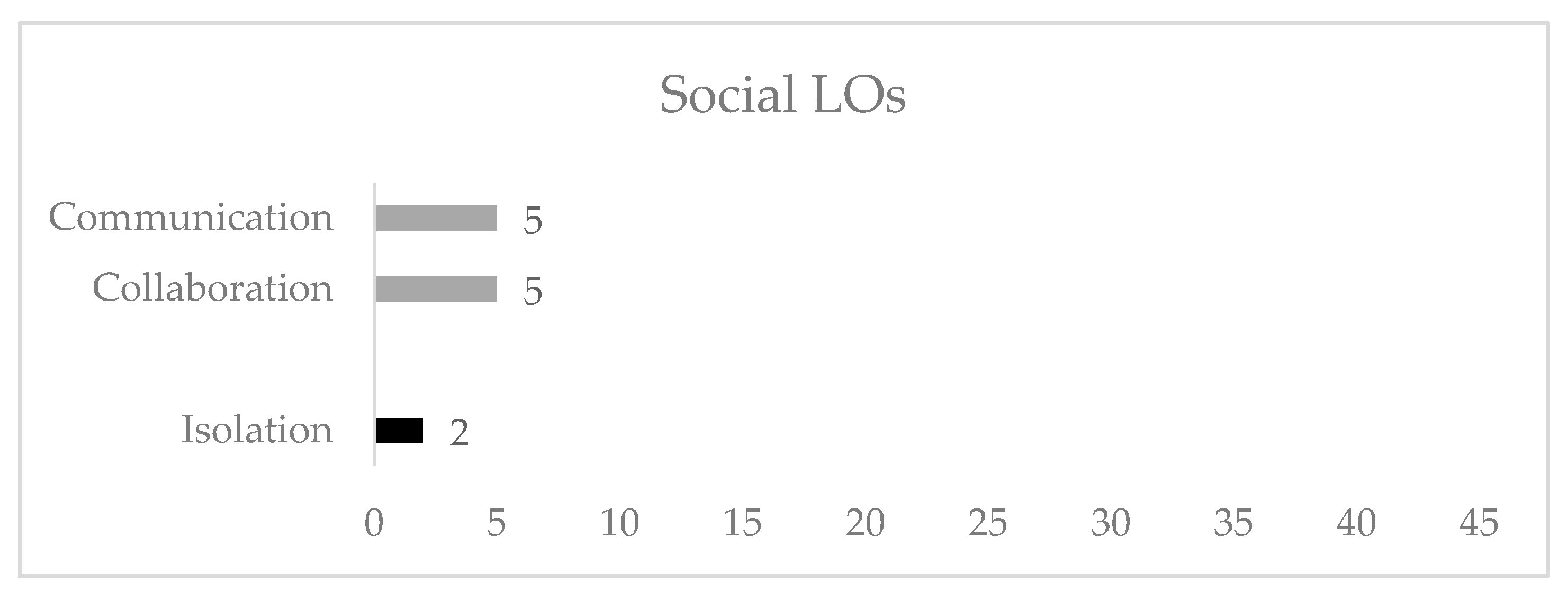
(5) Social LOs: Just eight studies documented results related to social interaction, of which five positive instances were recorded each for communication and collaboration (see Figure 17), like in H. T. Zimmerman et al.’s (2023) qualitative study with a medium sample size, where the AR-based geological time travel facilitated cooperation (some took responsibility for photo taking, others for map navigation) and sense-making discussions in families, assessed by interviews and observations. Negative social LOs were mentioned due to issues of isolation and social interaction lacks were present two times, e.g., found in interviews with users of smart glasses in an art gallery investigated by tom Dieck et al. (2018b). Only seven studies measured all three categories, for example, Aguayo and Eames (2023), who found positive outcomes throughout their mixed-methods study with a rather small sample size.

5.5. Learning-Theoretical Foundations of AR-IILP Interventions

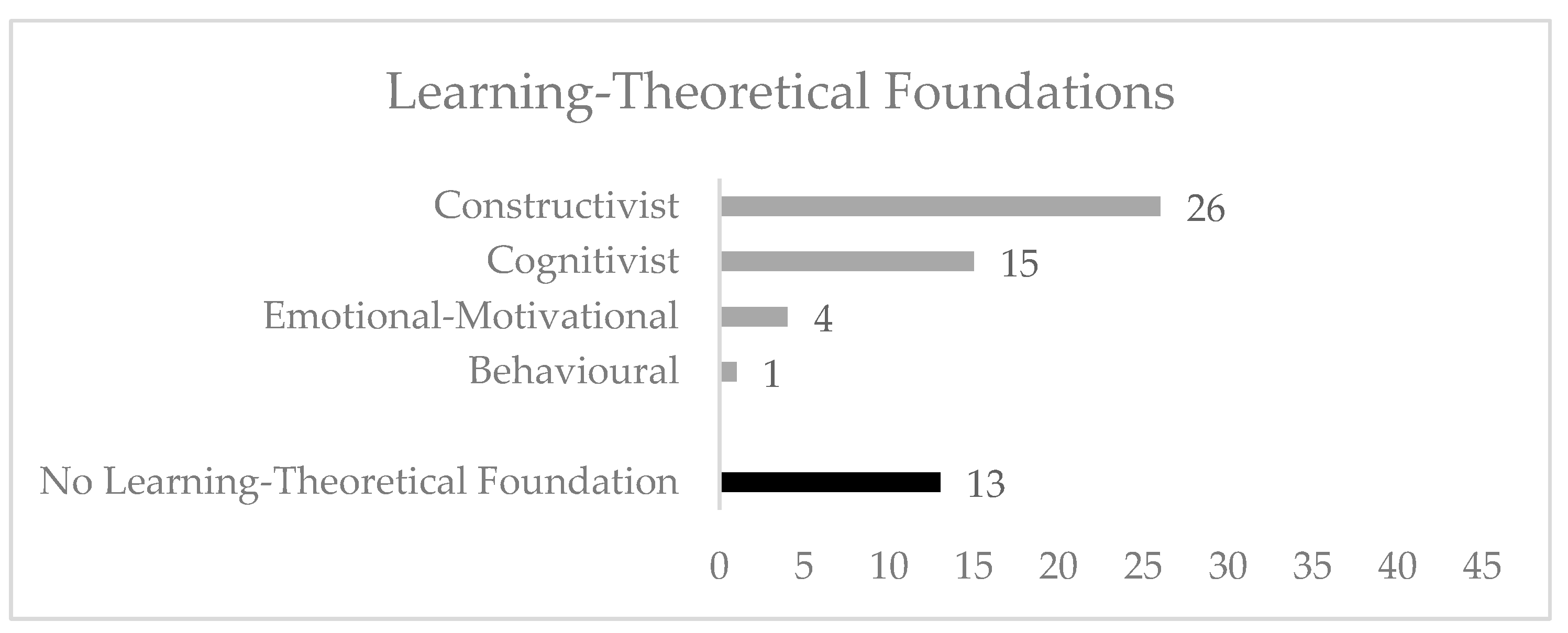
RQ 4 analyzed the learning-theoretical foundations for the reasoning of AR-IILP interventions (see Table S6 in the Supplementary Materials and Figure 18).
(1) Behavioral: Only one study, Koutromanos et al. (2018), mentioned behavioral approaches as a basis for the AR game evaluation component of their investigation
(2) Cognitivist: Fifteen studies mentioned cognitivist approaches, mostly referring to CLT and CTML. Out of the 12 principles for multimedia design, only the principles of multimedia, modality, signaling, spatial, and temporal contiguity could be registered. There were also frequent mentions of metacognitive knowledge forms, such as self-reflection, critical thinking, or scaffolding, which can be supported by AR-based learning in IILPs, as substantiating theoretical intervention justifications (e.g., scaffolding to prevent cognitive overload, as seen in C. H. Chen et al., 2023a). References to the multi-store model of human information processing also appeared (Sommerauer & Müller, 2018b), along with associative terms such as long-term memory retention, connections to previous knowledge, or unconscious cognitive processing (see Connaghan et al., 2019; Meekaew & Ketpichainarong, 2018). Moreover, individual cognitivist models or theoretical assumptions also appeared as groundings for AR interventions in IILPs, namely the Model of Cognitive Reconstruction of Knowledge (adapted by Kennedy et al., 2021), the Model of Technology Acceptance (internal mental processes shape human behavior, see Hammady et al., 2021), the Embodied Cognition Theory (stronger immersion through real objects, Georgiou & Kyza, 2021; Lee et al., 2025), the Model of Destination Image Formation (psychological cognitions of tourist attractions, stated by Weng et al., 2021), and lastly, Components of Comprehension (as a basal framework regarding word level processing, prior knowledge, and reader strategies, found in Danaei et al., 2020).
(3) Constructivist: Twenty-six studies reported principles associated with constructivism. Most of those encompassed principles belong to mobile and game-based learning (such as gamification or playfulness), with the latter specifically counted in seven cases. Additionally, situational interest theory and concepts such as situated, self-directed, free-choice, experiential, and collaborative learning, as well as similar understandings, were often incorporated. Notably, mentions of embodied or outdoor learning (e.g., Aguayo & Eames, 2023; Lim et al., 2021) were also documented and categorized accordingly, as these principles imply active engagement and real-world contexts. Story-based learning was discussed only once by Cesário and Nisi (2023). Further mentioned were Experience Economy (see tom Dieck et al., 2018a), Learning-on-the-Move (see H. T. Zimmerman et al., 2023), Scaffolding (learning under a sociocultural understanding, in Yoon et al., 2018), Behavioral Intention (as an experience-based concept, underlying in Weng et al.’s (2021) study), Semantic Coupling (active and contextualized engagement, see Georgiou & Kyza, 2021), Sociocultural Constructivism (El Bedewy et al., 2024), and the Three Levels of Comprehension (literal, inferential, and critical, resulting in active knowledge construction, see Danaei et al., 2020).
Nevertheless, a strict separation into Cognitivist and Constructivist categories of such theoretical assumptions was not always evident since some mentioned models carry characteristics of both orientations. For example, C. H. Chen et al. (2023a) justified their intervention design with B. J. Zimmerman’s (2000) Self-Regulation Phases, in which one can inherently recognize both Cognitivist and Constructivist features.
(4) Emotional-motivational: Four elaborated emotional-motivational foundations for the AR use in IILPs were identified, involving the statement of extrinsic and intrinsic motivation forms according to SDT (Ryan & Deci, 2017) that could be enhanced through AR interventions, but also the mention of theoretically framed models such as epistemic emotions (relevant for knowledge reconstruction according to Kennedy et al., 2021), satisfaction (Meekaew & Ketpichainarong, 2018), and immersion (declared as a positive emotional experience for learning support, fundamental in Georgiou & Kyza, 2021). Keller’s (1987) ARCS model was not mentioned explicitly.
In addition to these categorizations, the number of studies combining multiple categories was also determined. It was found that 19 studies only used one theoretical approach for justification of their AR interventions in IILPs, whereas combinations of multiple theoretical approaches were less common, but still present in nine studies for two combinations, and three studies for three combinations, such as in the document by C. H. Chen et al. (2023a), who justified their approach using the CLT, inquiry learning and intrinsic motivation concepts. No study employed all four theoretical orientations. Thirteen studies did not ground their AR intervention in any elaborated learning-theoretical foundation, meaning nearly a third.

6. Discussion

Institutional informal learning places (IILPs), such as museums and zoos, have attracted growing attention in educational research since the early 2000s. These settings offer ideal conditions for promoting self-directed, free-choice, incidental, and socially interactive learning for diverse audiences—an aspect particularly relevant for lifelong and everyday knowledge acquisition beyond formal education (Lewalter & Neubauer, 2019; Sommerauer, 2019). Concurrently, digital media have become integral to shaping learning experiences in IILPs, paving the way for innovations such as AR. This systematic literature review aims to provide an updated and comprehensive overview of AR-based learning in IILPs by analyzing recent empirical studies published between 2018 and 2025. The review addresses four main research questions (RQs), focusing on intervention contexts, medium characteristics, and learning functions, measured LOs, and the theoretical foundations that justify AR use in these settings.
RQ 1a. 
IILP—context description of AR use investigated.
Viewed as a whole, our results suggest that the publication of studies on AR in IILPs reached its peak around 2018/19. These results align with findings, such as those from Sakr and Abdullah (2024) and G. Li et al. (2025), who reported a peak in AR studies around 2020. More than half of the examined studies were published as journal articles, with K–12 school students (including all stages of K-12 education) and the general public being the most prominent samples, followed by tertiary-level learners (mainly bachelor’s level), similar to results from Akçayır and Akçayır (2017) and Zhou et al. (2022). Middle-aged adults (26–59 years) represented the largest group of participants from the general public, followed by teenagers (11–17 years; K–12-secondary level) and young adults (18–125 years). These results suggest that future research should place greater emphasis on families, as only H. T. Zimmerman et al. (2023) addressed them in the current set of reviewed literature. This is even more pressing, given that prior studies by Callanan et al. (2011) and Lewalter and Neubauer (2019) indicate that children and adolescents almost always visit IILPs accompanied by adults, typically as part of their family. Akçayır and Akçayır (2017) suggest that the dominance of K–12 or bachelor students is due to their frequent engagement with digital games in their leisure time, making AR games suitable learning applications. Goff et al. (2018) argue that this dominance may also result from the targeted development of AR applications for such groups, as underpinned by Zhou et al. (2022), who claim that it is due to curriculum excursions to museums. Furthermore, Bacca et al. (2014) suggest that AR technology requires abilities such as marker tracking, which can be excessively demanding for both very young children and older adults. This also raises important questions about other learner characteristics that may influence AR-based learning in IILPs, such as prior knowledge, specific abilities, and working memory capacity (Kozlova et al., 2025).
Beyond descriptive distributions, several patterns emerge that suggest meaningful relationships among variables. Although this review did not conduct formal correlation analyses, descriptive patterns suggest that K–12 samples are often linked to cognitive learning outcomes, as described in RQ3, reflecting the alignment of AR interventions with curriculum-related content and structured tasks. Adults and the general public are rather present in studies that measure emotional-motivational outcomes, such as enjoyment and perceived relevance, which may be driven by voluntary engagement and personal interest rather than formal learning goals. These results indicate that both technological affordances and contextual factors shape the pedagogical functions and learning effects of AR in IILPs.
The present studies frequently mention medium-sized samples, echoing findings similar to those in the review of Bacca and colleagues (Bacca et al., 2014), who argue that large samples require more devices, thus making them less common in AR interventions. Small-sized samples were frequently found in mixed-methods studies (combining quantitative and qualitative findings), as well as in quantitative studies, which pose challenges for the validity and generalizability of these studies’ results.
About half of the studies implemented small groups of different sizes, while the rest did not specify any group formations. These results indicate that AR can be used for both individual and social interactive learning. Regarding domains and places of the AR interventions, a broad diversity was registered over the respective seven-year period. The findings show a heterogeneous IILP spectrum, ranging from more enclosed (spatially confined and content-explicit) locations, such as museums and libraries, to more open environments (with broader spatial extent and not necessarily organized in all components), like natural spots, e.g., a beach, as seen in the study by Koutromanos et al. (2018) on environmental education. Furthermore, this review, like the one by Markouzis et al. (2022) on maker-based AR applications, identified numerous city and historical areas, including archeological sites, as well as campuses, as informal learning settings. Concerning content, for STEM-related domains, biology appeared as the most frequently studied subject, similar to Degner et al.’s (2022) study. This might be explained by the broad range of topics categorized under biology, such as biodiversity, which encompasses animals, plants, and microorganisms. Bacca et al. (2014) and Goff et al. (2018) argue that educational applications of AR are prominent in science, as they enable the envisioning of hidden occurrences and abstract or complex concepts, showcasing interrelations on the microscopic or even macroscopic scale, as in ecology. Furthermore, in humanity-related domains, cultural heritage was the most common subject, followed by history and art. In contrast, Bacca et al. (2014) and Zhou et al. (2022) only documented history and art subjects in their reports. This showcases a prosperous diversification of AR use for humanities-specific subjects. Taken together, these results highlight how AR can effectively enhance the understanding of diverse scientific concepts in informal learning environments. According to Ramsurrun et al. (2024), this diversity is key to promoting the engagement of learners with different interests and educational needs. Regarding the duration of the AR interventions, short-term study periods, ranging from a few minutes to up to two hours on a single day, were the most common among the reviewed studies. This aligns with findings in Ibáñez and Delgado-Kloos’s (2018) review on AR in STEM learning and Ramsurrun et al.’s (2024) review on digital media in informal STEM learning. Nearly all studies presented in this review conducted one-time surveys of a cohort of participants, while longitudinal studies with multiple surveys of the same cohort were significantly underrepresented, likely due to the high organizational effort required. This favors the measurement of immediate cognitive and affective effects, while long-term social or behavioral changes are rarely captured. This observation is consistent with prior reports, such as those by Bacca et al. (2014). While study periods vary based on factors such as participant numbers, the prevalence of cross-sectional studies on AR-based learning underscores the ongoing need for more longitudinal studies to gain a deeper understanding of learning patterns and the long-term effects of AR-based learning. This is crucial because perceived benefits, such as improved LOs, may be solely attributed to the novelty of AR and could diminish with frequent use (Akçayır & Akçayır, 2017; Bacca et al., 2014; Petrovich et al., 2018).
RQ 1b. 
Characteristics of AR media used for learning purposes in IILPs.
Regarding the hardware category, mainly wireless handheld devices, such as smartphones and tablets, were used, while head-worn equipment was only registered a few times. This distribution was also found in the review of Ramsurrun et al. (2024). Accordingly, these devices were predominantly used in mobile contexts, with only limited stationary applications. This pattern is consistent with prior existing literature on AR-based learning, which highlights a preference for hand-held mobile devices due to their cost-efficiency, ease of use, widespread familiarity, portability—particularly for outdoor activities, as frequently noted in reviewed studies—and their ability to support both social interaction and personalized, independent learning (Akçayır & Akçayır, 2017; Parhizkar et al., 2012; Santos et al., 2013; Zhou et al., 2022). Thus, the actual review indicates that mobile AR is particularly well-suited for IILPs, as these environments inherently involve movement, consistent with Schwan et al.’s (2014) definition of IILPs as structured information spaces with multiple points of interest. While computer desktop monitors offer advantages such as larger screens and higher computing power (Parhizkar et al., 2012; Santos et al., 2013), enabling complex AR tasks such as the real-time manipulation of invisible physical forces in Yoon et al.’s (2018) study, their fixed location does not align with the need for mobility due to the nature of most IILPs. Whether head-mounted displays, smartphones, and tablets will dominate mobile AR in IILPs as technology continues to advance rapidly remains an open question for the future. Marker-based AR is most frequently found in museums, while location-based AR is more prevalent in science centers and outdoor contexts, such as cultural heritage sites, likely due to its exploratory nature and integration with physical movement. Projection-based AR, though, is rather rare and used in both scenarios.
RQ 2. 
Learning-relevant functions of AR interventions.
Concerning learning-relevant functions of AR in IILPs, the review revealed that all five learning-relevant functions, as defined by Petko (2020), were present across the studies. Among these functions, the information and task functions were most frequently observed, consistent with the descriptions provided by Kampschulte et al. (2019) and Degner et al. (2022), whereas collaboration and communication functions were notably underrepresented. In nearly half of the studies, the information/content delivery function was the sole learning function provided, although instances of combined learning functions were also identified. Earlier reviews, such as Bacca et al. (2014), reported that AR was primarily used to explain topics and augment information. Similar to our results, Zhou et al. (2022) found little evidence of tasks involving, e.g., user-generated content. Likewise, J. Chen et al. (2023c) noted that the use of AR interventions to promote social interaction in informal learning settings was not investigated. This is particularly surprising given that many of the studies employed small groups for AR intervention. Since AR, unlike VR, readily enables social interaction (Rauschnabel et al., 2022), greater emphasis should be placed on collaboration and communication, particularly given the underrepresentation of social learning objectives identified in this review. The predominance of the information and task function in AR applications within the reviewed studies can be explained, in part, by the technological maturity of AR systems. Current AR technologies are optimized for delivering visual and textual content (G. Li et al., 2025), which makes information or task overlays relatively easy to implement. In contrast, features that enable synchronous collaboration or complex social interaction require advanced capabilities such as multi-user tracking and stable connectivity, which remain technically challenging and resource-intensive (J. Chen et al., 2023b; Harnal et al., 2024; Wang et al., 2022). Second, institutional constraints may hinder collaboration functions within the reviewed informal learning settings: many IILPs, such as museums or science centers, operate under organizational frameworks that prioritize content dissemination and visitor autonomy. Practical limitations, such as short visit durations and privacy concerns during the studies (Zhang et al., 2024) related to interactive features, may further discourage the integration of collaborative AR functionalities. Furthermore, implicit pedagogical models may also play a role (see RQ4): The design of AR experiences in the reviewed studies frequently reflects cognitivist principles, such as those outlined in the Cognitive Theory of Multimedia Learning (Mayer, 2005), which emphasize efficient information processing and reducing cognitive load. Constructivist or socio-cultural approaches, which would promote interaction and co-construction of knowledge, are less commonly operationalized in AR design for IILPs. This theoretical bias also aligns with our finding that social learning outcomes are rarely assessed (RQ3). Taken together, our analysis reveals a conceptual tension between the inherently social character of IILPs and the predominantly informational and individualized uses of AR identified in the reviewed studies. While informal learning environments are mostly designed to foster shared experiences and collaborative meaning-making, most AR applications reported in the examined studies prioritize individual engagement and information delivery. This misalignment suggests that current AR designs do not fully utilize the potential for social interaction, which is central to informal learning. Ramsurrun et al. (2024) also suggest that informal science practice should consider integrating digital tools and technologies that support social and collaborative actions, nurture interactivity and knowledge construction, and enhance visitors’ experiences. To address this gap, future research and AR development should integrate features that promote collaboration, such as multi-user modes, shared AR spaces, and cooperative tasks, alongside pedagogical strategies that encourage discussion and joint problem-solving. Such enhancements would align AR more closely with the social affordances of IILPs, unlocking its full educational potential.
RQ 3. 
Learning outcomes of AR interventions.
To investigate learning outcomes, most studies relied solely on the AR intervention without including a comparison group. Fewer studies employed comparative designs that contrasted with and without AR, while the least common study design was AR-only studies conducted under different instructional approaches (so-called added-value studies), both of which offered a rigorous framework for determining causal relationships. Similarly, Degner et al. (2022) reported that non-comparative designs dominated research on digital media in IILPs, followed by varying instructional conditions, with comparative designs remaining rare. Therefore, Degner et al. (2022) and the present study highlight the need for more comparative research. Further expanding on this, Ramsurrun et al. (2024) observed in their review that quantitative empirical studies frequently considered a comparative quasi-experimental research design, which can serve as an alternative when experimental designs are either unethical or infeasible. While single-medium studies offer basic insights into technology reception, comparisons with and without AR can enhance our understanding of its advantages and limitations for different learning objectives. Furthermore, over half of the studies employed mixed-method approaches, primarily using surveys, questionnaires, and observations, followed by quantitative methods. Interviews or observations were less frequently utilized to measure learning outcomes. This aligns with the findings of Sakr and Abdullah (2024), who discovered that most AR researchers prefer to use questionnaires and online surveys for data collection. Nevertheless, according to Degner et al. (2022), qualitative instruments can be particularly valuable for accurately capturing social interactions.
Emotional-motivational LOs were reported in nearly all examined studies. Positive effects predominated in both categories, indicating that AR improves learning by creating engaging and enjoyable experiences. The emotional-motivational LOs encompassed a wide variety of aspects, among which positive reports for perceived relevance and competence were the most prominent, followed by positive emotions and attitudes, while measures of perceived autonomy were the least prevalent. Only a few usability and usefulness issues were reported, which contributed to a diminished overall satisfaction. However, a publication bias cannot be ruled out, as positive results are more likely to be published. Nevertheless, these findings appear robust: Bacca et al. (2014) already reported that AR interventions typically improved learning performance, motivation, engagement, enjoyment, and attitudes. Similarly, Sommerauer and Müller (2018a) found no study without positive learning outcomes, and J. Chen et al. (2023c) reported such effects in 95% of the investigated cases. Additional studies have also reported numerous positive emotional and motivational outcomes following AR use (Akçayır & Akçayır, 2017; Gopalan et al., 2023; Ramsurrun et al., 2024). Goff et al. (2018) further argue that fostering interest is even more critical than knowledge acquisition as it can drive deeper engagement with the subject matter. Thus, this review supports that claim, suggesting that AR is a powerful medium in IILPs for promoting positive emotional-motivational associations that enhance information retention.
Cognitive LOs were measured in approximately three-quarters of the studies. For the cognitive LOs, domain-specific declarative knowledge was most frequently assessed, similar to the results reported by Zhou et al. (2022). Despite AR establishing itself as a learning medium, there is a missed opportunity to assess the development of media literacy. For example, 44 studies assessed familiarity with AR technologies before interventions, but rarely measured the knowledge or skills gained afterwards. Hence, future studies should address this gap. Furthermore, forthcoming AR applications should incorporate experimental scaffolds to promote procedural problem-solving and inquiry skills.
It is also noteworthy that there were more negative findings related to emotional-motivational LOs than to cognitive LOs. This is likely because there were more studies focusing on the former category, but also because it encompasses usability and usefulness, which are where most problems related to AR-based learning in IILPs have been observed.
As a final point, this review found limited evidence for assessing social LOs, with only about one-fifth of the studies reporting outcomes related to interaction, such as family or user communication. Earlier research similarly noted sparse social LOs (Akçayır & Akçayır, 2017; Degner et al., 2022; Garzón et al., 2019). This is especially surprising, given that a significant number of the studies used small groups for the AR intervention. Moreover, negative aspects emerged, including isolation and lack of interaction, underscoring the need to address this gap. Nevertheless, IILPs inherently provide contexts for social learning (Lewalter & Neubauer, 2019). Furthermore, social-constructivist theories emphasize learning in social contexts, and SDT (Ryan & Deci, 2017) identifies relatedness as a basic need for intrinsic motivation. It is therefore essential to address this research gap in future studies.
Summarizing for all three LO categories, it can be stated that emotional-motivational and cognitive LOs were focused on and clearly outweighed social LOs. Degner et al. (2022) observed the same pattern across all digital media, highlighting the need to integrate and examine more opportunities for social interaction through technologies such as AR in IILPs. Additionally, the focus on cognitive and emotional-motivational LOs reflects a methodological limitation in the reviewed studies. Most research in these domains focuses on individual-level outcomes (e.g., cognitive gains, motivation), as these are frequently easier to operationalize and measure. Capturing social interaction in informal learning environments is inherently more complex due to the presence of more uncontrolled factors and potential confounds, such as group composition or visitor flow. Consequently, studies tend to prioritize designs that minimize these challenges, which may explain the underrepresentation of social LOs in assessments. Additionally, to fully leverage the potential of AR in informal learning environments, future research and design should draw on comprehensive theoretical frameworks such as Technological Pedagogical Content Knowledge (TPACK; Koehler & Mishra, 2009). This perspective emphasizes the interplay between technology, pedagogy, and content, enabling them to move beyond isolated technical solutions toward integrated, learner-centered experiences. Applying TPACK would encourage interdisciplinary collaboration and ensure that AR applications incorporate pedagogical functions, such as opportunities for collaboration, inquiry-based tasks, and adaptive learning, rather than focusing solely on information delivery. Similarly, design-based research approaches could support iterative development and theory refinement, aligning AR interventions with the situated and social nature of informal learning contexts.
RQ 4. 
Learning-theoretical foundations of AR-IILP interventions.
Regarding the learning-theoretical foundations for AR interventions in IILPs, only about two-thirds of the 44 studies provided such theoretical grounding, predominantly from constructivist or cognitivist perspectives, though some combined multiple theoretical approaches. Similar patterns were noted by Sommerauer and Müller (2018a) and Zhou et al. (2022), who mentioned that constructivist foundations, and to a lesser extent, cognitivist ones, dominated their sample. Nonetheless, elements from various learning-theoretical approaches often appear together, as each offers unique strengths for explaining effective learning experiences. Like the current review, the authors also found that many AR-based learning studies lack theoretical grounding, stressing that such foundations are essential for designing effective interventions. This gap may stem from authors with backgrounds in computer science rather than education, highlighting the need for stronger interdisciplinary collaboration to optimize learning with emerging technologies like AR.
Across the examined studies, constructivist principles such as mobile, game-based, situated, self-directed, experiential, and collaborative learning were widely applied, supporting Lewalter and Noschka-Roos’ (2009) view that digital media in informal learning environments, including AR, foster constructivist learning processes. However, a more thorough consideration of the learning-theoretical foundations of game-based and story-based learning could reveal critical aspects, such as the importance of designing AR applications with stronger narrative coherence, as suggested by Markouzis et al. (2022).
Cognitivist theories were the second most common basis for intervention design among the investigated studies, primarily referencing Cognitive Load Theory (CLT) and the Cognitive Theory of Multimedia Learning (CTML). Notably, only five of Mayer’s twelve multimedia principles (multimedia, modality, signaling, and spatial and temporal contiguity) were applied. This finding is consistent with Sommerauer and Müller (2018a). These principles appear particularly effective for AR in informal learning contexts, for instance, the spatial contiguity principle is supported by marker-based AR, as it enables a broader spatial integration of supplementary information, thereby reducing frequent shifts in attention (Schwan et al., 2018; Schwan & Lewalter, 2020). Akçayır and Akçayır (2017) further linked AR-based learning to improved performance through reduced cognitive load by integrating multimedia in an organized manner. Mentions of metacognitive knowledge and models, such as the multi-store memory framework, also emerged, emphasizing processes like long-term retention and the reconstruction of mental representations.
The limited presence of behaviorist and especially emotional-motivational foundations in the reviewed studies highlights a notable gap in theoretical justification for AR-based learning in IILPs.
Emotional and motivational theoretical backgrounds were rarely addressed. Sommerauer and Müller (2018a) also did not classify emotional and motivational perspectives as an independent category. However, integrating frameworks such as SDT, ARCS (Keller, 1987), or the Cognitive-Affective Theory of Learning with Media (Moreno, 2006) could strengthen AR interventions by addressing autonomy, perceived competence, and relatedness, as well as affective engagement, factors increasingly recognized as critical for effective learning.
Behaviorist approaches were almost absent, with only one study (Koutromanos et al., 2018) explicitly referencing behavioral principles through game evaluation. This scarcity may stem from the passive learner role assumed in behaviorism, which contrasts with the active, exploratory nature of AR-mediated learning. Nevertheless, AR can effectively incorporate behaviorist elements, for example, through task demonstrations or device-use instructions combined with immediate feedback (Sommerauer & Müller, 2018a). These features could support procedural learning, even if they were not consistently categorized under behaviorism in the reviewed literature. Sommerauer and Müller (2018a) reported no studies grounded in behaviorism. This absence likely reflects the behaviorist view that disregards mental processes and positions learners as passive recipients (Urhahne, 2019; Petko, 2020).
Overall, the findings suggest that while constructivist and cognitivist theories dominate AR research in IILPs, emotional-motivational and behaviorist perspectives remain underemployed. Future studies could benefit from a more deliberate integration of these frameworks to enhance learner engagement and diversify theoretical grounding. Furthermore, researchers and instructional designers should base their approaches on multiple learning theories, such as collaborative learning theories in conjunction with cognitive and constructivist learning theories, rather than relying on a single approach, to facilitate comprehensive learning experiences.

Limitations

This review faces several limitations. First, the primary search was restricted to four databases (Scopus, Web of Science, IEEE Xplore, and FIS Bildung), which, despite including sources such as ERIC and BASE, may have excluded relevant studies from other repositories (cf. Bell & Smith, 2020; Aguayo & Eames, 2023). The use of specific keywords further narrowed the scope, and studies without these terms might not have been captured. Although secondary research through cross-referencing expanded the dataset, the review represents trends rather than an exhaustive collection. Although all included studies were peer-reviewed, no formal methodological quality assessment was conducted. Peer review ensures a basic level of rigor, but it does not eliminate variability in study design, sample size, or risk of bias. This omission may affect the interpretation and generalizability of the findings and should be considered when applying the results. Furthermore, for cognitive and social outcomes, distinctions between subjective and objective measures were omitted to reduce complexity, though finer trends might have emerged from such differentiation. Finally, some studies lacked clarity on AR-specific contributions or implementation details. For example, Bell and Smith (2020) did not clearly attribute the LOs to AR, but rather to the use of several digital media, including AR. Additionally, some studies did not detail how AR was applied in their interventions regarding specific formats, device types, deployments, or availability (e.g., Bell & Smith, 2020 or Aguayo & Eames, 2023).

7. Conclusions

This systematic review explored AR-based learning in informal institutional learning places (IILPs) through a systematic analysis of studies published between 2018 and 2025. The findings of this review are consistent with prior work in the field (e.g., J. Chen et al., 2023c; Degner et al., 2022; Goff et al., 2018; Ramsurrun et al., 2024), while updating the body of literature and broadening the scope of investigated topics and samples. This review underscores the scientific relevance of AR integration in IILPs by synthesizing recent evidence and expanding the scope of investigated topics. The findings confirm AR’s capacity to support diverse informal learning contexts, while revealing gaps in social interaction features. Our findings indicate that AR has matured technologically and is increasingly integrated into diverse educational contexts, from museums to outdoor environments, supporting STEM and humanities subjects. Most interventions relied on mobile AR and handheld devices, offering multimodal learning opportunities through marker-, location-, or outline-based deployments.
The examined studies reported that AR demonstrated positive effects on cognitive and emotional-motivational learning outcomes, while social outcomes were underassessed, reflecting the limited consideration of collaborative functions despite their relevance for informal learning. While the reported AR interventions often focused on delivering information and supporting individual exploration, they underutilized features that could foster social interaction and collaborative learning—key characteristics of IILPs. This gap suggests a misalignment between the affordances of AR and the pedagogical potential of informal learning environments. Future practitioners, such as teachers or AR designers, should incorporate these collaborative functions to strengthen interaction between visitors. Future researchers should accordingly adopt a more comprehensive assessment of AR-relevant learning outcomes that also integrate social outcomes. The predominant function of AR is to provide information. Constructivist and cognitivist theories dominated as basic frameworks, whereas emotional-motivational and behaviorist foundations were rarely applied within the examined studies. Here, future research should strengthen theoretical grounding, incorporate social interaction features, and conduct longitudinal studies to assess long-term impacts, including knowledge retention and behavioral changes.
Taken together, we derived the following implications. Future research should focus on strengthening theoretical frameworks, integrating collaborative features, and conducting longitudinal studies to examine sustained outcomes, such as knowledge retention and motivation. Museum curators could employ AR to design immersive, context-rich exhibits that promote active engagement with the exhibited content. Teachers can use AR as a complementary tool to support knowledge acquisition, motivation, and self-directed learning beyond formal classrooms. AR designers should develop user-centered solutions aligned with multiple learning theories and more frequently enriched with social interaction functionalities.
In sum, AR offers a promising synergy with informal learning environments, fostering active engagement and multimodal experiences. Thus, our review shows that museum or heritage curators could leverage AR to create immersive exhibits that foster active engagement and contextualized learning. However, to fully realize its educational potential, future AR designers should emphasize collaboration, autonomy, and theoretically informed design, ensuring that AR serves as a holistic tool for informal learning. This review acknowledges methodological and conceptual constraints, including the absence of systematic quality appraisal. Therefore, some results may not be uniformly applicable across all informal learning contexts. These limitations should be addressed in future work to strengthen the reliability and applicability of findings.

Supplementary Materials

The following supporting information can be downloaded at: https://www.mdpi.com/article/10.3390/educsci16010114/s1, Table S1: General Overview of the Reviewed Studies Regarding Their Identified AR Application in Specific IILPs to Answer RQ 1a; Table S2: General Characteristics (Hardware and Software) of the Applied AR Medium in the Reviewed Studies to Answer RQ 1b; Table S3: General Characteristics (Formats) of the Applied AR Medium in the Reviewed Studies to Answer RQ 1b; Table S4: Proposed Learning-Relevant AR Functions to Answer RQ 2; Table S5: Measured LOs of the AR Interventions in the Respective IILPs of the Reviewed Studies to Answer RQ 3; Table S6: Cited Learning-Theoretical Foundations for the Use of an AR Interventions in the IILPs of the Reviewed Studies to Answer RQ 4. References (Camps-Ortueta et al., 2019; Chanakira et al., 2023; Chiang et al., 2023; Chin et al., 2023; Chu et al., 2019; Efstathiou et al., 2018; Fenu & Pittarello, 2018; Ga et al., 2024; Harrington, 2020; Khan et al., 2021; Medina-Carrión et al., 2018; Patricio et al., 2019; Squires, 2019; Sulaiman et al., 2019) are cited in the supplementary materials.

Author Contributions

Conceptualization, S.M.; methodology, M.L. (Marina Lazarević), S.M.; investigation, M.L. (Marina Lazarević), M.L. (Miriam Lechner), S.M.; resources, D.L.; data curation, M.L. (Marina Lazarević), M.L. (Miriam Lechner); writing—original draft preparation, D.L., S.M.; writing—review and editing, D.L., M.L. (Marina Lazarević), M.L. (Miriam Lechner), S.M.; supervision, D.L., S.M.; project administration, S.M. All authors have read and agreed to the published version of the manuscript.

Funding

This research received no external funding.

Institutional Review Board Statement

Not applicable.

Informed Consent Statement

Not applicable.

Data Availability Statement

No new data was created.

Conflicts of Interest

The authors declare no conflict of interest.

Abbreviations

The following abbreviations are used in this manuscript:
IILPsInstitutional Informal Learning Places
ARAugmented Reality

References

* reviewed in this study.
  1. *Aguayo, C., & Eames, C. (2023). Using mixed reality (XR) immersive learning to enhance environmental education. The Journal of Environmental Education, 54(1), 58–71. [Google Scholar] [CrossRef]
  2. Akçayır, M., & Akçayır, G. (2017). Advantages and challenges associated with augmented reality for education: A systematic review of the literature. Educational Research Review, 20, 1–11. [Google Scholar] [CrossRef]
  3. Atkinson, R. C., & Shiffrin, R. M. (1968). Human memory: A proposed system and its control processes. In Psychology of learning and motivation (Vol. 2, pp. 89–195). Academic Press. Available online: https://escholarship.org/uc/item/5kd4s4j3 (accessed on 27 October 2025).
  4. Azuma, R. T. (1997). A survey of augmented reality. Presence: Teleoperators & Virtual Environments, 6(4), 355–385. [Google Scholar] [CrossRef]
  5. Azuma, R. T., Baillot, Y., Behringer, R., Feiner, S., Julier, S., & MacIntyre, B. (2001). Recent advances in augmented reality. IEEE Computer Graphics and Applications, 21(6), 34–47. [Google Scholar] [CrossRef]
  6. Bacca, A. J. L., Baldiris Navarro, S. M., Fabregat Gesa, R., & Graf, S. (2014). Augmented reality trends in education: A systematic review of research and applications. Journal of Educational Technology and Society, 17(4), 133–149. Available online: https://www.jstor.org/stable/jeductechsoci.17.4.133 (accessed on 27 October 2025).
  7. Bachiller, C., Monzo, J. M., & Rey, B. (2023). Augmented and virtual reality to enhance the didactical experience of technological heritage museums. Applied Sciences, 13(6), 3539. [Google Scholar] [CrossRef]
  8. *Barbosa, P., Amorim, P., Ferreira, S. B. L., & Castro, A. (2021). Supporting spontaneous museum visits by deaf people: An augmented reality application and a case study. In Augmented reality in tourism, museums and heritage: A new technology to inform and entertain (pp. 173–193). Springer International Publishing. [Google Scholar] [CrossRef]
  9. *Bell, D. R., & Smith, J. K. (2020). Inside the digital learning laboratory: New directions in museum education. Curator: The Museum Journal, 63(3), 371–386. [Google Scholar] [CrossRef]
  10. *Blanco-Pons, S., Carrión-Ruiz, B., Lerma, J. L., & Villaverde, V. (2019). Design and implementation of an augmented reality application for rock art visualization in Cova dels Cavalls (Spain). Journal of Cultural Heritage, 39, 177–185. [Google Scholar] [CrossRef]
  11. *Boboc, R. G., Duguleană, M., Voinea, G. D., Postelnicu, C. C., Popovici, D. M., & Carrozzino, M. (2019). Mobile augmented reality for cultural heritage: Following the footsteps of Ovid among different locations in Europe. Sustainability, 11(4), 1167. [Google Scholar] [CrossRef]
  12. Bodenmann, G., Perrez, M., Schär, M., & Trepp, A. (2016). Klassische lerntheorien: Grundlagen und anwendung in erziehung und psychotherapie. Hogrefe. [Google Scholar]
  13. *Boletsis, C., & Chasanidou, D. (2018, June 26–29). Smart tourism in cities: Exploring urban destinations with audio augmented reality. 11th Pervasive Technologies Related to Assistive Environments Conference (pp. 515–521), Corfu, Greece. [Google Scholar] [CrossRef]
  14. *Borovanska, Z., Poyade, M., Rea, P. M., & Buksh, I. D. (2020). Engaging with children using augmented reality on clothing to prevent them from smoking. Biomedical Visualisation, 7, 59–94. [Google Scholar] [CrossRef]
  15. Bower, M., Howe, C., McCredie, N., Robinson, A., & Grover, D. (2014). Augmented reality in education–cases, places and potentials. Educational Media International, 51(1), 1–15. [Google Scholar] [CrossRef]
  16. Buchner, J. (2017). Offener unterricht mit augmented reality. Erziehung und Unterricht, 167(7–8), 68–73. [Google Scholar]
  17. Callanan, M., Cervantes, C., & Loomis, M. (2011). Informal learning. Wiley Interdisciplinary Reviews: Cognitive Science, 2(6), 646–655. [Google Scholar] [CrossRef]
  18. *Camps-Ortueta, I., González-Calero, P. A., Quiroga, M. A., & Gómez-Martín, P. P. (2019). Measuring preferences in game mechanics: Towards personalized chocolate-covered broccoli. In Entertainment computing and serious games: First IFIP TC 14 joint international conference, ICEC-JCSG 2019, Arequipa, Peru, November 11–15 (pp. 15–27). Springer International Publishing. [Google Scholar] [CrossRef]
  19. Cedefop. (2014). Terminology of European education and training policy: A selection of 130 terms (2nd ed.). Publications Office of the European Union. [Google Scholar]
  20. Cen, L., Ruta, D., Al Qassem, L. M. M. S., & Ng, J. (2019). Augmented immersive reality (AIR) for improved learning performance: A quantitative evaluation. IEEE Transactions on Learning Technologies, 13(2), 283–296. [Google Scholar] [CrossRef]
  21. *Cesário, V., & Nisi, V. (2023). Lessons learned on engaging teenage visitors in museums with story-based and game-based strategies. ACM Journal on Computing and Cultural Heritage, 16(2), 1–20. [Google Scholar] [CrossRef]
  22. *Chanakira, T. A., Happonen, A., & Hasheela, V. (2023). An applied study of the impact of augmented reality on museum experience: A focus on museums in namibia. Research Highlights in Science and Technology, 8, 104–132. [Google Scholar] [CrossRef]
  23. Chandler, P., & Sweller, J. (1991). Cognitive load theory and the format of instruction. Cognition and Instruction, 8(4), 293–332. [Google Scholar] [CrossRef]
  24. Chang, C. Y., Kuo, H. C., & Du, Z. (2023). The role of digital literacy in augmented, virtual, and mixed reality in popular science education: A review study and an educational framework development. Virtual Reality, 27, 2461–2479. [Google Scholar] [CrossRef]
  25. Chang, Y.-S., Chen, C.-N., & Liao, C.-L. (2020). Enhancing english-learning performance through a simulation classroom for EFL students using augmented reality—A junior high school case study. Applied Sciences, 10(21), 7854. [Google Scholar] [CrossRef]
  26. *Chen, C. H., Chan, W. P., Huang, K., & Liao, C. W. (2023a). Supporting informal science learning with metacognitive scaffolding and augmented reality: Effects on science knowledge, intrinsic motivation, and cognitive load. Research in Science & Technological Education, 41(4), 1480–1495. [Google Scholar] [CrossRef]
  27. Chen, J., Ramakrishnan, K. K., Dhakal, A., & Ran, X. (2023b). Networked architectures for localization-based multi-user augmented reality. IEEE Communications Magazine, 61(12), 104–110. [Google Scholar] [CrossRef]
  28. Chen, J., Zhou, Y., & Zhai, J. (2023c). Incorporating AR/VR-assisted learning into informal science institutions: A systematic review. Virtual Reality, 27(3), 1985–2001. [Google Scholar] [CrossRef]
  29. *Chiang, K. C., Weng, C., Rathinasabapathi, A., Chen, H., & Su, J. H. (2023). Augmented reality supported learning for cultural heritage of Taiwan in on-site and off-site environments: The case of a daxi old street. ACM Journal on Computing and Cultural Heritage, 16(3), 1–17. [Google Scholar] [CrossRef]
  30. *Chin, K. Y., Chang, H. L., & Wang, C. S. (2023). Applying a wearable MR-based mobile learning system on museum learning activities for university students. Interactive Learning Environments, 32, 5744–5765. [Google Scholar] [CrossRef]
  31. *Chu, H. C., Chen, J. M., Hwang, G. J., & Chen, T. W. (2019). Effects of formative assessment in an augmented reality approach to conducting ubiquitous learning activities for architecture courses. Universal Access in the Information Society, 18, 221–230. [Google Scholar] [CrossRef]
  32. *Connaghan, R., Poyade, M., & Rea, P. M. (2019). Evaluation of child-friendly augmented reality tool for patient-centered education in radiology and bone reconstruction. Biomedical Visualisation, 4, 105–126. [Google Scholar] [CrossRef]
  33. *Danaei, D., Jamali, H. R., Mansourian, Y., & Rastegarpour, H. (2020). Comparing reading comprehension between children reading augmented reality and print storybooks. Computers & Education, 153, 103900. [Google Scholar] [CrossRef]
  34. Degner, M., Moser, S., & Lewalter, D. (2022). Digital media in institutional informal learning places: A systematic literature review. Computers and Education Open, 3, 100068. [Google Scholar] [CrossRef]
  35. Dobryakova, M., Froumin, I., Moss, G., Seel, N., Barannikov, K., & Remorenko, I. (2023). A framework of key competences and new literacies. In Key competences and new literacies: From slogans to school reality (pp. 27–56). Springer International Publishing. [Google Scholar] [CrossRef]
  36. Dunleavy, M., Dede, C., & Mitchell, R. (2009). Affordances and limitations of immersive participatory augmented reality simulations for teaching and learning. Journal of Science Education and Technology, 18, 7–22. [Google Scholar] [CrossRef]
  37. *Efstathiou, I., Kyza, E. A., & Georgiou, Y. (2018). An inquiry-based augmented reality mobile learning approach to fostering primary school students’ historical reasoning in non-formal settings. Interactive Learning Environments, 26(1), 22–41. [Google Scholar] [CrossRef]
  38. *El Bedewy, S., Lavicza, Z., & Lyublinskaya, I. (2024). STEAM practices connecting mathematics, arts, architecture, culture and history in a non-formal learning environment of a museum. Journal of Mathematics and the Arts, 18(1–2), 101–134. [Google Scholar] [CrossRef]
  39. European Commission: Directorate-General for Employment, Social Affairs and Inclusion & Directorate-General for Education, Youth, Sport and Culture. (2002). A European area of lifelong learning. Publications Office of the European Union. [Google Scholar]
  40. Falk, J. H., & Dierking, L. D. (2018). Learning from museums. Rowman & Littlefield. [Google Scholar]
  41. *Fenu, C., & Pittarello, F. (2018). Svevo tour: The design and the experimentation of an augmented reality application for engaging visitors of a literary museum. International Journal of Human-Computer Studies, 114, 20–35. [Google Scholar] [CrossRef]
  42. *Ga, S. H., Cha, H. J., & Yoon, H. G. (2024). How do students respond to the intended affordance of augmented reality dinosaur exhibits in a science museum? Journal of Science Education and Technology, 33(5), 687–698. [Google Scholar] [CrossRef]
  43. Garzón, J., Pavón, J., & Baldiris, S. (2019). Systematic review and meta-analysis of augmented reality in educational settings. Virtual Reality, 23(4), 447–459. [Google Scholar] [CrossRef]
  44. *Georgiou, Y., & Kyza, E. A. (2021). Bridging narrative and locality in mobile-based augmented reality educational activities: Effects of semantic coupling on students’ immersion and learning gains. International Journal of Human-Computer Studies, 145, 102546. [Google Scholar] [CrossRef]
  45. Gerber, B. L., Cavallo, A. M. L., & Marek, E. M. (2001). Relationships among informal learning environments, teaching procedures and scientific reasoning ability. International Journal of Science Education, 23(5), 535–549. [Google Scholar] [CrossRef]
  46. Goff, E. E., Mulvey, K. L., Irvin, M. J., & Hartstone-Rose, A. (2018). Applications of augmented reality in informal science learning sites: A review. Journal of Science Education and Technology, 27, 433–447. [Google Scholar] [CrossRef]
  47. Gonnermann-Müller, J., & Krüger, J. M. (2025). Unlocking augmented reality learning design based on evidence from empirical cognitive load studies—A systematic literature review. Journal of Computer Assisted Learning, 41(1), e13095. [Google Scholar] [CrossRef]
  48. Gopalan, V., Bakar, J. A. A., & Zulkifli, A. N. (2023). Systematic literature review on critical success factors in implementing augmented reality for science learning environment (2006–2021). Education and Information Technologies, 28(9), 11117–11144. [Google Scholar] [CrossRef]
  49. *Guedes, L. S., Zanardi, I., Mastrogiuseppe, M., Span, S., & Landoni, M. (2024). Scaffolding for inclusive co-design: Supporting people with cognitive and learning disabilities. In Universal access in human-computer interaction. HCII 2024 (pp. 151–170). Springer Nature Switzerland. [Google Scholar] [CrossRef]
  50. *Hammady, R., Ma, M., Al-Kalha, Z., & Strathearn, C. (2021). A framework for constructing and evaluating the role of MR as a holographic virtual guide in museums. Virtual Reality, 25(4), 895–918. [Google Scholar] [CrossRef]
  51. Harnal, S., Sharma, G., Anupriya, Mishra, A. M., Bagga, D., Saini, N., Goley, P. K., & Anupam, K. (2024). Bibliometric mapping of theme and trends of augmented reality in the field of education. Journal of Computer Assisted Learning, 40(2), 824–847. [Google Scholar] [CrossRef]
  52. *Harrington, M. C. (2020, June 21–25). Connecting user experience to learning in an evaluation of an immersive, interactive, multimodal augmented reality virtual diorama in a natural history museum & the importance of story. 2020 6th International Conference of the Immersive Learning Research Network (iLRN) (pp. 70–78), San Luis Obispo, CA, USA. [Google Scholar] [CrossRef]
  53. Hidayat, R., & Wardat, Y. (2023). A systematic review of augmented reality in science, technology, engineering and mathematics education. Education and Information Technologies, 29(8), 9257–9282. [Google Scholar] [CrossRef]
  54. Ibáñez, M. B., & Delgado-Kloos, C. (2018). Augmented reality for STEM learning: A systematic review. Computers & Education, 123, 109–123. [Google Scholar] [CrossRef]
  55. Innocente, C., Ulrich, L., Moos, S., & Vezzetti, E. (2023). A framework study on the use of immersive XR technologies in the cultural heritage domain. Journal of Cultural Heritage, 62, 268–284. [Google Scholar] [CrossRef]
  56. Jin, B., Kim, J., & Baumgartner, L. M. (2019). Informal learning of older adults in using mobile devices: A review of the literature. Adult Education Quarterly, 69(2), 120–141. [Google Scholar] [CrossRef]
  57. Johnson, L., Laurence, F., & Smith, R. (2006). The 2006 horizon report. The New Media Consortium. [Google Scholar]
  58. Kampschulte, L., Ostermann, A., Müller, F., Ropohl, M., Schwanewedel, J., Härtig, H., & Lindmeier, A. (2019). Einsatz digitaler und analoger Medien an außerschulischen Lernorten. IPN. [Google Scholar]
  59. Keller, J. M. (1987). Development and use of the ARCS model of instructional design. Journal of Instructional Development, 10(3), 2–10. [Google Scholar] [CrossRef]
  60. *Kennedy, A. A., Thacker, I., Nye, B. D., Sinatra, G. M., Swartout, W., & Lindsey, E. (2021). Promoting interest, positive emotions, and knowledge using augmented reality in a museum setting. International Journal of Science Education, Part B, 11(3), 242–258. [Google Scholar] [CrossRef]
  61. *Khan, M. A., Israr, S., S Almogren, A., Din, I. U., Almogren, A., & Rodrigues, J. J. (2021). Using augmented reality and deep learning to enhance Taxila museum experience. Journal of Real-Time Image Processing, 18, 321–332. [Google Scholar] [CrossRef]
  62. Koehler, M. J., & Mishra, P. (2009). What happens when teachers design educational technology? The development of technological pedagogical content knowledge. Journal of Educational Computing Research, 32(2), 131–152. [Google Scholar] [CrossRef]
  63. *Koutromanos, G., Tzortzoglou, F., & Sofos, A. (2018). Evaluation of an augmented reality game for environmental education: “Save Elli, save the environment”. In Research on e-learning and ICT in education: Technological, pedagogical and instructional perspectives (pp. 231–241). Springer. [Google Scholar] [CrossRef]
  64. Kozlova, Z., Bach, K. M., Edelsbrunner, P. A., & Hofer, S. I. (2025). Bringing learners into focus: A systematic review of learner characteristics in AR-supported STEM education. Learning and Individual Differences, 122, 102727. [Google Scholar] [CrossRef]
  65. *Lee, D., Nam, D., & Choi, S. (2025). Augmenting outdated museum exhibits with embodied and tangible interactions for prolonged use and learning enhancement. International Journal of Human-Computer Studies, 198, 103470. [Google Scholar] [CrossRef]
  66. Lewalter, D., & Neubauer, K. (2019). Informelles Lernen. In Psychologie für den Lehrberuf (pp. 125–142). Springer. [Google Scholar]
  67. Lewalter, D., & Noschka-Roos, A. (2009). Museum und Erwachsenenbildung (pp. 527–541). VS Verlag für Sozialwissenschaften. [Google Scholar]
  68. Li, G., Luo, H., Chen, D., Wang, P., Yin, X., & Zhang, J. (2025). Augmented reality in higher education: A systematic review and meta-analysis of the literature from 2000 to 2023. Education Sciences, 15(6), 678. [Google Scholar] [CrossRef]
  69. Li, J., Zheng, X., Watanabe, I., & Ochiai, Y. (2024). A systematic review of digital transformation technologies in museum exhibition. Computers in Human Behavior, 161, 108407. [Google Scholar] [CrossRef]
  70. *Lim, K. Y., Wong, Y. Y., & Hilmy, A. H. (2021, May 17–June 10). Communal spaces as ludic resources of learning with augmented reality and board games. 2021 7th International Conference of the Immersive Learning Research Network (iLRN) (pp. 1–5), Eureka, CA, USA. [Google Scholar] [CrossRef]
  71. Livingstone, D. (2001). Adults’ informal learning: Definitions, findings, gaps and future research (NALL Working Paper 21, New approaches to lifelong learning (NALL)). Ontario Institute for Studies in Education, University of Toronto. [Google Scholar]
  72. Markouzis, D., Baziakou, A., Fesakis, G., & Dimitracopoulou, A. (2022). A systematic review on augmented reality applications in informal learning environments. International Journal of Mobile and Blended Learning (IJMBL), 14(4), 18–34. [Google Scholar] [CrossRef]
  73. Mayer, R. E. (2005). Cognitive theory of multimedia learning. In The Cambridge handbook of multimedia learning (Vol. 41, pp. 31–48). Cambridge University Press. [Google Scholar]
  74. Mayer, R. E., & Fiorella, L. (2014). 12 principles for reducing extraneous processing in multimedia learning: Coherence, signaling, redundancy, spatial contiguity, and temporal contiguity principles. In The Cambridge handbook of multimedia learning (Vol. 279, pp. 279–315). Cambridge University Press. [Google Scholar]
  75. *Medina-Carrión, A., Arias-Espinoza, P., Robles-Bykbaev, V., Robles-Bykbaev, Y., Pesántez-Avilés, F., & Ortega, J. (2018, November 28–30). An interactive educational tool based on augmented reality, mobile applications and comic strips to teach children the Cañari and Inca cultures in the ecuadorian context. 2018 Congreso Argentino de Ciencias de la Informática y Desarrollos de Investigación (CACIDI) (pp. 1–5), Buenos Aires, Argentina. [Google Scholar] [CrossRef]
  76. *Meekaew, N., & Ketpichainarong, W. (2018, July 8–13). An augmented reality to support mobile game-based learning in science museum on biodiversity. 2018 7th International Congress on Advanced Applied Informatics (IIAI-AAI) (pp. 250–255), Yonago, Japan. [Google Scholar] [CrossRef]
  77. Milgram, P., & Kishino, F. (1994). A taxonomy of mixed reality visual displays. IEICE Transactions on Information and Systems, 77(12), 1321–1329. [Google Scholar]
  78. Moreno, R. (2006). Does the modality principle hold for different media? A test of the method-affects-learning hypothesis. Journal of Computer Assisted Learning, 22(3), 149–158. [Google Scholar] [CrossRef]
  79. Moser, S., & Lewalter, D. (2021). Informelles Lernen und digitale Medien. In T. Schmohl, & T. Philipp (Hrsg.), Hand-buch Transdisziplinäre Didaktik (S. 129–139). Bielefeld. [Google Scholar] [CrossRef]
  80. Na, H., & Yun, S. (2024). The effect of augmented reality on K-12 students’ motivation: A meta-analysis. Educational Technology Research and Development, 72, 2989–3020. [Google Scholar] [CrossRef]
  81. *Ogi, T., Takesue, Y., & Lukosch, S. (2019). Development of AR information system based on deep learning and gamification. In Advances in Network-Based Information Systems: The 21st International Conference on Network-Based Information Systems (NBiS-2018) (pp. 485–493). Springer International Publishing. [Google Scholar] [CrossRef]
  82. Ojstersek, N., & Kerres, M. (2010). Instructional design for virtual worlds: Basic principles for learning environments. In Looking toward the future of technology-enhanced education: Ubiquitous learning and the digital native (pp. 312–326). IGI Global Scientific Publishing. [Google Scholar] [CrossRef][Green Version]
  83. Parhizkar, B., Obeidy, W. K., Chowdhury, S. A., Gebril, Z. M., Ngan, M. N. A., & Lashkari, A. H. (2012, May 10–12). Android mobile augmented reality application based on different learning theories for primary school children. 2012 International Conference on Multimedia Computing and Systems (pp. 404–408), Tangiers, Morocco. [Google Scholar] [CrossRef]
  84. *Patricio, J. M., Costa, M. C., & Manso, A. (2019, June 19–22). A gamified mobile augmented reality system for the teaching of astronomical concepts. 2019 14th Iberian Conference on Information Systems and Technologies (CISTI) (pp. 1–5), Coimbra, Portugal. [Google Scholar] [CrossRef]
  85. Pavlov, I. P. (1928). Lectures on conditioned reflexes: Twenty-five years of objective study of the higher nervous activity (behaviour) of animals, translated from the Russian by WH Gantt with the collaboration of G. Volborth and an introduction by WB cannon (Vol. 1). International publishers. [Google Scholar]
  86. Pellas, N., Fotaris, P., Kazanidis, I., & Wells, D. (2019). Augmenting the learning experience in primary and secondary school education: A systematic review of recent trends in augmented reality game-based learning. Virtual Reality, 23(4), 329–346. [Google Scholar] [CrossRef]
  87. Petko, D. (2020). Einführung in die Mediendidaktik: Lehren und lernen mit digitalen Medien. 2. Beltz. [Google Scholar]
  88. Petrovich, M., Shah, M., & Foster, A. (2018, December 4–7). Augmented reality experiences in informal education. 2018 IEEE International Conference on Teaching, Assessment, and Learning for Engineering (TALE) (pp. 815–819), Wollongong, NSW, Australia. [Google Scholar] [CrossRef]
  89. Phelan, S., Bauer, J., & Lewalter, D. (2018). Visitor motivation: Development of a short scale for comparison across sites. Museum Management and Curatorship, 33(1), 25–41. [Google Scholar] [CrossRef]
  90. Piaget, J. (1954). The construction of reality in the child. Basic Books. [Google Scholar]
  91. Pintrich, P. R. (2002). The role of metacognitive knowledge in learning, teaching, and assessing. Theory into Practice, 41(4), 219–225. [Google Scholar] [CrossRef]
  92. Radu, I. (2012, November 5–8). Why should my students use AR? A comparative review of the educational impacts of augmented reality. 2012 IEEE International Symposium on Mixed and Augmented Reality (ISMAR) (pp. 313–314), Atlanta, GA, USA. [Google Scholar] [CrossRef]
  93. Radu, I. (2014). Augmented reality in education: A meta-review and cross-media analysis. Personal and Ubiquitous Computing, 18, 1533–1543. [Google Scholar] [CrossRef]
  94. Ramadhan, A. D., Permanasari, A. E., & Wibirama, S. (2022, December 15–16). Gamification opportunity in augmented reality-based learning media: A review. 2022 2nd International Conference on Intelligent Cybernetics Technology & Applications (ICICyTA) (pp. 117–122), Bandung, Indonesia. [Google Scholar] [CrossRef]
  95. Ramsurrun, H., Elaheebocus, R., & Chiniah, A. (2024). Digital tools in informal science education sites: A systematic literature review. Journal of Science Education and Technology, 33(4), 569–589. [Google Scholar] [CrossRef]
  96. Rauschnabel, P. A., Felix, R., Hinsch, C., Shahab, H., & Alt, F. (2022). What is XR? Towards a framework for augmented and virtual reality. Computers in Human Behavior, 133, 107289. [Google Scholar] [CrossRef]
  97. *Rodrigues, R., Pombo, L., & Marques, M. M. (2023). Raising students’ awareness about nature conservation: From the park to the city. International Association for Development of the Information Society. [Google Scholar]
  98. Rogers, A. (2014). The base of the iceberg: Informal learning and its impact on formal and non-formal learning (p. 97). Verlag Barbara Budrich. Available online: http://library.oapen.org/handle/20.500.12657/29434 (accessed on 27 October 2025).
  99. Rowe, S., Massarani, L., Gonçalves, W., & Luz, R. (2023). Emotion in informal learning as mediated action: Cultural, interpersonal and personal lenses. International Journal of Studies in Education and Science, 4(1), 73–99. [Google Scholar] [CrossRef]
  100. Ryan, R. M., & Deci, E. L. (2017). Self-determination theory: Basic psychological needs in motivation, development, and wellness. Guilford publications. [Google Scholar]
  101. Sakr, A., & Abdullah, T. (2024). Virtual, augmented reality and learning analytics impact on learners, and educators: A systematic review. Education and Information Technologies, 29, 19913–19962. [Google Scholar] [CrossRef]
  102. Santos, M. E. C., Chen, A., Taketomi, T., Yamamoto, G., Miyazaki, J., & Kato, H. (2013). Augmented reality learning experiences: Survey of prototype design and evaluation. IEEE Transactions on Learning Technologies, 7(1), 38–56. [Google Scholar] [CrossRef]
  103. *Sánchez-Francisco, M., Díaz, P., Fabiano, F., & Aedo, I. (2019, June 25–28). Engaging users with an AR pervasive game for personal urban awareness. XX International Conference on Human Computer Interaction (pp. 1–7), Donostia Gipuzkoa, Spain. [Google Scholar] [CrossRef]
  104. Scavarelli, A., Arya, A., & Teather, R. J. (2021). Virtual reality and augmented reality in social learning spaces: A literature review. Virtual Reality, 25(1), 257–277. [Google Scholar] [CrossRef]
  105. Schwan, S., Dutz, S., & Dreger, F. (2018). Multimedia in the wild: Testing the validity of multimedia learning principles in an art exhibition. Learning and Instruction, 55, 148–157. [Google Scholar] [CrossRef]
  106. Schwan, S., Grajal, A., & Lewalter, D. (2014). Understanding and engagement in places of science experience: Science museums, science centers, zoos, and aquariums. Educational Psychologist, 49(2), 70–85. [Google Scholar] [CrossRef]
  107. Schwan, S., & Lewalter, D. (2020). Multimediales lernen in öffentlichen Bildungseinrichtungen am beispiel von museen und ausstellungen. In Handbuch bildungstechnologie: Konzeption und einsatz digitaler lernumgebungen (pp. 689–697). Springer. [Google Scholar] [CrossRef]
  108. Sefton-Green, J. (2004). Literature review in informal learning with technology outside school. Futurelab. [Google Scholar]
  109. Skinner, B. F. (1974). About behaviorism. Knopf. [Google Scholar]
  110. Sommerauer, P. (2019). Augmented reality in informal learning environments design and evaluation of mobile applications. IT-Universitetet i København. [Google Scholar]
  111. Sommerauer, P., & Müller, O. (2014). Augmented reality in informal learning environments: A field experiment in a mathematics exhibition. Computers & Education, 79, 59–68. [Google Scholar] [CrossRef]
  112. Sommerauer, P., & Müller, O. (2018a). Augmented reality for teaching and learning—A Literature review on theoretical and empirical foundations (Vol. 2, No. 1, pp. 31–35). ECIS. [Google Scholar]
  113. *Sommerauer, P., & Müller, O. (2018b, January 3–6). Augmented reality in informal learning environments: Investigating short-term and long-term effects. 51st Hawaii International Conference on System Sciences (p. 1430), Waikoloa Village, HI, USA. [Google Scholar]
  114. *Squires, D. R. (2019). Immersive learning experiences: Technology enhanced instruction, adaptive learning, augmented reality, and m-learning in informal learning environments. i-Manager’s Journal of Educational Technology, 15(4), 17. [Google Scholar] [CrossRef]
  115. Stymne, J. (2020). Outdoor learning with mobile technology: A systematic review. IADIS International Journal on WWW/Internet, 18(1), 76–106. [Google Scholar]
  116. *Sugiura, A., Kitama, T., Toyoura, M., & Mao, X. (2019). The use of augmented reality technology in medical specimen museum tours. Anatomical Sciences Education, 12(5), 561–571. [Google Scholar] [CrossRef]
  117. *Sulaiman, S., Aziz, N. H. A., Adzmi, S. A. M., Ihsan, N. A. S., Jaidi, N. I., Yaziz, A. F. A., & Misroom, M. I. (2019, October 7). Museum informatics: A case study on augmented reality at Tanjung Balau fishermen museum. 2019 IEEE 9th International Conference on System Engineering and Technology (ICSET) (pp. 79–83), Shah Alam, Malaysia. [Google Scholar] [CrossRef]
  118. Sweller, J., Van Merrienboer, J. J., & Paas, F. G. (1998). Cognitive architecture and instructional design. Educational Psychology Review, 10, 251–296. [Google Scholar] [CrossRef]
  119. *tom Dieck, M. C., Jung, T. H., & Rauschnabel, P. A. (2018a). Determining visitor engagement through augmented reality at science festivals: An experience economy perspective. Computers in Human Behavior, 82, 44–53. [Google Scholar] [CrossRef]
  120. *tom Dieck, M. C., Jung, T. H., & tom Dieck, D. (2018b). Enhancing art gallery visitors’ learning experience using wearable augmented reality: Generic learning outcomes perspective. Current Issues in Tourism, 21(17), 2014–2034. [Google Scholar] [CrossRef]
  121. Urhahne, D. (2019). Lernen und verhalten. In Psychologie für den lehrberuf (pp. 3–22). Springer. [Google Scholar]
  122. Urhahne, D., & Wijnia, L. (2023). Theories of motivation in education: An integrative framework. Educational Psychology Review, 35, 45. [Google Scholar] [CrossRef]
  123. Vygotsky, L. S. (1978). Mind in society. In The development of higher psychological processes. Harvard University Press. [Google Scholar]
  124. Wang, N., Wang, H., Petrangeli, S., Swaminathan, V., Li, F., & Chen, S. (2022, December 13–16). A reality check of positioning in multiuser mobile augmented reality: Measurement and analysis. ACM Multimedia Asia (MMAsia’ 22) (pp. 1–5), Tokyo, Japan. [Google Scholar] [CrossRef]
  125. *Weng, F., Fu, T. T., & Sun, M. Y. (2021, July 23–25). The effect of applying augmented reality on historical site destination image and behavior intention. 2021 IEEE 4th International Conference on Knowledge Innovation and Invention (ICKII) (pp. 176–181), Taichung, Taiwan. [Google Scholar] [CrossRef]
  126. Xu, W., Dai, T. T., Shen, Z. Y., & Yao, Y. J. (2021). Effects of technology application on museum learning: A meta-analysis of 42 studies published between 2011 and 2021. Interactive Learning Environments, 31(7), 4589–4604. [Google Scholar] [CrossRef]
  127. Yoon, S. A., Anderson, E., Lin, J., & Elinich, K. (2017). How augmented reality enables conceptual understanding of challenging science content. Journal of Educational Technology & Society, 20(1), 156–168. [Google Scholar]
  128. *Yoon, S. A., Anderson, E., Park, M., Elinich, K., & Lin, J. (2018). How augmented reality, textual, and collaborative scaffolds work synergistically to improve learning in a science museum. Research in Science & Technological Education, 36(3), 261–281. [Google Scholar] [CrossRef]
  129. Yoon, S. A., Elinich, K., Wang, J., Steinmeier, C., & Tucker, S. (2012). Using augmented reality and knowledge-building scaffolds to improve learning in a science museum. International Journal of Computer-Supported Collaborative Learning, 7(4), 519–541. [Google Scholar] [CrossRef]
  130. Yun, S. T., Olsen, S. K., Quigley, K. C., Cannady, M. A., & Hartry, A. (2022). A review of augmented reality for informal science learning: Supporting design of intergenerational group learning. Visitor Studies, 26(1), 1–23. [Google Scholar] [CrossRef]
  131. Zhang, Y., Li, X., & Wang, J. (2024). Privacy equilibrium: Balancing privacy needs in dynamic multi-user augmented reality scenarios. IEEE Transactions on Visualization and Computer Graphics, 30(1), 123–134. [Google Scholar] [CrossRef]
  132. Zhou, Y., Chen, J., & Wang, M. (2022). A meta-analytic review on incorporating virtual and augmented reality in museum learning. Educational Research Review, 36, 100454. [Google Scholar] [CrossRef]
  133. Zimmerman, B. J. (2000). Attaining self-regulation: A social cognitive perspective. In Handbook of self-regulation (pp. 13–39). Academic Press. [Google Scholar] [CrossRef]
  134. *Zimmerman, H. T., Land, S. M., Faimon, L., & Chiu, Y. C. (2023). Mobile augmented reality supporting families’ immersive collaborative learning: Learning-on-the-move for place-based geoscience sense-making. International Journal of Computer-Supported Collaborative Learning, 18(2), 291–322. [Google Scholar] [CrossRef]
Figure 1. The flowchart of the selection process.
Education 16 00114 g001
Figure 2. Publication frequency of AR studies in IILPs from 2018 to 2025.
Education 16 00114 g002
Figure 3. Proportions of document types regarding the AR studies in IILPs from 2018 to 2025.
Education 16 00114 g003
Figure 4. Counts of different identified learner ages regarding the AR studies in IILPs from 2018 to 2025.
Education 16 00114 g004
Figure 5. Counts of identified subjects in the STEM-specific domains regarding the AR studies in IILPs from 2018 to 2025.
Education 16 00114 g005
Figure 6. Counts of identified subjects in the humanities-specific domains regarding the AR studies in IILPs from 2018 to 2025.
Education 16 00114 g006
Figure 7. Spectrum of the found counts for different IILPs that implemented AR studies from 2018 to 2025.
Education 16 00114 g007
Figure 8. Proportions of the intervention duration designs regarding the AR studies in IILPs from 2018 to 2025.
Education 16 00114 g008
Figure 9. Tracked counts for different AR enabling hardware device types regarding the AR studies in IILPs from 2018 to 2025.
Education 16 00114 g009
Figure 10. Quantification of AR deployment forms regarding the AR studies in IILPs from 2018 to 2025.
Education 16 00114 g010
Figure 11. Counts of the provided AR formats regarding the AR studies in IILPs from 2018 to 2025.
Education 16 00114 g011
Figure 12. Quantified learning functions provided by the AR implementations regarding the AR studies in IILPs from 2018 to 2025.
Education 16 00114 g012
Figure 13. Counts for various research designs and methods related to AR studies in IILPs from 2018 to 2025.
Education 16 00114 g013
Figure 14. Counts for the various data collection instruments regarding the AR studies in IILPs from 2018 to 2025.
Education 16 00114 g014
Figure 15. Quantification of the various cognitive learning outcomes regarding the AR studies in IILPs from 2018 to 2025. Grey columns represent positive results, and the black one stands for a negative finding.
Education 16 00114 g015
Figure 16. Quantification of the various learning outcomes concerning emotions and motivation regarding the AR studies in IILPs from 2018 to 2025. Grey columns represent positive results, and the black ones stand for negative findings.
Education 16 00114 g016
Figure 17. Quantification of the social learning outcomes regarding the AR studies in IILPs from 2018 to 2025. Grey columns represent positive results, and the black one stands for a negative finding.
Education 16 00114 g017
Figure 18. Counts of learning-theoretical groundings for the reasoning of AR interventions in the respective IILPs found in the studies from 2018 to 2025. Grey columns represent positive results, and the black one stands for a negative finding.
Education 16 00114 g018
Table 1. Syntax of Search Queries for all four Databases.
Group and Number of TermsTerms
AR (9)“augmented reality *” OR “mixed reality *” OR “extended reality *” OR “enhanced reality *” OR “computer-mediated reality *” OR “immersive reality *” OR “diminished reality *” OR “assisted reality *” OR “XReality *”
AND
Informal Learning (11)“informal learning *” OR “non-formal learning *” OR “extracurricular learning *” OR “informal education *” OR “non-formal education *” OR “extracurricular education *” OR “augmented reality-based learning *” OR “digital learning *” OR “free-choice learning *” OR “self-directed learning *” OR “self-regulated learning *”
AND
IILPs (31)“informal learning environment *” OR “museum *” OR “zoo *” OR “aquarium *” OR “center *” OR “centre *” OR “science lab *” OR “camp *” OR “planetarium *” OR “exhibition *” OR “botanical garden *” OR “garden *” OR “green space *” OR “arboretum *” OR “nature *” OR “park *” OR “festival *” OR “event *” OR “city *” OR “gallery *” OR “theatre *” OR “art house *” OR “studio *” OR “historical site *” OR “archaeological site *” OR “institution *” OR “out of class *” OR “outside the classroom *” OR “after school *” OR “out of school *” OR “extracurricular place *”
Note. IILP = institutional informal learning place, AR = augmented reality. The asterisk (*) serves as a placeholder, e.g., to find singular and plural forms of the search terms.
Table 2. Summary of Inclusion and Exclusion Criteria for the Publication Selection Process.
Type of CriteriaInclusionExclusion
Relation to Review Topic ✓ AR implementation in IILP
✓ examination of AR use on informal learning outcomes
X VR or other multimedia without AR
X only online or simulated IILP setting, or no mention of a specific location
X AR in formal education
X AR evaluation from the technology implementation or user need perspective
Research Construct✓ empirical research with data evidenceX theoretical or conceptual reports
Document Type✓ peer-reviewed journal articles, book chapters or conference proceedings X reviews, secondary data or meta-analyses, editorials, dissertations and master’s theses
Study Series✓ most recent, final evaluated or best covering of RQsX intermediate design cycles of the same or similar project
Year of Publication✓ 1 January 2018–1 November 2025X before 1 January 2018 and after 1 November 2025
Language✓ English, German X all other languages
Availability ✓ publicly and freely open full texts
✓ full texts obtained through email contact to authors
X no email response from authors after request for full text
X publisher’s restriction by requiring purchase
Note. AR = augmented reality, VR = virtual reality, IILP = institutional informal learning place. ✓ indicates inclusion criteria. X indicates exclusion criteria.
Disclaimer/Publisher’s Note: The statements, opinions and data contained in all publications are solely those of the individual author(s) and contributor(s) and not of MDPI and/or the editor(s). MDPI and/or the editor(s) disclaim responsibility for any injury to people or property resulting from any ideas, methods, instructions or products referred to in the content.