Essay

Integrating Systems Thinking into Sustainability Education: An Overview with Educator-Focused Guidance


by
Roee Peretz
Faculty of Education in Science and Technology, Technion, Israel Institute of Technology, Haifa 3200003, Israel
Educ. Sci. 2025, 15(12), 1685; https://doi.org/10.3390/educsci15121685
Submission received: 8 November 2025 / Revised: 9 December 2025 / Accepted: 11 December 2025 / Published: 14 December 2025
(This article belongs to the Special Issue Supporting Teaching Staff Development for Professional Education)

Abstract

This narrative review synthesizes conceptual frameworks, empirical evidence, and pedagogical approaches that support the integration of systems thinking into sustainability education across K–12 and higher education. Publications were purposively selected based on conceptual significance, empirical rigor, pedagogical relevance, and contextual diversity, with searches conducted across Web of Science, Scopus, ERIC, and Google Scholar. The analysis identified several recurring instructional patterns, as follows: the use of feedback-loop reasoning to connect scientific and social systems; the role of conceptual modeling and visual representations; and the value of inquiry-based, project-based, and socio-scientific issue frameworks in promoting systems-oriented understanding. Across educational levels, the review highlights consistent evidence that systems thinking can be taught effectively when learning activities scaffold students’ construction of system models, encourage interdisciplinary reasoning, and explicitly address dynamic processes such as accumulation, time delays, and unintended consequences. Case examples from K–12 and teacher education illustrate how visual modeling, simulations, and carefully designed task structures foster deeper understanding of socio-ecological interactions. The review also identifies key implications for curriculum design, teacher professional development, and assessment, emphasizing the need for sustained integration rather than one-time activities. Overall, this synthesis demonstrates that systems thinking is a foundational competency for sustainability education and provides educators with practical frameworks, strategies, and examples for meaningful classroom implementation. The findings underscore the importance of aligning pedagogical design, curricular structures, and assessment practices to cultivate students’ ability to reason about complex systems.

1. Introduction

Sustainability challenges such as climate change, biodiversity loss, resource overuse, and socio-economic instability stem from complex interactions among natural and human systems (Holling, 2001). These issues cannot be fully understood through linear reasoning or isolated disciplinary perspectives (Griggs et al., 2017). Education for Sustainable Development (ESD) therefore demands pedagogical approaches that help learners perceive patterns, relationships, and feedback loops across ecological, technological, economic, and social dimensions. Systems thinking—recognizing interdependencies, understanding dynamic processes, and anticipating the consequences of interventions—has been consistently identified as a core competency for sustainability (UNESCO, 2017; Wiek et al., 2011).
Despite broad recognition of systems thinking as a key competency for sustainability, its systematic integration into educational practice remains uneven and often fragmented (Burmeister & Eilks, 2013; Karaarslan Semiz, 2021; Wiek et al., 2011; Yoon et al., 2017). Many curricula treat natural and social domains separately, obscuring the coupled dynamics that shape real-world sustainability problems (Hong, 2020; Woo et al., 2012). In parallel, teachers often lack structured frameworks, instructional models, or assessment tools that help them embed systems-oriented reasoning into lessons (Yoon et al., 2017). While conceptual models, feedback-loop mapping, and interdisciplinary inquiries have been proposed as promising pedagogical practices (Lavi & Dori, 2019; Peretz et al., 2023b), the literature remains dispersed across disciplines, educational levels, and methodological traditions.
To address this gap, this article provides a narrative synthesis of theoretical foundations, pedagogical approaches, and empirical examples of systems thinking instruction in sustainability education. The aim is to (a) consolidate influential frameworks that define systems thinking competence, (b) identify common pedagogical patterns used in K–12 and higher education, and (c) derive coherent implications for curriculum design, assessment, and teacher professional development. By drawing on diverse sources, this review offers an integrated perspective on how systems thinking can be meaningfully cultivated across educational contexts.

2. Theoretical Framework: Systems Thinking as a Key Competency

2.1. Defining Systems Thinking in Sustainability Education

Systems thinking is generally defined as understanding and analyzing complex systems by examining the relationships among a system’s parts, including feedback processes and patterns over time (Peretz et al., 2023b). In the context of sustainability, UNESCO (2017) identifies systems thinking as one of the key competencies necessary to achieve the Sustainable Development Goals (SDGs) (Griggs et al., 2017). According to this definition, systems thinking competence involves recognizing and understanding relationships (e.g., between environmental, social, and economic factors), analyzing system dynamics at different scales, and coping with uncertainty and ambiguity. This emphasis on holistic thinking reflects earlier scholarly work. For instance, Riess and Mischo (2010) define systems thinking in a sustainable development context as “the ability to recognise, describe, model (e.g., to structure, to organise) and to explain complex aspects of reality as systems” (p. 707). In other words, a systems thinker can identify the key elements of a complex problem, understand how those elements interact in a system, and use that understanding to reason about possible outcomes or solutions.
Crucially, systems thinking in sustainability entails bridging scientific and social perspectives. Researchers note that students must learn to see natural and social phenomena as interconnected. Schuler et al. (2018) observe that systems thinking helps students grasp “the complexity and dynamics of natural, social and economic systems” (p. 192). For example, a problem like water scarcity involves hydrological cycles (a scientific system) and human usage, governance, and cultural values (social systems). Conceptualizing the issue’s biophysical and social dimensions—and, importantly, how they influence one another—is a hallmark of systems thinking in sustainability education (Allen et al., 2022).
It is helpful to outline key aspects of systems thinking relevant to education to ground this concept. Drawing on a summary by Riess and Mischo (2010), essential elements include the ability to:
  • Identify system elements and interdependencies: Recognize the key components of a system and the varied interrelations among those components. For instance, in a climate system, components might include greenhouse gas emissions, atmospheric temperature, ice cover, and human activities, all of which are linked.
  • Recognize dynamic processes and temporal dimensions: Understand that systems change over time, sometimes rapidly and sometimes gradually, and be able to consider time delays, historical trends, or future projections. For example, the effects of a policy on an ecosystem might not be immediate, reflecting a time lag in the system’s response.
  • Construct and use mental or conceptual models: Build internal or external representations, such as diagrams and simulations of complex real-world phenomena, to explain how the system works. Modeling can range from a simple causal loop diagram to a complex computer simulation; the key is to organize one’s understanding of the system’s structure.
  • Explain, predict, and strategize based on systems knowledge: Use understanding of a system to explain observed behavior, make predictions (or plausible forecasts), and develop solutions or interventions. In sustainability, this might mean forecasting how an ecosystem will respond to a disturbance or designing a policy intervention that leverages feedback loops to achieve a positive outcome.
These aspects align closely with the competencies framework put forth by sustainability education scholars. Notably, Wiek et al. (2011) and UNESCO (2017) list systems thinking competence alongside other essential competencies, such as anticipatory (futures thinking), normative (values thinking), strategic, and collaborative thinking, for sustainable problem-solving. Systems thinking underpins many of these other competencies by providing the holistic lens through which complex problems are approached (Peretz et al., 2023b).
To situate systems thinking within broader sustainability competency scholarship, a comparative review of major international frameworks was conducted. Table 1 provides an overview of six influential models that explicitly include systems thinking as a core competence. UNESCO (2017) highlights learners’ ability to recognize relationships, handle complexity, and reason across scales. Wiek et al. (2011) conceptualize systems thinking as analyzing interdependencies within complex sustainability problems to identify leverage points for intervention. The EU’s GreenComp framework (Martín-Ramos et al., 2025) positions systems thinking as exploring system interconnections and dynamics in relation to sustainability challenges, while the Spanish CRUE model emphasizes understanding interactions among ecological, social, and economic subsystems in higher education contexts. The A Rounder Sense of Purpose (RSP) framework focuses on teachers’ capacity to guide learners in examining dynamic systems.
In addition, the competency model proposed by Dentoni et al. (2012) extends systems thinking to the domain of multi-stakeholder sustainability interactions. In this framework, systems thinking refers to identifying and analyzing (sub)systems across the “people–planet–profit” domains, recognizing interdependencies, and understanding the wickedness of sustainability problems. This makes it particularly relevant for higher education programs that prepare graduates to work in multi-stakeholder environments.

2.2. A Heuristic Competence Model for Systems Thinking

How can educators ensure that systems thinking is systematically taught and learned? Schuler et al. (2018) offer a heuristic competence model for systems thinking within ESD, developed for (science) teacher education. This model breaks down the broad skill of “systems thinking” into four interrelated dimensions of competence:
  • Declarative Systems Knowledge—understanding core systems theory concepts and knowledge of specific system characteristics. This includes being aware of general system properties (e.g., hierarchies, feedback types, non-linearity) and being familiar with specific complex systems (such as climate, ecosystems, or urban systems). It is essentially the factual and conceptual knowledge base about systems.
  • Systems Modeling is the ability to create and interpret system models. This involves understanding interactions within systems and representing them through qualitative models (like causal loop diagrams or influence diagrams) or simple quantitative models. A student strong in this dimension can map out how different parts of a system connect and possibly quantify the relationships between them.
  • Solving Problems Using System Models—This aspect of systems thinking centers on reasoning and problem-solving using system models to explain phenomena, forecast system behavior, and design solutions for complex challenges. For instance, with an energy systems model, a learner could predict how boosting renewable energy adoption would impact carbon emissions or energy prices and then craft strategies in response.
  • Evaluating System Models—The Critical Appraisal of System Models. Learners must be able to assess whether a model accurately represents reality, check its assumptions and limitations, and evaluate the uncertainty in its predictions. This competence guards against seeing models as infallible—students learn to ask, “How reliable is this model? Does it fit the empirical data? What happens if conditions change?”
Schuler et al. (2018) used this four-dimensional model to design teacher education courses and measure pre-service teachers’ systems thinking abilities. Their research found that with targeted instruction aligned to these dimensions, pre-service science teachers significantly improved their systems thinking and pedagogical content knowledge for teaching systems thinking. This suggests that the competence model can guide curriculum development: teacher educators (and by extension, curriculum designers for K–12) can structure learning activities to build each dimension—from foundational knowledge through modeling practice to applied problem-solving and critical reflection on models.
Another theoretical approach in ESD literature is the syndrome concept (Schellnhuber et al., 1997), which exemplifies how to apply systems thinking to global problems. Initially developed by the German Advisory Council on Global Change, the syndrome approach identifies archetypal patterns of human–environment interactions (syndromes of global change). Each syndrome (such as the “overexploitation syndrome” or the “urban sprawl syndrome”) is essentially a model of a recurrent, unsustainable system, defined by specific symptoms in ecological, social, and economic subsystems. Schuler et al. (2018) discuss this approach as a pedagogical tool that engages learners in analyzing complex case studies of global change by having them create and analyze influence diagrams of the syndrome in question. For example, the marine overexploitation syndrome centers on overfishing and its causes and effects (Kropp et al., 2006). Students mapping this syndrome would identify key system elements, such as fish populations, fishing industry practices, economic drivers, regulatory policies, ecosystem health indicators, and public awareness. They would then draw connections, e.g., “globalized markets and policy failures lead to overexploitation of fish stocks, degrading ecosystem functions; this, in turn, spurs social responses like increased environmental awareness, which might lead to international agreements that feed back into policy”. In this manner, the systems approach demonstrates why systems thinking is crucial to understanding global change issues. It provides a concrete method for teaching systems thinking through real-world, interdisciplinary scenarios.
The theoretical foundation for incorporating systems thinking into sustainability education is well established. Models such as Schuler et al.’s (2018) four competencies or the syndrome approach provide educators with frameworks for breaking down and targeting this broad skill. The following sections focus on how these ideas are implemented in practice, illustrating, with diagrams and cases, how systems thinking can be nurtured in both school and university settings and how it facilitates the connection between scientific and social learning.

3. Materials and Methods

This study employed a narrative review design, guided by expert judgment and informed by established recommendations for conceptual and integrative reviews in education and sustainability research (Byrne, 2016; Sukhera, 2022). The review aimed to synthesize key theoretical and empirical contributions that illuminate how systems thinking supports sustainability education across K–12 and higher education contexts.

3.1. Rationale for the Narrative Approach

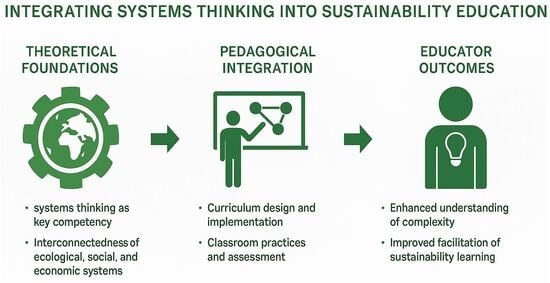
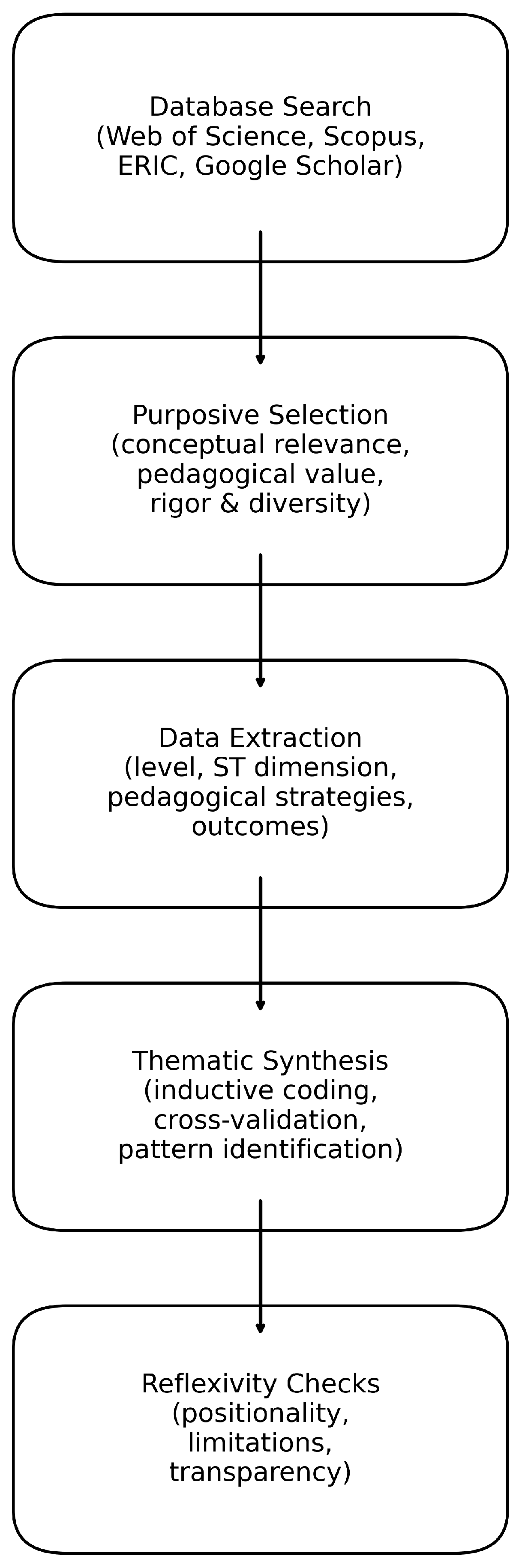
A narrative review was chosen to allow flexibility in synthesizing diverse sources—conceptual frameworks, empirical studies, and pedagogical exemplars—that span multiple disciplines. Unlike systematic reviews, which focus on exhaustive coverage, narrative reviews are particularly suited to fields characterized by evolving theoretical constructs and heterogeneous methodologies (Gutierrez-Bucheli et al., 2022). This conceptual significance approach enabled the integration of insights from both education and systems science, while maintaining a critical and interpretive stance (Figure 1).

3.2. Search Strategy

An iterative, multi-stage search was conducted on 4 December 2025 across four major databases: Web of Science (n = 102), Scopus (n = 295), and ERIC (n = 48). Google Scholar was also consulted to ensure broad coverage of gray literature, although no reliable count of retrieved items is reported due to known index inflation. Initial filtering was conducted using the built-in relevance-ranking algorithms of each academic database, followed by a secondary sorting based on citation counts. This structured approach, leveraging the native search engine functionalities, facilitated the identification of highly cited and thematically salient studies. Search terms combined Boolean operators and truncations, including:
(“system* thinking”) AND (“sustainability” OR “Education for Sustainable Development” OR “ESD” OR “sustainab* education”).
Reference lists of seminal papers and relevant reviews were also manually screened to identify additional studies through backward snowballing.

3.3. Selection Process and Inclusion Logic

Rather than applying rigid inclusion/exclusion filters, studies were purposively selected based on:
  • Conceptual significance—influential theoretical or competence frameworks (e.g., UNESCO, 2017; Wiek et al., 2011).
  • Empirical rigor—peer-reviewed studies reporting explicit instructional or assessment interventions, as well as reports and position papers issued by reputable international organizations or research bodies (e.g., UNESCO, OECD, World Bank, or equivalent institutions).
  • Pedagogical relevance—clear implications for teacher education or classroom practice.
  • Diversity of context—representation of both K–12 and higher-education implementations.
Publications in English from 2000 to 2025 were prioritized, acknowledging that this period corresponds with the mainstreaming of ESD within UNESCO’s policy frameworks.
A structured overview of the selected literature is presented in Appendix A, highlighting their educational settings, systems thinking components, and key implications for pedagogy.

3.4. Data Extraction and Thematic Synthesis

For each selected source, the following attributes were cataloged:
  • educational level and context;
  • systems thinking dimension(s) targeted;
  • pedagogical strategies or tools employed (e.g., conceptual modeling, simulations, socio-scientific issues);
  • reported learning outcomes or assessment methods.
An inductive thematic synthesis (Thomas & Harden, 2008) was then applied to distill recurring pedagogical patterns and theoretical constructs. To extract systems thinking frameworks and feedback loops, each selected article was screened for any explicit representation of system relationships, such as causal links, reinforcing or balancing interactions, or the use of named frameworks (e.g., DPSIR, system dynamics structures).

3.5. Reflexivity and Limitations

The author acknowledges his dual role as both a researcher and a practitioner in sustainability education, which may introduce interpretive bias. To mitigate this, triangulation was achieved by revisiting divergent disciplinary perspectives (education, systems engineering, environmental science) and by validating interpretations against established competency frameworks. Nevertheless, the purposive nature of selection limits reproducibility and may underrepresent non-English or unpublished studies.

4. Findings

4.1. Bridging Scientific and Social Systems Through Feedback Loops

One of the core principles of systems thinking is paying attention to feedback loops—cycles of cause and effect that can either amplify change (positive, or reinforcing feedback) or stabilize a system (negative, or balancing feedback) (Meadows, 2008; Senge, 1991). In sustainability studies, as in reality, feedback mechanisms dynamically connect natural processes with human actions. Highlighting these relationships allows students to understand how scientific and social systems interact.
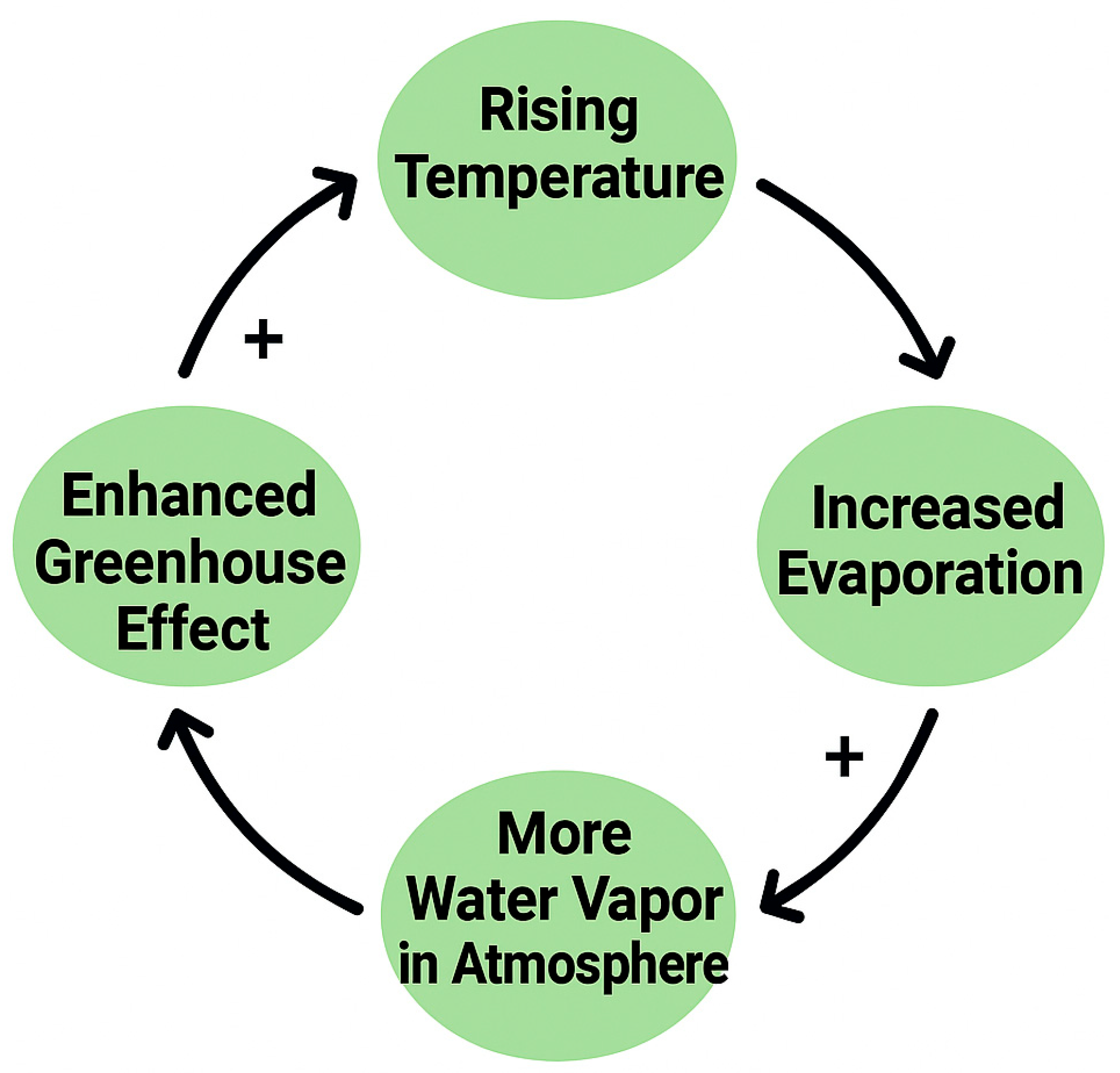
Below is an example of a real-world positive feedback loop in the climate system, illustrated in Figure 2:
  • Rising Temperatures
Greenhouse gas concentrations (CO2, CH4, etc.) increase. More heat is trapped in Earth’s atmosphere, causing average global temperatures to rise.
2.
Increased Evaporation
Warmer air and surface temperatures result in increased water evaporation from oceans, lakes, and soils.
3.
More Water Vapor in the Atmosphere
Water vapor is itself a potent greenhouse gas. The increased evaporation injects more water vapor into the atmosphere.
4.
Enhanced Greenhouse Effect
With more water vapor, the atmosphere traps even more infrared radiation, further boosting temperatures.
5.
Loop Reinforcement
That additional warming again drives higher evaporation, closing the loop and perpetuating further warming.
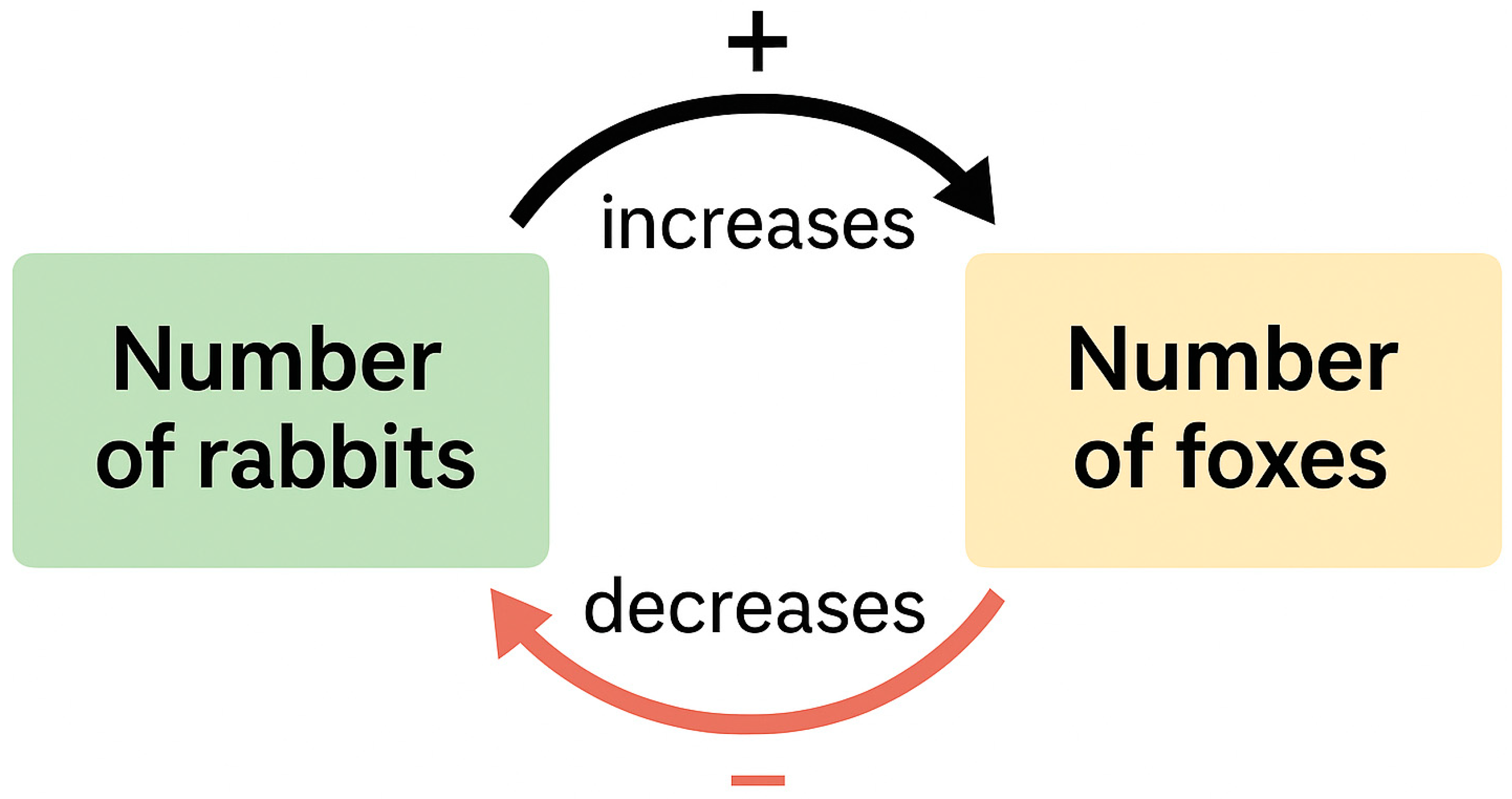
Positive feedback loops are often at the heart of sustainability problems, leading to exponential growth or rapid collapse (Arinze, 2024). However, students should also understand negative (balancing) feedback loops, which impose limits or oscillations. A simple example that can be introduced in class is the relationship between wildlife populations and the food chain: Figure 3 illustrates a classical negative feedback loop in ecology, often referred to as a predator–prey dynamic. When the rabbit population rises, the increased availability of food supports the growth of the fox population. However, increased fox populations lead to increased predation pressure on rabbits, which gradually reduces the rabbit population. As the rabbit population declines, food becomes scarce for the foxes, resulting in a subsequent decline in fox numbers. This process prevents either population from growing indefinitely and exemplifies a balancing loop in systems thinking that stabilizes a system around an equilibrium. Understanding such loops is crucial in sustainability education because it demonstrates how ecosystems self-regulate and why human disruptions (e.g., hunting, habitat loss) can destabilize them. Conversely, Figure 4 presents the linear approach to the same prey–predator dynamic.
Beyond isolated loops, sustainability education must address entire systems of systems, where multiple feedback loops and cross-domain interactions occur. A powerful interdisciplinary example is the phenomenon of resource overexploitation (like overfishing, deforestation, etc.), which typically involves a complex web of scientific and social feedback (Moxnes, 1998). Consider the overfishing case alluded to earlier (marine overexploitation syndrome). Ecologically, as fish stocks decline from overfishing, ecosystems degrade. Socially, there may initially be economic gains (profits for fishing industries)—a reinforcing loop that drives further exploitation. However, as fish become scarcer, negative feedback kicks in: catches diminish, impacting livelihoods and prompting social responses. We often see regulatory or grassroots responses emerge (e.g., international agreements, fishing quotas) once a crisis is recognized. Interestingly, those responses feed back into the system—successful contracts and policies can help replenish fish stocks (balancing feedback aimed at sustainability). In contrast, failing to enforce them can allow the destructive positive feedback loop to continue. Schuler et al. (2018) note that analyzing such socio-ecological feedback loops helps learners understand why systems thinking is vital (issues cannot be solved by examining ecology or economics alone) and how to apply a systems approach to real-world cases actively.
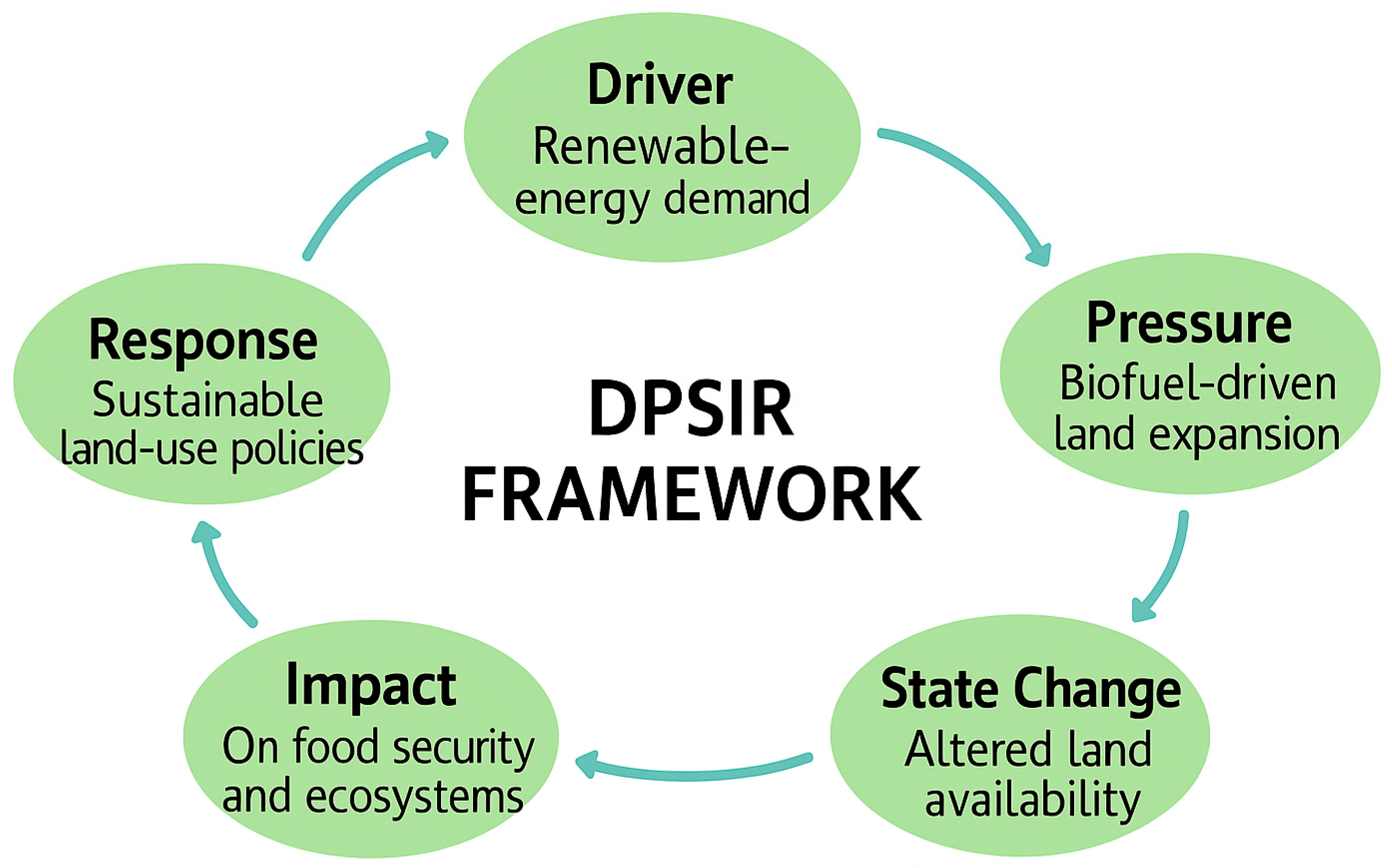
Another way to visualize the science–society interplay is through established frameworks like DPSIR: Driver–Pressure–State–Impact–Response—a model initially developed by the European Environment Agency (EEA) in 1999 (Smeets & Weterings, 1999). In a DPSIR model, human drivers (e.g., energy and food demand) lead to environmental pressures (e.g., pollution and resource extraction). These pressures alter the State of natural systems (e.g., atmospheric CO2 concentration, biodiversity levels), which in turn impact ecosystems and human well-being. Society then formulates Responses (policies, behavior changes, technologies) to mitigate or adapt to those impacts. Crucially, the response feeds back to drivers and pressures—ideally reducing the initial problem but sometimes introducing new issues (Atkins et al., 2011a, 2011b; Carnohan et al., 2023; Gari et al., 2015). For instance, the push for biofuels was a response to climate change (driver: need for renewable energy), which put pressure on land use (growing biofuel crops) and has had mixed impacts on food security and ecosystems, leading to further responses (see Figure 5). Using DPSIR or a similar system map in class may encourage students to trace these links and consider multiple feedback pathways, including how a policy (a social system element) can alter an environmental state, or how an environmental change can trigger social adaptations (Baldwin et al., 2016).
Discussing such complex interactions makes the dynamic interplay between scientific and social systems most evident. Students learn that you cannot fully understand phenomena like climate change, water security, urban pollution, or pandemic outbreaks by remaining in a single disciplinary silo. Each involves biophysical processes and human decisions linked in feedback loops. Allen et al. (2022) provide a compelling conceptualization in terms of achieving global sustainability goals: progress on social targets (e.g., education, equality, institutional strength) can reinforce ecological resilience and climate action, whereas setbacks on those social fronts undermine the strength of both human and natural systems (Allen et al., 2022). This creates a feedback loop on a grand scale: sustainable development, resilience, and climate stability all influence one another in a circular manner. The lesson for learners is that solving sustainability problems requires systems thinking across domains—for example, mitigating climate change is not just about emissions physics, but also about social systems, such as governance, economics, and culture, that drive emissions and implement solutions.
In summary, the discussion highlights that feedback loops and system linkages are central to sustainability. By examining reinforcing and balancing loops and mapping out multi-factor cause-and-effect chains, educators can help students see the connections between scientific concepts (like carbon cycles or habitat dynamics) and social concepts (like policy feedback or economic drivers). The following section will explore specific case studies and pedagogical practices that foster an integrated understanding of systems at various educational levels.

4.2. Case Examples in K–12 and Higher Education

Translating systems thinking’s lofty ideals into classroom practice can be challenging, but a growing body of case studies demonstrates effective strategies in school and university settings. Here are a few examples that demonstrate how systems thinking, especially the integration of social and scientific perspectives, can be introduced and assessed.

4.2.1. K–12 Case: Ecosystems and Human Impact in Middle School

A class might study a local water ecosystem (pond, river, etc.) by having students map out the food web, chemical cycles, and so on (the scientific system) and then overlay human factors like pollution sources, land use, or conservation efforts (the social system). Research by Evagorou et al. (2009) demonstrated that using an interactive ecosystem simulation helped 11- to 12-year-old students develop systems-thinking skills by visualizing how altering one part of the system (e.g., introducing a pollutant or removing a species) affected other parts. Students learned about ecology and grappled with management decisions in the simulation, watching the consequences unfold. This activity aligns with what others have found: even at the elementary and middle school levels, children can begin to understand complex systems if given appropriate tools and scaffolds (Evagorou et al., 2009).
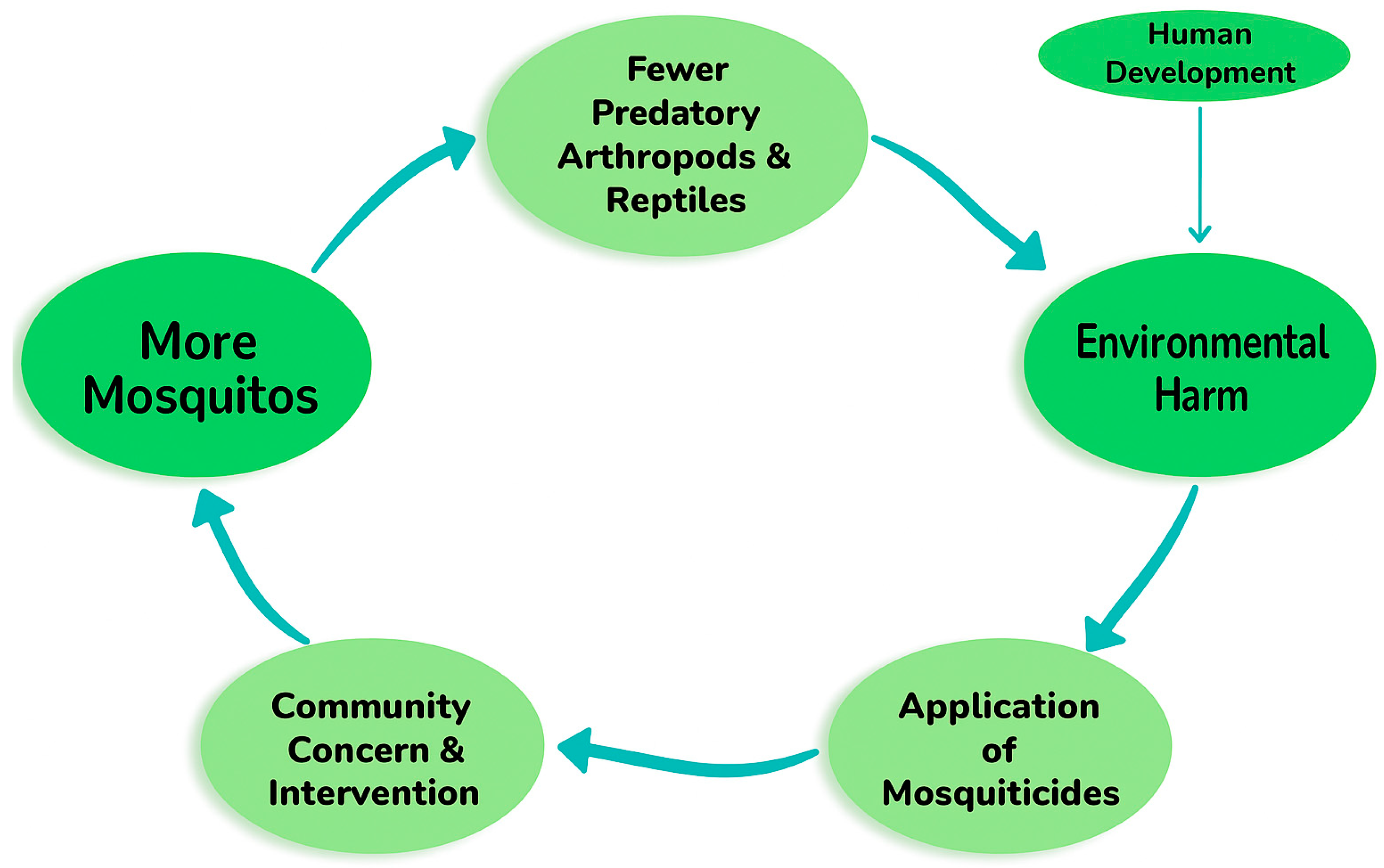
A hypothetical example illustrating how systems thinking can be integrated into elementary education involves a class exploring the question, “Why are there changes in our local arthropods and reptiles’ population?” Rather than attributing the change to a single cause—such as disease or habitat loss—the students, guided by their teacher, progressively construct a causal map involving multiple interconnected factors: water quality (affected by nearby farming run-off), weather patterns, predator populations, road construction (which drained wetlands), and community-led conservation efforts. The teacher scaffolds the inquiry by introducing system elements gradually and prompting discussion with questions like, “If we build more houses near ponds, what might happen to the water? How could that affect nature’s food chain?” On a large poster, students draw arrows connecting causes to effects, collaboratively building a mental model of the socio-ecological system. Over several weeks, as their understanding grows, they refine the model, adding new elements such as self-reinforcing feedback loops—for instance, environmental harm → fewer predatory arthropods and reptiles → more mosquitoes → increased community concern and intervention → more mosquitocides → more environmental harm (Figure 6).
This example does not depend on longitudinal field observations; it simply leverages a locally familiar ecological phenomenon to model systems-oriented questioning. For younger elementary students, systems thinking can be cultivated through simpler practices, such as identifying basic cause-and-effect relationships, recognizing classroom or environmental patterns, and engaging in guided discussions about how one change can influence another. These activities provide developmentally appropriate entry points into systems-oriented reasoning.
While this example is hypothetical as described, it mirrors the approach of project-based learning units recommended by environmental educators, such as the Sustainable Tomorrow curriculum guide (Ponto & Linder, 2011), which provides activities for students to map and discuss systems related to nature, wildlife, and habitat conservation. ESD—grounded in nature’s principles and driven by robust systems thinking frameworks—is indispensable for catalyzing harmonious, contextual, systemic transformation across interconnected “systems of systems,” empowering practitioners to intervene in real-world challenges and foster holistic, constructive environmental change (Soderquist & Overakker, 2010).
A notable outcome in K–12 implementations is that students become more engaged and show improved understanding when learning through a systems lens. In assessments, these students can often describe a chain of events or a system’s behavior more coherently than their peers who knew the same topic through rote facts (Karaarslan Semiz, 2021). For example, instead of simply stating “fertilizers cause algae blooms,” a systems-taught student might explain: “Nutrients from farm runoff (fertilizer) enter the river (Pressure), leading to algae growth (State change). When algae die, decomposition uses oxygen, causing fish kills (Impact on the ecosystem). This affects fishing livelihoods (Impact on society), prompting regulations on fertilizer use (Response).” This kind of explanation indicates a deeper grasp of the interconnected nature of the problem.

4.2.2. Higher Education Case: Pre-Service Teacher Training and Task Design

In higher education, systems thinking in sustainability is often emphasized in programs for future educators, engineers, or policymakers. A notable example comes from teacher education. Schuler et al. (2018) implemented a course for pre-service science teachers to enhance their systems thinking in ESD. In this course, student teachers engaged with the model’s four dimensions. As discussed earlier, they practiced drawing influence diagrams of syndromes and learned to incorporate systems concepts into lesson plans. By the end, their systems thinking improved, and they had concrete strategies for teaching those skills to their future pupils. For instance, a pre-service teacher might plan a high-school biology lesson on invasive species, where students map the spread of an invasive plant (including human actions such as gardening or transportation that aid its growth, ecological effects, and potential control measures). The teacher trainee would explicitly incorporate systems thinking by having students identify feedback loops (e.g., “Does the plant create conditions that allow it to spread further?”) and consider multiple scales (local ecosystem, regional trade, global climate).
A higher education case study by Peretz et al. (2023a) looked at how chemistry teachers (both in-service and pre-service) learn to design assessment tasks that are sustainability- and systems-oriented. These teachers were asked to develop their online learning tasks in a food and sustainability context, which inherently required linking chemistry content (scientific principles, e.g., chemical reactions in composting or cooking) with systems thinking about sustainable food systems (social, environmental, and economic aspects). Peretz et al. (2023a) also provided a rubric to guide and evaluate the teachers’ work, with four key attributes: (1) integration of sustainability and chemistry content, (2) diversity of thinking skills demanded, (3) inclusion of system aspects, and (4) use of visual representations. The “system aspects” criterion meant the task had to involve some notion of a larger system—for example, analyzing a food supply chain as a system with inputs, outputs, and feedback, or considering the life cycle of a product (farm to table to waste). One teacher’s task, as described in the study, involved having students investigate the chemistry of fermenting food as a preservation method and then evaluate its sustainability by mapping out the production, storage, and consumption systems, including social factors such as cultural preferences and economic costs. Visual system diagrams (like flow charts that the students had to fill in or concept maps they had to create) were part of the assignment, addressing the rubric’s fourth criterion.
The findings from this case are instructive: teachers initially found it challenging to connect chemistry topics with broader sustainability systems, but with practice and feedback, they showed significant improvement. They learned to formulate guiding questions that prompt students to think in systems terms, such as “What are the inputs and outputs of this process?” “How would a change in one part of the cycle affect other parts?” Over time, they also developed a greater appreciation for relevance—choosing topics meaningful to their students’ lives (like food) made it easier to discuss social and scientific dimensions. Another outcome was that teachers recognized the need for diverse thinking skills (another rubric point): a good systems-oriented task does not just ask for recall of facts, but might ask students to analyze a diagram, interpret data trends (to spot patterns), or consider alternative scenarios (to exercise anticipatory thinking). Peretz et al. (2023a) concluded that focusing on systems thinking in teacher training can enhance teachers’ assessment knowledge and task-design skills, enabling them to better evaluate student learning in sustainability contexts. In other words, if teachers are fluent in systems thinking, they are more likely to craft assessments that truly measure and foster that competence in their students.

4.2.3. Other Examples and Strategies

Beyond the above cases, educators have integrated systems thinking in numerous other ways. A few noteworthy strategies include:
Use of Concept Mapping and Modeling Software: High school and undergraduate students have benefited from tools such as concept mapping software and system dynamics simulations. For example, Brandstädter et al. (2012) employed computer-based concept mapping to assess German students’ systems thinking in biology and found it to be effective for large-scale evaluation. Such tools allow students to externalize their mental models of a system for discussion and grading (Karaarslan Semiz, 2021).
Lavi et al. (2020), Lavi and Dori (2019) and Peretz et al. (2024, 2023b) utilized the Object-Process Methodology (OPM) in OPCloud—a web-based application for modeling complex systems with OPM—to assess and develop teachers’ and students’ systems thinking in engineering, science, and sustainability contexts. OPM is a bimodal conceptual modeling language and methodology (Dori, 2016) that can be learned relatively easily by non-experts. It is the most extensively studied approach in model-based systems engineering (MBSE) (Dong et al., 2022).
Socio-scientific Issues (SSIs) as a Context: SSI pedagogy involves tackling real-world problems (e.g., climate policy, bioethics of genetic engineering, water resource management) through inquiry and debate. By their nature, SSIs blend science content with societal considerations (Holling, 2001). Teachers employing SSIs often implicitly teach systems thinking, as students must consider both scientific evidence and societal impacts simultaneously (Ke et al., 2020). For instance, an SSI unit on electric cars might require an understanding of battery chemistry, energy grids (a scientific field), consumer behavior, economics, and environmental policy (a social science).
Interdisciplinary Project Weeks or Hackathons: Some schools and colleges have implemented intensive projects where students from different subject backgrounds collaborate on a sustainability challenge (Happonen et al., 2020). In these settings, systems thinking tends to emerge as teams pool their expertise and have to create a shared model of the problem. A report on a university “sustainability hackathon” noted that mixed teams of engineering and social science students designed solutions, including a circular-economy plan for campus waste, explicitly mapping material flows and stakeholder roles (a system diagram) as part of their presentation. Participants later reflected that understanding teammates’ perspectives was akin to seeing a new part of the system—a direct outcome of systems-oriented collaboration.
From these examples, a common thread is that learning activities should be student-centered and inquiry-driven to build systems thinking effectively. Whether a middle-schooler is manipulating an ecosystem simulation or a pre-service teacher is designing a lesson, actively constructing knowledge (drawing a diagram, analyzing a case, debating solutions) is key. Traditional lectures about “systems theory” alone are unlikely to shift thinking; instead, immersive experiences and concrete practice are needed. Nearly every successful approach includes visual representation (diagrams, maps, models) to help learners concretize abstract relationships.

5. Implications for Pedagogy and Curriculum

Integrating systems thinking into sustainability education has several important implications for teaching practice and curriculum design:
Curriculum Integration: Systems thinking should not be confined to a single course or unit but instead fully integrated into curricula (Hong, 2020; Woo et al., 2012); it can serve as a cross-cutting theme. For K–12, this might mean revisiting core concepts (like the water cycle, energy, or community development) at increasing levels of complexity, each time adding more system context. A spiral curriculum (Harden, 1999) could introduce a simple system in the early grades and build on it later, adding more variables and connections. In higher education, interdisciplinary courses or modules can ensure students connect across subjects. For example, an environmental science program might require a policy analysis project, while an engineering program might include ecological and social impact assessments for design projects.
Teacher Professional Development: Teachers need support and training to effectively teach and assess systems thinking (Burmeister & Eilks, 2013; Peretz et al., 2023a; Schuler et al., 2018; Tal et al., 2023; Yoon et al., 2017). Professional development workshops can engage teachers in mapping systems for real-world issues and in reflecting on how to apply that experience to their students. Teachers often operate under time constraints and curricular mandates, so providing ready-to-use frameworks (like rubrics, a set of syndrome case studies, or DPSIR charts for common topics) can help them implement systems activities without feeling overwhelmed.
Assessment of Systems Thinking: Traditional tests (multiple-choice, single-topic problems) may fail to capture a student’s growth in systems thinking (Dugan et al., 2021). Educators should consider assessments that allow students to demonstrate their understanding of systems, such as having them draw and explain a concept map, analyze a scenario, and identify feedback loops, or work through a case study in an oral exam setting. Rubrics (such as the one by (Peretz et al., 2023b)) are helpful for consistently evaluating open-ended performances in sustainability contexts. Additionally, formative assessment techniques—like having students “think aloud” as they connect ideas or using clicker questions (Hubbard & Couch, 2018) that pose system-level predictions—can give immediate feedback on their systems comprehension during instruction and could benefit education for sustainability (Annelin & Boström, 2023)
Use of Diagrams and Visualization: Given the complexity of systems, visual aids are indispensable (Arnold & Wade, 2017; Dori, 2016; Dugan et al., 2021; Mayer, 2005; Meadows, 2008). Teachers should encourage students to create diagrams, such as influence diagrams, stock-and-flow diagrams, or timelines, that are suited to the topic. Even simple icons and arrows on a whiteboard can help externalize a system’s structure. Starting with a template or partially filled diagram is often helpful for novices. For example, in a lesson about a city’s water supply system, the teacher might provide bubbles for “reservoir,” “water treatment plant,” “households,” and arrows between them, and then have students annotate what each arrow means and add external factors like “drought” or “law” that influence the flows.
Connecting to Students’ Lives: Systems thinking can seem abstract unless students see its relevance. Effective sustainability educators should select examples that resonate with students’ experiences (Eilks & Hofstein, 2014) and also with their own experiences (Peretz et al., 2023a). Urban students might examine city traffic congestion (cars, public transit, air quality, health impacts, urban planning policies—a rich system). In contrast, rural students might examine agricultural systems (soil health, crops, markets, climate, and technology). By analyzing familiar systems, students more readily grasp the value of the approach. Moreover, it empowers them—they start seeing themselves as part of systems and recognizing leverage points where they can make a difference (the action-oriented nature of ESD; Sinakou et al., 2022).
Emphasizing both Natural and Social Dimensions: To truly highlight the dynamic interplay between scientific and social systems, instructors should deliberately include both types of content. A science class can incorporate discussion of human implications, and a social studies class can consider environmental constraints and scientific data. This does not mean every lesson must be an environmental science lesson; teachers might collaborate across disciplines for joint projects. For instance, a history teacher covering the Industrial Revolution could partner with a science teacher to have students examine the environmental system’s impacts (such as coal usage and pollution) and feedbacks (such as London’s smog leading to public health responses). Such collaboration models interdisciplinary thinking for students.
Addressing Misconceptions and System Blind Spots: A pedagogical challenge is that students (and people in general) often have cognitive biases and mental models that oversimplify systems—e.g., viewing change as linear, focusing solely on immediate causes, or assuming a fixed pie (ignoring feedback loops). Instruction should aim to uncover and correct these misconceptions. Educators can present common pitfalls—for example, exponential growth versus linear growth, or the concept of lag effects (such as how climate warming persists even after emissions decline, due to system inertia). Classroom experiments or simulations are great for this: one famous activity involves a stock-and-flow experiment where students predict a bathtub water level given in-flow and out-flow rates—many intuitively get it wrong, which opens a discussion on accumulation and time delays. Students gradually shift toward a true systems mindset by directly confronting these counterintuitive aspects.
Clarifying Pathways for Classroom Implementation: In practical terms, systems thinking can be introduced in different ways: as part of a single subject (e.g., science or geography), through project-based learning units, or via coordinated, cross-subject collaboration among teachers. While individual activities such as multi-factor cause and effect mapping can provide valuable entry points, the approach advocated in this article views systems thinking as a recurring pedagogical thread that is revisited and deepened over time, rather than as a one-off lesson (Evagorou et al., 2009; Wiek et al., 2011; Yoon et al., 2017).
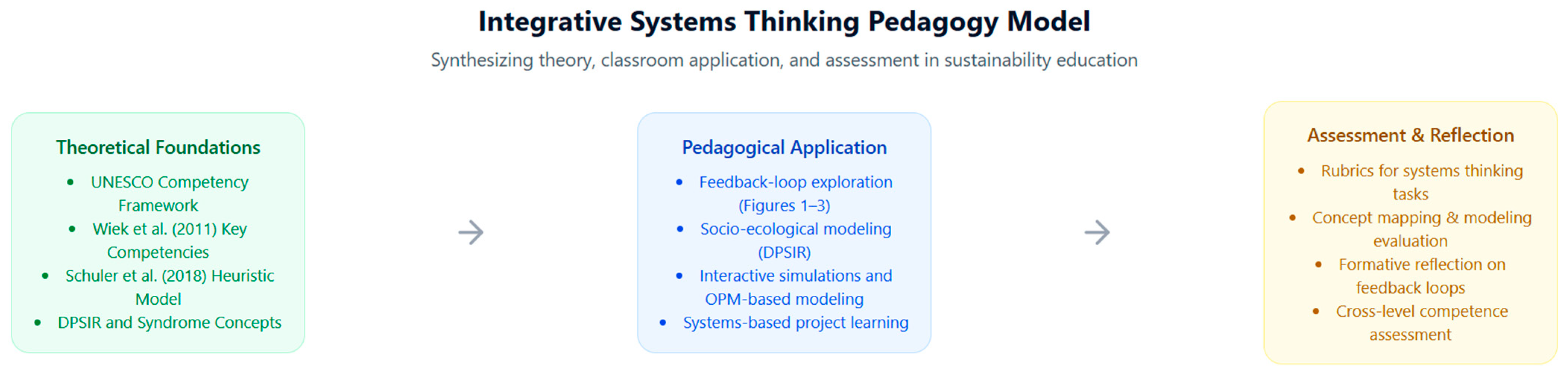
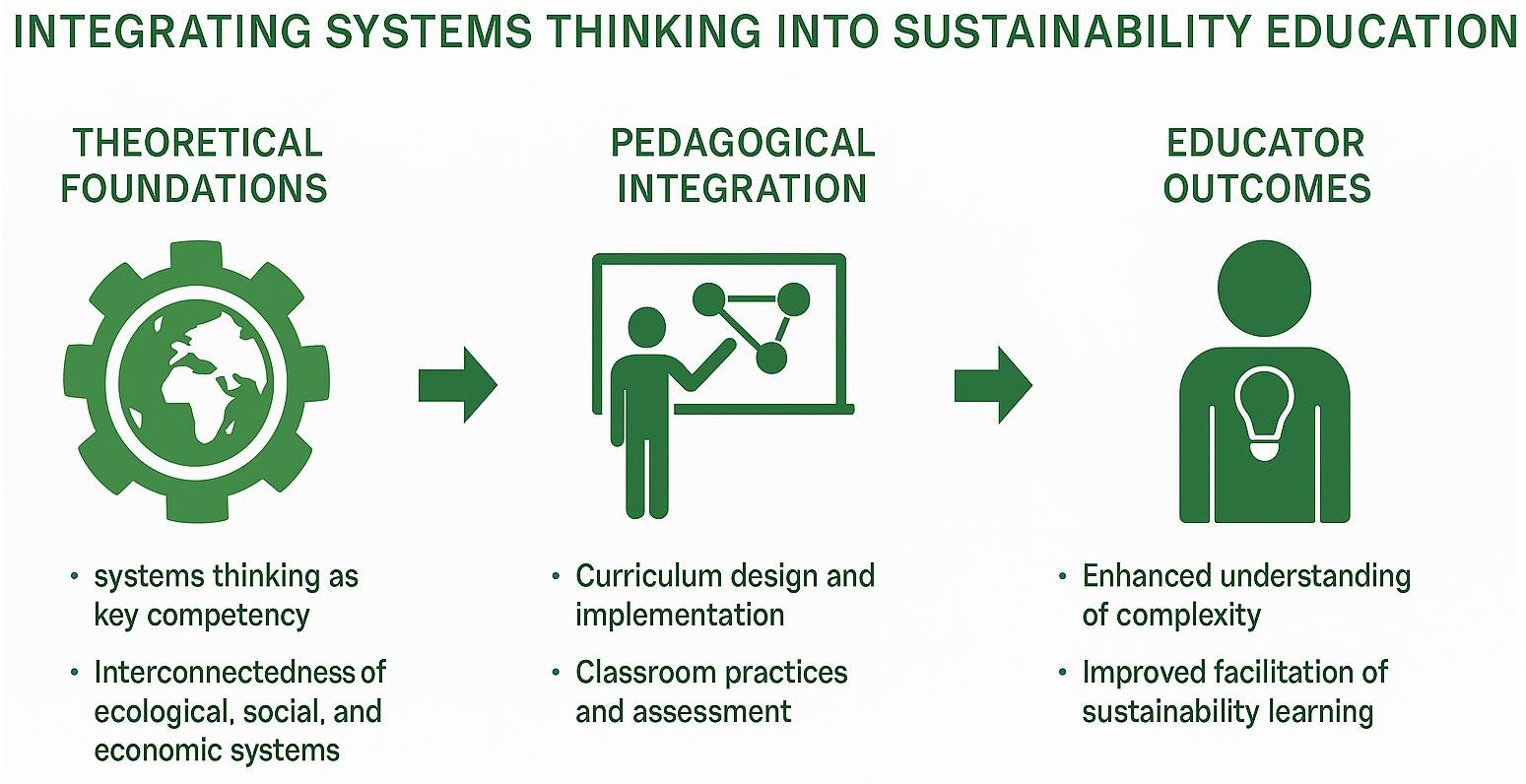
In essence, the pedagogical implications center on creating learning environments that reflect the complexity of the real world while still providing students with a structured framework to navigate that complexity (Figure 7). It is about scaffolding without oversimplifying. As noted by many educators, the reward is that students who engage in systems thinking learn the content more deeply and become more adept at critical thinking and problem-solving in novel situations. They tend to transfer their learning to new contexts better, because they are not just memorizing facts—they are practicing connecting and adapting knowledge.

6. Limitations

This narrative review offers a comprehensive conceptual synthesis and provides illustrative case examples of systems thinking in sustainability education; however, it is subject to several limitations. First, the purposive selection of literature, guided by author expertise rather than formal inclusion and exclusion criteria, may introduce selection bias and omit relevant studies or gray literature (Sukhera, 2022). Second, without a systematic search protocol or an explicit risk-of-bias assessment, the review’s reproducibility and comprehensiveness are constrained compared to those of systematic or scoping reviews (Gutierrez-Bucheli et al., 2022). Third, most case examples and empirical findings derive from English-language publications and specific educational contexts (e.g., K–12 programs in Western countries, pre-service teacher training), which may limit the transferability of conclusions to diverse cultural or institutional settings. Finally, as a narrative overview, this paper does not quantify effect sizes or compare the relative efficacy of different pedagogical strategies, leaving open questions about which systems thinking interventions yield the most robust learning gains. Nevertheless, narrative reviews, while interpretive in nature, can complement systematic approaches by revealing conceptual linkages and theoretical patterns that may be overlooked in quantitatively oriented syntheses.

7. Directions for Future Research

To deepen understanding and strengthen the evidence base, future research should pursue more rigorous and varied methodological approaches:
  • Systematic Mapping of the Field: Conduct systematic and scoping reviews using established protocols (e.g., PRISMA) to capture the full range of literature on systems thinking in sustainability education, identify emerging trends, and highlight under-studied areas (Gutierrez-Bucheli et al., 2022; Sanchez et al., 2025).
  • Robust Empirical Evaluations: Implement randomized controlled trials, longitudinal mixed-methods studies, and quasi-experimental designs to evaluate specific pedagogical interventions, quantify learning outcomes, and examine the durability of systems thinking skills over time (Demssie et al., 2023).
  • Cross-Cultural and Contextual Studies: Explore how systems thinking competencies develop and manifest in varied educational settings, such as non-Western schools, informal learning environments, and fully online contexts, to ensure findings are globally relevant.
  • Validation of Assessment Instruments: Refine and validate tools for measuring systems thinking (e.g., concept-mapping rubrics, modeling assessments) across different age groups, disciplines, and instructional modes to establish their reliability and generalizability (Minichiello & Caldwell, 2021).
  • Integration of Emerging Technologies: Investigate the potential of virtual simulations, augmented reality, and AI-driven platforms to scaffold systems thinking instruction, provide adaptive feedback, and personalize learning pathways in sustainability education.
By addressing these directions, future work can build a more robust, evidence-based framework for integrating and assessing systems thinking across educational levels and contexts.

8. Conclusions

The necessity of systems thinking in sustainability education cannot be overstated. As the challenges facing humanity and our planet become increasingly complex and interconnected, education must evolve to prepare learners who can think beyond linear cause-and-effect relationships and isolated disciplines. This article has explored how systems thinking bridges the gap between scientific and social understanding, enabling a more comprehensive understanding of sustainability issues. This paper reviewed theoretical frameworks that position systems thinking as a key competency, from UNESCO’s (2017) global policy perspective to detailed competence models for teachers. It has been illustrated, through conceptual diagrams and examples, what it means to perceive the world in terms of systems: recognizing feedback loops (whether the amplifying cycle of ice melting and warming, or the balancing loop of wildlife and human interaction) and mapping out the multiple connections that define problems like overfishing, climate change, or food security.
The case studies from K–12 and higher education demonstrate that students can learn systems thinking when deliberately integrated into pedagogy. Even young learners, with appropriate support such as interactive simulations or guided mapping, begin to see connections and think critically about causes and consequences. For older students and future educators, practicing systems thinking—and learning how to teach it—yields dividends in their ability to design interdisciplinary learning experiences and assessments. Importantly, these examples highlight that embracing systems thinking often leads to greater student engagement and agency. Sustainability education empowered by systems thinking encourages learners to move from passive absorption of information to active analysis and problem-solving. They learn that complex problems are not intractable; understanding the system can identify leverage points for change (Meadows, 2015)—whether that involves a policy intervention, a technological innovation, or a shift in social behavior.
The charge for educators and curriculum developers is clear: incorporate opportunities for students to think in systems, consistently and across contexts. This could mean restructuring some units to be problem-focused and interdisciplinary, or introducing new assessment forms as discussed. It means providing professional development so teachers become comfortable with system concepts (Yoon et al., 2017). The dynamic interplay between scientific and social systems should be made explicit in lessons—students should routinely be prompted to consider how a scientific phenomenon might impact society and how social actions might feed back into natural systems. Over time, such pedagogical practice can cultivate a generation of learners who naturally approach problems with a systems mindset. These individuals will be better equipped to collaborate across fields, anticipate unintended consequences, and devise holistic solutions for sustainability challenges.
In conclusion, sustainability education infused with systems thinking offers a path toward developing not just knowledge of sustainability but also the wisdom to apply that knowledge in a complex world. It produces systems-literate graduates who can navigate the interplay of ecology, technology, economics, culture, and policy. Given the stakes of issues such as climate change and sustainable development, this competency is not simply an academic addition—it is an essential outcome of education in the 21st century. As one of the key competencies for sustainability, systems thinking in education transforms learners from passive observers of fragmented subjects into active participants in understanding and shaping the larger systems that define our collective future. The task is to continue expanding this approach, supported by ongoing research (such as new case studies and assessment methods) and shared best practices, so that systems thinking becomes a natural and integral part of sustainability education at all levels.

Funding

This research received no external funding.

Institutional Review Board Statement

Not applicable. The study did not involve humans or animals.

Informed Consent Statement

Not applicable.

Data Availability Statement

All data generated or analyzed during this study are included in this published article.

Conflicts of Interest

The author declares no conflicts of interest.

Abbreviations

The following abbreviations are used in this manuscript:
DPSIRDriver–Pressure–State–Impact–Response
ESDEducation for Sustainable Development
OECDOrganisation for Economic Co-operation and Development
OPMObject-Process Methodology
SDGSustainable Development Goals
UNESCOUnited Nations Educational, Scientific and Cultural Organization

Appendix A

Summary of the reviewed studies, including target groups, disciplinary contexts, systems thinking components addressed, pedagogical strategies applied, and main educational contributions.
#Authors (Year)Journal/SourceRegionEducational LevelSystems Thinking Elements IdentifiedPedagogical Proposal/Contribution
1Evagorou et al. (2009)Int. J. of Science EducationCyprusElementary (5th–6th grade)Interactive ecosystem simulation; cause–effect linkages in food web and human impacts.Demonstrated that a simulation-based learning environment can help 11–12-year-old students develop systems thinking skills by visualizing how changes in one part of an ecosystem (e.g., adding a pollutant) affect other parts. Students learned to map ecological relationships and saw consequences of management decisions unfold, indicating even young learners can grasp complex system dynamics with appropriate tools.
2Riess and Mischo (2010)Int. J. of Science EducationGermanySecondary (Biology classes)Modeling and describing complex biological systems; identifying interdependencies in ecosystems.Analyzed teaching approaches in biology lessons to promote systems thinking, defined as “the ability to recognise, describe, model… and explain complex aspects of reality as systems”. Found that integrating cross-topic connections in biology (e.g., linking ecological and social factors) can improve students’ ability to understand and explain biological phenomena systemically, supporting the value of systems-oriented teaching in science.
3Ponto and Linder (2011)Curriculum Guide (Pacific Education Institute)USAHigh school (Grades 9–12)System mapping of environmental issues; cause–effect chains in nature and society.A curriculum guide (“Sustainable Tomorrow”) providing project-based learning units for environmental education. It offers activities for students to draw systems maps connecting natural processes (wildlife, habitat) and human factors, thereby helping teachers integrate systems thinking (e.g., food webs + land use) into high-school curricula. This guide emphasizes visual mapping and discussion of “systems of systems” to foster holistic understanding.
4Wiek et al. (2011)Sustainability ScienceGlobalHigher education (university programs)Key competencies framework (systems thinking as one of 5 sustainability competencies).Proposed a widely used competency framework for sustainability education, identifying systems thinking as a core competency alongside futures, values, strategic, and collaboration skills. This framework has informed curriculum development in universities by emphasizing the ability to understand interconnected environmental, social, and economic systems as essential for all sustainability professionals.
5Brandstädter et al. (2012)Int. J. of Science EducationGermanySecondary (High school biology)Concept mapping of system components and interactions; assessment of systemic understanding.Examined different concept-mapping practices to assess students’ systems thinking in biology. The study found that concept mapping is an effective tool for eliciting students’ understanding of biological systems. By comparing mapping techniques, they demonstrated that well-designed concept map tasks can validly capture how learners perceive relationships in a system, informing large-scale assessment of systems thinking skills.
6Woo et al. (2012)OIDA Int. J. of Sustainable DevelopmentMalaysia (global review)Higher education (curriculum review)Characteristics of ESD curriculum (holistic integration, interdisciplinarity, systems perspective).Reviewed sustainability curricula and highlighted that effective programs embed sustainability (and systems thinking) as a cross-cutting theme across courses. Emphasized a holistic approach—e.g., “spiral curriculum” revisiting core concepts with increasing system complexity—to help students progressively build systemic understanding of issues like water, energy, and community development.
7Burmeister and Eilks (2013)Science Education InternationalGermanyTeacher education (pre-service & trainee teachers)Understanding of sustainability and ESD concepts (systems aspect implicit).This study surveyed German chemistry student teachers and trainees, revealing a fragmented understanding of sustainability and ESD. The findings highlight the difficulty of linking scientific content to broader systems without explicit training. The study underscores the importance of professional development to strengthen systems thinking in future educators.
8Baldwin et al. (2016)Ocean & Coastal ManagementThailand (Gulf of Thailand)Tertiary/Professional training (transdisciplinary)DPSIR framework (Drivers-Pressures-State-Impact-Response) applied to coastal socio-ecological issues; feedback pathways between society & environment.This study applied the DPSIR framework in a transdisciplinary training program focused on environmental issues in the Gulf of Thailand. Participants used the model to map human drivers, environmental pressures, impacts, and policy responses, highlighting interconnected feedbacks. The exercise demonstrated that DPSIR diagrams support knowledge exchange and help learners analyze complex sustainability challenges through systemic lenses.
9Sweeney (2017)Book chapter—EarthEd (Island Press)USAK–12 (general, curriculum perspective)Core “systems literacy” concepts (interdependence, feedback loops, system archetypes); use of visual tools (connection circles, causal loop diagrams, simulations).This chapter advocates for integrating systems thinking throughout K–12 education to develop “systems-smart” learners. It outlines age-appropriate systems concepts, such as emergent behavior, archetypes, and feedback loops, and emphasizes visualization tools like causal-loop diagrams and simulations. The goal is to foster cross-disciplinary thinking so students can approach complex issues with interconnected, systems-based perspectives.
10Arnold and Wade (2017)INCOSE Intl. Symposium (Proc.)USA (conceptual)N/A (cross-domain skills framework)Comprehensive taxonomy of systems thinking skills (e.g., understanding hierarchies, feedback, emergent properties, using visual models).Defined a complete set of systems thinking skills for engineers and learners, highlighting abilities such as recognizing system boundaries, identifying feedback loops, understanding non-linearity, and employing visual modeling techniques. This skills framework serves as a guide for curriculum designers—stressing, for example, that teaching should include diagramming and modeling activities, since visualizing complex systems is critical for learning to “think in systems”.
11Yoon et al. (2017)Instructional ScienceUSAK–12 Teacher Professional DevelopmentComplex systems in science education; computer-supported systems simulations; teacher PD design.This study developed a professional development (PD) program to support science teachers in teaching complex systems using simulations and modeling tools. It highlighted the need for intensive support and identified effective PD strategies, including hands-on modeling, collaborative lesson design, and coaching. The program improved teachers’ confidence and instructional practices, offering guidance for building educator capacity in systems-based instruction.
12UNESCO (2017)UN SDG: Learn (UNESCO competencies report)GlobalAll levels (policy framework)Systems thinking defined as key sustainability competency (ability to recognize interconnections, handle complexity and uncertainty across scales). This UNESCO report established systems thinking as a key competency for achieving the Sustainable Development Goals. It emphasizes the need for education to foster learners’ ability to analyze complex interactions across environmental, social, and economic systems. The report calls for curricula and teacher training to support holistic, integrative thinking as a central aim of Education for Sustainable Development.
13Schuler et al. (2018)Journal of Geography in Higher EducationGermanyTeacher education (pre-service science teachers)Four-dimensional systems thinking competence model (knowledge of system characteristics; modeling and simulation; perspective-taking; evaluation of system dynamics).This study implemented a four-part heuristic model of systems thinking, systems knowledge, modeling skills, perspective-taking, and evaluation, in a teacher education course. Pre-service science teachers created influence diagrams and designed systems-based lessons, leading to marked improvements in their systems thinking and pedagogical approaches. The study demonstrates the effectiveness of structured, multidimensional training for building teachers’ capacity to teach systems thinking.
14Lavi and Dori (2019)Int. J. of Science EducationIsraelTeacher education (pre- vs. in-service teachers)Object-Process Methodology (OPM) modeling tasks; comparative assessment of systems thinking skills.This study used conceptual modeling (Object-Process Methodology) to assess and compare systems thinking in pre-service and in-service science and engineering teachers. Findings showed that experienced teachers demonstrated stronger systems thinking, especially in identifying feedback loops and system boundaries. The study underscores the value of modeling-based training in teacher education to close the gap in systems thinking competency between novice and practicing educators.
15Happonen et al. (2020)AIP Conference ProceedingsFinland (case study)Higher education (university students, interdisciplinary)Sustainability hackathon project; material flow mapping; stakeholder roles; interdisciplinary teamwork.This study examined a university sustainability hackathon where interdisciplinary student teams tackled circular economy challenges. Students created system diagrams and reflected on the value of diverse perspectives in understanding complex problems. The hackathon setting fostered systems thinking by requiring collaborative modeling and integration of varied disciplinary insights.
16Hong (2020)Book chapter (SDGs & Higher Education)USA (university context)Higher education (faculty development)Faculty Learning Community model; curriculum infusion of sustainability (across disciplines, systems perspective).This chapter described how a Faculty Learning Community was used to integrate sustainability across a university curriculum. Through regular cross-disciplinary meetings, faculty collaboratively embedded sustainability, and systems thinking, into diverse courses. The initiative fostered curricular coherence and interdisciplinary connections, demonstrating that faculty collaboration can effectively infuse systems perspectives into higher education.
17Ke et al. (2020)Int. J. of Science EducationUSASecondary science (socio-scientific issues in class)Socio-scientific issue (SSI) instruction blending science and social aspects; use of epistemic tools (e.g., evidence charts, system maps) to examine issues.This study explored how students engaged in systems thinking during a socio-scientific issues (SSIs)–based science unit. When analyzing topics like electric cars, students connected scientific concepts with societal factors using tools such as concept maps and stakeholder charts. The findings show that SSI pedagogy naturally fosters systems thinking by encouraging learners to analyze interdisciplinary, real-world problems.
18Lavi et al. (2020)IEEE Trans. on EducationIsraelHigher education (engineering undergraduates)Model-Based Systems Thinking (MBST) via OPM; team-based conceptual modeling projects.This study evaluated engineering student teams’ systems thinking using Object-Process Methodology (OPM) in a cloud-based environment. Teams created conceptual models of engineering systems, which were assessed for systems thinking indicators. Results showed that guided modeling helped students better identify system components, interactions, and constraints. The study validates model-based systems thinking (MBST) as an effective instructional and assessment tool in engineering education.
19Karaarslan Semiz (2021)In MDPI “Transitioning to Quality Education” (theoretical note)(Literature synthesis—global K–12)K–12 (science education, general)Reported outcomes of systems thinking pedagogy: student ability to explain causal chains, DPSIR framework usage for environmental issues.This theoretical review emphasizes that K–12 students exposed to systems thinking pedagogy demonstrate deeper, more coherent understanding of complex issues. Using frameworks like DPSIR, students articulate cause–effect chains rather than isolated facts, showing enhanced engagement and explanatory clarity. The review highlights systems thinking as a powerful approach for improving science education outcomes.
20Dugan et al. (2021)ASEE Conference ProceedingsUSAHigher education (engineering education)Assessment approaches for systems thinking (concept maps, scenario analysis, engagement measures).This review examined assessment methods for evaluating systems thinking in engineering education. It critiqued conventional tests as inadequate and proposed alternatives like concept mapping, case analysis, and think-aloud protocols. Dugan et al. emphasized the importance of authentic, open-ended tasks with clear rubrics to capture students’ systemic understanding, guiding more effective evaluation practices in project-based learning.
21Mahaffy and Elgersma (2022)Current Opinion in Green & Sust. ChemistryCanada/USAHigher education (chemistry curriculum)Planetary Boundaries framework linked to chemistry; molecular-level to global system connections.This paper advocates integrating systems thinking and planetary boundaries as core competencies in chemistry education. It proposes redesigning curricula to connect molecular science with global sustainability through concepts like feedbacks and thresholds. The contribution lies in offering a conceptual model to embed macro-level sustainability into chemistry teaching, equipping students with both disciplinary depth and systemic insight.
22Annelin and Boström (2023)Int. J. of Sustainability in Higher Ed.Sweden (global review)Higher education (competency assessment)Measurement of sustainability competencies (including systems thinking); review of assessment scales and validation.This review examined tools for assessing sustainability competencies, including systems thinking. It found diverse but inconsistent instruments, often lacking validation. The authors recommend developing assessments that capture dynamic system understanding, not just content recall. The study contributes by offering guidance for improving the reliability of systems thinking evaluation in educational programs.
23Demssie et al. (2023)Environmental Education ResearchEthiopia/Netherlands (case study)Secondary education (real-world learning program)Multiple real-world learning approaches (project-based learning, community projects, field-based inquiry) to foster systems thinking.This case study evaluated a program using real-world sustainability learning—like fieldwork and interdisciplinary projects—to foster systems thinking. Students showed improved ability to recognize systemic relationships and develop integrated solutions. The findings underscore the effectiveness of authentic, multi-context learning experiences in developing systems thinking competencies.
24Peretz et al. (2023a)Education SciencesIsraelTeacher professional development (Chemistry teachers)Rubric-guided task design for systems-oriented learning; system aspects in science tasks; feedback loops in food system context.This study explored how chemistry teachers learn to design assessments that integrate sustainability and systems thinking. Through a professional development course, teachers improved their ability to connect chemistry with broader systems using guiding questions and visual diagrams. A key outcome was a validated rubric for sustainability-oriented tasks, demonstrating that targeted training enhances teachers’ skills in promoting systems thinking.
25Peretz et al. (2023b)Instructional ScienceIsraelHigher education & Teacher education (Engineering and science students; teachers)Conceptual modeling (OPM) in an online platform; interdisciplinary systems tasks; comparative study across students and teachers.This study examined a web-based modeling intervention (using OPCloud) to develop systems thinking in engineering and science students, as well as educators. Participants improved in identifying system components, interactions, and feedback loops. Engineering students integrated social–technical elements in their designs, while teachers enhanced their guidance of systemic problem analysis. The study supports model-based exercises as effective pedagogy for advancing systems thinking across education levels.
26Peretz et al. (2024)IEEE Trans. on EducationIsraelHigher education (Engineering undergraduates)Online learning tasks with OPM modeling; assessment of systems thinking in an engineering course.This study evaluated engineering students’ systems thinking through online modeling tasks using Object-Process Methodology (OPM) on the OPCloud platform. By analyzing students’ digital models, researchers assessed their understanding of system components, interactions, and emergent behaviors. Findings show that model-based assignments can effectively foster and assess systems thinking in large-scale online courses, offering a scalable approach to teaching complex systems in engineering education.
27Pilcher (2024)Physical Sciences ReviewsSouth AfricaHigher education (Tertiary chemistry)Integration of systems thinking into chemistry curriculum; linking chemistry concepts to global sustainability frameworks (e.g., planetary boundaries).Pilcher provides a roadmap for integrating systems thinking into university-level chemistry education, aligning with IUPAC’s call for reform. The article outlines strategies such as life-cycle analysis, contextualizing chemistry within the Planetary Boundaries framework, and using cross-disciplinary case studies.

References

  1. Allen, K. J., Reide, F., Gouramanis, C., Keenan, B., Stoffel, M., Hu, A., & Ionita, M. (2022). Coupled insights from the palaeoenvironmental, historical and archaeological archives to support social-ecological resilience and the sustainable development goals. Environmental Research Letters, 17(5), 055011. [Google Scholar] [CrossRef]
  2. Annelin, A., & Boström, G.-O. (2023). An assessment of key sustainability competencies: A review of scales and propositions for validation. International Journal of Sustainability in Higher Education, 24(9), 53–69. [Google Scholar] [CrossRef]
  3. Arinze, E. D. (2024). Unravelling exponential growth dynamics: A comprehensive review. IAA Journal of Scientific Research, 11(3), 19–26. [Google Scholar] [CrossRef]
  4. Arnold, R. D., & Wade, J. P. (2017). A complete set of systems thinking skills. INCOSE International Symposium, 27(1), 1355–1370. [Google Scholar] [CrossRef]
  5. Atkins, J. P., Burdon, D., Elliott, M., & Gregory, A. J. (2011a). Management of the marine environment: Integrating ecosystem services and societal benefits with the DPSIR framework in a systems approach. Marine Pollution Bulletin, 62(2), 215–226. [Google Scholar] [CrossRef]
  6. Atkins, J. P., Gregory, A. J., Burdon, D., & Elliott, M. (2011b). Managing the marine environment: Is the DPSIR framework holistic enough? Systems Research and Behavioral Science, 28(5), 497–508. [Google Scholar] [CrossRef]
  7. Baldwin, C., Lewison, R. L., Lieske, S. N., Beger, M., Hines, E., Dearden, P., Rudd, M. A., Jones, C., Satumanatpan, S., & Junchompoo, C. (2016). Using the DPSIR framework for transdisciplinary training and knowledge elicitation in the gulf of Thailand. Ocean & Coastal Management, 134, 163–172. [Google Scholar] [CrossRef]
  8. Brandstädter, K., Harms, U., & Großschedl, J. (2012). Assessing system thinking through different concept-mapping practices. International Journal of Science Education, 34(14), 2147–2170. [Google Scholar] [CrossRef]
  9. Burmeister, M., & Eilks, I. (2013). An understanding of sustainability and education for sustainable development among German student teachers and trainee teachers of chemistry. Science Education International, 24(2), 167–194. [Google Scholar]
  10. Byrne, J. A. (2016). Improving the peer review of narrative literature reviews. Research Integrity and Peer Review, 1(1), 12. [Google Scholar] [CrossRef]
  11. Carnohan, S. A., Trier, X., Liu, S., Clausen, L. P. W., Clifford-Holmes, J. K., Hansen, S. F., Benini, L., & McKnight, U. S. (2023). Next generation application of DPSIR for sustainable policy implementation. Current Research in Environmental Sustainability, 5, 100201. [Google Scholar] [CrossRef]
  12. Demssie, Y. N., Biemans, H. J. A., Wesselink, R., & Mulder, M. (2023). Fostering students’ systems thinking competence for sustainability by using multiple real-world learning approaches. Environmental Education Research, 29(2), 261–286. [Google Scholar] [CrossRef]
  13. Dentoni, D., Blok, V., Lans, T., & Wesselink, R. (2012). Developing human capital for agri-food firms’ multi-stakeholder interactions. International Food and Agribusiness Management Review, 15, 61–68. [Google Scholar]
  14. Dong, M., Lu, J., Wang, G., Zheng, X., & Kiritsis, D. (2022, April 25–28). Model-based systems engineering papers analysis based on word cloud visualization. 2022 IEEE International Systems Conference (SysCon) (pp. 1–7), Montreal, QC, Canada. [Google Scholar] [CrossRef]
  15. Dori, D. (2016). Model-based systems engineering with OPM and SysML. Springer. [Google Scholar] [CrossRef]
  16. Dugan, K. E., Mosyjowski, E. A., Daly, S. R., & Lattuca, L. R. (2021, July 26–29). Systems thinking assessments: Approaches that examine engagement in systems thinking. ASEE Annual Conference & Exposition, Paper ID #32549, Virtual. [Google Scholar]
  17. Eilks, I., & Hofstein, A. (2014). Combining the question of the relevance of science education with the idea of education for sustainable development. In I. Eilks, S. Markic, & B. Ralle (Eds.), Science education research and education for sustainable development (pp. 3–14). Shaker. [Google Scholar] [CrossRef]
  18. Evagorou, M., Korfiatis, K., Nicolaou, C., & Constantinou, C. (2009). An investigation of the potential of interactive simulations for developing system thinking skills in elementary school: A case study with fifth-graders and sixth-graders. International Journal of Science Education, 31(5), 655–674. [Google Scholar] [CrossRef]
  19. Gari, S. R., Newton, A., & Icely, J. D. (2015). A review of the application and evolution of the DPSIR framework with an emphasis on coastal social-ecological systems. Ocean & Coastal Management, 103, 63–77. [Google Scholar] [CrossRef]
  20. Gil-Doménech, D., Magomedova, N., Sánchez-Alcázar, E. J., & Lafuente-Lechuga, M. (2021). Integrating sustainability in the business administration and management curriculum: A sustainability competencies map. Sustainability, 13(16), 9458. [Google Scholar] [CrossRef]
  21. Griggs, D. J., Nilsson, M., Stevance, A., & McCollum, D. (2017). A guide to SDG interactions: From science to implementation (Vol. 33, Issue 7, pp. 1–239). International Council for Science (ISC). [Google Scholar]
  22. Gutierrez-Bucheli, L., Reid, A., & Kidman, G. (2022). Scoping reviews: Their development and application in environmental and sustainability education research. Environmental Education Research, 28(5), 645–673. [Google Scholar] [CrossRef]
  23. Happonen, A., Minashkina, D., Nolte, A., & Angarita, M. A. M. (2020). Hackathons as a company—University collaboration tool to boost circularity innovations and digitalization enhanced sustainability. AIP Conference Proceedings, 2233, 050009. [Google Scholar] [CrossRef]
  24. Harden, R. M. (1999). What is a spiral curriculum? Medical Teacher, 21(2), 141–143. [Google Scholar] [CrossRef]
  25. Holling, C. S. (2001). Understanding the complexity of economic, ecological, and social systems. Ecosystems, 4(5), 390–405. [Google Scholar] [CrossRef]
  26. Hong, W. (2020). Build it and they will come: The faculty learning community approach to infusing the curriculum with sustainability content. In Sustainable development goals and institutions of higher education (pp. 49–60). Springer. [Google Scholar]
  27. Hubbard, J. K., & Couch, B. A. (2018). The positive effect of in-class clicker questions on later exams depends on initial student performance level but not question format. Computers & Education, 120, 1–12. [Google Scholar] [CrossRef]
  28. Karaarslan Semiz, G. (2021). Systems thinking research in science and sustainability education: A theoretical note. In Transitioning to quality education. MDPI. [Google Scholar] [CrossRef]
  29. Ke, L., Sadler, T. D., Zangori, L., & Friedrichsen, P. J. (2020). Students’ perceptions of socio-scientific issue-based learning and their appropriation of epistemic tools for systems thinking. International Journal of Science Education, 42(8), 1339–1361. [Google Scholar] [CrossRef]
  30. Kropp, J., Eisenack, K., & Scheffran, J. (2006). Marine overexploitation: A syndrome of global change. In Multiple dimensions of global change (pp. 257–284). TERI Press. [Google Scholar]
  31. Lavi, R., & Dori, Y. J. (2019). Systems thinking of pre- and in-service science and engineering teachers. International Journal of Science Education, 41, 248–279. [Google Scholar] [CrossRef]
  32. Lavi, R., Dori, Y. J., Wengrowicz, N., & Dori, D. (2020). Model-based systems thinking: Assessing engineering student teams. IEEE Transactions on Education, 63(1), 39–47. [Google Scholar] [CrossRef]
  33. Mahaffy, P. G., & Elgersma, A. K. (2022). Systems thinking, the molecular basis of sustainability and the planetary boundaries framework: Complementary core competencies for chemistry education. Current Opinion in Green and Sustainable Chemistry, 37, 100663. [Google Scholar] [CrossRef]
  34. Martín-Ramos, P., Sánchez-Hernández, E., Fourati-Jamoussi, F., Annelin, A., Charatsari, C., Ferreira-Santos, J., Doran, P., Naves-Sousa, D., Eugenio-Gozalbo, M., Giudice, L. A. L., Oliveira-Pinto, F., & Navas-Gracia, L. M. (2025). Operationalizing the European sustainability competence framework: Development and validation of learning outcomes for GreenComp. Open Research Europe, 5, 203. [Google Scholar] [CrossRef]
  35. Mayer, R. E. (2005). Cognitive theory of multimedia learning. In The Cambridge handbook of multimedia learning (Vol. 41, pp. 31–48). Cambridge University Press. [Google Scholar]
  36. Meadows, D. H. (2008). Introduction: The systems lens. In Thinking in systems: A primer. Chelsea Green Publishing. [Google Scholar]
  37. Meadows, D. H. (2015). Leverage points-places to intervene in a system. The Sustainability Institute. [Google Scholar]
  38. Millican, R. (2022). A rounder sense of purpose: Competences for educators in search of transformation. In Competences in education for sustainable development: Critical perspectives (pp. 35–43). Springer. [Google Scholar]
  39. Minichiello, A., & Caldwell, L. (2021). A narrative review of design-based research in engineering education: Opportunities and challenges. Studies in Engineering Education, 1(2), 31–54. [Google Scholar] [CrossRef]
  40. Moxnes, E. (1998). Overexploitation of renewable resources: The role of misperceptions. Journal of Economic Behavior & Organization, 37(1), 107–127. [Google Scholar] [CrossRef]
  41. Peretz, R., Dori, D., & Dori, Y. J. (2023a). Investigating chemistry teachers’ assessment knowledge via a rubric for self-developed tasks in a food and sustainability context. Education Sciences, 13(3), 308. [Google Scholar] [CrossRef]
  42. Peretz, R., Levi-Soskin, N., Dori, D., & Dori, Y. J. (2024). Assessing engineering students’ systems thinking and modeling based on their online learning. IEEE Transactions on Education, 67(3), 483–490. [Google Scholar] [CrossRef]
  43. Peretz, R., Tal, M., Akiri, E., Dori, D., & Dori, Y. J. (2023b). Fostering engineering and science students’ and teachers’ systems thinking and conceptual modeling skills. Instructional Science: An International Journal of the Learning Sciences, 51(3), 509–543. [Google Scholar] [CrossRef] [PubMed]
  44. Pilcher, L. A. (2024). Embedding systems thinking in tertiary chemistry for sustainability. Physical Sciences Reviews, 9(1), 309–325. [Google Scholar] [CrossRef]
  45. Ponto, C. F., & Linder, N. P. (2011). A teachers’ guidebook for applying systems thinking to environmental education curricula for grades 9–12. Pacific Eduation Institute (PEI). [Google Scholar]
  46. Riess, W., & Mischo, C. (2010). Promoting systems thinking through biology lessons. International Journal of Science Education, 32, 705–725. [Google Scholar] [CrossRef]
  47. Sanchez, S.-J., Piedrahita Guzman, Y., Sosa-Molano, J., Robertson, D., Ahern, S., & Garza, T. (2025). Systematic literature review: A typology of sustainability literacy and environmental literacy. Frontiers in Education, 10, 1490791. [Google Scholar] [CrossRef]
  48. Schellnhuber, H.-J., Block, A., Cassel-Gintz, M., Kropp, J., Lammel, G., Lass, W., Lienenkamp, R., Loose, C., Lüdeke, M. K., Moldenhauer, O., Petschel-Held, G., Plöchl, M., & Reusswig, F. (1997). Syndromes of global change. GAIA-Ecological Perspectives for Science and Society, 6(1), 18–33. [Google Scholar] [CrossRef]
  49. Schuler, S., Fanta, D., Rosenkraenzer, F., & Riess, W. (2018). Systems thinking within the scope of Education for Sustainable Development (ESD)—A heuristic competence model as a basis for (science) teacher education. Journal of Geography in Higher Education, 42(2), 192–204. [Google Scholar] [CrossRef]
  50. Senge, P. M. (1991). The fifth discipline, the art and practice of the learning organization. Performance + Instruction, 30(5), 37. [Google Scholar] [CrossRef]
  51. Sinakou, E., Donche, V., & Van Petegem, P. (2022). Action-orientation in education for sustainable development: Teachers’ interests and instructional practices. Journal of Cleaner Production, 370, 133469. [Google Scholar] [CrossRef]
  52. Smeets, E., & Weterings, R. (1999). Environmental indicators: Typology and overview (Technical Report No. 25). European Environment Agency (EEA). [Google Scholar]
  53. Soderquist, C., & Overakker, S. (2010). Education for sustainable development: A systems thinking approach. Global Environmental Research, 14(1), 193–202. [Google Scholar]
  54. Sukhera, J. (2022). Narrative reviews: Flexible, rigorous, and practical. Journal of Graduate Medical Education, 14(4), 414–417. [Google Scholar] [CrossRef] [PubMed]
  55. Sweeney, L. B. (2017). All systems go! Developing a generation of “systems-smart” kids. In Earthed: Rethinking education on a changing planet (pp. 141–153). Island Press/Center for Resource Economics. [Google Scholar]
  56. Tal, M., Zreke, D., Hugerat, M., & Hofstein, A. (2023). Chemistry teachers’ awareness of sustainability through social media: Cultural differences. In Y. J. Dori, C. Ngai, & G. Szteinberg (Eds.), Digital learning and teaching in chemistry. Royal Society of Chemistry. [Google Scholar]
  57. Thomas, J., & Harden, A. (2008). Methods for the thematic synthesis of qualitative research in systematic reviews. BMC Medical Research Methodology, 8(1), 45. [Google Scholar] [CrossRef] [PubMed]
  58. UNESCO. (2017). UNESCO cross-cutting and specialized SDG competencies. UN SDG:Learn. Available online: https://www.unsdglearn.org/unesco-cross-cutting-and-specialized-sdg-competencies/ (accessed on 27 May 2025).
  59. Wiek, A., Withycombe, L., & Redman, C. L. (2011). Key competencies in sustainability: A reference framework for academic program development. Sustainability Science, 6(2), 203–218. [Google Scholar] [CrossRef]
  60. Woo, Y. L., Mokhtar, M., Komoo, I., & Azman, N. (2012). Education for sustainable development: A review of characteristics of sustainability curriculum. OIDA International Journal of Sustainable Development, 3(8), 33–44. [Google Scholar]
  61. Yoon, S. A., Anderson, E., Koehler-Yom, J., Evans, C., Park, M., Sheldon, J., Schoenfeld, I., Wendel, D., Scheintaub, H., & Klopfer, E. (2017). Teaching about complex systems is no simple matter: Building effective professional development for computer-supported complex systems instruction. Instructional Science, 45(1), 99–121. [Google Scholar] [CrossRef]
Figure 1. The methodological workflow used in the narrative review, showing the progression from database search to synthesis and reflexive evaluation.
Education 15 01685 g001
Figure 2. A positive feedback loop in the climate system. This simplified causal-loop diagram illustrates how rising temperatures accelerate evaporation, increasing atmospheric water vapor. This potent greenhouse gas further amplifies the greenhouse effect, increasing warming and reinforcing the cycle. (Created by the author.)
Education 15 01685 g002
Figure 3. Negative (balancing) feedback loop involving rabbits and foxes in a predator–prey system. (Created by the author).
Education 15 01685 g003
Figure 4. Foxes prey on rabbits, causing their numbers to decline. This one-way, linear causal view omits the subsequent effects on fox population size (through reduced food availability) and fails to capture the balancing feedback stabilizing predator–prey dynamics. (Created by the author.)
Education 15 01685 g004
Figure 5. The DPSIR framework applied to biofuel policy and land use change. (Created by the author.)
Education 15 01685 g005
Figure 6. Human development initiates a reinforcing feedback loop. Urbanization and land use changes lead to environmental harm, reducing the number of natural predators, increasing mosquito populations, and necessitating human intervention. The use of mosquitocides exacerbates environmental damage, continuing the cycle. (Created by the author.)
Education 15 01685 g006
Figure 7. Integrative Systems Thinking Pedagogy Model—a conceptual synthesis connecting theoretical frameworks, pedagogical strategies, and assessment practices within sustainability education (Schuler et al., 2018; Wiek et al., 2011). (Created by the author.)
Education 15 01685 g007
Table 1. Comparative overview of international sustainability competency frameworks that include systems thinking explicitly or implicitly. The table summarizes the intended audience and the definition or emphasis provided in each framework.
FrameworkAudienceDefinition/Description of Systems ThinkingRegion
UNESCO (2017)Students (global)Recognizing relationships, handling complexity, considering feedback, scales, uncertainty.International
Wiek et al. (2011)Higher Ed StudentsAnalyzing complex systems, identifying interdependencies, proposing leverage-oriented interventions.International
EU GreenComp (Martín-Ramos et al., 2025)Students & AdultsExploring complexity in sustainability challenges through system interconnections and dynamics.European Union
CRUE (Gil-Doménech et al., 2021) Higher Ed InstitutionsUnderstanding interactions among ecological, social, and economic subsystems.Spain
A Rounder Sense of Purpose (RSP)
(Millican, 2022)
TeachersEnabling educators to guide learners in examining dynamic systems and interdependencies.Europe
Dentoni et al. (2012)Managers & HE graduates in agri-food sectorSystems thinking defined as identifying/analyzing (sub)systems across domains, recognizing interdependencies, and understanding wicked sustainability problems; part of a broader 7-competency model for multi-stakeholder sustainability interactions.International
Disclaimer/Publisher’s Note: The statements, opinions and data contained in all publications are solely those of the individual author(s) and contributor(s) and not of MDPI and/or the editor(s). MDPI and/or the editor(s) disclaim responsibility for any injury to people or property resulting from any ideas, methods, instructions or products referred to in the content.