Article

Family vs. Teacher–Student Relationships and Online Learning Outcomes Among Chinese University Students: Evidence from the Pandemic Period


1
Department of Sociology, School of Government, Shenzhen University, Shenzhen 518060, China
2
The Global Megacity Governance Institute (GMGI), Shenzhen University, Shenzhen 518060, China
*
Authors to whom correspondence should be addressed.
Educ. Sci. 2025, 15(12), 1682; https://doi.org/10.3390/educsci15121682 (registering DOI)
Submission received: 17 November 2025 / Revised: 3 December 2025 / Accepted: 8 December 2025 / Published: 13 December 2025

Abstract

The teacher–student relationship is often more strongly associated with learning outcomes than the family relationship during emerging adulthood, primarily through self-efficacy. However, most of these findings are based on offline contexts, where teachers interact with students face-to-face and families remain relatively distant. Online learning may involve different dynamics, especially during the COVID-19 pandemic, when families became more engaged and teacher–student interactions were digitally mediated. These shifts may also reshape the traditionally blurred boundaries between parental and teacher roles in China, where teachers are often regarded as quasi-parental figures. Therefore, it is necessary to re-examine and compare the relative contributions of family and teacher–student relationships to online learning outcomes. Data were collected from 1793 university students (Mage = 21.28, SD = 2.26; 50.08% male) across 32 provinces in China. Structural equation modeling with bootstrapping was used to test mediation and compare direct and indirect effects. The results showed that (a) both family and teacher–student relationships were positively associated with online learning outcomes via self-efficacy, and (b) although total effects were similar, the teacher–student relationship exhibited a stronger indirect effect. These findings suggest that family relationships primarily offer emotional and environmental support, maintaining background stability, whereas teacher–student relationships foster the cognitive–motivational processes underlying autonomous learning. They may play complementary roles in online learning within the Chinese higher education, where schools retain instructional authority even in digital environments and families continue to act as educational mediators.

1. Introduction

Online learning has been crucial since the COVID-19 pandemic, highlighting the need to enhance outcomes, particularly for emerging adults such as university students. The global e-learning market was valued at 296.6 billion dollars in 2023, with 355 million online learners in China (Global Growth Insights, 2025; China Internet Network Information Center (CNNIC), 2025). Despite challenges such as family distractions, limited teacher feedback, and reduced social engagement, online learning continues to shape students’ academic, career, and personal development, with over 60% of Chinese university students spending more than an hour per day on it, and 85.8% prioritizing self-development (iResearch Consulting Group, 2017; Chiu et al., 2021; Arnett, 2000). Successful online learning requires balancing autonomy with technological dependence while fostering digital literacy to prepare students for remote work (Martin & Borup, 2022; Yu, 2022b). In the context of promoting human–technology adaptation to enhance online learning outcomes, previous meta-analytic evidence suggests that supporting the development of students’ psychological resources helps improve online learning outcomes in higher education (van Dorresteijn et al., 2025). However, self-efficacy, a key psychological resource for online learning, is closely linked to real-world relationships rather than online interactions with the technology environment, including family and teacher–student relationships (Yu, 2022a; Chu, 2010; Richardson et al., 2012). These relationships are closely aligned with the call to build a robust academic community of engagement, which provides a supportive structure both online and offline, linking online courses with real-life experiences (Greenhow et al., 2022).
Family and teacher–student relationships may exert distinct roles in Chinese university students’ online learning outcomes. In the field of educational psychology, Bronfenbrenner’s ecological systems theory emphasizes that individual learning outcomes are shaped by interactions within nested developmental environments, with the family and school being two of the most influential microsystems (Bronfenbrenner, 2005). These environments affect learners both directly and indirectly by enhancing cognitive, emotional, and motivational competencies. However, most existing evidence comes from offline contexts, where teachers interact face-to-face and students are physically and psychologically distant from their families (Vasquez et al., 2016; Tao et al., 2022). Ecological systems theory also emphasizes that development arises from the dynamic interplay between proximal processes, individual characteristics, and the surrounding context over time (Tudge et al., 2016). In other words, findings from previous offline studies among younger learners cannot be directly generalized to university students’ online learning without considering developmental and contextual differences.
Individual development, changes in the online learning environment, and the broader Chinese cultural context may influence the relative contributions of family and teacher–student relationships to online learning outcomes, as well as their indirect effects through self-efficacy. First, during emerging adulthood, university students experience rapid development of independence, which likely alters their needs for and reliance on social relationships (Arnett, 2000). In academic contexts, trajectory research suggests that students may gradually reduce their dependence on family for emotional and material support, while placing greater emphasis on guidance and feedback from teachers or academic mentors (Helbling et al., 2019; Benner et al., 2021; R. Liu & Chiang, 2019). Second, while emerging adulthood is typically marked by increasing geographical and psychological separation from the family (Oliveira et al., 2020), the shift to online learning has substantially reshaped these psychosocial distances among university students, families, and teachers (Weidlich et al., 2024). During the COVID-19 pandemic, abundant evidence showed that families became more directly involved in the learning process, blurring the boundaries between educational and domestic spaces both physically and psychologically (Keser Aschenberger et al., 2023). Part of teachers’ disciplinary and supervisory roles was transferred to the family (Vachkova et al., 2022). Meanwhile, teachers’ functions became mediated by technology, requiring them to foster social presence and emotional connection through digital platforms (Tackie, 2022). Third, when the complex online learning dynamics among university students, families, and teachers intersect with the Chinese cultural context, the traditional quasi-parental role of teachers, characterized by emotional support, moral guidance, and holistic care, may be reshaped (Qu et al., 2025). As digital learning blurs the boundaries between home and school, it may also transform the emotional significance and authority traditionally granted to teachers within the Confucian hierarchy of “Heaven–Earth–Sovereign–Parent–Teacher” (Zou et al., 2021; Legge, 2004).
Therefore, while associations between family and teacher–student relationships, self-efficacy, and learning outcomes are well established, little is known about their relative associations among Chinese university students in online learning contexts. This study thus re-examines how these relationships relate to online learning outcomes via self-efficacy and compares the total and indirect effects of family and teacher–student relationships. The findings clarify the complementary roles of families and teachers in supporting university students’ online learning.

1.1. The Direct Associations of Family and Teacher–Student Relationships

Both family and teacher–student relationships are expected to be positively associated with online learning outcomes. Family relationship refers to the overall quality of interactions among family members, including parent–child and sibling relationships (Umberson & Thomeer, 2020). In online learning contexts, university students often face uncertainties and reduced real-time feedback from instructors (Chiu et al., 2021). Supportive family environments can buffer stress, maintain motivation, and provide structure, thereby enhancing students’ engagement and learning outcomes (Keser Aschenberger et al., 2023; Vachkova et al., 2022; Logan & Spitze, 1996). Although most evidence comes from studies of younger learners (Pozzoli et al., 2022), pre-pandemic meta-analytic evidence suggests that the positive association between family relationships and learning outcomes is robust across different developmental stages (Vasquez et al., 2016). Furthermore, longitudinal evidence among university students supports the causal interpretation (Cheng et al., 2012). During the COVID-19 pandemic, cross-sectional studies of university students indicate that family relationships are positively relevant for online learning outcomes (Gao et al., 2021; Zhu et al., 2022), and post-pandemic longitudinal evidence among younger learners further supports this causal interpretation in online learning (Niu et al., 2023).
Meanwhile, the teacher–student relationship in China is shaped by cultural norms that position teachers as quasi-parental figures, emphasizing emotional support, guidance, and holistic care (Legge, 2004). In higher education, such relationships are built through instructional and mentoring interactions that foster accountability, provide personalized feedback, and sustain social presence in campus learning environments (Y. S. Wang, 2018). In offline learning, strong teacher–student relationships often enhance students’ agency, motivation, and engagement; in technology-mediated environments, these relationships additionally need to foster social presence and emotional connection through digital platforms (Tackie, 2022; H. Song et al., 2016). Meta-analytic evidence in offline learning suggests that the positive association between the teacher–student relationship and learning outcomes is robust among university students (Tao et al., 2022). Moreover, longitudinal evidence among university students supports the causal influence of the teacher–student relationship during emerging adulthood (Sakız et al., 2021). However, during the pandemic, cross-sectional evidence suggests two potential outcomes: teacher–student relationship may either be positively associated with online learning outcomes or show no significant association (Ma et al., 2023; Su & Guo, 2021; Y. Liu et al., 2022).
Additionally, meta-analytic evidence from face-to-face learning, together with a series of cross-sectional and longitudinal studies, indicates that the positive influence of family relationships on students’ learning outcomes gradually diminishes as students mature, while the positive impact of teacher–student relationships increases (Reinke et al., 2019; Tao et al., 2022; Smith et al., 2020). Moreover, cross-sectional evidence from pre-pandemic online learning environments shows that only the teacher–student relationship, rather than the family relationship, is significantly positively associated with online learning outcomes (Vayre & Vonthron, 2017). Nevertheless, cross-sectional evidence among younger learners in Western contexts during the pandemic suggests that family relationships were significantly and positively associated with online learning outcomes, an effect that even exceeded that of the teacher–student relationship (Pozzoli et al., 2022).
Therefore, given university students’ greater independence compared with adolescents, as well as the traditionally quasi-parental nature of teacher–student relationships in China, although the pandemic temporarily increased family influence and reduced face-to-face teacher–student interactions, we expect that the overall positive associations of family and teacher–student relationships with online learning outcomes would not differ significantly.

1.2. The Mediating Role of Self-Efficacy

Self-efficacy serves as a fundamental psychological pathway linking relational contexts to learning outcomes. Self-efficacy, defined as individuals’ belief in their capability to organize and execute actions required to manage prospective situations (Bandura, 1982). Meta-analytic evidence has consistently identified self-efficacy as a robust correlate of online learning engagement and achievement (Yu, 2022a; Pellas, 2014). Within Bronfenbrenner’s (2005) ecological framework, family and teacher–student relationships are key proximal processes that shape individuals’ self-efficacy. In family contexts, warmth, understanding, and encouragement help students maintain confidence and persistence when facing digital learning challenges, thereby strengthening their beliefs in their own learning competence (Logan & Spitze, 1996). In teacher–student contexts, timely feedback and emotional support foster a sense of competence and control, enabling students to accumulate successful learning experiences and sustain motivation (Y. Song, 2024). However, in online environments where immediacy and interaction patterns differ, the relative contributions of these relationships to students’ self-efficacy remain underexplored. On the one hand, cross-sectional evidence from offline learning contexts suggests that teacher–student relationships tend to play a stronger role than family relationships in fostering students’ self-efficacy, even among younger learners who are more dependent on their families (Descals-Tomás et al., 2021; R. Liu & Chiang, 2019). In some cases, high-quality teacher–student relationships can even buffer the negative effects of less supportive family environments on self-efficacy (H. Liu et al., 2023). On the other hand, in online learning settings, cross-sectional evidence indicates that the teacher–student relationship often contributes more to building virtual learning communities than personal relationships (including family) do (Spring et al., 2024). Notably, before the pandemic, it was the sense of community, rather than direct family or teacher–student ties, that showed an indirect association with students’ self-efficacy in online learning (Vayre & Vonthron, 2017).
Therefore, due to the teacher’s central role in academic activities related to self-efficacy, the indirect association of the teacher–student relationship with online learning outcomes via self-efficacy is expected to be stronger than that of the family relationship.

1.3. Our Study

Based on the analysis above, the strength and processes through which family and teacher–student relationships affect students may differ due to university students’ developmental characteristics, the technological context of online learning, and the broader Chinese cultural environment, preventing a direct generalization of prior findings. Our cross-sectional study aimed to: (1) re-examine the direct and indirect associations of family and teacher–student relationships with online learning outcomes through self-efficacy; and (2) compare the total and indirect effect sizes. These findings may provide a comprehensive understanding of complementary roles between family and teacher in online learning. The specific hypotheses within the conceptual model (Figure 1) are as follows:
  • Both family and teacher–student relationships are positively associated with online learning outcomes;
  • Self-efficacy mediates the positive associations between both family and teacher–student relationships and online learning outcomes;
  • The overall effect sizes of family and teacher–student relationships with online learning outcomes do not differ significantly;
  • The indirect effect sizes via self-efficacy are greater for teacher–student relationships than for family relationships.

2. Materials and Methods

2.1. Participants

A total of 1793 university students (Mage = 21.28, SD = 2.26) from 32 provinces, municipalities, and regions across China participated in this study through voluntary sampling. Modest financial incentives were offered to encourage participation. The sample included 895 females (49.92%) and 898 males (50.08%), with 35.2% having spent 1–4 months, 36.9% 4–7 months, and 27.9% over 7 months in online courses. Data were collected in July 2023 via online electronic questionnaires administered through Wenjuanxing (https://www.wjx.cn, accessed on 10 December 2025), a widely used online survey platform in China. Prior to participation, all students provided informed consent electronically and were informed that participation was voluntary and that they could withdraw at any time without penalty. To ensure a representative sample, questionnaires were distributed to students from diverse majors, schools, and regions, and the system restricted responses from Guangdong Province (the province in which the corresponding author’s university is located) to 200 to avoid overrepresentation. Response speed was monitored, and questionnaires completed in under 8 min were automatically blocked in the platform to ensure data quality. The 8 min threshold was determined based on a small pilot test in which the average completion time was approximately 12 min; completing the survey in less than two-thirds of this duration was believed to be implausibly fast for careful responding. All survey responses were anonymous, and some items were reverse-scored to reduce response bias. Collected data were stored securely and used solely for research purposes, accessible only to the research team. The survey posed minimal risk to participants; students experiencing discomfort were provided with contact information for research staff. The study was approved by the Ethics Committee of the corresponding authors’ university (number: 202300047).

2.2. Measurements

Due to the time constraints associated with large-scale online data collection during the pandemic, including shortened allowable survey windows, institutional limits on survey length, and the need to reduce respondent burden in fully online settings, and given the well-established research background of motivational–emotional constructs in educational psychology, each construct was measured using a shortened 4–6 item scale, consistent with prior recommendations (Gogol et al., 2014). The items were selected based on factor loadings reported in previous psychometric studies conducted within the Chinese context, ensuring that the retained items reliably represented the intended constructs. The number of items retained was determined based on the maturity and psychometric quality of the original instruments. To ensure reliability and validity, we also reported internal consistency coefficients and conducted both exploratory (EFA) and confirmatory factor analyses (CFA) in the results section, supporting the stability and credibility of the factor structures.
First, family relationship was measured using a 4-item adapted scale based on the Chinese version of the FACES II (Olson et al., 1982; Phillips et al., 2004). Responses were recorded on a 5-point Likert scale (1 = “never” to 5 = “always”; McDonald’s ω = 0.867), e.g., “family members ask each other for help when needed.” After reverse-scoring the necessary items, total scores of participants ranged from 6 to 20, with higher scores indicating stronger family relationships. The full scale has also demonstrated good internal consistency in recent studies with Chinese adolescent samples (Lei & Kantor, 2022; Yuan et al., 2022).
Second, the teacher–student relationship was measured using 6 items from the Questionnaire on University Faculty-Student Relationship (QCFSR) (Y. S. Wang, 2018). The scale, rated on a 5-point Likert scale (1 = “not at all” to 5 = “fully compliant”, McDonald’s ω = 0.887), included items like “My teacher doesn’t get upset when I disagree with them.” Total scores of participants ranged from 9 to 30, with higher scores indicating a more positive teacher–student relationship.
Third, self-efficacy was assessed using 4 items from the Chinese version of the General Self-Efficacy Scale (GSES) (Schwarzer & Jerusalem, 1995; C. K. Wang et al., 2001). The scale, rated on a 5-point Likert scale (1 = “not at all” to 5 = “fully compliant”, McDonald’s ω = 0.847), included items like “I can always solve my problem if I try my best.” Total scores of participants ranged from 4 to 20, with higher scores indicating higher levels of self-efficacy. The scale is widely used among Chinese university students and consistently shows good internal consistency (Ran et al., 2022; Xiao & Song, 2022).
Fourth, online learning outcomes were assessed using a self-designed questionnaire with a 5-point Likert scale (1 = “not at all” to 5 = “fully compliant”). It included 5 items to evaluate students’ perceived online learning outcomes in 5 aspects: metacognition, autonomy, flexibility, practical skills, and cognitive abilities (McDonald’s ω = 0.847), such as “After learning online, I’ve become way more independent.” Total scores of participants ranged from 19 to 25, with higher scores indicating better perceived online learning outcomes in online learning.
Additionally, we also collected important demographic variables, including gender, age, household registration category (Hukou, the household registration system unique to China), students’ average monthly living expenses, parental education levels, and cumulative online course duration using a self-designed questionnaire. For the categorical variables with multiple categories, we employed numeric coding to facilitate statistical analysis. Specifically, parental educational level was coded as: 1 = primary school or below, 2 = junior high school, 3 = high school (including technical secondary school), 4 = associate degree, 5 = bachelor’s degree, and 6 = master’s degree or above. Students’ average monthly living expenses were coded as: 1 = 1000 RMB or below, 2 = 1001–2000 RMB, 3 = 2001–3000 RMB, and 4 = 3001 RMB or above. Cumulative online course duration was coded as: 1 = 1–4 months, 2 = 4–7 months, and 3 = more than 7 months.

2.3. Common Method Bias

To assess common method bias, we used the unmeasured latent method variable (ULMV) technique, comparing a bifactor model with a common method variance factor to a single-factor model without the method factor (Schwarz et al., 2017). The results showed no significant improvement in fit indices (ΔRMSEA = −0.002, ΔCFI = 0.017, ΔTLI = 0.017, ΔSRMR = 0.068). Thus, we can reasonably assume that, although common method variance may exist, it is unlikely to have seriously biased our findings.

2.4. Data Analysis

First, we conducted reliability analysis, correlation analysis, and EFA using SPSSAU, a online data analysis tool (https://spssau.com/indexs.html, accessed on 10 December 2025). Second, we conducted ULMV, CFA, and structural equation modeling (SEM) in Mplus 8.3, and we assessed the goodness of model fit according to Hu and Bentler’s (1999) guidelines.

3. Results

3.1. Description and Correlation

Table 1 shows Pearson correlations, standard deviations, and intercorrelations among key variables. Only students’ average monthly living expenses among demographic controls showed significant correlations, so we included it as a control variable in the SEM.

3.2. Exploratory and Confirmatory Factor Analyses

Before generating the SEM, we conducted an EFA to determine the number of potential factors (KMO = 0.865, Bartlett’s test: χ2(171) = 12,737.312, p < 0.001). The results (see details in Appendix A) revealed 4 orthogonal factors: online learning outcomes (original root = 5.403, explained variance = 17.777%, loadings 0.653–0.850), family relationship (original root = 1.885, explained variance = 12.961%, loadings 0.730–0.790), teacher–student relationship (original root = 1.615, explained variance = 12.223%, loadings 0.660–0.774), and self-efficacy (original root = 2.404, explained variance = 16.546%, loadings 0.688–0.787). The cumulative variance explained was 59.508%, confirming the factor structure aligned with our proposed constructs.
We conducted CFA to assess the fit of our data with the proposed factor model (see details in Appendix A). All factors had composite reliability (CR) values exceeding 0.70, indicating good internal consistency. The average variance extracted (AVE) values were close to or above 0.50 for online learning outcomes (0.541), family relationship (0.482), and teacher–student relationship (0.476), while self-efficacy had a lower AVE (0.440), though its CR was acceptable (0.758). Although AVE for self-efficacy fell below 0.50, the high CR and adequate factor loadings (0.610–0.694) suggest that the construct is measured with acceptable reliability. Furthermore, discriminant validity was supported, as the square roots of AVE for each construct exceeded the highest inter-factor correlations (e.g., online learning outcomes: 0.736 > 0.313), confirming that constructs are empirically distinct. The overall model fit indices were within acceptable ranges (χ2/df = 1065.838/146, p < 0.001; TLI = 0.915; CFI = 0.927; RMSEA = 0.059; SRMR = 0.038), indicating that the hypothesized factor structure adequately represents the data. Taken together, these results suggest that the measurement model demonstrates acceptable reliability and convergent and discriminant validity, supporting its use in subsequent structural analyses.

3.3. Examination of the Mediation Model

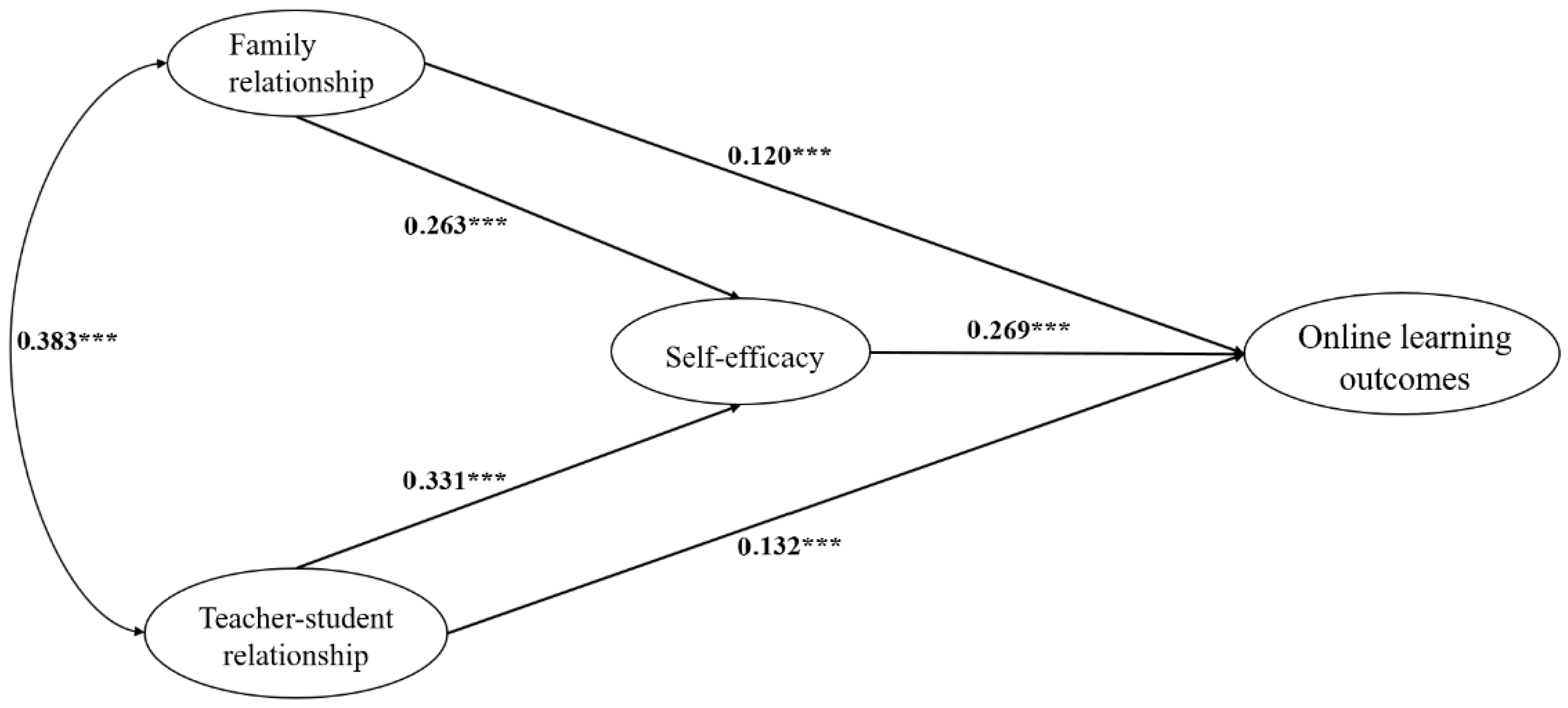
Before generating the SEM, we examined the potential clustering effects at both the school and provincial levels. The ICC values of our core variables were 0–0.002 at the school level and 0–0.008 at the provincial level, indicating negligible clustering effects. This suggests that individual-level variance is minimally influenced by school or province. Therefore, multilevel modeling is unnecessary, and a conventional SEM is appropriate for the analyses. After 5000 bootstrap sampling, the mediation model showed acceptable fitness (χ2/df = 1116.354/164, p < 0.001; TLI = 0.913; CFI = 0.925; RMSEA = 0.057, SRMR = 0.037). The model result is shown in Figure 2. For control variables, university students with higher average monthly living expenses exhibited higher self-efficacy (β = 0.086, p < 0.01). To ensure the robustness of our results, we additionally estimated an alternative model in which the control variables that were not significantly correlated at the bivariate level were included. The alternative model showed poorer fit (χ2/df = 1350.983/244, p < 0.001; TLI = 0.902; CFI = 0.920; RMSEA = 0.060, SRMR = 0.040), and none of these control variables exerted significant associations with the key variables. Therefore, we retained the original model for further analysis.
The model results in Figure 2 and the bias-corrected bootstrap findings in Table 2 fully support our hypotheses. Although both total effects fall within the range of small effect sizes commonly observed in psychological research, both family relationship and university teacher–student relationship have positive direct associations with online learning outcomes, while self-efficacy mediates the links between both family and teacher–student relationships and online learning outcomes.
We compared the total and indirect effects of family and teacher–student relationships using 5000 bootstrap samples. The results showed no significant difference between the total effects (comparison effect size = 0.089, 95% CI = [−0.034, 0.214]). However, the indirect effect of the teacher–student relationship was significantly stronger than that of the family relationship (comparison effect size = 0.042, 95% CI = [0.007, 0.084]).

4. Discussion

In order to re-examine and compare the relative contributions of family and teacher–student relationships to online learning outcomes, our results fully supported our hypotheses: (a) both family and teacher–student relationships were positively associated with online learning outcomes via self-efficacy; (b) total effects were similar, but the teacher–student relationship showed a stronger indirect effect. It should be noted that this study is cross-sectional. Causal inferences regarding the direction or temporal sequence of these associations cannot be made. Therefore, in the following discussion, the observed patterns are interpreted cautiously and theoretically, drawing on prior evidence, and the findings should be considered preliminary.

4.1. The Total Effects of Family Relationship and Teacher–Student Relationship

Consistent with most evidence from offline learning (Vasquez et al., 2016; Tao et al., 2022; Reinke et al., 2019), both family and teacher–student relationships were positively associated with online learning outcomes, highlighting the importance of these microsystems among Chinese university students, particularly given that their overall positive associations did not differ substantially during the pandemic. However, our findings differ from a pandemic-era study of Chinese university students that reported no significant association between teacher–student relationships and online learning (Su & Guo, 2021), as well as from a Western study of younger learners showing a stronger bivariate association between family relationships and online learning outcomes than that of teacher–student relationships (Pozzoli et al., 2022).
According to ecological systems theory (Bronfenbrenner, 2005), the strength of microsystem influences such as family and teacher–student relationships is shaped by broader contextual factors (e.g., technological environments, pandemic-related disruptions, cultural background) and by individuals’ developmental characteristics. Compared with younger learners (Pozzoli et al., 2022), university students possess greater autonomy (Arnett, 2000), which may reduce the extent to which family relationships directly influence their online learning outcomes, even if family support temporarily increased during the pandemic. However, developmental characteristics alone cannot account for the inconsistencies observed across studies. Differences in cultural and educational systems, and in the role expectations assigned to families and teachers, also shape how microsystems operate. In many Western educational contexts, learning is conceptualized as a pragmatic process aimed at competence development and problem solving (Chang et al., 2011). Families are therefore expected to participate actively, school–family boundaries tend to be open, and parental responsibilities related to learning management, motivational support, and emotional regulation are clearly defined (Chen et al., 2019; Fisher & Baissberg, 2025). The shift to fully online instruction during the pandemic heightened the salience of these roles, which may help explain why family relationships show stronger direct associations with learning outcomes in studies conducted in such contexts. In contrast, although East Asian societies place substantial value on education and view academic achievement as a central pathway to social mobility and family honor, learning is institutionally constructed as an activity centered within the school system (Ryan, 2019). A highly standardized examination structure governs students’ progression through educational stages, leaving families with limited formal channels to participate directly in instructional processes (Bol et al., 2014). Consequently, parental involvement tends to occur outside the school system through private tutoring, school choice decisions, and the provision of supplemental learning resources, rather than through direct engagement in classroom learning. Within this cultural and institutional configuration, instructional authority, knowledge evaluation, and academic regulation are concentrated in schools, while families primarily provide emotional and material support. These structural features may weaken the direct influence of family relationships on university students’ online learning outcomes. Meanwhile, prior research suggests that the most effective teacher–student support during the pandemic was primarily emotional in nature (Yang et al., 2022), whereas the previous study in question measured teacher–student relationships in a neutral, cognitive way (e.g., frequency of instructional interaction) (Su & Guo, 2021). Moreover, its data were drawn from a single university (Su & Guo, 2021), where online course policies may have placed limited emphasis on emotional connection, potentially explaining the non-significant association observed.
Taken together, these findings suggest that both family and teacher–student relationships remain significant protective and promotive factors in online learning contexts. The next section further examines how these relationships exert their associations indirectly through self-efficacy, a key motivational mechanism linking interpersonal relationships and learning outcomes.

4.2. The Stronger Indirect Effect of Teacher–Student Relationship

In line with our hypothesis, the indirect association of teacher–student relationship with online learning outcomes via self-efficacy was stronger than that of family relationship. This result is consistent with previous research in both offline and online learning (Yu, 2022a; R. Liu & Chiang, 2019; Descals-Tomás et al., 2021; Spring et al., 2024); however, it contrasts with pre-pandemic findings suggesting that the sense of community, rather than direct family or teacher–student relationships, was the primary predictor of students’ self-efficacy in online learning (Vayre & Vonthron, 2017). The shift observed in the present findings may reflect the pandemic’s reconfiguration of the online learning ecology, where the teacher–student relationship became a key channel for maintaining emotional connectedness and instructional guidance in the absence of in-person interaction (Tackie, 2022).
In the Chinese higher education context, teachers are often regarded as quasi-parental figures who not only provide academic instruction but also offer moral and emotional guidance (Qu et al., 2025; Legge, 2004). Such culturally rooted expectations may have strengthened the motivational influence of teacher–student relationships during the pandemic, as students increasingly relied on teachers for both academic structure and psychological reassurance (Chiu et al., 2021). Beyond culturally rooted expectations, more proximal instructional mechanisms may also help explain why teacher–student relationships showed a stronger indirect effect. During emergency remote teaching, teachers were able to provide targeted feedback, clear learning guidance, and necessary instructional scaffolding. Such direct, context-specific support strengthened students’ perceptions of competence and control, core components of academic self-efficacy. Through timely online feedback, encouragement, and the modeling of adaptive coping, teachers may have helped students internalize a stronger sense of control and competence, the core components of self-efficacy (Bandura, 1982; Y. Song, 2024). By contrast, the indirect association of family relationships with online learning outcomes through self-efficacy appeared weaker. Although families could provide emotional comfort and logistical support during home-based learning (Keser Aschenberger et al., 2023), their influence on students’ academic confidence may be less direct. For university students who are expected to self-regulate and make autonomous academic decisions, the family relationship might primarily function as a background buffer rather than as an immediate source of efficacy-building experiences.
In summary, these findings suggest that during the pandemic, teacher–student relationships were more closely associated with university students’ online learning motivation, primarily through cognitive and self-efficacy-related processes. In contrast, family relationships appeared to provide emotional and logistical support, helping to maintain a relatively stable home learning environment. These results highlight the complementary roles of these microsystems in the Chinese higher education context, where schools retain instructional authority even in online settings and families continue to act as educational mediators. Although both microsystems were positively related to online learning outcomes, their influences appear to operate through different pathways, consistent with culturally and institutionally shaped expectations of family and teacher involvement. Given the cross-sectional nature of the data, these interpretations should be considered tentative.
Additionally, these findings were situated within the pandemic context. With the return to normalcy, these microsystem influences may gradually revert to their pre-pandemic equilibrium, family influences may decline as students regain independence, whereas teacher–student relationships in online settings may return to a more cognitively oriented rather than emotionally supportive nature. This shift implies that students may again face the challenge of rebuilding a sense of community in technology-mediated learning. Nonetheless, the call for fostering supportive online learning communities remains ongoing (Spring et al., 2024). In China, where family and educational institutions are deeply intertwined in shaping students’ development, continued attention to the interplay of these support systems is crucial for strengthening students’ confidence and persistence in digital learning environments.

4.3. Limitations

Several limitations of this study should be noted. First, given the cross-sectional design, the observed associations should be interpreted as correlational rather than causal, especially in mediation analysis. The potential influence of reverse causality (e.g., stronger online learning outcomes may boost self-efficacy and subsequently improve interpersonal relationships) or unmeasured third variables (e.g., learning burnout) cannot be ruled out in the mediation analysis. Second, despite restrictions on questionnaire responses and sample representativeness, volunteer sampling led to overrepresentation of certain enthusiastic participants (e.g., those motivated by small monetary incentives), limiting the external validity. Third, to accommodate large-scale sampling during the pandemic, we shortened the scale to meet limited survey windows, institutional length restrictions, and reduce respondent burden. Although this is statistically acceptable, it may limit content validity in some contexts. The relatively low AVE values for self-efficacy and for family and teacher–student relationships were likely due to item reduction and method variance introduced by reverse-scored items, which can narrow the construct domain and reduce the shared variance among retained items. Shortened scales often capture key facets with fewer parallel indicators, making it less likely for each factor to explain more than half of its item variance. Thus, although composite reliability remained acceptable and method variance did not appear to introduce serious bias, these AVE values should be interpreted with caution. Future studies may consider using the full scales or conducting further validation. To address potential method variance, future researchers could apply CFA marker variables and implement procedural improvements, such as separating the measurement occasions or sources of predictors and outcomes. Fourth, more nuanced and theoretically meaningful structures within family and teacher–student relationships warrant further exploration. For instance, future research could distinguish between different dimensions of these microsystems, such as emotional versus instrumental (e.g., economic) family support, or cognitive versus affective components of teacher–student interactions and attachment patterns within both contexts. Examining these finer-grained aspects would help clarify the specific mechanisms through which family and teacher–student relationships contribute to students’ self-efficacy and online learning outcomes.

4.4. Practical Implications

Although this study does not allow for causal inferences, integrating its findings with existing intervention evidence still points to several potentially valuable practical directions, particularly for strengthening students’ online learning experiences in higher education.
First, teachers should be supported to play an active motivational role in online learning environments. Given that teacher–student relationships showed a stronger indirect association with learning outcomes through self-efficacy, institutions should design professional development that helps teachers foster emotional connection and provide timely, personalized feedback in digital contexts (Brouwers et al., 2010). Training that enhances instructors’ skills in online communication, motivational scaffolding, and socio-emotional support may be especially valuable when face-to-face interactions are limited (Topali et al., 2023; Alrabai & Algazzaz, 2025). Creating individualized and structured channels for check-ins, encouragement, and modeling adaptive coping strategies can further strengthen students’ sense of competence (Dietrich et al., 2021).
Second, institutions should adopt culturally responsive strategies that recognize the complementary role of families in online learning. Although family relationships showed a weaker indirect effect on self-efficacy, they played an important role in maintaining a stable emotional and logistical environment for students. In the Chinese higher education context, where instructional authority is centered within schools and families primarily provide background support, interventions should respect and build upon these institutionalized role expectations. Universities may offer families clear and feasible guidance on creating conducive home learning conditions, supporting students’ routines, and promoting well-being during extended periods of online study (Baumann et al., 2019). At the same time, interventions that reinforce teachers’ academic and emotional responsibilities ensure that both microsystems function effectively within their culturally embedded boundaries, thereby enhancing students’ confidence and persistence in digital learning environments (Ho et al., 2023).
Third, universities should strengthen the online learning community as a whole. The pandemic temporarily increased the emotional salience of teacher–student relationships; however, as learning environments shift back toward normalcy, students may again struggle with isolation in technology-mediated settings. Building structured opportunities for peer interaction, collaborative learning, and community-building activities can help students maintain motivation, belonging, and persistence in digital contexts, needs that remain essential beyond the pandemic (Stephen & Rockinson-Szapkiw, 2021).

5. Conclusions

According to the ecological system theory, the strength that family and teacher–student relationships affect students may differ due to university students’ developmental characteristics, the technological context of online learning, the pandemic disruptions, and the broader Chinese cultural environment, preventing a direct generalization of prior findings. This study re-examined the relative contributions of family and teacher–student relationships to online learning outcomes among Chinese university students. The results showed that: (a) both family and teacher–student relationships were positively associated with online learning outcomes via self-efficacy; (b) total effects were similar, but the teacher–student relationship showed a stronger indirect effect.
These findings indicate that both family and teacher–student relationships are indispensable microsystem supports within the online learning ecology. However, the difference in their indirect associations highlights their potential complementary functions: while family relationships maintain emotional and environmental stability, teacher–student relationships facilitate the cognitive and motivational processes underlying autonomous learning. Together, they form a balanced support system that helps students adapt to the challenges of online learning. in the Chinese higher education context, where schools retain instructional authority even in online settings and families continue to act as educational mediators.

Author Contributions

Conceptualization, Z.D. and C.J.; Formal analysis, C.J.; Investigation, S.C.; Writing—original draft, Z.D.; Writing—review & editing, C.J.; Supervision, S.C.; Funding acquisition, S.C. All authors have read and agreed to the published version of the manuscript.

Funding

This research was supported by the National Social Science Fund of China (Grant Nos. 23ASH012 and 24ASH013). It also forms part of the phased achievements of the Fujian Province Philosophy and Social Science Program (FJ2023B126).

Institutional Review Board Statement

The study was conducted in accordance with the Declaration of Helsinki, and approved by the Ethics Committee of Shenzhen University (protocol code: 202300047; date of approval: 8 April 2023).

Informed Consent Statement

Informed consent was obtained from all subjects involved in the study.

Data Availability Statement

The data is unavailable due to privacy or ethical restrictions. Reasonable requests for access to the data can be made to the corresponding author.

Conflicts of Interest

The authors declare no conflicts of interest.

Appendix A

Appendix A presents the results of the exploratory and confirmatory factor analyses (EFA and CFA), which include the following abbreviations: FR (Family Relationship), TSR (Teacher–Student Relationship), SE (Self-Efficacy), and OLO (Online Learning Outcomes). Moreover, the items from the shortened scale are also included in Appendix A.
Table A1. The EFA results.
ItemFactor 1Factor 2Factor 3Factor 4
Factor 1: Online learning outcomes, original root = 5.403, Rotated variance explained = 17.777
OLO10.753
OLO20.848
OLO30.850
OLO40.653
OLO50.752
Factor 2: Family relationship, original root = 1.885, Rotated variance explained = 12.961
FR1 0.772
FR2 0.730
FR3 0.790
FR4 0.738
Factor 3: Teacher–student relationship, original root = 1.615, Rotated variance explained = 12.223
TSR1 0.660
TSR2 0.670
TSR3 0.771
TSR4 0.770
TSR5 0.774
TSR6 0.716
Factor 4: Self-efficacy, original root =2.404, Rotated variance explained = 16.546
SE1 0.737
SE2 0.787
SE3 0.706
SE4 0.688
Table A2. The CFA results.
Latent FactorsItemsStd. ErrorCRStd. EstimateAVECR
Online learning outcomesOLO1--0.7060.5410.852
OLO20.03726.1360.671
OLO30.03722.5220.575
OLO40.03732.1970.849
OLO50.03731.9790.841
Self-efficacySE1--0.6100.4400.758
SE20.05520.9090.694
SE30.05720.8670.692
SE40.05220.2440.656
Family relationshipFR1--0.7270.4820.788
FR20.03724.9370.707
FR30.04224.9890.709
FR40.04022.7860.630
Teacher–student relationshipTSR1--0.5840.4760.843
TSR20.05121.6580.668
TSR30.05423.2960.749
TSR40.05623.3990.754
TSR50.04919.9910.595
TSR60.05523.5760.764
AVE (Average Variance Extracted) reflects the convergent validity of each latent construct, and CR (Composite Reliability) indicates the internal consistency reliability of the construct.
Table A3. The results of the Fornell–Larcker methods.
Variable1234
1. Teacher–student relationship0.690 a
2. Family relationship0.3170.694 a
3. Self-efficacy0.3560.3010.664 a
4. Online learning outcomes0.2670.2380.3130.736 a
Note: In the table, the diagonal values represent the square roots of the AVE for each construct (label as a), while the off-diagonal values are Pearson correlation coefficients between constructs. The numbers 1, 2, 3, and 4 in the column headers correspond to the order of variables listed in the leftmost column.
The specific items of the shortened scales are as follows:
  • Family relationship:
    • Family members ask each other for help when needed.
    • The relationships between family members and their friends are closer than those among other family members.
    • Family members are familiar with each other’s close friends.
    • When conflicts arise in the family, members show mutual concession to reach a compromise.
  • Teacher–student relationship:
    • My teacher doesn’t get upset when I disagree with them.
    • The teacher treats us as equals during the teaching process.
    • I can easily contact teachers who have previously taught me.
    • I can easily approach teachers and ask them questions.
    • The teacher allocates sufficient time for interaction and communication with me.
    • When I send messages to the teacher, I receive a prompt response.
  • Self-efficacy:
    • I can always solve my problem if I try my best.
    • Even when others oppose me, I can still achieve what I want.
    • For me, pursuing my ideals and achieving my goals is easy.
    • I am confident in my ability to effectively handle any unexpected events.
  • Online learning outcomes:
    • After learning online, I’ve become way more independent.
    • After learning online, my knowledge has broadened.
    • After learning online, my way of thinking has become more mature.
    • After learning online, I feel my personal arrangements are more flexible.
    • After learning online, my practical skills have noticeably improved.

References

  1. Alrabai, F., & Algazzaz, W. (2025). Testing experimental-based models on the influence of teacher emotional support on students’ basic psychological needs, emotions, and emotional engagement. Applied Linguistics, amaf036. [Google Scholar] [CrossRef]
  2. Arnett, J. J. (2000). Emerging adulthood: A theory of development from the late teens through the twenties. American Psychologist, 55, 469–480. [Google Scholar] [CrossRef]
  3. Bandura, A. (1982). Self-efficacy mechanism in human agency. American Psychologist, 37(2), 122–147. [Google Scholar] [CrossRef]
  4. Baumann, A. A., Domenech Rodríguez, M. M., Wieling, E., Parra-Cardona, J. R., Rains, L. A., & Forgatch, M. S. (2019). Teaching GenerationPMTO, an evidence-based parent intervention, in a university setting using a blended learning strategy. Pilot and Feasibility Studies, 5(1), 91. [Google Scholar] [CrossRef] [PubMed]
  5. Benner, A. D., Fernandez, C. C., Hou, Y., & Gonzalez, C. S. (2021). Parent and teacher educational expectations and adolescents’ academic performance: Mechanisms of influence. Journal of Community Psychology, 49(7), 2679–2703. [Google Scholar] [CrossRef] [PubMed]
  6. Bol, T., Witschge, J., Van de Werfhorst, H. G., & Dronkers, J. (2014). Curricular tracking and central examinations: Counterbalancing the impact of social background on student achievement in 36 countries. Social Forces, 94(4), 1545–1572. [Google Scholar] [CrossRef]
  7. Bronfenbrenner, U. (2005). Making human beings human: Bioecological perspectives on human development. SAGE Publications. [Google Scholar]
  8. Brouwers, M. C., Makarski, J., & Levinson, A. J. (2010). A randomized trial to evaluate e-learning interventions designed to improve learner’s performance, satisfaction, and self-efficacy with the AGREE II. Implementation Science, 5, 29. [Google Scholar] [CrossRef] [PubMed]
  9. Chang, L., Mak, M. C., Li, T., Wu, B. P., Chen, B. B., & Lu, H. J. (2011). Cultural adaptations to environmental variability: An evolutionary account of East–West differences. Educational Psychology Review, 23(1), 99–129. [Google Scholar] [CrossRef]
  10. Chen, B. B., Wiium, N., Dimitrova, R., & Chen, N. (2019). The relationships between family, school and community support and boundaries and student engagement among Chinese adolescents. Current Psychology, 38(3), 705–714. [Google Scholar] [CrossRef]
  11. Cheng, W., Ickes, W., & Verhofstadt, L. (2012). How is family support related to students’ GPA scores? A longitudinal study. Higher Education, 64(3), 399–420. [Google Scholar] [CrossRef]
  12. China Internet Network Information Center (CNNIC). (2025). Statistical report on internet development in China. Available online: https://www3.cnnic.cn/n4/2025/0117/c88-11229.html (accessed on 12 November 2025). (In Chinese).
  13. Chiu, T.-K., Lin, T.-J., & Lonka, K. (2021). Motivating online learning: The challenges of COVID-19 and beyond. Asia-Pacific Education Researcher, 30, 187–190. [Google Scholar] [CrossRef]
  14. Chu, R. J. C. (2010). How family support and internet self-efficacy influence the effects of e-learning among higher-aged adults: Analyses of gender and age differences. Computers & Education, 55, 255–264. [Google Scholar] [CrossRef]
  15. Descals-Tomás, A., Rocabert-Beut, E., Abellán-Roselló, L., Gómez-Artiga, A., & Doménech-Betoret, F. (2021). Influence of teacher and family support on university student motivation and engagement. International Journal of Environmental Research and Public Health, 18(5), 2606. [Google Scholar] [CrossRef] [PubMed]
  16. Dietrich, J., Greiner, F., Weber-Liel, D., Berweger, B., Kämpfe, N., & Kracke, B. (2021). Does an individualized learning design improve university student online learning? A randomized field experiment. Computers in Human Behavior, 122, 106819. [Google Scholar] [CrossRef]
  17. Fisher, Y., & Baissberg, S. (2025). Redefining boundaries: Unveiling the schism in teacher–parent perceptions of educational engagement. Frontiers in Psychology, 16, 1539049. [Google Scholar] [CrossRef] [PubMed]
  18. Gao, H., Ou, Y., Zhang, Z., Ni, M., Zhou, X., & Liao, L. (2021). The relationship between family support and e-learning engagement in university students: The mediating role of e-learning normative consciousness and behaviors and self-efficacy. Frontiers in Psychology, 12, 573779. [Google Scholar] [CrossRef]
  19. Global Growth Insights. (2025). E-Learning services market size, share & growth report, 2032. Available online: https://www.globalgrowthinsights.com/zh/market-reports/e-learning-services-market-100948 (accessed on 12 November 2025). (In Chinese).
  20. Gogol, K., Brunner, M., Goetz, T., Martin, R., Ugen, S., Keller, U., Fischbach, A., & Preckel, F. (2014). “My questionnaire is too long!” The assessments of motivational-affective constructs with three-item and single-item measures. Contemporary Educational Psychology, 39(3), 188–205. [Google Scholar] [CrossRef]
  21. Greenhow, C., Graham, C. R., & Koehler, M. J. (2022). Foundations of online learning: Challenges and opportunities. Educational Psychologist, 57(3), 131–147. [Google Scholar] [CrossRef]
  22. Helbling, L. A., Tomasik, M. J., & Moser, U. (2019). Long-term trajectories of academic performance in the context of social disparities: Longitudinal findings from Switzerland. Journal of Educational Psychology, 111(7), 1284–1301. [Google Scholar] [CrossRef]
  23. Ho, H. C., Poon, K. T., Chan, K. K. S., Cheung, S. K., Datu, J. A. D., & Tse, C. Y. A. (2023). Promoting preservice teachers’ psychological and pedagogical competencies for online learning and teaching: The TEACH program. Computers & Education, 195, 104725. [Google Scholar] [CrossRef]
  24. Hu, L. T., & Bentler, P. M. (1999). Cutoff criteria for fit indexes in covariance structure analysis: Conventional criteria versus new alternatives. Structural Equation Modeling, 6(1), 1–55. [Google Scholar] [CrossRef]
  25. iResearch Consulting Group. (2017). 2017 white paper on online learning among Chinese university students. Available online: https://www.idigital.com.cn/report/detail?id=3093 (accessed on 12 November 2025). (In Chinese).
  26. Keser Aschenberger, F., Radinger, G., Brachtl, S., Ipser, C., & Oppl, S. (2023). Physical home learning environments for digitally-supported learning in academic continuing education during the COVID-19 pandemic. Learning Environments Research, 26(1), 97–128. [Google Scholar] [CrossRef]
  27. Legge, J. (2004). The religions of China: Confucianism and Taoism described and compared with Christianity 1880. Kessinger Publishing. [Google Scholar]
  28. Lei, X., & Kantor, J. (2022). Social support and family quality of life in Chinese families of children with autism spectrum disorder: The mediating role of family cohesion and adaptability. International Journal of Developmental Disabilities, 68(4), 454–461. [Google Scholar] [CrossRef] [PubMed]
  29. Liu, H., Liu, Q., Du, X., Liu, J., Hoi, C. K. W., & Schumacker, R. E. (2023). Teacher–student relationship as a protective factor for socioeconomic status, students’ self-efficacy and achievement: A multilevel moderated mediation analysis. Current Psychology, 42(4), 3268–3283. [Google Scholar] [CrossRef]
  30. Liu, R., & Chiang, Y. L. (2019). Who is more motivated to learn? The roles of family background and teacher–student interaction in motivating student learning. The Journal of Chinese Sociology, 6(1), 6. [Google Scholar] [CrossRef]
  31. Liu, Y., Zhao, L., & Su, Y. S. (2022). The impact of teacher competence in online teaching on perceived online learning outcomes during the COVID-19 outbreak: A moderated-mediation model of teacher resilience and age. International Journal of Environmental Research and Public Health, 19(10), 6282. [Google Scholar] [CrossRef] [PubMed]
  32. Logan, J., & Spitze, G. (1996). Family ties. Temple University Press. [Google Scholar]
  33. Ma, X., Jiang, M., & Nong, L. (2023). The effect of teacher support on Chinese university students’ sustainable online learning engagement and online academic persistence in the post-epidemic era. Frontiers in Psychology, 14, 1076552. [Google Scholar] [CrossRef] [PubMed]
  34. Martin, F., & Borup, J. (2022). Online learner engagement: Conceptual definitions, research themes, and supportive practices. Educational Psychologist, 57, 162–177. [Google Scholar] [CrossRef]
  35. Niu, H., Wang, S., Tao, Y., Tang, Q., Zhang, L., & Liu, X. (2023). The association between online learning, parents’ marital status, and internet addiction among adolescents during the COVID-19 pandemic period: A cross-lagged panel network approach. Journal of Affective Disorders, 333, 553–561. [Google Scholar] [CrossRef]
  36. Oliveira, C., Fonseca, G., Sotero, L., Crespo, C., & Relvas, A. P. (2020). Family dynamics during emerging adulthood: Reviewing, integrating, and challenging the field. Journal of Family Theory & Review, 12(3), 350–367. [Google Scholar] [CrossRef]
  37. Olson, D. H., Portner, J., & Bell, R. (1982). FACES II: Family flexibility and cohesion evaluation scales. University of Minnesota. [Google Scholar]
  38. Pellas, N. (2014). The influence of computer self-efficacy, metacognitive self-regulation and self-esteem on student engagement in online learning programs: Evidence from the virtual world of Second Life. Computers in Human Behavior, 35, 157–170. [Google Scholar] [CrossRef]
  39. Phillips, M. R., West, C. L., Shen, Q., & Zheng, Y. (2004). Comparison of schizophrenic patients’ families and normal families in China, using Chinese versions of FACES-II and the Family Environment Scales. Family Process, 37(1), 95–106. [Google Scholar] [CrossRef]
  40. Pozzoli, T., Gini, G., & Scrimin, S. (2022). Distance learning during the COVID-19 lockdown in Italy: The role of family, school, and individual factors. School Psychology, 37(2), 183–196. [Google Scholar] [CrossRef] [PubMed]
  41. Qu, G., Li, P., Ju, E., Chen, X., & Luo, Y. (2025). Teachers’ emotional exhaustion relates to students’ well-being during the COVID-19 pandemic: The multilevel mediating role of students’ perceived teacher–student intimacy. Social Psychology of Education, 28(1), 168. [Google Scholar] [CrossRef]
  42. Ran, Z. O. U., Zeb, S., Nisar, F., Yasmin, F., Poulova, P., & Haider, S. A. (2022). The impact of emotional intelligence on career decision-making difficulties and generalized self-efficacy among university students in China. Psychology Research and Behavior Management, 15, 865–874. [Google Scholar] [CrossRef] [PubMed]
  43. Reinke, W. M., Smith, T. E., & Herman, K. C. (2019). Family–school engagement across child and adolescent development. School Psychology, 34(4), 346–359. [Google Scholar] [CrossRef] [PubMed]
  44. Richardson, M., Abraham, C., & Bond, R. (2012). Psychological correlates of university students’ academic performance: A systematic review and meta-analysis. Psychological Bulletin, 138(2), 353–387. [Google Scholar] [CrossRef] [PubMed]
  45. Ryan, J. (2019). Education in China: Philosophy, politics and culture. John Wiley & Sons. [Google Scholar]
  46. Sakız, H., Özdaş, F., Göksu, İ., & Ekinci, A. (2021). A longitudinal analysis of academic achievement and its correlates in higher education. SAGE Open, 11(1), 21582440211003085. [Google Scholar] [CrossRef]
  47. Schwarz, A., Rizzuto, T., Carraher-Wolverton, C., Roldán, J. L., & Barrera-Barrera, R. (2017). Examining the impact and detection of the “urban legend” of common method bias. ACM SIGMIS Database, 48(1), 93–119. [Google Scholar] [CrossRef]
  48. Schwarzer, R., & Jerusalem, M. (1995). Generalized self-efficacy scale. In J. Weinman, S. Wright, & M. Johnston (Eds.), Measures in health psychology: A user’s portfolio. Causal and control beliefs (pp. 35–37). NFER-Nelson. [Google Scholar] [CrossRef]
  49. Smith, T. E., Sheridan, S. M., Kim, E. M., Park, S., & Beretvas, S. N. (2020). The effects of family–school partnership interventions on academic and social-emotional functioning: A meta-analysis exploring what works for whom. Educational Psychology Review, 32(2), 511–544. [Google Scholar] [CrossRef]
  50. Song, H., Kim, J., & Luo, W. (2016). Teacher–student relationship in online classes: A role of teacher self-disclosure. Computers in Human Behavior, 54, 436–443. [Google Scholar] [CrossRef]
  51. Song, Y. (2024). Sustainable growth of learner engagement and well-being through social (teacher and peer) support: The mediator role of self-efficacy. European Journal of Education, 59(4), e12791. [Google Scholar] [CrossRef]
  52. Spring, K. J., Graham, C. R., Hanny, C. N., Tuiloma, S., & Badar, K. (2024). Academic communities of engagement: Exploring the impact of online and in-person support communities on the academic engagement of online learners. Journal of Computing in Higher Education, 36(3), 702–726. [Google Scholar] [CrossRef]
  53. Stephen, J. S., & Rockinson-Szapkiw, A. J. (2021). A high-impact practice for online students: The use of a first-semester seminar course to promote self-regulation, self-direction, online learning self-efficacy. Smart Learning Environments, 8(1), 6. [Google Scholar] [CrossRef]
  54. Su, C. Y., & Guo, Y. (2021). Factors impacting university students’ online learning experiences during the COVID-19 epidemic. Journal of Computer Assisted Learning, 37(6), 1578–1590. [Google Scholar] [CrossRef] [PubMed]
  55. Tackie, H. N. (2022). (Dis)connected: Establishing social presence and intimacy in teacher–student relationships during emergency remote learning. AERA Open, 8, 23328584211069525. [Google Scholar] [CrossRef]
  56. Tao, Y., Meng, Y., Gao, Z., & Yang, X. (2022). Perceived teacher support, student engagement, and academic achievement: A meta-analysis. Educational Psychology, 42(4), 401–420. [Google Scholar] [CrossRef]
  57. Topali, P., Chounta, I. A., Martínez-Monés, A., & Dimitriadis, Y. (2023). Delving into instructor-led feedback interventions informed by learning analytics in massive open online courses. Journal of Computer Assisted Learning, 39, 1039–1060. [Google Scholar] [CrossRef]
  58. Tudge, J. R., Payir, A., Merçon-Vargas, E., Cao, H., Liang, Y., Li, J., & O’Brien, L. (2016). Still misused after all these years? A reevaluation of the uses of Bronfenbrenner’s bioecological theory of human development. Journal of Family Theory & Review, 8(4), 427–445. [Google Scholar] [CrossRef]
  59. Umberson, D., & Thomeer, M. B. (2020). Family matters: Research on family ties and health, 2010 to 2020. Journal of Marriage and Family, 82(1), 404–419. [Google Scholar] [CrossRef]
  60. Vachkova, S. N., Vachkov, I. V., Klimov, I. A., Petryaeva, E. Y., & Salakhova, V. B. (2022). Lessons of the pandemic for family and school—The challenges and prospects of network education. Sustainability, 14(4), 2087. [Google Scholar] [CrossRef]
  61. van Dorresteijn, C., Fajardo-Tovar, D., Pareja Roblin, N., Cornelissen, F., Meij, M., Voogt, J., & Volman, M. (2025). What factors contribute to effective online higher education? A meta-review. Technology, Knowledge and Learning, 30, 171–202. [Google Scholar] [CrossRef]
  62. Vasquez, A. C., Patall, E. A., Fong, C. J., Corrigan, A. S., & Pine, L. (2016). Parent autonomy support, academic achievement, and psychosocial functioning: A meta-analysis of research. Educational Psychology Review, 28, 605–644. [Google Scholar] [CrossRef]
  63. Vayre, E., & Vonthron, A. M. (2017). Psychological engagement of students in distance and online learning: Effects of self-efficacy and psychosocial processes. Journal of Educational Computing Research, 55(2), 197–218. [Google Scholar] [CrossRef]
  64. Wang, C. K., Hu, Z. F., & Liu, Y. (2001). Reliability and validity of the General Self-Efficacy Scale. Chinese Journal of Applied Psychology, 7(1), 37–40. [Google Scholar]
  65. Wang, Y. S. (2018). Research on teacher–Student relationships in Chinese universities [Doctoral dissertation, Xiamen University]. Available online: https://kns-cnki-net.ezproxy.lib.szu.edu.cn/kcms2/article/abstract?v=0iq8nzQYh5Sd2yKn5flSK3MifO7vzbkw_NWJ4G_YfLbM7GjKeBGAXV4IBo39DWZP5uKhjcXWVIRRhP2pRKkoYGG_jORgxlk19t6yRfebmthGCDIS1xvZIaW1EZEmuSDH_Fg4U2Il0zF_WMynPnnkEB2bnjPQfxyYU05v9_33kabiF0g-wFEr2rn7yskv6X7jywbeAXCo5EI=&uniplatform=NZKPT&language=CHS (accessed on 12 November 2025). (In Chinese).
  66. Weidlich, J., Yau, J., & Kreijns, K. (2024). Social presence and psychological distance: A construal level account for online distance learning. Education and Information Technologies, 29(1), 401–423. [Google Scholar] [CrossRef]
  67. Xiao, B., & Song, G. (2022). Association between self-efficacy and learning conformity among Chinese university students: Differences by gender. Sustainability, 14(14), 8725. [Google Scholar] [CrossRef]
  68. Yang, Y., Liu, K., Li, M., & Li, S. (2022). Students’ affective engagement, parental involvement, and teacher support in emergency remote teaching during the COVID-19 pandemic: Evidence from a cross-sectional survey in China. Journal of Research on Technology in Education, 54, S148–S164. [Google Scholar] [CrossRef]
  69. Yu, Z. (2022a). A meta-analysis and bibliographic review of the effect of nine factors on online learning outcomes across the world. Education and Information Technologies, 27, 2457–2482. [Google Scholar] [CrossRef]
  70. Yu, Z. (2022b). Sustaining student roles, digital literacy, learning achievements, and motivation in online learning environments during the COVID-19 pandemic. Sustainability, 14, 4388. [Google Scholar] [CrossRef]
  71. Yuan, Y., Wang, W., Song, T., & Li, Y. (2022). The mechanisms of parental burnout affecting adolescents’ problem behavior. International Journal of Environmental Research and Public Health, 19(22), 15139. [Google Scholar] [CrossRef] [PubMed]
  72. Zhu, X., Chu, C. K., & Lam, Y. C. (2022). The predictive effects of family and individual wellbeing on university students’ online learning during the COVID-19 pandemic. Frontiers in Psychology, 13, 898171. [Google Scholar] [CrossRef] [PubMed]
  73. Zou, W., Ding, X., Xie, L., & Wang, H. (2021). Relationship between higher education teachers’ affect and their psychological adjustment to online teaching during the COVID-19 pandemic: An application of latent profile analysis. PeerJ, 9, e12432. [Google Scholar] [CrossRef] [PubMed]
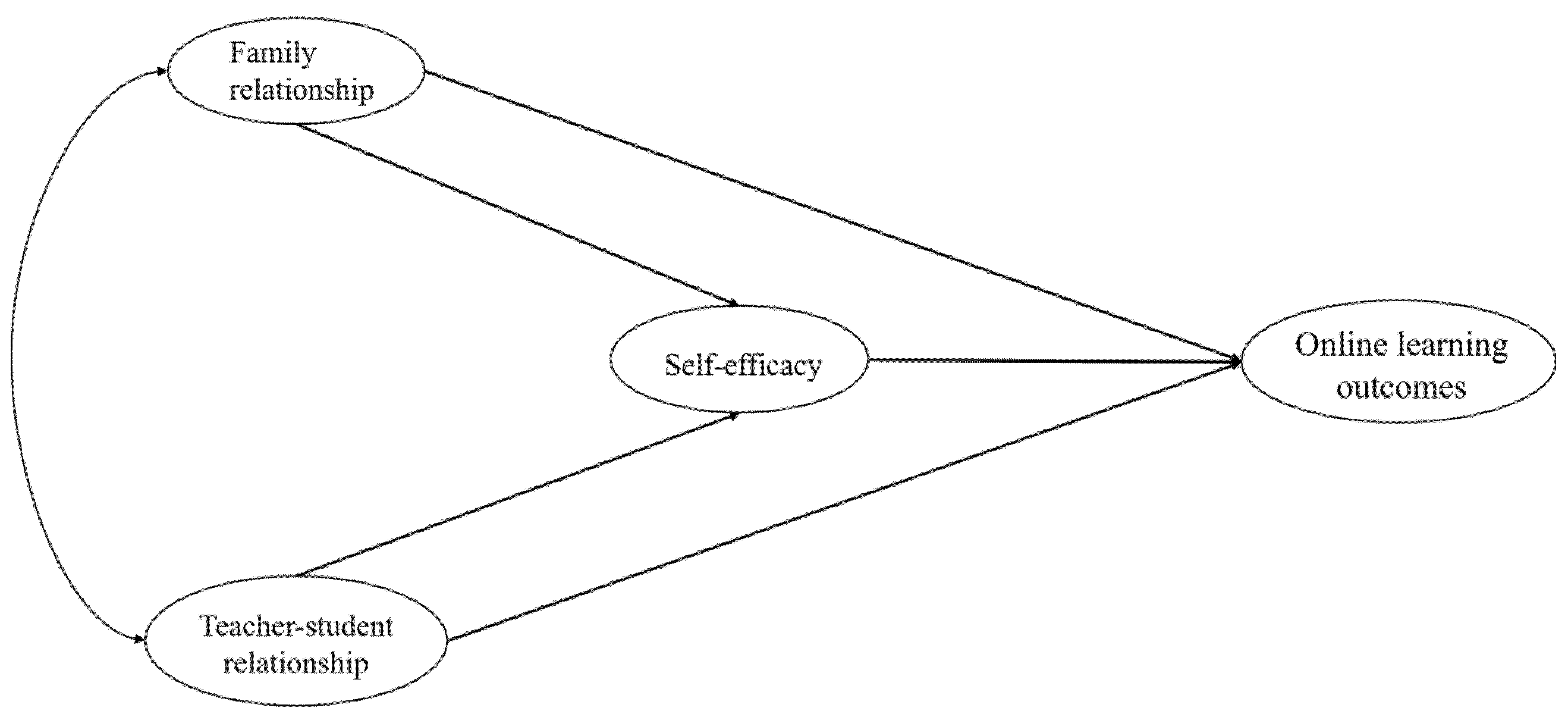
Figure 1. The conceptual model.
Education 15 01682 g001
Figure 2. The model results. *** p < 0.001.
Education 15 01682 g002
Table 1. The Correlation Matrix.
Variable1234M (SD)
1. Online learning outcomes 2.88 (0.82)
2. Family relationship0.308 ** 3.25 (0.85)
3. Teacher–student relationship0.344 ***0.474 *** 3.34 (0.76)
4. Self-efficacy0.283 **0.306 **0.425 ***3.26 (0.73)
5. Household registration category0.0620.1090.1900.059
6. Student’s average monthly living expenses0.1680.223 *0.1530.134
7. Father’s education level0.098−0.021−0.067−0.031
8. Mother’s education level0.059−0.0030.0420.028
9. Cumulative online course duration0.144−0.1260.001−0.069
10. Age−0.002−0.0230.0070.000
11. Gender−0.0400.0030.0050.010
* p < 0.05, ** p < 0.01, *** p < 0.001. Gender and Household registration category (Hukou) were coded as dummy variables (0 = female, 1 = male) and (0 = Agricultural, 1 = Non-agricultural). Other categorical variables (hukou type, parental educational level, monthly living expenses, and online course duration) were treated as ordinal variables in the analysis.
Table 2. Testing the pathways of the structural equation model.
Pathβ95%CI
LowerUpper
  • Total effect model
Family relationship → online learning outcomes0.1800.1180.244
Teacher–student relationship → online learning outcomes0.2690.1870.354
b.
Multiple mediation model
Direct effects
Family relationship → online learning outcomes0.1200.0530.187
Teacher–student relationship → online learning outcomes0.1320.0640.199
Family relationship → self-efficacy0.2630.1970.338
Teacher–student relationship → self-efficacy0.3310.2610.397
Self-efficacy → online learning outcomes0.2690.1960.346
Indirect effects
Family relationship → self-efficacy → online learning outcomes0.0710.0460.104
Teacher–student relationship → self-efficacy → online learning outcomes0.0890.0600.125
Disclaimer/Publisher’s Note: The statements, opinions and data contained in all publications are solely those of the individual author(s) and contributor(s) and not of MDPI and/or the editor(s). MDPI and/or the editor(s) disclaim responsibility for any injury to people or property resulting from any ideas, methods, instructions or products referred to in the content.