Harness a Simple Design to Make Authentic Learning Moments Visible: A Design-Based Research Study in Clinical Reasoning



Abstract
1. Introduction
2. Research Objectives
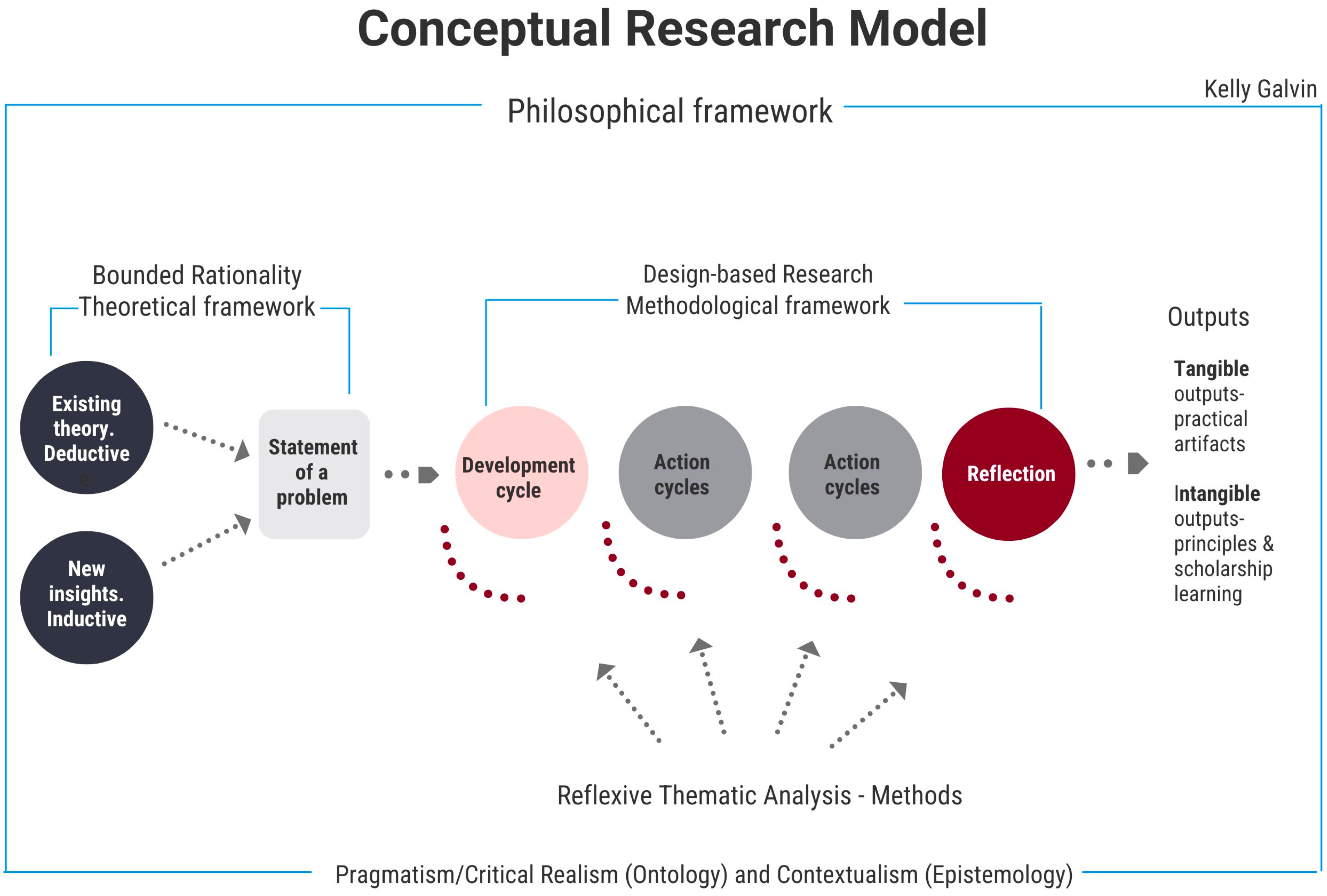
Main Research Question (Advisory): How can combining independent online clinical reasoning analysis with group work support undergraduate health science students learning to perform rational decision making?
3. Materials and Methods
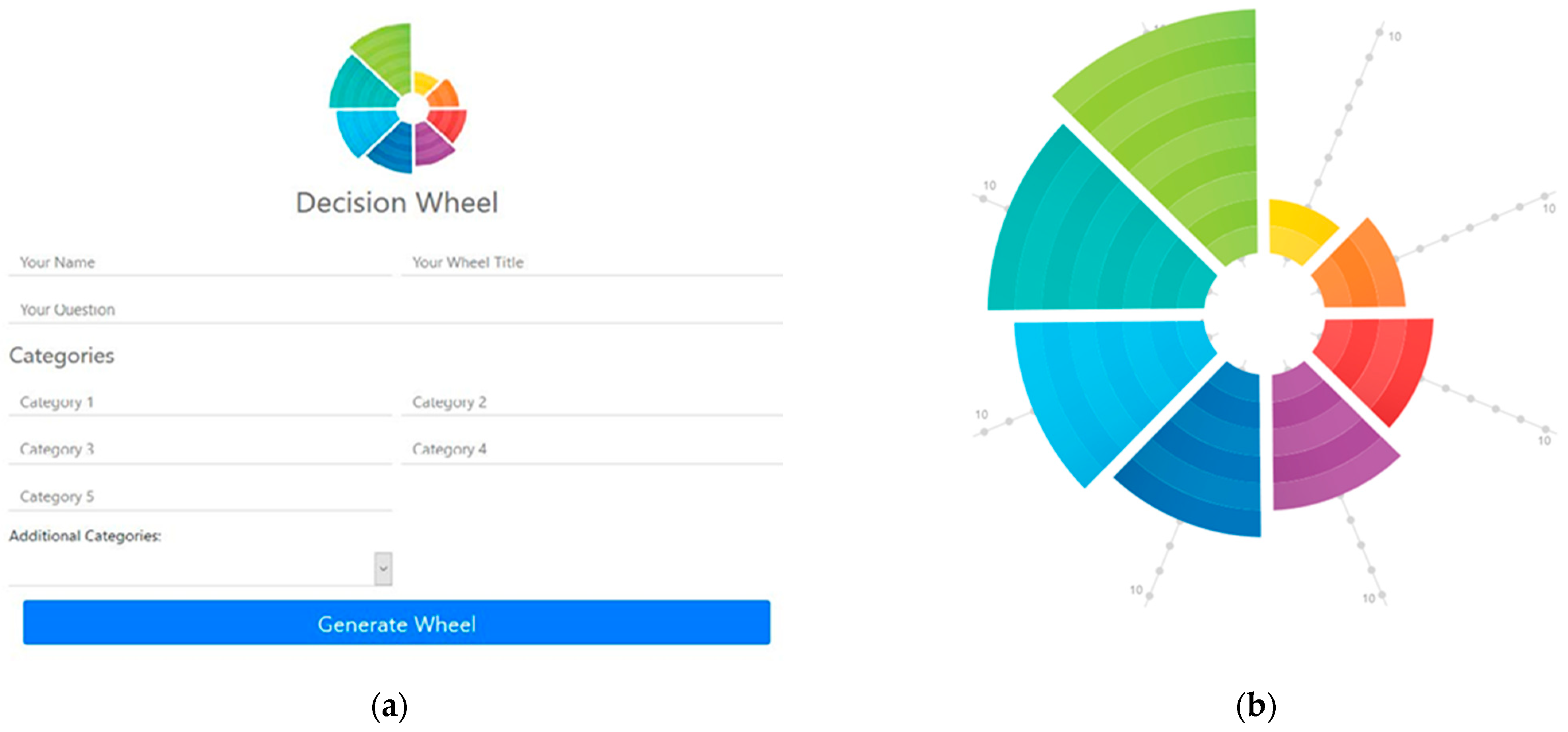
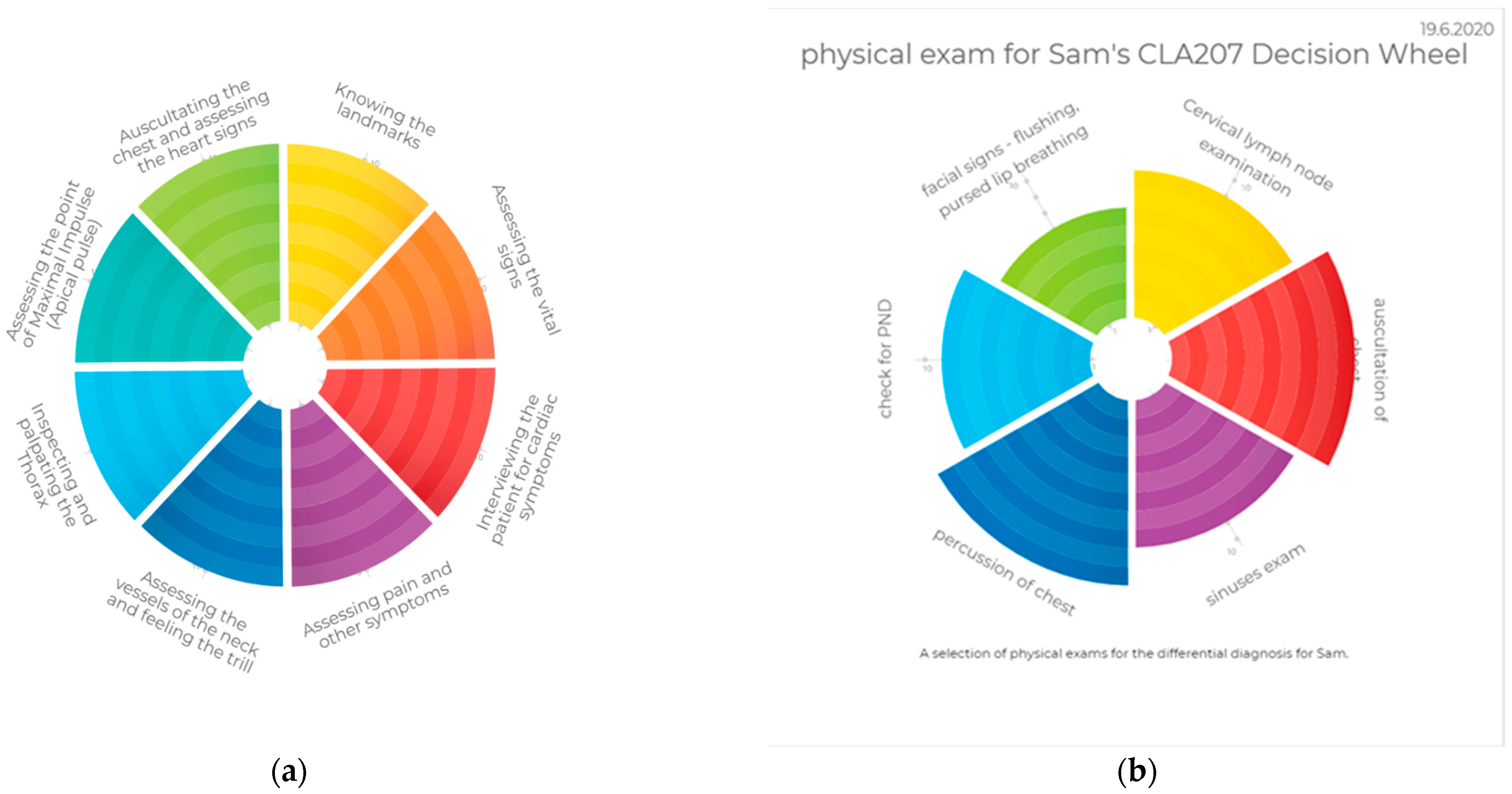
- Structured PBL design using the decision wheel for weekly non-graded group learning activities (6 subjects).
- Using the decision wheel tool for non-graded learning activities independently and for informal group work (12 subjects).
- Group-based learning design (not structured PBL) using decision wheel for weekly non-graded learning activities (2 subjects).
- During later DBR action cycles, the decision wheel was used in selected subjects for assessments as a non-graded hurdle, albeit not mentioned in the rubric for grading (5 subjects).
4. Results
- Being a useful and versatile learning tool for decision-making to use as individuals and in groups.
- Enhancing inclusivity and collaboration for learning.
- Encouraging learning attempts to show authentic progression of thinking.
- Assisting transparency of learning and reducing academic integrity risk.
- Providing better opportunities for efficient formative feedback dialogue between peers and key teachers.
5. Discussion
5.1. Time Constraints
5.2. Information Imperfection
5.3. Cognitive Limitations
5.4. Psychological Authenticity in Decision-Making
5.5. The Benefit of a “Critical Pause”
6. Conclusions
Author Contributions
Funding
Institutional Review Board Statement
Informed Consent Statement
Data Availability Statement
Acknowledgments
Conflicts of Interest
Abbreviations
| TUA | Torrens University of Australia |
| DBR | Design-based Research |
| DPs | Design Principles |
| F2F | Face-to-Face |
| BL | Blended Learning |
| FOL | Fully Online Learning |
| PBL | Problem-based Learning |
| GenAI | Generative Artificial Intelligence |
| Chat GPT | Chat Generative Pre-Trained Transformer |
Appendix A

| Final Theme and Design Principle | Introduction to DP Meaning |
|---|---|
| DP1: Be the guide in the hive | Highlights a concept expressed across various points throughout the data for how the teacher role is a vital component of the learning experience. |
| DP2: Engage Coaching | Explores the concept that ongoing support is key for both teachers and students. |
| DP3: Harness a simple design | Outlines the central notion that simplicity is key for learning. Particularly evident when using digital tools for problem-based learning and in relation to both content and resources for subject designs involving decision-making. |
| DP4: Integrate time for reflexivity | Brings to the fore the concept that time for a quality reflexive process in learning and teaching is key. |
| DP5: Vocalise and collaborate | Promotes the concept that accessible spaces for communication is required to expand perspectives for quality decision-making. |
| DP6: Encourage stakeholders as partners in curriculum | Indicates quality of learning design evolves when choices for curriculum are ‘conscious & considered’. Extending to the need for co-creation & consultation with stakeholders using the learning design and tools for clinical reasoning development. |
References
- Ajjawi, R., Tai, J., Dollinger, M., Dawson, P., Boud, D., & Bearman, M. (2024). From authentic assessment to authenticity in assessment: Broadening perspectives. Assessment & Evaluation in Higher Education, 49(4), 499–510. [Google Scholar] [CrossRef]
- Al-Azri, H., & Ratnapalan, S. (2014). Problem-based learning in continuing medical education: Review of randomized controlled trials. Canadian Family Physician, 60(2), 157–165. Available online: http://www.cfp.ca/content/60/2/157 (accessed on 20 February 2018). [PubMed]
- Bakker, A. (2014). Research questions in design-based research. Utrecht University, Freudenthal Institute. [Google Scholar]
- Bakker, A. (2018). Design research in education: A practical guide for early career researchers (1st ed.). Routledge. [Google Scholar]
- Barber, W., King, S., & Buchanan, S. (2015). Problem based learning and authentic assessment in digital pedagogy: Embracing the role of collaborative communities. Electronic Journal of E-Learning, 13(2), 59–67. [Google Scholar]
- Bearman, M., Tai, J., Dawson, P., Boud, D., & Ajjawi, R. (2024). Developing evaluative judgement for a time of generative artificial intelligence. Assessment and Evaluation in Higher Education, 49(6), 893–905. [Google Scholar] [CrossRef]
- Benton, P. (2025). Career development learning in higher education: How authentic work experiences and opportunities for career exploration can increase self-efficacy and inform career identity. Journal of the National Institute for Career Education and Counselling, 34(1), 40–47. [Google Scholar] [CrossRef]
- Blackburn, G. (2015). Innovative eLearning: Technology shaping contemporary problem based learning: A cross-case analysis. Journal of University Teaching & Learning Practice, 12(2), 1–19. [Google Scholar]
- Bolton, G. E. J. (2018). Reflection and reflexivity: What and why. In G. E. J. Bolton, & R. Delderfield (Eds.), Reflective practice. SAGE Publications Ltd. [Google Scholar]
- Braun, V., & Clarke, V. (2012). Thematic analysis. In H. Cooper, P. M. Camic, D. L. Long, A. T. Panter, D. Rindskopf, & K. J. Sher (Eds.), APA handbook of research methods in psychology, Vol 2: Research designs: Quantitative, qualitative, neuropsychological, and biological (pp. 57–71). American Psychological Association. [Google Scholar] [CrossRef]
- Braun, V., & Clarke, V. (2021). To saturate or not to saturate? Questioning data saturation as a useful concept for thematic analysis and sample-size rationales. Qualitative Research in Sport, Exercise and Health, 13(2), 201–216. [Google Scholar] [CrossRef]
- Braun, V., & Clarke, V. (2022). Thematic analysis. A practical guide. Sage Publications. [Google Scholar]
- Braun, V., & Clarke, V. (2025). Reporting guidelines for qualitative research: A values-based approach. Qualitative Research in Psychology, 22(2), 399–438. [Google Scholar] [CrossRef]
- Burgess, A., Roberts, C., Ayton, T., & Mellis, C. (2018). Implementation of modified team-based learning within a problem based learning medical curriculum: A focus group study. BMC Medical Education, 18(1), 74. [Google Scholar] [CrossRef] [PubMed]
- Campbell, K., Orr, E., Durepos, P., Nguyen, L., Li, L., Whitmore, C., Gehrke, P., Graham, L., & Jack, S. (2021). Reflexive thematic analysis for applied qualitative health research. The Qualitative Report, 26(6), 2011–2028. [Google Scholar] [CrossRef]
- Chambers, T. P., & Broadbent, J. (2024). Why authenticity matters: A qualitative investigation of students’ perceptions of personal values in first-year assessments. Teaching in Higher Education, 30(3), 623–639. [Google Scholar] [CrossRef]
- Chan, C. K. Y., & Tsi, L. H. Y. (2024). Will generative AI replace teachers in higher education? A study of teacher and student perceptions. Studies in Educational Evaluation, 83, 101395. [Google Scholar] [CrossRef]
- Christensen, N., & Jensen, G. M. (2019). Developing clinical reasoning capability. In J. Higgs, G. M. Jensen, S. Loftus, & N. Christensen (Eds.), Clinical reasoning in the health professions (4th ed.). Elsevier. [Google Scholar]
- Cochrane, T., Galvin, K., Buskes, G., Lam, L., Rajagopal, V., Glasser, S., Osborne, M. S., Loveridge, B., Davey, C., John, S., Townsin, L., & Moss, T. (2023). Design-based research: Enhancing pedagogical design. In T. Cochrane, V. Narayan, C. Brown, K. MacCallum, E. Bone, C. Denneen, R. Vanderburg, & B. Hurren (Eds.), ASCILITE 2023 conference proceedings: People, partnerships and pedagogies (pp. 351–356). ASCILITE Publications. [Google Scholar] [CrossRef]
- Dawson, P., Bearman, M., Dollinger, M., & Boud, D. (2024). Validity matters more than cheating. Assessment & Evaluation in Higher Education, 49(7), 1005–1016. [Google Scholar] [CrossRef]
- Dolmans, D. (2019). How theory and design-based research can mature PBL practice and research. Advances in Health Sciences Education, 24(5), 879–891. [Google Scholar] [CrossRef]
- Ellis, C., & Lodge, J. (2024, July). Stop looking for evidence of cheating with AI and start looking for evidence of learning [Post]. LinkedIn. Available online: https://www.linkedin.com/posts/cath-ellis-8162581b_education-highered-learning-activity-7216169175851892737-3uyr?utm_source=share&utm_medium=member_desktop&rcm=ACoAABjUX2AB_0FjvoyIXvgA9sQXlXcqGtGWxT0 (accessed on 10 June 2025).
- Falkner, K., & Stålbrandt, E. E. (2023). Meanings of authentic learning scenarios: A study of the interplay between higher education and employability of higher education graduates. International Journal of Teaching and Learning in Higher Education, 35(2), 171–183. [Google Scholar]
- Fan, C., Jiang, B., Shi, X., Wang, E., & Li, Q. (2018). Update on research and application of problem-based learning in medical science education. Biochemistry and Molecular Biology Education, 46(2), 186–194. [Google Scholar] [CrossRef] [PubMed]
- Fawns, T., Bearman, M., Dawson, P., Nieminen, J. H., Ashford-Rowe, K., Willey, K., Jensen, L. X., Damşa, C., & Press, N. (2024). Authentic assessment: From panacea to criticality. Assessment & Evaluation in Higher Education, 50(3), 396–408. [Google Scholar] [CrossRef]
- Fergusson, L., van der Laan, L., Imran, S., & Danaher, P. A. (2022). Authentic assessment and work-based learning: The case of professional studies in a post-COVID Australia. Higher Education, Skills and Work-Based Learning, 12(6), 1189–1210. [Google Scholar] [CrossRef]
- Galvao, T. F., Silva, M. T., Neiva, C. S., Ribeiro, L. M., & Pereira, M. G. (2014). Problem-based learning in pharmaceutical education: A systematic review and meta-analysis. The Scientific World Journal, 2014, 578382. [Google Scholar] [CrossRef]
- Galvin, K. (2021). Decision wheel tool [artefact]. Available online: http://x16.space/dw/ (accessed on 10 June 2025).
- Galvin, K. (2023). Clinical reasoning development: Enhancing independent and group rational decision making [Doctoral thesis, Torrens University of Australia]. [Google Scholar] [CrossRef]
- Galvin, K., & Cochrane, T. (2023). Design-based Research: An ethical framework to address pedagogical problems and innovation [Poster]. AARE2023. University of Melbourne. [Google Scholar] [CrossRef]
- Gamage, K. A. A., de Silva, E. K., & Gunawardhana, N. (2020). Online delivery and assessment during COVID-19: Safeguarding academic integrity. Education Sciences, 10(11), 11. [Google Scholar] [CrossRef]
- Gholami, M., Moghadam, P. K., Mohammadipoor, F., Tarahi, M. J., Sak, M., Toulabi, T., & Pour, A. H. H. (2016). Comparing the effects of problem-based learning and the traditional lecture method on critical thinking skills and metacognitive awareness in nursing students in a critical care nursing course. Nurse Education Today, 45, 16–21. [Google Scholar] [CrossRef]
- Herrington, J., Reeves, T. C., & Oliver, R. (2006). Authentic tasks online: A synergy among learner, task, and technology. Distance Education, 27(2), 233–247. [Google Scholar] [CrossRef]
- Higgs, J., Jensen, G. M., Loftus, S., & Christensen, N. (Eds.). (2019). Clinical reasoning in the health professions (4th ed.). Elsevier. [Google Scholar]
- Hoadley, C., & Campos, F. C. (2022). Design-based research: What it is and why it matters to studying online learning. Educational Psychologist, 57(3), 207–220. [Google Scholar] [CrossRef]
- Lee, D., Arnold, M., Srivastava, A., Plastow, K., Strelan, P., Ploeckl, F., Lekkas, D., & Palmer, E. (2024). The impact of generative AI on higher education learning and teaching: A study of educators’ perspectives. Computers and Education. Artificial Intelligence, 6, 100221. [Google Scholar] [CrossRef]
- Liu, D., & Bates, S. (2025). Generative AI in higher education: Current practices and ways forward. In [Whitepaper] Generative AI in higher education: Current practices and ways forward—APRU. Association of Pacific Rim Universities. [Google Scholar]
- Lodge, J. M., De Barba, P., & Broadbent, J. (2024). Learning with generative artificial intelligence within a network of co-regulation. Journal of University Teaching & Learning Practice, 20(7), 1–10. [Google Scholar] [CrossRef]
- Lodge, J. M., Howard, S., & Bearman, M. (2023). Assessment reform for the age of artificial intelligence. Available online: https://www.teqsa.gov.au/sites/default/files/2023-09/assessment-reform-age-artificial-intelligence-discussion-paper.pdf (accessed on 15 February 2025).
- Lombardi, M. (2007). Authentic learning for the 21 Century: An overview. Educause Learning Initiative, 1(2007), 1–12. [Google Scholar]
- Maloney, S., Tai, J. H. M., & Lo, K. (2013). Honesty in critically reflective essays: An analysis of student practice. Advances in Health Sciences Education, 18, 617–626. [Google Scholar] [CrossRef]
- Mandala Partners. (2023). Technology and the universities of tomorrow. Available online: https://mandalapartners.com/reports/technology-and-the-universities-of-tomorrow (accessed on 3 June 2023).
- Marewski, J. N., & Gigerenzer, G. (2012). Heuristic decision making in medicine. Dialogues in Clinical Neuroscience, 14(1), 77–89. Available online: https://www.ncbi.nlm.nih.gov/pmc/articles/PMC3341653/ (accessed on 8 September 2019). [CrossRef]
- McKenney, S., & Reeves, T. (2019). Conducting educational design research (2nd ed.). Routledge. [Google Scholar]
- Medina, M. S. (2017). Making students’ thinking visible during active learning. American Journal of Pharmaceutical Education, 81(3), 41. [Google Scholar] [CrossRef]
- Moore, R. L. (2020). Developing lifelong learning with heutagogy: Contexts, critiques, and challenges. Distance Education, 41(3), 381–401. [Google Scholar] [CrossRef]
- Simon, H. A. (1972). Theories of bounded rationality. In C. B. McGuire, & R. Radner (Eds.), Decision and organisation (pp. 161–176). North-Holland Publishing Company. [Google Scholar]
- Simon, H. A. (1991). Bounded rationality and organizational learning. Organization Science, 2(1), 125–134. [Google Scholar] [CrossRef]
- Smith, B. (2018). Generalizability in qualitative research: Misunderstandings, opportunities and recommendations for the sport and exercise sciences. Qualitative Research in Sport, Exercise and Health, 10(1), 137–149. [Google Scholar] [CrossRef]
- Tautz, J., & Steen, D. (2021). The honey factory: Inside the ingenious world of bees (2nd ed.). Black Inc. [Google Scholar]
- Young, M., Dory, V., Lubarsky, S., & Thomas, A. (2018). How different theories of clinical reasoning influence teaching and assessment. Academic Medicine, 93(9), 1415. [Google Scholar] [CrossRef] [PubMed]


| Bounded Rationality Theory Elements | Learning and Teaching Experience | Yr Level |
|---|---|---|
| Imperfect Information | “The act of filling in the wheel made me question why chose the ratings at a deeper level” (p. 307). | 2nd Yr Students |
| “Positive experience using wheel as helped to break down information and come to a conclusion. Found it helped to differentiate what my preferences were for the case study” (p. 309). | 2nd Yr Students | |
| “I do think it’s a good fit to use in an assessment [as non-graded appendix] and I think it’s supported where the students might have been a little bit scared to write a reflective piece. I think just being able to deduce it down and keep them focused on those particular points that they want to discuss. I think it was really good” (p. 210). | 2nd Yr Teacher | |
| Cognitive Limitations | “I would have had a completely different outcome for my assessment if had not used the wheel tool. It helped a lot to come to best outcome. Helped me to notice ratings, priorities and things to consider. If no wheel, the considerations to reflect on would not have been as broad” (p. 311). | 1st Yr Student |
| “The wheel did change what I would have prescribed, and it was easier to discuss appropriate choice” (p. 308). | 2nd Yr Student | |
| “I can compare previous trimesters to this trimester, where we had similar questions, but we didn’t have the wheel. Having the wheel there as a facilitator, really substantiates what the students are saying, or not saying” (p. 311). | 1st Yr Teacher | |
| Time Constraints | It actually makes the students stop and think about their own approach or their own critical reasoning process or their own decision-making process. I think just that pause, it creates then sparks the, “Oh, hang on. I’ve actually got to make decisions myself. How would I go about making those decisions what’s important in that decision? What are the priorities in that decision?” (p. 320). | 1st Yr Teacher |
| I think it is a great tool when you have a group working and then everyone can have a buy in and then can compare. So it is a bit of a that time-saver in that it allows us to put our thoughts down and then you can combine everybody views for example, then we can see if we all agree or not, where we have differing opinions and see where the differences are. Whereas if just talk as a group, it takes forever. (p. 323). | 2nd Yr Student |
| Psychological Authenticity Indicators | Learning and Teaching Experience | Yr Level |
|---|---|---|
| “I suffer with social anxiety and to have a tool to go, ‘yep, I’m really confident in this area’, will make it easier for someone like me to speak up and felt like I’m not just being pushed aside by the rest of the group […]. I also feel confident with other dominant personalities to have my say”. (p. 326). | 1st Yr Student |
| “Sometimes people in a group can dominate and then quieter people retreat. But if everyone has done an individual wheel before coming to the group, then everyone participates better” (p. 326). | 2nd Yr Student |
| “We had a little bit of an argument in an academic forum, kind of feel like a real discussion, about why we thought that was a different priority[..]” (p. 325). | 3rd Yr Student |
| “Because the wheel was the non-assessable aspect of the assessment, as facilitator could see all the attempts were their own and not done by someone else” (p. 210). | 1st Yr Teacher |
| “It was more egalitarian in the sense that it allowed students to not be dominated so much, but a single voice that might happen in a discussion that didn’t include this visual tool [..]” (p. 326). | 1st Yr Teacher |
| DBR Phases | Improvements | DP 3 Evolution |
|---|---|---|
| Phase 2—Cycle 1 1 focus group/15 interviews across 3 subject cohorts/24 weeks | Customise title and notes section of the wheel tool. Create instructional videos and improve exemplars. | Provide safe practice for learning (simplicity is key for learning tools) |
| Phase 3—Cycle 2 13 focus groups/18 interviews across 17 subject cohorts/24 weeks | Creation of autonomous online learning spaces and improving how groups can use the wheel synchronously. | Autonomy can inspire learning (versatility is key for learning tools) |
| Phase 3—Cycle 3 6 focus groups/11 interviews across 16 subject cohorts/12 weeks | Wheel tool added into both non-graded learning activities and as assessment hurdles. | Simple designs bridge learners (visual tools benefit justification of ideas) |
| Phase 4—Revisiting all data set using 6 stages of RTA | Creation of more ways to use decision wheel to practice decision-making without penalty. | Harness a simple design |
Disclaimer/Publisher’s Note: The statements, opinions and data contained in all publications are solely those of the individual author(s) and contributor(s) and not of MDPI and/or the editor(s). MDPI and/or the editor(s) disclaim responsibility for any injury to people or property resulting from any ideas, methods, instructions or products referred to in the content. |
© 2025 by the authors. Licensee MDPI, Basel, Switzerland. This article is an open access article distributed under the terms and conditions of the Creative Commons Attribution (CC BY) license (https://creativecommons.org/licenses/by/4.0/).
Share and Cite
Galvin, K.; Townsin, L. Harness a Simple Design to Make Authentic Learning Moments Visible: A Design-Based Research Study in Clinical Reasoning. Educ. Sci. 2025, 15, 1679. https://doi.org/10.3390/educsci15121679
Galvin K, Townsin L. Harness a Simple Design to Make Authentic Learning Moments Visible: A Design-Based Research Study in Clinical Reasoning. Education Sciences. 2025; 15(12):1679. https://doi.org/10.3390/educsci15121679
Chicago/Turabian StyleGalvin, Kelly, and Louise Townsin. 2025. "Harness a Simple Design to Make Authentic Learning Moments Visible: A Design-Based Research Study in Clinical Reasoning" Education Sciences 15, no. 12: 1679. https://doi.org/10.3390/educsci15121679
APA StyleGalvin, K., & Townsin, L. (2025). Harness a Simple Design to Make Authentic Learning Moments Visible: A Design-Based Research Study in Clinical Reasoning. Education Sciences, 15(12), 1679. https://doi.org/10.3390/educsci15121679