


Conceptual Model-Based Problem Solving: An Evidence-Based Review for Students Who Are Struggling in Mathematics



Abstract
1. Introduction
1.1. Students with Disabilities and Diverse Learning Needs
1.2. Intervention Strategies for Students Struggling with Mathematics
1.3. Schema-Based Instruction
1.4. Model-Based Problem Solving
- According to the Council for Exceptional Children Quality Indicators (CEC, 2014), what was the quality of the extant COMPS research studies?
2. Methods and Data Source
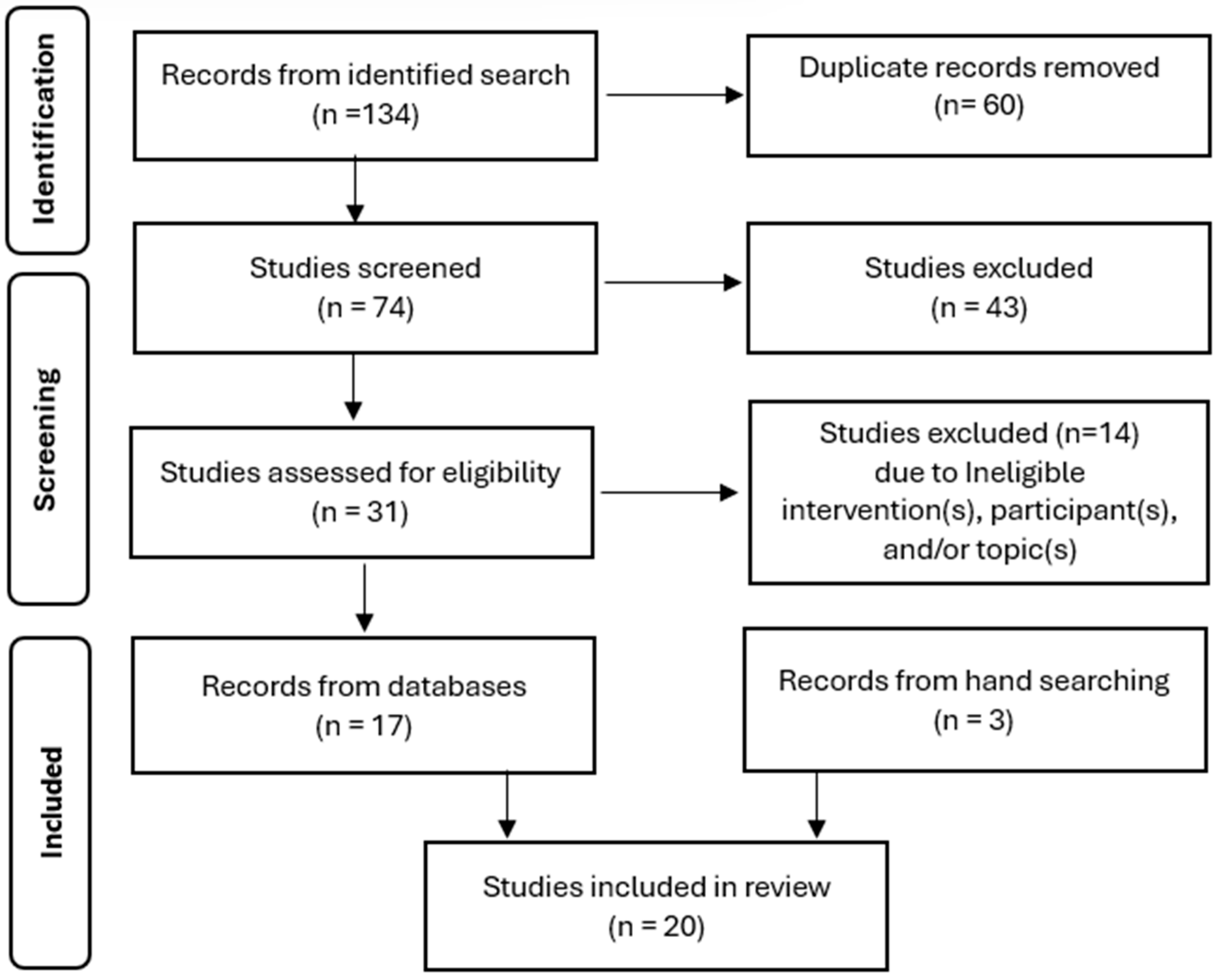
2.1. Literature Search and Selection Procedures
2.2. Coding Procedures for Methodology Rigor and Evidence Base
3. Results
3.1. Description of Included Studies
3.1.1. Study Design
3.1.2. Participants
3.1.3. Targeted Math Problem-Solving Skills
3.1.4. Intervention Procedure
3.1.5. Intervention Agent
3.2. Presence of QIs
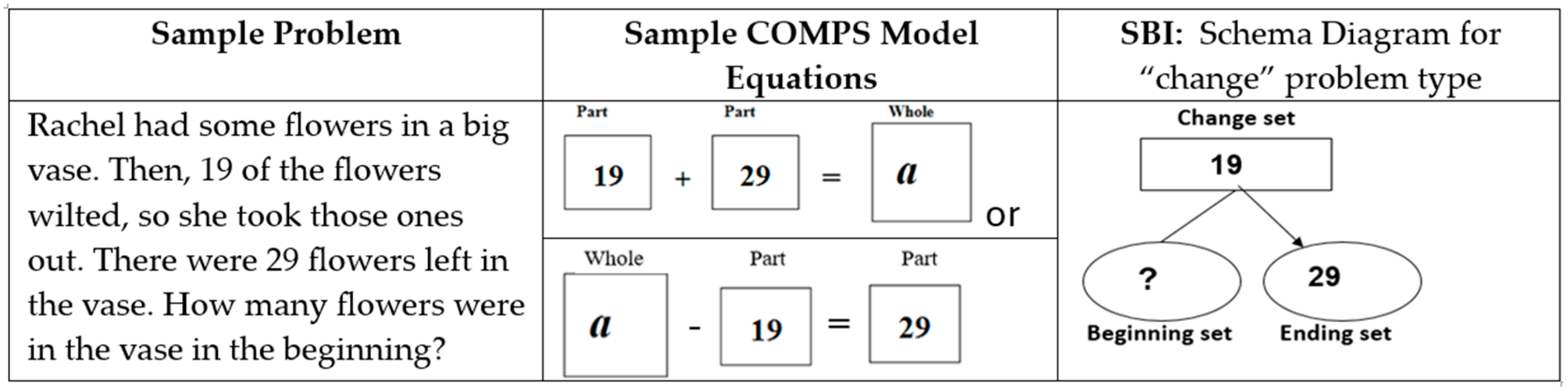
3.3. COMPS Intervention
3.4. Applying COMPS Strategy to Solve Additive and Multiplicative Word Problems
3.5. COMPS-Based Computer Tutors
3.6. Applying COMPS to Solve Cartesian Product Problems
3.7. Extending COMPS to Solve Geometry Word Problem Solving
3.8. COMPS-Based Problem Posing and Problem Solving
3.9. Evidence-Based Classification of COMPS
4. Discussion
4.1. The Quality of the COMPS Research and the Establishment as an EBP
4.2. Limitations and Future Studies
4.3. Practical Implications
5. Conclusions
Author Contributions
Funding
Institutional Review Board Statement
Informed Consent Statement
Data Availability Statement
Conflicts of Interest
Abbreviations
| ASD | Autism Spectrum Disorder |
| COMPS | Conceptual Model-based Problem Solving |
| ID | Intellectual Disability |
| LDM | Learning Difficulties in Mathematics |
| MLD | Mathematics Learning Disabilities |
| QI | Quality Indicator |
| RCT | Randomized Controlled Trial |
| SCD | Single-Case Design |
References
- Anser, M. K., Yousaf, Z., Nassani, A. A., Alotaibi, S. M., Kabbani, A., & Zaman, K. (2020). Dynamic linkages between poverty, inequality, crime, and social expenditures in a panel of 16 countries: Two step GMM estimates. Journal of Economic Structures, 9(1), 1–25. [Google Scholar] [CrossRef]
- Berch, D. B., & Mazzocco, M. M. (2007). Why is math so hard for some children? The nature and origins of mathematical learning difficulties and disabilities. Paul H. Brookes Publishing Co. [Google Scholar]
- Blomhøj, M. (2004). Mathematical modelling: A theory for practice. In International perspectives on learning and teaching mathematics (pp. 145–159). National Center for Mathematics Education. [Google Scholar]
- Boutot, E. A., & Myles, B. S. (2011). Autism spectrum disorders foundations, characteristics, and effective strategies. Pearson Education, Inc. [Google Scholar]
- Browder, D. M., Spooner, F., Lo, Y.-Y., Saunders, A. F., Root, J. R., Ley Davis, L., & Brosh, C. (2018). Teaching students with moderate intellectual disability to solve word problems. The Journal of Special Education, 51(4), 222–235. [Google Scholar] [CrossRef]
- Brown, S. I., & Walter, M. I. (2005). The art of problem posing. Psychology Press. Available online: https://www.taylorfrancis.com/books/mono/10.4324/9781410611833 (accessed on 1 December 2025).
- Carpenter, T., Fennema, E., Franke, M., Levi, L., & Empson, S. (1999). Children’s mathematics: Cognitively guided instruction. Heinemann. [Google Scholar]
- Cook, S. C., Collins, L. W., Morin, L. L., & Riccomini, P. J. (2020). Schema-based instruction for mathematical word problem solving: An evidence-based review for students with learning disabilities. Learning Disability Quarterly, 43(2), 75–87. [Google Scholar] [CrossRef]
- Council for Exceptional Children (CEC). (2014). Council for exceptional children standards for evidence-based practices in special education. Available online: https://exceptionalchildren.org/sites/default/files/2021-04/EBP_FINAL.pdf?srsltid=ARcRdnq2bLU_NiVVrycLmdMZzd0i8ARUcnsydWF8HPH5aXsZZxEhtj78 (accessed on 1 December 2025).
- Cox, S. K., & Root, J. R. (2021). Development of mathematical practices through word problem–solving instruction for students with autism spectrum disorder. Exceptional Children, 87(3), 326–343. [Google Scholar] [CrossRef]
- Cox, S. K., Root, J. R., Goetz, K., & Taylor, K. (2021). Modified schema-based instruction to encourage mathematical practice use for a student with autism spectrum disorder. Education and Training in Autism and Developmental Disabilities, 56(2), 190–204. [Google Scholar] [CrossRef]
- Fuchs, L. S., Newman-Gonchar, R., Schumacher, R., Dougherty, B., Bucka, N., Karp, K. S., Woodward, J., Clarke, B., Jordan, N. C., Gersten, R., & Jayanthi, M. (2021). Assisting students struggling with math: Intervention in the elementary grades (WWC 2021006). National Center for Education Evaluation and Regional Assistance (NCEE). Institute of Education Sciences. U.S. Department of Education. Available online: http://whatworks.ed.gov/ (accessed on 1 December 2025).
- Fuchs, L. S., Schumacher, R. F., Sterba, S. K., Long, J., Namkung, J., Malone, A., Hamlett, C. L., Jordan, N. C., Gersten, R., Siegler, R. S., & Changas, P. (2014). Does working memory moderate the effects of fraction intervention? An aptitude-treatment interaction. Journal of Educational Psychology, 106, 499–514. [Google Scholar] [CrossRef]
- García-Moya, M., Polo-Blanco, I., Blanco, R., & Goñi-Cervera, J. (2023). Teaching cartesian product problem solving to students with autism spectrum disorder using a conceptual model-based approach. Focus on Autism and Other Developmental Disabilities, 38(4), 245–257. [Google Scholar] [CrossRef]
- Geary, D. C. (2011). Consequences, characteristics, and causes of mathematical learning disabilities and persistent low achievement in mathematics. Journal of Developmental & Behavioral Pediatrics, 32(3), 250–263. [Google Scholar] [CrossRef]
- Geary, D. C., Hoard, M. K., Byrd-Craven, J., Nugent, L., & Numtee, C. (2007). Cognitive mechanisms underlying achievement deficits in children with mathematical learning disability. Child Development, 78(4), 1343–1359. [Google Scholar] [CrossRef]
- Gersten, R., Fuchs, L. S., Compton, D., Coyne, M., Greenwood, C., & Innocenti, M. S. (2005). Quality indicators for group experimental and quasi-experimental research in special education. Exceptional Children, 71(2), 149–164. [Google Scholar] [CrossRef]
- Gierut, J. A., Morrisette, M. L., & Dickinson, S. L. (2015). Effect size for single-subject design in phonological treatment. Journal of Speech, Language, and Hearing Research, 58(5), 1464–1481. [Google Scholar] [CrossRef]
- Gonsalves, N., & Krawec, J. (2014). Using number lines to solve math word problems: A strategy for students with learning disabilities. Learning Disabilities Research & Practice, 29(4), 160–170. [Google Scholar] [CrossRef]
- Griffin, C. C., Gagnon, J. C., Jossi, M. H., Ulrich, T. G., & Myers, J. A. (2018). Priming mathematics word problem structures in a rural elementary classroom. Rural Special Education Quarterly, 37(3), 150–163. [Google Scholar] [CrossRef]
- Harcourt Assessment. (2004). Stanford achievement test series: Tenth edition technical data report. Harcourt Assessment. [Google Scholar]
- Hobri, H., Susanto, H. A., Hidayati, A., Susanto, S., & Warli, W. (2021). Exploring thinking process of students with mathematics learning disability in solving arithmetic problems. International Journal of Education in Mathematics, Science, and Technology (IJEMST), 9(3), 498–513. [Google Scholar] [CrossRef]
- Hord, C., & Xin, Y. P. (2013). Intervention research for helping elementary school students with math learning difficulties understand and solve word problems: 1996–2010. Learning Disabilities: A Multidisciplinary Journal, 19(1), 3–17. [Google Scholar]
- Hord, C., & Xin, Y. P. (2015). Teaching area and volume to students with mild intellectual disability. The Journal of Special Education, 49(2), 118–128. [Google Scholar] [CrossRef]
- Horner, R. H., Carr, E. G., Halle, J., McGee, G., Odom, S., & Wolery, M. (2005). The use of single-subject research to identify evidence-based practice in special education. Exceptional Children, 71(2), 165–179. [Google Scholar] [CrossRef]
- Hughes, E. M., Witzel, B. S., Riccomini, P. J., Fries, K. M., & Kanyongo, G. Y. (2014). A Meta-Analysis of Algebra Interventions for Learners with Disabilities and Struggling Learners. Journal of the International Association of Special Education, 15(1), 36–47. [Google Scholar]
- Jitendra, A. K., Nelson, G., Pulles, S. M., Kiss, A. J., & Houseworth, J. (2016). Is mathematical representation of problems an evidence-based strategy for students with mathematics difficulties? Exceptional Children, 83(1), 8–25. [Google Scholar] [CrossRef]
- Kim, S. J., & Xin, Y. P. (2024). A meta-analysis of technology-based word-problem interventions for students with disabilities. Education Sciences, 14(12), 1372. [Google Scholar] [CrossRef]
- Ma, X., & Xin, Y. P. (2024). Teaching mathematics word problem solving to students with autism spectrum disorder. The Journal of Special Education, 58(1), 47–58. [Google Scholar] [CrossRef]
- Marshall, S. P. (1995). Schemas in problem solving. Cambridge University Press. [Google Scholar]
- Moher, D., Liberati, A., Tetzlaff, J., & Altman, D. G. (2009). Preferred reporting items for systematic reviews and meta-analyses: The PRISMA statement. BMJ, 339, b2535. Available online: https://www.bmj.com/content/339/bmj.b2535.short (accessed on 1 December 2025). [CrossRef]
- Montague, M., Enders, C., & Dietz, S. (2011). Effects of cognitive strategy instruction on math problem solving of middle school students with learning disabilities. Learning Disability Quarterly, 34(4), 262–272. [Google Scholar] [CrossRef]
- Myers, J. A., Witzel, B. S., Powell, S. R., Li, H., Pigott, T. D., Xin, Y. P., & Hughes, E. M. (2022). A meta-analysis of mathematics word-problem solving interventions for elementary students who evidence mathematics difficulties. Review of Educational Research, 92(5), 695–742. [Google Scholar] [CrossRef]
- Nasamran, A., Witmer, S. E., & Los, J. E. (2017). Exploring predictors of postsecondary outcomes for students with autism spectrum disorder. Education and Training in Autism and Developmental Disabilities, 52(4), 343–356. [Google Scholar] [CrossRef]
- Parker, R. I., Vannest, K. J., Davis, J. L., & Sauber, S. B. (2011). Combining nonoverlap and trend for single-case research: Tau-U. Behavior Therapy, 42(2), 284–299. [Google Scholar] [CrossRef]
- Polo-Blanco, I., González-López, M.-J., & Fernández-Cobos, R. (2025). A Follow-Up on the Development of Problem-Solving Strategies in a Student with Autism. Education Sciences, 15, 1359. [Google Scholar] [CrossRef]
- Polo-Blanco, I., Van Vaerenbergh, S., Bruno, A., & González, M. J. (2022). Conceptual model-based approach to teaching multiplication and division word-problem solving to a student with autism spectrum disorder. Education and Training in Autism and Developmental Disabilities, 57(1), 31–43. [Google Scholar] [CrossRef]
- Polotskaia, E., & Savard, A. (2018). Using the relational paradigm: Effects on pupils’ reasoning in solving additive word problems. Research in Mathematics Education, 20(1), 70–90. [Google Scholar] [CrossRef]
- Powell, S. R., & Fuchs, L. S. (2018). Effective word-problem instruction: Using schemas to facilitate mathematical reasoning. TEACHING Exceptional Children, 51(1), 31–42. [Google Scholar] [CrossRef]
- Root, J. R., Cox, S. K., & McConomy, M. A. (2022). Teacher-implemented modified schema-based instruction with middle-grade students with autism and intellectual disability. Research and Practice for Persons with Severe Disabilities, 47(1), 40–56. [Google Scholar] [CrossRef]
- Root, J. R., Ingelin, B., & Cox, S. K. (2021). Teaching mathematical word problem solving to students with autism spectrum disorder. Education and Training in Autism and Developmental Disabilities, 56(4), 420–436. [Google Scholar] [CrossRef]
- Root, J. R., Saunders, A., Cox, S. K., Gilley, D., & Clausen, A. (2024). Teaching word problem solving to students with autism and intellectual disability. TEACHING Exceptional Children, 57(1), 44–55. [Google Scholar] [CrossRef]
- U.S. Department of Education, Institute of Education Sciences, National Center for Education Statistics & National Assessment of Educational Progress. (2024). Mathematica assessment. Available online: https://www.nationsreportcard.gov/reports/mathematics/2024/g4_8/performance-by-student-group/ (accessed on 1 December 2025).
- Van de Walle, J. A., Karp, K. S., & Bay Williams, J. M. (2013). Elementary and middle school mathematics: Teaching developmentally (8th ed.). Pearson. [Google Scholar]
- Verschaffel, L., Schukajlow, S., Star, J., & Van Dooren, W. (2020). Word problems in mathematics education: A survey. ZDM, 52(1), 1–16. [Google Scholar] [CrossRef]
- Wang, J., Shanahan Bazis, P., & Lei, Q. (2025). Exploring the effects of a problem-posing intervention with students at risk for mathematics and writing difficulties. Education Sciences, 15(6), 780. [Google Scholar] [CrossRef]
- What Works Clearinghouse (WWC). (2022). What Works Clearinghouse procedures and standards handbook (Version 5.0). U.S. Department of Education. Institute of Education Sciences. National Center for Education Evaluation and Regional Assistance. Available online: https://ies.ed.gov/ncee/wwc/Docs/referenceresources/Final_WWC-HandbookVer5.0-0-508.pdf (accessed on 1 December 2025).
- Xin, Y. P. (2008). The effect of schema-based instruction in solving word problems: An emphasis on pre-algebraic conceptualization of multiplicative relations. Journal for Research in Mathematics Education, 39, 526–551. [Google Scholar] [CrossRef]
- Xin, Y. P. (2012). Conceptual model-based problem solving: Teach students with learning difficulties to solve math problems. Sense. Available online: https://link.springer.com/book/10.1007/978-94-6209-104-7 (accessed on 1 December 2025).
- Xin, Y. P. (2019). The effect of a conceptual model-based approach on ‘additive’ word problem solving of elementary students struggling in mathematics. ZDM, 51(1), 139–150. [Google Scholar] [CrossRef]
- Xin, Y. P., & Hord, C. (2013). Conceptual model-based teaching to facilitate geometry learning of students who struggle in mathematics. Journal of Scholastic Inquiry: Education, 1(1), 147–160. [Google Scholar]
- Xin, Y. P., Kim, S. J., Lei, Q., Liu, B. Y., Wei, S., Kastberg, S. E., & Chen, Y. V. (2023a). The effect of model-based problem solving on the performance of students who are struggling in mathematics. The Journal of Special Education, 57(3), 181–192. [Google Scholar] [CrossRef]
- Xin, Y. P., Kim, S. J., Lei, Q., Wei, S., Liu, B., Wang, W., Kastberg, S., Chen, Y., Yang, X., Ma, X., & Richardson, S. E. (2020a). The effect of computer-assisted conceptual model-based intervention program on mathematics problem-solving performance of at-risk English learners. Reading & Writing Quarterly, 36(2), 104–123. [Google Scholar] [CrossRef]
- Xin, Y. P., Kim, S. J., Zhang, J., Lei, Q., Yılmaz Yenioglu, B., Yenioglu, S., & Ma, X. (2023b). Effect of model-based problem solving on error patterns of at-risk students in solving additive word problems. Education Sciences, 13(7), 714. [Google Scholar] [CrossRef]
- Xin, Y. P., Park, J. Y., Tzur, R., & Si, L. (2020b). The impact of a conceptual model-based mathematics computer tutor on multiplicative reasoning and problem-solving of students with learning disabilities. The Journal of Mathematical Behavior, 58, 100762. [Google Scholar] [CrossRef]
- Xin, Y. P., Si, L., Hord, C., Zhang, D., Cetinas, S., & Park, J. Y. (2012). Conceptual model-based problem solving that facilitates algebra readiness: An exploratory study with computer-assisted instruction. Learning Disabilities: A Multidisciplinary Journal, 18(2), 71–85. [Google Scholar]
- Xin, Y. P., Tzur, R., Hord, C., Liu, J., Park, J. Y., & Si, L. (2017). An intelligent tutor-assisted mathematics intervention program for students with learning difficulties. Learning Disability Quarterly, 40(1), 4–16. [Google Scholar] [CrossRef]
- Xin, Y. P., Wiles, B., & Lin, Y.-Y. (2008). Teaching conceptual model—Based word problem story grammar to enhance mathematics problem solving. The Journal of Special Education, 42(3), 163–178. [Google Scholar] [CrossRef]
- Xin, Y. P., & Zhang, D. (2009). Exploring a conceptual model-based approach to teaching situated word problems. The Journal of Educational Research, 102(6), 427–442. [Google Scholar] [CrossRef]
- Xin, Y. P., Zhang, D., Park, J. Y., Tom, K., Whipple, A., & Si, L. (2011). A comparison of two mathematics problem-solving strategies: Facilitate algebra-readiness. The Journal of Educational Research, 104(6), 381–395. [Google Scholar] [CrossRef]
- Yang, X., & Xin, Y. P. (2022). Teaching problem posing to students with learning disabilities. Learning Disability Quarterly, 45(4), 280–293. [Google Scholar] [CrossRef]
- Zentall, S. S. (2013). Students with mild exceptionalities: Characteristics and applications. SAGE Publications. [Google Scholar]
- Zhang, D., & Xin, Y. P. (2012). A follow-up meta-analysis for word-problem-solving interventions for students with mathematics difficulties. The Journal of Educational Research, 105(5), 303–318. [Google Scholar] [CrossRef]

| CEC Quality Indicators | QI 1 | QI 2 | QI 3 | QI 4 | QI 5 | QI 6 | QI 7 | QI 8 | Total QIs Met |
|---|---|---|---|---|---|---|---|---|---|
| Single-Case Design | |||||||||
| (Number of Sub-Indicators) | (1) | (2) | (2) | (2) | (3) | (6) | (5) | (1) | (22) |
| Cox and Root (2021) | 1 | 2 | 2 | 2 | 3 | 6 | 5 | 1 | 22 |
| García-Moya et al. (2023) | 1 | 2 | 2 | 2 | 3 | 6 | 5 | 1 | 22 |
| Hord and Xin (2015) | 1 | 2 | 2 | 2 | 3 | 6 | 5 | 1 | 22 |
| Ma and Xin (2024) * | 1 | 2 | 2 | 2 | 1 | 6 | 5 | 1 | 20 |
| Polo-Blanco et al. (2022) | 1 | 2 | 2 | 2 | 3 | 6 | 5 | 1 | 22 |
| Root et al. (2022) | 1 | 2 | 2 | 2 | 3 | 6 | 5 | 1 | 22 |
| Wang et al. (2025) | 1 | 2 | 2 | 2 | 1 | 6 | 5 | 1 | 22 |
| Xin (2008) * | 1 | 2 | 0 | 2 | 0 | 6 | 5 | 1 | 17 |
| Xin (2019) * | 1 | 2 | 2 | 2 | 1 | 6 | 5 | 1 | 20 |
| Xin and Hord (2013) * | 1 | 2 | 2 | 2 | 2 | 6 | 5 | 1 | 21 |
| Xin et al. (2020a) * | 1 | 2 | 2 | 2 | 1 | 6 | 5 | 1 | 20 |
| Xin et al. (2020b) | 1 | 2 | 2 | 2 | 3 | 6 | 5 | 1 | 22 |
| Xin et al. (2012) | 1 | 2 | 2 | 2 | 3 | 6 | 5 | 1 | 22 |
| Xin et al. (2008) | 1 | 2 | 2 | 2 | 3 | 6 | 5 | 1 | 22 |
| Xin and Zhang (2009) | 1 | 2 | 2 | 2 | 3 | 6 | 5 | 1 | 22 |
| Yang and Xin (2022) | 1 | 2 | 2 | 2 | 3 | 6 | 5 | 1 | 22 |
| Group Design | |||||||||
| (Number of Sub-Indicators) | (1) | (2) | (2) | (2) | (3) | (6) | (6) | (2) | (24) |
| Griffin et al. (2018) | 1 | 2 | 2 | 2 | 3 | 6 | 6 | 2 | 24 |
| Xin et al. (2023a) | 1 | 2 | 2 | 2 | 3 | 6 | 6 | 2 | 24 |
| Xin et al. (2017) | 1 | 2 | 2 | 2 | 3 | 6 | 6 | 2 | 24 |
| Xin et al. (2011) | 1 | 2 | 2 | 2 | 3 | 6 | 6 | 2 | 24 |
| Number of Articles Meeting QIs | 20/20 | 20/20 | 19/20 | 20/20 | 15/20 | 20/20 | 20/20 | 20/20 | 15/20 |
| Setting | Participants | Math Tasks | Intervention | Intervention Agent | ||
|---|---|---|---|---|---|---|
| Single-Case Design Studies | ||||||
| Cox and Root (2021) | Public schools in a university town in the Southeastern U.S. | Pull-out sessions during the school day |
N = 4 (ASD *)
6th grade Ages = 10–12 years | Multiplicative comparison and proportion | Modified schema-based/COMPS | Researcher |
| García-Moya et al. (2023) | University in Spain | Summer school |
N = 3 (ASD, including 1 ADHD *)
3rd and 4th grades Ages = 8 years | Multiplicative problems including Cartesian product | COMPS | Researcher |
| Hord and Xin (2015) | Middle school in Midwestern U.S. | Pull-out sessions during school day |
N = 3 (LDM *)
6th grade Ages = 11–13 years | Multiplicative area/volume word problem | CSA * + COMPS | Researcher |
| Polo-Blanco et al. (2022) | Special education program, Spain | As part of a weekly extracurricular activity |
N = 1 (severe ASD and ID *)
Ages = 14 years | Multiplicative word problem solving | COMPS | The instructor had 20 years of teaching experience |
| Root et al. (2022) | One school district in the Southeastern U.S. | Special education class sessions |
N = 6 (ASD, include 3 ASD + ID)
6th and 8th grades Ages = 12–13 years | Multiplicative word problem solving | Modified schema-based/COMPS | Special education teachers |
| Wang et al. (2025) | A university reading center in the Midwestern U.S. | After-school tutoring program |
N = 3 (MWD *)
3rd grade Ages = 8–9 years | Multiplicative equal-group word problem solving and posing | Math–writing mat, COMPS and COMPS-based problem posing | Researcher |
| Xin et al. (2008) | Two small, urban public elementary schools in the Midwestern U.S. | After school; conference rooms or classrooms |
N = 5 (2 LD * + 3 LDM)
4th and 5th grades Ages = 10–11 years | Multiplicative and additive problem solving | COMPS | Researcher |
| Xin et al. (2020b) | An urban public school in the Midwestern U.S. | After school; computer lab |
N = 3 (LD)
3rd and 4th grades Ages = 9–10 years | Multiplicative word problem solving and reasoning | PGBM *-COMPS intelligent tutor | Intelligent tutor |
| Xin et al. (2012) | Urban public school in the Midwestern U.S. | During school day; computer lab |
N = 8 (5 LD + 3 LDM)
4th and 5th grades Ages = 9–12 years | Multiplicative problem solving | COMPS | Computer tutor |
| Xin and Zhang (2009) | Urban public school in the Midwestern U.S. | After school; conference rooms or classrooms |
N = 3 (LDM)
4th and 5th grades Ages = 10 years | Multiplicative problem solving | COMPS | Researcher |
| Yang and Xin (2022) | An urban public school in the Southern U.S. | Pull-out sessions during school day; classrooms |
N = 3 (LD)
7th grade Ages = 13 years | Multiplicative (MC) problem solving and posing | COMPS-based problem posing | Researcher |
| Group Design Studies | ||||||
| Griffin et al. (2018) | A school in the Southern U.S., rural county; classroom | Near the end of the school day |
N = 27 (8 SWD * + 19 LDM)
4th and 5th grades | Multiplicative word problem solving | COMPS | Researcher |
| Xin et al. (2023a) | A school in the Midwestern U.S.; school library | After school | N = 17 (3 LD + 14 LDM) 3rd grade | Additive word problem solving | MBPS */COMPS tutor vs. BAU * | Computer tutor vs. schoolteachers |
| Xin et al. (2017) | A school in the Midwestern U.S. | After-school program | N = 17 (4 LD + 4 EL * + 2 ADHD + 1 mild ID + 6 LDM) 3rd and 4th grades | Multiplicative word problem solving | PGBM *-COMPS intelligent tutor vs. BAU | Intelligent tutor vs. schoolteachers |
| Xin et al. (2011) | Two elementary schools in the Midwestern U.S. | Regular math session |
N = 29 (10 LD + 1 ADHD + 2 mild ID + 13 LDM + 3 other disorders)
3rd, 4th, and 5th grades | Multiplicative word problem solving | COMPS vs. General Heuristic Instruction | Researcher and schoolteacher counterbalanced assignment |
| Study ID | Research Design | Positive Effect |
|---|---|---|
| Single-Case Design | ||
| Cox and Root (2021) | Multiple-probe-across-participants design | Results showed significant gains for all 4 participants (100%), with mean differences between baseline and intervention performance estimating a medium effect (BC SMD * (Gierut et al., 2015) = 4.78. Tau-U * 1.00 [0.69, 1.00] |
| García-Moya et al. (2023) | Multiple-baseline design | Results showed significant gains for all 3 participants (100%; WPS), with high percentage of non-overlapping data scores of 84.62%, 100%, and 100%, respectively, across three participants. Tau-U * 1.00 [0.48, 1.00] |
| Hord and Xin (2015) | An adapted multiple-baseline design | Results showed significant gains for all 3 participants (100%; CSA + COMPS), where students’ performance improved from 0%, 0%, and 20% correct during baseline to 90%, 100%, and 80% correct during protests. Tau-U 1.00 [0.32, 1.00] |
| Polo-Blanco et al. (2022) | Multiple-baseline design | Results showed significant gains for the participant across all 3 problem types (100%), where students’ performance improved from 25%, 0%, and 0% correct during baseline to 100%, 100%, and 100% correct during protests. Tau-U 1.00 [0.54, 1.00] |
| Root et al. (2022) | Multiple-probe-across-participants design | Results showed significant gains for all 6 participants (100%), and mean differences between baseline and intervention performance estimate a medium effect (BC SMD (Gierut et al., 2015) = 3.5, 95% confidence interval [CI] = [1.9, 5.1]). |
| Wang et al. (2025) | Multiple-baseline design | Results showed significant gains for all 3 participants (100%), and students’ performance improved from 0%, 35.7%, and 0% correct during baseline to 33.3%, 100%, and 58.3% correct during protests. Tau-U 1.00 [0.44, 1.00] |
| Xin et al. (2020b) | Adapted multiple-baseline design | Results showed significant gains for all 3 participants (100%; MWPS *), and students’ performance improved from 30%, 6%, and 20% correct during baseline to 98%, 79%, and 89% correct during protests. Tau-U 1.00 [0.42, 1.00] |
| Xin et al. (2012) | Adapted multiple-baseline design | Results showed significant gains for all 8 participants (100%; MWPS), and students’ performance improved from a median of 25% correct during baseline to a median of 94% correct during protests. Tau-U * 1.00 [0.64, 1.00] |
| Xin et al. (2008) | Adapted multiple-baseline design | Results showed significant gains for all 5 participants (100%; 3 worked on AWPS, 2 worked on MWPS). Three students’ performance (AWPS intervention) improved from 29%, 21%, and 21% correct during the baseline to 79%, 86%, and 92% during protests. Two students’ performance (MWPS) improved from 3% and 0% correct during the baseline to 100% and 100% correct during protests. Tau-U 1.00 [0.38, 1.00] |
| Xin and Zhang (2009) | Adapted multiple-baseline design | Results showed significant gains for all 3 participants (100%; MWPS *),and students’ performance improved from 5%, 30%, and 45% correct during the baseline to 80%, 95%, and 92.5% correct during protests. Tau-U 1.00 [0.35, 1.00] |
| Yang and Xin (2022) | Adapted multiple-baseline design | Results showed significant gains for all 3 participants (100%), and students’ performance improved from 0%, 17%, and 42% correct during baseline to 83%, 100%, and 100% correct during protests. Tau-U 1.00 [0.42, 1.00] |
| Group Design | ||
| Griffin et al. (2018) | Pre–post group comparison with RCT * | Results showed that the COMPS condition improved significantly more than the control group. The effect size Hedge’s g for the exp group was 0.82. |
| Xin et al. (2023a) | Pre–post group comparison | Results showed that the COMPS condition improved significantly more than the control group. The effect size for the exp group was 1.88. |
| Xin et al. (2017) | Pre–post group comparison with RCT * | Results showed that the PGBM *-COMPS condition improved significantly more than the control group. The effect size (Cohen’s d) for the exp group was 1.99. |
| Xin et al. (2011) | Pre–post group comparison with RCT * | Results showed that the COMPS condition improved significantly more than the control group. The effect size (Cohen’s d) for the exp group was 0.601 |
Disclaimer/Publisher’s Note: The statements, opinions and data contained in all publications are solely those of the individual author(s) and contributor(s) and not of MDPI and/or the editor(s). MDPI and/or the editor(s) disclaim responsibility for any injury to people or property resulting from any ideas, methods, instructions or products referred to in the content. |
© 2025 by the authors. Licensee MDPI, Basel, Switzerland. This article is an open access article distributed under the terms and conditions of the Creative Commons Attribution (CC BY) license (https://creativecommons.org/licenses/by/4.0/).
Share and Cite
Xin, Y.P.; Wang, Y.; Yilmaz Yenioglu, B.; Yu, L. Conceptual Model-Based Problem Solving: An Evidence-Based Review for Students Who Are Struggling in Mathematics. Educ. Sci. 2025, 15, 1664. https://doi.org/10.3390/educsci15121664
Xin YP, Wang Y, Yilmaz Yenioglu B, Yu L. Conceptual Model-Based Problem Solving: An Evidence-Based Review for Students Who Are Struggling in Mathematics. Education Sciences. 2025; 15(12):1664. https://doi.org/10.3390/educsci15121664
Chicago/Turabian StyleXin, Yan Ping, Yichen Wang, Busra Yilmaz Yenioglu, and Lejia Yu. 2025. "Conceptual Model-Based Problem Solving: An Evidence-Based Review for Students Who Are Struggling in Mathematics" Education Sciences 15, no. 12: 1664. https://doi.org/10.3390/educsci15121664
APA StyleXin, Y. P., Wang, Y., Yilmaz Yenioglu, B., & Yu, L. (2025). Conceptual Model-Based Problem Solving: An Evidence-Based Review for Students Who Are Struggling in Mathematics. Education Sciences, 15(12), 1664. https://doi.org/10.3390/educsci15121664

