


Cultural Empathy in AI-Supported Collaborative Learning: Advancing Inclusive Digital Learning in Higher Education

Abstract
1. Introduction
2. Theoretical Background
2.1. AI-Driven Transformation in Higher Education: Advancing Learning Through SEL
2.2. Promoting Equity and Intercultural Understanding Through Allport’s Contact Theory in AI-Mediated Learning Environments
2.3. Purpose of Study and Hypotheses
2.4. Research Questions
- (a)
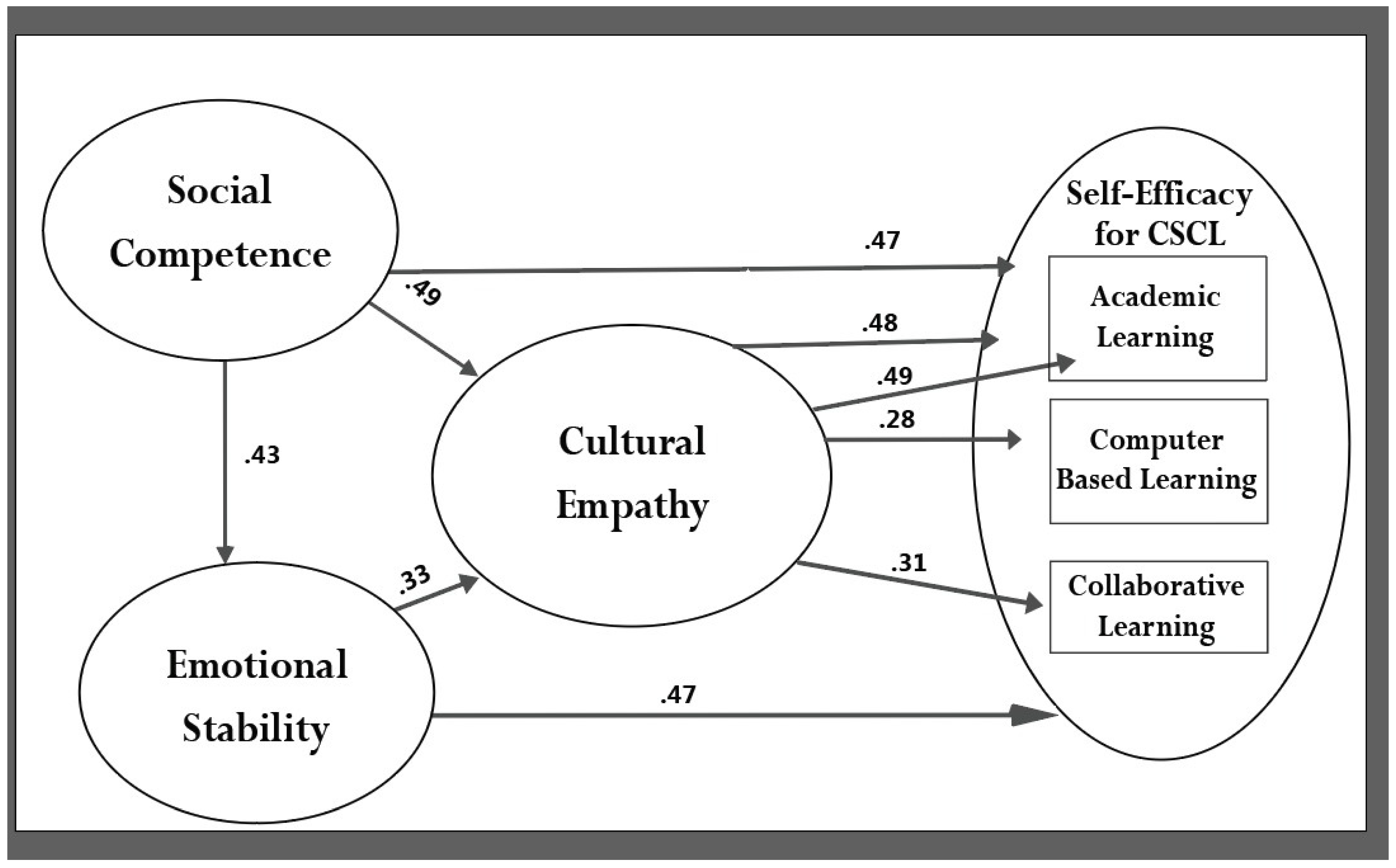
- How are the SEL competencies—social competence, emotional stability, and cultural empathy—related to self-efficacy for CSCL?
- (b)
- Does cultural empathy mediate the relationship between social competence, emotional stability, and self-efficacy for CSCL?
2.4.1. Hypothesis 1
2.4.2. Hypothesis 2
2.4.3. Hypothesis 3
3. Method
3.1. Participants
3.2. Instruments and Procedures
- Demographic Questionnaire: This section gathered background information, including gender, age, religion, sector (Jews/Arabs), academic institution, field of study, academic degree, family socioeconomic status, country of birth, presence of disabilities, type of employment (temporary or permanent), executive role (yes/no/other), and number of years in the workforce.
- The self-efficacy for CSCL questionnaire (Mor, 2001; Salomon, 2002) is grounded in theoretical frameworks developed by Bandura (1986), Schunck (1990), and Pintrich and De Groot (1990).We adapted this instrument for the university context to assess students’ beliefs about their capabilities to engage in academic tasks, regulate their learning processes in peer settings, manage study organization, seek support within collaborative teams, and identify effective strategies for enhancing learning outcomes. Academic self-efficacy in CSCL was measured using 24 items, each targeting skills necessary for successful participation in computer-supported collaborative learning environments.The instrument differentiates between three core components of academic self-efficacy in CSCL:
- (a)
- Academic learning (e.g., “I am sure that I can do an excellent job in the academic task assigned to me”);
- (b)
- Computer-based learning (e.g., “The computer is my best learning partner”);
- (c)
- Collaborative learning (e.g., “Learning in a team promotes my learning because I am known to work in a team and activate my colleagues”).
The questionnaire underwent expert validation by three academic reviewers, who confirmed that it accurately captured self-efficacy for learning and successfully distinguished among the three sub-dimensions of self-efficacy—academic, collaborative, and computer-based. The internal consistency of the scale was acceptable (α = 0.79); see Table 2. - Two subscales of the Multicultural Personality Questionnaire (MPQ) were used in this study:
- Cultural Empathy (18 items; α = 0.89): Content validity checks yielded a Cronbach’s alpha of 0.90. Sample items include: “Finds it hard to empathize with others,” “Enjoys other people’s stories,” and “Able to voice other people’s thoughts from different cultural backgrounds.”
- Emotional Stability (20 items; α = 0.82): Our content validation showed a Cronbach’s alpha of 0.77. Sample items include: “Considers problems solvable,” “Suffers from conflicts with others,” and “Is not easily hurt.”
These subscales are part of the broader Multicultural Personality Questionnaire (MPQ) (Van der Zee & Van Oudenhoven, 2000), a 91-item instrument assessing five personality factors. Respondents rate their agreement with statements using the prompt “To what extent do the following statements apply to you?” on a 5-point Likert-type scale (1 = totally not applicable, 5 = completely applicable). The reliability and validity of this full version have been rigorously tested and confirmed (Van der Zee & Van Oudenhoven, 2000).The MPQ was translated into Hebrew and validated by Lacher Edenburg (2019), yielding an overall Cronbach’s alpha of α = 0.83. Content validity was established through expert reviews and focus group sessions, which concluded that no items required rewording. In the context of AI-supported CSCL, the MPQ subscales of cultural empathy and emotional stability are especially relevant because technology-mediated collaboration often reduces access to non-verbal cues, increases the likelihood of misunderstandings, and heightens stress when negotiating across cultural differences. Measuring these constructs allows us to assess students’ capacity to regulate emotions and empathize with peers in digital environments, thereby capturing critical factors that directly influence the quality of AI-mediated collaboration. - The Social Competence Questionnaire (Valkenburg & Peter, 2008) is a 19-item self-report measure designed to assess social competence across four distinct dimensions: initiation of (offline) relationships or interactions, supportiveness, assertiveness, and the ability to self-disclose. These four predefined dimensions were empirically validated through exploratory factor analysis. To determine whether these dimensions were components of a broader construct, a second-order confirmatory factor analysis was conducted, confirming that a single overarching social competence factor underpinned the four subscales.Participants were asked to reflect on how they had managed various interpersonal situations over the previous six months. Each subscale is illustrated below with example items and internal consistency coefficients:
- Initiation (α = 0.86): e.g., “Start a conversation with someone you did not know very well.”
- Supportiveness (α = 0.83): e.g., “Listen carefully to someone who told you about a problem they were experiencing.”
- Self-disclosure (α = 0.83): e.g., “Express your feelings to someone else.”
- Assertiveness (α = 0.86): e.g., “Stand up for your rights when someone wronged you.” In AI-mediated CSCL, the SCQ provides a robust measure of students’ ability to initiate and sustain relationships, offer support, assert themselves, and disclose appropriately in environments where communication is technology-driven and face-to-face interaction is limited. These competencies are particularly critical for collaborative platforms where cues such as tone, body language, and immediacy are often absent, making explicit social competence a key determinant of effective teamwork and digital collaboration.
3.3. Data Analysis
4. Results
4.1. Hypothesis Testing
4.2. A Prediction Model for Self-Efficacy for CSCL
4.3. Mediation Analysis
5. Discussion
6. Limitations and Directions for Future Research
7. Conclusions
8. Theoretical and Practical Implications
Author Contributions
Funding
Institutional Review Board Statement
Informed Consent Statement
Data Availability Statement
Conflicts of Interest
References
- Allport, G. W. (1954). The nature of prejudice. Addison-Wesley. [Google Scholar]
- Alqurashi, E. (2016). Self-efficacy in online learning environments: A literature review. Contemporary Issues in Education Research (CIER), 9(1), 45–52. [Google Scholar] [CrossRef]
- Bandura, A. (1982). Self efficacy mechanism in human agency. American Psychologist, 37(2), 122–147. [Google Scholar] [CrossRef]
- Bandura, A. (1986). Social foundations of thought and action: A social cognitive theory. Prentice Hall. [Google Scholar]
- Bandura, A. (1994). Self-efficacy. In V. S. Ramachaudran (Ed.), Encyclopedia of human behavior (Vol. 4, pp. 71–81). Academic Press. [Google Scholar]
- Bandura, A. (1997). Self-efficacy: The exercise of control. W. H. Freeman. [Google Scholar]
- Baron, R. M., & Kenny, D. A. (1986). The moderator–mediator variable distinction in social psychological research: Conceptual, strategic, and statistical considerations. Journal of Personality and Social Psychology, 51(6), 1173–1182. [Google Scholar] [CrossRef] [PubMed]
- Basilotta-Gómez-Pablos, V., Matarranz, M., Casado-Aranda, L. A., & Otto, A. (2022). Teachers’ digital competencies in higher education: A systematic literature review. International Journal of Educational Technology in Higher Education, 19(1), 8. [Google Scholar] [CrossRef]
- Burr, D. A., Castrellon, J. J., Zald, D. H., & Samanez-Larkin, G. R. (2021). Emotion dynamics across adulthood in everyday life: Older adults are more emotionally stable and better at regulating desires. Emotion, 21(3), 453–464. [Google Scholar] [CrossRef] [PubMed]
- Cain, M., Campbell, C., & Coleman, K. (2023). ‘Kindness and empathy beyond all else’: Challenges to professional identities of higher education teachers during COVID-19 times. The Australian Educational Researcher, 50(4), 1233–1251. [Google Scholar]
- CASEL [Collaborative for Academic, Social, and Emotional Learning]. (2022). Introduction to SEL. What is SEL? Available online: http://casel.org/why-it-matters/what-is-sel/ (accessed on 30 January 2025).
- Castro Olivo, S. M., Ura, S., & dAbreu, A. (2021). The effects of a culturally adapted program on ELL students’ core SEL competencies as measured by a modified version of the BERS-2. Journal of Applied School Psychology, 38(4), 380–396. [Google Scholar] [CrossRef]
- Corradi, D., & Levrau, F. (2021). Social adjustment and dynamics of segregation in higher education–Scrutinising the role of open-mindedness and empathy. International Journal of Intercultural Relations, 84, 12–26. [Google Scholar]
- De Backer, L., Van Keer, H., De Smedt, F., Merchie, E., & Valcke, M. (2022). Identifying regulation profiles during computer-supported collaborative learning and examining their relation with students’ performance, motivation, and self-efficacy for learning. Computers & Education, 179, 104421. [Google Scholar] [CrossRef]
- Eriksen, E. V., & Bru, E. (2023). Investigating the links of social emotional competencies: Emotional wellbeing and academic engagement among adolescents. Scandinavian Journal of Educational Research, 67(3), 391–405. [Google Scholar] [CrossRef]
- Francescato, D., Porcelli, R., Mebane, M., Cuddetta, M., Klobas, J., & Renzi, P. (2006). Evaluation of the efficacy of collaborative learning in face-to-face and computer-supported university contexts. Computers in Human Behavior, 22(2), 163–176. [Google Scholar] [CrossRef]
- Grant, D. E., Jr., & Hill, J. B. (2020). Activating culturally empathic motivation in diverse students. Journal of Education and Learning, 9(5), 45–58. [Google Scholar] [CrossRef]
- Gribble, L., & Beckmann, E. A. (2023). The 4 Cs strategy for disseminating innovations in university teaching: Classroom, corridors, campus, community. Journal of University Teaching and Learning Practice, 20(1), 13–34. [Google Scholar] [CrossRef]
- Henriksen, D., Creely, E., Gruber, N., & Leahy, S. (2025). Social-emotional learning and generative AI: A critical literature review and framework for teacher education. Journal of Teacher Education, 76(3), 312–328. [Google Scholar] [CrossRef]
- Hernández-Sellés, N., Muñoz-Carril, P. C., & González-Sanmamed, M. (2019). Computer-supported collaborative learning: An analysis of the relationship between interaction, emotional support and online collaborative tools. Computers & Education, 138, 1–12. [Google Scholar] [CrossRef]
- Hofer, S. I., Nistor, N., & Scheibenzuber, C. (2021). Online teaching and learning in higher education: Lessons learned in crisis situations. Computers in Human Behavior, 121, 106789. [Google Scholar] [CrossRef]
- Hsu, H. P. (2025). An autoethnographic study of ESL academic writing with ChatGPT: From psychological insights to the SUPER framework. Cogent Education, 12(1), 2543113. [Google Scholar] [CrossRef]
- Jan, S. K. (2015). The relationships between academic self-efficacy, computer self-efficacy, prior experience, and satisfaction with online learning. American Journal of Distance Education, 29(1), 30–40. [Google Scholar] [CrossRef]
- Jones, S. M., & Doolittle, E. J. (2017). Social and emotional learning: Introducing the issue. The Future of Children, 27(1), 3–11. [Google Scholar] [CrossRef]
- Jones, S. M., & Kahn, J. (2017). The evidence base for how we learn: Supporting students’ social, emotional, and academic development. In Consensus statements of evidence from the council of distinguished scientists. Aspen Institute. [Google Scholar]
- Junge, C., Valkenburg, P. M., Deković, M., & Branje, S. (2020). The building blocks of social competence: Contributions of the Consortium of Individual Development. Developmental Cognitive Neuroscience, 45, 100861. [Google Scholar] [CrossRef] [PubMed]
- Kamei, A., & Harriott, W. (2021). Social emotional learning in virtual settings: Intervention strategies. International Electronic Journal of Elementary Education, 13(3), 365–371. [Google Scholar] [CrossRef]
- Kirschner, P. A., Martens, R. L., & Strijbos, J. W. (2004). CSCL in higher education? In What we know about CSCL. Springer. [Google Scholar] [CrossRef]
- Lacher Edenburg, L. (2019). Examining the relationship between social network participation and social competence and loneliness among people with an intellectual disability [Master’s thesis, Haifa University]. [Google Scholar]
- Lipponen, L. (2023). Exploring foundations for computer-supported collaborative learning. In Computer support for collaborative learning (pp. 72–81). Routledge. [Google Scholar]
- Ma, X., Liu, J., Liang, J., & Fan, C. (2023). An empirical study on the effect of group awareness in CSCL environments. Interactive Learning Environments, 31(1), 38–53. [Google Scholar] [CrossRef]
- Mor, N. (2001). Changes in the conception of learning as a function of experiencing novel learning environments [Doctoral dissertation, Haifa University]. [Google Scholar]
- Muñoz-Carril, P. C., Hernández-Sellés, N., Fuentes-Abeledo, E. J., & González-Sanmamed, M. (2021). Factors influencing students’ perceived impact of learning and satisfaction in computer supported collaborative learning. Computers & Education, 174, 104310. [Google Scholar] [CrossRef]
- OECD. (2021). Beyond academic learning: First results from the survey of social and emotional skills. OECD Publishing. [Google Scholar]
- Pintrich, P. R., & De Groot, E. V. (1990). Motivational and self-regulated learning components of classroom academic performance. Journal of Educational Psychology, 82(1), 33–36. [Google Scholar] [CrossRef]
- Salomon, G. (2002). Technology and pedagogy: Why don’t we see the promised revolution? Educational Technology, 42(2), 71–75. [Google Scholar]
- Schonert-Reichl, K. A., & Weissberg, R. P. (2023). Social and emotional learning. In International encyclopedia of education-perspectives on learning: Theory and methods (4th ed.). Elsevier. [Google Scholar]
- Schoon, I. (2021). Towards an integrative taxonomy of social-emotional competences. Frontiers in Psychology, 12, 515313. [Google Scholar] [CrossRef]
- Schunck, H. D. (1990). Introduction to the special section on motivation and efficacy. Journal of Educational Psychology, 82(1), 3–6. [Google Scholar] [CrossRef]
- Serebryakova, T. Y. A., Morozova, L. B., Kochneva, E. M., Zharova, D. V., Kostyleva, E. A., & Kolarkova, O. G. (2016). Emotional stability as a condition of students’ adaptation to studying in a higher educational institution. International Journal of Environmental and Science Education, 11(15), 7486–7494. [Google Scholar]
- Sethi, S. S., & Jain, K. (2024). AI technologies for social emotional learning: Recent research and future directions. Journal of Research in Innovative Teaching & Learning, 17(2), 213–225. [Google Scholar] [CrossRef]
- Simion, A. (2023). The impact of socio-emotional learning (SEL) on academic evaluation in higher education. Educatia, 21(24), 109–117. [Google Scholar] [CrossRef]
- Singh, R., Singh, S. K., & Mishra, N. (2025). Factors influencing student learning performance and continuous use of artificial intelligence in online higher education. Discover Education, 4, 292. [Google Scholar] [CrossRef]
- Soffer-Vital, S., & Finkelstein, I. (2024). Empowering teachers: Multicultural social and emotional learning (MSEL) among Arab minority teachers. Journal of Ethnic and Cultural Studies, 11, 39–57. [Google Scholar] [CrossRef]
- Strielkowski, W., Grebennikova, V., Lisovskiy, A., Rakhimova, G., & Vasileva, T. (2024). AI-driven adaptive learning for sustainable educational transformation. Sustainable Development, 33(2), 1921–1947. [Google Scholar] [CrossRef]
- Tedla, Y. G., & Chen, H. L. (2024). The impacts of computer-supported collaborative learning on students’ critical thinking: A meta-analysis. Education and Information Technologies, 30, 1487–1516. [Google Scholar] [CrossRef]
- Tseng, H., Yi, X., & Yeh, H. T. (2019). Learning-related soft skills among online business students in higher education: Grade level and managerial role differences in self-regulation, motivation, and social skill. Computers in Human Behavior, 95, 179–186. [Google Scholar] [CrossRef]
- Valkenburg, P. M., & Peter, J. (2008). Adolescents’ identity experiments on the internet: Consequences for social competence and selfconcept unity. Communication Research, 35(2), 208–231. [Google Scholar]
- Van der Zee, K. I., & Van Oudenhoven, J. P. (2000). The multicultural personality questionnaire: Reliability and validity of self and other ratings of multicultural effectiveness. Journal of Research in Personality, 35(3), 278–288. [Google Scholar]
- Warren, C. A., Presberry, C., & Louis, L. (2022). Examining teacher dispositions for evidence of (transformative) social and emotional competencies with Black boys: The case of three urban high school teachers. Urban Education, 57(2), 251–277. [Google Scholar]
- Won, S., Kapil, M. E., Drake, B. J., & Paular, R. A. (2024). Investigating the role of academic, social, and emotional self-efficacy in online learning. The Journal of Experimental Education, 92(3), 485–501. [Google Scholar] [CrossRef]
- Zheng, Y., & Xiao, A. (2024). A structural equation model of online learning: Investigating self-efficacy, informal digital learning, self-regulated learning, and course satisfaction. Frontiers in Psychology, 14, 1276266. [Google Scholar] [CrossRef] [PubMed]

| Demographic Variables | % | N | |
|---|---|---|---|
| Gender | Male | 14% | 36 |
| Female | 86% | 222 | |
| Mean age | 32.83 (SD = 10.62) | ||
| Degree level | Bachelor’s students | 51% | 132 |
| Master’s students | 49% | 126 | |
| Discipline | Education and social studies | 65% | 168 |
| Other disciplines | 35% | 90 | |
| Religion | Muslim | 63% | 163 |
| Jewish | 36% | 93 | |
| Other | 1% | 2 | |
| Religious affiliation | Traditional | 31% | 80 |
| Religious | 38% | 98 | |
| Secular | 31% | 80 | |
| Native language | Arabic | 63% | 163 |
| Hebrew | 35% | 90 | |
| Other | 2% | 5 |
| Mean | SD | Range | Alpha Cronbach | |
|---|---|---|---|---|
| Academic learning | 3.38 | 0.45 | 1.38–4.00 | 0.75 |
| Computer-based learning | 3.07 | 0.57 | 1.00–4.00 | 0.70 |
| Collaborative learning | 3.12 | 0.589 | 1.29–4.00 | 0.80 |
| Self-efficacy for CSCL—total scale | 3.19 | 0.38 | 1.75–3.96 | 0.83 |
| 1 | 2 | 3 | 4 | |
|---|---|---|---|---|
| 1. Social competence | --- | |||
| 2. Emotional stability | 0.43 ** | -- | ||
| 3. Cultural empathy | 0.49 ** | 0.33 ** | -- | |
| 4. Self-efficacy for CSCL | 0.47 ** | 0.47 ** | 0.48 ** | -- |
| Predictors | Self-Efficacy for CSCL-Total Scale β | Computer-Based Learning β | Collaborative Learning β | Academic Learning β |
|---|---|---|---|---|
| First step | ||||
| Religion (Jewish = 1) | 0.13 | - | - | - |
| Age | 0.08 | - | - | 0.21 ** |
| Degree | 0.16 * | 0.19 ** | 0.24 ** | - |
| A sense of belonging | 0.26 ** | - | - | 0.34 ** |
| Socioeconomic | 0.04 | - | - | |
| Second step | ||||
| Social competence | 0.22 ** | 0.04 | 0.15 * | 0.27 ** |
| Emotional stability | 0.21 ** | 0.11 | 0.05 | 0.22 ** |
| Cultural empathy | 0.29 ** | 0.20 ** | 0.10 | 0.27 ** |
| Predictors | Coefficients | ||||
|---|---|---|---|---|---|
| β | SE | B | t | R2 | |
| First model—dependent variable: Self-Efficacy for CSCL | |||||
| Social competence | 0.48 | 0.05 | 0.48 | 8.92 ** | 0.23 |
| Second model—dependent variable: Cultural Empathy | |||||
| Social competence | 0.49 | 0.05 | 0.49 | 8.99 ** | 0.24 |
| Third model—dependent variable: Self-Efficacy for CSCL | |||||
| Social competence | 0.31 | 0.05 | 0.31 | 5.33 ** | 0.33 |
| Cultural empathy | 0.35 | 0.05 | 0.35 | 6.07 ** | |
| Predictors | Coefficients | ||||
|---|---|---|---|---|---|
| β | SE | B | t | R2 | |
| First model—dependent variable: Self-Efficacy for CSCL | |||||
| Emotional stability | 0.43 | 0.05 | 0.43 | 7.62 ** | 0.18 |
| Second model—dependent variable: Cultural Empathy | |||||
| Emotional stability | 0.33 | 0.06 | 0.33 | 5.55 ** | 0.10 |
| Third model—dependent variable: Self-Efficacy for CSCL | |||||
| Emotional stability | 0.29 | 0.05 | 0.29 | 5.46 ** | 0.33 |
| Cultural empathy | 0.41 | 0.05 | 0.41 | 7.64 ** | |
Disclaimer/Publisher’s Note: The statements, opinions and data contained in all publications are solely those of the individual author(s) and contributor(s) and not of MDPI and/or the editor(s). MDPI and/or the editor(s) disclaim responsibility for any injury to people or property resulting from any ideas, methods, instructions or products referred to in the content. |
© 2025 by the authors. Licensee MDPI, Basel, Switzerland. This article is an open access article distributed under the terms and conditions of the Creative Commons Attribution (CC BY) license (https://creativecommons.org/licenses/by/4.0/).
Share and Cite
Finkelstein, I.; Soffer-Vital, S. Cultural Empathy in AI-Supported Collaborative Learning: Advancing Inclusive Digital Learning in Higher Education. Educ. Sci. 2025, 15, 1305. https://doi.org/10.3390/educsci15101305
Finkelstein I, Soffer-Vital S. Cultural Empathy in AI-Supported Collaborative Learning: Advancing Inclusive Digital Learning in Higher Education. Education Sciences. 2025; 15(10):1305. https://doi.org/10.3390/educsci15101305
Chicago/Turabian StyleFinkelstein, Idit, and Shira Soffer-Vital. 2025. "Cultural Empathy in AI-Supported Collaborative Learning: Advancing Inclusive Digital Learning in Higher Education" Education Sciences 15, no. 10: 1305. https://doi.org/10.3390/educsci15101305
APA StyleFinkelstein, I., & Soffer-Vital, S. (2025). Cultural Empathy in AI-Supported Collaborative Learning: Advancing Inclusive Digital Learning in Higher Education. Education Sciences, 15(10), 1305. https://doi.org/10.3390/educsci15101305