
Article

Predicting the Intention to Use Technology in Education among Student Teachers: A Path Analysis

1
Institute of Computer Science, University of Tartu, Narva mnt 18, 51009 Tartu, Estonia
2
Institute of Educational Science, University of Tartu, Salme 1a, 50103 Tartu, Estonia
*
Author to whom correspondence should be addressed.
Educ. Sci. 2021, 11(9), 564; https://doi.org/10.3390/educsci11090564

Submission received: 16 August 2021 / Revised: 12 September 2021 / Accepted: 16 September 2021 / Published: 21 September 2021
(This article belongs to the Special Issue Technology-Enhanced Learning and Teaching: Present and Future)

Abstract

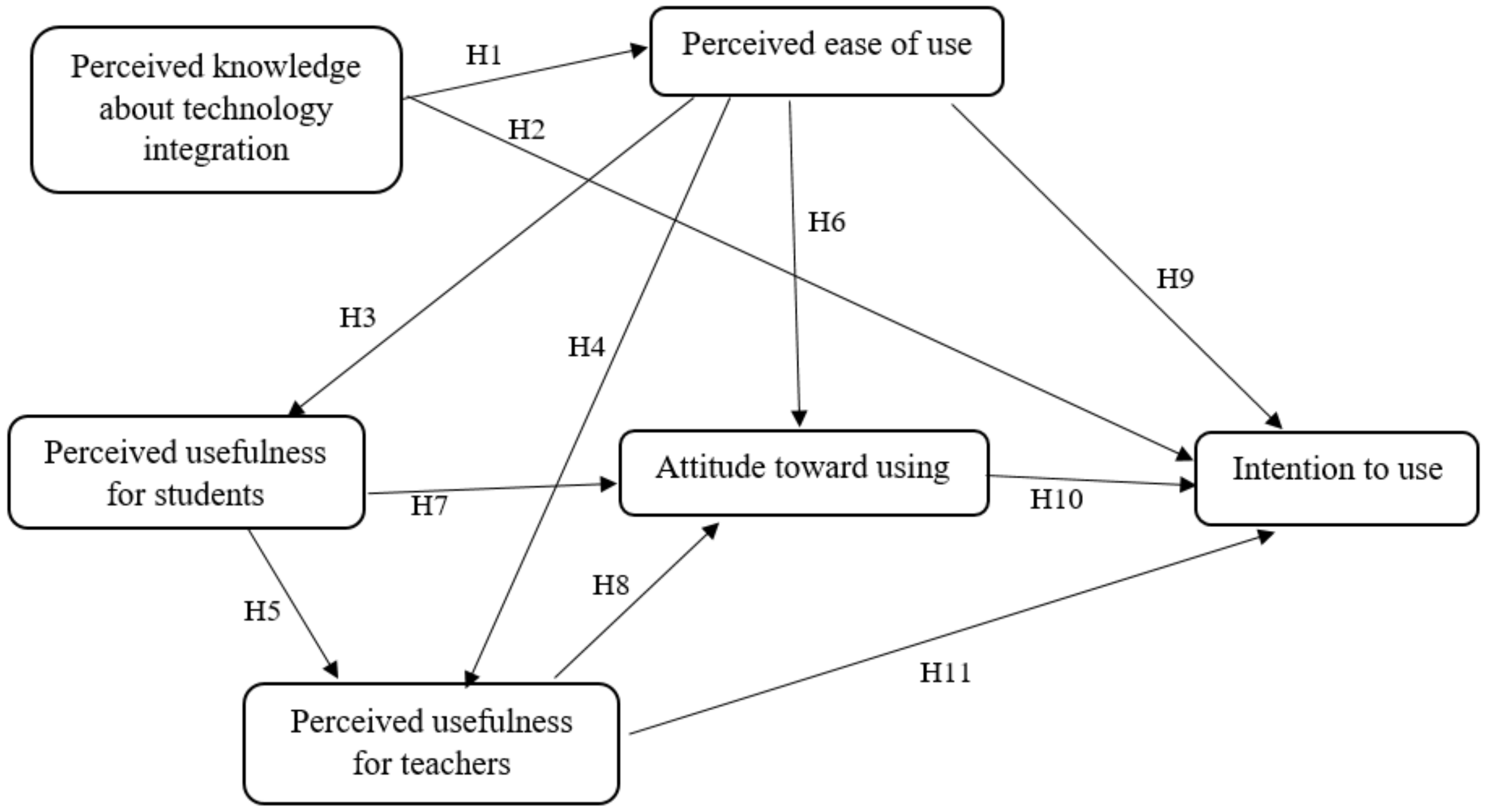
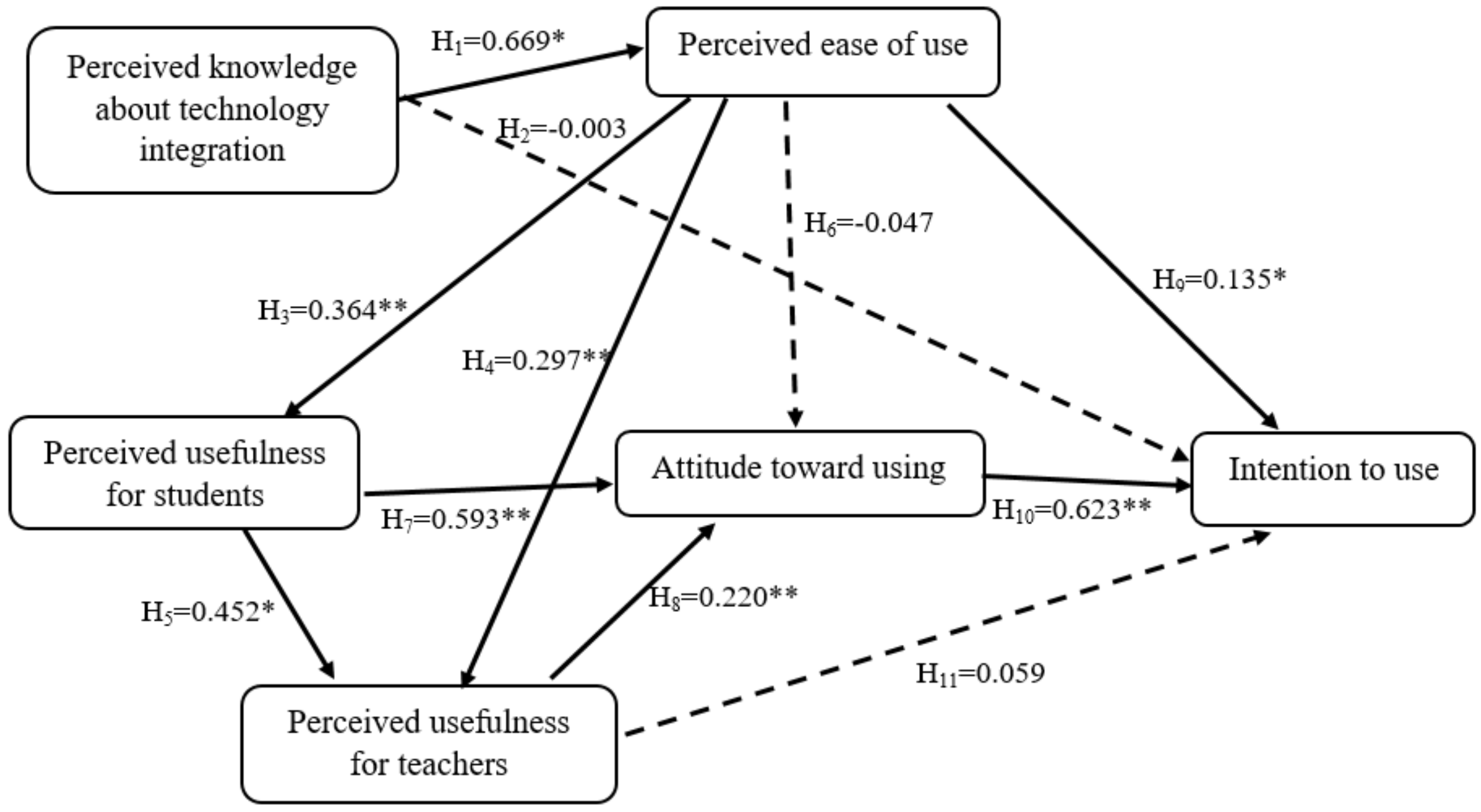
Teacher education must provide the knowledge and skills necessary for technology integration, but also influence attitudes and beliefs. Little research has been conducted on how knowledge, beliefs, and attitudes predict teachers’ intentions to use technology. The aim of this study was to identify how perceived knowledge about technology integration, and beliefs and attitudes towards using technology, impact the intention to use technology among student teachers. The sample consisted of 232 student teachers from the University of Tartu. Data were collected using a questionnaire based on elements of two different models. Validating the technology acceptance scale using a confirmatory factor analysis identified that perceived usefulness was split into two constructs: perceived usefulness for students and perceived usefulness for teachers. Path analysis, as a special type of structural equation modelling, was used to test 11 hypotheses. The results showed that both perceived ease of use and attitude to use have direct effects on intention to use. Still, perceived usefulness for teachers and perceived knowledge displayed an indirect influence. Based on these results, it is important that student teachers should be convinced that technology is easy to use in teaching.
Keywords: student teachers; intention to use; knowledge about technology integration; beliefs for using technology; path analysis student teachers; intention to use; knowledge about technology integration; beliefs for using technology; path analysis