1. Introduction
Private supplementary tutoring has become a quantitatively important component of household education investment in both developed and developing economies (
Bray, 2006;
W. Zhang & Bray, 2020;
Hajar & Karakus, 2022). Its rapid expansion has attracted growing policy attention because access to tutoring is strongly associated with household income and parental background, which can reinforce educational inequality (
S. Kim & Lee, 2010;
Liu & Bray, 2017;
Zwier et al., 2020;
Matsuoka, 2018). At the same time, tutoring may intensify educational competition and increase pressure on students, raising broader concerns about well-being and resource allocation (
Pan et al., 2022;
T. Kim et al., 2022;
Zheng et al., 2020). Recent studies also show that the COVID-19 period accelerated changes in the organization and delivery of private supplementary tutoring, particularly through the expansion of online provision, while more recent international evidence continues to document substantial variation across countries and education systems in the role and consequences of private tutoring (
J. C. Lee et al., 2023;
Karakus et al., 2024;
Bray, 2024).
A central challenge for policy evaluation is that it remains unclear whether private tutoring primarily builds productive human capital or mainly improves exam performance. While some studies find positive effects on academic outcomes, others show limited or heterogeneous effects once selection and endogeneity are taken into account (
Y. Zhang, 2013;
Kuan, 2011;
Sun et al., 2020). Existing evidence further suggests that tutoring may improve exam performance more than long-run productive human capital.
Dang and Rogers (
2008) emphasize that even participating households may be uncertain about whether tutoring generates genuine productive gains or mainly improves performance in competitive examinations, although tutoring need not be entirely wasteful.
Guo et al. (
2020), by contrast, provide more direct evidence that tutoring primarily raises subject-specific and exam-related performance, with much weaker effects on broader cognitive ability. This distinction is crucial because the desirability of regulation depends on whether tutoring mainly builds productive skills or mainly strengthens relative position.
This issue is especially important in high-stakes, ranking-based admission systems. In such settings, educational success depends not only on absolute achievement but also on relative performance in competition for limited slots in higher-quality schools and universities. A growing literature shows that tutoring is closely tied to selective educational transitions and ranking-based allocation (
Guill & Lintorf, 2019;
Zwier et al., 2020;
Stevenson & Baker, 1992;
Buchmann et al., 2010). This structure gives households incentives to invest in tutoring even when its contribution to long-run productivity is uncertain, and can turn educational investment into a form of positional competition (
Ramey & Ramey, 2010).
The broader economics literature has studied closely related mechanisms through models of parental investment and intergenerational human-capital accumulation. Quantitative work in this tradition emphasizes that household resources, parental characteristics, and education policies jointly shape investments in children and thereby affect human-capital formation, inequality, and the persistence of economic status across generations.
Abbott et al. (
2019), for example, analyze education policy and intergenerational transfers in a life-cycle framework in which parental characteristics and household resources influence children’s skill formation and educational choices.
S. Y. Lee and Seshadri (
2019) emphasize the role of childhood human-capital investment in generating intergenerational persistence, while
Caucutt and Lochner (
2020) show how family resources, borrowing constraints, and the timing of parental investment affect children’s human-capital accumulation and mobility. More broadly,
Abdulla (
2023) highlights the importance of human-capital differences for persistent differences in economic outcomes.
Abbott (
2022) further emphasizes the role of household heterogeneity in shaping educational investment and long-run outcomes. Together, these studies provide a broader human-capital foundation for understanding how differences in household educational investment can translate into persistent inequality across generations. The present paper builds on these insights but focuses on private tutoring as a distinct form of household education investment and on the additional strategic incentives that arise when scarce educational opportunities are allocated according to relative exam performance.
Recent work has begun to incorporate educational competition into quantitative frameworks.
S. Kim et al. (
2024) study the role of educational competition in a model of endogenous fertility, where parents care about their children’s outcomes relative to those of other children and competition operates through a status externality in parental preferences.
Gu and Zhang (
2024) analyze parental investment competition for college admissions in a quantitative model where investment affects both labor productivity and admission outcomes through an empirically estimated admission mapping, and where pre-college human capital may only partially translate into productive adult human capital.
Motivated by these contributions, this paper develops a quantitative framework that endogenizes ranking-based admission competition within a model of household education investment. We build a partial-equilibrium overlapping-generations economy with heterogeneous households in which parents allocate resources across consumption, savings, and private tutoring for their children. Compared with
S. Kim et al. (
2024), where competition enters parental preferences directly through concern for children’s relative outcomes, parents in our model care about their children’s expected future consumption, and private tutoring matters because it changes admission prospects through an explicitly ranking-based allocation mechanism. Children’s outcomes depend on both public schooling and private tutoring. The central question is how regulation performs when tutoring is partly productive but also improves relative position in a competitive admission system.
The paper makes three related contributions. First, it introduces an endogenous ranking-based admission mechanism that links household tutoring decisions to the economy-wide distribution of exam performance. Second, it separates the exam-related and skill-related effects of tutoring and shows how the policy trade-off changes with the productive value of tutoring. Third, it studies how imperfect enforcement changes the incidence of a ban when access to informal tutoring differs across parental education types. Together, these mechanisms connect private tutoring regulation to broader questions in development economics concerning human-capital formation, inequality of opportunity, and the intergenerational transmission of economic advantage.
We compare three policy regimes: a complete ban on private tutoring, a ban with imperfect enforcement and black-market tutoring, and a tutoring tax whose revenue partly replaces the common contribution used to finance public education. In the benchmark calibration, prohibition-based policies generate large model-implied welfare and human-capital losses when tutoring contributes to productive skills. Unequal informal access partly preserves tutoring activity but creates additional differences in participation across household groups. The welfare-selected tutoring tax performs better among the specific policy experiments considered. This comparison is conditional on the model’s enforcement and financing assumptions: the tax is optimized over a grid and assumed to be collected effectively, whereas the prohibition experiments use fixed enforcement structures. China provides the data and institutional motivation for the benchmark calibration, but the policy exercises are not intended as a direct structural evaluation of a particular observed reform. In particular, the tutoring tax is a counterfactual policy instrument rather than a description of current Chinese policy. Although the quantitative magnitudes are specific to the Chinese calibration, the underlying mechanisms are relevant to other education systems in which households can purchase supplementary instruction and access to scarce educational opportunities depends partly on relative academic performance.
The remainder of the paper is organized as follows.
Section 2 presents the model.
Section 3 describes the calibration strategy.
Section 4 reports the main quantitative results and policy comparisons.
Section 5 provides three counterfactual experiments.
Section 6 discusses the robustness.
Section 7 discusses interpretation and limitations.
Section 8 concludes.
2. The Model
We develop a partial-equilibrium overlapping-generations (OLG) model to study how policies regulating private tutoring affect household behavior, educational investment, and intergenerational human capital dynamics. The model features a continuum of heterogeneous households, endogenous ranking-based college admission, and policy interventions that change the cost and accessibility of private tutoring.
2.1. Household Problem
In each generation, a parent chooses consumption, savings, and private tutoring expenditure for a child to maximize lifetime utility:
Here,
c and
denote first- and second-period consumption,
s denotes savings, and
p denotes private tutoring expenditure for the child. The term
denotes the child’s expected lifetime-consumption index, obtained from the consumption policy associated with the child’s expected adult human capital. It enters parental utility through altruistic preferences.
1 The parameter
is the intertemporal elasticity of substitution,
is the discount factor, and
captures parental altruism.
Household income is given by
, where
w is the wage rate,
is parental human capital, and
is a multiplicative residual earnings component not explained by
.
2 The parameter
r denotes the interest rate, and
is the depreciation rate of savings. The term
is a common contribution used to finance public education. The function
denotes the total cost of private tutoring and may depend on policy and the parent’s previously realized education type
, as specified below.
2.2. Human Capital Formation
Human capital formation has four components: intergenerational inheritance, pre-college human capital accumulation, college admission, and post-college human capital realization. The child inherits human capital from the parent according to
where
captures intergenerational persistence and
governs the dispersion of the inheritance shock.
Before college admission, the child accumulates two forms of pre-college human capital. The first is exam-relevant human capital, which determines the child’s position in the admission system:
where
denotes fixed public education expenditure. The second is skill-relevant human capital, which affects long-run productivity:
The education production function is
Here,
A is a scale parameter,
governs the relative contribution of public education, and
determines the elasticity of substitution between public education and private tutoring.
3 The parameter
measures the extent to which private tutoring contributes to skill-relevant human capital relative to exam performance. A higher
implies that tutoring is more productive in the long run, while a lower
implies that tutoring mainly improves exam outcomes.
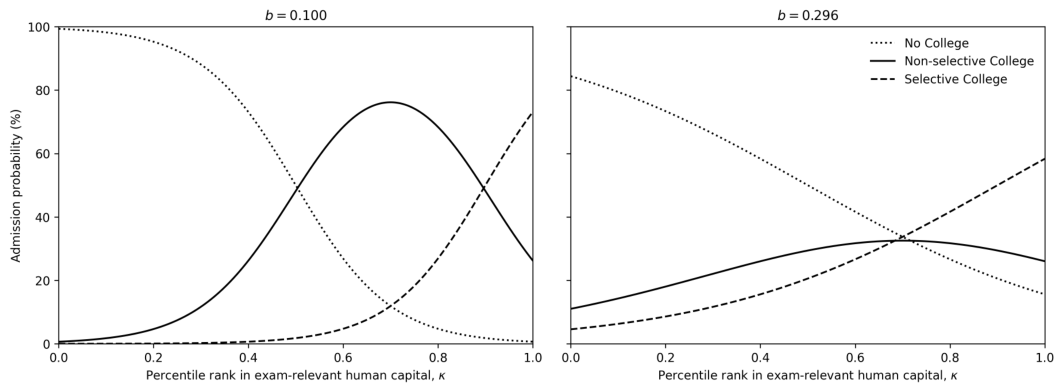
4College admission depends on the child’s position in the economy-wide distribution of exam-relevant human capital. Let
denote the child’s percentile rank in this distribution. The ranking is determined endogenously by the equilibrium distribution of exam-relevant human capital across households, and only relative rank matters for admission in the model.
There are three possible education tracks for the child: no college
, non-selective college
, and selective college
. Admission probabilities
are given by
where
Here,
and
are the admission thresholds for non-selective and selective colleges, and
b controls the smoothness of the admission function.
5Given these admission probabilities, the child’s expected human capital is
Here,
is the model-implied earnings premium associated with the child’s realized education track
. After the education track is realized, post-college human capital is given by
where
is an idiosyncratic productivity shock. This realized human capital becomes parental human capital in the next generation.
2.3. Policy Environment
We now specify the tutoring cost introduced in the household problem. The total tutoring cost for a parent of type
is
The parameter
is a baseline reduced-form cost wedge that captures search, coordination, transportation, and other non-tuition costs of using tutoring. The parameter
represents enforcement intensity: a higher value raises the effective cost of obtaining tutoring under regulation. When
, the economy corresponds to the baseline without tutoring regulation, and tutoring is available at cost
. When
, private tutoring is officially restricted but imperfectly enforced, so households can still obtain tutoring at higher and type-dependent costs. As
, tutoring becomes prohibitively costly and households optimally choose
, corresponding to a strict ban. The scenario parameters
govern type-specific costs of informal access, with
This ordering assumes that parents with higher previous education have better information or social connections and therefore face lower effective costs under regulation.
6In addition to quantity-based regulation, we consider a price-based policy in which private tutoring is taxed rather than restricted. Under this policy, we set
and introduce a proportional tutoring tax rate
. The total tutoring cost becomes
For each benchmark environment,
is selected from a fixed grid to maximize average model utility. The reported tax is therefore the best-performing tax within the grid, whereas the prohibition experiments use fixed enforcement structures.
7Tutoring tax revenue is used to finance public education, with average revenue given by
Total public education expenditure remains fixed at
and is jointly financed by the common contribution
and tutoring tax revenue:
The tax therefore operates through two channels. It raises the private cost of tutoring and reduces the common contribution required to finance public education. The resulting welfare effect combines a change in tutoring incentives with a change in the distribution of the financing burden.
2.4. Timing and Equilibrium
The timing within each generation is as follows. A parent enters the period with human capital and a previously realized education type , and draws the residual earnings component . Given the policy environment, the common public education contribution, and the reference distribution of exam performance, the parent chooses consumption, savings, and tutoring expenditure.
Public education and tutoring then determine the child’s exam-relevant and skill-relevant human capital. The child’s exam-relevant human capital is mapped into a percentile rank using the economy-wide distribution F. This rank determines the probabilities of entering the three education tracks. The child’s education track and productivity shock are then realized, determining adult human capital. The resulting human capital and education type become for the next generation.
Thus, are household-level states, while are household choices. The distribution F is an aggregate equilibrium object. Individual households take it as given when choosing tutoring expenditure, while the distribution generated by all household decisions must be consistent with the distribution used to form percentile ranks. The numerical procedure iterates on this distribution until convergence.
3. Calibration
The calibration proceeds in three steps. First, a set of parameters is fixed externally using normalization, institutional information, and directly observed statistics. Second, another set is disciplined by reduced-form empirical relationships estimated outside the model. Third, the remaining parameters are internally calibrated by matching model-implied moments to their empirical counterparts. Further details are provided in
Appendix D.
3.1. Data
The empirical analysis uses microdata from the China Family Panel Studies (CFPS) for the 2010–2022 waves. We construct a unified individual-level dataset by merging adult and child records, linking them to household identifiers through the family relationship files, and adding household economic information from the family economic files. Since variable definitions differ across waves, we make the key variables consistent across waves. All monetary variables are deflated using province-level consumer price index (CPI) data and expressed in real terms with 2010 as the base year. Household-level variables are then adjusted using the OECD-modified equivalence scale and normalized into model units.
8 3.2. Descriptive Trends in Private Tutoring
Before turning to the calibration, we document the evolution of private tutoring in the CFPS.
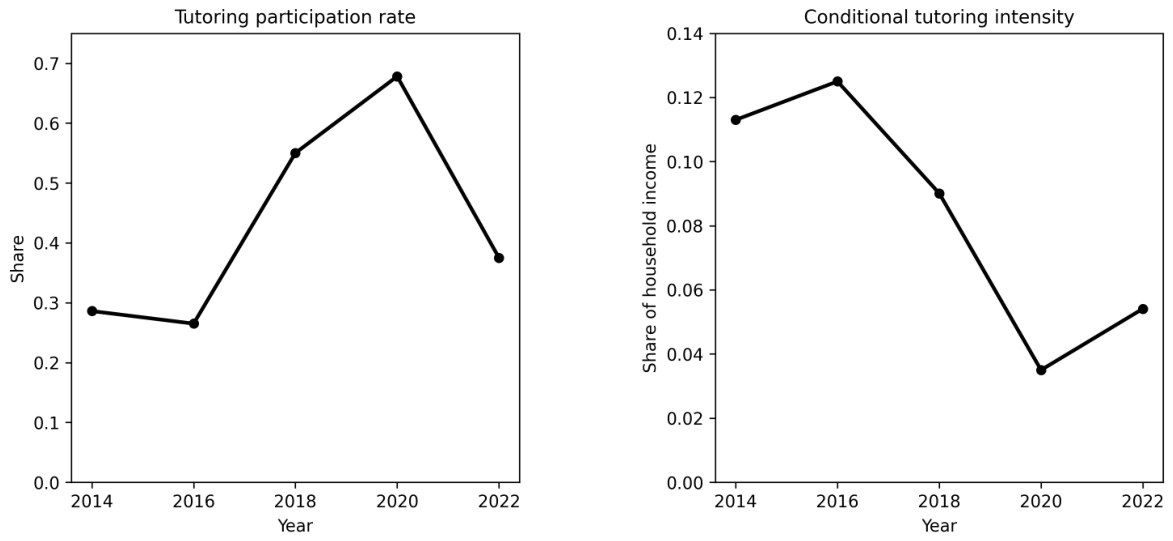
Figure 1 reports tutoring participation and conditional tutoring intensity among children aged 12–18 for the harmonized survey waves from 2014 to 2022. Tutoring participation is defined as reporting positive tutoring expenditure or participation in tutoring classes. Conditional tutoring intensity is measured as tutoring expenditure relative to household income among participating households.
9The data reveal a pronounced expansion of private tutoring before 2020. Participation remained at around 27–29% in 2014–2016, but then rose rapidly to 55.0% in 2018 and 67.8% in 2020. By 2022, however, the participation rate had fallen sharply to 37.5%. This reversal coincides with a major change in China’s tutoring-policy environment. The “Double Reduction” policy introduced in 2021 imposed extensive restrictions on subject-based off-campus tutoring, while the COVID-19 period also altered the availability and delivery of supplementary tutoring, particularly through the expansion of online provision (
J. C. Lee et al., 2023;
Karakus et al., 2024). The 2022 decline should therefore be interpreted as a descriptive pattern that is consistent with these institutional and market disruptions rather than as a causal estimate of either effect.
Conditional tutoring intensity followed a different trajectory. Among participating households, tutoring expenditure accounted for approximately 11–13% of household income in 2014–2016, declining to 9.0% in 2018 and 3.5% in 2020 before increasing modestly to 5.4% in 2022. Taken together, the two panels show that the rapid pre-2020 expansion of tutoring occurred mainly along the extensive margin, while the share of income spent by participating households generally declined. These changes provide empirical context for the model’s emphasis on tutoring participation, expenditure intensity, and policy regulation.
3.3. Externally Fixed and Benchmark Parameters
We first fix a set of parameters using normalization, institutional information, and direct measurement from the data. These parameters are reported in
Table 1.
The wage rate
w is normalized to one, which defines the unit of measurement in the model. Specifically, all monetary variables are converted into real, equivalized terms and normalized by the weighted median of household wage income in 2010.
10 Public education expenditure
is measured from household-level school education expenditures for households with children in public schools, using the weighted median across household-year observations from the 2016–2022 waves. The net return on savings,
, is set to 0.02, consistent with observed real interest rates. Parameters
and
are benchmark admission thresholds for the two college tracks.
11 Finally,
,
,
, and
are benchmark scenario parameters rather than quantities directly estimated from underground tutoring markets. The benchmark enforcement intensity
represents an intermediate case in which regulation substantially raises the effective cost of tutoring but does not eliminate informal participation. The values of
,
, and
represent a plausible ordering of informal access across parental types. The quantitative importance of both enforcement intensity and unequal access is assessed over wider ranges in
Section 5.
3.4. Parameters Disciplined by Reduced-Form Evidence
We next discipline a set of parameters using reduced-form empirical relationships estimated from the data. These relationships provide benchmark mappings rather than structural or causal identification, and the resulting values are treated as fixed inputs in the baseline calibration. Accordingly, these estimates should be interpreted as empirically anchored benchmark parameters rather than precisely identified structural primitives. The robustness exercises therefore examine how the main policy conclusions change when the less precisely disciplined parameters are varied.
Table 2 reports their values.
The parameter
governs the extent to which private tutoring contributes to skill-relevant human capital, as distinct from exam performance. We construct a benchmark value by comparing conditional associations between tutoring expenditure and more exam-oriented outcomes, such as mathematics and language scores, with associations for broader cognitive measures, such as memory and digit span. The former are used as proxies for exam-related performance, while the latter are used as proxies for broader skill formation.
12 We then map the relative strength of these associations into
.
The parameters and are anchored by the conditional parent–child relationship in completed education and its residual dispersion. These reduced-form moments contain inherited, family, investment, and institutional channels, so they should be interpreted as empirical disciplines on overall intergenerational persistence rather than pure measures of inherited ability. The parameters are mapped from conditional earnings differences across education groups, while the dispersion parameters use within-group residual variation. The earnings differences may include selection into education and are therefore interpreted as model-consistent earnings premia rather than causal returns to college.
3.5. Internally Calibrated Parameters
The remaining parameters are jointly calibrated to match a set of moments capturing household behavior, human capital accumulation, and the interaction between educational investment and economic heterogeneity. These moments include tutoring participation, tutoring intensity, average human capital, admission sensitivity, and the income gradient in tutoring participation.
Table 3 reports the calibrated values.
Tutoring participation is the share of households that engage in private tutoring. Tutoring intensity is the average share of income spent on tutoring among participating households, excluding extreme values. Admission sensitivity measures the gap in college attendance probabilities between students in the top 20% and bottom 20% of the distribution of standardized exam-related human capital.
13 The income gradient in tutoring participation captures how tutoring participation varies across the income distribution. It is constructed by sorting households by income, removing extremes, dividing the remaining sample into five groups, and taking the difference between the average participation rate in the top two groups and that in the bottom two groups. These moments are jointly targeted using a numerical optimization procedure, and the model matches most targeted moments closely.
14 3.6. Non-Targeted Moments
We further assess the model using a non-targeted income distribution.
Table 4 reports selected quantiles in the data and in the model.
The model reproduces the broad shape of the income distribution reasonably well. This comparison is a limited diagnostic rather than a strong external validation, because the income distribution is closely related to the model’s initial heterogeneity and earnings components. The more policy-relevant fit is therefore assessed mainly through the targeted tutoring, education, and admission moments reported above.
4. Policy Effects
This section compares the quantitative effects of alternative tutoring regulations in the calibrated economy.
15 We consider three policy regimes relative to the baseline: a complete ban, a ban with black-market access, and a tutoring tax. The tutoring-tax rate is selected by a grid search over
with increments of 0.01 to maximize average model utility.
16 Welfare is reported as a model-implied consumption-equivalent variation (CEV) based on average lifetime utility;
Appendix B gives the exact formula. We first examine aggregate effects and then turn to heterogeneity across parental human-capital groups.
4.1. Aggregate Effects of Tutoring Policies
Table 5 reports the aggregate effects of the alternative policy regimes at the calibrated benchmark. A complete ban generates the largest model-implied welfare loss, sharply lowers mean child human capital, and eliminates tutoring activity. The CEV is much larger than the tutoring expenditure share because it reflects the full utility effect of current consumption, savings, and the child’s expected future consumption over the intergenerational transition. Its magnitude should therefore be interpreted as a model-based welfare measure rather than a direct empirical estimate of an observed ban. Although the ban raises the mobility indicator, this mainly reflects compression in the outcome distribution rather than a broad improvement in absolute outcomes. In particular, higher relative mobility need not imply higher welfare for the bottom group.
Allowing a black market partly mitigates these effects. Relative to a complete ban, the ban-with-black-market regime yields a smaller welfare loss and higher child human capital because some households continue to obtain tutoring through informal channels. Its aggregate income Gini is only modestly higher than under the complete ban. The distributional importance of the black market is therefore clearer in the large group differences in tutoring participation reported below than in the aggregate Gini alone.
The welfare-selected tutoring tax performs better than the prohibition-based policies within the experiments considered. It keeps mean child human capital and tutoring activity close to baseline levels. Its welfare effect, however, combines a price channel with a financing channel, because tutoring-tax revenue partly replaces the common household contribution used to finance public education. To separate these channels, we consider a same-rate counterfactual that retains the benchmark tax rate of but does not recycle tax revenue through public-education finance. The tutoring-price wedge is therefore unchanged, while the household contribution remains at its baseline level.
Table 6 shows that removing revenue recycling changes the CEV from
to
, while tutoring participation remains almost unchanged. The positive welfare effect of the benchmark tax therefore depends primarily on the financing and redistribution channel rather than on the tutoring-price channel alone. Accordingly, the tax result should be interpreted as conditional on the assumed public-finance arrangement.
4.2. Distributional Effects Across Households
Aggregate results do not show how policy effects differ across households. To examine these distributional effects,
Table 7 reports outcomes separately for households in the bottom 30%, middle 40%, and top 30% of the parental human capital distribution.
Under a complete ban, model-implied welfare losses are large for all groups and are most severe for the bottom group. At the same time, the bottom group’s mean child human capital and probability of reaching the top 20% rise slightly, while the largest absolute decline in child human capital occurs among the top group. The resulting increase in mobility therefore mainly reflects compression of the outcome distribution rather than a uniform improvement for disadvantaged households. Mobility is a relative-rank measure, whereas CEV also reflects current consumption, savings, and the child’s expected future consumption. A policy can therefore raise measured mobility while lowering lifetime welfare, especially when the compression is generated by larger losses at the top and reduced household resources across the distribution.
Under the ban with black-market access, outcomes diverge sharply across groups. The top group retains high tutoring participation, whereas participation remains extremely limited for the bottom group. Part of this pattern comes from the endogenous resource gradient, and part comes from the imposed ordering of informal-access costs. Imperfect enforcement therefore does more than weaken the ban: under the benchmark access assumption, it creates an additional source of group inequality that favors high-background households. The access-gap experiment below shows how strongly this conclusion depends on that assumption.
The tutoring tax generates a markedly asymmetric welfare pattern: the bottom group experiences a substantial model-implied gain, while the middle and top groups see only small changes relative to the baseline. Child human capital and tutoring outcomes remain close to baseline levels. The bottom group benefits most because households that purchase little tutoring bear little direct tax burden while benefiting from the reduction in the common public-education contribution. As shown in
Table 6, this distributional effect is closely tied to the assumed revenue-recycling mechanism.
4.3. Mechanisms: Why Do Policies Differ?
The policy differences in
Table 5 and
Table 7 arise because private tutoring has both a productive role and a competitive role. Policies that reduce tutoring may therefore lessen positional competition, but they may also reduce productive investment. The three policy regimes differ in how they trade off these two effects.
A complete ban removes the tutoring margin entirely. This compresses differences in educational investment and raises measured mobility, but it also generates large model-implied welfare losses by eliminating both the productive and competitive uses of tutoring. The middle group experiences the smallest welfare loss under the ban. In the calibrated economy, these households face competitive pressure similar to that of the top group, but have substantially fewer resources. The ban therefore removes not only potential returns to tutoring, but also part of the competitive burden they would otherwise bear.
The black-market regime differs from a strict ban because access to tutoring is no longer eliminated uniformly. Instead, it becomes unequally distributed across households. High-background households retain better access to informal tutoring channels, whereas the middle group still has strong incentives to participate but faces substantially higher effective costs. As a result, the middle group experiences the sharpest drop in tutoring and the largest welfare loss. The bottom group is less affected because its baseline tutoring participation is already low.
The tutoring tax works through prices and education finance rather than prohibition. It discourages tutoring at the margin while preserving market access, and its revenue reduces the common contribution required to finance public education. Because low-background households purchase relatively little tutoring, this financing mechanism benefits them disproportionately. The decomposition in
Table 6 confirms that the benchmark welfare advantage of the tax is conditional on this revenue-recycling arrangement.
5. Counterfactual Experiments
This section presents three counterfactual experiments. We examine how the results change when varying (i) the productivity of private tutoring in skill formation, (ii) the level of public education spending, and (iii) the degree of imperfect enforcement in the presence of a black market.
5.1. The Role of Tutoring Efficiency
Table 8 reports outcomes under different values of
, which governs the contribution of private tutoring to skill formation relative to exam performance. Since this parameter is difficult to measure directly, the counterfactual exercise assesses how policy performance depends on the productive value of tutoring.
17 When , tutoring is purely positional. In this case, policies that reduce tutoring mainly curb wasteful competition, so welfare losses become much smaller than in the calibrated case and even turn into gains for the middle group. Mean child human capital also rises slightly, because resources are no longer diverted to non-productive tutoring.
When , tutoring is fully productive. Restricting tutoring then becomes increasingly costly in the model: the tutoring tax is no longer binding and coincides with the baseline, while banning tutoring generates large welfare losses and substantial declines in human capital across all groups. A higher also lowers mobility, because higher-income households can convert tutoring more directly into their children’s future productivity.
These results show that the model-based evaluation of tutoring policies depends critically on whether tutoring mainly affects relative rank or productive human capital. Given the limited empirical discipline on , the pattern across the full range is more informative than the benchmark point estimate alone.
5.2. Public Education and Policy Interaction
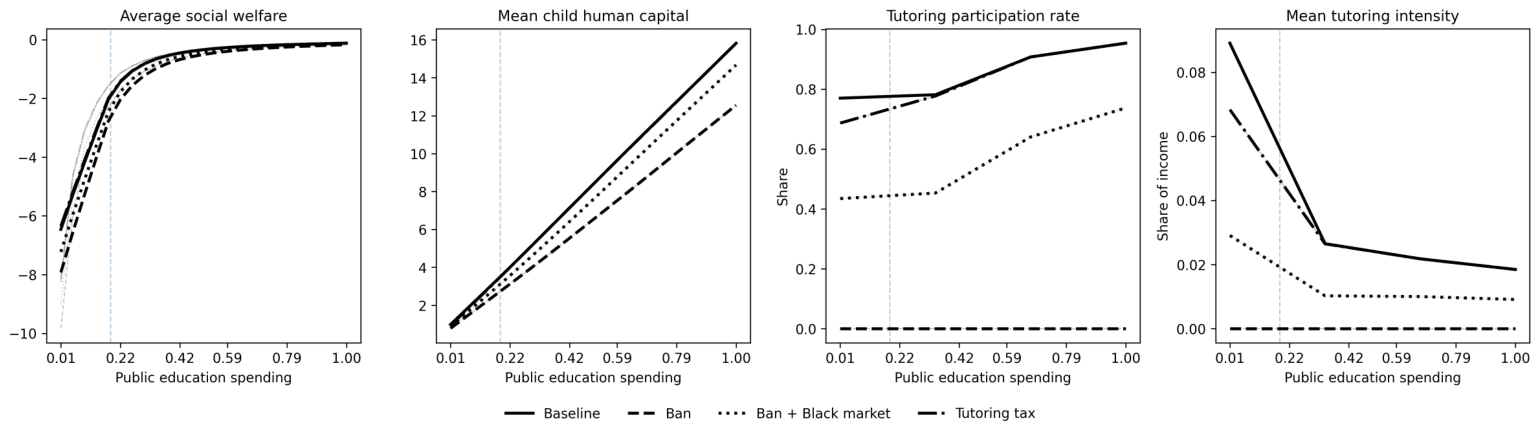
Figure 2 shows how outcomes vary with public education spending
under different policy regimes.
18 Higher public education spending crowds out private tutoring mainly along the intensive margin rather than the extensive margin. As
increases, mean tutoring intensity declines sharply across policies, while participation often rises. This indicates that stronger public education reduces households’ reliance on intensive tutoring expenditure without necessarily pushing them out of the tutoring market.
19 5.3. Black Market Access and Imperfect Enforcement
We next examine how the performance of prohibition depends on imperfect enforcement in the presence of a black market. We consider two parameters: the enforcement intensity
, which affects the overall cost of tutoring under regulation, and the access gap parameter
, which governs inequality in access to informal tutoring across household types. The benchmark black-market experiment uses
, while the exercise below varies enforcement intensity over a wider range.
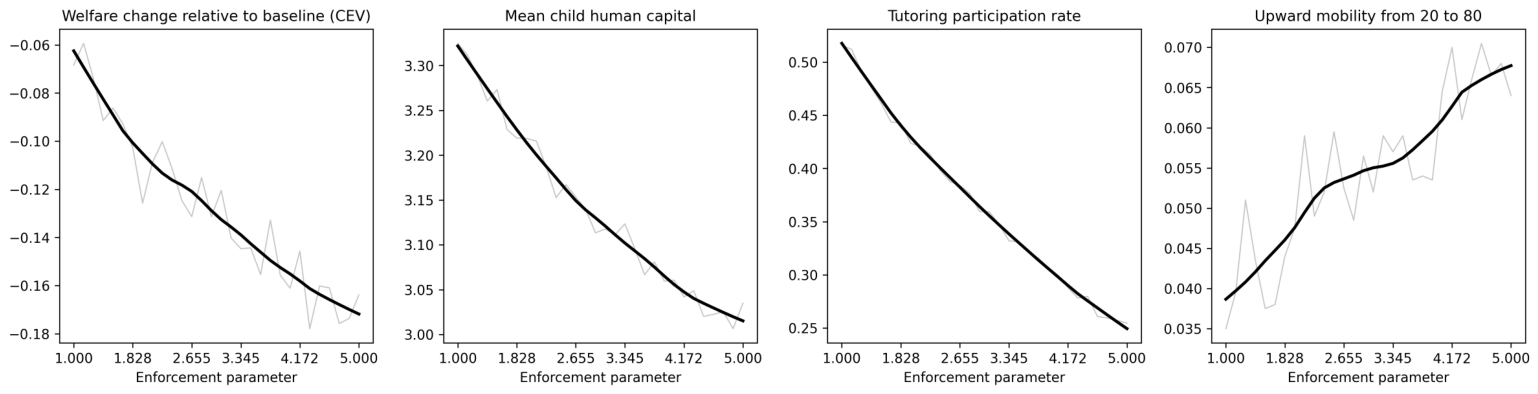
20Figure 3 shows that stronger enforcement sharply reduces tutoring participation, lowers human capital and welfare, and raises mobility. Stronger enforcement therefore makes the economy look increasingly like a complete ban, compressing differences in educational investment at the cost of lower efficiency.
Table 9 focuses on the distributional consequences of black-market access. Increasing
raises tutoring participation and improves model-implied aggregate welfare and human capital, because more tutoring activity is preserved for types with lower informal-access costs. However, the distributional effects are not uniform across the range of access inequality. In particular, when the access gap rises beyond the calibrated structure, the improvement in aggregate welfare is driven by gains among the middle and top groups, while the bottom group becomes worse off. The group-specific CEV results therefore show that higher aggregate welfare need not imply welfare gains for all household groups.
21 6. Robustness
This section examines the robustness of the results to alternative parameter values. We focus on six key parameters of the model: the efficiency of private tutoring , the intergenerational persistence and dispersion parameters and , the admission thresholds and , and the admission smoothness parameter b.
6.1. Tutoring Efficiency
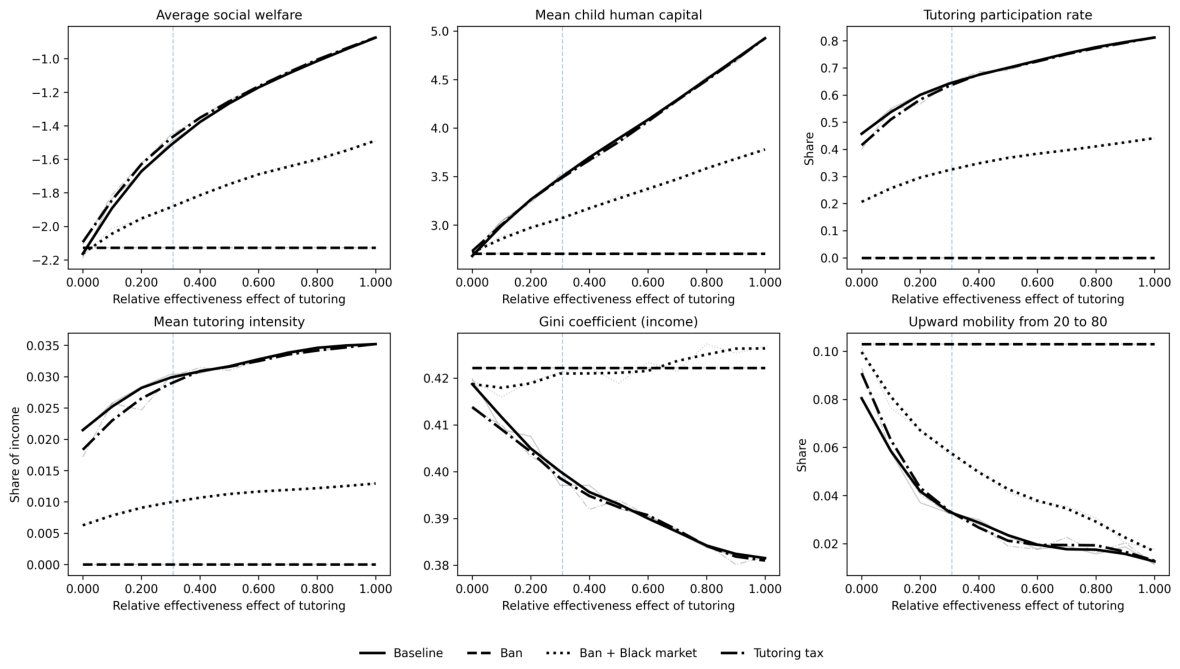
Figure 4 reports results for different values of
, holding all other parameters fixed. Policies that restrict tutoring generally improve measured mobility but reduce human capital as
rises, whereas policies that preserve tutoring access generate higher human capital at the cost of lower mobility. The welfare effects change substantially across the range, especially for prohibition. The calibrated value lies in a region where local changes are gradual, but the wider exercise confirms that
is a central policy parameter rather than a secondary robustness input.
6.2. Intergenerational Transmission
We examine the sensitivity of the results to the intergenerational persistence parameter
and the dispersion parameter
. Each parameter is varied separately by approximately
around its calibrated value, while all other parameters are held fixed.
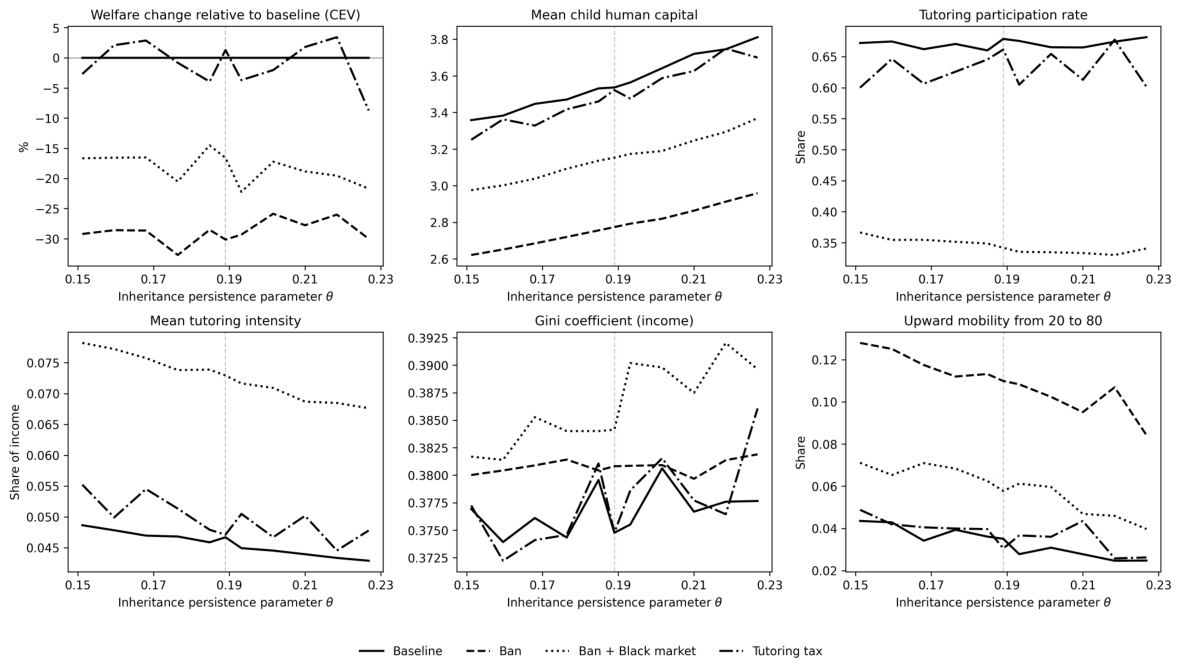
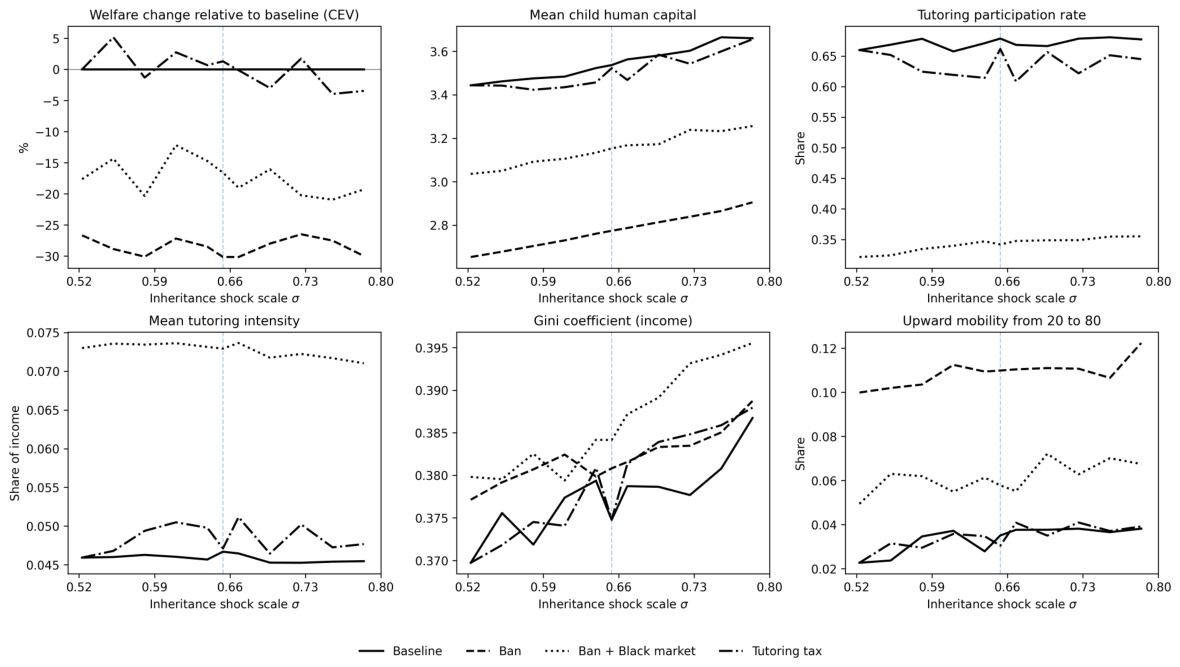
Figure 5 and
Figure 6 show that the main qualitative effects of the prohibition policies remain broadly stable across alternative values of
and
. The complete ban continues to generate substantial welfare and human-capital losses, while black-market access mitigates part of these losses. The welfare effect of the tutoring tax is more sensitive to the calibration of intergenerational transmission, especially with respect to
.
6.3. Admission Thresholds
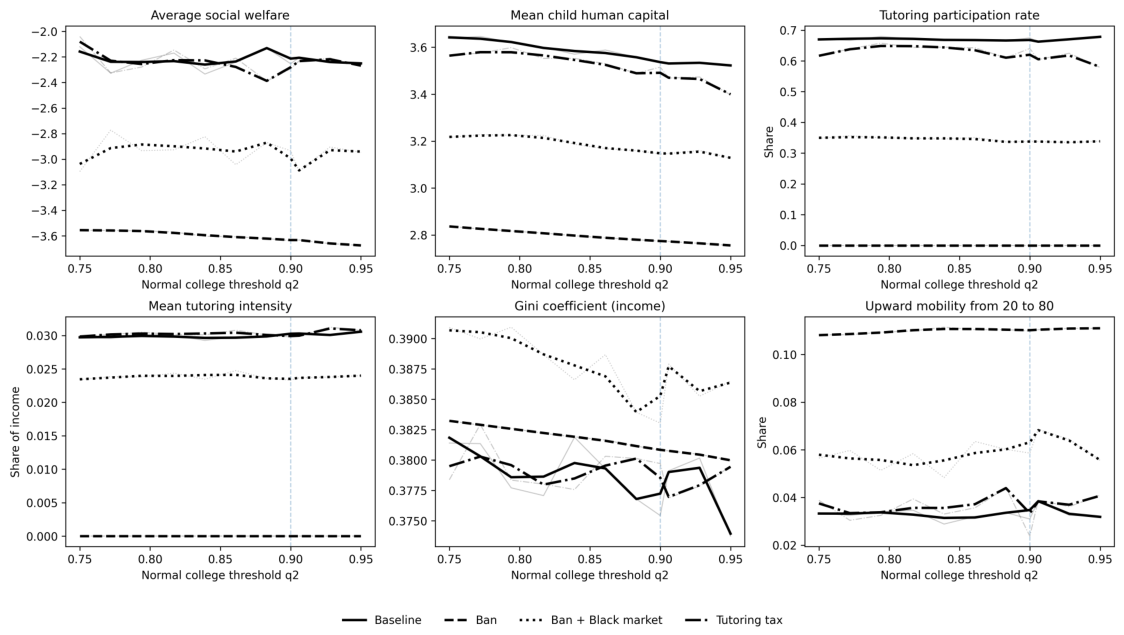
Figure 7 presents the results when varying the non-selective college threshold
, while holding all other parameters fixed. Increasing
lowers welfare and mean child human capital across all policy regimes, reflecting tighter access to higher education. Inequality also rises, while upward mobility increases slightly. By contrast, the effects on tutoring behavior are modest: tutoring participation remains broadly stable and tutoring intensity changes little. Within the specified experiments, the welfare-selected tutoring tax remains the best-performing policy and the ban performs worst. Thus, the benchmark comparison is not driven by the precise value of the lower admission threshold.
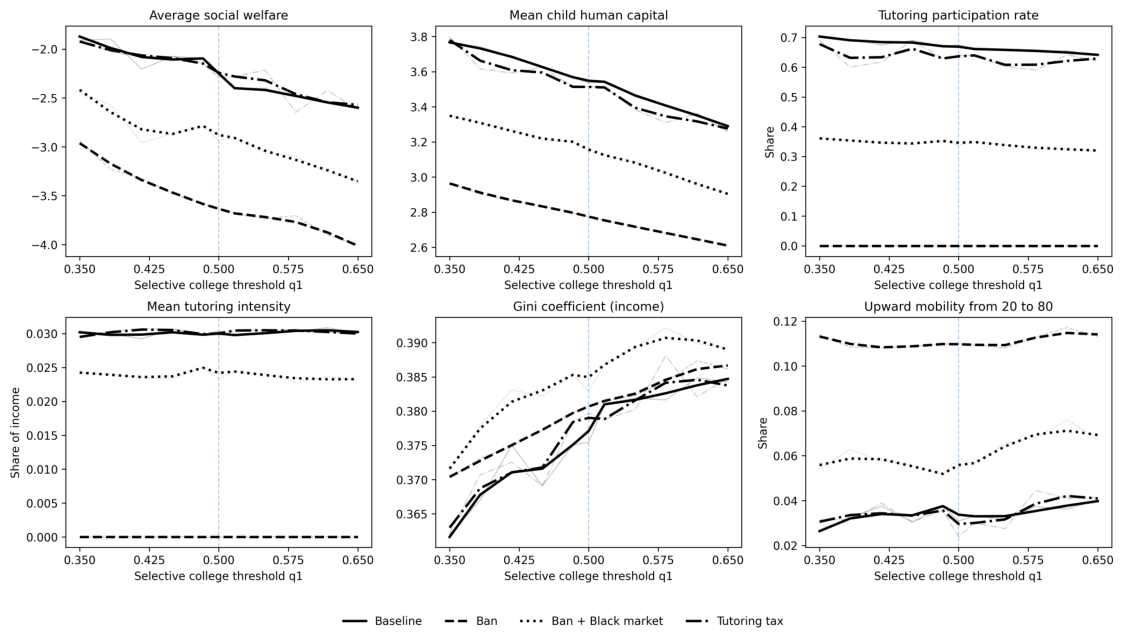
Figure 8 reports the corresponding results for variations in the selective college threshold
. In contrast to
, changes in
have quantitatively smaller effects on aggregate outcomes. Welfare, child human capital, and tutoring behavior remain largely stable, while inequality declines as
increases and other outcomes change little. The conditional policy ranking is again unchanged, indicating that the benchmark comparison is robust to alternative values of the upper admission threshold.
6.4. Admission Smoothness
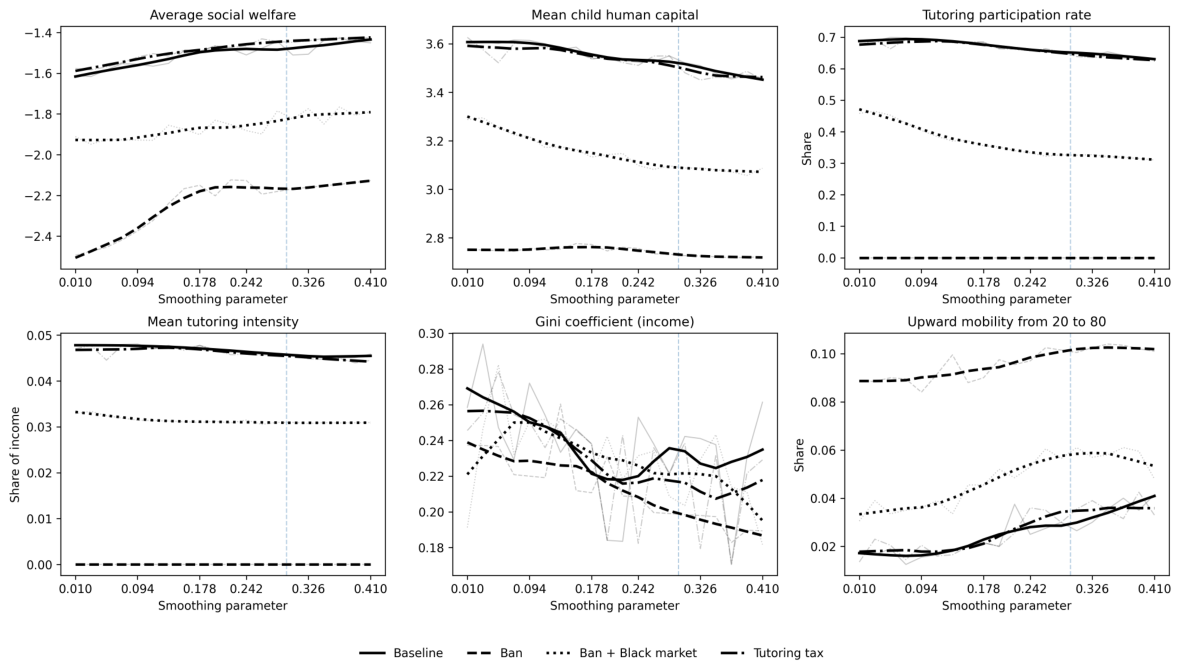
Figure 9 reports the results when varying the admission smoothness parameter
b, while holding all other parameters fixed. Higher
b makes admission less sensitive to rank and therefore weakens tutoring incentives. As a result, mean child human capital, tutoring participation, and tutoring intensity all decline across policies, while upward mobility rises. Welfare increases with
b, especially under the ban, because a smoother admission system reduces competition for rank. The effects on inequality are less monotonic, but they do not alter the qualitative comparison across policies. The conditional policy ranking remains unchanged throughout, with the welfare-selected tutoring tax performing best and the ban performing worst within the specified experiments.
7. Discussion and Limitations
The quantitative results should be interpreted as a mechanism-based policy comparison rather than a direct causal evaluation of a specific Chinese reform. The CFPS data discipline the benchmark economy, but several model parameters are mapped from reduced-form associations. In particular, the benchmark value of compares tutoring associations with exam-oriented subject tests and broader cognitive measures; tutoring expenditure remains endogenous, so this mapping is not a causal identification strategy. The intergenerational parameters and are anchored by the conditional parent–child relationship in completed education and its residual dispersion, and the education-track premia use conditional earnings differences. These mappings are informative but do not separately identify the corresponding structural technologies. The counterfactual and robustness exercises therefore assess how the main conclusions change when empirically less certain parameters are varied.
The policy comparison is also deliberately limited. The tutoring tax is selected to maximize average model utility over a fixed grid and is assumed to be collected effectively, whereas the prohibition experiments use fixed enforcement structures. A tax with evasion, an optimized enforcement policy, or a more flexible quantity regulation could produce a different ranking. In addition, the benchmark tutoring tax operates through both a price channel and a public-finance channel.
Table 6 shows that, at the same tax rate, removing revenue recycling changes the model-implied CEV from positive to negative while leaving tutoring participation almost unchanged. The benchmark tax advantage therefore depends importantly on the assumed financing arrangement rather than on the tax instrument alone.
The black-market results are conditional on the assumed ordering of informal-access costs. Household resources already generate unequal tutoring demand, while the parameters add a separate access advantage for more educated parents. These parameters are not direct estimates of underground tutoring prices or access costs. The results should therefore be read as showing how unequal informal access can affect policy incidence, with the sensitivity exercises indicating how strongly the outcomes depend on enforcement and access assumptions. Group-specific CEV measures are reported alongside aggregate welfare to make the distributional incidence explicit. As shown in the access-gap experiment, improvements in aggregate welfare can coexist with welfare losses for the bottom group when informal access becomes more unequal.
Finally, the model is partial equilibrium. Household tutoring and saving choices respond endogenously to policy, but wages, returns, aggregate labor demand, and other economy-wide feedbacks are held fixed. In a general-equilibrium setting, policy-induced changes in aggregate human capital could alter wages, skill premia, and the returns to education, which could in turn feed back into household investment incentives. The quantitative effects reported here should therefore be interpreted as operating through household education investment, admission competition, and intergenerational transmission within the modeled environment. The mechanisms may be relevant beyond China, particularly in education systems that share similar institutional features, such as high-stakes examination-based admissions, strong reliance on relative academic performance, and substantial household investment in supplementary education. In such settings, the qualitative policy trade-offs identified in the model may provide useful guidance, although the numerical effects should not be extrapolated directly without recalibration to local institutional and educational conditions. General-equilibrium labor-market responses, richer public-finance arrangements, and broader education reforms remain important extensions for future research.
8. Conclusions
This paper develops a quantitative framework to study how private tutoring regulation affects household behavior, human capital formation, inequality, and intergenerational mobility. The model combines heterogeneous households, intergenerational transmission, and endogenous ranking-based admission, while allowing tutoring to affect exam performance and productive skills differently.
In the benchmark calibration, a complete ban generates large model-implied welfare and human-capital losses, although it compresses educational differences and raises measured mobility. When enforcement is imperfect, informal tutoring preserves part of human-capital investment, but unequal access creates large differences in participation across parental education groups. A welfare-selected tutoring tax performs better than the prohibition experiments while keeping tutoring and human capital close to baseline levels. Its advantage, however, reflects both the tutoring-price channel and the replacement of part of the common public-education contribution.
The broader economic implication is that regulation of supplementary education can affect not only educational competition but also human-capital accumulation and the intergenerational distribution of opportunities. Regulation is more attractive when tutoring mainly improves relative rank and less attractive when it contributes strongly to productive skills, while policy outcomes also depend on enforcement and financing design. Because the productive contribution of tutoring is difficult to identify precisely, the pattern across alternative values of is more informative than the benchmark estimate alone. The results therefore support careful use of price and quantity instruments rather than a general claim that one instrument always dominates another. Although the numerical results are specific to the Chinese calibration, the mechanisms are relevant to other education systems with substantial household investment and competitive admission.
Future work could estimate the long-run productive effects of tutoring more directly, model tax evasion and endogenous enforcement, incorporate general-equilibrium labor-market responses, and compare tutoring regulation with reforms to examinations and admission rules. These extensions would help determine which mechanisms are quantitatively most important in particular education systems.