1. Introduction
Agriculture is increasingly confronted with the need to produce sufficient, safe, and nutritious food while reducing pressure on natural resources, biodiversity, climate, and rural livelihoods (
Foley et al., 2011;
Pretty et al., 2018;
Rockström et al., 2017). Conventional agricultural systems have often relied on linear models of production, based on high inputs of energy, water, nutrients, and other resources, followed by the generation of residues, emissions, and waste. In this context, the circular economy (CE) has gained growing attention as a framework that seeks to move beyond the traditional “take–make–dispose” model by improving resource efficiency, extending the value of materials, reducing waste, and closing biological and technical loops (
Geissdoerfer et al., 2017;
Kirchherr et al., 2017).
Although the circular economy is widely used in academic, policy, and business debates, its meaning remains diverse and context-dependent (
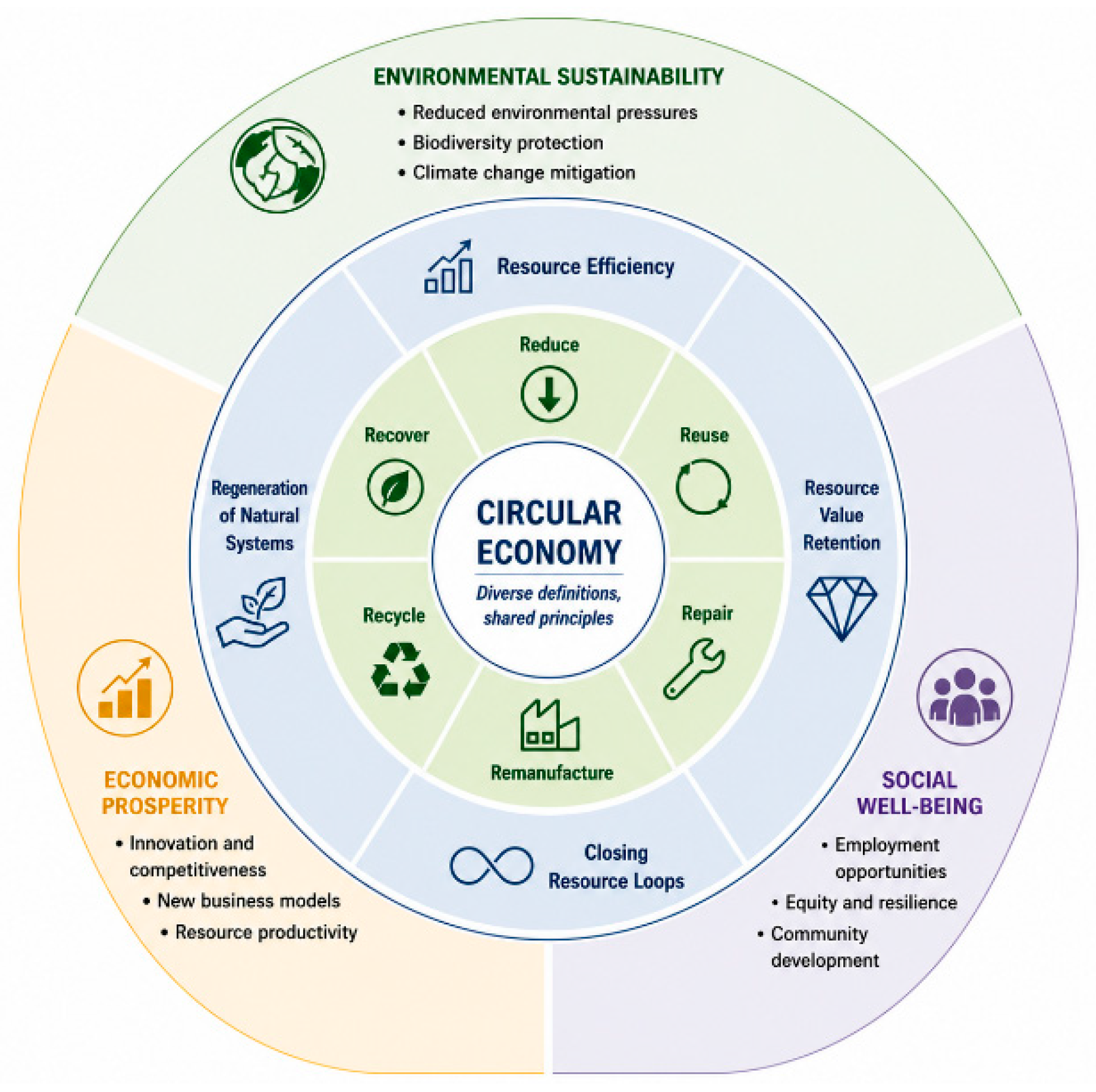
Kirchherr et al., 2017). Broadly, CE seeks to reduce resource inputs and environmental pressures while maintaining the value of materials and resources through strategies that slow, narrow, and close material and energy loops (
Geissdoerfer et al., 2017). Its definitions and theoretical development are discussed in greater detail in
Section 3.1.
The application of circular economy principles to agriculture has led to the emergence of the concept of circular agriculture. In broad terms, circular agriculture refers to agricultural systems that aim to optimize the use of natural resources, reduce external inputs, valorize residues and by-products, and reconnect crop, livestock, soil, water, and energy flows (
Jurgilevich et al., 2016;
de Boer & van Ittersum, 2018;
Velasco-Muñoz et al., 2021). Unlike some industrial sectors, where circularity is often linked to product design, reuse, or recycling, agriculture is based on living systems and biological processes. Therefore, circular agriculture extends beyond waste management and recycling to encompass the management and recirculation of resources across farming and agri-food systems (
Hamam et al., 2021;
Velasco-Muñoz et al., 2021).
A growing body of literature has examined circular economy models in agriculture and agri-food systems. Previous reviews have emphasized the potential of CE to contribute to sustainable resource management, climate change mitigation, waste reduction, and the creation of new economic opportunities in rural areas (
Hamam et al., 2021;
Cahyadi et al., 2024). At the farm level, circular practices may include nutrient recycling, composting, manure management, integrated crop–livestock systems, crop rotation, use of agricultural residues, renewable energy production, water reuse, and precision agriculture technologies (
Jurgilevich et al., 2016;
Lemaire et al., 2014;
Velasco-Muñoz et al., 2021;
Hamam et al., 2021). At the agri-food chain level, circularity extends beyond primary production to encompass the reduction in food losses and waste, valorization of by-products, development of bio-based products, optimization of logistics, and the adoption of circular business models aimed at resource recovery and value retention (
Tamasiga et al., 2022;
Borrello et al., 2020;
Muscio & Sisto, 2020).
However, the transition towards circular agriculture is not straightforward. Agricultural systems differ significantly in terms of farm structure, specialization, resource availability, technological capacity, market access, and institutional support (
Meynard et al., 2017). In many cases, the successful implementation of circular practices depends on access to knowledge, financial resources, stakeholder collaboration, and enabling policy environments (
Manninen et al., 2018;
Muscio & Sisto, 2020). Furthermore, scholars emphasize that circularity should not be equated with sustainability, as circular solutions may generate trade-offs and do not necessarily lead to positive environmental, economic, or social outcomes in all circumstances (
Geissdoerfer et al., 2017;
Korhonen et al., 2018a). Recent evidence further indicates that the outcomes of circular interventions can depend strongly on system boundaries, production scale, market conditions, policy design, and the allocation of economic and environmental costs and benefits (
Olanrewaju & Engelberth, 2026;
Gatto et al., 2024). Consequently, evaluating circular agriculture requires attention not only to resource efficiency, but also to economic viability, adoption conditions, and potential environmental and social trade-offs.
Policy frameworks play an important role in enabling or constraining circular transitions in agriculture (
Velasco-Muñoz et al., 2021;
Muscio & Sisto, 2020). At the European Union level, the Circular Economy Action Plan, the European Green Deal, the Farm to Fork Strategy, and the Common Agricultural Policy provide a broader strategic context for promoting sustainable resource use, reducing waste, supporting bio-based value chains, and encouraging more sustainable agricultural practices (
European Commission, 2019,
2020a,
2020b). These policy directions indicate that circularity in agriculture is not only a technical issue, but also a governance challenge that requires coordination between agricultural, environmental, climate, food, waste, and rural development policies (
D’Amato et al., 2017;
Muscio & Sisto, 2020). At the same time, circular transitions increasingly extend beyond the European policy context, raising questions concerning institutional capacity, infrastructure, access to technology, financing, and knowledge systems across different economic and geographical settings. Nevertheless, the degree to which circular economy principles are explicitly integrated into agricultural policy instruments remains uneven and requires further analysis.
Despite the growing interest in circular agriculture, the field remains characterized by heterogeneous interpretations, implementation approaches, and assessment methods (
Morseletto, 2020;
Korhonen et al., 2018b;
Reike et al., 2018;
Prieto-Sandoval et al., 2018). Previous reviews have made important contributions by examining circular food-system transitions, circular agriculture concepts and indicators, circular business models, agri-food supply chains, and implementation strategies. However, these strands of literature remain relatively fragmented, particularly with respect to the connections between circular practices, economic feasibility, adoption conditions, sustainability outcomes, and enabling policy environments. Moreover, the rapid expansion of research in recent years has introduced new evidence concerning digitalization and artificial intelligence, circularity assessment, circular bioeconomy, and the economic and institutional barriers affecting the adoption of circular solutions.
Table 1 positions the present review in relation to selected previous reviews and highlights its distinctive analytical scope.
Building on these gaps, the contribution of this review lies not merely in bringing together concepts, practices, and policies, but in combining bibliometric mapping with a critical thematic synthesis that links circular agricultural practices to their economic feasibility, adoption conditions, sustainability trade-offs, and policy environments. Particular attention is given to recent empirical evidence and to the conditions under which greater circularity may generate economic, environmental, or social trade-offs rather than unambiguously improving sustainability. This approach also enables the identification of emerging research clusters and less developed areas of the literature, providing a more differentiated assessment of the current state of circular agriculture research.
Accordingly, this review examines circular economy in agriculture through three interrelated substantive dimensions: conceptual foundations, practical applications, and policy implications, complemented by bibliometric mapping of the scientific literature. First, the paper discusses the conceptual foundations of circular agriculture and its relationship with sustainability, bioeconomy, and agri-food system transformation. Second, it critically reviews major circular practices and approaches applied at farm and agri-food system levels, with particular attention to their benefits, implementation conditions, and potential trade-offs. Third, it examines the policy and governance context supporting circular transitions in agriculture across different institutional settings. By integrating bibliometric evidence with thematic analysis, the review further identifies emerging research trends, persistent knowledge gaps, and priorities for future research and policy development.
2. Materials and Methods
This study employed a structured literature review complemented by bibliometric analysis and qualitative thematic synthesis to examine the conceptual foundations, practical applications, sustainability implications, and policy dimensions of circular agriculture. This combined approach was selected because the literature on circular agriculture is heterogeneous, encompassing conceptual studies, empirical applications, technological solutions, economic assessments, and policy analyses that cannot be meaningfully synthesized through a quantitative meta-analysis. Bibliometric mapping was therefore used to identify the structure and development of the research field, while qualitative thematic synthesis enabled a critical interpretation of the substantive findings.
2.1. Literature Search Strategy
The literature search was conducted using the Scopus and Web of Science Core Collection data-bases, which are widely recognized as leading sources of peer-reviewed scientific literature. The final database search was conducted on 24 August 2026 and covered publications from 2015 to 2026. The starting year was selected to capture the period during which circular economy principles became increasingly prominent in agricultural and agri-food research, while extending the search through 2026 ensured the inclusion of the most recent developments in the field.
Following an initial exploratory search, the search strategy was refined to improve specificity and reduce the retrieval of studies in which agriculture or circularity appeared only incidentally. The final search expression included the following terms: “circular agriculture”, “circular farming”, “circular agri-food”, “circular agrifood”, “circular economy in agriculture”, “circular economy in farming”, and “circular economy in agri-food systems”. In Web of Science Core Collection, these terms were searched using the Topic field, whereas in Scopus they were searched within titles, abstracts, and keywords (TITLE-ABS-KEY).
The exact Scopus search string was:
TITLE-ABS-KEY (“circular agriculture” OR “circular farming” OR “circular agri-food” OR “circular agrifood” OR “circular economy in agriculture” OR “circular economy in farming” OR “circular economy in agri-food systems”).
The equivalent expression was applied as a Topic search in Web of Science Core Collection. The search identified 612 records in Scopus and 439 records in Web of Science, resulting in 1051 records before deduplication.
Additional policy documents and institutional reports were identified separately from the scientific database search and were used to contextualize the policy analysis. These sources included documents published by the European Commission, the Food and Agriculture Organization of the United Nations (FAO), the Organisation for Economic Co-operation and Development (OECD), and other relevant international institutions. Because these documents served a contextual rather than bibliometric purpose, they were not included in the bibliometric corpus or in the database screening counts.
The search strategy was intentionally centered on publications explicitly using circular-economy and circular-agriculture terminology in order to maintain a clearly defined and reproducible review scope. Consequently, relevant studies addressing conceptually related approaches, such as resource cycling, regenerative agriculture, industrial symbiosis, or closed-loop agricultural systems, without explicitly referring to circular economy or circularity may fall outside the retrieved corpus. This represents a limitation of the review and should be considered when interpreting the comprehensiveness of the literature coverage.
2.2. Eligibility Criteria and Study Selection
Eligible publications were peer-reviewed journal articles and review papers published in English between 2015 and 2026. Restricting the scientific corpus to peer-reviewed journal publications was intended to ensure a consistent level of scientific quality and comparability across the reviewed literature. However, this criterion may exclude relevant technical reports, professional case studies, and other grey literature that could provide additional evidence on the practical implementation of circular agriculture. Studies were included when circular economy or circularity represented a substantive component of the research in an agricultural, farming, or agri-food context and when they contributed to at least one of the analytical dimensions of this review: conceptual development, circular agricultural practices and technologies, economic or sustainability outcomes, adoption and implementation barriers, circularity assessment, or policy and governance.
Studies were excluded when circularity or agriculture was mentioned only incidentally; when they focused exclusively on industrial circular economy applications without substantive relevance to agricultural or agri-food systems; or when they represented conference papers, conference reviews, book chapters, book reviews, editorials, notes, or other non-eligible publication types. Publications outside the defined period and non-English-language publications were also excluded.
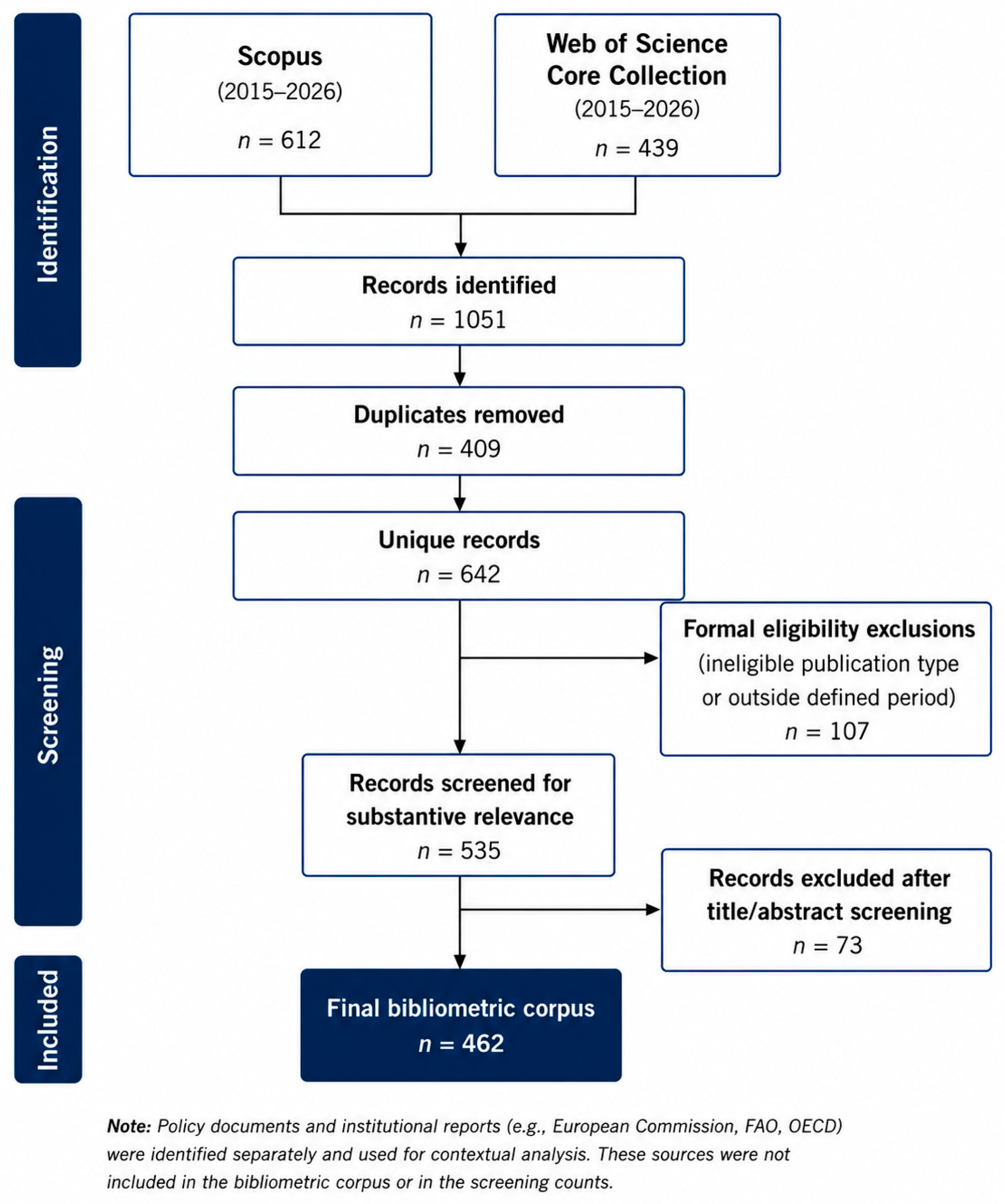
Records retrieved from Scopus and Web of Science were merged and deduplicated using DOI as the primary identifier and normalized publication titles as a secondary criterion. Of the 1051 records initially identified, 409 duplicates were removed, leaving 642 unique records. Following the application of formal eligibility criteria and title and abstract screening, 180 records were excluded because of ineligible publication type, publication period, or insufficient substantive relevance to circular agriculture. The final bibliometric corpus therefore consisted of 462 publications.
The study-selection process was documented using a PRISMA-style flow diagram to enhance transparency and reproducibility (
Page et al., 2021).
Figure 1 summarizes the identification, deduplication, screening, and final inclusion of records.
2.3. Bibliometric Analysis
Bibliometric analysis was conducted on the final corpus of 462 publications to examine the development and thematic structure of research on circular economy in agriculture. The analysis included the annual evolution of scientific production, the distribution of publications across scientific journals, keyword frequencies, and keyword co-occurrence relationships. Particular attention was given to keyword co-occurrence analysis as a means of identifying the principal thematic clusters and relationships among research topics within the field.
Keyword co-occurrence analysis and network visualization were performed using VOSviewer (version 1.6.21), a software tool specifically developed for constructing and visualizing bibliometric networks (
van Eck & Waltman, 2010). All keywords available in the bibliographic records were considered, and the full-counting method was applied. Prior to the final analysis, keywords were checked for non-informative terms, and a thesaurus file was used to remove the generic term “sustainable”. Conceptually distinct terms, such as “bioeconomy” and “circular bioeconomy”, “compost” and “composting”, and “sustainability” and “sustainable development”, were retained separately in order to preserve the conceptual structure of the original literature.
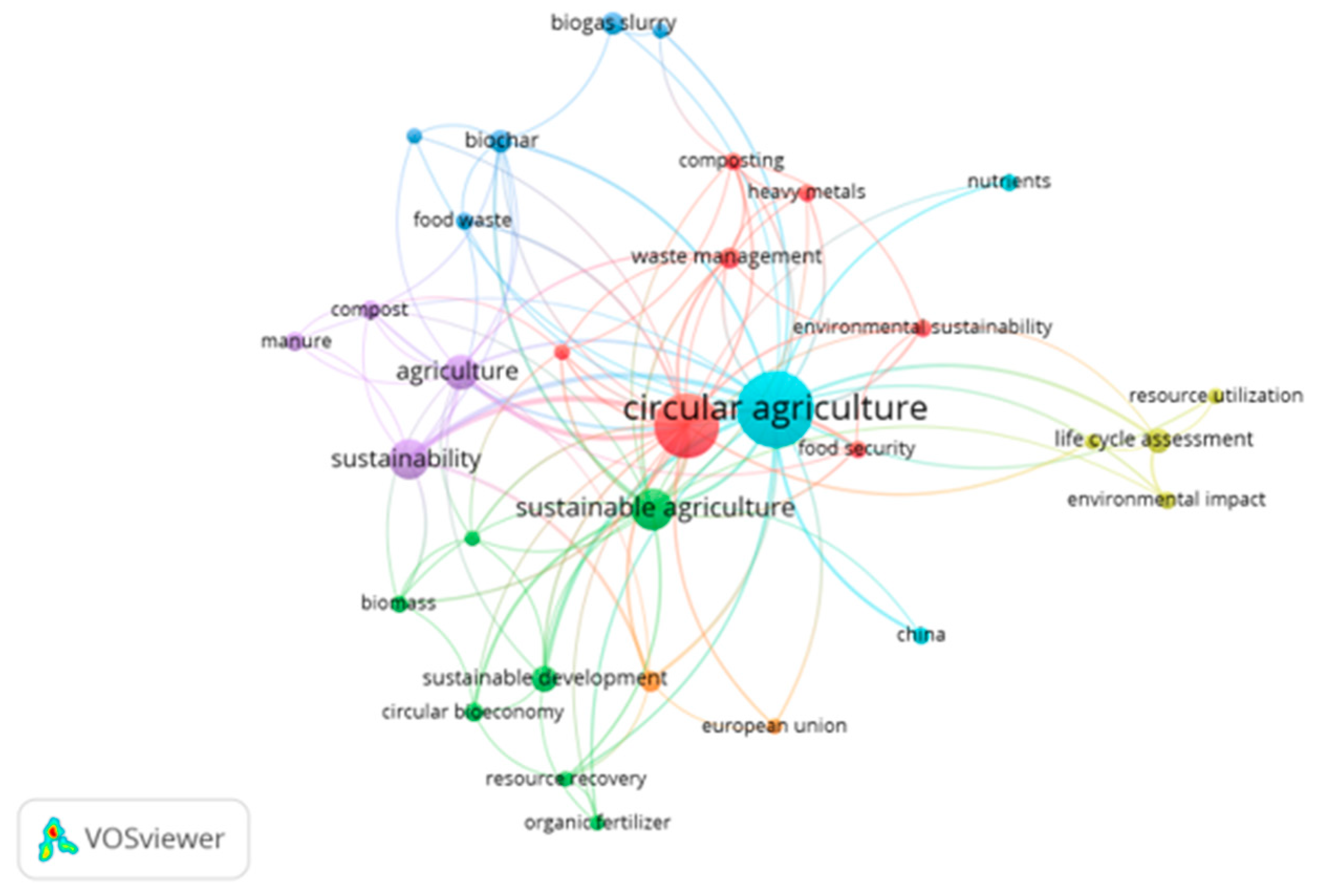
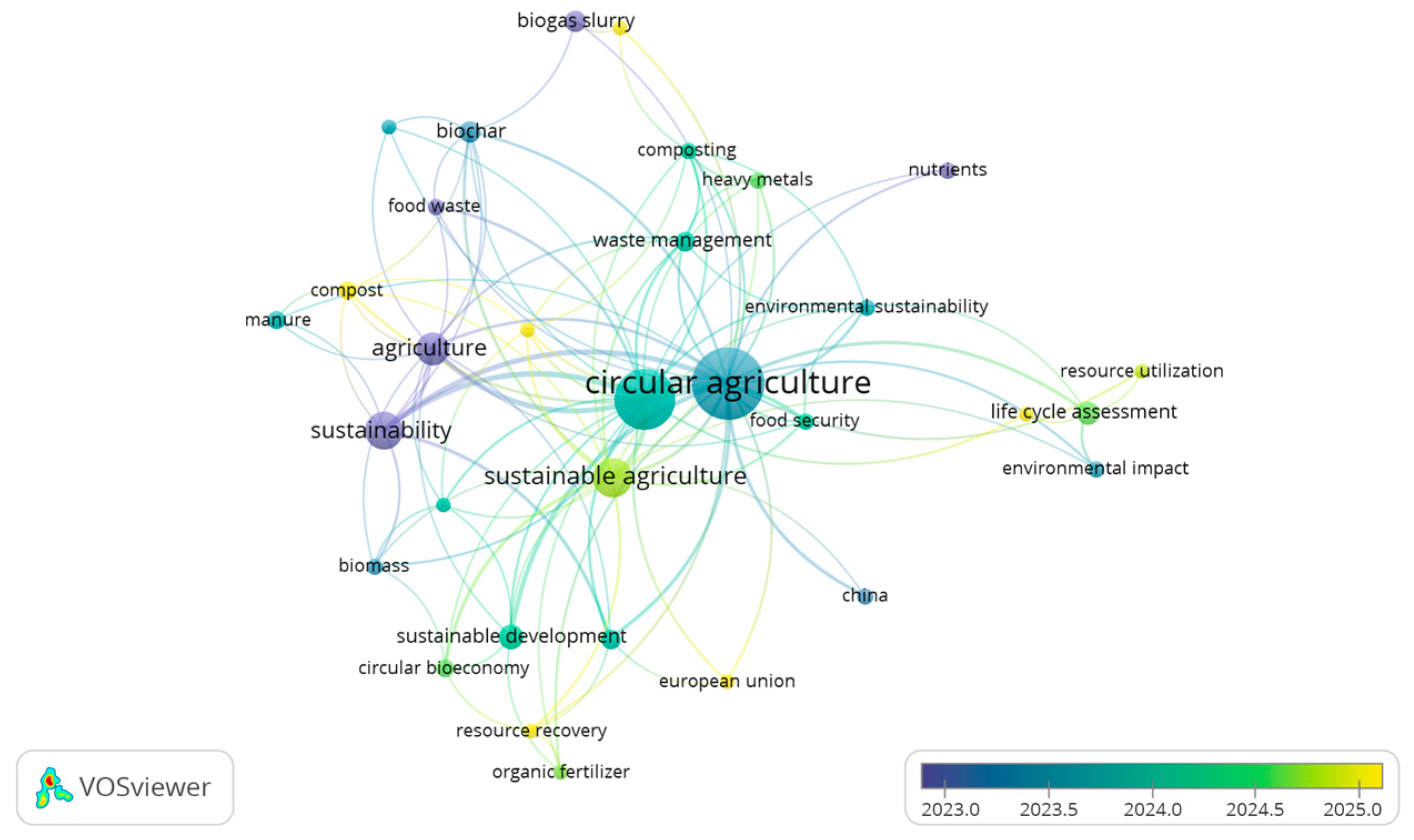
A minimum occurrence threshold of five publications was applied to ensure network readability while retaining sufficiently recurrent research topics. Following thesaurus-based cleaning, keywords meeting this threshold were included in the final co-occurrence analysis. In the resulting network visualization, node size represents keyword occurrence frequency, links indicate co-occurrence relationships between keywords, and cluster colors represent groups of closely related terms.
In addition to the network visualization, an overlay visualization based on the average publication year was generated to examine the temporal evolution of research topics. This approach enabled the distinction between comparatively established and more recently emerging themes within circular agriculture research. The resulting bibliometric maps were subsequently interpreted in conjunction with the qualitative thematic synthesis to identify dominant research streams, emerging topics, and comparatively underexplored dimensions of circular agriculture.
2.4. Qualitative Thematic Synthesis
Following the bibliometric analysis, the literature was subjected to qualitative thematic synthesis. The initial thematic framework was derived from the objectives of the review and refined iteratively during the reading and interpretation of the included studies. Publications were classified according to their primary analytical focus, while studies addressing more than one dimension were considered across the relevant themes where appropriate. The analysis was organized around three substantive dimensions: (1) conceptual foundations of circular agriculture and its relationship with sustainability and bioeconomy; (2) practical applications of circularity in agricultural systems; and (3) policy, governance, and institutional implications. Within the practical dimension, studies were further considered in relation to nutrient and biomass recycling, integrated farming systems, and resource-efficient and digital solutions.
Rather than merely cataloguing individual circular practices, the synthesis examined the conditions under which these approaches are implemented and their reported economic, environmental, and social implications. Particular attention was given to recent empirical evidence concerning circularity measurement, economic feasibility, digitalization and artificial intelligence, adoption barriers, circular bioeconomy, and potential trade-offs or rebound effects. This analytical approach allowed circularity to be assessed critically rather than treated as inherently synonymous with sustainability.
The bibliometric and thematic components were subsequently integrated by comparing the thematic patterns identified through keyword co-occurrence analysis with the substantive findings emerging from the qualitative synthesis. This enabled the identification of areas of convergence between prominent bibliometric themes and the reviewed evidence, as well as research dimensions that remain comparatively underdeveloped. This combined approach provided the basis for identifying research gaps and developing implications for future research and policy.
4. Circular Practices in Agriculture
The practical implementation of circular agriculture relies on a wide range of strategies and practices aimed at reducing resource losses, improving resource-use efficiency, and strengthening the recirculation of materials, nutrients, energy, and water within agricultural systems. While specific approaches vary depending on local conditions, production systems, and available technologies, most circular practices share a common objective: maintaining the value of resources for as long as possible while minimizing environmental impacts (
Jurgilevich et al., 2016;
Hamam et al., 2021;
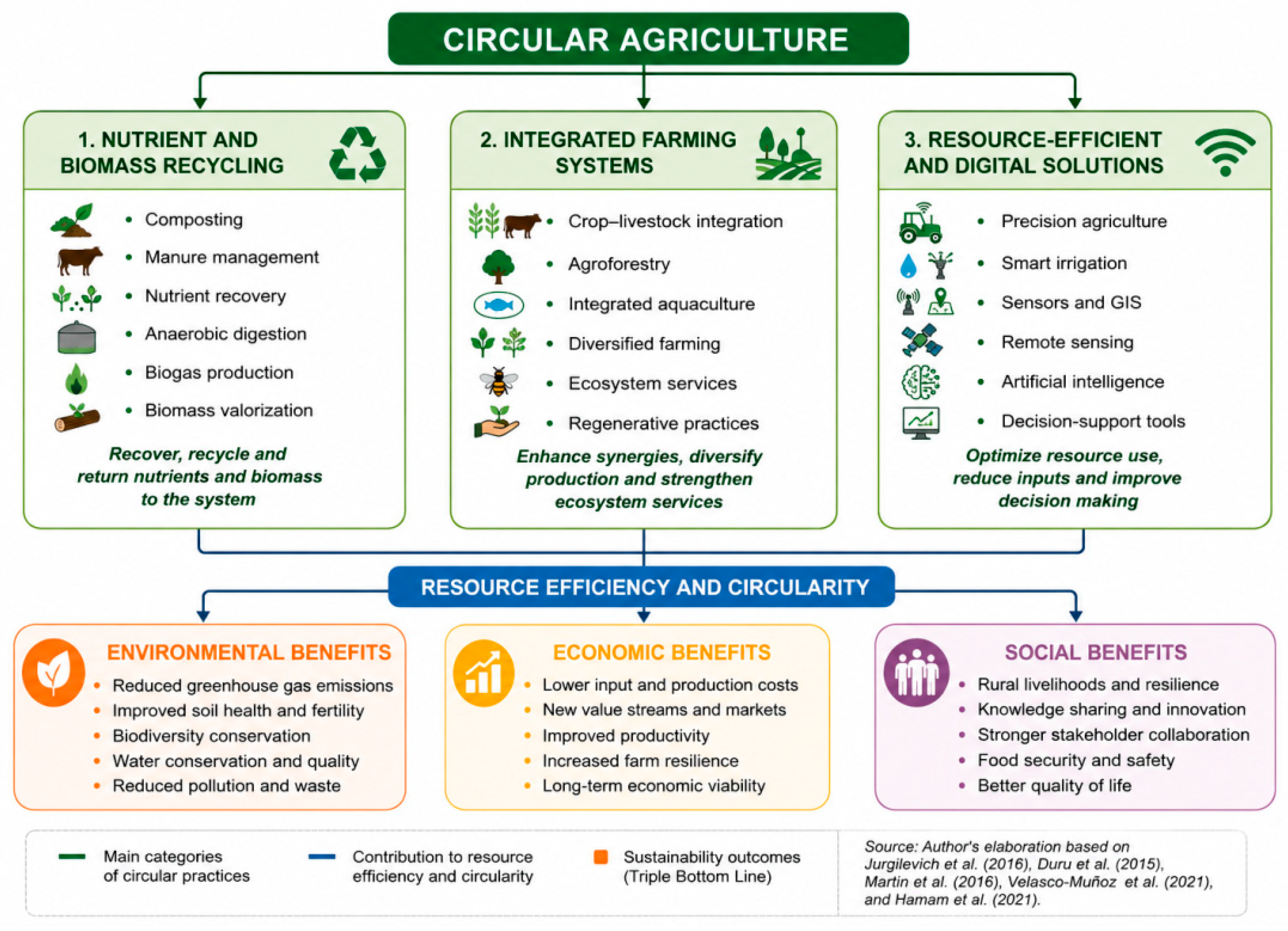
van Selm et al., 2024). However, their contribution to circularity depends not only on the technical possibility of recovering resources, but also on whether recovered materials can be safely, economically, and effectively reintegrated into agricultural production. The main categories of circular agricultural practices and their contribution to resource efficiency, circularity, and sustainability outcomes are summarized in
Figure 3.
4.1. Nutrient and Biomass Recycling
One of the fundamental principles of circular agriculture is the recovery and recirculation of nutrients and biomass within agricultural systems. Conventional agricultural production often relies on significant inputs of synthetic fertilizers while simultaneously generating large quantities of organic residues and waste streams. Circular approaches seek to close nutrient loops by returning valuable nutrients to the soil through composting, manure management, anaerobic digestion, and the utilization of agricultural by-products (
Velasco-Muñoz et al., 2021).
Nutrient recycling contributes to improved soil fertility, reduced dependence on mineral fertilizers, and lower environmental pressures associated with nutrient losses. Livestock manure represents one of the most important nutrient sources in circular farming systems, providing nitrogen, phosphorus, and organic matter that can be reused in crop production. Similarly, crop residues, food processing by-products, and organic municipal waste can be transformed into valuable soil amendments through composting and other biological treatment processes (
Jurgilevich et al., 2016).
The importance of nutrient recycling is particularly evident in the case of phosphorus, a finite and non-renewable resource that is essential for agricultural production. Concerns regarding the long-term availability of phosphate reserves and the environmental consequences of nutrient losses have stimulated growing interest in technologies and management practices that enable phosphorus recovery and reuse. Recycling nutrients from manure, food waste, wastewater, and other organic streams can reduce dependence on mineral fertilizers while contributing to more resilient agricultural systems (
Cordell et al., 2009;
Withers et al., 2015).
In addition to nutrient recovery, the recirculation of organic matter plays a crucial role in maintaining soil health and ecosystem functioning. Organic amendments derived from compost, manure, digestate, and crop residues contribute to improving soil structure, increasing water-holding capacity, enhancing microbial activity, and promoting carbon sequestration. These benefits are particularly relevant in regions facing soil degradation, declining organic matter content, and increasing climate-related stresses (
Gurmu, 2019;
Poeplau & Don, 2015). Nevertheless, the agronomic value and safe reuse of recycled organic materials depend on their nutrient composition, stability, availability to crops, and potential contamination, including risks associated with heavy metals, microplastics, pathogens, and residues of antibiotics or other veterinary pharmaceuticals in manure, sewage sludge, and related organic streams (
Koyuncuoğlu & Erden, 2021;
Chen et al., 2024). Moreover, recycling nutrients does not eliminate the risk of nutrient losses if recovered materials are applied in excess of crop requirements or transported between regions with existing nutrient surpluses (
Lisenbee et al., 2024). Effective nutrient recycling therefore requires matching the quantity, composition, timing, and spatial distribution of recovered nutrients with actual agricultural demand (
Tamsma et al., 2024). The spatial distribution of biomass and manure also has important economic implications. Because these materials are often bulky, wet, and relatively low in value per unit of mass, transport over longer distances can substantially increase logistics costs and associated emissions, potentially reducing both the economic feasibility and the net environmental benefits of resource recirculation.
Recent developments in nutrient recovery technologies have further expanded the possibilities for circular resource management in agriculture. Innovations such as struvite precipitation, nutrient extraction from wastewater streams, and advanced anaerobic digestion systems enable the recovery of valuable nutrients that can be reintroduced into agricultural production. These technologies illustrate how circular economy principles can be translated into practical solutions that simultaneously address waste management challenges and agricultural input requirements (
Ellen MacArthur Foundation, 2019;
Roy, 2017). The environmental advantage of such technologies must nevertheless be considered alongside their energy requirements, capital costs, operational complexity, and the quality and marketability of the recovered products (
Sen & Bakshi, 2023;
Mayor et al., 2023).
Biomass valorization extends beyond nutrient recovery. Agricultural residues can serve as feedstocks for bioenergy production, biofertilizers, bioplastics, and other bio-based products, contributing to the development of circular bioeconomy models. Such approaches create additional value streams while reducing waste generation and greenhouse gas emissions (
Lewandowski, 2018;
D’Amato et al., 2017). The cascading use of biomass, whereby biological resources are utilized sequentially for multiple purposes before being returned to the environment, is increasingly recognized as an important strategy for maximizing resource efficiency and value creation within circular agricultural systems (
Stegmann et al., 2020). However, biomass is not an unlimited waste resource. Crop residues and other biological materials may already perform important functions within agricultural systems, including soil organic matter maintenance, erosion protection, animal feeding, and habitat provision. Their diversion towards energy or bio-based products may therefore generate competing uses and environmental trade-offs. From a circular perspective, biomass valorization should consequently prioritize applications that retain the highest possible resource value while avoiding the displacement of essential agronomic and ecological functions (
Olofsson, 2025).
Nevertheless, the scaling-up of nutrient and biomass recycling remains constrained by a combination of technical, economic, regulatory, and organizational factors. Nutrient transport may become economically and environmentally inefficient where organic resources are spatially concentrated far from areas of agricultural demand, while contamination risks can restrict the safe reuse of some waste-derived materials. High investment and processing costs, uncertain markets for recovered products, regulatory requirements, and the need for coordination among farms, waste managers, processors, and other actors may further limit implementation (
Velasco-Muñoz et al., 2021;
Muscio & Sisto, 2020). These constraints indicate that closing nutrient and biomass loops cannot be evaluated solely in terms of the quantity of resources recovered. The location of resource flows, quality of recovered materials, economic feasibility, competing biomass uses, and net environmental effects are equally important for determining whether recycling strategies contribute to genuinely circular and sustainable agricultural systems.
4.2. Integrated Farming Systems
Integrated farming systems represent one of the most established examples of circularity in agriculture. These systems aim to enhance synergies between different agricultural activities by linking crop production, livestock husbandry, aquaculture, forestry, and other farm enterprises. Through such integration, outputs from one production process become inputs for another, thereby reducing waste and improving resource efficiency (
Lemaire et al., 2014).
Crop–livestock integration is particularly relevant in the context of circular agriculture. Crop residues can be utilized as animal feed, while livestock manure can be applied as organic fertilizer, thereby strengthening nutrient cycling within the farm system. This integration reduces the need for external inputs and contributes to improved nutrient management, soil health, and farm resilience (
Martin et al., 2016). However, the degree to which nutrient loops can be closed depends on the balance between crop and livestock activities, land availability, nutrient requirements, and the spatial organization of production.
Integrated farming systems are based on the principle that interactions among system components can generate ecological and economic synergies that would not be achieved in specialized production systems. By facilitating the circulation of nutrients, organic matter, water, and energy within farms or across groups of farms, integrated systems contribute to greater resource-use efficiency and reduced environmental impacts. Such interactions are considered fundamental to the transition from linear to circular agricultural models (
Duru et al., 2015;
Tittonell, 2014).
Beyond crop–livestock integration, circular agriculture may also incorporate agroforestry and integrated aquaculture systems. Agroforestry combines trees, crops, and sometimes livestock within the same production system, promoting nutrient cycling, carbon sequestration, biodiversity conservation, and soil protection. Similarly, integrated aquaculture-agriculture systems enable the reuse of nutrients and water resources through interactions between fish production and crop cultivation. These approaches demonstrate how biological processes can be managed to enhance circularity and sustainability simultaneously (
Pretty et al., 2018;
FAO, 2021).
Integrated systems also contribute to the provision of ecosystem services. Increased biological diversity, improved soil structure, enhanced water infiltration, and greater carbon storage are frequently reported benefits of diversified farming systems. Such ecosystem services support long-term agricultural productivity while strengthening resilience to climatic variability and environmental disturbances (
Dumont et al., 2016;
Gurmu, 2019). Nevertheless, environmental outcomes remain context-specific, and integration alone does not ensure improved performance. Poorly balanced crop–livestock systems, for example, may still generate localized nutrient surpluses, while the environmental benefits of diversification can depend on management intensity, stocking density, and the spatial allocation of resources (
Xing et al., 2022).
From an economic perspective, diversification may improve farm resilience by reducing dependence on a single source of income and spreading production risks across multiple activities. Integrated systems can also reduce expenditures on fertilizers, feed, and other purchased inputs by making greater use of internally generated resources. As a result, they may contribute to both economic viability and environmental sustainability, particularly in regions facing increasing resource constraints and climate-related challenges (
Lemaire et al., 2014;
Martin et al., 2016). These potential benefits, however, need to be weighed against greater management complexity, labor and knowledge requirements, investment needs, and additional costs associated with establishing and coordinating integrated production activities (
Moojen et al., 2024). The economic attractiveness of integration therefore depends on whether savings from internal resource use and diversification compensate for the additional costs of establishing and managing more complex production systems.
Integrated farming systems also share important characteristics with agroecological and regenerative approaches, particularly their emphasis on biological interactions, diversification, resource cycling, and reduced dependence on external inputs (
Schreefel et al., 2020;
Dumont et al., 2016). Their particular relevance to circular agriculture lies in the deliberate organization of complementary resource flows among different production activities.
Overall, integrated farming systems illustrate how circular economy principles can be translated into agricultural practice through the deliberate creation of synergies among production activities. Their contribution to circularity depends, however, on the effective matching of complementary resource flows and on whether ecological and economic benefits outweigh the additional complexity associated with integration. Rather than integration per se, it is therefore the capacity of the system to reduce external resource dependency, avoid internal surpluses, and generate net environmental and economic benefits that determines its contribution to circular agriculture.
4.3. Resource-Efficient and Digital Solutions
Technological innovation plays an increasingly important role in supporting circular agriculture. Advances in precision agriculture, digital technologies, remote sensing, artificial intelligence, and data-driven farm management contribute to more efficient use of land, water, energy, fertilizers, and pesticides (
Rose & Chilvers, 2018;
Klerkx et al., 2019). However, digitalization should be regarded as an enabling mechanism rather than an inherently circular practice: its contribution to circular agriculture depends on whether technological applications effectively reduce resource inputs, prevent losses, facilitate resource recirculation, or improve coordination of material flows.
Precision agriculture technologies enable farmers to optimize input application according to site-specific conditions, reducing waste and minimizing environmental impacts. Variable-rate technologies, sensor-based monitoring systems, and decision-support tools facilitate more accurate management of nutrients, irrigation, and crop protection measures. These innovations align closely with circular economy objectives by improving resource productivity and reducing unnecessary inputs (
Basso & Antle, 2020).
The integration of remote sensing technologies, geographic information systems (GIS), and unmanned aerial vehicles (UAVs) has further expanded opportunities for resource-efficient farm management. These technologies enable real-time monitoring of crop growth, soil conditions, water availability, and pest dynamics, allowing farmers to respond more effectively to changing environmental conditions. By improving the accuracy of management decisions, digital tools contribute to reducing resource losses and enhancing the overall efficiency of agricultural systems (
Gebbers & Adamchuk, 2010;
Zhang et al., 2002;
Papadopoulos et al., 2024).
Artificial intelligence and big data analytics are increasingly recognized as important drivers of agricultural sustainability. Machine learning algorithms can support yield forecasting, disease detection, irrigation scheduling, and nutrient management, thereby improving decision-making processes and reducing production risks. The ability to collect, process, and analyze large volumes of agricultural data creates new opportunities for optimizing resource flows and supporting circular management strategies at both farm and supply chain levels (
Klerkx et al., 2019;
Javaid et al., 2023).
More recent applications extend beyond farm-level optimization towards the integration of AI with Internet of Things (IoT) devices, automated monitoring, predictive analytics, and decision-support systems. In a circular agriculture context, these technologies are particularly relevant where they enable improved monitoring of resource use, optimize nutrient and water management, and support more efficient coordination of agricultural production processes (
Shahab et al., 2024).
Nevertheless, the expansion of AI and data-intensive agriculture introduces additional sustainability considerations. Digital technologies themselves require energy, infrastructure, hardware, data storage, and periodic equipment replacement, while their effective use depends on data quality, interoperability, digital skills, and access to reliable connectivity. Consequently, improvements in resource-use efficiency at farm level should be considered alongside the wider environmental and economic costs of digital infrastructure and the risk that technological benefits remain concentrated among farms with greater financial and technical capacity (
Huck et al., 2024;
La Rocca et al., 2024).
Digitalization also enhances traceability and information exchange across agri-food value chains. Improved monitoring of material flows can support the identification of opportunities for resource recovery, waste reduction, and circular business models. Furthermore, digital platforms may facilitate collaboration among farmers, processors, retailers, and consumers, thereby strengthening the implementation of circular practices beyond the farm level (
Ingram & Maye, 2020). Digital traceability systems can also improve transparency regarding the origin, use, and destination of agricultural products and by-products, supporting more effective resource circulation throughout food systems (
Wolfert et al., 2017). This system-level function is particularly relevant to circular agriculture because effective resource exchange often requires information about the quantity, quality, location, and timing of available residual streams across multiple actors.
Water management represents another area in which technological innovation can support circular agriculture. Precision irrigation systems, soil moisture sensors, automated irrigation scheduling, and water reuse technologies contribute to improving water-use efficiency and reducing pressure on freshwater resources. Such approaches are becoming increasingly important in the context of climate change and growing water scarcity in many agricultural regions (
Velasco-Muñoz et al., 2021).
Despite their considerable potential, technological and digital solutions often face barriers related to investment costs, technical expertise, data availability, interoperability issues, and unequal access among different categories of farms. Small-scale farmers may face particular challenges in adopting advanced digital technologies due to financial constraints, limited infrastructure, and insufficient technical support. Consequently, concerns regarding the digital divide have become an important topic within discussions on sustainable agricultural transitions (
Rose & Chilvers, 2018;
Klerkx et al., 2019;
Cimino et al., 2024). These barriers are particularly important from a circular-transition perspective because unequal technological capacity may create uneven opportunities for farms to participate in emerging circular value chains. Digitalization can therefore simultaneously enable circularity and reinforce structural inequalities if access to technology, data, finance, knowledge, and infrastructure is unevenly distributed.
Therefore, successful adoption requires supportive policies, knowledge transfer mechanisms, digital infrastructure, and adequate advisory services. Investments in farmer training, innovation networks, and rural digitalization are increasingly viewed as essential prerequisites for maximizing the benefits of digital technologies within circular agricultural systems. Equally important are interoperability standards, accessible advisory services, data governance arrangements, and mechanisms ensuring that digital innovation remains economically accessible to farms of different sizes and technological capacities.
Overall, the practices examined in sections above demonstrate that the transition towards circular agriculture depends on the interaction of biological, technological, and organizational innovations. Nutrient and biomass recycling can close or narrow resource loops, integrated farming systems can create complementary flows among production activities, while digital technologies can improve the information, monitoring, and coordination required to manage these flows more efficiently. Their contribution to circular agriculture depends on system boundaries, local resource conditions, technological and economic feasibility, management capacity, and the effective integration of resource flows within the wider agricultural system.
5. Policy Frameworks and Implications
The transition towards circular agriculture requires more than technological innovation and changes in farm management practices. It also depends on supportive policy frameworks capable of creating favorable institutional, economic, and regulatory conditions. Because agricultural systems operate at the intersection of food production, environmental protection, climate action, and rural development, the implementation of circular economy principles requires coordinated policy approaches across multiple sectors and governance levels (
Velasco-Muñoz et al., 2021).
In recent years, the circular economy has become a central element of sustainability policies worldwide. The European Union has emerged as one of the leading promoters of circular economy strategies through the adoption of the Circular Economy Action Plan (CEAP), first introduced in 2015 and updated in 2020 as part of the European Green Deal (
European Commission, 2020a). These initiatives aim to promote sustainable production and consumption patterns, improve resource efficiency, reduce waste generation, and support the transition towards climate-neutral and resource-efficient economies.
Although agriculture is not the primary focus of circular economy policies, several EU policy initiatives contain objectives directly relevant to circular agriculture. The European Green Deal establishes an overarching framework for achieving climate neutrality while promoting sustainable resource use and biodiversity conservation (
European Commission, 2019). Within this framework, the Farm to Fork Strategy seeks to create more sustainable food systems by reducing nutrient losses, lowering dependency on chemical inputs, decreasing food waste, and strengthening circular resource flows across agri-food value chains (
European Commission, 2020b).
The Common Agricultural Policy (CAP) also plays an important role in supporting the transition towards circular agriculture. Recent CAP reforms place greater emphasis on environmental sustainability, climate action, resource efficiency, and ecosystem services. Instruments such as eco-schemes, agri-environmental measures, investments in sustainable technologies, and support for knowledge transfer can indirectly facilitate the adoption of circular practices at farm level (
Matthews, 2022). However, the extent to which circular economy objectives are explicitly incorporated into CAP measures varies among Member States and remains a subject of ongoing debate. Moreover, many CAP instruments support practices that are compatible with circularity without explicitly targeting the closure or optimization of resource loops, making it difficult to distinguish support for circular agriculture from broader environmental and sustainability measures.
Knowledge transfer and innovation systems play a particularly important role in accelerating circular transitions. The adoption of circular practices often requires new technical knowledge, management skills, and investment decisions that may exceed the capacities of individual farmers. Strengthening agricultural advisory services, farmer training programs, demonstration farms, and innovation networks can therefore contribute significantly to the dissemination and scaling-up of circular solutions. Within the European Union, initiatives such as the Agricultural Knowledge and Innovation Systems (AKIS) framework increasingly emphasize the role of knowledge exchange and innovation in supporting sustainability transitions in agriculture (
EU SCAR, 2019;
Klerkx et al., 2019).
Beyond the European Union, international organizations have increasingly recognized the importance of circular approaches in food and agricultural systems. The Food and Agriculture Organization (FAO) emphasizes the role of circular bioeconomy strategies in improving resource efficiency, reducing waste, and supporting sustainable agricultural development (
FAO, 2021). Similarly, the Organization for Economic Cooperation and Development (OECD) highlights circular economy approaches as potential pathways for achieving environmental and economic objectives simultaneously (
OECD, 2020).
However, the transferability of policy approaches across countries and regions should be considered with caution. The feasibility and effectiveness of circular agriculture policies depend on institutional capacity, regulatory frameworks, infrastructure, access to finance and technology, market development, and agricultural structure. These conditions may differ substantially between the European Union and developing or emerging economies, where constraints related to infrastructure, financing, knowledge systems, and institutional capacity may influence both the adoption of circular practices and the effectiveness of policy instruments. Consequently, the EU policy experience discussed in this review should be interpreted as an important reference framework rather than a universally transferable model, and circular agriculture policies should be adapted to specific institutional, economic, and geographical contexts.
In addition to regulatory and financial support, successful implementation of circular agriculture depends on effective governance mechanisms and stakeholder engagement. Circular transitions require cooperation among farmers, researchers, advisory services, agribusinesses, policymakers, and consumers. Consequently, policy frameworks should support multi-actor approaches that facilitate knowledge exchange, co-innovation, and the development of locally adapted circular solutions (
Klerkx & Begemann, 2020;
Muscio & Sisto, 2020).
Despite growing policy support, several barriers continue to hinder the widespread implementation of circular agriculture. Economic constraints, insufficient infrastructure, fragmented value chains, limited access to knowledge and advisory services, and regulatory inconsistencies often restrict the adoption of circular practices. Such regulatory bottlenecks may also arise from direct conflicts between circularity objectives and sector-specific requirements. For example, hygiene, food-safety, waste, or fertilizer regulations may restrict the reuse of certain biomass streams, digestates, or by-products as feed or agricultural inputs, even where their recovery could otherwise support resource circularity. Effective circular-agriculture policy therefore requires not only additional support measures but also greater regulatory coherence across agricultural, food-safety, waste, and environmental legislation. In addition, many existing policy instruments were designed within sector-specific frameworks and may not adequately address the systemic nature of circular transitions (
Angulo et al., 2024). From an economic perspective, this creates a particular challenge because many circular practices generate environmental or societal benefits that are not fully reflected in farm-level market returns. At the same time, farmers may bear investment, transaction, learning, and coordination costs associated with adopting new technologies or reorganizing resource flows (
de Lauwere et al., 2025). Policy support may therefore be necessary not only to overcome initial investment barriers but also to address the uneven distribution of costs and benefits associated with circular transitions.
Another emerging policy priority concerns the integration of circular economy objectives into broader food system governance. While many policy initiatives focus on individual sectors or stages of the value chain, circular agriculture requires a systems perspective that considers interactions among production, processing, distribution, consumption, and waste management. More integrated policy approaches may help identify synergies among environmental, agricultural, climate, energy, and rural development objectives while reducing policy fragmentation and inconsistencies (
D’Amato et al., 2017;
Angulo et al., 2024).
Another important challenge concerns the measurement and monitoring of circularity in agricultural systems. Policymakers increasingly require reliable indicators capable of assessing environmental, economic, and social outcomes associated with circular practices. However, there is currently no universally accepted framework for evaluating circular agriculture, and existing indicator systems often focus on specific dimensions of sustainability rather than circularity itself (
Smol et al., 2017). This creates a policy implementation problem because the absence of harmonized indicators makes it difficult to establish baselines, compare performance across farming systems, determine eligibility for circularity-oriented incentives, and evaluate whether supported practices generate net sustainability benefits. Moreover, circularity indicators and conventional sustainability metrics capture different aspects of system performance, meaning that greater resource recirculation cannot by itself be interpreted as improved environmental performance (
van Loon et al., 2023;
Møller et al., 2024). The development of multidimensional assessment frameworks capable of distinguishing circularity performance from broader sustainability outcomes therefore represents an important priority for future policy and research. Such a framework could, for example, combine resource-flow indicators (e.g., nutrient or biomass recirculation efficiency) with environmental indicators such as carbon footprint and biodiversity performance, together with economic and social measures reflecting farm viability and broader societal outcomes.
Future policy efforts should therefore move beyond supporting individual circular practices towards enabling systemic transformations of agri-food systems. This requires a policy mix combining regulatory standards, targeted investment support, economic incentives, knowledge and advisory services, digital infrastructure, and mechanisms facilitating cooperation and resource exchange among actors. Particular attention should be given to reducing the risks and transaction costs associated with circular innovation, while avoiding incentives that promote resource recirculation irrespective of its net environmental or economic performance. Harmonized monitoring systems are equally necessary to assess whether policy-supported circular practices deliver measurable improvements in resource efficiency, ecosystem regeneration, farm viability, and broader social outcomes (
Pe’er et al., 2020;
Smol et al., 2017). The main EU policy frameworks relevant to the development and implementation of circular agriculture are summarized in
Table 4.
Overall, policy frameworks have become increasingly supportive of circular economy principles and provide important opportunities for advancing circular agriculture. Nevertheless, achieving a successful transition requires greater policy coherence, stronger integration across sectors, improved monitoring systems, enhanced knowledge transfer, and active participation of stakeholders throughout the agri-food chain. As circular agriculture continues to evolve, the central policy challenge is therefore not simply to encourage greater resource recirculation, but to create enabling conditions under which circular practices generate measurable environmental, economic, and social benefits without shifting burdens across sectors, regions, or actors.
6. Bibliometric Findings, Research Gaps and Future Research Directions
The combination of bibliometric mapping and qualitative thematic synthesis provides complementary perspectives on the development of circular agriculture research. While the thematic analysis presented in the preceding sections examined the conceptual foundations, practical applications, sustainability implications, and policy dimensions of circular agriculture, the bibliometric analysis provides a quantitative perspective on the structure and evolution of the research field. Integrating these two approaches enables the identification of dominant research themes, emerging areas of interest, and dimensions that remain comparatively underdeveloped. The following sections therefore interpret the bibliometric findings in relation to the qualitative synthesis and identify key research gaps and priorities for future research.
6.1. Bibliometric Findings and Emerging Research Themes
The bibliometric analysis of the final corpus of 462 publications identified 1687 unique keywords, of which 32 met the minimum occurrence threshold of five following thesaurus-based cleaning. The resulting keyword co-occurrence network comprised seven thematic clusters, 110 links, and a total link strength of 222 (
Figure 4). The structure of the network indicates that circular agriculture research is organized around several interconnected thematic areas rather than a single, clearly delimited research domain.
The most prominent terms in the network were circular agriculture (114 occurrences; total link strength 79), circular economy (83; 71), sustainable agriculture (34; 36), sustainability (33; 33), and agriculture (25; 28). Their central position and comparatively high link strength indicate that the literature is strongly structured around the relationship between circularity and broader sustainability-oriented approaches to agricultural production. At the same time, the close connections among these terms support the conceptual observation made in sections above that circular agriculture has developed at the intersection of circular economy, sustainable agriculture, bioeconomy, and sustainable development rather than as an entirely independent research paradigm.
The seven-cluster structure further reveals the thematic diversity of the field. One group of interconnected keywords is associated with resource recovery and biological cycling, including terms such as nutrient cycling, biomass, organic fertilizer, resource recovery, and circular bioeconomy. Another visible thematic area concerns waste and nutrient management, represented by terms including waste management, composting, heavy metals, and related resource-recovery concepts. A further group is associated with agricultural sustainability and farm-level biological processes, linking terms such as agriculture, sustainability, soil health, manure, and compost. These thematic patterns are consistent with the qualitative synthesis in
Section 4, where nutrient and biomass recycling and integrated resource management emerged as core practical expressions of circular agriculture.
A distinct part of the network is associated with environmental assessment and resource-use implications, particularly through life cycle assessment, environmental impact, environmental sustainability, and resource utilization. The presence of these terms indicates growing attention to the evaluation of environmental outcomes rather than to resource recirculation alone. This is particularly relevant to the distinction emphasized throughout this review between circularity and sustainability: closing resource loops represents an important circular strategy, but its net environmental performance must be evaluated using broader impact-based approaches.
Other terms, including biochar, food waste, anaerobic digestion, and biogas slurry, illustrate the continued importance of specific technologies and waste-valorization pathways within the literature. At the same time, the occurrence of European Union and China reflects the geographical and policy contexts in which circular agriculture research has developed. However, compared with the strong representation of resource management and environmental themes, explicitly economic, social, institutional, and governance-related keywords are considerably less visible in the network. This imbalance provides an initial indication that these dimensions remain less consolidated within the research field and warrants further consideration in the identification of research gaps.
The overlay visualization based on average publication year provides additional insight into the temporal evolution of research topics (
Figure 5). The distribution of colors suggests that the field has evolved from broader themes related to agriculture, sustainability, food waste, and some established resource-management approaches towards more recent attention to specific circular resource strategies and assessment-related topics.
More recent topics visible in the overlay include compost, resource recovery, resource utilization, and life cycle assessment, while several established terms occupy earlier positions in the temporal distribution. This pattern suggests an evolution from broad conceptual discussions of sustainability and circularity towards more specific questions concerning how resources can be recovered, reused, and evaluated within agricultural systems. The increasing visibility of assessment-related terminology is particularly important because it reflects growing interest in determining not only whether agricultural systems are becoming more circular, but also whether circular strategies result in measurable environmental improvements.
At the same time, several topics identified as increasingly important in the qualitative synthesis are not yet strongly represented among the most recurrent keywords in the bibliometric network. These include the economic feasibility of circular practices, farm-level profitability, social outcomes, adoption processes, governance mechanisms, digitalization, and policy integration. Their comparatively limited visibility does not imply that these topics are absent from the literature; rather, it suggests that they have not yet developed into research streams as consolidated as nutrient recycling, waste management, resource recovery, and environmental assessment. The qualitative synthesis nevertheless indicates increasing attention to these dimensions, particularly in recent studies addressing circular business models, digital technologies, adoption barriers, circularity measurement, and policy support. This asymmetry between the strong bibliometric visibility of resource-management and environmental themes and the weaker presence of economic, social, and institutional dimensions points to an important imbalance in the development of the field. In particular, questions concerning whether circular practices are economically viable at farm level, accessible to different types of producers, supported by appropriate institutional conditions, and capable of generating broader social benefits remain less consolidated than technical questions of resource recovery. At the same time, the growing visibility of life cycle assessment and environmental impact terminology suggests increasing recognition of the need to evaluate sustainability trade-offs rather than assuming that greater resource circularity necessarily produces positive sustainability outcomes.
Taken together, the bibliometric findings show that circular agriculture research is moving beyond its initial emphasis on waste reduction and resource recirculation towards a broader consideration of sustainability performance and system-level implications. However, this development remains uneven across research dimensions, with important questions concerning economic feasibility, adoption, social outcomes, institutional conditions, and sustainability trade-offs requiring further consolidation. These bibliometric patterns, interpreted together with the qualitative findings presented in
Section 3,
Section 4 and
Section 5, provide the empirical basis for the research gaps and priorities discussed in
Section 6.2.
6.2. Research Gaps and Future Research Directions
The combined bibliometric and qualitative analysis reveals several research gaps that should be addressed to advance circular agriculture from a predominantly resource-oriented concept towards a more comprehensive framework for sustainable agricultural development. Although the literature has expanded rapidly, the field remains conceptually fragmented and unevenly developed across environmental, economic, social, technological, and institutional dimensions.
The first research priority concerns the conceptualization and measurement of circularity in agricultural systems. Circular agriculture overlaps with sustainable agriculture, agroecology, regenerative agriculture, and the circular bioeconomy, while the boundaries among these concepts remain only partially defined. At the same time, no harmonized framework exists for measuring circularity across different farming systems. Existing approaches frequently emphasize material or nutrient recirculation, although greater circularity does not necessarily imply improved overall sustainability (
Smol et al., 2017;
van Loon et al., 2023;
Møller et al., 2024). Recent attempts to integrate circularity and sustainability indicators demonstrate progress in this direction (
Entrena-Barbero et al., 2024), but further validation across farm types, production systems, and geographical contexts is required. Future research should therefore develop multidimensional assessment frameworks that combine resource-flow indicators with environmental impacts, economic performance, and social outcomes.
A second gap concerns the economic and social dimensions of circular agriculture. The bibliometric analysis confirms the strong prominence of resource recovery, waste management, nutrient cycling, and environmental assessment, whereas explicitly economic and social themes are considerably less visible. Although circular practices may reduce input dependency or generate new value from agricultural residues, their implementation can also involve substantial investment, transaction, learning, and coordination costs. Recent research on circular agricultural business models similarly identifies financial viability, market access, regulatory uncertainty, and access to knowledge and finance as important implementation challenges (
de Lauwere et al., 2025). More empirical evidence is therefore needed on farm profitability, investment requirements, risk, labor implications, distribution of costs and benefits, and the long-term economic viability of circular practices. The social consequences of circular transitions—including employment, skills, inclusion, farmer well-being, and effects on rural communities—remain particularly underexplored. Particular attention should be given to the risk that high investment and adaptation costs may disproportionately constrain small-scale farms, potentially excluding them from emerging circular value chains and widening existing structural inequalities.
A third priority is to strengthen understanding of system boundaries, trade-offs, and unintended effects. Improvements in circularity at the farm level do not necessarily translate into improved sustainability at the food-system level. Recycling nutrients, utilizing agricultural residues, integrating production activities, or substituting external inputs may generate benefits within one part of the system while increasing energy demand, transport requirements, emissions, or resource competition elsewhere. Biomass use is particularly illustrative, since residues may have competing functions related to soil fertility, animal feeding, energy production, and bio-based industries. Future studies should therefore adopt broader system boundaries and explicitly assess trade-offs, displacement effects, and potential rebound effects rather than evaluating circular practices primarily through the quantity of resources recovered or recirculated.
A fourth research direction concerns the role of technological innovation and the conditions for its adoption. Digital agriculture, precision technologies, artificial intelligence, remote sensing, and data-driven decision support offer considerable opportunities for improving resource management and enabling more precise circular resource flows. However, their contribution to sustainability depends on economic accessibility, infrastructure, digital skills, interoperability, energy requirements, and the environmental footprint of digital technologies themselves (
Papadopoulos et al., 2024;
La Rocca et al., 2024). Future research should consequently move beyond assessments of technical potential and examine the net sustainability effects of digital solutions, their accessibility across different farm types, and the institutional and knowledge conditions required for widespread adoption.
Finally, greater attention is needed to governance, policy integration, and long-term empirical evaluation. Circular agriculture requires coordination among farmers, processors, waste managers, advisory services, researchers, policymakers, and other value-chain actors, yet many existing policies and institutions remain organized around individual sectors and resource flows. Future research should examine how combinations of regulatory instruments, economic incentives, advisory services, innovation networks, and market mechanisms can support circular transitions while avoiding incentives for resource recirculation that do not generate net sustainability benefits. Longitudinal and comparative studies are particularly important for determining whether circular practices remain environmentally effective and economically viable over time and under different institutional, market, and agroecological conditions.
Overall, future research should move from examining individual circular practices towards evaluating circular agriculture as an integrated socio-ecological and economic system. This requires stronger connections between circularity measurement and sustainability assessment, greater attention to economic and social outcomes, broader system boundaries, and more empirical evidence on implementation under real farming conditions. Such an approach would enable future research to determine not simply whether agricultural systems are becoming more circular, but under which conditions greater circularity contributes to measurable and lasting improvements in environmental sustainability, farm viability, and rural development.
7. Conclusions
This review demonstrates that circular agriculture is evolving from a predominantly resource-oriented approach towards a broader framework integrating resource efficiency, environmental performance, economic viability, technological innovation, and institutional conditions. The combined bibliometric and qualitative analysis shows that the research field remains strongly centered on nutrient cycling, waste management, resource recovery, and environmental sustainability, while economic, social, governance, and implementation dimensions are comparatively less developed.
Circular practices such as nutrient and biomass recycling, integrated farming systems, and resource-efficient and digital technologies offer considerable potential to reduce external input dependency, recover resource value, and improve the resilience of agricultural systems. However, a central conclusion of this review is that greater circularity should not be considered inherently synonymous with greater sustainability. Environmental benefits may be accompanied by economic costs, competing resource uses, spatial displacement of impacts, technological requirements, or social and institutional constraints. The performance of circular agriculture must therefore be evaluated within appropriate system boundaries and through multidimensional assessment frameworks that distinguish resource circularity from broader sustainability outcomes.
The transition towards circular agriculture consequently requires more than the adoption of individual circular practices. From a practical and policy perspective, priority should be given to reducing adoption barriers through accessible finance, technologies, knowledge and infrastructure; strengthening coordination among farmers and other value-chain actors; supporting circular practices where their environmental, economic, and social benefits can be demonstrated; and developing monitoring frameworks capable of distinguishing circularity performance from broader sustainability outcomes. These priorities should be adapted to different farming systems and institutional contexts rather than applied uniformly across settings. Future research should place greater emphasis on long-term empirical assessment, economic and social performance, harmonized circularity indicators, system-level trade-offs, and the conditions that enable circular practices to be successfully implemented across diverse farming systems.
Overall, the contribution of circular agriculture should ultimately be assessed not by the extent to which resources are recirculated, but by whether and under which conditions circularity generates measurable and lasting improvements in environmental sustainability, farm viability, and the resilience of agri-food systems. Addressing this question will be essential for moving circular agriculture from an emerging conceptual and technological framework towards an operational model for sustainable agricultural development.





 ,
,