1. Introduction
Encouraging international tourism has received significant attention from policymakers and government authorities worldwide as it has several important economic benefits for the host economies. For instance, international tourism generally creates employment opportunities, increases foreign reserves, and consequently adds to the process of sustainable economic growth (
Roy & Medhekar, 2026;
Alsabhan et al., 2025;
Brida et al., 2020).
Li et al. (
2018) reviewed the available literature on tourism and pointed out that it impacts economic performance directly, indirectly, and in an induced manner. In terms of economic benefits, in 2025, the travel and tourism industry contributed approximately 11.6 trillion US
$ to the global economy, which is almost 9.8% of the global GDP (
WTTC, 2026). International tourism is one of the fastest growing dynamic industries worldwide in the modern world (
Garg, 2025). The last couple of decades have witnessed an exponential rise in international tourism worldwide (
Li et al., 2018). Approximately, 307 million tourists traveled globally in the first quarter of 2026, which is 6 million more than that during the same quarter in 2025 (
UNWTO, 2026). Empirical literature studies have also shown consistent evidence about the positive impacts of international tourism on economic growth (
Alsabhan et al., 2025;
Lin, 2024;
Adedoyin et al., 2022;
Fayissa et al., 2008).
In addition to economic benefits, international tourism is also helpful in advancing social inclusion through employment generation and entrepreneurial opportunities for marginalized segments of society such as women. According to the
World Bank (
2024), women’s empowerment means “Empowerment is a process of change by which those who have been denied the ability to make strategic life choices acquire this ability”. Women’s empowerment is an integral part of SDG-5, which emphasizes the achievement of gender equality and the empowerment of all women and girls. Women’s empowerment in the form of decision-making power, economic independence, and social participation is indeed important for the long run sustainable economic performance of economies (
Duflo, 2012). According to
Kabeer (
2002), women’s empowerment can be defined as follows: “Women’s empowerment is the process by which those who have been denied the ability to make strategic life choices acquire such ability.” In this scenario, the role of international tourism is important as it generates numerous employment and entrepreneurial opportunities for women to play an active role in the labor market, which ultimately improves their skills and income. In other words, tourism development improves livelihoods by reducing poverty, improves environmental quality, and ultimately empowers women by reducing gender inequalities (
UNWTO, 2008).
Abou-Shouk et al. (
2021) pointed out that women’s empowerment is a crucial component of tourism development in destination economies. Empowering women using the channel of international tourism is one of the key policy objectives of developed nations (
Nassani et al., 2019). However, the role of international tourism in enhancing women’s empowerment and addressing the severe inequalities is equally important for developing and emerging economies. However, quantitative evidence linking international tourism with women’s empowerment is indeed very rare.
Promoting women’s empowerment has also received noticeable attention from the authorities of Saudi Arabia (KSA, hereafter), particularly after the launch of Vision 2030. Vision 2030 strongly emphasizes ensuring women’s empowerment in the KSA (
Alhawsawi & Jawhar, 2023). In fact, Vision 2030 has considered the female population of the country a strategic asset which is competitive, open, hardworking, and capable of contributing to the economic performance positively (
Ainurrofiq & Khasanah, 2024). Like all resource-dependent economies, the KSA is also trying hard to diversify its economy and develop its labor market by increasing the share of the female population in order to achieve an advanced level of sustainable development in the long run (
Parveen, 2022). Policymakers of the KSA have taken several steps in recent decades to improve women’s empowerment. In 2017, policymakers of the KSA relaxed the guardian policy and further lifted the ban on women’s driving (
Ahmed, 2020). Similarly, in 2019, several changes were made to civil and labor laws to enhance women’s empowerment (
Elbushra et al., 2025). Legislative reforms and the labor market have enhanced employment opportunities for women in the KSA, and they are entering different sectors such as renewable energy, cybersecurity, and aircraft maintenance (
UNESCO-UNEVOC, 2024). Based on these steps, the World Bank has ranked the KSA as one of the top reformers related to women’s empowerment for the year 2020 (
Okonofua & Omonkhua, 2021). Moreover,
Rizvi and Hussain (
2022) pointed out that many females in the KSA are joining the labor force and have been exploring unexplored opportunities in recent years. This study found that females in the KSA are as equally competent as males in different organizations. However, the unambiguous impacts of international tourism from the perspective of women’s empowerment aligned with Vision 2030 of the Kingdom has yet be examined comprehensively.
Amid this backdrop, this research study scrutinizes the impact of international tourism on women’s empowerment, which has not received adequate attention from prior studies. More specifically, the role of international tourism in shaping women’s empowerment in the context of the KSA has yet to find a convincing answer, while both promoting international tourism and empowering women are key elements of Vision 2030 as they are associated directly with the economic diversification strategies. In addition, in recent years, we witnessed considerable efforts undertaken by policymakers to promote international tourism by introducing the e-visa policy in 2019. The e-visa policy is an important step in the right direction to encourage international tourists. In addition to the e-visa policy, the requirements for visa issuance need to be reduced in order to positively impact the inflow of tourists to Saudi Arabia. Moreover, several reforms related to women’s empowerment have also been introduced in recent years in the form of changes in guardian policies, eliminating the ban on women’s driving, and providing equal opportunities to women in the job market. In addition, Saudization (Nitaqat) has also been introduced by the KSA to increase the number of Saudi nationals in private companies. Under the Saudization policy, companies are ranked into different categories based on their hiring of Saudi nationals. Amid these developments in the KSA, it is important to explore the potential impacts of international tourism on women’s empowerment. The prior literature has not paid sufficient attention to estimating the impact of international tourism on women’s empowerment. This lack of studies related to international tourism and women’s empowerment is the primary motivation behind the current research study.
This research attempts to enrich the existing body of knowledge in several important ways. This study focuses on investigating the impact of international tourism on women’s empowerment, which is still an under-researched but important research area from the policy perspective. Secondly, this study adds to the literature in the context of the KSA, where both international tourism and women’s empowerment are key policy objectives outlined in Vision 2030. Thirdly, the present study advances research on SDG-5 and Vision 2030, which emphasizes women’s empowerment and gender equality. Therefore, the outcome of this research study is expected to benefit policymakers of the KSA in advancing the agenda of SDG-5 and Vision 2030.
This research article has several sections. The relevant literature is articulated in
Section 2. Commentary on relevant statistics is shown in
Section 3. The
Section 4 of the article is mainly concerned with modeling and estimation methods. The main results of the study are reported and discussed in the penultimate section. The penultimate section includes results of the sensitivity analysis. The last section of the article provides concluding remarks, presents policy implications, sheds some light on the limitations, and discusses the future research agenda relevant to the KSA.
2. Literature Review
Women’s empowerment or gender equality has received noticeable consideration in the literature in recent years due to its enormous importance specifically in resource-abundant economies. The policy objective of economic diversification, which is commonly linked with resource abundant economies, can be achieved by developing some key sectors including international tourism and women’s empowerment. Women’s empowerment is a multifaceted phenomenon, and hence, it can be impacted by several factors, as identified in the literature. For instance,
Soharwardi and Ahmad (
2020) studied the dimensions and determinants of women’s empowerment using a comprehensive sample of 38 economies. The study found that women’s empowerment positively responds to husband’s education and husband’s employment, among others. Similarly,
Batool and Batool (
2018) examined the relationship between education and women’s empowerment and paid significant attention to the mediating role of income and self-esteem. The study empirically showed that education is responsible for 11% variation in women’s empowerment, while income and self-esteem have played a significant mediating roles. Moreover, the study of
Banerjee et al. (
2020) found that women’s empowerment responds positively to her employment, income, education, property, freedom, and self-esteem, among others.
In recent years, some studies have focused on investigating the impacts of international tourism on women’s empowerment. For instance,
Nassani et al. (
2019) focused on 24 European economies and utilized panel data for the period 1990–2015 to highlight the role of international tourism in shaping the level of gender development and women’s empowerment. The findings of the study underscored that international tourism promotes gender development through the channel of financial factors. In other words, financial factors play an important role in shaping the relationship between international tourism and gender development. Similarly, the study of
Mitra et al. (
2023) utilized the techniques of a quantile regression model for studying the relationship between international tourism and gender inequality. The study found evidence that international tourism is helpful in reducing inequality and promoting gender development, which is desirable from a social point of view. Moreover, based on the data of Asian economies,
Zhang and Zhang (
2020) provided evidence about the positive impact that international tourism has on gender equality. Finally, the research of
Jackman (
2022) based on 143 economies indicated that women’s empowerment or gender equality responds positively to increased international tourism. The main lesson from the mentioned studies is that indeed international tourism promotes gender development by narrowing the gap between males and females.
Some studies have used data from the KSA to shed some light on women’s empowerment and its determinants. For instance,
Khan et al. (
2024) focused on data from the KSA to figure out the true determinants of women’s empowerment. The study found that women’s empowerment in the KSA is dependent on education, social factors, as well as economic factors. In addition, the study of
Ali et al. (
2021) attempted to examine the determinants of financial empowerment of women in the KSA. The study reported that financial literacy and coping behavior are important determinants of financial empowerment of women in the KSA.
Khizindar (
2012) used data of 775 residents of the Makkah region of the KSA to figure out the impacts of international tourism on the quality of life of the local residents. The research found that international tourism has improved the quality of life of the local residents in the Makkah region.
Elneel and Almulhim (
2024) found that socioeconomic factors are unable to explain variation in women’s empowerment in the KSA in isolation. The study further endorsed that training and skills are the main channels by which socioeconomic factors influence women’s empowerment. However, the specific role of international tourism on women’s empowerment has yet be examined comprehensively for the economy of the KSA. This short review of the literature suggests that international tourism and its impact from the perspective of women’s empowerment is rarely researched not only globally but also in the context of the KSA. More specifically, the role of international tourism in shaping the pace of women’s empowerment has yet to find a convincing answer in the case of the KSA, while it is a fact that both promoting international tourism sector and empowering women are key policy objectives of the KSA and they are aligned with Vision 2030. Therefore, the lack of studies on the potential impact of international tourism on women’s empowerment is one of the principle motivations behind the current study. Consequently, this study attempts to provide comprehensive evidence about the specific role of international tourism in shaping the journey towards a higher level of women’s empowerment in the KSA. Therefore, this research study carries significant policy implications for the consideration of policymakers and government authorities of the KSA.
2.1. Hypothesis of the Study
The present study developed several hypotheses for testing based on previous studies.
2.1.1. Tourism and Women’s Empowerment
H1. “There is a positive relationship between tourism and women’s empowerment”.
2.1.2. Control Variables and Women’s Empowerment
H2. “There is a positive relationship between international trade and women’s empowerment”.
H3. “There is a positive relationship between female participation and women’s empowerment”.
H4. “There is a positive relationship between urbanization and women’s empowerment”.
H5. “There is a positive relationship between internet use and women’s empowerment”.
4. Results and Analysis
4.1. Discussion on Descriptive Analysis
Descriptive statistics of the gender development, tourism, and control variables are shown in
Table 2 displayed below. The descriptive results demonstrate that the average value of women’s empowerment measured by the gender development index was 0.881 during the study period. The highest value of women’s empowerment was seen in the KSA in 2023. Likewise, the minimum value of women’s empowerment was observed in the KSA in 1995. This means that the KSA has made significant and continuous progress in terms of women’s empowerment during the last couple of decades. Overall, the performance of the KSA in terms of women’s empowerment is impressive as the mean value of gender development index is indeed reasonably high.
In terms of tourism, the KSA has been successful over the years in increasing the inflow of tourists. During the study period, the KSA has managed to attract approximately 11.538 million tourists from the outside world. The lowest and highest number of tourists are recorded in 1995 and 2024, respectively. Again, it is important to highlight that improvements in tourist attraction have occurred continuously in the KSA. The development of the tourism sector is basically one of the key pillars of Vision 2030 which strictly emphasizes on economic diversification and global economic integration.
Moreover, the descriptive analysis underscored that the average value of labor force participation of females, “Labor force participation rate, female (% of female population ages 15–64)”, is more than 21 percent, having a standard deviation of 6.331. The highest female participation (35.617%) was achieved by the KSA in 2023. In contrast, the lowest female participation rate was observed in 1995. This statistic indicates the continuous improvement in labor force participation of females. However, still, the participation of labor force is not impressive enough. The policymakers of the KSA need to focus on increasing job opportunities for female labor force in order to ensure improved participation rates of females.
Similarly, integration with the global economy in the form of increased global trade is one of the salient features of the economy of the KSA during the last several decades. It is found that the value of trade openness remained more than 69 percent on average, demonstrating that presence of liberalized trade policies in the KSA. The economy of the KSA experienced its highest trade openness in 2008, while the lowest trade openness in 1995. Increased integration with the global economy in the form of higher trade openness generally enhances the growth and development process of economies through multiple channels. Hence, the KSA has realized the importance of liberalized trade policies and has taken several important steps during the last several decades to enhance the foreign trade sector, aligned with Vision 2030.
The statistics of urbanization are also satisfactory, as displayed in
Table 1. It is found that the mean value of urbanization is more than 81 percent, which is notable. Urbanization is one of the leading factors of growth and development, as documented recently by several researchers. The highest and lowest urbanization statistics for the KSA are recorded in 2024 and 1995, respectively. This means that the urbanization process in the KSA has grown steadily during the last three decades. Finally, we found that on average, internet use, “Individuals using the Internet (% of population)”, is more than 45 percent. In 2024, internet use reached 100 percent, which is remarkable. The lowest internet use was recorded in 1995.
4.2. Correlation Findings
Correlation among the regressors is shown in
Table 3. The highest correlation is found between internet use and interntional tourism. Similarly, the lowest correlation is observed between trade openness and international tourism. All other variables inlcuded in this study are correlated moderately. Finally, no evidence is foud regarding a strong correlation, which leads to the problem of multicollinearity.
4.3. Discussion on Unit Root
This study shows the findings of non-stationarity testing in
Table 4. The ADF, Phillips–Perron and DF-GLS tests are applied to check the non-stationarity problem. This study found that all variables except internet use, are non-stationary at level. However, upon taking the first difference, the problem of non-stationarity is resolved for all variables. In addition, the internet use variable is stationary both at level as well as at first difference. Moreover, both tests could not provide evidence about the I(2) variables among the selected variables. Finally, it is important to mention that the selected variables in this study shares the non-uniform order of integration, which justifies the use of ARDL modeling.
4.4. Lag Selection Analysis
The unit root analysis showed the appropriateness of ARDL modeling as the selected variables share a non-uniform integration order. To run the ARDL test, it is important to identify the exact number of lags to be used in the analysis because ARDL modeling is very sensitive to the number of lags. Both the AIC as well as the SC criteria shown in
Table 5 highlight the use of two lags. In addition, the HQ and FPE tools also showed the use of two lags. Hence, this study utilized two lags of both dependent and independent variables while estimating ARDL modeling.
4.5. Results of ARDL Testing
After the confirmation of integration order and lags selection, in the next step, ARDL testing was conducted. The cointegration results using the ARDL testing are displayed in
Table 6. This study found that cointegration is present in the models where women’s empowerment, tourism, and trade openness are used as dependent variable at all significance levels. Similarly, this study revealed that cointegration cannot be rejected for models where urbanization and female labor force participation are treated as a dependent variable at the 5 percent level. Finally, we found that cointegration cannot be accepted for a model where internet use is treated as a dependent variable.
4.6. Discussion on the Long Run
This study reports the long-run relationships in
Table 7. This study found a positive and significant impact (
) that tourism has on women’s empowerment in the case of the KSA. The point estimate indicates that a 1% increase in international tourism is responsible for a 0.070% increase in women’s empowerment. This means that international tourism brings about improvements in gender development by creating significant employment opportunities for the female labor force, particularly in the tourism-related sectors such as the hotel, transportation, and service sectors.
Mitra et al. (
2023) underscored that tourism negatively impacts gender inequality and reduces the gender gap, which ultimately enhances women’s empowerment. Similarly, this study’s findings are also supported by the research of
Zhang and Zhang (
2020), who also showed that international tourism improves gender equality using the data of 36 Asian economies for the period 2006–2018. Therefore, the authorities of the KSA need to develop the tourism sector further by relaxing all sorts of restrictions on tourists and further extend the list of countries entitled to e-visas. Increased tourism is expected to improve women’s empowerment and further help policymakers to diversify the sources of economic performance, which is aligned with Vision 2030.
Similarly, this study’s findings also confirmed the essential role of trade openness in reducing inequalities and improving women’s empowerment. According to the findings, the coefficient of openness to trade is positive as well as significant (
). The point estimate suggests that a 1% increase in openness is responsible for a 0.009% increase in women’s empowerment.
Bussmann (
2009) pointed out that increased trade openness casts a positive impact on females’ professional lives and further increases their participation in the labor market. The positive impacts of trade openness on women’s empowerment demonstrates the commitment of the KSA’s authorities to liberalizing the trade regimes and ensuring greater economic integration with the rest of the world, consistent with the guidelines of Vision 2030. Enhanced trade liberalization will not only improve women’s empowerment but will also enhance the process of economic growth.
In addition to tourism, this study found that urbanization is an important factor for enhancing women’s empowerment, which is one of the main priorities of policymakers. The results demonstrated that the coefficient of urbanization is positive and significant statistically (
). This means that a 1% rise in urbanization will lead to a 0.134% improvement in women’s empowerment, which is impressive. The results indicate that the impact of urbanization on women’s empowerment is highest compared to other factors considered in this study. The results of this study do not support the findings of
Dhamija et al. (
2025), who demonstrated that urbanization has only limited benefits for females and it does not increase labor force participation, financial autonomy, and market access.
The findings further demonstrated that female labor force participation has an important positive impact on women’s empowerment in the KSA. The coefficient of labor force participation variable is both positive as well as different from zero (
) in the estimated model. The findings suggest that increased participation of females in economic activities generally enhances their income and decision-making power, which ultimately contributes positively to women’s empowerment. In addition, increased participation of females in the labor market and economic activities reduces gender disparities, which is desirable both socially as well as economically.
Abbas et al. (
2021) showed that women participation in economic activities is important for women’s empowerment.
Breitkreuz and Baird (
2025) endorsed women’s economic empowerment as being essential as it helps in poverty reduction and ultimately enhances the wellbeing of women. It is a fact that increased labor force participation of males as well as females is expected to cast a positive influence on the production process, which is required for better economic performance. More specifically, in the case of the KSA, efforts to integrate the female population into the workforce provides desirable positive impacts on women’s empowerment. Therefore, the authorities of the KSA are suggested to pay significant attention to generating sufficient employment opportunities for the growing labor force, particularly for the female population, in order to reduce existing disparities and achieve the objective of enhanced economic performance in the long run.
Finally, this study showed that internet use has positively but insignificantly impacted women’s empowerment. The coefficient of internet use is although positive but not different from zero statistically (). The positive impacts of internet use imply that digital technologies have expanded opportunities for the female population. However, the benefits associated with the increased technologies are yet to be translated into the health, income, and education dimensions of the gender development index. Therefore, policymakers need to devise policies to ensure that expanded financial inclusion and digital technologies enhance the skills, education, and participation of the female population in the labor force, which are important for women’s empowerment.
4.7. Short-Run Findings
This study reports the short-run impacts of tourism and control variables on women’s empowerment in
Table 8. This study found evidence of the positive role of tourism in shaping women’s empowerment in the short run, which is aligned with earlier results. However, unlike the long-run results, the impact of tourism on women’s empowerment is relatively smaller in the short run, as demonstrated by the magnitude of the coefficient. Similarly, urbanization and female labor force participation have also improved women’s empowerment in the short run.
Moreover, trade openness has lost its significance level, although it still carries a positive coefficient. This means that trade openness is a solution for improving women’s empowerment only in the long run. Finally, we found that internet use is important for women’s empowerment in the short run, which is slightly different from the long-run results in terms of statistical significance level. This implies that greater access to the internet in the short run gives access to information, and generates employment opportunities which reduces existing disparities and improves women’s empowerment.
Finally, it is pertinent to mention the adjustment mechanism in the estimated model. The value of the ECT is (−0.575), which indicates that the model corrects itself with the speed of 575% per annum, which is realistic. In simple terms, the speed of adjustment shows that the model converts to equilibrium in the long run from the short-run disequilibrium with a speed of 57% per annum.
4.8. Diagnostic Analysis
This study also assessed the reliability of the estimated models using several tests, and the findings are shown in
Table 9. This study assessed the serial correlation problem using the well-known and widely utilized LM test, while the White test was used to see whether the problem of heteroscedasticity is associated with the estimated models. The results shown in
Table 9 indicate the absence of a serial correlation as well as heteroscedasticity as the probability values of both tests exceed the 5 percent level. In addition, the functional form is flawless, as endorsed by the Ramsey test results. Finally, the Jarque–Bera test indicated that the residuals are normally distributed.
4.9. Stability of Residuals
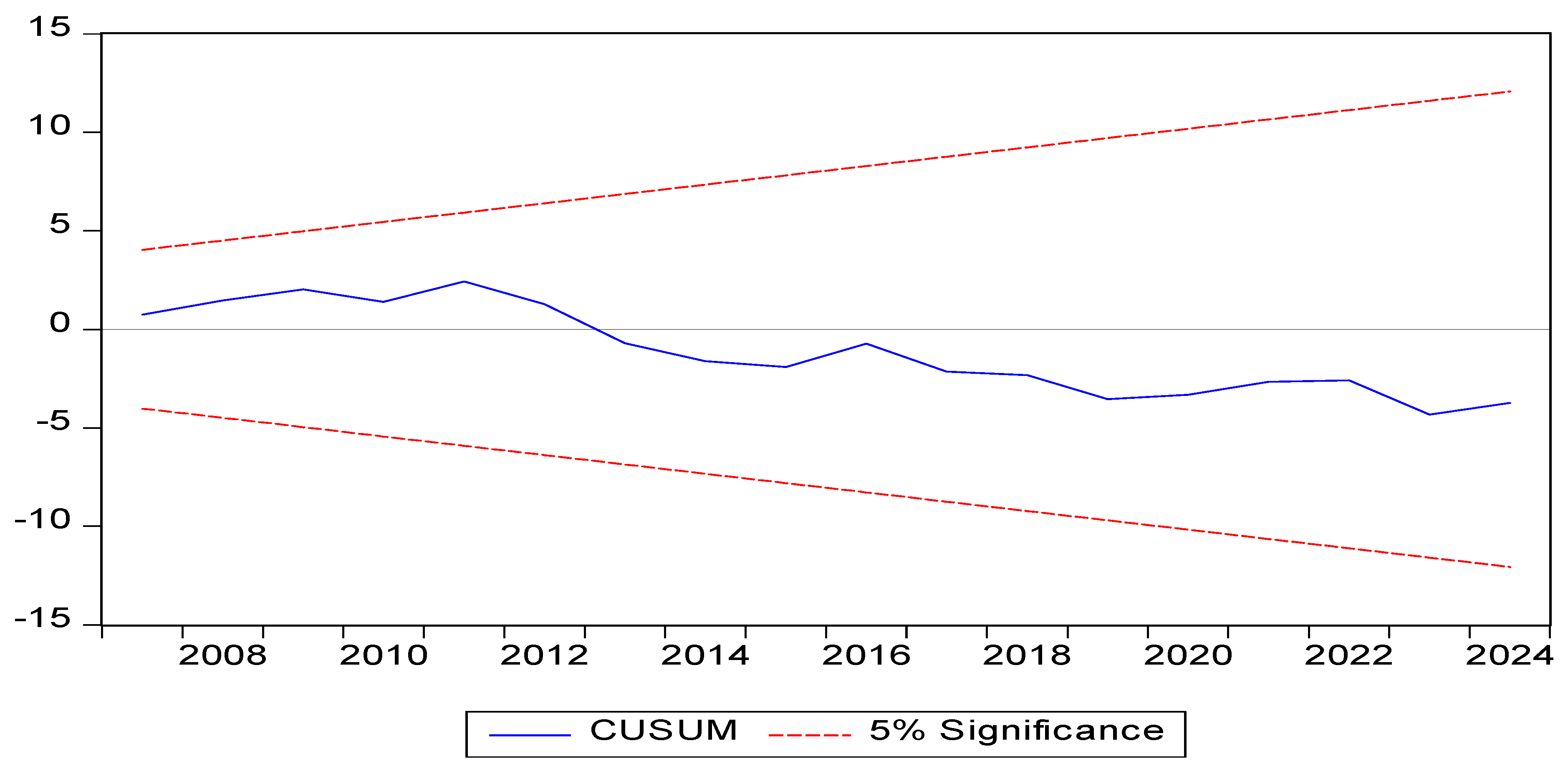
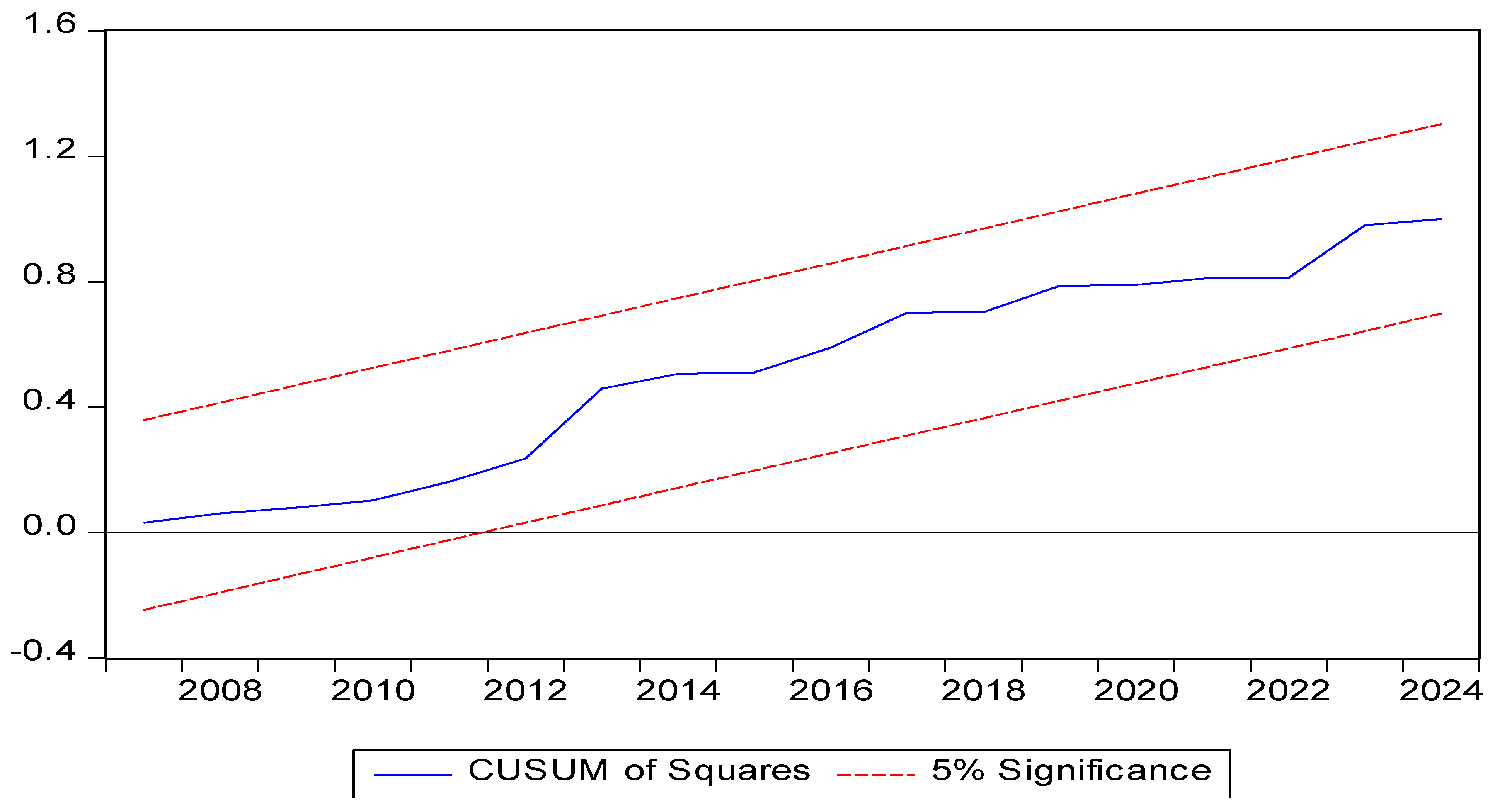
This study also explored whether the residuals of estimated models are stable or unstable using the CUSUM test and the square of CUSUM test. In
Figure 1, this study shows the outcome of the CUSUM test. Similarly,
Figure 2 displays the outcome of the square of the CUSUM test. This study found that the residuals are stable as the estimated lines in both figures are inside the critical lines.
5. Robustness Analysis
To test the robustness of the findings, this study included two dummy variables to capture the main global events that occurred during the study period. The first dummy variable was included to examine the potential impact of Vision 2030 on women’s empowerment directly. The dummy for Vision 2030 was created by assigning a value of 1 for the period 2016 and onward, and zero otherwise. The second dummy variable is the dummy variable capturing the impact of COVID-19 pandemic. The COVID-19 dummy was created by assigning a value of 1 for the period 2020–2021 and 0 otherwise. Both these dummy variables were included step by step in order to avoid the issue of reduced degree of freedom and ensure that sufficient observations are available for estimation. This study illustrates both the long- and short-run results in
Table 10.
The findings displayed that Vision 2030 has improved women’s empowerment in the long run only. This means that policy changes such as Vision 2030 take some time to bring about their desirable impacts. Therefore, policymakers need to continue the efforts and policy actions outlined in Vision 2030 to enhance the level of women’s empowerment in the KSA. Women’s empowerment is one of the key pillars of Vision 2030. However, COVID-19 appeared to be an irrelevant factor in explaining variation in women’s empowerment in the KSA; it was entered into both the long-run and short-run models and showed an insignificant but positive coefficient. The positive but insignificant impact of COVID-19 indicates that other factors may play more important roles in shaping women’s empowerment in the KSA.
Finally, it is important to highlight that the earlier reported results largely remained the same after the addition of Vision 2030 and COVID-19 into the estimated models. For instance, tourism, urbanization, female participation, and trade openness have played important positive roles in shaping women’s empowerment in the KSA in the long run. Similarly, in the short run, this study found that tourism, internet use, female participation rate, and urbanization are the main driving forces behind improved women’s empowerment in the KSA. Hence, it could be said that both the long- and short-run results regarding tourism and women’s empowerment in the presence of control variables are valid and hence could be used for policymaking. Finally, the speed of adjustment is 59 percent for the model with Vision 2030 and 55 percent for the model with COVID-19.
6. Conclusions and Implications
6.1. Conclusions
This research paper attempted to contribute to the literature by investigating the relationship between international tourism and women’s empowerment, which has not received the required attention in the existing body of knowledge. This study focused on the economy of the KSA and used annual data for the period 1995–2024 and employed the ARDL modeling approach, which simultaneously produces both long-run as well as short-run relationships.
The findings underscored that international tourism has contributed positively to women’s empowerment in the KSA both in the long run as well as in the short run, which is desirable. Hence, international tourism could be used as a tool to enhance the women’s empowerment as well as improve economic growth. Besides international tourism, this study found that increased global economic integration in the form of increased international trade openness is important for improving women’s empowerment in the KSA in the long run. In addition, this study also found evidence of the positive role of urbanization in shaping the pace of women’s empowerment. Furthermore, this study found that female labor force participation is important for reducing existing disparities and improving women’s empowerment. Moreover, the study’s results showed that trade openness matters for women’s empowerment in the long run while internet use matters for women’s empowerment in the short run only. Finally, it is found that Vision 2030 has positively impacted women’s empowerment in the long run while COVID-19 appeared to be an irrelevant factor in explaining the variations in women’s empowerment in the KSA.
6.2. Policy Implications
This study’s findings offer several suggestions for policymakers of the KSA. Firstly, it is suggested that policymakers must consider international tourism as a strategic tool for ensuring women’s empowerment and reducing gender inequalities. Therefore, attracting international tourists to the Kingdom shall be the priority of policymakers. Promoting international tourism is indeed aligned with Vision 2030 of the KSA outlined by policymakers in 2016. A developed tourism sector is expected to contribute substantively to the process of economic diversification. In this regard, the existing e-visa facilitation policy shall be made much more relaxed by extending the list of eligible countries. In addition, all sorts of administrative barriers related to visa issuance need to be relaxed to attract international tourists. In addition, gender-inclusive policies for the development of tourism shall be formulated and implemented in order to achieve the dream of women’s empowerment using the tourism sector. Moreover, policymakers of the KSA should focus on encouraging gender-responsive training and ensuring workplace protections in order to improve women’s empowerment. Increased inflow of international tourists will generate numerous job opportunities in the KSA, both for male and female populations.
Moreover, policymakers of the KSA must embrace the policy of trade liberalization wholeheartedly as it is beneficial from the perspective of women’s empowerment. Generally, liberalized trade policies produce employment opportunities; give access to advanced technologies; and increase income levels, which ultimately enhances the process of women’s empowerment. In addition, well-planned and sustainable urbanization appears to be an important factor for women’s empowerment in the KSA. Urban areas are generally conducive to women’s empowerment due to the availability of numerous opportunities. However, urbanization leads to several issues, including excessive pressure on urban infrastructure. Therefore, government authorities of the KSA need to invest significantly in sustainable urbanization. Significant investment in urban infrastructure is expected to contribute positively to women’s empowerment by providing employment opportunities, and access to improved education and health facilities for the female segment of the population.
Finally, this study underscored that the participation of women in the labor market is integral to women’s empowerment, as displayed by the results. Therefore, the authorities of the KSA need to improve the skills of the female population and generate employment opportunities by ensuring equal opportunities both for females as well as males. Lastly, it is advisable to ensure the availability of digital services, including internet facilities for all segments of society, as it contributes positively to women’s empowerment. Increased access to the internet and other digital facilities is considered important in the modernized world. Policy changes in light of the implications based on robust results are expected to add positively to women’s empowerment, which is socially desirable and economically essential for the KSA.
6.3. Limitations and Future Research Agenda
The unavoidable shortcomings of this study are as follows. Firstly, this study used only limited time series data as data on key variables such as tourism is not available prior to 1995. Hence, this study used only a few control variables in the estimation process. However, women’s empowerment is a multifaceted process, and hence, it could respond to several factors other than those included in the study’s model. Therefore, future research studies must consider replacing the current control variables with alternative control variables such as financial development and government expenditures to see the responsiveness of women’s empowerment. Secondly, the gender development index may not be a perfect measure of women’s empowerments. However, due to the unavailability of other proxies of women’s empowerment on the economy of the KSA, the present study has used the gender development index as a reflection of women’s empowerment. In addition, this study used the total number of arrivals for the measurement of tourism, which also includes religious pilgrims, leisure visitors, business travelers, or all categories, since Saudi Arabia’s tourism structure is distinctive. Therefore, future studies must use separate categories of tourism and test their impact on women’s empowerment. Thirdly, the present research endeavor only assumed a linear relationship between international tourism and women’s empowerment. However, there is a significant possibility of a non-linear relationship between international tourism and women’s empowerment. Therefore, the present study recommends that future studies must look into the non-linear relationship while linking international tourism to women’s empowerment. Fourthly, the indicator used for internet use includes females and males, and the distribution between male and female use is not known. Therefore, future research studies must focus on female internet use. Lastly, the present study has focused on the KSA, and hence, the results have indeed very limited generalization. The economy of the KSA is a unique economy in terms of economic, social, religion, cultural, and political structure. Consequently, this study suggests that future research endeavors must test the study’s model in other contexts by using data of other economies and regions including GCC, ASEAN, and BRICS. We leave these research agendas for future researchers.