4.1. Baseline Full-Sample Evidence
The full-sample Bayesian PVAR estimations provide evidence of heterogeneous monetary policy transmission across euro area country groups, although the degree of statistical uncertainty varies considerably across responses.
Table 2 reports the peak posterior median responses together with the associated 68% and 90% credible intervals. The results indicate that the magnitude and persistence of monetary policy transmission differ across Core, Periphery, and CEE economies, supporting the presence of structural heterogeneity within the monetary union. However, the posterior distributions also reveal substantial uncertainty surrounding several estimated responses. In most cases, the 90% credible intervals include zero, suggesting that the estimated effects should be interpreted as indicative transmission patterns rather than precise point estimates. The strongest statistical evidence emerges for GDP responses in the Core economies, where the 90% credible interval excludes zero at the peak response horizon. Overall, the results suggest that monetary policy transmission is not homogeneous across euro area economies, but the strength of the evidence varies across country groups and macroeconomic variables.
The full-sample results reveal meaningful differences in the transmission of monetary policy shocks across the three country groups. However, the posterior distributions indicate that the degree of statistical uncertainty varies considerably across responses, suggesting that cross-group comparisons should be interpreted with appropriate caution.
For the Core economies, the estimated GDP response exhibits the strongest statistical support among the examined variables. The peak posterior median response is positive and the associated 90% credible interval excludes zero, indicating relatively robust evidence that an expansionary monetary policy surprise raises output in the Core economies, consistent with the conventional transmission of accommodative monetary policy. By contrast, employment responses remain comparatively small and are characterised by wider credible intervals that include zero. Accordingly, the negative point estimate obtained for employment in some groups should not be interpreted as evidence of a contractionary labour-market effect, since these responses are not statistically distinguishable from zero at conventional credibility levels; the apparent divergence in sign between the output and employment responses therefore reflects estimation uncertainty rather than a genuine contradiction in the direction of transmission.
The Periphery economies display larger posterior median responses than the Core group in several horizons, particularly for employment dynamics. Nevertheless, the associated credible intervals remain relatively wide and generally include zero, implying that the estimated responses should be interpreted primarily as indicative transmission patterns rather than statistically precise effects. This result is broadly consistent with the view that peripheral economies remain more exposed to financial and macroeconomic vulnerabilities, although the strength of the evidence varies across variables and horizons.
The CEE economies exhibit a distinct adjustment pattern characterised by moderate output responses and relatively persistent labour-market dynamics. Similar to the Periphery group, however, the posterior uncertainty surrounding many responses remains substantial. Consequently, while the estimated median responses suggest differences in transmission mechanisms relative to the Core economies, the credible intervals indicate that these differences should be interpreted cautiously.
Overall, the full-sample evidence supports the presence of heterogeneous monetary policy transmission across euro area economies. At the same time, the credible intervals highlight that the degree of statistical certainty differs considerably across variables and country groups. This finding reinforces the importance of evaluating monetary policy transmission within a probabilistic framework rather than relying exclusively on point estimates.
The impulse response functions provide additional insight into the dynamic adjustment patterns underlying the full-sample results. While the peak posterior median responses reported in
Table 2 summarise the maximum estimated effects, the impulse response functions illustrate the timing, persistence, and evolution of these responses across horizons.
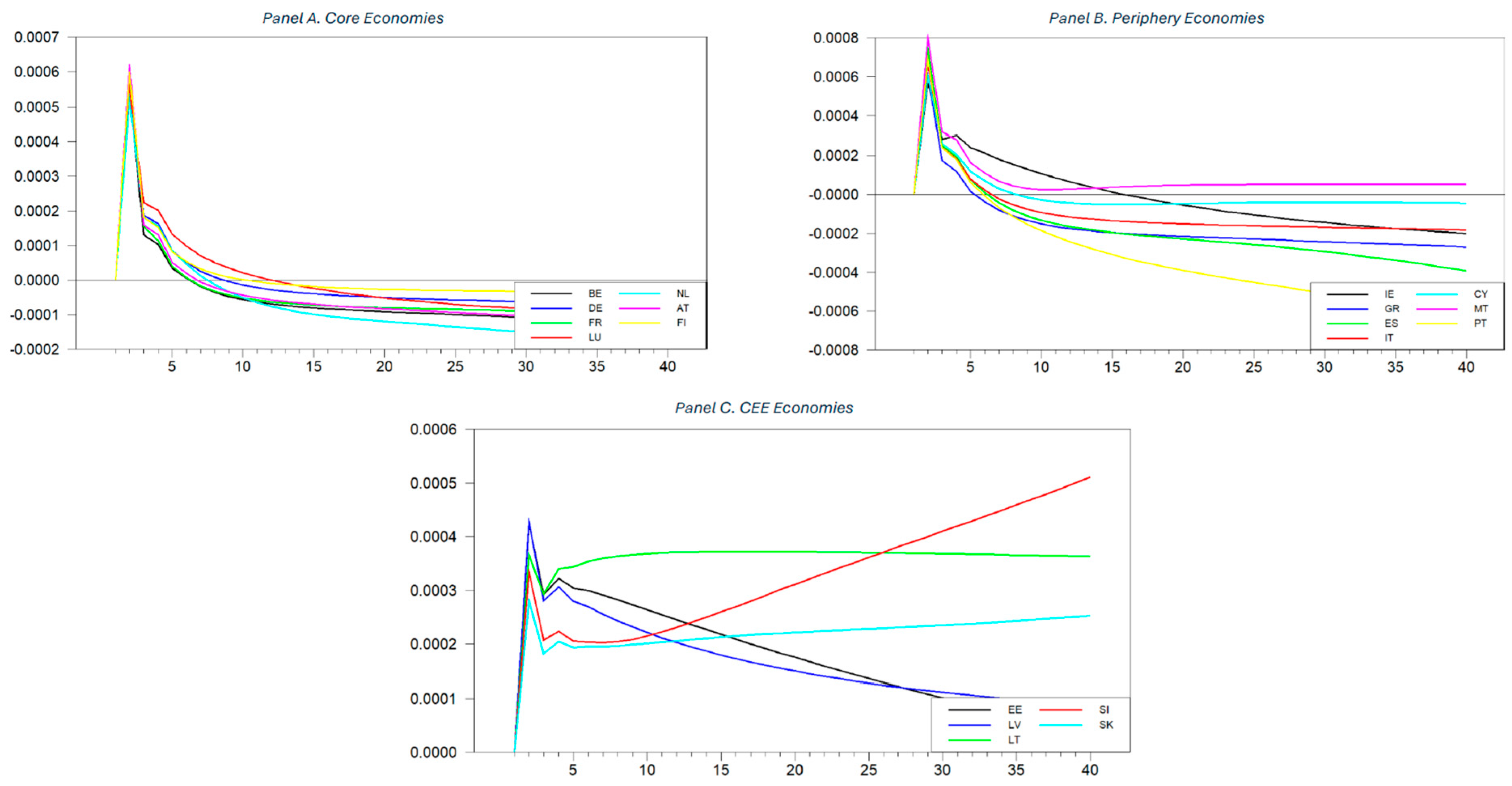
Figure 1 and
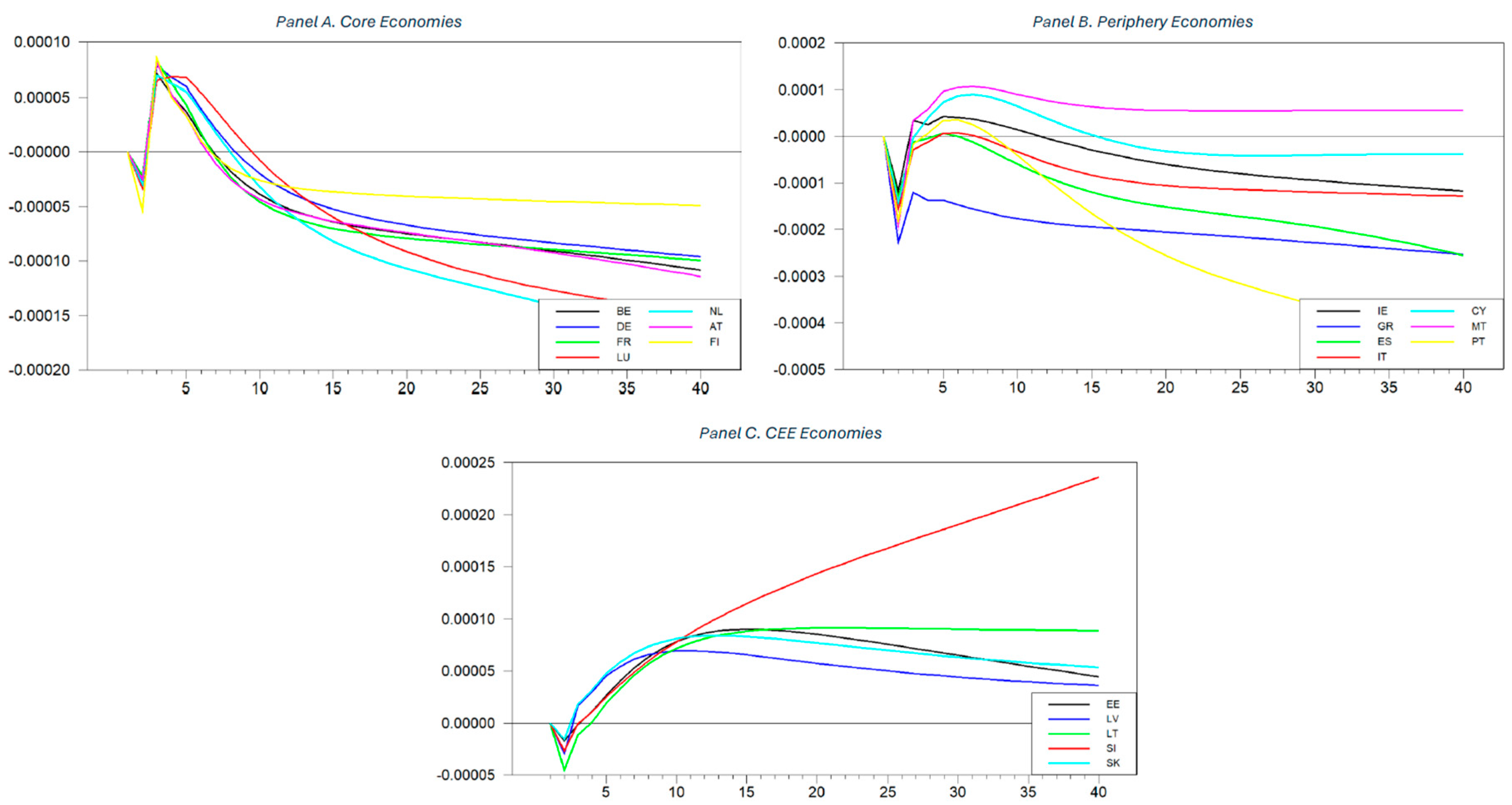
Figure 2 present the posterior median responses of GDP and employment to identified monetary policy shocks for the Core, Periphery, and CEE country groups. Particular attention is given to output and labour-market dynamics because these variables represent the primary channels through which monetary policy affects real economic activity and because they provide the clearest basis for evaluating transmission asymmetries across country groups.
The figures indicate that the overall transmission mechanism differs not only in magnitude but also in persistence and adjustment speed across groups. Core economies generally exhibit smoother adjustment paths, whereas the responses observed in the Periphery and CEE groups display greater variability over time. However, as highlighted by the posterior credible intervals reported in
Table 2, substantial uncertainty surrounds several estimated responses. Consequently, the impulse response functions should be interpreted as probabilistic estimates of transmission dynamics rather than deterministic measures of economic effects. The graphical evidence complements the peak-response analysis by illustrating how monetary policy shocks propagate through different macroeconomic environments within the euro area and by highlighting the role of structural heterogeneity in shaping adjustment dynamics.
As the variables enter the system in log-levels, the estimated dynamics are highly persistent, consistent with the near-nonstationarity noted in
Section 3. To assess this formally, the largest modulus of the companion-matrix eigenvalues was computed across the posterior draws for each group. The posterior median of the largest modulus is 0.987 for the Periphery, 1.012 for the CEE, and 1.013 for the Core group, with 90% credible intervals of [0.933, 1.040], [0.942, 1.085], and [0.928, 1.079], respectively. In every case the credible interval straddles unity, and posterior mass lies on both sides of one (the share of draws with a modulus above unity is 0.35, 0.60, and 0.62 for the Periphery, CEE, and Core groups). The data are therefore consistent with a largest root at or near unity—as is typical for macroeconomic variables in levels—rather than with genuine explosiveness; the point estimates close to one should be read as evidence of a near-unit-root, not of an unstable system. This high persistence, inherent to the level specification, is what causes the impulse responses to decay only gradually over the reported horizon, directly addressing the observation that some responses do not appear to revert to zero within the window displayed. Because the largest root lies so close to unity, the analysis concentrates on the transmission of shocks over business-cycle horizons, where the responses are well-defined and economically interpretable, and relies on the Minnesota shrinkage prior to stabilise estimation given the short sample.
Turning to prices, the peak responses of the Harmonised Index of Consumer Prices are reported in
Table 2. For the Core and CEE groups, the inflation responses are not statistically distinguishable from zero at the 90% level and are therefore not interpreted as evidence of a systematic price response. For the Periphery group, by contrast, the peak inflation response is negative and its 90% credible interval excludes zero, indicating a statistically meaningful decline in prices. Under the sign convention adopted here, this implies that an expansionary monetary policy surprise is associated with lower prices in the Periphery—a sign reversal that mirrors the output and employment responses discussed above. Taken together, the joint decline in output, employment and prices in the Periphery is consistent with the central bank information effects emphasised earlier (
Jarociński & Karadi, 2020;
Jarociński, 2022): an apparently accommodative surprise that partly conveys adverse information about the economic outlook would be expected to depress real activity and prices simultaneously, rather than to raise them as conventional transmission would predict.
These findings can be related to the existing evidence on heterogeneous monetary transmission in the euro area. The stronger and more precisely estimated output response in the Core economies, contrasted with the more volatile and less precisely estimated responses in the Periphery, is broadly consistent with
Barigozzi et al. (
2014), who document persistent North–South differences in the responses of euro area economies, and with
Georgiadis (
2015), who attributes such asymmetries to structural differences across countries. The heightened sensitivity of the Periphery during the sovereign debt crisis accords with
Ciccarelli et al. (
2013), who show that transmission intensifies with financial fragility and sovereign stress. At the same time, the sign reversal observed for the Periphery during 2010–2014 is consistent with the central bank information effects emphasised by
Jarociński and Karadi (
2020) and
Jarociński (
2022), whereby high-frequency policy surprises during periods of acute stress partly reflect the information content of central bank communication rather than pure policy shocks. Overall, the direction and cross-country pattern of the estimated responses are in line with the broader literature, while the regime-specific dimension of the analysis contributes new evidence on how these asymmetries evolve across distinct monetary environments.
4.2. Robustness Across Monetary Policy Regimes
The full-sample estimations provide important baseline evidence regarding the asymmetric transmission of monetary policy shocks across euro area economies. Nevertheless, the extended sample period encompasses multiple episodes characterised by substantially different monetary and macroeconomic environments, including the post-sovereign-debt adjustment phase, the unconventional monetary policy period associated with the ECB’s asset purchase programmes, and the subsequent pandemic and monetary tightening episode. As a result, the full-sample responses may conceal regime-specific transmission dynamics. To address this issue, the baseline PVAR model is re-estimated across three sub-periods corresponding to distinct monetary policy regimes.
It should be emphasised that each regime covers a relatively short sample (twenty quarters), which limits the precision with which the regime-specific responses can be estimated. The results in this section should therefore be interpreted as indicative of how transmission evolves across monetary environments rather than as precise estimates; the credible intervals reported in
Table 3 and
Table 4, which include zero for most regimes, convey this uncertainty directly.
To further examine the heterogeneity of monetary policy transmission across euro area economies,
Table 3 and
Table 4 report the impulse response dynamics of GDP and employment following a monetary policy shock across the three monetary policy regimes. The analysis is conducted separately for Core, Periphery, and CEE economies in order to capture differences in the magnitude, persistence, and adjustment patterns of macroeconomic responses under changing monetary and financial conditions. By separating the sample into distinct monetary policy regimes, the empirical analysis allows for a more detailed evaluation of how transmission mechanisms evolved across periods characterised by financial fragmentation, unconventional monetary accommodation, and post-pandemic monetary tightening.
The discussion focuses primarily on GDP and employment responses because these variables provide the clearest representation of real economic adjustment following monetary policy shocks and constitute the main channels through which transmission asymmetries emerge across euro area economies. While the remaining macroeconomic variables are also incorporated into the empirical framework and discussed throughout the analysis, GDP and labour-market dynamics offer the most direct evidence regarding the effectiveness, persistence, and cross-country heterogeneity of ECB monetary policy transmission.
4.2.1. Post-Crisis Adjustment Period (2010Q1–2014Q4)
The first sub-period corresponds to the aftermath of the euro area sovereign debt crisis, when several member states were still exposed to elevated financial stress, fiscal consolidation pressures, banking-sector fragilities, and fragmented credit conditions. The regime-specific Bayesian PVAR estimates indicate that monetary policy transmission during this period was most pronounced in the Periphery economies.
The strongest evidence concerns the Periphery group. The posterior median GDP response reaches −0.000541 at the peak horizon, with a 90% credible interval of [−0.000855, −0.000242]. Employment displays an even larger response of the same sign, with a peak posterior median of −0.000794 and a 90% credible interval of [−0.001180, −0.000396]. In both cases the 90% credible intervals exclude zero, indicating a statistically meaningful response during the post-crisis adjustment period. Under the sign convention adopted here, these negative responses imply that an expansionary monetary policy surprise is associated with lower output and employment in the Periphery economies during this regime—a reversal of the sign observed in the Core.
This result suggests that monetary policy surprises were transmitted more forcefully to peripheral economies during the sovereign debt crisis aftermath, and that their effects differed qualitatively from those observed in the Core. The sign reversal is consistent with the presence of central bank information effects during this period (
Jarociński & Karadi, 2020;
Jarociński, 2022): in an environment marked by financial fragmentation, elevated sovereign-risk premia, and fragile banking systems, accommodative ECB surprises are likely to have coincided with, and partly revealed, adverse information about the economic outlook of the periphery, so that expansionary surprises were associated with weaker output and labour-market conditions rather than with the expansionary effects predicted by conventional transmission. This interpretation accords with the view that high-frequency policy surprises during periods of acute stress are partly contaminated by the information content of central bank communication.
By contrast, the Core economies exhibit comparatively milder and statistically less precise responses. Although the posterior median responses suggest some adjustment following monetary policy shocks, the corresponding credible intervals include zero, indicating weaker evidence of systematic effect. This pattern is consistent with the greater financial depth, stronger institutional capacity, and higher macroeconomic resilience of core euro area economies. The CEE economies also display negative median responses during this period, particularly for employment, but the associated credible intervals generally include zero. Therefore, while the median estimates point to some sensitivity to monetary shocks, the statistical evidence is less robust than in the Periphery group.
Overall, the 2010–2014 results provide the clearest evidence of asymmetric monetary policy transmission in the regime analysis. The statistically robust responses are concentrated in the Periphery economies, where both GDP and employment responses are distinguishable from zero and are of the opposite sign to those estimated for the Core. This finding supports the interpretation that the sovereign debt crisis amplified cross-country asymmetries in euro area monetary transmission, including a reversal in the direction of the estimated response that is consistent with central bank information effects.
4.2.2. Unconventional Monetary Policy Period (2015Q1–2019Q4)
The second sub-period corresponds to the era of unconventional monetary policy, during which the ECB implemented large-scale asset purchase programmes and maintained highly accommodative monetary conditions. This period was characterised by declining sovereign spreads, improved financial conditions, enhanced liquidity provision, and a gradual recovery from the disruptions associated with the sovereign debt crisis. The regime-specific Bayesian PVAR estimates indicate that monetary policy transmission became more supportive of macroeconomic activity relative to the previous period, although the associated uncertainty remains substantial.
Across all three country groups, the posterior median responses generally shift towards more favourable output and employment dynamics compared with the post-crisis adjustment regime. In the Core economies, both GDP and employment responses become positive over several horizons, suggesting that accommodative monetary conditions were associated with improved macroeconomic performance. However, the corresponding credible intervals continue to include zero, indicating that the statistical evidence remains less definitive than the point estimates alone might suggest.
A similar pattern emerges in the Periphery economies. Relative to the negative responses observed during 2010–2014, the posterior median estimates indicate a substantial moderation of adverse effects and, in some cases, a transition towards mildly positive responses. This finding is consistent with the view that unconventional monetary policy may have contributed to easing financial constraints, reducing fragmentation pressures, and improving financing conditions in economies that had been disproportionately affected by the sovereign debt crisis. Nevertheless, the associated credible intervals remain relatively wide, implying that the estimated effects should be interpreted with caution.
The CEE economies also exhibit more favourable median responses during this period, particularly with respect to labour-market dynamics. These results are broadly consistent with stronger financial integration, increased capital inflows, and continued economic convergence within the euro area framework. At the same time, the posterior uncertainty surrounding the estimated responses remains non-negligible, limiting the strength of statistical inference.
Taken together, the 2015–2019 regime is consistent with a more supportive transmission environment than the post-crisis period. The posterior median responses suggest that unconventional monetary policy is consistent with improved macroeconomic conditions across all country groups. However, the credible intervals indicate that the magnitude of these effects remains subject to considerable uncertainty, highlighting the importance of interpreting the results within a probabilistic rather than deterministic framework.
4.2.3. Pandemic and Monetary Tightening Period (2020Q1–2024Q4)
The final sub-period encompasses one of the most complex macroeconomic environments in the history of the euro area. The period includes the COVID-19 pandemic, the subsequent recovery phase, the energy and supply-chain disruptions associated with the post-pandemic inflation surge, and the ECB’s return to monetary tightening. Consequently, monetary policy transmission operated within an environment characterised by exceptional uncertainty, extensive fiscal intervention, and multiple overlapping shocks.
The regime-specific Bayesian estimates indicate that the posterior median responses generally become more positive than those observed during earlier periods, particularly for GDP. However, the associated credible intervals remain relatively wide across all country groups, suggesting that monetary policy effects are more difficult to identify precisely during this regime. This result is consistent with the unprecedented macroeconomic conditions that characterised the period and the interaction of monetary policy with large-scale fiscal support measures and extraordinary policy interventions.
For the Core economies, the posterior median responses remain positive, indicating continued adjustment following monetary policy shocks. Nevertheless, the credible intervals include zero, implying that the statistical evidence remains weaker than the corresponding point estimates might suggest. Compared with the unconventional monetary policy period, the transmission mechanism appears less predictable and more sensitive to changing macroeconomic conditions.
The Periphery economies exhibit a notable shift relative to the post-crisis regime. While the posterior median responses no longer display the pronounced negative responses observed during 2010–2014, the associated uncertainty remains substantial. This finding suggests that the combination of fiscal support measures, post-pandemic recovery dynamics, and inflationary pressures altered the transmission mechanism, reducing the persistence of adverse responses while increasing overall volatility.
The CEE economies continue to display a distinct adjustment pattern characterised by relatively strong median GDP responses and comparatively rapid adjustment dynamics. However, as in the other groups, the corresponding credible intervals indicate considerable uncertainty. The results therefore suggest that although transmission patterns differ across country groups, the exceptional macroeconomic environment of the period complicates precise identification of monetary policy effects.
Overall, the 2020–2024 regime highlights the importance of macroeconomic context in shaping monetary policy transmission. While the posterior median responses suggest that transmission mechanisms remained active throughout the pandemic and post-pandemic period, the wider credible intervals indicate that uncertainty surrounding the estimated effects increased substantially relative to earlier regimes. These findings reinforce the view that euro area monetary transmission is both regime-dependent and sensitive to large-scale economic disruptions.
Overall, the regime-specific analysis confirms that monetary policy transmission within the euro area is neither homogeneous nor stable over time. The estimated responses vary across country groups and monetary policy environments, indicating that the effectiveness and persistence of monetary policy shocks depend critically on the broader macroeconomic context.
The strongest evidence emerges during the post-sovereign-debt crisis period, when the Periphery economies exhibit statistically meaningful responses in both GDP and employment that are of the opposite sign to those in the Core, consistent with central bank information effects. By contrast, the unconventional monetary policy period is characterised by more supportive posterior median responses across all country groups, although the associated credible intervals indicate substantial uncertainty regarding the precise magnitude of these effects. During the pandemic and monetary tightening regime, transmission patterns become more difficult to identify, reflecting the interaction of monetary policy with extraordinary fiscal interventions, elevated uncertainty, and multiple overlapping macroeconomic shocks.
Taken together, the findings support the view that euro area monetary transmission is both structurally asymmetric and regime dependent. While the posterior median responses reveal meaningful differences across Core, Periphery, and CEE economies, the credible intervals highlight the importance of accounting for estimation uncertainty when evaluating the strength and persistence of monetary policy effects.
Table 5 summarises these regime-specific findings and their main economic interpretation across the three country groups.
4.3. Comparative Interpretation Across Country Groups
The combined evidence from the full-sample estimations and the regime-specific analysis highlights the presence of substantial heterogeneity in monetary policy transmission across euro area economies. Although all countries operate under a common monetary policy framework, the estimated responses indicate that transmission dynamics differ considerably across Core, Periphery, and Central and Eastern European (CEE) economies.
The Core economies generally exhibit the most stable adjustment patterns throughout the sample. Both the full-sample and regime-specific estimations suggest comparatively smoother output and employment responses, consistent with stronger institutional capacity, deeper financial markets, and more resilient macroeconomic structures. Although the posterior median responses indicate meaningful reactions to monetary policy shocks, the associated credible intervals often reveal substantial uncertainty, implying that transmission effects are relatively moderate and less volatile than in the other country groups.
The Periphery economies display the clearest evidence of asymmetric transmission. This pattern is particularly pronounced during the post-sovereign-debt adjustment period, when both GDP and employment responses are statistically distinguishable from zero at the 90% credibility level. The results suggest that financial fragmentation, sovereign-risk pressures, and weaker financing conditions amplified the effects of monetary policy shocks in these economies. While the subsequent regimes indicate a moderation of these effects, the Periphery group continues to exhibit greater sensitivity and variability than the Core economies.
The CEE economies follow a distinct adjustment path that differs from both the Core and Periphery groups. The posterior median responses suggest comparatively flexible adjustment dynamics, particularly during the later regimes, although the associated uncertainty remains substantial. These findings are broadly consistent with the transitional characteristics of converging economies, where ongoing structural adjustment and financial integration may influence the transmission mechanism differently from the more mature economies of the euro area.
Taken together, the comparative evidence indicates that monetary policy transmission within the euro area remains both structurally asymmetric and regime dependent. The results suggest that differences in institutional quality, financial development, and macroeconomic resilience continue to shape the effectiveness of common monetary policy across member states. Consequently, a uniform monetary policy may generate heterogeneous economic outcomes even within a highly integrated monetary union.
4.4. Granger-Causality Analysis
As a complementary, reduced-form check on the direction of the estimated relationships, panel Granger-causality tests were conducted for each group, based on a VAR(1) with country fixed effects. The results are reported in
Table 6.
Two features are worth emphasising. First, the five macroeconomic variables do not jointly Granger-cause the monetary policy surprise in any group (p-values of 0.19, 0.19, and 0.16 for the Core, Periphery, and CEE groups), supporting the treatment of the high-frequency surprise as predetermined with respect to the domestic macroeconomic state. Second, in the forward direction the estimated coefficients share the sign of the corresponding impulse responses—positive for output, negative for prices in the Periphery, and positive for investment in the CEE group—so that the two approaches agree on the qualitative pattern of transmission.
The Granger tests nonetheless indicate limited individual statistical significance, with the investment channel in the CEE group the clearest exception. This apparent contrast with the baseline results reflects the different nature of the two exercises rather than a genuine inconsistency. Because the monetary policy surprise is common to all countries within a group, the effective number of independent observations identifying its effect is governed by the time dimension (sixty quarters) rather than by the full panel, and the standard errors are clustered by time period accordingly; the Granger test, moreover, assesses a single reduced-form lag coefficient in isolation. The Bayesian panel VAR, by contrast, pools information across countries through the hierarchical shrinkage prior and traces the full dynamic response of the system, yielding more precise inference in a short sample. The two sets of results are therefore best read as mutually reinforcing: the impulse responses provide the primary, system-based evidence on transmission, while the Granger tests confirm the direction of the relationships and the exogeneity of the identified surprise.
4.5. Policy Implications and Limitations
The empirical findings of this study carry important implications for the conduct and effectiveness of monetary policy within the euro area. The estimated responses demonstrate that monetary policy transmission remains heterogeneous across country groups and varies across alternative monetary policy regimes. Consequently, the effects of ECB policy interventions cannot be assumed to be uniform across member states, despite the existence of a common monetary authority and a unified monetary framework.
A central implication of the analysis concerns the challenges associated with implementing a common monetary policy within structurally heterogeneous economies. The results indicate that monetary policy transmission differs across Core, Periphery, and CEE economies, reflecting differences in financial structures, institutional characteristics, and macroeconomic conditions. While the posterior median responses suggest stronger transmission patterns in some country groups and periods, the associated credible intervals indicate that the magnitude of these differences should be interpreted with appropriate caution.
The findings further suggest that the effectiveness of ECB interventions depends critically on the broader macroeconomic environment. The regime-specific analysis indicates that transmission dynamics vary substantially across periods characterised by financial fragmentation, unconventional monetary accommodation, and post-pandemic monetary tightening. In particular, the strongest statistically supported responses are observed during the post-sovereign-debt adjustment period, whereas later regimes are characterised by greater estimation uncertainty despite economically meaningful posterior median responses.
An additional implication concerns the importance of financial integration and institutional resilience within the euro area. The stronger responses observed in some country groups during periods of financial stress suggest that fragmentation mechanisms may continue to influence the transmission process under adverse macroeconomic conditions. Consequently, monetary policy alone may be insufficient to ensure homogeneous adjustment across member states. Complementary institutional arrangements, financial integration mechanisms, and national policy frameworks may therefore play an important role in supporting the effectiveness of ECB interventions.
The regime-specific results also speak directly to the interaction between monetary and fiscal policy. The pronounced widening of the credible intervals during the pandemic and tightening regime—the period in which monetary policy operated alongside large-scale fiscal interventions—indicates that the transmission of monetary policy shocks becomes substantially more difficult to isolate when monetary and fiscal measures act simultaneously. To the extent that this reflects the overlapping of policy instruments rather than a genuine absence of transmission, the finding implies that assessments of monetary policy effectiveness during such episodes should explicitly account for the concurrent fiscal stance, rather than treating monetary policy in isolation.
Overall, the evidence suggests that euro area monetary transmission remains conditional on structural heterogeneity, financial conditions, and regime-specific dynamics. As a result, future ECB policy design may benefit from greater consideration of cross-country asymmetries and macroeconomic context when evaluating the likely effectiveness of common monetary policy interventions.